
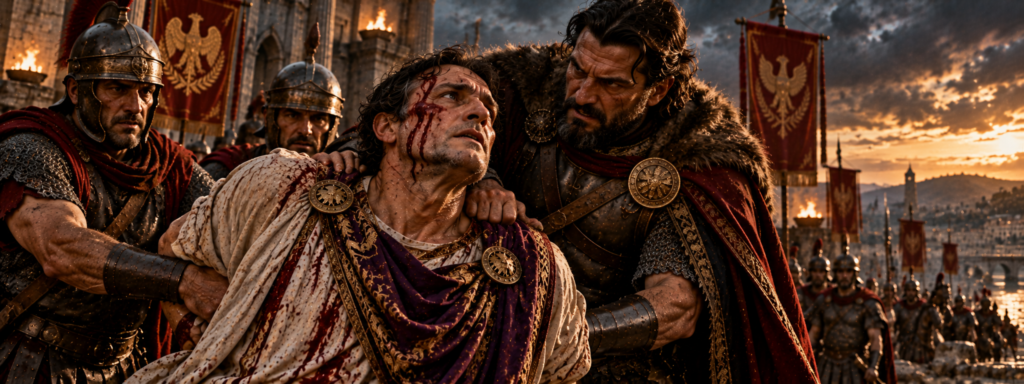
Majorian: Rome’s Last Great Emperor Betrayed, Tortured, and Executed by His Own General
The Emperor Who Tried to Save the Western Roman Empire, the Treachery of Ricimer, and the Bloody Execution That Destroyed Rome’s Last Great Hope
Flavius Julius Valerius Majorianus, better known as Majorian (c. 420–7 August 461 CE), was Western Roman emperor from 457 to 461 and one of the last rulers to make a serious attempt to restore the empire’s collapsing military and political authority. A talented soldier and determined reformer, he fought to recover Roman territory in Gaul and Hispania, challenged the growing independence of powerful regional rulers, and prepared an ambitious naval expedition against the Vandal kingdom in North Africa. His achievements made him an unusually energetic emperor during an age when western rulers were increasingly overshadowed by their generals. Yet his greatest danger came not from the Vandals, Visigoths, or Burgundians, but from Ricimer, the powerful military commander whose support had helped place him on the throne. In August 461, after the failure of Majorian’s African expedition, Ricimer seized him near Dertona, modern Tortona in northern Italy, stripped him of imperial authority, and had him executed on 7 August. The near-contemporary chronicler Hydatius describes Majorian’s death as occurring through Ricimer’s treachery, while later accounts provide the particularly grim details of his mistreatment and beheading. His death became one of the most consequential political murders of the fifth century, eliminating an emperor who had demonstrated that the Western Roman Empire was not yet beyond every possibility of recovery.
The Emperor Who Was Destroyed by the Man Who Helped Crown Him
The road through northern Italy should have been a passage home. Majorian had spent years fighting to restore the authority of a Western Roman Empire that many of his contemporaries had begun to regard as irreparably broken. He had marched into rebellious provinces, confronted enemies who had grown accustomed to Roman weakness, reorganized his government, and prepared an invasion that might have transformed the balance of power in the Mediterranean. Now, returning from the disastrous failure of that expedition, he was about to discover that his greatest enemy had been waiting inside his own government.
The emperor was no stranger to military danger. He had risen through the ranks during some of the most violent decades in Roman history, served under the celebrated general Aetius, and established a reputation for courage and competence long before receiving the imperial purple. His campaigns had demonstrated a willingness to lead soldiers personally rather than remain safely behind palace walls. Unlike some of the emperors who had preceded him, Majorian had attempted to exercise real authority over the empire he supposedly ruled.
Yet battlefield courage offered little protection against political betrayal. Ricimer, the powerful magister militum whose military influence had helped Majorian gain the throne, had become increasingly uncomfortable with the emperor’s independence. Majorian was not content to serve as a ceremonial ruler while another man controlled the armies and dictated policy. He intended to govern, and in the dangerous political world of the fifth century, that ambition threatened the very commander who had once supported him.
The failure of the expedition against the Vandals provided Ricimer with an opportunity. Majorian had assembled a substantial fleet in Hispania for an attack upon the Vandal kingdom in North Africa, hoping to recover the wealthy province whose loss had devastated western imperial finances. Before the invasion could begin, the fleet was destroyed or captured through a Vandal operation whose precise circumstances remain disputed. The setback forced Majorian to abandon the campaign and negotiate with Geiseric, the Vandal king.
The defeat was serious, but it was not necessarily fatal to Majorian’s reign. He remained a capable commander who had achieved meaningful successes in Gaul and Hispania, and the Western Empire still possessed territories and military resources that might have supported further recovery. What he could not easily survive was the withdrawal of loyalty by the most powerful general in Italy. Ricimer controlled forces close enough to threaten the emperor directly, and the failure of the African expedition weakened Majorian’s political position at the worst possible moment.
In early August 461, Ricimer moved against him. Majorian was seized near Dertona, a town in northern Italy, and stripped of his imperial status. Later historical accounts describe several days of degrading treatment before his execution, although the precise details of his captivity are not equally well supported by contemporary evidence. On 7 August, the emperor was killed, with the later tradition identifying beheading as the method.
The man who had tried to restore Roman power was dead at approximately forty years of age. He had not fallen defending the frontiers, nor had he been captured by the foreign king whose kingdom he had intended to invade. He was destroyed by a commander within his own military establishment, a man who had once helped him rise to power. The execution demonstrated that even an energetic emperor could be eliminated when his ambitions conflicted with those of the general who controlled the soldiers.
Majorian’s death would eventually acquire a significance far greater than the end of a single reign. Later generations would remember him as one of the last Western emperors who genuinely attempted to reverse the empire’s decline rather than merely survive it. His accomplishments were incomplete, his policies were sometimes harsh, and his grandest military project ended in failure. Nevertheless, his murder removed a ruler whose ability and determination had briefly made imperial recovery seem possible.
An Empire That Was Falling Apart
To understand Majorian’s rise, it is necessary to understand the extraordinary weakness of the Western Roman Empire during the middle of the fifth century. The empire had once controlled territories stretching from Britain to North Africa, but decades of warfare, political instability, and the growing independence of powerful regional kingdoms had transformed its position. Britain had effectively passed beyond imperial control, much of Gaul was contested, and Spain had become a battleground among Roman authorities and various Germanic groups. The western government retained the symbols of ancient supremacy, but its practical ability to enforce its commands had diminished.
The loss of North Africa was particularly devastating. The Vandals, led by Geiseric, had crossed into Africa in 429 and captured Carthage in 439, establishing control over a region that had supplied immense agricultural wealth and tax revenue to the western government. Without those resources, maintaining armies and supporting imperial administration became increasingly difficult. The Vandal kingdom also possessed naval power, allowing it to threaten Roman interests throughout the western Mediterranean.
The military structure of the Western Empire had changed as well. Roman armies increasingly relied upon commanders who maintained personal relationships with soldiers and allied peoples. These generals could become indispensable to the government, but their influence also threatened the authority of emperors who lacked independent military support. The distinction between serving the emperor and controlling him had become dangerously blurred.
Flavius Aetius had been the dominant western commander for much of Majorian’s early career. He helped preserve Roman authority in parts of Gaul, negotiated with powerful foreign groups, and played a central role in resisting Attila the Hun. His influence was so extensive that Emperor Valentinian III eventually regarded him as a threat. In September 454, Valentinian personally participated in Aetius’s assassination.
The murder was a disastrous political decision. Aetius had maintained a complicated network of military and diplomatic relationships that could not simply be transferred to another official. His death weakened the government and angered soldiers who had served under him. Six months later, Valentinian himself was assassinated by men associated with the murdered general.
The subsequent reign of Petronius Maximus lasted approximately seventy-five days. He seized the throne after Valentinian’s murder, married the widowed empress Licinia Eudoxia, and attempted to establish a new dynasty through the imperial family. His decisions complicated relations with Geiseric, and when the Vandal fleet approached Italy, his government collapsed. Maximus was killed in Rome while attempting to escape the approaching invasion.
In June 455, the Vandals entered Rome and carried away enormous quantities of wealth and important captives, including members of the imperial household. The sack demonstrated the vulnerability of the historic capital and further damaged confidence in western leadership. Although the city survived, the imperial government emerged from the catastrophe deeply weakened. The Western Empire had lost not only resources and territory but also much of the political stability necessary for recovery.
Majorian’s eventual accession occurred against this background of assassination, invasion, and governmental breakdown. The empire did not need another ruler content to wear the purple while generals and foreign kings determined its future. It needed someone capable of restoring military authority, rebuilding administrative institutions, and recovering lost revenue. Majorian would attempt all three, and the ambition of that program would make him both remarkable and dangerous.
The Young Soldier Who Caught Aetius’s Attention
Majorian was probably born around 420 into a family connected with the Roman military establishment. His grandfather had served in a senior military or administrative capacity under Theodosius I, while his father was associated with the financial administration of Aetius’s army. These connections placed the young Majorian within a world where military service offered opportunities for advancement. His background was distinguished, but his future reputation would rest primarily upon his own abilities.
He entered military service under Aetius and became associated with officers who would later play important roles in western politics. Among them was Ricimer, whose career would eventually become inseparable from Majorian’s own. Both men developed within a military establishment increasingly dependent upon personal loyalty, aristocratic connections, and relationships with powerful commanders. Their early association would later make the circumstances of Majorian’s death particularly bitter.
The surviving sources provide only fragmentary details about Majorian’s early campaigns. Sidonius Apollinaris, a Gallic aristocrat and poet who later composed a panegyric in Majorian’s honor, describes his military talents and youthful achievements. Such praise must be treated cautiously because panegyrics were designed to glorify their subjects. Nevertheless, Majorian’s subsequent career supports the general impression that he possessed genuine military ability.
One episode traditionally associated with his early service concerns operations against Frankish forces in northern Gaul. The surviving literary account presents Majorian as a courageous young commander who distinguished himself in battle. The details are difficult to verify independently, but they fit the broader pattern of a soldier whose reputation grew through active campaigning. In an empire desperate for competent officers, such experience mattered.
Majorian also developed relationships with influential figures outside the military. His later supporters included men connected to the Italian aristocracy and imperial administration. These networks could help an officer advance, but they also placed him within the rivalries that surrounded Aetius and Valentinian III. A promising soldier could become politically dangerous if his reputation attracted too much attention.
Later tradition suggests that Majorian’s advancement was interrupted because of tensions involving Aetius and the general’s plans for his own family. Some accounts connect the dispute to fears that Majorian might become a rival to Aetius’s son Gaudentius. The precise circumstances remain uncertain, and the surviving narratives may exaggerate personal rivalries. What is clear is that Majorian did not remain continuously at the center of military command during the final years of Aetius’s dominance.
The interruption did not end his career. Majorian retained military connections and a reputation that would become valuable after the assassination of Aetius. When Valentinian needed capable officers to replace the murdered general’s influence, Majorian was among the men who could be recalled to prominence. His previous service gave him credibility with soldiers at a moment when the government urgently needed dependable commanders.
The young officer had learned an important lesson from the world in which he served. Military talent could elevate a man far beyond his original position, but political jealousy could destroy him just as quickly. Aetius had been the most powerful general in the West and had nevertheless been murdered by his own emperor. Majorian would eventually experience the same deadly relationship between military success and political suspicion, although this time the roles would be reversed.
The Death of Aetius and Majorian’s Return to Power
The assassination of Aetius in September 454 transformed the political landscape of the Western Empire. Valentinian III had removed the general who had dominated military affairs for decades, but the emperor lacked an equally capable replacement. The western armies were scattered across threatened territories, and their commanders maintained loyalties that could not be redirected by imperial decree. The government needed officers who possessed military experience and sufficient credibility to command soldiers.
Majorian emerged as one of those officers. His earlier association with Aetius gave him experience, while his reputation for military competence made him useful to the emperor. The precise sequence of appointments is not completely clear, but Majorian returned to prominence during the period following Aetius’s death. His career was revived by the same political violence that had destroyed his former commander.
The assassination of Valentinian III in March 455 created another crisis. With the emperor dead and no surviving male heir, competing political interests struggled to determine the succession. Petronius Maximus briefly occupied the throne before being killed during the Vandal invasion. The subsequent elevation of Avitus reflected the growing influence of military and aristocratic interests in Gaul.
Avitus had strong connections among the Gallic aristocracy and the Visigoths. His accession was supported by the Visigothic king Theodoric II, giving him an important military foundation outside Italy. Yet this support did not guarantee acceptance among the Italian political and military establishment. Powerful commanders increasingly viewed the emperor as a figure whose authority depended upon their cooperation.
Majorian and Ricimer emerged as central figures in the opposition to Avitus. Ricimer possessed a distinguished military reputation and had achieved successes against Vandal forces. Majorian brought his own military standing and connections within the western establishment. Together, they represented a formidable challenge to an emperor whose principal support came from Gaul.
The conflict culminated in the defeat of Avitus near Placentia in October 456. He was removed from imperial office and subsequently died under circumstances that remain disputed. Some accounts suggest he was compelled to become a bishop, while others imply that his death may have involved violence or coercion. The episode demonstrated how easily an emperor could be destroyed when military commanders withdrew their support.
The removal of Avitus created a vacancy in the western throne. For a time, the empire lacked a recognized emperor in the West, while the Eastern emperor Marcian died in January 457 and was succeeded by Leo I. The new eastern ruler possessed considerable influence over questions of western legitimacy. Yet military power in Italy remained essential to determining who would actually govern.
Majorian was now positioned to become emperor. His military reputation, political connections, and association with Ricimer made him an attractive candidate. Unlike Avitus, he possessed a stronger foundation among the forces operating in Italy. His accession would represent a new attempt to establish effective imperial leadership after years of instability.
The opportunity was extraordinary, but so were the dangers. Majorian had helped remove one emperor and was about to become another. He understood that military commanders could determine the fate of rulers, yet his own ambition would eventually bring him into conflict with the general whose support made his accession possible. The political system that elevated him contained the mechanism of his destruction.
Ricimer: The General Who Made and Unmade Emperors
Ricimer was one of the most powerful military figures in the final decades of the Western Roman Empire. His father was associated with the Suevic royal family, while his mother was connected to the Visigothic royal house. These relationships placed him within the complex world of Roman and Germanic political alliances. His career demonstrates how men of diverse backgrounds could rise to extraordinary authority within the late Roman military establishment.
Ricimer served in the Roman army and developed a reputation for military competence. He achieved important victories against Vandal forces during the crisis following the sack of Rome in 455. His successes strengthened his standing among the soldiers and political leaders of Italy. By the time Avitus was removed, Ricimer had become one of the central figures in western military affairs.
His position was complicated by questions of imperial legitimacy and religious identity. Ricimer was associated with Arian Christianity, while the imperial establishment increasingly identified with Nicene orthodoxy. His ancestry and religious affiliation may have made direct accession to the imperial throne politically difficult, although the precise importance of these factors remains debated. Whatever the reasons, Ricimer did not attempt to become emperor himself.
Instead, he exercised influence through the appointment and removal of emperors. This arrangement allowed him to control military affairs while leaving the ceremonial responsibilities of imperial office to another man. The system could function when emperor and general shared political objectives. It became dangerous when the emperor attempted to exercise authority independently.
Majorian’s relationship with Ricimer began as a partnership. Both men had served within the western military establishment, opposed Avitus, and possessed reasons to support a new government. Majorian could provide imperial legitimacy and personal military leadership. Ricimer could supply troops and influence within Italy.
Yet the partnership contained an obvious contradiction. Majorian was not a passive aristocrat content to receive ceremonial honors. He possessed military experience and intended to conduct campaigns, reorganize administration, and restore imperial authority. Such ambitions could reduce Ricimer’s ability to dominate the government.
The surviving evidence does not provide a detailed record of every disagreement between the two men. Later historians often portray Ricimer as jealous of Majorian’s independence, but his private motives cannot be established with certainty. Political rivalry, military calculations, and disagreements over strategy may all have contributed. What matters is that their alliance eventually collapsed.
Ricimer’s role in Majorian’s death would establish a pattern repeated during the following decade. He would continue to exercise enormous influence over western imperial succession, supporting some rulers and destroying others. His power reflected the weakness of a government in which military commanders could control the throne without occupying it. Majorian became the most famous victim of that arrangement.
The Making of an Emperor
Majorian was proclaimed emperor in 457, following the removal of Avitus and a period of political uncertainty. His accession is generally dated to 1 April 457, although the chronology of his elevation and recognition involves some complexities. He had already received important military authority, and his position depended upon the support of forces in Italy. The new emperor entered office with a reputation for military ability and an apparent determination to govern actively.
His relationship with the Eastern emperor Leo I was important. The eastern government possessed greater resources and maintained a stronger institutional structure than its western counterpart. Recognition from Constantinople could strengthen a western ruler’s legitimacy. The precise timing and extent of Leo’s recognition of Majorian remain debated, but the two imperial courts formed part of the same broader Roman political world.
Majorian’s accession was celebrated through traditional imperial ceremony. Sidonius Apollinaris later composed a panegyric praising the emperor’s achievements and character. Such literary works were intended to present rulers as embodiments of Roman virtue, courage, and legitimate authority. They also reveal the expectations placed upon an emperor who promised to restore order.
The new ruler faced immediate military challenges. The Western Empire had lost effective control over substantial territories, and powerful regional groups were unwilling to accept imperial authority without negotiation or force. Gaul remained divided among Roman interests, Visigoths, Burgundians, and local aristocratic factions. Hispania was similarly fragmented, while the Vandals controlled North Africa.
Majorian’s strategy was ambitious. He intended to restore authority in Gaul, reassert Roman influence in Hispania, and ultimately recover Africa. These objectives were interconnected because the loss of African revenue had weakened the government’s ability to maintain armies. Recovering territory could provide resources for further military operations.
He also recognized the importance of administrative reform. The western government needed reliable taxation, functioning municipal institutions, and protection against corruption. Military victories would accomplish little if the state could not collect revenue or maintain public confidence. Majorian therefore pursued legislation alongside campaigning.
The combination of military action and administrative reform distinguished his reign from those of several immediate predecessors. He did not merely attempt to survive through palace alliances. He sought to rebuild the practical foundations of imperial authority. His program was difficult, expensive, and politically disruptive, but it reflected a coherent understanding of the empire’s problems.
The emperor’s ambitions also made him vulnerable. Every successful campaign increased his personal authority, potentially reducing Ricimer’s influence. Every reform threatened individuals who benefited from administrative weakness or political privilege. Majorian was attempting to strengthen the state within a system whose most powerful figures did not necessarily want a strong emperor.
The First Test: Defending Italy from the Vandals
The Vandal kingdom remained one of the most dangerous enemies confronting Majorian. Geiseric controlled North Africa and possessed naval forces capable of raiding Roman territory. The sack of Rome in 455 had demonstrated the reach of Vandal power. Any western emperor who hoped to restore stability needed to confront that threat.
Early in Majorian’s reign, Vandal forces threatened the Italian coast. The emperor responded through military action, and the surviving accounts describe a Roman success against a raiding force. The precise location and details of the engagement are not entirely certain, but the episode became part of the evidence used to praise Majorian’s military competence. It demonstrated that Roman forces could still defeat Vandal detachments under effective leadership.
The victory had significance beyond its immediate military consequences. The western government needed to restore confidence after the humiliation of 455. A successful defense of Italy showed that the empire was not entirely helpless. It also strengthened Majorian’s reputation among soldiers and civilians.
Yet the victory did not eliminate the Vandal threat. Geiseric retained control of Carthage and the resources of North Africa. His naval power remained formidable, and Roman forces lacked the means to guarantee security throughout the western Mediterranean. The emperor understood that defensive operations alone could not restore the empire’s position.
The strategic problem was economic as well as military. Without African revenue, the western government struggled to finance armies and administration. The Vandals had deprived Rome of a region that had long supported imperial power. Recovering Africa would therefore offer the possibility of rebuilding the state on a stronger financial foundation.
Majorian’s early success encouraged more ambitious planning. He began preparing for campaigns that would restore Roman authority in the western provinces and eventually support an invasion of Africa. The undertaking required soldiers, ships, supplies, and cooperation from regional elites. It was an extraordinary challenge for a government that had recently experienced repeated assassinations and political collapse.
The emperor’s willingness to attempt such a program made him unusual among the rulers of his era. He recognized that survival without recovery would leave the Western Empire increasingly dependent upon foreign kings and powerful generals. His military policy therefore aimed at reversing the underlying causes of weakness. The effort would produce meaningful successes before ending in catastrophe.
Gaul: The Province That Had Learned to Live Without Rome
Gaul was one of the most important regions Majorian sought to recover. Once a central part of the Western Empire, it had become divided among competing political and military interests. Visigoths controlled substantial territory in the southwest, Burgundians were expanding their influence, and local Roman aristocrats maintained their own networks of power. Imperial authority survived in some areas but could no longer be assumed.
The removal of Avitus had complicated relations with the Gallic aristocracy. Avitus had been a member of that elite and possessed strong connections with the Visigoths. His defeat by Majorian and Ricimer could be interpreted as an attack upon Gallic political interests. The new emperor therefore needed to restore loyalty among people who had supported his predecessor.
Majorian approached the problem through a combination of military force and negotiation. He moved into Gaul and confronted resistance from groups that had become accustomed to acting independently. His campaigns demonstrated that the western government still possessed the capacity to project military power beyond Italy. They also required careful diplomacy with local elites.
One important episode involved the city of Lugdunum, modern Lyon, where Burgundian influence and local political tensions challenged imperial authority. Majorian’s forces restored Roman control, although the precise sequence of events is not completely clear. The emperor subsequently pursued reconciliation with sections of the Gallic aristocracy. His policy combined punishment for resistance with efforts to rebuild cooperation.
Sidonius Apollinaris became an important literary witness to these events. His panegyric praised Majorian and helped present the emperor as a restorer of Roman greatness. The poem was political literature, not an impartial military report, but it reflects the significance of Majorian’s presence in Gaul. The emperor was attempting to persuade provincial elites that the imperial government remained worth supporting.
Majorian also confronted the Visigoths. The surviving evidence indicates that he achieved a favorable military and diplomatic outcome against Theodoric II, compelling the Visigothic king to acknowledge Roman authority in some form. The exact terms of the settlement remain uncertain. Nevertheless, the result represented a meaningful improvement in the western government’s position.
The emperor’s success in Gaul was not complete. The region remained politically fragmented, and the Roman government lacked the resources to impose permanent direct control everywhere. Yet Majorian had demonstrated that military action supported by negotiation could restore influence. His campaigns offered evidence that the empire’s decline was not an entirely irreversible process.
These achievements also increased his personal prestige. Majorian was no longer merely the emperor whom Ricimer had helped elevate. He was a campaigning ruler who could win victories and negotiate with powerful foreign kings. That independence would become politically significant as his relationship with the general deteriorated.
The Emperor Who Refused to Govern from a Palace
Majorian’s willingness to campaign personally distinguished him from rulers whose authority depended almost entirely upon court politics. He traveled through threatened territories, supervised military operations, and attempted to restore imperial control through direct action. His presence in Gaul and Hispania gave him opportunities to develop relationships with soldiers and provincial elites. It also exposed him to the dangers of military failure.
The Western Empire had long depended upon generals who conducted campaigns while emperors remained in secure residences. This arrangement could preserve the dignity of the imperial office, but it also allowed commanders to accumulate independent power. A successful general might become more important than the ruler he served. Majorian’s military activity challenged that division.
His approach resembled earlier Roman traditions in which emperors personally led armies and gained legitimacy through victory. The imperial office had always possessed a military dimension, even when individual rulers lacked battlefield experience. Majorian sought to restore that connection at a time when it had become dangerously weak. His campaigns were therefore political acts as well as military operations.
Personal leadership also carried risks. Defeat could damage an emperor’s reputation more severely when he had directly supervised the campaign. Soldiers might blame him for losses, while political rivals could exploit setbacks. Majorian accepted those dangers because his larger strategy required decisive action.
His reforms and military operations reinforced one another. Campaigning required money, and money required a functioning administrative system. Recovering territory could increase revenue, while improved taxation could support further military activity. The emperor’s program was therefore more systematic than a series of isolated battles.
The difficulty was that the government remained dependent upon powerful individuals whose interests did not always align. Ricimer retained substantial military influence in Italy, while provincial commanders and aristocrats possessed their own priorities. Majorian could strengthen imperial authority only by reducing the independence of some of these figures. Success therefore threatened the political arrangements that had made his accession possible.
The emperor’s personal reputation grew during his campaigns. Supporters portrayed him as courageous, disciplined, and committed to Roman restoration. Such praise must be read critically, but his actions demonstrate an unusual degree of energy. He was attempting to govern an empire that had become accustomed to rulers with limited practical power.
This determination would eventually become one of the central causes of his vulnerability. Majorian was not content to remain a figurehead, and his military successes gave him reasons to assert independence. Ricimer could support an emperor who depended upon him. A ruler who might eventually command the state without him presented a different problem.
Laws Against Corruption and the Plunder of the State
Majorian understood that military victories alone could not restore the Western Empire. The government needed revenue, functioning institutions, and a measure of confidence among the people who paid taxes and supplied soldiers. Decades of instability had encouraged corruption and weakened administrative discipline. The emperor therefore introduced legislation intended to address abuses that threatened the state’s survival.
Several of his laws survive in the collection known as the Novellae Maioriani. They provide unusually direct evidence of his governmental priorities. Unlike panegyrics, which praise rulers through literary convention, these laws reveal the practical problems the emperor attempted to confront. They show a government struggling with taxation, official misconduct, municipal decline, and the preservation of public resources.
One major concern was the collection of taxes. The western government depended upon revenue from landowners and communities, but corruption and unequal enforcement could undermine the system. Powerful individuals sometimes used influence to avoid obligations, leaving weaker taxpayers to bear disproportionate burdens. Majorian sought to improve collection while addressing abuses that damaged public confidence.
He also attempted to restrain officials who exploited their positions. Administrative corruption could reduce revenue and alienate provincial populations already tempted to seek protection from local magnates or foreign rulers. The emperor recognized that arbitrary exactions weakened loyalty to the state. Reforming such practices was essential to any lasting recovery.
Majorian’s legislation concerning public buildings is especially revealing. He condemned the destruction and unauthorized removal of materials from ancient monuments and public structures. The law reflects a Rome in which magnificent buildings could be treated as convenient sources of stone and decoration. It also demonstrates the emperor’s concern for the physical inheritance of Roman civilization.
The problem was not merely aesthetic. Public buildings represented civic identity, institutional continuity, and the authority of the Roman state. Their destruction could symbolize the abandonment of communal responsibilities in favor of private profit. Majorian attempted to impose legal restrictions upon such practices. His efforts suggest that he regarded the preservation of Rome’s urban fabric as part of governmental recovery.
Other legislation addressed social and economic concerns, including marriage, inheritance, and the responsibilities of local elites. Some measures reflected the coercive and hierarchical assumptions of late Roman society and should not be romanticized as modern reforms. Majorian’s objective was to strengthen imperial administration, not to create political equality. His laws reveal both practical intelligence and the limitations of the social order he sought to preserve.
The reform program also threatened established interests. Officials who benefited from corruption and aristocrats who avoided obligations could resent attempts to enforce discipline. Majorian was asking influential groups to accept greater accountability at a moment when imperial authority was already fragile. His determination to strengthen the state therefore created additional political risks.
The Ruins of Rome and the Emperor Who Tried to Save Them
One of Majorian’s most memorable legislative measures concerned the destruction of public buildings in Rome. By the middle of the fifth century, the city still possessed an extraordinary architectural inheritance, but its political and economic circumstances had changed dramatically. Some structures were neglected, while others were damaged or dismantled for building materials. The emperor regarded this destruction as an abuse requiring intervention.
The law did not emerge from a romantic desire to preserve ruins for future tourists. Roman public buildings represented the wealth, authority, and civic identity of the state. Their columns, marble, and decorative materials had been accumulated through centuries of imperial investment. Allowing private individuals to strip them for profit undermined the public character of that inheritance.
Majorian condemned the practice of removing materials from public monuments without proper authorization. He imposed restrictions intended to protect buildings from destruction and regulate the use of their materials. The measure demonstrates that the physical condition of Rome remained a matter of imperial concern. Even during military crisis, the government recognized the symbolic importance of the capital’s architecture.
The legislation also reveals the pressures facing the city. Rome had suffered political upheaval, population changes, and the effects of repeated military emergencies. Maintaining its enormous infrastructure required resources that the western government increasingly struggled to provide. Private construction could become more attractive than expensive public preservation.
The emperor’s intervention therefore addressed a conflict between individual advantage and collective responsibility. Wealthy builders could benefit from the materials of ancient monuments, while the city lost part of its historical and civic identity. Majorian attempted to reassert the principle that public structures belonged to the community and the state. His law was an effort to preserve authority through the protection of physical space.
The measure has often been cited as evidence of Majorian’s unusual appreciation for Rome’s past. That interpretation is reasonable, but it should be connected to his broader political program. He sought to restore imperial institutions, recover territory, and rebuild revenue. Protecting public buildings formed part of the same attempt to reverse visible decline.
The irony is that Majorian could legislate against the destruction of monuments but could not protect his own political position. The emperor recognized the danger posed by private interests consuming public resources. Yet the military structure of the Western Empire allowed powerful commanders to appropriate political authority in much the same way. Ricimer would eventually demonstrate that the imperial office itself could be treated as something to control and discard.
The law nevertheless remains one of the most distinctive surviving documents of Majorian’s reign. It shows a ruler concerned not only with immediate military survival but also with the preservation of Roman civic life. His government understood that an empire could decline through administrative neglect as well as battlefield defeat. The tragedy is that his attempt to address both problems was cut short before its long-term effects could be tested.
Hispania and the Road to Africa
After his campaigns in Gaul, Majorian turned his attention toward Hispania. The Iberian Peninsula had become politically fragmented, with Roman authority challenged by Suevic power and other regional interests. Recovering influence there was important in its own right, but the emperor also needed a base for his planned invasion of North Africa. Hispania offered ports and staging areas from which a fleet could cross toward Vandal territory.
Majorian’s operations in the peninsula formed part of a broader western strategy. He sought to restore Roman military authority, secure cooperation from local elites, and prepare the logistical foundations for a major expedition. His forces moved through territories where imperial control had weakened but not disappeared entirely. The campaign required both military pressure and political negotiation.
The surviving evidence is incomplete, and the exact sequence of operations remains debated. Contemporary chronicles provide fragments rather than a continuous narrative. They indicate that Majorian and his commanders achieved successes against opponents in Hispania, but they do not allow every battle or movement to be reconstructed. The emperor’s broader objective, however, is clear.
North Africa remained the ultimate prize. Recovering Carthage would restore access to one of the richest regions formerly controlled by the Western Empire. It could provide revenue, agricultural supplies, and strategic control over important Mediterranean routes. The campaign promised benefits far beyond the prestige of a military victory.
The undertaking was extraordinarily ambitious. Geiseric had ruled in Africa for decades and possessed substantial naval experience. His kingdom had survived Roman attempts to contain it and had demonstrated its ability to attack Italy. An invasion would require a powerful fleet, trained troops, reliable supplies, and careful coordination.
Majorian nevertheless proceeded with preparations. He assembled ships in Hispania, traditionally associated with the area around Carthago Nova, modern Cartagena. The fleet was intended to transport Roman forces across the Mediterranean and support operations against the Vandals. Its construction represented one of the most ambitious western military projects of the fifth century.
The emperor’s preparations also demonstrated that the Western Empire retained some capacity for large-scale organization. Ships had to be built or gathered, crews recruited, supplies collected, and troops concentrated. Such efforts required administrative coordination and financial resources. Majorian’s government had not recovered the strength of earlier centuries, but it could still attempt significant military operations.
The success or failure of the African expedition would determine much of the emperor’s future. Victory might restore the financial foundations of western power and greatly strengthen Majorian’s authority. Defeat would waste scarce resources and expose him to political enemies. The stakes were enormous, and Geiseric understood them as well as the emperor did.
Geiseric: The Enemy Majorian Could Not Ignore
Geiseric had transformed the Vandals from a migrating people into rulers of a powerful Mediterranean kingdom. His conquest of North Africa deprived the Western Empire of crucial resources and established a new center of military power at Carthage. He combined strategic calculation with diplomatic flexibility and a willingness to exploit Roman political weakness. By the time Majorian became emperor, Geiseric had already survived numerous changes of government in the West.
The Vandal king understood the importance of controlling the sea. His forces could raid coastal territories, transport soldiers, and threaten Roman communications. The sack of Rome in 455 had demonstrated the reach of his naval power. A Roman invasion of Africa would therefore challenge the foundation of his kingdom.
Geiseric also understood that Majorian represented a more serious opponent than some of his predecessors. The new emperor had demonstrated military ability and achieved successes in Gaul and Hispania. His preparations for an African expedition suggested that he intended to do more than negotiate temporary peace. He was attempting to recover the territory upon which Vandal power depended.
The king responded through diplomacy and military preparation. Ancient accounts suggest that he sought to discourage or disrupt the Roman expedition before it could reach Africa. The precise details of his negotiations and intelligence operations remain uncertain. What is clear is that he recognized the danger and acted before Majorian could launch the invasion.
The Vandal kingdom had important advantages. It controlled the territory the Romans intended to attack and possessed experienced naval forces. Geiseric could gather intelligence through maritime networks and exploit weaknesses in Roman preparations. The Western Empire, by contrast, was attempting a complex expedition while still recovering from years of political instability.
Majorian’s campaign therefore required more than courage. It demanded secrecy, logistical discipline, and the protection of a fleet assembled far from the imperial capital. A single major failure could destroy months of preparation. The emperor’s enemies understood that vulnerability.
The confrontation between Majorian and Geiseric was also a struggle over the future of western imperial finances. Without Africa, the Western Empire would remain dependent upon shrinking resources and increasingly difficult taxation. Recovering the province could provide the means to rebuild military strength. The campaign was therefore central to Majorian’s entire program of restoration.
Geiseric would ultimately prevent the invasion without fighting the decisive battle Majorian had intended. The destruction or capture of the Roman fleet ended the expedition before it reached Africa. The result was a major strategic victory for the Vandals. It also created the political opportunity Ricimer would use to destroy the emperor.
The Fleet That Never Reached Africa
Majorian’s planned invasion of North Africa ended in disaster in 460. The emperor had assembled a substantial fleet in Hispania, preparing to transport Roman forces across the Mediterranean. The undertaking represented the culmination of years of campaigning and administrative effort. Its success might have transformed the financial and military position of the Western Empire.
The fleet was attacked or otherwise neutralized by Vandal forces before the invasion could begin. The surviving accounts differ over the precise circumstances. Some later narratives suggest that Geiseric obtained information about the Roman preparations and exploited weaknesses in the fleet’s security. Others provide only the essential fact that the expedition was ruined.
The scale of the loss is difficult to establish with certainty. Ancient writers describe a substantial fleet, but the exact number of vessels and the proportion destroyed or captured remain uncertain. The event was nevertheless serious enough to force Majorian to abandon the African campaign. The emperor could no longer proceed with the invasion he had spent so much effort preparing.
The failure was devastating because it struck at the central objective of his reign. Majorian had restored some Roman influence in Gaul and Hispania, but the recovery of Africa promised the greatest long-term benefits. Without that victory, the empire remained deprived of its most valuable lost province. The financial problems that weakened western military power would continue.
The emperor also suffered a major political defeat. Military success had strengthened his authority and helped distinguish him from rulers dependent upon palace alliances. The destruction of the fleet damaged that reputation. Rivals could argue that he had wasted scarce resources on an unsuccessful undertaking.
Majorian reportedly negotiated a settlement with Geiseric after the failure. The terms are not securely preserved, and the agreement did not restore Africa to Roman control. The emperor was forced to accept the continuation of Vandal power. His grandest strategic ambition had been frustrated.
The defeat did not necessarily mean that Majorian’s entire program had failed. He had achieved successes in other provinces and introduced reforms intended to strengthen administration. A ruler with sufficient political support might have survived the setback and continued governing. The Western Empire still possessed territory, soldiers, and institutions capable of further action.
Yet Majorian’s position depended upon relationships that were becoming increasingly dangerous. Ricimer retained powerful military influence in Italy, and the emperor’s failure weakened his ability to resist political opposition. The disaster in Hispania provided an opportunity for those who wished to limit his independence. The fleet had been lost to the Vandals, but the emperor would lose his life to a Roman general.
The Return Journey That Became a Trap
After the failure of the African expedition, Majorian began returning toward Italy. He had spent much of his reign campaigning away from the imperial center, and the loss of the fleet required a reassessment of his military and political position. The journey should have brought him back into the territory where his government possessed its strongest institutional base. Instead, it carried him toward the confrontation that ended his reign.
Ricimer was waiting in Italy with substantial military influence. The general had helped establish Majorian’s government and retained the ability to command troops. The precise development of their disagreement is poorly documented. The surviving evidence does not preserve a detailed record of negotiations, accusations, or private confrontations between the two men.
Later historians often explain the conflict through Ricimer’s jealousy of Majorian’s independence. The interpretation is plausible because the emperor had demonstrated a determination to govern actively and command armies personally. Such behavior could threaten a general accustomed to exercising decisive influence over imperial affairs. Yet jealousy alone cannot be established as the sole motive.
Military and political calculations may also have mattered. Majorian’s failed expedition had consumed resources without recovering Africa, and his absence from Italy may have allowed Ricimer to strengthen his own position. The general could have concluded that the emperor’s policies endangered his interests or the stability of the government. Whatever his reasoning, Ricimer decided to remove him.
The surviving sources indicate that Majorian was seized near Dertona, modern Tortona, in northern Italy. The location was strategically important because it lay along routes connecting the western provinces with the Italian heartland. The emperor was returning from the region where his great expedition had failed. He was now within reach of the general whose support had once secured his throne.
The arrest appears to have been a military coup rather than a lawful transfer of power. Majorian was stripped of imperial authority and placed under the control of his opponents. He had no effective means of resisting the forces that surrounded him. The emperor who had commanded campaigns across the western provinces was reduced to a prisoner.
The speed of the collapse is striking. Majorian had ruled for more than four years and demonstrated substantial military ability. He had defeated enemies, negotiated settlements, and attempted administrative reform. Yet his position disintegrated when Ricimer withdrew support.
The episode illustrates the central weakness of western imperial government. Majorian could exercise authority only while powerful military figures accepted his rule. Once Ricimer turned against him, the emperor lacked the independent force necessary to defend himself. His achievements could not protect him from the political system within which he had risen.
Stripped of the Purple: The Arrest at Dertona
Majorian’s arrest near Dertona marked the end of his effective reign. The emperor was seized by forces loyal to Ricimer and deprived of the authority he had exercised since 457. The precise date of the arrest is generally placed in early August 461, shortly before his execution. The surviving sources agree upon the essential event, although they differ in the amount of detail provided.
The removal of imperial insignia carried enormous symbolic significance. The purple robe, ceremonial ornaments, and official titles represented the authority of the Roman state. To strip an emperor of these symbols was to declare that he no longer possessed the right to rule. Such acts could transform a sovereign into a political prisoner almost instantly.
Majorian had experienced the violence of imperial succession before. He had participated in the overthrow of Avitus and witnessed the consequences of military intervention in politics. Yet his own arrest demonstrated that the same mechanisms could be turned against him. The general who had once supported his elevation now possessed the power to destroy him.
Later historical narratives describe Majorian being subjected to humiliating treatment during his captivity. Some accounts refer to several days of abuse or torture before his death. These details have become central to popular retellings of the episode, but they should be distinguished from the more securely established facts of arrest, deposition, and execution. The surviving near-contemporary evidence does not provide a complete description of his final days.
The uncertainty does not diminish the brutality of the event. Majorian was a reigning emperor who had been seized by a military commander and deprived of his freedom. He was held under the authority of men who had already decided to remove him from power. His position was extraordinarily vulnerable.
Ricimer’s decision also carried political risks. Majorian possessed a reputation for military competence and had supporters who admired his efforts to restore Roman authority. Killing him could create resentment among soldiers and provincial elites. Yet allowing him to survive might provide a focus for opposition to the new political arrangement.
The logic of violent succession therefore favored eliminating the deposed ruler. A living former emperor could become a rival, especially one with Majorian’s military reputation. Ricimer had already demonstrated that he could remove emperors through force. He now chose to prevent Majorian from returning to power.
The arrest at Dertona transformed the emperor’s military defeat into a personal catastrophe. The loss of the fleet had damaged his strategic ambitions, but the coup destroyed his political existence. Majorian was no longer the commander who had attempted to recover Africa. He was a prisoner awaiting the decision of the man who controlled his fate.
The Torture and Execution of Majorian
Majorian was executed on 7 August 461, only days after his arrest near Dertona. The near-contemporary chronicler Hydatius attributes his death to the treachery of Ricimer, establishing the general’s responsibility for the emperor’s downfall. Later sources provide more elaborate descriptions of the circumstances, including accounts of physical mistreatment and beheading. The essential historical fact is that Majorian was deliberately killed after being overthrown by his own military commander.
The tradition of torture is particularly grim. Later narratives describe the emperor being subjected to humiliating treatment during the interval between arrest and execution. The precise nature of that treatment cannot be reconstructed with confidence. The sources do not provide a reliable, detailed account of every act committed against him.
The execution itself is commonly described as a beheading. Such a death was a brutal reversal for a man who had held the highest office in the Western Empire. The emperor who had commanded armies and issued laws was reduced to a condemned prisoner. His former authority offered no protection.
The location near Dertona adds to the tragedy. Majorian was not killed in a distant province after capture by foreign enemies. He died in northern Italy, within the territory that formed the political center of his government. His execution was carried out through the power of a general who served the Roman military establishment.
Ricimer’s responsibility is central to the episode. He had helped Majorian become emperor and later decided that the ruler could no longer remain in office. The surviving evidence does not establish every private motive behind the decision, but the political result is unmistakable. Ricimer eliminated a ruler whose independence threatened his dominance.
The killing also exposed the weakness of imperial legitimacy. Majorian had been recognized as emperor and had governed for more than four years. He had conducted campaigns, negotiated with foreign rulers, and introduced legislation. Yet his authority could be terminated through military force without an effective institutional mechanism to protect him.
The execution was therefore more than the murder of an individual. It demonstrated that the Western Roman emperor could be treated as disposable when he conflicted with the interests of a powerful commander. The imperial title remained prestigious, but its holder could be removed and killed by the man who controlled the troops. Majorian’s fate became one of the clearest examples of this destructive political arrangement.
The tragedy was intensified by the nature of his reign. He had not simply occupied the throne while others governed in his name. He had attempted to restore military authority, recover territory, and strengthen administration. His death removed a ruler who had demonstrated unusual energy during an era of decline.
Ricimer’s Motives: Fear, Power, and the Limits of Loyalty
Why Ricimer turned against Majorian remains one of the central questions surrounding the emperor’s death. The surviving sources establish the general’s role in the coup but provide limited reliable evidence about his private reasoning. Later historians frequently describe Ricimer as jealous of Majorian’s achievements or determined to prevent the emperor from becoming independent. These explanations are plausible, but they should not be treated as proven psychological facts.
The political relationship between the two men had always contained tension. Ricimer possessed military influence in Italy and had helped Majorian gain the throne. Majorian, however, was an experienced commander who intended to exercise imperial authority personally. Their partnership could function while their interests aligned, but the emperor’s growing independence threatened the general’s position.
Majorian’s military successes may have increased that tension. His campaigns in Gaul and Hispania demonstrated that he could command soldiers and negotiate with powerful regional rulers. Each achievement strengthened his reputation as an active emperor. A ruler who acquired independent military loyalty might eventually reduce Ricimer’s influence.
The failed African expedition changed the balance. Majorian had invested substantial resources in a campaign that ended before the invasion began. The loss weakened his prestige and provided opponents with grounds for criticism. Ricimer could exploit the setback to justify intervention.
The general may also have disagreed with Majorian’s broader strategy. Recovering Africa required enormous resources and carried significant risks. Ricimer might have preferred a more limited policy focused upon maintaining control in Italy. The surviving evidence does not allow such disagreements to be reconstructed in detail, but they remain possible explanations.
Personal ambition was undoubtedly relevant to the political environment. Ricimer had already helped remove Avitus and possessed the military power to influence succession. He had strong reasons to preserve his position as the dominant commander in the West. Majorian’s independent authority threatened that arrangement.
The decision to execute the emperor suggests that Ricimer regarded him as too dangerous to leave alive. A deposed Majorian could potentially rally supporters among soldiers and provincial elites. His military reputation made him a more formidable rival than a purely ceremonial ruler. Killing him removed that possibility.
Whatever combination of motives drove Ricimer, the outcome was disastrous for the Western Empire. The general preserved his immediate political dominance but eliminated a ruler who had demonstrated the ability to organize meaningful military and administrative recovery. The coup strengthened one man’s position while weakening the authority of the imperial government. It was a victory for Ricimer and a severe defeat for the state he supposedly served.
The Death That Changed the Future of the Western Empire
Majorian’s execution removed one of the last Western emperors capable of exercising substantial independent military authority. His reign had been brief, but it included campaigns, reforms, and an ambitious attempt to recover North Africa. The failure of the African expedition was serious, yet his government had achieved meaningful successes elsewhere. His death ended the possibility that he might rebuild upon those achievements.
Ricimer remained the dominant military figure in Italy. After Majorian’s death, the western throne was occupied by rulers whose authority depended heavily upon powerful commanders. The next emperor, Libius Severus, was elevated in November 461. His government struggled to secure broad recognition, particularly from the Eastern Empire and important western military figures.
The political fragmentation of the West continued. Regional commanders and aristocrats increasingly exercised authority independent of the imperial court. In Gaul, Aegidius, a military leader associated with Majorian, refused to accept the new political arrangement and maintained a separate power base. His resistance demonstrated that the murdered emperor had possessed supporters whose loyalty did not automatically transfer to Ricimer’s chosen ruler.
The loss of Majorian also weakened the prospects for coordinated recovery. His campaigns had attempted to reconnect Italy, Gaul, Hispania, and North Africa within a coherent military strategy. After his death, the western government struggled to maintain such an ambitious program. The resources and political unity required for major reconquest became increasingly difficult to assemble.
The Vandal kingdom remained secure in North Africa. Geiseric continued to exercise naval power and influence Mediterranean politics. The Western Empire would make another major attempt to recover Africa in 468, this time through a massive expedition organized by the Eastern emperor Leo I. That campaign also ended in catastrophe, demonstrating the enormous difficulty of reversing Vandal control.
The failure of the 468 expedition further weakened the prospects for western recovery. Its financial and military costs were immense, and the Vandals retained their kingdom. The Western Empire continued to lose effective authority over its remaining territories. The political system became increasingly dependent upon military commanders and regional rulers.
Majorian’s death therefore acquired a significance that extended beyond his individual achievements. He had represented an attempt to restore the emperor as an active military and administrative leader. Ricimer’s coup demonstrated that such independence could be destroyed by the general who controlled the army. The western government lost not only a capable ruler but also an opportunity to strengthen the imperial office.
The traditional end of the Western Roman Empire came in 476, fifteen years after Majorian’s execution. The deposition of Romulus Augustulus by Odoacer marked the disappearance of a separate western imperial court in Italy. That outcome was not inevitable in every detail, and historians continue to debate the possibilities available to earlier rulers. Yet Majorian’s murder remains one of the moments when a serious attempt at recovery was violently interrupted.
The Emperor Remembered by His Enemies and Admirers
Majorian’s historical reputation is unusually favorable compared with those of many late Western emperors. Ancient and later writers often praised his military ability, courage, and determination to restore Roman authority. His reforms and campaigns provide substantial evidence that he attempted to govern actively. Yet the surviving sources also require careful interpretation.
Sidonius Apollinaris’s panegyric is among the most important literary witnesses to Majorian’s reign. It celebrates the emperor through elaborate praise and presents him as a restorer of Roman greatness. The work is valuable for understanding contemporary political ideals and the image Majorian wished to project. It is not, however, an impartial biography.
The legal evidence provides a different perspective. Majorian’s surviving laws reveal concrete concerns about taxation, corruption, public buildings, and administrative responsibilities. They show a ruler attempting to address structural problems within the western government. Their existence supports the view that his reign involved more than military ambition.
The chronicles of Hydatius and other writers preserve the major events of his campaigns and death. They provide valuable chronological evidence but often lack detailed explanations. Their accounts must be compared carefully because they reflect different regional perspectives and political interests. The result is a historical picture that remains incomplete.
Later historians, including Edward Gibbon, portrayed Majorian as one of the last rulers who deserved the imperial title in the West. Such judgments reflect admiration for his energy and military competence. They also belong to broader narratives about Roman decline that sometimes exaggerate the contrast between heroic individuals and an inevitably collapsing state. Majorian’s achievements were real, but his capacity to reverse every structural problem should not be overstated.
The emperor’s reputation also benefits from the circumstances of his death. A ruler betrayed and executed by his own general naturally invites sympathy, especially when he had attempted ambitious reforms. Ricimer’s later political conduct reinforced the image of Majorian as a victim of destructive military domination. The contrast between reforming emperor and self-interested commander became central to historical memory.
Yet Majorian was not a flawless hero. His campaigns involved coercion and warfare, his laws reflected the hierarchical assumptions of late Roman society, and his African expedition ended in a costly failure. He operated within a political system shaped by violence and had himself participated in the removal of Avitus. His career cannot be separated from the same dangerous mechanisms that eventually destroyed him.
The strongest assessment therefore recognizes both his achievements and limitations. Majorian was an energetic and capable ruler who attempted to restore imperial authority under extraordinarily difficult circumstances. He achieved meaningful successes but failed in his most ambitious strategic objective. His murder prevented any further attempt to recover from that failure and left the Western Empire under the dominance of a general who had chosen political control over imperial continuity.
Was Majorian Rome’s Last Great Emperor?
The description of Majorian as Rome’s last great Western emperor has become common in historical writing. It reflects his military achievements, administrative reforms, and determination to recover lost territory. Compared with rulers whose authority was largely ceremonial, he appears unusually capable. Yet the phrase requires careful qualification.
Majorian was not the final Western emperor to attempt meaningful military action. Later rulers and commanders continued to pursue campaigns and diplomatic strategies intended to preserve or restore Roman power. Anthemius, for example, supported the enormous expedition against the Vandals in 468. The Western Empire did not simply surrender after Majorian’s death.
Nevertheless, Majorian’s reign stands out because he combined personal military leadership with an ambitious reform program. He attempted to restore authority in Gaul and Hispania while preparing to recover North Africa. His legislation addressed practical problems within the administration. The breadth of his efforts distinguishes him from many immediate predecessors and successors.
His successes also challenge the idea that the Western Empire was entirely helpless by the middle of the fifth century. Roman armies could still win battles, and the government could still organize major operations. Provincial elites could be persuaded or compelled to renew cooperation. The state retained resources that might have supported further recovery under favorable circumstances.
The limitations were equally serious. Majorian could not restore Africa, and the destruction of his fleet revealed the strength of Vandal power. His government remained dependent upon powerful military commanders whose loyalty was uncertain. The administrative reforms he introduced required time and political stability that his reign did not provide.
His death therefore invites speculation about what might have happened had he survived. Perhaps he could have consolidated his gains in Gaul and Hispania, rebuilt military strength, and attempted another campaign against the Vandals. Perhaps the structural weaknesses of the Western Empire would have defeated him regardless. The surviving evidence cannot establish an alternative future.
What can be said is that his murder removed a ruler who had demonstrated unusual ability and determination. Ricimer’s coup ended an active program of imperial restoration and replaced it with a government more dependent upon military domination. The consequences were significant even if the empire’s eventual survival cannot be guaranteed. Majorian’s death narrowed the possibilities available to the Western state.
His reputation as a great emperor therefore rests not upon an imaginary certainty that he could have saved Rome, but upon the seriousness of his attempt. He recognized the central problems facing the empire and pursued policies intended to address them. His failure was real, but so was his ambition. In an age of shrinking authority, that combination made him exceptional.
The Cruel Irony of Majorian’s Fate
Majorian’s career contains a particularly bitter irony. He rose to power through a political system in which military commanders could remove emperors, and he was eventually destroyed by the same system. His partnership with Ricimer helped bring down Avitus and establish a new government. The alliance that made his accession possible later became the instrument of his execution.
The emperor understood the importance of military power. He had served under Aetius, witnessed the consequences of the general’s assassination, and participated in the struggles that followed. His own campaigns demonstrated that he recognized the need for active leadership. Yet he never fully escaped dependence upon the powerful commander who controlled forces in Italy.
His successes may have intensified the danger. A weak emperor could remain useful to Ricimer because he posed little threat to the general’s dominance. Majorian was different. His military reputation and administrative ambitions offered the possibility of restoring independent imperial authority.
The failed African expedition provided the opportunity for betrayal. Majorian returned from Hispania with his greatest strategic objective unfulfilled and his political position weakened. Ricimer acted before the emperor could rebuild support. The arrest at Dertona demonstrated how quickly military power could overturn imperial legitimacy.
The execution also reversed the meaning of Majorian’s achievements. He had attempted to recover territory and strengthen the state, but his own government could not protect him from internal enemies. He had sought to reduce the empire’s dependence upon foreign rulers, yet he was destroyed by a Roman commander. His reforms aimed to restrain abuses of public authority, but the ultimate abuse was committed against the emperor himself.
The manner of his death intensified the humiliation. A ruler who had commanded armies was seized, stripped of office, and executed. Later traditions describe torture and beheading, presenting his final days as a deliberate degradation of imperial dignity. The precise details remain uncertain, but the political violence is beyond doubt.
Ricimer survived the coup and continued to dominate western politics. Majorian did not. The general preserved his immediate authority, while the emperor’s restoration program ended. The outcome demonstrated the destructive consequences of a system in which military commanders could place personal control above institutional stability.
The irony is therefore not simply that Majorian was betrayed by an ally. It is that the qualities that made him valuable as emperor also made him dangerous to the man who had helped crown him. His independence, ambition, and military competence threatened Ricimer’s position. The Western Empire lost one of its most capable rulers because the political system could not accommodate a strong emperor alongside a dominant general.
The Final Years of Ricimer’s Domination
Ricimer’s political career continued after Majorian’s death. He supported the elevation of Libius Severus and remained the principal military authority in Italy. The new emperor lacked the independent military reputation that had made Majorian dangerous. His government depended heavily upon Ricimer’s influence.
Yet the arrangement did not restore stability. Important western commanders refused to accept the new political order, while the Eastern Empire did not fully recognize Severus. The Western Empire remained fragmented, and the government struggled to exercise authority beyond Italy. Ricimer’s dominance did not solve the problems Majorian had attempted to address.
After Severus’s death in 465, the western throne remained vacant for a period. The eventual elevation of Anthemius in 467 reflected negotiations involving the Eastern emperor Leo I and powerful western interests. Anthemius possessed greater political standing and was associated with a renewed effort to confront the Vandals. His reign would eventually end in another violent confrontation with Ricimer.
The failure of the massive expedition against the Vandals in 468 damaged Anthemius’s position. Political tensions intensified, and Ricimer eventually moved against him. In 472, Rome experienced another violent struggle as forces loyal to Ricimer besieged the city. Anthemius was captured and killed after the fall of his government.
The repetition is striking. Majorian had been removed after a failed campaign against the Vandals, and Anthemius suffered a similar fate after another unsuccessful effort to recover Africa. In both cases, the emperor’s military ambitions brought him into conflict with Ricimer. The general’s ability to destroy rulers demonstrated the continuing weakness of imperial authority.
Ricimer himself died in August 472, only weeks after the destruction of Anthemius. His death ended the career of a man who had dominated western politics for much of the preceding decade and a half. Yet the political system he represented survived him. Military commanders continued to determine the fate of emperors.
The Western Empire lasted only a few more years. Its final rulers possessed increasingly limited authority, while powerful military figures controlled the remaining forces in Italy. In 476, Odoacer removed Romulus Augustulus and ended the separate western imperial court. The transformation reflected decades of political fragmentation rather than a single decisive event.
Majorian’s murder remains central to that history because it demonstrated the consequences of destroying capable imperial leadership. Ricimer’s immediate victory did not create a stronger state. It preserved his dominance while the empire continued to weaken. The general who eliminated Majorian ultimately failed to secure the political order upon which his own power depended.
The Execution That Symbolized an Empire’s Decline
The execution of Majorian was one of the most revealing political events of the fifth century. It exposed the weakness of imperial institutions, the dominance of military commanders, and the difficulty of restoring authority within a fragmented state. The emperor had achieved meaningful successes, yet his position depended upon the loyalty of a general who could remove him by force. His death demonstrated that military power had become capable of overriding the imperial office itself.
The event also reveals the limits of personal ability in a declining political system. Majorian possessed courage, administrative intelligence, and strategic ambition. He recognized the importance of recovering Africa and strengthening government finances. Yet these qualities could not overcome the structural weakness of a state whose military leadership was divided.
His reforms illustrate the seriousness of his program. He attempted to address corruption, taxation, municipal decline, and the destruction of public buildings. These measures were intended to preserve the resources and institutions necessary for imperial survival. They demonstrate that Majorian understood the empire’s problems as more than a series of military defeats.
His campaigns reveal similar ambition. He restored Roman influence in parts of Gaul and Hispania and prepared a major expedition against the Vandals. The failure of that expedition was a severe setback, but it did not erase his earlier achievements. A government with stable political institutions might have allowed him to recover from the defeat.
Instead, Ricimer exploited the moment of weakness. The general seized the emperor near Dertona and had him executed. The political system offered no effective protection against such intervention. Majorian’s authority disappeared when the military force supporting it was withdrawn.
The death also carried a symbolic message to future emperors. A ruler who attempted to exercise independent authority could become a threat to the commander who controlled the army. Military success might strengthen the emperor’s position, but it could also provoke opposition. The imperial office had become a dangerous prize because its holder could be destroyed by the very men responsible for defending it.
Majorian’s execution therefore belongs among the most consequential acts of political violence in late Roman history. It did not single-handedly cause the fall of the Western Empire, but it removed a ruler who had demonstrated unusual capacity for action. The coup weakened the prospects for coordinated recovery and reinforced the dominance of military strongmen. Its consequences extended far beyond the town where the emperor died.
The tragedy is that Majorian’s failure was not simply a failure of courage or intelligence. He confronted problems that had accumulated over generations and attempted to address them through military and administrative action. His efforts were incomplete, but they were serious. The empire that needed such leadership could not protect the man who provided it.
The Emperor Who Tried to Save Rome and Was Killed for It
Majorian came to power during one of the darkest periods in the history of the Western Roman Empire. The government had endured the assassination of Aetius, the murder of Valentinian III, the disastrous reign of Petronius Maximus, and the Vandal sack of Rome. Its territories were fragmented, its finances weakened, and its military authority increasingly dependent upon powerful commanders. The imperial throne remained prestigious, but the ability to govern effectively had become dangerously uncertain.
Unlike several of his immediate predecessors, Majorian attempted to confront these problems directly. He campaigned in Gaul and Hispania, restored Roman influence in contested regions, and introduced legislation intended to strengthen administration. His laws addressed corruption, taxation, and the preservation of public buildings. His military strategy aimed at recovering North Africa, the province whose loss had inflicted one of the most damaging blows upon western imperial power.
The failure of his African expedition was a severe defeat. The fleet assembled in Hispania was destroyed or captured before the invasion could begin, forcing the emperor to abandon his greatest strategic objective. Yet Majorian remained a capable ruler with significant achievements behind him. The setback did not automatically require his removal or execution.
Ricimer made that decision. The general whose support had helped Majorian gain the throne turned against him during his return to Italy. Near Dertona, the emperor was arrested, stripped of power, and held under the control of his enemies. On 7 August 461, he was executed, with later traditions describing torture and beheading.
The killing revealed the fatal contradiction within the western imperial system. The empire needed strong rulers capable of commanding armies and restoring authority, but powerful generals could regard such rulers as threats to their own positions. Majorian’s independence made him dangerous to Ricimer. His death preserved the general’s immediate dominance while destroying one of the most serious attempts at imperial recovery.
The Western Empire continued for another fifteen years, but it never again produced a ruler who combined Majorian’s military activity, administrative reform, and personal determination in quite the same way. Later emperors attempted important campaigns, and the eastern government continued to intervene in western affairs. Nevertheless, the political fragmentation that had destroyed Majorian remained unresolved. The empire’s final decades were marked by further coups, assassinations, and the growing dominance of military commanders.
Majorian’s reputation should not depend upon the romantic certainty that he could have saved Rome. The problems facing the Western Empire were enormous, and even a successful invasion of Africa would not have guaranteed permanent recovery. His achievements were substantial but incomplete, and his policies reflected the harsh assumptions of the society he governed. What makes him remarkable is that he attempted to reverse decline through action rather than merely preside over it.
His execution remains one of the most bitter episodes in the history of the late Roman world. A soldier who had risen through courage and ability became emperor, fought to recover lost territory, and attempted to rebuild the institutions of a weakening state. His grandest military project failed, but the final blow came not from the foreign enemy he had challenged. It came from Ricimer, the commander who had once stood beside him.
In August 461, Majorian returned to Italy carrying the disappointment of a failed expedition but also the record of a reign that had briefly restored confidence in Roman military power. He had confronted the Vandals, challenged the independence of powerful regional rulers, and attempted to strengthen the government through law and administration. Yet none of those achievements could protect him when Ricimer decided that the emperor had become an obstacle to his own authority. Near Dertona, Majorian was stripped of the purple, reduced to a prisoner, and executed by the forces of the state he had struggled to preserve. The Western Roman Empire would survive him for fifteen more years, but the murder exposed a devastating truth about its condition: Rome still possessed men capable of fighting for its recovery, yet its political system had become capable of destroying them.