
Petronius Maximus: The Emperor Who Seized Rome’s Throne and Was Torn Apart by His Own People
Imperial Murder, a Stolen Empress, the Vandal Invasion, and the Bloody End of Rome’s Seventy-Five-Day Emperor
Flavius Anicius Petronius Maximus (c. 396–31 May 455 CE) was Western Roman emperor from 17 March to 31 May 455, ruling for approximately seventy-five days during one of the most catastrophic political crises of the fifth century. A wealthy and influential Roman aristocrat who had held some of the empire’s highest offices, Maximus seized the throne immediately after the assassination of Emperor Valentinian III, a murder in which several ancient accounts implicate him. He strengthened his claim by marrying Valentinian’s widow, Licinia Eudoxia, apparently against her wishes, and attempted to arrange a dynastic marriage involving her daughter Eudocia. His actions helped destabilize an already fragile political situation as Geiseric, king of the Vandals, prepared an expedition against Italy. When news arrived that the Vandal fleet was approaching Rome, Maximus attempted to escape the city rather than confront the invasion. On 31 May 455, he was killed amid the resulting panic, reportedly by an enraged crowd that attacked him with stones, although ancient accounts differ over the precise circumstances of his death. His body was subsequently mutilated, and one tradition records that his remains were thrown into the Tiber. Three days later, the Vandals entered Rome, beginning one of the most infamous sacks in the city’s history.
The Emperor Who Tried to Run Away from His Own Capital
The emperor was trying to escape Rome when the crowd turned against him. For seventy-five days, Petronius Maximus had possessed the most prestigious title in the Western Roman Empire, surrounded himself with the symbols of imperial authority, and attempted to secure his position through a marriage to the widow of the man whose murder had brought him to power. Now, as the fleet of the Vandal king Geiseric approached Italy, the magnificence of the imperial court had become meaningless. The emperor who had seized the throne through political maneuvering discovered that he could neither defend the city nor command the loyalty of the people who lived within it.
The streets of Rome were filling with fear. News of the approaching Vandals had spread through a population already shaken by months of assassinations, political uncertainty, and the collapse of confidence in imperial leadership. The memory of the Gothic sack of 410 remained part of the city’s living historical consciousness, and the prospect of another foreign army entering Rome was terrifying. Wealthy families sought ways to protect their possessions, ordinary citizens feared violence and captivity, and the government offered little reassurance that an effective defense was being organized.
Petronius Maximus had good reason to fear the approaching enemy. His seizure of power had disrupted the delicate political arrangements established under Valentinian III, including connections between the imperial family and the Vandal kingdom in North Africa. Geiseric possessed a formidable fleet, controlled Carthage, and had demonstrated that the western Mediterranean was no longer a Roman-controlled sea. The emperor had inherited a weakened government, but his own decisions had made its position even more precarious.
Rather than remain in the capital and organize resistance, Maximus attempted to flee. Ancient accounts describe an emperor abandoned by the military and political support upon which his authority depended. He was no longer surrounded by obedient subjects eager to protect their sovereign. Instead, he encountered a population that blamed him for the disaster approaching their city.
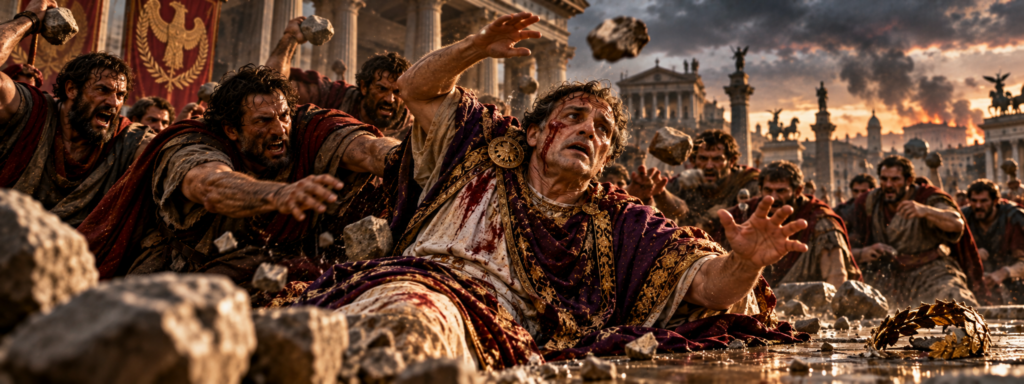
The violence came quickly. According to one prominent tradition, an angry crowd attacked Maximus with stones as he attempted to escape, killing him in the streets. Other accounts describe a soldier striking him down or provide different details about the attackers, making it impossible to reconstruct every moment with certainty. What the sources agree upon is that Maximus was killed during the panic preceding the Vandal arrival, and that his death was followed by the public degradation of his body.
The treatment of his corpse reflected the fury surrounding his downfall. Ancient traditions describe his remains being mutilated and thrown into the Tiber, denying him the dignity normally associated with imperial burial. The man who had briefly occupied the throne of the Caesars became a victim of the very city he had attempted to rule. His imperial title could not protect him from a crowd that saw him as a failed ruler and perhaps as the author of its approaching catastrophe.
Three days later, the Vandals entered Rome. Their arrival would transform the city’s political panic into a prolonged episode of plunder, captivity, and humiliation. The emperor whose government had failed to prevent the invasion was already dead, and the Roman people faced the consequences without an effective ruler. Petronius Maximus had gained the throne through the destruction of another emperor, only to discover that the power he coveted was far more dangerous than the influence he had previously enjoyed.
His story is one of the darkest examples of ambition overtaking judgment in the final decades of the Western Roman Empire. Maximus had spent a lifetime accumulating wealth, prestige, and political authority, but the crown he finally obtained brought him neither security nor lasting greatness. It brought him seventy-five days of increasingly desperate rule, a foreign fleet approaching the capital, and a violent death at the hands of those he had failed to protect.
A Nobleman Born into a Dying Imperial Order
Petronius Maximus was born around 396 into the highest ranks of Roman society, although the details of his ancestry and early life are not entirely secure. He belonged to the world of wealthy senatorial families whose fortunes had been built upon landownership, imperial service, political connections, and generations of aristocratic prestige. By the early fifth century, these families still exercised considerable influence within the Western Roman Empire, even as military commanders and foreign rulers increasingly determined its political future. Maximus would spend much of his career mastering the opportunities offered by that aristocratic world.
His family connections have often been associated with the powerful Anician aristocracy, although the precise genealogical relationships proposed by historians remain debated. The Anicii were among the most distinguished senatorial families of late antiquity, possessing enormous wealth and a tradition of holding high public office. Membership in such a social network could provide access to education, patronage, marriage alliances, and positions within the imperial administration. For an ambitious young aristocrat, these advantages offered a path toward extraordinary influence.
The Rome of Maximus’s youth was a city of striking contradictions. Its monumental buildings, ancient temples, churches, aristocratic residences, and ceremonial traditions preserved the appearance of imperial grandeur. Yet the Western Empire was struggling to maintain effective control over territories that earlier generations had regarded as securely Roman. Military defeats, civil wars, and the settlement of powerful Germanic groups within imperial territory had transformed the political landscape.
The Gothic sack of Rome in 410 occurred when Maximus was probably still a young man. Led by Alaric, the Visigoths entered the city after prolonged conflict with the western government, exposing the vulnerability of the empire’s historic capital. The sack was not the total destruction sometimes imagined in later popular accounts, but its psychological significance was immense. Rome had been violated by an enemy army, and the event shattered assumptions about the city’s inviolability.
Maximus belonged to a generation that had witnessed imperial weakness without abandoning the traditions of aristocratic power. The senatorial elite continued to occupy prestigious offices, sponsor buildings, manage vast estates, and participate in political ceremonies. Wealth and status remained valuable, even as the government struggled to maintain its armies and territories. The contrast between private aristocratic prosperity and public imperial decline would shape the political world in which Maximus rose.
Unlike many of the military strongmen who dominated the Western Empire, Maximus built his reputation primarily through civilian office and aristocratic influence. His career demonstrates that the old senatorial establishment had not disappeared. It could still produce men capable of reaching the highest levels of government. What it increasingly lacked was independent control over the military force necessary to defend that authority.
This distinction would eventually become fatal. Maximus understood the workings of the imperial court, the value of family alliances, and the importance of ceremonial legitimacy. He had far less experience commanding armies against formidable foreign enemies. When he finally became emperor, the qualities that had made him successful as an aristocrat would prove insufficient to preserve his throne.
The Long Climb Through Rome’s Highest Offices
Before becoming emperor, Petronius Maximus enjoyed an exceptionally distinguished public career. He held several of the most prestigious offices available to a Roman aristocrat, including the urban prefecture of Rome, the praetorian prefecture of Italy, and the consulship. These appointments placed him among the leading political figures of the Western Empire. His advancement reflected both personal influence and the continuing importance of senatorial families within imperial administration.
The office of urban prefect carried responsibility for the administration of Rome itself. Its duties included aspects of public order, judicial administration, urban services, and the management of a city whose population and traditions required considerable attention. Holding the prefecture brought prestige because Rome remained the symbolic heart of the empire. Maximus served in this office during the early years of Valentinian III’s reign, and his appointment demonstrated that he had already become a trusted member of the governing elite.
He also served as praetorian prefect of Italy, one of the most powerful civilian positions in the western administration. By the fifth century, praetorian prefects were primarily senior administrators rather than commanders of the emperor’s personal guard. Their responsibilities included taxation, legal administration, and oversight of important governmental functions. Such authority gave Maximus experience in the financial and political machinery of imperial government.
His consulships further enhanced his standing. The consulship no longer possessed the executive power it had held during the Roman Republic, but it remained one of the most prestigious honors in the Roman world. Consular status conferred enormous social distinction and placed its holder within a tradition extending back many centuries. Maximus held the consulship twice, in 433 and 443, marking him as one of the leading aristocrats of his generation.
His career unfolded under the long reign of Valentinian III, whose government was dominated for many years by powerful military figures. Maximus operated within the civilian aristocratic establishment while generals such as Flavius Aetius exercised extraordinary influence over military affairs. The two spheres of power overlapped, but they were not identical. A man could become immensely influential within the Senate and administration without commanding the armies that determined the survival of the empire.
Maximus’s accumulated honors also made him a plausible candidate for imperial office in the event of a succession crisis. He possessed wealth, experience, and connections among the senatorial elite. His distinguished career could be presented as evidence of his suitability to govern. Yet none of these advantages guaranteed that soldiers would accept him as emperor.
The distinction between civilian prestige and military power had become increasingly important during the fifth century. Western emperors depended upon generals who could mobilize troops, negotiate with foreign rulers, and defend threatened provinces. A senator might possess an ancient family name and immense estates, but those assets could not stop an invading army. Maximus would eventually discover the limitations of aristocratic influence under the most dangerous circumstances imaginable.
His rise nevertheless demonstrated remarkable political endurance. He had survived decades of court rivalry and administrative change while maintaining his standing among the empire’s leading families. By the middle of the fifth century, he had achieved nearly every honor available to a Roman nobleman. Only the imperial throne remained beyond his reach, and the desire to obtain it would become inseparable from the final catastrophe of his life.
Valentinian III and the Court of Dangerous Men
Valentinian III had become Western emperor in 425, when he was only six years old. His mother, Galla Placidia, initially exercised considerable influence over the government, while competing military commanders struggled for authority. As the emperor matured, the general Flavius Aetius emerged as the dominant military figure in the West. The result was a government in which the emperor possessed supreme ceremonial authority but frequently depended upon powerful men to exercise practical control.
The imperial court was a dangerous environment for ambitious aristocrats. Access to the emperor could determine appointments, financial privileges, and political survival. Military commanders and civilian officials competed for influence, while family relationships provided opportunities to strengthen alliances. Men who had spent years accumulating prestige could lose their positions through a single shift in imperial favor.
Maximus operated within this world as one of its most successful civilian figures. His wealth and offices made him important, but the presence of Aetius limited the political opportunities available to aristocrats who lacked military commands. The general had become indispensable to the defense of the Western Empire. His influence extended across military affairs, diplomacy, and the distribution of important positions.
Aetius had helped preserve Roman interests in Gaul and played a central role in resisting Attila the Hun. His victory alongside allied forces at the Battle of the Catalaunian Plains in 451 strengthened his reputation as the principal defender of the West. Yet his enormous power also created resentment among courtiers and political rivals. The emperor himself increasingly feared that the general might threaten the independence of the throne.
Valentinian’s personal position was complicated by the absence of a surviving son. His daughters, Eudocia and Placidia, possessed considerable dynastic importance because their marriages could connect powerful families to the Theodosian imperial line. Aetius sought a marriage between his son Gaudentius and Placidia, an arrangement that could have strengthened his family’s future influence. Such negotiations intensified fears that the general intended to make his political dominance hereditary.
For Maximus, the imperial court offered both opportunity and danger. He could advance through the traditional offices of government, but the greatest military power remained beyond his control. The emperor’s growing resentment toward Aetius created possibilities for other influential figures. The assassination of the general would eventually transform the balance of power, but it would also unleash forces that Maximus could not fully control.
The court’s atmosphere became increasingly unstable after the death of Galla Placidia in 450 and the disappearance of Attila as an immediate threat in 453. Valentinian had fewer reasons to tolerate the dominance of Aetius, while courtiers who resented the general could encourage the emperor’s suspicions. The surviving sources disagree about the private motives involved. What is certain is that the political relationship between emperor and commander deteriorated catastrophically.
Maximus would soon find himself at the center of the crisis that followed. Whether he had already begun planning to seize the throne remains uncertain, but his subsequent actions demonstrate how quickly he exploited the destruction of the established political order. The opportunity he had spent a lifetime preparing for would emerge from two murders committed within six months. By the time he became emperor, the foundations of western authority would already be dangerously fractured.
The Murder of Aetius and the Beginning of the End
On 21 September 454, Emperor Valentinian III personally participated in the killing of Flavius Aetius. The general had been summoned to the imperial palace, where a confrontation ended with the emperor attacking him, reportedly assisted by the influential court official Heraclius. Aetius died inside the residence of the ruler whose throne he had helped defend for decades. His death was one of the most consequential political murders of late Roman history.
The precise motives behind the killing remain disputed. Ancient accounts emphasize Valentinian’s jealousy, fear of Aetius’s power, and concern over the proposed marriage alliance involving the general’s son. These explanations are plausible, but the private conversations and intentions of the participants cannot be reconstructed with certainty. The political consequences, however, were unmistakable.
Aetius had maintained relationships with military commanders, foreign rulers, and groups whose cooperation was essential to western security. His influence could not simply be transferred to another official. By killing him, Valentinian removed a powerful rival but also destroyed a central pillar of the government’s military organization. The emperor had gained personal freedom at the cost of weakening the state.
The murder created resentment among soldiers and officers who had served Aetius. Some regarded the emperor’s actions as a betrayal of a commander who had defended the empire against formidable enemies. Their loyalty to the dead general did not disappear with his death. Instead, it became a source of danger for Valentinian.
Petronius Maximus’s position during these events is difficult to establish precisely. Later sources connect him with the conspiracy that ultimately killed Valentinian, but they do not provide a uniformly reliable account of his earlier intentions. He may have seen the destruction of Aetius as an opportunity to expand his own influence. What is clear is that the general’s death destabilized the court and weakened the emperor’s political security.
The disappearance of Aetius also exposed the Western Empire to further uncertainty. Its armies were already stretched across threatened territories, while the Vandals controlled North Africa and possessed a growing naval power. A capable military leader remained essential to the government’s survival. Valentinian had removed the most experienced commander available to him without securing a reliable replacement.
The murder therefore set the stage for a second assassination. The emperor had created enemies among men who retained access to weapons and military positions. Powerful aristocrats could exploit their resentment, and ambitious courtiers could imagine a government without Valentinian. The imperial throne had become vulnerable to the very forces that had previously supported it.
Within six months, the emperor would be dead. His murder would open the way for Petronius Maximus, but the opportunity would arrive wrapped in danger. The throne Maximus desired had become the center of a violent struggle involving military revenge, aristocratic ambition, and dynastic uncertainty. Seizing it would prove easier than keeping it.
The Scandalous Stories Surrounding Maximus and Valentinian
Some ancient accounts offer a deeply personal explanation for Petronius Maximus’s hostility toward Valentinian III. According to one tradition, the emperor became involved in a scandal concerning the wife of Maximus, leading to humiliation, sexual violence, and a desire for revenge. The story appears in differing forms in later historical narratives. Its dramatic character has made it memorable, but its reliability is highly uncertain.
One version describes Valentinian using deception to obtain access to Maximus’s wife. Another presents a complicated episode involving gambling, a ring, and a summons that led the woman to believe she was acting under her husband’s authority. These stories contain elements characteristic of moralizing court literature, where sexual misconduct becomes the explanation for political catastrophe. Their differences make it difficult to identify a reliable historical core.
The allegations should not be treated as established facts about Valentinian or the woman involved. The surviving sources were not neutral investigators, and later writers frequently used stories of sexual scandal to explain the downfall of rulers. Such narratives could transform complex political struggles into tales of private dishonor and revenge. They also reflected assumptions about aristocratic masculinity, family reputation, and the moral character of emperors.
The broader political circumstances provide a substantial explanation for Maximus’s ambitions without requiring acceptance of the scandal. He was an exceptionally wealthy senator who had held the highest civilian offices and possessed connections within the ruling elite. The murder of Aetius weakened Valentinian’s military support, while the absence of a male heir created uncertainty over succession. Maximus had both the status and the opportunity to seek imperial power.
Nevertheless, the persistence of the scandalous tradition is historically revealing. Ancient writers understood the assassination of Valentinian through the language of betrayal, dishonor, and personal revenge. They portrayed the imperial court as a place where private desires could produce public disaster. Whether or not the particular allegations were true, the stories reflected the reputation of a government consumed by internal rivalry.
The danger lies in allowing such accounts to overshadow the better-supported political events. Valentinian was assassinated by men associated with Aetius, and Maximus became emperor almost immediately afterward. Several ancient traditions implicate Maximus in the conspiracy, but the precise extent of his involvement remains uncertain. His subsequent seizure of power provides grounds for suspicion, not proof of every dramatic accusation preserved by later writers.
The scandal therefore belongs within the story as a disputed tradition rather than a confirmed motive. It adds another layer to the hostile reputation surrounding Maximus, but it cannot be used to reconstruct his private thoughts with confidence. The historical record already reveals an ambitious aristocrat emerging from a deadly succession crisis. The uncertainty surrounding his motives makes the episode more complex, not less compelling.
The Assassination of Valentinian III
On 16 March 455, Valentinian III was assassinated in Rome while engaged in military exercises, traditionally associated with the Campus Martius. He had ruled for nearly thirty years and remained the last reigning Western emperor of the Theodosian dynasty. Yet his position had become dangerously exposed after the murder of Aetius. The men who killed him were connected with the general whose death had shattered the political balance of the empire.
The principal assassins are commonly identified as Optila and Thraustila. Ancient sources describe them as men associated with Aetius’s military following who possessed sufficient access to approach the emperor. Their attack was sudden, and Valentinian was killed before effective resistance could be organized. Heraclius, the court official who had participated in the murder of Aetius, was also killed.
The assassination had an obvious element of revenge. Aetius’s supporters could regard Valentinian as the man who had betrayed their commander. Killing the emperor and Heraclius eliminated two figures directly associated with the general’s death. Yet the attack also served the interests of those who wished to replace Valentinian with a different ruler.
Petronius Maximus was later implicated in the conspiracy by ancient historians. Some accounts portray him as encouraging the assassins or exploiting their grievances against the emperor. Others focus more heavily upon the revenge motive of Aetius’s followers. The surviving evidence does not permit a definitive reconstruction of the planning, but Maximus’s rapid accession made his involvement a natural subject of suspicion.
Valentinian’s death created an immediate constitutional and political vacuum. He had no surviving son, and his daughters could not simply assume the imperial title under the prevailing political conventions. The Theodosian dynasty retained prestige through its surviving female members, but the Western throne lacked an obvious successor. Powerful senators and military figures now had an opportunity to compete for control.
Maximus moved quickly. His wealth, political experience, and aristocratic connections gave him advantages over less established candidates. He had held the consulship twice and occupied important administrative offices, making him one of the most distinguished men in the western government. His supporters could present him as a capable statesman who might restore order after the assassination.
Yet the manner of his accession would haunt his entire reign. He emerged from the murder of an emperor and inherited a government whose military leadership had already been shattered. The soldiers who had killed Valentinian had demonstrated the fragility of imperial security. Maximus could claim the throne, but he could not erase the violence that had made his elevation possible.
The death of Valentinian also destabilized relationships with foreign rulers. The emperor’s daughters were connected to diplomatic arrangements involving powerful kingdoms, including the Vandals. The removal of their father created uncertainty about those agreements. Maximus would soon attempt to use the imperial family to strengthen his position, with consequences that proved disastrous.
Seventy-Five Days: The Seizure of the Imperial Throne
Petronius Maximus became Western Roman emperor on 17 March 455, the day after Valentinian’s assassination. His accession was astonishingly rapid, suggesting that influential political interests were prepared to support him or that he moved decisively before rivals could organize. The precise negotiations surrounding his elevation remain uncertain. What is clear is that a distinguished senator had suddenly acquired the title that had eluded him throughout his long career.
Maximus was approximately fifty-eight or fifty-nine years old when he became emperor. He had accumulated immense prestige through public office and aristocratic standing, but he had never faced the responsibilities of imperial rule under such desperate circumstances. The Western Empire was struggling with territorial losses, financial pressure, and military fragmentation. The murder of Aetius had removed its most influential general, while Valentinian’s assassination had destroyed dynastic continuity.
The new emperor needed legitimacy immediately. He lacked a direct hereditary claim to the Theodosian throne and could not rely upon decades of military loyalty. His strongest assets were his wealth, senatorial connections, and administrative experience. These qualities might help him secure support within Rome, but they were insufficient to guarantee recognition throughout the empire.
His accession also required the cooperation or acceptance of military commanders. The Western Empire could no longer function through civilian authority alone. Armies stationed in Italy, Gaul, and other territories possessed the power to recognize or reject imperial claimants. Maximus needed to establish relationships with these forces before competing rulers emerged.
One of his first major decisions was to strengthen his connection to the former imperial family. Licinia Eudoxia, the widow of Valentinian III, possessed exceptional dynastic prestige as the daughter of the Eastern emperor Theodosius II. Marriage to her could provide Maximus with a connection to the ruling house he had replaced. The political value of the union was enormous.
Yet the marriage would become one of the most controversial acts of his reign. Ancient sources describe Maximus compelling Eudoxia to marry him, apparently against her wishes. The circumstances are not documented in sufficient detail to reconstruct every interaction, but the tradition consistently presents the union as politically coercive. The new emperor sought legitimacy through a woman whose husband had been murdered only weeks earlier.
Maximus also attempted to secure the future through additional marriage arrangements. His son Palladius was elevated to the rank of Caesar and became involved in plans concerning Valentinian’s daughter Eudocia. These measures were designed to create a new ruling family connected to the old dynasty. They also interfered with existing diplomatic arrangements involving the Vandals.
The emperor was therefore trying to construct a dynasty before he had secured his government. He possessed the throne but lacked reliable military support, broad political recognition, and the confidence of the imperial household. His decisions created the appearance of legitimacy without resolving the underlying crisis. The reign that began with such extraordinary ambition was already moving toward disaster.
Licinia Eudoxia: The Empress Forced into a New Marriage
Licinia Eudoxia occupied an exceptionally vulnerable position after the assassination of Valentinian III. She was the daughter of the Eastern emperor Theodosius II, the widow of the murdered Western emperor, and the mother of two daughters whose marriages carried enormous political significance. Her dynastic connections made her valuable to any man seeking legitimacy. They also exposed her to the ambitions of the new ruler.
Petronius Maximus married Eudoxia shortly after taking the throne. Ancient accounts commonly portray the marriage as forced or imposed through political pressure. The precise details are uncertain, but the speed of the union and the circumstances surrounding Valentinian’s death make it difficult to regard the marriage as an ordinary dynastic arrangement. The new emperor was attempting to attach himself to the dynasty he had replaced.
For Maximus, the marriage offered immediate advantages. Eudoxia’s father had ruled the Eastern Empire, while her deceased husband had occupied the Western throne for nearly thirty years. Through her, Maximus could claim a connection to the imperial family recognized across much of the Roman world. The marriage might also discourage rival claimants who lacked comparable dynastic ties.
For Eudoxia, the situation was far more dangerous. Her husband had been murdered, and the man who now occupied his throne was implicated in the conspiracy by several historical traditions. She possessed high rank but limited freedom to resist the political decisions imposed upon her. Her position illustrates how imperial women could become instruments of legitimacy during succession crises.
Later accounts describe Eudoxia as deeply resentful of Maximus and suggest that she sought assistance from Geiseric, king of the Vandals. The story is famous, but the surviving evidence does not establish that she personally invited the Vandal invasion. Some sources present the claim as part of a dramatic narrative of revenge. Others emphasize the political and diplomatic circumstances that gave Geiseric reasons to intervene independently.
The distinction matters because the Vandal expedition cannot be explained solely through the supposed actions of a grieving empress. Geiseric controlled a powerful kingdom in North Africa and possessed strategic interests in Italy and the western Mediterranean. The death of Valentinian disrupted agreements involving his family and the Roman imperial household. The political opportunity created by Maximus’s accession was substantial.
Eudoxia’s marriage nevertheless became a symbol of the new emperor’s questionable legitimacy. He had taken the throne after her husband’s assassination and then claimed her as his wife. The arrangement offered him dynastic prestige but could not create genuine loyalty within the imperial family. It also made the women of Valentinian’s household central figures in the struggle over succession.
The consequences would extend beyond Maximus’s death. When the Vandals entered Rome, Eudoxia and her daughters were taken to Carthage. Their captivity demonstrated that dynastic legitimacy remained valuable even after the Western government had lost control of its capital. The emperor’s attempt to secure power through marriage had helped place the imperial family at the center of another international crisis.
The Broken Marriage Alliance with the Vandals
Before Valentinian III’s assassination, the Western imperial family had been involved in marriage negotiations connecting his daughter Eudocia with Huneric, the son of the Vandal king Geiseric. The arrangement formed part of the complex diplomacy between Rome and the Vandal kingdom in North Africa. Such marriages could help stabilize relations between rival powers. They also gave foreign rulers a direct interest in Roman dynastic politics.
The Vandals had established a powerful kingdom after crossing into North Africa in 429. Their capture of Carthage in 439 gave them control over one of the wealthiest and most strategically important cities in the western Mediterranean. Geiseric used naval power and diplomacy to strengthen his position. Relations with the Western Empire alternated between conflict and negotiated accommodation.
The proposed marriage between Huneric and Eudocia was politically valuable to Geiseric. It connected his family to the Theodosian dynasty and could provide recognition within the Roman political world. For Valentinian’s government, the arrangement offered a means of managing relations with a formidable enemy. The alliance was part of a broader attempt to preserve stability despite the loss of Africa.
Maximus disrupted this arrangement when he attempted to connect Eudocia to his own son Palladius. The precise status of the marriage negotiations at the time remains a matter of scholarly discussion, but the political implications were serious. Geiseric could interpret the change as a rejection of an established understanding. The new emperor had interfered with an agreement involving one of the most powerful rulers in the Mediterranean.
The decision reflected Maximus’s immediate priorities. He needed to establish a dynasty and secure the succession through his son. Marriage to a daughter of Valentinian would provide Palladius with a connection to the Theodosian family. Yet the arrangement risked alienating Geiseric at precisely the moment when the Western Empire was least prepared for conflict.
The Vandal king possessed substantial reasons to intervene. Valentinian was dead, the western government was unstable, and diplomatic agreements involving the imperial family had been disrupted. The new emperor lacked the military authority of Aetius and had not secured a strong coalition of supporters. An expedition against Italy offered both political and material opportunities.
Ancient accounts differ over the immediate trigger for Geiseric’s decision. Some emphasize the supposed appeal of Licinia Eudoxia, while others focus upon the broken marriage arrangement and the weakness of the western government. These explanations are not necessarily mutually exclusive, but none should be accepted without caution. The invasion emerged from a complex combination of diplomacy, ambition, and political opportunity.
Maximus had therefore created a dangerous international problem while trying to solve his domestic succession crisis. His marriage arrangements might strengthen his claim within Rome, but they threatened relations with a powerful naval kingdom. The emperor who sought legitimacy through dynastic connections had underestimated the foreign interests attached to those same connections. The consequences would soon arrive by sea.
Geiseric: The King Who Had Taken Rome’s Richest Province
Geiseric was one of the most formidable rulers of the fifth-century Mediterranean. As king of the Vandals, he had led his people into North Africa and established a kingdom that challenged Roman control over one of its most valuable regions. His capture of Carthage in 439 transformed the balance of power in the western Mediterranean. By 455, he possessed the resources necessary to threaten Italy itself.
The loss of North Africa had been devastating for the Western Empire. The region supplied agricultural products, tax revenue, and commercial wealth that helped support imperial administration and military operations. Carthage was a major urban center with extensive maritime connections. Its capture deprived the western government of resources it could scarcely afford to lose.
Geiseric understood the strategic importance of naval power. His kingdom developed the ability to conduct maritime expeditions and threaten coastal territories. Roman control of the western Mediterranean had once been a defining feature of imperial strength. The Vandals now demonstrated that the sea could become a route of attack against Rome.
The Vandal king was also an experienced diplomat. He negotiated agreements with Roman governments while pursuing the interests of his own kingdom. Marriage alliances, territorial recognition, and political concessions could be as valuable as military victories. His involvement with the Theodosian family reflected this broader strategy.
The assassination of Valentinian III created an opportunity for Geiseric. The emperor with whom diplomatic arrangements had been negotiated was dead, and his successor lacked a secure political foundation. The murder of Aetius had already weakened western military leadership. The new government appeared vulnerable to pressure.
Maximus’s marriage arrangements further complicated relations. By attempting to connect Eudocia to Palladius, he interfered with the proposed union involving Huneric. The Vandal king could regard the change as a violation of expectations or a challenge to his family’s interests. The resulting dispute provided a political justification for intervention.
Geiseric’s decision to send a fleet against Italy was therefore not an inexplicable act of barbarian aggression. It reflected the strategic ambitions of a ruler who controlled substantial resources and recognized the weakness of his opponent. The Western Empire had lost the ability to guarantee security across the Mediterranean. The Vandal king intended to exploit that reality.
For Petronius Maximus, the danger was immense. He had inherited an empire already weakened by decades of conflict, and his own actions had alienated a powerful foreign ruler. He possessed the ceremonial authority of an emperor but lacked the military organization necessary to confront a major invasion. When Geiseric’s fleet approached, the limitations of his reign became impossible to conceal.
An Emperor Without an Army He Could Trust
One of the greatest weaknesses of Petronius Maximus’s government was its lack of dependable military support. The Western Empire had long relied upon powerful generals who commanded troops and maintained relationships with allied peoples. The murder of Aetius had disrupted that system. Valentinian’s assassination had further weakened confidence in the imperial court.
Maximus was a distinguished civilian administrator, but he did not possess the military reputation necessary to command automatic loyalty from soldiers. His experience in the urban and praetorian prefectures had prepared him for administration rather than battlefield leadership. The distinction mattered because the empire faced immediate external threats. The new emperor needed commanders capable of organizing defense.
He attempted to strengthen his position through political appointments and alliances. One important figure was Avitus, a Gallic aristocrat with connections among the Visigoths. Maximus reportedly sent Avitus to seek support from the Visigothic king Theodoric II. The mission reflected the government’s dependence upon relationships with powerful groups outside direct imperial control.
The appointment was politically sensible in principle. The Visigoths possessed military strength and occupied an important position in Gaul. Their cooperation could provide resources unavailable to the western government. Yet diplomatic negotiations required time, and Maximus’s reign would be too brief for such efforts to secure his position.
The military situation in Italy remained uncertain. The death of Aetius had deprived the government of a commander with established authority over many western forces. Soldiers who had served the general might distrust a regime associated with Valentinian’s assassination and the subsequent seizure of power. Maximus could not assume that they would risk their lives to defend him.
The problem extended beyond individual loyalty. The Western Empire’s financial resources had been weakened by territorial losses, particularly the Vandal conquest of Africa. Maintaining armies required money, supplies, and reliable administrative structures. Maximus inherited a government already struggling to meet those demands. His brief reign offered little opportunity for reform.
The approaching Vandal fleet exposed the consequences. Rome required a coordinated defense involving soldiers, supplies, leadership, and political confidence. The emperor could not provide these elements with sufficient speed. His government had not secured the military foundation necessary to withstand a major crisis.
Maximus’s predicament illustrates the central contradiction of late western imperial politics. An aristocrat could acquire the throne through wealth, prestige, and political maneuvering, but he could not govern securely without military support. The imperial title conferred authority in theory. In practice, it offered little protection when soldiers and commanders refused to act.
The Fleet Approaches Italy
By the final days of May 455, the threat from Geiseric had become immediate. Vandal forces were approaching Italy by sea, and news of their movement spread through the Roman political world. The Western Empire lacked the naval strength necessary to guarantee that the expedition could be intercepted. The prospect of another sack of Rome became increasingly real.
The capital was especially vulnerable because its government had been destabilized by successive assassinations. Aetius had been killed in September 454, Valentinian in March 455, and Maximus had ruled for only a few weeks. The rapid succession of violent events undermined confidence in imperial leadership. The population had little reason to believe that the new emperor possessed a reliable plan for defense.
The memory of 410 intensified the fear. The earlier Gothic sack had demonstrated that Rome could be entered and plundered by a foreign army. Although the city had continued to function and retain enormous prestige, the psychological wound remained significant. The arrival of another hostile force threatened to repeat a humiliation that Roman society had not forgotten.
Maximus faced an impossible-looking political situation. He could remain in Rome and attempt to organize resistance with inadequate resources, or he could leave the city and seek safety elsewhere. Either choice carried serious risks. Remaining might expose him to capture by the Vandals, while fleeing would appear to confirm that he had abandoned the people he was supposed to protect.
Ancient accounts portray the emperor as increasingly desperate. He reportedly attempted to escape when the Vandal approach became known. Some traditions describe him being abandoned by his guards or unable to secure a safe departure. The precise details are uncertain, but the essential picture is one of a ruler whose authority collapsed under pressure.
The population’s anger reflected more than fear of the invasion. Maximus had taken power after Valentinian’s murder and had imposed controversial marriage arrangements upon the imperial family. His government had failed to establish stability or provide convincing protection. The approaching enemy transformed existing resentment into open hostility.
The crisis also revealed the limits of imperial ceremony. Maximus could wear the purple, receive formal honors, and claim the authority of the Roman state. Yet those symbols could not stop the Vandal fleet. The emperor’s legitimacy depended increasingly upon his ability to protect the city, and that ability was visibly absent.
As panic spread, the government began to disintegrate. The emperor’s attempt to flee became the immediate cause of his downfall. The people of Rome, facing the prospect of invasion, turned against the ruler who appeared ready to abandon them. The final hours of Petronius Maximus had begun.
Rome Turns Against Its Emperor
The anger directed at Petronius Maximus during the final crisis reflected the collapse of confidence in his government. The people of Rome had endured decades of political uncertainty, but the approaching Vandal invasion presented an immediate threat to their homes, possessions, and families. They needed leadership capable of organizing defense or negotiating protection. Instead, they saw an emperor attempting to escape.
The precise composition of the crowd that attacked Maximus cannot be established. Ancient sources refer to a mob or hostile gathering, but they do not provide a detailed account of the participants. Some may have been ordinary citizens, while others could have been soldiers or individuals connected with rival political factions. The violence emerged from a city experiencing fear and governmental breakdown.
Maximus’s political reputation made him an especially vulnerable target. He had seized the throne immediately after Valentinian’s assassination, and ancient writers associated him with the conspiracy. His marriage to Licinia Eudoxia had been portrayed as coercive, while his dynastic arrangements had complicated relations with Geiseric. Many inhabitants could regard him as responsible for the crisis even though the empire’s problems extended far beyond his brief reign.
The emperor’s attempt to flee also violated expectations about imperial responsibility. Roman rulers were supposed to protect the state, even when circumstances made effective defense difficult. Abandoning the capital in the face of invasion could be interpreted as cowardice or betrayal. The symbolism was devastating for a ruler whose legitimacy was already contested.
The anger was intensified by the absence of reliable military protection. A powerful emperor surrounded by loyal troops might have escaped despite popular hostility. Maximus lacked that security. His guards and supporters were unable or unwilling to shield him from the crowd. The imperial title no longer commanded obedience.
Ancient writers describe the violence as sudden and overwhelming. The crowd attacked the emperor during his attempted departure, and he was killed before he could reach safety. The details vary, but the event demonstrates how completely his authority had collapsed. He had become a fugitive within the city he ruled.
The murder also reflected the brutal political culture of the late empire. Public anger could become deadly when the government lost control of armed force and urban order. The deaths of emperors were often followed by the humiliation of their bodies. Maximus would receive no more mercy than many of the rulers who had fallen before him.
The Roman people could not stop the Vandal invasion by killing their emperor. His death did not restore military strength or prevent Geiseric’s arrival. Yet in the atmosphere of panic, Maximus became the visible symbol of governmental failure. The crowd destroyed the man who represented a state that appeared to have abandoned its responsibility to protect them.
Stoned, Beaten, and Cast into the Tiber
Petronius Maximus was killed on 31 May 455, after a reign of approximately seventy-five days. Ancient sources agree that his death occurred amid the panic caused by the approaching Vandals. Several accounts describe an enraged crowd attacking him as he attempted to escape Rome. The precise manner of his killing, however, differs among the surviving traditions.
One prominent account states that Maximus was stoned to death by the Roman populace. Other traditions describe a soldier striking him down or emphasize the involvement of armed men rather than an undifferentiated crowd. These variations make it difficult to identify the exact weapon that delivered the fatal blow. The broader event remains clear: the emperor was violently killed while trying to flee the capital.
The circumstances of his death were particularly humiliating because he had occupied the throne for such a short period. He had not been defeated in a formal battle or condemned through an established legal procedure. He was attacked in the streets by people who rejected his authority. His final moments revealed the complete disappearance of the political protection that had allowed him to become emperor.
Ancient accounts also describe the mutilation of his corpse. One tradition records that his body was dismembered and thrown into the Tiber. Such treatment denied the fallen ruler the ceremonial dignity normally associated with imperial death. It transformed his remains into a public expression of contempt.
The Tiber had long been associated with Roman political violence. In earlier periods, the bodies of condemned criminals and disgraced political figures had sometimes been cast into the river. The act could symbolize rejection by the community and the denial of honorable burial. Whether every detail of Maximus’s treatment is accurate, the tradition reflects the extraordinary hostility surrounding his death.
The mutilation of a ruler’s body also served a political purpose. It demonstrated that the former emperor no longer possessed the sacred or ceremonial status attached to his office. The crowd could degrade the man who had recently commanded the state. His corpse became evidence of the destruction of his authority.
The death of Maximus occurred before the Vandals entered Rome. The people who killed him were not foreign invaders but individuals within the city he had attempted to govern. This distinction is central to the story. The emperor was destroyed by the collapse of domestic loyalty before the external enemy arrived.
His fate was a grim reversal of his ambitions. Maximus had spent decades accumulating honors and influence, then seized the imperial throne at the moment of Valentinian’s assassination. He attempted to secure a dynasty through marriage and political appointments. Yet when the empire faced its greatest immediate danger, he could not even secure a safe passage out of Rome.
The Emperor Who Died Before the Sack Began
Petronius Maximus’s death left Rome without effective imperial leadership just as the Vandals approached. The new emperor had failed to establish a secure military command, and his murder deepened the political vacuum. The city now faced a formidable foreign force without a recognized ruler capable of coordinating its defense. The consequences would become visible almost immediately.
On 2 June 455, Geiseric’s forces entered Rome. The date is traditionally associated with the beginning of the Vandal sack, which lasted approximately two weeks according to the surviving accounts. The Vandals removed substantial wealth and carried away important captives. The event became one of the defining episodes of the Western Empire’s decline.
The invasion was not simply the result of Maximus’s personal failures. The Western Empire had lost control of North Africa, suffered financial weakening, and become increasingly dependent upon powerful military commanders. The murder of Aetius had disrupted its military organization, while Valentinian’s assassination destroyed dynastic continuity. Maximus inherited a government already facing extraordinary difficulties.
Nevertheless, his decisions worsened the crisis. His marriage arrangements interfered with diplomatic relationships involving the Vandals, while his inability to secure military support left Italy vulnerable. His attempted flight destroyed what remained of public confidence. The emperor’s death removed the possibility of coordinated leadership at the moment of invasion.
The Vandals entered a city whose political institutions had been shaken by months of violence. The Senate retained prestige, and the Roman church possessed growing influence, but neither could replace the full machinery of imperial military government. The population faced the invaders under conditions of uncertainty. The sack became a profound humiliation for the western state.
Ancient sources describe the removal of treasures, valuables, and members of the imperial household. The Vandals carried away wealth accumulated through centuries of Roman history. Some later accounts emphasize the stripping of important public buildings and the seizure of ceremonial objects. The precise inventory cannot be reconstructed, but the scale of plunder was substantial.
The invasion also demonstrated the power of Geiseric’s kingdom. The Vandals had transformed their control of North Africa into maritime dominance capable of threatening Italy. Their fleet could carry an army across the Mediterranean and return with captives and treasure. The Western Empire could no longer guarantee the security of its historic capital.
Maximus had died before witnessing the full consequences of the crisis. His reign ended in the streets, while the city he had attempted to rule fell into the hands of foreign soldiers. The contrast between his ambitions and the outcome was devastating. He had wanted the throne of Rome, but his seizure of power became part of the chain of events leading to another sack of the city.
Pope Leo I and the Attempt to Spare Rome
The approach of the Vandals created an urgent need for negotiation. With Petronius Maximus dead and imperial leadership effectively absent, other influential figures attempted to protect the city. Among them was Pope Leo I, whose role in the events of 455 became central to later historical tradition. His involvement reflected the growing importance of ecclesiastical leadership during periods of imperial weakness.
Ancient accounts describe Leo meeting or negotiating with Geiseric. The pope reportedly sought to prevent the destruction of Rome and limit violence against its inhabitants. Later traditions credited him with persuading the Vandal king to avoid wholesale slaughter and the burning of the city. The precise terms of any agreement remain uncertain.
The story has often been compared with Leo’s earlier encounter with Attila the Hun in 452. In that episode, a Roman embassy that included the pope met the Hunnic ruler during his invasion of Italy. Later Christian narratives emphasized Leo’s personal influence in securing Attila’s withdrawal. The actual circumstances were more complicated, involving military, logistical, and diplomatic considerations.
The negotiations with Geiseric should be understood with similar caution. The Vandals had strong reasons to preserve the city sufficiently to remove its wealth and captives. Widespread destruction could interfere with the orderly collection of plunder. Any restraint shown during the sack may therefore have reflected both negotiation and practical calculation.
The event nevertheless demonstrated the absence of effective imperial leadership. The pope could act as an intermediary because the emperor was dead and the government had failed to organize defense. Religious authority was becoming increasingly important in situations where secular institutions struggled to function. The contrast with earlier centuries was striking.
The sack itself involved substantial plunder and the removal of captives. Ancient sources do not support the idea that Rome was completely destroyed, and the city continued to exist as an important urban and religious center. Nevertheless, the invasion inflicted serious material and symbolic damage. The humiliation of the capital became part of the historical memory of imperial decline.
Leo’s role also highlights the limitations of Maximus’s government. The emperor had possessed formal authority but failed to provide effective protection. After his death, other figures were left to negotiate with the invaders. The responsibility of defending Rome had passed beyond the imperial household.
The story of the pope and the Vandal king therefore belongs to the wider consequences of Maximus’s downfall. His assassination did not cause every problem facing the city, but it removed the recognized ruler at a moment of extreme danger. The negotiations that followed reflected an emergency created by military weakness and political collapse. Rome survived the sack, but the prestige of western imperial government suffered another devastating blow.
The Captivity of the Imperial Family
One of the most significant consequences of the Vandal sack was the capture of Licinia Eudoxia and her daughters, Eudocia and Placidia. These women belonged to the Theodosian dynasty and possessed exceptional political value. Their marriages and family connections could influence claims to imperial legitimacy. Geiseric understood that their captivity offered advantages beyond the immediate wealth taken from Rome.
Eudoxia had already endured the assassination of her husband Valentinian III and the controversial marriage imposed upon her by Petronius Maximus. The Vandal invasion now carried her into another political world. She was taken to Carthage, the capital of Geiseric’s kingdom. Her status remained important even though the western imperial government had lost control over her fate.
Eudocia’s position was particularly significant because of the earlier marriage arrangement involving Huneric. The union had been disrupted by Maximus’s attempt to connect her to his own son Palladius. After the Vandal sack, Eudocia eventually married Huneric. The marriage fulfilled a dynastic connection that had become entangled in the political crisis of 455.
The captivity of the imperial women demonstrated the continuing importance of family legitimacy. The Western Empire had lost territory and military strength, but the Theodosian name still carried prestige. Foreign rulers could use marriage alliances to strengthen their political standing. The imperial household remained valuable even after the emperor himself was dead.
The experience also reveals the vulnerability of elite women during succession crises. Eudoxia and her daughters were treated as instruments of diplomacy and dynastic strategy by competing rulers. Their personal preferences are poorly documented, and later accounts often interpret their actions through political or moral narratives. The surviving evidence provides limited access to their own perspectives.
The Vandal kingdom benefited from the capture. Geiseric gained hostages and dynastic connections that could influence relations with the Roman world. The marriage between Huneric and Eudocia strengthened the political significance of his family. The sack therefore produced long-term diplomatic consequences as well as immediate plunder.
For the Western Empire, the loss of the imperial women was another humiliation. The family that had supplied dynastic legitimacy for decades was now partly under the control of a foreign king. The government could not protect its own ruling household. The symbolic consequences were profound.
The captivity of Eudoxia and her daughters also completed the collapse of Maximus’s dynastic plans. He had attempted to secure his throne by marrying the widowed empress and arranging a union involving Eudocia. Instead, he was murdered, his government collapsed, and the women became captives of the Vandal kingdom. The marriages intended to establish his dynasty had contributed to a crisis that destroyed it before it could begin.
The Fall of Palladius and the Dynasty That Never Existed
Petronius Maximus attempted to establish a new imperial dynasty through his son Palladius. The young man was elevated to the rank of Caesar, giving him an official position within the succession. The appointment was intended to provide continuity and strengthen the new regime. It also demonstrated Maximus’s determination to transform his brief seizure of power into a hereditary government.
The proposed marriage between Palladius and Eudocia was central to this strategy. Eudocia was the daughter of Valentinian III and a member of the Theodosian dynasty. A union with her could connect Palladius to the previous ruling family. The arrangement would give Maximus’s descendants a stronger claim to legitimacy.
Yet the plan was politically dangerous. Eudocia had been associated with a proposed marriage to Huneric, the son of Geiseric. Interfering with that arrangement threatened relations with the Vandal kingdom. Maximus was attempting to solve a domestic legitimacy problem by creating an international dispute.
Palladius’s personal role in the crisis is poorly documented. The surviving sources provide little reliable information about his character, ambitions, or political experience. His elevation appears primarily as part of his father’s dynastic strategy. The young Caesar’s future depended entirely upon the survival of Maximus’s government.
That government collapsed within weeks. The approach of the Vandals caused panic in Rome, and Maximus was killed while attempting to flee. Palladius disappears from the historical record amid the catastrophe, and his precise fate is uncertain. The dynasty his father hoped to establish never became a durable political reality.
The failure illustrates the fragility of succession arrangements during the final decades of the Western Empire. A ruler could proclaim a son Caesar and arrange prestigious marriages, but such measures required military support and political stability to succeed. Maximus possessed neither. His dynastic plans were overwhelmed by events beyond his control.
The attempt also reveals the continuing appeal of hereditary legitimacy. Even in a period dominated by powerful generals and military intervention, rulers sought connections to established imperial families. Maximus understood that the Theodosian name carried political value. He attempted to appropriate that prestige through marriage rather than through descent.
The result was a bitter reversal. The emperor who tried to found a dynasty through the family of his murdered predecessor left no lasting imperial succession. His son failed to inherit the throne, and the imperial women were carried away by the Vandals. The entire project collapsed before it had time to acquire meaningful stability.
Was Petronius Maximus Responsible for the Vandal Sack?
Petronius Maximus has often been blamed for the Vandal sack of Rome in 455. His seizure of the throne, controversial marriage to Licinia Eudoxia, and interference with the proposed marriage between Eudocia and Huneric contributed to the political crisis. His inability to organize an effective defense left the city vulnerable. Yet assigning him sole responsibility would oversimplify the circumstances.
The Western Empire had been weakening for decades before Maximus became emperor. The Vandals had entered North Africa in 429 and captured Carthage in 439, depriving the western government of crucial revenue and strategic resources. The loss of African wealth reduced the empire’s ability to maintain armies and defend its territories. These structural problems could not be reversed during a reign lasting only seventy-five days.
The murder of Aetius also played an important role. The general had maintained military relationships and coordinated western defense for decades. His assassination in September 454 disrupted the government before Maximus reached the throne. Valentinian’s murder six months later compounded the instability.
Geiseric possessed independent strategic ambitions. His kingdom controlled a powerful fleet and had interests throughout the western Mediterranean. The death of Valentinian and the disruption of marriage agreements created an opportunity to intervene. The Vandal king did not require a personal invitation from Eudoxia to recognize the advantages of attacking Italy.
Maximus nevertheless made decisions that worsened the situation. His marriage arrangements prioritized dynastic legitimacy without adequately considering foreign diplomatic consequences. His government failed to secure sufficient military support. When the invasion approached, his attempted flight destroyed public confidence and contributed to the collapse of political order.
His responsibility therefore lies in aggravating an existing crisis rather than creating it from nothing. He inherited a weakened state and pursued policies that made its immediate position more dangerous. His inability to provide leadership during the invasion exposed the limitations of his authority. The emperor’s death became part of the wider breakdown.
The sack itself was also shaped by the decisions of Geiseric and his commanders. The Vandals chose to conduct an expedition, enter Rome, and remove wealth and captives. Those actions reflected their own interests and military capabilities. Roman political instability created the opportunity, but Vandal strategy determined how it was exploited.
The historical judgment must therefore remain balanced. Maximus was not the sole author of Rome’s disaster, but his ambition and miscalculations contributed significantly to the circumstances surrounding it. His brief reign illustrates how a ruler could accelerate the collapse of an already fragile government. The catastrophe was larger than one man, but his decisions helped make it worse.
The Ancient Sources and the Stories of His Death
The surviving evidence for Petronius Maximus comes from a combination of contemporary chronicles, later historical narratives, and fragments of works that no longer survive in full. Important witnesses include Prosper of Aquitaine, Hydatius, Priscus as preserved through later writers, and John of Antioch. These sources provide the broad outline of the events but differ in their details. Their disagreements are particularly important when reconstructing the emperor’s motives and death.
Prosper of Aquitaine was a contemporary chronicler whose account is valuable for the events of 455. His work provides information about the assassination of Valentinian, the accession of Maximus, and the Vandal invasion. Like other chroniclers, he wrote within a particular political and religious environment. His account must therefore be considered alongside other evidence.
Hydatius, writing in the western provinces, also recorded major events of the period. His chronicle reflects the instability experienced across the Western Empire and the growing importance of non-Roman kingdoms. He provides valuable testimony, although his information about events in Rome was not necessarily based upon direct observation. The distance between author and event must be considered.
John of Antioch preserves later traditions about the political intrigues surrounding Maximus. Some of these narratives include sensational stories of sexual scandal, revenge, and deception. Their dramatic detail has influenced modern retellings, but they cannot all be accepted as reliable. The differences between accounts suggest that later writers reshaped the events according to moral and literary interests.
The manner of Maximus’s death is a particularly important example. Some sources describe him being stoned by a crowd, while others identify a soldier or emphasize different forms of violence. The tradition that his body was mutilated and thrown into the Tiber appears in the surviving historical narrative, but the precise sequence cannot be independently verified. A responsible account should therefore describe the broad event confidently while acknowledging uncertainty over the details.
The allegation that Licinia Eudoxia invited Geiseric to attack Rome presents a similar problem. It appears in influential historical traditions but is not established beyond doubt. The story may reflect attempts to explain the invasion through personal revenge rather than through the complex diplomatic and strategic circumstances. Geiseric had substantial reasons to intervene regardless of any appeal from the empress.
The political significance of Maximus’s reign does not depend upon accepting every dramatic anecdote. He became emperor immediately after Valentinian’s assassination, married the widowed empress, attempted to establish a dynasty, and died during the panic preceding the Vandal invasion. These events are sufficient to explain the collapse of his government. The disputed stories add complexity but should not replace the secure historical framework.
The surviving sources also remind us how quickly political reputations could be shaped after death. Maximus left no enduring dynasty to defend his memory, and his reign ended in humiliation. Later writers had little incentive to portray him sympathetically. His image became that of an ambitious usurper whose greed for power brought destruction upon himself and Rome.
The Aristocrat Who Mistook Prestige for Power
Petronius Maximus’s career demonstrates the extraordinary opportunities still available to Roman aristocrats during the fifth century. He had held major administrative offices, served twice as consul, and accumulated immense wealth and influence. His social standing placed him among the most distinguished men in the Western Empire. Yet the qualities that made him successful within the senatorial establishment did not guarantee success as emperor.
The imperial office required more than ceremonial prestige. A ruler needed the loyalty of soldiers, the cooperation of powerful commanders, the confidence of provincial elites, and the resources necessary to maintain government. Maximus inherited a state whose military and financial foundations had been weakened. His personal wealth could not compensate for the absence of reliable armed support.
His accession also lacked the stability provided by established dynastic succession. Valentinian III had belonged to the Theodosian family and ruled for nearly thirty years. Maximus emerged from the emperor’s assassination and immediately sought legitimacy through marriage. The speed of his actions revealed the urgency of his position.
The marriage to Licinia Eudoxia was politically understandable but morally and diplomatically troubling. It connected Maximus to the previous dynasty, yet ancient accounts portray the union as coercive. His attempt to arrange a marriage between Palladius and Eudocia further strengthened his dynastic ambitions. These decisions also interfered with relationships involving the Vandals.
The emperor’s strategy therefore emphasized the appearance of legitimacy rather than the foundations of security. He could present himself as a distinguished statesman married into the imperial family. He could elevate his son and claim continuity with the previous regime. Yet none of these measures guaranteed that soldiers would defend him when Geiseric approached.
His final attempt to flee revealed the weakness of his authority. A ruler who possessed genuine military support might have organized resistance or secured an orderly withdrawal. Maximus was unable to do either. The crowd that attacked him recognized that his imperial title no longer carried effective power.
The contrast between his long career and brief reign is striking. He had spent decades mastering the political world of Rome, but he survived only seventy-five days as emperor. His administrative experience and aristocratic prestige proved insufficient during a military emergency. The throne demanded capabilities and loyalties he did not possess.
Maximus’s story therefore illustrates the danger of confusing political advancement with sovereign power. He had achieved nearly every honor available to a Roman nobleman and may have believed that the imperial title represented the natural culmination of his career. Instead, it exposed him to threats that his previous positions had allowed him to avoid. The crown he coveted became the instrument of his destruction.
The Politics of Regicide in the Final Western Empire
The murder of Petronius Maximus belongs to a long tradition of violent imperial succession. Roman emperors had been assassinated by guards, soldiers, conspirators, and political rivals for centuries. The third century had witnessed repeated military coups and the rapid destruction of rulers. By the fifth century, assassination remained a familiar method of resolving disputes over authority.
The events of 454 and 455 created an especially destructive sequence. Valentinian III personally participated in the murder of Aetius, eliminating the general who had dominated western military affairs. Six months later, men associated with Aetius assassinated Valentinian. Maximus then seized the throne and was himself killed during the panic preceding the Vandal invasion.
Each death weakened the government’s ability to function. Aetius had coordinated military defense and maintained important relationships with foreign rulers. Valentinian supplied dynastic legitimacy and continuity. Maximus attempted to replace both forms of authority through aristocratic prestige and marriage, but his government collapsed before it could establish stability.
The cycle also demonstrated the importance of military loyalty. Valentinian could murder Aetius but could not secure the loyalty of the general’s supporters. Maximus could seize the throne but could not guarantee that soldiers would protect him. The absence of dependable armed support made both rulers vulnerable.
The role of the Roman crowd in Maximus’s death adds another dimension. His murder was not simply a palace conspiracy carried out by a small group of officers. Ancient accounts describe public anger erupting into lethal violence during a moment of fear. The population became an active force in the destruction of imperial authority.
Such violence did not necessarily represent a coherent political program. The crowd that killed Maximus did not possess a plan for restoring military strength or negotiating with Geiseric. Its actions reflected anger, panic, and the collapse of confidence in the ruler. The assassination removed a hated figure but did not solve the crisis.
The treatment of Maximus’s body also reflected the political symbolism of regicide. Mutilation and disposal of a fallen ruler’s remains could communicate public rejection of his authority. The emperor was stripped not only of life but also of the dignity associated with his office. His corpse became part of the spectacle of political defeat.
The episode reveals the fragility of imperial legitimacy during the Western Empire’s final decades. A ruler could be elevated through political influence and destroyed by violence within weeks. The government lacked a stable mechanism for succession and depended increasingly upon military commanders whose interests could conflict with those of the emperor. Maximus became another victim of a system in which the throne offered prestige without security.
The Aftermath: A Throne No One Could Hold Securely
The death of Petronius Maximus did not end the Western Roman Empire, but it intensified the instability that had already weakened the government. Rome was sacked by the Vandals, the imperial family was taken captive, and the succession remained uncertain. The empire needed a ruler capable of restoring military authority and diplomatic confidence. Instead, competing factions continued to struggle over the throne.
Avitus eventually emerged as the next Western emperor, supported by influential interests in Gaul and the Visigothic kingdom. His accession reflected the growing importance of regional power bases and alliances with Germanic rulers. The Western Empire could no longer assume that the political decisions made in Rome would automatically command obedience throughout its territories. Imperial authority had become increasingly fragmented.
Avitus’s reign was also short. He was eventually removed through military opposition, demonstrating that the problem of unstable succession had not been resolved. Later emperors, including Majorian, attempted to restore western power through military campaigns and administrative reforms. Their efforts faced enormous obstacles.
The general Ricimer became one of the dominant figures in western politics during the following decades. He influenced the elevation and removal of several emperors, exercising authority that often exceeded that of the rulers themselves. His career resembled the earlier dominance of Aetius, although the political circumstances had changed. The pattern of powerful military commanders overshadowing emperors continued.
The Western Empire also faced ongoing pressure from the Vandals and other kingdoms. The loss of North Africa remained a major financial and strategic disaster. The government’s attempts to recover territory required resources it struggled to assemble. The sack of 455 had demonstrated how vulnerable Italy had become.
The imperial office nevertheless retained symbolic importance. Emperors continued to issue laws, receive ceremonial honors, and represent Roman political legitimacy. The problem was not that the title had become meaningless. It was that the authority attached to it could no longer guarantee effective control over armies and territories.
The events of 455 therefore marked an important stage in the transformation of western political power. The assassination of Valentinian removed dynastic continuity, while the death of Maximus demonstrated the weakness of an emperor without military support. The Vandal sack exposed the vulnerability of Rome itself. Together, these events accelerated the fragmentation of the western government.
The traditional end of the Western Roman Empire came in 476, when Odoacer deposed Romulus Augustulus. That event occurred twenty-one years after Maximus’s death. The collapse was the result of a long process rather than a single assassination or invasion. Yet the catastrophe of 455 remains one of the clearest demonstrations of how political violence and military weakness could reinforce one another.
The Emperor History Remembered as a Coward
Petronius Maximus has often been remembered as an ambitious usurper who abandoned Rome when danger approached. The image is powerful because it contrasts his desire for the throne with his unwillingness or inability to defend the city. Ancient writers emphasized his flight and violent death as evidence of political and moral failure. Later historians frequently repeated the judgment.
The accusation of cowardice, however, should be considered within the circumstances he faced. The Western Empire had lost substantial territory and revenue, and its military leadership had been destabilized by the murder of Aetius. Maximus had ruled for only a few weeks when the Vandal threat became immediate. He possessed limited time to organize an effective defense.
His decision to flee may therefore have reflected a realistic assessment of military weakness as well as personal fear. An emperor who remained in a defenseless city risked capture, death, or becoming a political hostage. Withdrawal could sometimes preserve the government and allow resistance to continue elsewhere. The problem was that Maximus failed to organize an orderly evacuation or maintain public confidence.
The distinction does not absolve him of responsibility. He had seized power during a crisis and made decisions that complicated relations with the Vandals. His marriage arrangements prioritized dynastic legitimacy while exposing the government to diplomatic danger. He also failed to establish reliable military support before the invasion approached.
His attempted flight became politically disastrous because it appeared to confirm that he had placed personal survival above the security of Rome. The crowd that attacked him did not evaluate the strategic alternatives available to the government. It saw an emperor abandoning the capital. In a moment of fear, that image was enough to provoke lethal violence.
The ancient tradition also reflects the moral expectations placed upon Roman rulers. Emperors were supposed to embody courage, authority, and responsibility for the state. A ruler who fled while his people faced invasion could be portrayed as violating those ideals. The contrast between imperial ceremony and personal vulnerability became central to Maximus’s reputation.
His death was especially humiliating because it occurred before the Vandals arrived. He was not killed while defending Rome against foreign soldiers. He died during an attempted escape, reportedly attacked by his own people. The circumstances made his downfall an irresistible subject for hostile historical storytelling.
Yet the broader lesson is more complex than a simple condemnation of cowardice. Maximus inherited a government already weakened by decades of structural decline and recent political murder. His ambition led him to claim a throne whose dangers he could not master. His death revealed the gap between the prestige of imperial office and the practical resources necessary to exercise power.
A Reign Too Brief to Repair an Empire
Seventy-five days was an extraordinarily short period in which to confront the problems facing the Western Roman Empire. Maximus inherited territorial losses, financial weakness, military uncertainty, and a succession crisis created by assassination. The Vandals controlled North Africa and possessed the naval power necessary to threaten Italy. The government lacked the stability required for major reform.
His immediate priorities were therefore understandable. He needed to establish legitimacy, secure military support, and arrange the succession. Marriage to Licinia Eudoxia connected him to the Theodosian dynasty, while the elevation of Palladius created a potential heir. Diplomatic efforts involving the Visigoths offered the possibility of military assistance.
The problem was that these measures did not address the immediate danger quickly enough. The emperor could not create a loyal army through marriage arrangements. He could not replace Aetius’s military network in a matter of weeks. He could not restore the revenues lost with North Africa. The structural weakness of the state remained unchanged.
Maximus also made decisions that worsened the diplomatic situation. His attempt to redirect Eudocia’s marriage toward Palladius interfered with arrangements involving Geiseric’s family. The Vandal king possessed both the motive and the means to intervene. The emperor’s dynastic strategy therefore increased the danger confronting his government.
The approaching invasion forced a crisis before Maximus had consolidated his authority. He lacked dependable soldiers, broad recognition, and the confidence of the population. His attempt to flee demonstrated that the government could not provide an effective response. The resulting violence destroyed his reign.
The brevity of his rule also limited his historical legacy. He had no opportunity to undertake major reforms, conduct successful campaigns, or establish lasting institutions. His reputation became defined almost entirely by the circumstances of his accession and death. The long administrative career that preceded his reign was overshadowed by seventy-five disastrous days.
This contrast is one of the most striking features of his story. Maximus had spent decades building a reputation as a distinguished Roman statesman. He had reached the highest offices and enjoyed the prestige of the senatorial aristocracy. Yet the imperial title transformed him from an influential official into the principal target of political anger.
His reign demonstrates that the possession of power and the ability to exercise it are not the same. Maximus acquired the throne but never secured the foundations necessary to govern. His authority collapsed when confronted by a military crisis that ceremonial legitimacy could not resolve. The emperor’s death became the final proof that his government had never truly controlled its own fate.
The Last Days of Roman Grandeur
The story of Petronius Maximus unfolds against the fading grandeur of the Western Roman Empire. Rome still possessed magnificent monuments, wealthy aristocratic households, churches, public buildings, and traditions extending back many centuries. Its name continued to carry extraordinary prestige throughout the Mediterranean world. Yet the political power that had created that grandeur was increasingly fragmented.
The city had already experienced the Gothic sack of 410, an event that demonstrated the vulnerability of the imperial capital. In the decades that followed, the Western Empire struggled to defend its remaining territories and maintain financial stability. The Vandals established a kingdom in North Africa, while the Visigoths and other groups exercised growing independence in the western provinces. The imperial government retained authority but could no longer command the resources of earlier centuries.
Maximus represented the continuing confidence of the Roman aristocracy. His career demonstrated that senatorial prestige remained valuable, and his wealth placed him among the leading men of the empire. He had mastered the ceremonial and administrative world of late Roman government. His downfall revealed how little that prestige could accomplish without military power.
The sack of 455 also exposed the changing relationship between Rome and the wider Mediterranean. The city that had once dominated the sea now faced invasion by a kingdom established in a former Roman province. Geiseric’s fleet demonstrated that control of maritime routes had shifted. The Western Empire could no longer assume that its capital was secure from overseas attack.
The capture of the imperial family added another layer of humiliation. The women whose dynastic connections had been used to legitimize emperors became captives of the Vandal king. Their political value survived, but it was now exercised within a foreign court. The old imperial order had lost control over some of its most important symbols.
Yet Rome itself did not disappear. The city continued to function after the sack, and its religious and cultural importance remained substantial. The Eastern Roman Empire survived, while Roman law, institutions, and traditions continued to influence the Mediterranean world. The events of 455 represented a severe political catastrophe rather than the sudden destruction of Roman civilization.
Maximus’s death nevertheless became a memorable image of imperial decline. An emperor who had sought the highest office was killed by his own people while attempting to escape a foreign invasion. His body was reportedly thrown into the river that had flowed through Rome throughout its history. The contrast between ancient grandeur and immediate political helplessness was impossible to ignore.
The final days of his reign therefore illuminate a broader historical transformation. The Western Empire still possessed the language and ceremony of universal power, but its ability to enforce that power had weakened. Maximus could claim to rule the Roman world, yet he could not defend Rome. His assassination revealed the distance between imperial ambition and political reality.
The Emperor Who Won the Throne and Lost Everything
Petronius Maximus spent much of his life accumulating the honors, wealth, and influence available to a Roman aristocrat. He served in some of the Western Empire’s highest offices, held the consulship twice, and became one of the most distinguished members of the senatorial elite. His career unfolded during decades of territorial decline and political instability, but he remained successful within the traditional structures of Roman government. By the middle of the fifth century, he had achieved nearly every distinction available to a man of his social standing.
The assassination of Valentinian III created the opportunity that transformed his career. Maximus became emperor almost immediately after the murder, inheriting a government already weakened by the destruction of Aetius and the collapse of dynastic continuity. Ancient accounts implicate him in the conspiracy, although the precise extent of his involvement remains uncertain. Whatever his role in the assassination, he benefited directly from the emperor’s death.
His attempt to consolidate power was swift and controversial. He married Licinia Eudoxia, the widow of Valentinian, in circumstances ancient writers portray as coercive. He elevated his son Palladius and attempted to establish a dynastic marriage involving Eudocia. These arrangements were intended to strengthen his legitimacy, but they also complicated relations with the Vandal kingdom of Geiseric.
The approaching Vandal invasion exposed the weakness of his government. Maximus lacked the military resources and political confidence necessary to organize an effective defense. The emperor who had seized the throne through political maneuvering now faced a crisis that could not be resolved through aristocratic prestige or ceremonial authority. His attempted flight from Rome destroyed what remained of public confidence.
On 31 May 455, Petronius Maximus was killed amid the panic preceding the Vandal arrival. Ancient accounts describe him being attacked by an angry crowd, reportedly stoned to death, although the precise circumstances differ among the sources. His body was subjected to further humiliation, with one tradition recording that his remains were thrown into the Tiber. The man who had ruled the Western Empire for seventy-five days died without the protection of the soldiers or citizens whose loyalty he needed.
Three days later, the Vandals entered Rome. Their sack brought plunder, captivity, and another profound humiliation to the historic capital of the empire. Licinia Eudoxia and her daughters were taken to Carthage, while the dynasty Maximus had attempted to establish disappeared almost as quickly as it had emerged. His political ambitions had ended in catastrophe.
The responsibility for the disaster cannot be placed entirely upon Maximus. The Western Empire had been weakened by decades of military pressure, territorial losses, financial difficulties, and unstable succession. Geiseric possessed independent ambitions, and the murder of Aetius had disrupted the government’s military organization before Maximus became emperor. Yet the new ruler’s decisions intensified the crisis, and his failure to provide leadership during the invasion sealed his reputation.
Petronius Maximus remains one of the clearest examples of the dangers of imperial ambition during the final decades of the Western Roman Empire. He had mastered the world of aristocratic politics but misunderstood the demands of sovereign power. His wealth could purchase influence, his offices could provide prestige, and his marriages could create dynastic connections, but none of these advantages could guarantee the loyalty of an army or the safety of a city. When the Vandals approached, the emperor discovered that the throne he had coveted offered no refuge.
In the final days of May 455, Petronius Maximus possessed the title of Roman emperor but almost none of the power that title had once represented. The armies he needed were absent, the people he ruled had turned against him, and the foreign king whose interests he had challenged was approaching with a fleet. His attempt to escape ended beneath the blows of an enraged crowd, and his body was reportedly cast into the Tiber while Rome waited for the invaders. He had spent a lifetime climbing toward the imperial throne, only to discover that the highest seat in the Roman world had become one of its most dangerous places. Three days after his death, the Vandals entered the city, leaving behind the final, devastating irony of his reign: Petronius Maximus had gained an empire through political ambition, but when that empire needed an emperor, he was already dead.