
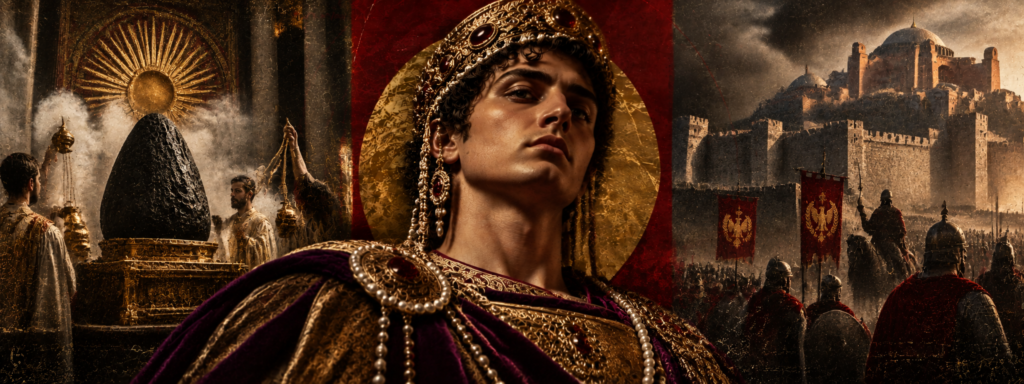
Justin II: The Emperor Who Lost His Mind as His Empire Fell Apart
He inherited the throne of Justinian the Great, one of the most powerful rulers in Byzantine history, and promised to restore an empire exhausted by war, taxation, and imperial ambition. Instead, Justin II would preside over military disasters, religious persecution, political humiliation, and the loss of territories his predecessor had fought desperately to recover. As enemies advanced and his authority weakened, the emperor himself reportedly descended into terrifying episodes of mental disturbance. Ancient witnesses described uncontrollable outbursts, frightening behavior, and a ruler who could no longer reliably govern. Eventually, his own wife helped transfer power to another man while Justin remained alive inside the palace, a crowned emperor whose authority had slipped from his grasp.
The imperial palace of Constantinople was supposed to be the safest place in the Byzantine Empire. Behind its guarded entrances, marble halls, ceremonial chambers, and richly decorated apartments lived the emperor, the man whose authority extended from the Balkans to the eastern Mediterranean. He commanded armies, appointed officials, directed religious policy, and claimed a sacred responsibility to protect the Christian Roman Empire. His position was surrounded by elaborate rituals designed to demonstrate that imperial government represented order in a world frequently threatened by violence. Yet during the final years of Justin II’s active reign, the palace reportedly became the setting for scenes that deeply disturbed those who witnessed them.
According to the sixth-century church historian John of Ephesus, the emperor experienced episodes of severe mental disturbance during which his behavior became frightening and difficult to control. John described Justin’s mind as agitated and darkened, portraying him as a ruler who sometimes behaved with the violence and unpredictability of a wild animal. Other accounts describe attendants struggling to manage his behavior, extraordinary efforts to calm him, and episodes of agitation that disrupted life within the imperial residence. The image was extraordinary: a man who possessed the highest authority in the Roman world had become increasingly dependent on the people responsible for protecting and attending him.
The circumstances surrounding Justin’s decline made the situation especially dangerous. Byzantine armies were struggling to contain Persian pressure in the east, while the Lombards had invaded Italy and begun dismantling much of the territory recovered during Justinian’s costly wars. In the Balkans, the arrival of the Avars created new military and diplomatic problems. The treasury faced enormous demands, and religious disagreements continued to divide Christian communities across the empire. At precisely the moment when the government needed decisive leadership, the emperor’s ability to exercise that leadership had become uncertain.
Justin had entered office determined to distinguish himself from his uncle, Justinian I. He criticized the financial burdens inherited from the previous administration, adopted a more confrontational foreign policy, and attempted to strengthen imperial authority through religious unity. Yet several of his decisions contributed to conflicts that the empire was increasingly unable to manage. By AD 574, his condition had deteriorated so severely that effective government required an extraordinary political arrangement. His wife, Empress Sophia, became central to the effort to preserve stability, and the general Tiberius was elevated to the rank of Caesar to assume much of the practical burden of ruling.
Justin remained emperor until his death in AD 578, but the effective direction of the government had passed into other hands. His story has often been reduced to the tragic image of a ruler who supposedly went mad after military defeat, although the surviving evidence does not support such a simple explanation. Contemporary sources describe serious behavioral and mental disturbances, but they do not provide enough reliable medical information to establish a modern diagnosis. Nor can historians confidently determine whether political stress, illness, neurological disease, or some combination of circumstances contributed to his condition.
What survives is a disturbing account of imperial ambition, military overextension, religious conflict, and the gradual collapse of one ruler’s ability to govern. Justin II inherited enormous problems, made consequential decisions of his own, and eventually became unable to exercise authority during a period of extraordinary danger. His reign reveals an unsettling contradiction at the heart of monarchy: an emperor could command armies, surround himself with guards, and claim authority sanctioned by God, yet remain vulnerable to forces that neither wealth nor political power could control.
The Shadow of Justinian: Born Into an Empire of Ambition
Justin II was born around AD 520 into a family whose fortunes had risen dramatically through the success of Justinian I. His mother, Vigilantia, was Justinian’s sister, making him the nephew of one of the most consequential emperors in late Roman history. Through that relationship, Justin belonged to the ruling dynasty and possessed a valuable connection to imperial authority long before he became emperor. His family background was not that of an ancient Roman aristocratic house with centuries of senatorial distinction, but rather one whose rise reflected the opportunities available through military service, administrative advancement, and political connections within the eastern Roman state.
The dynasty had emerged from the Balkan provinces, where Justinian’s uncle and predecessor, Justin I, had risen through military service before becoming emperor in AD 518. Justin I’s advancement from relatively modest origins to the imperial throne demonstrated that power in Constantinople did not belong exclusively to families with ancient aristocratic pedigrees. His nephew Justinian eventually inherited the throne and embarked on a reign of extraordinary ambition, transforming the political world into which Justin II matured. By the time the younger Justin reached adulthood, his uncle had become the central figure in an imperial project intended to restore Roman greatness across the Mediterranean.
Justinian’s armies, commanded by generals such as Belisarius and Narses, defeated the Vandal kingdom in North Africa and fought prolonged campaigns against the Ostrogoths in Italy. Imperial forces also established positions in southern Spain, restoring Roman authority to territories that had been outside direct imperial control for generations. These victories created the impression that the Roman Empire, diminished by centuries of political fragmentation in the west, might recover something resembling its former territorial reach. For supporters of Justinian, the campaigns demonstrated that Roman power remained formidable and that the emperor had fulfilled a sacred responsibility to defend and restore the Christian empire.
Yet the victories came at an enormous cost. The reconquest of Italy required nearly two decades of devastating warfare, while conflicts with Persia placed continuing pressure on the eastern frontier. Justinian’s government also confronted the catastrophic epidemic commonly known as the Plague of Justinian, which struck Constantinople in AD 541–542 and returned in later outbreaks. The disease caused severe mortality, although estimates of its overall demographic impact remain debated. Warfare, disease, and economic disruption placed substantial burdens on communities already expected to support the empire’s military and administrative ambitions.
Justinian’s magnificent building program further demonstrated both the wealth and the demands of imperial government. Hagia Sophia, completed in AD 537 after the destruction of its predecessor during the Nika revolt, became one of the most remarkable churches in the Christian world. Fortifications, churches, roads, and administrative projects appeared across the empire, reinforcing the image of a ruler determined to restore Roman greatness. These achievements became enduring symbols of his reign, but they also required resources that had to be collected, transported, and administered across an enormous territory.
Justin II grew up surrounded by this mixture of extraordinary achievement and mounting pressure. His uncle’s reign provided a model of imperial ambition, but it also left difficult questions about how the empire could sustain its commitments. Maintaining distant provinces required soldiers, officials, fortifications, and money, while the treasury faced competing demands from nearly every frontier. When Justin eventually inherited the throne, he would receive not simply Justinian’s prestige but the immense financial and military obligations associated with that legacy.
Sophia: The Woman Who Would Hold the Empire Together
Justin’s marriage to Sophia connected him even more closely with the imperial household. Sophia was a niece of Empress Theodora, Justinian’s formidable wife and one of the most influential women in Byzantine history. The marriage therefore united two branches of the ruling family’s extended network, strengthening Justin’s position within the political world of Constantinople. It also placed Sophia in a court where imperial women could exercise considerable influence through family connections, religious patronage, and personal access to the emperor.
Theodora had occupied an extraordinary position during Justinian’s reign. She participated in court politics, supported religious figures associated with Miaphysite Christianity, and became a central figure in accounts of the imperial response to the Nika revolt of AD 532. Her reputation was shaped by both admiration and hostility, with ancient writers presenting dramatically different portraits of her conduct. Nevertheless, her prominence demonstrated that an empress could become a significant political actor even within a system that formally concentrated supreme authority in the emperor.
Sophia inherited this complicated political environment. Imperial women did not possess a constitutional role equivalent to that of the emperor, but they could influence appointments, communicate with religious leaders, distribute patronage, and exercise authority through the networks surrounding the palace. Their position became particularly important during moments of succession or instability, when family legitimacy could determine whether a dynasty survived. Sophia would eventually demonstrate exceptional political influence during her husband’s incapacity, but her importance did not suddenly emerge during that crisis.
From the beginning of Justin’s reign, Sophia occupied a prominent position in the ceremonial representation of imperial power. Her image appeared on coinage, and she participated in the public identity of the ruling couple. The prominence of an empress could reinforce dynastic stability, particularly when the emperor lacked an obvious surviving son to succeed him. It also created opportunities for political involvement that became increasingly important as Justin’s government encountered difficulties.
Their marriage connected them to religious traditions that were politically sensitive. Theodora had supported Christians who rejected the Council of Chalcedon’s formulation concerning Christ’s two natures, while Justinian had repeatedly attempted to reconcile competing theological communities. Sophia’s own religious relationships and political choices were more complicated than any simple division between Chalcedonian and Miaphysite camps. Nevertheless, the imperial household remained closely connected with theological disputes that affected the political stability of Syria, Egypt, and other regions.
Justin and Sophia would eventually become deeply involved in these conflicts, sometimes pursuing policies that alienated communities the government hoped to reconcile. Their religious decisions would form part of the broader crisis of the reign, although Sophia’s most important historical role emerged when Justin could no longer reliably govern. Before that happened, however, the couple faced a more immediate political challenge. Justinian was growing old, and the question of succession remained dangerously uncertain.
The Death of Justinian and the Dangerous Struggle for Power
Justinian I died on November 14, AD 565, after a reign of nearly thirty-nine years. He had no surviving children who could inherit the throne, and the succession was not governed by a fixed hereditary rule. Several members of the extended imperial family possessed potential claims, while the support of palace officials, military commanders, and the Senate remained crucial. The death of a ruler who had dominated the empire for decades therefore created a moment of uncertainty in which speed and access to the political machinery of Constantinople could determine the future.
Justin II enjoyed a major advantage because he was already present in the capital and occupied the influential position of curopalates, an office associated with the imperial palace. His access to court officials placed him close to the center of government at the moment when Justinian died. The poet and official Corippus, who celebrated Justin’s accession in a surviving Latin panegyric, provides an elaborate account of the transition. His narrative emphasizes the orderly transfer of authority and the legitimacy of the new ruler, although it was written to praise Justin and cannot be treated as an entirely neutral description.
According to the accession tradition, influential palace figures moved quickly to secure Justin’s elevation. He was proclaimed emperor before competing claimants could organize an effective challenge, and the transition was presented as a legitimate continuation of Justinian’s dynasty. The speed of the process mattered because imperial succession could become violent when rival candidates possessed military support or influential patrons. Control of the palace, ceremonial institutions, and key officials allowed Justin’s supporters to establish his authority before opposition could develop.
One important rival was another Justin, commonly called Justin the cousin, a military commander associated with the eastern army. His position gave him potential support outside Constantinople, making him a possible threat to the new emperor. The rival was eventually removed from his military position and later killed, an event that ancient sources connect with the political insecurity of Justin II’s reign. The precise circumstances and responsibility for his death remain uncertain, but the episode demonstrates that the succession was not entirely free from danger.
Justin II was approximately forty-five years old when he took the throne. Unlike the teenage emperors whose inexperience had sometimes contributed to political instability, he was a mature court official who had spent years close to imperial government. His accession initially appeared secure, but the existence of rival family members and powerful military commanders created the possibility of future conflict. He also faced the challenge of establishing an identity separate from his uncle’s enormous reputation.
The new emperor began by presenting himself as a ruler determined to correct the failures of the previous administration. He inherited a government burdened by military commitments, financial demands, and religious disagreements, but he believed a different approach could restore confidence in imperial authority. His early actions suggested energy and determination, qualities that initially distinguished him from the image of decline that would later dominate his reputation. Yet the decisions he made in pursuit of imperial dignity would gradually expose the empire to dangers it was poorly positioned to confront.
A New Emperor Promises to Repair a Weary Empire
Justin II’s accession was accompanied by promises of financial relief and administrative reform. Contemporary accounts describe his government paying debts left by Justinian’s administration and attempting to restore confidence among people who had suffered from delayed payments and fiscal demands. The gestures were politically significant because Justinian’s long reign had produced extraordinary achievements while leaving resentment over taxation and the costs of warfare. By presenting himself as a ruler willing to address those grievances, Justin could distinguish his government from the burdens associated with his predecessor.
Corippus portrays the new emperor as generous, accessible, and committed to justice. Such descriptions belong to the conventions of imperial praise, but they reflect the public image Justin wished to establish. The new ruler was not simply continuing Justinian’s policies without question; he intended to demonstrate that a different approach to government was possible. Financial relief and public generosity helped reinforce his legitimacy during the uncertain period following the succession.
Yet financial reform could not eliminate the empire’s underlying obligations. Armies still needed to be paid, frontier defenses maintained, and distant territories administered. The reconquered provinces of Italy and North Africa required substantial resources, while the eastern frontier remained vulnerable to renewed conflict with Persia. Reducing unpopular financial burdens could strengthen domestic support, but maintaining imperial commitments demanded continuing expenditure.
Justin’s early policies also revealed a willingness to challenge diplomatic arrangements established under Justinian. He was particularly critical of payments made to neighboring powers in exchange for peace or military cooperation. To Justin, such arrangements could appear humiliating, suggesting that the Roman Empire was paying foreign rulers to refrain from attacking its territories. A government that claimed to represent the continuation of Roman greatness could find such concessions difficult to reconcile with its public image.
Nevertheless, diplomacy through subsidies and payments had long been part of Roman frontier policy. Money could sometimes achieve what military campaigns could not, preventing costly invasions or securing alliances with strategically important peoples. Justin’s determination to reject certain payments therefore carried substantial risks, especially when the empire’s military resources were already stretched. His desire to demonstrate strength would soon contribute to conflicts on several frontiers, exposing the dangerous gap between imperial ambition and practical military capacity.
The Dangerous Politics of Refusing Tribute
One of Justin II’s most consequential foreign-policy decisions involved the Avars, a powerful steppe confederation that had emerged as an important force north of the Danube. During Justinian’s reign, Roman diplomacy had used payments and negotiations to manage relations with the Avars and other groups whose military movements threatened the Balkans. These arrangements were not always successful, but they provided one method of limiting frontier conflict without committing large armies to continuous warfare. Justin inherited this complicated diplomatic system at a moment when the empire faced substantial obligations elsewhere.
Ancient sources describe him rejecting demands for subsidies and emphasizing that the Roman Empire should not purchase peace through payments to foreign rulers. The policy had an understandable political appeal because Roman imperial ideology celebrated military superiority and the emperor’s responsibility to defend the state. Payments to neighboring peoples could be portrayed as signs of weakness, particularly when they appeared to reward threats of invasion. For a ruler determined to restore imperial dignity, refusing such demands could seem an appropriate demonstration of strength.
The strategic situation, however, was far more complicated than the language of imperial prestige suggested. The empire faced military obligations in Italy, North Africa, and the east, while its Balkan defenses depended on forces that could not be concentrated everywhere simultaneously. The Avars possessed mobile military capabilities and could exert pressure through raids, alliances, and threats against neighboring peoples. Their growing influence contributed to instability across the Danube region, where political relationships were already changing rapidly.
Justin’s refusal to continue certain payments increased tensions, although the relationship between individual diplomatic decisions and later invasions was not always straightforward. The Avars pursued their own strategic interests, and the collapse of neighboring political structures also shaped events. One important development came in AD 567–568, when the Avars became involved in the destruction of the Gepid kingdom. Their alliance with the Lombards helped transform the political landscape north of the Danube, creating consequences that extended beyond the immediate frontier.
Justin’s government had sought to demonstrate strength by rejecting arrangements associated with imperial dependence. Instead, the empire confronted an increasingly dangerous strategic environment in which diplomatic flexibility became more difficult. The policy was not necessarily irrational, but it carried substantial risks because subsidies had been one method of managing threats that Roman armies could not always eliminate. By abandoning some of those arrangements, Justin increased the importance of military strength at precisely the moment when the empire faced serious limitations.
Italy Begins to Slip Away
The Lombard invasion of Italy in AD 568 became one of the defining disasters of Justin II’s reign. Under their king Alboin, the Lombards entered northern Italy and began establishing control over territories that Justinian’s armies had recovered from the Ostrogoths only a few years earlier. The invasion struck a peninsula already weakened by prolonged warfare, economic disruption, and the destruction of important infrastructure. For an empire that had spent enormous resources restoring Roman authority in Italy, the renewed loss of territory represented a devastating reversal.
Justinian’s Gothic War had caused immense damage across the peninsula. Cities had endured sieges, agricultural production had been disrupted, and political institutions had struggled to survive years of fighting. Although Byzantine forces eventually defeated the Ostrogothic kingdom, the reconquest did not restore Italy to the prosperity it had enjoyed before the wars. The imperial government inherited a territory that required extensive resources to defend and administer, while the local population continued to experience the consequences of military devastation.
The Lombards encountered an Italy whose defenses were uneven and whose resources had been depleted. Byzantine forces retained important cities and regions, but they lacked the strength to prevent the invaders from establishing themselves across much of the north. Milan fell to the Lombards, and Pavia eventually became a major center of Lombard power after a prolonged siege. The precise chronology of individual conquests varies among sources, but the overall pattern is unmistakable: imperial control over northern Italy contracted rapidly.
The invasion did not immediately eliminate Byzantine authority throughout the peninsula. The empire retained Ravenna, Rome, parts of southern Italy, and other territories, while local commanders continued resisting Lombard expansion. Nevertheless, the political consequences were profound because Italy became divided between Byzantine-controlled regions and emerging Lombard territories. This fragmentation would shape the peninsula for centuries, contributing to the development of distinct political communities and competing centers of authority.
For Justin II, the invasion represented a humiliating reversal of his uncle’s achievements. Justinian had invested enormous resources in restoring Roman rule over Italy, presenting the reconquest as the recovery of the empire’s historic heartland. Now, during the reign of his successor, substantial portions of that territory were being lost. The disaster cannot be attributed solely to Justin’s personal decisions, since Italy’s vulnerability reflected the destruction caused by the Gothic War, limited military resources, and broader political changes in central Europe.
Yet the invasion exposed the limits of Justin’s government. The empire could not simultaneously defend every frontier with the forces available, and Justinian’s reconquests had created obligations that were increasingly difficult to sustain. The loss of northern Italy became a visible reminder that territorial expansion did not guarantee permanent control. While the emperor struggled to contain the consequences of Lombard expansion, an even more dangerous conflict was developing along the eastern frontier.
Persia: The Enemy Justin Could Not Ignore
The eastern frontier remained one of the most strategically important regions of the Byzantine Empire. For centuries, Roman and Persian rulers had competed over territories, fortresses, trade routes, and political influence across Mesopotamia, Armenia, and the Caucasus. The rivalry involved two sophisticated imperial states whose armies possessed considerable experience and whose governments understood the importance of controlling frontier cities. Peace could reduce the enormous costs of warfare, but it rarely eliminated the underlying competition.
During Justinian’s reign, the empire had fought repeated conflicts with the Sasanian Persians under Khosrow I. The two powers eventually concluded a major peace agreement in AD 562, establishing arrangements intended to reduce frontier conflict. The agreement involved substantial financial payments from the Romans, reflecting the practical reality that maintaining peace could be less costly than continuing large-scale warfare. Justin II inherited this settlement but increasingly rejected the diplomatic assumptions behind it.
Tensions intensified over Armenia and the treatment of Christian communities under Persian influence. In AD 571, an Armenian rebellion against Persian authority created an opportunity for Byzantine intervention. Justin supported the Armenian rebels, a decision that challenged Persian interests and contributed to the breakdown of peace. Religious solidarity, strategic ambition, and imperial prestige all played roles in the conflict, making it difficult to separate theological concerns from the wider competition between the two empires.
The decision was dangerous because Persia remained a formidable military power. Khosrow I had demonstrated his ability to conduct major campaigns, and the Sasanian state possessed experienced armies, substantial resources, and an established system of frontier defense. Justin’s government nevertheless moved toward war, apparently believing that a more assertive policy could strengthen Byzantine influence and challenge Persian authority. The renewed conflict began in AD 572, placing the empire under additional military pressure while Italy remained threatened by Lombard expansion and the Balkans faced instability.
The eastern war would prove especially damaging to Justin’s reputation because it produced a major defeat that ancient writers later associated with the deterioration of his mental health. The catastrophe centered on Dara, one of the empire’s most important frontier fortresses. Its fall would undermine Byzantine defenses and expose the consequences of confronting Persia without sufficient military strength. For Justin, the loss became inseparable from the broader collapse of his political ambitions.
The Fall of Dara: A Fortress Lost, an Emperor Shaken
Dara was a heavily fortified city near the Roman-Persian frontier in northern Mesopotamia. Originally developed as a major military stronghold under Anastasius I, it occupied a strategic position in the defense of Byzantine territory against Persian invasion. Its walls, fortifications, and military importance made it a symbol of imperial strength, while control of the city helped protect the approaches to Roman territory. Losing Dara would therefore represent far more than the surrender of an isolated fortress.
In AD 573, Persian forces captured the city after a siege. The fall of Dara was a serious military disaster, undermining Byzantine defenses and damaging the prestige of Justin’s government. The defeat occurred during a period when the empire was already struggling to contain multiple threats, including Lombard expansion in Italy and pressure from the Avars in the Balkans. The eastern war had placed enormous demands on military resources, and the loss of a major frontier stronghold intensified the government’s difficulties.
Ancient writers connected the news of Dara’s fall with a dramatic deterioration in Justin’s condition. John of Ephesus and other sources describe the emperor becoming severely disturbed, suggesting that the military catastrophe contributed to his inability to govern. The connection is historically important, but it requires caution because the surviving evidence does not establish that the defeat directly caused a psychiatric illness. Justin may already have been experiencing symptoms, and later writers may have emphasized the disaster because it provided a dramatic explanation for his condition.
Nevertheless, the timing was politically devastating. The emperor who had rejected diplomatic payments and pursued a more confrontational policy toward Persia had suffered the loss of a major frontier fortress. The defeat weakened Byzantine defenses, damaged morale, and complicated negotiations with the Persian government. It also raised questions about the emperor’s judgment and the ability of his administration to manage the consequences of war.
The political crisis became even more troubling because Justin’s capacity to direct government was now uncertain. The empire faced military threats on several fronts, but the man responsible for its supreme authority could no longer reliably fulfill his role. The fall of Dara did not single-handedly destroy Byzantine power, and the empire would continue resisting Persia under later rulers. Yet for Justin II, the defeat became associated with the moment when the pressures of imperial government and his personal decline converged in a particularly disturbing way.
The Emperor’s Mind Begins to Fail
The most unsettling accounts of Justin II’s final years concern his reported episodes of severe mental disturbance. John of Ephesus, a contemporary church historian who experienced persecution under Justin’s religious policies, provides one of the most important descriptions. John portrays the emperor’s mind as agitated and darkened, describing behavior that appeared frightening and uncontrolled. His account includes episodes in which Justin reportedly cried out, behaved violently, and required extraordinary efforts from attendants to manage his condition.
Other narratives contain more elaborate stories about the emperor’s conduct, including accounts of attendants using music or special arrangements to calm him. Some traditions describe dangerous outbursts and bizarre behavior within the palace, creating an image of imperial authority transformed into helplessness and disorder. These descriptions became central to Justin’s reputation as a ruler who lost his sanity after military defeat. Their dramatic qualities, however, make careful interpretation especially important.
John of Ephesus was a valuable contemporary witness, but he was not a neutral observer. As a Miaphysite Christian who suffered under imperial religious persecution, he had strong reasons to criticize Justin’s government. His theological perspective influenced his interpretation of events, including the possibility that the emperor’s suffering represented divine punishment. The language he used to describe Justin’s condition therefore reflected both observations of disturbing behavior and the religious assumptions through which he understood the emperor’s misfortunes.
The reports nevertheless cannot simply be dismissed. Multiple traditions indicate that Justin experienced a serious condition that interfered with his ability to govern, and the political transfer of authority to Tiberius provides independent confirmation that a major crisis occurred. What remains uncertain is the nature of the illness. Modern writers have proposed psychiatric disorders, neurological disease, severe psychological distress, and other explanations, but none can be established from the surviving evidence.
The ancient descriptions of animal-like behavior and uncontrollable agitation may reflect genuine episodes, but they also employ literary language intended to emphasize the collapse of imperial dignity. The central historical fact is that Justin’s condition became sufficiently serious to disrupt government. For an emperor whose authority depended on personal participation in appointments, diplomacy, military decisions, and religious policy, such incapacity created a political emergency. The Byzantine Empire had no simple modern mechanism for removing an incapacitated ruler while preserving orderly government, and the court now needed to find a solution that would prevent the emperor’s condition from becoming a crisis of succession.
Inside the Palace: Fear, Secrecy, and Imperial Vulnerability
The imperial palace was not merely a residence. It was the administrative and ceremonial center of the Byzantine state, containing officials, guards, servants, advisers, and spaces where the emperor conducted public and private business. Decisions made within its walls could affect military campaigns hundreds of miles away, determine the careers of powerful officials, and influence religious communities across the empire. When Justin became unable to govern reliably, the consequences therefore extended far beyond his personal suffering.
Officials needed decisions, military commanders required instructions, and foreign powers continued to negotiate or fight regardless of the emperor’s condition. The court faced the difficult task of preserving the appearance and continuity of imperial authority while managing a ruler whose behavior had become unpredictable. Byzantine political culture placed enormous importance on ceremonial legitimacy, and openly acknowledging that the emperor could no longer exercise his responsibilities risked encouraging uncertainty. The government needed to maintain confidence without allowing the machinery of administration to become paralyzed.
Ancient descriptions of Justin’s illness emphasize the extraordinary contrast between his ceremonial position and his vulnerability. The emperor wore the symbols of supreme power, but attendants reportedly had to protect him from harm and manage episodes of agitation. Some accounts describe violent behavior toward those around him, although the details are difficult to verify and the more sensational stories should not be treated as confirmed incidents without qualification. Even without accepting every anecdote, the broader situation was deeply serious.
The problem was particularly dangerous because imperial incapacity could encourage conspiracies or competing claims to power. Byzantine history contained numerous examples of violent succession, military rebellion, and the removal of rulers whose authority had weakened. Justin himself had secured the throne through rapid action by palace officials, demonstrating how important control of the capital could become during a transition. If influential figures concluded that the emperor could no longer rule, they might attempt to install a successor through force rather than negotiation.
Sophia therefore faced a political challenge as well as a personal crisis. She needed to preserve her husband’s dignity and the legitimacy of his reign while ensuring that the empire had someone capable of exercising effective authority. The solution required cooperation among influential court officials, military leaders, and members of the Senate. It also required Justin, at least formally, to participate in the transfer of power, allowing the arrangement to appear as a legitimate imperial decision rather than an overthrow.
The man selected for that role was Tiberius, a military officer whose career had placed him close to the imperial household. His elevation would demonstrate that the empire could preserve continuity even when the reigning emperor became incapacitated. Yet the arrangement also revealed how much Byzantine stability depended on the cooperation of powerful individuals rather than on a fixed constitutional process. The court was preparing to transfer effective authority while leaving the crown on Justin’s head.
Empress Sophia Takes Control
Sophia emerged as the central political figure during Justin’s incapacity. Her position as empress gave her access to the palace, officials, and ceremonial machinery of imperial government, while her family connections reinforced her authority. Ancient sources describe her working with influential figures to stabilize the administration and arrange for a successor who could assume practical responsibilities without immediately removing Justin from the throne. Her intervention became one of the most consequential acts of the reign.
Her role was remarkable because Byzantine political institutions did not provide a straightforward system for an empress to govern independently. Women could exercise influence through dynastic status and court relationships, but formal supreme authority remained associated with the emperor. Sophia therefore needed a solution that preserved legitimacy while allowing decisions to be made by someone capable of carrying out the responsibilities of government. The choice of a designated successor offered a way to accomplish both objectives.
Tiberius was a politically practical candidate. He had military experience, held an important position connected with the imperial guard, and possessed the confidence of influential figures within the court. Elevating him to the rank of Caesar would establish him as an official successor while allowing Justin to remain Augustus, the senior emperor. The arrangement avoided the immediate dangers of deposition and allowed the government to present the transfer of responsibility as an orderly act within the existing dynasty.
Sophia’s involvement also protected her own political position. As the wife of a living emperor, she retained considerable prestige, and the selection of a successor through the existing court reduced the likelihood of a violent struggle. The decision was not simply an act of compassion toward an incapacitated ruler; it was a calculated response to an imperial emergency. The empire faced Persian warfare, territorial losses in Italy, and instability in the Balkans, making a prolonged vacuum at the center of government potentially disastrous.
Her intervention helped preserve continuity at a moment when Justin’s condition threatened the functioning of the state. It also demonstrated the political importance of imperial women in circumstances where formal institutions provided limited guidance. Sophia could not eliminate the empire’s military problems or reverse the emperor’s illness, but she could help prevent those difficulties from producing an immediate succession crisis. The arrangement she supported would allow Justin to retain his title while another man assumed responsibility for the empire’s survival.
Tiberius Constantine: The General Chosen to Save the Throne
Tiberius, later known as Tiberius II Constantine, had risen through military service and held the position of comes excubitorum, commander of the Excubitors, an elite imperial guard unit. His office placed him close to the emperor and gave him substantial influence within the palace. He was therefore familiar with the political environment surrounding Justin’s illness and possessed connections that could help secure the cooperation of military and administrative officials. These advantages made him a plausible candidate for the extraordinary responsibility the court intended to place upon him.
On December 7, AD 574, Tiberius was elevated to the rank of Caesar. The ceremony formally established him as Justin’s designated successor and provided a legitimate basis for his assumption of governmental responsibilities. Ancient accounts describe Justin participating in the elevation, although the extent of his ability to make independent decisions during this period remains uncertain. The ceremony was important because it allowed the transfer of authority to appear as an orderly act of imperial succession rather than a coup.
Tiberius adopted the name Constantine, strengthening the symbolism of continuity with Roman imperial tradition. His new position gave him authority to direct administration, military policy, and diplomatic negotiations while Justin remained the senior emperor. The arrangement represented a remarkable political compromise because the empire did not immediately remove its incapacitated ruler, nor did it allow the government to collapse around him. Instead, it created a structure in which another man could exercise practical authority under the legitimacy of the existing dynasty.
Sophia remained influential, and her relationship with Tiberius became an important feature of the new political arrangement. Ancient sources suggest that she expected to retain substantial authority, although tensions later emerged over the direction of government and the future succession. These disagreements were not unusual in a court where political power depended on personal relationships, dynastic claims, and access to the emperor. The important immediate achievement was that the government continued functioning despite Justin’s condition.
For Justin, the elevation of Tiberius marked the effective end of his active reign. He remained emperor in title, but the decisions shaping the empire’s future increasingly belonged to another man. The transformation was extraordinary because Justin had inherited the throne from one of Rome’s most powerful rulers, attempted to reshape imperial policy, and confronted military disasters that threatened the state. Now he occupied the palace as a living symbol of authority that he could no longer fully exercise.
Religious Persecution and the Emperor’s Troubled Legacy
Justin II’s reign was also marked by serious religious conflict, particularly involving Miaphysite Christians who rejected the Chalcedonian formulation concerning the nature of Christ. The theological disputes had deep roots in the fifth and sixth centuries, and their consequences extended far beyond arguments among bishops and theologians. Religious allegiance could shape regional identity, political loyalty, and relationships between Constantinople and influential Christian communities. The emperor’s attempts to impose unity therefore carried significant political consequences.
The Council of Chalcedon in AD 451 had defined Christ as existing in two natures, divine and human, united in one person. Many Christians in Egypt, Syria, and other regions rejected that formulation, favoring theological language emphasizing the unity of Christ’s incarnate nature. These disagreements affected church leadership, imperial legitimacy, and relations between the government and provincial populations. They also created rival networks of bishops, monasteries, and religious patrons whose influence could complicate attempts at reconciliation.
Justinian had attempted various forms of religious compromise while also using coercion against opponents. His wife Theodora had provided protection to some Miaphysite leaders, creating a complicated religious environment within the imperial household. Justin II initially pursued policies that appeared to offer possibilities for reconciliation, issuing statements intended to reduce theological conflict and encourage unity. Those efforts ultimately failed, and the emperor’s policies became increasingly coercive.
John of Ephesus, himself a Miaphysite bishop and historian, describes persecution directed against members of his religious community. His testimony includes accounts of arrests, pressure to accept Chalcedonian doctrine, and the suffering of clergy and believers. John’s perspective was shaped by personal experience and theological commitment, but his writings provide important evidence for the religious tensions of the reign. His hostility toward Justin also helps explain why his descriptions of the emperor’s later illness must be read with particular care.
The persecution damaged Justin’s reputation among communities already suspicious of imperial interference in religious affairs. It also undermined the possibility of reconciliation at a time when the empire needed stability and cooperation across its provinces. The religious conflict reveals another dimension of Justin’s government, demonstrating that his reign was not defined solely by foreign-policy failures or illness. His attempts to impose religious unity through imperial authority contributed to tensions that would continue shaping the eastern Mediterranean long after his death.
The Empire Justin Could No Longer Govern
By the time Tiberius assumed practical authority, the Byzantine Empire faced a difficult strategic situation. The eastern war with Persia had produced major setbacks, including the fall of Dara, while Lombard expansion had transformed the political landscape of Italy. The Balkans remained vulnerable to pressure from the Avars and other groups, and the empire’s military resources were stretched across several regions. Tiberius inherited the challenge of stabilizing the government while managing these overlapping threats.
One of his priorities was to restore diplomatic flexibility. The new administration sought arrangements that could reduce immediate military pressure and provide time to reorganize defenses. Negotiations with Persia produced temporary agreements, although the eastern conflict continued and required substantial resources. The government needed to balance the demands of military resistance with the financial and logistical limitations that had contributed to earlier difficulties.
Tiberius also pursued a more generous financial policy, distributing funds and attempting to secure loyalty through payments and public benefactions. Ancient writers often portrayed him favorably in contrast with Justin, emphasizing his generosity and willingness to relieve financial burdens. Such comparisons require caution because they reflect the political interests of writers evaluating successive rulers. Nevertheless, the transition brought a recognizable change in the presentation and management of imperial government.
Justin remained alive throughout these developments, but his role was increasingly ceremonial. The empire had effectively entered a period of delegated authority in which the designated successor directed much of the government while the senior emperor remained incapacitated. This arrangement preserved political continuity, but it also demonstrated the vulnerability of a system concentrated around one ruler. Justinian’s empire had depended heavily on the personal direction of an energetic emperor, while Justin’s illness exposed the difficulty of maintaining that model when the individual occupying the throne could no longer perform its responsibilities.
The solution was not institutional reform in the modern sense. It was another carefully managed dynastic arrangement, dependent on the cooperation of powerful individuals. The court had found a way to keep the government functioning without immediately removing Justin, but the arrangement remained vulnerable to changes in personal relationships and political loyalties. For the moment, however, it prevented the emperor’s incapacity from producing an immediate collapse of central authority.
The Final Years: An Emperor Still Alive but No Longer Ruling
Justin II lived for nearly four years after Tiberius was elevated to Caesar. During this period, he remained Augustus, retaining the highest imperial title while the practical responsibilities of government were increasingly exercised by his designated successor. The arrangement created an unusual division between ceremonial authority and effective power, allowing the empire to preserve the legitimacy of the reigning emperor while another man directed its affairs. Justin’s position remained formally supreme, but his ability to shape policy had become severely limited.
The surviving sources provide limited reliable information about the daily course of Justin’s condition during these years. Ancient writers focus primarily on the dramatic episodes that led to the transfer of authority rather than offering a systematic account of his subsequent health. Some traditions suggest that his condition fluctuated, with periods of greater awareness alternating with episodes of disturbance. Such reports cannot be translated into a confident modern diagnosis, but they reinforce the impression that his incapacity was serious and prolonged.
Sophia continued to occupy a prominent position within the palace. Her political role remained important, although the balance of authority between her and Tiberius evolved as the latter consolidated his position. The arrangement also created questions about the future because Justin had no surviving son who could inherit the throne. Tiberius’s elevation provided a practical solution to the succession problem, but the court still needed to ensure that the eventual transfer of supreme authority would occur without renewed conflict.
In September AD 578, Justin elevated Tiberius to the rank of Augustus, making him co-emperor. The ceremony formalized the position Tiberius had already occupied in practice and prepared the empire for the senior emperor’s death. Justin died on October 5, AD 578, at approximately fifty-eight years of age, ending a reign that had begun with ambitious promises of financial reform and imperial dignity but had become associated with military reversals, religious persecution, and severe personal incapacity.
Tiberius II Constantine succeeded him as sole emperor, preserving continuity at a moment when the empire could ill afford another violent succession. The transition was comparatively orderly, particularly when measured against the repeated assassinations and civil wars that had marked other periods of Roman imperial history. Yet Justin’s reputation would remain dominated by the disturbing accounts of his final years. The emperor who had inherited Justinian’s throne became remembered not only for the military disasters of his reign but also for the extraordinary circumstances under which he surrendered effective authority while still alive.
Was Justin II Really Insane?
Justin II has frequently appeared in discussions of monarchs believed to have experienced mental illness. Ancient descriptions of agitation, violent behavior, confusion, and incapacity have encouraged modern speculation about psychiatric or neurological disorders. The accounts are disturbing, particularly because they describe a ruler whose condition became severe enough to interfere with government. Yet the evidence does not permit a reliable diagnosis, and the language used by ancient historians must be interpreted within its historical context.
John of Ephesus provides valuable contemporary testimony, but his descriptions were written within a religious and political framework that interpreted imperial conduct through moral and theological concerns. His personal experience of persecution under Justin’s government also shaped his perspective. Other writers preserved accounts of the emperor’s behavior, sometimes adding dramatic details that became increasingly sensational in later retellings. These narratives are important historical evidence, but they cannot be treated as clinical records.
The reports suggest that Justin experienced a serious condition affecting his behavior and ability to govern. That conclusion is supported by the political necessity of elevating Tiberius and transferring practical authority. However, the symptoms described are not specific enough to establish a particular illness. Severe agitation, confusion, behavioral changes, and episodes of apparent disorientation can arise from many different medical and psychiatric conditions, making retrospective diagnosis especially uncertain.
The popular claim that Justin simply went mad after hearing of Dara’s fall is also too simplistic. The military defeat may have intensified an existing condition or contributed to severe distress, but the surviving sources cannot demonstrate a direct causal relationship. Ancient historians often connected political catastrophe with personal collapse because the relationship created a compelling moral narrative. An emperor whose decisions had contributed to disaster could be portrayed as suffering a punishment that reflected the failures of his government.
Such interpretations reveal the values of the writers, but they do not establish medical causation. Justin’s illness should therefore be understood as a serious historical event whose precise nature remains unknown. It affected the functioning of the Byzantine state and required an extraordinary political response, making its political consequences more securely established than any modern medical label. The emperor’s suffering was significant enough to alter the government of an empire, even if its explanation remains beyond recovery.
The Emperor Who Inherited Too Much
Justin II’s reign is sometimes portrayed as a straightforward failure, particularly when compared with the achievements of Justinian I. The contrast is understandable because Justinian had reconquered territories, commissioned monumental architecture, and left a lasting legal legacy, while Justin’s reign witnessed the Lombard invasion of Italy, renewed war with Persia, and the loss of Dara. Yet the comparison risks obscuring the problems Justin inherited. The empire he received was impressive in size and prestige, but its commitments had become increasingly difficult to sustain.
Justinian’s reconquests had extended imperial responsibilities across enormous distances. Maintaining those territories required resources that the empire struggled to provide, particularly after decades of warfare and epidemic disease. The peace arrangements Justin inherited were also politically complicated because payments to foreign powers could preserve stability while appearing humiliating to rulers determined to demonstrate imperial strength. Justin’s decisions contributed to the deterioration of foreign relations, especially in the east, but they were made within a strategic environment already marked by severe pressures.
The Lombard invasion of Italy reflected weaknesses created by the Gothic War and broader political changes in central Europe. The Persian conflict emerged from longstanding competition between two powerful states, intensified by developments in Armenia and disputes over diplomatic obligations. Justin therefore bears responsibility for consequential choices without being the sole cause of every disaster associated with his reign. His policies mattered, but they interacted with structural problems that had developed long before he became emperor.
His religious policies also require critical examination. Attempts to impose unity through coercion damaged relations with Miaphysite communities and contributed to the continuing fragmentation of Christian society within the empire. These decisions reflected the belief that religious agreement could strengthen imperial stability, yet coercion often deepened the divisions it was intended to resolve. Justin’s government therefore faced not only external military threats but also internal tensions that complicated relations between Constantinople and important provincial populations.
The emperor’s illness made these problems more dangerous, but it did not create them. By the time he became incapacitated, the empire was already confronting the consequences of military overextension, diplomatic confrontation, and religious division. His inability to govern intensified the crisis because it weakened the center of political decision-making when coordinated leadership was especially important. The reign of Justin II therefore reveals the limits of imperial power in a state whose ambitions had exceeded its capacity to control every frontier.
The Dark Legacy of Justin II
Justin II ruled the Byzantine Empire from November AD 565 until his death in October AD 578, although his effective authority was substantially reduced after the elevation of Tiberius in AD 574. His reign began with the promise of reform and a determination to restore imperial dignity after the exhausting final years of Justinian’s government. He inherited a vast empire whose military achievements concealed serious weaknesses, including the enormous cost of defending reconquered territories and the continuing demands of the eastern frontier. The difficulties he faced were substantial, but his own decisions contributed to the crises that would eventually overwhelm his administration.
The Lombard invasion transformed Italy, undermining much of Justinian’s reconquest and establishing a political division that would endure for centuries. The renewed war with Persia culminated in the loss of Dara, a major strategic defeat that damaged imperial prestige and weakened frontier defenses. At the same time, religious persecution alienated communities whose cooperation remained important to the empire’s stability. Justin’s government struggled to reconcile theological differences and increasingly relied on coercion, deepening tensions that had already divided eastern Christianity.
His personal decline added another layer of tragedy. Contemporary accounts describe severe disturbances that interfered with his ability to govern, although their precise medical explanation remains unknown. The image of an emperor behaving uncontrollably within the palace became one of the most memorable features of his historical reputation. Yet the sensational stories should not obscure the political significance of what followed, because the court responded to his incapacity through a carefully managed transfer of practical authority.
Sophia and influential officials arranged for Tiberius to assume responsibility for government while Justin retained the imperial title. The arrangement demonstrated both the fragility and adaptability of Byzantine imperial politics, preserving continuity without immediately removing the incapacitated ruler. Justin remained emperor until his death, but the final years of his reign belonged increasingly to the man chosen to succeed him. His story is therefore not simply that of a ruler overwhelmed by illness, but of an empire struggling to sustain the ambitions of a previous generation while confronting new military, financial, and religious realities.
The contrast with Justinian remains unavoidable. Justinian had sought to restore the Roman world through conquest, law, and monumental construction, leaving behind achievements that would shape Byzantine civilization for centuries. Justin inherited the consequences of those ambitions and discovered that preserving an empire could be more difficult than expanding it. His reign ended without the violent assassination that destroyed many Roman emperors, but it was marked by a different kind of loss: the gradual disappearance of effective authority while the ruler himself remained alive.
For years, Justin had occupied the center of a political system that presented the emperor as the guardian of Roman civilization and the earthly defender of Christian order. His commands could send armies across distant provinces, determine the fate of religious communities, and alter the relationships between powerful states. Yet when his health deteriorated, those immense powers offered no protection against the loss of his ability to govern. The empire continued through the decisions of others, while Justin remained within the palace that had once symbolized his unquestioned authority.
Justin II inherited the throne of a man remembered as great, but he also inherited an empire burdened by the cost of greatness. As Italy fractured, Persia advanced, and religious divisions deepened, the emperor himself became unable to govern. His final years revealed the cruel limits of imperial power, demonstrating that even the ruler of the Roman world could become dependent on the people who served him. He had inherited armies, palaces, titles, and the authority of an ancient empire, but none of those things could guarantee his health or preserve his control over events. In the end, Justin remained an emperor long after effective power had passed from his hands, leaving behind the haunting image of a ruler surrounded by the symbols of absolute authority while the government of his empire continued without him.