
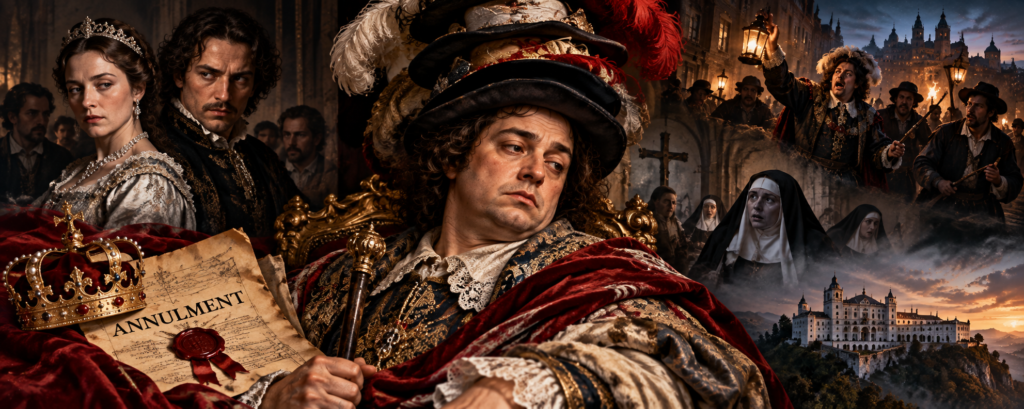
Afonso VI of Portugal: The Broken King, the Stolen Crown, and the Palace Coup That Buried Him Alive
King of Portugal, 1656–1683 | Afonso the Victorious | Disability, Political Intrigue, Deposition, and Confinement
The King Who Lived Sixteen Years After Losing His Throne
In November 1667, King Afonso VI of Portugal was still alive, still crowned, and still legally sovereign, but the world around him was already beginning to behave as though his reign were over. His government was collapsing into the hands of his younger brother Pedro, his powerful minister Luís de Vasconcelos e Sousa, Count of Castelo Melhor, had been driven from power, and his wife Marie Françoise of Savoy had abandoned the royal household and taken refuge in a convent. Within a matter of weeks, Afonso would be pressured into surrendering effective control of the government. He would remain king in name for another sixteen years, but he would never again exercise meaningful authority over the kingdom that continued to bear his name.
The destruction of Afonso’s political life was accompanied by an even more personal humiliation. Marie Françoise sought an annulment on the grounds that their marriage had never been consummated, forcing an investigation into the king’s sexual capabilities and private physical condition. Witnesses were questioned, intimate allegations circulated, and the body of the reigning monarch became evidence in a proceeding that was simultaneously religious, marital, dynastic, and political. After the marriage was annulled, Marie Françoise married Pedro, the very brother who had taken control of Afonso’s government. To anyone sympathetic to the imprisoned king, the sequence could hardly have looked more suspicious.
Afonso’s enemies had powerful material with which to justify what they were doing. A severe childhood illness had left him with significant physical disabilities, including weakness or paralysis affecting one side of his body and an abnormal gait. Contemporary and near-contemporary accounts also describe educational difficulties, impulsiveness, violent behavior, inappropriate companions, extraordinary eating habits, sexual scandal, and an inability or unwillingness to conform to the ceremonial expectations surrounding a seventeenth-century monarch. Some reports portray him roaming Lisbon at night with a gang of disreputable favorites, breaking windows, provoking fights, terrorizing pedestrians, and seeking entertainment in convents. Other stories depict a grotesquely eccentric king who remained in bed, overate until he vomited, wore multiple coats and hats, and surrounded himself with men whose criminal behavior should have placed them before royal justice rather than within the royal household.
Yet almost everything about Afonso VI comes with a warning. He was genuinely disabled, and there are strong reasons to believe that his childhood illness had neurological as well as physical consequences, but the precise extent of his cognitive impairment cannot now be established. He appears genuinely to have behaved badly on numerous occasions, but many of the most sensational stories were preserved in a political environment in which proving him incapable served the interests of people who had taken his authority. His wife benefited from demonstrating his physical incapacity, his brother benefited from demonstrating his political incapacity, and the aristocratic faction that overthrew his favorite benefited from portraying the king as a dangerous puppet surrounded by unsuitable men.
Afonso’s story is therefore not a simple tale of a mad king who had to be removed, nor is it a straightforward story of an innocent disabled monarch destroyed entirely by conspiracy. The darker possibility is that both sides of his reputation contain truth. Afonso may have suffered serious neurological impairment and still have been politically exploited; he may have been violent and impulsive while his enemies exaggerated those characteristics; and Pedro may have been a more capable ruler while also taking ruthless advantage of his brother’s weakness. That ambiguity makes Afonso one of the most disturbing figures in the Mad Monarchs, because his downfall occurred in the murky territory where illness, disability, propaganda, ambition, family betrayal, and genuine political necessity became almost impossible to separate.
The Prince Who Was Never Supposed to Be King
Afonso was born in Lisbon on August 21, 1643, into a monarchy that was itself still fighting for survival. His father, João IV, had become king only three years earlier after the Portuguese revolution of 1640 ended sixty years of rule by the Spanish Habsburgs. Portugal had restored a separate monarchy under the House of Braganza, but Spain did not simply accept the loss, and the resulting Restoration War would continue for most of Afonso’s youth. The young prince therefore entered a dynasty whose legitimacy remained bound to military resistance, diplomatic maneuvering, and the need to prove that the restored Portuguese crown could survive.
Afonso was not originally expected to inherit that crown. His elder brother Teodósio, Prince of Brazil, stood ahead of him in the succession and was educated as the future king. This allowed Afonso’s family to treat his health problems as a personal and dynastic concern without immediately confronting the far more dangerous question of whether a physically and possibly neurologically impaired child could someday govern Portugal. Had Teodósio lived, Afonso might have remained an important but secondary prince, protected by rank while spared the responsibilities of sovereignty. Instead, death would eventually remove the brother who stood between Afonso and a throne for which almost nobody seems to have believed he was naturally suited.
The defining medical event of Afonso’s childhood occurred when he was roughly three or four years old. Sources describe a severe illness, often called a malignant fever, after which he was left with lasting physical impairment. Modern historians and physicians have sometimes suggested meningoencephalitis or another infection affecting the central nervous system, but no diagnosis can be established with certainty centuries later. What is much more secure is that the illness left significant weakness on one side of his body, usually described as affecting his right side, and caused a pronounced difficulty in walking that remained visible throughout his life.
There are also indications that the illness affected more than his movement. Afonso struggled with education, and later observers described problems involving memory, learning, judgment, emotional control, and intellectual development. These reports have encouraged the view that the childhood illness caused permanent neurological damage, but determining its exact severity is extremely difficult because many descriptions were written or repeated after Afonso had become politically inconvenient. He was clearly capable of speech, relationships, preferences, anger, political attachments, and at least some understanding of the struggles surrounding him, which makes portrayals of him as completely intellectually helpless implausible.
The situation became dramatically more serious when Teodósio died in 1653 at only nineteen. Afonso, once the impaired younger son who could remain at the edge of dynastic responsibility, suddenly became heir to the throne. The change must have transformed the way the entire court viewed him, because characteristics that might have been tolerated in a younger prince now had constitutional implications. Portugal’s future king was physically disabled, educationally behind what was expected of a monarch, and approaching adolescence in a kingdom still at war with Spain.
Three years later João IV died, and thirteen-year-old Afonso became king. His mother, Luísa de Gusmão, assumed the regency because her son was still a minor. The crown had passed exactly as hereditary law required, but hereditary law had no mechanism for asking whether the boy who inherited it possessed the abilities the office demanded. Portugal now faced a problem that would define the next decade: Afonso was unquestionably king by blood, while the question of whether he could actually rule remained unanswered.
A Crown Without Power
Queen Luísa was no passive caretaker. She had been closely involved in the political world surrounding the Braganza restoration and understood the dangers confronting the dynasty. Under her regency, Portugal continued its war with Spain, maintained diplomatic relationships abroad, and attempted to secure the restored monarchy against both foreign attack and internal instability. Afonso occupied the throne, but the machinery of government remained firmly in adult hands.
As the king grew older, that arrangement became increasingly difficult to sustain. A regency is theoretically temporary, and every year that passed brought Afonso closer to the point at which an adult monarch would ordinarily assume personal control. If Luísa continued governing indefinitely, she risked appearing to usurp her son’s legitimate authority. If she surrendered power to a young man she believed incapable of using it responsibly, she risked placing the kingdom in the hands of someone whose judgment she did not trust.
Afonso’s developing personality did little to resolve those fears. He seems to have resisted the disciplined educational program expected of a prince and showed far more enthusiasm for physical entertainment, rough companionship, and nighttime activity than for the slow routines of administration. His disability did not prevent him from seeking excitement, and his attraction to people outside the highest aristocratic circles became particularly controversial. The court increasingly divided between those who wanted to protect the king from unsuitable influences and those who realized that gaining his personal affection could provide a route around the regency.
One of the most notorious figures in this early circle was António Conti, an Italian or foreign-born companion of comparatively low social standing. Conti became closely associated with Afonso’s youthful excesses and with the group of rough companions who allegedly accompanied the king on nocturnal expeditions through Lisbon. Established courtiers regarded such men with contempt, but Afonso may have found precisely their lack of aristocratic polish attractive. A prince who had spent his life being examined, corrected, and quietly judged by nobles might understandably prefer companions who amused him rather than reminding him of his deficiencies.
The political consequences were serious regardless of Afonso’s motives. Access to a king was power, and men who enjoyed his personal affection could potentially influence appointments, favors, punishments, and policy. The problem was therefore not merely that Afonso kept socially unsuitable friends. It was that a young monarch whose capacity was already questioned appeared increasingly willing to trust people whom the traditional governing elite regarded as irresponsible, violent, or opportunistic.
The Night King of Lisbon
The stories of Afonso’s nighttime behavior are among the most sensational elements of his biography. According to hostile and later accounts, the king and his companions prowled Lisbon after dark, breaking windows, damaging property, provoking fights, harassing pedestrians, and turning the capital into a playground for royal hooliganism. Merchants, beggars, servants, and ordinary inhabitants could supposedly find themselves confronted by a group whose leader was effectively beyond normal punishment because he happened to be the king. The image is almost cinematic: a disabled monarch who struggled through formal court life becoming animated after dark, surrounded by companions who transformed royal privilege into street violence.
It is difficult to determine how frequently such incidents occurred or how many of the most dramatic details were later embellishments. Political enemies had obvious reasons to portray Afonso as a menace who could not distinguish kingship from lawlessness. Yet concerns about his companions and conduct arose before the final coup against him, which makes it equally unwise to dismiss the entire pattern as propaganda invented after 1667. The most reasonable conclusion is that there was genuine disorder surrounding Afonso’s youthful household, while later retellings selected and intensified the most shocking episodes.
The allegations were particularly damaging because they inverted the basic symbolism of monarchy. A king was supposed to stand above private violence as the source of justice, punishing people who disturbed the peace and protecting subjects from arbitrary aggression. Afonso was instead accused of participating in precisely the behavior his courts were supposed to suppress. If a merchant’s window was smashed by ordinary youths, the law could intervene; if the king himself stood among the offenders, the very idea of legal accountability became absurd.
His preference for men associated with violence further damaged his reputation. Later accounts, including those repeated by the eighteenth-century historian Thomas Carte, claim that Afonso sometimes showed a perverse attraction to men accused of serious crimes and might prefer recruiting a dangerous individual into his personal service rather than seeing him punished. Such stories should not be accepted literally without corroboration, especially given their later transmission, but they reflect a persistent contemporary theme: the king valued toughness, aggression, and personal loyalty more than respectable pedigree. To aristocratic critics, this made his household look less like a royal court than a gang protected by the crown.
Reports of dog fighting and other violent entertainment fit the same pattern. Blood sports were hardly unique to Afonso’s Portugal, and cruelty toward animals cannot simply be used as evidence of mental illness in an age when such spectacles were widely tolerated. What disturbed observers was the alleged disorder surrounding the king’s enjoyment of them, including claims that dog fights took place within palace spaces where ceremonial dignity was supposed to prevail. Afonso repeatedly appears in the sources as a ruler who either could not or would not respect the boundaries separating royal recreation from royal responsibility.
Convents, Scandal, and the King Who Crossed Every Boundary
Afonso’s reputation for disorder extended into religious spaces. Stories circulated that he and his companions visited convents not simply for worship or formal royal patronage but for amusement, flirtation, and rowdy entertainment. Some accounts describe inappropriate performances staged in or around convent settings, while others claim the king pursued relationships with cloistered women. These stories became part of a larger portrait in which Afonso appeared incapable of recognizing the social, sexual, and religious boundaries expected of a Catholic monarch.
The allegations require considerable caution. Early modern convents were not always completely isolated from aristocratic society, and royal or noble contact with religious houses was normal. Women from powerful families entered convents, relatives visited them, patronage relationships developed, and convent parlors could become important social spaces. A king’s presence around a religious community therefore cannot automatically be transformed into evidence of sacrilege or sexual misconduct.
More serious claims allege that Afonso became violently jealous over women in religious houses and threatened or ordered retaliation against men he considered rivals. Those accusations are difficult to establish and should not be treated as documented murders without stronger evidence. They fit so neatly into the later image of Afonso as a violent sexual deviant that historians have particular reason to ask how much was contemporary fact and how much was political storytelling. Nevertheless, the persistence of reports about inappropriate conduct around women suggests that Afonso’s reputation for sexual disorder was already established before his marriage became a political weapon.
That reputation would later create a striking contradiction. Afonso was simultaneously portrayed as sexually predatory and sexually incapable, a man supposedly pursuing women in convents while being unable to consummate his own marriage. To modern readers those accusations may seem mutually exclusive, but seventeenth-century observers could distinguish between sexual interest, sexual behavior, fertility, impotence, and successful intercourse. A man could therefore acquire a reputation for lechery while still being accused of a physical incapacity that prevented him from functioning as a husband.
The contradiction also demonstrates how thoroughly Afonso’s body had become public property. His enemies could portray his sexual appetite as evidence of moral disorder and his sexual limitations as evidence of physical inadequacy without feeling any need to reconcile the two. Both accusations served the same larger conclusion: this was a king whose body, appetites, and judgment were fundamentally out of control. By the time his marriage collapsed, that conclusion would have consequences far beyond gossip.
The Grotesque King of Later Memory
Afonso’s personal habits generated some of the most memorable stories attached to his name. He was accused of extreme gluttony, remaining in bed for long periods, refusing ordinary court routines, and dressing in bizarre combinations of clothing. Particularly famous are accounts that he sometimes wore numerous coats and placed several hats upon his head at once. Whether these habits occurred exactly as later writers described them is uncertain, but they became visual shorthand for a king portrayed as incapable of normal behavior.
His eating attracted equally lurid attention. Some accounts describe enormous meals brought to him in bed, followed by continued eating and drinking until he became physically sick. Modern writers have occasionally tried to interpret this behavior through present-day eating disorders, but the evidence does not support a confident psychiatric diagnosis. Overeating may have been genuine, yet inactivity, neurological problems, medication, digestive illness, court excess, and hostile exaggeration could all have contributed to the descriptions that survived.
The bed itself became part of the caricature. Afonso was said to resist rising and sometimes required religious observances to accommodate him rather than following the ceremonial schedule expected of a monarch. The image of a king hearing Mass from bed while eating excessively and dressing absurdly was politically devastating because it suggested both physical incapacity and contempt for royal responsibility. Yet his known mobility problems make it essential to distinguish disability from laziness, something his contemporaries were not always willing or able to do.
A man with significant hemiparesis would experience dressing, walking, standing through lengthy ceremonies, mounting horses, climbing stairs, and navigating palace spaces differently from an able-bodied courtier. Behaviors interpreted as indolence could sometimes have reflected fatigue, pain, weakness, or the practical difficulties created by his condition. This does not mean every report should be explained away medically, but it does mean that Afonso’s disability was repeatedly moralized. His body did not merely function differently; observers turned those differences into evidence that his character and intellect were defective as well.
This is one of the reasons his reputation demands unusual caution. Afonso almost certainly gave contemporaries genuine reasons for concern, but those concerns developed in a society that had little concept of separating neurological disability from moral worth. Once he became politically vulnerable, every strange habit could be fitted into a single narrative of monstrosity. The impaired king gradually disappeared beneath the grotesque figure his enemies and later historians found much easier to describe.
Castelo Melhor and the Struggle Against the Queen Mother
By the early 1660s, the political tension between Afonso and his mother could no longer remain unresolved. Luísa had governed Portugal for years and had strong reasons to doubt whether her son was prepared to replace her. Afonso, however, had equally obvious reasons to resent remaining under maternal control after reaching adulthood. Into this conflict stepped Luís de Vasconcelos e Sousa, Count of Castelo Melhor, an ambitious and capable courtier who understood how much power could be gained by helping the king escape the regency.
Castelo Melhor became increasingly important to Afonso and helped organize the faction that challenged the queen mother’s government. Later narratives often portray him as a manipulator who filled the impaired king’s mind with paranoid fears that Luísa intended to steal his crown or exile him. There may have been manipulation, but the underlying political conflict was real enough without inventing a delusion. Afonso was legally king, and his mother was continuing to exercise the authority attached to his crown.
In 1662 the confrontation ended with the queen mother’s removal from effective government. Afonso and his allies asserted control, and Luísa withdrew from political life, eventually entering a convent. She died in 1666. The episode has often been described as a cruel and irrational son banishing the mother who had protected his kingdom, but that interpretation overlooks the constitutional problem created by an adult monarch whose regent was reluctant to surrender power.
What followed, however, hardly demonstrated Afonso’s independence. Castelo Melhor became the dominant political figure in the new government and acquired the powerful position of escrivão da puridade, giving him extraordinary access to the king and influence over state affairs. Afonso had escaped government by his mother only to become heavily dependent upon another person capable of managing him and translating royal authority into practical policy. His enemies would later use that dependence as proof that the king could not govern without someone governing through him.
The irony was that Castelo Melhor proved considerably more effective than the lurid image of Afonso’s court might suggest. Portugal was still fighting Spain, and the government required military organization, finance, diplomacy, and sustained administrative work. Under Castelo Melhor, the state did not simply collapse into the chaos of the king’s alleged nocturnal adventures. Some of the most important victories in the struggle for Portuguese independence occurred while Afonso remained on the throne and Castelo Melhor directed much of the government.
The Victorious King Who Did Not Win His Own Victories
Afonso VI eventually became known as O Vitorioso, “the Victorious,” because Portugal achieved major military successes during his reign. The epithet is one of the great ironies of his life. A king later remembered as incapable presided over the period in which Portuguese forces dealt Spain some of the defeats that effectively secured the survival of the restored Braganza monarchy. Those victories belonged directly to commanders, soldiers, ministers, and the administrative system sustaining them, but early modern political culture naturally attached the glory of successful warfare to the reigning sovereign.
The Battle of Ameixial in 1663 was particularly important. A Spanish invasion had penetrated Portugal and captured Évora, creating a serious threat, but Portuguese forces counterattacked and defeated the invading army. Two years later, at Montes Claros in 1665, another major Spanish force was decisively beaten. The victory substantially weakened Spain’s ability to reverse Portuguese independence by military means.
These successes complicate any description of Afonso’s reign as a period of uninterrupted governmental incompetence. Portugal could function effectively even if the king himself was poorly suited to administration because monarchy was never simply one man making every decision. Councils, ministers, military commanders, diplomats, financiers, secretaries, and local officials continued to operate. Castelo Melhor’s political importance demonstrated how a capable minister could use the authority of a weak sovereign to pursue coherent policy.
Yet the very success of government without substantial personal leadership from Afonso made him vulnerable. If ministers could run the kingdom, armies could win battles, and diplomacy could proceed while the king spent much of his time pursuing personal interests, then his practical indispensability diminished. The monarchy needed a legitimate sovereign, but it did not necessarily need Afonso personally directing the state. That distinction would become increasingly important when a politically more attractive member of the dynasty emerged as an alternative.
Afonso’s younger brother Pedro occupied exactly that position. He had the advantages Afonso lacked: greater physical conventionality, stronger acceptance among influential nobles, and no childhood reputation for neurological impairment. As long as Castelo Melhor controlled government and Portugal remained at war, Pedro’s potential role could be contained. Once the political coalition around Afonso began to fracture, however, the younger brother became the obvious person around whom opposition could organize.
A French Queen Enters a Dangerous Court
In 1666 Afonso married Marie Françoise of Savoy-Nemours, a French princess whose marriage strengthened Portugal’s diplomatic relationship with France. The alliance had strategic value because Portugal still needed international support while its conflict with Spain remained unresolved. Yet the most important domestic purpose of the marriage was unmistakable. Afonso needed to produce a legitimate heir and secure the future of the Braganza dynasty.
Marie Françoise arrived in a court already divided by faction. Castelo Melhor dominated government, Afonso carried a deeply troubling personal reputation, and Pedro remained close enough to the succession that every failure of the royal marriage increased his importance. The new queen therefore entered an environment in which her private relationship with her husband could immediately affect the balance of power. Her bedchamber was never merely a private space because the future of the monarchy depended upon what happened there.
The marriage deteriorated with extraordinary speed. Marie Françoise later maintained that Afonso had never consummated it and that he was physically incapable of doing so. She also became hostile to Castelo Melhor and increasingly connected with the political coalition forming around Pedro. Whatever personal unhappiness existed between husband and wife soon became inseparable from the struggle over who would control Portugal.
Reports of Afonso’s treatment of Marie Françoise include allegations of cruelty and physical abuse. These accusations cannot simply be dismissed because the queen later benefited politically from his downfall, but neither should every hostile claim be accepted without qualification. By the time the marriage crisis erupted publicly, Marie Françoise and Afonso occupied opposing sides of a political struggle in which evidence of his violence strengthened both her personal case and the argument that he was unfit to rule.
The marriage produced no children, which made every rumor more dangerous. Afonso’s sexual capabilities became a matter of state because an impotent king could not secure the succession. His previous reputation for sexual impropriety did nothing to protect him, because the question was not whether he displayed sexual interest but whether he could physically consummate a legitimate marriage and father an heir. In 1667 that question moved from whispered court gossip into an astonishing public and ecclesiastical proceeding.
The Queen Abandons the King
Marie Françoise eventually left the royal household and took refuge in the Convent of Esperança in Lisbon. Her departure was an unmistakable declaration that the marriage had failed, but it also occurred while opposition to Castelo Melhor and Afonso’s political circle was intensifying. A royal wife seeking protection in a convent could not be treated as an ordinary marital dispute. The queen’s actions immediately became part of a constitutional crisis.
She sought an annulment on the ground that the marriage had never been consummated. Catholic marriage law made dissolving a valid consummated marriage extraordinarily difficult, but non-consummation created a possible legal route out of the union. Proving it required inquiry into matters that royal dignity normally kept behind closed doors. Afonso’s sexual functioning, physical condition, alleged experiences with women, and ability to perform intercourse were suddenly relevant evidence.
The resulting testimony was deeply humiliating. Accounts of the proceedings include statements concerning Afonso’s intimate anatomy and sexual history, including evidence attributed to women with whom he had supposedly attempted or engaged in sexual activity. Later retellings have often seized upon the most graphic details and treated them as definitive medical proof of a specific condition. The political circumstances demand more caution, because witnesses could repeat gossip, testimony could be shaped by expectation, and nearly everyone involved understood that the future of the queen and perhaps the government depended upon the outcome.
The central conclusion, however, cannot be avoided. The marriage was accepted as unconsummated and annulled, freeing Marie Françoise from Afonso. For the king, this was far more than a failed marriage. His sexual body had effectively been judged incapable of fulfilling the dynastic function upon which hereditary monarchy depended, and the proceeding reinforced the larger argument that his physical limitations made him unsuitable for kingship.
The timing was devastating. Afonso was losing his minister, his wife, and his political authority in the same general crisis. Marie Françoise’s marital revolt did not by itself overthrow him, but it weakened a king whose enemies were already gathering around his younger brother. What had begun in the bedchamber was helping to transform the government.
Castelo Melhor Falls
Opposition to Castelo Melhor had accumulated among nobles who resented his concentration of power and his privileged access to Afonso. Marie Françoise’s hostility toward the minister strengthened that opposition, while Pedro increasingly emerged as its dynastic center. Castelo Melhor’s ability to govern through the king depended upon controlling the political environment around Afonso, and by 1667 that control was disintegrating. Once the minister fell, the king lost the person who had been most capable of converting his nominal authority into effective government.
Castelo Melhor was forced from power and eventually went into exile. His removal exposed just how dependent Afonso had become upon him. The king had no equally capable political network ready to replace the fallen favorite, while Pedro’s supporters were organized and increasingly dominant. Afonso’s personal weaknesses, which had been partly concealed by an effective ministerial government, now became politically decisive.
This does not mean Castelo Melhor had been an altruistic guardian. His own power depended upon Afonso, and he had benefited enormously from controlling access to a sovereign whose limitations made him unusually susceptible to influence. The relationship was therefore mutually useful: Afonso obtained a minister capable of governing and defending his authority, while Castelo Melhor obtained royal power without possessing royal blood. Once that partnership collapsed, both men lost almost everything.
The downfall also reveals how unstable personal monarchy could become when institutions were organized around access to the sovereign. Afonso’s legal authority had not changed, yet his ability to exercise it evaporated as the people surrounding him changed. The same royal signature that had once empowered Castelo Melhor could become meaningless if the court, councils, military elite, and queen shifted allegiance to Pedro. Kingship was theoretically absolute in dignity but practically dependent upon cooperation.
By late 1667, Afonso still possessed the crown but was losing that cooperation. His opponents no longer needed to defeat him on a battlefield or prove that he had committed treason. They needed only to demonstrate that Portugal required someone else to govern. His childhood illness, adult misconduct, failed marriage, dependence upon favorites, and lack of an heir supplied an overwhelming collection of arguments.
Brother Against Brother
Pedro had spent his life behind an elder brother whose disabilities made comparison almost unavoidable. By 1667 he had become the natural alternative for aristocrats dissatisfied with Castelo Melhor and concerned about Afonso’s capacity. He was a legitimate Braganza prince, an adult, and close enough to the succession that transferring authority to him could be presented as preservation rather than revolution. The political coalition gathering around him therefore possessed both practical strength and dynastic respectability.
In November 1667, Afonso was compelled to relinquish effective direction of the government. Pedro assumed control, eventually taking the position of Prince Regent, while Afonso remained king in name. This arrangement was politically ingenious because it avoided the dangerous symbolism of immediately declaring an anointed monarch deposed. Portugal could claim that the legitimate king remained on the throne while his more capable brother merely exercised authority on his behalf.
The distinction protected Pedro as much as it protected the monarchy. A brother who openly seized the crown could be branded a usurper, whereas a regent governing because the king was incapable could present himself as a responsible guardian of the state. The Portuguese Cortes and leading political interests helped legitimate the new arrangement, giving the transfer a constitutional appearance beyond a simple palace coup. Afonso’s title survived, but almost everything that made the title meaningful passed to Pedro.
For Afonso, the difference between deposition and permanent regency was largely semantic. He could no longer choose the direction of government, control the principal officers of state, or freely organize a political faction capable of restoring him. His brother had acquired the substance of monarchy while leaving him its ceremonial shell. The arrangement would continue not for a few months of emergency but for the remainder of Afonso’s life.
The political justification rested heavily upon incapacity. Pedro’s supporters could point to Afonso’s neurological history, physical disability, violent reputation, educational limitations, dependence upon favorites, and marital failure as evidence that the kingdom could not safely remain under his personal government. Those arguments were not fabricated from nothing, which made them extraordinarily powerful. The question was not whether Afonso had weaknesses, but whether those weaknesses were being assessed fairly by people who stood to inherit everything he lost.
Turning Disability Into a Political Verdict
Afonso’s removal demonstrates how easily medical and political judgments could merge in an age without any independent mechanism for determining royal capacity. There was no neutral neurological panel capable of separating physical disability from intellectual ability, no constitutional court insulated from dynastic ambition, and no modern standard by which temporary incapacity could be distinguished from permanent unfitness. The people making the judgment were courtiers, clerics, nobles, relatives, and political actors whose own fortunes depended upon the outcome. Under those circumstances, diagnosis became inseparable from power.
Afonso unquestionably provided material for the case against him. His childhood illness was real, his mobility impairment obvious, and his dependence upon stronger personalities difficult to deny. Reports of volatile behavior existed before Pedro’s takeover, which makes it unlikely that the entire picture was invented retrospectively. A king who repeatedly surrounded himself with disruptive companions and appeared unable to sustain disciplined engagement with government naturally alarmed people responsible for the survival of a still-vulnerable monarchy.
Yet the process by which those facts became a total judgment of incapacity deserves scrutiny. A learning difficulty could be described as stupidity, impulsive behavior as insanity, physical weakness as general incompetence, and reliance upon a minister as proof that the king possessed no political mind of his own. Once Pedro’s faction controlled the political narrative, every earlier anecdote could be reorganized into evidence that Afonso’s removal had always been inevitable. The conclusion shaped the biography as much as the biography shaped the conclusion.
This is where the later “dark legend” surrounding Afonso becomes especially important. The more grotesque he appeared, the easier it became to explain why his brother had taken over. Stories of stacked hats, gluttonous meals, vomiting, criminals, convent scandals, street violence, sexual incapacity, and childish tantrums collectively created a man so obviously unfit that the political interests of his opponents almost disappeared from view. A ridiculous king requires no conspiracy because removing him begins to look like simple common sense.
The reality was probably far less convenient. Afonso could be genuinely impaired and still retain meaningful awareness and agency. Pedro could be genuinely more competent while still acting from ambition. Marie Françoise could have legitimate reasons to escape her marriage while simultaneously helping create a political order that served her own future. None of those possibilities cancels the others, and refusing to force them into a simple story is essential to understanding what happened.
The Queen Marries the Brother
The annulment of Afonso’s marriage was followed by one of the most extraordinary developments in Portuguese dynastic history. Marie Françoise married Pedro in 1668, turning the former wife of the living king into the wife of the brother who now governed in his place. Whatever legal arguments justified the marriage, its political appearance was astonishing. Afonso had lost his wife and his government to the same man within a remarkably short period.
The sequence inevitably generated rumors that Marie Françoise and Pedro had been lovers before Afonso’s downfall or had conspired from the beginning to remove him. Such allegations should not be presented as established fact. Political cooperation can develop into personal attachment, and the collapse of Marie Françoise’s marriage created circumstances in which an alliance with Pedro became advantageous to both of them without requiring a long-planned adulterous conspiracy.
Nevertheless, the marriage created an obvious interest in maintaining the narrative of Afonso’s incapacity. If he had been a competent husband and legitimate ruler unfairly pushed aside, the new couple’s position looked deeply troubling. If he was instead a physically incapable, mentally impaired, violent monarch from whom both wife and kingdom required rescue, the same sequence could be presented as necessary and lawful. The darker Afonso appeared, the easier it became to defend what had happened.
Marie Françoise and Pedro soon achieved something her marriage to Afonso had failed to produce. Their daughter Isabel Luísa Josefa was born in 1669 and became an important figure in the Portuguese succession. The birth reinforced the contrast between the two brothers, particularly in a political culture that treated fertility as evidence of successful royal masculinity. Afonso’s former wife had produced a child with the man who replaced him, while Afonso himself remained alive, childless, and increasingly isolated.
For the confined king, the personal humiliation must have been extraordinary, although historians should avoid inventing his private emotional reactions. He knew that Marie Françoise had ceased to be his wife, that Pedro controlled the government, and that the new marriage had produced a child. Whatever the extent of his cognitive limitations, there is no good reason to assume he was incapable of understanding the basic reality of what had happened. His political defeat had become a family arrangement unfolding while he was still alive.
A King Sent Across the Sea
Pedro’s control of government did not make Afonso harmless. As long as the deposed-in-practice monarch remained close to Lisbon, dissatisfied nobles could potentially use him as the legal center of a counter-movement. Afonso did not need to be capable of personally organizing a sophisticated conspiracy; his name and hereditary legitimacy were enough to make him dangerous. Any faction opposed to Pedro could claim that it was merely restoring the rightful king.
The solution was physical removal. In 1669 Afonso was sent to Terceira in the Azores, placing hundreds of miles of ocean between him and the political networks of mainland Portugal. He remained formally king, but the sovereign of Portugal was now living under supervision on an Atlantic island while his younger brother governed from Lisbon. The distance made unauthorized contact more difficult and dramatically reduced the possibility of a sudden restoration attempt.
Reports from the Azores describe Afonso as quarrelsome, volatile, and deeply difficult for his attendants. He allegedly resisted supervision, erupted in anger, and made life miserable for those charged with controlling him. Such behavior has often been cited as further proof of his instability, and it may indeed reflect the same impulse-control problems visible earlier in his life. Yet captivity itself must be considered before every outburst is transformed into a psychiatric symptom.
Afonso had lost his minister, marriage, government, freedom of movement, and place at court. He had been subjected to an intimate legal investigation and sent away from the kingdom whose crown he technically still wore. Anger under those circumstances does not require insanity, even if neurological impairment made his anger more difficult to regulate. The circumstances of his confinement therefore complicate rather than clarify attempts to diagnose him from the behavior recorded by his custodians.
His resistance also demonstrates something often obscured by the most extreme descriptions of his intellectual limitations. Afonso understood enough to know that his circumstances were intolerable. He could recognize restrictions, resent attendants, and remain politically significant enough that his brother considered distance necessary. A man can lack the capacity required for sophisticated government without lacking awareness of his own imprisonment, and Afonso’s tragedy exists precisely within that uncomfortable distinction.
The Threat of Restoration
Removing Afonso to the Azores reduced his immediate political usefulness but did not erase it. During the 1670s, fears persisted that opponents of Pedro might attempt to restore the king or use his name as the basis for a conspiracy. These concerns demonstrate that legitimacy remained attached to Afonso despite everything said about his incapacity. A crown could be emptied of practical authority without losing all of its symbolic power.
Political opponents of Pedro did not necessarily need to believe Afonso would become an excellent ruler if restored. They could use him because he remained the lawful elder brother and nominal king. Early modern factional politics often operated through precisely such figures, with an alternative claimant or displaced sovereign providing legitimacy to people whose deeper motives involved offices, patronage, grievances, or opposition to the existing regime. Afonso’s usefulness therefore survived even while his personal reputation deteriorated.
Concerns about possible restoration contributed to the decision to bring him back to mainland Portugal in 1674. The return was not a rehabilitation. Instead, Afonso was placed under close supervision at the royal palace in Sintra, far enough from Lisbon to limit political activity but close enough for Pedro’s government to control him more directly. The king had returned to Portugal only to discover that his country itself had become his prison.
Sintra’s beauty can obscure the reality of what happened there. Afonso was not chained in a dungeon or treated as an ordinary criminal, but confinement inside a palace remained confinement. His movements were restricted, his contacts monitored, and his ability to participate in government effectively eliminated. Royal rooms, servants, and ceremonial respect could make captivity more comfortable without making it freedom.
He would remain at Sintra for the rest of his life. The arrangement created one of the strangest political situations in seventeenth-century Europe: Portugal had a living king who did not govern and a prince regent who exercised nearly every meaningful power of kingship. The fiction persisted because it served everyone except the man at its center.
The Prisoner of Sintra
Afonso’s years at Sintra lasted long enough to transform a temporary political solution into the permanent structure of his adult life. He had been only twenty-four when Pedro took control in 1667. By the time Afonso died in 1683, he had spent roughly sixteen years deprived of meaningful political authority, most of his mature adulthood consumed by supervision and confinement. The king who had once been accused of roaming Lisbon too freely now lived in a world defined by restrictions.
His health deteriorated during these years. Longstanding neurological disability, limited mobility, weight problems described by contemporaries, and other physical ailments likely compounded one another. Afonso had never enjoyed robust health, and prolonged inactivity could only have made movement more difficult. Reports continued to emphasize irritability and eccentric behavior, but the conditions under which those observations were made must remain part of any responsible interpretation.
It would be equally misleading to turn the imprisoned king into a romantic hero who would have flourished if only Pedro had released him. Nothing in Afonso’s earlier life strongly suggests that he possessed the discipline, political judgment, or administrative interest required for effective personal government. Castelo Melhor had been powerful precisely because Afonso needed someone capable of managing affairs around him. The evidence for genuine impairment is too substantial to dismiss merely because his enemies exploited it.
The tragedy is therefore not that a brilliant ruler was secretly locked away by a jealous brother. It is that an impaired and often difficult man became trapped inside a political system that had no humane solution for an incapable sovereign. Hereditary monarchy had placed him on the throne without asking whether he could govern, and dynastic politics removed his authority without creating any meaningful life for him afterward. Once he ceased to be useful as king, he became useful primarily as someone who had to be contained.
Sintra thus became the physical expression of Afonso’s strange constitutional status. He lived in a royal palace because he was still king, but he could not exercise royal freedom because everyone who mattered had agreed that he must not rule. The crown protected his dignity while simultaneously helping justify the elaborate prison surrounding him. He possessed the highest title in Portugal and remarkably little control over his own existence.
The Body That Became Evidence
Afonso’s story cannot be understood without recognizing how completely his body became political evidence. His impaired gait affected perceptions of his masculinity and authority from childhood. His educational difficulties were interpreted through assumptions about neurological damage, while his eating, sleeping, clothing, sexual functioning, and movement were all eventually used to build a larger picture of incapacity. Few monarchs demonstrate more clearly how the physical body of a hereditary ruler could become a constitutional problem.
Seventeenth-century political culture expected kings to perform authority physically. A successful monarch was supposed to appear in ceremonies, receive ambassadors, ride, hunt, command troops symbolically or literally, marry, consummate that marriage, and father legitimate heirs. Afonso struggled with several of these expectations before anyone considered his personality. His visible disability marked him as different in a culture that frequently treated bodily difference as evidence of broader weakness.
The annulment proceedings intensified that scrutiny to an almost unbearable degree. Afonso’s ability to perform sexually was not merely a private concern because dynastic succession depended upon it. Once Marie Françoise alleged non-consummation, intimate testimony about the king’s body became relevant to canon law and national politics. The same man whose physical impairment had been watched since childhood now found even the most private aspects of his anatomy subjected to judgment.
Modern readers should resist repeating the assumptions of his contemporaries. Hemiparesis does not prove intellectual disability, and intellectual disability does not automatically make someone violent or psychotic. Sexual dysfunction does not demonstrate insanity, just as unusual clothing or eating habits cannot establish a psychiatric diagnosis from centuries away. Afonso’s physical condition mattered profoundly, but it cannot safely explain everything attributed to him.
At the same time, sensitivity to disability should not erase evidence of misconduct. A disabled person can still behave violently, make poor decisions, mistreat others, and become dependent upon destructive companions. Treating Afonso fairly therefore requires resisting two equally misleading extremes: the old caricature of a grotesque madman and the modern temptation to transform him into a completely competent victim whose every fault was invented by enemies.
How a Troubled King Became a Monster
Later historical writing often gathered the most sensational accusations against Afonso into a single overwhelming portrait. He became the king who broke windows, assaulted pedestrians, recruited criminals, staged chaos in convents, abused women, watched dog fights, ate until he vomited, refused to rise from bed, dressed in layers of coats, stacked hats on his head, and failed sexually with his queen. Read consecutively, the stories create a figure so grotesque that removing him from power appears almost self-evidently necessary. That narrative has tremendous dramatic power, which is precisely why it requires careful examination.
Some of the stories probably contain substantial truth. Afonso’s attraction to rough companions and his behavioral volatility were not invented from nothing, and there is little reason to doubt that his household alarmed respectable contemporaries. His eating and daily routines may also have been genuinely unusual. The problem arises when uncertain anecdotes, politically motivated testimony, later histories, and documented facts are all presented with equal confidence.
The stacked hats are a useful example. It is entirely possible that Afonso sometimes dressed eccentrically or wore several layers of clothing, but the detail became famous because it reduces an extraordinarily complicated political life to a memorable visual joke. Readers can instantly understand a king with several hats as ridiculous, while understanding the constitutional relationship among neurological disability, regency, ministerial government, aristocratic faction, and dynastic legitimacy requires considerably more work. Caricature succeeds because it makes complexity unnecessary.
The same process occurred with his gluttony. Descriptions of excessive eating and vomiting may preserve authentic behavior, but repetition gradually turned appetite into identity. Afonso ceased to be a king who may have had disordered eating habits and became a creature of appetite, incapable of controlling his body in the same way he supposedly could not control his kingdom. The symbolism was almost too perfect for hostile writers to resist.
Pedro’s political order did not require every story to be fabricated. It benefited simply from preserving a particular selection of truths and rumors. If future generations remembered Afonso primarily through his most humiliating habits, fewer people would ask whether his brother’s takeover had involved ambition as well as necessity. A politically useful reputation can be built from genuine facts if those facts are chosen carefully enough.
Was Afonso Violent?
The allegation of violence deserves more serious consideration than many of the picturesque eccentricities because concern about Afonso’s aggression appears relatively early. His attraction to street disturbances, rough companions, and confrontational behavior suggests genuine problems with impulse control. Neurological injury can sometimes affect emotional regulation, but applying a specific medical explanation to Afonso remains speculative. The historical evidence can establish a pattern of concern more confidently than it can identify its neurological mechanism.
Even here, however, scale matters. A royal entourage moving through Lisbon at night could generate disturbances for which responsibility became blurred. Violence committed by companions might later be attributed personally to the king, while a drunken altercation could grow into a story of deliberate terror as it passed through hostile circles. Afonso’s protected status also meant that ordinary complaints against him could become politically charged in ways that complaints against other young noblemen did not.
Allegations of lethal retaliation require greater caution still. Claims that Afonso ordered men killed because he considered them rivals for the attention of women, including nuns, fit the image of a violently jealous king but are much harder to establish securely. Murder accusations should not be repeated as fact merely because they appear in later hostile narratives. The difference between a reputation for violence and documented responsibility for specific killings is substantial.
The accusations concerning Marie Françoise present a similar problem. The marriage was clearly disastrous, and allegations that Afonso treated her abusively cannot simply be ignored. Yet the queen’s later legal and political position created an obvious incentive to document cruelty as well as non-consummation. A careful account can acknowledge the allegations without pretending the partisan context does not matter.
The strongest conclusion is therefore neither acquittal nor sensational condemnation. Afonso probably did have serious behavioral problems involving aggression and impulse control, and these problems contributed materially to the fear and contempt surrounding him. His enemies then had every incentive to preserve the worst examples, amplify uncertain ones, and interpret all of them as symptoms of a single condition called “madness.” Genuine misconduct became the foundation upon which a much larger political legend could be constructed.
Was Afonso Intellectually Incapable?
The question of Afonso’s intellectual capacity is even more difficult because the sources do not allow a modern assessment. His education was clearly disappointing by royal standards, and contemporary descriptions suggest that learning did not come easily to him. His childhood illness makes neurological impairment plausible, perhaps highly plausible, but the degree to which memory, reasoning, attention, language, and executive function were affected cannot now be measured. Terms such as “cognitive delay” can describe the general impression without providing a diagnosis.
The harshest portrayals reduce him almost to an intellectual nonentity manipulated by whoever happened to stand nearest. That image is difficult to reconcile with his demonstrated preferences and political behavior. Afonso understood enough to resent his mother’s continued regency, form strong attachments to particular companions, support Castelo Melhor, resist people he disliked, and recognize that Pedro’s takeover had deprived him of power. None of this proves that he possessed the judgment required to govern a kingdom, but it does demonstrate meaningful agency.
Dependence upon Castelo Melhor also requires perspective. Seventeenth-century Europe was filled with monarchs who relied heavily upon powerful ministers and favorites. Richelieu under Louis XIII, Olivares under Philip IV of Spain, and other ministerial figures exercised enormous authority without automatically proving that their sovereigns lacked basic mental capacity. Afonso’s dependence looked more sinister because it existed alongside visible disability, educational weakness, and behavioral problems.
The most convincing interpretation lies between the extremes. Afonso probably had genuine cognitive limitations that made sustained administration and complex political judgment difficult. He nevertheless retained enough understanding to possess preferences, recognize threats, participate in decisions, and experience his eventual confinement as a deprivation. Calling him entirely incapable erases that agency, while calling him fully competent ignores substantial evidence that people close to him had genuine reasons for concern.
This distinction matters morally as well as historically. A person can be unable to govern Portugal effectively without being incapable of understanding that his brother has taken his authority. Afonso did not need to possess the skills of a successful statesman to comprehend betrayal, humiliation, anger, or loss. His tragedy becomes more severe once that middle ground is acknowledged.
The Mother He Drove From Power
Afonso’s treatment of his mother has often been presented as evidence of irrational paranoia. Luísa had preserved the monarchy during his minority, yet in 1662 her son and Castelo Melhor removed her from effective authority and forced her away from the center of government. Later narratives sometimes portray Afonso as having been manipulated into believing absurd stories that his mother intended to steal his crown permanently. The episode then becomes another example of a damaged mind turned against someone who had protected him.
The real political situation was more complicated. Luísa had legitimate reasons to worry about her son’s ability to govern, but Afonso also had legitimate reasons to object to an indefinite regency once he had reached adulthood. A monarchy cannot easily proclaim a man sovereign while simultaneously denying him authority without creating conflict. Even a perfectly healthy king might have resisted a mother who appeared unwilling to surrender power.
Castelo Melhor undoubtedly benefited from the confrontation. Removing Luísa eliminated a formidable rival and allowed him to become the dominant intermediary between Afonso and the state. He may have encouraged the king’s suspicions or interpreted maternal caution as a deliberate threat. Yet political manipulation works most effectively when it attaches itself to a genuine grievance, and Afonso’s frustration with the regency hardly needed to be invented.
There is a grim symmetry between Luísa’s removal and Afonso’s later fate. In 1662, Afonso’s faction argued that the person controlling government had to step aside so the lawful king could exercise authority. In 1667, Pedro’s faction argued that the lawful king had to step aside so competent government could continue. Afonso had participated in destroying one regency only to discover that another could be constructed around him.
The comparison does not make the two events morally identical, but it reveals how unstable the question of capacity had become. Whoever controlled the court could define whether continued supervision represented prudent government or illegitimate domination. Afonso won that argument against his mother and lost it catastrophically against his brother.
Pedro’s Convenient Virtue
Pedro’s later reputation as a comparatively capable ruler has sometimes encouraged the assumption that his takeover must therefore have been justified. Portugal did enjoy greater political stability under his direction, and there is little reason to doubt that he possessed stronger administrative and interpersonal abilities than Afonso. Yet competence alone does not settle the ethical or constitutional questions surrounding how he acquired power. A more capable younger brother is still a younger brother benefiting from the political destruction of the lawful king.
Pedro did not need to invent Afonso’s disabilities because they were obvious. He did not need to invent every episode of misconduct because enough genuine incidents apparently existed. His political genius lay in building a coalition capable of turning those weaknesses into a justification for permanent regency. By leaving Afonso formally on the throne, Pedro could exercise authority without immediately confronting the full accusation of usurpation.
His marriage to Marie Françoise inevitably complicated the moral picture. Whatever the truth about their relationship before the annulment, Pedro ended up with both the government and his brother’s former wife. Their subsequent child strengthened the dynastic future of Pedro’s branch while emphasizing Afonso’s failure to produce an heir. Every element of the new political arrangement seemed to confirm the interests of the people who had created it.
None of this proves that Pedro should have left Portugal under Afonso’s personal direction. A ruler whose judgment was impaired and whose behavior was volatile could pose genuine dangers, especially in a monarchy still securing its independence. A regency may have been the most practical solution available. The uncomfortable question is whether practical necessity and personal ambition reinforced each other so perfectly that they can no longer be disentangled.
That ambiguity is more historically plausible than either a heroic Pedro rescuing Portugal from a madman or a villainous Pedro inventing his brother’s illness from nothing. Pedro could sincerely believe that Afonso was incapable and still want the power that incapacity made available. Human beings rarely require pure motives before acting in ways that also benefit the state.
A King Who Could Not Escape His Diagnosis
Once Afonso had been defined politically as incapable, almost anything he did could reinforce the verdict. If he became angry at confinement, the anger could be described as another violent fit. If he attempted to contact supporters, the effort could be treated as a dangerous conspiracy requiring tighter supervision. If he remained passive, his inactivity could confirm that he lacked the energy or understanding necessary to govern. The structure of his captivity made it extraordinarily difficult for him to demonstrate fitness even if his condition improved.
This is a familiar problem in histories of rulers declared insane or incapable. The political diagnosis can become self-validating because resistance to it is itself interpreted as a symptom. Afonso’s preexisting reputation made the mechanism especially powerful. A king already known for aggression and poor judgment could scarcely protest forcefully without appearing to prove his enemies correct.
His legal status added another layer of absurdity. Portugal continued to recognize him as king, which meant his hereditary legitimacy was never entirely denied. Yet the same political establishment that acknowledged his royal title prevented him from exercising the powers ordinarily attached to it. The arrangement preserved the sanctity of monarchy by separating the sacred king from the practical business of kingship.
This fiction also prevented Afonso from receiving the clarity of formal abdication or deposition. He had not voluntarily retired into private life, nor had he been publicly replaced by another crowned monarch during his lifetime. He remained suspended between sovereignty and captivity, possessing enough legitimacy to be dangerous but not enough freedom to use it. For sixteen years, his political identity existed in this deliberately unresolved state.
Such an arrangement may have protected Portugal from civil conflict, which was undoubtedly one of its attractions. Pedro could govern while traditionalists continued to acknowledge Afonso’s title, reducing the need to choose openly between competing kings. The cost of that stability was paid by the man at Sintra, whose existence became a constitutional inconvenience carefully preserved behind palace walls.
The Long Death of a Reign
By the early 1680s, Afonso’s reign had become little more than chronology. Officially he had been king since 1656, giving him a reign longer than many active monarchs. Practically, he had exercised no meaningful government since 1667. Pedro’s regency had lasted so long that an entire political generation was becoming accustomed to the idea that the king and the ruler of Portugal were two different men.
Marie Françoise remained part of this strange family arrangement until her death in December 1683, although Afonso himself died several months earlier, on September 12. He was only forty years old. His body had endured the consequences of childhood illness, chronic disability, inactivity, and deteriorating health for decades, and the final years at Sintra offered no political rehabilitation before his death.
Only then could Pedro become king formally as Pedro II. The transition was almost anticlimactic because he had already exercised royal authority for sixteen years. Afonso’s death did not produce a revolution in government; it merely allowed the title to catch up with the political reality established in 1667. The brother who had governed Portugal while the king lived could finally govern as king himself.
Afonso’s death also simplified the historical narrative for the victorious political order. There was no longer a living displaced monarch whose existence complicated the legitimacy of Pedro’s government. The former regent could be remembered as the capable ruler who had stepped forward when his impaired brother could not govern. Afonso, meanwhile, could be categorized as the unfortunate but dangerous king whose removal had been necessary.
That interpretation contained enough truth to endure. It also served the dynasty that survived him. History did not need to invent a completely false Afonso when the real man’s disabilities and misconduct already provided such powerful material.
Was He Actually “Mad”?
If “mad” is intended to mean psychotic, delusional, or afflicted by a clearly identifiable psychiatric disorder, there is no secure basis for applying the label to Afonso VI. The strongest medical evidence concerns a severe childhood illness followed by permanent physical impairment and probable neurological consequences. Meningoencephalitis is a plausible retrospective explanation, but it remains a hypothesis rather than a diagnosis established by contemporary medical evidence. The exact relationship between that illness and his later behavior cannot be reconstructed with confidence.
His cognitive limitations appear more credible than many of the sensational anecdotes. Afonso seems to have struggled educationally and may have had difficulties involving memory, attention, judgment, or broader intellectual development. His behavioral volatility also appears sufficiently well attested that it should not be dismissed as pure propaganda. These characteristics could have resulted partly from neurological injury, but the historical record does not permit a modern clinical profile.
Physical disability must be separated from mental incapacity. Afonso’s impaired gait and weakness were visible, but neither proves that he could not reason. Likewise, his possible sexual dysfunction had enormous dynastic consequences without establishing anything about his sanity. Seventeenth-century observers often blended these categories because a king’s body was expected to project a unified image of strength, masculinity, fertility, and command.
The term “madness” therefore tells us as much about politics as medicine. Afonso’s enemies needed a vocabulary capable of explaining why a living hereditary monarch should no longer exercise authority. Incapacity, irrationality, violence, and eccentricity provided that vocabulary. The resulting portrait could be persuasive without being medically precise.
Afonso may indeed have been incapable of governing Portugal effectively. That is a political judgment supported by substantial evidence. It is not the same thing as proving that he was insane, and confusing the two allows the propaganda of his opponents to masquerade as diagnosis.
Disability in a World That Worshipped Royal Bodies
Afonso’s life also exposes the particular cruelty of disability within hereditary monarchy. The royal body was never entirely private because it represented continuity, authority, fertility, and the physical presence of the state. Kings were expected to stand through ceremonies, appear before crowds, ride, hunt, lead armies symbolically or personally, marry suitable women, consummate those marriages, and produce heirs. Afonso’s body repeatedly failed to match that ideal.
His gait made his impairment visible every time he moved through court. His difficulty with education raised questions about whether the illness had damaged his mind as well as his body. His failed marriage then transformed sexual capability into another test he appeared unable to pass. These separate issues could easily merge in the minds of contemporaries into a general conclusion that nature itself had made him unfit for kingship.
Modern readers can recognize the prejudice within that reasoning without denying Afonso’s actual limitations. Disability does not imply stupidity, and unusual movement does not imply moral failure. Yet neither does disability guarantee competence, kindness, or good judgment. Afonso deserves the same moral complexity granted to able-bodied rulers rather than being reduced either to a monster or to an innocent victim.
His case also illustrates the brutality of a hereditary system that could not choose another candidate when the heir was impaired. Had Teodósio lived, Afonso’s disabilities might have remained a private concern managed within a royal household. Once Teodósio died, the same characteristics became national problems because bloodline placed Afonso next in succession. The monarchy elevated him automatically and then struggled for years with the consequences.
There is something particularly tragic in that sequence. Afonso did not choose to become the heir, did not choose the childhood illness that altered his body, and did not design a political system in which his ability to father children determined national stability. Yet once he became king, his own actions mattered enormously, and his violent or irresponsible behavior cannot be excused simply because his circumstances were unfair. The tragedy lies in the collision between limitations he did not choose and choices for which he still bore responsibility.
The King Behind the Hats and Horror Stories
Strip away the most famous anecdotes and a more complicated Afonso begins to emerge. He was a child who survived a severe illness but did not recover fully, a younger prince unexpectedly pushed toward the throne after his elder brother’s death, and a teenage king whose mother continued governing because powerful people doubted his capacity. He then became attached to companions who offered excitement and loyalty but damaged his reputation, followed a minister who gave his reign political coherence, and eventually found himself trapped between a hostile wife, an ambitious brother, and an aristocratic faction determined to change the government.
This version is less entertaining than the king with six coats and a tower of hats, but it explains considerably more. Afonso’s life was not a sequence of disconnected eccentricities. His behavior developed within a court that had been questioning him since childhood and within a political system in which access to him was fiercely contested. Every favorite became dangerous because the king’s dependence gave favorites unusual power.
His marriage then exposed the most private weakness of all. The queen’s accusation of non-consummation transformed sexual failure into public political evidence. Afonso could survive being a poor student, an eccentric dresser, or an embarrassing companion to rough men, but a king who could not produce an heir created a dynastic problem that magnified every other criticism.
Once Pedro emerged as a plausible alternative, Afonso’s disadvantages aligned catastrophically. Portugal could obtain a physically conventional adult prince, a more stable government, and eventually a new dynastic household without formally executing or immediately dethroning the reigning monarch. Confinement offered a solution that was politically cleaner than bloodshed and constitutionally less explosive than open usurpation.
For Afonso, however, the cleanliness of the solution was an illusion. He lost nearly everything while remaining alive enough to understand at least some of what had happened. His survival turned what might otherwise have been a swift dynastic overthrow into a sixteen-year demonstration of political helplessness.
The Mad King Who Was Politically Useful
Afonso VI belongs among the Mad Monarchs because his story demonstrates how useful accusations of madness could become when monarchy encountered disability. His childhood illness created genuine limitations, and his adult behavior appears to have included serious volatility. Those facts made the argument for incapacity plausible in a way that pure fabrication never could have achieved. Political propaganda works most effectively when it organizes real weaknesses into a story that serves the people telling it.
Pedro’s faction needed that story because hereditary monarchy placed Afonso ahead of him. Marie Françoise needed at least part of it because escaping her marriage required demonstrating that the union had never become complete. Aristocrats opposed to Castelo Melhor needed it because portraying the king as incapable undermined the minister who governed through him. Different interests therefore converged upon the same conclusion even when their motives were not identical.
The resulting legend became stronger than any individual accusation. Afonso was no longer merely a disabled king who sometimes behaved violently or relied excessively upon favorites. He became a comprehensive failure of body and mind, grotesque in appearance, appetite, sexuality, companionship, judgment, and behavior. Once that portrait was established, the transfer of power could be remembered as rescue rather than coup.
Yet Pedro’s success cannot prove Afonso’s total incapacity any more than Afonso’s hereditary right can prove he should have continued governing. Portugal may genuinely have benefited from Pedro’s regency. The government required stability, and the kingdom had only recently secured its restored independence against Spain. A monarch incapable of sustained administration could endanger far more than himself.
The historical discomfort comes from recognizing that political necessity and personal ambition can operate simultaneously. Pedro did not have to choose between saving Portugal and advancing himself if the same action accomplished both. Marie Françoise did not have to choose between escaping an intolerable marriage and improving her political position if the annulment accomplished both. Afonso’s weakness created a situation in which almost everyone around him could pursue self-interest while claiming the public good.
The Cruel Logic of Hereditary Monarchy
Afonso’s life reveals a fundamental weakness within hereditary monarchy: the system could guarantee succession more easily than competence. A crown passed according to blood, not ability. The same rules that gave political stability when a capable heir inherited could produce crisis when illness, disability, childhood, or personality made the heir unsuitable. Portugal had no simple constitutional mechanism for replacing Afonso without simultaneously challenging the sacred assumptions supporting monarchy itself.
The regency under Luísa postponed the problem because Afonso was young. Castelo Melhor’s government postponed it again because a capable minister could operate through the adult king. Pedro’s regency finally resolved it by separating title from authority, allowing Afonso to remain monarch while someone else performed the work of monarchy. Each stage represented a different attempt to manage the same underlying contradiction.
That contradiction also explains why Afonso was not simply deposed and forgotten in 1667. Formally stripping him of the crown could have created resistance among people who regarded hereditary legitimacy as inviolable. Keeping him as nominal king preserved continuity while ensuring he could not interfere. The solution was politically sophisticated precisely because it allowed everyone to pretend the monarchy had not been broken.
The human cost was enormous. Afonso could not return to ordinary princely life because he remained too important. He could not govern because the political elite had judged him incapable. He could not easily abdicate into obscurity because his existence continued to provide a possible rallying point for opposition.
The system that had placed him at the top of society therefore left him with remarkably few choices once it decided he could no longer rule. His royal blood had given him a crown, and the same blood prevented him from ever becoming politically harmless enough to be free.
The Final Years of a King Without Power
Afonso’s last years at Sintra did not produce a dramatic reconciliation with Pedro or a restoration of his authority. The political order created in 1667 had become too stable, and Pedro’s government had no reason to risk undoing it. Afonso remained under supervision as his health declined, increasingly removed from the political world that technically continued to operate under his reign. The extraordinary arrangement had become ordinary through repetition.
His death on September 12, 1683 finally ended the contradiction. Afonso had reached only forty, an age at which many monarchs were entering the most experienced phase of their reigns. He had instead spent most of his adulthood either governed through by stronger figures or prevented from governing altogether. His nominal reign lasted twenty-seven years, but the years of meaningful personal authority were comparatively few.
Pedro succeeded formally as Pedro II, inheriting the title he had effectively been waiting sixteen years to receive. The transfer required no new palace coup because the decisive struggle had occurred long before. The regent simply became king, and the political fiction separating title from power disappeared with Afonso’s death.
The former king’s reputation, however, remained trapped within the justification for his removal. Afonso was remembered as the impaired monarch whom Portugal had been forced to govern around, while Pedro became the more capable brother who restored order. That interpretation was not entirely false, which helped make it durable. Its incompleteness lay in how easily it concealed the ambitions, interests, and ruthless family politics surrounding the transfer.
Afonso never recovered the ability to shape that narrative himself. The people who controlled his government also possessed greater power to determine how his reign would be explained. His disability became part of the official logic of the political settlement, while his worst behavior provided memorable evidence for generations of historians who wanted to understand why a king had spent sixteen years confined while his brother ruled.
Afonso VI and the Meaning of Madness
There is no need to invent a modern psychiatric diagnosis to make Afonso’s life disturbing. A severe childhood illness almost certainly left him physically disabled, and neurological consequences beyond the paralysis are plausible. His difficulties with education and behavior suggest that the illness may indeed have affected his cognitive or emotional development. Beyond that point, certainty rapidly decreases.
Calling him “mad” collapses too many different questions into a single word. Was he intellectually limited? Probably to some degree. Was he physically disabled? Clearly. Did he have difficulty controlling impulses and anger? The historical evidence makes that likely. Was he psychotic, delusional, or suffering from a specific modern psychiatric disorder? The surviving evidence cannot establish that.
Was he capable of governing Portugal effectively? That is ultimately a political rather than purely medical question, and the evidence gives substantial reason for doubt. Afonso relied heavily upon Castelo Melhor, showed little sustained interest in disciplined administration, and repeatedly behaved in ways that undermined royal dignity. His removal from personal government may therefore have improved political stability even if the process by which it occurred was self-serving.
Was his reputation exaggerated by his enemies? Almost certainly. Pedro and his supporters had obvious reasons to emphasize everything that made Afonso appear incapable. Marie Françoise had her own reasons to document his physical and marital deficiencies, while later defenders of the new political order inherited an interest in presenting the transfer of authority as unavoidable.
These conclusions can coexist without contradiction. Afonso could be impaired without being insane, incompetent without being mindless, violent without being the monster of later legend, and victimized without being innocent of serious faults. His story becomes clearer once the demand for a single verdict is abandoned.
The Brother Who Took the Kingdom and the Wife Who Changed Sides
The triangle among Afonso, Marie Françoise, and Pedro remains the most dramatic element of the story because it gives the political crisis an intensely personal form. Afonso did not lose power to a distant general or unrelated nobleman. He lost it to his younger brother, while the wife who had publicly rejected him subsequently married that brother. Even if no secret conspiracy preceded the crisis, the final arrangement looked almost designed to inspire one.
Marie Françoise should not be reduced to a scheming adulteress simply because later events benefited her. She had entered a marriage that appears genuinely to have failed and may have experienced behavior from Afonso that made remaining with him intolerable. Seeking an annulment could therefore represent personal self-preservation as well as political calculation. Her subsequent alliance and marriage with Pedro nevertheless made her an active participant in the new order that replaced her first husband.
Pedro likewise should not be reduced to a theatrical villain waiting for an opportunity to steal everything his brother possessed. Portugal had real reasons to worry about Afonso’s government, and Pedro was the obvious dynastic figure capable of assuming responsibility. Yet his own interests aligned so perfectly with the outcome that portraying him as merely a reluctant public servant would be equally naive. He gained the government, the former queen, a dynastic household, and eventually the crown.
Afonso stood at the losing end of every transaction. His wife escaped him, his favorite fell, his brother replaced him, and the political establishment ratified his confinement. Even his continued possession of the title became less a victory than another mechanism for controlling him, because it made him too politically significant to release.
The family drama therefore cannot be separated from the constitutional one. Portugal’s government changed because a marriage failed, a brother became an alternative, a minister lost support, and a disabled king proved unable to preserve the coalition keeping him in power. The coup was political, but it was also brutally intimate.
The King They Buried Politically Before He Died
Afonso VI did not experience the clean ending that death gives most monarchs. His effective reign ended while he remained a young man, and he then lived for sixteen years inside the consequences. He knew that Pedro governed, that Marie Françoise was no longer his wife, and that his own movements were controlled. Whatever his intellectual limitations, reducing him to a mind incapable of comprehending any of this is unsupported and unnecessarily dehumanizing.
That long survival is what makes his fate particularly bleak. Had Afonso died during the crisis of 1667, Pedro’s succession would have appeared far more conventional. Instead, Portugal spent year after year maintaining a living reminder that the man exercising royal authority was not technically the king. The continued existence of Afonso made the political arrangement visible even as the court attempted to normalize it.
His confinement also ensured that he could never meaningfully repair his reputation. A ruler who returns to public life can demonstrate competence, reconcile with enemies, cultivate supporters, or at least present his own version of events. Afonso had no comparable opportunity. The political establishment that controlled his movements also controlled the circumstances under which information about him circulated.
The most lurid stories consequently became easier to preserve than any quieter evidence of awareness or ordinary behavior. Eccentricity is memorable, humiliation is repeatable, and scandal travels farther than routine. Over time the imprisoned king became less a complicated historical actor than a collection of warnings about what happens when hereditary monarchy produces the wrong man.
Yet the very length of his confinement should make us hesitate before accepting that caricature uncritically. Afonso remained dangerous enough to require supervision because legitimacy still clung to him. The supposedly useless king was politically important precisely because people could still imagine using his name against the brother who had replaced him.
The Final Reckoning
Afonso VI of Portugal was not simply a “mad king,” and treating him as one obscures the most fascinating and unsettling elements of his life. His childhood illness was real, his physical disability substantial, and neurological impairment beyond the paralysis is highly plausible. His education appears to have suffered, his behavior could be volatile, and his choice of companions repeatedly undermined the dignity and security of his position. There are therefore genuine reasons to doubt whether he possessed the abilities required for effective personal rule.
At the same time, the darkest version of Afonso was constructed by people who had powerful reasons to make him appear incapable. His wife needed freedom from a marriage she said had never been consummated. His brother needed political legitimacy for a transfer of authority that left the lawful king alive but powerless. Aristocratic opponents of Castelo Melhor needed to discredit the sovereign through whom the minister governed, and later supporters of Pedro’s regime inherited every reason to portray the events of 1667 as rescue rather than usurpation.
The truth does not require choosing one explanation and discarding the other. Afonso’s impairments could be genuine while the description of them was exaggerated. Pedro could be the better ruler while still exploiting his brother’s vulnerability. Marie Françoise could have legitimate reasons to escape Afonso while also becoming one of the beneficiaries of his political destruction. Castelo Melhor could govern effectively while using his privileged relationship with a weak monarch to accumulate extraordinary power.
This is precisely why Afonso’s story belongs in the Mad Monarchs category. His “madness” was never merely a condition inside his mind. It became a political language through which other people explained why a crowned king could be deprived of government, separated from his wife, sent across the Atlantic, returned under guard, and confined for the rest of his life. Medical reality and political usefulness became so entangled that historians are still trying to pull them apart.
The old caricature offers an easy answer. It presents Afonso as a grotesque figure stumbling through the palace in layers of clothing, piling hats upon his head, devouring food until he vomited, consorting with criminals, terrorizing Lisbon after dark, invading convents, mistreating his queen, and proving through every action that someone else had to rule. There may be pieces of truth scattered throughout that picture, but assembled without context they create precisely the monster his enemies needed.
The more difficult portrait is also the more human one. Afonso was a child damaged by illness before he had any idea that he might become king. His elder brother’s death placed a burden upon him for which neither his body nor his education had prepared him, while his mother’s long regency taught everyone around him that Portugal could function with the king removed from direct government. When he finally asserted himself, he did so through powerful favorites rather than by becoming the independent monarch his title suggested.
His marriage then exposed the vulnerability that royal ceremony could not hide. A hereditary monarchy required heirs, and Afonso produced none. Marie Françoise’s accusation of non-consummation transformed the private failure of a marriage into a public demonstration that the king could not perform one of the fundamental dynastic functions expected of him. At almost the same moment, Castelo Melhor’s political system collapsed and Pedro emerged as the alternative around whom opponents could unite.
The result was a coup that avoided calling itself one. Afonso remained king so that hereditary legitimacy would not appear to have been violated, while Pedro took the authority necessary to rule. The arrangement was elegant from the perspective of constitutional stability because Portugal obtained a functioning government without immediately crowning a usurper. It was merciless from Afonso’s perspective because it left him with the title that made him dangerous and without the power that might have allowed him to defend himself.
His exile and confinement completed the transformation. Afonso was first moved far enough away that he could not easily become the center of opposition, then returned to Sintra where he could be watched more closely. He spent years inside a royal palace as a monarch who could not choose where to live or whether to return to his capital. The contradiction was almost perfect: the man who theoretically stood above every subject in Portugal possessed less freedom than many of them.
Afonso’s final years therefore challenge the idea that political necessity produces morally simple outcomes. Perhaps Portugal genuinely needed Pedro to govern. Perhaps Afonso’s neurological and behavioral limitations made restoration dangerous. Those possibilities do not make sixteen years of confinement emotionally insignificant, nor do they transform everyone who benefited from his downfall into a neutral guardian of the state.
The most haunting aspect of Afonso VI is ultimately not whether he wore several hats, ate until he vomited, or wandered Lisbon with violent companions. It is the possibility that he understood enough to know exactly what had happened to him while lacking the abilities necessary to reverse it. He could recognize that he had lost his wife, resent the brother who governed in his place, rage against his custodians, and still be incapable of demonstrating that Portugal would be safe if he returned to power.
That is a far darker fate than the simple label of madness suggests. Afonso did not disappear into delusion while other people quietly rescued the kingdom from him. He remained physically present, politically significant, and inconveniently alive while his family constructed a future that no longer required his participation. The monarchy continued around him until his own reign became little more than a date on official documents.
When Afonso finally died at Sintra in September 1683, Pedro did not need to seize the throne. He had already possessed the government for sixteen years, and death merely allowed him to exchange the title of regent for that of king. Afonso’s political burial had taken place long before his physical one, accomplished not with an executioner’s blade but through annulment, regency, exile, confinement, and the relentless argument that he was incapable.
Portugal survived the crisis. The Braganza dynasty survived, the independence secured during Afonso’s nominal reign endured, and Pedro II went on to rule in his own name. From the perspective of the state, the solution worked well enough to become its own justification.
From the perspective of the man confined at Sintra, the story looks very different. A childhood illness had altered his body, his weaknesses had made him dependent upon stronger personalities, and his worst behavior had provided his enemies with the evidence they needed. Once those enemies controlled the government, they also controlled the meaning of his disability.
Afonso VI therefore remains one of the most complicated figures in the history of royal “madness.” He was neither simply sane nor simply insane, neither wholly victim nor wholly villain, neither an innocent prisoner nor a ruler whose every humiliation can be excused as necessary. He was an impaired man placed in an office that demanded extraordinary abilities, and when he failed to meet those demands, the people closest to him discovered that his incapacity could become the foundation of their own power.
That is the real darkness of his reign. The illness was not invented, the political ambition was not imagined, and the two became useful to each other. Afonso’s enemies did not need to create a fictional mad king from nothing; they needed only to take a troubled, disabled, frequently reckless man and make the worst interpretation of him the only interpretation that mattered.
By the time Afonso died, that work was complete. Portugal remembered the victories won during his reign but not as his victories, remembered the government conducted in his name but not as his government, and remembered his crown while accepting that another man had been entitled to use its power. Even his epithet, the Victorious, acquired an almost cruel irony when set against the personal devastation of his life.
Afonso had technically defeated Spain during his reign, but he could not defeat the people inside his own palace. He had been born a prince, unexpectedly made an heir, crowned as a boy, controlled by a mother, influenced by favorites, publicly rejected by a wife, displaced by a brother, exiled to an island, and confined in a palace. Each stage narrowed his world until almost nothing remained except the royal title he was not permitted to use.
His story ends not with the spectacle of a raving madman but with something quieter and more unsettling: a king living behind palace walls while another man ruled his country. That image captures the ambiguity of Afonso VI better than any diagnosis ever could. His disabilities were real, his failings were serious, the danger of his government was plausible, and the political exploitation of all three was relentless.
Portugal found a solution to the problem of Afonso VI, but it never truly solved the question of who he was. More than three centuries later, the line between neurological impairment and political caricature remains blurred, exactly as the people who fought over his crown left it. What survives is the disturbing possibility that Afonso was impaired enough to lose his kingdom, aware enough to understand the loss, and powerless enough to spend sixteen years watching everyone else call that loss necessary.