
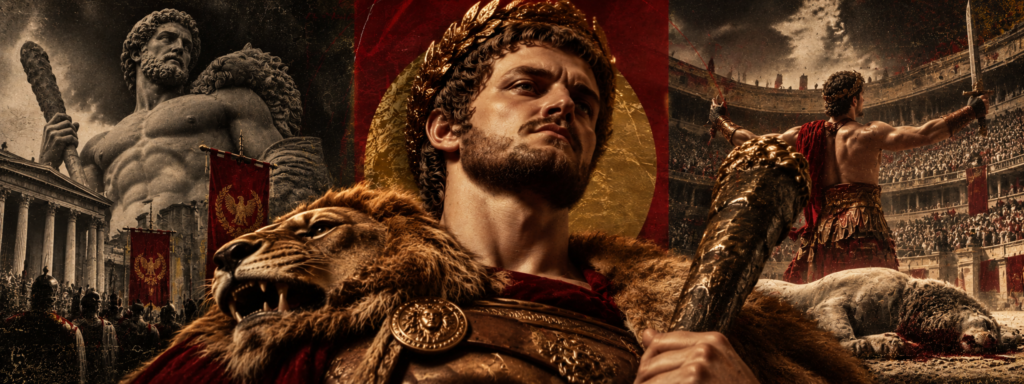
Commodus: Rome’s Gladiator Emperor and the Bloody Descent Into Madness
He was born into imperial luxury, raised by one of Rome’s most respected emperors, and destined to inherit an empire that stretched across much of the known world. Yet Commodus would become notorious for abandoning the responsibilities of government, surrounding himself with corrupt favorites, executing suspected enemies, and transforming the imperial throne into a stage for his own glorification. He fought as a gladiator, presented himself as the living incarnation of Hercules, and attempted to remake Rome in his own image. By the time his reign ended, the emperor who believed himself worthy of divine honors had become so dangerous to those around him that members of his own household conspired to kill him.
Rome had witnessed its share of dangerous emperors. Caligula had become infamous for his alleged cruelties and humiliations of the Senate, while Nero’s reign had ended in rebellion, assassination plots, and the collapse of the Julio-Claudian dynasty. Yet Commodus would occupy a particularly disturbing place in Roman history. Unlike rulers who seized power through conspiracy or civil war, he inherited the throne through an established succession, receiving the empire from a father remembered for philosophical discipline and devotion to public duty.
His father was Marcus Aurelius, the Stoic emperor whose writings on self-control, responsibility, and the temporary nature of earthly glory would survive for centuries. Commodus, by contrast, became associated with spectacular displays of personal vanity, increasingly extravagant divine honors, and an obsession with performing before audiences. The contrast between father and son was so striking that ancient historians used it to explain what they regarded as a dramatic decline in Roman government.
But the familiar story of a wise father succeeded by a monstrous son conceals a more complicated reality. Commodus did not inherit a peaceful empire free from danger. His father’s reign had been marked by devastating epidemics, prolonged frontier wars, military pressures, and political conspiracies. Nor did Commodus immediately abandon government upon becoming sole emperor. His reign developed through a series of political crises in which powerful advisers, imperial servants, military officers, and members of the aristocracy competed for influence.
The most sensational accounts of Commodus come from Cassius Dio, Herodian, and the Historia Augusta. Dio was a senator who lived during Commodus’s reign and witnessed some of its events, making his testimony especially important. Herodian wrote later, while the Historia Augusta is a much later and frequently unreliable collection of imperial biographies. Their accounts preserve valuable information, but they also reflect aristocratic hostility, dramatic storytelling, and moral judgments about rulers who violated traditional expectations.
Commodus’s gladiatorial performances were real. His association with Hercules is supported by coins, sculpture, and other material evidence. His government experienced serious political upheaval, including conspiracies, executions, the rise and fall of powerful favorites, and an increasingly dangerous concentration of personal authority. Yet the ancient descriptions of his supposed insanity, uncontrolled depravity, and supernatural ambitions cannot simply be accepted as medical or psychological facts.
What emerges from the evidence is the story of an emperor whose pursuit of personal glory became entangled with the political machinery of an empire. His spectacular public performances and divine imagery were not merely private eccentricities. They were expressions of imperial authority, staged before a society in which refusing to applaud the emperor could carry serious consequences.
And when the performance finally ended, Commodus would discover that the people closest to him had decided he could no longer be allowed to live.
Born to Rule: The Son of Rome’s Philosopher Emperor
Lucius Aurelius Commodus was born on August 31, AD 161, at Lanuvium, a town southeast of Rome. His father, Marcus Aurelius, had become emperor earlier that year alongside Lucius Verus, while his mother, Faustina the Younger, was the daughter of Emperor Antoninus Pius. Commodus therefore entered the world at the center of the Antonine dynasty, surrounded by the privileges and expectations of imperial life.
His birth was unusual in another respect. Commodus had a twin brother, Titus Aurelius Fulvus Antoninus, who died in childhood. Several of his siblings also died young, a reminder that even the wealthiest Roman families remained vulnerable to disease and the high mortality of the ancient world. Although Commodus enjoyed extraordinary material security, his childhood was not untouched by the losses that affected families throughout the empire.
Marcus Aurelius has often been remembered as an unusually thoughtful ruler. His private philosophical reflections, later collected as the Meditations, emphasized self-discipline, humility, duty, and the importance of accepting circumstances beyond human control. These writings have encouraged later generations to imagine the emperor as a model of restrained and principled leadership, although his actual reign was shaped by military necessity and difficult political decisions rather than philosophy alone.
The empire Commodus was expected to inherit faced substantial pressures. Roman armies fought prolonged wars against Germanic and Sarmatian peoples along the Danube frontier, while the Antonine Plague devastated communities and military forces across large parts of the empire. The epidemic’s precise cause remains debated, but its consequences were severe enough to affect manpower, economic activity, and public life.
Commodus grew up in a world where imperial power carried both enormous prestige and demanding responsibilities. His father spent considerable time directing military operations along the northern frontiers, and the young prince became associated with the army and imperial administration from an early age. Marcus Aurelius arranged for his education and advancement, preparing him for a position that would place him above almost every other individual in the Roman world.
The decision to promote Commodus as successor would later attract criticism. Modern readers sometimes imagine Marcus Aurelius deliberately rejecting a tradition in which emperors selected capable adopted heirs, but that interpretation oversimplifies Roman succession. Several earlier emperors had adopted successors because they lacked surviving biological sons, and Marcus Aurelius had legitimate reasons to favor his own son.
Commodus’s elevation was therefore not an inexplicable departure from Roman custom. It reflected the dynastic character of imperial power, even during an era often celebrated for orderly succession.
Nevertheless, the decision would acquire enormous significance after Commodus’s death. Ancient writers who condemned his reign portrayed his accession as the moment when Rome passed from the government of a philosopher to that of a ruler consumed by pleasure and spectacle.
A Childhood Surrounded by War and Imperial Expectations
Commodus’s upbringing unfolded amid the military campaigns that dominated much of his father’s reign. Marcus Aurelius spent years confronting threats along the Danube, where Roman forces fought difficult campaigns against the Marcomanni, Quadi, and other peoples beyond the imperial frontier. The wars required substantial resources and imposed considerable pressure on the army, while the continuing effects of epidemic disease complicated the empire’s ability to sustain military operations.
The young Commodus was drawn into imperial public life unusually early. He received the title of Caesar in AD 166, marking him as an important member of the ruling dynasty. In AD 176, he was granted the title of imperator in association with military achievements, and in AD 177, he became co-emperor with Marcus Aurelius. These honors were intended to establish continuity and strengthen his legitimacy before his father’s death.
His advancement gave him access to the ceremonies and privileges of supreme authority before he had accumulated substantial independent experience. Roman emperors did not receive formal training through a fixed constitutional system, and much depended on the quality of their advisers, military commanders, and household officials. Commodus had the advantage of his father’s position, but the responsibilities awaiting him were extraordinary.
Ancient writers later described Commodus as lacking the seriousness expected of an emperor. The Historia Augusta, in particular, presents his youth as marked by troubling behavior and an attraction to pleasure. Such descriptions require caution because ancient biographies often portrayed the childhood of an unpopular ruler as containing early signs of future wickedness.
There is insufficient reliable evidence to reconstruct Commodus’s personality as a child or to determine whether his later conduct was already apparent during his upbringing. What can be established is that he received an education appropriate to his rank, occupied increasingly prominent positions, and was publicly prepared to succeed his father.
His mother, Faustina the Younger, died in AD 175 while accompanying Marcus Aurelius in the eastern provinces. Her death removed an important figure from the imperial household, although the precise nature of her relationship with Commodus cannot be reconstructed in detail.
By his late teens, Commodus had already experienced family bereavement, imperial ceremonies, and the pressures of a dynasty engaged in prolonged warfare. He had been elevated to co-emperor and was increasingly associated with the continuity of Roman government.
The decisive moment came in March AD 180, when Marcus Aurelius died during the northern campaigns.
Commodus was eighteen years old.
The Death of Marcus Aurelius and the End of an Era
Marcus Aurelius died on March 17, AD 180, while the empire remained engaged in military operations along its northern frontiers. Commodus, already co-emperor, became sole ruler without the succession struggle that might otherwise have followed the death of an emperor. His position had been carefully established during his father’s lifetime, and the transition initially appeared secure.
Later historians often treated Marcus Aurelius’s death as a symbolic dividing line in Roman history. Cassius Dio famously contrasted the preceding period with what followed, describing a transition from a kingdom of gold to one of iron and rust. The judgment reflected his hostility toward Commodus and his belief that the empire had entered a period of deteriorating government.
The comparison was powerful, but it was also selective. Marcus Aurelius had governed during years of war, disease, and military unrest, and his reign had not been an uninterrupted golden age. Commodus inherited an empire whose institutions remained formidable but whose frontier commitments were expensive and exhausting.
One of his first major decisions concerned the war along the Danube. Rather than continuing his father’s campaigns indefinitely, Commodus negotiated arrangements with neighboring peoples and returned to Rome. Ancient writers criticized the decision, portraying it as evidence that the young emperor preferred comfort and entertainment to military responsibility.
The settlement deserves a more balanced assessment. Continuing offensive operations would have required additional manpower, money, and political commitment, while the empire faced other demands. Commodus’s decision to end the immediate campaigns may have reflected strategic calculations as well as his desire to return to the capital.
Nevertheless, his departure from the frontier contributed to the contrast later writers drew between father and son. Marcus Aurelius had spent years accompanying the army through difficult campaigns, while Commodus returned to Rome and increasingly centered his public identity on the imperial court and urban spectacles.
The young emperor entered the capital with the prestige of an established dynasty and the authority of a ruler whose succession had been prepared in advance. His reign began without the immediate collapse or civil war that had accompanied earlier changes of power.
Yet the stability would prove fragile. The imperial household contained powerful individuals competing for influence, and the Senate remained sensitive to any ruler who appeared to disregard its traditional status.
Within a few years, a conspiracy involving Commodus’s own family would transform his relationship with Rome’s political elite.
The Conspiracy of Lucilla: Betrayal Within the Imperial Family
One of the most important turning points of Commodus’s reign occurred in AD 182, when a conspiracy against him involved his elder sister, Lucilla. She had previously been married to Lucius Verus, Marcus Aurelius’s co-emperor, and retained considerable prestige within the imperial family. Her position gave her access to influential circles, but it also placed her within a household where questions of status and authority could become politically dangerous.
Ancient accounts describe Lucilla as resentful of the honors enjoyed by Commodus’s wife, Bruttia Crispina, and dissatisfied with her own declining prominence. Herodian emphasizes tensions surrounding court precedence and imperial dignity, although the precise motives of the conspirators remain uncertain. Personal rivalry may have contributed to the plot, but political dissatisfaction with Commodus’s government was also significant.
The conspiracy involved several prominent figures, including Claudius Pompeianus Quintianus, who attempted to attack the emperor. According to the surviving narratives, the assassination attempt failed, and the conspirators were arrested. Ancient writers preserve dramatic details about the attack, but the exact sequence of events cannot be independently reconstructed.
Lucilla was exiled and subsequently executed. Other individuals associated with the conspiracy also suffered severe punishments, while Commodus’s relationship with prominent members of the aristocracy deteriorated.
The episode had consequences beyond the immediate deaths. It demonstrated that opposition to Commodus existed within his own family and among influential Romans, undermining the sense of security that had accompanied his accession. A ruler who had inherited the throne peacefully now faced the possibility that relatives and aristocrats might attempt to remove him by force.
Later historians portrayed the conspiracy as a decisive moment in Commodus’s development. They suggested that the attempt on his life intensified his suspicion of senators and encouraged increasingly severe punishments against perceived enemies.
The claim that the conspiracy permanently transformed his personality cannot be established, but its political consequences were real. Commodus had reason to recognize that his position was vulnerable, while the executions and punishments that followed created further resentment among those who feared imperial retaliation.
The cycle of conspiracy, punishment, and growing hostility would become a recurring feature of his reign.
The Rise of Perennis: Power Behind the Throne
As Commodus became increasingly associated with court life and public entertainments, influential officials acquired substantial authority within the government. One of the most important was Sextus Tigidius Perennis, a Praetorian prefect who emerged as a dominant figure during the early and middle years of the reign.
Perennis controlled important aspects of the imperial administration and exercised considerable influence over military appointments. Ancient writers portray Commodus as allowing him to manage government while the emperor devoted attention to personal pleasures, although the extent of this delegation is difficult to establish. Roman emperors routinely relied on advisers and officials, and the existence of a powerful prefect did not necessarily mean that the ruler had completely abandoned his responsibilities.
Nevertheless, Perennis accumulated enough authority to provoke opposition. Cassius Dio and Herodian preserve accounts of accusations that he had abused his position and sought to advance his own family. Some stories suggest that he intended to establish his sons in positions from which they could threaten Commodus’s rule.
The precise truth of these accusations remains uncertain. Powerful imperial officials were vulnerable to charges of ambition, particularly when their influence created resentment among military commanders, senators, and competing court factions.
In AD 185, Perennis was removed and executed. Ancient accounts associate his downfall with complaints from soldiers and allegations of conspiracy, but they differ in their explanations of how the crisis unfolded. His sons were also killed, eliminating the family as a potential political force.
The fall of Perennis demonstrated the dangers facing men who exercised authority on behalf of the emperor. A prefect could become extraordinarily powerful, but that influence depended entirely on imperial favor and could disappear with devastating speed.
For Commodus, the episode also revealed the instability of government conducted through powerful intermediaries. Delegating authority allowed the emperor to concentrate on other interests, but it created opportunities for officials to accumulate influence and provoke resentment.
The removal of Perennis did not restore lasting stability. Instead, another imperial favorite would rise to even greater prominence, and his downfall would produce one of the most serious crises of Commodus’s reign.
Cleander: The Chamberlain Who Turned Imperial Favor Into a Fortune
Marcus Aurelius Cleander began his career as an imperial slave before rising to extraordinary influence within Commodus’s household. By the later 180s, he had become one of the most powerful figures in the empire, controlling access to the emperor and exercising substantial influence over appointments and political decisions.
Ancient writers describe Cleander as exploiting his position for personal enrichment. According to Cassius Dio and Herodian, he sold offices, accepted payments for favors, and manipulated appointments to accumulate wealth. The accounts portray an administration in which access to imperial authority could be purchased, allowing ambitious individuals to secure positions through payments rather than established political qualifications.
The scale of Cleander’s alleged corruption is difficult to measure, but his extraordinary rise and eventual downfall are well established. He occupied a position close to Commodus, and his influence extended beyond ordinary household administration into the political machinery of the empire.
One of the most striking allegations concerns the sale of consulships and other prestigious offices. Roman political honors had long been associated with competition, patronage, and wealth, but the idea that they could be openly purchased through an imperial favorite offended aristocratic expectations. To senators who regarded public office as a mark of family distinction, Cleander’s influence represented a humiliating challenge to their status.
Commodus’s reliance on Cleander also exposed the dangers of concentrating power within the imperial household. Officials who controlled access to the emperor could shape the information he received, influence appointments, and determine which petitioners obtained favorable treatment. Their position could become particularly powerful when the ruler preferred to devote attention to activities outside routine administration.
Yet Cleander’s authority remained dependent on Commodus. His wealth and influence could not protect him if public anger or court intrigue persuaded the emperor that he had become a liability.
That moment arrived in AD 190, when food shortages and unrest in Rome created a crisis that threatened the stability of the government.
Hunger, Riots, and the Fall of Cleander
The downfall of Cleander was associated with a severe food crisis in Rome. Ancient accounts describe shortages that intensified public anger and created accusations that Cleander had manipulated grain supplies for personal advantage. Whether he deliberately engineered the shortages remains uncertain, but his reputation for corruption made him a natural target for popular resentment.
Rome depended heavily on imported grain, and disruptions to the supply could produce serious political consequences. The capital contained a large population whose access to affordable food was closely connected with public order. When supplies became uncertain, dissatisfaction could quickly turn against officials believed responsible for distribution and administration.
Herodian describes a dramatic confrontation in which crowds gathered during public games and demanded Cleander’s removal. The protests escalated, and armed forces were reportedly deployed against demonstrators. Violence followed, with accounts describing casualties and growing disorder as the unrest spread.
The precise details of the confrontation differ among ancient writers, but the central outcome is clear. Cleander lost imperial protection and was executed, while his body was reportedly subjected to public humiliation. His downfall ended the career of a man who had risen from slavery to become one of the most influential figures in the Roman world.
The episode demonstrated the limits of imperial favoritism. Cleander had accumulated enormous authority through his proximity to Commodus, but that authority became a liability when public anger threatened the emperor’s position. Commodus could preserve his own rule by sacrificing the official whose influence had become politically dangerous.
The crisis also exposed the instability of a government in which powerful household servants could exercise influence over major administrative decisions. Whether Commodus had been unaware of Cleander’s conduct or had tolerated it for political convenience cannot be established. What mattered was that the emperor’s government had become associated with corruption, shortages, and violent unrest.
After Cleander’s death, Commodus increasingly asserted his personal authority. Ancient writers describe the final years of his reign as marked by intensified self-glorification, extravagant performances, and increasingly disturbing confrontations with the aristocracy.
The emperor who had allowed powerful favorites to dominate government was now placing himself at the center of an extraordinary imperial spectacle.
Commodus the Gladiator: An Emperor Enters the Arena
Commodus’s fascination with gladiatorial combat became one of the defining features of his reign. Unlike emperors who attended games as spectators or patrons, he personally participated in performances before audiences. His appearances challenged Roman expectations about imperial dignity, since gladiators occupied a socially degraded position despite their popularity with spectators.
The arena was a place of violence, entertainment, and public spectacle. Gladiators could become celebrated figures, but their profession was associated with infamia, a form of diminished legal and social standing. For an emperor to appear as a gladiator therefore represented an extraordinary reversal of traditional hierarchy.
Commodus did not necessarily face the same dangers as professional gladiators. Ancient accounts suggest that his opponents were selected and that performances were arranged to ensure his safety. His appearances included demonstrations of skill against animals and staged encounters in which the outcome was unlikely to be genuinely uncertain.
Cassius Dio describes Commodus killing animals in the arena, including exotic creatures brought from across the empire. The emperor reportedly displayed considerable physical skill, particularly with weapons used in hunting performances. His participation was not simply a matter of pretending to fight, although the circumstances were carefully controlled.
The most troubling aspect for senators was not necessarily the violence itself. Roman elites attended gladiatorial spectacles and accepted public killing as part of established entertainment. What offended aristocratic expectations was the emperor’s willingness to occupy the role of performer and demand admiration for activities traditionally associated with lower social status.
Commodus reportedly required senators to attend his appearances and applaud his achievements. Cassius Dio, who personally witnessed events during the reign, describes the discomfort of senators forced to participate in these displays. His account reveals how imperial entertainment could become an exercise in political domination.
The emperor’s performances were therefore more than unusual hobbies. They transformed the arena into a setting where imperial authority, public spectacle, and personal glorification intersected. Audiences were expected to admire the ruler not only as emperor but also as a victorious combatant whose achievements could not safely be questioned.
Commodus’s fascination with the arena would eventually become inseparable from his identification with Hercules, the mythological hero celebrated for extraordinary strength and the defeat of dangerous creatures.
Hercules Reborn: The Emperor Who Claimed Divine Glory
During the later years of his reign, Commodus increasingly associated himself with Hercules. The connection was expressed through sculpture, coinage, titles, and public imagery, providing some of the clearest material evidence for his extraordinary self-presentation.
A famous surviving bust depicts Commodus wearing the lion skin associated with Hercules and holding the hero’s club. The sculpture presents the emperor through the visual language of mythological strength, connecting imperial authority with the legendary achievements of a figure who had overcome monsters and completed extraordinary labors.
Roman rulers had long associated themselves with gods and heroic figures. Imperial portraits frequently used symbolic imagery to communicate military victory, divine favor, and exceptional authority. Commodus’s use of Hercules imagery therefore belonged to an established tradition, but its intensity and prominence became unusually striking.
Ancient writers describe Commodus adopting titles that connected him directly with Hercules and presenting himself as the hero’s earthly manifestation. Coins from the period reinforce the association, demonstrating that it was not merely an invention of hostile historians.
The symbolism served several possible purposes. Hercules represented physical strength, victory over dangerous enemies, and the protection of civilization against threatening forces. By identifying himself with the hero, Commodus could portray his gladiatorial performances as demonstrations of qualities appropriate to a ruler.
Yet the association also carried political risks. Senators who already resented the emperor’s arena appearances could interpret his divine imagery as another expression of arrogance and contempt for traditional expectations. His self-presentation increasingly blurred the distinction between imperial authority, religious honor, and theatrical performance.
The evidence supports a ruler who deliberately cultivated an extraordinary heroic identity. It does not establish that Commodus literally believed himself to possess supernatural powers or that he suffered from a psychiatric disorder. Political symbolism, religious language, and personal vanity could overlap without allowing modern observers to reconstruct his private mental state.
Nevertheless, the transformation of the emperor into Hercules became one of the most memorable features of his final years. Commodus was no longer content merely to rule Rome. He increasingly presented his reign as an age defined by his own exceptional identity.
A City Remade in the Emperor’s Image
Commodus’s efforts at self-glorification extended beyond the arena and imperial portraiture. Ancient accounts describe his attempt to rename Rome and redefine institutions through titles associated with himself. The surviving evidence indicates that his final years involved an extraordinary expansion of imperial honors and personal symbolism.
One of the most striking developments was the use of the name Colonia Commodiana for Rome. The title presented the ancient capital as a colony associated with Commodus, symbolically placing the city within a framework of personal imperial ownership and benefaction. Other names and honors connected with the emperor appeared in official language and ceremonial contexts.
The renaming was more than an eccentric gesture. Roman cities frequently adopted titles honoring emperors, but applying such a designation to Rome itself carried unusual symbolic weight. The capital was the historic center of Roman political identity, and its transformation into a city bearing the emperor’s name suggested an extraordinary concentration of prestige around one individual.
Ancient writers also describe efforts to rename months and reorganize official terminology around Commodus’s titles. Some details are difficult to verify, but inscriptions and coins confirm that his government promoted an elaborate system of personal honors.
The emperor increasingly presented himself as the source of a renewed age of prosperity and glory. Such claims were not unique to Commodus, since Roman imperial propaganda routinely celebrated rulers as restorers of peace, security, and abundance. What distinguished his final years was the intensity with which his personal identity appeared to dominate these claims.
To critics, the developments represented a dangerous departure from the traditions of Roman government. The emperor seemed increasingly unwilling to preserve the appearance that he ruled within an established political order. Instead, institutions, ceremonies, and public symbols were being reshaped to celebrate his individual greatness.
The result was an imperial personality cult expressed through architecture, titles, coinage, and spectacle. Its political meaning was clear even if Commodus’s private beliefs remain unknowable: the emperor wanted Rome to recognize his authority through increasingly extraordinary forms of public honor.
The Senate Under an Emperor Who Demanded Applause
Commodus’s relationship with the Senate became increasingly hostile during the final years of his reign. The aristocracy had already suffered through conspiracies, executions, and the influence of powerful imperial favorites. Now senators were expected to participate in public ceremonies that celebrated the emperor’s extraordinary identity.
Cassius Dio provides particularly valuable testimony because he was a senator who witnessed some of Commodus’s performances. His account describes members of the Senate being compelled to attend spectacles and respond enthusiastically to the emperor’s achievements. The situation placed senators in an uncomfortable position, since their presence demonstrated loyalty while their private feelings could be entirely different.
Dio also recounts an episode in which Commodus displayed the severed head of an ostrich and appeared to threaten senators with it. According to Dio, he and others struggled to conceal their reactions, fearing that laughter might be interpreted as disrespect. The story is memorable because it captures the tension between the emperor’s theatrical behavior and the danger faced by those required to witness it.
The anecdote comes from a participant, but its precise details remain dependent on Dio’s account. It should not be treated as evidence of a diagnosable mental illness, nor does it establish the emperor’s private intention. What it illustrates is the atmosphere of coercion that could surround imperial spectacle.
Commodus reportedly received enormous payments for his arena appearances, with the financial burden falling upon the imperial administration. Ancient writers condemned these arrangements as further evidence of extravagance and self-indulgence, although the exact figures they provide require caution.
The Senate’s resentment reflected more than embarrassment over gladiatorial performances. Commodus had increasingly reduced aristocratic participation to public displays of submission, while the emperor’s personal identity dominated ceremonies and honors. Senators who possessed distinguished family histories and traditional offices found themselves applauding a ruler whose authority could determine their careers and survival.
The conflict exposed a fundamental contradiction of the Roman Principate. The Senate retained the language and dignity of republican government, but the emperor possessed overwhelming power. Commodus’s conduct made that imbalance unusually visible, turning political hierarchy into public theater.
Executions, Fear, and the Violence of Imperial Suspicion
The later years of Commodus’s reign were associated with executions and punishments directed against prominent Romans. Ancient writers describe an atmosphere of suspicion in which accusations could lead to confiscation, exile, or death. The precise number of victims is difficult to establish, but the surviving accounts identify substantial political violence.
Some executions followed genuine conspiracies, while others may have resulted from court rivalries, accusations of disloyalty, or efforts to eliminate potential threats. The distinction matters because Roman imperial politics often blurred the boundary between legitimate security concerns and the use of treason proceedings to remove opponents.
Commodus had survived an assassination attempt involving his sister, witnessed the downfall of powerful advisers, and confronted serious unrest in the capital. These events provided genuine reasons for concern about his security. Yet the existence of threats did not justify every punishment, and ancient accounts suggest that fear of imperial retaliation became widespread among influential Romans.
The emperor’s reliance on personal favorites further complicated the situation. Officials who controlled access to him could influence accusations and appointments, while their own positions remained vulnerable to sudden reversal. The resulting instability encouraged competition, suspicion, and efforts to secure imperial favor.
Later historians portrayed Commodus as increasingly cruel and arbitrary, sometimes describing punishments inflicted for minor offenses or personal grievances. Individual anecdotes require caution because they often follow familiar literary patterns used to condemn tyrants. Nevertheless, the broader political violence is supported by the record of conspiracies, executions, and the repeated destruction of prominent figures.
The atmosphere became particularly dangerous as Commodus’s public self-glorification intensified. An emperor who demanded extraordinary honors and visible admiration could interpret resistance as more than ordinary disagreement. Political opposition could appear as an attack on the ruler’s authority and the symbolic identity he had constructed around himself.
By AD 192, the combination of court intrigue, political hostility, and imperial spectacle had created a volatile situation. The emperor remained powerful, but the people closest to him had begun to fear the consequences of his decisions.
The Final Conspiracy: When the Palace Turned Against Commodus
Commodus’s assassination emerged from a conspiracy involving members of his own household. Among the principal figures identified by ancient writers were Marcia, a woman closely associated with the emperor; Eclectus, an imperial chamberlain; and Laetus, the Praetorian prefect. Their involvement demonstrates that the danger to Commodus came not only from senators or provincial commanders but from individuals who occupied positions of intimate access.
Ancient accounts suggest that the conspirators feared for their lives after learning that Commodus intended to remove or execute them. Herodian preserves a dramatic story in which Marcia discovered a list of intended victims, prompting those named to act before the emperor could carry out his plans. The narrative may preserve elements of an actual court crisis, but its precise details cannot be independently confirmed.
The broader circumstances make the conspiracy understandable as a struggle for survival and political control. Commodus had become increasingly unpredictable in his treatment of prominent figures, while his extraordinary public ambitions threatened established expectations about government. Members of the household who had benefited from imperial favor could also become vulnerable if the emperor decided they were no longer useful.
The conspirators faced a difficult problem. Commodus was protected by imperial guards and occupied a position that made direct opposition dangerous. Removing him required access, secrecy, and coordination among people close enough to approach him without immediately attracting suspicion.
The plot developed during the final days of AD 192, when Commodus was preparing for further public appearances and celebrations associated with the new year. Ancient accounts describe plans for the emperor to appear in the arena and continue the extraordinary performances that had become central to his public identity.
The conspirators decided that he could not be allowed to continue.
Their decision would end a reign that had begun with orderly succession and imperial prestige but had deteriorated into a struggle between the emperor and members of his own household.
December 31, AD 192: The Death of the Gladiator Emperor
Commodus died on December 31, AD 192, at the age of thirty-one. Ancient accounts describe a conspiracy in which Marcia administered poison to the emperor, but the attempt did not produce the intended immediate result. When Commodus became ill, the conspirators reportedly feared that he might recover and discover what had happened.
They then turned to a man capable of killing him directly.
According to the surviving narratives, Narcissus, an athlete or wrestling instructor associated with Commodus, entered the emperor’s quarters and strangled him. The details differ among ancient writers, but the central account of assassination by members of the imperial household is well established.
The circumstances were bitterly ironic. Commodus had spent years presenting himself as a powerful combatant, displaying physical strength before audiences and identifying himself with Hercules. Yet his life ended not in the arena before cheering spectators but within the imperial residence, killed through a conspiracy organized by people close to him.
The assassination was immediately followed by efforts to secure a successor. Pertinax, a respected senator and former military commander, was elevated to the throne with the support of influential figures. The transition initially appeared to offer an opportunity to restore stability after the increasingly controversial final years of Commodus’s reign.
But the political system remained fragile. The Praetorian Guard possessed enormous influence, while competing interests within the army and aristocracy complicated any attempt to establish lasting authority.
Commodus’s death therefore did not bring an immediate return to orderly government. Instead, it opened another period of instability in which the succession would become increasingly violent.
The emperor who had inherited the throne from Marcus Aurelius had died without establishing a secure successor. His assassination ended the Antonine dynasty’s direct line of imperial rule and exposed the dangers of a system dependent on personal authority and military loyalty.
The Year of Five Emperors: Chaos After Commodus
The assassination of Commodus helped trigger the political upheaval of AD 193, remembered as the Year of the Five Emperors. Pertinax initially succeeded him, but his reign lasted only a few months before he was murdered by members of the Praetorian Guard. The soldiers who had helped sustain imperial authority now demonstrated their willingness to remove a ruler who failed to satisfy their expectations.
Following Pertinax’s death, Didius Julianus obtained the throne after negotiations involving the Praetorian Guard, an episode later remembered for the extraordinary appearance that imperial power had been sold to the highest bidder. The situation provoked outrage and encouraged provincial commanders to challenge the legitimacy of the new government.
Several powerful military leaders emerged as contenders, including Septimius Severus, Pescennius Niger, and Clodius Albinus. Their competing claims led to civil conflict, demonstrating that the death of Commodus had not resolved the fundamental problem of succession.
Septimius Severus eventually secured control and established a new dynasty. His rise marked a significant transformation in Roman politics, emphasizing the importance of military support in determining imperial authority.
The turmoil of AD 193 became inseparable from Commodus’s historical legacy. Ancient writers who condemned his reign treated his death as the conclusion of a disastrous period, but the subsequent civil wars demonstrated that Rome’s difficulties extended beyond one emperor’s personality.
The empire remained powerful, yet its political institutions struggled to manage succession without violence. The Senate retained ceremonial authority, but armies and their commanders increasingly determined who could occupy the throne.
Commodus had inherited power through a carefully prepared dynastic transition. His death left an empire in which rival claimants competed through military force, revealing the fragility of the stability his father had attempted to preserve.
Was Commodus Really Mad?
Commodus has frequently been described as insane, delusional, or consumed by megalomania. These labels reflect the extraordinary stories preserved by ancient writers, particularly those concerning his gladiatorial performances, identification with Hercules, and attempts to rename Rome.
Yet applying modern psychiatric diagnoses to an ancient ruler is exceptionally difficult. The surviving evidence consists primarily of literary accounts written within political and moral traditions that emphasized the misconduct of unpopular emperors. These sources do not provide the clinical information necessary to establish a specific mental disorder.
Commodus’s identification with Hercules is sometimes presented as proof that he had lost contact with reality. But Roman imperial ideology already incorporated divine associations, heroic imagery, and religious honors. The emperor’s use of Hercules symbolism can be understood as a political and ceremonial strategy, even if contemporaries regarded its intensity as excessive.
His gladiatorial performances likewise do not establish mental illness. They demonstrate a strong interest in public spectacle and a willingness to violate aristocratic expectations about imperial dignity. The fact that senators found his behavior humiliating does not mean that his conduct can be explained through psychiatric speculation.
The documented violence of his reign also requires political analysis. Conspiracies, executions, court rivalries, and struggles over access to the emperor were recurring features of Roman imperial government. Commodus’s decisions may have intensified these conflicts, but they occurred within institutions that already concentrated extraordinary power in one individual.
The ancient sources support a ruler whose government became increasingly dominated by personal glorification, political suspicion, and coercive displays of authority. They do not allow confident conclusions about his private mental state.
The distinction does not diminish the seriousness of his reign. It places responsibility for documented actions within their historical context rather than relying on an unverified diagnosis to explain them.
The Emperor History Turned Into a Monster
Commodus’s reputation was shaped by writers who viewed his reign as a dramatic departure from the government of Marcus Aurelius. Cassius Dio’s contrast between a golden age and a period of iron and rust became particularly influential, encouraging later generations to interpret Commodus as the ruler who ended an era of relative stability.
The comparison contains elements of historical truth, but it also simplifies a complicated period. Marcus Aurelius had faced severe military and economic pressures, while Commodus inherited problems that could not be resolved through personal discipline alone. The empire’s difficulties were structural as well as political.
Nevertheless, Commodus’s own conduct contributed substantially to his hostile reputation. His reliance on powerful favorites created opportunities for corruption and instability, while his executions and treatment of the aristocracy damaged relationships necessary for effective government. His increasingly elaborate self-glorification offended traditional expectations and transformed imperial ceremonies into displays centered on his personal identity.
The ancient sources also exaggerated or dramatized some aspects of his behavior. The Historia Augusta is particularly problematic because it contains sensational anecdotes and unreliable material. Herodian and Dio provide more substantial evidence, but their accounts must still be interpreted in light of their perspectives and literary purposes.
Material evidence offers an important counterbalance. Coins, inscriptions, and sculpture confirm Commodus’s association with Hercules and his extraordinary system of titles, demonstrating that some apparently bizarre features of the literary tradition reflected genuine imperial policy.
The result is a historical figure more complicated than the familiar image of a mad emperor who cared only about gladiatorial combat. Commodus exercised power within a sophisticated political system, but his government increasingly became associated with personal spectacle, unstable court politics, and violent struggles over influence.
His reputation survived because the contrast between his inherited position and his eventual downfall was so dramatic. The son of Marcus Aurelius became the emperor whose name symbolized the dangers of unrestrained personal authority.
The Dark Legacy of Commodus
Commodus ruled the Roman Empire for fifteen years as co-emperor and sole ruler, inheriting a position prepared for him by one of Rome’s most respected emperors. His accession initially promised dynastic continuity after decades of military pressure and political uncertainty. Yet his reign became associated with conspiracies, executions, corrupt favorites, public unrest, and an increasingly extraordinary system of imperial self-glorification.
His fascination with gladiatorial combat made him one of the most recognizable rulers of antiquity. Unlike emperors who merely sponsored games, Commodus personally entered the arena and demanded recognition as a victorious performer. His identification with Hercules transformed these appearances into expressions of imperial symbolism, connecting the emperor’s physical achievements with heroic and divine imagery.
The performances were not simply entertainment. They demonstrated how personal ambition could become inseparable from political authority, particularly when audiences included senators and officials whose careers depended on imperial favor. Applause could function as a public declaration of loyalty, while reluctance or criticism carried potential risks.
The rise and fall of Perennis and Cleander exposed another weakness of Commodus’s government. Powerful intermediaries could accumulate extraordinary influence, but their authority depended on the emperor’s changing favor. Their downfalls produced executions and political instability, while the food crisis associated with Cleander revealed the consequences of public anger directed against imperial administration.
The final years of the reign brought increasingly elaborate honors and attempts to redefine Rome through Commodus’s personal identity. The emperor’s association with Hercules, his extraordinary titles, and the renaming of the capital demonstrated a deliberate effort to present imperial power through the language of personal magnificence.
Yet the same ruler who commanded extraordinary public honors could not guarantee the loyalty of his own household. His assassination was organized by people close enough to know his habits and vulnerabilities, exposing the limits of imperial authority when those responsible for protecting the emperor turned against him.
Commodus’s death did not restore stability. Instead, it helped open the succession crisis of AD 193, when rival emperors and military commanders competed for control of the Roman world. The violence demonstrated that Rome’s political difficulties extended beyond the conduct of a single ruler.
His historical reputation remains shaped by the contrast with Marcus Aurelius. The father is remembered for philosophical reflections on duty and self-restraint, while the son became associated with gladiatorial spectacle, divine honors, and political violence. The contrast is compelling, but it should not obscure the broader institutions and pressures that shaped both reigns.
Commodus did not need to be clinically insane for his government to become dangerous. His documented actions, the political violence surrounding his court, and his increasingly coercive displays of personal authority provide substantial grounds for examining the consequences of his rule.
In the end, the emperor who presented himself as Hercules could not escape the ordinary vulnerabilities of human power. His wealth, titles, guards, and public honors failed to protect him when members of his own household decided that his survival threatened theirs.
Commodus inherited an empire from a father who wrote about the importance of mastering oneself. He spent his final years demanding recognition as a hero, a gladiator, and a figure worthy of extraordinary honors. Yet the ruler who sought to make Rome a monument to his own greatness died at the hands of those closest to him, leaving behind an empire that would soon descend into another struggle for the throne.