
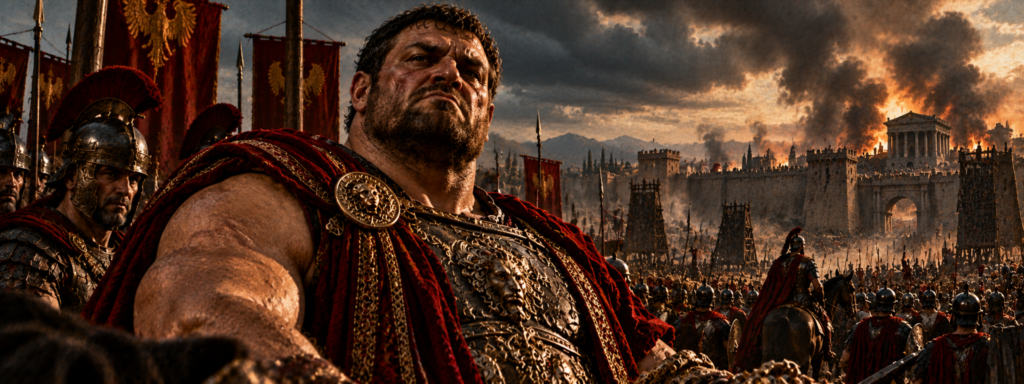
Maximinus Thrax: Rome’s Giant Emperor and the Bloody Beginning of the Third-Century Crisis
He was said to stand more than eight feet tall, possess the strength of several men, and crush his enemies with the same brutality he brought to the battlefield. Born far from the privileged world of Rome’s aristocracy, Maximinus Thrax rose through the military ranks to become emperor through the murder of his predecessor. Ancient writers portrayed him as a terrifying giant consumed by resentment, suspicious of educated nobles, and willing to execute anyone who threatened his authority. His reign lasted barely three years, yet it marked the beginning of one of the most destructive periods in Roman history. By the time his own soldiers turned against him outside the walls of Aquileia, the empire had entered a cycle of rebellion, civil war, and political violence from which it would struggle to recover for decades.
The Giant Who Terrified Rome
In the spring of AD 238, the Roman emperor Maximinus Thrax stood before the fortified city of Aquileia in northern Italy, facing a disaster that threatened to destroy everything he had achieved. His army had marched south to crush a rebellion supported by the Roman Senate, but the campaign had stalled. The city’s inhabitants refused to surrender, its defenses remained intact, and the soldiers outside its walls were growing increasingly desperate. Food supplies were running short, morale was deteriorating, and the emperor’s reputation for harsh discipline offered little comfort to men who feared they might never return home.
For Maximinus, the situation was particularly humiliating. He had built his career on military strength, rising from comparatively obscure origins to command Roman soldiers and eventually seize the imperial throne. His authority rested heavily on the belief that he could lead armies, defeat enemies, and impose obedience through force. Now an Italian city, defended by determined inhabitants and supported by senators who despised him, was resisting his entire military establishment.
Ancient accounts describe an increasingly dangerous atmosphere within the imperial camp. Soldiers were exhausted by the siege and frustrated by the lack of progress, while the emperor reportedly responded to setbacks with anger and severe punishments. The historian Herodian portrays Maximinus as a ruler whose harshness intensified the resentment of his troops. The later Historia Augusta adds more sensational stories of his cruelty, although its details must be treated cautiously because the work frequently exaggerates or invents incidents.
The men who had once raised Maximinus to power began to question whether their loyalty was worth the suffering. His enemies in Rome had declared him a public enemy, the Senate had recognized rival emperors, and the campaign intended to restore his authority had become a humiliating siege. The emperor who had conquered the throne through military support was discovering how quickly that support could disappear.
Then the soldiers turned against him.
According to the principal ancient narratives, members of his army, particularly soldiers associated with the Second Parthian Legion, participated in the mutiny that ended his reign. Maximinus and his son, Maximus, were killed, and their severed heads were sent to Rome as proof that the emperor was dead. The exact circumstances of the killings differ among the sources, and the familiar claim that Maximinus was assassinated in his sleep cannot be established securely. What is beyond serious dispute is that he died at the hands of his own soldiers during the failed siege of Aquileia.
It was a fittingly violent conclusion to a reign that had begun with another emperor’s murder.
Maximinus had come to power in AD 235 after the assassination of Severus Alexander, a young ruler whose government had depended heavily on advisers and whose military policies had become unpopular with some soldiers. The army’s decision to proclaim Maximinus emperor broke with important expectations about imperial succession. Unlike many previous rulers, he did not emerge from the traditional senatorial elite, and his accession exposed the growing power of the military to determine who would govern Rome.
Later generations would identify AD 235 as the beginning of the Crisis of the Third Century, an era of repeated imperial assassinations, civil wars, invasions, economic disruption, and political fragmentation. Maximinus did not single-handedly create every problem that followed, and the empire’s difficulties had developed over many years. Nevertheless, his accession became a defining moment in the transformation of Roman politics.
His reign also produced one of antiquity’s most extraordinary imperial legends. Ancient writers claimed that Maximinus possessed almost superhuman physical strength and stood more than eight Roman feet tall. They described enormous hands, extraordinary feats of endurance, and a body that seemed better suited to mythology than ordinary human life.
Whether any of these claims were true remains uncertain. The measurements and feats come from literary traditions shaped by hostility, fascination, and exaggeration, particularly the unreliable Historia Augusta. Yet the image of the gigantic soldier-emperor endured because it seemed to embody the political transformation he represented: a ruler whose authority came not from distinguished ancestry or senatorial approval, but from the army and the force it could command.
To understand how Maximinus became one of Rome’s most feared emperors, it is necessary to begin far from the marble halls of the imperial capital, in the military world that shaped his rise.
Born Beyond Rome’s Aristocratic World
Gaius Julius Verus Maximinus, commonly known as Maximinus Thrax, was probably born around AD 173, although his precise birth date remains uncertain. Ancient sources associate his origins with Thrace or the surrounding Balkan regions, territories that supplied substantial numbers of recruits to the Roman army. His nickname, Thrax, means Thracian and reflects the geographical identity attached to him by later writers. The details of his family background are difficult to reconstruct because the surviving accounts contain contradictions and hostile embellishments.
The Historia Augusta claims that his father was a Goth named Micca and his mother an Alan named Ababa. These assertions are highly doubtful, particularly because the terminology and ethnic details raise chronological problems. The account appears designed to emphasize Maximinus’s supposed foreignness and distance from Roman aristocratic society. It should not be accepted as a reliable genealogy.
Herodian, whose history is generally more useful for the events of Maximinus’s reign, presents him as a man of humble origins who rose through military service. His description emphasizes the contrast between the emperor’s background and the refined expectations of Rome’s governing elite. Maximinus was associated with the rougher social world of frontier soldiers rather than the senatorial families that traditionally dominated high political office. His rise therefore represented an important challenge to established ideas about imperial dignity.
Roman society was deeply hierarchical. Wealth, ancestry, education, citizenship status, and public office shaped an individual’s opportunities and reputation. Members of the senatorial order occupied the highest levels of traditional political prestige, while military advancement could offer men from less privileged backgrounds a route to wealth and authority. The army was one of the few institutions capable of elevating an individual far beyond the social position into which he had been born.
Maximinus appears to have benefited from precisely that possibility. He entered military service and gradually established a reputation as a capable soldier and commander. The surviving sources do not provide a fully reliable account of every stage of his career, but they consistently associate his advancement with physical strength, military discipline, and the respect of soldiers. These qualities became central to both his political success and his later reputation.
His origins mattered because Roman emperors were expected to embody more than battlefield courage. They were supposed to possess dignity, judgment, generosity, religious propriety, and an understanding of the traditions surrounding imperial office. A ruler could certainly be celebrated for military achievements, but he was also expected to manage relationships with the Senate and aristocratic society. Maximinus’s accession placed a man identified primarily with the army at the center of a political system whose elite had little reason to welcome him.
The hostility that followed would shape nearly everything written about his character.
Eight Feet Tall: The Legend of Rome’s Giant Emperor
Few Roman emperors acquired a physical reputation as extraordinary as that of Maximinus Thrax. Ancient writers described him as exceptionally tall, immensely powerful, and capable of feats that ordinary men could scarcely imagine. The Historia Augusta claims that he stood eight feet and six inches tall in Roman measurements, a figure that would make him extraordinarily large by any historical standard. The same source attributes to him remarkable strength, enormous hands, and an appetite appropriate to his supposedly gigantic body.
One famous story claims that Maximinus could wear his wife’s bracelet as a ring on his thumb. Other anecdotes describe him breaking stones, pulling heavily loaded wagons, and overpowering opponents through sheer physical force. Such stories were intended to portray him as a man whose body seemed almost beyond human limitations. They also helped explain how someone without distinguished aristocratic ancestry could command the attention of powerful soldiers.
The difficulty is that these accounts come largely from a source notorious for invention. The Historia Augusta contains fabricated documents, improbable conversations, fictional anecdotes, and exaggerated descriptions of emperors. Its stories about Maximinus’s size and strength cannot be verified through contemporary measurements or independent testimony. They may preserve a genuine memory that he was unusually tall and physically imposing, but the precise figures are not secure historical facts.
Modern speculation has occasionally suggested that Maximinus may have had a medical condition associated with exceptional height, such as gigantism or acromegaly. Such diagnoses cannot be established from the surviving evidence. Ancient literary descriptions are not medical records, and the emperor’s physical remains are unavailable for examination. Assigning him a specific condition would therefore go beyond what the sources can support.
His portraiture offers a more restrained image. Surviving representations depict a mature man with a broad face, pronounced features, short hair, and the stern expression characteristic of many third-century imperial portraits. They emphasize military authority and physical solidity rather than fantastic proportions. These images cannot reveal his actual height, but they demonstrate how his government wished to present him publicly.
The giant legend served several purposes. For admirers, extraordinary strength could symbolize courage, endurance, and the ability to command soldiers. For hostile aristocratic writers, the same qualities could be transformed into evidence of brutishness and a lack of refinement. Maximinus’s body became part of a larger argument about whether a soldier from humble origins belonged on the imperial throne.
The fascination with his size has sometimes overshadowed the more consequential reality of his career. Whatever his actual height, Maximinus commanded enough military support to overthrow an emperor and govern substantial Roman territories for three years. His political power did not depend on being a literal giant. It depended on the soldiers who believed he could lead them.
The Soldier Who Rose Through the Ranks
The Roman army of the late second and early third centuries offered ambitious soldiers opportunities for advancement unavailable in many other parts of society. Military service could provide regular pay, rewards after campaigns, legal privileges, and the possibility of promotion into positions of authority. Experienced soldiers were valuable because the empire required disciplined forces to defend its extensive frontiers. Commanders who demonstrated effectiveness could attract the attention of senior officers and, eventually, emperors.
Maximinus’s early military career is obscured by the unreliable anecdotes preserved in later biographies. The Historia Augusta places him in the army during the reign of Septimius Severus and describes impressive demonstrations of strength that supposedly attracted imperial notice. The precise incidents cannot be confirmed, and some elements may be literary inventions. Nevertheless, the broader claim that Maximinus advanced through military service is consistent with his later position.
Septimius Severus had become emperor in AD 193 after a civil war and relied heavily on military support throughout his reign. His government increased soldiers’ pay and reinforced the political importance of the army, developments that shaped the environment in which later commanders rose. The Severan dynasty continued to depend on military loyalty, even as conflicts within the imperial family weakened political stability. Maximinus’s career developed within this increasingly militarized system.
By the reign of Severus Alexander, Maximinus had achieved sufficient standing to hold important responsibilities involving recruits and military training. Herodian associates him with the preparation of troops in the region of the Rhine frontier. His authority over soldiers gave him an opportunity to develop personal influence among men who were dissatisfied with the existing government. This connection would become decisive in AD 235.
Military leadership required more than physical strength. Commanders needed to organize supplies, maintain discipline, direct operations, and preserve the confidence of their troops. Maximinus’s advancement suggests that he possessed at least some of these practical abilities, even if later sources preferred to describe him through crude stereotypes. His career would have been difficult to sustain without experience and competence in military affairs.
Yet the qualities that made him successful as a commander did not necessarily prepare him for the political complexities of imperial government. A general could impose discipline within an army through established hierarchies, but an emperor had to negotiate relationships among soldiers, senators, provincial officials, and urban populations. Maximinus would discover that the authority needed to command troops was not identical to the authority needed to govern an empire.
His opportunity came when the army lost confidence in the young emperor Severus Alexander.
Severus Alexander: The Young Emperor Marked for Death
Severus Alexander became emperor in AD 222 after the assassination of his cousin Elagabalus. He was still a teenager, and his government depended heavily on advisers, including his mother Julia Mamaea. Ancient sources portray Mamaea as an influential figure in court politics, although their descriptions are shaped by conventional hostility toward women exercising power. Her influence reflected the dynasty’s reliance on family relationships during a period of repeated political instability.
Alexander’s reign lasted approximately thirteen years, considerably longer than those of many third-century emperors. His government attempted to maintain stability through administration, diplomacy, and military operations. Yet the empire faced serious external threats, including the expansion of the Sasanian Persian Empire in the east and increasing pressure along the Rhine frontier. These challenges exposed tensions between the emperor’s advisers and soldiers who expected decisive military leadership.
In AD 234 or 235, Alexander traveled to the Rhine region to confront Germanic threats. Herodian reports that the emperor favored negotiations and payments intended to secure peace rather than immediate military confrontation. Some soldiers regarded this policy as humiliating and believed that the government was unwilling to fight. Their dissatisfaction was intensified by resentment toward the emperor’s court and the influence of his mother.
The precise causes of the rebellion remain debated. Negotiating with frontier groups was not inherently unusual or irrational, since Roman governments had long used diplomacy alongside military force. Payments could be less expensive than extended campaigns, particularly when the empire faced threats elsewhere. Nevertheless, soldiers who had been mobilized for war could interpret negotiations as evidence that their efforts and sacrifices were being disregarded.
Maximinus occupied an influential position among troops who had become dissatisfied with Alexander. His military reputation and direct connection with soldiers made him an attractive alternative to a ruler perceived as dependent on court advisers. Herodian describes the troops turning toward Maximinus and proclaiming him emperor, setting in motion the destruction of the Severan government.
The rebellion culminated in the murder of Severus Alexander and Julia Mamaea near Mogontiacum, modern Mainz, in March AD 235. The exact circumstances differ among ancient accounts, but the essential event is secure. The emperor and his mother were killed by soldiers, and Maximinus emerged as the new ruler. A dynasty that had governed Rome for decades came to a violent end.
The accession marked a major turning point in imperial history.
March 235: The Army Creates an Emperor
Maximinus’s elevation demonstrated the increasing ability of soldiers to determine imperial succession through force. Previous emperors had depended on military support, and Roman history contained many examples of armies proclaiming rulers. What made Maximinus particularly significant was his distance from the traditional senatorial aristocracy and the circumstances of his accession. He had risen through military service rather than through a conventional sequence of elite political offices.
The soldiers who supported him expected a commander capable of confronting external enemies and rewarding military loyalty. Maximinus therefore began his reign with a political foundation concentrated in the army. His authority was immediately recognized by military forces under his control, while the Senate faced the difficult question of how to respond to an emperor created through the murder of his predecessor. Resistance would have been dangerous without an army capable of challenging him.
The Senate initially accepted Maximinus’s rule, but the relationship was strained. Aristocratic senators had traditionally expected emperors to consult them, respect established privileges, and acknowledge the dignity of their order. Maximinus had little personal connection with this political world, and his accession threatened its influence. Ancient writers emphasized the contrast by portraying him as an uncultivated soldier whose manners were unsuitable for imperial office.
Such descriptions must be approached critically. Roman aristocratic authors often used accusations of vulgarity, foreignness, and inadequate education to discredit rulers they disliked. Maximinus’s background made him particularly vulnerable to these attacks. The surviving literary portrait may therefore reveal as much about elite prejudice as about his actual behavior.
Nevertheless, the political tension was real. Maximinus did not travel to Rome during his reign, choosing instead to remain with armies near the northern frontiers. His absence deprived him of opportunities to build relationships with senators through personal appearances, ceremonies, and patronage. It also reinforced the perception that he regarded military affairs as more important than traditional civic government.
The emperor’s decision had practical advantages. Remaining with the army allowed him to direct campaigns and maintain the loyalty of the soldiers who had elevated him. Yet it also meant that much of the empire encountered his authority through taxation, officials, military demands, and reports of punishment rather than through direct imperial presence. The distance between the ruler and Rome’s political elite widened.
Maximinus had gained the throne through military strength, but he had not secured the broad political support necessary for a stable reign.
A Reign Built on Suspicion and Fear
Ancient accounts portray Maximinus as intensely suspicious of aristocrats and officials who might question his legitimacy. Herodian describes a ruler who distrusted men of distinguished background and feared that those familiar with his humble origins would regard him with contempt. The Historia Augusta develops this theme further, claiming that he persecuted individuals who had known him before his rise to power. These descriptions helped establish his reputation as an emperor consumed by resentment.
The precise psychological motives attributed to Maximinus cannot be verified. It is possible that his unconventional accession made him sensitive to aristocratic opposition, but ancient authors frequently explained political violence through personal insecurity or moral defects. Their interpretations should not be treated as direct access to the emperor’s private thoughts. The more reliable historical question concerns what actions his government actually took against perceived opponents.
Political repression did occur during his reign. Ancient sources describe investigations, executions, confiscations, and punishment of individuals suspected of conspiracy or disloyalty. Some episodes are more securely established than others, and the surviving evidence does not support a complete list of victims. Nevertheless, the broader pattern of hostility between Maximinus and influential members of the governing elite is consistent across the sources.
The emperor had reasons to fear rebellion. He had personally benefited from the murder of Severus Alexander, demonstrating that soldiers could overthrow a ruler when dissatisfied. His own accession established a precedent that ambitious commanders might attempt to imitate. The absence of a secure dynastic tradition also increased uncertainty about the future of his government.
Repression could temporarily discourage opposition, but it also created new enemies. Senators who feared confiscation or execution had incentives to support alternatives, while provincial officials faced pressure to satisfy the emperor’s demands. The more Maximinus relied on coercion, the more his authority appeared to depend on the continued loyalty of the army. This dependence would become dangerous when military circumstances deteriorated.
The ancient portrayal of systematic persecution should not be accepted in every sensational detail. Claims that Maximinus hunted down everyone who had ever slighted him are broader than the surviving evidence can establish. Yet the political atmosphere was sufficiently hostile that powerful men eventually organized resistance against his government. Fear became part of the relationship between the emperor and the elites whose cooperation he needed.
The Alleged Tortures and Executions
The most disturbing stories about Maximinus concern his alleged treatment of political enemies. The Historia Augusta describes spectacular punishments, including executions, confinement, and torture, presenting the emperor as a man who took pleasure in cruelty. Such accounts contributed to his reputation as one of Rome’s most brutal rulers. Yet their sensational character and unreliable source require careful separation between documented repression and literary exaggeration.
One tradition describes Maximinus punishing senators and aristocrats for their connections with previous rulers or suspected conspiracies. Another claims that he eliminated individuals who remembered his earlier social position, supposedly fearing that their knowledge would undermine his dignity. These stories fit the literary theme of a low-born ruler ashamed of his origins. They are not independently verified evidence that he conducted a systematic campaign against every person who had known him before becoming emperor.
More substantial evidence concerns political conspiracies and their suppression. Herodian describes an alleged plot involving Magnus, a senator associated with opposition to Maximinus. The details are uncertain, and historians debate whether the conspiracy existed in the form described or whether accusations were used to justify repression. The episode nevertheless reflects the atmosphere of suspicion surrounding the new government.
Ancient accounts also describe disturbances involving soldiers and officers, including the episode associated with Quartinus and the commander Macedo. The surviving narratives differ in detail, but they suggest that military opposition emerged early in the reign. Maximinus’s position depended on controlling such threats before they spread through the army. The punishment of suspected conspirators reinforced his authority while deepening the perception that his government relied on fear.
Roman imperial politics had long included executions and confiscations. Earlier emperors, including members of established dynasties, had used similar methods against perceived opponents. Maximinus’s reputation became especially notorious partly because aristocratic writers regarded him as an outsider who lacked the social legitimacy expected of a ruler. His violence was therefore presented not merely as political repression but as evidence of personal barbarism.
The distinction matters because the most extreme stories are often the least reliable. Maximinus’s government undoubtedly confronted opposition through coercive measures, and some individuals suffered severe punishment. But the evidence does not justify accepting every lurid account of torture or attributing enjoyment of suffering to the emperor as an established fact. His political conduct was harsh enough without adding details that cannot be verified.
War on the Rhine: The Emperor Who Preferred the Battlefield
Maximinus devoted much of his reign to military operations along the northern frontiers. His accession had been supported by soldiers dissatisfied with Severus Alexander’s policies, and he needed to demonstrate that he could provide the decisive leadership they expected. Campaigning against Germanic groups offered an opportunity to reinforce his military reputation and secure frontier regions. It also allowed him to remain close to the troops whose loyalty sustained his government.
Herodian describes Maximinus conducting aggressive operations beyond the Rhine, including campaigns through difficult terrain. The emperor reportedly led forces into hostile territory, confronting opponents who attempted to use forests and marshes to their advantage. Ancient narratives emphasize his personal courage and willingness to participate in dangerous operations. Although individual dramatic details may be embellished, the broader evidence supports substantial military activity.
One of the most famous representations of these campaigns appears in descriptions of fighting in marshy terrain. Maximinus was said to have entered dangerous ground and fought while soldiers struggled to follow him. The story reinforced the image of an emperor whose physical strength and battlefield courage exceeded those of ordinary men. Its precise details are uncertain, but it reflects the military identity central to his public reputation.
Imperial coinage celebrated victories over Germanic enemies. Titles and imagery associated with military success helped present Maximinus as a defender of Roman territory. Such propaganda was important because the emperor lacked the aristocratic pedigree and civic prestige traditionally associated with imperial legitimacy. Military victory provided an alternative foundation for authority.
His campaigns also required substantial resources. Armies needed food, equipment, transportation, animals, weapons, and regular pay. Sustained operations along the northern frontiers placed heavy demands on provincial communities and imperial finances. The emperor’s determination to maintain military pressure therefore had consequences far beyond the battlefield.
Maximinus appears to have achieved some military successes, but his strategic ambitions increased the burden on the empire. The army’s needs became a central priority of government, and the resources required to support it contributed to resentment among civilians. His military reputation strengthened his authority among soldiers while creating pressures that undermined his political position elsewhere.
The contradiction would prove fatal. The same campaigns that justified his rule also required financial demands that helped provoke rebellion.
The Price of War: Taxes, Confiscations, and Growing Resentment
The Roman military establishment was expensive, and the costs of maintaining armies had increased substantially during the Severan period. Soldiers expected pay, supplies, rewards, and support for their families, while emperors depended on their loyalty for political survival. Maximinus inherited these obligations and pursued military campaigns that required further expenditure. The financial pressure contributed to serious tensions between the government and provincial communities.
Herodian describes the emperor’s officials demanding money and resources with exceptional severity. Wealthy individuals faced confiscations, while communities struggled to meet fiscal obligations. The account emphasizes resentment among property owners and local elites who believed that military spending was consuming resources needed for ordinary civic life. These grievances became important in the rebellion that eventually destroyed Maximinus.
The Historia Augusta adds accusations that sacred property and public funds were seized to support the army. Some claims may preserve memories of genuine fiscal pressure, but the work’s unreliable character prevents every detail from being accepted. The broader pattern of extraordinary financial demands is more credible than the most dramatic individual stories. Military expenditure was a genuine structural problem for the third-century empire.
Taxation and requisitioning affected different social groups unevenly. Wealthy landowners might lose property or income, while farmers and local communities could be required to supply food, animals, and transport. Municipal officials were often responsible for collecting resources, placing them between imperial demands and local resentment. The resulting tensions could undermine support for the government even among people who did not participate directly in political conspiracies.
Maximinus’s military priorities therefore created a dangerous political imbalance. Soldiers benefited from the resources directed toward campaigns, while civilians increasingly associated the emperor with confiscation and financial hardship. The Senate, whose members owned substantial estates and possessed strong provincial connections, had particular reasons to resent the government’s policies. Opposition could develop through economic grievances as well as aristocratic hostility.
The financial pressures were not unique to Maximinus. The empire had long struggled to balance military expenditure against available revenue, and later emperors would face similar difficulties. Yet his reign became associated with particularly severe demands because military operations remained central to his authority. The government needed the army to survive, but supporting the army helped alienate the wider society on which imperial finances depended.
By AD 238, resentment had reached a point where a provincial disturbance could become an empire-wide rebellion.
Africa Revolts: The Beginning of the End
The rebellion that destroyed Maximinus began in the Roman province of Africa Proconsularis, one of the empire’s wealthiest agricultural regions. Africa supplied grain and other resources to the Mediterranean economy, while its cities and estates supported influential landowning families. Provincial elites possessed substantial wealth and connections with the Roman Senate. These characteristics made the region an important center of opposition when fiscal demands became intolerable.
Herodian describes the immediate crisis as beginning with resistance to a financial official associated with Maximinus’s government. Young aristocrats and landowners reportedly organized violence against the official after facing severe demands. The precise details are difficult to verify, but the broader setting of resentment over taxation and confiscation is consistent with the political circumstances. The disturbance quickly escalated beyond a local dispute.
The rebels approached Marcus Antonius Gordianus, the elderly governor of Africa, and proclaimed him emperor. Gordian was a senator of distinguished background whose position gave the rebellion an appearance of legitimacy. He initially hesitated, according to the ancient narrative, but eventually accepted the imperial title. His son, Gordian II, was associated with him as co-emperor.
The proclamation created a direct challenge to Maximinus. Unlike a military rebellion emerging from frontier troops, the African movement drew heavily on provincial aristocratic opposition. Its leaders could appeal to senators who resented the emperor’s background, fiscal policies, and treatment of the governing elite. The revolt therefore threatened the political foundations of his rule.
The rebels sought recognition from the Senate in Rome. Their success depended on persuading the central aristocracy to support an alternative government and mobilize resistance against Maximinus. The Senate faced considerable danger because the emperor still commanded experienced troops. Supporting the Gordians meant risking retaliation if the rebellion failed.
Nevertheless, the Senate recognized Gordian I and Gordian II as emperors and declared Maximinus a public enemy. The decision transformed a provincial uprising into a struggle for control of the Roman state. Maximinus was no longer merely confronting dissatisfied landowners in Africa. He faced an organized political challenge supported by the empire’s most prestigious governing institution.
The rebellion began the extraordinary sequence of events remembered as the Year of the Six Emperors.
The Year of the Six Emperors
AD 238 became one of the most chaotic years in Roman imperial history. Six men held or claimed the imperial title during the struggle: Maximinus Thrax, Gordian I, Gordian II, Pupienus, Balbinus, and Gordian III. Their overlapping claims reflected the collapse of consensus about who possessed legitimate authority. The army, Senate, provincial elites, and urban populations supported competing candidates, creating a crisis that threatened civil war across the empire.
The African rebellion initially appeared promising because the Gordians possessed senatorial prestige and provincial support. Yet their military position was weak. Capelianus, governor of neighboring Numidia, remained loyal to Maximinus and commanded experienced forces. His troops advanced against the rebels, who lacked comparable military strength.
Gordian II was killed in battle near Carthage, and his father died shortly afterward, traditionally said to have taken his own life upon learning of his son’s defeat. The African revolt had lasted only a few weeks. Its rapid collapse demonstrated that aristocratic prestige could not substitute for military power. Maximinus’s supporters had defeated the first major challenge to his authority.
The Senate, however, had already committed itself to rebellion. Having declared Maximinus a public enemy, senators faced the prospect of severe punishment if he regained control of Rome. The defeat of the Gordians therefore created an urgent need to establish new leadership. Rather than surrender, the Senate selected two emperors, Pupienus and Balbinus, to continue the resistance.
Pupienus possessed military experience, while Balbinus came from a distinguished aristocratic background. Their joint rule was intended to combine military leadership with senatorial legitimacy. Yet the arrangement created its own difficulties because the two men had different political strengths and potentially competing interests. Their authority also depended on securing support from soldiers and the population of Rome.
Public unrest soon forced the Senate to elevate the young Gordian III, grandson of Gordian I, to the rank of Caesar. The boy’s connection to the popular Gordian family helped strengthen the new regime’s appeal. The political situation had become extraordinarily unstable, with multiple rulers claiming legitimacy while Maximinus prepared to march south.
The empire now faced the possibility of a major confrontation between the emperor’s frontier army and forces loyal to the Senate. The outcome would determine whether military authority could overcome aristocratic resistance or whether the political establishment could remove a ruler it had rejected.
The Senate Declares War on Its Emperor
The Senate’s decision to oppose Maximinus represented an extraordinary act of political resistance. Senators had traditionally participated in recognizing emperors, but the military realities of the third century increasingly limited their ability to determine succession. Maximinus’s accession had demonstrated that an army could create a ruler without prior senatorial approval. By supporting the Gordians and then Pupienus and Balbinus, the Senate attempted to reassert its political influence.
The conflict was not simply a struggle between good government and tyranny. Senators possessed their own interests, including the protection of property, social prestige, and political authority. Their opposition to Maximinus reflected genuine grievances but also resistance to a ruler whose background challenged aristocratic expectations. The rebellion therefore combined concerns about government conduct with competition over the distribution of power.
Maximinus’s response was to march toward Italy. He commanded experienced soldiers who had served in northern campaigns and expected that military strength would overcome senatorial resistance. His army represented a formidable threat to opponents whose political support was not matched by equivalent military resources. The emperor’s plan depended on reaching Rome before the opposition could consolidate its defenses.
The Senate’s supporters prepared for invasion. Cities along the route faced decisions about whether to admit Maximinus’s troops or resist them. Local officials had to calculate the consequences of choosing the wrong side, knowing that victory by either faction could bring punishment for its opponents. The political crisis therefore extended beyond Rome into communities whose inhabitants had little control over imperial succession.
Pupienus moved north to organize resistance, while Balbinus remained responsible for affairs in Rome. The arrangement reflected their different roles but also exposed the government to rivalry and public disorder. Meanwhile, Maximinus advanced with his army, expecting to force a decision through military pressure. The confrontation was moving toward northern Italy, where the fortified city of Aquileia would become the decisive obstacle.
The March on Italy
Maximinus’s army began its advance toward Italy in AD 238, moving from the northern military regions where the emperor had spent much of his reign. The troops included experienced soldiers accustomed to frontier campaigning, but they now faced a different kind of operation. Instead of fighting external enemies beyond the empire’s borders, they were marching against Roman communities that had rejected their emperor. The campaign threatened to turn imperial military strength against the population it was supposed to protect.
The army’s route brought it toward the northeastern approaches to Italy. Maximinus expected to obtain supplies and passage through cities along the way, but resistance complicated his plans. Ancient accounts describe communities removing food, destroying resources, or refusing cooperation to deny the invading army support. Such measures were intended to weaken the troops before they could reach Rome.
Aquileia occupied a strategically important position near the northern Adriatic. The city controlled routes connecting Italy with the northeastern provinces and possessed substantial defensive walls. Its inhabitants had strong reasons to resist an army associated with confiscations and political punishment. The city’s leaders organized defenses and prepared for a siege.
Two former consuls, Rutilius Pudens Crispinus and Tullius Menophilus, are associated with the defense in the ancient sources. They helped organize resistance, strengthen fortifications, and maintain morale. The defenders possessed the advantage of operating within a fortified urban environment, while Maximinus’s army depended on supply lines that could become increasingly vulnerable. The approaching confrontation would test the emperor’s military reputation.
Maximinus expected that his army’s experience and strength would overcome the city. Yet the defenders were determined, and the siege developed into a prolonged struggle. The emperor’s troops encountered obstacles that could not be resolved simply through aggressive battlefield leadership. Aquileia became the place where his political and military authority began to unravel.
Aquileia: The City That Refused to Surrender
The siege of Aquileia became the decisive event of Maximinus’s reign. The city was defended by substantial walls and inhabitants who understood the consequences of defeat. Its leaders organized supplies, repaired defenses, and encouraged resistance. The defenders also benefited from the wider political struggle because senatorial forces had an interest in preventing Maximinus from reaching Rome.
Herodian provides the most detailed surviving narrative of the siege. He describes the defenders using projectiles, missiles, and other weapons to repel assaults, while the attackers struggled to breach the walls. The city possessed sufficient resources to continue resisting for a time, whereas the besieging army faced increasing logistical difficulties. The contrast between defenders and attackers became central to the outcome.
The emperor’s troops reportedly attempted to cross or overcome defensive obstacles, but their efforts failed to produce a breakthrough. Ancient accounts describe fierce fighting and casualties as soldiers approached the walls. The defenders used their elevated positions to inflict damage on attackers, while the army outside struggled to maintain momentum. The siege became increasingly costly without offering a clear prospect of victory.
Supply problems proved especially serious. Maximinus’s army had entered territory where local communities were hostile or unwilling to cooperate. Food and fodder became difficult to obtain, while the demands of maintaining a large military force strained available resources. Soldiers who had expected a rapid campaign instead found themselves trapped in a prolonged operation against fellow Romans.
The emperor’s authority depended on convincing his troops that continued obedience would lead to success. Yet every failed assault weakened that expectation. The soldiers had supported Maximinus because of his military reputation, but the siege exposed the limits of his ability to overcome determined resistance. His harsh discipline became increasingly difficult to tolerate when victory appeared uncertain.
Aquileia’s defenders understood that time favored them. If they could maintain the walls and deny the besiegers supplies, the invading army might collapse through exhaustion and internal resentment. The city’s resistance therefore became more than a local defense. It was a direct challenge to the military foundation of Maximinus’s imperial power.
Hunger, Exhaustion, and the Collapse of Discipline
As the siege continued, conditions in Maximinus’s camp deteriorated. Soldiers faced shortages, frustration, and the physical strain of repeated operations. Their expectations of a swift victory had been disappointed, while the city remained secure behind its defenses. The emperor’s reputation for severe discipline made the atmosphere increasingly tense.
Herodian describes Maximinus becoming angry with his troops and officers as the siege failed to progress. His account emphasizes the emperor’s harsh treatment of subordinates and the resentment that followed. The Historia Augusta adds further accusations of extreme punishments, including stories that have contributed to the claim that Maximinus executed generals for cowardice. The specific assertion that he systematically executed his generals during the siege is not securely established by the surviving evidence.
Nevertheless, the broader picture of deteriorating morale is credible. An army suffering shortages while facing determined resistance could become dangerous to its own commander. Soldiers might question whether continued loyalty served their interests, particularly when the emperor’s enemies controlled Rome and offered the possibility of a settlement. The political situation outside the camp increased the pressure on those within it.
The Second Parthian Legion played an important role in the final mutiny according to the ancient narratives. Its soldiers had connections to Italy, including a traditional base near Rome, and may have been particularly concerned about the consequences of fighting against the Senate. Their families and personal interests could be affected by the civil war. The exact motives of individual soldiers cannot be reconstructed, but the circumstances made rebellion increasingly attractive.
Maximinus’s position was becoming untenable. He could not capture Aquileia quickly, could not easily retreat without appearing defeated, and could not rely indefinitely on troops whose supplies and patience were exhausted. The emperor had entered Italy to demonstrate overwhelming military authority. Instead, he found himself dependent on soldiers who were beginning to regard him as the source of their suffering.
The collapse of loyalty was now only a matter of time.
The Assassination of Maximinus Thrax
The mutiny that ended Maximinus’s reign occurred in the spring of AD 238, traditionally dated to April or May. Ancient sources describe soldiers turning against the emperor while the siege of Aquileia remained unresolved. The Second Parthian Legion is particularly associated with the rebellion, although the exact composition of the mutinous group is uncertain. The troops had reached the point where removing Maximinus appeared preferable to continuing the campaign.
Herodian describes soldiers approaching the emperor’s quarters and killing him, along with his son Maximus. The narrative emphasizes the sudden reversal of military loyalty and the inability of the imperial household to resist. The Historia Augusta offers additional details, but its more dramatic elements require skepticism. The popular claim that Maximinus was murdered while sleeping is not securely supported as a definitive reconstruction of the event.
The emperor’s son, Gaius Julius Verus Maximus, had been elevated to the rank of Caesar and represented the intended continuation of the dynasty. His death alongside his father ensured that the rebellion would not leave an immediate dynastic claimant capable of rallying loyal troops. The killings therefore served a political purpose beyond removing Maximinus personally. They destroyed the succession plan that might have allowed his supporters to continue the struggle.
After the assassinations, the soldiers reportedly severed the heads of Maximinus and his son and sent them to Rome. The display of their remains provided unmistakable proof that the emperor was dead and helped persuade opponents that the military threat had ended. Such treatment reflected the brutal political culture of the period, in which the bodies of defeated rulers could become symbols of victory. The spectacle also demonstrated how completely imperial dignity could disappear once military support collapsed.
The news was welcomed by the Senate’s supporters. Maximinus had been declared a public enemy, and his death removed the immediate danger of an invasion of Rome. The defenders of Aquileia had achieved their objective without surrendering, while the army that had once elevated Maximinus now accepted his destruction. The emperor’s reign ended where his authority had always been strongest: among soldiers.
His assassination did not restore lasting stability. The political struggle of AD 238 continued, and the new emperors faced their own difficulties. Nevertheless, the death of Maximinus marked the end of the first major confrontation between a soldier-emperor and a senatorial rebellion during the third-century crisis.
The Heads Sent to Rome
The treatment of Maximinus’s remains became part of the political theater surrounding his fall. Ancient accounts describe the severed heads of the emperor and his son being transported to Rome, where their arrival confirmed the success of the rebellion. The display communicated that the military ruler who had threatened the Senate could no longer punish his enemies. It also reinforced the legitimacy of those who had opposed him.
Public celebrations followed the news of his death. The Senate and urban population had endured weeks of uncertainty as Maximinus advanced toward Italy, and the failure of his campaign removed an immediate threat. Yet the celebrations occurred within a political system still deeply divided. The deaths of the Gordians and the elevation of Pupienus and Balbinus had already demonstrated how unstable imperial succession had become.
The violence directed against Maximinus’s memory reflected familiar Roman practices. Defeated rulers could be condemned, their images removed, and their names subjected to official dishonor. Such measures were intended to distinguish the new government from the previous regime and reinforce the legitimacy of its successors. They also reveal how quickly imperial status could be transformed into public disgrace.
For Maximinus, the humiliation was particularly striking because his public image had emphasized strength and military authority. Coins and portraits had presented him as a commanding ruler capable of defending the empire. Now his severed head served as evidence that his own soldiers had rejected him. The transformation from emperor to condemned enemy occurred with extraordinary speed.
The spectacle also exposed the brutality of Roman political competition. Maximinus had come to power after the murder of Severus Alexander and Julia Mamaea, and his own death followed the same pattern of military violence. The political system had become increasingly dependent on assassination as a means of resolving disputes over authority. Each successful rebellion encouraged the possibility of another.
The empire had removed Maximinus, but it had not escaped the forces that made his rise possible.
Pupienus, Balbinus, and the Failure of Senatorial Rule
After Maximinus’s death, Pupienus and Balbinus remained joint emperors, supported by the Senate and associated with the young Gordian III. Their government represented an attempt to restore aristocratic influence after the military domination associated with Maximinus. Yet the arrangement faced immediate difficulties because the two emperors possessed different political backgrounds and competing sources of authority. Their cooperation depended on overcoming tensions within the Senate, army, and urban population.
Pupienus had military experience and had been involved in organizing resistance against Maximinus. Balbinus possessed aristocratic prestige and administrative standing, but the ancient sources portray their relationship as strained. Their joint rule created uncertainty about who should command troops and control appointments. In a political environment already shaped by military rebellion, such disagreements were dangerous.
The Praetorian Guard remained a particularly important source of instability. Its soldiers had repeatedly influenced imperial succession and were suspicious of governments that appeared to diminish their authority. The senatorial emperors could not assume that the Guard would accept their rule simply because Maximinus was dead. The military institution that had helped shape Roman politics for centuries continued to possess the power to overthrow rulers.
In July AD 238, the Praetorian Guard seized Pupienus and Balbinus and murdered them. Their reign had lasted only a few months. The young Gordian III emerged as sole emperor, providing a dynastic figure whose connection to the earlier African rebellion helped secure broader acceptance. The rapid succession of rulers demonstrated that the defeat of Maximinus had not resolved the empire’s political crisis.
The Senate had succeeded in opposing one emperor but failed to establish a stable alternative government. Its authority remained dependent on military support, and its chosen rulers could be destroyed by soldiers just as Maximinus had been. The events of AD 238 therefore revealed the limits of aristocratic resistance within an increasingly militarized imperial system.
The Year of the Six Emperors became a warning about the dangers of political fragmentation. Competing claims of legitimacy, military intervention, and court rivalry could produce a succession of violent deaths without restoring stability. Maximinus’s reign had helped expose these weaknesses, but his assassination did not eliminate them.
The Crisis of the Third Century Begins
Historians traditionally date the beginning of the Crisis of the Third Century to AD 235, the year Maximinus Thrax became emperor. The period continued, with varying definitions, until the accession and reforms of Diocletian in AD 284. During these decades, the Roman Empire experienced repeated civil wars, foreign invasions, political fragmentation, and severe pressures on its economy and institutions. The crisis transformed the relationship between military power and imperial authority.
Maximinus’s accession became a symbolic starting point because it demonstrated how a commander supported by soldiers could seize the throne without traditional aristocratic legitimacy. His reign also revealed the difficulty of governing through military loyalty alone. The financial demands of campaigns alienated provincial elites, while repression intensified opposition among senators. When his army failed at Aquileia, the political foundation of his rule collapsed.
The empire’s problems were broader than the actions of one ruler. External pressures had increased before AD 235, while the military reforms and political conflicts of the Severan period had already changed imperial government. The assassination of Severus Alexander reflected tensions that had developed over many years. Maximinus accelerated certain patterns but did not create the crisis from nothing.
After his death, the empire continued experiencing unstable succession. Emperors rose and fell through military rebellion, while frontier threats required constant campaigning. In AD 260, Emperor Valerian was captured by the Sasanian Persians, and major western territories eventually came under the control of the Gallic Empire. The eastern provinces also developed increasingly autonomous political structures centered on Palmyra.
These later disasters demonstrated the long-term consequences of weakened central authority. Military commanders could establish regional regimes when the emperor lacked the resources to control every frontier. Provincial communities sometimes supported local rulers who offered immediate protection, even when those rulers challenged the central government. The political system became increasingly fragmented as military necessity encouraged independent authority.
Yet the Roman Empire did not disappear during the crisis. Later emperors, particularly Aurelian and Diocletian, restored unity and reorganized important aspects of imperial government. Their achievements demonstrate that Roman institutions retained substantial resilience despite decades of instability. The crisis was a period of transformation as well as destruction.
Maximinus’s reign therefore occupies an important place in Roman history. It marked the beginning of a prolonged era in which military force became even more decisive in determining imperial succession. His rise and fall illustrated the dangers of a system that could elevate a commander through soldiers’ support and destroy him when that support vanished.
Was Maximinus Really a Monster?
The ancient portrayal of Maximinus Thrax is unusually hostile. Writers emphasized his humble origins, enormous body, harsh manners, and alleged cruelty, presenting him as a ruler whose physical strength concealed a lack of political judgment. The Historia Augusta transformed these themes into sensational anecdotes involving extraordinary feats of strength and brutal punishments. Herodian offered a more coherent narrative but also portrayed Maximinus as suspicious, severe, and increasingly alienated from the governing elite.
Modern historians approach these descriptions with caution. Maximinus’s background made him an obvious target for aristocratic prejudice, and his conflict with the Senate influenced the literary tradition that survived. Accusations of vulgarity or foreignness often served political purposes in Roman historical writing. They could suggest that a ruler lacked the cultural qualities necessary for legitimate government, regardless of his actual abilities.
The emperor’s military career demonstrates that he possessed practical skills. He rose through the ranks, commanded soldiers, and conducted campaigns along the northern frontiers. His government maintained enough authority to direct major military operations for approximately three years. These achievements are difficult to reconcile with the image of a completely incapable brute.
At the same time, the political failures of his reign were substantial. His relationship with the Senate deteriorated, financial demands contributed to provincial resentment, and his government relied heavily on coercion. The rebellion of AD 238 demonstrated that influential groups were willing to risk civil war rather than continue accepting his rule. His final campaign exposed weaknesses in logistics, political support, and military morale.
The evidence therefore supports a complicated interpretation. Maximinus was a military ruler whose accession challenged traditional aristocratic expectations and whose government became associated with harsh repression and financial pressure. He also faced structural problems that would have troubled many emperors, including the expense of frontier defense and the instability of military succession. His failures cannot be explained entirely through personal cruelty, but neither can they be dismissed as inventions of hostile writers.
The giant legend illustrates the danger of allowing sensational details to dominate historical understanding. Whether Maximinus stood six feet, seven feet, or more than eight feet cannot be established securely. His actual height matters far less than the political transformation represented by his rise. A soldier from outside the traditional elite had become emperor through military support, and the Roman political establishment struggled to accept the consequences.
The Emperor Who Never Reached Rome
One of the most striking facts about Maximinus’s reign is that he never visited Rome as emperor. He governed from military regions, directing campaigns and maintaining contact with the troops who had elevated him. This absence reinforced the separation between the emperor and the traditional political center of the empire. It also deprived him of opportunities to build personal relationships with senators and urban elites.
Roman emperors had long spent substantial periods away from Rome, particularly when frontier threats required military attention. Maximinus’s absence was therefore not inherently unprecedented or irrational. The difference lay in his political circumstances. He had come to power through the murder of a predecessor, lacked strong aristocratic connections, and faced a Senate increasingly hostile to his government.
His decision to march toward Rome in AD 238 was intended to restore authority through military force. The emperor expected that experienced soldiers could overcome resistance and compel recognition. Yet the campaign failed before he reached the capital. Aquileia became the barrier that his army could not overcome.
The irony is powerful. Maximinus spent his reign commanding troops and celebrating military strength, but his final attempt to impose authority on Rome ended in a siege that destroyed his soldiers’ loyalty. He had risen because the army believed he could lead it more effectively than Severus Alexander. He died because soldiers no longer believed that following him offered a future worth enduring.
The emperor’s absence from Rome also shaped his posthumous reputation. Most senators knew him through official orders, fiscal demands, reports of punishment, and the threat of military invasion. Their surviving literary traditions had little incentive to preserve a sympathetic portrait. Maximinus became an ideal figure through whom aristocratic writers could condemn the dangers of military domination.
His reign therefore illustrates the importance of political relationships in Roman government. Military strength could secure the throne, but it could not guarantee cooperation from every institution required to sustain imperial authority. Maximinus possessed the army until the final weeks of his life. When that support disappeared, nothing remained to protect him.
The Dark Legacy of Maximinus Thrax
Maximinus Thrax ruled for only three years, yet his reign became one of the defining episodes in the history of the Roman Empire’s third-century crisis. He rose from comparatively obscure origins to become emperor through the support of soldiers who had murdered Severus Alexander. His accession challenged traditional expectations about imperial legitimacy and demonstrated the growing power of the military to determine succession. The Senate accepted his authority reluctantly, but the relationship never developed into lasting political cooperation.
His government concentrated heavily on military affairs. Campaigns along the northern frontiers reinforced his reputation as a soldier-emperor, while the financial demands of warfare placed pressure on provincial communities. Ancient sources describe confiscations, harsh punishments, and growing resentment among aristocrats and landowners. Although many sensational details are unreliable, the broader conflict between military expenditure and civilian interests contributed to the rebellion that destroyed him.
The African uprising of AD 238 transformed local grievances into a struggle for imperial power. Gordian I and Gordian II briefly challenged Maximinus before their defeat, while the Senate elevated Pupienus and Balbinus to continue resistance. The resulting Year of the Six Emperors exposed the instability of Roman succession and the competing claims of soldiers, senators, and provincial elites. Maximinus attempted to resolve the crisis through military force, but his campaign stalled at Aquileia.
The siege became the final test of his authority. The city’s defenders resisted determined assaults, while shortages and exhaustion weakened the besieging army. Ancient accounts portray the emperor responding harshly to failure, contributing to resentment among soldiers who had once supported him. Eventually, members of his own army killed him and his son, sending their severed heads to Rome as proof that the threat had ended.
His death completed a cycle of violence that had begun with the murder of Severus Alexander. The army that created Maximinus destroyed him when his leadership no longer served its interests. The Senate celebrated his removal, but its own chosen emperors were murdered only months later. The political system had become trapped in a pattern of rebellion and assassination that would continue for decades.
The legend of Maximinus as an eight-foot giant remains one of the most memorable aspects of his reputation. Ancient writers described extraordinary strength, enormous proportions, and a personality supposedly dominated by brutality. Yet the most sensational details come from sources whose reliability is deeply questionable. His physical stature cannot be reconstructed with confidence, and the stories about his cruelty must be distinguished from the documented political violence of his reign.
The historical Maximinus was not simply a mythical giant who terrorized Rome. He was an experienced military commander who rose through a system increasingly dependent on armed force, governed during a period of mounting pressure, and failed to secure the political cooperation necessary for lasting rule. His accession revealed the power of the army, while his assassination revealed the danger of depending on that power alone.
His reign also demonstrated that the Roman Empire’s problems could not be solved through military strength without political stability. Campaigns required money, money required taxation, taxation generated resentment, and resentment encouraged rebellion. The emperor’s response to opposition relied heavily on coercion, further weakening relationships with the governing elite. By the time he marched on Italy, the conflict had become a struggle between military authority and senatorial resistance.
Maximinus Thrax entered history as a soldier who seized the imperial throne and left it as a murdered ruler whose severed head was carried to the capital he had never visited. His extraordinary physical reputation made him seem larger than life, but the forces that destroyed him were painfully ordinary: hunger, exhaustion, political resentment, failed logistics, and soldiers who no longer wished to obey. He had risen because the army believed strength could provide the leadership Rome needed, yet strength alone could not secure the cooperation of an empire. His death outside Aquileia did not end the crisis that began with his accession. Instead, it revealed how deeply the foundations of Roman authority had begun to fracture. The giant emperor had fallen, but the political violence that elevated and destroyed him would continue consuming Roman rulers for generations.