
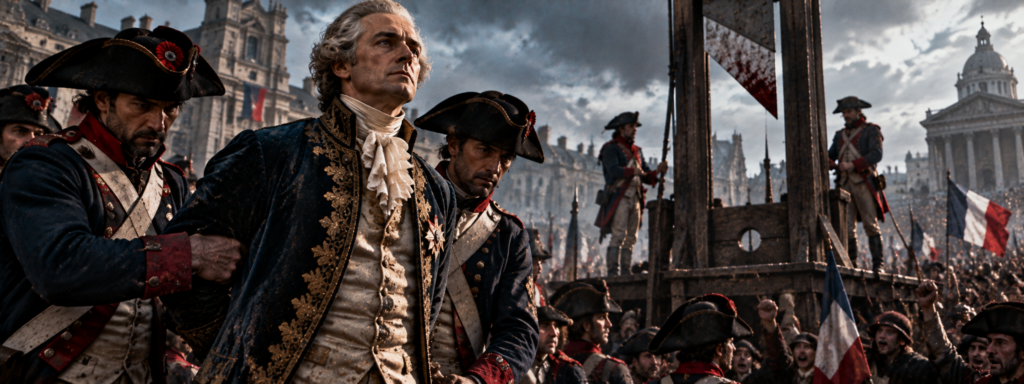
Philippe Égalité: The Royal Duke Who Voted for His King’s Death and Followed Him to the Guillotine
Louis Philippe II, Duke of Orléans (1747–1793) | Born Louis Philippe Joseph d’Orléans | Prince of the Blood and one of the wealthiest aristocrats in France | Great-great-grandson of Louis XIII and cousin of Louis XVI | Duke of Chartres before succeeding as Duke of Orléans in 1785 | Married Louise Marie Adélaïde de Bourbon, heiress to the enormous Penthièvre fortune | Known for his hostility toward the royal court and complicated rivalry with Louis XVI and Marie Antoinette | Associated with liberal aristocratic opposition before the French Revolution | Owner of the Palais-Royal, whose arcades and gardens became one of revolutionary Paris’s most important political gathering places | Elected to the Estates-General in 1789 and joined the Third Estate | Accused by enemies of financing or encouraging revolutionary agitation, including the October Days, although claims that he deliberately engineered popular violence in order to seize the throne remain disputed | Renounced traditional aristocratic distinctions and adopted the name Philippe Égalité | Elected to the National Convention | Voted for the execution of his cousin Louis XVI in January 1793 | Politically compromised after the defection of his son Louis Philippe, Duke of Chartres, alongside General Dumouriez | Arrested with other members of the Orléans family | Tried before the Revolutionary Tribunal | Condemned to death during the Terror | Guillotined in Paris on November 6, 1793 | Father of the future King Louis Philippe I, who became King of the French in 1830.
The Prince in the Cart
On November 6, 1793, a former royal prince was carried through revolutionary Paris toward the guillotine. Only a few years earlier, Louis Philippe Joseph d’Orléans had been one of the richest and highest-ranking aristocrats in Europe, a prince of the blood whose ancestry placed him within reach of the French throne. Now he was known as Philippe Égalité, Citizen Equality, a name meant to advertise how completely he had broken with the privileged world into which he had been born. The Revolution had accepted his vote when he condemned Louis XVI to death, but it was no longer prepared to accept that a Bourbon prince could ever truly become an ordinary citizen.
The journey contained an almost unbearable political irony. In January, Philippe had sat among the deputies of the National Convention while they decided whether his cousin Louis XVI should live or die, and when his turn came he voted for death. Less than ten months later, Philippe himself had been condemned by the same revolutionary order he had supported. The monarchy had fallen, the king was dead, and the Revolution was consuming men who had helped destroy the old regime.
His route toward execution reportedly carried him near the Palais-Royal, the extraordinary Parisian property that had once made him one of the most visible aristocrats in France. Its gardens, cafés, shops, theaters, gambling houses, political clubs, prostitutes, pamphleteers, and restless crowds had made the complex one of the great public spaces of the early Revolution. Philippe had opened much of the property to commercial development and public life long before anyone could know what political role it would eventually play. Now the former owner passed through a city in which his name had become politically toxic.
The guillotine waiting for him stood on the Place de la Révolution, the same great square where Louis XVI had been executed on January 21. Marie Antoinette had followed on October 16. Philippe Égalité would now join them, not as a royalist martyr who had resisted revolution but as a prince who had embraced it, benefited from it, and ultimately discovered that revolutionary loyalty could not erase royal blood. The machine did not care that he had voted for his cousin’s death.
His execution was not a regicide in the strict sense because Philippe was not a reigning monarch. Yet few deaths belong more naturally in a history of assassinated rulers, executed royals, and revolutionary regicides because Philippe stood on both sides of the blade. He helped condemn a king, rejected much of his own aristocratic identity, and participated in the political destruction of the Bourbon monarchy. Then the Revolution looked at the Bourbon blood still running through his veins and decided that Citizen Equality was not equal enough to survive.
Born Almost Close Enough to the Throne
Louis Philippe Joseph d’Orléans was born at Saint-Cloud on April 13, 1747. His father was Louis Philippe I, Duke of Orléans, and his mother was Louise Henriette de Bourbon, a member of another powerful branch of the extended Bourbon dynasty. At birth he received the title Duke of Montpensier, later becoming Duke of Chartres before eventually succeeding his father as Duke of Orléans. His position placed him among the princes du sang, the princes of the blood who stood within the dynastic succession after the king’s immediate family.
The House of Orléans descended from Philippe I, Duke of Orléans, younger brother of Louis XIV. Philippe II, Duke of Orléans, had served as regent for the young Louis XV between 1715 and 1723, giving the family a powerful historical association with government during moments when the direct royal line was vulnerable. The Orléans princes therefore existed close enough to the throne to matter politically while remaining distant enough to develop interests independent of the reigning king. That position created opportunity, suspicion, and recurring rivalry.
Louis Philippe Joseph grew up amid extraordinary wealth. The Orléans fortune included enormous estates and valuable urban properties, particularly the Palais-Royal in Paris. He was not merely another titled courtier dependent upon royal generosity. His private resources allowed him a degree of independence unusual even among great aristocrats.
That independence would become politically important. A nobleman dependent upon Versailles could be disciplined through offices, pensions, and access to the king. A prince possessing his own wealth, name, household, properties, and clientele was harder to control. The Orléans family could function almost like a rival court within the monarchy.
Philippe’s birth also carried a burden he could never entirely escape. No matter what political opinions he later adopted, he remained a Bourbon prince. His ancestry connected him to the monarchy he would help destroy. During the Revolution, that bloodline would transform from privilege into evidence against him.
Marriage to an Heiress
In 1769, Philippe married Louise Marie Adélaïde de Bourbon, daughter of Louis Jean Marie de Bourbon, Duke of Penthièvre. She was one of the wealthiest heiresses in France. Her father descended from Louis XIV and Madame de Montespan through their legitimized son, the Count of Toulouse. The marriage joined two enormous fortunes.
The couple had several children who survived infancy, including Louis Philippe, Duke of Chartres, the future King Louis Philippe I. Their sons received military careers appropriate to their rank, while their daughter Adélaïde would remain deeply connected to her brother’s later political life. The children were raised within an aristocratic household increasingly influenced by unconventional educational ideas. Madame de Genlis, who became closely associated with the family, played an important role in their upbringing.
Philippe’s marriage was not a conventional story of enduring domestic harmony. He acquired a reputation for numerous affairs, and his relationship with his wife deteriorated. Eighteenth-century aristocratic marriages frequently involved political and financial considerations more than romantic compatibility, but Philippe’s private life contributed to the image of a prince who rejected conventional restraints. His enemies found abundant material in his behavior.
One important relationship was with Grace Elliott, a Scottish courtesan and social figure whose later memoirs provided a vivid, though not always independently verifiable, picture of revolutionary Paris. Elliott remained royalist while Philippe moved toward revolutionary politics. Their relationship illustrates the strange social world in which political enemies could remain personally connected. The Revolution eventually forced such ambiguities into increasingly dangerous forms.
Philippe’s private scandals mattered because political reputation in pre-revolutionary France was shaped by gossip as much as official action. Versailles thrived on rumors of adultery, debts, sexual behavior, secret alliances, and personal insults. The Duke of Orléans would become one of the most gossiped-about men in the kingdom. When revolution arrived, old court scandal merged with new political accusation.
The Prince Who Did Not Fit Versailles
Philippe’s relationship with the royal court was difficult long before 1789. He possessed the rank to demand respect but lacked the temperament to become an obedient satellite of Versailles. He cultivated interests and friendships that could appear fashionable, liberal, Anglophile, or oppositional. His admiration for aspects of British political and social life distinguished him from more traditional courtiers.
He served in the French navy and participated in operations during the American War of Independence. His conduct at the Battle of Ushant in 1778 became controversial after a misunderstanding or dispute concerning naval maneuvers. Critics accused him of cowardice, an especially damaging charge for an aristocratic prince. The episode injured his military reputation and deepened his alienation from court circles.
Philippe and Marie Antoinette developed a famously hostile relationship. The exact origins and intensity of their mutual dislike have accumulated layers of gossip, and not every colorful anecdote deserves confidence. What is clear is that Philippe became associated with opposition to the queen and the court culture surrounding her. Marie Antoinette’s supporters reciprocated with contempt.
The queen herself was already the target of an extraordinary culture of libel. Pornographic pamphlets and political slander depicted her as sexually depraved, financially destructive, foreign, manipulative, and treasonous. Philippe’s enemies would later accuse him of helping finance anti-royal propaganda. Some Orléanist political activity undoubtedly existed, but claims that every attack upon the queen originated from his money are impossible to sustain.
The relationship nevertheless mattered because personal antagonism reinforced structural rivalry. The Orléans branch possessed wealth, dynastic standing, and a history of regency. If the reigning monarchy weakened, people naturally wondered whether Orléans might benefit. Every sign of opposition could therefore be interpreted as preparation for something larger.
Philippe increasingly became the prince whom enemies imagined waiting for royal collapse. Whether he actually intended to replace Louis XVI is a far more complicated question. Suspicion, however, became politically powerful long before proof existed.
The Palais-Royal: A Palace That Became a Political City
The Palais-Royal was central to Philippe’s fortune and eventually to his revolutionary reputation. Facing financial pressures despite his immense wealth, he redeveloped parts of the property during the 1780s. Arcades containing shops, cafés, entertainment venues, and other commercial establishments transformed the complex. The gardens became accessible to an unusually broad public.
Because the Palais-Royal was associated with a prince and enjoyed distinctive jurisdictional circumstances, it developed a reputation as a space where political discussion and printed material could circulate with unusual freedom. Cafés became gathering places for journalists, agitators, intellectuals, speculators, prostitutes, gamblers, and curious Parisians. The atmosphere was commercial, fashionable, scandalous, and increasingly political. By 1789, the Palais-Royal had become one of the places where revolutionary Paris talked to itself.
This association later fed accusations that Philippe deliberately created or financed revolutionary agitation. The reality was more complicated. The commercial redevelopment predated the Revolution, and the crowds who gathered there were not puppets controlled by the duke. Yet Philippe undeniably benefited from and tolerated a public environment hostile to the court.
Camille Desmoulins famously addressed a crowd at the Palais-Royal on July 12, 1789, after news spread of the dismissal of the popular minister Jacques Necker. His call helped intensify the political mobilization that preceded the storming of the Bastille two days later. Philippe did not need to stand beside Desmoulins for the location itself to strengthen suspicions about him. The revolution seemed to be erupting from his garden.
The Palais-Royal therefore became both real political space and symbolic evidence. Royalists could point to it as an Orléanist nest of sedition. Revolutionaries could treat it as a liberated public sphere. Philippe stood awkwardly between these interpretations, benefiting from opposition without controlling the forces his property helped accommodate.
That distinction would haunt him. A man can own a building without owning the crowd inside it. Philippe’s enemies repeatedly blurred the difference.
The Assembly of Notables
France’s financial crisis brought Philippe into increasingly open conflict with royal policy. In 1787, Louis XVI summoned the Assembly of Notables in an attempt to secure support for fiscal reforms. The monarchy faced enormous debt, structural taxation problems, and resistance from privileged groups. Philippe participated as one of the kingdom’s greatest princes.
He increasingly aligned himself with aristocratic opposition to royal financial measures. Such opposition should not automatically be interpreted as democratic revolutionary politics. Many privileged critics of the monarchy wanted constitutional limits or institutional reform while also defending their own corporate rights. Opposition to absolutism could arise from aristocratic privilege as easily as from popular egalitarianism.
Philippe nevertheless cultivated a reputation for liberalism. His willingness to challenge royal authority made him popular among some critics of Versailles. When the Parlement of Paris resisted royal measures, Philippe publicly questioned the legality of a royal proceeding in November 1787. Louis XVI responded by exiling him temporarily from court.
The episode increased his prestige as an opponent of arbitrary royal authority. A prince of the blood had publicly confronted the king and suffered punishment. For supporters, this demonstrated courage. For enemies, it demonstrated dangerous ambition.
By the time Louis XVI agreed to summon the Estates-General, Philippe’s political identity had become difficult to separate from opposition. He remained one of the richest aristocrats in France, but he increasingly spoke the language of reform. The contradiction would become one of the defining features of his revolutionary career.
1789: The Royal Prince Joins the Third Estate
Philippe was elected to the Estates-General in 1789 as a representative of the nobility. The assembly opened at Versailles amid disputes over voting procedures and representation. The Third Estate eventually declared itself the National Assembly, claiming the right to represent the nation rather than merely one traditional order. The constitutional crisis escalated rapidly.
Philippe was among the nobles who moved toward the Third Estate. His decision reinforced his image as a liberal prince willing to surrender aspects of aristocratic solidarity. It also deepened royalist suspicion that he was exploiting the crisis for personal advantage. A Bourbon prince joining the political rebellion against traditional royal structures could hardly appear neutral.
He was not alone among liberal nobles. The Marquis de Lafayette and other aristocrats also supported substantial reform. The early Revolution included many privileged figures who believed constitutional government could preserve monarchy while transforming France. Philippe’s participation therefore did not by itself prove a secret plan for the throne.
Yet his dynastic position made every action more suspicious than that of an ordinary reforming noble. Lafayette could seek constitutional monarchy without plausibly becoming king himself. Philippe belonged to a branch of the royal house. If Louis XVI fell, Orléans was one of the names that naturally entered speculation.
The distinction between genuine reform and dynastic ambition became increasingly difficult to maintain in public debate. Philippe could sincerely support constitutional change and still understand that royal weakness increased his own political importance. Human motives need not be singular. Revolutionary politics rewarded men whose ideals and interests happened to point temporarily in the same direction.
The Bastille and the Orléanist Shadow
The storming of the Bastille on July 14 transformed the political crisis into revolution. Royal authority in Paris collapsed with astonishing speed. The National Assembly gained strength, while popular mobilization became an independent force. France entered a political world in which events could move faster than any individual conspiracy.
Royalist observers nevertheless looked for hidden organizers. Philippe became an obvious suspect. His wealth, hostility toward the court, connections with liberal politicians, and association with the Palais-Royal made him an ideal villain. Rumors portrayed him as financing mobs, purchasing popular support, and preparing to replace Louis XVI.
Some political figures certainly imagined an Orléanist solution to the crisis. A constitutional monarchy headed or influenced by the Duke of Orléans could appear attractive to those who considered Louis XVI incapable of adapting. Philippe had supporters and clients who promoted his interests. It would be equally mistaken to deny Orléanism entirely or to treat the whole Revolution as an Orléanist conspiracy.
The scale of popular unrest cannot plausibly be reduced to one prince’s money. Bread shortages, fiscal collapse, political mobilization, fear of royal repression, pamphlet culture, institutional conflict, and decades of social tension all contributed. The Revolution had causes far larger than Philippe. Even a wealthy duke could not simply purchase July 1789.
The conspiracy image nevertheless survived because it explained chaos in personally understandable terms. Rather than accepting that institutions and social forces were collapsing, frightened observers could imagine one ambitious prince pulling strings. Philippe’s reputation would never fully escape that suspicion. In revolutionary politics, an allegation repeated often enough could become almost as dangerous as a proven act.
The October Days
The events of October 5–6, 1789 intensified accusations against Philippe. Crowds, many of them market women from Paris, marched to Versailles amid anger over bread shortages and political fears. The demonstrations escalated, and violence broke out around the palace. The royal family was ultimately forced to move from Versailles to Paris.
Royalists accused Philippe and his agents of encouraging or financing the march. His supporters denied that he had orchestrated the uprising. Historians have debated the extent of Orléanist involvement ever since. There were individuals connected to his political circle among revolutionary activists, but this does not establish that Philippe personally designed the October Days.
The allegation made sense to contemporaries because Philippe benefited politically from the humiliation of the court. Bringing the king to Paris placed Louis XVI closer to the revolutionary population and farther from the protective world of Versailles. An Orléanist hoping to weaken the king might logically favor such an outcome. Logic, however, is not evidence of command.
Lafayette and others viewed Philippe with enough suspicion that pressure developed for him to leave France temporarily. He traveled to Britain on what was presented as a diplomatic mission. The journey conveniently removed him from Paris at a moment when accusations were becoming dangerous. His absence did little to silence rumors.
The October Days illustrate the central problem in Philippe’s biography. He inhabited a political network in which people acting in his interest sometimes participated in revolutionary agitation, while his enemies attributed almost every disturbance to his secret direction. The truth lies between total innocence and omnipotent conspiracy. Philippe was politically ambitious and deeply opposed to the court, but the Revolution was never his private machine.
A Prince Becomes a Revolutionary Citizen
As the Revolution advanced, aristocratic titles and hereditary privilege came under increasing attack. Philippe adapted more dramatically than almost any other member of the royal family. He embraced the new political language and distanced himself from the aristocratic identity that had defined his birth. Eventually he became known as Philippe Égalité.
The name has often been treated as if he simply invented it as a theatrical revolutionary disguise. The circumstances were more institutional. After the abolition of noble titles and changes in civil naming, the former duke needed a surname, and “Égalité” became associated with him. Whether embraced eagerly or pragmatically, the name perfectly captured the transformation he wished to display.
For royalists, the transformation was grotesque. A Bourbon prince whose wealth came from centuries of hereditary privilege now called himself Equality. His estates, fortune, and social connections did not disappear merely because titles had been abolished. Critics saw hypocrisy.
For revolutionaries, his aristocratic origin remained equally problematic. However radical his public alignment became, he could not change his ancestry. Every political crisis revived suspicion that he might still become the center of a monarchical alternative. The name Égalité could not erase Orléans.
Philippe therefore occupied a position that became more dangerous as the Revolution radicalized. Royalists despised him as a traitor to his class and family. Radicals distrusted him because he remained a prince by blood. He had crossed the political bridge away from the monarchy without ever being allowed to reach the other side completely.
The Fall of the Monarchy
The constitutional monarchy created in 1791 proved unstable. Louis XVI’s attempted flight to Varennes in June 1791 severely damaged public trust. The king’s acceptance of the constitution could no longer erase suspicions that he hoped foreign powers would restore stronger royal authority. War beginning in 1792 intensified the crisis.
Philippe continued aligning himself with the revolutionary order. His sons entered military service, and the eldest, Louis Philippe, Duke of Chartres, served with distinction in the revolutionary armies. The family seemed to be building a future inside the new France rather than waiting for restoration of the old. For a time, this strategy appeared remarkably successful.
The insurrection of August 10, 1792, destroyed the monarchy politically. The Tuileries Palace was attacked, the Swiss Guards were massacred, and the royal family was imprisoned. A new National Convention was elected. France would soon become a republic.
Philippe won election to the Convention. The former duke now sat as a representative in the assembly that would determine the fate of his cousin. This was the ultimate transformation from prince to revolutionary politician. No symbolic gesture could have demonstrated his break with the old dynasty more dramatically.
Yet the very presence of a Bourbon in the Convention remained extraordinary. Louis XVI was imprisoned while another descendant of the royal house participated in the republic replacing him. The Revolution had created a political scene unimaginable only a few years earlier. It was about to demand that Philippe prove which side he had truly chosen.
The Trial of Louis XVI
The discovery of documents in the iron chest at the Tuileries strengthened accusations that Louis XVI had secretly corresponded with counterrevolutionary figures and foreign powers. The Convention decided to put the former king, now officially referred to as Louis Capet, on trial. Deputies debated questions of guilt, appeal, and punishment. The proceedings placed every member under immense political pressure.
Philippe’s position was uniquely painful and politically dangerous. Louis was his cousin and head of the dynasty into which Philippe had been born. Voting to spare him could confirm suspicions that blood remained stronger than republican loyalty. Voting for death would mark an almost irreversible rupture with his family.
There were also accusations that Philippe stood to benefit personally from Louis’s elimination. If some future political crisis restored monarchy while excluding the direct Bourbon line, Orléans might conceivably become a candidate. This possibility made his vote vulnerable to cynical interpretation. A prince voting to execute a king could be portrayed as clearing his own path.
Yet by January 1793, Philippe had spent years publicly identifying with the Revolution. He had accepted the republic and served in its legislature. From that perspective, treating Louis differently because they were related would itself contradict the political equality Philippe claimed to support. The vote forced ideology, self-preservation, ambition, and family loyalty into a single decision.
When the Convention voted on punishment, Philippe voted for death. His recorded explanation emphasized duty and equality before the law rather than family relationship. The decision shocked royalists and permanently defined his historical reputation. The Duke of Orléans had voted to send the King of France to the guillotine.
The Vote That Could Never Be Taken Back
Louis XVI was executed on January 21, 1793. Philippe’s vote was only one among those that produced the death sentence, and the final voting procedure was more complicated than the popular claim that the king died by a simple one-vote majority. Nevertheless, Philippe’s individual vote carried symbolic weight far beyond its numerical value. A Bourbon prince had chosen the Republic over the life of his cousin.
Royalists never forgave him. To them, Philippe Égalité became the ultimate dynastic traitor, a man who had purchased revolutionary approval with the king’s blood. Later Bourbon memory treated his vote as an especially shameful betrayal. The accusation would shadow his descendants.
Revolutionaries did not reward him with lasting trust. If anything, the vote demonstrated the impossible position he occupied. A man capable of voting for the death of his own cousin could appear ruthlessly republican, but he could also appear ruthlessly ambitious. The same action that proved loyalty to one observer could prove treachery to another.
The execution also removed one of the strongest reasons Philippe might have been politically useful as an alternative prince. France was now a republic. The question was no longer which Bourbon should occupy the throne. Increasingly, the question was whether any Bourbon could be trusted at all.
Philippe had made the most dramatic sacrifice available to him. He had placed his vote between himself and his dynasty. Within months, he would discover that the Revolution still saw the dynasty when it looked at him.
Dumouriez and the Son Who Defected
The crisis that destroyed Philippe politically began with General Charles François Dumouriez. Dumouriez had achieved important military victories for revolutionary France, including Valmy and Jemappes, but his relationship with the radicalizing government deteriorated. After military setbacks in 1793, he moved toward open betrayal. He eventually defected to the Austrians.
Philippe’s eldest son Louis Philippe served under Dumouriez. When the general defected in April 1793, the young prince went with him rather than return to a France where his position had become extremely dangerous. Louis Philippe would later insist upon circumstances and motives distinct from a simple ideological betrayal. For the revolutionary government, however, the essential fact was devastating: Philippe Égalité’s son had crossed over with a traitorous general.
The father had not defected. There is no solid evidence that Philippe Égalité had secretly coordinated his son’s action or participated in Dumouriez’s plans. Revolutionary politics in 1793, however, did not require such evidence to produce suspicion. Family connection itself became dangerous.
The Convention moved against the Bourbons still within its reach. Philippe and other members of the Orléans family were arrested. His earlier revolutionary service, abandonment of title, and vote against Louis XVI could not protect him. The behavior of his son revived every old accusation about Orléanist ambition.
This was the trap from which Philippe could not escape. If his family remained royalist, he was suspect because of their royalism. If a son defected with a general accused of treason, he was suspect because of the defection. Blood had become political evidence.
The name Égalité suddenly looked fragile. Philippe had attempted to become a citizen. The Revolution now treated him as a Bourbon.
Arrested by the Revolution He Supported
Philippe’s arrest marked the collapse of the political strategy he had followed since 1789. He had moved steadily away from court, aristocratic privilege, and monarchy. He had joined the Third Estate, accepted revolutionary institutions, served in the Convention, and voted for the king’s death. None of it could erase the suspicion attached to his birth.
He was imprisoned while the Revolution itself became increasingly violent. France faced foreign invasion, civil war in the Vendée, federalist revolts, economic crisis, and political struggle between revolutionary factions. The Committee of Public Safety gained extraordinary powers. The Revolutionary Tribunal became an increasingly important instrument against alleged enemies.
The Girondins fell in June 1793, strengthening the Montagnards and accelerating political radicalization. Philippe had associations across the revolutionary political world, but he possessed no faction powerful enough to protect him. His wealth and ancestry now made him more liability than asset. The revolutionary state was becoming increasingly intolerant of ambiguous loyalties.
For months, Philippe remained imprisoned. His fortune and properties became vulnerable to confiscation and political attack. The man who had once enjoyed one of the largest private incomes in France could no longer command his own movement or guarantee his own safety. The distance from Palais-Royal prince to prisoner had been crossed with astonishing speed.
The Terror did not operate through a single consistent mechanism in which every victim was selected by the same people for the same reason. Political struggles, wartime fear, ideological suspicion, local conflicts, and personal rivalries all contributed. Philippe’s case combined several of these elements. He was wealthy, royal, politically controversial, connected by blood to a defector, and no longer useful enough to justify the risk of sparing him.
The Terror Tightens
By autumn 1793, revolutionary France had entered the period commonly known as the Reign of Terror. The government faced genuine existential threats, including war with European powers and internal rebellion. These dangers were accompanied by intense fears of conspiracy. Revolutionary leaders increasingly treated suspected disloyalty as potentially lethal.
The Law of Suspects, passed in September, widened the categories of people vulnerable to arrest. The Revolutionary Tribunal operated within an atmosphere in which acquittal could itself appear politically suspicious. Former nobles, priests, royalists, moderates, and even revolutionaries who had fallen out of favor could become targets. Political identity was unstable.
Marie Antoinette was tried and executed in October. Her death demonstrated that royal status no longer offered even symbolic protection. The former queen was followed by Girondins and other prominent political prisoners. The guillotine had become part of the daily machinery of revolutionary government.
Philippe’s turn came in November. The timing was significant because revolutionary suspicion of royal blood was at a peak. His son remained outside France after defecting with Dumouriez. The former Duke of Orléans could easily be represented as part of a broader conspiracy regardless of his own revolutionary record.
His enemies did not need to explain why a committed republican would have voted for Louis XVI’s death. They could simply reinterpret that vote as ambition. In the logic of conspiracy, even revolutionary behavior became evidence of hidden royal designs. Philippe was trapped inside a theory that made innocence almost impossible to demonstrate.
Before the Revolutionary Tribunal
Philippe was brought before the Revolutionary Tribunal on November 6, 1793. The proceedings did not resemble the kind of prolonged judicial investigation that might have carefully distinguished his actions from those of his son. The political environment favored rapid judgment. His identity already carried much of the prosecution’s argument.
Charges and suspicions centered upon conspiracy against the Republic, connections to Dumouriez’s treason, and longstanding allegations of personal ambition. Philippe’s wealth and former princely status reinforced the image of a man who might have used revolutionary upheaval for dynastic ends. Years of royalist accusations could now be repackaged in republican language. The same man once accused of destroying the monarchy could be accused of secretly wanting a monarchy for himself.
This ideological reversal is one of the strangest aspects of his downfall. Royalists had said Philippe financed revolution because he wanted Louis XVI’s throne. Revolutionaries could now say his revolutionary conduct concealed the same ambition. Both narratives assumed that Orléans could never genuinely act from political conviction. His bloodline made sincerity almost impossible to prove.
The tribunal condemned him to death. Whatever hopes Philippe might once have had that his vote against Louis XVI would protect him disappeared completely. Revolutionary justice did not recognize a permanent credit for past loyalty. The political needs of November 1793 mattered more than those of January.
The sentence was to be carried out that same day. Philippe had only hours left as Citizen Égalité. The Republic he had helped create would now perform upon him the same punishment he had voted to impose upon his cousin.
The Last Journey Through Paris
Accounts of Philippe’s final hours often emphasize his composure. Like many famous execution narratives, some details were embellished by admirers, enemies, or later storytellers. Revolutionary executions generated legends almost immediately because spectators wanted victims to die either heroically or contemptibly. Caution is therefore necessary when reconstructing exact gestures and remarks.
There is nevertheless substantial agreement that Philippe faced execution with considerable self-control. He had spent his life amid aristocratic codes that prized courage and contempt for physical fear. Whatever his political contradictions, he understood the importance of public bearing. The last performance available to him was the manner in which he died.
The cart carried him through streets filled with people who knew exactly who he was. Some had once cheered the Duke of Orléans as a liberal prince. Others had gathered in the Palais-Royal as revolutionary politics exploded. Now the crowd watched the former owner pass as a condemned prisoner.
The route reportedly took him within sight of the Palais-Royal, now associated with a revolutionary world that had moved far beyond him. The symbolism was almost cruelly precise. The palace had helped make Philippe famous as an aristocratic opponent of Versailles and had become a nursery of revolutionary agitation. He could look toward the world he had helped open and see that it no longer belonged to him.
The guillotine waited at the Place de la Révolution. Philippe had known the square in another age when it was the Place Louis XV, a monument to Bourbon monarchy. Revolution had renamed it and transformed it into a place of state execution. Names changed quickly in revolutionary France, but the political meaning of space changed even faster.
November 6, 1793
Philippe Égalité was fifty-six years old when he reached the scaffold. He had been born under Louis XV, lived through the final decades of the old regime, challenged Louis XVI, joined the Revolution, and helped establish the Republic. Now he was being killed by that Republic. Few lives embodied the violent political transformations of the eighteenth century so completely.
He was executed by guillotine on November 6, 1793. The machine was designed as a standardized method of capital punishment rather than the uniquely revolutionary instrument later memory made it. By 1793, however, its repeated use against famous political prisoners had turned it into the most recognizable symbol of the Terror. Philippe’s death added another royal neck to its history.
Unlike Louis XVI, Philippe did not die defending monarchy. Unlike Marie Antoinette, he could not be transformed easily into a straightforward royalist martyr. He had voted for the king’s execution and publicly embraced revolutionary politics. His death therefore disturbed simple political categories.
Royalists could see divine or historical punishment. Revolutionaries could see the necessary elimination of a suspicious Bourbon. Later historians could see something more complicated: a man who helped dismantle the political order that gave him extraordinary privilege but remained unable to escape the identity that order had given him. His life had become a contradiction the Terror resolved with a blade.
The execution did not erase the House of Orléans. Philippe’s eldest son survived in exile. Decades later, after revolution, empire, restoration, and another revolution, that son would return to the center of French politics. The dynasty Philippe was accused of trying to place on the throne would eventually reach it after all.
Did Philippe Want Louis XVI’s Crown?
The most persistent question surrounding Philippe is whether his revolutionary politics concealed a deliberate plan to replace Louis XVI. Royalist contemporaries frequently believed so. His wealth, dynastic position, hostility toward the court, political clientele, Palais-Royal network, and popularity among reformers made the theory plausible. Some revolutionaries also considered an Orléans constitutional monarchy.
There is evidence of an Orléanist political current. Certain politicians and pamphleteers imagined Philippe as a possible regent or alternative constitutional monarch. People around him sometimes promoted his interests. It would be naive to pretend that dynastic possibilities never entered the calculations of an ambitious prince.
What remains far less certain is whether Philippe personally directed a coherent conspiracy to provoke revolution, overthrow Louis XVI, and seize the crown. The Revolution involved forces vastly beyond his control. Events repeatedly surprised him as much as they surprised other political actors. His behavior does not reveal the kind of disciplined master plan later conspiracy narratives imagined.
He also declined or failed to pursue opportunities that a determined usurper might have exploited more aggressively. His temporary departure for Britain after the October Days weakened rather than strengthened his immediate political position. As the Revolution moved toward republicanism, he followed it rather than attempting openly to rally a monarchist Orléans faction. These choices complicate the portrait of a single-minded pretender.
Ambition and conviction can coexist. Philippe may have believed France needed constitutional reform while also recognizing that the weakening of Versailles enhanced his own importance. He may have enjoyed being considered an alternative to the king without possessing a fixed plan to become king. Human political behavior is often messier than conspiracy theories allow.
The safest conclusion is that Philippe was genuinely oppositional, politically ambitious, and surrounded by people willing to imagine an Orléans solution. Claims that he personally engineered the Revolution as a dynastic coup remain unproven. His enemies saw a crown behind every gesture because his ancestry made that crown imaginable.
The Vote Against Louis XVI Reconsidered
Philippe’s vote for Louis XVI’s death remains the most emotionally charged act of his career. It can be interpreted as republican conviction, political self-preservation, personal hostility, dynastic ambition, or some mixture of motives. No surviving evidence allows historians to look directly into his mind at the moment of voting. His stated justification emphasized duty rather than family.
The vote was especially shocking because early modern monarchy treated blood relationship as politically sacred. Princes of the blood derived their status from the same dynasty whose head Philippe condemned. By voting for execution, he appeared to reject not merely a cousin but the hereditary principle that had elevated him. The symbolism was devastating.
Yet abstaining would also have been politically meaningful. Philippe was a deputy to the Convention and had publicly accepted the Republic. Claiming family privilege at the decisive moment would have exposed the limits of his professed equality. The Revolution demanded a choice from which there was no safe escape.
His decision failed to purchase security because revolutionary suspicion did not operate like a ledger. One dramatic act of loyalty could not permanently cancel aristocratic ancestry. When his son defected, Philippe’s earlier vote was reinterpreted rather than rewarded. A supposed proof of republicanism became another possible proof of ruthless ambition.
The story is therefore more tragic than the simple claim that he received poetic justice for voting against Louis. Philippe participated knowingly in a political system that increasingly accepted death as a solution to political danger. When that system turned upon him, it did not need to prove that he had secretly regretted his vote. It needed only to decide that he had become dangerous.
Father and Son
The contrast between Philippe Égalité and his eldest son Louis Philippe is extraordinary. The father died beneath the revolutionary guillotine in 1793. The son spent years in exile, traveling through Europe and eventually the United States while avoiding the wars and political dangers surrounding France. Their family fortunes appeared shattered.
Louis Philippe eventually reconciled himself with branches of the Bourbon family during exile, though the memory of his father’s vote remained deeply uncomfortable. After Napoleon’s fall, the Bourbon Restoration returned Louis XVIII and later Charles X to the throne. The Orléans family recovered much of its position but remained politically distinct from the senior Bourbon line. The old dynastic rivalry had survived Revolution and Empire.
In 1830, Charles X was overthrown during the July Revolution. The political settlement that followed rejected both a republic and straightforward restoration of the senior Bourbon monarchy. Louis Philippe, Duke of Orléans, was offered the throne. He became “King of the French” rather than “King of France,” signaling a monarchy supposedly grounded in national sovereignty rather than pure hereditary right.
The irony was immense. Philippe Égalité had spent his revolutionary career accused of secretly wanting to replace the senior Bourbons. He died without becoming king and perhaps without ever possessing a concrete plan to do so. His son nevertheless became monarch thirty-seven years later through another revolution.
Louis Philippe’s reign lasted until 1848, when he too was overthrown by revolution. The Orléans monarchy therefore ended as it had begun, amid popular upheaval. Philippe Égalité’s descendants reached the throne, but revolutionary France remained as dangerous to them as it had been to him.
A Prince Hated by Everyone
Philippe’s historical reputation suffered because nearly every major political tradition had reasons to dislike him. Bourbon royalists viewed him as a traitor who abandoned his family and voted for the king’s death. Jacobin revolutionaries could view him as a suspicious aristocrat whose egalitarianism never erased his wealth or dynastic connections. Later republicans had little reason to celebrate a man associated with possible Orléanist monarchy.
His son’s accession in 1830 further politicized his memory. Supporters of the July Monarchy had reasons to soften the father’s reputation, while Legitimists hostile to Louis Philippe could revive the accusation that the Orléans dynasty had been built upon betrayal of Louis XVI. The vote of January 1793 became a weapon in nineteenth-century dynastic politics. Philippe’s dead hand continued to trouble his descendants.
Popular history often reduces him to a hypocritical prince who called himself Equality while remaining enormously rich. The contradiction is real but incomplete. Many aristocratic liberals participated in the Revolution because opposition to absolutism and privilege had spread far beyond the common population. A privileged man could sincerely believe privileges required reform.
At the same time, Philippe was not a modern democratic egalitarian in any simple sense. He was a product of aristocratic culture, enjoyed immense wealth, pursued personal pleasure, maintained political clients, and understood dynastic power. His revolutionary identity developed gradually within extraordinary circumstances. The name Égalité did not transform his personality overnight.
His complexity is precisely why he remains fascinating. He was neither merely a cynical usurper nor merely a heroic liberal prince. He was an aristocrat who helped attack aristocratic privilege, a Bourbon who helped destroy Bourbon monarchy, and a revolutionary who died because revolutionaries could not forget he was a Bourbon.
The Palais-Royal After Its Prince
The Palais-Royal outlived Philippe and retained its importance in Parisian life. Its political culture had never depended entirely upon him. Shops, cafés, theaters, gambling establishments, and public promenades continued to attract crowds. The property demonstrated how urban space could develop a political life beyond the intentions of its owner.
During the early Revolution, the Palais-Royal had functioned almost as an unofficial parliament of the streets. News circulated rapidly, speeches attracted crowds, pamphlets changed hands, and rumors became political events. The gardens embodied the emerging power of public opinion. Philippe benefited from this atmosphere without ever fully controlling it.
This distinction undermines the old image of him as puppet master of the Revolution. A puppet master controls the strings. Philippe could not control Desmoulins, the Paris crowds, the National Assembly, the Jacobins, Dumouriez, or the Convention. Eventually he could not control what happened to himself.
The palace therefore offers a better metaphor for his career than conspiracy. Philippe opened a space that became politically larger than its owner. He participated in a movement that became larger than its aristocratic reformers. He helped release forces that no prince could command.
By 1793, the revolutionary public sphere that had once made Philippe useful had no need for him. The Palais-Royal could remain while the Duke of Orléans disappeared. Institutions and crowds survived individuals. That was one of the hardest lessons the old aristocracy learned from the Revolution.
Equality and the Problem of Blood
Philippe’s chosen revolutionary identity rested upon the principle that inherited rank should no longer determine political worth. The abolition of noble titles made him legally less different from other citizens. Calling himself Égalité dramatized that transformation. Yet revolutionary politics repeatedly treated ancestry as meaningful.
Former nobles were viewed with suspicion because their old social networks might connect them to counterrevolution. Émigré relatives could make those who remained in France suspect. Royal blood carried an even heavier burden because any surviving prince might become a rallying point for restoration. The Revolution that proclaimed equality could therefore assign political danger according to birth.
Philippe’s fate exposes this contradiction vividly. He could surrender his title but not his genealogy. He could vote against his cousin but not stop being that cousin’s relative. He could call himself Égalité but could not make the Convention forget Orléans.
His son’s defection made the problem impossible to ignore. Revolutionary authorities did not need to believe Philippe personally planned Dumouriez’s betrayal. They could fear the political possibilities represented by his family. A Bourbon outside France with military experience could become a future enemy.
The Terror often treated potential danger as sufficient reason for repression. Philippe’s identity supplied a ready-made theory of potential danger. His entire life became evidence against him because every earlier action could be reinterpreted through suspicion.
Citizen Equality discovered that revolutionary equality had limits. The law had abolished his title. Politics remembered his blood.
Was His Execution Legal Murder?
Philippe was tried and formally condemned by the Revolutionary Tribunal, so his death differs from an assassination such as the murder of Louis of Orléans or John the Fearless. Armed men did not ambush him privately. The revolutionary state arrested, prosecuted, sentenced, and executed him through institutions it regarded as lawful. Calling the death a conventional assassination would therefore be inaccurate.
Yet the judicial context was profoundly political. The tribunal operated during the Terror, when procedural protections were increasingly subordinated to revolutionary security. Philippe’s conviction rested within a climate of conspiracy fears and collective suspicion. His relationship to Dumouriez’s defection was far less direct than the punishment implied.
This makes his death especially appropriate for a broader category encompassing regicides, executed royals, revolutionary killings, and politically motivated elimination of rulers or princely figures. Philippe was not murdered secretly; he was eliminated publicly by a revolutionary government. The blade was legal according to the institutions wielding it. That does not make the political process neutral.
His execution also forms part of the same revolutionary sequence as those of Louis XVI and Marie Antoinette. The Republic was systematically dismantling the human remnants of monarchy. Philippe’s revolutionary alignment briefly distinguished him from other Bourbons but could not protect him indefinitely. By late 1793, his existence itself could be represented as a risk.
The state therefore killed a man who had helped legitimize the state’s power to kill royal figures. Philippe had voted for the execution of Louis XVI as an act of republican justice. Ten months later, revolutionary justice pronounced the same final sentence upon him. The categories of judge, accomplice, and victim had collapsed into one life.
The Revolution Devours a Prince
The phrase that revolutions devour their children is often used so casually that it can lose meaning. Philippe was not literally a child of the Revolution because he was forty-two when the Bastille fell and had spent most of his life as a privileged prince. Yet politically, he reinvented himself through the revolutionary process. The new order gave him a second identity and then destroyed it.
His trajectory was extraordinary. He began as Duke of Chartres, became Duke of Orléans, challenged court authority, joined the Third Estate, accepted the end of noble privilege, entered the Convention, adopted the name Égalité, voted for a republic, and voted for the king’s death. Few aristocrats traveled farther politically. The distance still was not enough.
The Revolution’s standards of loyalty changed too rapidly. What appeared radical in 1789 could seem moderate in 1792 and suspicious in 1793. Men who had once been celebrated as patriots found themselves denounced as traitors. Philippe’s earlier liberalism became almost irrelevant.
The execution therefore reveals something broader than personal irony. Revolutionary legitimacy had become unstable because political survival depended upon continually proving commitment under changing conditions. Past service offered no permanent immunity. The Revolution judged people in the present.
Philippe’s royal blood ensured that the burden of proof would always be unusually high. He attempted to compensate with increasingly dramatic demonstrations of loyalty. Voting for Louis XVI’s death was the most dramatic possible demonstration. Even that expired within months.
Louis XVI and Philippe Égalité: Two Roads to the Same Scaffold
Louis XVI and Philippe could hardly have taken more different political paths after 1789. Louis attempted to preserve monarchy within changing constitutional arrangements while privately hoping to recover greater freedom and authority. His flight to Varennes shattered much of the remaining trust between king and Revolution. Philippe moved in the opposite direction and increasingly identified himself with revolutionary institutions.
Louis was imprisoned as the embodiment of monarchy. Philippe sat in judgment upon him as a representative of the nation. One wore the burden of kingship while the other publicly abandoned princely identity. Their political separation seemed complete.
Yet both eventually entered the same execution system. Louis reached the guillotine in January 1793 because the Convention concluded that the former king was an enemy of the Republic. Philippe arrived in November because the revolutionary government concluded that the former prince could not be trusted. Their different choices converged upon the same blade.
The comparison does not mean their trials or political responsibilities were identical. Louis had been head of state, involved in secret diplomacy, and central to the constitutional crisis. Philippe’s alleged conspiracy in 1793 was far less substantial. The Revolution nevertheless treated both as dangers requiring permanent removal.
The guillotine created a brutal equality that Philippe’s chosen surname could never have anticipated. King and prince, royalist and revolutionary, cousin and cousin’s judge all became condemned citizens before the machine. The difference was that Philippe had once voted to send the first man there.
The Fortune He Could Not Take With Him
Philippe’s wealth had shaped almost every stage of his political reputation. It gave him independence from Versailles, allowed him to maintain a substantial household, supported the redevelopment of the Palais-Royal, and encouraged accusations that he financed revolutionary agitation. Money made him powerful. It also made him suspicious.
Revolutionary France increasingly viewed enormous private fortunes through a political lens. Wealth could finance conspiracy, purchase newspapers, support armed followers, or sustain émigrés. Philippe’s fortune therefore became part of the case against his trustworthiness even when no specific expenditure proved treason. The old privilege of wealth became a revolutionary liability.
His financial affairs had never been as secure as the scale of his assets suggested. Aristocratic expenditure, property development, household costs, and debt complicated his position. The Palais-Royal redevelopment itself reflected a desire to generate income. Immense wealth did not mean unlimited liquid resources.
None of this mattered on the scaffold. Titles, estates, jewels, rents, and dynastic claims could not purchase an exception from a government determined to kill him. The fortune that had once allowed Philippe to stand independently of Louis XVI offered no independence from the Revolutionary Tribunal. Political systems decide which forms of wealth remain usable.
His descendants would recover substantial property and eventually royal status. Philippe himself saw none of it. In November 1793, the richest inheritance available to him was a controversial name his children would spend decades trying to explain.
Why Philippe Égalité Belongs in Assassinated Rulers & Regicides
Philippe was neither an assassinated monarch nor a regicide victim in the narrowest sense. He was a royal duke executed by a revolutionary tribunal. Yet his story is inseparable from regicide because he personally participated in the political decision that sent Louis XVI to death. He then became a victim of the same revolutionary culture of political execution.
His dynastic rank also makes his death more significant than that of an ordinary Convention deputy. Philippe belonged to the Bourbon royal house and had once stood within the succession. His possible role as alternative monarch or regent was repeatedly discussed, whether or not he actively pursued such plans. Killing him removed a figure around whom future dynastic politics might conceivably gather.
The execution was unmistakably political. His son’s defection with Dumouriez triggered the immediate crisis, while years of suspicion surrounding Orléanist ambition supplied the larger narrative. The tribunal did not discover a straightforward secret order from Philippe directing Dumouriez’s betrayal. It condemned a man whose identity had become politically intolerable.
His death also exposes the blurred boundary between judicial execution and political elimination. Revolutionary institutions supplied legal forms, but those institutions operated during an emergency regime increasingly willing to treat suspicion as evidence of conspiracy. Philippe went to the guillotine not because he had returned to royalism but because revolutionaries feared what a Bourbon might someday become. The state killed a possibility as much as a proven conspirator.
Most importantly, Philippe’s story places regicide and revolutionary execution inside the same human life. He began as a prince close to the throne, became a legislator who voted to kill the king, and ended as a royal victim of the Revolution. Few historical figures crossed so many sides of political violence before the blade finally reached them.
Citizen Equality Beneath the Blade
Louis Philippe Joseph d’Orléans had been born into a world where blood determined almost everything. His ancestry gave him titles before he could speak, palaces before he could understand wealth, and a position near the French throne before he could form a political opinion. He belonged to a dynasty that had ruled France for centuries. Nothing about his birth suggested that he would someday vote to execute its king.
Yet Philippe never fit comfortably inside the court that privilege expected him to serve. His wealth made him independent, his personality made him difficult to discipline, and his hostility toward Versailles increasingly pushed him toward opposition. The court answered with suspicion. By the final years of the old regime, the Duke of Orléans had become the prince most easily imagined as an alternative to Louis XVI.
The Palais-Royal magnified that reputation. Its arcades and gardens filled with the noisy, commercial, argumentative life of Paris. People talked politics beneath the roof of a Bourbon prince while pamphlets, rumors, speeches, and anger circulated around them. When revolution came, the palace seemed almost designed for it.
Philippe benefited from that political atmosphere. He embraced reform, challenged royal authority, and joined nobles willing to cooperate with the Third Estate. His choices were real. Reducing them entirely to a secret desire for the crown makes him less interesting than he actually was.
He could oppose absolutism sincerely and still be ambitious. He could despise aspects of Versailles while enjoying aristocratic privilege. He could support political equality without ceasing to be one of the richest men in France. Contradiction was not unique to Philippe; it was one of the defining characteristics of the revolutionary generation.
His enemies preferred simpler explanations. They imagined money passing from the Palais-Royal into the hands of agitators. They imagined mobs responding to secret Orléanist instructions. They imagined the duke waiting for Louis XVI to fall so that he could take the crown.
Some Orléanist intrigue certainly existed, and Philippe was no politically innocent bystander. Men around him promoted his interests, and constitutional alternatives involving the House of Orléans were discussed. Yet no convincing evidence transforms him into the hidden director of the French Revolution. The upheaval was far too large for that.
The October Days intensified every suspicion. Versailles was invaded, the royal family was brought to Paris, and Philippe appeared to benefit from the weakening of the court. Again, rumors of his involvement multiplied. Again, proof remained less impressive than accusation.
Philippe nevertheless continued moving toward the Revolution. Aristocratic privilege fell, and eventually the title Duke of Orléans disappeared from his official political identity. Louis Philippe Joseph became Philippe Égalité. The transformation was so dramatic that it almost seemed theatrical.
There was something absurd about one of the richest princes in Europe calling himself Equality. There was also something genuinely revolutionary about it. A society built upon hereditary distinction was forcing even its princes to describe themselves as citizens. Philippe accepted the new language more completely than almost any other Bourbon.
Then monarchy itself collapsed. Louis XVI became a prisoner, France became a republic, and Philippe entered the National Convention. The two cousins now occupied opposite sides of a political judgment no family could survive intact. One was the defendant, and the other was among his judges.
Philippe could have attempted to avoid the decision. Any evasion would have carried its own political meaning. A former prince who claimed republican equality but refused to judge his royal cousin would immediately become suspect. The Revolution demanded proof.
He gave it the most terrible proof possible. Philippe voted for death. Whatever mixture of conviction, calculation, hostility, fear, and ambition lay behind the decision, the vote could never be withdrawn.
Louis XVI went to the guillotine on January 21, 1793. The blade severed more than the king’s life. It severed the old assumption that royal blood stood outside ordinary punishment. Philippe had helped make that principle real.
Royalists saw betrayal. To them, the Duke of Orléans had become something worse than a revolutionary because he had betrayed his own blood. A stranger might kill a king as an enemy, but Philippe had helped condemn a relative. His surname Égalité sounded to them less like principle than mockery.
The Revolution did not see things so sentimentally. It accepted his vote and moved forward. France was at war, internal rebellion spread, political factions fought for survival, and suspicion intensified. Yesterday’s demonstration of loyalty could not guarantee tomorrow’s safety.
Then Dumouriez defected. Philippe’s son went with him. Suddenly every old accusation returned.
Perhaps Orléans had always been conspiring. Perhaps the Revolution had merely been a road toward a different crown. Perhaps the father’s vote against Louis XVI had been the most cynical act of all. In the fevered politics of 1793, possibilities hardened quickly into accusations.
Philippe himself had not crossed the frontier with Dumouriez. He had not abandoned the Convention. No secure evidence established that he had directed his son’s defection.
It did not matter enough. The Revolution looked at Philippe and saw a Bourbon whose son was now outside France with a traitorous general. Blood, which Philippe had tried to make politically irrelevant, became relevant again.
His arrest revealed the limits of his reinvention. The title could be abolished. The family tree could not.
The name Égalité could be printed on official documents. It could not remove Louis XIII, Louis XIV’s brother, the regents, dukes, princes, and kings from his ancestry. The Revolution that rejected hereditary privilege remained intensely aware of hereditary danger.
By November, Marie Antoinette was dead. Girondins had gone to the scaffold. The Terror was tightening its grip upon France.
Philippe was brought before the Revolutionary Tribunal. The accusations against him gathered old suspicions and new fears into a single narrative. The prince who had supposedly wanted Louis XVI’s throne was now accused of conspiracy against the republic that had abolished that throne.
There is something almost surreal about the ideological reversal. Royalists had hated Philippe because they believed he wanted revolution. Revolutionaries could kill him because they believed he might secretly want monarchy. Both sides saw ambition where Philippe claimed principle.
Perhaps both saw part of the truth. Philippe was ambitious. He enjoyed political relevance and understood the possibilities created by royal weakness. None of that proves the vast conspiracy imagined by his enemies.
The tribunal did not require a biography nuanced enough to satisfy future historians. It required a verdict. Philippe received one.
Death.
The sentence placed him on the road already traveled by his cousin. Months earlier, Philippe had participated in deciding that Louis XVI should make that journey. Now the cart belonged to him.
Paris watched Citizen Equality pass. The city had known him as prince, libertine, reformer, rival, patron, conspirator, revolutionary, deputy, and alleged traitor. Every political faction possessed its own Philippe d’Orléans. The condemned man carried all of those identities toward the same scaffold.
The Palais-Royal stood along the world of his final journey as a monument to everything he had once possessed. Its gardens had helped nurture revolutionary public life. Its owner was now disposable to that Revolution.
No fortune could stop the cart. No title could stop it because the titles had been abolished. No revolutionary credential could stop it because credentials expired.
Even the vote against Louis XVI could not stop it. Philippe had sacrificed the most powerful evidence of family loyalty he possessed. The Republic accepted the sacrifice and later demanded his life as well.
At the Place de la Révolution, the old distinctions collapsed completely. Louis XVI had arrived there as a deposed king. Marie Antoinette had arrived as a former queen.
Philippe arrived as a former duke who had renounced the world they represented. The blade made no meaningful distinction among them. Royal blood and revolutionary politics ended in the same basket.
There is a temptation to call this poetic justice. Philippe voted for the king’s death, so the Revolution killed him in return. The symmetry is undeniable, but history is more disturbing when we resist making it morally neat.
Philippe was not executed because a court had decided to avenge Louis XVI. He was executed because revolutionary politics had reached a point where his existence seemed dangerous. His vote for the king’s death did not cause his sentence. It merely made the sentence more haunting.
The real irony lies elsewhere. Philippe had spent years proving that he was willing to live without the privileges of royal blood. The Revolution ultimately killed him because it could not believe royal blood had ceased to matter. His attempt to become an ordinary citizen ended because no one truly considered him ordinary.
His son survived. Louis Philippe wandered through exile while France passed from Republic to Directory, Consulate, Empire, Bourbon Restoration, and renewed revolution. Dynasties returned in forms Philippe Égalité could never have predicted.
Then came 1830. The senior Bourbon monarchy collapsed again, and Louis Philippe was called to the throne. The son of Citizen Equality became King of the French.
The accusation that had haunted the father therefore acquired an extraordinary postscript. Philippe had been suspected of wanting the crown, yet he died beneath the guillotine without it. His son received a crown from another revolution almost four decades later.
Even that settlement would not last. Louis Philippe fell in 1848, fleeing a revolution as another French monarchy collapsed. The House of Orléans discovered that revolutionary legitimacy could elevate a dynasty and destroy it with equal speed.
Philippe Égalité never saw any of this. His political world ended on November 6, 1793, beneath a machine that represented the terrifying simplicity of revolutionary punishment. A blade fell, and one of the most complicated men of the Revolution became another name on the list of the dead.
He had been born above almost everyone in France. He had spent the Revolution declaring that birth should no longer determine political worth. He had helped condemn a king according to that principle.
Then the Revolution judged him according to another principle entirely. It decided that some bloodlines remained too dangerous to ignore. Citizen Equality discovered that equality before the guillotine could be brutally literal.
Louis XVI had lost his crown before losing his head. Philippe had surrendered the symbols of his rank voluntarily, hoping to survive in the world replacing monarchy. Neither path saved them.
One cousin resisted the destruction of kingship until events overwhelmed him. The other helped destroy it and tried to become a citizen. Ten months apart, they arrived at the same scaffold.
That is what makes Philippe Égalité’s death more than a story of hypocrisy or revenge. It is a story about a man attempting to outrun his own identity while history changed the meaning of that identity around him. Prince became patriot, patriot became republican, republican became suspect, and suspect became condemned.
The titles vanished first. The fortune followed. Political protection disappeared after that.
Only the blood remained. In the end, that was precisely what the Revolution could not forget.