
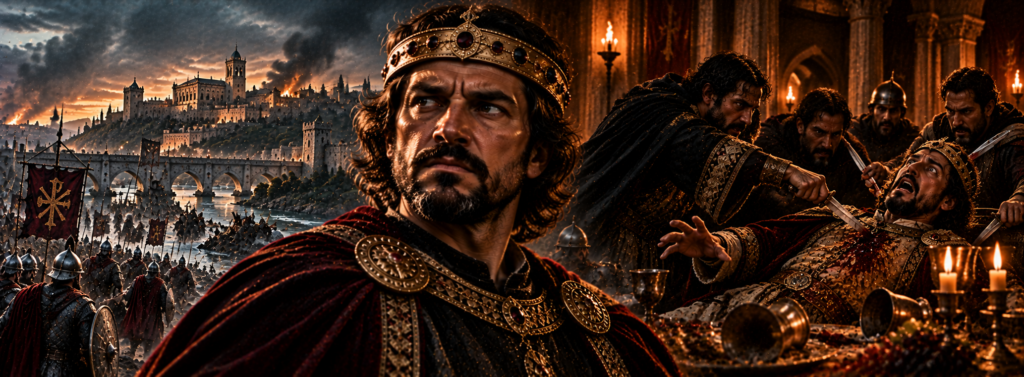
Agila I: The Visigothic King Murdered by His Own Soldiers as His Kingdom Fell Apart
Agila I (d. 554) | King of the Visigoths, 549–554 | Also known as Achila, Akhila, or Aquila | Succeeded the assassinated King Theudegisel | Suffered a disastrous defeat at Córdoba, losing his son, much of his army, and the royal treasury | Faced a rebellion led by Athanagild | Saw the Eastern Roman Empire intervene in Hispania under Emperor Justinian I | Murdered by his own followers at Mérida in 554 | Succeeded by Athanagild.
The King His Own Soldiers Decided to Kill
By the spring of 554, Agila I had become a king whose survival was beginning to look more dangerous to his followers than his death. His army had suffered humiliating defeats, his son was dead, his royal treasure had been lost, and a rival claimant was fighting to take his throne. Worse still, soldiers serving the Eastern Roman emperor Justinian had entered Hispania, turning a Visigothic civil war into an opportunity for imperial conquest. Agila had spent years struggling to preserve his crown, but the men who were supposed to defend him were beginning to wonder whether the kingdom could survive another year of his rule.
The king was in Mérida, an important city in western Hispania, when the final betrayal came. According to the early historical tradition, Agila was murdered by his own followers, who had concluded that continuing the struggle against Athanagild threatened the kingdom itself. The precise circumstances of the assassination have not survived, leaving us without a reliable description of the weapon, the killers’ identities, or the king’s final moments. What is clear is that the men upon whom Agila depended for protection turned against him, ending his reign and allowing his rival to take the throne.
It was an extraordinary conclusion to a civil war that had already brought the Visigothic kingdom close to disaster. Agila’s enemies had not simply defeated him in battle; they had persuaded enough of his own supporters that removing him was preferable to prolonging the conflict. His assassination was therefore more than an act of personal betrayal. It was a political decision made through murder, intended to end a destructive struggle and confront a growing foreign threat.
The irony was almost unbearable. Agila had become king after the assassination of his predecessor, Theudegisel, who had been killed during a banquet in Seville. He inherited a monarchy already accustomed to violent succession, but he could hardly have imagined how quickly that violence would return to claim him. Within five years, the crown had passed from one murdered ruler to another, and the kingdom had lost territory to an empire determined to recover the lands of ancient Rome.
Yet Agila’s downfall was not simply the story of an unfortunate king overwhelmed by enemies. His own military failures, his confrontation with the powerful city of Córdoba, and his inability to contain aristocratic opposition helped create the crisis that destroyed him. His reign also exposed deeper weaknesses within Visigothic government, where powerful regional communities could resist royal authority and ambitious nobles could challenge a reigning monarch. The civil war gave Justinian precisely the opportunity he needed to extend imperial power into Hispania.
Agila’s assassination remains one of the most revealing episodes in the violent history of Visigothic kingship. His soldiers did not kill him because he had surrendered to a foreign enemy, but because they believed his determination to continue fighting might allow that enemy to become permanently established in their country. The king was eliminated in the name of preserving the kingdom he had failed to protect. His death ended one struggle for the throne, but it could not undo the damage already inflicted.
A Kingdom Built on the Ruins of Rome
To understand why Agila’s reign collapsed so catastrophically, it is necessary to understand the kingdom he inherited. By the middle of the sixth century, the Visigoths had been established in the western Mediterranean for generations. Their rulers governed a mixture of Gothic and Hispano-Roman populations, controlled important cities, and exercised authority through institutions inherited partly from the Roman Empire. Yet the kingdom remained politically fragmented, and the authority of its kings was far less secure than the royal title might suggest.
The Visigoths had once ruled an extensive kingdom centered on Toulouse in southern Gaul. Under kings such as Euric and Alaric II, their territories stretched across much of southwestern Gaul and substantial portions of Hispania. Their government relied upon Roman administrative traditions while maintaining a powerful Gothic military aristocracy. The combination produced one of the strongest successor kingdoms to emerge from the collapse of Western Roman imperial authority.
That position changed dramatically in 507, when the Frankish king Clovis defeated Alaric II at the Battle of Vouillé. Alaric was killed, Toulouse fell, and much of the Visigothic territory in Gaul passed into Frankish hands. The surviving kingdom increasingly shifted its political center toward Hispania, where the Visigoths still possessed substantial territories. The loss of their Gallic heartland, however, created problems that would influence the monarchy for decades.
The kingdom was preserved partly through the intervention of Theodoric the Great, the powerful Ostrogothic ruler of Italy. His grandson Amalaric possessed a legitimate claim to the Visigothic throne, and Theodoric used military force to protect that inheritance. For years, the Visigothic kingdom remained under substantial Ostrogothic influence. Military commanders and officials associated with Theodoric exercised authority across its territories.
Theodoric’s death in 526 weakened that arrangement. Amalaric eventually ruled independently, but his reign ended violently in 531 after a disastrous conflict with the Frankish king Childebert I. Theudis, a powerful Ostrogothic commander who had accumulated considerable influence in Hispania, succeeded him. The old royal dynasty associated with Toulouse had effectively disappeared from the throne.
This succession marked an important change in the political character of the monarchy. Royal ancestry still mattered, but military leadership and aristocratic support could become decisive. Powerful commanders possessed the resources necessary to claim the crown, while influential families could determine whether a ruler survived. Agila would inherit a kingdom in which the monarch’s authority depended heavily upon men capable of abandoning or overthrowing him.
The Bloody Throne Agila Inherited
The Visigothic monarchy had experienced repeated assassinations long before Agila’s accession. In 415, King Athaulf was murdered at Barcelona, and his successor Sigeric was killed after a reign traditionally described as lasting only seven days. Thorismund was murdered in 453 during a conspiracy associated with his brothers. Theodoric II, who benefited from that assassination, was himself killed in 466 when another brother, Euric, took power.
These episodes revealed the dangerous relationship between royal authority and aristocratic ambition. A king could possess military prestige, hereditary legitimacy, and substantial resources while remaining vulnerable to relatives or commanders who wanted his position. There was no consistently enforced system guaranteeing that the crown would pass peacefully to a particular heir. Powerful factions could attempt to settle succession disputes through violence.
Theudis managed to rule for approximately seventeen years after becoming king in 531. His reign included military campaigns against the Franks and attempts to challenge Eastern Roman influence in North Africa. He also issued legislation and maintained a government capable of surviving considerable external pressure. Nevertheless, his reign ended in assassination in 548.
According to Isidore of Seville, Theudis was attacked by a man who pretended to be insane. The deception reportedly allowed the assassin to approach the king closely enough to inflict a fatal wound. Isidore preserves the remarkable claim that the dying ruler asked his followers not to execute the murderer. The story presents Theudis as a man who recognized his own death as punishment for an earlier act of violence, although the details of that alleged offense remain uncertain.
Theudis was succeeded by Theudegisel, a military commander associated with the successful defense of Hispania against Frankish invasion. His reign lasted little more than a year before he too was murdered. Gregory of Tours describes his assassination during a banquet in Seville, where the lights were extinguished and the king was killed with a sword. Isidore connects the killing to accusations that Theudegisel had violated the marriages of powerful men.
Agila became king in 549 following this second assassination. The surviving sources provide little secure information about his family or the precise circumstances of his accession. He appears as a ruler whose authority depended upon acceptance by the Gothic military and aristocratic elite rather than an uncontested hereditary succession. The crown he inherited had already passed through two violent deaths in little more than a year.
A New King with Dangerous Enemies
Agila’s accession offered an opportunity to restore stability after the murders of Theudis and Theudegisel. The kingdom needed a ruler capable of maintaining military authority, managing powerful aristocratic families, and defending its territories against foreign intervention. Agila apparently possessed enough support to secure recognition as king. Yet his reign soon revealed how difficult it had become to impose royal authority throughout Hispania.
The Visigothic kingdom was not a completely unified state in which every city and region obeyed the monarch without resistance. Powerful local aristocrats retained influence, while some communities possessed traditions of autonomy rooted in Roman municipal government. Regional leaders could resist royal demands, particularly when the central government appeared weak. The king’s authority therefore depended upon negotiation as well as military force.
Religious differences added another layer of complexity. The Visigothic royal elite generally followed Arian Christianity, while much of the Hispano-Roman population adhered to Nicene Christianity. These communities shared many Christian beliefs but differed over important theological questions. Their divisions could become politically significant when religious identity overlapped with opposition to royal authority.
Agila’s government faced particular difficulties in southern Hispania. The region of Baetica contained wealthy cities with strong Roman traditions, influential landowners, and established Catholic institutions. Royal attempts to impose authority could provoke resistance from communities accustomed to considerable local influence. Córdoba would become the center of the first major disaster of his reign.
The precise origins of the conflict remain uncertain. Some historians interpret Agila’s campaign as an attempt to suppress a city already in rebellion, while others suggest that Córdoba may never have been securely incorporated into Visigothic royal control. The distinction matters because the king may have been trying to recover lost authority rather than simply punish disobedient subjects. Either way, the confrontation ended in catastrophe.
Agila’s decision to confront Córdoba would prove one of the most consequential choices of his reign. He marched against a city whose defenders were prepared to resist him, and the campaign produced losses that seriously damaged his political position. His failure created an opening for ambitious rivals. The king who had inherited a dangerous throne was about to make it even more precarious.
Córdoba: The City That Refused to Submit
Córdoba was one of the most important cities in southern Hispania. Its Roman heritage extended back centuries, and its surrounding territory contained valuable agricultural resources and influential landholding families. The city also possessed a strong Christian identity associated with local martyrs and religious institutions. Its wealth and prestige made control of Córdoba politically important for any ruler claiming authority over Baetica.
Agila’s confrontation with the city occurred around 550. The surviving accounts do not provide a complete military chronology, but they establish that the king attempted to impose his authority and suffered a devastating defeat. Isidore of Seville describes the conflict through a strongly religious interpretation. He connects Agila’s downfall to an alleged act of sacrilege committed against the shrine of Saint Acisclus.
According to Isidore, Agila profaned the martyr’s burial place during the campaign. The historian describes the sacred site being dishonored through the presence and blood of animals and soldiers. His account presents the king’s conduct as a deliberate violation of Christian sanctity. The subsequent military disaster is interpreted as punishment for that offense.
The accusation is important but requires careful treatment. Isidore wrote as a Catholic bishop whose understanding of history was deeply influenced by religious beliefs. He interpreted military victories and defeats partly through the relationship between rulers and divine justice. His account may preserve a genuine incident of sacrilege, but the precise details cannot be independently verified.
The conflict also had political causes that should not disappear behind the religious narrative. Córdoba possessed local elites capable of organizing resistance, and its inhabitants had reasons to oppose the extension of royal authority. Agila’s campaign may have threatened established privileges or challenged the city’s autonomy. Religion could reinforce that resistance without being its only cause.
Whatever the original grievance, the defenders of Córdoba inflicted a defeat from which Agila never fully recovered. The king lost men, prestige, and valuable resources. The disaster exposed the weakness of royal authority in a region that should have been important to the kingdom’s future. It also encouraged opponents who had been waiting for evidence that the new monarch could be defeated.
The Battle That Destroyed His Family and His Fortune
The defeat at Córdoba was more than an ordinary military setback. According to Isidore of Seville, Agila lost his son during the fighting, along with a large portion of his army and the royal treasury. These losses struck at the military, financial, and dynastic foundations of his kingship. Few disasters could have been more damaging to a ruler whose authority depended upon the confidence of powerful warriors.
The death of Agila’s son was particularly significant. The surviving sources provide little information about the prince, including his age and personal circumstances. We cannot determine whether he had already been recognized as an heir or held an important military command. His death nevertheless deprived the king of a close family member and potentially weakened the prospects for dynastic continuity.
The loss of the royal treasury was equally serious. Treasure was not merely a collection of ornaments displayed to demonstrate wealth. Kings used precious metals, valuable objects, and other resources to reward followers, finance military campaigns, and maintain political relationships. Losing the treasury could therefore undermine the practical means through which royal loyalty was sustained.
The destruction of much of the army compounded the problem. Soldiers who survived might question the king’s judgment, while families whose relatives had died could become resentful. Military commanders might begin considering whether continued loyalty offered any prospect of success. In a political system where military prestige mattered enormously, defeat could quickly become a threat to the throne itself.
Agila withdrew toward Mérida after the disaster. The retreat was a recognition that his position in southern Hispania had become dangerously weak. He needed time to recover his forces, rebuild political support, and respond to the challenges created by his defeat. His enemies, however, had little reason to grant him that time.
The campaign against Córdoba became the turning point of his reign. Before it, Agila was a recently established king attempting to assert royal authority. After it, he was a defeated ruler who had lost his son, much of his military strength, and the resources necessary to reward his followers. The disaster created precisely the conditions in which an ambitious rival could hope to take the crown.
The Martyr Whose Tomb Became a Battlefield
The religious dimension of the Córdoba disaster deserves particular attention because it shaped how Agila was remembered. Saint Acisclus was a local Christian martyr whose cult held significance for the city’s Catholic population. His burial place represented a sacred connection between the community and its religious past. An attack upon such a site could be interpreted as an attack upon the identity of the city itself.
Isidore’s account presents Agila as a ruler whose disrespect for the martyr brought divine punishment. The king allegedly dishonored the sacred site, and his army subsequently suffered catastrophic losses. The death of his son and the disappearance of his treasury become elements of a moral narrative. The military disaster is explained through religious justice rather than strategy alone.
This interpretation reflects a wider tradition in early medieval historical writing. Bishops and chroniclers frequently connected political misfortune with the sins of rulers. Defeat could be presented as punishment for sacrilege, cruelty, or religious error. Such explanations reinforced the authority of saints and religious institutions within political society.
Agila’s Arian Christianity made him especially vulnerable to this kind of portrayal. Catholic writers often regarded Arian rulers with suspicion, particularly when their actions threatened Catholic communities. A military campaign against a Catholic city could therefore be interpreted as religious persecution. Yet the broader history of Visigothic government demonstrates that Arian kings did not uniformly persecute their Catholic subjects.
Theudis, for example, had permitted Catholic councils during his reign. Cooperation between Gothic rulers and Hispano-Roman religious institutions was often necessary for effective government. Agila’s alleged sacrilege may therefore have represented an exceptional incident rather than a comprehensive policy of persecution. The surviving evidence does not justify treating his entire reign as a systematic campaign against Catholic Christianity.
The story nevertheless mattered politically. A king accused of violating a revered martyr’s shrine could alienate Catholic communities far beyond Córdoba. His military defeat might appear to confirm the righteousness of resistance. Religious condemnation could therefore reinforce the loss of prestige caused by battlefield failure.
Mérida: Refuge of a Defeated King
After the Córdoba disaster, Agila withdrew to Mérida, the ancient Roman city of Emerita Augusta. Founded during the reign of Augustus, Mérida had long been an important administrative and urban center in western Hispania. Its monumental Roman buildings, strategic location, and regional influence made it a valuable political refuge. For Agila, it became the principal setting of the final years of his troubled reign.
Mérida offered advantages that Córdoba no longer provided. The city lay farther from the immediate center of rebellion in Baetica and could serve as a base for reorganizing military forces. Its position within Lusitania connected it to important routes and territories in western Hispania. A king who had lost authority in the south might still hope to rebuild his position from such a center.
Yet refuge was not the same as security. Agila’s withdrawal demonstrated that he could no longer impose his authority across the regions he claimed to rule. The loss of Córdoba had encouraged opposition, and powerful men elsewhere could now question his ability to defend the kingdom. His presence in Mérida became associated with a prolonged struggle to recover lost prestige.
The surviving sources do not describe his daily government in the city. We cannot reconstruct the palace in which he resided, identify the full membership of his court, or determine how he organized his remaining army. Later descriptions sometimes imagine elaborate councils of frightened nobles and desperate military preparations. Such scenes may be plausible, but they are not documented in sufficient detail to present as fact.
What can be established is that Mérida became central to the final phase of his reign. Agila continued claiming the Visigothic throne while his enemies gained strength elsewhere. The city provided a base from which he could resist the rebellion that soon emerged. It would also become the place where his own followers finally turned against him.
There is a bitter irony in that progression. Mérida had offered Agila an opportunity to survive the disaster at Córdoba and continue his reign. Instead, it became the setting of his assassination. The refuge that preserved his kingship for several years could not protect him from the men who eventually decided that he must die.
Athanagild: The Rival Who Wanted His Crown
Agila’s defeat created an opportunity for Athanagild, a powerful Visigothic noble who emerged as his principal rival. Athanagild’s precise family background remains uncertain, although he belonged to the aristocratic world capable of producing serious claimants to the throne. He possessed sufficient support to challenge the reigning monarch openly. His rebellion transformed regional resistance into a struggle for control of the entire kingdom.
The revolt began around 551, with Seville becoming an important center of Athanagild’s opposition. The city was a major political and economic center in Baetica, making it a valuable base for a claimant seeking to challenge royal authority. Control of Seville could provide resources, supporters, and strategic access to southern Hispania. Athanagild’s position therefore threatened Agila far more directly than the earlier resistance at Córdoba.
The surviving sources do not fully explain why Athanagild rebelled. He may have been encouraged by Agila’s military failures, aristocratic dissatisfaction, or regional opposition to royal authority. Religious differences may also have influenced the conflict, although the evidence does not establish a simple division between Catholic rebels and an Arian king. Athanagild himself belonged to the Visigothic political elite, and his struggle was fundamentally a contest for royal power.
The rebellion placed Agila in an increasingly difficult position. He now faced an organized rival capable of claiming the crown, rather than merely a city resisting royal control. Defeating Athanagild required military resources that had already been weakened at Córdoba. Every unsuccessful campaign risked further undermining the loyalty of Agila’s followers.
Athanagild, meanwhile, could present himself as an alternative capable of restoring order. The king’s failures gave his rival an opportunity to argue that continued loyalty to Agila endangered the kingdom. Such arguments were particularly powerful in a monarchy where military effectiveness was central to political legitimacy. A ruler who repeatedly lost battles could become vulnerable even without a clear hereditary challenger.
The conflict would eventually draw in a foreign power whose ambitions extended far beyond the Visigothic succession. Athanagild’s rebellion created an opening for the Eastern Roman Empire, which had already reconquered substantial territories in the western Mediterranean. Justinian’s intervention transformed the struggle into something far more dangerous than a domestic civil war. Agila was no longer fighting only for his throne but also against the possibility that Hispania would become another target of imperial restoration.
The Civil War That Tore the Kingdom Apart
The struggle between Agila and Athanagild developed into a destructive civil war. Both men claimed authority over the Visigothic kingdom, and both needed the support of soldiers and aristocratic families. The conflict divided political loyalties at a moment when the monarchy was already weakened by earlier assassinations and regional resistance. The longer the struggle continued, the more difficult it became to restore a unified government.
The fighting centered heavily upon southern Hispania, where important cities and regional elites possessed substantial resources. Seville was associated with Athanagild’s rebellion, while Agila continued operating from Mérida. Córdoba remained a separate problem, having demonstrated its ability to resist royal military intervention. The region was becoming a patchwork of competing authorities rather than a territory securely governed by one king.
The surviving accounts describe further military setbacks for Agila, including defeat in the struggle against Athanagild. The precise chronology and locations of every engagement remain difficult to establish. Some later reconstructions provide detailed sequences of battles and retreats, but the early evidence is considerably less complete. What is clear is that Agila failed to destroy the rebellion.
Civil war created opportunities for powerful local figures to strengthen their independence. Communities that might have obeyed a secure monarchy could resist demands from rival claimants. Landowners and military commanders could choose sides according to their interests. The conflict therefore weakened the authority of the crown regardless of which claimant ultimately prevailed.
The consequences extended beyond the immediate battlefield. Armies required supplies, resources, and loyal followers, while prolonged fighting could disrupt agricultural production and trade. Powerful families might lose property or influence depending upon which side controlled their region. Even without a detailed record of every local hardship, the political disruption was substantial.
Agila’s determination to continue fighting became increasingly dangerous. Each failed attempt to defeat Athanagild consumed resources that might otherwise have been used to defend the kingdom. His supporters could begin questioning whether victory remained possible. The civil war was gradually transforming loyalty to the reigning king into a potential threat to the survival of the state.
Justinian: The Emperor Who Wanted the West Back
While Agila and Athanagild fought over the Visigothic throne, Emperor Justinian I was pursuing one of the most ambitious military programs of late antiquity. Ruling from Constantinople, Justinian sought to restore imperial authority over territories that had once belonged to the Roman Empire. His government had already destroyed the Vandal kingdom in North Africa and was engaged in a prolonged campaign against the Ostrogoths in Italy. The western Mediterranean was becoming a major theater of imperial expansion.
Justinian’s ambitions were supported by substantial administrative and military resources. His generals had demonstrated their ability to defeat established successor kingdoms, even when those kingdoms possessed experienced armies. The reconquest of North Africa in the 530s had provided the empire with a valuable strategic base. Imperial forces could now operate across the Mediterranean with increasing confidence.
The campaign in Italy proved far more difficult. The Gothic War devastated large areas of the peninsula and required years of fighting before the empire achieved decisive success. Nevertheless, Justinian remained committed to recovering territories once governed from Rome. Hispania offered another opportunity to extend imperial authority.
The Visigothic kingdom was a particularly attractive target because it was divided. Agila’s defeat at Córdoba had weakened royal power, while Athanagild’s rebellion created competing claims to legitimacy. A foreign emperor could intervene under the pretext of supporting one side in a domestic dispute. Such intervention might be presented as assistance rather than conquest, at least initially.
Justinian also possessed ideological advantages. His government claimed continuity with the Roman imperial tradition, and many inhabitants of Hispania still lived within cities shaped by centuries of Roman rule. Catholic communities might view the Nicene Christian emperor more favorably than an Arian Visigothic monarch. These connections did not guarantee local support, but they could make imperial intervention easier to justify.
The emperor therefore faced a tempting opportunity. A divided kingdom occupied territory that had once belonged to the Roman Empire, and its rival rulers were struggling to defeat one another. Intervention could strengthen imperial influence while exploiting the weaknesses of both claimants. The civil war provided precisely the opening that Justinian’s government needed.
The Dangerous Invitation to the Romans
The question of who invited Eastern Roman intervention remains one of the most important uncertainties surrounding Agila’s reign. The familiar account presents Athanagild as the rebel who requested imperial assistance against the reigning king. Isidore of Seville supports this interpretation, describing Athanagild’s appeal to Justinian and the subsequent arrival of Roman forces. In this version, the usurper introduced a foreign army into Hispania to strengthen his claim to the throne.
Yet the evidence is not entirely consistent. Jordanes, writing in the sixth century, appears to suggest that imperial assistance was associated with Agila rather than Athanagild. His account has led historians to question whether the traditional explanation captures the full diplomatic situation. It is possible that competing claims, changing alliances, or imperial propaganda influenced how the intervention was described.
The chronology is also disputed. The conventional account places the arrival of Eastern Roman forces around 552, during the civil war between Agila and Athanagild. Some modern scholarship has argued for a later arrival, around 554, based upon a different interpretation of the surviving evidence. The disagreement matters because it affects how directly the imperial intervention contributed to Agila’s final defeat.
What is beyond serious doubt is that Justinian’s government exploited the Visigothic conflict to establish a military presence in Hispania. Imperial forces entered the peninsula and eventually secured territory in the south and southeast. Their presence created a new political reality that neither Visigothic claimant could easily control. A struggle over the crown had opened the kingdom to foreign occupation.
The identity of the commander responsible for the expedition is also discussed in the historical literature. Liberius, an experienced Roman official who had previously served under Theodoric the Great, is traditionally associated with the intervention. His career made him a plausible figure for such an operation, although the precise command arrangements remain debated. The uncertainty should not obscure the larger significance of the campaign.
Whether Agila or Athanagild first sought imperial assistance, the result was disastrous for Visigothic independence. Justinian’s government gained an opportunity to acquire territory that might otherwise have remained beyond its reach. The civil war had weakened the kingdom sufficiently for a foreign army to establish itself. The question was no longer simply which Gothic noble would wear the crown, but how much of Hispania would remain under Gothic rule.
The Empire Returns to Hispania
The arrival of Eastern Roman forces represented a remarkable historical reversal. The Western Roman Empire had disappeared as a political institution in the fifth century, but the empire centered on Constantinople continued to regard itself as Roman. Justinian’s armies had already restored imperial rule in North Africa and much of Italy. Their appearance in Hispania extended that program to another former western province.
The intervention was initially connected to the Visigothic civil war, but imperial ambitions quickly exceeded the immediate dispute. Roman forces established control over important territories and strategic coastal positions. The exact extent of their early conquests remains debated, and later maps sometimes present boundaries with greater certainty than the evidence permits. Nevertheless, the empire secured a lasting foothold in southern and southeastern Hispania.
This territory would eventually form the imperial province commonly known as Spania. Its establishment was one of the most important consequences of the struggle between Agila and Athanagild. The province remained under Eastern Roman control for generations, creating a persistent challenge to the Visigothic monarchy. The final elimination of the imperial presence would not occur until the seventh century.
For Agila, the arrival of Roman forces made an already desperate situation worse. He was fighting a rival claimant while attempting to preserve the authority of a kingdom weakened by regional rebellion. The imperial intervention introduced soldiers whose ultimate loyalty belonged to Justinian rather than to either Visigothic ruler. Even a temporary alliance with such forces carried enormous risks.
The danger was particularly severe because imperial armies possessed experience in exploiting political divisions. Justinian’s campaigns against the Vandals and Ostrogoths had demonstrated how disputes over legitimacy could provide opportunities for intervention. A foreign ruler could claim to support a lawful authority while pursuing territorial advantage. The Visigothic civil war offered another example of that pattern.
The Roman return also exposed the limitations of Agila’s kingship. He could not prevent Córdoba from resisting him, could not defeat Athanagild decisively, and could not stop the empire from exploiting the conflict. His military authority had deteriorated at the very moment when the kingdom faced its greatest external danger. His own followers would eventually conclude that continuing to support him risked making the situation even worse.
The Soldiers Who Began to Doubt Their King
Agila’s political survival depended upon the loyalty of men who had already endured years of military failure. His army had suffered a catastrophic defeat at Córdoba, losing soldiers, royal treasure, and the king’s son. The rebellion of Athanagild had then prolonged the conflict, forcing Agila to continue fighting for a throne he could no longer securely control. The arrival of Eastern Roman forces added a threat that extended beyond the immediate succession struggle.
For soldiers and commanders, loyalty to Agila may have become increasingly difficult to justify. A king who could not defeat his rival might continue consuming resources without bringing the war closer to an end. Meanwhile, foreign troops were establishing themselves in territories that had belonged to the kingdom. Supporting the reigning monarch could begin to look less like patriotic duty and more like participation in a destructive struggle.
The surviving sources do not preserve the private discussions through which Agila’s followers reached their decision. We do not know whether particular commanders organized the opposition or whether dissatisfaction spread gradually among the army. Nor can we identify the exact moment when influential supporters concluded that the king had become expendable. The historical record preserves the outcome more clearly than the process.
Isidore of Seville presents the assassination as a response to the danger posed by continued civil war and Roman intervention. According to his account, the Goths feared that imperial forces would exploit the conflict to penetrate more deeply into Hispania. They therefore killed Agila and accepted Athanagild as king. The narrative portrays the murder as an attempt to preserve the kingdom by ending the struggle for the throne.
This explanation is politically plausible, although it should not be treated as a complete account of every participant’s motives. Some soldiers may have feared foreign conquest, while others may have been exhausted by repeated defeats. Powerful nobles might have calculated that Athanagild offered better prospects for preserving their estates and influence. Personal ambition and genuine concern for the kingdom could have existed side by side.
The decisive change was that Agila’s supporters no longer regarded his survival as essential to their own interests. His claim to the throne remained, but the practical foundation of his authority was disappearing. A king whose soldiers had lost confidence in him was dangerously vulnerable. At Mérida, that vulnerability would become fatal.
Mérida, 554: The Murder of Agila I
Agila’s reign ended at Mérida in 554, when men belonging to his own political and military following killed him. The assassination followed years of conflict with Athanagild and the arrival of Eastern Roman forces in Hispania. The surviving historical tradition presents the killing as an attempt to end the civil war and prevent further imperial expansion. The king’s own supporters had concluded that removing him was preferable to continuing the struggle.
The precise circumstances of the murder remain unknown. We cannot identify the building in which Agila was killed, the number of attackers, or the weapon used. No reliable account preserves a dramatic confrontation between the king and his assassins. Later narratives sometimes imagine soldiers entering his quarters or surrounding him during a council, but such scenes cannot be established from the surviving evidence.
The absence of detail makes the political meaning of the assassination especially important. Agila was not killed by a foreign soldier during a battle, nor was he executed after a formal judgment. He was murdered by men who had previously supported his authority. Their decision transformed the king’s own military following into the instrument of his destruction.
The assassination also differed from the murder of Theudegisel five years earlier. Theudegisel had reportedly been killed during a banquet amid accusations of sexual misconduct. Agila’s death was associated instead with military failure, civil war, and fear of foreign intervention. Both kings were destroyed by opposition within the kingdom, but the circumstances reflected different kinds of political crisis.
The immediate result was the end of Agila’s claim to the throne. His followers accepted Athanagild, bringing the principal Visigothic succession struggle to a close. The rival who had fought against him for years became king without needing to defeat Agila in one final decisive battle. Murder accomplished what prolonged warfare had failed to settle.
Yet the assassination could not restore the territories already lost to the Eastern Romans. Agila’s death removed one obstacle to political unity, but it did not eliminate Justinian’s armies. The kingdom had sacrificed its reigning monarch in the hope of preserving itself. The price had been paid, but the damage could not be undone.
Was Agila Murdered to Save the Kingdom?
The explanation preserved by Isidore of Seville gives Agila’s assassination an unusually political character. His followers supposedly feared that continued fighting would allow the Romans to occupy more of Hispania. By killing the king and recognizing Athanagild, they hoped to end the internal conflict and concentrate resistance against the foreign threat. The murder was therefore presented as a desperate attempt to preserve the kingdom.
Such reasoning reveals the dangerous flexibility of Visigothic political loyalty. A king was expected to defend his people and maintain order, but his followers could decide that he had become incapable of fulfilling those responsibilities. Once that judgment took hold, continued loyalty might appear harmful rather than honorable. The monarchy offered no reliable mechanism for peacefully removing a ruler who refused to surrender his claim.
Agila’s supporters may have believed that Athanagild was the stronger candidate. The rebel had survived years of conflict and possessed enough military and aristocratic backing to remain a serious rival. Recognizing him could end the civil war without requiring further battles between Gothic armies. The decision would also allow the kingdom to confront imperial forces under a single monarch.
Yet the claim that the murder was committed solely for the public good should be treated cautiously. Political conspirators often justified violent acts by presenting them as necessary for collective survival. Men who benefited from Agila’s death may have had personal reasons to abandon him. Their interests could coincide with the broader need to end the war without being identical to it.
The assassination also raises an uncomfortable question about legitimacy. Agila was the reigning king, while Athanagild had rebelled against him. By murdering Agila and accepting his rival, the king’s followers effectively transformed rebellion into lawful succession. The political outcome determined which claimant would be remembered as the successful monarch.
This pattern was familiar in Visigothic history. A ruler could be condemned as ineffective or dangerous after his enemies had removed him, while the successful successor gained legitimacy through recognition and control. Agila’s death therefore illustrates how political necessity could be used to justify regicide. The kingdom survived, but the principle that armed followers could eliminate an unsuccessful king remained intact.
Athanagild Takes the Throne
After Agila’s assassination, Athanagild became king of the Visigoths. His accession ended the immediate civil war between the two claimants, allowing the monarchy to recover a degree of political unity. The new ruler inherited a kingdom weakened by regional rebellion and foreign intervention. His victory was therefore substantial but far from complete.
Athanagild’s position was complicated by the Eastern Roman presence in Hispania. The imperial forces that had intervened during the civil war were not prepared simply to abandon their territorial gains. Their commanders represented Justinian’s government, whose ambitions extended beyond the fortunes of individual Visigothic claimants. The new king faced the difficult task of containing an ally or former participant in the conflict that had become a territorial rival.
The establishment of imperial territory in southern Hispania became one of the defining problems of Athanagild’s reign. He attempted to resist Roman expansion, but the empire retained important possessions. The political settlement that followed Agila’s death therefore failed to restore the kingdom’s previous boundaries. The civil war had created consequences that could not be reversed by changing kings.
Athanagild nevertheless enjoyed a considerably longer reign than his immediate predecessors. He ruled until 567 or 568, depending upon the chronological reckoning used. His government helped restore some stability after the violent succession struggles of the preceding decades. The kingdom continued developing its political institutions and strengthening its position in Hispania.
His reign also became significant through dynastic marriages with the Frankish royal family. His daughters Brunhild and Galswintha married Frankish kings, creating connections that would later become entangled in some of the most notorious conflicts of Merovingian history. Galswintha’s death in particular would contribute to a prolonged cycle of rivalry and violence. The attempt to use marriage as a diplomatic instrument continued producing both opportunities and dangers.
Agila’s assassination therefore opened the way for a new political chapter. Athanagild achieved the crown that he had fought to obtain, but he inherited the consequences of the struggle. The Eastern Roman foothold remained, and the kingdom’s internal weaknesses had been exposed. Removing Agila ended the civil war without restoring the world that had existed before it.
The Province of Spania: The Territory That Never Came Back
One of the most enduring consequences of Agila’s reign was the establishment of Eastern Roman rule in parts of Hispania. Justinian’s intervention had been made possible by the civil war, but imperial forces soon pursued territorial objectives of their own. The resulting province of Spania became a permanent challenge to the Visigothic monarchy. Its existence demonstrated that the empire had returned to the western Mediterranean as a serious military power.
The exact boundaries of the province changed over time and remain difficult to reconstruct for its earliest years. Imperial control was concentrated in parts of southern and southeastern Hispania, particularly areas accessible from the Mediterranean. Important coastal positions provided connections with other Roman territories and allowed supplies and reinforcements to arrive by sea. The imperial government could therefore maintain a foothold even when Visigothic armies controlled much of the interior.
The province survived long after Agila’s death. Successive Visigothic kings attempted to recover territory from the Eastern Romans, sometimes achieving important successes. The struggle became part of the broader effort to consolidate royal authority throughout the Iberian Peninsula. The final expulsion of imperial forces did not occur until the reign of Suinthila in the early seventh century.
This long survival reveals the scale of the opportunity created by Agila’s civil war. A dispute over the Visigothic throne had allowed Justinian’s government to establish a province that endured for roughly seven decades. The intervention was not merely a temporary expedition supporting one claimant. It became a lasting territorial conquest.
The consequences were especially painful because the Visigoths had already lost so much territory in Gaul. The defeat at Vouillé had forced the kingdom to concentrate increasingly upon Hispania. The Eastern Roman occupation now threatened that remaining geographical foundation. The monarchy faced foreign pressure from multiple directions while still struggling to impose authority over rebellious regions.
Agila did not personally witness the full duration of the imperial occupation. He died before the long struggle over Spania had fully developed. Nevertheless, his reign became associated with the crisis that made the province possible. His assassination ended his personal struggle for the crown, but the territorial consequences continued shaping Visigothic history for generations.
The King Who Lost Córdoba Before Losing Everything Else
Agila’s defeat at Córdoba was the first great catastrophe of his reign, and its consequences reached far beyond the immediate battlefield. The loss of his son weakened his family, the destruction of much of his army undermined his military authority, and the disappearance of the royal treasury damaged his ability to reward supporters. The campaign also demonstrated that an important city could resist the king successfully. His position never fully recovered.
Córdoba’s resistance reflected the broader limits of Visigothic royal power in southern Hispania. Local aristocrats and urban communities could possess sufficient resources to challenge the monarchy. Their authority did not disappear simply because a king claimed sovereignty over the region. Agila’s attempt to impose control exposed the difficulty of governing a politically fragmented kingdom.
The city’s success also created an example for other opponents. If Córdoba could defeat the king, powerful nobles elsewhere might believe that rebellion offered a realistic path to political advantage. Athanagild’s revolt followed within a short period. The connection between the two events was not necessarily the result of a single coordinated conspiracy, but the first disaster clearly weakened Agila’s position.
The religious narrative surrounding Córdoba further damaged his reputation. Isidore portrayed the defeat as punishment for sacrilege against the shrine of Saint Acisclus. The story connected military failure with moral wrongdoing, creating an explanation that later readers could easily remember. Agila became not merely an unsuccessful commander but a king whose impiety supposedly brought disaster upon him.
Yet the historical reality was more complex than a simple tale of divine punishment. Agila faced military resistance from a powerful city within a kingdom whose political institutions remained unstable. His defeat may have resulted from strategic errors, local advantages, inadequate resources, or factors that the surviving sources do not describe. The religious interpretation tells us much about Isidore’s worldview, but it cannot replace a military explanation.
The Córdoba disaster remains central because it began the sequence that ended in Mérida. A defeated king retreated, a rival rebelled, foreign forces intervened, and the king’s own followers eventually murdered him. The events were connected by the gradual erosion of Agila’s authority. His death was the final consequence of a political collapse that had begun years earlier.
The Problem of the Royal Treasury
The loss of Agila’s treasury at Córdoba deserves particular attention because royal wealth was closely connected to political survival. In the sixth century, kings relied upon treasure to maintain relationships with powerful followers. Precious metals, valuable objects, and other resources could be distributed as rewards or used to support military campaigns. A ruler who lost such wealth could find his authority weakened even if he survived the battlefield.
Royal treasure also possessed symbolic importance. It represented the accumulated wealth and prestige of the monarchy, linking the reigning king to the authority of his predecessors. Capturing a royal treasury could therefore demonstrate the victor’s superiority. The loss was both practical and humiliating.
Agila’s defeat deprived him of resources at the moment when he most needed them. Rebuilding an army required supplies, equipment, and the loyalty of commanders who might expect rewards. Maintaining aristocratic support could also depend upon the king’s ability to distribute wealth. Without adequate resources, Agila’s attempts to recover his position became more difficult.
The disappearance of the treasury may also have encouraged rivals. Athanagild could argue that the reigning monarch had squandered the resources necessary to defend the kingdom. Powerful nobles might question whether Agila could continue supporting their interests. The king’s military failure therefore threatened the financial relationships upon which his authority depended.
The surviving sources do not describe the contents of the lost treasury in detail. We cannot identify particular crowns, vessels, coins, or ceremonial objects that disappeared during the campaign. Later descriptions sometimes imagine magnificent collections of jewels and gold carried away by victorious enemies. Such imagery may capture the general significance of royal wealth, but specific inventories are not preserved.
The loss remains historically important without those details. Agila suffered a defeat that deprived him of both military strength and financial resources. His ability to maintain loyalty was damaged at precisely the moment when rebellion became more likely. The treasury’s disappearance helped turn a battlefield disaster into a crisis of kingship.
A Kingdom Divided by More Than Religion
Agila’s reign is sometimes described as a conflict between Arian Visigoths and Catholic Hispano-Romans. Religious differences certainly mattered, particularly in the account of the Córdoba campaign. Yet reducing the entire crisis to a religious war obscures the political divisions that made the kingdom vulnerable. The struggle involved regional autonomy, aristocratic ambition, military failure, and competing claims to royal authority.
The Visigothic monarchy itself was Arian, but its rulers governed large Catholic populations. Cooperation with Catholic bishops and Roman aristocrats was often essential for maintaining order. Some Arian kings permitted Catholic councils and avoided systematic persecution. The relationship between religious communities was therefore more complicated than permanent hostility.
Agila’s alleged sacrilege at Córdoba may have intensified Catholic opposition. A king who dishonored a revered martyr’s shrine could provoke outrage among local Christians. Yet the city also possessed political and economic interests that might have encouraged resistance. Religious identity could strengthen opposition without fully explaining its origins.
Athanagild’s rebellion likewise cannot be understood solely through theology. He was a Visigothic noble seeking the throne, and his supporters likely possessed a variety of motives. Some may have opposed Agila’s conduct, while others sought political advancement or greater regional influence. The surviving sources do not permit every faction to be classified neatly according to religious allegiance.
Justinian’s intervention added another layer of complexity. The Eastern Roman emperor was a Nicene Christian ruler who could appeal to religious connections with Catholic communities in Hispania. Yet his government also pursued territorial expansion and imperial restoration. Religious solidarity and strategic ambition were not mutually exclusive.
Agila’s downfall therefore resulted from overlapping conflicts. His military failures weakened the monarchy, regional communities resisted royal authority, aristocratic rivals challenged his claim, and foreign armies exploited the disorder. Religion influenced how these events were interpreted and sometimes how participants justified their actions. It was one powerful element within a much broader political catastrophe.
The Soldiers Who Became Regicides
The most disturbing feature of Agila’s assassination is that the fatal betrayal came from his own side. Kings expected enemies to seek their destruction, particularly during civil war. They depended upon their followers to defend them against those threats. Agila’s final crisis occurred when the men responsible for preserving his authority decided that he should no longer live.
The surviving sources do not establish whether the killers were ordinary soldiers, senior commanders, or a broader group of supporters. The phrase describing his death at the hands of his own people should not be treated as a complete identification of the conspirators. Nevertheless, the tradition clearly associates the assassination with internal Gothic opposition rather than a direct attack by Athanagild’s army. Agila was destroyed by the collapse of loyalty within his own political camp.
That distinction gives the murder its significance. A king defeated by an enemy army might remain a symbol around whom supporters could rally. A king murdered by his own followers had lost the very foundation of his claim to authority. His death demonstrated that his remaining supporters no longer believed he could lead them successfully.
The conspirators may have viewed their action as a practical solution to an otherwise endless struggle. Athanagild had proved difficult to defeat, and the Eastern Romans were gaining influence. Continuing to fight could exhaust the kingdom while allowing foreign forces to strengthen their position. Removing Agila offered a way to end the civil war immediately.
Yet the act also reinforced the dangerous precedent that unsuccessful kings could be eliminated through violence. The monarchy lacked a secure method for resolving conflicts between a reigning ruler and powerful factions. When negotiation failed, murder could become a political instrument. Agila’s assassination therefore solved one crisis while preserving the conditions that made future crises possible.
The killing belongs among the clearest examples of regicide committed by a ruler’s own followers. It was not simply a murder motivated by personal hatred or a dispute within the royal household. It was the violent removal of a king whose supporters believed his continued reign threatened their interests and perhaps the kingdom itself. The assassins changed the political future of Hispania by killing the man they had once defended.
Did Athanagild Arrange the Murder?
Athanagild was the obvious beneficiary of Agila’s death. He had rebelled against the reigning king, fought a prolonged civil war, and sought to establish himself as monarch. When Agila was killed, Athanagild obtained the throne. The sequence naturally raises the possibility that he encouraged or arranged the assassination.
Yet the surviving evidence does not establish his direct responsibility. Isidore presents Agila’s followers as the men who killed him because they feared the consequences of continued warfare and Roman intervention. The account does not provide proof that Athanagild ordered the murder. His political advantage should not be confused with evidence of personal involvement.
Athanagild may nevertheless have influenced the circumstances indirectly. His rebellion had weakened Agila’s authority and demonstrated that an alternative ruler possessed substantial support. His survival made it possible for Agila’s followers to imagine ending the war by transferring allegiance. Without a viable rival, removing the king might have created an even more dangerous succession crisis.
The existence of a strong alternative claimant therefore mattered enormously. Agila’s supporters could kill him and recognize Athanagild without needing to invent a new political settlement. The rebel had already established a claim through military resistance. His accession could be presented as the restoration of unity rather than the beginning of another struggle.
The possibility of secret negotiations between the rival camps cannot be excluded, but no detailed record survives. We do not know whether Athanagild promised rewards to defecting commanders or offered guarantees to Agila’s supporters. Such arrangements would have been politically plausible during a civil war. They should nevertheless remain possibilities rather than established facts.
The responsible conclusion is that Athanagild benefited decisively from Agila’s assassination, while his direct involvement remains unproven. His rebellion created the political conditions in which Agila’s followers could abandon their king. The final decision to murder Agila appears in the surviving tradition as an act by men within his own camp. The distinction preserves the uncertainty surrounding one of the most consequential killings in Visigothic history.
The Cost of Choosing a New King
The assassination of Agila ended the civil war, but it did not restore the kingdom to its earlier condition. Córdoba had demonstrated its independence, important military resources had been lost, and the Eastern Romans had established themselves in Hispania. The new king inherited the consequences of years of conflict. Political unity could be restored more quickly than territory or military strength.
Athanagild’s accession nevertheless offered immediate advantages. The Visigoths no longer needed to divide their forces between two rival claimants. Powerful aristocrats could redirect their support toward a single monarchy. The kingdom could begin confronting the imperial presence without the same level of internal competition.
Yet the Eastern Romans had little reason to surrender their gains voluntarily. Justinian’s government had invested military resources in the intervention and possessed broader ambitions in the western Mediterranean. Imperial commanders could maintain strategic coastal positions and exploit local relationships. The Visigoths faced a foreign power capable of sustaining operations beyond the immediate civil war.
The assassination also carried a political cost that is harder to measure. Agila’s followers had demonstrated that royal authority could be withdrawn through murder when a king became inconvenient. Such a precedent could encourage future factions to consider similar action. The monarchy remained vulnerable to the ambitions of men who possessed military power.
The kingdom’s later history would include further struggles over succession, although it also produced rulers capable of strengthening royal institutions. Leovigild, who came to power later in the sixth century, would undertake major campaigns to consolidate Visigothic authority. His reign demonstrated that the monarchy could become more effective when supported by military success and political organization. Yet the violent events of Agila’s reign remained part of the kingdom’s historical inheritance.
The men who killed Agila may have believed they were saving the state. In the immediate sense, ending the civil war helped restore unity. In the longer term, however, the kingdom continued confronting the territorial consequences of the conflict. The assassination solved the problem of two competing kings without solving the problem of a foreign empire occupying Visigothic land.
Agila and the Visigothic Tradition of Violent Succession
Agila’s death belongs to a long sequence of Visigothic royal assassinations that shaped the kingdom’s political reputation. Athaulf, Sigeric, Thorismund, Theodoric II, Theudis, and Theudegisel had all died violently under circumstances connected to political rivalry or conspiracy. Agila joined them in 554. His death reinforced the perception that the Visigothic throne could be obtained and lost through murder.
Later writers sometimes described this recurring violence through the idea of a specifically Gothic tendency toward regicide. Such interpretations can be misleading because other early medieval kingdoms experienced similar conflicts. The Frankish royal family was repeatedly torn apart by dynastic murders, while the Eastern Roman Empire experienced its own conspiracies and violent transfers of power. Political assassination was not an exclusively Visigothic phenomenon.
Nevertheless, the Visigothic monarchy possessed structural weaknesses that made succession particularly dangerous. Hereditary claims did not always determine the next ruler, and powerful military commanders could become viable candidates. Aristocratic support was essential, but that support could change rapidly after defeat. A king who lost military prestige might find his position threatened by the same men who had elevated him.
Agila’s reign illustrates those weaknesses with unusual clarity. He became king after the assassination of Theudegisel, attempted to impose authority over Córdoba, and suffered a catastrophic defeat. A rival noble then challenged him, and foreign intervention made the struggle increasingly destructive. His own followers finally killed him and recognized the rival claimant.
The sequence demonstrates how military failure could become a crisis of legitimacy. Agila’s royal title did not disappear after Córdoba, but his ability to enforce it weakened. Athanagild’s rebellion offered an alternative political center, while the Eastern Roman intervention increased the cost of continued division. The assassination occurred when the practical arguments for preserving Agila’s reign had collapsed.
His death therefore represents more than another example of a king murdered by ambitious nobles. It shows how a monarchy could become trapped between the authority of a reigning ruler and the perceived need to replace him. Without an accepted mechanism for peaceful removal, political necessity could become a justification for violence. Agila paid for that institutional weakness with his life.
The King Whose Defeat Opened the Door to an Empire
Agila’s reign was historically significant because it coincided with the return of Roman imperial power to Hispania. Justinian’s armies had already reconquered North Africa and were fighting to restore imperial rule in Italy. The Visigothic civil war created an opportunity to extend that program westward. The result was the establishment of imperial territory that survived long after Agila’s assassination.
The relationship between the civil war and the imperial intervention remains complicated. The surviving sources disagree over which Visigothic claimant initially sought Roman assistance, and historians continue debating the precise chronology. Nevertheless, the broader outcome is clear. The empire exploited internal division to acquire territory that the Visigoths struggled to recover.
Agila’s military failures helped create that vulnerability. His defeat at Córdoba weakened royal authority, while his inability to suppress Athanagild’s rebellion prolonged the conflict. The kingdom became divided at precisely the moment when Justinian’s government was seeking opportunities for expansion. Foreign intervention became more attractive because the Visigoths could not present a united defense.
Yet it would be unfair to attribute every consequence solely to Agila’s personal incompetence. The kingdom had inherited political divisions from earlier generations, and its rulers faced difficult relationships with powerful regional communities. The Eastern Roman Empire possessed substantial resources and strategic ambitions that extended beyond the Visigothic succession. Agila operated within circumstances that would have challenged even a more successful monarch.
His decisions nevertheless mattered. The campaign against Córdoba produced a disaster that damaged his authority, and the prolonged struggle with Athanagild left the kingdom exposed. His refusal or inability to end the conflict peacefully contributed to the conditions in which his own followers turned against him. The assassination was therefore connected to the political choices of his reign.
The lasting consequence was a territorial loss that outlived everyone directly involved. Agila died in 554, and Athanagild eventually died more than a decade later. Justinian himself died in 565, but the imperial province of Spania continued. The civil war had opened a door that could not easily be closed.
Why Agila I Belongs Among the Assassinated Rulers & Regicides
Agila I belongs firmly within the Assassinated Rulers & Regicides category because he was deliberately killed by his own followers while still claiming the Visigothic throne. His death occurred at Mérida in 554 during the final stage of a destructive civil war. The assassination removed the reigning king and allowed his rival Athanagild to assume power. It was therefore a politically decisive act of regicide.
The circumstances distinguish his death from ordinary battlefield violence. Agila was not killed while leading a charge against enemy soldiers or defending a besieged city. He was murdered by men who had previously supported him. Their betrayal transformed the king’s own political and military following into the instrument of his removal.
The motive preserved by Isidore of Seville is especially revealing. Agila’s supporters supposedly feared that continued civil war would allow Eastern Roman forces to occupy more of Hispania. They therefore killed their king in an attempt to end the struggle and preserve the kingdom. The assassination was presented as a desperate political solution rather than merely an act of personal revenge.
That explanation must be treated with caution because the surviving evidence does not reveal every conspirator’s motives. Some participants may have acted from exhaustion, ambition, or resentment toward the king. Others may genuinely have believed that Athanagild offered the best hope of resisting imperial expansion. The historical record does not allow us to separate these possibilities with certainty.
The killing also demonstrates the fragility of royal legitimacy in a monarchy dependent upon aristocratic and military support. Agila possessed the crown, but his repeated defeats weakened the practical foundation of his authority. Once his followers decided that continued loyalty threatened their interests, his position became untenable. His assassination made that judgment irreversible.
His story combines military disaster, religious controversy, civil war, foreign intervention, dynastic ambition, and betrayal by his own soldiers. It also reveals the enormous consequences that could follow a single failed reign. Agila’s death ended the immediate succession struggle, but it could not restore the territory lost during the conflict. His murder remains a powerful example of regicide committed in the name of political survival.
The King Who Became the Price of Peace
Agila I inherited a monarchy already marked by violence. His predecessor Theudegisel had been murdered during a banquet in Seville, and Theudegisel’s predecessor Theudis had been assassinated the year before. The crown had passed through repeated acts of bloodshed, revealing the insecurity of royal authority. Agila became king in 549 within a political system where powerful men could decide that a ruler’s life was expendable.
His accession offered an opportunity to restore stability after years of violent succession. The Visigothic kingdom still possessed substantial territories in Hispania and retained the military resources necessary to defend itself. Yet its authority remained uneven, particularly in regions where powerful cities and aristocratic families resisted royal control. Agila’s reign would expose those weaknesses more dramatically than almost any other ruler of the period.
The disaster began at Córdoba. Agila attempted to impose his authority over a city whose inhabitants were prepared to resist him, and the resulting campaign ended in catastrophic defeat. His son was killed, much of his army was lost, and the royal treasury disappeared. The losses damaged the military, financial, and dynastic foundations of his kingship.
The religious interpretation preserved by Isidore of Seville made the defeat even more damaging to his reputation. The historian accused Agila of profaning the shrine of Saint Acisclus and presented the subsequent disaster as divine punishment. The story connected military failure with moral wrongdoing, transforming the king into an example of the dangers of sacrilege. Yet the surviving evidence does not permit the entire campaign to be explained through religion alone.
Córdoba’s resistance also reflected the political fragmentation of the kingdom. Important cities and regional elites possessed resources that allowed them to challenge royal authority. Agila’s failure demonstrated that the monarchy could not always impose its will through military force. His defeat encouraged opponents who had been waiting for an opportunity to challenge him.
Athanagild emerged as the most dangerous of those opponents. Beginning around 551, he established a rebellion that transformed Agila’s difficulties into a struggle for the throne. The conflict divided the kingdom and consumed resources that might otherwise have been used against foreign enemies. Agila continued fighting, but he could not destroy the rival who threatened his authority.
The civil war also created an opportunity for Justinian I. The Eastern Roman emperor had already reconquered North Africa and was fighting to restore imperial power in Italy. Hispania, divided between rival Visigothic claimants, offered another tempting target. Imperial intervention transformed a domestic succession struggle into a crisis threatening the kingdom’s territorial independence.
The surviving sources disagree over the precise circumstances of that intervention. Athanagild is traditionally described as requesting Roman assistance, but other testimony has been interpreted as connecting the appeal to Agila. Historians also debate the chronology of the expedition. These uncertainties complicate the story without changing its essential outcome.
Eastern Roman forces entered Hispania and established a territorial presence that would endure for generations. Their intervention demonstrated how dangerous civil war could become when powerful foreign rulers were waiting for an opportunity to exploit it. The Visigoths were no longer fighting only over who should occupy the throne. They were struggling to prevent an empire from acquiring part of their kingdom.
Agila’s supporters faced an increasingly difficult choice. Continuing to fight for their king meant prolonging a conflict that had already weakened the monarchy and exposed its territories to foreign occupation. Abandoning him meant accepting the victory of a rival who had rebelled against lawful royal authority. Neither option offered an uncomplicated solution.
The surviving tradition suggests that the fear of further Roman expansion eventually became decisive. Agila’s own followers concluded that the kingdom could not afford to continue the civil war. They killed their king at Mérida in 554 and accepted Athanagild as his successor. The murder ended the struggle for the throne without requiring another major battle between the rival claimants.
The exact circumstances of Agila’s final moments remain unknown. We do not know who delivered the fatal blow, what weapon was used, or whether the king had any warning that his followers intended to kill him. The sources do not preserve a final speech or a detailed account of the confrontation. Those silences should remain part of the history rather than being filled with invented scenes.
What survives is the political meaning of the betrayal. Agila was murdered by men who had previously recognized his authority and depended upon him as their king. Their decision reflected the collapse of confidence in his ability to lead the kingdom successfully. Royal legitimacy had become less important to them than the perceived necessity of ending the war.
The assassination was therefore both an act of regicide and an attempt to resolve a constitutional crisis through violence. Agila’s followers had no reliable mechanism for peacefully removing a monarch who refused to surrender his claim. They chose murder as the quickest means of transferring power. The result demonstrated how easily political necessity could become a justification for killing a king.
Athanagild benefited immediately. His rival was dead, and he became the recognized ruler of the Visigoths. The kingdom regained a measure of unity after years of destructive conflict. Yet the new king inherited problems that Agila’s assassination could not solve.
The Eastern Romans remained in Hispania. Their forces had secured territory during the civil war, and Justinian’s government was unwilling to abandon those gains simply because the Visigoths had chosen a new monarch. The resulting province of Spania would remain an imperial possession for generations. The political damage inflicted during Agila’s reign outlived the king himself.
The assassination also failed to eliminate the deeper weaknesses of Visigothic kingship. Powerful aristocrats continued influencing succession, while regional communities retained the ability to resist royal authority. Military success remained essential to political legitimacy. A king who lost the confidence of his followers could still face the possibility of violent removal.
Agila’s story therefore belongs to a larger history of rulers destroyed by the political systems that elevated them. He became king after an assassination and inherited a monarchy where armed support mattered enormously. His own military failures gradually undermined that support. In the end, the same kind of violence that had opened the throne to him brought his reign to an end.
His death was also a personal tragedy whose details have largely disappeared. The king had already lost his son during the disaster at Córdoba, and his final years were consumed by rebellion and military defeat. The surviving accounts provide little insight into his private grief or his relationships with the men who eventually betrayed him. We know the political consequences far better than the human experience.
That absence makes the broad outline of his downfall especially haunting. Agila began his reign as the recognized ruler of a substantial kingdom, but within a few years he had lost his son, his treasury, much of his army, and control over important territories. A rival claimed his throne, and foreign soldiers entered his country. His own followers finally decided that the kingdom would be safer without him.
There is a cruel contradiction at the heart of the assassination. Agila was killed because his supporters feared that continued civil war would allow the Eastern Romans to conquer more territory. Yet the civil war had already given Justinian the opportunity to establish a lasting imperial presence. Murdering the king ended the internal struggle, but it could not reverse the consequences of the conflict.
The decision may nevertheless have appeared necessary to the men who made it. A divided kingdom was less capable of resisting foreign armies than one governed by a single ruler. Athanagild offered a way to reunite the Visigoths, while Agila’s continued resistance threatened to prolong the disaster. The assassination was therefore presented as an act intended to preserve the state.
Whether every conspirator genuinely believed that justification remains uncertain. Political ambition, resentment, exhaustion, and fear could all have contributed to the decision. Some men may have hoped to gain favor under Athanagild, while others may simply have wanted the fighting to end. The sources do not allow us to identify the private motives of the killers.
The broader consequences, however, are unmistakable. Agila’s death brought the civil war to a close and transferred the crown to Athanagild. The Visigothic monarchy survived, but the kingdom had lost territory and exposed the fragility of its political institutions. The assassination solved an immediate problem while leaving a legacy of foreign occupation and violent succession.
Agila remains a particularly compelling figure because he was destroyed not by a single enemy but by the accumulation of failures that made his own supporters abandon him. Córdoba weakened his military reputation, Athanagild challenged his legitimacy, and Justinian exploited the resulting division. Each crisis reduced the resources and relationships upon which his authority depended. By 554, his crown had become a symbol of a struggle that many of his followers no longer wished to continue.
His assassination also raises a question that reaches far beyond the sixth century. When a ruler’s determination to retain power threatens the survival of the state, who has the authority to remove him? The men who killed Agila answered that question through violence, claiming the practical necessity of ending a destructive war. Their decision restored unity but left the moral and political problem unresolved.
Agila’s death at Mérida was therefore not merely the final act of an unsuccessful reign. It was a moment when the interests of a king and the perceived interests of his kingdom had become irreconcilable. His soldiers chose the kingdom, or at least their understanding of its survival, over the life of the monarch they had sworn to defend. The crown passed to Athanagild, but the bloodshed exposed how uncertain royal authority remained.
The Visigothic kingdom would eventually recover much of its strength and develop a more stable political center in Hispania. Later rulers would challenge regional independence, confront foreign enemies, and attempt to strengthen the institutions of monarchy. Yet the violent lessons of Agila’s reign would remain relevant. A kingdom divided against itself could become vulnerable to conquest, and a ruler who lost the loyalty of his own followers could be destroyed without ever facing his enemies in one final battle.
In the end, Agila I was not killed by the Romans who threatened his territory or by Athanagild, the rival who wanted his crown. He was murdered by men who had once stood on his side, because they had come to believe that his continued reign endangered everything they were supposed to defend. His assassination ended the civil war, but the Eastern Roman province established during that conflict remained for decades. Agila lost his throne and his life at Mérida, while the kingdom he had fought to preserve was left to live with the consequences of his failure.