
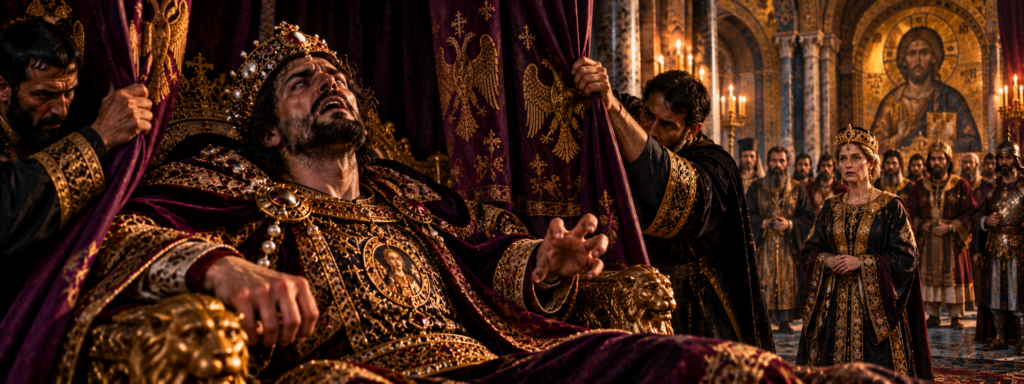
Michael IV the Paphlagonian: Byzantium’s Tormented Emperor, a Murdered Husband, and the Purple Curtains That Hid His Suffering
He rose from an obscure provincial family to become the lover of an empress, the suspected accomplice in an imperial murder, and ultimately the ruler of one of the wealthiest empires in the medieval world. Michael IV possessed neither royal ancestry nor an established claim to the throne, yet his relationship with Empress Zoe brought him extraordinary power. His reign began in the shadow of the suspicious death of Emperor Romanos III, whose body was discovered in the imperial baths shortly before Michael married his widow. But the young emperor’s remarkable ascent concealed a deeply troubling personal struggle. He suffered from a serious seizure disorder, traditionally identified as epilepsy, and Byzantine accounts describe attendants using curtains to shield him from public view during attacks. As his health deteriorated, religious devotion and acts of charity became increasingly prominent in his life, while later writers connected his suffering to the circumstances of his accession. Behind the glittering ceremonies of Constantinople stood a ruler whose physical vulnerability, contested legitimacy, and approaching death would shape one of the most unsettling reigns of the eleventh-century Byzantine Empire.
Behind the Purple Curtains: An Emperor the Court Could Not Allow the World to See
In the imperial palace of Constantinople, appearances were never merely appearances. The Byzantine emperor occupied the center of an elaborate political and religious world in which every gesture carried meaning. His clothing, movements, public audiences, and ceremonial entrances reinforced the idea that imperial authority was orderly, dignified, and protected by divine favor. Visitors encountered a carefully arranged spectacle of wealth and majesty intended to inspire respect, loyalty, and sometimes intimidation.
For Michael IV, however, the carefully maintained image of imperial control concealed a condition that could overwhelm him without warning. Byzantine historians describe the emperor suffering from recurring seizures, an illness generally identified in modern historical writing as epilepsy. The attacks could interrupt his activities and leave him physically exhausted, creating difficulties for a ruler expected to appear in public ceremonies and receive foreign representatives. The contrast between the emperor’s ceremonial position and his unpredictable symptoms became one of the defining features of his reign.
According to the eleventh-century historian Michael Psellos, precautions were taken to conceal Michael’s seizures from public observation. Curtains could be drawn around him when an attack occurred, preventing spectators from witnessing his distress. The detail has become especially memorable because of the symbolism of the imperial purple, the color traditionally associated with Byzantine sovereignty. Yet the surviving account should not be expanded into an unsupported claim that every audience involved an elaborate emergency procedure or that the emperor was constantly incapacitated.
The purpose of such concealment was not necessarily shame alone. Byzantine court ceremonial depended upon maintaining the dignity of the imperial office, and a sudden medical emergency could disrupt carefully orchestrated appearances. Attendants were responsible for protecting the emperor’s privacy and safety while preserving the formal atmosphere of the palace. Their response reveals how the institution adapted to the physical needs of the individual occupying the throne.
Michael’s illness also became entangled with the violent circumstances of his accession. His predecessor, Romanos III Argyros, had died suspiciously in 1034, and Michael had married Romanos’s widow almost immediately afterward. Rumors of murder circulated, and later writers sometimes interpreted Michael’s physical suffering as evidence of divine punishment. In a deeply religious society, illness could be understood through moral and spiritual explanations that modern medicine does not support.
The emperor’s religious activities intensified as his reign progressed. He supported monasteries, practiced forms of devotion, and sought spiritual assistance while his health deteriorated. Some accounts portray him as deeply troubled by the circumstances surrounding Romanos’s death, but his private feelings cannot be established with certainty. The surviving narratives reveal what contemporaries believed about guilt, illness, and divine judgment more clearly than they reveal Michael’s innermost thoughts.
The image of the emperor hidden behind curtains is therefore more than an unusual medical anecdote. It introduces a reign in which public authority and private vulnerability existed side by side, while accusations of murder and fears about succession haunted the imperial household. To understand how Michael reached that position, it is necessary to return to the extraordinary family whose ambitions carried him from relative obscurity into the palace.
From Paphlagonia to Constantinople: The Family That Wanted Everything
Michael IV was born around 1010, probably in the region of Paphlagonia along the southern coast of the Black Sea, although the details of his early life remain uncertain. His family was not part of the highest hereditary aristocracy that traditionally dominated imperial military and political life. Later sources associated his background with comparatively modest circumstances, making his eventual accession particularly remarkable. In a society that placed considerable importance on ancestry, the family’s rise attracted both fascination and resentment.
The most influential figure in Michael’s advancement was his brother John, known as John the Orphanotrophos. The title referred to an official responsible for an orphanage, although John’s political importance extended far beyond that position. He became a powerful administrator and court figure whose connections allowed him to place relatives in positions of influence. His career demonstrated how talented and ambitious officials could rise through the Byzantine bureaucracy without belonging to the traditional military aristocracy.
John possessed administrative ability, political instincts, and a determination to advance his family’s interests. Michael Psellos, who knew the political world of Constantinople and later wrote extensively about its rulers, portrays John as exceptionally capable but also harsh and manipulative. His account is valuable because it preserves detailed observations about the court, yet Psellos’s judgments reflect personal attitudes and the literary conventions of his historical writing. His descriptions should therefore be read critically rather than accepted as neutral character assessments.
Michael entered the imperial environment through his brother’s influence. Sources emphasize his physical attractiveness, a characteristic that became important in accounts of his relationship with Empress Zoe. His youth and appearance distinguished him from the aging emperor Romanos III, whose marriage to Zoe had become increasingly unhappy. The contrast supplied later historians with material for a dramatic story of desire, ambition, and betrayal.
Michael also suffered from seizures before or during his rise to power, although the precise chronology of the illness cannot be established. His condition did not prevent him from attracting attention at court or entering a relationship that would transform his position. Nor did it automatically disqualify him from imperial authority. Byzantine history contained numerous rulers whose physical conditions affected their lives without preventing them from governing.
The family’s opportunity emerged from the troubled marriage between Zoe and Romanos III. Zoe belonged to the Macedonian dynasty, whose legitimacy remained enormously important to the empire. A man who married her could acquire a connection to imperial authority that his own ancestry could not provide. For Michael and his relatives, that connection offered the possibility of extraordinary advancement.
Yet the path to the throne would pass through a death that contemporaries found deeply suspicious.
Empress Zoe: The Woman at the Center of the Empire
Zoe Porphyrogenita was born around 978 into the Macedonian dynasty, the ruling family associated with some of Byzantium’s most successful emperors. Her father, Constantine VIII, inherited sole authority after the death of his brother Basil II in 1025. Constantine’s reign was brief, and the question of succession became urgent because he had no surviving son. His daughters represented the dynasty’s remaining direct connection to imperial legitimacy.
In 1028, the aging emperor arranged Zoe’s marriage to Romanos Argyros, a prominent aristocrat and official. Romanos was already married, but his existing marriage was dissolved to make the dynastic union possible. The arrangement reflected political necessity rather than a documented romantic attachment. Constantine died shortly afterward, and Romanos became emperor as Romanos III.
Zoe was approximately fifty years old when she married Romanos, while her husband was considerably older than Michael would later be. The marriage placed Romanos on the throne through his relationship with a legitimate Macedonian princess. Yet the arrangement soon became troubled. Romanos reportedly hoped to produce an heir, but the couple had no children.
Psellos describes the marriage deteriorating as Romanos became increasingly distant from Zoe. The emperor pursued religious building projects and administrative initiatives, while his wife experienced restrictions on her influence and resources. Psellos’s account emphasizes the personal hostility that developed between them, although the precise details of their private relationship remain difficult to verify. His narrative reflects the importance later writers attached to the contrast between Zoe’s dynastic status and Romanos’s treatment of her.
Zoe’s position remained powerful despite her unhappy marriage. She represented the Macedonian dynasty, whose legitimacy was deeply embedded in Byzantine political culture. The public could distinguish between loyalty to the dynasty and support for an individual emperor who had married into it. This distinction would become crucial when Romanos died.
Michael entered Zoe’s life within this tense political environment. Psellos describes a passionate relationship developing between them, with Zoe becoming increasingly attached to the younger man. The narrative contains literary embellishment, but the relationship itself is strongly supported by the events that followed. Michael’s rapid marriage to Zoe after Romanos’s death made their association central to the accession story.
The relationship threatened Romanos’s position because imperial marriage was not simply a private matter. Zoe’s choice of husband could determine who controlled the empire. Her affection for Michael therefore carried political consequences extending far beyond the palace.
Romanos III: An Emperor Whose Marriage Became Dangerous
Romanos III ruled from 1028 until 1034, inheriting an empire still benefiting from the military and financial achievements of Basil II. He sought to establish his reputation through military campaigns, religious patronage, and public works. Yet his reign produced mixed results, and his military ambitions suffered a significant setback during a campaign against Aleppo in 1030. The defeat damaged his prestige and exposed weaknesses in his leadership.
Romanos also devoted considerable resources to the construction and embellishment of religious buildings. His patronage of the monastery of the Theotokos Peribleptos became an important feature of his reign. Such projects could express piety and imperial magnificence, but critics argued that they consumed resources needed elsewhere. Psellos portrays Romanos as excessively concerned with appearing distinguished and successful.
His relationship with Zoe deteriorated as the reign progressed. Later accounts describe the emperor restricting her financial independence and withdrawing his attention from her. Whether every detail is accurate is uncertain, but the marriage clearly failed to produce the stable dynastic partnership originally intended. The absence of children intensified the succession problem.
Meanwhile, Michael’s presence at court became increasingly significant. His relationship with Zoe placed him in proximity to the throne, while his brother John possessed the political experience needed to exploit an opportunity. The combination of dynastic access and administrative organization made the family formidable. Yet Romanos remained emperor, and there was no legitimate path for Michael to marry Zoe while her husband lived.
By early 1034, Romanos was in declining health. Sources describe symptoms and physical deterioration, but they differ in explaining the cause. Rumors circulated that he had been poisoned or otherwise deliberately weakened. Such accusations were common in Byzantine political narratives, particularly when an emperor died under circumstances that benefited an obvious successor.
The evidence does not establish that Michael or Zoe poisoned Romanos. Psellos records suspicions and describes the emperor’s condition, but his account cannot be treated as a forensic investigation. Other later narratives contain additional allegations, sometimes presented with greater certainty. The distinction between rumor and proven action is essential.
The emperor’s final hours, however, were sufficiently unusual to ensure that suspicion would never disappear.
The Death in the Imperial Baths
On April 11, 1034, Romanos III died after entering the imperial baths. Byzantine accounts describe him becoming distressed in the water and being removed in a severely weakened condition. The circumstances quickly generated allegations that he had been deliberately drowned. The event became one of the most notorious suspicious deaths in Byzantine imperial history.
Psellos’s narrative is particularly important because it preserves both the circumstances of Romanos’s death and the rumors surrounding it. He describes the emperor’s sudden collapse in the bath and suggests that attendants may have interfered with his ability to breathe. Yet the historian does not provide conclusive evidence identifying a murderer. His account combines observation, hearsay, and literary interpretation.
Later chroniclers offered more explicit versions of the accusation. Some implicated Michael’s associates, while others suggested Zoe’s involvement. These narratives reflect the political logic of the situation: Romanos’s death immediately benefited the man who had been involved with his wife. Motive and opportunity, however, are not the same as proof.
The possibility that Romanos died naturally cannot be excluded. He had reportedly been ill before entering the bath, and sudden death during bathing could have resulted from an underlying medical condition. The surviving sources do not permit a reliable determination of the cause. Claims that Michael personally murdered Romanos therefore exceed what can be established.
Nevertheless, the timing was extraordinary. Romanos died on April 11, and Michael married Zoe almost immediately afterward. The marriage provided the dynastic legitimacy necessary for Michael’s accession. He became emperor as Michael IV, transforming his position from a comparatively obscure court figure into the ruler of the Byzantine Empire.
The speed of the transition reinforced suspicion. To observers already aware of the relationship between Michael and Zoe, the succession appeared to confirm a carefully arranged conspiracy. Whether or not the death had been planned, its political consequences were unmistakable. Michael gained the throne through the sudden removal of a husband whose marriage had become an obstacle.
The new emperor inherited power, wealth, and ceremonial magnificence. He also inherited a reputation that would shadow the rest of his life.
A Crown Stained by Suspicion
Michael IV’s accession depended on his marriage to Zoe, but effective government soon passed into the hands of his family. John the Orphanotrophos became the dominant administrator, supervising financial affairs, appointments, and much of the machinery of imperial government. His influence allowed Michael to rule despite the challenges posed by his health. It also created resentment among officials who disliked the family’s rapid advancement.
The new emperor’s legitimacy remained complicated. Zoe possessed hereditary authority through the Macedonian dynasty, while Michael’s claim derived from marriage. His humble background made him vulnerable to criticism from aristocrats who regarded imperial power as their natural preserve. His relationship with Zoe and the circumstances of Romanos’s death provided further opportunities for hostile interpretation.
Michael’s conduct toward Zoe changed after their marriage. Psellos reports that the emperor increasingly distanced himself from her and restricted her influence. This reversal was striking because their relationship had supposedly been passionate before Romanos’s death. The woman whose dynastic position had enabled Michael’s accession found herself marginalized within the government.
Several explanations are possible. Michael may have wished to prevent Zoe from exercising independent political authority, while John may have regarded her as a potential threat to the family’s control. The emperor’s illness and religious concerns may also have affected his personal relationships. Yet the surviving evidence does not establish his private motives with certainty.
The political consequences are clearer. Zoe remained empress, but her role in government diminished. John and Michael’s other relatives gained influence, creating a family-centered administration that critics increasingly resented. The court became a place where advancement depended heavily on connections to the Paphlagonian brothers.
Michael was not simply an ornamental ruler, however. Despite his illness, he participated in government and military affairs. His reign witnessed significant challenges, including rebellions, financial pressures, and warfare along the empire’s frontiers. The image of an emperor entirely consumed by guilt and incapable of governing is inconsistent with the broader historical record.
His physical condition was serious, but it did not erase his political agency.
The Seizures That Haunted the Throne
Michael’s most distinctive personal difficulty was his recurring seizure disorder. Byzantine sources describe attacks that could interrupt his activities and cause considerable physical distress. The condition is traditionally identified as epilepsy, although modern medicine cannot determine its precise type or cause from medieval descriptions. The terminology used by contemporary writers reflected the medical understanding of their own period.
Epilepsy was known in the ancient and medieval Mediterranean world, but explanations varied. Physicians inherited medical traditions that sought natural causes for seizures, while popular religious interpretations sometimes associated them with spiritual forces or divine judgment. These approaches could coexist rather than exclude one another. An emperor might receive medical treatment while also seeking religious assistance.
Psellos describes Michael’s illness as severe and increasingly burdensome. The emperor’s attacks could occur during public appearances, creating practical difficulties for palace ceremonial. Attendants reportedly used curtains to shield him when necessary. The detail suggests that the court developed procedures to preserve privacy and maintain the dignity of imperial audiences.
The curtains have sometimes been portrayed as evidence of shame or terror, but the sources do not establish Michael’s feelings about their use. They may have served several purposes, including protecting him from public observation during a medical emergency. The court’s response reflects the importance of ceremonial control rather than a simple desire to conceal weakness. Byzantine emperors were expected to embody authority even when their bodies were vulnerable.
The condition also affected perceptions of legitimacy. In a society where imperial success could be interpreted as evidence of divine favor, recurring illness might invite moral speculation. Critics could connect Michael’s suffering to the suspicious death of Romanos III. Such interpretations reveal contemporary beliefs, not a causal relationship between wrongdoing and disease.
The seizures were not voluntary, and they should not be confused with mental illness or violent behavior. Epilepsy is a neurological condition, and the surviving evidence does not justify describing Michael as clinically mad. Accounts of paranoia, emotional instability, or psychological collapse require particular caution because medieval writers often interpreted illness through moral narratives.
Michael’s condition was serious enough to shape his public life, but it did not prevent him from ruling for more than seven years. His reign included administrative decisions, military campaigns, and political crises that demand attention beyond the medical anecdotes.
John the Orphanotrophos: The Brother Who Controlled the Empire
John the Orphanotrophos became one of the most powerful figures in Michael IV’s government. His administrative experience and political connections allowed him to supervise affairs that might otherwise have overwhelmed an emperor dealing with recurring illness. He managed appointments, revenue collection, and the advancement of family members. His influence was so extensive that later historians often portrayed him as the true organizer of the regime.
John’s methods attracted criticism. Psellos describes him as energetic, intelligent, and relentless in pursuing his objectives, but also capable of harsh treatment toward opponents. His financial policies generated resentment among communities burdened by taxation. The government’s need for revenue reflected military and administrative demands, yet critics blamed John for excessive extraction.
The Paphlagonian family benefited from his control. Relatives received important positions, strengthening the network that supported Michael’s throne. Such appointments were not unusual in Byzantine politics, where family connections frequently shaped access to power. The speed and scale of the family’s rise nevertheless provoked hostility among established elites.
John also played a central role in managing succession. Michael’s deteriorating health made the question increasingly urgent because the emperor had no surviving son who could inherit the throne. The family’s position depended on finding a successor capable of preserving its influence. Zoe’s dynastic legitimacy remained essential to any arrangement.
The relationship between Michael and John appears to have involved considerable trust, although the emperor was not necessarily powerless before his brother. Michael relied on John’s administrative abilities while retaining imperial authority. Their partnership allowed the government to function during a difficult period. Yet it also concentrated influence within a family whose legitimacy was contested.
John’s dominance created long-term problems. Officials and military commanders who felt excluded could become opponents, while provincial populations might associate the government with heavy taxation. The regime’s survival depended on maintaining military loyalty and preventing powerful rivals from exploiting dissatisfaction. These pressures intensified as Michael’s health declined.
The emperor’s illness therefore interacted with the political structure of his government. It encouraged reliance on trusted relatives, but that reliance increased resentment toward the family. The resulting tensions would become especially dangerous after Michael’s death.
The Price of Imperial Ambition: Taxes, Rebellion, and Resentment
Michael IV inherited an empire that remained powerful but faced significant administrative and military challenges. The achievements of Basil II had expanded Byzantine territory, yet maintaining those possessions required substantial expenditure. Frontier defense, military salaries, and provincial administration placed continuing demands on the treasury. The government needed reliable revenue to sustain imperial authority.
John the Orphanotrophos pursued financial policies intended to secure these resources. His administration became associated with rigorous taxation and the collection of arrears. Critics accused him of placing excessive burdens on provincial populations, particularly communities already facing economic difficulties. The surviving sources reflect hostility toward his methods, although they do not provide a complete statistical picture of imperial finances.
In the Balkans, taxation became a particularly sensitive issue. Basil II had incorporated Bulgaria into the empire in 1018, preserving certain local arrangements while establishing Byzantine authority. Over time, changes in administration and fiscal obligations contributed to dissatisfaction. The imposition of monetary taxation in areas accustomed to other forms of payment is often identified as one factor behind later unrest.
The empire also faced military threats along its frontiers. Raids and conflicts required continued investment in defensive forces, while political instability could disrupt revenue collection. The government therefore confronted competing demands: it needed money to maintain security, but aggressive taxation could undermine loyalty. This tension became increasingly visible during Michael’s reign.
The most serious rebellion occurred in Bulgaria in 1040, when Peter Delyan emerged as a leader of resistance against Byzantine rule. Claiming connections to the former Bulgarian royal dynasty, he attracted support from communities dissatisfied with imperial administration. The uprising spread across substantial areas of the Balkans and threatened Byzantine authority. It became one of the major crises of Michael’s reign.
The rebellion exposed the limits of the empire’s control over territories conquered only a generation earlier. Military victory had not eliminated local political traditions or resentment toward taxation. Michael’s government needed to respond with force while managing divisions among the rebels. The campaign would become one of the emperor’s final major undertakings.
Despite his worsening health, Michael participated in the effort to suppress the uprising.
Peter Delyan and the Bulgarian Revolt
The uprising of Peter Delyan began in 1040 and developed rapidly. Delyan claimed descent from the Bulgarian royal family and presented himself as a legitimate ruler capable of restoring independence. His movement gained support in regions where Byzantine taxation and administration had generated dissatisfaction. The rebellion demonstrated that the political identity of the former Bulgarian state remained influential.
The rebels achieved early successes and extended their operations across parts of the Balkans. Byzantine officials struggled to contain the movement, while local communities responded differently depending on their interests and circumstances. The uprising threatened important communications and strategic positions. Its scale required a major imperial response.
A second claimant, Alusian, entered the rebellion and complicated its leadership. Alusian was connected to the former Bulgarian ruling family and possessed his own ambitions. His arrival created tensions with Peter Delyan, weakening the movement’s unity. The conflict between the two leaders became decisive.
According to Byzantine accounts, Alusian eventually arranged for Delyan to be blinded. The episode echoed the brutal political methods familiar throughout Byzantine history. Mutilation could eliminate a rival’s ability to rule while preserving his life. In this case, it severely weakened the rebellion’s leadership and contributed to its collapse.
Alusian subsequently negotiated with the Byzantine government and received favorable treatment. His defection deprived the rebels of important support. The imperial army then advanced against the remaining resistance. Michael IV participated in the campaign despite his deteriorating health.
The emperor’s presence is significant because it challenges the image of a ruler who had abandoned government entirely. He was seriously ill, but he remained capable of directing or accompanying military operations. The campaign required travel, organization, and political judgment. His participation demonstrated determination under difficult circumstances.
By 1041, the rebellion had been suppressed. Byzantine authority was restored across the affected regions, although the underlying tensions did not disappear. The victory represented an important achievement during Michael’s final year. It also came at a time when his physical condition was becoming increasingly grave.
The emperor returned to Constantinople exhausted and approaching the end of his life.
A Victory Won by a Dying Emperor
Michael IV’s campaign against the Bulgarian revolt was one of the most important military events of his reign. The uprising had threatened imperial control over territories acquired under Basil II, and its suppression preserved Byzantine authority in the Balkans. The government benefited from divisions among the rebel leaders, but military operations were still necessary to restore control. Michael’s involvement demonstrated that his illness had not prevented him from fulfilling important imperial responsibilities.
The physical demands of campaigning were considerable. Travel through the Balkans required endurance even for healthy commanders, while military operations exposed participants to exhaustion and illness. Michael’s seizure disorder and other reported health problems made such activity especially difficult. Byzantine writers emphasize his determination despite declining strength.
The campaign also strengthened the emperor’s political position. Military victory could reinforce legitimacy, particularly for a ruler whose accession remained controversial. Suppressing rebellion demonstrated that the government retained the capacity to defend its territories. It also provided an opportunity to present Michael as a protector of imperial order rather than merely the beneficiary of a suspicious palace succession.
Yet the victory could not reverse his physical decline. Sources describe worsening illness during the final months of his life. The emperor increasingly withdrew from ordinary political activity and devoted greater attention to religious concerns. His brother John continued managing the government while arrangements for succession became urgent.
Later narratives often interpret this withdrawal as evidence of overwhelming guilt. They connect Michael’s illness, the suspicious death of Romanos, and his religious devotion into a single moral story. The sequence is compelling, but it does not establish that guilt caused his behavior. Serious illness frequently encouraged religious preparation for death in medieval Christian society.
Michael’s final year therefore combined military success with personal deterioration. He had preserved imperial authority against a major rebellion, yet he could not secure his own recovery. The government now faced the prospect of losing the ruler around whom the Paphlagonian family’s power had been organized.
The question of what would happen after his death became increasingly urgent.
Monasteries, Charity, and the Search for Salvation
Religion occupied a central place in Byzantine imperial life, and Michael IV’s later years were marked by conspicuous acts of devotion. He supported religious institutions, made charitable donations, and sought spiritual assistance while his health deteriorated. Such activities were common among medieval rulers, particularly those confronting serious illness or approaching death. They could express genuine faith, reinforce public legitimacy, and prepare for the possibility of divine judgment.
Michael became especially associated with the monastery of Saints Cosmas and Damian, known as the Anargyroi, whose cult was connected with healing. The saints were revered as physicians who offered assistance without payment, making their sanctuary particularly meaningful for someone suffering from a chronic condition. Michael’s patronage reflected both religious devotion and the hope of relief from illness. The monastery would become closely associated with his final days.
Psellos describes the emperor engaging in acts of humility and charity. Later retellings sometimes portray him wandering Constantinople barefoot in monastic clothing, distributing gold in a state of desperate panic. The underlying tradition of penitential behavior and generosity is important, but the more theatrical details should be treated cautiously. The surviving evidence does not justify presenting every such scene as a precisely documented event.
Michael’s religious activity has frequently been interpreted as an attempt to atone for Romanos III’s death. This interpretation appears within a broader medieval tradition that associated bodily suffering with moral wrongdoing. Yet the emperor’s private beliefs remain uncertain. He may have experienced remorse, fear of death, concern for salvation, or ordinary religious devotion, and these possibilities are not mutually exclusive.
The distinction matters because the historical narrative can easily become a psychological drama built upon assumptions. We know that Romanos died suspiciously, that Michael benefited from his death, and that Michael later pursued religious devotion while seriously ill. We do not know whether Michael personally arranged Romanos’s murder or believed his seizures were divine punishment. Claims of a documented guilt-induced psychological collapse therefore go beyond the evidence.
His religious patronage nevertheless reveals an important aspect of Byzantine rulership. Emperors were expected to demonstrate piety, support monasteries, and protect the church. Their actions could be interpreted through both spiritual and political frameworks. Michael’s devotion was therefore part of a recognizable imperial tradition, even if his circumstances made it unusually dramatic.
As his condition worsened, the boundary between imperial ceremony and religious withdrawal became increasingly significant. The emperor who had entered the palace through a controversial marriage was now preparing for death within a monastic setting. His family, meanwhile, was preparing to preserve its political power.
The Successor Chosen to Save a Dynasty
Michael IV had no direct heir capable of succeeding him, creating a serious problem for the Paphlagonian family. Their political influence depended heavily on the emperor’s position, and his death threatened to expose them to retaliation from rivals. John the Orphanotrophos therefore sought a succession arrangement that would preserve family authority. The solution involved another Michael, the son of a relative.
The future Michael V was adopted by Empress Zoe and elevated to the rank of Caesar. The adoption was politically essential because Zoe’s Macedonian ancestry provided the dynastic legitimacy that the Paphlagonian family lacked. By making the younger Michael her adopted son, the government created a connection between him and the established imperial dynasty. The arrangement offered a path to succession without abandoning the family’s interests.
The plan also revealed Zoe’s continuing importance. Although Michael IV had marginalized her during his reign, her legitimacy remained indispensable. The family needed her cooperation to secure the future. The woman whose marriage had brought Michael IV to power was once again central to the transfer of authority.
Michael V’s position was not entirely secure. His relationship with John the Orphanotrophos was complicated, and the family contained competing ambitions. The adoption arrangement could establish a formal claim, but it could not guarantee political loyalty. Byzantine succession frequently depended on the support of palace officials, military commanders, and the population of Constantinople.
Michael IV’s declining health increased the urgency of these arrangements. The emperor could no longer assume that he would have years to prepare a successor. His illness had become a political factor affecting the entire government. The future of the dynasty depended on decisions made during his final months.
The succession plan would initially succeed. Michael V eventually inherited the throne, but his reign would reveal how fragile the arrangement had been. His treatment of Zoe would provoke a crisis that destroyed his authority within months.
Michael IV did not live to witness that disaster.
The Emperor’s Final Retreat
During the final stage of his illness, Michael IV withdrew increasingly into religious surroundings. The monastery of Saints Cosmas and Damian became closely associated with his last days. Sources describe him embracing a penitential way of life and preparing for death. His withdrawal marked a striking contrast with the circumstances of his accession seven years earlier.
The emperor’s physical condition had deteriorated severely. His recurring seizures were accompanied by other reported symptoms, although the precise medical relationship between them remains uncertain. Byzantine writers sometimes describe swelling and weakness, but their terminology does not permit a definitive modern diagnosis. The surviving evidence establishes serious illness rather than a single fully identifiable disease.
Psellos portrays Michael’s final days with considerable emotional and moral intensity. His narrative emphasizes the emperor’s religious devotion and the distance that had developed between Michael and Zoe. The account reflects Psellos’s interest in the relationship between personal character, political conduct, and divine judgment. It should be read as a historical source shaped by literary purpose.
One of the most memorable elements concerns Zoe’s attempt to see Michael before his death. According to the narrative tradition, the emperor refused or avoided a final meeting with her. The episode has often been interpreted as evidence of remorse or rejection. Yet its meaning remains uncertain because the account does not provide direct access to Michael’s motives.
The scene is nevertheless politically revealing. Zoe had made Michael emperor through marriage, but their relationship had deteriorated after his accession. By the end of his life, the empress was largely excluded from the government controlled by his family. Their separation symbolized the failure of the partnership that had brought him to power.
Michael died on December 10, 1041, at approximately thirty-one years of age. He had ruled for seven years and eight months. His death ended a reign shaped by illness, contested legitimacy, family ambition, and significant military challenges.
The young man from Paphlagonia had reached the highest position in the empire, but he had not lived long enough to establish a secure dynasty.
Michael V and the Revenge of Empress Zoe
Michael V succeeded Michael IV in December 1041, initially relying on the legitimacy provided by his adoption by Zoe. His accession preserved the appearance of continuity, but the new emperor soon attempted to free himself from the influence of the Paphlagonian family. He moved against John the Orphanotrophos, whose dominance had shaped the previous reign. The resulting conflict demonstrated that the succession arrangement had not created lasting unity.
Michael V also sought to reduce Zoe’s political importance. This decision proved disastrous because Zoe remained the living representative of the Macedonian dynasty. Her legitimacy was deeply rooted in Constantinople’s political culture, and the population could view attacks against her as attacks against the rightful imperial line. The new emperor underestimated the strength of that attachment.
In April 1042, Michael V ordered Zoe removed from the palace and sent into exile. The decision triggered widespread anger in Constantinople. Crowds gathered, demonstrations escalated, and the city erupted into rebellion. The population demanded Zoe’s restoration and turned against the emperor.
The uprising became one of the most dramatic popular interventions in Byzantine succession politics. Michael V lost control of the capital and attempted to seek refuge. His opponents captured him, and he was blinded, ending his ability to rule. His reign had lasted only a few months.
Zoe returned to power alongside her sister Theodora, another member of the Macedonian dynasty. Their joint rule represented a remarkable reversal of the Paphlagonian family’s ambitions. The family that had risen through Zoe’s marriage to Michael IV had attempted to exclude her, only to provoke its own destruction.
The events of 1042 demonstrate the importance of dynastic legitimacy in Byzantine politics. Michael IV had possessed authority through his marriage to Zoe, but his relatives could not easily replace that connection with their own hereditary claims. The political system continued recognizing the Macedonian dynasty even after years of rule by husbands and adopted successors.
Michael IV’s death therefore exposed the weakness of the structure that had sustained his reign. His family had accumulated influence, but its position depended on a legitimacy it did not independently possess. Once Michael V challenged Zoe, the arrangement collapsed.
Was Michael IV Driven Mad by Guilt?
Michael IV is sometimes included in discussions of mentally unstable or supposedly mad monarchs because of his seizures, religious behavior, and association with a suspicious imperial death. Such classifications require caution. The surviving sources provide substantial evidence of serious physical illness, but they do not establish a psychiatric disorder. Epilepsy should not be equated with madness, irrationality, or moral weakness.
The claim that Michael suffered escalating paranoia is particularly difficult to substantiate. Byzantine political narratives frequently describe suspicion, fear, and religious anxiety, but these descriptions do not necessarily correspond to modern clinical concepts. An emperor who feared political rivals or worried about divine judgment was not automatically experiencing pathological paranoia. The context of court politics and religious belief matters.
Similarly, the idea of a manic religious guilt spiral imposes a modern psychological framework on medieval evidence. Michael’s patronage of monasteries, charitable donations, and penitential practices are historically meaningful, but they were also familiar expressions of Byzantine Christianity. Such behavior could intensify during illness without indicating mania. The sources do not provide enough information to establish a specific mental state.
The suspicion surrounding Romanos III’s death remains central to the story. Michael benefited from the emperor’s sudden death and married Zoe almost immediately afterward. Contemporary and later writers considered the circumstances suspicious, and some accused Michael’s associates of murder. Yet the surviving evidence does not conclusively identify the cause of Romanos’s death or prove Michael’s involvement.
The moral interpretation of Michael’s illness was therefore shaped by an unresolved political accusation. Later writers could present his suffering as divine punishment because the narrative offered a compelling connection between wrongdoing and bodily affliction. This explanation reflected religious assumptions rather than medical evidence. It also allowed historians to transform a complex reign into a cautionary tale.
Michael’s actual conduct complicates the stereotype of a ruler incapacitated by fear and guilt. He participated in military campaigns, oversaw government through trusted officials, and helped suppress the Bulgarian rebellion of 1040–1041. His administration faced serious criticism, particularly over taxation and family favoritism, but it remained capable of effective action. The emperor’s illness limited him without eliminating his authority.
The most defensible historical portrait is therefore more nuanced. Michael IV was a seriously ill ruler whose accession remained shadowed by accusations of murder, whose government relied heavily on family networks, and whose later years involved conspicuous religious devotion. Whether he experienced profound personal remorse cannot be known. His life was tragic enough without assigning him an unsupported psychiatric diagnosis.
The Man Behind the Imperial Purple
Michael IV’s reign reveals the extraordinary distance between the image of Byzantine emperorship and the realities of the individuals who occupied the throne. The imperial court presented its ruler as the center of a divinely sanctioned political order, surrounded by ceremony, wealth, and carefully controlled appearances. Yet Michael’s body could interrupt that spectacle without warning. His seizures exposed the vulnerability hidden beneath the imperial costume.
The purple curtains described by Psellos became an enduring symbol of this contradiction. They protected the emperor’s privacy during attacks, but they also separated the public image of sovereignty from the suffering of the person exercising it. The court could conceal the physical symptoms, but it could not eliminate the political consequences of illness. Questions about succession, administrative dependence, and legitimacy remained.
Michael’s relationship with Zoe provides another example of the gap between appearance and reality. Their marriage gave him access to the throne, but the partnership deteriorated once he became emperor. Zoe remained essential to dynastic legitimacy even while her influence was restricted. Her eventual restoration after Michael V’s downfall demonstrated the enduring importance of the Macedonian line.
The Paphlagonian family’s rise also illustrates the opportunities and dangers of Byzantine court politics. John the Orphanotrophos used administrative ability and political connections to advance his relatives, creating a powerful network within the government. Yet the family’s dominance generated resentment and depended on an unstable succession arrangement. Its collapse after Michael IV’s death revealed the limits of influence unsupported by independent legitimacy.
The suspicious death of Romanos III remained the darkest element of Michael’s story. Whether Romanos was murdered cannot be established, but the speed of Michael’s accession ensured that the allegation survived. Later writers connected the accusation to Michael’s illness and religious devotion, creating a narrative of guilt and punishment. That narrative shaped his reputation long after the political circumstances had faded.
Michael’s military record deserves greater attention than it often receives. His participation in suppressing the Bulgarian rebellion demonstrated determination despite serious illness. The campaign preserved imperial authority during a dangerous crisis and represented a significant achievement of his final year. It complicates the image of an emperor who abandoned all responsibility in favor of religious panic.
His reign was therefore neither a simple story of madness nor an uncomplicated tale of victimhood. It involved ambition, political manipulation, religious devotion, administrative effectiveness, and serious physical suffering. The emperor’s vulnerability existed alongside his capacity to exercise power.
The Emperor Who Could Hide His Seizures but Not His Past
Michael IV began life far from the highest circles of Byzantine aristocracy. Through the influence of his brother John and his relationship with Empress Zoe, he entered the imperial palace and eventually became emperor. His accession followed the suspicious death of Romanos III, creating allegations that would shadow his reputation. The circumstances offered later historians a dramatic narrative of ambition rewarded by power and followed by suffering.
His illness became central to that narrative. Recurring seizures disrupted his public appearances, and attendants reportedly used curtains to shield him from spectators during attacks. The detail reveals both the seriousness of his condition and the importance of maintaining imperial dignity. It does not, however, establish that he was mentally unstable or incapable of governing.
Michael relied heavily on John the Orphanotrophos, whose administrative abilities helped sustain the government. Their family-centered regime attracted criticism over taxation, appointments, and the marginalization of Zoe. Yet the empire continued functioning, and Michael participated in major military operations. His suppression of the Bulgarian rebellion demonstrated that his reign cannot be reduced to physical decline.
Religious devotion became increasingly prominent as his health deteriorated. He supported monasteries, practiced charity, and eventually withdrew into religious surroundings. Later writers interpreted these actions as evidence of remorse for Romanos’s death, but the emperor’s private beliefs remain uncertain. The sources reveal a ruler preparing for death within the religious culture of his time.
Michael died in December 1041, still a relatively young man. His chosen successor, Michael V, inherited the throne but quickly destroyed his position by attempting to remove Zoe from power. The resulting uprising restored the Macedonian dynasty and ended the Paphlagonian family’s immediate control of the empire. Michael IV’s political arrangements survived him for only a few months.
His historical reputation remains inseparable from three images: the dead emperor in the bath, the purple curtains drawn around a suffering ruler, and the monastery where Michael spent his final days. Together they create a powerful story of ambition, vulnerability, and the limits of imperial authority. Yet each image requires careful interpretation because Byzantine historians wrote within a world that often understood political misfortune through moral and religious judgment.
Michael IV’s tragedy was not that epilepsy made him unworthy of the throne, nor that his illness proved the accusations surrounding Romanos III’s death. His tragedy lay in the collision between extraordinary political ambition, a body increasingly burdened by serious disease, and a court that interpreted nearly every misfortune through the language of legitimacy and divine judgment. He gained an empire through a marriage made possible by a suspicious death, governed through a family whose power inspired resentment, and spent his final years seeking religious consolation while his health deteriorated. The curtains around his throne could shield his seizures from public view, but they could not conceal the questions surrounding his accession or secure the dynasty he hoped to leave behind. In the end, the imperial purple offered Michael everything Byzantine society associated with earthly power, yet it could protect him from neither mortality nor the judgment of history.