
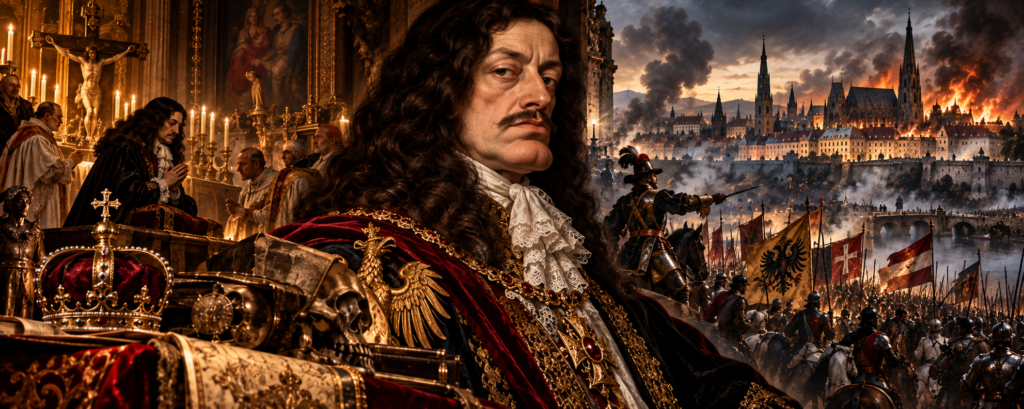
Leopold I: The Pious Emperor, the Habsburg Jaw, and the Wars That Consumed a Lifetime
Holy Roman Emperor, 1658–1705 | Habsburg Inbreeding, Religious Intolerance, the Expulsion of Vienna’s Jews, Protestant Revolt, the Ottoman Siege of Vienna, Louis XIV, Baroque Spectacle, Dynastic Obsession, the Spanish Succession, and Forty-Seven Years of War
The Emperor Who Was Never Supposed to Rule
When Leopold I died in Vienna in May 1705, he left behind a monarchy dramatically larger and more powerful than the one he had inherited nearly half a century earlier. Ottoman armies had been driven back from the heart of Central Europe, Habsburg authority had expanded across Hungary, Vienna had survived one of the most famous sieges in European history, and the Austrian branch of the dynasty was becoming a major continental power. Yet Leopold also left Europe trapped in another enormous war, this time over the Spanish inheritance, while generations of soldiers and civilians had spent much of his reign living beneath the shadow of invasion, rebellion, taxation, religious persecution, and military occupation. His reign was an extraordinary contradiction: the quiet, hesitant, deeply religious emperor who seemed personally unsuited to heroic kingship presided over one of the most violent periods in Habsburg history.
Leopold was not clinically insane, nor was he generally regarded by informed contemporaries as a ruler who had lost contact with reality. There is no convincing evidence of psychosis, mania, or the incapacitating mental illness associated with some other monarchs who have acquired the label of “mad.” The confusion is sometimes worsened by the long and complicated Habsburg family tree, which contains rulers with genuine histories of severe psychological disturbance, but Leopold himself does not belong among them in that medical sense. His place among the darker and more eccentric monarchs of European history comes instead from a mixture of dynastic inbreeding, severe physical deformity, intense Catholic piety, religious persecution, extreme caution, a taste for elaborate court ritual, and a political life dominated by wars that seemed to end only when new ones began.
Even his appearance seemed to embody the strange inheritance of the Habsburg dynasty. Leopold possessed the protruding lower jaw for which the family became notorious, a hereditary feature strengthened by generations of marriages among close relatives. Portraitists could soften it but could not completely conceal it. The elongated face, projecting lower lip, and unmistakable jaw gave him an appearance that foreign observers sometimes described with extraordinary cruelty, turning physical difference into political caricature and using his features as evidence of supposed Habsburg degeneration.
Behind that face, however, was a highly educated man who loved music, composed sophisticated works of his own, knew several languages, took an interest in theology and the sciences, and could be warm and humorous among people he trusted. He was personally less flamboyant than Louis XIV of France, his great rival, yet he sponsored enormous operatic spectacles capable of consuming astonishing amounts of money. He was cautious to the point of frustrating his ministers, yet he remained committed to dynastic claims that helped draw Europe into massive wars. He could appear humble before God while insisting upon the sacred privileges of his dynasty, and he could practice personal austerity while presiding over a court capable of extraordinary Baroque extravagance.
Leopold’s story is therefore not one of insanity. It is the story of a ruler whose contradictions were amplified by the immense power he inherited, a man trained for the Church who unexpectedly became emperor and then spent forty-seven years fighting to preserve, expand, and sanctify Habsburg authority. His “madness,” if the word is used at all, belonged not to delusion but to excess: excessive dynastic calculation, excessive religious certainty, excessive caution followed by remarkable stubbornness, and an almost relentless willingness to continue struggles whose costs spread far beyond the imperial palace.
Born Into the Habsburg Family Maze
Leopold Ignaz Joseph Balthasar Felician was born in Vienna on 9 June 1640, the son of Emperor Ferdinand III and Maria Anna of Spain. He entered one of Europe’s most interconnected royal families, and in the Habsburg world that description carried a darker biological meaning. The Austrian and Spanish branches of the dynasty had repeatedly married one another in an effort to keep territories, claims, and political alliances inside the family. Uncles married nieces, cousins married cousins, and the same ancestors appeared repeatedly on different branches of royal family trees.
Leopold himself was the product of this dynastic system. His parents were closely related, and generations of earlier Habsburg intermarriage had already concentrated hereditary characteristics within the family. The most visible of these was mandibular prognathism, popularly remembered as the “Habsburg jaw” or, less politely, the “Habsburg lip.” Leopold displayed the feature prominently, though the sensational description “hogmouth” belongs more to hostile caricature and later popular writing than to any useful medical terminology.
The deformity appears to have affected the way Leopold looked and perhaps the way he spoke and ate, although dramatic claims that he could barely chew at all should be treated cautiously. Contemporary portraits show a markedly projecting lower jaw and heavy lower lip, while observers remarked upon his unusual appearance. Physical beauty mattered enormously in seventeenth-century royal culture because the monarch’s body was treated as an expression of dynastic legitimacy, health, and magnificence. Leopold’s face therefore became political material, especially for enemies eager to contrast him unfavorably with more glamorous rulers.
Yet focusing too heavily on his jaw risks turning a real man into a caricature. Leopold was not intellectually impaired by his appearance, nor is there evidence that the deformity itself caused mental illness. He received an extensive education and became unusually learned for a ruler, developing interests that ranged from theology and law to astronomy, literature, music, astrology, and alchemy. The physically awkward prince whom enemies mocked was capable of understanding a remarkably broad intellectual world.
The Prince Intended for the Church
Leopold was not originally expected to become the principal ruler of the Austrian Habsburg lands. His elder brother Ferdinand IV stood ahead of him in the succession and had already been crowned King of the Romans, marking him as their father’s expected imperial successor. Leopold could therefore be prepared for an ecclesiastical career, an arrangement perfectly normal for a younger son of a powerful Catholic dynasty. His education consequently possessed an unusually strong theological and clerical character.
Jesuit influence played an important role in that education. Leopold studied Catholic theology, devotional practice, languages, philosophy, history, law, and the intellectual disciplines expected of a cultivated Habsburg prince, but religion occupied the center of the program. He absorbed the tradition later associated with pietas Austriaca, the distinctive Habsburg culture of Catholic devotion that linked dynasty, faith, and political legitimacy. To Leopold, Catholicism was not simply a private belief attached to his public office; it formed part of the explanation for why his family ruled at all.
Everything changed in 1654 when Ferdinand IV died unexpectedly of smallpox. Leopold was only fourteen, but the quiet younger son destined for the Church suddenly became the future of the dynasty. The transformation could not erase the education he had already received. Instead, the habits and assumptions of an ecclesiastically trained prince were carried directly into secular monarchy.
His father Ferdinand III died in April 1657, leaving the seventeen-year-old Leopold ruler of the hereditary Habsburg lands. The imperial crown did not pass automatically from father to son because the Holy Roman Emperor was elected by the prince-electors. France, determined to prevent another effortless Habsburg succession, worked to obstruct Leopold and encouraged alternatives. After prolonged maneuvering, he was finally elected emperor in July 1658, beginning a reign that would last until 1705.
A Face Europe Remembered
Leopold’s physical appearance remained one of the most frequently remarked-upon aspects of his personality. He was not the towering warrior-prince celebrated in heroic paintings, and he lacked the theatrical physical confidence associated with Louis XIV. Descriptions portray him as reserved, solemn, awkward in public, and physically unimpressive by conventional standards. His protruding jaw and lip made an easy target for diplomats and hostile writers accustomed to judging monarchs as harshly by appearance as by policy.
It is tempting to interpret Leopold’s reserve as psychological compensation for his appearance, but that conclusion goes beyond what the evidence can establish. He may certainly have been conscious of how others perceived him, especially within a court culture obsessed with presentation. Yet his shyness and formality could equally reflect temperament, upbringing, Spanish-influenced court etiquette, and the clerical direction of his childhood education. Modern psychological explanations should therefore remain possibilities rather than diagnoses.
What is clearer is that Leopold behaved very differently in formal and intimate settings. Publicly, he could seem cold, deliberate, stiff, and painfully ceremonial. Among family members, trusted courtiers, and musicians, he appears to have been considerably more relaxed. His letters and artistic interests reveal a personality far richer than the expressionless imperial mask visible in official portraiture.
This contrast would follow him throughout his reign. The emperor whom foreign observers could dismiss as awkward and unimpressive possessed enormous endurance. He survived political crises, military disasters, epidemics, rebellions, Ottoman invasions, French aggression, court factionalism, the deaths of wives and children, and almost half a century of European warfare. Whatever his weaknesses, Leopold was remarkably difficult to break.
The Religion That Governed the Emperor
Leopold’s Catholic devotion was intense even by the standards of his dynasty. He attended Mass frequently, observed elaborate devotional practices, supported religious institutions, participated in processions and pilgrimages, and understood imperial responsibility through a deeply providential worldview. Religious ceremonies occupied substantial portions of court life, particularly during major festivals and penitential seasons. Accounts of extraordinarily demanding schedules of worship capture something genuine about the atmosphere of his court, although exact claims about fixed numbers of daily Masses or dozens upon dozens of compulsory Lenten services should not be repeated as though every detail can be verified.
His piety could be personally sincere and politically dangerous at the same time. Leopold believed Catholic monarchy possessed obligations toward the preservation and restoration of the faith. That conviction shaped policies toward Protestants in Habsburg territories, particularly in Hungary, where political resistance and religious difference became dangerously intertwined. Measures against Protestant institutions, clergy, and communities contributed to resentment that repeatedly erupted into rebellion.
Hungary presented Leopold with problems far more complicated than simple religious disagreement. Hungarian nobles defended constitutional privileges and resented attempts at centralization, while large portions of the population remained Protestant. Ottoman power still dominated significant territories, and anti-Habsburg rebels could seek assistance from Transylvania, France, or the Ottomans. Every attempt to impose greater royal authority therefore risked transforming political resistance into international conflict.
After a conspiracy among Hungarian and Croatian magnates was uncovered in the late 1660s and early 1670s, the Habsburg response became severe. Leading conspirators were executed, constitutional government was restricted, and Protestant clergy faced persecution, trials, imprisonment, and in some notorious cases condemnation to the galleys. Leopold’s government treated political disloyalty and confessional resistance as interconnected threats. The result was not religious unity but deeper alienation.
The Jews Expelled From Vienna
Leopold’s religious intolerance was not confined to Protestants. In 1670, the Jewish community of Vienna was expelled, one of the most notorious acts of religious persecution during his reign. The community had occupied a defined district across the Danube channel and included merchants, financiers, scholars, families, and institutions that had become part of the city’s economic and cultural life. Hostility toward Jews had nevertheless remained powerful among clergy, urban interests, and sections of the court.
Multiple pressures contributed to the expulsion, including religious prejudice, local economic hostility, and the influence of strongly Catholic figures around the imperial family. Leopold ultimately authorized the removal despite efforts to prevent it. Jewish residents were forced to abandon Vienna, and the principal synagogue was converted into a Catholic church. The former Jewish district eventually became associated with Leopold’s own name as Leopoldstadt, an enduring geographical reminder of a policy that had uprooted an entire community.
The decision is especially revealing because economic reality soon exposed the limitations of ideological exclusion. The Habsburg monarchy needed credit, financial expertise, supply networks, and wealthy intermediaries capable of supporting a state almost constantly at war. Within a few years, Jewish financiers again became indispensable to imperial government, most famously Samuel Oppenheimer and later Samson Wertheimer. Leopold’s government therefore found ways to admit and employ individuals whose financial services it urgently required.
The contradiction was striking. The emperor could expel a Jewish community as an act consistent with confessional politics and then rely upon Jewish financiers because the machinery of war demanded resources theological purity could not provide. This did not make Leopold uniquely hypocritical by the standards of early modern Europe, where persecution and pragmatic exception frequently existed side by side. It did, however, expose the tension between the emperor’s ideal of Catholic order and the practical requirements of ruling a sprawling, expensive monarchy.
A Ruler Who Could Barely Decide—Until He Would Not Yield
Leopold acquired a reputation for extreme caution and slow decision-making. Ministers could become exasperated by his reluctance to commit himself quickly, particularly when court factions offered contradictory advice. He preferred consultation, written memoranda, careful deliberation, and the weighing of competing arguments. His motto, often rendered as “By counsel and industry,” suited a ruler who regarded patient consideration as a virtue rather than a weakness.
To contemporaries confronting military emergencies, however, deliberation could look like paralysis. Armies did not wait politely while imperial committees debated, and diplomatic opportunities could disappear while Vienna hesitated. Leopold sometimes postponed decisions until circumstances narrowed his options for him. His cautious personality was reinforced by a religious belief in Providence that could encourage patience when more aggressive advisers demanded immediate action.
It would nevertheless be wrong to portray him as incapable of governing. As Leopold matured, especially after the fall of powerful ministers who had dominated the early years of his reign, he became increasingly involved in policy. He read reports, considered appointments, participated in diplomatic strategy, and could dismiss advisers who lost his confidence. The hesitant emperor was not a puppet.
The deeper contradiction was that Leopold could be slow in choosing a course but extraordinarily persistent once committed to it. Caution before a decision did not necessarily produce moderation afterward. On matters touching dynastic rights, Catholic authority, or the security of the Habsburg monarchy, hesitation could harden into stubbornness. Europe repeatedly discovered that the quiet emperor who took so long to decide could be even harder to persuade to stop.
The Myth of the Anti-French Language Ban
Leopold’s rivalry with France, particularly with Louis XIV, became one of the defining political struggles of his reign. It is therefore easy to understand how stories developed portraying him as so consumed by hatred of France that he supposedly banned the French language from his court. The claim is colorful, but it should not be accepted literally without strong qualification. Leopold’s court was multilingual, and he himself possessed substantial linguistic abilities.
Italian was particularly important at the Viennese court and was central to Leopold’s musical and literary interests. Latin remained essential to imperial government and scholarship, while German, Spanish, and other languages circulated through the multinational Habsburg world. French cultural influence grew enormously across Europe during Leopold’s lifetime, even in courts politically hostile to Louis XIV. A total prohibition on French under all circumstances would have been extraordinarily difficult to enforce and is not a reliable way to describe Viennese court life.
What was real was Leopold’s deep political opposition to Louis XIV. The French king represented almost everything that threatened Habsburg interests: territorial expansion along the empire’s western frontier, intervention in German affairs, diplomatic cooperation with Habsburg enemies, and eventually a rival claim to the Spanish inheritance. Leopold’s antagonism toward France was therefore not an irrational personal obsession invented from nothing. It arose from decades of genuine strategic competition.
The two monarchs nevertheless made a fascinating contrast. Louis projected deliberate magnificence, controlled his image with extraordinary skill, and made Versailles a theater of monarchy. Leopold appeared more restrained and personally modest, but his own court was hardly immune to Baroque spectacle. The struggle between them was not simplicity against extravagance so much as two different versions of seventeenth-century dynastic power.
The Emperor Who Lived Quietly and Staged Spectacles
Leopold’s greatest personal passion was music. His father had also composed, and the younger emperor inherited both talent and enthusiasm. Leopold wrote sacred music, arias, oratorios, and other compositions, and his surviving work demonstrates that this was more than an aristocratic hobby performed for appearances. He understood music seriously and participated directly in one of the most sophisticated court cultures in Europe.
Opera became especially important during his reign. The Viennese court sponsored elaborate productions involving enormous sets, complicated machinery, lavish costumes, mythological imagery, dance, instrumental music, and enormous casts. Celebrations surrounding dynastic marriages could become spectacles designed to overwhelm spectators with the magnificence of Habsburg monarchy. The emperor who could appear personally austere was willing to spend heavily on performances that transformed imperial ideology into sound, light, movement, and illusion.
This was not simply wasteful entertainment. Baroque court spectacle was political communication. An opera presenting heroic rulers, divine favor, dynastic marriage, or the triumph of order over chaos could glorify the Habsburgs just as effectively as a military parade. Foreign ambassadors watched these productions, courtiers participated in them, and the magnificence of the stage announced that Vienna belonged among Europe’s great capitals.
Leopold occasionally participated personally in theatrical and musical culture rather than merely watching from an imperial box. His compositions were performed at court, and music accompanied intimate family events as well as great public ceremonies. The contrast with his public stiffness is striking. The emperor who struggled to project effortless charisma through conversation could express himself fluently through music.
Astrology, Alchemy, and a Catholic Emperor’s Curiosity
Leopold’s intellectual world also included subjects modern readers may find surprising in a ruler so intensely Catholic. He possessed interests in astrology and alchemy, fields that existed in complicated relationships with seventeenth-century science, medicine, philosophy, and religion. Neither interest automatically implied occult rebellion against Catholic teaching. Learned Europeans frequently investigated ideas that later centuries would separate sharply into “science,” “magic,” and “superstition.”
Astrology remained intertwined with astronomy in parts of European intellectual culture, while alchemy encompassed practical experimentation as well as dreams of transmutation and hidden natural processes. Courts across Europe patronized people who promised medicinal discoveries, metallurgical knowledge, or secrets capable of enriching rulers. Leopold’s curiosity therefore placed him within a broad early modern intellectual tradition rather than making him a secret sorcerer. Sensational descriptions of an emperor obsessed with forbidden occultism distort the historical context.
The contrast with his religious persecution nevertheless remains uncomfortable. Leopold could tolerate speculative investigations among educated courtiers while refusing confessional freedoms to communities whose beliefs challenged Catholic authority. The apparent inconsistency becomes more understandable once we recognize that he did not categorize these things as modern readers might. Investigating nature did not necessarily threaten the religious and political order in the way organized Protestant worship did.
His curiosity also reminds us that Leopold was intellectually more complicated than the stereotype of a narrow-minded zealot. He could be rigid on confessional policy while remaining interested in mathematics, natural philosophy, music, mechanics, and other learned pursuits. The same mind could contain intense orthodoxy and genuine curiosity because seventeenth-century Europeans did not necessarily see those impulses as opposites.
The First Great Enemy: The Ottoman Empire
Leopold inherited a monarchy living beside one of Europe’s great imperial frontiers. The Ottoman Empire controlled much of Hungary, while Habsburg and Ottoman territories faced one another across a militarized border marked by fortresses, raids, diplomacy, and periodic warfare. Transylvania occupied an especially complicated position between the rival powers. Leopold therefore inherited an eastern problem that no amount of court ceremony could make disappear.
War broke out in the 1660s, and imperial forces under Raimondo Montecuccoli won an important victory over the Ottomans at the Battle of Saint Gotthard in 1664. Yet the subsequent Peace of Vasvár disappointed many Hungarians because Leopold accepted terms they considered far too lenient given the battlefield success. The emperor had reasons for caution, including fear of France and concern about fighting simultaneously on multiple fronts. What looked prudent from Vienna could look like betrayal from Hungary.
The resentment fed the conspiracy among Hungarian and Croatian magnates and contributed to the cycle of repression that followed. Leopold’s government answered perceived treason by tightening control, which in turn intensified resistance. Protestant grievances combined with political resentment, creating conditions in which anti-Habsburg rebels could find support. Imre Thököly eventually emerged as one of the most formidable leaders of the Hungarian opposition.
By the early 1680s, the Ottoman government saw an opportunity. Grand Vizier Kara Mustafa Pasha led an enormous army into Habsburg territory, supported by forces connected to Thököly. The target became Vienna itself. Leopold, whose reign had already been filled with wars and rebellions, now faced the possibility that his capital might fall.
The Emperor Who Fled Vienna
As the Ottoman army approached in 1683, Leopold left Vienna with his family and court. Later heroic mythology sometimes makes royal flight appear cowardly, but removing the dynasty from a city facing siege was a rational act. If Vienna fell with the emperor trapped inside it, the political catastrophe would become immeasurably worse. Leopold departed while Count Ernst Rüdiger von Starhemberg prepared the defenses.
The siege began in July and became increasingly desperate. Ottoman engineers dug trenches and mines toward the fortifications while defenders struggled to repair shattered walls and repel assaults. Disease, exhaustion, casualties, and dwindling supplies transformed Vienna into a city waiting for either rescue or destruction. Leopold could do little but rely upon military commanders, diplomatic arrangements, and the coalition forming beyond the besieged capital.
The relief came on 12 September 1683. A combined Christian army including imperial, German, and Polish forces attacked the Ottomans outside Vienna, with King John III Sobieski of Poland playing the most celebrated role. The battle ended in a dramatic Ottoman defeat, and the siege collapsed. Vienna survived.
For Leopold, the deliverance could easily be interpreted through the providential worldview that had shaped him since childhood. The Habsburg capital had stood at the edge of catastrophe and escaped. Yet the victory was not simply a miraculous rescue. It resulted from diplomacy, coalition warfare, military leadership, Polish intervention, imperial forces, and the determination of Vienna’s defenders.
From Near Disaster to Habsburg Triumph
The failure of the Ottoman siege transformed the balance of power in Central Europe. Rather than merely driving the Ottomans away from Vienna and returning to the previous frontier, Habsburg and allied forces launched a sustained offensive. The resulting Great Turkish War would continue for years, gradually pushing Ottoman power back across Hungary. Leopold’s monarchy moved from desperate defense toward territorial expansion.
Buda, under Ottoman rule for generations, fell to Christian forces in 1686 after a brutal siege. The victory carried enormous symbolic significance because the old Hungarian capital had been one of the great prizes of Ottoman conquest. Further campaigns followed, and the Battle of Mohács in 1687 strengthened Habsburg control. Hungarian political arrangements were altered in ways that reinforced hereditary Habsburg succession.
The transformation culminated in the great victory of Prince Eugene of Savoy at Zenta in 1697. Eugene, who would become one of the outstanding commanders of the age, destroyed an Ottoman army attempting to cross the Tisza River. The scale of the defeat helped force negotiations. The Treaty of Karlowitz in 1699 transferred most of Ottoman Hungary to Habsburg control and marked a major turning point in Central European history.
Leopold had begun the crisis of 1683 as an emperor fleeing his threatened capital. He emerged from the larger war as ruler of a monarchy that had expanded dramatically eastward. The victory strengthened the Habsburg dynasty for generations, but it also encouraged the centralizing ambitions that continued to generate resistance within Hungary. Triumph did not eliminate the political problems concealed beneath territorial expansion.
Hungary: The Kingdom That Would Not Submit Quietly
The recovery of Hungary from Ottoman rule did not mean that Hungarian society welcomed unlimited Habsburg authority. Nobles remained protective of their constitutional privileges, while Protestants remembered years of persecution. The imperial government wanted a more secure and governable kingdom after generations of warfare. Hungarian elites feared that Vienna intended to turn military reconquest into political subordination.
Leopold’s earlier policies had already damaged trust. The repression of the 1670s, persecution of Protestant clergy, and suspension or restriction of traditional political arrangements created a legacy that military victories could not erase. Although policy moderated at times, particularly when practical necessity required cooperation, suspicion remained profound. The emperor’s Catholic convictions continued to shape the monarchy’s approach to confessional questions.
After 1683, Habsburg military success gave Vienna greater leverage. In 1687, the Hungarian Diet accepted hereditary succession in the male Habsburg line, strengthening the dynasty’s legal position. The change represented a major achievement in Leopold’s program of dynastic consolidation. Yet it was obtained in a political atmosphere transformed by military conquest and the overwhelming presence of imperial power.
Resistance would eventually revive. Near the end of Leopold’s life, the uprising associated with Francis II Rákóczi erupted in 1703, driven by a mixture of political, social, economic, and confessional grievances. The old emperor therefore entered his final years facing rebellion in lands whose recovery from the Ottomans had been celebrated as one of his greatest successes. Habsburg victory had changed Hungary, but it had not made the kingdom obedient.
Louis XIV: The Rival Across the Rhine
While Leopold struggled with Ottomans and Hungarians in the east, France exerted pressure from the west. Louis XIV pursued territorial expansion, strategic frontiers, dynastic claims, and French influence within the Holy Roman Empire. The rivalry between Bourbon France and Habsburg Austria became one of the central geopolitical struggles of the age. Leopold’s reign consequently developed into a grim pattern in which danger on one frontier frequently intensified while he was occupied on another.
The Franco-Dutch War beginning in 1672 eventually drew the emperor into conflict against France. Louis’s armies demonstrated their power across western Europe, while French diplomacy sought allies and exploited divisions within the empire. Leopold had to balance resistance to France against the continuing instability of Hungary and the Ottoman frontier. His cautious diplomacy becomes far more understandable when viewed against this impossible strategic geography.
Louis continued pressing claims through policies of reunion and annexation during the following decade. Imperial territories and neighboring states watched French expansion with increasing alarm. The revocation of the Edict of Nantes in 1685 also sent Protestant refugees fleeing France, although Leopold’s own record of confessional intolerance gave him little moral standing from which to condemn persecution. European rulers routinely denounced religious coercion when practiced by rivals while defending their own versions of it.
The Nine Years’ War began in 1688, only a few years after Vienna had nearly fallen to the Ottomans. Once again Leopold faced major war with France while the struggle against the Ottoman Empire remained unresolved. Europe had entered an age in which dynastic monarchies could mobilize increasingly large armies and sustain conflicts across multiple theaters. The financial and human demands were enormous.
The Quiet Emperor Versus the Sun King
Louis XIV and Leopold I were near-perfect political opposites in public image. Louis cultivated physical grace, theatrical authority, elaborate ceremony, and an unmistakable cult of royal magnificence. Leopold’s elongated face, reserved personality, clerical education, and deliberate manner seemed almost designed to lose a competition in royal glamour. French observers could therefore treat the Austrian emperor as awkward, provincial, or antiquated.
Yet beneath the difference in style, the two men shared important assumptions. Both believed strongly in dynasty, hierarchy, monarchical authority, and the legitimacy of using war to defend or enlarge inherited claims. Both maintained elaborate courts, patronized the arts, and understood ceremony as political language. Both could demand immense sacrifices from subjects in pursuit of objectives framed as necessary to the security and honor of their houses.
Their rivalry also reveals why calling Leopold’s hostility toward France irrational is misleading. Louis genuinely threatened Habsburg interests. French armies crossed borders, occupied territories, supported enemies of the emperor, and challenged the European balance of power. Leopold did not need a personal neurosis to regard Bourbon expansion as dangerous.
The tragedy was that rational dynastic competition could produce consequences that looked insane from the perspective of ordinary people. Villages burned because kings disputed frontiers, soldiers died because genealogies generated claims, and taxpayers financed armies created to prevent rival dynasties from becoming too powerful. Leopold’s wars were not irrational within the political system of his age. The system itself could produce results that appeared horrifyingly irrational.
Three Marriages and the Dynastic Machine
Marriage was not merely a private matter for Leopold. It was one of the principal instruments through which Habsburg power reproduced itself, both biologically and politically. His first marriage, in 1666, was to Margarita Teresa of Spain, the daughter of King Philip IV and Leopold’s own niece. She is familiar from the paintings of Diego Velázquez, particularly the royal world immortalized in Las Meninas. The marriage was another example of the close intermarriage between the Austrian and Spanish Habsburg branches.
Leopold appears to have been genuinely attached to Margarita Teresa, but the marriage also demonstrates the disturbing logic of dynastic endogamy. Their close biological relationship was not incidental; it was considered politically advantageous because it reinforced connections between the two branches of the family. Several children were born, but most did not survive infancy or early childhood. Margarita herself died in 1673 at only twenty-one after repeated pregnancies had weakened her health.
Leopold next married Claudia Felicitas of Austria, a member of the Tyrolean Habsburg line. She too died young, in 1676, and their daughters did not survive childhood. Leopold’s third marriage, to Eleonore Magdalene of Neuburg, finally produced the sons upon whom the future Austrian succession would depend. Among them were Joseph, the future Emperor Joseph I, and Charles, the future Emperor Charles VI.
The emperor’s family life therefore carried the same mixture of affection, mortality, and political calculation that defined royal marriage throughout the period. Children were loved, but they were also heirs, diplomatic assets, and links in chains of inheritance stretching across Europe. When the Spanish Habsburg line approached extinction, those family connections would help ignite one of the greatest wars of Leopold’s reign.
The Shadow of Charles II of Spain
No monarch demonstrated the biological dangers of repeated Habsburg intermarriage more dramatically than Charles II of Spain. He suffered severe physical and developmental problems and remained childless despite two marriages. His inability to produce an heir created an international crisis because the Spanish monarchy included not merely Spain but territories in Italy, the Spanish Netherlands, overseas possessions, and an immense colonial empire. Whoever inherited that collection of territories could alter the balance of power across Europe.
Leopold possessed a powerful dynastic interest in the succession. He was closely related to Charles II and represented the Austrian branch of the Habsburg dynasty. Louis XIV also possessed claims through his own marriage to Maria Theresa of Spain and through Bourbon family connections. The problem was therefore not simply deciding which prince had the most convincing family tree, because European governments feared the geopolitical consequences of allowing either great dynasty to acquire the entire Spanish inheritance.
Diplomats attempted partition schemes while Charles II was still alive, trying to divide the inheritance in ways that might prevent general war. These plans were complicated by the understandable resistance of Spanish political elites, who did not want their monarchy carved apart by foreign powers before their king was even dead. Charles himself ultimately made a will naming Philip, Duke of Anjou, a grandson of Louis XIV, as heir to the entire Spanish monarchy. The intention was to preserve the empire intact under a Bourbon prince rather than allow its territories to be partitioned.
Leopold refused to accept the outcome as a final settlement. His own dynastic claims and the fear of Bourbon dominance made acceptance extremely difficult, while other European powers worried about the relationship between France and Spain. The emperor increasingly championed the claims of his younger son, Archduke Charles. What began as a succession dispute became another continental war.
The War of the Spanish Succession
Charles II died on 1 November 1700, bringing the Spanish Habsburg male line to an end. Philip of Anjou was proclaimed Philip V of Spain, and Louis XIV accepted the inheritance for his grandson. The possibility that Bourbon France and Spain might become strategically aligned alarmed Leopold, England, the Dutch Republic, and other powers. Diplomacy gave way to the War of the Spanish Succession in 1701.
It is tempting to portray Leopold as simply ignoring Charles II’s will because he wanted Spain for his own son. There is truth in the dynastic ambition, but the crisis was broader than one emperor’s stubbornness. Wills did not automatically settle international disputes involving enormous composite monarchies, particularly when other powers believed the result threatened their security. European politics operated through a combination of inheritance law, treaties, military strength, diplomacy, and the elusive concept of the balance of power.
Leopold nevertheless pursued the Austrian Habsburg claim with determination. His younger son Charles became the rival candidate for the Spanish crown, while Leopold’s elder son Joseph remained positioned to inherit the Austrian lands and imperial ambitions. The arrangement theoretically prevented the entire Habsburg inheritance from being united under one immediate ruler. Yet circumstances could change, and the possibility of a revived Habsburg super-monarchy frightened other powers just as Bourbon dominance did.
The war spread across the Low Countries, Germany, Italy, Spain, and beyond Europe through the colonial possessions of the combatants. It became another vast conflict financed by taxes, borrowing, commercial systems, and the labor of populations far removed from royal family disputes. Leopold, already in his sixties, entered the final years of his life watching Europe bleed over an inheritance produced by the very dynastic marriage system his family had practiced for generations.
Prince Eugene and the Emperor’s Late Victories
One of Leopold’s greatest assets during his later reign was Prince Eugene of Savoy. Eugene had originally sought a military career in France but entered Habsburg service after Louis XIV refused him the position he wanted. The decision proved enormously beneficial to Vienna. Eugene became one of the greatest commanders in Habsburg history.
His victory at Zenta in 1697 had helped bring the Ottoman war toward a favorable conclusion. During the War of the Spanish Succession, Eugene again became central to imperial strategy. He cooperated with John Churchill, Duke of Marlborough, in the campaign culminating at Blenheim in 1704. The allied victory destroyed a major Franco-Bavarian army and removed the immediate danger that Vienna might be threatened from the west.
For Leopold, Blenheim arrived near the end of a reign that had begun with uncertainty and repeatedly approached disaster. The emperor who had once struggled simply to secure election in 1658 now presided over a monarchy capable of competing with France and defeating Ottoman armies. His political system remained cumbersome, financially strained, and internally divided, but the strategic transformation was undeniable. Austria was emerging as one of Europe’s great powers.
Leopold did not live long enough to see the final outcome of the Spanish war. The conflict continued through the reigns of his sons and eventually produced settlements very different from the complete dynastic victory he had desired. Philip V remained King of Spain, while the Austrian Habsburgs received important European territories formerly belonging to the Spanish monarchy. Once again, Leopold’s ambitions were only partly fulfilled, but the dynasty emerged stronger than it had been at the beginning of his reign.
The Strange Problem of Leopold’s “Madness”
Leopold’s inclusion among supposedly mad rulers requires especially careful handling because almost every dramatic element of his personality can be exaggerated. His Habsburg jaw was severe, but physical deformity is not mental illness. His religious devotion was intense, but seventeenth-century Catholic piety cannot automatically be diagnosed as pathological fanaticism. His decision-making was cautious, but hesitation can be a political temperament rather than a psychiatric symptom.
Likewise, his wars cannot simply be attributed to an uncontrollable personal desire for conflict. Leopold inherited Ottoman rivalry, faced genuine French expansion, confronted Hungarian rebellion, and became entangled in a Spanish succession crisis involving almost every major European power. He did not personally invent the strategic conflicts that dominated his reign. Many of his wars would probably have occurred in some form regardless of his personality.
Yet personality mattered in the way he handled those problems. Leopold’s religious convictions contributed to policies that alienated Hungarian Protestants and expelled Vienna’s Jews. His dynastic worldview made the Spanish succession something more than an abstract diplomatic question. His caution could delay decisions, while his stubbornness could prolong commitments after they had been made.
The result was not madness but a distinctive political temperament. Leopold was simultaneously hesitant and persistent, modest and magnificent, intellectually curious and religiously intolerant, personally reserved and theatrically extravagant. Those contradictions make him more interesting than a simplistic diagnosis ever could.
Was Leopold Socially Crippled by His Appearance?
Later writers have often linked Leopold’s public reserve directly to his jaw, suggesting that embarrassment over his appearance made him pathologically shy. The theory is plausible but difficult to prove. Seventeenth-century observers certainly noticed his appearance, and hostile descriptions could be merciless. It would be surprising if Leopold remained completely unaware of such judgments.
Nevertheless, his upbringing offers an equally powerful explanation for his demeanor. He had been trained as a younger son expected to enter the Church, not as a dazzling warrior-prince destined to dominate European court society. His education emphasized discipline, religion, scholarship, and restraint. When his brother died, Leopold inherited the political role without receiving an entirely new personality.
Rigid court etiquette may also have suited him. Ceremony created predictable relationships, established exactly who stood where, determined who spoke first, and reduced spontaneous social interaction. For a naturally reserved ruler, such structures could provide both authority and protection. The imperial persona became a framework within which Leopold could operate without needing the effortless charisma of Louis XIV.
Among intimates, however, he could be warmer and more expressive. Music provided another outlet entirely, allowing the emperor to participate in emotional and dramatic worlds difficult to reconcile with his stiff official image. Leopold may have been socially awkward, but he was not emotionally empty. The private musician and the public emperor belonged to the same man.
Music in the Middle of War
The amount of music produced under Leopold is remarkable when set against the relentless violence of his reign. While armies marched through Hungary, Germany, Italy, and the Low Countries, the imperial court staged operas, oratorios, ballets, comedies, and elaborate celebrations. Leopold spent substantial sums maintaining musicians and theatrical institutions. Hundreds of new works were produced within the cultural world of his court.
The emperor himself composed extensively. His surviving works include sacred compositions, dramatic music, arias, and pieces connected with family events. Requiems associated with the deaths of loved ones demonstrate how music entered even the most intimate moments of dynastic grief. Leopold did not merely finance artists; he belonged to their world.
The contrast can seem grotesque. Soldiers lacked wages while elaborate stages rose in Vienna, and civilians struggled beneath wartime taxation while court musicians performed allegories celebrating Habsburg glory. Yet court culture cannot simply be dismissed as frivolous spending. It created employment, cultivated artistic innovation, communicated political messages, and helped make Vienna a major cultural center.
Still, the juxtaposition remains haunting. Leopold’s Europe contained both the refined harmonies of Baroque music and the screams of towns subjected to war. The emperor could spend hours perfecting a composition while military reports described sieges, casualties, and ruined provinces. Early modern monarchy possessed an extraordinary ability to place beauty and violence within the same palace.
The Fatalism of a Habsburg Emperor
Leopold’s belief in divine Providence has sometimes been described as fatalism. He certainly understood political events through a religious framework and could interpret victory, disaster, disease, and dynastic survival as elements of a divine order. This attitude may have contributed to his patience and caution. A ruler convinced that history ultimately remained under God’s control could endure circumstances that appeared hopeless.
The danger came when providential belief encouraged passivity or excessive confidence that persistence would eventually be rewarded. Leopold could wait while advisers demanded action, trusting that time might reveal the correct path. Yet he was not simply inactive. His reign contains too many diplomatic maneuvers, alliances, military reorganizations, appointments, and policy changes to sustain the image of an emperor who merely prayed and waited.
His religiosity instead shaped the emotional atmosphere in which decisions were made. Political defeat did not necessarily prove a policy wrong because earthly reverses could represent divine tests. Survival after disaster could confirm the sense that Providence protected the dynasty. The relief of Vienna in 1683 offered especially powerful material for such an interpretation.
This worldview gave Leopold resilience but also reinforced the exceptional status he attributed to his house. Habsburg survival could appear not merely fortunate but providential. Dynastic interest and sacred responsibility therefore became difficult to separate. The emperor could defend family claims while sincerely believing he was defending a divinely ordered political system.
The Cost of Forty-Seven Years
Leopold’s reign lasted nearly forty-seven years, an extraordinary span during an era of frequent royal deaths. During that time, peace repeatedly proved temporary. Wars against the Ottoman Empire alternated with conflicts involving France, while Hungary generated rebellions and the Spanish succession eventually dragged the monarchy into another enormous European struggle. The emperor who had been educated for a religious career spent most of his adult life managing warfare.
These conflicts helped create a stronger Habsburg monarchy, but the costs were enormous. Maintaining armies required taxation, loans, requisitions, and complex relationships with financiers and military contractors. Soldiers frequently suffered from delayed wages and inadequate supplies. Civilians endured billeting, requisitions, disrupted trade, damaged agriculture, and the movement of armies across their lands.
War also encouraged administrative change. Governments needed better systems for raising revenue, supplying armies, coordinating fortresses, and negotiating credit. Leopold’s monarchy remained far from a centralized modern state, but the demands of almost continuous warfare pushed Habsburg institutions toward greater integration. Dynastic consolidation was therefore built partly through the pressure of military emergency.
The process contained another dark irony. Leopold fought wars partly to preserve the monarchy, but the wars themselves helped create the stronger monarchy capable of fighting future wars. Expansion produced new frontiers requiring defense, victories created new claims, and dynastic success generated new rivals. Power did not end insecurity; it multiplied the things that had to be protected.
A Court of Prayer, Opera, and Death
Death remained constantly present in Leopold’s personal life. His first two wives died young, numerous children failed to survive, epidemics threatened Vienna, and warfare repeatedly carried away men serving the dynasty. Royal families possessed wealth unavailable to ordinary subjects, but seventeenth-century medicine offered little protection against many diseases. Dynastic palaces were filled with nurseries that could become mourning chambers within days.
Religion provided the language through which Leopold processed this instability. Masses, requiems, processions, relics, pilgrimages, and devotional rituals placed private grief within a larger Christian understanding of death. Music served a similar function. The emperor composed sacred works connected to bereavement, transforming sorrow into ritual performance.
This helps explain why the intensity of his religious life should not be reduced entirely to fanaticism. Leopold inhabited a world where death arrived suddenly and repeatedly, and his faith offered a structure capable of making suffering comprehensible. The same faith that sustained him personally, however, also informed policies that denied religious freedom to others. Consolation and coercion emerged from the same religious universe.
His court therefore embodied the contradictions of Baroque monarchy. Black mourning cloth could be replaced by glittering theatrical costumes, solemn Mass by elaborate opera, military crisis by dynastic celebration. Death, faith, magnificence, and violence were never far apart. Leopold seemed strangely at home within all four.
The Inbreeding That Haunted the Dynasty
Leopold’s physical appearance cannot be separated entirely from the marriage strategy of his family. The Habsburgs used marriage with extraordinary success to acquire territories and preserve claims, but repeated unions among relatives created biological risks that became increasingly obvious in the Spanish line. Leopold’s own marriage to his niece Margarita Teresa continued the pattern. Political calculation repeatedly outweighed concerns that later generations would understand through genetics.
The famous Habsburg jaw became the most visible symbol of this system, but it should not be treated as proof that every Habsburg with a prominent lower jaw was physically or mentally defective. Prognathism varied greatly among family members. Some rulers with pronounced features remained intellectually capable and physically active. Leopold’s own long reign demonstrates the danger of assuming that appearance determines competence.
Charles II of Spain represented a much more severe dynastic crisis. His health problems, infertility, and lack of an heir threatened the survival of the Spanish branch and eventually destabilized Europe. The marriage policies designed to preserve the dynasty helped create the succession problem that Leopold then attempted to solve through another dynastic claim. Family strategy had become a circle from which the Habsburgs could not easily escape.
There is a grim symmetry in the story. Leopold’s own face visibly advertised the close relationships within his ancestry, while the death of his childless Spanish relative unleashed a war over who would inherit the accumulated possessions of that same family system. The dynasty had used blood to build an empire. Eventually, the limitations of that blood helped set Europe on fire.
The Spanish Crown He Could Not Surrender
Leopold’s refusal to accept Bourbon possession of Spain has sometimes been presented as the ultimate example of his dynastic obsession. There is reason for that judgment. The emperor regarded Austrian Habsburg rights as legitimate and was unwilling to watch the Spanish inheritance pass quietly to Louis XIV’s grandson. His younger son Charles became the instrument through which those claims could be pursued.
Yet Leopold was hardly alone in believing the Spanish succession worth fighting over. England and the Dutch Republic did not go to war because they cared deeply about Habsburg family pride. They feared the strategic consequences of Bourbon dominance and wanted guarantees concerning commerce, territory, and the European balance of power. German princes and Italian rulers also calculated their interests within the crisis.
Leopold’s stubbornness therefore operated inside a larger international system that rewarded stubbornness. If he abandoned the claim, France might become overwhelmingly powerful. If Louis abandoned Philip, France would sacrifice a spectacular dynastic opportunity. Each side could interpret compromise as weakness while expecting military success to improve future negotiations.
The war outlived Leopold because its causes outlived him. His death did not magically remove the competing strategic interests that had created it. Indeed, subsequent events would reveal another irony when his son Charles eventually inherited the Austrian Habsburg lands and became emperor, making some former allies less enthusiastic about placing Spain in his hands as well. The balance of power mattered more than loyalty to either dynasty.
The Final Years
By the beginning of the eighteenth century, Leopold had become an old ruler by the standards of his age. He had outlived rivals, ministers, commanders, wives, siblings, and children. The young prince unexpectedly thrust toward the throne in 1654 had become one of Europe’s longest-reigning monarchs. Yet the final years offered little peace.
The War of the Spanish Succession continued, and Rákóczi’s uprising erupted in Hungary in 1703. Leopold therefore confronted major conflict in both western and eastern parts of his political world. The monarchy he had expanded was simultaneously more powerful and more difficult to govern. Every territorial gain brought new populations, privileges, grievances, and strategic obligations.
The victory at Blenheim in 1704 provided an enormous boost to the anti-French coalition. It prevented a potentially disastrous threat to Vienna and demonstrated the effectiveness of the alliance between Marlborough and Prince Eugene. Leopold could see that the struggle against Louis XIV was no longer hopeless. Yet he would not live to see the peace.
Leopold I died in Vienna on 5 May 1705, a month short of his sixty-fifth birthday. His eldest surviving son succeeded him as Emperor Joseph I. The wars, claims, rebellions, and dynastic calculations of the father passed immediately into the hands of the next generation.
The Emperor Who Became Larger After Death
Leopold’s reputation has long suffered from comparison with more dramatic personalities. Louis XIV possessed Versailles and the legend of the Sun King. John III Sobieski became the heroic liberator of Vienna. Prince Eugene acquired the glamour of military genius. Leopold, sitting at the center of events, often appears as the awkward man with the enormous jaw who hesitated while more charismatic figures acted.
That image underestimates him. Leopold possessed neither Louis’s theatrical self-confidence nor Eugene’s military brilliance, but he had extraordinary political endurance. He survived long enough to see crises reverse themselves, alliances change, enemies weaken, and Habsburg fortunes recover. His greatest talent may have been persistence.
The monarchy he left was significantly stronger than the one he had inherited. Ottoman power had been pushed back from most of Hungary, hereditary Habsburg authority had been strengthened, Austria had emerged as a major European power, and Vienna had developed into an increasingly important political and cultural capital. The dynasty remained financially strained and administratively complicated, but its strategic position had transformed.
His achievements nevertheless carried heavy moral and human costs. Religious minorities experienced coercion, Hungarian resistance produced brutal reprisals, Vienna’s Jewish community was expelled, and decades of warfare demanded enormous sacrifices. Leopold’s success cannot be separated from the suffering through which it was constructed.
Was Leopold I Actually “Mad”?
There is no good historical basis for describing Leopold I as mentally insane. He remained intellectually functional throughout an exceptionally long reign, handled complicated political affairs, composed music, maintained relationships, negotiated with advisers, raised a family, and adjusted policy when circumstances demanded it. His occasional indecisiveness, intense piety, awkwardness, and dynastic stubbornness do not amount to a psychiatric disorder. Any attempt to diagnose him retrospectively as psychotic would be unsupported.
His physical appearance has probably contributed disproportionately to later caricatures. The Habsburg jaw was striking, and hostile observers easily converted unusual appearance into assumptions about intelligence and character. Modern fascination with Habsburg inbreeding has intensified that tendency. Leopold’s ancestry was extraordinarily tangled, but genetic risk is not proof of mental illness.
Some claims surrounding his eccentricities should likewise be treated cautiously. He was intensely religious, but exact stories about endlessly repeated Masses or ceremonial routines can become exaggerated. He was interested in astrology and alchemy, but those interests were not bizarre by seventeenth-century standards. He opposed France for powerful geopolitical reasons, but the claim that he simply prohibited all French speech at court is far too neat to accept as a defining fact.
What remains after the exaggerations are removed is more compelling. Leopold was a deeply pious, physically distinctive, cautious, artistically gifted ruler whose personal temperament existed in constant tension with the enormous violence of his political world. He did not need to be insane to make decisions with devastating consequences.
The Madness of Dynasty
If there is a form of madness in Leopold’s story, it belongs less to the emperor’s mind than to the dynastic system he embodied. Habsburg rulers repeatedly married relatives to preserve territories and claims. The strategy produced astonishing political success while also concentrating hereditary problems within the family. Leopold’s own jaw became a visible emblem of a marriage system whose most catastrophic consequences appeared in the final generations of the Spanish Habsburgs.
When Charles II of Spain died without children, the entire system reached its crisis. Europe was forced to confront the question of who inherited territories accumulated through centuries of marriages, deaths, treaties, and genealogical accidents. Leopold believed his family possessed rights worth defending. Louis XIV believed the Bourbon claim could not simply be ignored.
Millions of people had no meaningful role in deciding the issue. Farmers in Bavaria, merchants in the Low Countries, soldiers in Italy, colonists across the Atlantic, and villagers in Spain could find their lives transformed because royal genealogies had produced competing inheritance claims. The logic was perfectly comprehensible to seventeenth-century statesmen. Its consequences could still be appalling.
Leopold therefore personified something larger than himself. He represented a political culture in which family inheritance could determine the fate of continents. The emperor was not mad for understanding that system. He was one of its most determined practitioners.
The Madness of Religious Certainty
Religion presents a similar problem. Leopold’s Catholic devotion was not evidence of insanity because millions of contemporaries possessed intense religious convictions. Protestants could be equally certain that their own beliefs represented divine truth, and rulers across confessional lines restricted religious freedom. Religious intolerance was tragically ordinary in seventeenth-century Europe.
Leopold nevertheless exercised power on a scale unavailable to ordinary believers. When he treated Protestantism as a political and religious threat, clergy could lose churches, communities could face coercion, and opposition could become treason. When he agreed to expel Vienna’s Jews, an entire population was forced to leave. Personal conviction became institutional force.
His policies in Hungary demonstrate the danger particularly clearly. Political resistance, noble privilege, foreign intervention, and Protestant religion became entangled until Vienna increasingly viewed confessional difference through the lens of security. Repression then strengthened the very resistance it was intended to eliminate. Persecution became both a consequence and a cause of instability.
Leopold eventually showed greater pragmatism when necessity demanded it. Yet the damage created by earlier policies remained. The pious emperor who understood himself as guardian of Christian order helped produce bitterness that haunted Habsburg rule long after individual decrees were forgotten.
The Madness of Endless War
War dominated Leopold’s reign so thoroughly that it becomes difficult to imagine him outside it. He fought Ottomans, confronted French expansion, suppressed or resisted Hungarian rebellions, participated in continental coalitions, and entered the War of the Spanish Succession. Victories did not produce permanent peace because success altered the balance of power and created new disputes. Defeat merely made the next campaign more urgent.
Leopold did not start all these conflicts, and several were clearly defensive in origin. The Ottoman siege of Vienna was not the product of an emperor irrationally seeking war. Louis XIV’s expansion threatened genuine imperial interests. Hungarian revolts emerged from complex internal tensions rather than a simple desire by Leopold to conquer his own subjects.
Yet the persistence of dynastic warfare reveals the brutal normality of the age. Monarchs could consider decades of conflict acceptable when inheritance, prestige, frontier security, or the balance of power was at stake. Governments became increasingly skilled at raising armies and borrowing money, making wars larger and harder to end. The machinery of state grew partly because rulers needed better machinery for war.
Leopold survived within that system extraordinarily well. His subjects paid much of the price. That distinction matters whenever the achievements of long-reigning monarchs are celebrated.
The Man Behind the Jaw
Strip away the hostile caricatures and Leopold becomes unexpectedly human. He was a younger son whose expected life disappeared when his brother died. He inherited responsibilities for which his childhood had not primarily prepared him and entered an imperial election threatened by French opposition before he was twenty. He then spent almost five decades confronting one crisis after another.
He found refuge in religion, family, hunting, scholarship, and above all music. Composition offered a world governed by structures more harmonious than European politics. Notes could be ordered in ways princes could not, and musical tension could resolve according to rules warfare stubbornly refused to obey. The image of Leopold composing while Europe fought should not simply be mocked as aristocratic detachment; music appears to have been one of the most genuine parts of his personality.
He also seems to have possessed more warmth than his public reputation suggests. Formal imperial ceremony demanded distance, and his physical appearance encouraged observers to focus upon awkwardness. Yet private correspondence and his relationships reveal affection and emotional depth. The emperor was not merely the solemn face preserved in official portraits.
That private humanity does not erase the consequences of his rule. It makes them more difficult to dismiss. Leopold was capable of beauty and persecution, tenderness and dynastic ruthlessness, intellectual curiosity and religious intolerance. History rarely provides villains convenient enough to contain only one side of human character.
A Monarchy Forged Between Two Frontiers
Perhaps Leopold’s greatest historical achievement was the transformation of the Habsburg monarchy’s strategic position. In 1658, the dynasty faced Ottoman power across a divided Hungary and French pressure within western Europe. By 1705, Ottoman control had been pushed dramatically southeastward, while Austria had become indispensable to the coalition resisting Bourbon dominance. The Habsburg monarchy was no longer merely surviving between great enemies; it was becoming one of the powers determining Europe’s future.
The change was neither inevitable nor solely Leopold’s accomplishment. Generals such as Montecuccoli and Prince Eugene, diplomats, ministers, financiers, soldiers, allied rulers, and local populations all contributed. John III Sobieski and the allied army that relieved Vienna in 1683 played a role no honest account can minimize. Leopold’s achievement was partly his ability to keep a complicated dynastic structure functioning long enough for these people to act.
His cautiousness may even have helped him in some circumstances. A more impulsive ruler might have gambled everything on a single campaign or alienated essential allies beyond repair. Leopold’s instinct to consult, delay, and preserve options could be maddening to contemporaries but useful in a political system requiring constant negotiation. The same quality that looked like weakness could become endurance.
The danger came when caution hardened into refusal to compromise. The emperor could spend months deciding and years persisting. His reign repeatedly oscillated between those two modes. It was an exhausting way to govern an exhausting empire.
The Last Contradiction
Leopold’s life offers no spectacular descent into insanity, no final psychotic collapse, and no dramatic moment when ministers discovered that the emperor could no longer govern. He remained recognizably himself until the end: religious, cautious, musically gifted, dynastically conscious, physically distinctive, patient, and stubborn. The qualities that shaped the young prince remained visible in the old emperor.
That makes his reign especially useful for a broader understanding of “mad monarchy.” Some rulers were genuinely incapacitated by mental illness, and their stories deserve to be told without mockery or sensationalism. Others acquired reputations for madness because political enemies found the accusation useful. Still others, like Leopold, appear strange because their values and priorities could lead them toward behavior later generations struggle to comprehend.
The emperor’s face became a symbol of inbreeding, his piety could become persecution, his patience could become indecision, and his dynastic loyalty could become continental war. None of those things required psychosis. They required a political culture that gave one family extraordinary power and then encouraged that family to interpret its interests as matters of European destiny.
Leopold’s reign demonstrates how dangerous that combination could become. The quiet man behind the enormous Habsburg jaw did not need to believe he was made of glass or hear imaginary voices. He only needed to believe, as kings and emperors had been taught for generations, that dynasty, faith, inheritance, and sovereignty were causes for which kingdoms could legitimately bleed.
The Emperor Who Outlasted Almost Everyone
By the time Leopold died in 1705, the Europe of his childhood had largely vanished. The Thirty Years’ War had ended only eight years before his birth, leaving the Holy Roman Empire traumatized and politically fragmented. During his lifetime Louis XIV had transformed France, Ottoman armies had reached Vienna and been thrown back, Habsburg Hungary had expanded dramatically, and the Spanish branch of Leopold’s own family had disappeared. The emperor had lived long enough to watch the balance of power shift repeatedly around him.
He had also transformed from an unlikely adolescent heir into the patriarch of a dynasty. His son Joseph succeeded him, while Charles continued pursuing the Spanish crown. The monarchy Leopold left was stronger, larger, and more ambitious than the one inherited by the awkward seventeen-year-old in 1657. Yet it was also committed to wars and political problems that remained unresolved.
The Spanish conflict continued for years after his death. Joseph I died in 1711, and Charles inherited the Austrian Habsburg lands and became Emperor Charles VI. Ironically, that development weakened international enthusiasm for placing Charles on the Spanish throne, because the same powers that had feared a Bourbon concentration of power now feared recreating an enormous Habsburg combination. Philip V ultimately remained king of Spain, while Austria received substantial former Spanish possessions in Europe.
Leopold’s dream therefore ended in compromise, as so many supposedly absolute dynastic struggles eventually did. Europe had spent years fighting over an inheritance only to construct a settlement designed to prevent either claimant from receiving everything. The emperor who had refused to surrender the Austrian Habsburg claim did not live to see how thoroughly geopolitical calculation would reshape it.
Faith, Blood, Music, and War
There is an eerie quality to Leopold’s long reign when its different parts are placed beside one another. In one room of the Hofburg, musicians could rehearse an elaborate opera composed or sponsored by the emperor. In another, ministers could discuss money for armies fighting on the Rhine or in Hungary. Nearby, Jesuit confessors and court clergy participated in the religious life that gave Leopold’s monarchy its sacred language.
Beyond the palace, the consequences were far less elegant. Protestant communities confronted coercion, Jewish families were driven from Vienna, Hungarian rebels fought imperial troops, Ottoman and Habsburg armies devastated frontier regions, and French wars consumed resources across western Europe. The glittering Baroque court and the battered military frontier belonged to the same political system. Neither can be understood honestly without the other.
Leopold himself bridged these worlds. He could write music and sign orders, kneel in worship and discuss war, mourn his children and pursue dynastic claims that sent other people’s children into battle. This does not make him uniquely monstrous. It makes him representative of a form of monarchy in which private humanity coexisted easily with enormous public violence.
His contradictions were therefore not incidental details. They were the essence of his reign. The man who preferred personal restraint could sponsor extraordinary spectacle, the cautious ruler could sustain enormous wars, and the devout Christian emperor could authorize persecution.
The Long Shadow of Leopold I
Leopold’s forty-seven-year imperial reign helped lay foundations for the eighteenth-century Habsburg monarchy. The recovery of most of Hungary from Ottoman control fundamentally altered the dynasty’s geography. Vienna became increasingly secure as an imperial capital, while the monarchy acquired greater demographic, economic, and military resources. The political structure that would later confront Prussia, administer vast Central European territories, and survive repeated continental crises was taking shape.
His reign also helped make Vienna a great Baroque cultural center. Music flourished at court, Italian influences remained powerful, and theatrical spectacle became embedded in Habsburg political culture. Leopold’s own compositions form an unusual personal legacy for a ruler remembered primarily for wars. Few emperors were simultaneously so involved in statecraft and so genuinely capable as practicing musicians.
The darker legacy remained equally durable. Habsburg centralization in Hungary produced resistance that did not disappear with Leopold’s death. Confessional coercion left memories that survived long after specific laws changed. The expulsion of Vienna’s Jewish population remained a stain upon a ruler whose government later discovered how badly it needed the financial expertise of Jewish court factors.
Above everything stood the dynastic transformation. Leopold inherited a Habsburg monarchy that still lived under the shadow of Ottoman expansion. He left one advancing into territories the Ottomans had lost and competing directly with France for European predominance. The physically awkward prince who had never been intended to rule had become one of the architects of Habsburg great-power status.
The Emperor Who Did Not Need to Be Mad
Leopold I is a useful reminder of why historical “madness” must be handled carefully. His face was unusual, but ugliness is not insanity. His family was dangerously inbred, but genetic consanguinity does not permit us to invent psychiatric symptoms. His piety was severe, but intense religion in seventeenth-century Europe existed within a cultural context radically different from our own.
His eccentricities likewise require proportion. Astrology and alchemy were not uniquely bizarre interests. Formal court etiquette was not evidence that he was psychologically incapable of ordinary human contact. His love of opera and music was extravagant but culturally sophisticated rather than irrational.
The strongest case for placing him among Mad Monarchs therefore lies in the broader meaning of the category: rulers whose obsessions, rigidities, reputations, peculiarities, or destructive policies caused contemporaries or later generations to question their judgment. Leopold fits that world through the extraordinary combination of dynastic fixation, confessional intolerance, hesitation, stubbornness, physical Habsburg inheritance, and nearly continuous war. His life demonstrates how a ruler can appear profoundly strange without being mentally ill.
Indeed, calling him insane would make his story less disturbing. Insanity could explain away persecution, dynastic warfare, and political obsession as products of a disordered mind. Leopold offers no such comfort. His decisions emerged from recognizable values shared by much of Europe’s ruling class.
The Quiet Man at the Center of the Storm
Leopold’s greatest historical paradox is that a man so frequently described as cautious and uncharismatic presided over a period of extraordinary transformation. He did not lead cavalry charges like Sobieski, dominate salons like Louis XIV, or become a legendary battlefield commander like Prince Eugene. He remained behind the machinery of monarchy, consulting, hesitating, praying, composing, deciding, and then waiting for the consequences. His personality was almost anti-heroic.
Yet endurance itself became a political weapon. Leopold survived long enough for the Ottoman threat to retreat, for alliances against France to form, for capable commanders to emerge, and for Habsburg power to expand. He repeatedly endured situations that looked catastrophic and emerged with his dynasty intact. In a century where sudden deaths could overturn decades of planning, simply remaining alive and politically functional for nearly half a century mattered enormously.
That endurance came at a price because Leopold rarely inhabited a world in which victory meant the end of struggle. Ottoman defeat created Hungarian consolidation, which created resistance. French expansion generated coalitions, whose settlements produced new disputes. Spanish dynastic extinction created a succession crisis, and the solution became another war.
Leopold spent his life escaping one catastrophe by entering the conditions for another. This pattern was not entirely his creation, but he became extraordinarily skilled at surviving within it. By the end, survival and expansion had become almost indistinguishable.
The Habsburg Jaw and the Habsburg Will
The jaw that dominates Leopold’s portraits has become an irresistible symbol. It represented generations of Habsburg marriage politics written directly onto the emperor’s face. His dynasty had repeatedly turned family relationships into political strategy, marrying relatives to preserve inheritance and accumulate claims. Leopold himself continued that tradition.
Yet the jaw tells only half the story. The more important inheritance was psychological and political rather than biological: an extraordinary confidence in the historical mission of the House of Austria. Leopold had been taught that his dynasty possessed responsibilities to Catholicism, the empire, and the territories accumulated through generations of marriage and war. Protecting those responsibilities could therefore appear inseparable from protecting legitimate order itself.
That belief helped sustain him during crisis. It also made relinquishing dynastic claims difficult. The Spanish succession was not merely an opportunity for territorial greed from Leopold’s perspective; it involved rights embedded within the same family structure that had defined European monarchy for centuries. What looked like obsession from outside could feel like duty from within.
The distinction does not absolve the consequences. It explains them. Leopold’s most dangerous qualities were not alien impulses erupting from an irrational mind but virtues pushed toward extremes: loyalty becoming inflexibility, caution becoming paralysis, faith becoming intolerance, perseverance becoming stubbornness, and dynastic responsibility becoming war.
When the Music Finally Stopped
Leopold died while the War of the Spanish Succession still raged and Hungary remained in rebellion. There was no final scene of universal triumph, no moment when the aging emperor could survey Europe and declare his work complete. The political world was still moving too quickly, and the conflicts he had spent decades managing were passing directly into the hands of his sons. His long reign ended as it had largely been lived: amid uncertainty.
The music, however, survived. Compositions written by the emperor remain evidence of the private world behind the imperial mask. They reveal a man capable of discipline, sensitivity, structure, and artistic expression, qualities difficult to reconcile with the crude caricature of an inbred fanatic. Leopold’s cultural legacy complicates his political one because it prevents the historian from reducing him to a single trait.
So does his family life, his intellectual curiosity, and his capacity for endurance. None of these redeem the persecution carried out under his authority, and none erase the enormous human cost of his wars. They instead make the moral picture harder. Leopold was not a monster in every room he entered.
That complexity is precisely why his story deserves more than a diagnosis. Historical rulers rarely divide neatly into sane statesmen and mad tyrants. Leopold occupied a far more troubling middle ground, where ordinary human qualities operated inside institutions capable of extraordinary violence.
The Madness Was Bigger Than the Man
The darkest conclusion to Leopold’s reign is that he may have been considerably saner than the political world surrounding him. Europe’s royal families married cousins and nieces to preserve claims, then fought wars when those marriages produced disputed inheritances. Governments persecuted religious minorities while insisting that coercion protected moral order. Monarchs spent fortunes displaying magnificence while borrowing additional fortunes to finance armies.
Within that system, Leopold’s behavior often made perfect sense. Fighting Louis XIV protected the balance of power. Fighting the Ottomans protected Habsburg lands. Claiming the Spanish inheritance protected dynastic rights. Restricting religious dissent defended the confessional monarchy as he understood it.
The consequences could nevertheless be horrific. Rational decisions made within a violent political system can produce outcomes no less destructive than irrational ones. Leopold’s reign illustrates that uncomfortable truth repeatedly. There was logic behind the wars, but logic did not resurrect the dead.
This is why reducing him to the Habsburg jaw misses the point. His face was merely the most visible consequence of a dynasty obsessed with preserving itself. The deeper inheritance was a political culture in which bloodlines could determine borders and confessional identity could determine whether a family remained in its home.
Leopold I and the Dark Side of Habsburg Survival
When Leopold inherited power, the Habsburg monarchy remained vulnerable. When he died, it was stronger, larger, and positioned to dominate much of Central European politics during the century ahead. Judged purely by dynastic survival, his reign was an extraordinary success. Few rulers could claim to have reversed such dangerous strategic circumstances over the course of a lifetime.
But dynasties do not experience history the way their subjects do. What appears on a royal map as territorial consolidation can mean conscription, taxation, confiscation, religious coercion, forced migration, and war to the people living inside the colored borders. Leopold’s victories against the Ottomans transformed Central Europe, but they also strengthened a government that struggled to accommodate Hungarian political and religious diversity. His success against France required resources extracted from populations that did not share the emperor’s dynastic ambitions.
His religious policies reveal the same divide. To Leopold, Catholic unity could represent spiritual and political order. To a Protestant minister stripped of his church or a Jewish family expelled from Vienna, it meant something entirely different. Imperial policy was experienced at ground level through individual loss.
The Mad Monarchs label therefore works best when it provokes questions rather than pretending to provide a diagnosis. Leopold was not insane, but his reign forces us to ask how far certainty can go before it begins to resemble madness from the outside. It asks whether a ruler’s behavior should be judged only by whether it was rational to him, or also by what that rationality did to everyone else.
The Pious Emperor’s Final Legacy
Leopold I never became the glamorous hero of his own age. Even the salvation of Vienna belonged in popular memory more readily to Sobieski and the soldiers who charged down from the Vienna Woods. The victories over the Ottomans later became associated with Prince Eugene. The great cultural mythology of absolute monarchy belonged to Louis XIV.
Leopold remained the awkward emperor in the background. His jaw dominated his portraits, his court ceremony concealed his personality, and his slow methods lacked the drama historians often prefer. Yet the Europe that existed at his death bore his imprint everywhere. Habsburg power had shifted eastward, Ottoman Hungary had largely disappeared, Austria stood as a great power, and the Bourbon-Habsburg rivalry had become one of the organizing struggles of European politics.
He had accomplished much of this without ever becoming the warrior king his age celebrated. His weapon was persistence more than brilliance. He survived, waited, compromised when forced, refused when determined, found capable servants, endured disasters, and continued.
That may explain why Leopold is both difficult to admire and difficult to dismiss. His reign contains undeniable achievements alongside persecution and enormous suffering. His political caution saved his monarchy at times and crippled it at others. His faith sustained him personally while helping justify intolerance toward people whose beliefs differed from his own.
The Emperor Behind the Mask
Look again at Leopold’s portraits and the first thing most modern viewers notice is still the jaw. It is impossible not to see it because generations of dynastic marriage made it part of his public face. Yet concentrating on that feature reproduces the mistake made by many of his enemies: judging the emperor by the easiest caricature. The more interesting Leopold existed behind it.
He was the younger son trained for a life he never lived, the shy prince suddenly required to become emperor, the devout Catholic who collected knowledge beyond theology, and the solemn monarch who found extraordinary pleasure in music and theater. He was the cautious ruler capable of waiting endlessly before making decisions and the stubborn dynast who could continue a struggle once convinced his rights were at stake. He was personally restrained but politically ambitious, socially awkward but artistically expressive.
He was also the ruler under whom Jewish Vienna was emptied, Hungarian Protestantism was persecuted, rebellions were suppressed, wars multiplied, and dynastic ambitions reached across Europe. These actions cannot be blamed on his jaw, his childhood, or an invented mental illness. They were political choices shaped by the values of his dynasty and his age.
That distinction matters. Physical difference has too often been transformed into moral symbolism, as though Leopold’s unusual face somehow revealed an unusual mind. It did not. The disturbing parts of his reign came from convictions far more ordinary among Europe’s rulers than his appearance ever was.
The Emperor Who Was Sane Enough to Be Dangerous
Leopold I died without the comforting explanation of madness. There was no psychotic break that could explain the expulsion of the Jews from Vienna, no delusion that caused the persecution of Hungarian Protestants, and no hallucination that made the Spanish succession worth fighting over. His decisions emerged from religion, dynasty, strategy, fear, ambition, precedent, and political calculation. They were understandable within his world.
That makes them more unsettling. A clinically disturbed monarch can be treated as an exception, someone whose mind ceased to operate according to ordinary expectations. Leopold instead demonstrates what ordinary expectations among seventeenth-century rulers could themselves permit. Entire populations could be displaced because religious uniformity seemed desirable, and continents could be plunged into war because a royal inheritance threatened the balance of power.
He was not merely destructive. The same emperor sponsored extraordinary music, helped build Vienna into a cultural center, presided over the recovery of Hungary from Ottoman control, and left his dynasty stronger than he found it. His reign cannot honestly be reduced to persecution and war any more than it can honestly be celebrated without them. The contradictions must remain together.
Leopold’s deepest historical lesson therefore lies not in proving whether he was mad. He almost certainly was not. It lies in recognizing how a highly educated, rational, artistically gifted, deeply religious ruler could participate in systems that inflicted enormous suffering while believing himself responsible, conscientious, and morally justified.
The young prince who had once been destined for the Church became emperor because his brother died. The awkward teenager then occupied the imperial throne for nearly forty-seven years, longer than almost anyone could have expected. During those decades he watched Ottoman armies surround his capital, French armies threaten the empire, Hungarian nobles rebel, his wives and children die, his Spanish relatives approach extinction, and Europe descend into yet another struggle over dynastic inheritance.
He responded as he had been trained to respond: with prayer, consultation, caution, persistence, and an almost immovable faith in his dynasty. Sometimes those qualities saved him. Sometimes they trapped him. Sometimes they trapped everyone around him as well.
By 1705, the Habsburg monarchy had survived every catastrophe thrown against it. Vienna still stood. Ottoman power had retreated. Hungary had been largely recovered. Louis XIV had failed to dominate Europe uncontested, and Austrian armies were again fighting successfully under Prince Eugene.
The emperor himself was dying while the wars continued. There was something appropriate about that unfinished ending because Leopold’s entire reign had been a struggle without a final resolution. Every victory created another question, every settlement left another grievance, and every dynastic success produced another inheritance that had to be defended.
His face became the image later generations remembered, but his true monument was the Habsburg monarchy he left behind: larger, stronger, more confident, more centralized in ambition, and still riddled with contradictions. It was a state forged through faith and finance, music and military power, diplomacy and persecution. Leopold had spent a lifetime holding those incompatible elements together.
There was no madness in the medical sense behind that achievement. There was something more historically significant: an extraordinary capacity to believe that endurance itself would eventually vindicate the Habsburg cause. Leopold waited through disasters that would have destroyed weaker rulers, and enough of those disasters eventually turned into victories that his faith in persistence could seem justified.
Yet history remembers more than the dynasty that survived. It remembers the people expelled from Vienna, the Protestants persecuted in Hungary, the civilians caught between armies, the soldiers buried far from home, and the populations taxed to sustain wars whose causes were decided in palaces. Their stories complicate every triumphant map showing the growth of Habsburg power.
Leopold I was not a mad emperor. He was something harder to categorize and perhaps more unsettling: a sane, educated, devout, musically gifted ruler who could be cautious almost to paralysis and stubborn almost to obsession, whose private simplicity coexisted with spectacular court display, and whose belief in dynasty and faith helped sustain nearly half a century of conflict. His life shows that monarchy did not require insanity to become extreme.
The Habsburg jaw may have made him look strange to his contemporaries and grotesque to his enemies, but the most consequential features of Leopold’s reign were invisible. They were faith without much tolerance, patience without easy surrender, dynastic loyalty without clear limits, and an ability to endure war until endurance itself became a political strategy. Those qualities helped build the Austrian Habsburgs into a great European power.
They also left blood in the foundations.