
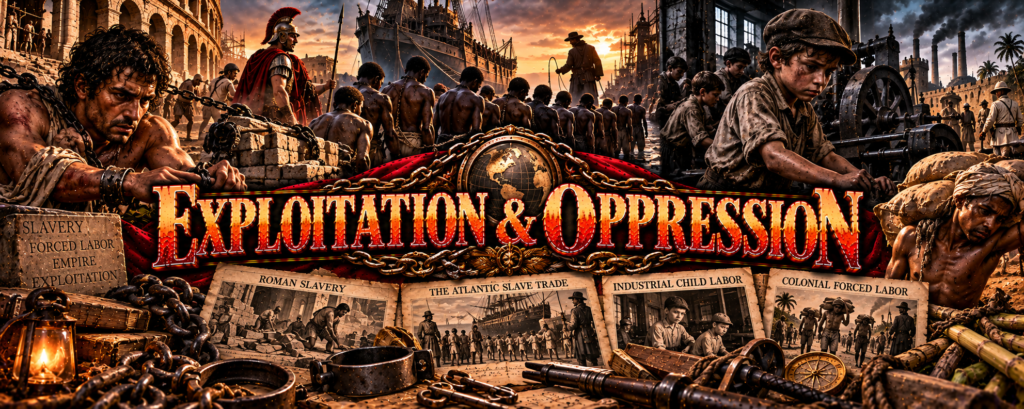
Behind the palaces, monuments, factories, plantations, mines, railways, and empires celebrated in traditional histories were millions of people whose labor was extracted through force, coercion, poverty, conquest, and systems that denied them freedom. Enslaved people built wealth they could never possess, children spent exhausting days inside dangerous factories and mines, conquered populations were compelled to work for colonial regimes, and entire economies developed around the exploitation of people whose suffering was treated as an acceptable price for prosperity. From slavery in the ancient Roman world and the horrors of the Atlantic slave trade to the brutal realities of industrial child labor and the forced-labor systems imposed under colonial rule, discover the darker human cost behind some of history’s most powerful civilizations and periods of economic expansion.
Slavery existed in many forms long before the modern era. In the Roman world, enslaved people could be found in households, workshops, mines, farms, public works, entertainment, and countless other areas of economic and social life. Some educated enslaved people served as tutors, scribes, accountants, or administrators, while others endured extraordinarily dangerous conditions in agriculture and mining. Enslaved people were legally treated as property, families could be separated through sale, and physical punishment could be severe. Manumission offered freedom to some, but its existence did not lessen the fundamental violence of a society in which one human being could legally own another.
Across other ancient and medieval societies, warfare, debt, raiding, punishment, and conquest also supplied enslaved populations. The institution differed greatly between places and periods, making it misleading to treat every historical system of slavery as identical. What they shared was the ability of powerful individuals and institutions to deprive other human beings of autonomy and extract their labor for the benefit of someone else.
The Atlantic slave trade eventually created one of history’s largest systems of forced human displacement. Over several centuries, millions of African men, women, and children were transported across the Atlantic, overwhelmingly to the Americas, under horrific conditions. European traders, African political and commercial actors, plantation owners, merchants, and colonial governments participated in interconnected systems that generated enormous profits while inflicting catastrophic human suffering. The Middle Passage became notorious for overcrowding, disease, violence, and death, while survivors faced lives of forced labor and legal bondage.
Plantation slavery transformed entire regions and produced enormous quantities of sugar, tobacco, cotton, coffee, and other commodities consumed throughout the Atlantic world. Behind these fortunes were people forced to work under threat of punishment, families vulnerable to separation, and generations born into hereditary enslavement. Yet enslaved people were never simply passive victims. They resisted in countless ways—preserving cultures, forming communities, escaping, sabotaging work, challenging owners through legal systems where possible, and sometimes organizing revolts that terrified slaveholding societies.
The Industrial Revolution created different forms of exploitation. Rapidly expanding factories, mills, workshops, and mines demanded enormous quantities of cheap labor, and poor families frequently had little choice but to send children to work. Child labor placed young workers in textile mills, coal mines, factories, and other hazardous environments where long hours, dangerous machinery, dust, exhaustion, injuries, and inadequate protections were common. Reformers eventually exposed many of these conditions, helping drive legislation that gradually restricted child employment and improved workplace standards, although exploitation persisted.
Adults faced their own dangers. Industrial workers could spend exceptionally long days in poorly ventilated factories, mines could collapse or explode, and injuries might leave families without income or meaningful assistance. Employers often possessed far greater economic power than individual workers, while attempts to organize for higher wages or safer conditions could meet fierce resistance. The struggle over working conditions became one of the defining social conflicts of the industrial age and contributed to the development of labor movements, unions, workplace regulation, and political reform.
European imperial expansion created additional systems of coercion. Colonial governments and private companies sometimes imposed taxes that effectively forced people into wage labor, appropriated land, compelled communities to construct roads or extract resources, and punished those who resisted. In some territories, forced labor became inseparable from colonial economic policy. One of the most infamous examples occurred in the Congo Free State under King Leopold II of Belgium, where the pursuit of rubber and other resources was accompanied by coercion, hostage-taking, violence, mutilation, and enormous loss of life.
Other colonial regimes created their own systems of compulsory labor, indenture, land seizure, and economic dependency. After slavery was abolished in many regions, indentured labor transported workers across the British, French, Dutch, and other colonial worlds under contracts that could leave them vulnerable to exploitation and severe restrictions on their freedom. These systems were not identical to chattel slavery, but they demonstrate how economic demands repeatedly generated new methods of controlling labor even as older institutions were dismantled.
Oppression was not limited to labor. Governments and ruling groups created legal and social systems that restricted where particular populations could live, what occupations they could enter, whether they could own property, whom they could marry, and what political rights they possessed. Religious minorities, conquered peoples, ethnic groups, Indigenous communities, lower social classes, and other marginalized populations could face discrimination reinforced by law, violence, or custom.
Yet exploitation repeatedly produced resistance. Enslaved people escaped and rebelled, workers organized strikes, colonized populations resisted imperial authorities, reformers documented abuses, journalists exposed dangerous workplaces, and abolitionists challenged institutions once defended as normal or inevitable. Change was often slow and fiercely opposed because systems of exploitation benefited people and institutions with enormous political and economic power.
Understanding this history also means resisting overly simple narratives. Systems of slavery, forced labor, colonial exploitation, and industrial oppression differed enormously across centuries and societies, and the people involved cannot be reduced to neat categories of villains and victims. Historical circumstances, local power structures, economics, law, race, class, warfare, and politics all shaped how exploitation operated. Examining those differences makes the history more accurate without diminishing the suffering involved.
Explore the darker foundations of wealth and power, from slavery in ancient civilizations and the transatlantic trafficking of human beings to industrial sweatshops, child labor, colonial coercion, indentured workers, and other systems designed to extract labor from vulnerable populations. Follow not only the rulers, merchants, plantation owners, industrialists, and governments that benefited from these systems, but also the experiences of the people forced to live within them—and the resistance movements that fought to destroy them.
Separate historical evidence from sanitized national myths, political propaganda, and simplistic explanations as we investigate who benefited, who suffered, how these systems were justified, and why they survived for so long. This is the history behind the wealth—the people whose labor built fortunes and empires, the systems designed to control them, and the long struggle of those who refused to remain powerless.