
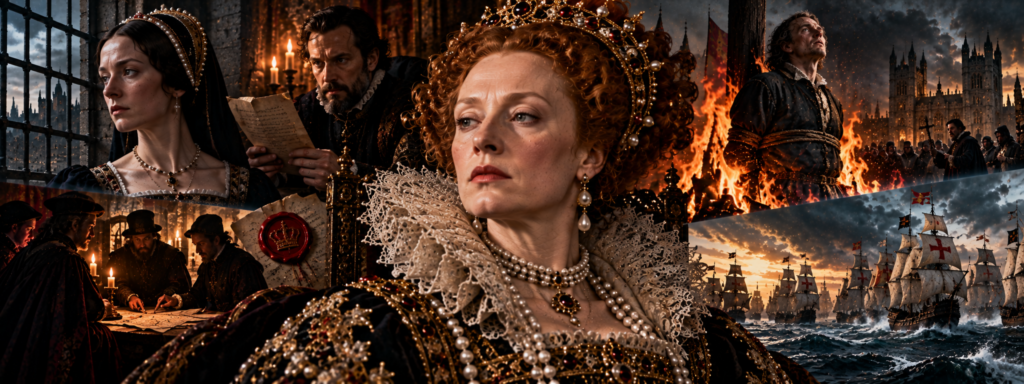
Elizabeth I: The Virgin Queen, Her Deadly Spy Network, and the Dark Side of England’s Golden Age
She survived a childhood overshadowed by execution, a dangerous adolescence filled with scandal, and imprisonment in the same fortress where her mother had awaited death. When Elizabeth Tudor finally inherited the English throne in 1558, she understood something that few monarchs could ever forget: a crown offered extraordinary power, but it could also make its wearer a target. For forty-four years, Elizabeth I ruled a kingdom divided by religion, threatened by foreign invasion, and haunted by conspiracies to replace her. Behind the glittering gowns, magnificent portraits, elaborate court entertainments, and celebrated achievements of the Elizabethan age existed another England, one of intercepted letters, secret informants, political prisoners, torture chambers, and executions. Her Catholic cousin Mary, Queen of Scots, spent nearly nineteen years in English captivity before losing her head. Priests were hunted as suspected agents of foreign powers, conspirators were drawn into elaborate intelligence operations, and even the queen’s most favored courtiers could discover that affection offered little protection against accusations of treason. Elizabeth became one of England’s most celebrated monarchs, but her survival came at a considerable human cost. Was the Virgin Queen consumed by paranoia, or had the dangers surrounding her taught her that survival required suspicion, secrecy, and sometimes ruthless decisions?
The Queen Who Learned to Fear the Shadows
On November 17, 1558, Elizabeth Tudor became Queen of England. She was twenty-five years old, unmarried, Protestant, and the daughter of a woman who had been executed on her father’s orders. Her accession ended the troubled reign of her half-sister Mary I, but it did not end the religious divisions that had torn England apart for decades. Elizabeth inherited a kingdom whose people disagreed profoundly about the nature of the true church, the authority of the pope, and the legitimacy of religious changes imposed by successive monarchs.
Her position was more precarious than the celebrations surrounding her accession might suggest. Catholic opponents questioned her legitimacy because Henry VIII’s marriage to Anne Boleyn had been declared invalid. Foreign rulers possessed competing interests in the English succession, while powerful noble families could become involved in conspiracies or rebellions. Elizabeth also faced the problem of succession itself, since an unmarried queen without children left the future of the dynasty uncertain.
The new queen understood that political danger could emerge from within her own household. She had witnessed the destruction of her mother, the downfall of royal favorites, and the imprisonment of people whose proximity to the throne made them vulnerable. During Mary’s reign, Elizabeth herself had been detained under suspicion of involvement in rebellion. These experiences provided powerful reasons for caution, although historians cannot determine their precise psychological effects.
Elizabeth’s government eventually developed sophisticated methods of intelligence gathering and political surveillance. Sir Francis Walsingham, one of her principal secretaries, coordinated networks of informants and agents who monitored foreign governments, religious exiles, and suspected conspirators. Letters were intercepted, codes were deciphered, and secret communications were examined for evidence of treason. Such operations became particularly important as relations with Catholic powers deteriorated.
Yet Elizabeth’s reputation for suspicion should not be confused with evidence of psychiatric illness. She was capable of careful negotiation, political flexibility, and long-term strategic planning. Her decisions often reflected recognizable political calculations, even when their consequences were severe. The historical record does not establish that she suffered from paranoia in the clinical sense or from another identifiable mental disorder.
Nor should every harsh action be excused as an unavoidable response to danger. Elizabeth faced genuine threats, including rebellion, invasion plans, and conspiracies involving her removal. Her government also adopted policies that criminalized forms of religious activity and exposed individuals to severe punishment. Understanding the dangers does not eliminate the need to examine how the crown chose to respond.
The contrast between Elizabeth’s celebrated public image and the coercive machinery of her government is one of the most revealing aspects of her reign. She cultivated the appearance of a majestic, almost timeless sovereign while relying upon officials who operated in a world of secrecy and suspicion. To understand how those two worlds became inseparable, it is necessary to return to the childhood of a princess whose future changed catastrophically before she was three years old.
The Daughter of Anne Boleyn: A Childhood Marked by Execution
Elizabeth was born at Greenwich Palace on September 7, 1533, the daughter of Henry VIII and his second wife, Anne Boleyn. Her birth followed one of the most controversial marriages in European royal history. Henry had broken with papal authority in his determination to end his marriage to Catherine of Aragon and marry Anne. The arrival of a daughter rather than the hoped-for son did not immediately destroy Anne’s position, but it left Henry’s dynastic ambitions unfulfilled.
Elizabeth entered the world as a legitimate princess under the religious and legal settlement established by her father. Her household reflected her royal status, and arrangements were made for her education and upbringing. Yet her position depended upon the stability of her parents’ marriage. Within three years, that marriage would collapse with extraordinary speed.
In May 1536, Anne Boleyn was arrested and accused of adultery, incest, and conspiracy against the king. The charges have been heavily questioned by historians, and the alleged offenses cannot be accepted as established facts. Anne was tried, condemned, and executed at the Tower of London on May 19. Elizabeth was only two years and eight months old.
The execution transformed Elizabeth’s status. Her parents’ marriage was declared invalid, and she was excluded from the succession under the arrangements then in force. The daughter who had once represented the future of Henry’s new marriage became Lady Elizabeth, a child whose legitimacy had been politically repudiated. Her mother was dead, and her father soon married Jane Seymour.
It is tempting to describe Anne’s execution as the defining psychological trauma of Elizabeth’s childhood. Yet Elizabeth was extremely young, and the surviving evidence does not reveal how much she understood at the time. Historians cannot reconstruct her earliest memories or diagnose lasting psychological effects from the event. What can be established is that she grew up in a political environment where her mother’s fate remained a dangerous subject.
Elizabeth’s household continued to provide education and supervision. Katherine Champernowne, later Katherine Ashley, became an important figure in her upbringing. Elizabeth developed into an exceptionally accomplished student, studying languages, theology, rhetoric, and classical literature. Her education prepared her for a life at court, even though her eventual accession was far from certain.
Her father’s later marriages created a complicated family environment. Jane Seymour gave birth to Edward in 1537 and died shortly afterward. Anne of Cleves briefly became queen before her marriage was annulled, while Catherine Howard was executed in 1542. Elizabeth’s childhood unfolded amid repeated changes in the royal household and the shifting fortunes of women married to Henry VIII.
Catherine Parr, Henry’s sixth wife, provided a more stable influence during the final years of his reign. She encouraged education and maintained relationships with the king’s children. Under the succession arrangements established before Henry’s death, Mary and Elizabeth were restored to the line of inheritance after Edward, although questions concerning their legitimacy remained politically sensitive.
By the time Henry died in January 1547, Elizabeth had learned that royal status could change abruptly. The crown had brought her family immense privilege, but it had also produced executions, annulments, and political disgrace. Her future remained uncertain, and the next chapter of her life would expose her to another scandal involving a man who hoped to rise through proximity to the throne.
Thomas Seymour: The Scandal That Threatened a Teenage Princess
After Henry VIII’s death, Catherine Parr married Thomas Seymour, brother of Edward Seymour, Duke of Somerset, who became Lord Protector during Edward VI’s minority. Thomas Seymour was ambitious, politically restless, and eager to increase his influence. His marriage to Catherine placed him close to the royal family, including the young Elizabeth. The relationship between Seymour and Elizabeth became the subject of disturbing reports.
Elizabeth lived for a period in Catherine Parr’s household, where Seymour behaved toward her in ways that contemporary testimony described as inappropriate. Accounts collected during later investigations included incidents of entering her chamber, physical familiarity, and conduct that crossed accepted boundaries. Elizabeth was still a teenager, and Seymour was an adult with considerable social and political power. The surviving evidence does not establish every detail, but it supports serious concern about his behavior.
Catherine Parr eventually intervened, and Elizabeth was removed from the household. Catherine died in September 1548 following childbirth, leaving Seymour a widower. His political ambitions continued, and he became involved in schemes that brought him into conflict with the government. His interest in Elizabeth’s potential marriage also attracted suspicion.
In January 1549, Seymour was arrested following allegations of treasonous activity. Investigators questioned Elizabeth’s servants and sought evidence concerning her relationship with him. The inquiry placed Elizabeth in a dangerous position because any suggestion of complicity could damage her standing or expose her to prosecution. She was forced to navigate accusations involving her reputation and political loyalty.
Elizabeth’s responses demonstrated considerable caution. She denied involvement in Seymour’s schemes and resisted attempts to implicate her. Her household officials were questioned, and the investigation became a serious threat to her security. Seymour was eventually condemned through an act of attainder and executed in March 1549.
The scandal has sometimes been presented as the origin of Elizabeth’s lifelong reluctance to marry. Such interpretations go beyond the surviving evidence. Her later decisions concerning marriage involved diplomacy, religion, succession, and the preservation of political authority. No single childhood or adolescent experience can be established as the cause.
Nevertheless, the Seymour affair revealed the dangers of personal relationships within the Tudor royal family. Elizabeth’s reputation could become entangled in another person’s political ambitions, even when her own involvement was disputed. The episode reinforced the importance of controlling information, maintaining discretion, and avoiding commitments that could be exploited by rivals.
Elizabeth was still years away from the throne, but she had already experienced the vulnerability of royal women whose lives could be shaped by powerful men and political investigations.
Mary I and the Tower of London: Elizabeth Becomes a Prisoner
When Edward VI died in July 1553, the English succession entered a crisis. Edward and his advisers had attempted to exclude his Catholic half-sister Mary in favor of Lady Jane Grey. Mary successfully asserted her claim, gathered supporters, and became queen after the collapse of the attempted succession. Elizabeth initially supported her sister’s accession, but their religious differences soon created tension.
Mary intended to restore Catholicism and reconcile England with Rome. Elizabeth, whose education and religious associations were Protestant, represented a possible alternative for those opposed to the restoration. Her position was politically sensitive because she stood next in the succession if Mary died without children. Even without actively seeking rebellion, Elizabeth could become a focus for dissatisfied subjects.
The crisis intensified in early 1554 when Sir Thomas Wyatt the Younger led a rebellion against Mary’s proposed marriage to Philip of Spain. The uprising reflected concerns about foreign influence and included participants with Protestant sympathies. Wyatt’s forces advanced toward London before the rebellion collapsed. The government responded with arrests and executions.
Elizabeth came under suspicion because some rebels viewed her as a possible replacement for Mary. The evidence connecting Elizabeth directly to the rebellion was insufficient to establish her participation. Nevertheless, the government ordered her detention. She was brought to the Tower of London in March 1554.
The Tower carried a terrifying significance for Elizabeth. Her mother had been imprisoned and executed there, and the fortress had witnessed the deaths of numerous political prisoners. Elizabeth’s confinement placed her under the authority of a government that regarded her as potentially dangerous. Her future depended upon whether investigators could establish grounds for prosecution.
Later stories describe Elizabeth’s fear upon entering the Tower and preserve dramatic remarks attributed to her. Some details may reflect genuine traditions, but the precise wording of such anecdotes cannot always be verified. The documented fact of her imprisonment is sufficient to demonstrate the seriousness of her predicament. She remained detained while the government investigated the rebellion.
Elizabeth was eventually moved from the Tower to Woodstock, where she lived under supervision. Her conditions improved over time, but she remained politically vulnerable. Mary did not authorize her execution, and Elizabeth gradually regained a measure of freedom. The absence of convincing evidence against her contributed to her survival.
The experience has frequently been described as the foundation of Elizabeth’s later political suspicion. It certainly demonstrated that a person could be imprisoned because of perceived dynastic danger rather than proven involvement in rebellion. Yet historians cannot determine precisely how the imprisonment shaped her emotional life. The strongest conclusion is that Elizabeth acquired direct experience of the coercive powers available to a Tudor monarch.
Four years later, those powers would belong to her.
The Crown of a Divided Kingdom: Elizabeth’s Dangerous Accession
Mary I died on November 17, 1558, leaving no surviving child. Elizabeth succeeded her at the age of twenty-five. Her accession brought relief to many Protestants who had opposed the Marian religious restoration, but it also created uncertainty among Catholics who feared another transformation of the church. The new queen inherited a kingdom divided by competing religious convictions.
Elizabeth’s legitimacy remained disputed in Catholic circles because Henry VIII’s marriage to Anne Boleyn had been rejected by the papacy. Under English succession law, however, Elizabeth possessed a recognized claim through the arrangements established during her father’s reign. Her accession was accepted domestically without a major armed challenge. Nevertheless, international recognition and religious allegiance remained politically complicated.
The queen quickly demonstrated her determination to control the direction of government. She selected experienced advisers, most notably William Cecil, who became her principal secretary. Cecil possessed considerable administrative ability and remained one of the most influential figures of the reign. His relationship with Elizabeth became central to the management of domestic and foreign policy.
The religious settlement of 1559 restored royal supremacy over the English church and established a revised framework for worship. Elizabeth adopted the title Supreme Governor rather than Supreme Head, a formulation that accommodated certain political and theological concerns. The Act of Uniformity required use of the Book of Common Prayer, while the Act of Supremacy rejected papal jurisdiction. The settlement created the institutional foundation of the Elizabethan Church of England.
Elizabeth’s religious policies were initially less aggressively punitive than some later measures. Her government sought outward conformity and political stability, although recusancy penalties and restrictions developed over time. The distinction between private belief and public obedience became increasingly important. Catholics who attended established worship could sometimes avoid direct confrontation, while those who openly rejected the settlement faced growing pressure.
The queen’s unmarried status created another problem. Parliament and councillors repeatedly urged her to marry and produce an heir. Marriage negotiations involved numerous European princes and English nobles, but no arrangement proved acceptable. Elizabeth’s decision to remain unmarried preserved her personal authority and diplomatic flexibility, although it also left the succession unresolved.
Her position required constant balancing. A marriage to a Catholic prince might alarm Protestants, while a Protestant alliance could provoke Catholic powers. An English husband might elevate one noble family above its rivals, while a foreign husband could raise fears of outside domination. Remaining unmarried avoided some dangers but created others.
Elizabeth’s government therefore developed through negotiation, caution, and selective confrontation. The queen’s political style was shaped by circumstances in which almost every major decision carried risks. Her survival would depend upon managing those risks without allowing opponents to exploit uncertainty.
The Virgin Queen: Marriage, Power, and the Politics of Refusal
Elizabeth’s refusal to marry became one of the defining features of her public identity. Throughout her reign, advisers urged her to produce an heir and secure the succession. European rulers proposed diplomatic marriages, while English courtiers hoped to gain influence through personal relationships with the queen. Elizabeth considered possibilities but never committed herself to a husband.
Her relationship with Robert Dudley, later Earl of Leicester, attracted particular attention. Dudley had known Elizabeth for years and became one of her most favored companions. Their closeness generated speculation about marriage, especially after the death of Dudley’s wife, Amy Robsart, in 1560. Amy’s death following a fall down stairs became the subject of rumors, but there is no reliable evidence that Elizabeth or Dudley arranged her death.
The scandal damaged Dudley’s marriage prospects. A queen marrying a subject whose wife had died under suspicious circumstances risked serious political controversy. Elizabeth continued favoring Dudley, but she did not marry him. Their relationship remained important for decades, combining personal affection, political influence, and occasional tension.
Elizabeth also entertained negotiations involving foreign princes, including Archduke Charles of Austria and François, Duke of Anjou. Such discussions served diplomatic purposes even when marriage remained uncertain. The possibility of a royal marriage could influence alliances, discourage enemies, and create opportunities for negotiation. Elizabeth’s unmarried status therefore became a political instrument.
The queen’s public image gradually developed around the concept of virginity. Courtly literature, portraits, and ceremonial language presented her as a ruler devoted to her kingdom rather than a husband. The symbolism drew upon religious, classical, and political traditions. It also helped transform a potentially controversial personal decision into a source of royal authority.
The image did not eliminate concern about succession. Elizabeth’s refusal to name an heir created uncertainty throughout her reign. Mary, Queen of Scots, possessed a strong hereditary claim through the descendants of Henry VII, but her Catholicism made her unacceptable to many English Protestants. The unresolved succession became increasingly dangerous as Elizabeth aged.
Later writers have sometimes explained Elizabeth’s unmarried status through supposed psychological damage caused by her mother’s execution or the Seymour scandal. Such theories cannot be established from the evidence. Her decision involved identifiable political advantages and disadvantages, and she repeatedly demonstrated awareness of both. Marriage was not merely a personal question; it concerned the distribution of sovereign power.
Elizabeth’s refusal to marry preserved her independence, but it also ensured that the question of who would inherit her crown remained central to English politics for more than four decades.
Mary, Queen of Scots: The Cousin Who Became a Living Threat
Mary Stuart, Queen of Scots, occupied a uniquely dangerous position in Elizabeth’s political world. She was the granddaughter of Margaret Tudor, sister of Henry VIII, and therefore possessed a hereditary claim to the English throne. Her Catholicism made her attractive to those who rejected Elizabeth’s legitimacy. Her personal history also connected her to the French royal family, increasing her international significance.
Mary became queen of Scotland as an infant and spent much of her childhood in France. She married Francis II, who briefly became king of France, before returning to Scotland as a widow in 1561. Her rule faced serious difficulties because Scotland had undergone Protestant reform during her absence. Religious and political tensions complicated her relationship with powerful nobles.
Mary’s second marriage to Henry Stuart, Lord Darnley, in 1565 intensified conflict. Darnley possessed his own claim to the English succession, and their marriage united two lines of Tudor descent. Their relationship deteriorated amid factional struggles and accusations surrounding the murder of Mary’s secretary David Rizzio in 1566. Mary gave birth to a son, James, later that year.
Darnley was murdered in February 1567 following an explosion at Kirk o’ Field in Edinburgh. The precise circumstances of the murder remain disputed, but suspicion fell upon James Hepburn, Earl of Bothwell, and others. Mary’s subsequent marriage to Bothwell created a political catastrophe. Scottish nobles rebelled, and Mary was forced to abdicate in favor of her infant son, James VI.
In May 1568, Mary escaped captivity in Scotland and fled to England. She hoped Elizabeth would assist her in recovering the Scottish throne. Instead, Elizabeth faced an extraordinary dilemma. Mary was an anointed queen and a close relative, but she was also a potential rival whose presence could encourage rebellion.
Elizabeth refused to restore Mary immediately and ordered her detention while inquiries examined the accusations surrounding Darnley’s murder. The proceedings produced contested evidence, including the controversial Casket Letters. Their authenticity and interpretation have remained subjects of historical debate. The inquiries did not produce a definitive judicial resolution of Mary’s guilt.
Mary remained in English custody for nearly nineteen years. Her imprisonment was not always conducted in a dungeon; she lived in various castles and manor houses with servants and household arrangements appropriate to her rank. Nevertheless, her movements and communications were restricted, and she remained unable to leave England freely.
Her presence created an enduring political problem. Catholic opponents of Elizabeth could regard Mary as an alternative sovereign, while foreign rulers could use her claim to justify intervention. Elizabeth was reluctant to execute another anointed monarch, but she was also unwilling to release a woman whose hereditary position threatened her security.
The relationship between the two queens became one of the most consequential political rivalries of the sixteenth century. They corresponded and negotiated through intermediaries, but they never met in person. Their conflict would eventually culminate in an execution that troubled Elizabeth’s conscience and reputation.
The Papal Bull of 1570: When Religion Became a Question of Treason
In February 1570, Pope Pius V issued the bull Regnans in Excelsis, excommunicating Elizabeth and declaring her deprived of her claimed authority. The document also released her subjects from obligations of allegiance to her. Its political implications were profound because it challenged the legitimacy of the English monarchy. The bull intensified fears that Catholic opposition could be justified through religious authority.
The papal action followed years of religious tension and political conflict. Elizabeth’s settlement had rejected papal jurisdiction, while English Catholics faced pressure to conform to Protestant worship. The Northern Rebellion of 1569 had demonstrated that powerful Catholic interests could participate in armed resistance. The rebellion sought changes to the religious settlement and involved support for Mary, Queen of Scots.
The papal bull did not mean that all Catholics supported rebellion or assassination. Many English Catholics remained loyal to Elizabeth while privately rejecting aspects of the religious settlement. Others regarded papal authority as spiritually binding but avoided political resistance. The relationship between religious allegiance and political loyalty was therefore more complicated than the government sometimes acknowledged.
Nevertheless, the bull strengthened the perception that Catholicism could be associated with foreign intervention. English officials feared that Spain, France, or the papacy might support efforts to remove Elizabeth. The possibility of assassination or rebellion became a central concern of government intelligence. Religious identity increasingly intersected with questions of national security.
The government responded through legislation and enforcement. Laws imposed penalties for denying royal supremacy, reconciling subjects to Rome, or participating in activities regarded as threats to the established church. Later measures specifically targeted Catholic missionary priests and those who sheltered them. The distinction between religious ministry and political conspiracy became increasingly contested.
Catholic seminaries established abroad trained priests who returned to England to serve recusant communities. Some missionaries focused upon religious work and denied involvement in treason. English authorities nevertheless feared that their connections with foreign Catholic institutions created opportunities for political subversion. The resulting prosecutions produced executions that Catholic communities remembered as martyrdom.
Elizabeth’s government therefore operated within a genuine international conflict, but its response also criminalized religious practices that did not necessarily involve rebellion. The crown’s fear of conspiracy was not imaginary, yet suspicion could extend beyond individuals who had committed demonstrable political offenses. This tension became central to the darker side of Elizabethan rule.
The papal bull marked a turning point because it intensified the association between Catholic allegiance and political danger. Elizabeth’s government increasingly treated religious nonconformity through the language of loyalty and treason. The consequences would be felt in prisons, interrogation chambers, and execution grounds throughout the kingdom.
Francis Walsingham: The Spymaster Behind the Throne
Sir Francis Walsingham became one of the most important figures in Elizabeth’s intelligence system. Appointed principal secretary in 1573, he developed networks of agents and informants who monitored suspected conspirators, foreign courts, and Catholic exiles. His work reflected the growing importance of intelligence in a kingdom facing religious division and international rivalry. Walsingham’s reputation as a master spy emerged from his ability to coordinate information across numerous political environments.
The intelligence network was not a modern professional agency with standardized departments and permanent institutional structures. It depended upon personal relationships, diplomatic contacts, paid informants, couriers, and individuals willing to provide information for political or financial reasons. Walsingham used these connections to gather reports from France, the Low Countries, Spain, and other locations. Information moved through diplomatic correspondence and private channels.
Intercepted letters formed an important part of the system. Couriers could be watched, communications diverted, and documents copied before delivery. Officials also employed specialists capable of deciphering encrypted messages. Thomas Phelippes became particularly associated with codebreaking and the examination of secret correspondence.
The system depended upon secrecy and deception. Informants sometimes entered circles of suspected conspirators while concealing their connections to the government. Agents could encourage correspondence, monitor meetings, and report conversations. Such methods created opportunities to uncover genuine plots, but they also raised questions about manipulation and the reliability of evidence.
Walsingham’s operations were shaped by the political culture of the time. European rulers routinely employed ambassadors, informants, and secret agents to gather intelligence. Elizabeth’s government developed these practices in response to increasingly serious threats. The network was sophisticated for its period, but describing it as the world’s first modern intelligence service would exaggerate its institutional novelty.
Walsingham’s personal religious convictions also influenced his work. He was a committed Protestant who regarded Catholic intervention as a grave danger to England. His experience of exile during Mary’s reign reinforced his opposition to Catholic political power. Yet his intelligence activities were not merely expressions of religious hostility; they were closely connected to the government’s efforts to preserve Elizabeth’s authority.
The queen relied upon information gathered through these networks, but she did not always accept the conclusions or recommendations of her advisers. Elizabeth frequently hesitated before authorizing severe measures, particularly when they involved Mary, Queen of Scots. Her reluctance could frustrate officials who believed decisive action was necessary. The relationship between monarch and spymaster therefore involved negotiation as well as cooperation.
Walsingham’s greatest success came through the investigation of the Babington Plot in 1586. The operation exposed correspondence that appeared to connect Mary, Queen of Scots, with a conspiracy against Elizabeth. It also demonstrated how intelligence gathering could shape the outcome of a major political crisis.
The spymaster’s work helped protect Elizabeth from genuine threats, but it also contributed to a political environment in which surveillance and suspicion became central instruments of government.
The Babington Plot: Secret Letters and a Queen’s Death Warrant
The Babington Plot of 1586 became the decisive event in Mary, Queen of Scots’ long imprisonment. Anthony Babington, a young Catholic gentleman, became involved in a conspiracy to remove Elizabeth and restore Catholic rule. The plot included plans for foreign intervention and the liberation of Mary. Its most dangerous element was the proposed assassination of Elizabeth.
Walsingham’s agents monitored the conspiracy and developed access to communications involving Mary. A secret correspondence system used letters concealed in the bung of a beer barrel delivered to her household at Chartley. The method was intended to evade official surveillance, but the channel had been compromised. Messages passed through individuals connected to the government’s intelligence operation.
Thomas Phelippes deciphered intercepted correspondence. A letter associated with Mary appeared to approve the general plan for her liberation and respond to proposals involving Elizabeth’s removal. The interpretation of Mary’s involvement has been debated, particularly because the surviving correspondence passed through the hands of government agents. Nevertheless, the intercepted material became central to the case against her.
The investigation also raised questions about the conduct of Walsingham’s agents. Phelippes added a forged postscript to one intercepted letter seeking the names of the proposed assassins. This manipulation was designed to obtain further information about the conspiracy. It demonstrates that the intelligence operation involved active intervention rather than passive observation.
Babington and his associates were arrested. They were prosecuted for treason and executed in September 1586. Their punishments were severe, reflecting the government’s determination to deter assassination plots. The executions also reinforced the danger faced by individuals who participated in conspiracies against the crown.
Mary was subsequently tried under legislation designed to address plots involving claimants to the throne. The proceedings took place at Fotheringhay Castle in October 1586. Mary denied responsibility for any attempt to assassinate Elizabeth and challenged aspects of the evidence. Her status as a foreign anointed queen complicated the legal and political issues.
The commissioners found Mary guilty of involvement in the conspiracy. Parliament and leading councillors urged Elizabeth to authorize execution. The queen hesitated, aware that killing another monarch could establish a dangerous precedent and provoke international condemnation. Her reluctance also reflected the extraordinary significance of the decision.
The Babington Plot transformed Mary’s position. For years, Elizabeth had maintained her cousin in custody while resisting demands for execution. Now the government possessed evidence it regarded as sufficient to justify a death sentence. The question was no longer whether Mary represented a potential threat, but whether Elizabeth would permit that threat to be eliminated permanently.
The Execution of Mary, Queen of Scots: Elizabeth’s Most Terrible Decision
Mary, Queen of Scots, was executed at Fotheringhay Castle on February 8, 1587. Her death followed nearly nineteen years of English captivity and months of political pressure upon Elizabeth. The execution was one of the most controversial acts of the reign because it involved the killing of an anointed sovereign. Its consequences extended far beyond the immediate question of English security.
Elizabeth signed Mary’s death warrant in February 1587. The circumstances surrounding its dispatch became the subject of considerable controversy. After the execution, Elizabeth claimed that her instructions had been exceeded and expressed anger toward officials involved in carrying out the sentence. William Davison, a secretary who handled the warrant, became a principal target of her displeasure.
Historians have debated whether Elizabeth genuinely intended to delay the execution or sought to distance herself from responsibility after it occurred. The surviving evidence permits different interpretations of her conduct. What is certain is that she signed the warrant and that her government carried out the sentence. Her later anger cannot erase the legal and political authority under which Mary died.
Accounts of the execution describe a solemn and disturbing scene. Mary wore clothing that included a red undergarment associated with Catholic martyrdom, according to contemporary descriptions. The executioner’s work was not immediately successful, and several blows were reportedly required. The details became part of the enduring historical memory of her death.
Mary’s execution removed a prominent claimant who had become the focus of Catholic opposition to Elizabeth. It also created diplomatic consequences, particularly in relations with Catholic powers. Philip II of Spain had already developed serious grievances against England, including English support for Dutch rebels and attacks upon Spanish interests. Mary’s death contributed to an atmosphere of escalating hostility.
For Elizabeth, the execution represented a profound political dilemma. Keeping Mary alive allowed conspirators to rally around her claim, while executing her risked international condemnation and challenged traditional assumptions about the sacred status of monarchy. Elizabeth had delayed the decision for years, but the Babington Plot intensified pressure upon her government. The final outcome reflected both security concerns and the political calculations of her advisers.
The execution has sometimes been interpreted as evidence of Elizabeth’s paranoia or cruelty. Yet the historical circumstances were more complex. Mary had become connected to conspiracies against Elizabeth, although the precise extent of her responsibility in particular plots remains debated. Elizabeth’s decision can be examined through dynastic rivalry, religious conflict, legal proceedings, and the pressures of government without assigning her a psychiatric disorder.
Mary’s death also revealed the limitations of royal kinship. Elizabeth and Mary were cousins who corresponded but never met. Their relationship was shaped by competing claims, religious differences, and the political uses others made of their identities. In the end, the security of one crown was pursued through the destruction of another queen.
Torture, Priests, and Political Prisoners: The Darker Side of Elizabethan Justice
Elizabethan England employed imprisonment, interrogation, and severe criminal punishment against individuals accused of threatening the state. The Tower of London and other prisons held political suspects, religious dissenters, and people connected to alleged conspiracies. Conditions varied considerably, but imprisonment could involve isolation, uncertainty, and harsh treatment. The government possessed considerable discretion in determining how suspects were detained.
Torture was used in certain state investigations, although it was not an ordinary part of English common-law criminal procedure. Authorities could authorize methods such as the rack or manacles to obtain information from suspected conspirators. These practices were especially associated with investigations involving treason and threats to the monarchy. Their use reveals the coercive methods available to Elizabeth’s government.
Catholic missionary priests became particular targets during the later decades of the reign. Seminaries abroad trained clergy who returned to England to minister to Catholic communities. The government feared that such networks could facilitate foreign intervention or encourage disloyalty. Legislation increasingly criminalized activities associated with Catholic priesthood and the maintenance of papal authority.
Edmund Campion, a Jesuit priest, became one of the most prominent victims. He returned to England in 1580 and participated in Catholic missionary activity. Arrested in 1581, he was interrogated and subjected to torture. He was subsequently convicted of treason and executed at Tyburn in December 1581.
Campion’s supporters regarded him as a religious martyr who had been punished for his faith. The government maintained that the prosecution concerned treason and political allegiance rather than religious belief alone. The distinction was deeply contested because the legal framework treated certain forms of Catholic ministry as inherently connected to foreign authority. His execution became a central episode in Catholic accounts of Elizabethan persecution.
Other priests and lay supporters suffered similar punishments. Some were executed for activities involving Catholic missions, while others faced fines, imprisonment, or restrictions. The number of Catholic martyrs recognized in later religious traditions differs from the total number of people prosecuted under Elizabethan religious laws. Careful historical analysis must distinguish religious executions, political treason cases, and broader forms of repression.
Radical Protestants also faced punishment when their activities challenged the established church or political order. Separatists and other religious dissenters could be imprisoned, fined, or prosecuted. However, the patterns of punishment differed from those directed against Catholic missionary networks. Claims that Catholics and Puritans experienced identical forms of repression would therefore be misleading.
The darker side of Elizabethan government lay partly in the expanding association between religious identity and political loyalty. The crown faced genuine conspiracies and foreign threats, but its enforcement policies could reach individuals whose principal activities were religious. The result was a system in which belief, allegiance, and criminal suspicion became difficult to separate.
Elizabeth’s government preserved the monarchy through institutions capable of surveillance and coercion. Those institutions also produced suffering that complicates the familiar image of a tolerant and glorious Elizabethan age.
The Spanish Armada: Invasion, Fear, and the Defense of England
The Spanish Armada of 1588 represented one of the greatest external threats of Elizabeth’s reign. Relations between England and Spain had deteriorated through religious conflict, English support for the Dutch revolt, maritime competition, and attacks upon Spanish interests. Philip II eventually authorized an invasion plan intended to overthrow Elizabeth’s government and restore Catholic authority. The expedition became a major confrontation between European powers.
The Armada sailed from Spain in 1588 with a large fleet intended to secure control of the English Channel and support the transport of an invasion army from the Low Countries. English naval forces attempted to disrupt the Spanish formation and prevent the planned junction. The campaign involved complex logistical difficulties, changing weather conditions, and repeated naval engagements. The Spanish plan ultimately failed.
Elizabeth’s government prepared for possible invasion. Defensive measures were organized, troops were assembled, and coastal areas were placed on alert. The queen visited forces at Tilbury, where she delivered a speech that became one of the most famous expressions of Elizabethan monarchy. The precise wording survives through later accounts, but the event itself demonstrates the importance of royal leadership during the crisis.
The Armada’s defeat resulted from several interacting factors. English naval tactics, Spanish logistical difficulties, the disruption of the fleet’s formation, and severe weather all contributed. The Spanish ships were unable to complete the planned invasion operation. Many suffered further losses during the difficult return voyage around Scotland and Ireland.
The victory strengthened Elizabeth’s prestige and became a central element of English national memory. Protestant writers interpreted the outcome as evidence of divine favor, while later histories celebrated it as a defining moment in England’s emergence as a maritime power. Such interpretations often simplified the military and diplomatic complexities of the campaign. Spain remained a formidable European power after 1588, and the war continued.
The Armada also demonstrated that Elizabeth’s fears of foreign intervention were not imaginary. A major Catholic power had organized an invasion intended to remove her government. The threat reinforced the importance of intelligence, naval defense, and alliances. It also strengthened arguments for continued vigilance against domestic conspiracies.
Yet the failure of the Armada did not eliminate political insecurity. War imposed financial burdens, religious divisions persisted, and the succession remained unresolved. Elizabeth’s government continued relying upon surveillance and coercive legislation. The celebrated victory therefore did not mark the end of the darker pressures shaping her reign.
The queen emerged from 1588 with enhanced authority, but the final years of her rule would bring new difficulties and the destruction of one of her most favored courtiers.
Robert Devereux, Earl of Essex: The Favorite Who Turned Against His Queen
Robert Devereux, second Earl of Essex, became one of Elizabeth’s most prominent favorites during the later years of her reign. Young, ambitious, and associated with military glory, he attracted considerable attention at court. His relationship with Elizabeth combined personal favor, political influence, and repeated conflict. The age difference between them contributed to later romanticized portrayals, but the political dimensions of their association were substantial.
Essex sought military command and influence over foreign policy. He participated in campaigns against Spain and developed a reputation for courage and ambition. Yet he also clashed with experienced councillors, particularly William Cecil’s son Robert Cecil. Court rivalry intensified as Elizabeth aged and the succession question became more urgent.
In 1599, Essex was appointed Lord Lieutenant of Ireland and sent to suppress the rebellion led by Hugh O’Neill, Earl of Tyrone. The campaign proved unsuccessful, and Essex negotiated a controversial truce. He then returned to England without authorization, hoping to defend his conduct directly before the queen. His actions angered Elizabeth and undermined his political position.
Essex was placed under restrictions and eventually lost important privileges. His financial difficulties increased because he depended upon royal favor for certain sources of income. His enemies gained influence, while his supporters became increasingly frustrated. The political crisis surrounding him deepened during 1600.
In February 1601, Essex attempted to organize an uprising in London. He hoped to mobilize support against his political opponents and force changes in government. The attempt failed when the expected popular support did not materialize. Essex was arrested and prosecuted for treason.
He was executed on February 25, 1601. His death marked the destruction of a man who had once enjoyed extraordinary royal favor. The execution demonstrated that Elizabeth would not tolerate armed opposition even from individuals with whom she had maintained close personal relationships. It also revealed the dangerous consequences of factional rivalry at the end of the reign.
Later accounts often portrayed Elizabeth as emotionally devastated by Essex’s death. Some stories describe prolonged grief, regret, or a decline in her spirits. Such narratives may reflect elements of contemporary perception, but their details are not always securely documented. The evidence does not establish that Essex’s execution caused a psychiatric or emotional collapse.
The political significance of the episode is clearer. Essex attempted rebellion against the government and was executed after conviction for treason. Elizabeth’s decision reflected the crown’s determination to preserve authority during a period of uncertainty. The fate of her former favorite became another example of the limits of personal affection within Tudor politics.
The Aging Queen: Suspicion, Succession, and the Final Years
By the beginning of the seventeenth century, Elizabeth had ruled for more than four decades. She was approaching seventy, an advanced age for a monarch of her period. Many of the advisers who had supported her during the early years of the reign were dead, including William Cecil and Francis Walsingham. A younger generation of politicians increasingly shaped government affairs.
The queen’s unmarried status meant that the succession remained unresolved. James VI of Scotland, son of Mary, Queen of Scots, possessed a strong hereditary claim through Margaret Tudor. His Protestantism made him more acceptable to many English political figures than his mother had been. Nevertheless, Elizabeth avoided formally naming a successor during most of her reign.
The refusal reflected several political considerations. Publicly identifying an heir could encourage factions to organize around the future monarch and weaken the reigning sovereign’s authority. Elizabeth had witnessed the dangers of disputed succession during her own lifetime. Keeping the question unresolved preserved flexibility, although it also created uncertainty.
Her final years were marked by financial strain, military commitments, and political controversy. The war with Spain continued, while conflict in Ireland imposed substantial costs. Monopolies granted to favored individuals generated criticism, leading to parliamentary complaints. Elizabeth responded to some concerns, demonstrating that she remained engaged in political negotiation.
The queen’s physical health gradually declined. Contemporary reports describe periods of weakness and illness during her final months. Later accounts have emphasized melancholy following the deaths of friends and associates, but the precise nature of her emotional condition remains uncertain. The evidence does not establish dementia, psychosis, or another specific psychiatric disorder.
Elizabeth died at Richmond Palace on March 24, 1603, at the age of sixty-nine. Her death ended the Tudor dynasty’s direct rule of England. James VI of Scotland succeeded peacefully as James I of England, uniting the crowns of England and Scotland under one monarch. The transition avoided the major succession crisis that had long been feared.
Elizabeth was buried at Westminster Abbey, where she eventually shared a tomb with her half-sister Mary I. The two queens had pursued sharply different religious policies, yet both had governed within a political culture shaped by dynastic insecurity and the enforcement of religious conformity. Their shared burial place became a striking symbol of Tudor continuity.
The reign ended without the violent overthrow that Elizabeth and her advisers had repeatedly feared. Her political caution, diplomatic flexibility, and institutional support had helped preserve the monarchy. Yet the methods used to maintain that stability remained part of the darker legacy of her government.
Was Elizabeth I Really Mad? Suspicion, Survival, and the Limits of Diagnosis
Elizabeth I was not documented as suffering from a severe psychiatric disorder. Her political suspicion, reluctance to trust rivals, and willingness to authorize imprisonment or execution do not establish clinical paranoia. The historical record instead reveals a monarch governing within a dangerous political environment. Her concerns about rebellion, assassination, and foreign intervention were supported by actual events.
The queen’s early experiences provide important context. Her mother’s execution, the Seymour scandal, and her own imprisonment exposed her to the instability of Tudor politics. These events may have influenced her approach to trust and security, but historians cannot determine their precise psychological consequences. Describing her as traumatized in a clinical sense would require evidence that does not survive.
Elizabeth’s intelligence system reflected practical political needs. Walsingham’s agents uncovered conspiracies, intercepted communications, and gathered information about foreign powers. Their methods were sometimes deceptive and coercive, but they were organized around identifiable security objectives. The existence of surveillance does not demonstrate that the monarch was delusional or irrational.
Her treatment of Mary, Queen of Scots, illustrates the complexity of her decisions. Elizabeth kept Mary in custody for nearly nineteen years, resisting repeated demands for execution. When the Babington Plot provided evidence of involvement in an assassination conspiracy, she eventually signed the death warrant. Her hesitation and later reaction reveal political conflict rather than a straightforward pattern of uncontrolled cruelty.
The government’s persecution of Catholic priests and other religious dissenters also requires historical context. Elizabethan authorities increasingly associated certain religious activities with foreign intervention and treason. Some conspiracies were genuine, while other prosecutions involved individuals whose principal activities were religious. The policies were coercive and sometimes severe, but they emerged from legal and political structures rather than an identifiable mental illness.
The label paranoia can be useful in ordinary language to describe excessive suspicion, but it becomes misleading when treated as a diagnosis. Elizabeth had reason to fear assassination and invasion, yet her government sometimes extended suspicion beyond those demonstrably involved in plots. The challenge for historians is to evaluate the proportionality and consequences of particular policies without assigning psychiatric conditions to a long-dead ruler.
Elizabeth’s reign demonstrates that political intelligence and coercion can coexist with cultural achievement and administrative stability. Her government encouraged exploration, literature, and maritime expansion while also enforcing religious conformity and punishing perceived threats. These developments were not mutually exclusive. They formed part of the same political system.
The Virgin Queen’s historical significance therefore lies not in supposed madness, but in the extraordinary demands of maintaining authority in a divided kingdom. She survived dangers that destroyed other rulers and preserved the Tudor settlement through decades of uncertainty. Her methods, however, exposed opponents and dissenters to imprisonment, torture, and death.
The Legacy of Elizabeth I: The Glory and the Fear Behind the Golden Age
Elizabeth I’s reign became associated with a period of remarkable cultural and political development. English literature flourished, maritime activity expanded, and the defeat of the Spanish Armada became a defining moment in national memory. The queen’s carefully cultivated public image transformed her into a symbol of stability and sovereignty. Her unmarried status, once a source of anxiety, became central to the mythology of the Virgin Queen.
Yet the celebrated Elizabethan age also contained profound contradictions. Religious conformity was enforced through law, Catholic missionary networks faced prosecution, and political suspects could be subjected to severe interrogation. The government’s intelligence operations uncovered genuine conspiracies but also contributed to an atmosphere of suspicion. The same monarchy that patronized art and scholarship possessed institutions capable of imprisonment and execution.
Elizabeth’s personal history helps explain why security remained central to her government. She had grown up in a family where royal favor could disappear suddenly and where accusations of treason could prove fatal. Her mother’s execution, her own detention, and the succession crises of earlier Tudor reigns demonstrated the vulnerability of those close to the throne. Nevertheless, the surviving evidence does not permit a psychiatric diagnosis based upon these experiences.
Her relationship with Mary, Queen of Scots, remains one of the most revealing aspects of the reign. Elizabeth hesitated for years before authorizing her cousin’s execution, aware of the political and moral implications. Mary’s death removed a prominent rival but also demonstrated the willingness of the English state to execute an anointed monarch. The episode remains central to debates about Elizabeth’s judgment and responsibility.
The Babington Plot and Walsingham’s intelligence operations reveal the sophistication of Elizabethan statecraft. Secret correspondence, codebreaking, informants, and surveillance became important instruments of political security. These methods helped expose threats, but they also blurred the boundary between investigation and manipulation. The resulting system reflected the dangers of the period and the government’s determination to preserve royal authority.
Elizabeth’s treatment of religious dissenters complicates the traditional contrast between her reign and that of Mary I. The two queens employed different religious settlements and legal approaches, but both governed within a culture that regarded religious unity as politically important. Mary’s persecution of Protestants and Elizabeth’s punishment of certain Catholic activities reflected opposing confessional priorities. Their reputations developed through later historical traditions that emphasized different aspects of their rule.
The queen’s final achievement was the preservation of a succession that avoided major civil conflict. James VI of Scotland inherited the English crown in 1603, bringing the Tudor era to an end. Elizabeth had never married or produced an heir, yet the monarchy survived the transition. The outcome reflected political negotiation and the willingness of influential figures to accept James’s claim.
Elizabeth’s reputation as a brilliant and cautious ruler rests upon substantial historical achievements. Her government maintained authority through periods of rebellion, religious conflict, and foreign threat. At the same time, the human consequences of its security policies cannot be separated from those achievements. The Elizabethan settlement was preserved through diplomacy and administration, but also through surveillance, imprisonment, and punishment.
Elizabeth I entered the world as a princess whose legitimacy depended upon her father’s controversial marriage, lost her mother to the executioner’s blade before her third birthday, and spent part of her youth imprisoned under suspicion of treason. When she became queen, she inherited a kingdom where religion, succession, and foreign policy could turn political disagreement into a matter of life and death. Her reign produced extraordinary cultural achievements and a powerful image of royal majesty, but behind that image stood informants, intercepted letters, prisoners, and execution warrants. There is no reliable evidence that Elizabeth was mad, nor is madness necessary to explain the severity of her government. She was a ruler who understood the dangers of power because she had once been vulnerable to them, and who later wielded that same power against those she considered threats. The enduring question is not whether the Virgin Queen was consumed by irrational fear, but how much freedom and suffering a monarchy was prepared to sacrifice in the name of survival. England remembered Elizabeth’s reign as a Golden Age, yet some of its darkest shadows were cast by the crown itself.