
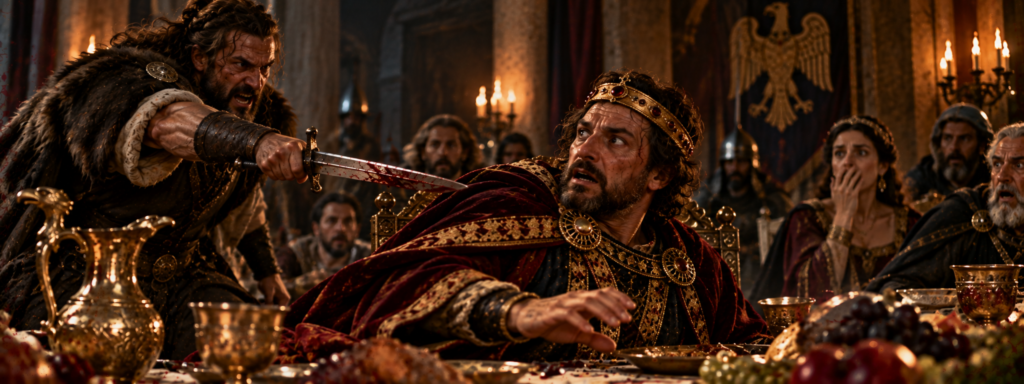
Ildibad: The Ostrogothic King Murdered at a Banquet Over a Stolen Bride
The Forgotten King Who Defied Justinian, Revived Gothic Resistance, and Was Assassinated by a Warrior Seeking Revenge
Ildibad (died 541), also known as Hildibad or Hildebad, was King of the Ostrogoths in Italy from 540 to 541, during the devastating Gothic War against the Eastern Roman Empire. Elevated to the throne after the surrender of King Witiges to the Byzantine general Belisarius, he attempted to rebuild Gothic resistance at a time when the Ostrogothic kingdom appeared close to destruction. His brief reign included a significant victory over Byzantine forces near Treviso, but his growing authority was undermined by tensions among his own followers. In 541, Ildibad was assassinated during a banquet by a Gepid warrior named Velas, whom the king had personally offended in a dispute involving the warrior’s intended bride. His murder abruptly ended a promising Gothic military revival and plunged the kingdom into another succession crisis.
Blood at the Banquet: The Murder of a King
The king was seated at a banquet when the man who intended to kill him approached. Around Ildibad were members of the Gothic court, men whose loyalty had helped raise him to the throne of a kingdom fighting for its survival. Food, wine, and the formalities of royal hospitality should have offered a momentary escape from the exhausting war that had consumed Italy for years. Instead, the gathering became the setting for one of the most startling royal assassinations of the sixth century.
The killer was not a Byzantine spy sent by Emperor Justinian, nor a general attempting to seize the Ostrogothic crown. He was a Gepid warrior named Velas, a man who had served within the king’s military following and whose grievance was intensely personal. According to the historian Procopius, Velas had been deprived of the woman he intended to marry after Ildibad arranged for her to be given to another man. The insult struck at matters of marriage, honor, and personal standing within a society where a warrior’s reputation could be inseparable from his position among his companions.
Velas did not challenge the king openly or seek satisfaction through the political institutions of the kingdom. Instead, he waited for an opportunity to approach Ildibad while the ruler was vulnerable. Procopius describes the assassin striking during a meal, killing the king with a sword. The account presents the murder as an act of revenge arising from a private grievance rather than a carefully organized political conspiracy.
The violence was shocking because Ildibad had appeared to be restoring the fortunes of a kingdom on the edge of extinction. Only a short time earlier, the Byzantine general Belisarius had captured Ravenna, the political heart of the Ostrogothic monarchy, and taken King Witiges into imperial custody. Many observers might reasonably have believed that Gothic independence in Italy was finished. Yet Ildibad had emerged from the remaining Gothic resistance and begun rebuilding the military strength that Justinian’s armies had spent years attempting to destroy.
His success had been more than symbolic. Near Treviso, his forces defeated a Byzantine army commanded by Vitalius, demonstrating that the imperial conquest was far from secure. The victory encouraged Gothic resistance and gave Ildibad an authority that his predecessors had struggled to maintain. For a brief period, the king appeared capable of transforming scattered military opposition into a renewed campaign against Constantinople.
Then a quarrel over a marriage destroyed him. A ruler who had survived the collapse of his kingdom’s defenses, the fall of Ravenna, and the ambitions of one of the most powerful emperors in Roman history was killed by a warrior from his own following. The assassination exposed the dangerous fragility of personal loyalty in the political world of the Ostrogoths. Military success could restore a king’s prestige, but it could not necessarily protect him from an insulted subordinate standing close enough to draw a sword.
Ildibad’s death also arrived at a particularly disastrous moment for Italy. The Gothic War had already devastated cities, disrupted agriculture, displaced communities, and exhausted the population. The Ostrogothic kingdom needed stable leadership if it was to resist imperial conquest. Instead, the murder produced another succession crisis, opening the way for a brief and troubled reign under Eraric before the emergence of Ildibad’s nephew Totila.
The story of Ildibad is therefore not simply a strange medieval murder involving a stolen bride. It is the story of a kingdom struggling to survive, a king whose military achievements made him dangerous to an empire, and a personal grievance that shattered a political recovery. It also reveals a recurring truth about early medieval monarchy: the men closest to a ruler could sometimes pose a greater immediate danger than the armies gathered against him.
To understand why Ildibad’s assassination mattered, it is necessary to return to the destruction of the kingdom he was attempting to save. His reign belonged to the final, desperate decades of Ostrogothic Italy, when the legacy of Theodoric the Great was being dismantled by invasion, betrayal, and civil conflict. The king murdered at the banquet had inherited a crown that was already stained with blood.
The Kingdom That Rose from the Ruins of Rome
The Ostrogothic kingdom of Italy had been established by Theodoric the Great, one of the most formidable rulers of the early Middle Ages. In 488, Theodoric led his followers into Italy at the encouragement of the Eastern Roman emperor Zeno, who wanted to remove the troublesome ruler Odoacer. The campaign developed into a prolonged struggle for control of the peninsula. By 493, Theodoric had defeated his rival and established himself as king.
The final victory was secured through an act of calculated violence. Odoacer had agreed to a settlement under which the two rulers would supposedly share authority over Italy. During a banquet in Ravenna on 15 March 493, Theodoric personally killed him, bringing the arrangement to a bloody end. The murder eliminated the principal obstacle to Gothic control and established the foundations of a new royal dynasty.
Despite this brutal beginning, Theodoric’s reign became associated with relative stability. He preserved many Roman administrative institutions, employed experienced Roman officials, and maintained a working relationship with the Italian aristocracy. Gothic military power supported the monarchy, while Roman bureaucratic expertise helped administer the kingdom. The arrangement allowed Italy to retain important elements of its imperial heritage after the disappearance of the Western Roman imperial office.
Theodoric’s government was not free from tension. Gothic warriors and Roman aristocrats possessed different traditions, interests, and expectations, while religious divisions complicated relations with Constantinople. The king and much of the Gothic elite followed Arian Christianity, whereas the eastern imperial government supported Nicene orthodoxy. Theodoric’s personal authority helped manage these difficulties, but his successors would find the balance much harder to maintain.
When Theodoric died in 526, the throne passed to his young grandson Athalaric. The boy’s mother, Amalasuntha, governed as regent and attempted to preserve the administrative system inherited from her father. Her policies favored cooperation with Roman institutions and friendly relations with Constantinople. Yet powerful Gothic nobles increasingly challenged her authority, particularly over the education and upbringing of the young king.
Athalaric died in 534, leaving Amalasuntha without the male ruler through whom she had exercised the regency. She elevated her cousin Theodahad as co-ruler, apparently expecting to retain effective control of government. Theodahad instead turned against her, deprived her of authority, and imprisoned her on an island in Lake Bolsena. In 535, she was murdered during captivity, an event that became one of the principal diplomatic justifications for Justinian’s invasion of Italy.
Theodahad proved unable to organize an effective defense against the Byzantine army. His failures contributed to his deposition by Gothic soldiers, who elevated the military commander Witiges in 536. Theodahad attempted to escape toward Ravenna but was overtaken and killed by a fellow Goth. The Ostrogothic monarchy had now experienced the violent removal of two rulers in little more than a year.
By the time Ildibad entered the struggle for kingship, the political world established by Theodoric was disintegrating. The dynasty that had conquered Italy had lost its authority, and the kingdom was engaged in a desperate war against an empire determined to restore Roman rule. Its rulers had been murdered, deposed, or taken prisoner. The survival of Gothic independence increasingly depended upon commanders capable of winning the loyalty of exhausted soldiers.
Justinian’s Dream of a Restored Roman Empire
Emperor Justinian I became ruler of the Eastern Roman Empire in 527, inheriting a state that still claimed the political legacy of ancient Rome. Although the western imperial office had disappeared in 476, the government in Constantinople continued to regard itself as Roman. Its rulers preserved Roman law, imperial titles, administrative institutions, and the belief that the empire possessed a legitimate claim to territories once governed from Rome. Justinian would transform that claim into an ambitious program of military expansion.
His reign combined major administrative achievements with costly warfare. The codification of Roman law, the construction of Hagia Sophia, and efforts to strengthen imperial authority became defining features of his government. His wife, Empress Theodora, exercised considerable influence within the imperial court. Together, they presided over a period in which the eastern empire sought to recover territories that had passed into the hands of independent western kingdoms.
The first major western success came in North Africa. In 533, the general Belisarius led an expedition against the Vandal kingdom, which had ruled much of the region for nearly a century. The campaign succeeded with remarkable speed, and the Vandal monarchy collapsed. The victory demonstrated that Justinian’s armies could defeat established kingdoms far from Constantinople.
Italy became the next great objective. The peninsula possessed immense symbolic importance as the historic center of Roman power, and its recovery would strengthen the emperor’s prestige. The Ostrogothic kingdom preserved Roman institutions but remained politically independent in practice. Justinian could present intervention as the restoration of legitimate imperial authority.
The murder of Amalasuntha in 535 provided a particularly useful justification. She had maintained friendly relations with Constantinople, and her imprisonment and death created a diplomatic grievance against Theodahad’s government. Justinian’s ambitions were broader than avenging the queen, but the crime offered a powerful argument for intervention. The invasion of Italy began that same year.
The imperial campaign initially appeared successful. Belisarius captured Sicily and advanced into southern Italy, eventually taking Naples after a difficult siege. Gothic resistance was weakened by political divisions and uncertain leadership. Theodahad’s inability to organize an effective defense contributed to his removal from power.
Witiges, the Gothic commander who replaced him, attempted to reverse the situation. He reorganized resistance and challenged Belisarius, but the war became increasingly destructive. Rome endured a major siege, and the struggle spread across much of the peninsula. Neither side could secure an easy victory without imposing enormous costs upon Italy.
The emperor’s dream of restoration was therefore becoming a nightmare for many of the people living in the territory he intended to recover. Cities faced siege and occupation, armies consumed agricultural supplies, and political loyalties became dangerous. The Ostrogothic kingdom struggled to preserve its independence, while the imperial government committed increasing resources to the conquest. Ildibad would emerge from this violent struggle at the moment when Gothic defeat appeared almost complete.
The Fall of Ravenna and the Capture of Witiges
Ravenna had served as one of Italy’s principal political centers since the late Roman period. Its surrounding marshes and waterways made it difficult to capture, and its defensive advantages had protected successive rulers. Theodoric had established his authority there after defeating Odoacer, and the city became closely associated with the Ostrogothic monarchy. Its fall would therefore carry enormous political significance.
By 539, the Gothic position had deteriorated severely. Belisarius controlled important territories, while Witiges struggled to preserve the remaining centers of resistance. The Byzantine army advanced toward Ravenna, placing the Gothic capital under increasing pressure. The war had exhausted both soldiers and civilians, making continued resistance difficult.
The situation was complicated by negotiations between the Gothic leadership and the imperial commander. According to Procopius, some Gothic nobles became willing to recognize Belisarius himself as ruler of the western territories if he would accept their offer. The proposal reflected dissatisfaction with the existing political situation and the desire to preserve some form of Gothic autonomy. Belisarius appeared to entertain the negotiations, although his ultimate loyalty remained with Justinian.
In 540, Ravenna surrendered to Belisarius. Witiges was taken into imperial custody and eventually transported to Constantinople, where he received honorable treatment rather than execution. His removal deprived the Ostrogoths of their reigning king. The imperial government appeared to have achieved the decisive victory it had sought.
The fall of Ravenna was a profound humiliation for the Gothic political order. The city that had witnessed Theodoric’s triumph over Odoacer was now in the hands of an imperial general. The royal court had been dismantled, the king had been captured, and much of the kingdom’s territory was under Byzantine control. For the remaining Gothic forces, the future appeared bleak.
Yet the conquest was not complete. Gothic warriors still held positions in northern Italy, and important territories remained outside effective imperial control. The empire’s armies were stretched across a large and difficult theater of war. The fall of the capital had not destroyed the willingness of Gothic soldiers to resist.
The surviving Gothic leadership now faced a crucial decision. Without Witiges, they needed a ruler capable of restoring unity and organizing resistance. A king who could command soldiers and challenge Byzantine authority might still preserve the kingdom. The man they selected was Ildibad.
Ildibad’s Rise: A King Chosen in Desperation
Ildibad emerged as a leading figure among the Gothic forces that remained in northern Italy after Ravenna’s surrender. His earlier life is poorly documented, and the surviving sources provide little reliable information about his childhood, birth date, or family background. He was connected by family to the Visigothic royal house in Spain, a relationship that could have offered valuable diplomatic possibilities. His military position among the surviving Ostrogoths made him a natural candidate for leadership.
The Gothic nobles initially considered another possible ruler, Uraias, a prominent commander and relative of Witiges. Uraias declined the kingship, apparently believing that his association with the defeated monarch would make him a problematic choice. He supported Ildibad instead. This decision gave the new ruler important backing from men who retained influence within the Gothic military elite.
Ildibad was elevated to kingship in 540, at a moment when the kingdom’s survival was far from assured. The crown he received was not accompanied by secure possession of Italy, a functioning central administration, or the wealth once controlled by Theodoric. Much of the territory was occupied by imperial forces. His authority depended upon the loyalty of soldiers who had recently suffered major defeats.
The new king’s immediate problem was survival. He needed to preserve the remaining Gothic positions, gather supporters, and prevent the imperial army from eliminating the last centers of resistance. The surrender of Ravenna had damaged morale, and the capture of Witiges created uncertainty about the future. Ildibad had to persuade his followers that the war was not yet lost.
His selection reflected a change in the nature of Ostrogothic kingship. The Amal dynasty had once provided hereditary legitimacy through descent from Theodoric’s family. Now military leadership and the ability to organize resistance mattered more than a direct claim through that dynasty. Ildibad’s authority arose from the needs of an army fighting for survival.
The situation also offered opportunities. Imperial forces had won major victories, but their occupation of Italy remained incomplete. Local dissatisfaction, administrative difficulties, and military overextension could create openings for Gothic resistance. A capable commander might exploit those weaknesses and recover territory.
Ildibad’s brief reign would demonstrate that the Ostrogoths remained a dangerous military force. His early successes challenged the assumption that the fall of Ravenna had ended the war. Yet his position remained vulnerable to the personal rivalries and unstable loyalties that had already destroyed several Gothic rulers. The kingdom needed a leader who could unite its surviving warriors, but those warriors brought their own grievances into the royal court.
The Visigothic Connection: A Possible Lifeline from Spain
Ildibad’s family relationship with the Visigothic royal house was one of his most important political advantages. His uncle was Theudis, the Visigothic king who ruled in Spain from 531 to 548. The relationship connected the embattled Ostrogothic monarchy to another powerful Gothic kingdom. In theory, that connection could provide diplomatic support or military assistance against Constantinople.
The Visigoths had established themselves as a major political force in the western Mediterranean after losing much of their former territory in Gaul to the Franks. Their kingdom remained centered increasingly upon Spain, where Theudis sought to preserve and strengthen royal authority. The Visigoths shared historical and cultural connections with the Ostrogoths, although the two kingdoms had distinct political interests. Family ties could create opportunities for cooperation without guaranteeing military intervention.
For Ildibad, the relationship mattered because the Ostrogothic kingdom had become isolated. Justinian’s armies controlled much of Italy, and the remaining Gothic forces possessed limited resources. Support from Spain might strengthen resistance or force the empire to consider the possibility of a wider conflict. Even the prospect of assistance could enhance the new king’s political credibility.
The surviving evidence does not establish that Theudis sent a major army to rescue Ildibad. The connection was politically significant, but it did not produce a documented intervention capable of transforming the war. The Visigothic kingdom had its own strategic concerns and could not be assumed to share every objective of the Ostrogothic resistance. Ildibad therefore remained dependent primarily upon the forces available in Italy.
The relationship nevertheless reveals that the Gothic world was not confined to a single kingdom. Royal families, military leaders, and aristocratic networks extended across regions once governed by the Western Roman Empire. Marriages and kinship could link rulers whose territories were separated by considerable distances. Such connections offered opportunities for diplomacy, but they also created expectations that could prove difficult to fulfill.
Ildibad’s hopes for external support formed part of his wider effort to restore the kingdom. He needed to demonstrate that the Ostrogoths had not been abandoned and that resistance remained possible. His connection to Theudis could help sustain that belief. Ultimately, however, his most important achievement would come not from Spain but from the battlefield in northern Italy.
The Byzantine Victory That Wasn’t Final
The capture of Ravenna in 540 created the appearance of an imperial triumph. Belisarius had defeated the reigning Gothic king, secured the capital, and brought much of Italy under Justinian’s authority. From Constantinople, the campaign could be presented as another stage in the restoration of Roman rule. Yet the situation on the ground remained far more complicated.
The empire’s armies were scattered across a large territory. Garrisons had to occupy cities, protect communications, and maintain control over populations exhausted by years of warfare. The imperial government also faced demands elsewhere, particularly along its eastern frontier with Persia. Italy could not receive unlimited military resources.
Belisarius himself was recalled to Constantinople in 540. His departure removed the commander whose leadership had been central to the imperial campaign. The generals who remained in Italy did not always cooperate effectively, and the occupation faced increasing difficulties. Their rivalries and competing responsibilities created opportunities for Gothic resistance.
The imperial administration also encountered problems collecting revenue and maintaining order. War had damaged agricultural production and disrupted established economic relationships. Local populations could resent taxation, military requisitions, and the behavior of occupying soldiers. The restoration of imperial authority did not automatically produce peace or prosperity.
Ildibad recognized that these weaknesses could be exploited. His remaining forces were smaller than the armies that had once defended Theodoric’s kingdom, but they retained military experience and knowledge of the terrain. A successful campaign against isolated imperial units could restore confidence among the Goths. It might also encourage communities to reconsider their allegiance.
The emperor’s victory therefore remained incomplete. Ravenna had fallen, but the Ostrogothic monarchy had not disappeared. Its surviving warriors had chosen a new king, and that king was preparing to challenge the occupation. The next major confrontation would reveal how dangerous the Gothic resistance could still become.
The Battle Near Treviso: Ildibad Strikes Back
Ildibad’s most important military achievement came in 541, when his forces defeated a Byzantine army near Treviso in northeastern Italy. The imperial commander was Vitalius, whose troops included a substantial contingent of Heruli, a Germanic people who served in Roman military forces. The engagement became a significant reversal for the imperial occupation. It demonstrated that Gothic resistance remained capable of defeating organized Byzantine troops.
The surviving account of the battle comes principally from Procopius. He describes Ildibad confronting Vitalius and winning a major victory, with the imperial forces suffering heavy losses. The defeat was particularly damaging because it occurred after Ravenna’s surrender, when the empire might have expected Gothic resistance to weaken. Instead, the new king had demonstrated his ability to fight successfully.
The precise movements of the armies are not preserved in enough detail to reconstruct every stage of the engagement. We know the general location and the outcome, but the surviving evidence does not support an elaborate description of tactical formations or battlefield dialogue. The victory was nevertheless important. It altered the political atmosphere in northern Italy.
For the Gothic soldiers, the battle provided proof that their kingdom was not finished. They had watched Ravenna fall and Witiges disappear into imperial custody. Many had experienced defeat, uncertainty, and the loss of familiar political structures. Ildibad’s success offered a reason to believe that resistance could continue.
The victory also strengthened the king’s personal authority. In a military society where leadership was closely associated with success in war, defeating an imperial army could attract new supporters. Commanders who had hesitated to commit themselves might now regard Ildibad as a viable ruler. His reputation began to grow.
The Byzantine defeat exposed the weakness of the imperial position after Belisarius’s departure. The generals remaining in Italy lacked the unity and effectiveness necessary to suppress every center of resistance. Gothic forces could exploit local opportunities and challenge isolated units. The war was entering a new phase.
Ildibad’s achievement was especially striking because he had inherited a kingdom that appeared almost destroyed. Within a relatively short time, he had transformed scattered resistance into a force capable of winning a significant battle. His reign seemed to offer the possibility of recovery. Yet military success would soon be overshadowed by a dispute inside his own following.
A Kingdom Revived, but a Court Divided
The victory near Treviso increased Ildibad’s standing among the surviving Gothic forces. His authority expanded as the possibility of renewed resistance became more credible. The kingdom still faced enormous challenges, but the immediate threat of extinction appeared less certain. The king had achieved something that many observers might have considered impossible after Ravenna’s surrender.
Success, however, brought new political difficulties. As more warriors and commanders gathered around the king, rivalries over status, influence, and personal relationships became increasingly important. The Gothic military elite was not a unified body whose members automatically accepted every royal decision. It consisted of men with their own families, followers, ambitions, and grievances.
The court also included warriors from different ethnic and political backgrounds. The Gepids, for example, were a Germanic people whose homeland lay primarily in the Danubian region. Individual Gepid warriors could serve in military forces beyond their own kingdom, including among the Goths. Their loyalty might depend upon personal relationships, rewards, and the treatment they received from commanders.
Such diversity could strengthen an army by providing experienced fighters. It could also create tensions when royal decisions interfered with the expectations of individual warriors. A king needed to distribute rewards, settle disputes, and preserve the loyalty of men who might otherwise seek service elsewhere. Personal honor was not a trivial matter in this environment.
Ildibad’s authority was particularly dependent upon these relationships because his kingship had emerged from military necessity. He lacked the long-established dynastic prestige of Theodoric’s direct successors. His legitimacy rested heavily upon the support of commanders and the success of his campaigns. Alienating influential warriors could therefore have serious consequences.
The king also faced tension involving Uraias, the commander whose support had helped secure his elevation. Procopius describes a dispute that arose through the rivalry of women associated with their households. The quarrel eventually contributed to the killing of Uraias, an event that damaged Ildibad’s political position. The episode illustrates how personal relationships within a royal court could become matters of life and death.
The atmosphere surrounding Ildibad’s final months was therefore more dangerous than his battlefield success might suggest. The king was gaining military strength while internal grievances accumulated. His authority could withstand a Byzantine army near Treviso, but it remained vulnerable to conflicts among the men closest to him. One such conflict would end his life.
The Quarrel Between the King’s Wife and Uraias’s Wife
One of the most revealing episodes of Ildibad’s reign concerns a dispute between his wife and the wife of Uraias. Procopius describes the women becoming involved in a quarrel that reflected tensions over status and royal prestige. The details are presented through a narrative shaped by the historian’s interest in personal rivalries. Nevertheless, the incident illustrates the importance of household relationships within the Gothic political elite.
Uraias was not an ordinary soldier. He had been an important commander under Witiges and had supported Ildibad’s elevation to kingship. His loyalty had helped provide legitimacy to the new ruler at a moment of crisis. A dispute involving his household therefore had implications beyond private embarrassment.
According to Procopius, the quarrel began when the wife of Uraias displayed wealth or social distinction in a way that offended Ildibad’s wife. The queen reportedly resented the suggestion that another woman at court might appear more splendid or influential than herself. Such an insult could become politically significant because public displays of wealth and status reflected the hierarchy of aristocratic society. The episode may also have been shaped by later storytelling that emphasized female jealousy as an explanation for male political violence.
The conflict eventually reached Ildibad. Procopius reports that the king came to suspect Uraias and arranged for his death. The surviving narrative does not establish that Uraias was genuinely plotting rebellion. His killing appears instead as an example of royal suspicion intensified by personal rivalry.
The consequences were serious. Uraias had been an important supporter of Ildibad, and his death could alienate men who respected him. Removing a powerful commander might eliminate a potential rival, but it could also weaken the network of loyalty supporting the crown. The king’s decision therefore carried substantial political risk.
The episode also reveals how dangerous courtly intimacy could become. Royal households were not separate from the political world; they were among its central institutions. Marriage, wealth, reputation, and personal insults could influence alliances and provoke violence. Ildibad’s court was a place where private disputes could become matters of state.
The killing of Uraias did not directly cause Ildibad’s assassination, at least according to the surviving account of the murder. Yet it formed part of the atmosphere of mistrust surrounding the king’s final months. A ruler who had gained authority through military success was becoming entangled in personal conflicts that threatened the loyalty of his followers. The fatal dispute involving Velas would emerge from that same world.
The Gepid Warrior and the Woman He Intended to Marry
The man who killed Ildibad was named Velas, a Gepid warrior serving within the Gothic military environment. Procopius identifies him as the assassin and provides a personal explanation for his grievance. Velas had been associated with a woman whom he intended to marry, but Ildibad intervened and arranged for her to be given to another man. The act deprived the warrior of the marriage he expected and publicly challenged his standing.
The surviving account does not preserve the woman’s name or provide her own perspective. It does not explain whether she had consented to the original arrangement, whether she wished to marry the second man, or how the competing claims arose. Those omissions are important because the narrative is told through the political concerns of male warriors. The woman appears primarily as the subject of a dispute over marriage and authority.
Marriage arrangements in early medieval aristocratic and military society could carry considerable social significance. They created alliances between families, established expectations of property and inheritance, and affected the reputation of the people involved. Interference by a powerful ruler could therefore be experienced as more than a private disappointment. It could threaten a warrior’s standing among his companions.
Ildibad’s intervention demonstrated the reach of royal authority into personal relationships. A king might arrange marriages to reward followers, settle disputes, or strengthen political alliances. Such decisions could be regarded as legitimate exercises of power when accepted by those involved. They could also provoke intense resentment when a warrior believed that the ruler had violated an existing agreement.
Velas apparently regarded the king’s decision as an intolerable insult. Procopius presents his later actions as motivated by the desire for revenge. The account does not provide a detailed record of his thoughts, and it would be misleading to invent conversations or emotional scenes. What survives is the connection between the marriage dispute and the assassination.
The incident also exposes a weakness in Ildibad’s position. His military successes had strengthened his authority, but his relationship with individual warriors remained essential. A king who offended a man within his own following could create a danger that battlefield victories did not eliminate. Velas possessed the opportunity to approach the ruler because he belonged to the world surrounding the royal court.
The grievance was personal, but its consequences would be political. Velas did not merely attack another warrior or challenge a rival suitor. He targeted the king of the Ostrogoths during a war for the survival of the kingdom. His act would destroy a ruler whose military leadership had begun to reverse the fortunes of Gothic resistance.
The Meaning of Honor in a Warrior’s World
The marriage dispute that preceded Ildibad’s death is difficult to understand without considering the importance of reputation in early medieval military society. Warriors depended upon the respect of their companions and commanders, particularly in political systems where personal loyalty played a central role. An insult could damage a man’s standing and threaten relationships that were essential to his livelihood. Marriage arrangements were among the matters through which that standing could be publicly recognized or challenged.
The surviving sources do not allow us to reconstruct a single uniform code of Gothic or Gepid honor. Customs varied across communities, and the political world of sixth-century Italy was shaped by Roman law, Gothic traditions, military service, and personal relationships. Nevertheless, aristocratic reputation and the public recognition of status were clearly important. A ruler who interfered with such matters risked creating resentment.
Velas’s grievance appears to have been intensified by the king’s direct involvement. The dispute was not simply a romantic rivalry between two men. According to Procopius, Ildibad himself arranged for the woman to marry someone other than Velas. The warrior therefore held the king responsible for the loss.
The imbalance of power made ordinary retaliation difficult. A soldier could not easily challenge a reigning monarch without risking punishment or death. Public opposition might be interpreted as rebellion, particularly during a war in which military loyalty was essential. The very authority that allowed Ildibad to intervene in the marriage could prevent Velas from seeking an open remedy.
Assassination offered a different path. A man who could approach the king at close quarters might be able to strike before guards or companions intervened. The opportunity would be especially dangerous during a gathering where the ruler expected hospitality rather than combat. The banquet provided precisely such a setting.
The episode reveals how personal resentment could intersect with political vulnerability. Ildibad was engaged in a struggle against the Byzantine Empire, but his immediate danger came from a subordinate who believed he had been wronged. The king’s power over marriage arrangements became the source of his exposure. A decision that may have seemed minor compared with the war would have fatal consequences.
It would be misleading, however, to describe Velas’s action as an inevitable expression of a universal warrior code. Procopius provides a particular explanation for a particular murder. Other men might have responded to a similar grievance differently. Velas chose violence, and the result was the death of a king.
The Banquet: A Place of Royal Power and Hidden Danger
Banquets occupied an important place in the political culture of late antiquity and the early Middle Ages. They allowed rulers to display wealth, reward followers, reinforce hierarchies, and cultivate personal relationships. Sharing food and drink could symbolize loyalty and mutual obligation. Yet the intimacy of such gatherings also created opportunities for betrayal.
The history of the Ostrogothic kingdom already contained a notorious example. In 493, Theodoric the Great had killed Odoacer during a banquet associated with their supposed reconciliation. The murder helped establish Gothic rule in Italy. Nearly half a century later, another Ostrogothic king would die during a meal.
The similarity is striking, but the two events should not be treated as identical conspiracies. Theodoric’s killing of Odoacer was a political act directed against a rival ruler during a struggle for control of Italy. Ildibad’s assassination, as described by Procopius, arose from a personal grievance involving a marriage arrangement. Both occurred in settings where hospitality should have offered some measure of security.
A banquet could place a ruler in close proximity to armed followers, servants, and members of the court. Formal ceremonies and established relationships might reduce suspicion, allowing individuals to approach the king more easily than they could during a military campaign. The gathering was therefore both a demonstration of royal authority and a moment of potential vulnerability. A determined assassin did not necessarily need an army to reach his target.
The surviving account does not provide a detailed description of the room, the decorations, the food, or the order in which guests were seated. Such details are tempting additions to a dramatic narrative, but they cannot be established from the evidence. We know that the king was killed during a meal and that the attacker was able to strike him. The historical significance lies in the betrayal of proximity rather than in imagined ceremonial details.
The setting also highlights the limits of royal protection. Ildibad commanded warriors capable of defeating an imperial army, yet he could not prevent one of his own men from attacking him at close range. Military power was effective against enemies on the battlefield, but it offered no absolute defense against an assassin inside the royal household. The king’s apparent security depended upon trust.
That trust was destroyed by Velas. The warrior approached the ruler not as an invading enemy but as a man connected to his military following. The banquet became the place where a personal grievance overwhelmed the obligations of loyalty. The resulting murder would change the political future of the Ostrogothic kingdom.
The Assassination of Ildibad in 541
Procopius records that Ildibad was killed during a banquet by Velas, the Gepid warrior whose intended marriage had been disrupted by the king. The account describes the assassin striking the ruler with a sword while he was eating. The attack was sudden and fatal. Ildibad died in 541, ending a reign that had lasted only a short time.
The exact date of the murder is not securely preserved. The year is well established, but the surviving evidence does not support assigning a precise day with confidence. The location is likewise less certain than the circumstances of the killing. The familiar description of a palace banquet conveys the royal setting, but the sources do not provide a detailed architectural identification of the room in which the murder occurred.
The assassination was remarkable because the king was not defeated by a Byzantine army. He had recently achieved a significant military victory near Treviso and appeared capable of strengthening Gothic resistance. His death came instead from within his own following. The danger was personal rather than strategic, although its consequences would affect the entire war.
Velas’s attack was not presented by Procopius as part of a broad conspiracy organized by imperial agents. The historian connects the murder to the marriage grievance and the warrior’s desire for revenge. No reliable surviving evidence establishes that Justinian, Byzantine commanders, or rival Gothic nobles directed the assassination. The absence of such evidence does not prove that no one else knew of Velas’s intentions, but it prevents the claim of a larger conspiracy from being treated as fact.
The king’s death created an immediate leadership crisis. Ildibad had become a central figure in the effort to revive Gothic resistance, and his victory near Treviso had increased confidence in his abilities. Removing him deprived the kingdom of a commander whose reputation was growing. The surviving Gothic forces would have to choose another ruler while the imperial occupation continued.
The murder also damaged the political stability necessary for sustained resistance. Gothic commanders and warriors were already divided by rivalries and competing interests. The killing of Uraias had weakened important relationships, and the assassination of Ildibad deepened the uncertainty. The kingdom could not easily afford another succession struggle.
The immediate outcome was therefore much larger than the death of one man. The Ostrogoths lost a king who had begun to reverse their military fortunes. The imperial occupation gained a temporary reprieve from a potentially dangerous opponent. The political struggle entered another unstable phase.
Was Ildibad Murdered for Love, Honor, or Revenge?
The traditional explanation for Ildibad’s murder centers upon the woman whom Velas intended to marry. Procopius reports that the king arranged for her to be given to another man, provoking the warrior’s resentment. This account has often been retold as a murder committed over a stolen bride. The phrase captures the dramatic outline of the story, but it risks oversimplifying the social and political circumstances.
The surviving narrative does not establish that the woman was physically abducted or that she had been married to Velas before Ildibad intervened. It describes a disrupted marriage arrangement. The distinction matters because later retellings can turn a dispute over an intended marriage into a more sensational account of kidnapping or romantic betrayal. The evidence supports the grievance, but not every embellishment attached to it.
Velas may have understood the incident primarily as an attack upon his honor and standing. Marriage arrangements could involve family alliances, property expectations, and public recognition of status. A ruler’s interference might therefore humiliate a warrior before his companions. Such a motive is consistent with Procopius’s account, although the historian does not provide a complete psychological portrait of the assassin.
The killing also involved revenge against an individual who possessed overwhelming authority. Ildibad was king, and Velas could not easily compel him to reverse the decision. The imbalance of power may have contributed to the warrior’s choice of assassination. Yet this remains an interpretation of the circumstances rather than a documented statement of his private thoughts.
There is no secure evidence that Velas intended to become king or establish a new political regime. His act removed the monarch but did not place him in control of the kingdom. The assassination therefore differs from coups in which a ruler is killed to make way for a rival claimant. It was a personal attack with enormous political consequences.
The distinction is central to the case. Ildibad’s murder demonstrates that regicide did not always arise from elaborate conspiracies or struggles over succession. A private grievance could become a national catastrophe when the offended individual possessed access to the ruler. The king’s authority made the insult possible, and his proximity to the warrior made retaliation possible.
The most responsible conclusion is that Velas killed Ildibad in revenge for the marriage dispute described by Procopius. The precise emotions, conversations, and planning behind the attack remain unknown. The surviving evidence does not justify inventing a secret imperial plot or a detailed romantic tragedy. The documented circumstances are already extraordinary.
The Immediate Aftermath: A Kingdom Without Its King
Ildibad’s assassination left the Ostrogothic resistance without the commander who had recently restored its confidence. The kingdom was still fighting for survival against Byzantine occupation, and its military resources remained limited. A stable succession would have been essential to preserve the momentum created by the victory near Treviso. Instead, the murder opened another period of political uncertainty.
The Goths elevated Eraric, a ruler associated with the Rugians, a Germanic people whose members had become integrated into the wider political and military world of Italy. His accession reflected the influence of different groups within the remaining Gothic forces. Yet his authority was not universally accepted. The kingdom remained divided by competing loyalties and ambitions.
Eraric’s reign was brief and troubled. Procopius portrays him as seeking an arrangement with Justinian that would preserve his personal position while conceding important political interests. The account suggests that he was willing to negotiate terms unfavorable to continued Gothic independence. Such claims should be interpreted cautiously because the historian wrote from the perspective of the imperial war.
Many Gothic warriors wanted a ruler committed to renewed resistance. They had seen Ildibad defeat an imperial army and believed that further victories were possible. Eraric’s policies did not inspire the same confidence. Dissatisfaction with his leadership grew rapidly.
Within months, Eraric was killed, and the throne passed to Totila, a relative of Ildibad. The succession demonstrated how unstable the monarchy had become. Kings could be elevated, rejected, and murdered in rapid succession. Military loyalty remained the decisive foundation of royal authority.
The murder of Ildibad therefore contributed to a chain of violent political changes. His death removed a successful commander, Eraric’s accession failed to restore unity, and another assassination followed. The kingdom eventually found a new leader in Totila, but the intervening instability weakened its position. The Gothic War continued amid a succession of rulers whose survival depended upon the uncertain loyalty of their followers.
Eraric: The King Who Followed the Murdered King
Eraric’s accession in 541 occurred under circumstances that made his position exceptionally difficult. The Ostrogoths had lost Ravenna, their former king Witiges had been taken to Constantinople, and Ildibad had been murdered despite his recent military success. The surviving Gothic forces needed a ruler capable of maintaining unity and confronting imperial occupation. Eraric inherited a political environment in which confidence was fragile.
His connection to the Rugians distinguished him from some of the other Gothic leaders. The Rugians had long been involved in the political struggles of the Danubian and Italian regions, and members of their community had become part of the Ostrogothic military world. Their support could help secure a throne, but it did not guarantee acceptance by every Gothic faction. Eraric therefore faced the problem of establishing authority across a divided coalition.
Procopius describes him as pursuing negotiations with Constantinople. The historian suggests that Eraric was willing to accept arrangements that would benefit himself personally while weakening the independence of the Gothic kingdom. The details of these negotiations are difficult to verify independently. Nevertheless, the account reflects the dissatisfaction that developed among Gothic warriors who wanted continued resistance.
The contrast with Ildibad was politically damaging. Ildibad had demonstrated his military abilities through victory near Treviso, giving the remaining Goths a reason to hope. Eraric appeared less committed to the kind of aggressive resistance that many commanders desired. His position weakened as opposition gathered around another candidate.
That candidate was Totila, also known as Baduila, a relative of Ildibad who possessed military experience and connections within the Gothic leadership. His emergence offered an alternative to Eraric’s government. The surviving sources describe political maneuvering that culminated in Eraric’s murder. Another king had been removed through violence.
Eraric’s death demonstrated that Ildibad’s assassination had not been an isolated disruption. The Ostrogothic monarchy was trapped in a cycle of unstable successions, military emergencies, and lethal political conflict. Each new ruler needed to secure the loyalty of warriors whose expectations were shaped by the desperate struggle against Constantinople. Failure could bring rapid removal.
The kingdom would eventually regain momentum under Totila, but the violence of 541 remained significant. Two kings died within a short period, and the political order continued to fracture. The assassination of Ildibad had opened a dangerous interval at the very moment when his military success suggested that resistance might recover. The consequences would shape the next phase of the Gothic War.
Totila: The Nephew Who Continued the Fight
Totila, whose Gothic name was Baduila, emerged as king after the death of Eraric in 541. He was related to Ildibad, commonly identified as his nephew, and had served within the Gothic military leadership. His accession restored a connection to the king whose victory near Treviso had revived resistance. It also marked the beginning of one of the most remarkable phases of the Gothic War.
Totila inherited a kingdom that had suffered repeated defeats and political upheavals. Ravenna remained in imperial hands, and much of Italy was occupied by Byzantine forces. The surviving Gothic army was smaller and less secure than the forces that had once served Theodoric the Great. Yet Totila proved capable of exploiting the weaknesses of the imperial occupation.
His early campaigns achieved important successes against Byzantine commanders who were divided by rivalry and competing interests. Totila combined military operations with political efforts to win support among communities dissatisfied with imperial administration. He sought to restore Gothic authority over territories that had already been conquered by Justinian’s armies. His victories demonstrated that the war was far from over.
Totila’s success was not simply the continuation of Ildibad’s policies, because the surviving evidence does not provide a complete record of Ildibad’s political program. Nevertheless, the two rulers shared the immediate objective of preserving Gothic independence. Both emerged from the resistance that survived Ravenna’s surrender. Both demonstrated that the imperial conquest remained vulnerable.
The relationship between the two men gives Ildibad’s murder an additional significance. His death did not end Gothic resistance permanently, but it interrupted a revival that his relative would later carry much further. Totila’s campaigns would threaten imperial control across large areas of Italy. The kingdom that appeared destroyed in 540 would become a serious military challenge once again.
Totila eventually captured Rome during the continuing war, although control of the city changed repeatedly. His campaigns prolonged the conflict and imposed further suffering upon the population. The emperor responded by committing additional resources to the struggle. The war entered a destructive final phase.
Totila died in 552 after the Battle of Taginae, where imperial forces under Narses defeated the Gothic army. His death was followed by the final collapse of organized Ostrogothic resistance. The kingdom that Ildibad had attempted to revive would ultimately disappear. Yet the years between 541 and 552 demonstrated how close the imperial conquest had come to unraveling.
The Women Behind the Political Conflicts
The story of Ildibad’s assassination contains two separate disputes involving women, both of which had serious political consequences. The first concerned the rivalry between the king’s wife and the wife of Uraias. The second involved the woman whom Velas intended to marry. In both episodes, women appear in the surviving narrative primarily through their relationships with powerful men.
This pattern reflects the limitations of the sources rather than the absence of female agency. Procopius records the disputes because they help explain political violence, but he provides little information about the women themselves. Their names, intentions, and personal circumstances are either omitted or insufficiently documented. The result is a narrative in which marriage and household rivalry become causes of male conflict without preserving the perspectives of those most directly involved.
The quarrel involving Uraias’s wife illustrates the political importance of aristocratic display. Clothing, wealth, and public recognition could communicate status within a royal court. A dispute over such matters might appear trivial when separated from its social context, but it could threaten the hierarchy upon which political relationships depended. The killing of Uraias demonstrates how dangerous those tensions could become.
The marriage dispute involving Velas was even more consequential. The king’s decision to assign the woman to another man appears to have violated the warrior’s expectations. Procopius presents the resulting resentment as the motive for assassination. The woman’s own wishes remain unknown.
It would be misleading to describe either woman as personally responsible for the violence. The decisions that produced the killings were made by men who possessed military and political authority. Ildibad reportedly ordered or permitted the death of Uraias, and Velas chose to murder the king. The women were involved in the circumstances, but the acts of violence belonged to those who carried them out.
The episodes also reveal the importance of marriage within the political structure of the kingdom. Royal and aristocratic marriages could create alliances, distribute property, and strengthen personal loyalty. Interference in such arrangements could destabilize relationships among influential warriors. The king’s authority over these matters was therefore both a political resource and a potential source of danger.
Ildibad’s assassination is often summarized as the story of a ruler killed over a stolen bride. That description is memorable, but it should not obscure the deeper significance of the dispute. The murder arose within a world where personal relationships, social standing, and political authority were closely connected. The fatal act was committed by a warrior who believed the king had wronged him.
Could Ildibad Have Saved the Ostrogothic Kingdom?
Ildibad’s brief reign invites a question that cannot be answered with certainty. Had he survived the banquet in 541, could he have continued rebuilding Gothic resistance and perhaps preserved the kingdom? His victory near Treviso demonstrated that he possessed military ability and could exploit weaknesses in the imperial occupation. Yet the obstacles confronting him remained enormous.
Justinian’s empire controlled major cities, possessed substantial resources, and could reinforce its armies from territories beyond Italy. The Ostrogoths had lost Ravenna and much of their former administrative structure. Their surviving forces were scattered and dependent upon uncertain political alliances. A single victory could improve morale without guaranteeing long-term survival.
Ildibad also faced serious internal difficulties. The killing of Uraias suggested that his relationship with important commanders had become unstable. The dispute involving Velas demonstrated that personal grievances could threaten his authority from within. A ruler who could defeat Byzantine troops but alienate his own warriors faced a dangerous contradiction.
The subsequent success of Totila shows that renewed Gothic resistance was possible. Totila recovered territory, challenged imperial control, and prolonged the war for more than a decade. His achievements suggest that the imperial conquest remained vulnerable after 540. Yet they do not prove that Ildibad would have achieved the same results.
The political and military circumstances were constantly changing. Byzantine commanders were recalled or replaced, imperial priorities shifted, and local populations responded differently to occupation and resistance. Ildibad’s future decisions would have mattered, but they cannot be reconstructed from the brief record of his reign. Any claim that he would certainly have saved the kingdom would be speculation.
What can be said is that his assassination removed a ruler who had begun to achieve military success. The kingdom lost a commander whose reputation was growing at a moment when stable leadership was essential. His death contributed to a succession crisis that interrupted the revival of Gothic resistance. The opportunity he had created passed to other men.
The tragedy lies in that interruption. Ildibad had survived the collapse of the old monarchy and demonstrated that defeat was not inevitable. His achievements were real, even if their ultimate potential remains unknowable. The assassin’s sword ended his reign before those possibilities could be tested.
Why the Murder Was More Than a Private Revenge
At first glance, Ildibad’s assassination appears to be a straightforward act of personal vengeance. Velas had been deprived of an intended marriage, blamed the king, and killed him during a banquet. The surviving account does not establish a wider conspiracy or an organized attempt to change the government. Yet the political consequences of the act were immense.
Ildibad was not merely a private individual involved in a marriage dispute. He was the reigning king of a people fighting for survival against a powerful empire. His personal authority helped hold together a coalition of warriors, commanders, and communities that had suffered years of defeat. Removing him threatened the fragile unity of the resistance.
The assassination also occurred after a significant military victory. Ildibad had demonstrated that Byzantine forces could be defeated and that the Gothic kingdom was not necessarily finished. His death interrupted that momentum. The army lost a leader whose achievements had begun to restore confidence.
The murder therefore illustrates how private grievances could destabilize public authority in early medieval politics. Royal government depended heavily upon personal relationships and the loyalty of military followers. A king’s decisions concerning marriage, property, and status could affect the same men who were expected to defend him. When those relationships broke down, the consequences could reach far beyond the individuals involved.
The banquet setting made the vulnerability especially clear. Ildibad was surrounded by people who belonged to his political and military world. He had reason to expect loyalty from those permitted to approach him. The assassin exploited that proximity.
The resulting succession crisis weakened the kingdom during an ongoing war. Eraric’s brief reign failed to restore stability, and another murder followed before Totila emerged as king. The sequence demonstrated how rapidly political authority could disintegrate when personal loyalty collapsed. Ildibad’s assassination was therefore both an individual act of revenge and a major event in the history of the Gothic War.
Regicide in the Ostrogothic Kingdom
Ildibad’s murder belongs to a broader pattern of violent royal deaths in Ostrogothic Italy. The kingdom itself had been established through Theodoric’s killing of Odoacer in 493. Decades later, Amalasuntha was murdered during captivity after being betrayed by Theodahad. Theodahad was subsequently deposed and killed while fleeing toward Ravenna.
These events differed in motive and circumstance. Theodoric killed a rival ruler during a struggle for control of Italy, while Amalasuntha’s death followed a dynastic coup. Theodahad was killed after losing military support during an invasion. Ildibad was murdered by a warrior whose grievance arose from a marriage dispute.
Yet the killings shared an important feature. Royal authority depended upon personal relationships, military loyalty, and the ability to maintain political support. When those relationships collapsed, rulers could become vulnerable to violence even within their own courts. The crown did not provide automatic security.
Ildibad’s case is distinctive because his assassin was not presented as a rival claimant. Velas did not kill the king in order to occupy the throne himself. His motive, according to Procopius, was revenge for a personal wrong. The act nevertheless produced a succession crisis comparable to those caused by more openly political murders.
The case also demonstrates the dangers of royal power exercised over intimate matters. A king could influence marriages and personal relationships among his followers. Such authority might strengthen alliances when accepted, but it could create enemies when perceived as unjust. Ildibad’s intervention in Velas’s intended marriage became the grievance that destroyed him.
The assassination therefore belongs firmly within the history of regicide. It was the deliberate killing of a reigning monarch by a member of his own military following. Its immediate motive was personal, but its consequences were political and military. The death of one king changed the leadership of a kingdom fighting for its existence.
The Historical Sources and Their Limitations
The principal source for Ildibad’s reign and assassination is Procopius of Caesarea, the sixth-century historian who accompanied Belisarius during important stages of Justinian’s wars. His Wars provides the most detailed surviving narrative of the Gothic conflict. Procopius had access to information concerning military operations, political negotiations, and the conduct of leading figures. His account is indispensable for reconstructing the events of 540 and 541.
Procopius nevertheless wrote from within the imperial world. His perspective was shaped by the campaigns of Justinian’s generals and the political concerns of Constantinople. He could admire the abilities of Gothic opponents while still presenting the war through an imperial framework. His descriptions of motives and private disputes require particular caution.
The account of Ildibad’s murder is vivid but relatively brief. It identifies Velas as the assassin and connects the killing to the dispute over an intended marriage. It does not preserve the woman’s name, the precise date of the assassination, or a detailed account of the king’s final moments. Later retellings sometimes add dramatic elements that are not securely documented.
The dispute involving Uraias also comes principally through Procopius. His narrative emphasizes the rivalry between the women associated with the two households and the resulting suspicion of the king. The episode may preserve genuine political tensions, but it is also shaped by literary conventions that explain male violence through female jealousy. The historian must therefore distinguish the reported sequence from assumptions about private motives.
Other surviving evidence helps establish the wider chronology of the Gothic War, the fall of Ravenna, and the later reign of Totila. Yet the documentation for Ildibad’s personal life remains limited. We know far more about the military and political circumstances of his reign than about his upbringing, personality, or private relationships. The scarcity of evidence makes imaginative reconstruction especially tempting.
A responsible account must resist that temptation. Ildibad became king after the fall of Ravenna, defeated Byzantine forces near Treviso, and was murdered during a banquet in 541. Procopius attributes the killing to Velas’s resentment over a marriage dispute. These are the essential elements of the story.
Beyond them, uncertainty remains. We cannot know exactly what Ildibad said to Velas, how the woman involved understood the dispute, or whether the assassin shared his intentions with anyone else. The surviving sources do not justify inventing conversations or claiming a hidden conspiracy. The documented history is dramatic enough without those additions.
The Cost of Endless War
Ildibad’s reign unfolded during a conflict that inflicted enormous suffering upon Italy. The Gothic War began in 535 and continued, with changing fortunes and repeated campaigns, until the final destruction of organized Ostrogothic resistance in the 550s. Cities were besieged, agricultural production was disrupted, and populations faced shortages and displacement. The struggle exhausted both the imperial government and the communities it sought to rule.
The war’s effects extended beyond the battlefield. Armies required food, animals, equipment, and money, placing heavy burdens upon local populations. Garrisons occupied cities and demanded supplies, while military movements disrupted trade and communication. Political uncertainty made it difficult for communities to plan for the future. The restoration of imperial authority did not automatically restore stability.
The plague that reached the Mediterranean world during Justinian’s reign further complicated the situation. Beginning in the early 540s, epidemic disease affected the empire and contributed to demographic and economic disruption. Its relationship to particular military events in Italy is difficult to measure precisely. Nevertheless, the wider crisis increased the burdens confronting the imperial government and the populations under its authority.
The Ostrogoths also suffered from the prolonged conflict. Their political institutions had been weakened by repeated defeats, and their leadership was destabilized by deposition and assassination. The fall of Ravenna deprived them of their principal capital. Ildibad’s attempt to rebuild resistance occurred under conditions of severe political and military strain.
His victory near Treviso briefly offered hope that the kingdom might survive. Yet the assassination destroyed the leader who had achieved that success. The subsequent succession crisis consumed political energy that might otherwise have been directed against the imperial occupation. The kingdom’s internal violence therefore compounded the damage inflicted by war.
The civilians of Italy had little control over these struggles. They endured the consequences of imperial ambition, Gothic resistance, and the personal rivalries of military leaders. The murder of a king at a banquet could change the course of a campaign and prolong political uncertainty. For ordinary communities, such events translated into new armies, new demands, and further insecurity.
Ildibad’s story is therefore inseparable from the wider tragedy of the Gothic War. His assassination was dramatic because of its personal motive, but its significance lay in the instability it created during a destructive conflict. The kingdom he attempted to save would continue fighting for more than a decade. Italy would bear the consequences long after the banquet was forgotten.
The Forgotten King Between Witiges and Totila
Ildibad is often overshadowed by the rulers who came before and after him. Witiges is remembered for his struggle against Belisarius and the surrender of Ravenna. Totila is remembered for his remarkable military recovery and prolonged resistance against Justinian’s armies. Ildibad occupied the brief interval between those more extensively documented reigns.
His short time on the throne has contributed to his relative obscurity. He ruled for roughly a year, and the surviving sources preserve only selected episodes of his career. His military victory near Treviso receives attention because it demonstrated the weakness of the imperial occupation. His assassination receives attention because of its unusual personal motive.
Yet Ildibad played an important role in the survival of Gothic resistance. After Ravenna’s surrender, the kingdom might have disappeared as an organized political force. His elevation gave the remaining Goths a king around whom they could rally. His victory showed that the imperial conquest was not irreversible.
The later success of Totila makes Ildibad’s contribution more significant. Totila inherited a resistance movement that had survived the apparent destruction of the monarchy in 540. Ildibad had helped preserve that movement and restore its confidence. His achievements formed part of the political and military background against which Totila rose.
The assassination interrupted that process. Instead of consolidating his victory and continuing the campaign, Ildibad was killed by a member of his own following. The kingdom passed through another unstable succession before Totila emerged. The brief reign therefore stands as both a moment of recovery and a warning about the fragility of Gothic kingship.
Ildibad’s relative obscurity should not diminish the historical importance of his death. His murder demonstrates how a private grievance could remove a ruler at a decisive moment in a major war. It also reveals the instability of a monarchy whose survival depended upon the personal loyalty of armed followers. The king who defeated a Byzantine army was unable to survive a banquet among his own people.
The King Who Defeated an Empire’s Soldiers but Not His Own Assassin
Ildibad came to the Ostrogothic throne at one of the darkest moments in the kingdom’s history. Ravenna had fallen, Witiges had been taken into imperial custody, and Justinian’s armies controlled much of Italy. The monarchy established by Theodoric the Great appeared close to destruction. Yet the surviving Gothic warriors refused to surrender their independence.
They chose Ildibad because they needed a leader capable of organizing resistance. His connection to the Visigothic royal house offered diplomatic possibilities, while his military position gave him credibility among the remaining forces. The crown he received was far removed from the secure monarchy that Theodoric had governed decades earlier. It was the crown of a kingdom fighting for survival.
Ildibad quickly demonstrated that the war was not finished. His victory over Byzantine forces near Treviso challenged the assumption that Ravenna’s surrender had ended Gothic resistance. The imperial occupation was vulnerable, and the new king possessed the ability to exploit its weaknesses. His success restored confidence among warriors who had experienced years of defeat.
For a brief period, the future appeared less hopeless. Ildibad had begun rebuilding the military strength necessary to challenge Constantinople. His reputation was growing, and his authority was strengthened by victory. The kingdom that had seemed destroyed in 540 was once again capable of fighting.
Yet the king’s political position remained dangerously fragile. His court contained rival commanders, competing households, and warriors whose loyalty depended upon personal relationships. The killing of Uraias revealed the destructive potential of suspicion and aristocratic rivalry. Military success did not eliminate the tensions surrounding the throne.
The fatal grievance arose from a marriage arrangement. Velas, a Gepid warrior, believed that Ildibad had wronged him by assigning the woman he intended to marry to another man. The surviving account does not preserve the woman’s perspective or every detail of the dispute. It does, however, identify the grievance as the motive for the assassination.
Velas chose revenge. During a banquet in 541, he approached the king and struck him with a sword, killing him. The act was sudden, personal, and devastating in its political consequences. A ruler who had survived the collapse of Ravenna and defeated imperial troops was murdered by a man from his own military world.
The killing was not the result of a documented Byzantine conspiracy. Procopius presents it as an act of vengeance arising from the marriage dispute. No reliable evidence establishes that Justinian or his generals directed the assassin. The murder’s significance lies partly in the absence of such a grand political plot.
Ildibad died because a personal grievance reached the point of lethal violence. Yet his death changed the leadership of a kingdom engaged in a major war. The assassination removed a successful commander and opened another succession crisis. The surviving Goths were forced to choose a new ruler while the imperial occupation continued.
Eraric’s brief reign failed to restore stability. His policies alienated warriors who wanted continued resistance, and he too was killed. Totila eventually emerged as king and revived the Gothic military struggle on a much larger scale. The kingdom survived Ildibad’s death, but the interruption was costly.
The sequence illustrates the dangerous instability of early medieval monarchy. Kings depended upon personal loyalty, military success, and the ability to manage disputes among powerful followers. A ruler could win battles and still lose his life through a quarrel within his own court. The crown offered authority, but it did not guarantee protection.
Ildibad’s story also reveals the political importance of matters that modern readers might initially regard as private. Marriage arrangements could shape alliances, status, and relationships among warriors. A king’s interference could create resentment that threatened his authority. Velas’s grievance became fatal because the offended man possessed access to the ruler.
The woman at the center of the dispute remains almost entirely absent from the surviving record. Her name, wishes, and circumstances were not preserved in the account that explains the king’s death. She appears as the subject of a conflict between men whose decisions shaped the political consequences. The omission is a reminder that the surviving history of royal violence often preserves the ambitions of rulers and warriors while leaving other lives in shadow.
The assassination also echoes the violent origins of the Ostrogothic kingdom. Theodoric had secured his rule by killing Odoacer during a banquet in 493. Nearly half a century later, Ildibad died during another royal meal. The circumstances and motives differed, but both killings demonstrated how easily hospitality could become the setting for political violence.
The kingdom that Theodoric established had been built through conquest and sustained by his personal authority. After his death, succession disputes, dynastic betrayals, and imperial invasion exposed its weaknesses. Amalasuntha was murdered, Theodahad was assassinated, and Witiges was taken into captivity. Ildibad’s death continued the sequence of violent disruptions that undermined royal stability.
His reign was too short to establish whether he could have preserved Gothic independence. The victory near Treviso demonstrated military promise, but the empire remained powerful and the kingdom’s resources were limited. His internal difficulties also suggested that maintaining unity would have been challenging. Any confident claim about what he might have achieved must remain speculation.
What can be established is that Ildibad mattered. He became king when the Ostrogothic monarchy appeared finished, organized resistance, and defeated an imperial army. His achievements helped demonstrate that Justinian’s conquest of Italy was incomplete. His death removed a ruler whose leadership had begun to restore the kingdom’s fortunes.
The Gothic War would continue for years after his assassination. Totila’s campaigns would challenge imperial control, and Justinian would commit further resources to the struggle. Italy would endure repeated sieges, military occupations, and devastating disruption. The kingdom Ildibad had attempted to save would ultimately disappear.
His murder remains one of the most unusual cases of regicide in the history of the early Middle Ages. It was not a battlefield death, a public execution, or the culmination of a documented dynastic conspiracy. It was an assassination carried out by a warrior who believed the king had wronged him in a personal matter. The consequences, however, reached far beyond the grievance that inspired it.
Ildibad’s final tragedy was that his greatest danger came from within the world he commanded. He had faced the armies of Justinian and demonstrated that they could be defeated. He had survived the political collapse that followed Ravenna’s surrender and restored hope among the remaining Goths. Yet he could not protect himself from a man who stood close enough to strike during a royal banquet.
The king’s life ended at the very moment when his reign appeared to be gaining strength. His military success had offered the possibility of renewed resistance, but his own decisions had created an enemy within his following. The sword that killed him did not belong to the empire he was fighting. It belonged to a warrior whose loyalty had been destroyed by a personal grievance.
In the end, Ildibad was not brought down by Justinian’s generals, the fall of Ravenna, or the overwhelming resources of Constantinople. He was killed over a marriage dispute by a man who had once served within his military world. The assassination destroyed a promising reign and exposed the fragile foundations of royal authority in a kingdom already torn apart by war. Ildibad had begun to save the Ostrogoths from their enemies, but he could not save himself from one of his own.