
Constans II: The Emperor Murdered in His Bath and the Bloody Conspiracy at Syracuse
Constans II (630–668 CE) | Eastern Roman Emperor, 641–668 CE | Assassinated at Syracuse, Sicily, on September 15, 668
Murder in the Imperial Bathhouse
On September 15, 668, the Roman emperor Constans II entered a bathhouse in Syracuse, Sicily, unaware that he was approaching the final moments of his life. He had survived nearly three decades on the throne, a devastating naval defeat, religious rebellion, bitter family conflict, and the relentless expansion of the Arab Caliphate. He had ordered the arrest of a pope, presided over the mutilation and exile of a celebrated theologian, and eliminated his own brother when he feared that the young man might threaten his position. Yet after all those years of danger, the emperor would not die beneath the swords of an invading army or in a spectacular palace coup.
He would die in his bath.
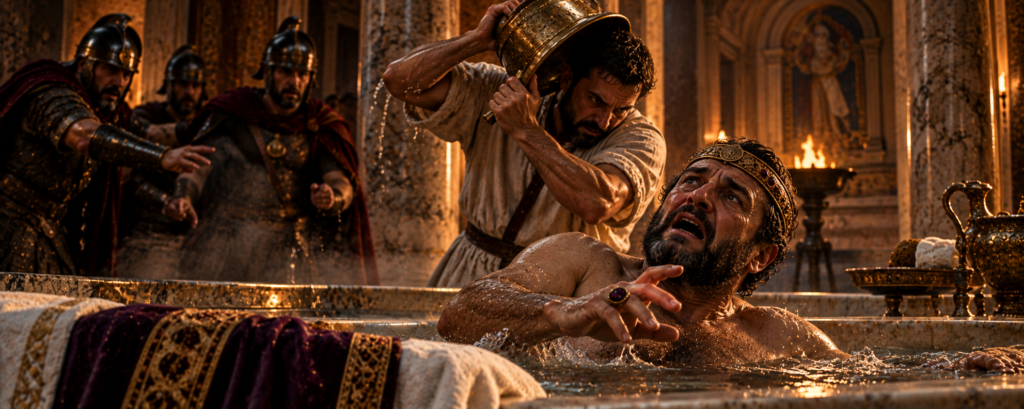
According to the most famous Byzantine account, a servant or attendant named Andrew approached the emperor while he was bathing and struck him on the head with a heavy object. The weapon is usually described as a bucket, vessel, or container used in the bathing process, although later retellings sometimes identify it as a soap dish. The blow reportedly killed Constans, leaving the ruler of the Eastern Roman Empire dead in one of the most private and supposedly secure places available to him. The circumstances were almost absurdly ordinary for the murder of a man who had commanded armies, fleets, governors, patriarchs, and entire provinces.
The simplicity of the killing concealed a far more complicated political crisis. Constans had spent the final years of his reign far from Constantinople, establishing himself at Syracuse while his family and much of the imperial government remained in the eastern capital. His prolonged absence had generated suspicion, his financial demands had angered important communities, and his efforts to strengthen Roman power in the western Mediterranean had produced mixed results. By the time he was murdered, the emperor had become isolated from the political center of his own empire.
The assassination was followed almost immediately by an attempt to seize the throne. A military figure named Mezezius, also known in some sources as Mizizios, was proclaimed emperor in Sicily, although the precise relationship between his elevation and the murder of Constans remains uncertain. Some accounts imply that he was connected to the conspiracy, while others describe him as a reluctant figure elevated by troops after the emperor’s death. The surviving evidence does not allow historians to reconstruct the plot with complete confidence.
What is certain is that Constans II was murdered and that his death triggered a struggle over the imperial succession. His son Constantine IV, who had remained in Constantinople, ultimately secured the throne, while the Sicilian usurpation failed. The empire continued, but the murder brought an abrupt end to one of the most controversial reigns of the seventh century. It also left behind an extraordinary question: how had an emperor powerful enough to command the Roman world become vulnerable to assassination by a man standing close enough to hand him water?
The answer begins decades before the bathhouse at Syracuse. Constans had inherited a battered empire as a child, grown into a ruler determined to preserve what remained of Roman power, and gradually acquired a reputation for severity that made enemies both inside and outside the palace. His story is not simply about a strange murder weapon or an unexpected assassination. It is about the dangerous loneliness of imperial authority, the violence required to maintain it, and the moment when a ruler discovered that the greatest threat to his life could come from someone permitted to stand beside him.
A Child Emperor in a Dying Imperial World
Constans II was born in 630, during the final years of the reign of his grandfather, the emperor Heraclius. His father was Constantine III, the son and intended successor of Heraclius, while his mother, Gregoria, belonged to the imperial family through her own distinguished connections. The child entered a dynasty that had recently achieved one of the greatest military recoveries in Roman history. Unfortunately, the triumph would prove terrifyingly short-lived.
Heraclius had spent much of his reign fighting the Sasanian Persian Empire, which had occupied enormous stretches of Roman territory during a devastating war. Persian armies had taken Syria, Palestine, and Egypt, while Constantinople itself faced serious danger. Through a remarkable series of campaigns, Heraclius eventually forced Persia into defeat and recovered the territories it had conquered. By the late 620s, the emperor appeared to have rescued the Roman Empire from destruction.
Yet the war had exhausted both great powers. Their armies had been depleted, their finances strained, and their frontier defenses weakened by years of campaigning. Almost immediately, a new military force emerged from Arabia under the banner of Islam. Arab armies began attacking territories that Rome and Persia had fought so desperately to control.
The speed of the Arab conquests shocked the established powers. Roman forces suffered a catastrophic defeat at the Battle of Yarmouk in 636, effectively destroying imperial control over much of Syria. Jerusalem surrendered soon afterward, while Egypt came under increasing pressure. The empire that Heraclius had rescued from Persia was losing its eastern provinces to an entirely different enemy.
Constans grew up amid this collapse. His childhood was not spent in a secure empire confidently ruling the Mediterranean, but in a state struggling to understand how so much territory could disappear within a few years. The great cities of the eastern provinces, once centers of Roman administration and Christian religious life, were falling under new rulers. Constantinople remained powerful, but its world was shrinking.
The political situation within the imperial family was equally dangerous. Heraclius had married his niece Martina, a union that generated controversy and resentment, and the succession arrangements following his death were complicated by competing branches of the dynasty. Constans was still a child when those rivalries erupted into a struggle for the throne. His earliest experience of imperial politics would be marked by suspicion, accusations of murder, and mutilation.
The circumstances were an ominous introduction to power. Before Constans was old enough to govern independently, he had already seen how quickly members of the imperial family could be destroyed when their political usefulness ended. He would later apply similar lessons to his own relatives. The violence that surrounded his accession became part of the world in which he learned to rule.
The Suspicious Death of Constantine III
Heraclius died in February 641, leaving the throne to two sons from different marriages. Constantine III, the father of Constans, was the senior emperor, while Heraclonas, the son of Martina, shared imperial authority. The arrangement was intended to preserve dynastic unity, but it instead created a dangerous rivalry. Constantinople became the setting for a struggle between competing branches of the ruling family.
Constantine III was already seriously ill when he inherited the throne. His reign lasted only a few months before he died in May 641, leaving his young son as a potential successor. The speed of his death immediately encouraged suspicion. Rumors spread that Martina had poisoned him to secure power for Heraclonas.
The accusation was never conclusively established. Constantine III may have died from tuberculosis or another illness, and the surviving evidence does not prove that Martina arranged his murder. Nevertheless, the rumor was politically devastating because it portrayed her as a woman willing to eliminate her stepson for the sake of her own child. In a capital already divided by religious and dynastic tensions, the story helped turn opinion against her.
Martina attempted to maintain the authority of Heraclonas, but opposition intensified. Military commanders, senators, and other powerful figures supported the claims of Constantine III’s son. The young Constans became a convenient symbol of legitimate succession. His age made him vulnerable, but his ancestry made him valuable.
The crisis ended with the overthrow of Martina and Heraclonas. Both were subjected to mutilation, a punishment that would become increasingly associated with Byzantine political struggles. Martina reportedly had her tongue cut out, while Heraclonas suffered mutilation of the nose. These injuries were intended to disqualify them from exercising imperial authority and permanently mark their defeat.
Constans was elevated to the throne late in 641. He was approximately eleven years old, far too young to direct the empire’s wars or manage its complicated administration without assistance. Senior officials and military leaders therefore exercised considerable influence during the early years of his reign. The child emperor inherited both the magnificent title of Augustus and the dangerous knowledge that imperial relatives could be mutilated when political circumstances changed.
His formal imperial name was Constantine, and the name Constans became the form by which later historians commonly distinguished him. He is also frequently associated with the nickname Pogonatus, meaning bearded, although the application of that epithet has been confused with his son Constantine IV in historical tradition. Such naming complications are minor compared with the political problems he faced. The boy who had survived a dynastic struggle now had to preserve an empire fighting for its existence.
The Empire He Inherited Was Falling Apart
By the time Constans became emperor, the Eastern Roman Empire had already lost much of the territory that had once supplied its wealth and prestige. Syria and Palestine were largely beyond imperial control, while Egypt was being conquered by Arab armies. These were not remote borderlands whose loss could be absorbed without consequence. They contained prosperous cities, agricultural regions, ports, and tax revenues essential to the imperial economy.
Egypt was particularly important. For centuries, its grain production had helped feed Constantinople, and its taxes supported the imperial government. Alexandria was one of the Mediterranean’s greatest cities, a center of trade, learning, and Christian theology. Losing Egypt meant surrendering an economic foundation of Roman power.
Alexandria fell to Arab forces in 642, although Roman efforts to recover the city briefly continued. The loss demonstrated how dramatically the balance of power had shifted. The empire that once commanded the eastern Mediterranean was struggling to defend its remaining coastline. Its enemies were learning to fight not only on land but also at sea.
The Arab Caliphate possessed advantages that Roman leaders initially struggled to counter. Its armies were highly mobile, experienced, and supported by a rapidly expanding political system. Roman forces, meanwhile, had endured decades of war and repeated territorial losses. The empire could still mobilize formidable resources, but it could no longer assume that its traditional military superiority would guarantee victory.
Constans inherited these problems before he could fully understand them. His advisers faced immediate decisions concerning taxation, recruitment, military appointments, and the defense of threatened provinces. Every decision carried political risks because demanding more money or soldiers could provoke resistance among communities already suffering from war. The emperor’s government needed to survive long enough for the child ruler to become an effective adult.
The early reign therefore combined military emergency with political fragility. Constans had to defend his dynasty against possible rivals while defending the empire against foreign conquest. The two problems were inseparable because military defeats weakened imperial legitimacy, and internal conflict made foreign invasion more dangerous. The pattern would follow him throughout his life.
He eventually developed into an energetic ruler willing to campaign personally and confront powerful institutions. His decisions were not always successful, and some were extraordinarily harsh. Yet the image of Constans as merely a cruel or incompetent emperor fails to capture the scale of the crisis he inherited. He spent his reign trying to preserve an empire whose survival was far from guaranteed.
The Arabs Take to the Sea
One of the most dangerous developments during Constans’s reign was the creation of a powerful Arab navy. For centuries, Roman control of the Mediterranean had been a central foundation of imperial strength. Sea routes allowed the government to move troops, supplies, officials, and revenue between distant provinces. Constantinople’s security depended heavily upon maritime power.
The new Arab rulers recognized that defeating Rome required challenging its dominance at sea. Naval forces were developed using the resources and expertise available in conquered coastal territories. Shipbuilding centers and experienced sailors from Syria and Egypt contributed to the expansion. The Roman navy soon faced an enemy capable of attacking islands and coastal settlements previously considered relatively secure.
Cyprus became one of the early targets. Arab forces attacked the island in the late 640s, demonstrating that the empire could no longer rely upon the sea as a defensive barrier. Further expeditions threatened other Mediterranean islands and coastal regions. The Roman government faced the possibility that its enemies might eventually attack Constantinople itself by water.
Constans attempted to respond with naval operations of his own. The emperor understood that allowing the Arab fleet to expand without resistance would endanger the entire imperial system. He committed resources to defending maritime routes and confronting enemy squadrons. These efforts culminated in one of the most disastrous episodes of his reign.
In 655, Roman and Arab fleets met near the coast of Lycia in a battle commonly known as the Battle of the Masts. The name reflects the closely packed ships and the intensity of the fighting, which involved combat at close quarters. Constans personally commanded the Roman fleet. The engagement ended in a major Arab victory.
The emperor himself narrowly escaped death. Later accounts describe him changing clothing or otherwise concealing his identity to avoid capture during the disaster, although the precise details are difficult to verify. The essential fact is that Constans survived a battle in which his fleet suffered a crushing defeat. His personal presence made the humiliation especially severe.
The Battle of the Masts shattered any assumption that Roman supremacy at sea was secure. Arab forces had demonstrated that they could defeat an imperial fleet led by the emperor himself. The consequences extended far beyond the immediate loss of ships and men. The Mediterranean had become a contested military frontier.
Constans survived, but the experience must have reinforced the dangers surrounding his position. He had witnessed the possibility of imperial death at sea, far from the ceremonial protections of Constantinople. His enemies had nearly achieved what internal conspirators would eventually accomplish. The emperor returned to a state whose military survival required constant adaptation.
A Breathing Space Created by Civil War
The empire received unexpected relief when political conflict erupted within the Arab Caliphate. The assassination of Caliph Uthman in 656 triggered a major civil war that divided the expanding Muslim state. Rival leaders competed for authority, and military resources were redirected toward internal struggles. For Constans, the conflict created an opportunity to strengthen Roman defenses.
The emperor did not cause the civil war, but he benefited from it. Arab pressure against Roman territory temporarily eased, allowing the government to recover from some of its earlier defeats. The pause was particularly valuable after the naval disaster of 655. It gave Constans time to reorganize forces and address threats elsewhere.
The emperor also pursued military operations in the Balkans. Slavic groups had settled or established control over substantial areas once governed directly by Constantinople. The Roman state retained important cities and strategic positions, but its authority across the peninsula had become uneven. Reasserting control required military campaigns as well as negotiation.
In 658, Constans conducted a campaign against Slavic groups in the Balkans. The expedition achieved enough success to demonstrate that the empire remained capable of offensive operations. Some populations were reportedly relocated or incorporated into imperial military arrangements, although the precise scale of these measures is uncertain. The campaign helped strengthen Roman influence in areas threatened by fragmentation.
These successes complicate the image of an emperor whose reign consisted entirely of defeat. Constans inherited a desperate strategic position and sometimes responded effectively. He could exploit divisions among enemies and launch campaigns when circumstances permitted. His government was attempting to rebuild military strength under extremely difficult conditions.
Yet foreign threats were only one source of danger. Inside the Christian empire, religious disagreements were becoming increasingly bitter. Constans would soon discover that attempts to impose theological peace could produce enemies as determined as those confronting him on the battlefield. The struggle over doctrine would help transform his reputation from embattled defender into persecuting tyrant.
The Religious War Inside Christianity
The theological controversy that troubled Constans’s reign concerned the relationship between the divine and human wills of Jesus Christ. The dispute emerged from centuries of argument over how Christ’s divine and human natures should be understood. Imperial governments had repeatedly attempted to establish formulas capable of reconciling rival Christian communities. Those efforts often produced further conflict.
The doctrine commonly called Monothelitism maintained that Christ possessed a single will, although its supporters differed in how they explained the relationship between his divine and human natures. Opponents insisted that Christ possessed both a divine and a human will corresponding to his two natures. To modern readers, the distinction may appear remote from political life. In the seventh century, however, it touched questions of salvation, religious authority, and the legitimacy of imperial government.
Constans inherited the controversy from Heraclius and earlier church leaders. The government hoped that theological compromise might restore unity among Christian populations, particularly at a time when the empire was losing territory to Muslim armies. Instead, proposed formulas generated resistance from bishops, monks, and theologians. Religious disagreement became intertwined with political loyalty.
The emperor eventually attempted to end the argument through imperial command. In 648, he issued the Typos, an edict forbidding further public controversy over whether Christ possessed one or two wills or operations. Rather than resolving the doctrinal issue, the decree attempted to silence debate. Constans apparently hoped that prohibiting discussion would reduce division.
The policy proved deeply unpopular among opponents of Monothelitism. They regarded silence as unacceptable because they believed the theological issue concerned fundamental Christian truth. To them, the emperor was not preserving peace but suppressing orthodox teaching. The conflict therefore became a confrontation between imperial authority and religious conscience.
The controversy also exposed tensions between Constantinople and Rome. The papacy rejected attempts to impose theological compromise through imperial command. Constans considered such resistance politically dangerous because it challenged his authority during a period of military emergency. The result was one of the most notorious confrontations between a Byzantine emperor and the Roman church.
The Emperor Who Arrested a Pope
Pope Martin I became one of Constans’s most prominent opponents. Elected in 649, Martin convened a council at the Lateran in Rome that condemned Monothelitism and rejected the imperial Typos. The council’s actions directly challenged the religious policy of Constantinople. Constans could not easily ignore such defiance from the bishop of Rome.
The emperor’s government moved against Martin. Imperial officials attempted to enforce the policy, and the pope eventually faced arrest. In 653, Martin was seized in Rome and transported east under imperial authority. His removal demonstrated that the emperor was willing to use coercion against one of Christianity’s most prominent religious figures.
Martin’s treatment became a scandal in later church history. He was brought to Constantinople, subjected to proceedings involving accusations of political disloyalty, and eventually exiled to Cherson in the Crimea. The charges against him were framed partly in political terms rather than simply as a theological disagreement. This allowed the government to portray resistance as treasonous conduct.
The pope suffered severe hardship during his imprisonment and exile. His health deteriorated, and he died in 655, far from Rome. Later Christian tradition honored him as a martyr and confessor who had resisted imperial interference in doctrine. Constans, by contrast, acquired a reputation as a ruler willing to persecute a pope for refusing to obey.
The episode illustrates the emperor’s increasingly uncompromising approach to opposition. He believed that religious unity was necessary for political survival, but his methods alienated influential communities. Arresting Martin did not eliminate the controversy. It created a powerful symbol of resistance.
The confrontation also reveals how different Constans’s world was from that of earlier Roman emperors. He ruled a Christian empire in which religious institutions possessed their own authority and traditions. The emperor could command armies and appoint officials, but he could not simply decree what every Christian must believe. His attempt to impose silence helped deepen the divisions he wanted to end.
Maximus the Confessor and the Price of Defiance
Another major opponent of Constans’s religious policy was Maximus the Confessor. A learned theologian and former imperial official, Maximus became one of the most influential defenders of the doctrine that Christ possessed both a divine and a human will. His writings and public arguments challenged the theological compromise supported by the imperial government. He eventually became a target of political prosecution.
Maximus had connections across the eastern Mediterranean and participated in theological debates that attracted considerable attention. His opposition was not merely private disagreement expressed in obscure manuscripts. He became an influential voice against the emperor’s religious settlement. For a government already struggling to maintain unity, that influence appeared threatening.
He was arrested and brought before imperial authorities. The proceedings involved accusations of political disloyalty as well as theological controversy, reflecting the difficulty of separating religion from imperial politics. Maximus refused to abandon his position. His resistance became increasingly costly.
In 662, after further proceedings, Maximus was subjected to mutilation and exile. Later accounts describe his tongue being cut out and his right hand removed, punishments symbolically directed against his ability to teach and write. The details are preserved within a strongly sympathetic religious tradition, but the severe treatment of Maximus is well established. He died in exile later that year.
The mutilation became one of the darkest episodes associated with Constans’s reign. A ruler attempting to enforce religious peace had ordered punishments that made his opponents appear heroic. Maximus’s suffering strengthened his reputation among those who rejected the imperial policy. The emperor’s attempt to silence dissent ultimately helped preserve the dissenter’s memory.
The incident also reflected a broader pattern in Constans’s government. Political insecurity encouraged increasingly severe responses to perceived threats. Whether the challenge came from a theologian, a pope, a military commander, or a member of the imperial family, the emperor showed a willingness to use coercion. The consequences would become particularly personal when suspicion fell upon his own brother.
The Brother Who Became a Threat
Constans’s younger brother Theodosius occupied a dangerous position within the imperial family. He possessed the bloodline of Heraclius and Constantine III, giving him a legitimate connection to the throne. In a stable dynasty, such a relative might have served as a useful supporter. In a government marked by suspicion and repeated usurpations, he could become a potential rival.
The exact sequence of events leading to Theodosius’s death is not entirely clear. Byzantine sources describe Constans forcing his brother into the clergy before eventually ordering his execution, generally dated to 659 or 660. The ecclesiastical appointment appears to have been intended to remove Theodosius from ordinary succession politics. It did not eliminate the emperor’s fear.
Theodosius was ultimately killed on Constans’s orders. Later writers portrayed the execution as an act of fratricide motivated by jealousy, paranoia, or fear that the brother might be elevated by political opponents. The sources do not provide enough reliable evidence to establish every private motive. What matters is that Constans eliminated a close relative whose dynastic status made him politically dangerous.
The murder was particularly damaging to the emperor’s reputation. Killing a brother violated powerful expectations of family loyalty and Christian morality. Even in a political culture accustomed to violent succession struggles, fratricide could provoke horror. Theodosius became another victim whose death could be used to condemn the ruler.
Later traditions claimed that Constans was haunted by visions of his dead brother. One story describes Theodosius appearing before him holding a cup of blood, a symbolic accusation that the emperor had spilled his own family’s blood. Such visions belong to the moralizing tradition surrounding the reign and cannot be accepted as documented psychological experiences. They reveal how later writers wanted readers to understand the killing.
The execution may also have contributed to Constans’s growing alienation from Constantinople. Some historians have suggested that the emperor’s departure for the west was influenced by the hostility generated by his brother’s death. That explanation is plausible but not certain, since strategic considerations also played a major role in his decision. The two possibilities need not exclude each other.
Theodosius’s fate demonstrates the danger of imperial kinship. A brother could become threatening precisely because he was close enough to possess a credible claim. Constans had survived a dynastic struggle as a child and may have feared exposing his own sons to another. By eliminating Theodosius, he attempted to protect the succession while creating a lasting stain upon his reign.
Why Did Constans Abandon Constantinople?
In 662, Constans made one of the most unusual decisions of his reign. He left Constantinople and traveled west, eventually establishing himself at Syracuse in Sicily. Eastern Roman emperors had occasionally campaigned far from the capital, but Constans’s prolonged residence in the western Mediterranean was extraordinary. His departure raised questions that historians continue to debate.
One explanation emphasizes military strategy. Arab naval expansion threatened the Mediterranean, while Roman possessions in Italy and North Africa remained vulnerable. Sicily occupied a valuable position between the eastern and western basins of the sea. An emperor based there could potentially direct operations against enemies threatening several important regions.
Another explanation focuses on political alienation. Constans had acquired enemies in Constantinople through religious persecution, harsh government, and the execution of his brother. Remaining in the capital may have become increasingly uncomfortable or dangerous. A western residence offered distance from hostile court factions.
The emperor may also have hoped to revive Roman authority in Italy. Much of the peninsula had fallen under Lombard control after their invasion in the late sixth century, while Roman territory survived in scattered regions including Ravenna, Rome, Naples, and parts of southern Italy. The western provinces were not irrelevant remnants. They still possessed economic resources, military importance, and symbolic value.
Constans’s decision was therefore probably influenced by several overlapping motives. He wanted to strengthen western defenses, challenge enemies, and perhaps escape the increasingly poisonous political atmosphere of Constantinople. The move did not necessarily mean that he intended permanently to abandon the eastern capital. Nevertheless, his extended absence created the impression that the emperor was shifting the center of his attention away from the traditional seat of government.
The decision carried enormous risks. Constantinople remained the administrative and ceremonial heart of the empire, while Constans’s wife and sons stayed there. A ruler living far away could become dependent upon local commanders and officials whose loyalty was difficult to guarantee. The distance that offered strategic flexibility also created political isolation.
The emperor’s western journey would eventually place him in the bathhouse where he was murdered. At the time, however, he appears to have viewed the expedition as an opportunity to strengthen imperial power. Sicily was supposed to become a base for renewed Roman activity in the Mediterranean. Instead, it would become the setting for the final conspiracy of his reign.
The Emperor Returns to Italy
Constans traveled through the Balkans and into Italy, where he confronted the Lombard threat. The Lombards had established powerful kingdoms and duchies across much of the peninsula, reducing Roman control to a fragmented collection of territories. Southern Italy remained particularly important because it connected the empire’s Italian possessions with Sicily and the eastern Mediterranean. The emperor hoped to demonstrate that Roman power could still operate offensively in the region.
His campaign included operations against the Lombard duchy of Benevento. Roman forces attacked several positions, but the expedition did not achieve a decisive transformation of the political situation. The Lombards remained formidable opponents. Constans discovered that recovering Italy would require more resources than the empire could easily spare.
The campaign also revealed the limitations of imperial prestige. An emperor arriving personally in Italy could inspire loyalists, but his presence did not automatically compel Lombard rulers to submit. Local military realities mattered more than ceremonial claims to universal Roman authority. The empire’s western ambitions were constrained by the same shortages affecting its eastern defenses.
Constans eventually abandoned the attempt to secure a major victory around Benevento. He continued toward Rome, where his arrival carried extraordinary symbolic significance. The ancient capital had not hosted a reigning eastern emperor for generations. The visit offered an opportunity to display continuity between the old Roman world and the government now centered in Constantinople.
Yet the visit would also generate resentment. Constans required money and valuable materials to support his military and administrative ambitions. The resources of Italy were limited, and communities already burdened by taxation were unlikely to welcome further demands. The emperor’s western expedition increasingly revealed the tension between imperial ambition and local suffering.
The journey therefore combined spectacle with disappointment. Constans had come west hoping to strengthen Roman authority, but his military results were modest. He could still command elaborate ceremonies and receive honors as emperor. What he could not easily do was restore the political world that had existed before the Lombard invasions and Arab conquests.
Seventeen Days in Rome
Constans arrived in Rome in July 663, becoming the first reigning emperor to visit the city in a very long time. Pope Vitalian received him with appropriate ceremony, and the emperor participated in religious observances at important churches. The visit briefly restored the spectacle of an imperial ruler moving through the ancient capital. For Romans accustomed to distant government, the occasion must have been extraordinary.
The emperor spent approximately twelve days in Rome itself, according to the usual reconstruction of the visit, although the wider itinerary and ceremonial details are described differently in some accounts. He attended services and presented gifts to churches. His reception by the pope demonstrated that relations between Constantinople and Rome were not uniformly hostile despite the persecution of Martin I. Political necessity encouraged cooperation.
Yet the visit became notorious for the removal of valuable materials from Roman buildings. The most famous accusation concerns the bronze roofing of the Pantheon, which Constans reportedly ordered stripped and transported for imperial use. The building had already been converted into a Christian church, making the removal especially controversial. Later Roman tradition remembered the act as imperial plunder.
The emperor also collected other valuable objects and materials. These actions reflected the financial pressures facing a government attempting to support military operations across the Mediterranean. From the imperial perspective, ancient bronze could be treated as a resource for the state. From the perspective of Rome’s inhabitants, the removal looked like the stripping of their city’s remaining grandeur.
The episode illustrates the contradiction at the heart of Constans’s western policy. He claimed to be strengthening Roman power in Italy, yet his financial demands could make local communities feel exploited rather than protected. The empire needed resources to defend its territories. Those territories increasingly resented the costs of defense.
Constans departed Rome and continued south. His brief visit would remain one of the most memorable imperial appearances in the city during the early medieval period. It demonstrated that the emperor still claimed authority over the old capital. It also reinforced the impression that his government demanded more than it could provide.
The bronze removed from Rome became part of the emperor’s dark reputation in western tradition. Later writers could portray him as a ruler who stripped sacred and ancient buildings while failing to secure lasting military victories. Whether that judgment is entirely fair is another question. What matters is that Constans was accumulating grievances in the very regions where he hoped to establish a stronger imperial presence.
Syracuse: A New Imperial Residence
Constans eventually settled at Syracuse, one of the most important cities in Sicily. The city possessed a magnificent harbor, strong defensive advantages, and a strategic location in the central Mediterranean. From Syracuse, the emperor could communicate with Italy, North Africa, and the eastern provinces. It was a plausible base for a ruler concerned about maritime warfare.
Syracuse also carried an ancient prestige of its own. Once one of the greatest Greek cities of the Mediterranean, it had been famous for its wealth, naval power, and resistance to foreign enemies. Its history included tyrants, sieges, and dramatic political upheavals. The arrival of a Roman emperor added another chapter to that long tradition.
Constans’s residence transformed the city into a temporary center of imperial government. Officials, guards, servants, military personnel, and administrators accompanied or served the emperor. Decisions affecting distant provinces could now be issued from Sicily rather than Constantinople. The arrangement was unusual but not impossible within the flexible traditions of Roman imperial government.
The move may have strengthened the emperor’s ability to supervise western military affairs. Sicily was well placed to monitor threats to Africa and Italy, and the island’s resources could support naval operations. Constans was not simply hiding in an isolated palace. His residence had genuine strategic advantages.
Nevertheless, the costs were substantial. Maintaining an imperial court required money, supplies, and labor. Sicily and neighboring territories faced heavy demands, while officials were expected to support the emperor’s military projects. Later sources describe severe taxation and widespread resentment.
The degree of oppression may have been exaggerated by hostile writers, but the financial pressures were real. The empire had lost wealthy eastern provinces and needed to fund armies and fleets from a reduced economic base. Constans’s government could not sustain its ambitions without imposing burdens upon surviving territories. Those burdens contributed to the political hostility surrounding his final years.
Syracuse therefore became both a strategic headquarters and a place of growing danger. The emperor could command the central Mediterranean from its harbor, but he was also surrounded by communities and military personnel whose loyalty might be strained. He had exchanged the complex politics of Constantinople for a different set of risks. The decision would prove fatal.
The Emperor’s Family Remains Behind
One of the most striking features of Constans’s western residence was the separation between the emperor and his immediate family. His wife Fausta and their sons remained associated with Constantinople, where the dynasty’s future depended upon maintaining control of the capital. Constantine, the eldest son, had already been elevated to imperial rank. His brothers Heraclius and Tiberius also received imperial titles.
The arrangement preserved dynastic authority in the east while Constans operated in the west. It also created the possibility of competing political centers. Constantinople remained home to the emperor’s heirs and much of the administrative establishment, while Syracuse housed the reigning ruler. Communication between the two depended upon maritime routes and trusted officials.
Later accounts suggest that Constans wanted members of his family to join him in Sicily, but that opposition in Constantinople prevented their departure. The details are not entirely secure, and the episode has been interpreted in different ways. Nevertheless, it reflects the tensions created by the emperor’s prolonged absence. The capital did not necessarily welcome the prospect of losing the imperial household.
For Constantine IV, remaining in Constantinople proved crucial. When his father was murdered, the young emperor already possessed an established position in the traditional center of Roman government. He did not need to travel from a distant province to claim the throne. His presence helped preserve dynastic continuity during the crisis.
For Constans, however, the separation may have increased his vulnerability. His closest dynastic supporters were far away, while the men surrounding him in Sicily included military officers and servants whose personal loyalties could not always be trusted. A ruler can command obedience through institutions, but physical security depends upon individuals. The emperor’s final hours would demonstrate the difference.
The family arrangement also highlights the tragedy of his political choices. Constans had killed his brother partly because dynastic rivals could threaten the succession. He then spent years away from the sons whose future he sought to protect. The dynasty survived his murder, but the emperor himself died far from the family that would inherit his crown.
An Empire Growing Tired of Its Emperor
By the late 660s, Constans had ruled for more than twenty-five years. He had inherited the throne as a child and survived crises that might have destroyed a weaker dynasty. His government had endured the Arab conquests, fought naval battles, managed religious disputes, and attempted to strengthen Roman power in the west. Yet endurance did not guarantee affection.
The emperor had accumulated enemies through several different policies. Religious opponents remembered the arrest of Pope Martin and the mutilation of Maximus the Confessor. Members of the aristocracy could resent the execution of Theodosius and the atmosphere of dynastic suspicion. Provincial communities faced heavy financial demands.
Military personnel also had reasons for dissatisfaction. Campaigns required difficult service, and the empire’s strategic situation remained precarious. Commanders could question the wisdom of prolonged residence in Sicily while threats continued elsewhere. Soldiers might admire an emperor who campaigned personally while still resenting his decisions.
Later sources portray Constans as increasingly unpopular, especially in the west. Such descriptions should not be accepted without caution because assassination often encourages historians to reconstruct an atmosphere of universal hatred. The emperor must have retained substantial support to govern for so long. His government did not simply collapse before the murder.
Nevertheless, the assassination demonstrates that opposition had reached the emperor’s immediate surroundings. Someone with access to his private bathing arrangements was able to attack him. Whether the killer acted on behalf of a wider conspiracy or participated in a smaller plot remains uncertain. Either possibility reveals a serious failure of imperial security.
The emperor’s position had become paradoxical. He was powerful enough to command armies and order the punishment of prominent religious figures, yet he could not guarantee loyalty among the people who served him personally. The machinery of government remained formidable. The private body of the ruler remained vulnerable.
The Bathhouse at Syracuse
The surviving accounts place the assassination in a bathhouse at Syracuse on September 15, 668. Bathing was an established part of Roman social and personal life, and elite bathhouses could contain heated rooms, pools, attendants, and elaborate facilities. An emperor bathing in such a setting would ordinarily expect privacy and protection. The very familiarity of the environment made the murder especially shocking.
According to the best-known tradition, an attendant named Andrew was responsible for the fatal attack. The sources do not provide a detailed, independently verifiable biography of the killer. His precise position within the household is uncertain, although he appears as someone permitted to approach the emperor during bathing. That access was essential to the murder.
The weapon is the most famous feature of the story. Byzantine accounts describe a heavy bathing vessel or bucket being used to strike the emperor on the head. Later popular versions sometimes substitute a soap dish, but that description should not be treated as an equally secure ancient detail. The essential tradition is that Constans was killed with an ordinary object associated with the bath.
The method was brutally practical. A man in a bathhouse would not normally be wearing armor or carrying weapons, and the attacker did not need to smuggle in an obvious sword. A heavy container could become a lethal weapon at close range. The murder exploited the emperor’s temporary physical vulnerability.
Later retellings sometimes describe the killer pouring water over Constans before striking him. The details vary, and the surviving sources do not allow every movement to be reconstructed with confidence. There is no reliable basis for inventing the emperor’s final words or describing an elaborate struggle. The historical record establishes the assassination without preserving a complete eyewitness account.
The death itself appears to have been sudden. Constans was struck on the head and killed, ending a reign that had lasted from 641 to 668. There is no secure evidence that he survived long enough to identify his attackers or issue final commands. The emperor who had endured naval disaster and decades of political danger was killed in a moment of personal exposure.
The contrast between imperial power and ordinary violence is what makes the assassination so memorable. Constans did not fall in a heroic final battle or face execution after a formal deposition. He was attacked while bathing, in a setting where the presence of servants was normal and the absence of weapons was expected. The murder reduced the ruler of an empire to a defenseless man confronted by someone standing within arm’s reach.
Who Was Andrew?
Andrew is one of the most intriguing figures in the story precisely because so little is known about him. He appears in the assassination tradition as the man who delivered the fatal blow. Beyond that role, the surviving evidence offers few secure details about his background, motives, or relationships. He is remembered almost entirely through the death of the emperor.
Some accounts identify him as a servant or bath attendant. Others place greater emphasis upon the wider political conspiracy and provide less detail about the individual killer. The differences reflect the limitations of the sources. Historians cannot confidently reconstruct Andrew’s personal history from the surviving narratives.
His motive is similarly uncertain. He may have acted under orders from political conspirators who wanted Constans removed. He may have participated in a plot involving military officers dissatisfied with the emperor’s government. It is also possible that later writers connected a relatively obscure killer to a broader conspiracy because the assassination was followed by a usurpation.
The method suggests planning, but the extent of that planning is unknown. An attacker who could approach the emperor during bathing possessed an unusual opportunity. Someone had to know when Constans would be vulnerable and how to reach him without immediate interference. Whether Andrew exploited a routine duty or gained access through deliberate assistance cannot be established.
The lack of evidence is important because the story is often told with excessive certainty. Popular accounts may describe a carefully organized palace conspiracy in which every participant possessed a clear role. The surviving record does not justify that level of detail. The murder is certain, but the conspiracy behind it remains partly obscured.
Andrew’s historical significance therefore rests upon a single act. He became the instrument through which an emperor’s reign ended, but he did not become a major political figure in the surviving narrative. The attention of later writers quickly shifted from the killer to the question of succession. Once Constans was dead, the empire’s future mattered more than the biography of the man who struck him.
Was the Murder Part of a Larger Conspiracy?
The assassination occurred in a political environment filled with potential motives for rebellion. Constans had alienated religious opponents, imposed heavy financial demands, and remained absent from Constantinople for years. His brother’s execution had damaged his reputation, while military officers could resent the direction of his western policy. These circumstances made conspiracy plausible.
Yet plausibility is not proof. The surviving sources do not provide a complete list of conspirators or a reliable account of meetings in which the emperor’s murder was planned. The relationship between Andrew and the military figure Mezezius remains especially uncertain. Some traditions imply coordination, while others do not clearly establish it.
The immediate proclamation of a new emperor in Sicily strongly suggests that political forces were prepared to exploit Constans’s death. It does not necessarily prove that every beneficiary had participated in arranging the assassination. Usurpations often followed sudden imperial deaths because ambitious commanders recognized opportunities. A man could profit from murder without having ordered it.
The possibility of military involvement deserves particular attention. Constans’s prolonged residence at Syracuse placed him among soldiers whose loyalty was essential to his security. A military faction dissatisfied with his government might have viewed assassination as the simplest way to force political change. The subsequent elevation of Mezezius fits that possibility.
However, the surviving evidence does not allow historians to identify a single definitive mastermind. The murder may have involved a small group of attendants and officers, or it may have formed part of a broader rebellion. Later narratives were shaped by the need to explain why the emperor died and why another man briefly claimed his throne. Their explanations cannot automatically be treated as neutral investigative findings.
The uncertainty gives the case its enduring fascination. Constans was unquestionably murdered, but the full structure of the plot remains hidden. The weapon was ordinary, the setting private, and the political consequences enormous. The gap between the simplicity of the killing and the complexity of its possible motives is what makes the assassination more than a historical curiosity.
Mezezius: The Man Who Tried to Take the Throne
After Constans’s murder, Mezezius emerged as the central figure in the Sicilian usurpation. His name appears in several forms, including Mizizios, reflecting the difficulties of transmitting names through Greek and later historical sources. He is often described as a military officer of Armenian origin, although aspects of his background remain uncertain. His connection to the emperor’s final household or military command made him an important figure at Syracuse.
Mezezius was proclaimed emperor by forces in Sicily. The proclamation demonstrates that Constans’s death created an immediate political vacuum in the western imperial establishment. The soldiers and officials present could not simply wait indefinitely for instructions from Constantinople. Some chose to elevate a ruler of their own.
The surviving accounts disagree over whether Mezezius willingly accepted the crown. Some traditions portray him as an ambitious usurper, while others suggest that troops compelled him to accept imperial authority. Such claims of reluctant elevation were common in Roman political culture and could serve as excuses for rebellion. The evidence does not permit a definitive judgment about his intentions.
His position was dangerous from the beginning. Constans had left an established heir in Constantinople, and Constantine IV possessed both dynastic legitimacy and access to the traditional center of government. Mezezius could control forces in Sicily, but claiming the entire empire required recognition far beyond the island. He needed military victories, political allies, and time.
The usurpation therefore exposed the weakness of Constans’s western experiment. Syracuse had become important enough to house the emperor, but it lacked the institutional authority necessary to guarantee succession. When the ruler died, local military forces attempted to create their own emperor. The separation between Sicily and Constantinople became a source of instability.
Mezezius’s rebellion ultimately failed. Accounts differ over the precise sequence of events and the forces responsible for defeating him, but the regime established after Constans’s death did not survive. Constantine IV emerged as the undisputed emperor. The Sicilian challenge was suppressed, and the dynasty continued.
The failed usurpation is essential to understanding the assassination. Constans’s death did not occur in a political vacuum, and the immediate struggle for power suggests that his removal was useful to men dissatisfied with the existing order. Whether Mezezius helped arrange the murder remains uncertain. His attempt to claim the throne nevertheless turned the killing into an imperial crisis.
Constantine IV Secures the Succession
Constantine IV was approximately sixteen years old when his father was assassinated. He had already been associated with imperial authority and remained in Constantinople, where the central government continued to function. His position gave him an enormous advantage over the Sicilian usurper. The empire possessed a recognized dynastic successor even though the reigning emperor had died far away.
The succession was not entirely automatic. A sudden imperial murder could encourage rival commanders to seek power, especially when the emperor’s court had been divided between distant locations. Constantine needed to secure the loyalty of the capital’s military and political institutions. His success demonstrated that the dynasty retained substantial legitimacy despite Constans’s unpopularity.
The young emperor eventually overcame the Sicilian challenge. Later traditions differ over whether he personally led an expedition west or relied upon loyal commanders and regional forces. The details of the suppression are not entirely secure, but the outcome is clear. Mezezius failed to establish a lasting regime.
Constantine IV inherited many of the same strategic problems that had dominated his father’s reign. Arab naval power remained a serious threat, while the empire’s finances and territorial position were strained. Religious disputes also continued. The assassination had changed the ruler without removing the pressures facing the state.
Nevertheless, Constantine would achieve important successes. His reign became associated with the defense of Constantinople against Arab naval attacks and the eventual conclusion of a favorable peace. He also helped resolve the Monothelite controversy through the Third Council of Constantinople in 680–681. These developments altered the religious and military landscape inherited from Constans.
The contrast between father and son influenced later historical judgments. Constans became associated with persecution, family violence, and assassination, while Constantine IV was remembered for military defense and religious settlement. Such comparisons can oversimplify both reigns. The son benefited from foundations laid by his father as well as from opportunities that emerged after 668.
The succession nevertheless ensured that Constans’s murder did not destroy the dynasty. His political enemies killed the emperor but failed to replace his family permanently. The government centered in Constantinople proved stronger than the temporary regime established at Syracuse. The empire survived another assassination, even as the emperor himself became one more victim of Roman political violence.
The Body of an Emperor, the Silence of the Sources
The surviving accounts provide remarkably little detail about the treatment of Constans’s body immediately after the murder. Later writers focused primarily upon the assassination and the succession struggle rather than offering a careful description of funeral arrangements. Some traditions suggest that the emperor’s remains were eventually brought to Constantinople. The precise chronology and circumstances are not entirely clear.
The lack of detail contrasts sharply with the elaborate descriptions preserved for other murdered emperors. Some Roman rulers were dragged through streets, displayed publicly, or mutilated by enemies. Constans’s death was remembered for the unusual weapon and the private setting rather than for a spectacular public humiliation. His murder was intimate rather than theatrical.
That intimacy makes the event particularly unsettling. An emperor’s public appearances were normally surrounded by guards, ceremony, and visible symbols of authority. Bathing temporarily removed many of those protections. The assassin did not need to defeat an imperial army or storm a fortified palace.
The historical record does not preserve the emperor’s final thoughts. We do not know whether he recognized his attacker, understood the danger before the blow, or had any opportunity to resist. There is no reliable account of a final confession, accusation, or dramatic speech. Inventing such details would turn a poorly documented murder into fiction.
What survives is enough to establish the brutal contrast between power and vulnerability. Constans had spent decades making decisions that affected millions of people. He had ordered arrests, approved punishments, commanded campaigns, and attempted to reshape the empire’s religious and military policies. His life ended through a sudden act of violence carried out at close range.
The silence surrounding the final moments is part of the tragedy. The emperor’s policies are recorded in chronicles, church histories, and administrative traditions, but the actual experience of his death remains inaccessible. Historians can reconstruct the political world that made assassination possible. They cannot recover the private terror of the man who was killed.
The Strange Irony of the Murder Weapon
The bucket associated with Constans’s assassination has become one of the most memorable details in Byzantine history. It seems almost impossible that an emperor could survive decades of warfare and political intrigue only to be killed with an object used in bathing. The contrast invites dark humor, but it also reveals something important about political violence. Assassination does not require an impressive weapon when the victim is vulnerable.
The Roman imperial office was surrounded by symbols of majesty. Emperors wore distinctive clothing, received elaborate ceremonial honors, and appeared in images designed to communicate authority. Their commands could mobilize armies across enormous distances. Yet none of those symbols could make the human body invulnerable.
The bathhouse removed the emperor from the setting in which his power was most visible. He was not seated upon a throne or surrounded by officials performing acts of submission. He was bathing, dependent upon attendants who could approach him without arousing suspicion. The ordinary nature of the setting made the attack possible.
The weapon also raises questions about planning. A heavy vessel was readily available and would not necessarily appear suspicious in a bathhouse. If the murder was premeditated, using such an object reduced the need to introduce an obvious weapon into the emperor’s private space. If the attack was more spontaneous, the object offered an immediate means of violence.
The surviving sources do not allow historians to decide between every possible scenario. The traditional account may preserve the essential truth while simplifying the details. Later retellings may have exaggerated the unusual weapon because it made the assassination more memorable. The soap-dish version, in particular, should be treated as a later popular variation rather than a securely documented fact.
What remains certain is that Constans was murdered in circumstances that exposed the fragility of imperial protection. His death required neither a battlefield defeat nor a formal rebellion in the capital. A person with access to his private routine could end his reign. The bathhouse became the place where the distance between emperor and ordinary man disappeared.
Was Constans II a Tyrant?
Constans’s reputation has long been shaped by the hostility of religious writers and later Byzantine historians. His persecution of Pope Martin and Maximus the Confessor gave Christian tradition powerful reasons to condemn him. The execution of his brother Theodosius added the accusation of fratricide. His financial demands in Italy and Sicily reinforced the image of an oppressive ruler.
These accusations cannot simply be dismissed. Martin was arrested and exiled, Maximus suffered severe punishment, and Theodosius was executed. Constans’s government used coercion against prominent opponents. The violence of his reign was real.
Yet the emperor also faced extraordinary pressures. He inherited the throne as a child while the empire was losing some of its richest provinces. Arab armies threatened the eastern frontier and challenged Roman naval power. The government needed money and soldiers simply to survive.
His religious policies were harsh, but they emerged from an attempt to preserve unity in a divided Christian state. The Typos was intended to suppress controversy rather than encourage theological persecution for its own sake. That intention does not excuse the suffering imposed upon opponents. It does help explain why the emperor considered religious disagreement a political danger.
His western expedition likewise had strategic logic. Sicily offered a valuable position from which to defend Italy, Africa, and Mediterranean sea routes. Constans’s presence there was unusual but not irrational. The policy failed to produce the stability he sought, yet it was more than an eccentric escape from Constantinople.
The most damaging aspect of his government may have been the accumulation of enemies. Religious opponents, political rivals, military commanders, and heavily taxed communities all possessed reasons to resent him. A ruler can survive opposition from one group if others remain loyal. Constans increasingly faced hostility from several directions.
Calling him a tyrant therefore captures part of his reputation but risks obscuring the complexity of his reign. He was capable of energetic military action and serious strategic planning. He was also willing to employ severe punishments against those he perceived as threats. His assassination emerged from the dangerous intersection of those qualities and the instability of the empire he governed.
The Murder as a Political Warning
Constans’s death belongs to a long tradition of Roman emperors killed by people close to them. Caligula was murdered by members of the Praetorian Guard, Domitian died in a palace conspiracy, and Caracalla was assassinated during a journey. In each case, the ruler’s power depended upon individuals who could eventually turn against him. Imperial security was never absolute.
The assassination at Syracuse was distinctive because of its setting and apparent simplicity. The emperor was not attacked during a public procession or surrounded by rebellious soldiers in a camp. He was killed while bathing. The circumstances made the murder seem almost absurdly easy.
Yet the ease of the final act should not conceal the political conditions that preceded it. Constans had spent years making enemies through religious coercion, family violence, taxation, and controversial strategic decisions. His prolonged residence in Sicily separated him from the established political center of Constantinople. These factors created an environment in which conspiracy could become attractive.
The murder also illustrates the danger of personalizing imperial authority. The empire possessed institutions capable of surviving a ruler’s death, but the emperor himself remained the focal point of political conflict. Removing him could create an immediate opportunity for a rival. Mezezius’s elevation after the assassination demonstrates how quickly murder could become usurpation.
The fact that the usurpation failed does not make the assassination politically insignificant. Constans’s death ended an unusual experiment in western imperial residence and restored the centrality of Constantinople under Constantine IV. It also removed a ruler whose religious policies had generated intense opposition. The consequences extended beyond the individual victim.
The assassination therefore belongs among the most revealing cases of imperial murder. It shows how a ruler could survive enormous external threats while remaining vulnerable to private betrayal. It demonstrates how political resentment could penetrate the spaces where an emperor expected personal safety. Above all, it exposes the fragile human foundation beneath the magnificent structure of Roman imperial power.
The Empire After Syracuse
The death of Constans did not end the Arab threat. Constantine IV inherited a state still struggling to defend its remaining territories against a powerful and expanding caliphate. Naval warfare continued to dominate the strategic situation. Constantinople remained the ultimate prize for enemies seeking to destroy Roman power.
During Constantine’s reign, Arab forces mounted repeated attacks against the imperial capital. The conflict is traditionally associated with the siege or blockade of Constantinople between 674 and 678, although modern historians debate aspects of the chronology and the exact nature of the operations. Roman naval defenses played a crucial role in resisting the attacks. Greek fire became famous as a weapon associated with the empire’s survival.
The eventual Roman success demonstrated that the state remained capable of adaptation. Constans had struggled to counter Arab naval expansion, but his successors continued developing the military institutions necessary for defense. The empire survived because it learned to fight under radically changed conditions. The seventh century was a period of transformation rather than simple collapse.
Religious policy also changed. Constantine IV eventually supported the Third Council of Constantinople, which condemned Monothelitism and affirmed the doctrine of two wills in Christ. The council helped resolve the controversy that had consumed so much of his father’s reign. The outcome represented a major reversal of Constans’s attempt to impose silence.
The contrast was historically significant. Constans had tried to end theological conflict through prohibition and punishment. Constantine pursued a formal ecclesiastical settlement that brought important church authorities into agreement. The son’s policy did not erase the suffering of Martin and Maximus, but it changed the direction of imperial religious government. Their opposition was ultimately vindicated within the church’s official doctrine.
The empire also faced new threats in the Balkans, including the emergence of the Bulgars as a major political force. Constantine IV suffered setbacks there despite his successes against Arab naval power. The Roman state remained under pressure from multiple directions. No emperor could solve every problem inherited from the previous generation.
Constans’s reign therefore formed part of a larger transformation. The empire was becoming smaller, more militarized, and increasingly centered upon its surviving territories in Anatolia, the Balkans, and the eastern Mediterranean. The old Roman world of vast Mediterranean dominance had disappeared. The government that survived would gradually develop into the medieval Byzantine state.
A Murder That History Never Fully Explained
The assassination of Constans II remains a historical mystery because the surviving accounts provide only fragments of the event. The date, location, and violent nature of his death are secure. The tradition of an attendant striking him with a bathing vessel is well established in Byzantine historical writing. The exact weapon, the killer’s motives, and the structure of any wider conspiracy are less certain.
Andrew remains a shadowy figure. Mezezius became the immediate political beneficiary of the emperor’s death, but his direct involvement in arranging the murder cannot be proved. The possibility of a coordinated military plot is plausible without being conclusively documented. Historians must resist the temptation to fill those gaps with invented conversations and secret meetings.
The uncertainty is not unusual for ancient political murders. Assassinations often occur in private, and the people best positioned to know the truth may have strong reasons to conceal it. Victorious regimes also shape the surviving narrative to justify their actions. The historical record frequently preserves the outcome more clearly than the conspiracy that produced it.
Constans’s case is particularly difficult because later writers had reasons to portray him negatively. His religious policies made him an enemy of influential Christian traditions, while his execution of Theodosius encouraged stories of divine punishment. A bizarre death in a bathhouse offered an irresistible ending to the life of a ruler remembered for cruelty. The narrative almost writes itself as moral retribution.
Yet historical evidence does not establish that the assassination was an act of divine justice or that every hostile accusation against Constans was true. It establishes that a controversial emperor was murdered during a period of political tension. The moral meaning attached to the event belongs partly to later interpretation. The historian’s task is to separate that interpretation from what can reasonably be known.
The unanswered questions remain compelling. Did Andrew act alone, or was he the instrument of powerful conspirators? Did Mezezius know of the plot before the emperor died, or did he seize an unexpected opportunity? Were religious grievances, military resentment, financial burdens, or personal ambitions the decisive motives? The surviving evidence does not provide definitive answers.
What the evidence does reveal is a ruler whose personal security failed at the most intimate level. Constans had surrounded himself with the authority of empire, yet someone close enough to serve him in the bathhouse could kill him. The assassination was both a political event and a profoundly personal betrayal. Its mystery lies in the narrow space between those two realities.
The Emperor Who Could Command an Empire but Not Protect His Own Life
Constans II became emperor before he was old enough to understand the full dangers of the throne. His father died under circumstances that encouraged accusations of poisoning, while rival members of the imperial family were mutilated and removed from power. The child who survived that struggle inherited an empire losing territory at an astonishing pace. His reign began with dynastic violence and foreign invasion.
He grew into a ruler determined to preserve what remained of Roman authority. He confronted Arab expansion, fought to defend Mediterranean sea routes, and personally commanded a fleet in one of the most disastrous naval battles of the seventh century. He survived that defeat and continued governing. The empire endured because rulers such as Constans refused to accept its destruction as inevitable.
Yet the methods he used to maintain control created enemies. His attempt to silence religious controversy led to the arrest of Pope Martin I and the persecution of Maximus the Confessor. His fear of dynastic rivalry contributed to the execution of his brother Theodosius. His financial demands placed heavy burdens upon communities already struggling with war and political instability.
The emperor’s decision to move west added another layer of danger. Syracuse offered strategic advantages, but it separated Constans from Constantinople and much of his family. His prolonged residence required resources and placed him among military personnel whose loyalty could not be guaranteed. The city that was supposed to strengthen Roman power became the setting for his assassination.
On September 15, 668, the emperor entered a bathhouse and was killed. The traditional account identifies an attendant named Andrew as the attacker and describes a heavy bathing vessel being used to strike Constans on the head. Later versions sometimes call the weapon a soap dish, but the exact object remains uncertain. The essential fact is that the emperor was murdered in a place where he expected privacy and safety.
The death was followed by an attempted usurpation. Mezezius was proclaimed emperor in Sicily, revealing how quickly a political vacuum could attract ambitious men. Constantine IV, however, retained control of the dynastic succession from Constantinople. The rebellion failed, and the empire continued under Constans’s son.
The assassination did not destroy the Roman state. Its institutions survived, its armies continued fighting, and its government adapted to the changing Mediterranean world. Constantine IV would achieve important military and religious successes during his own reign. Yet the murder ended the unusual experiment of maintaining the emperor’s principal residence in Sicily.
Constans’s reputation remains divided between military necessity and political brutality. He was not simply a helpless ruler overwhelmed by events, nor was he merely the monstrous persecutor described by hostile traditions. He possessed energy, determination, and strategic ambition. He also demonstrated a willingness to employ extreme violence against perceived enemies.
The murder therefore cannot be understood solely as a strange anecdote about an emperor killed with a bucket. It was the culmination of a reign marked by war, religious conflict, family bloodshed, taxation, and political isolation. The final blow was simple, but the circumstances that made it possible were anything but simple. Behind the ordinary object used as a weapon stood decades of accumulated tension.
The most unsettling feature of the assassination is the contrast between Constans’s public authority and private vulnerability. He could order fleets into battle, command the arrest of a pope, and determine the fate of his own brother. He could move the imperial court across the Mediterranean and attempt to reshape the strategic direction of the Roman Empire. Yet he could not guarantee the loyalty of a man permitted to approach him while he bathed.
That contradiction lies at the heart of so many imperial murders. Power can compel obedience in public without creating trust in private. Guards, ceremonies, titles, and palaces may discourage open rebellion, but they cannot eliminate resentment or betrayal. The people allowed closest to a ruler may possess opportunities that entire armies lack.
Constans had survived the dangers of childhood succession, the collapse of Roman provinces, the Battle of the Masts, and decades of political conflict. His death did not come from the Arab fleets he had fought or the foreign armies threatening his empire. It came from within the world of his own household, in a moment when imperial majesty offered no protection. The emperor who had spent his life defending the Roman state could not defend himself against a single attacker.
His story remains one of the strangest and most revealing assassinations in Byzantine history. The weapon was ordinary, the setting private, and the victim among the most powerful men in the Mediterranean. The political consequences were immediate, but the deeper mystery of the conspiracy has never been fully resolved. More than thirteen centuries later, the image of Constans dying in his bath continues to expose the fragile humanity concealed beneath imperial power.
Constans II ruled an empire that had survived the collapse of ancient kingdoms, the rise of new powers, and centuries of war. He had commanded soldiers, condemned enemies, and claimed the authority of Rome itself. Yet his reign ended not with the fall of a fortress or the destruction of a fleet, but with a sudden blow in a bathhouse at Syracuse. The man who could command an empire discovered, in the final moment of his life, that even an emperor was never beyond the reach of betrayal.