
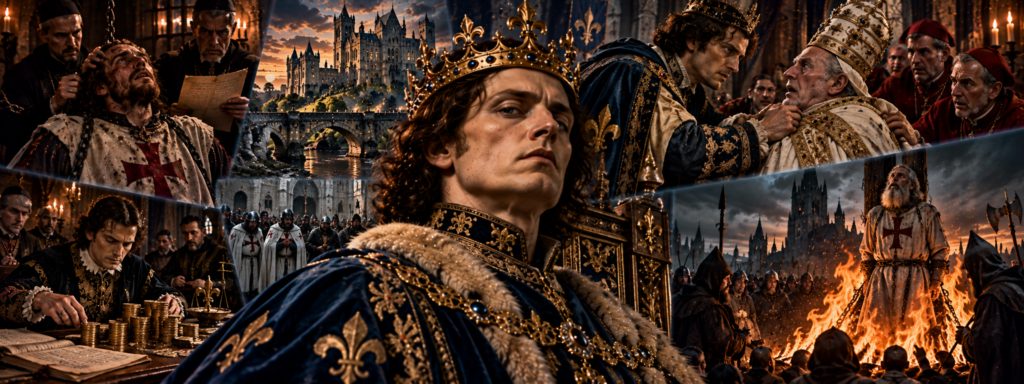
Philip IV of France: The Iron King, the Templar Purge, and the Curse That Haunted a Dynasty
King of France, 1285–1314
He was one of the most powerful kings in medieval Europe, a handsome monarch whose reputation for beauty concealed a reign of extraordinary political violence. Philip IV of France, remembered as Philip the Fair, challenged the authority of the pope, expelled the Jews from his kingdom, manipulated the currency, pursued wealthy financiers, and orchestrated the destruction of the Knights Templar. His enemies accused him of greed, sacrilege, cruelty, and an almost unnatural absence of emotion. A contemporary bishop famously compared him to a statue, while his ministers pursued investigations filled with accusations of heresy, sexual depravity, sorcery, and secret conspiracies. In 1303, royal agents helped seize Pope Boniface VIII in an astonishing confrontation at Anagni. Four years later, hundreds of Templars were arrested in a coordinated operation that became one of medieval Europe’s most notorious persecutions. Their confessions, many extracted under torture, described obscene initiation ceremonies and the worship of mysterious idols. In 1314, the order’s last grand master, Jacques de Molay, was burned in Paris, and a legend emerged that he had summoned both Philip and the pope before God’s judgment. Both men died within the year. Yet Philip’s reign did not end with the destruction of his enemies. In its final months, accusations of adultery within his own family threatened the reputation of the Capetian dynasty. Philip was not clinically mad, and the surviving evidence does not establish that he suffered from delusions or a psychiatric disorder. His story is more unsettling: a king whose determination to defend and expand royal authority helped turn law, religion, finance, and public accusation into instruments of extraordinary power.
The Flames on the Seine: The Death of the Last Templar Grand Master
On March 18, 1314, Jacques de Molay, the last grand master of the Knights Templar, was burned in Paris. His execution brought a grim conclusion to a prosecution that had consumed nearly seven years and helped destroy one of medieval Christendom’s most prestigious religious military orders. The Templars had once enjoyed the patronage of kings and popes, accumulated considerable property, and established an international network supporting warfare and pilgrimage in the Holy Land. By the time Molay faced the flames, their organization had been suppressed, their reputation shattered, and many of their members imprisoned or dispersed.
The immediate circumstances of Molay’s execution were especially dramatic. He and other senior Templars had been brought before church authorities to receive sentences following years of investigation. Molay and Geoffrey de Charney, the Templar preceptor of Normandy, publicly rejected the accusations against the order after earlier confessions. Their declarations were treated as a return to heresy, and the two men were handed over for execution. The speed of the proceedings contributed to the enduring controversy surrounding their deaths.
Later tradition transformed the execution into a supernatural reckoning. According to versions of the story that developed around the event, Molay called upon Pope Clement V and King Philip IV to answer before divine judgment within a year. The words have become inseparable from the legend of the Templar curse, although the exact dramatic summons familiar from popular retellings is not securely established by contemporary evidence. Medieval accounts differ, and later writers embellished the scene.
The coincidence that followed was remarkable. Clement V died on April 20, 1314, only weeks after Molay’s execution. Philip IV died on November 29 of the same year. Both deaths occurred within the period associated with the legendary curse, encouraging interpretations of divine punishment among those already troubled by the destruction of the Templars.
There is no historical evidence that a supernatural curse caused either death. Clement had suffered from recurring illness, while Philip died after a period of deteriorating health associated in accounts with a hunting accident. Nevertheless, the timing offered a compelling narrative to people who believed that divine justice could reveal itself through the fate of rulers.
Philip’s death was especially striking because he had appeared so formidable during his lifetime. He had confronted the papacy, strengthened royal institutions, pursued enemies through judicial proceedings, and compelled much of his kingdom to accept increasingly intrusive government. Yet neither his authority nor his wealth could protect him from an early death at forty-six.
The legend of Molay’s curse survived because it offered something the historical record could not provide: a simple moral ending to an extraordinarily complicated story. The king who had destroyed the Templars was himself destroyed, apparently summoned to judgment by the man he had condemned.
But the real history of Philip IV is darker than the legend. To understand the king behind the persecution, it is necessary to examine the monarchy he inherited and the political ambitions that shaped his reign.
Philip the Fair: The Beautiful King with an Unsettling Reputation
Philip IV was born in 1268, the son of Philip III of France and Isabella of Aragon. He belonged to the Capetian dynasty, whose rulers had spent generations expanding the authority of the French monarchy. By the late thirteenth century, France was one of Europe’s largest and most influential kingdoms, although its political structure remained a complex arrangement of royal lands, feudal obligations, ecclesiastical jurisdictions, and powerful territorial lordships.
Philip became king in 1285 following his father’s death during the disastrous Aragonese Crusade. He was approximately seventeen years old. His accession placed him at the head of a kingdom whose rulers possessed considerable prestige but still faced significant limits upon their practical authority. Regional nobles, church institutions, towns, and foreign rulers all held rights that could conflict with royal ambitions.
His nickname, le Bel, referred to his physical appearance. Philip was remembered as tall and handsome, and later descriptions emphasized his striking royal presence. The title did not imply kindness, fairness, or moral excellence. Indeed, the contrast between his celebrated appearance and the severity of his government became one of the most enduring features of his reputation.
One of the most frequently repeated descriptions of Philip came from Bernard Saisset, Bishop of Pamiers, who reportedly compared the king to a statue. In hostile accounts, Philip appeared beautiful but unresponsive, a ruler who seemed to observe events without ordinary human warmth. The comparison became a foundation for later portrayals of him as unnaturally cold.
The remark must be understood in context. Saisset was involved in a bitter dispute with the monarchy, and his words were not a neutral psychological assessment. The familiar expanded image of Philip as someone who never blinked, spoke, or reacted normally goes beyond what can safely be inferred from the surviving descriptions. A hostile metaphor about a king’s manner cannot establish an emotional disorder.
Philip’s government also depended heavily upon educated officials. Men such as Pierre Flote, Guillaume de Nogaret, and Enguerrand de Marigny played important roles in administration, diplomacy, and political prosecution. Their influence encouraged criticism from aristocrats and clerics who resented the growing power of royal lawyers and administrators.
The king’s reliance upon these officials reflected a broader transformation in medieval government. Written records, legal arguments, financial administration, and formal investigations became increasingly important instruments of authority. Philip’s ministers could translate political disputes into accusations that appeared before courts or councils.
This development made his reign formidable. Opponents did not merely face royal armies; they could confront elaborate proceedings that challenged their legitimacy, property, religious standing, or personal honor. The monarchy increasingly presented its actions as the defense of justice and the common good.
Philip’s reputation for coldness emerged within this atmosphere of expanding royal power. His enemies saw a ruler who allowed lawyers and ministers to pursue opponents with relentless severity. His supporters could regard the same government as disciplined, lawful, and determined to defend the crown.
Neither perspective establishes clinical madness. What the evidence reveals is a monarchy becoming increasingly capable of turning political conflict into formal prosecution.
A Kingdom Hungry for Money: The Financial Pressures Behind the Crown
Philip inherited a powerful kingdom, but power was expensive. Medieval warfare required soldiers, horses, supplies, fortifications, and payments to allies. Royal households consumed substantial resources, while administration and diplomacy imposed additional costs. Traditional revenues from crown lands and feudal rights could not always meet the demands of prolonged conflict.
Philip’s wars with England and Flanders placed particular pressure upon royal finances. In 1294, conflict with Edward I of England intensified over disputes involving Gascony and the obligations of the English king as a French vassal. The resulting struggle required major expenditures and complicated diplomatic arrangements. France also faced costly resistance in Flanders, where royal ambitions encountered powerful towns and determined local opposition.
The monarchy responded through taxation, borrowing, financial expedients, and increasingly assertive claims upon available resources. These measures affected nobles, clergy, townspeople, merchants, and religious communities. They also generated political resistance because the crown’s demands challenged established expectations about taxation and property.
Philip’s financial policies have often been described as evidence of obsessive greed. That characterization overlooks the structural pressures of warfare and government. Yet financial necessity did not make every measure fair or effective. The monarchy’s efforts to obtain revenue could be disruptive, coercive, and deeply unpopular.
One particularly controversial policy involved the currency. Medieval coinage depended upon the relationship between the face value of coins and their precious-metal content. By altering coinage standards and monetary valuations, rulers could obtain short-term financial advantages. Such interventions also affected prices, contracts, debts, and public confidence.
Philip’s government repeatedly modified the coinage. Some changes reduced the precious-metal content of circulating money, while later attempts to restore stronger coinage created additional difficulties. The effects were uneven and complicated, but the policies contributed to economic disruption and resentment. A single precise figure describing a universal loss of more than sixty percent would oversimplify a series of monetary changes involving different coins and periods.
The king also relied upon taxation and extraordinary levies. These demands provoked opposition from groups who believed that royal government was exceeding legitimate limits. The conflict over clerical taxation became especially important because it brought Philip into confrontation with the papacy.
Financial pressure did not alone explain the Templar prosecution, the expulsion of the Jews, or the treatment of Italian financiers. Those events involved religious, legal, and political considerations as well. Nevertheless, the need for money formed an important background to many of the most controversial decisions of Philip’s reign.
The king’s government was becoming more powerful, but that power required resources. The search for those resources would leave deep scars upon French society.
Debased Coins and Angry Crowds: The Paris Riots
Philip’s monetary policies contributed to some of the most visible unrest of his reign. Changes in the currency affected merchants, landlords, tenants, creditors, and wage earners. When the value of money shifted, the consequences could spread rapidly through everyday economic life. People who had agreed to payments under one monetary arrangement could find themselves disadvantaged by another.
The disturbances of 1306 became particularly serious. The government’s attempt to restore stronger coinage created tensions over payments and obligations. In Paris, anger erupted into rioting, and the king faced direct hostility from sections of the population. The unrest demonstrated that even a powerful monarchy could provoke resistance through financial policy.
Philip sought refuge within the fortified Temple complex in Paris, associated with the Knights Templar. The episode later acquired an almost irresistible irony. The king who would order the arrest of the Templars in 1307 had recently found protection within their Paris headquarters during a moment of public danger.
The connection is historically striking, but it should not be transformed into proof that Philip subsequently destroyed the order because he resented having depended upon it. The evidence does not establish such a motive. His later prosecution of the Templars emerged from a more complicated combination of accusations, political calculations, religious concerns, and institutional conflict.
The Paris unrest also reveals the limits of describing Philip’s policies as simple financial madness. Monetary manipulation was an established tool of medieval government, and rulers across Europe faced similar difficulties. The problem lay in the disruptive consequences of repeated changes and the burdens imposed upon the population.
Philip’s government sought to maintain authority through enforcement and administrative control. Yet the riots exposed the vulnerability of royal legitimacy when economic policy damaged public confidence. The king’s ability to command obedience did not guarantee acceptance of his financial decisions.
The crisis also intensified the monarchy’s need to stabilize revenue and restore order. Within the same year, Philip undertook another measure with devastating consequences for a vulnerable population: the expulsion of the Jews from the royal domain.
The Expulsion of the Jews: Confiscation, Debt, and Royal Power
In 1306, Philip IV ordered the expulsion of Jews from territories under his authority. The decision formed part of a longer history of persecution, restriction, and exploitation of Jewish communities in medieval Europe. Jewish residents had lived in French lands for generations, contributing to commerce, lending, scholarship, and local economic life. Their legal position, however, remained vulnerable to royal and ecclesiastical policies.
The expulsion involved confiscation of property and the seizure of assets and debts associated with Jewish lenders. Royal officials supervised the process, and the monarchy sought financial benefit from the transfer of property and claims. The measures disrupted families, businesses, and communities, forcing people to abandon homes and livelihoods.
The policy cannot be understood solely as an attempt to obtain money. Medieval anti-Jewish prejudice, religious hostility, political calculations, and established patterns of royal control all contributed to the environment in which expulsion became possible. Financial advantage was important, but it operated within a broader system of discrimination.
Philip’s government treated Jewish property and credit relationships as resources that could be appropriated through royal authority. Debts owed to Jewish lenders did not simply disappear in every case; the crown could attempt to collect or profit from them. The result was a transfer of economic power accomplished through coercion and exclusion.
The expulsion inflicted serious harm upon Jewish communities. It separated people from established networks and exposed them to uncertainty in territories where their reception depended upon local rulers. Some eventually returned under later arrangements, but the events of 1306 remained a major episode in the history of persecution.
Popular descriptions sometimes present the expulsion as one element in a straightforward sequence in which Philip first robbed Jews, then Italian bankers, and finally the Templars. The financial connections are significant, but the events were not identical in legal structure, religious context, or political purpose. Reducing them to a single plan to erase debts obscures the distinct forms of coercion involved.
The expulsion nevertheless demonstrates the severity with which Philip’s monarchy could pursue financial and political objectives. A ruler celebrated for his appearance and royal dignity authorized policies that deprived an entire religious minority of security and property.
It was one of the clearest examples of how royal authority could become an instrument of systematic injustice.
The Italian Financiers: When Royal Debt Became a Political Weapon
Italian merchant-bankers occupied an important position in the financial life of medieval France. Families and companies from cities such as Florence, Siena, and Lucca provided credit, facilitated payments, and helped move money across political boundaries. Their activities were particularly valuable to monarchs who needed funds for military campaigns or diplomatic commitments before ordinary revenues became available.
These financial relationships created opportunities for conflict. Kings who borrowed heavily could find themselves dependent upon creditors whose commercial networks extended beyond royal control. Conversely, foreign merchants operating within France remained vulnerable to taxation, legal investigations, and changes in royal policy. Philip’s government exploited this imbalance on several occasions.
In 1291, royal authorities took action against Italian merchants and financiers operating in France. The measures involved arrests, investigations, and financial demands, although the circumstances and treatment of different groups varied. Such proceedings could produce substantial payments to the crown while reinforcing the monarchy’s claim to regulate commercial activity.
The Lombards, a broad contemporary designation often applied to Italian financiers, were especially vulnerable to accusations concerning unlawful lending and usury. Medieval Christian doctrine condemned certain forms of interest-taking, but commercial practice depended upon complicated arrangements that could blur the boundary between legitimate transactions and prohibited lending. Royal authorities could invoke these restrictions when pursuing merchants whose wealth offered an attractive source of revenue.
It would be misleading to describe every proceeding against Italian financiers as a simple robbery carried out to cancel Philip’s personal debts. The monarchy’s financial dealings involved many institutions and contractual arrangements, and the surviving evidence does not support one universal explanation. Nevertheless, coercive financial settlements and confiscations formed part of the crown’s methods for obtaining resources.
These actions contributed to a broader pattern. Philip’s government repeatedly asserted that established privileges, whether commercial, aristocratic, or ecclesiastical, could be challenged when they conflicted with royal interests. The language of justice and public necessity accompanied policies that also benefited the treasury.
The Templars would eventually confront a similar assertion of royal authority, although their religious status made the confrontation considerably more complicated. Unlike ordinary financiers, they belonged to an institution formally subject to papal protection. Their destruction would require accusations capable of overcoming that protection.
Before confronting the Templars, Philip had already demonstrated his willingness to challenge an even more formidable religious authority: the pope himself.
The War Against Pope Boniface VIII: Two Powers Claiming Supreme Authority
The conflict between Philip IV and Pope Boniface VIII became one of the defining confrontations between monarchy and papacy in medieval Europe. Its origins lay partly in the question of taxation. Philip needed resources for warfare, while the Church possessed substantial wealth and claimed privileges that limited secular interference in ecclesiastical affairs.
In 1296, Boniface issued Clericis laicos, a papal decree restricting the taxation of clergy by secular rulers without papal authorization. The measure challenged the financial policies of both France and England. Philip responded by restricting the export of precious metals and money from France, creating pressure upon the papacy because ecclesiastical revenues depended upon international transfers.
The dispute temporarily eased, but the underlying disagreement remained unresolved. Philip believed that the French crown possessed extensive authority within its kingdom. Boniface maintained that the Church held spiritual supremacy and that Christian rulers remained accountable to ecclesiastical authority. Their conflict involved jurisdiction, taxation, political sovereignty, and competing interpretations of medieval Christian government.
The confrontation intensified in 1301 after the arrest of Bernard Saisset, Bishop of Pamiers. Saisset had become involved in disputes with royal authorities and faced accusations of treasonable conduct. Philip’s government treated the matter as an offense against the crown, while Boniface regarded the arrest and prosecution of a bishop as an infringement upon ecclesiastical jurisdiction.
Saisset’s famous characterization of Philip as a statue belongs to this hostile political environment. His criticism was not a detached medical observation but part of a broader conflict in which the bishop regarded royal government as dangerously overbearing. The remark acquired lasting significance because it seemed to capture the unsettling contrast between Philip’s magnificent appearance and his severe political conduct.
In 1302, Boniface issued Unam sanctam, a declaration asserting the necessity of submission to papal authority in the spiritual order. The document became famous for its expansive language concerning the relationship between temporal and spiritual power. Philip’s supporters rejected the implications for French sovereignty and intensified their campaign against the pope.
Royal officials assembled accusations against Boniface, including claims involving heresy, sexual misconduct, and other grave offenses. The charges were politically useful because they sought to undermine the pope’s moral and religious legitimacy. Their existence does not establish that the allegations were true, nor does it prove that Philip personally believed every accusation.
The dispute was no longer merely about money. It had become a struggle over whether the French king could defend his authority against papal interference by challenging the character and legitimacy of the pope himself.
In September 1303, that struggle erupted into violence.
The Outrage of Anagni: The Day the Pope Was Seized
In September 1303, Guillaume de Nogaret, a leading royal official, joined forces with members of the Colonna family, longstanding enemies of Boniface VIII. Their objective was to confront the pope at Anagni, a town southeast of Rome where he was staying. The operation became one of the most shocking episodes in the history of medieval relations between monarchy and papacy.
The attackers entered Anagni and seized Boniface. The pope was subjected to intimidation and held for several days before local opposition helped secure his release. Later accounts describe confrontations involving Sciarra Colonna and the elderly pontiff, including the famous allegation that the pope was struck. The details of any physical assault remain disputed, but the seizure itself is well established.
The incident became known as the Outrage of Anagni. It represented an extraordinary challenge to papal dignity. Although medieval popes had previously experienced political violence and imprisonment, the direct involvement of agents acting for the French crown made this confrontation especially consequential.
Philip did not personally lead the expedition. Nogaret and his allies carried out the operation, and historians have debated the precise scope of the king’s instructions and the degree of autonomy exercised by his representatives. Nevertheless, the attack emerged directly from the monarchy’s campaign against Boniface and cannot be separated from Philip’s political objectives.
Popular descriptions sometimes claim that Philip sent soldiers to kidnap the pope because he believed himself divinely infallible. The surviving evidence supports a more complicated interpretation. Philip’s government asserted expansive claims concerning royal sovereignty and defended its actions through legal and religious arguments. Such claims could be extreme, but they were political and ideological positions rather than proof of delusion.
Boniface was released, but his health deteriorated, and he died on October 11, 1303. Later narratives sometimes suggested that humiliation and shock caused his death. His precise medical condition and the relative importance of the events at Anagni cannot be established with certainty.
The pope’s death did not end the conflict between France and the papacy. His successor Benedict XI attempted to address the crisis but died in 1304 after a brief pontificate. The subsequent papal election produced Clement V in 1305, a French-born churchman whose relationship with Philip would become central to the fate of the Templars.
The Outrage of Anagni demonstrated that Philip’s government was prepared to use extraordinary pressure against an institution that claimed authority over Christian rulers. The king had not abolished the papacy, but he had shown that its prestige did not place it beyond the reach of royal political action.
The consequences would become visible in the next great confrontation of his reign.
Clement V and the Avignon Papacy: A Church Under Pressure
Bertrand de Got became Pope Clement V in 1305. His election occurred after a prolonged and difficult process shaped by divisions within the Church and the political pressures surrounding the French monarchy. Clement inherited the unresolved consequences of the conflict between Philip and Boniface VIII, together with wider concerns about ecclesiastical reform and the future of crusading.
Clement’s relationship with Philip was complicated. The French king sought concessions concerning earlier papal actions and pressed for investigations into alleged misconduct by Boniface. Clement attempted to manage these demands while preserving the authority of the papacy. He faced a monarch whose government had already demonstrated its capacity to challenge ecclesiastical institutions through legal accusations and political pressure.
In 1309, Clement established the papal court at Avignon, beginning the period commonly known as the Avignon Papacy. The city was not then part of the kingdom of France itself, although it lay within a region strongly influenced by French political interests. The move reflected several factors, including instability in Italy, diplomatic considerations, and the practical needs of papal government.
Later critics portrayed the Avignon papacy as captivity under French control. The expression Babylonian Captivity of the Church became associated with the period, emphasizing perceived dependence upon the French monarchy. Modern historians generally recognize a more complicated relationship in which the popes retained institutional authority but operated within significant political constraints.
Clement’s handling of the Templar affair illustrates these difficulties. The order belonged to the Church and was formally subject to papal jurisdiction. Philip’s decision to arrest its members without prior papal authorization challenged that jurisdiction. Clement initially objected to aspects of the royal intervention but subsequently became involved in the investigation and suppression process.
The pope’s actions cannot be reduced entirely to helpless obedience. He sought to control proceedings, investigate accusations, and preserve ecclesiastical authority. Yet Philip’s government maintained relentless pressure, and the monarchy’s initial arrests created circumstances that were difficult to reverse.
The resulting struggle unfolded through councils, commissions, interrogations, and legal arguments. The fate of the Templars depended not simply upon whether individual accusations were true, but upon the political relationship between the French crown and the papacy.
By 1307, Philip was preparing an operation of remarkable scale and secrecy.
Friday, October 13, 1307: The Arrest of the Knights Templar
The Knights Templar had emerged during the twelfth century as a religious military order dedicated to protecting pilgrims and supporting Christian interests in the Holy Land. Over generations, they acquired lands, privileges, fortresses, and extensive financial responsibilities. Their members took religious vows, and the order operated through an international network of commanderies.
The fall of Acre in 1291 marked a major turning point. With the loss of the last major Crusader stronghold in the Holy Land, the military orders faced questions about their future purpose. The Templars remained wealthy and influential, but their continued existence became the subject of debate concerning reform, merger, and renewed crusading.
Jacques de Molay became grand master around 1291 or 1292. He sought support for new crusading initiatives and defended the order’s independence. Yet criticism circulated concerning Templar practices, and allegations emerged from individuals who claimed knowledge of misconduct within the organization.
Philip’s government seized upon these accusations. On September 14, 1307, secret royal instructions ordered officials throughout France to prepare for the arrest of the Templars. The coordinated operation was carried out on October 13, when members of the order were seized in numerous locations.
The scale of the arrests was extraordinary. Royal officials acted simultaneously across the kingdom, taking Templars into custody and securing their property. The operation demonstrated the growing administrative reach of the French monarchy. It also prevented the order from organizing an effective collective response before its leaders were imprisoned.
The charges included denial of Christ, desecration of the cross, improper sexual acts during initiation, and worship of mysterious idols. Some allegations described obscene kisses or secret ceremonies that violated Christian doctrine. Their sensational character helped transform the arrests into a religious scandal.
The charges were not established facts. They emerged through denunciations and interrogations conducted under conditions in which coercion played a major role. Their consistency in some records may reflect standardized questioning as much as independent testimony.
Philip presented the arrests as a defense of Christian faith against hidden corruption. His government insisted that the alleged crimes were so grave that immediate intervention was necessary. The pope, however, had not authorized the initial arrests, creating a major jurisdictional dispute.
The operation changed the Templars’ position almost overnight. Men who had belonged to a respected religious order suddenly faced accusations that threatened their lives, property, and spiritual standing. Their institutional prestige offered little protection once the machinery of royal prosecution began operating against them.
Confessions Under Torture: The Dark Machinery of the Templar Trials
Following the arrests, royal investigators began questioning the imprisoned Templars. Many were subjected to torture or the threat of torture, methods that could produce statements reflecting what interrogators wanted to hear rather than what prisoners had actually done. The proceedings created a documentary record filled with admissions, denials, retractions, and contradictory accounts.
Some Templars confessed to denying Christ during initiation. Others admitted to spitting near or upon a cross, participating in improper kisses, or witnessing ceremonies involving mysterious objects. The descriptions varied considerably, particularly regarding the supposed idols. Some accounts mentioned a head or image, while later popular traditions developed the idea of a cat-like idol or a mysterious figure called Baphomet.
These stories became among the most sensational elements of the prosecution. Yet the existence of confessions does not establish the truth of the alleged practices. Prisoners facing physical suffering, isolation, and threats of execution had powerful incentives to agree with accusations. The use of leading questions and standardized interrogations further undermines the reliability of the evidence.
Jacques de Molay initially confessed to certain accusations before later rejecting them. His changing statements reflected the pressures surrounding the investigation. Other senior Templars also moved between confession and denial, sometimes depending upon whether they were questioned by royal officials or ecclesiastical investigators.
The prosecution became increasingly complicated when some Templars attempted to defend their order. Papal commissions gathered testimony, and members challenged the allegations. The opportunity for organized defense, however, was severely restricted by the threat of punishment for those treated as relapsed heretics.
In May 1310, fifty-four Templars were burned near Paris after being condemned as relapsed heretics. Their deaths devastated efforts to mount a collective defense. Men who had hoped to challenge the accusations now faced the possibility that denying earlier confessions could lead directly to execution.
The burnings demonstrated the terrifying power of combining religious prosecution with coercive interrogation. Once a confession had been obtained, retracting it could be interpreted as renewed heresy. The accused were trapped within a process in which both confession and denial carried grave risks.
Philip’s government maintained that it was defending the Church against corruption. Yet the methods used against the Templars made reliable determination of guilt exceptionally difficult. The prosecutions reveal how accusations of hidden religious crimes could become instruments of institutional destruction.
The surviving records do not establish that the Templars practiced the elaborate heresies attributed to them. They do establish that the order was subjected to a devastating campaign of arrests, torture, confiscation, and execution.
The Destruction of an Order: What Happened to the Templar Wealth?
The financial dimension of the Templar affair has inspired centuries of speculation. Popular accounts often suggest that Philip destroyed the order primarily to seize its treasure or eliminate debts owed to its bankers. The Templars possessed substantial property and had performed important financial services, making such explanations attractive. Yet the actual disposition of their assets was more complicated.
Templar property included estates, buildings, agricultural revenues, commanderies, and movable goods distributed across many territories. The order’s wealth was not simply a single treasury of gold waiting to be seized. Its resources supported religious obligations, military activities, administration, and networks of personnel.
After the arrests, royal officials took control of Templar property in France. The process involved inventories, administration, and financial accounting. The crown could benefit from control of revenues and from claims for expenses incurred during the proceedings. Nevertheless, the ultimate legal disposition of the order’s property required papal action.
At the Council of Vienne, Clement V suppressed the Templar order in 1312 through the bull Vox in excelso. The suppression was an administrative decision made amid scandal and controversy, rather than a definitive judicial finding that every allegation against the order had been proved. The distinction matters because the dissolution of an institution does not automatically establish the guilt of its members.
The papacy subsequently directed that most Templar property be transferred to the Knights Hospitaller, another religious military order. Implementation varied by region, and disputes over assets continued. The French crown obtained financial advantages and compensation connected with the proceedings, but it did not simply inherit the entire international Templar fortune.
This outcome complicates the familiar theory that Philip organized the prosecution solely to erase royal debt. Financial interests undoubtedly formed part of the political environment, but historians continue to debate their relative importance. Religious concerns, institutional rivalry, political ambition, and the monarchy’s relationship with the papacy also contributed.
The destruction of the Templars was therefore not a straightforward bank robbery disguised as a heresy trial. It was a prolonged institutional conflict in which religious accusation, coercive justice, royal administration, and financial opportunity reinforced one another.
By 1312, the order had been formally suppressed. Yet the fate of its imprisoned leaders remained unresolved, and the final executions would provide the story with its most enduring legend.
Sorcery at the French Court: Bishops, Wax Figures, and Alleged Poisoning
The Templar prosecutions were not the only proceedings during Philip’s reign to feature extraordinary accusations. The monarchy’s disputes with ecclesiastical opponents sometimes involved claims of sorcery, heresy, sexual misconduct, and conspiracies against royal persons. Such allegations reflected a medieval world in which magic, religious transgression, and political danger could be closely connected.
One important case involved Guichard, Bishop of Troyes. He became the subject of serious accusations involving sorcery and attempts to harm members of the royal family. The allegations included claims about magical practices and the use of a wax image intended to cause injury or death. The proceedings became entangled with suspicions surrounding the death of Queen Joan I of Navarre, Philip’s wife, in 1305.
The case has sometimes been retold as proof that Philip was personally convinced a bishop had murdered his wife through a magical doll. That conclusion goes beyond the evidence. The allegations were made within a political and judicial setting, and the king’s private beliefs cannot be reconstructed with certainty. The accusations themselves are historically significant, but they do not establish that the supposed magic occurred.
The expression voodoo doll, frequently used in popular summaries, is anachronistic and misleading. Medieval European traditions included forms of image magic in which figures could be used symbolically to harm a person. These practices belonged to different religious and cultural contexts from Vodou traditions. Describing the alleged wax figure as a voodoo doll obscures rather than clarifies the historical accusation.
Guichard’s case illustrates how sorcery allegations could become entangled with political disputes and personal rivalries. A charge involving magic was difficult to disprove when the alleged act was secret and its supposed effects could be attributed to ordinary illness or death. Such accusations also carried considerable emotional force in a society where supernatural intervention was widely regarded as possible.
Philip’s government operated within this intellectual and religious environment. Belief in sorcery was not, by itself, evidence of psychiatric delusion in medieval Europe. Nor does the use of magical accusations in prosecutions demonstrate that every official involved sincerely accepted them.
The surviving evidence supports a pattern in which accusations of hidden wrongdoing became powerful tools of political and ecclesiastical conflict. It does not justify diagnosing Philip with paranoid delusions.
Marguerite Porete and the Beguines: Religious Dissent Under Fire
During the same period as the Templar proceedings, another religious controversy culminated in execution. Marguerite Porete, a French mystical writer associated with the wider world of Beguine spirituality, was condemned for her religious teachings. Her case demonstrates the severity with which ecclesiastical authorities could respond to ideas judged heretical.
Porete wrote The Mirror of Simple Souls, a work exploring spiritual union with God and the transformation of the soul through divine love. Her ideas attracted opposition from church authorities, who regarded aspects of her teaching as dangerous. She continued to defend or circulate her work despite earlier condemnation.
In 1310, Porete was burned in Paris after refusing to submit to the proceedings against her. Her execution occurred during the same period as the burning of Templars, creating a striking juxtaposition between different forms of religious prosecution. Both cases involved accusations of heresy and the authority of institutions determined to enforce doctrinal boundaries.
Nevertheless, the cases were not identical. Porete’s prosecution concerned theological teachings and ecclesiastical judgments, while the Templar affair involved an international military order accused of secret initiation crimes. It would be misleading to claim that Philip personally ordered the indiscriminate arrest of all Beguines or that every Beguine community was prosecuted as part of a single royal campaign.
Beguines were women who pursued forms of religious life outside some conventional monastic structures. Their communities varied considerably in organization and practice. Some received support from church authorities, while others attracted suspicion because of concerns about religious independence and unapproved teaching.
Porete’s death reveals the dangers faced by individuals whose spiritual ideas challenged accepted boundaries. It also shows that the period’s religious persecutions cannot be explained solely through Philip’s personality. Ecclesiastical institutions, theologians, inquisitors, and political authorities all participated in defining and enforcing orthodoxy.
The broader atmosphere was one in which allegations of hidden religious danger could carry lethal consequences. Philip’s reign coincided with—and sometimes intensified—these mechanisms of accusation and punishment.
The Tour de Nesle Affair: Sex, Betrayal, and Scandal Inside the Royal Family
In 1314, Philip’s final year, scandal erupted within the royal household. Three of his daughters-in-law became implicated in allegations involving adultery and misconduct. The affair threatened not merely the reputation of individual princesses but the legitimacy of future royal heirs.
Philip had three surviving sons who would eventually succeed him: Louis, Philip, and Charles. Their marriages formed part of the dynasty’s strategy for securing alliances and producing legitimate descendants. The wives of these princes therefore occupied positions of considerable political importance.
Margaret of Burgundy, wife of the future Louis X, and Blanche of Burgundy, wife of the future Charles IV, were accused of adultery with two knights, Philippe and Gautier d’Aunay. Joan of Burgundy, wife of the future Philip V, was accused of knowing about the alleged affairs or assisting in concealing them.
Later accounts connected the discovery to Isabella of France, Philip’s daughter and queen consort of Edward II of England. According to a familiar version, Isabella noticed that the knights possessed embroidered purses previously given to her sisters-in-law. The detail became an enduring feature of the story, although the surviving accounts do not establish every stage of the alleged discovery with certainty.
The accusations were devastating because the legitimacy of royal children depended upon confidence in their parentage. An allegation of adultery involving the wife of a future king could create uncertainty about succession. In a dynasty whose authority rested heavily upon hereditary continuity, that uncertainty had immense political consequences.
The two knights were arrested and subjected to torture. Accounts describe extraordinarily brutal executions, involving mutilation and public punishment. The precise details differ between sources, but the severity of their treatment is beyond doubt.
Margaret and Blanche were imprisoned at Château Gaillard in Normandy. Joan was also detained, although her circumstances and eventual fate differed. She was later restored to favor and became queen consort when her husband succeeded to the throne.
Margaret died in confinement in 1315, after Philip IV’s death. Her death generated suspicions of murder, but the circumstances remain uncertain. Blanche remained imprisoned for years before her marriage to Charles IV was annulled. She eventually entered religious life and died in 1326.
The Tour de Nesle Affair has often been presented as an established account of three guilty princesses whose misconduct destroyed the dynasty. Modern scholarship has questioned that certainty. Contemporary chronicles differ, and the political circumstances raise questions about the reliability of accusations and confessions extracted through torture.
The scandal remains significant regardless of whether every allegation was true. Philip’s government responded to suspected sexual misconduct with severe punishment, imprisonment, and the public destruction of reputations. The affair demonstrated how the sexuality of royal women could become a matter of dynastic security and political coercion.
The Capetian Succession: How a Royal Scandal Became a Dynastic Crisis
Philip IV died in November 1314, leaving the crown to his eldest son, Louis X. The succession initially appeared secure because Philip had three adult sons. Yet the following years produced a remarkable series of deaths and inheritance disputes that eventually ended the direct male Capetian line.
Louis X died in 1316, leaving a disputed succession. His posthumous son, John I, survived only a few days. Louis’s daughter Joan faced obstacles to recognition as queen of France, including questions surrounding her mother’s reputation and the developing preference for male succession.
Philip V subsequently became king, but he died in 1322 without a surviving son. The crown then passed to his brother Charles IV. When Charles died in 1328 without a surviving male heir, the direct male line descended from Philip IV came to an end.
The succession passed to Philip VI of the Valois branch of the Capetian dynasty. Edward III of England, grandson of Philip IV through Isabella of France, also possessed a dynastic claim. Disputes over inheritance and sovereignty contributed to the political background of the Hundred Years’ War, although that conflict had multiple causes and cannot be attributed simply to the Tour de Nesle scandal.
The scandal’s importance lay partly in its effect upon perceptions of legitimacy. Questions surrounding Margaret of Burgundy and her daughter Joan complicated succession arguments during a period when hereditary authority depended upon accepted parentage. Yet it would be inaccurate to claim that the affair alone destroyed the dynasty or directly caused a century of warfare.
The sequence nevertheless encouraged later writers to portray Philip’s family as cursed. Within fourteen years of his death, all three of his sons had become kings and died without leaving a surviving male heir capable of continuing the direct line. The coincidence appeared especially ominous when combined with the legend of Jacques de Molay.
The story of the doomed Capetians became a powerful theme in historical fiction and popular memory. Maurice Druon’s twentieth-century novel sequence The Accursed Kings drew upon this atmosphere of intrigue, scandal, and dynastic collapse. Such literature helped reinforce the idea that Philip’s persecution of the Templars had brought supernatural punishment upon his descendants.
The historical explanation is less supernatural but no less dramatic. Dynastic succession depended upon mortality, fertility, marriage, political acceptance, and competing interpretations of inheritance. Philip’s successors encountered an unfortunate combination of these vulnerabilities.
The monarchy he had worked so hard to strengthen survived, but the direct male line of his family did not.
The Curse of Jacques de Molay: Divine Judgment or Historical Coincidence?
The legend of Jacques de Molay’s curse remains one of the most famous stories associated with Philip IV. According to its familiar form, the condemned grand master summoned Pope Clement V and King Philip to appear before God’s judgment within a year. Both men died in 1314, creating a coincidence that seemed to confirm the curse.
The legend developed from accounts of Molay’s final declarations and later interpretations of the deaths. Contemporary evidence supports his public rejection of earlier confessions before execution, but the exact prophetic wording commonly repeated today is not securely documented. Later chronicles and literary retellings shaped the story into a dramatic moral judgment.
Clement V died on April 20, 1314. His health had been poor, and his death does not require a supernatural explanation. Philip died on November 29 after an illness associated in some accounts with a hunting accident. The medical details remain uncertain, but there is no evidence that the deaths were caused by anything beyond natural circumstances.
The legend nevertheless carried enormous emotional force. Medieval Christians often interpreted sudden death, military defeat, disease, or dynastic disaster through a providential framework. A ruler accused of grave injustice might be expected to face divine punishment, especially when his victims were members of a religious order.
The subsequent deaths of Philip’s sons strengthened the curse narrative. The direct male Capetian line ended in 1328, allowing later writers to connect the Templar executions with a sequence of royal misfortunes. The story became increasingly elaborate as generations passed.
The curse also provided a moral structure for a history otherwise filled with uncertainty. The Templars had been accused of shocking crimes, but the evidence against them was compromised by torture. Their destruction involved both royal and papal authority. The legend allowed audiences to imagine that a higher court had eventually corrected the failures of earthly justice.
Yet historical explanation requires separating coincidence from causation. The deaths of Philip and Clement cannot establish the supernatural power of Molay’s words, even if he uttered some form of appeal to divine judgment.
The curse remains historically important not because it can be demonstrated as real, but because it reveals how contemporaries and later generations struggled to interpret the destruction of the Templars. It transformed a complicated political and religious persecution into a story about guilt, punishment, and the limits of royal power.
Was Philip IV Really Mad? Ruthlessness, Suspicion, and the Limits of Diagnosis
Philip IV does not belong among monarchs for whom surviving evidence establishes episodes of clinical mental illness. His reputation for madness or unnatural behavior arose from the severity of his policies, the accusations made against his enemies, and descriptions of his personal manner. These features are historically significant, but they do not justify a psychiatric diagnosis.
The famous comparison of Philip to a statue illustrates the problem. Bernard Saisset was a hostile political figure whose description expressed contempt for the king’s apparent reserve. It cannot establish that Philip lacked emotion, empathy, or normal social functioning. Claims that he was incapable of ordinary feeling go beyond the evidence.
The sorcery prosecutions likewise require context. Belief in magic and supernatural danger was widespread in medieval Christian society. Accusations involving wax figures, heresy, or secret rituals could reflect sincere belief, political manipulation, or a combination of motives. They do not establish that Philip suffered from delusions.
His conflict with Boniface VIII involved competing claims about sovereignty and ecclesiastical authority. Philip’s government pursued aggressive policies and supported actions that violated papal dignity, but those actions emerged from recognizable political objectives. They were not inexplicable outbursts of irrationality.
The Templar prosecution presents the most disturbing example of his government’s methods. The coordinated arrests, use of torture, exploitation of sensational allegations, and destruction of the order demonstrate an extraordinary willingness to employ coercive power. Yet the operation was administratively organized and sustained over years. Its brutality should not be confused with evidence of psychiatric disorder.
Financial policies also contributed to his reputation. Coinage manipulation, taxation, expulsions, and actions against financiers caused hardship and resentment. These measures reflected fiscal pressures and royal ambitions, although their consequences could be severe. Describing them as economic madness risks substituting a psychological label for an analysis of government policy.
Philip’s reign is therefore better understood through the development of royal institutions, the relationship between law and coercion, the demands of warfare, and the political use of religious accusation. His decisions were consequential and sometimes destructive, but the surviving evidence does not establish that they resulted from clinical insanity.
The distinction matters because calling a ruler mad can obscure responsibility. A policy does not become less deliberate simply because it appears cruel or excessive. Philip’s government possessed the administrative capacity to pursue its objectives through coordinated legal and political action.
His story belongs within the history of reputedly mad monarchs because his contemporaries and later generations found aspects of his conduct deeply unsettling. Yet the historical evidence points toward a ruler whose actions were shaped by ambition, institutional conflict, and an expansive conception of royal authority rather than a demonstrable mental disorder.
The Legacy of Philip IV: The King Who Put an Entire Order on Trial
Philip IV ruled France from 1285 until 1314, a period of profound change in the relationship between monarchy, finance, law, and religion. His government strengthened royal administration and expanded the capacity of the crown to pursue political objectives through written orders, investigations, taxation, and judicial proceedings. These developments contributed to the growth of centralized monarchy, but they also enabled severe forms of coercion.
His wars placed heavy demands upon royal finances. Currency manipulation and extraordinary revenue measures disrupted economic life and provoked resistance. The expulsion of Jews in 1306 inflicted devastating harm upon communities whose property and financial relationships became targets of royal policy. Proceedings against Italian financiers similarly demonstrated the vulnerability of wealthy groups to political intervention.
His confrontation with Boniface VIII challenged longstanding assumptions about papal authority. The Outrage of Anagni became a symbol of the violence that could accompany disputes between secular and ecclesiastical power. The subsequent relationship between the French monarchy and Clement V created circumstances in which the Templar order became increasingly vulnerable.
The persecution of the Templars remains Philip’s most notorious legacy. The arrests of October 1307 demonstrated the administrative reach of the monarchy, while the subsequent interrogations exposed the dangers of torture and coercive confession. The suppression of the order in 1312 and the execution of Jacques de Molay in 1314 transformed a powerful religious institution into a symbol of injustice and conspiracy.
The Tour de Nesle Affair added a final scandal to Philip’s reign. Accusations involving his daughters-in-law led to brutal executions and imprisonment, raising questions about royal succession and the political vulnerability of women within dynastic marriage. The later deaths of his three sons without surviving male heirs encouraged the development of legends linking the family’s misfortunes to the supposed curse of the Templars.
Philip’s death in November 1314 ended a reign marked by formidable political ambition and repeated controversy. The monarchy he helped strengthen continued to develop, even as the direct male line of his dynasty disappeared within fourteen years. His reputation remained divided between interpretations emphasizing administrative achievement and those condemning the violence and coercion of his government.
Philip IV of France did not need to be mad to become one of the most unsettling rulers of the Middle Ages. His reign demonstrates how a monarch could combine administrative discipline, religious conviction, political ambition, and ruthless methods to devastating effect. He challenged a pope, expelled a religious minority, manipulated the currency, pursued wealthy financiers, and helped destroy an international order whose members had once enjoyed the protection of Christendom’s highest authorities. His government transformed accusations into prosecutions, prosecutions into confiscations, and confessions extracted under torture into instruments of institutional destruction. Yet his final year exposed the fragility of the dynasty he had sought to secure. Scandal erupted within his family, the last Templar grand master died in flames, and both Philip and Clement V were dead before the year ended. Later generations imagined that Jacques de Molay had summoned his persecutors before divine judgment, giving the story a supernatural ending that history cannot verify. The reality is more disturbing because it requires no curse. Philip’s greatest power lay in his ability to make extraordinary acts of coercion appear as the ordinary work of government. His reign leaves a question that reaches far beyond medieval France: when a ruler possesses the authority to define justice, accuse enemies, and control the institutions that judge them, how easily can the machinery of law become the machinery of persecution?