
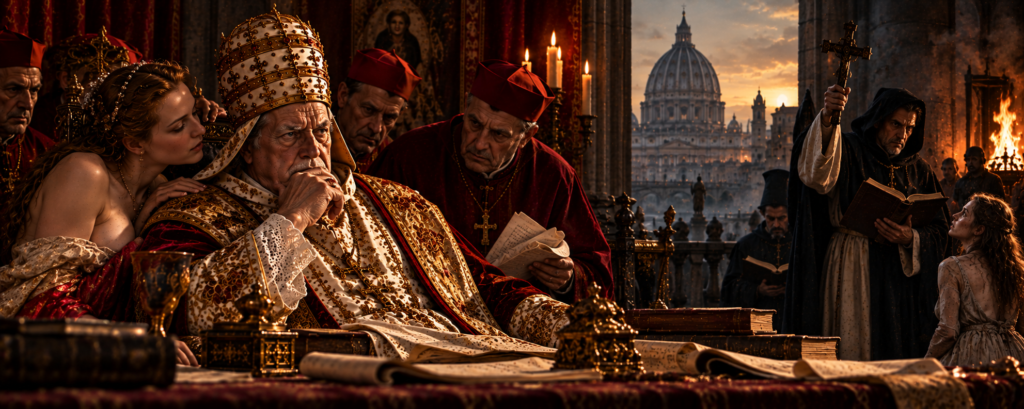
Innocent VIII: The Pope of Nepotism, Debt, and the Gathering Witch Hunt
Innocent VIII — 1484–1492
The Pope Who Gave Witch-Hunters a Weapon
On December 5, 1484, only months after Giovanni Battista Cibo became Pope Innocent VIII, the papal chancery issued a document whose consequences would echo far beyond the immediate problems it was intended to address. The bull Summis desiderantes affectibus described disturbing reports from parts of Germany, where men and women were said to have abandoned the Christian faith, entered relationships with demons, destroyed crops, harmed livestock, caused infertility, and inflicted mysterious suffering upon their neighbors. These accusations belonged to a rapidly developing conception of witchcraft in which traditional fears of harmful magic were becoming fused with ideas about heresy, demonic conspiracy, and deliberate allegiance to Satan. The pope’s intervention gave two Dominican inquisitors, Heinrich Kramer and Jacob Sprenger, explicit support for pursuing such offenses in specified German territories.
Innocent VIII did not invent the European witch hunt, and his bull did not suddenly create witch persecution out of nothing. Belief in harmful magic was centuries old, prosecutions had occurred before his election, and the fully developed mass witch hunts of the sixteenth and seventeenth centuries still lay in the future. Yet the bull mattered because it confirmed that accusations of demonic witchcraft could fall within inquisitorial jurisdiction and rebuked those who obstructed the inquisitors. Heinrich Kramer would subsequently place the text prominently alongside the notorious Malleus Maleficarum, helping give his campaign against supposed witches the appearance of powerful papal endorsement.
The distinction is essential because Innocent has sometimes been credited with formally approving or commissioning the Malleus Maleficarum. He did neither. The bull preceded the book, did not mention it, and was issued to address disputes over inquisitorial authority rather than to endorse a future witch-hunting manual. Nevertheless, Innocent had provided Kramer with something extremely valuable: a papal document affirming the seriousness of the witchcraft accusations he wanted to pursue.
That alone would give Innocent VIII a troubling place in European history, but his pontificate contained other scandals that make his inclusion among the Wicked Popes easier to understand. He openly acknowledged illegitimate children born before his elevation to the papacy and used his position to advance his family. His government suffered chronic financial weakness, while the multiplication and sale of offices became an important method of raising money. His political dealings with Naples repeatedly exposed the weakness of papal authority, and his final years brought the papacy into contact with the exiled Ottoman prince Cem, who effectively became an extraordinarily valuable political hostage.
Innocent was not a spectacular monster in the mold created by later legends about the Borgias. He did not possess the terrifying energy of some medieval warrior popes, nor did he leave behind a single murderous conspiracy comparable to the darkest episode of Sixtus IV’s reign. His failures were quieter, more administrative, and in one respect more far-reaching. Under an outwardly unremarkable pope, corruption, nepotism, political bargaining, and institutional support for witch persecution became part of a papacy already moving toward one of the most notorious eras in its history.
The man responsible had once seemed unlikely to become pope at all.
Giovanni Battista Cibo: The Man Behind Innocent VIII
Giovanni Battista Cibo was born in Genoa in 1432, although his family had connections with Naples and the wider Mediterranean political world. His father, Arano Cibo, served in important administrative positions and eventually became associated with the court of King René of Anjou at Naples. Giovanni therefore grew up with access to social and political networks unavailable to most ordinary churchmen. He did not come from one of the dominant Roman dynasties, but neither did he emerge from complete obscurity.
His early life later became surrounded by stories concerning youthful pleasures, romantic affairs, and numerous illegitimate children. Some hostile accounts dramatically inflated the number, giving him as many as sixteen children and sometimes attaching symbolic significance to the supposed total. Those claims should not be repeated as established fact. What is securely documented is that Giovanni fathered at least two acknowledged children, Franceschetto Cibo and Teodorina Cibo, before becoming pope.
Clerical fatherhood was hardly unprecedented in fifteenth-century Italy. Many churchmen entered ecclesiastical careers after having sexual relationships, and celibacy was frequently violated in practice. What distinguished the Renaissance papacy was the increasingly open manner in which some pontiffs incorporated their children or other relatives into political strategies. Family ties could become instruments of diplomacy, wealth, and dynastic advancement.
Giovanni’s ecclesiastical career eventually took precedence over whatever secular ambitions he may once have possessed. He entered church service and benefited from influential connections. His administrative abilities and patrons helped him move through the hierarchy. Like many Renaissance prelates, he combined ecclesiastical advancement with the social expectations of an aristocratic political world.
His rise would eventually bring him into the orbit of the della Rovere family and Pope Sixtus IV.
From Bishop to Cardinal
Giovanni became bishop of Savona in 1467 and was transferred to the bishopric of Molfetta in 1472. These appointments gave him income, prestige, and experience within the higher administration of the Church. His career advanced during the pontificate of Sixtus IV, whose reign was increasingly dominated by family politics. Giovanni proved capable of navigating this environment.
In 1473, Sixtus created him a cardinal. The appointment brought Giovanni into the College of Cardinals and placed him among the men who would determine the future direction of the papacy. He became associated with Giuliano della Rovere, Sixtus’s powerful nephew and the future Pope Julius II. That relationship would prove decisive.
Giovanni did not possess the commanding reputation of some other cardinals. He was not regarded as one of Europe’s greatest theologians, nor had he built an independent political dynasty comparable to the most powerful Italian families. His relative weakness could actually become an advantage in a conclave. Powerful factions sometimes preferred a candidate they believed could be influenced.
By the time Sixtus IV died in August 1484, the College of Cardinals was deeply divided. The late pope’s nepotism and political wars had produced enemies, alliances, and unresolved grievances. Rome itself was tense, with rival factions maneuvering for advantage. The election of the next pope would take place within this atmosphere of suspicion and bargaining.
Giovanni Battista Cibo was about to benefit from it.
A Conclave Filled With Bargaining
The conclave of 1484 was shaped by competition between powerful cardinals, particularly Giuliano della Rovere and Rodrigo Borgia. Both men possessed substantial influence, but each faced opposition that made his own election difficult. The solution was to support a candidate acceptable enough to competing factions. Giovanni Cibo emerged as that compromise.
Contemporary and later accounts describe extensive bargaining surrounding the election. Promises of offices, benefices, and favors were part of the political culture of Renaissance conclaves, although individual allegations about precisely what was promised must be treated cautiously. The atmosphere was nevertheless far removed from an idealized gathering concerned solely with spiritual discernment. Cardinals were negotiating over power.
Giuliano della Rovere played an important role in securing Cibo’s election. The expectation appears to have been that the new pope would remain politically dependent upon the powerful cardinal who had helped elevate him. Cibo was elected on August 29, 1484, and chose the name Innocent VIII. His papacy began with the shadow of another man’s influence hanging over it.
The choice of name would acquire an ironic quality in later histories. Innocent VIII would preside over corruption, nepotism, political bargaining, and the strengthening of inquisitorial action against alleged witchcraft. Yet judging him solely through the irony of his papal name would be too easy. His failures emerged from structural weaknesses within the Renaissance papacy as much as from personal vice.
He inherited an institution already burdened by the ambitions and debts of Sixtus IV.
The Ruins Left by Sixtus IV
Sixtus IV had spent heavily on warfare, architectural projects, cultural patronage, and the advancement of relatives. The Sistine Chapel, Vatican Library, and improvements to Rome represented genuine achievements, but they came alongside expensive political campaigns. The Pazzi War and War of Ferrara had placed additional pressure upon papal finances. Innocent inherited the consequences.
The new pope also inherited a political system filled with powerful relatives of his predecessor. Giuliano della Rovere remained one of the most influential cardinals in Rome. Girolamo Riario still controlled territories acquired through Sixtus’s patronage. Other families watched carefully for opportunities created by the transition.
Innocent lacked the political strength necessary to dominate these factions immediately. He depended upon alliances and frequently struggled to impose a consistent policy. His government would therefore become reactive, balancing competing interests rather than controlling them. This weakness contributed to the financial and political instability of his reign.
The papacy also faced expectations that could not easily be reduced. Cardinals, officials, ambassadors, relatives, and foreign rulers all expected favors. Maintaining the court required money, while defending the Papal States demanded additional resources. Innocent entered office already facing a dangerous gap between papal ambitions and papal income.
His response would make corruption one of the defining features of his government.
A Papacy Desperate for Money
Financial problems plagued Innocent VIII throughout his reign. The papal treasury lacked the resources necessary to meet the demands placed upon it. Revenue from traditional sources proved insufficient, especially when combined with debts and the costs of political administration. The pope needed money continuously.
One solution was the expansion and sale of offices. Positions within the papal administration could be created, transferred, or sold in exchange for payments. Officeholders might then recover their investment through salaries, fees, or privileges associated with the position. The system transformed parts of ecclesiastical administration into a market.
Venality in church office was not invented by Innocent. Earlier popes had relied upon similar practices, and the distinction between legitimate administrative fees and corrupt sale of influence could become blurred. Under Innocent, however, financial desperation encouraged extensive reliance upon such mechanisms. Critics saw the papal bureaucracy becoming increasingly commercialized.
The danger went beyond appearances. When offices were treated primarily as revenue-generating assets, administrative competence could become secondary to the ability to pay. The practice also encouraged officials to extract money from those who needed their services. Corruption could reproduce itself throughout the institution.
A papacy struggling to remain solvent was effectively selling pieces of its own government.
Offices for Sale
The creation of new offices offered an attractive short-term solution because buyers provided immediate cash. A newly established administrative college could be filled with men willing to purchase positions. The pope gained revenue without imposing a conventional tax. The cost was transferred into the future operation of the bureaucracy.
The practice created perverse incentives. Officeholders who had paid substantial sums naturally expected returns on their investment. Fees could become more aggressive, while access to ecclesiastical administration became increasingly dependent upon money. Spiritual government risked appearing indistinguishable from commercial enterprise.
Critics of the Renaissance Church would later point repeatedly to the sale of offices as evidence of corruption. The practice contributed to the wider atmosphere of dissatisfaction that preceded the Protestant Reformation. Innocent died decades before Martin Luther’s challenge, but the institutional habits visible during his reign helped create the world Luther would attack. The papacy’s credibility was being damaged gradually through practices that appeared financially convenient in the moment.
Innocent’s weakness made reform particularly difficult. Reducing expenditure would have required confronting powerful beneficiaries of the existing system. Increasing ordinary revenue was politically challenging. Selling offices offered immediate relief, even though it deepened the longer-term problem.
The same logic would shape his treatment of his own family.
The Pope Who Acknowledged His Children
Unlike earlier popes who disguised inconvenient family relationships behind the language of nephews and cousins, Innocent openly acknowledged Franceschetto and Teodorina Cibo as his children. They had been born before his papal election and before the later stages of his ecclesiastical career. Their existence was not a secret whispered only by enemies. They became visible members of the papal family’s political world.
The acknowledgement was striking because the pope represented an institution that demanded clerical celibacy. Innocent’s children were evidence of a sexual past inconsistent with the ideal expected of churchmen. Yet fifteenth-century Rome had become accustomed to contradictions between clerical ideals and aristocratic practice. The scandal lay increasingly not in the existence of such children but in how aggressively they were promoted.
Franceschetto became particularly important. He was not known for exceptional administrative or military ability, but his father’s elevation transformed his prospects. The pope could provide wealth, social standing, and marriage connections that would have been difficult to obtain otherwise. Franceschetto became another example of how papal office could function as an engine of family advancement.
Teodorina also benefited from her father’s position, although her political role was less dramatic. Through marriage and patronage, the Cibo family entered networks of Italian aristocratic power. Innocent’s election therefore changed not merely his own status but the fortunes of his descendants. The papacy became a dynastic opportunity.
The most spectacular example would involve an alliance with the very family Sixtus IV had once tried to destroy.
Franceschetto Cibo: The Pope’s Problematic Son
Franceschetto Cibo acquired a reputation for gambling, extravagance, and dependence upon his father’s position. Hostile accounts portray him as irresponsible and greedy, although individual stories should be approached carefully. He certainly benefited enormously from papal patronage. His lifestyle became a source of embarrassment for those who expected greater dignity from the pope’s household.
Gambling was particularly associated with his reputation. Renaissance aristocratic culture included gaming, and wealthy men could lose enormous sums. Franceschetto’s access to papal wealth made such behavior politically sensitive. Every story about his debts or excesses reinforced the impression that ecclesiastical resources were supporting a pope’s son.
Innocent nevertheless continued advancing him. Family loyalty appears to have outweighed concerns about public criticism. The pope sought a marriage capable of giving Franceschetto greater political status. That search eventually produced an extraordinary reconciliation between the papacy and the Medici.
The alliance demonstrates how quickly Renaissance enemies could become relatives when political interests changed. Sixtus IV had fought Lorenzo de’ Medici after the Pazzi conspiracy. Innocent VIII would bring Lorenzo’s family directly into the papal dynasty. The transformation occurred within little more than a decade.
Marriage would accomplish what warfare had failed to achieve: a durable connection between Rome and the Medici.
The Pope Makes Peace With Lorenzo de’ Medici
Relations between the papacy and Lorenzo de’ Medici improved dramatically under Innocent VIII. Lorenzo remained the dominant political figure in Florence and one of Italy’s most skilled diplomats. Innocent needed stable relationships with powerful neighboring states. Both men had reasons to cooperate.
The alliance became dynastic when Franceschetto Cibo married Maddalena de’ Medici, Lorenzo’s daughter, in 1488. The marriage linked the pope’s acknowledged son to the family that had survived the Pazzi conspiracy. It also provided Franceschetto with prestigious connections. Lorenzo gained valuable access to the papal court.
The marriage represented a remarkable reversal of recent history. Ten years earlier, men associated with the papal government had attempted to destroy Medici power in Florence. Now the reigning pope welcomed Lorenzo’s daughter into his own family. Political necessity had transformed former enemies into allies.
The arrangement also carried ecclesiastical consequences. Lorenzo wanted advancement for his son Giovanni de’ Medici. Innocent eventually created Giovanni a cardinal while he was still extraordinarily young. The boy would later become Pope Leo X.
Once again, family politics were shaping the future leadership of the Church.
The Thirteen-Year-Old Cardinal
Giovanni de’ Medici was born in 1475, the second son of Lorenzo de’ Medici. His family intended him for an ecclesiastical career from childhood. Through the extraordinary opportunities available to powerful dynasties, he accumulated church positions at an age when ordinary boys were still receiving basic education. His father’s alliance with Innocent accelerated his rise.
In 1489, Innocent created Giovanni a cardinal in secret, with the appointment publicly recognized later. He was only thirteen years old. The elevation represented one of the clearest examples of how ecclesiastical office could be used to reward political alliances. No serious argument could pretend that a child had acquired the experience normally expected of a prince of the Church.
Lorenzo had secured an extraordinary advantage for the Medici. A cardinal in the family provided influence within Rome and positioned Giovanni for future advancement. The investment eventually produced results beyond anything Lorenzo could have guaranteed. In 1513, Giovanni became Pope Leo X.
Innocent’s nepotism had therefore merged with Medici dynastic ambition. His son’s marriage brought the families together, while a cardinal’s hat rewarded the alliance. The arrangement demonstrated how papal office could be exchanged for political loyalty and family prestige.
The spiritual government of Christianity had become entangled with the marriage negotiations of Renaissance aristocrats.
Naples: The Enemy Innocent Could Not Control
Innocent’s most difficult political relationship involved King Ferrante of Naples. Ferrante was an experienced and ruthless ruler who defended his kingdom against both internal barons and external interference. The papacy claimed feudal rights over Naples, creating a complicated relationship between pope and king. Disputes over tribute and authority repeatedly produced tension.
Innocent initially became involved in opposition to Ferrante during the revolt of the Neapolitan barons. Several nobles rebelled against the king, seeking support from outside powers. The pope saw an opportunity to assert papal influence. His involvement transformed the rebellion into an international political crisis.
Ferrante responded with determination. The king had little intention of allowing the papacy to dictate the internal government of Naples. Military and diplomatic pressure forced Innocent to confront the limits of his authority. The pope lacked the resources necessary to impose his will decisively.
The conflict revealed a recurring weakness of the pontificate. Innocent could issue spiritual threats and negotiate alliances, but he struggled to translate papal claims into effective political control. Powerful rulers understood that weakness. Ferrante repeatedly exploited it.
The pope’s intervention would end with promises that proved dangerously unreliable.
The Barons’ Revolt
The revolt of the Neapolitan barons erupted from deep tensions between Ferrante and powerful nobles within his kingdom. The rebels feared the king’s efforts to strengthen royal authority and reduce aristocratic independence. They sought support from Innocent VIII, who had his own grievances against Ferrante. The pope’s involvement gave the rebellion a wider political dimension.
Innocent recognized the rebels’ cause and attempted to pressure Ferrante. Papal forces and diplomatic maneuvers became part of the struggle. The conflict placed additional strain upon the already weak papal treasury. Warfare was expensive, and Innocent lacked the financial resources enjoyed by stronger territorial rulers.
Negotiations eventually produced an agreement in 1486. Ferrante promised concessions and offered assurances concerning the treatment of the rebellious nobles. Innocent accepted the settlement. The pope apparently believed that his intervention had secured meaningful protections.
Ferrante soon demonstrated otherwise. Once the immediate danger passed, he moved ruthlessly against his opponents. Several rebel barons were arrested, imprisoned, or eliminated despite earlier assurances. The episode humiliated Innocent and revealed how little power he possessed to enforce the agreement.
The pope had trusted a king whose political survival depended upon destroying the men Innocent had supported.
Ferrante’s Revenge
Ferrante’s treatment of the defeated barons became notorious. His reputation for political ruthlessness was already formidable, and the aftermath of the rebellion reinforced it. Nobles who had relied upon negotiated protections discovered that royal promises offered limited security. Arrests and punishments followed.
Innocent protested the king’s actions. From the papal perspective, Ferrante had violated commitments made during the settlement. The pope’s credibility was damaged because men who had trusted his protection suffered after laying down their resistance. A ruler who could not protect his allies risked losing future influence.
The conflict resumed in different forms. Innocent threatened Ferrante with ecclesiastical sanctions and challenged his rights to the kingdom. The king responded through diplomacy and resistance. Neither side achieved complete control over the other.
The dispute also drew other Italian powers into negotiations. Lorenzo de’ Medici often favored maintaining political balance rather than allowing the conflict to destroy regional stability. His relationship with Innocent became increasingly important in managing the crisis. The pope’s family alliance with the Medici therefore had practical diplomatic value.
Yet Innocent’s weakness remained visible. His authority could frighten lesser opponents, but Ferrante repeatedly demonstrated that a determined king could resist Rome.
The Bull That Would Haunt European History
While Innocent struggled with Italian politics, a different problem emerged north of the Alps. Heinrich Kramer, a Dominican inquisitor active in German-speaking territories, encountered resistance to his efforts against alleged witchcraft. Local ecclesiastical authorities did not always accept his jurisdiction or methods. Kramer wanted clearer support from Rome.
The resulting papal bull, Summis desiderantes affectibus, was issued on December 5, 1484. It named Kramer and Jacob Sprenger and confirmed their authority to proceed against persons accused of serious forms of witchcraft in specified regions. The document described alleged acts involving demons, reproductive harm, destruction of crops, damage to animals, and other forms of maleficium. It also ordered ecclesiastical authorities not to obstruct the inquisitors.
The language is deeply unsettling to modern readers because it treats extraordinary accusations as sufficiently credible to justify inquisitorial intervention. People were said to cause infertility, destroy unborn children, ruin agricultural production, and inflict suffering through supernatural means. Such claims were not investigated according to modern standards of evidence. They existed within a worldview in which demonic action was considered a real possibility.
Innocent’s bull did not create these beliefs. The theological and legal foundations for prosecuting harmful magic had developed over generations. Yet the document gave institutional support to inquisitors who wanted to pursue accused witches more aggressively. Its significance lies in legitimizing and facilitating an existing trend.
One of those inquisitors would soon become infamous.
Heinrich Kramer: The Inquisitor Who Wanted More Power
Heinrich Kramer, also known by the Latinized name Henricus Institoris, was a Dominican friar and inquisitor. He possessed intense convictions about witchcraft and the dangers he believed witches posed to Christian society. His activities brought him into conflict with local authorities who questioned his jurisdiction or methods. The papal bull provided him with valuable support.
Kramer was not simply a neutral investigator responding to widespread public demand. He actively promoted an expansive understanding of witchcraft and pursued suspects with determination. His writings reveal a deeply misogynistic conception of women and a willingness to interpret sexual, religious, and social anxieties through the framework of demonic conspiracy. These attitudes would become especially visible in the Malleus Maleficarum.
Innocent’s bull addressed Kramer’s institutional difficulties rather than endorsing every future claim he would make. The distinction matters because Kramer later used papal authority strategically. By reproducing Summis desiderantes in association with his witch-hunting manual, he encouraged readers to see his work as aligned with papal policy. The bull became a credential.
Jacob Sprenger’s relationship to the Malleus is more complicated than older histories often suggested. Although his name became associated with the work, modern scholarship has questioned the extent of his actual authorship and collaboration with Kramer. Innocent’s bull, however, did name both men as inquisitors. The later literary history should not be projected backward onto the papal document.
What Innocent unquestionably did was strengthen Kramer’s hand at a crucial moment.
The Failed Witch Trial at Innsbruck
Kramer’s methods soon generated controversy in Innsbruck, where he pursued women accused of witchcraft in 1485. The proceedings became especially associated with Helena Scheuberin, a woman Kramer regarded as suspicious and hostile to his authority. His questioning included intense interest in sexual behavior. The trial exposed the disturbing assumptions underlying his approach.
Georg Golser, bishop of Brixen, became increasingly uncomfortable with Kramer’s conduct. The bishop eventually intervened and brought the proceedings to an end. Kramer was ordered to leave the region. This episode is important because it demonstrates that fifteenth-century church authorities were not uniformly enthusiastic about aggressive witch prosecution.
The failure at Innsbruck undermines simplistic narratives in which the entire medieval Church moved together toward witch hunting. Local bishops could resist inquisitors, and legal authorities could reject cases they considered improper. Kramer’s zeal exceeded what some contemporaries found acceptable. Papal authorization did not guarantee local cooperation.
The humiliation appears to have influenced his later writing. Kramer wanted to defend his methods, explain the supposed danger of witchcraft, and persuade authorities to act more aggressively. The Malleus Maleficarum emerged from this environment. Its hostility toward women accused of witchcraft reflected his own obsessions as much as official church policy.
The pope had opened a door, but Kramer intended to push far beyond it.
The Malleus Maleficarum
The Malleus Maleficarum, usually translated as The Hammer of Witches, appeared in the later 1480s. The work became one of the most notorious texts in the history of European witch persecution. It presented elaborate arguments concerning the reality of witchcraft, the supposed characteristics of witches, methods of investigation, and procedures for prosecution. Its treatment of women was especially hostile.
Kramer is now generally regarded as the principal author. Jacob Sprenger’s traditional co-authorship has been seriously questioned, and historians should avoid presenting the older attribution as unquestioned fact. The book drew upon theological, legal, and folkloric traditions while adding Kramer’s own aggressive interpretations. It was not an official papal handbook.
Innocent VIII did not commission the Malleus, write it, or formally approve its contents. The University of Cologne’s relationship to the book has also been misrepresented in later accounts, particularly through claims that its theologians enthusiastically endorsed the work. Kramer sought legitimacy from multiple directions because his methods had encountered resistance. The book’s presentation attempted to make his authority appear broader than it actually was.
Nevertheless, Summis desiderantes was printed with the Malleus in some editions. Readers encountering the papal bull alongside the manual could easily assume a direct relationship. The document gave Kramer precisely the kind of institutional prestige he needed. Innocent’s intervention therefore became entangled with the later influence of a book he had never specifically endorsed.
This is where the historical responsibility becomes complicated but impossible to ignore.
Did Innocent VIII Start the Witch Hunts?
The claim that Innocent VIII started the European witch hunts is inaccurate. Witchcraft prosecutions existed before 1484, and the intellectual development of the demonic witch stereotype had been underway for decades. Local secular and ecclesiastical courts already prosecuted people for magical practices. The great waves of witch trials would occur primarily after Innocent’s lifetime.
Nor did Summis desiderantes create a universal new law requiring the execution of witches. Its immediate purpose was to confirm inquisitorial authority in particular territories and prevent obstruction. The bull assumed that the alleged crimes were real possibilities, but it did not establish the entire legal machinery later associated with mass witch hunting. Its scope was narrower than popular mythology sometimes suggests.
Yet minimizing the bull would be equally misleading. Papal documents carried enormous symbolic authority. When a pope described alleged demonic crimes and instructed officials to assist inquisitors pursuing them, he strengthened the legitimacy of persecution. Kramer understood the value of that legitimacy immediately.
Innocent therefore belongs to the history of witch hunting not as its inventor but as an important institutional enabler. His papacy validated men who interpreted misfortune, infertility, illness, and social conflict through accusations of demonic witchcraft. The consequences developed gradually rather than instantly. That gradual development makes the episode no less significant.
The machinery of persecution often begins with authorization rather than mass violence.
Women, Demons, and the Growing Witch Stereotype
By the late fifteenth century, European ideas about witchcraft were changing. Earlier accusations of magic had often focused upon individual acts of harmful sorcery. Increasingly, theologians and inquisitors described witches as members of a wider demonic conspiracy. They were imagined as people who rejected Christianity, entered pacts with demons, and gathered in secret groups.
Women became especially vulnerable to this developing stereotype. Misogynistic theological traditions portrayed women as morally or intellectually weaker and therefore supposedly more susceptible to demonic temptation. Social tensions involving sexuality, childbirth, healing, and household conflict could be reinterpreted through accusations of witchcraft. The Malleus would push these ideas with particular intensity.
Innocent’s bull reflected this changing intellectual environment. Its descriptions included harm to pregnancies, fertility, marriage, animals, and agricultural production. These were precisely the kinds of misfortunes that frightened communities because their causes were often poorly understood. Witchcraft offered an explanation and a target.
Once authorities accepted that explanation, ordinary tragedy could become criminal evidence. A failed harvest might indicate supernatural sabotage, while a miscarriage could produce suspicion of a neighbor. Illness, impotence, or livestock deaths could be attributed to malicious magic. The accused were forced to confront allegations that could not be disproved through ordinary means.
The bull did not create this terrifying logic, but it helped give the logic institutional authority.
The Ottoman Prince Who Became a Papal Hostage
Another extraordinary episode of Innocent’s reign involved Cem Sultan, a son of the Ottoman conqueror Mehmed II. After Mehmed’s death in 1481, Cem contested the succession with his brother Bayezid II. Defeated in the struggle, he eventually sought refuge with the Knights Hospitaller. His presence created an enormous diplomatic opportunity.
Cem was more than an exiled prince. As a potential rival claimant to the Ottoman throne, he could become a weapon against Bayezid. European rulers understood that possessing Cem gave them leverage in negotiations with the sultan. His custody therefore became a matter of international politics.
In 1489, Cem was transferred to papal custody in Rome. Innocent received him with considerable ceremony. The prince was treated with outward respect appropriate to his rank, but his freedom was severely constrained. He was effectively a prestigious political prisoner.
Bayezid had strong reasons to keep his brother safely confined in Christian hands rather than allow him to return and challenge the throne. Financial arrangements surrounding Cem’s custody therefore became extremely valuable. The papacy could receive substantial payments in exchange for ensuring that the prince remained under control. A human being had become a diplomatic asset.
The episode reveals another side of Innocent’s financial and political opportunism.
A Prince Worth a Fortune
Bayezid II agreed to provide substantial payments connected with Cem’s maintenance and confinement. For a papacy suffering chronic financial problems, the arrangement was extremely attractive. Cem’s presence generated revenue while also giving Innocent diplomatic leverage. The prince became one of the strangest sources of papal income.
The arrangement was not equivalent to an ordinary ransom because the political situation was more complicated. Bayezid did not necessarily want Cem returned. He wanted him prevented from becoming the center of a rival Ottoman movement. Christian rulers, meanwhile, considered whether Cem might be useful in a crusading campaign.
Innocent therefore occupied a powerful intermediary position. He could negotiate with the Ottoman sultan while presenting himself as a leader of Christian resistance to Ottoman power. The contradiction was striking. The papacy could condemn the Ottoman threat while accepting money from the sultan to keep his brother confined.
Such diplomacy was characteristic of Renaissance politics, where religious hostility did not prevent practical negotiation. Yet the financial dimension made the arrangement especially uncomfortable. Cem’s captivity had become profitable. His continued usefulness depended upon his inability to determine his own fate.
The pope’s desperate treasury had found value in a prince’s imprisonment.
The Holy Lance and the Sultan’s Gift
Relations with Bayezid produced another remarkable episode. The Ottoman sultan sent Innocent a relic claimed to be part of the Holy Lance, the weapon traditionally associated with the piercing of Christ’s side during the Crucifixion. The relic arrived in Rome with great ceremony. Its reception allowed the papacy to present the event as a religious triumph.
Relics possessed enormous spiritual and symbolic importance in late medieval Christianity. A fragment associated with the Passion of Christ could attract devotion and reinforce Rome’s sacred prestige. The arrival of the lance therefore had significance far beyond diplomacy. It could be incorporated into the religious life of the papal court.
Yet the circumstances were politically awkward. The relic came from a Muslim ruler who wanted his rival brother kept under control. Sacred symbolism and diplomatic bargaining had become intertwined. The papacy received both money and a revered object within the same broader relationship.
The authenticity of relics was often difficult to establish, and multiple objects claimed association with the Holy Lance existed in Christian tradition. Innocent nevertheless treated the gift with solemnity. The event strengthened the ceremonial prestige of his pontificate. It also demonstrated how easily sacred objects could become instruments of international politics.
Few episodes capture the contradictions of his papacy more vividly.
Crusading Dreams Without a Crusade
Like several predecessors, Innocent spoke about the need for Christian action against the Ottoman Empire. The fall of Constantinople remained a traumatic memory, while Ottoman power continued threatening territories in southeastern Europe and the Mediterranean. The presence of Cem appeared to offer a potential strategic opportunity. Some Europeans imagined using the prince in a campaign against Bayezid.
Yet no great crusade emerged from Innocent’s pontificate. European rulers remained divided by their own conflicts, while the papacy lacked the military and financial resources necessary to force cooperation. Cem’s value as a hostage often exceeded his usefulness as a military claimant. Diplomacy proved more profitable than crusading.
This gap between rhetoric and action was not unique to Innocent. Popes throughout the fifteenth century struggled to organize coordinated resistance against the Ottomans. National rivalries repeatedly defeated calls for Christian unity. Innocent inherited the same structural problem.
His financial relationship with Bayezid nevertheless made the contradiction unusually visible. The pope could condemn Ottoman expansion while receiving money from the Ottoman ruler. Cem remained in Rome because his confinement served multiple interests. Religious warfare and practical diplomacy existed side by side.
Innocent’s papacy repeatedly operated in this uncomfortable space between ideal and necessity.
Rome Under Innocent VIII
Rome during Innocent’s reign remained a city of extraordinary contrasts. Ancient ruins stood beside new Renaissance palaces and churches, while pilgrims, merchants, clerics, ambassadors, soldiers, and criminals crowded its streets. Papal authority existed alongside the power of aristocratic families. Violence was never entirely distant from political life.
Innocent lacked the commanding personality necessary to dominate Roman factions completely. Powerful cardinals and noble families continued pursuing their own interests. Giuliano della Rovere remained particularly influential. The pope’s dependence upon advisers reinforced perceptions of weakness.
Crime and disorder also troubled the city. Contemporary accounts describe violence and insecurity, although hostile chroniclers may exaggerate conditions to condemn the government. Renaissance Rome was not uniquely lawless, but papal authority struggled to impose consistent order. Political protection could shield powerful offenders.
Financial corruption further damaged the administration’s reputation. Offices and favors circulated through networks of money and patronage. A ruler dependent upon such systems found it difficult to present himself as a moral reformer. Innocent’s government appeared increasingly transactional.
Rome remained magnificent, but the institution ruling it looked vulnerable.
The Scandal of Forged Papal Documents
One particularly revealing scandal involved officials accused of forging papal documents. The papal chancery depended upon seals, signatures, and carefully regulated procedures to authenticate grants and privileges. Forgery threatened both administrative order and the credibility of the pope’s authority. A false document could transfer money, offices, or legal rights.
During Innocent’s pontificate, individuals within or connected to the bureaucracy exploited these systems for profit. Some cases involved the fabrication of papal bulls and other documents. When discovered, the crimes could bring severe punishment. The scandal demonstrated how financial corruption could penetrate the machinery of government.
It would be unfair to assume that Innocent personally approved forgery. On the contrary, authorities prosecuted offenders when their activities became known. Yet the environment of venality made such crimes easier to imagine. When offices, dispensations, and privileges regularly carried financial value, fraudulent documents offered obvious opportunities.
The problem therefore reflected a wider institutional culture. Papal administration had become a place where spiritual authority and financial opportunity constantly intersected. Innocent relied upon that system because he needed revenue. The resulting corruption was not always under his direct control, but his policies helped sustain the environment in which it flourished.
A government that sells authority eventually attracts people willing to counterfeit it.
A Papacy Governed Through Favors
Patronage was essential to Renaissance politics. Rulers rewarded supporters with offices, money, marriages, and privileges. Popes participated in the same system, but their rewards included ecclesiastical positions carrying spiritual responsibilities. This created an inherent tension between political loyalty and religious qualification.
Innocent’s dependence upon favors became especially visible through family advancement. Franceschetto benefited because he was the pope’s son, while Giovanni de’ Medici became a cardinal because his family alliance mattered politically. Other appointments served diplomatic or financial objectives. Merit competed with money and kinship.
The system was not entirely dysfunctional. Patronage could place capable men in office, and personal loyalty mattered in an unstable political environment. A pope surrounded by hostile factions needed supporters he trusted. The problem arose when loyalty became more important than competence or spiritual responsibility.
Innocent lacked the authority to transcend the system and instead relied upon it heavily. His papacy therefore became representative of the institutional weaknesses critics increasingly associated with Rome. Offices were resources to distribute, marriages were diplomatic instruments, and family connections were tools of government. The Church looked less like a spiritual community and more like an Italian court.
That image would become even more damaging under his successor.
Rodrigo Borgia Waits in the Shadows
Among the most powerful cardinals during Innocent’s pontificate was Rodrigo Borgia. He had been elevated by his uncle Callixtus III and had accumulated enormous wealth and influence. As vice-chancellor of the Church, he occupied one of the most important positions within the papal administration. His political abilities were formidable.
Borgia’s private life was already controversial. He had acknowledged children and maintained relationships that violated clerical expectations. Yet such conduct had not prevented his advancement. The Renaissance College of Cardinals could tolerate remarkable contradictions when power and patronage were involved.
During Innocent’s reign, Borgia continued strengthening his position. He observed the pope’s weaknesses, maintained alliances, and accumulated the resources necessary for future political action. The conclave following Innocent’s death would provide his opportunity. In 1492, Rodrigo became Pope Alexander VI.
The transition from Innocent VIII to Alexander VI would later appear almost inevitable to critics of Renaissance corruption. The structures that enabled the Borgia papacy were already firmly established. Nepotism, office-selling, acknowledged children, and political marriages were not innovations introduced suddenly by Alexander. Innocent’s reign had demonstrated how normalized such practices had become.
The coming scandal was already waiting inside the College of Cardinals.
Lorenzo the Magnificent Dies
Lorenzo de’ Medici died on April 8, 1492. His death removed one of the most important political stabilizers in Italy. Lorenzo had used diplomacy to preserve a balance among the major Italian powers. His ability to negotiate with Naples, Milan, Rome, and other states helped prevent regional conflicts from escalating.
Innocent had benefited significantly from his relationship with Lorenzo. Their family alliance connected Franceschetto Cibo to the Medici, while Lorenzo’s diplomatic influence helped manage disputes involving Naples. The pope lost both an ally and an important mediator. Italy became more politically uncertain.
The timing was ominous. Innocent himself was in declining health. Within months, both men would be dead. Their deaths helped mark the end of a political era.
Two years later, King Charles VIII of France would invade Italy, beginning the Italian Wars that devastated the peninsula for decades. Innocent did not live to witness that catastrophe. Yet the fragile political system of his time was already showing signs of collapse.
The papacy he left behind would soon face pressures far greater than those he had managed.
The Pope’s Final Illness
Innocent’s health deteriorated significantly during his final years. He suffered recurring illnesses and periods of severe weakness. Contemporary medicine offered limited understanding of the underlying causes. Physicians relied upon theories and treatments that modern medicine would often consider ineffective or harmful.
By the summer of 1492, the pope was gravely ill. Reports circulated concerning his condition, and political maneuvering intensified as cardinals anticipated the coming conclave. The death of a pope always created opportunities and dangers. Powerful factions prepared to compete for control of the succession.
Innocent died on July 25, 1492. He had ruled for nearly eight years. His death opened the conclave that elected Rodrigo Borgia as Alexander VI. The Renaissance papacy was about to enter its most infamous chapter.
The circumstances of Innocent’s final illness later attracted one of the strangest medical legends associated with any pope. According to the story, a physician attempted an extraordinary procedure involving the blood of young boys. The tale has often been repeated as the first recorded blood transfusion.
Its historical reliability is highly questionable.
The Blood Transfusion Legend
A sensational story claims that during Innocent VIII’s final illness, a physician attempted to save him by giving him blood taken from three young boys. In some versions, the boys died after their blood was removed, while the pope received no benefit and died soon afterward. The account has been repeated in histories of medicine as an early or even first attempted blood transfusion. Its dramatic details have made it exceptionally persistent.
The problem is that the story rests upon questionable evidence and later interpretation. Fifteenth-century medicine did not possess the anatomical and physiological understanding necessary for modern intravenous blood transfusion. William Harvey’s demonstration of the circulation of blood would not appear until the seventeenth century. Descriptions of what supposedly occurred are ambiguous and may involve the oral administration of blood rather than transfusion into the bloodstream.
Some scholars doubt that the episode happened at all in the form later described. The story may derive from hostile reporting or misunderstandings of medical treatment administered during the pope’s final illness. The identities and fate of the alleged boys are also uncertain. Presenting the episode as established medical fact would therefore be irresponsible.
The legend remains relevant because it reveals how Innocent’s reputation developed. A pope already associated with corruption and scandal became the subject of a grotesque deathbed story involving children’s blood. The image was almost too perfectly suited to later portrayals of a decadent Renaissance papacy. Its symbolic power helped it survive despite weak evidence.
The documented failures of Innocent’s reign require no such embellishment.
Death and the Coming of Alexander VI
Innocent’s death immediately triggered intense political activity. Cardinals entered conclave carrying alliances, ambitions, and expectations accumulated over years. Giuliano della Rovere remained powerful, but Rodrigo Borgia possessed wealth, connections, and considerable political skill. The election would become one of the most controversial in papal history.
Borgia emerged victorious and became Alexander VI. His pontificate would eventually overshadow Innocent’s in popular memory. Stories of the Borgia family, Cesare Borgia, Lucrezia Borgia, political murders, sexual scandal, and dynastic ambition became legendary. Innocent appeared almost restrained by comparison.
Yet Alexander inherited a system Innocent had helped normalize. The open advancement of papal children no longer seemed unimaginable. Ecclesiastical offices were deeply embedded in financial and political networks. Cardinals understood the value of family alliances and patronage.
In that sense, Innocent’s reign forms an important bridge between Sixtus IV and Alexander VI. Sixtus had transformed nepotism into a powerful political system. Innocent added acknowledged children, marriage alliances, financial venality, and institutional weakness. Alexander would push Renaissance papal family politics to even greater extremes.
The road to the Borgias passed directly through Innocent VIII.
How Wicked Was Innocent VIII?
Innocent VIII does not belong among the Wicked Popes because he was uniquely cruel. The evidence does not support portraying him as a murderous tyrant or sadistic persecutor personally directing mass executions. His personality appears less formidable than those of many notorious pontiffs. Weakness, opportunism, and institutional irresponsibility better describe his failures.
His nepotism was nevertheless unmistakable. He openly acknowledged children and used papal authority to advance their interests. Franceschetto’s marriage to Maddalena de’ Medici converted the pope’s family into part of Italy’s dynastic political network. The elevation of young Giovanni de’ Medici demonstrated how ecclesiastical office could become a bargaining instrument.
His financial administration provides another strong basis for criticism. The extensive creation and sale of offices weakened confidence in the integrity of church government. Immediate financial needs took precedence over institutional reform. The papacy increasingly appeared to sell access to authority.
His political weakness also carried consequences. The conflict with Ferrante of Naples exposed his inability to protect allies or enforce agreements. The custody of Cem Sultan turned an exiled prince into a profitable diplomatic asset. Again and again, political expediency shaped papal behavior.
Yet the witchcraft bull remains the most consequential element of his darker legacy.
The Difference Between Personal Evil and Institutional Harm
Historical wickedness does not always require a ruler who enjoys cruelty. Institutions can cause enormous harm through decisions made by people who consider themselves responsible administrators. Innocent’s support for Kramer illustrates this problem. The pope responded to a request concerning inquisitorial jurisdiction, but the resulting document strengthened a persecutory ideology.
Innocent probably did not imagine the enormous witch hunts that would sweep parts of Europe generations later. He could not have foreseen every trial, execution, or social panic influenced by the intellectual tradition Kramer helped popularize. Historical responsibility should not be expanded into omniscience. A fifteenth-century pope cannot be blamed personally for every seventeenth-century witch execution.
Nevertheless, his bull contributed to an institutional environment in which accusations of demonic witchcraft received official validation. Kramer used that validation deliberately. The Malleus Maleficarum then circulated through the new technology of printing, reaching audiences far beyond the immediate jurisdiction named in the bull. Papal authority and print culture combined in ways Innocent could not fully control.
This is precisely why the episode matters. A relatively short administrative document can outlive the political circumstances that produced it. Once reproduced, cited, and attached to later arguments, it acquires a life beyond its author’s intentions.
Innocent’s most lasting dark legacy may therefore have begun as paperwork.
The Pope and the Witch-Hunter
The relationship between Innocent and Kramer should neither be exaggerated nor minimized. There is no evidence that the pope personally supervised Kramer’s individual witch trials or shared every obsession expressed in the Malleus. The two men should not be imagined as partners designing a continental campaign of persecution. Their connection was institutional rather than intimate.
Kramer sought papal support because his authority had been challenged. Innocent provided that support through Summis desiderantes. The bull ordered cooperation and recognized the kinds of witchcraft allegations Kramer wanted to prosecute. It therefore strengthened his position.
When local church authorities later rejected Kramer’s methods at Innsbruck, the limits of papal endorsement became clear. Bishop Golser was willing to oppose him despite the bull. Kramer responded by developing arguments intended to persuade a wider audience that witchcraft represented an urgent threat. His subsequent book transformed his personal campaign into something much larger.
The pope’s responsibility lies in legitimizing the inquisitor at a moment when restraint might have produced a different outcome. Innocent could not know exactly what Kramer would do with the authority. He nevertheless gave it to him. That decision deserves a place in any serious assessment of his reign.
A Church Selling Offices While Hunting Witches
The juxtaposition is uncomfortable. In Rome, ecclesiastical offices were being used to generate revenue, family alliances were rewarded with cardinalates, and the pope’s acknowledged son enjoyed the advantages of papal power. North of the Alps, inquisitors received support for pursuing ordinary men and women accused of supernatural crimes. The institution demanding religious conformity was itself struggling with visible corruption.
Contemporaries did not necessarily perceive the contradiction exactly as modern readers do. Nepotism, patronage, and venal offices operated within accepted political conventions even when criticized. Witchcraft was widely believed to be real, and rulers across Europe punished magical offenses. Innocent could therefore regard both family patronage and inquisitorial intervention as compatible with his office.
Yet historical perspective reveals the institutional imbalance. The papacy devoted energy to policing supposed supernatural crimes while failing to reform abuses within its own administration. Powerful families could purchase influence, while socially vulnerable people faced investigation for alleged dealings with demons. The difference in power was enormous.
This contradiction would become increasingly damaging to the Church’s reputation. Critics would ask why Rome punished the sins of others while tolerating corruption within its own walls. Innocent’s reign did not create that question. It helped make the question harder to ignore.
The crisis of credibility was slowly accumulating.
The Forgotten Pope Between Two Giants of Scandal
In popular history, Innocent VIII is often overshadowed by Sixtus IV and Alexander VI. Sixtus is remembered for the Pazzi conspiracy, extraordinary nepotism, and the Sistine Chapel. Alexander became the legendary Borgia pope whose family scandals dominate accounts of Renaissance corruption. Innocent stands between them like a transitional figure.
That position can make his pontificate appear less important than it was. His reign strengthened family politics, deepened financial venality, connected the papacy to the Medici through marriage, elevated the future Leo X, and brought Cem Sultan into papal custody. His witchcraft bull acquired an influence far beyond Rome. These developments helped shape both the Renaissance Church and later European history.
He also demonstrates that institutional decline rarely occurs through a single dramatic collapse. Corruption becomes normal through repetition. Practices once considered scandalous become familiar, and familiar practices become precedents for something more extreme. Innocent inherited nepotism and office-selling rather than inventing them.
His failure was to perpetuate and expand those systems instead of reforming them. The papacy emerged from his reign no more morally credible and arguably more financially compromised. The next pope would exploit the same structures with greater energy. Innocent’s weakness prepared the ground for Alexander’s audacity.
Sometimes the most consequential ruler is the one who makes the next scandal easier.
The Pope Who Helped Open the Door to the Witch Hunts
Innocent VIII died in July 1492 without leaving behind the spectacular reputation of the Borgia pope who followed him. He had not transformed Italy through military genius, nor had he become the central figure in a famous assassination conspiracy. His pontificate was marked instead by weakness, bargaining, debt, family advancement, and a series of decisions whose consequences extended beyond his own intentions. The darkness of his reign lies less in theatrical villainy than in the quiet corruption of institutions and the dangerous authority he placed behind persecution.
His family policy reflected the increasingly dynastic character of the Renaissance papacy. Franceschetto and Teodorina Cibo were openly acknowledged as his children, and Franceschetto received advantages available only because his father occupied the papal throne. The marriage to Maddalena de’ Medici connected the Cibo family to one of Italy’s most powerful dynasties. The arrangement converted spiritual office into an instrument of hereditary advancement.
The elevation of Giovanni de’ Medici revealed the same problem from another direction. A boy of thirteen became a cardinal because his family possessed extraordinary political value. Giovanni would eventually become Pope Leo X, giving the appointment enormous historical consequences. Yet the fundamental scandal existed before anyone knew what his future would hold, because one of the Church’s highest offices had been given to a child.
Financial weakness intensified these moral compromises. Innocent inherited serious difficulties from Sixtus IV but failed to solve them through meaningful reform. The creation and sale of offices offered immediate money while deepening the commercialization of ecclesiastical government. Men increasingly encountered a papal administration in which money could purchase positions, privileges, and influence.
The consequences extended beyond the balance sheet. An office bought as an investment encouraged its holder to seek financial returns, while a bureaucracy dependent upon venality became vulnerable to fraud and exploitation. Scandals involving forged documents exposed the dangers of a government where official authority possessed obvious market value. Innocent punished particular offenders but did little to eliminate the underlying culture that made such corruption profitable.
His relationship with Naples revealed a different kind of weakness. Innocent supported rebellious barons against King Ferrante and then proved unable to protect them after a negotiated settlement. Ferrante’s ruthless retaliation humiliated the pope and exposed the limitations of papal political power. Spiritual authority did not guarantee the ability to control a determined secular monarch.
Cem Sultan’s captivity demonstrated Innocent’s opportunism more clearly. The exiled Ottoman prince became valuable because his existence threatened Bayezid II’s security. Keeping Cem safely confined produced diplomatic leverage and substantial financial benefit. The papacy effectively discovered that a prince’s imprisonment could become an asset.
None of these episodes, however, has the long shadow cast by Summis desiderantes affectibus. The bull did not begin European belief in witchcraft, did not invent inquisitorial persecution, and did not command the mass executions associated with later witch hunts. It also did not formally endorse the Malleus Maleficarum, despite the misleading impression created when Kramer later placed the document alongside his book. Those distinctions are essential to an accurate judgment.
Yet accuracy does not require absolution. Innocent explicitly supported inquisitors who claimed that men and women were committing terrible acts through demonic witchcraft. He confirmed their authority and instructed local churchmen not to obstruct their work. Heinrich Kramer received precisely the institutional reinforcement he had sought.
Kramer’s later conduct demonstrates why that decision mattered. His prosecution at Innsbruck became so objectionable that Bishop Georg Golser intervened against him. The episode revealed that aggressive witch hunting was not universally accepted even among contemporary church authorities. Restraint was possible, and some churchmen exercised it.
Kramer responded to resistance not by moderating his ideas but by promoting them more aggressively. The Malleus Maleficarum presented a terrifying vision of witchcraft in which women were portrayed as especially vulnerable to demonic corruption. Printing allowed the text to circulate widely. Innocent’s bull traveled with it in editions that gave Kramer’s arguments the appearance of papal backing.
The consequences cannot be measured through a simple chain in which one pope causes every later execution. European witch hunting developed differently across regions and depended upon secular courts, local conflicts, theological changes, legal traditions, and popular fears. Many of the largest persecutions occurred generations after Innocent’s death. Historical responsibility must respect those complexities.
Still, papal authority mattered. When the highest ecclesiastical office in western Christianity treated accusations of demonic witchcraft as legitimate matters for inquisitorial prosecution, it helped normalize a dangerous understanding of misfortune. Illness, infertility, failed crops, and dead livestock could become evidence of malicious supernatural intervention. Once authorities accepted that premise, vulnerable neighbors could become suspects.
The accused faced an almost impossible problem. Ordinary evidence could not easily disprove supernatural allegations, while interrogation could produce confessions shaped by fear, coercion, or torture. Communities suffering genuine hardship gained imaginary enemies upon whom they could place blame. The ideology transformed unexplained tragedy into criminal conspiracy.
Innocent’s responsibility therefore lies partly in what he chose to authorize. He did not need to hate individual accused witches personally. He did not need to supervise torture chambers or witness executions. Institutional power can cause harm at a distance, through documents carrying seals and signatures rather than through swords.
That is what makes his story particularly unsettling. Some wicked rulers are easy to recognize because their violence is immediate and visible. Their victims die in prisons, on battlefields, or beneath assassins’ blades. Innocent’s most consequential decision traveled through bureaucracy, print, and legal argument.
His reign also exposes the moral contradictions of the late fifteenth-century Church. A papal government willing to investigate supposed demonic corruption was itself deeply entangled in nepotism and financial venality. The pope advanced his acknowledged son, rewarded political allies, and participated in dynastic marriage arrangements. A thirteen-year-old could become a cardinal while accused villagers faced inquisitors demanding answers about demons.
The contradiction would become increasingly dangerous as Europe entered the sixteenth century. Critics of the Church would focus upon clerical wealth, family patronage, purchased offices, and the distance between religious ideals and ecclesiastical practice. Innocent died twenty-five years before Martin Luther’s Ninety-Five Theses. Yet the world against which reformers would revolt was already taking recognizable form.
His successor would make the crisis even more dramatic. Rodrigo Borgia became Alexander VI only weeks after Innocent’s death, and the Borgia pontificate would turn papal family politics into one of the great scandals of Renaissance Europe. Alexander’s acknowledged children and dynastic ambitions would eventually eclipse the Cibo family in historical memory. The structures enabling those scandals, however, were already well established.
Innocent VIII therefore deserves to be remembered as more than a weak pope standing between Sixtus IV and Alexander VI. His pontificate connected several of the most troubling currents of the late medieval Church: nepotism, venality, political dependency, dynastic bargaining, and inquisitorial fear. None began with him, and none ended when he died. His significance lies in how comfortably they operated together beneath his authority.
The famous blood-transfusion story should remain outside the case against him unless clearly identified as legend. There is no need to imagine dying children being drained beside the papal bed in order to make Innocent’s reign disturbing. The documented record already contains enough darkness. Responsible history becomes more powerful when it refuses unnecessary horror.
The same principle applies to his sexual reputation. Innocent fathered children before becoming pope, and their existence is well established. Inflated stories claiming enormous numbers of illegitimate children belong to hostile tradition rather than secure biography. His acknowledged offspring and the advantages he gave them provide sufficient evidence of the dynastic character of his government.
What emerges is not a monster but something historically more recognizable. Innocent was a compromised ruler operating within a compromised system and repeatedly choosing expediency over reform. He inherited corruption and adapted himself to it rather than challenging it. His weakness became dangerous because powerful institutions do not need powerful leaders to cause harm.
The bull of 1484 captures that danger better than any lurid legend. A pope faced an administrative request from inquisitors claiming obstruction in their pursuit of witchcraft. He could have responded cautiously, demanded stronger evidence, or limited their authority. Instead, he reinforced their mission and gave their accusations the prestige of Rome.
Heinrich Kramer took that authority and carried it into a much darker intellectual campaign. When local resistance frustrated him, he wrote a book designed to persuade others that witches represented an enormous demonic threat. The Malleus Maleficarum would become infamous, although its influence has sometimes been exaggerated and its relationship to official church authority misunderstood. Innocent’s bull nevertheless remained attached to its history.
The tragedy is not that Innocent VIII single-handedly unleashed the European witch hunts, because he did not. The tragedy is that he contributed one important piece to a developing machinery of persecution at a moment when other churchmen demonstrated that resistance was possible. His authority helped strengthen a man whose ideas deserved skepticism rather than encouragement. The consequences outlived them both.
Innocent VIII’s Rome glittered with cardinals, ambassadors, noble families, relics, political marriages, and expensive offices. Behind that splendor stood a treasury struggling for money and a government increasingly dependent upon transactions. Beyond Rome, inquisitors searched for supposed servants of demons while an Ottoman prince remained confined because his captivity was financially and diplomatically useful. The contradictions were extraordinary, but by the standards of the Renaissance papacy they were becoming dangerously normal.
That may be Innocent’s most important place among the Wicked Popes. He demonstrates how corruption becomes ordinary and how ordinary decisions can prepare the ground for extraordinary harm. There was no single dramatic descent into darkness during his reign, only a series of compromises that made the institution less credible, more commercial, and more willing to place coercive authority behind dangerous beliefs. By the time he died in 1492, the papacy was ready for Alexander VI, Europe was moving toward deeper religious crisis, and Heinrich Kramer’s vision of witches was already in print.
The pope who signed Summis desiderantes affectibus could not see the bonfires of later centuries, and history should not pretend that he could. What he could see were inquisitors asking for greater power over people accused of impossible crimes, and he chose to strengthen them rather than restrain them. That decision does not make Innocent VIII the creator of the witch hunts, but it makes him part of their history. Among all the debts, offices, relatives, political bargains, and scandals of his troubled pontificate, that quiet act of authorization would cast the longest shadow.