
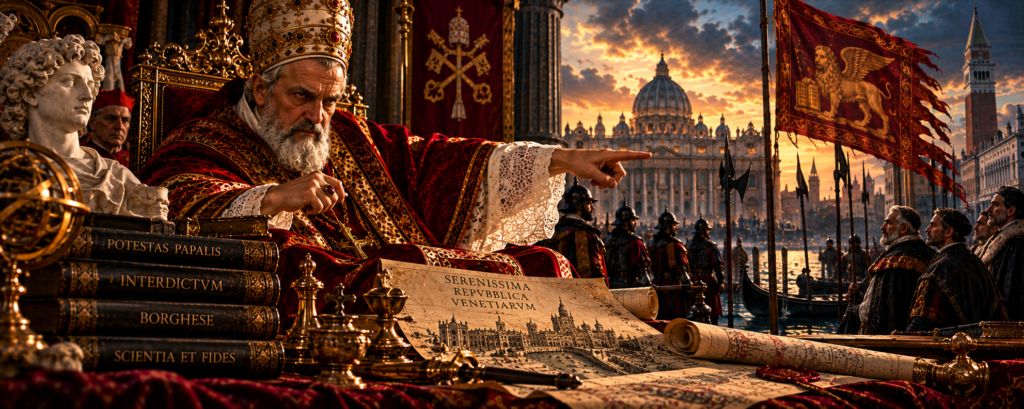
Paul V: The Pope Who Defied Venice and Turned the Vatican Into a Borghese Dynasty
Pope Paul V (1550–1621) | Reigned 1605–1621
The Pope Who Tried to Silence an Entire Republic
In the spring of 1606, the Republic of Venice found itself facing an enemy more dangerous than an invading army. Pope Paul V, a determined and uncompromising defender of papal authority, had decided that the Venetian government had gone too far in challenging the privileges of the Catholic Church. His response was extraordinary: he imposed religious penalties upon the republic’s rulers and placed Venetian territory under interdict, ordering the suspension of important public religious ceremonies. In a deeply Catholic society, where the Church shaped everything from marriage and burial to the rhythms of daily life, the consequences could have been devastating.
The pope expected Venice to submit, but the republic had other ideas. Its government rejected the legitimacy of the papal penalties and instructed its clergy to continue performing their religious duties. Churches remained open, Masses continued, and Venetian officials refused to surrender their authority over criminal prosecutions and property regulations. Instead of bringing the republic to its knees, Paul had created a confrontation that threatened to divide Catholic Europe and expose the limits of papal power.
The conflict became even more dangerous when a Venetian friar named Paolo Sarpi emerged as the republic’s most formidable defender. Sarpi argued that the pope had no right to interfere in matters belonging to the civil government, challenging the sweeping claims of Roman authority. His writings infuriated papal supporters, and in October 1607 he was attacked by assassins in the streets of Venice. Sarpi survived, but the assault transformed an already bitter political dispute into something resembling a struggle for survival.
While this confrontation unfolded, another drama was taking shape inside Rome. Paul V was elevating his relatives into positions of extraordinary wealth and influence, particularly his nephew Scipione Borghese. The young cardinal would become one of the richest and most powerful men in the papal court, acquiring magnificent artworks, valuable estates, and a political position that ordinary churchmen could scarcely imagine. The pope who demanded obedience from an independent republic was simultaneously transforming his own family into one of Italy’s great aristocratic dynasties.
Paul V was not remembered primarily for the sexual scandals or personal extravagance associated with some Renaissance popes. He was a serious administrator, an energetic patron of architecture, and a ruler convinced that defending the authority of the papacy was a sacred obligation. Yet his pontificate reveals how easily spiritual leadership could become entangled with political domination, family enrichment, censorship, and the protection of institutional privilege. Under Paul V, the Catholic Church was not merely a religious institution but also a territorial state, a diplomatic power, and the foundation of an ambitious family empire.
His reign would leave behind magnificent monuments, bitter controversies, and decisions that shaped the future of relations between Church and state. He would confront Venice, challenge England’s Protestant monarchy, intervene in the early Galileo controversy, and oversee the transformation of St. Peter’s Basilica. His nephew would help create one of Rome’s greatest art collections while accumulating wealth through a system of papal favoritism. By the time Paul died in 1621, the Borghese name had become inseparable from the grandeur and contradictions of seventeenth-century Rome.
Camillo Borghese: The Man Behind the Papal Crown
The future Paul V was born Camillo Borghese in Rome on September 17, 1550. His family originated in Siena and had established itself among the increasingly influential households of the papal capital. Although the Borghese were not yet among Rome’s most powerful dynasties, they possessed the education, connections, and financial resources necessary for advancement. Camillo grew up in a world where legal expertise and ecclesiastical service could open doors that military conquest or hereditary titles might otherwise keep closed.
His father, Marcantonio Borghese, was a distinguished lawyer whose professional standing helped secure the family’s place in Roman society. Camillo followed a similar intellectual path, studying law and developing the administrative skills that would eventually define his career. He attended the universities of Perugia and Padua, institutions known for their legal traditions. His education prepared him for the complicated world of papal government, where questions of jurisdiction, privilege, and property were inseparable from religious authority.
Borghese entered ecclesiastical service and steadily advanced through the Roman Curia. His career was not built upon the spectacular scandals or military adventures that had elevated some earlier papal families. Instead, he became known as a capable administrator with a strong understanding of canon law. His experience would later influence his approach to government, particularly his insistence that ecclesiastical privileges must be defended against secular interference.
During the pontificate of Clement VIII, Borghese received increasingly important responsibilities. He served in diplomatic and administrative positions and developed a reputation for competence. In 1596, Clement elevated him to the College of Cardinals, placing him among the senior figures eligible to elect a pope. The appointment marked a decisive step in the family’s rise.
As a cardinal, Borghese became associated with the strict defense of ecclesiastical rights. He believed that the Church possessed privileges that secular rulers could not simply disregard. Such convictions were common within the Roman Curia, but Borghese expressed them with particular firmness. His legal background reinforced his tendency to view disputes over jurisdiction as fundamental questions of authority rather than matters suitable for casual compromise.
His personality was generally described as serious and determined. He was not famous for dazzling conversation or extravagant personal pleasures. His strength lay in persistence, administrative knowledge, and confidence in the institutional rights of the papacy. Those qualities would help him govern, but they would also make compromise difficult when his authority was challenged.
By the beginning of 1605, Borghese had become a respected member of the College of Cardinals. He possessed experience in law, diplomacy, and ecclesiastical administration. Few could have predicted the full consequences of his eventual election. The lawyer’s son from a rising Roman family was approaching a position that would allow him to confront sovereign states and enrich his relatives on an extraordinary scale.
The Conclave That Created a Borghese Pope
The death of Clement VIII in March 1605 created another papal election. Clement had governed for more than thirteen years, providing stability after the rapid succession of pontiffs in the early 1590s. His death reopened the familiar struggle among powerful Catholic factions seeking influence over the papacy. Spain and France watched the proceedings closely, knowing that the new pope’s policies could affect the political balance of Europe.
The cardinals initially elected Alessandro Ottaviano de’ Medici, who became Leo XI. His election appeared to favor French interests, but his pontificate lasted less than a month. Leo died on April 27, 1605, leaving the Church facing another conclave almost immediately. The sudden vacancy intensified political maneuvering within the College of Cardinals.
The second conclave was marked by rivalries among candidates and competing international interests. Spain remained an important force in Italian politics, while France sought to preserve the diplomatic gains achieved under Clement VIII. Cardinals also considered the need for a capable administrator who could defend ecclesiastical authority. Camillo Borghese emerged as a candidate acceptable to enough factions to secure election.
On May 16, 1605, Borghese became pope and chose the name Paul V. He was fifty-four years old, comparatively young for a pontiff of the period. His age suggested the possibility of a long and energetic reign. His family immediately understood that the election had transformed its future.
The new pope inherited a Church strengthened by decades of Counter-Reformation activity. The Council of Trent had established important reforms, religious orders were expanding their influence, and Catholic rulers continued supporting efforts to restore religious unity. Yet the papacy also faced growing resistance from states unwilling to surrender control over their own affairs. The relationship between spiritual authority and political sovereignty remained deeply unsettled.
Paul approached these challenges with the instincts of a trained canon lawyer. He believed that the rights of the Church required vigorous protection. Where Clement VIII had sometimes demonstrated diplomatic flexibility, Paul was more inclined to defend principle even when doing so created serious political difficulties. His determination would soon bring him into direct confrontation with Venice.
The election also provided opportunities for family advancement. Papal relatives traditionally received offices, titles, and financial advantages, and the Borghese were eager to secure their place among Rome’s leading dynasties. Paul would prove remarkably generous to his own household. His reign would demonstrate that personal austerity and family ambition could exist comfortably within the same pontificate.
Venice: The Republic That Refused to Bow
The Republic of Venice occupied a distinctive position in early modern Europe. Its government was dominated by an aristocratic political class, but its institutions possessed a long tradition of independence. Venice maintained extensive commercial networks, controlled important territories in northern Italy, and conducted diplomacy according to its own interests. Its rulers were Catholic, yet they resisted attempts by outside authorities to dictate the republic’s internal affairs.
Relations between Venice and Rome had been strained for years. The Venetian government believed that ecclesiastical institutions were accumulating too much land and wealth. Property transferred into church ownership could become difficult to tax or regulate, reducing the resources available to the state. Venetian officials therefore sought greater control over the acquisition of property by religious institutions.
In 1604, the republic restricted the construction of new churches and religious establishments without government permission. The following year, it imposed additional limitations upon transfers of property to ecclesiastical bodies. Venetian leaders considered these measures legitimate exercises of civil authority. Roman officials regarded them as infringements upon the rights of the Church.
The dispute became more serious when Venetian authorities arrested two clerics accused of criminal offenses. The cases involved serious allegations, including sexual misconduct and violence. The republic intended to prosecute the accused under its own legal procedures. Paul V insisted that the clerics should be subject to ecclesiastical jurisdiction.
The principle at stake was clerical immunity, an established privilege that protected clergy from certain forms of secular prosecution. Church authorities defended this immunity as necessary to preserve ecclesiastical independence. Venetian officials argued that criminal conduct within their territory could not be placed beyond the reach of civil law. The disagreement concerned the fundamental question of who possessed authority over clergy accused of violating public order.
Paul demanded that Venice surrender the imprisoned clerics to ecclesiastical authorities. He also insisted that the republic repeal the laws restricting church property and construction. Venetian leaders refused, maintaining that the pope had no right to interfere with their government’s legitimate powers. The confrontation rapidly escalated.
Both sides understood that the dispute extended far beyond two prisoners or several property regulations. If Venice yielded, other governments might face similar demands. If the pope retreated, secular rulers could interpret the outcome as evidence that ecclesiastical privileges were negotiable. The conflict therefore became a test of sovereignty.
Venice was particularly unwilling to surrender because its independence formed a central part of its political identity. The republic had survived centuries of warfare, diplomatic pressure, and commercial rivalry. Its ruling class did not intend to accept what it considered foreign interference merely because that interference came from Rome. Paul V was about to discover that spiritual penalties did not guarantee political obedience.
The Weapon of Interdict
For centuries, popes had used spiritual sanctions to pressure rulers who resisted ecclesiastical authority. Excommunication excluded individuals from communion with the Church, while an interdict restricted religious services within a territory. Such penalties could create enormous pressure in societies where public worship and sacramental life were central to daily existence. Medieval rulers had sometimes been forced into humiliating settlements after their subjects suffered under papal sanctions.
Paul V believed that Venice’s resistance justified a similarly forceful response. On April 17, 1606, he issued penalties against the Venetian leadership and placed the republic under interdict. The measures were intended to compel obedience by disrupting religious life and undermining the government’s legitimacy. The pope expected the spiritual consequences to make continued resistance politically unbearable.
The sanctions were formidable in theory. Public religious ceremonies were to be restricted, and the normal celebration of sacraments could be interrupted. In a Catholic society, such restrictions affected far more than private devotion. Religious ceremonies marked births, marriages, deaths, festivals, and the collective identity of communities.
The interdict also carried a political message. Paul was asserting that the pope possessed authority to punish a sovereign Catholic government for violating ecclesiastical rights. He treated Venice’s actions not merely as a disagreement over jurisdiction but as defiance of the Church itself. The republic’s rulers were expected to recognize that spiritual authority stood above their civil legislation.
Venice responded with extraordinary determination. The Senate rejected the validity of the interdict and ordered clergy within Venetian territory to continue their religious functions. The government maintained that the pope had exceeded his legitimate authority. Venetian officials refused to allow Rome to turn the republic’s churches into instruments of political coercion.
The decision placed individual priests and religious communities in a difficult position. Obedience to the pope could mean defying the Venetian government. Obedience to Venice could mean disregarding papal commands. Clergy were forced to choose between competing authorities, each claiming legitimacy.
Many priests continued conducting services as the republic instructed. The Venetian government supported those who resisted the interdict and took action against religious communities that attempted to enforce it. The Jesuits, Theatines, and Capuchins were among the orders expelled from Venetian territory. Their departure demonstrated how far the confrontation had progressed.
Instead of silencing Venice, the interdict produced a public challenge to papal authority. Churches continued operating, and the republic maintained its institutions. The government had successfully prevented the pope’s sanctions from producing the paralysis he intended. Paul now faced the dangerous possibility that his most powerful spiritual weapon might fail.
Paolo Sarpi: The Friar Who Challenged the Pope
The Venetian government’s most influential defender was Paolo Sarpi, a Servite friar whose intellectual abilities made him one of the most formidable figures of the controversy. Born in Venice in 1552, Sarpi had developed expertise in theology, canon law, philosophy, mathematics, and natural science. He was deeply familiar with the institutions and arguments of the Catholic Church. His religious status made his opposition to papal claims especially significant.
Sarpi had spent years studying the relationship between ecclesiastical authority and secular government. He believed that the pope’s spiritual responsibilities did not give him unlimited jurisdiction over independent states. In his view, Venice possessed legitimate authority to regulate property, prosecute crimes, and govern its territory. The interdict therefore represented an unlawful intrusion into civil affairs.
The republic appointed Sarpi as a theological and legal adviser during the crisis. He prepared arguments defending Venice’s position and challenging the validity of the papal sanctions. His writings combined detailed legal reasoning with a powerful political message. A Catholic state, he argued, could remain faithful to religion without surrendering its sovereignty to Rome.
Sarpi’s position was particularly threatening because it undermined the assumptions supporting Paul’s strategy. The pope expected Venetian Catholics to regard obedience to Rome as a religious obligation. Sarpi insisted that resisting an unjust papal command could be compatible with loyalty to the Church. The argument offered the republic a theological defense against spiritual intimidation.
His influence extended beyond Venice. Pamphlets and diplomatic reports circulated throughout Europe, attracting attention from rulers already concerned about papal interference. Protestant governments watched the confrontation with considerable interest. Catholic states also recognized that the dispute raised questions relevant to their own authority.
Roman defenders responded vigorously. Cardinal Robert Bellarmine, one of the leading Catholic theologians of the period, supported the papal position. Other writers argued that Venice’s resistance threatened the proper order of Christian society. The controversy became a battle of legal and theological arguments conducted through an expanding world of printed pamphlets.
Sarpi’s writings were not simply neutral legal analyses. He was deeply hostile to what he regarded as the excessive power of the Roman Curia. His arguments reflected a broader vision of political independence and ecclesiastical reform. Nevertheless, his criticism was grounded in serious scholarship and attracted considerable respect.
Paul’s government regarded Sarpi as a dangerous opponent. A friar who publicly challenged papal jurisdiction threatened the moral authority of the interdict. Sarpi was summoned to Rome and subsequently excommunicated after refusing to submit. The conflict had become intensely personal as well as political.
A Catholic Republic Defies the Vatican
Venice’s refusal to obey the interdict produced an extraordinary spectacle. A government that remained publicly Catholic was rejecting commands issued by the head of the Catholic Church. Its priests continued celebrating religious services, and its officials insisted that the republic had committed no offense requiring spiritual punishment. The situation challenged assumptions about the relationship between Catholic identity and papal obedience.
The Venetian Senate carefully framed its resistance. It did not announce a conversion to Protestantism or reject Catholic doctrine. Instead, it maintained that the pope had exceeded his authority in matters belonging to civil government. This distinction allowed Venice to defend its religious identity while opposing Rome’s political demands.
The strategy was effective because many Venetian citizens saw no contradiction between Catholic devotion and loyalty to their republic. Their churches remained open, their religious ceremonies continued, and their government portrayed itself as the defender of legitimate law. The interdict therefore failed to create the widespread religious disruption Paul had anticipated. Venetian resistance exposed the limits of spiritual coercion when a government possessed sufficient public support.
The conflict also threatened to become a European war. Spain supported strong papal authority but had its own strategic interests in northern Italy. France, under Henry IV, sought to prevent Spanish influence from expanding and maintained important relations with Venice. Protestant powers recognized an opportunity to weaken Rome’s political position.
Both sides began considering the possibility of military confrontation. The pope could not simply invade Venice without risking a wider conflict, while the republic understood that papal diplomacy might encourage hostile powers to intervene. Military preparations and diplomatic maneuvering increased the tension. The dispute had moved far beyond its original legal causes.
Paul’s insistence upon ecclesiastical privilege also created uncomfortable questions about the two imprisoned clerics. The Venetian government had arrested them in connection with serious criminal accusations. Rome’s demand for their surrender appeared to prioritize institutional immunity over the republic’s ability to prosecute wrongdoing. Critics could argue that the pope was defending clerical privilege rather than justice.
Supporters of Paul viewed the issue differently. They believed that allowing secular governments unrestricted jurisdiction over clergy could expose the Church to political persecution. Ecclesiastical courts existed partly to protect religious institutions from hostile rulers. The controversy therefore involved competing fears about the abuse of power.
The deeper question concerned the boundary between spiritual and temporal authority. Paul regarded the Church’s jurisdiction as a sacred inheritance that could not be surrendered. Venice regarded its sovereignty as essential to political survival. Neither side was prepared to accept the other’s understanding of legitimate government.
The Compromise That Exposed Papal Weakness
By 1607, the confrontation had become increasingly dangerous for both Rome and Venice. The pope had imposed severe sanctions without securing submission. The republic had defied the interdict but faced the possibility of military escalation and diplomatic isolation. A negotiated settlement became increasingly attractive.
Henry IV of France played an important role in mediation. French diplomacy sought to prevent the crisis from developing into a wider European conflict. The negotiations required careful attention to appearances because neither side wanted to acknowledge defeat. Paul needed to preserve the dignity of papal authority, while Venice refused to admit that its laws were illegitimate.
A compromise was reached in April 1607. The imprisoned clerics were transferred through French mediation, allowing the pope to claim that his demand concerning ecclesiastical jurisdiction had been addressed. Venice, however, did not simply repeal its disputed legislation as Rome had originally demanded. The settlement allowed both governments to retreat without a formal confession of wrongdoing.
On April 21, 1607, the interdict was lifted. The republic resumed normal diplomatic relations with Rome, although mutual suspicion remained. Venice had preserved the essential principle that its government could resist papal intervention in civil affairs. The pope had failed to compel the sweeping submission he initially sought.
The outcome represented a significant limitation upon papal political power. Earlier medieval popes had sometimes used interdicts to force rulers into dramatic concessions. Paul V discovered that a well-organized early modern state could resist such penalties when its government controlled local institutions and retained public support. The spiritual weapon had lost much of its effectiveness.
Rome did not publicly celebrate the settlement as a defeat. Papal supporters emphasized the transfer of the imprisoned clerics and the restoration of religious relations. Venetian officials emphasized their refusal to surrender legislative sovereignty. The different interpretations reflected the compromises necessary to end the crisis.
For Paul personally, the experience was deeply frustrating. He had entered the dispute convinced that ecclesiastical authority required uncompromising defense. The settlement left the central question of jurisdiction unresolved. His determination had nearly produced a major European conflict without securing the obedience he demanded.
The Venetian Interdict became one of the defining events of his pontificate. It demonstrated the dangers of attempting to use spiritual penalties as instruments of political domination. It also showed that Catholic rulers could challenge the pope without abandoning their religion. The consequences extended far beyond Venice.
The Knives That Nearly Killed Paolo Sarpi
The lifting of the interdict did not end the hostility surrounding Paolo Sarpi. His writings had made him a celebrated defender of Venetian independence and a bitter enemy of powerful figures in Rome. He continued advising the republic on ecclesiastical affairs. His influence remained a source of resentment among supporters of strong papal authority.
On October 5, 1607, Sarpi was attacked in Venice by armed assailants. The attackers stabbed him repeatedly, leaving him gravely wounded. One weapon penetrated his face and head, creating injuries that could easily have proved fatal. The assault shocked the republic and intensified suspicions that political enemies were seeking revenge.
Sarpi survived after receiving medical treatment. His recovery became an important event in Venetian political life. Supporters regarded him as a man who had risked his life defending the republic’s independence. The attack strengthened his reputation as a courageous opponent of Roman interference.
The identity and connections of the attackers became the subject of intense controversy. Some of the men involved had links to Rome, and suspicion quickly fell upon circles hostile to Sarpi within the papal world. Sarpi himself believed that the attack had been connected to his enemies in the Roman Curia. Venetian authorities investigated the conspiracy and treated it as a political crime.
However, the surviving evidence does not establish that Paul V personally ordered the assassination attempt. Claims that the pope directly commanded Sarpi’s murder go beyond what can be demonstrated securely. The involvement of individuals associated with Roman interests is not equivalent to proof of a papal order. Responsible historical interpretation must preserve that distinction.
The uncertainty does not make the attack less significant. Sarpi had become a prominent critic of papal political claims, and men hostile to him attempted to kill him. The violence demonstrated how dangerous the conflict between Venice and Rome had become. Arguments about ecclesiastical jurisdiction had moved from printed pamphlets into the streets.
Sarpi continued working for Venice after his recovery. He remained an influential adviser and later wrote a controversial history of the Council of Trent. His scholarship challenged the official Roman interpretation of the council and the development of papal authority. He died in 1623, two years after Paul V.
The attempted assassination became part of the enduring legend of Venetian resistance. Sarpi was remembered as a scholar who had survived both excommunication and violence. Paul V, meanwhile, remained associated with the confrontation that had made the friar famous. The episode added a sinister dimension to a dispute already marked by extraordinary bitterness.
The Borghese Family Begins Its Golden Age
While Paul struggled to impose his authority upon Venice, his family was enjoying a remarkable rise within Rome. The Borghese had possessed wealth and influence before his election, but the papacy transformed their position. Offices, titles, property, and political connections became available on a scale previously beyond their reach. The family began establishing itself among the great aristocratic dynasties of Italy.
Paul’s most important relative was his nephew Scipione Borghese. Born in 1577 as Scipione Caffarelli, he was the son of the pope’s sister Ortensia Borghese. After his uncle became pope, Scipione adopted the Borghese name and entered the highest ranks of ecclesiastical society. His advancement was astonishingly rapid.
In July 1605, only weeks after Paul’s election, Scipione was created a cardinal. He was twenty-seven years old and possessed neither the long ecclesiastical career nor the administrative experience that might ordinarily justify such elevation. His principal qualification was his relationship to the reigning pope. The appointment made him one of the most powerful young men in Rome.
Scipione became the cardinal-nephew, a position that combined family loyalty with immense political influence. He acted as a principal intermediary between the pope and the Roman Curia, controlled access to important decisions, and exercised influence over appointments and financial matters. His position allowed him to shape both ecclesiastical government and the fortunes of the Borghese household. Few individuals outside the pope himself possessed comparable opportunities.
The cardinal-nephew system was not unique to Paul V. Earlier popes had relied upon relatives to manage government and protect family interests. Supporters argued that trusted kin provided dependable assistance in a political environment filled with rival factions. Critics saw the arrangement as an invitation to corruption and the diversion of church resources into private hands.
Scipione embraced the opportunities of his position with extraordinary energy. He accumulated benefices, pensions, estates, and valuable possessions. His income became immense, supporting a lifestyle associated with the highest aristocracy. The young cardinal soon emerged as one of Rome’s greatest collectors and patrons.
Paul did not appear to regard this enrichment as fundamentally incompatible with his religious responsibilities. He considered family advancement an accepted feature of papal government. His personal habits remained comparatively restrained, but his relatives benefited enormously from his office. The distinction between the pope’s private austerity and the family’s collective wealth became one of the defining contradictions of his reign.
The Borghese were no longer merely a successful Roman family. They were becoming a dynasty whose power rested upon the papacy itself. Their palaces, estates, artworks, and political marriages would preserve the advantages created during Paul’s pontificate. The transformation demonstrated how a supposedly spiritual office could serve as the foundation of lasting aristocratic wealth.
Cardinal Scipione Borghese: The Nephew Who Had Everything
Scipione Borghese possessed the tastes and ambitions of a Renaissance prince. Although he wore a cardinal’s robes, his interests extended far beyond theology and ecclesiastical administration. He loved architecture, sculpture, painting, magnificent residences, and the prestige that accompanied artistic patronage. His wealth allowed him to acquire works that would eventually form one of the world’s most celebrated collections.
The cardinal’s influence depended upon his uncle’s protection. As cardinal-nephew, he occupied a privileged position within the papal government. Petitioners seeking appointments or favors understood the importance of gaining his attention. Political influence and artistic patronage became intertwined within his household.
Scipione collected works by some of the most important artists of his age. He became a major patron of the young Gian Lorenzo Bernini, whose sculptures would later transform the artistic character of Baroque Rome. He also acquired paintings by Caravaggio and other celebrated artists. His collection helped establish the cultural reputation of the Borghese family.
Yet the methods used to acquire certain works were controversial. Scipione’s position gave him advantages unavailable to ordinary collectors. Artists and owners dealing with him understood that he was not simply a wealthy private buyer. He was the nephew of the pope and one of the most influential men in Rome.
The most notorious episode involved the painter Giuseppe Cesari, commonly known as the Cavalier d’Arpino. In 1607, Cesari became involved in proceedings concerning weapons held in his possession. His collection of paintings was confiscated and subsequently passed into Scipione’s hands. The episode has long been cited as an example of the cardinal’s ability to exploit political circumstances to enrich his collection.
The precise relationship between the legal proceedings and Scipione’s desire for the paintings has been debated. It would be misleading to present every accusation of deliberate manipulation as conclusively established. Nevertheless, the outcome is clear: a powerful papal nephew obtained valuable artworks through a process involving the coercive authority of the state. The circumstances illustrate the extraordinary imbalance of power surrounding his acquisitions.
Scipione also acquired Raphael’s Deposition, originally commissioned for a church in Perugia. The painting was removed from its original setting and entered the Borghese collection, provoking resentment among those who regarded it as belonging to their community. The episode demonstrated how aristocratic collecting could conflict with local religious and civic interests. A masterpiece created for one setting became an ornament of a powerful family’s private collection.
These acquisitions reveal the darker side of Baroque patronage. The Borghese collection was not merely the product of refined taste and generous payment. It also reflected political privilege, unequal bargaining power, and the ability of a papal family to obtain objects that others struggled to protect. Scipione’s artistic legacy is magnificent, but the history of its creation is not entirely innocent.
The Villa Borghese: Beauty Built Upon Power
Scipione’s ambitions eventually produced one of Rome’s most famous aristocratic residences. The Villa Borghese, developed on the Pincian Hill, became a setting for his expanding art collection and a visible statement of family prestige. Its gardens, architecture, and galleries reflected the wealth accumulated during Paul’s pontificate. The estate transformed artistic patronage into a permanent monument to the Borghese name.
The villa was designed to impress visitors. Paintings, sculptures, and architectural decoration demonstrated the cardinal’s taste and financial resources. Its setting allowed the family to display cultural sophistication alongside political influence. Art became a language through which the Borghese announced their arrival among Rome’s greatest dynasties.
Scipione’s patronage helped support extraordinary artistic achievement. Bernini’s early work benefited from the cardinal’s encouragement and financial support. The sculptures later associated with the Borghese collection became landmarks of Baroque art. Without wealthy patrons, many such works might never have been created.
Yet the artistic achievements cannot be separated entirely from their political foundations. Scipione’s wealth came in significant part from ecclesiastical appointments and opportunities associated with his uncle’s papacy. The family used religious office to establish an aristocratic position that could survive beyond Paul’s death. The villa was therefore both a cultural treasure and a monument to nepotism.
The contrast between the Venetian conflict and the Borghese building projects is striking. Paul demanded that Venice respect ecclesiastical property rights and the jurisdictional privileges of clergy. Meanwhile, his own family accumulated property and influence through the advantages of papal government. The pope defended institutional independence abroad while permitting family enrichment at home.
Contemporaries did not necessarily regard these practices as mutually exclusive. Nepotism remained deeply embedded in the political culture of the papal court. A pope was expected to provide for relatives, and powerful families routinely converted public office into lasting social advantage. Nevertheless, critics recognized the dangers of allowing spiritual government to become a mechanism of dynastic advancement.
Scipione’s collection eventually became one of Rome’s greatest artistic legacies. Visitors today can admire masterpieces acquired through his patronage and ambition. The beauty of those works is undeniable. So is the uncomfortable history of the power that helped assemble them.
The Borghese family’s cultural achievements therefore complicate rather than excuse Paul’s reputation. His pontificate supported the creation and preservation of remarkable art. It also demonstrated how easily the resources and privileges of the Church could be redirected toward family prestige. The grandeur of Baroque Rome was often inseparable from the politics of papal favoritism.
The Pope Who Turned Relatives Into Princes
Scipione was not the only Borghese relative to benefit from Paul’s election. The pope also advanced other members of his family through titles, property acquisitions, and advantageous marriages. His nephew Marcantonio Borghese became an important figure in the family’s secular ambitions. The accumulation of estates helped establish the Borghese as a durable aristocratic power.
In 1608, Marcantonio acquired the principality of Sulmona, strengthening the family’s standing among Italy’s titled nobility. The purchase represented more than an investment in land. It gave the Borghese a princely identity that could continue after the death of the reigning pope. The family was converting temporary ecclesiastical influence into hereditary status.
This strategy was familiar from earlier papal dynasties. The Farnese had established territorial power under Paul III, while the Medici had repeatedly used papal influence to advance their political interests. The Borghese followed a similar pattern, although their methods reflected the increasingly bureaucratic character of seventeenth-century papal government. Wealth and titles could accomplish what earlier families had sometimes pursued through open warfare.
Paul’s support for his relatives raised obvious questions about the proper use of ecclesiastical authority. Church offices were intended to serve religious purposes, but they also generated income and political influence. A pope who controlled appointments could direct those benefits toward trusted family members. The arrangement blurred the distinction between public responsibility and private advantage.
The scale of Borghese enrichment was particularly striking because Paul cultivated a reputation for personal seriousness. He was not famous for indulging in the extravagant pleasures associated with some earlier Renaissance pontiffs. His family, however, lived magnificently. Personal restraint did not prevent the accumulation of dynastic wealth.
Supporters could argue that the pope needed reliable relatives to manage government. The Roman Curia contained powerful factions, and family loyalty offered a degree of political security. Scipione’s administrative role was therefore not entirely ornamental. He performed important duties while enjoying extraordinary privileges.
Nevertheless, the concentration of wealth and influence remained difficult to justify purely as an administrative necessity. Scipione’s extensive benefices and collections far exceeded what was required to assist his uncle. The Borghese family emerged from the pontificate transformed. Its prosperity became one of the most visible consequences of Paul’s rule.
The pope’s legacy therefore includes a fundamental contradiction. He demanded strict respect for ecclesiastical authority from other governments while allowing his own relatives to benefit from that authority on an enormous scale. The Church was defended as an independent spiritual institution, yet its resources helped create an Italian family principality. Few pontificates illustrate that dual identity more clearly.
St. Peter’s Basilica: The Monument That Carried His Name
Paul V’s architectural ambitions were as significant as his political disputes. During his reign, work on the new St. Peter’s Basilica entered a decisive phase. The great church had been under construction for generations, shaped by the plans of Bramante, Michelangelo, and other architects. Paul inherited a monumental project whose completion would become one of the defining achievements of his pontificate.
The pope supported the extension of the basilica’s nave and the construction of its great façade. Carlo Maderno became the principal architect associated with this phase of the work. His design transformed the building’s appearance and helped create the structure familiar to visitors today. The façade was completed in 1612.
The project involved enormous expense and labor. St. Peter’s was intended to demonstrate the religious authority and cultural prestige of the Catholic Church. Its scale surpassed that of ordinary churches and proclaimed Rome’s position as the center of Catholic Christianity. Paul understood the symbolic importance of bringing the building closer to completion.
Yet the façade also became a monument to papal self-promotion. Its prominent inscription commemorates Paul V Borghese and his role in the construction. The pope’s name appears across the front of one of Christianity’s most important churches. The display ensured that his contribution would remain visible to future generations.
Such inscriptions were common features of Renaissance and Baroque patronage. Popes, cardinals, and aristocrats regularly placed their names and coats of arms upon buildings they financed. The practice expressed gratitude, authority, and the desire for lasting remembrance. Paul participated enthusiastically in this culture.
The Borghese eagle and dragon appeared in numerous decorative contexts associated with the family’s patronage. These symbols transformed architecture into a form of dynastic advertisement. Visitors encountered the family identity alongside religious imagery. The distinction between glorifying the Church and glorifying the reigning pope could become difficult to maintain.
The construction also reflected genuine religious ambition. St. Peter’s provided a monumental setting for Catholic worship and pilgrimage. Its completion strengthened Rome’s prestige during the Counter-Reformation. Paul regarded the project as an important service to the Church.
Nevertheless, the grandeur of the building should not obscure the political message embedded within it. The pope who insisted upon the supremacy of ecclesiastical authority ensured that his own name dominated the basilica’s façade. The spiritual center of Catholicism became a permanent reminder of Borghese patronage. Architecture preserved the memory of a family as well as the authority of a religion.
Aqueducts, Fountains, and the Transformation of Rome
Paul’s building projects extended beyond St. Peter’s Basilica. He invested in the restoration and improvement of Rome’s water supply, continuing a tradition of papal urban development. Reliable access to water was essential for a growing city. Aqueducts and fountains also provided opportunities to display the generosity and authority of the reigning pope.
One of the most important projects was the restoration of the ancient Aqua Traiana, which became associated with the Acqua Paola. The work helped supply water to the Janiculum Hill and surrounding districts. Its monumental fountain, commonly known as the Fontanone, became one of Rome’s most recognizable landmarks. The structure combined practical infrastructure with architectural spectacle.
The fountain’s inscription celebrated Paul V’s role in restoring the water supply. Like the façade of St. Peter’s, it turned a public improvement into a permanent statement of papal achievement. The Borghese name became part of the city’s physical landscape. Visitors could encounter evidence of Paul’s patronage in streets, churches, and public spaces.
The restoration of water infrastructure provided genuine benefits. Fountains improved access to water, supported urban growth, and enhanced public life. Such projects were not merely exercises in vanity. They demonstrated that papal government could undertake substantial works serving the population.
Paul also supported other improvements, including religious buildings and facilities connected with the administration of the city. His pontificate contributed to the transformation of Rome into the monumental Baroque capital that would develop further under his successors. The projects strengthened the image of the papacy as a capable temporal government. They also created opportunities for architects, artists, and craftsmen.
Yet public works carried political meaning. A ruler who supplied water, built churches, and improved streets could present himself as a benefactor of the people. Monumental inscriptions reinforced that message. The city itself became a record of papal generosity and authority.
The Borghese family benefited from this association. Its heraldic symbols appeared on buildings financed through papal patronage. The family became linked with Rome’s prosperity and magnificence. The same pontificate that enriched Scipione also produced improvements that ordinary residents could use.
Paul’s architectural legacy therefore deserves serious recognition. He helped reshape Rome and supported projects of lasting practical and artistic value. Yet the monuments also reveal how public service and dynastic self-promotion could become intertwined. The pope built for the Church and the city, but he also built for the memory of Paul V Borghese.
The Gunpowder Plot and the English Crown
Paul V’s election occurred only months before one of the most notorious conspiracies in English history. In November 1605, a group of Catholic conspirators attempted to destroy the English Parliament and kill King James I. The Gunpowder Plot failed when authorities discovered explosives stored beneath the parliamentary buildings. The conspirators’ plans shocked England and intensified hostility toward Catholics.
The plot emerged from the frustration of English Catholics living under restrictions imposed by a Protestant monarchy. Some conspirators believed that violent action could produce a political transformation favorable to Catholic interests. Their scheme involved mass murder and the attempted destruction of the government. It was not an authorized operation of the papacy.
There is no sound basis for claiming that Paul V ordered the Gunpowder Plot. The conspiracy had developed independently of his newly established pontificate. Catholic authorities had reasons to fear that such violence would worsen the position of English Catholics. The failed attack nevertheless created a crisis that the pope could not ignore.
James I responded by strengthening measures intended to identify Catholics whose loyalty might be divided between the English crown and Rome. In 1606, Parliament established a new oath of allegiance. The oath required Catholics to affirm loyalty to the king while rejecting certain claims concerning papal authority over monarchs. Its wording created a serious problem for Catholics who wished to remain loyal to both their sovereign and their Church.
Paul V condemned the oath in September 1606 and reaffirmed his opposition the following year. He believed that accepting its language would compromise important principles of papal authority. The decision placed English Catholics in a difficult position. Refusing the oath could expose them to suspicion and legal penalties, while taking it risked conflict with Rome.
The controversy produced intense debate among Catholic theologians and political writers. Some argued that Catholics could legitimately swear civil loyalty without surrendering their faith. Others believed that the oath’s rejection of papal claims made it unacceptable. The dispute became another confrontation over the boundary between spiritual and temporal authority.
Cardinal Robert Bellarmine defended the papal position against arguments advanced by James I and his supporters. The controversy generated a substantial body of polemical literature. James himself participated in the debate, presenting the oath as a necessary protection against political disloyalty. Rome regarded the disputed clauses as an unacceptable intrusion into ecclesiastical authority.
Paul’s stance resembled his position during the Venetian crisis. He was unwilling to surrender principles he regarded as essential to the papacy, even when compromise might have eased the difficulties faced by ordinary Catholics. His defense of ecclesiastical authority took precedence over political accommodation. The result was another dispute in which religious loyalty and civil obedience became dangerously entangled.
A Pope Who Could Not Control Protestant England
The English controversy exposed the limits of papal influence beyond Catholic Europe. Paul could condemn the oath of allegiance, but he could not compel James I to withdraw it. English authorities continued enforcing their own laws. Catholics living in England had to navigate the consequences of a conflict between governments they could not control.
The situation differed from the Venetian dispute in important respects. Venice remained a Catholic republic whose leaders rejected specific claims of papal jurisdiction. England was a Protestant monarchy that denied the pope’s authority over its established church. The political and religious divisions were therefore more fundamental.
Nevertheless, both conflicts revolved around the same central question. Paul believed that the papacy possessed rights that secular rulers could not lawfully disregard. Venice and England maintained that their governments possessed independent authority over civil affairs. The disagreements revealed the growing strength of state sovereignty in early modern Europe.
The pope’s opposition to the oath did not produce the political transformation he desired. James continued ruling England and Scotland, while Catholic communities remained subject to restrictions. The controversy contributed to suspicion surrounding Catholics who refused the oath. It also reinforced Protestant arguments that allegiance to Rome might conflict with loyalty to the crown.
Paul’s position should not be confused with support for the Gunpowder Plot. Condemning an oath that denied papal claims was not equivalent to endorsing assassination or rebellion. The distinction is essential because Protestant polemicists often portrayed Catholic loyalty to Rome as inherently dangerous. Historical analysis must separate documented papal policy from hostile accusations.
At the same time, Paul’s refusal to accept the oath’s disputed language had practical consequences. It complicated efforts by English Catholics to demonstrate their civil loyalty. The pope defended principles of ecclesiastical authority while believers under Protestant government bore much of the resulting pressure. His decisions reveal the human costs of conflicts between competing sovereign claims.
The controversy also showed that the papacy could no longer impose its political will upon major European states through spiritual declarations alone. Paul possessed immense religious influence, but England remained beyond his control. His authority depended upon cooperation from rulers and communities willing to recognize it. The limits of that cooperation were becoming increasingly visible.
By the end of his reign, England remained Protestant and the oath controversy had not produced a settlement satisfactory to Rome. Paul’s determination had preserved his stated principles without changing the fundamental political situation. The pattern resembled the outcome in Venice. Strong assertions of papal authority could produce bitter conflict without securing obedience.
Galileo Galilei and the Dangerous Question of the Heavens
Another controversy associated with Paul V would eventually become one of the most famous conflicts between scientific inquiry and religious authority. During his pontificate, Galileo Galilei’s astronomical discoveries attracted increasing attention. The invention and improvement of the telescope had opened new possibilities for observing the heavens. Galileo’s findings challenged assumptions about the structure of the universe.
Galileo observed mountains and irregularities on the Moon, discovered satellites orbiting Jupiter, and studied the phases of Venus. These observations undermined aspects of traditional Aristotelian cosmology. They also strengthened the plausibility of the Copernican model, in which the Earth moves around the Sun. The implications extended beyond astronomy because established interpretations of Scripture had often assumed a stationary Earth.
Galileo was not the first person to propose heliocentrism. Nicolaus Copernicus had published his influential work in 1543. By the early seventeenth century, astronomers were debating several competing models of the cosmos. Galileo’s observations made the discussion more urgent.
The controversy became dangerous when theological authorities began examining whether heliocentrism could be reconciled with Scripture. Some scholars believed that biblical passages appeared to support the immobility of the Earth. Others argued that Scripture should not be interpreted as a technical astronomical textbook. The dispute involved questions of scientific evidence and religious interpretation.
Galileo attempted to defend the compatibility of his observations with Catholic faith. He maintained relationships with influential churchmen and did not initially present himself as an enemy of the Church. Nevertheless, his increasingly public support for Copernican ideas attracted criticism. Opponents accused him of challenging accepted doctrine.
The Roman Inquisition became involved in the controversy during Paul’s pontificate. In 1616, theological consultants examined propositions concerning the motion of the Earth and the stability of the Sun. They judged the ideas incompatible with their understanding of Scripture. The matter reached the pope.
Paul ordered Cardinal Robert Bellarmine to warn Galileo against maintaining the condemned positions. The resulting proceedings became a crucial moment in the history of the Galileo affair. Although the famous trial and sentence against Galileo occurred later, under Urban VIII in 1633, the restrictions imposed during Paul’s reign helped establish the framework for that confrontation.
The episode demonstrates how Paul understood the defense of religious authority. He was prepared to intervene when intellectual claims appeared to challenge accepted theological interpretations. The Church’s institutional judgment could therefore limit the public defense of scientific ideas. The consequences would extend far beyond his lifetime.
The Warning of 1616
The events of February 1616 became especially important because they established restrictions that would later be central to Galileo’s prosecution. Theological consultants had condemned propositions associated with the Earth’s motion and the Sun’s immobility. Paul V directed that Galileo be warned to abandon the opinions judged erroneous. Cardinal Bellarmine was assigned to communicate the warning.
On February 26, Galileo appeared before Bellarmine. The surviving records describe a warning and an instruction concerning the defense and teaching of Copernican doctrine. A formal precept was also recorded in the proceedings. Historians have debated aspects of the documentation and its later interpretation, particularly in relation to the trial of 1633.
Galileo was not imprisoned or executed during Paul’s pontificate. He continued his scholarly activities, although the restrictions affected how he could discuss heliocentrism. The episode therefore should not be confused with his later condemnation. Paul’s responsibility concerns the intervention and warning of 1616.
In March of that year, the Congregation of the Index issued a decree concerning books defending the motion of the Earth. Copernicus’s On the Revolutions of the Heavenly Spheres was suspended until corrected. Other works were prohibited or subjected to restrictions. The decision attempted to control the presentation of heliocentrism as established truth.
The authorities believed they were defending Scripture and Catholic doctrine against dangerous interpretations. Their concern was not simply that a scientist had made unusual observations. They feared that accepting heliocentrism as physically true would undermine established theological understandings. The scientific question had become inseparable from religious authority.
The consequences were significant. The Church had publicly intervened in an ongoing astronomical debate and restricted the circulation of important ideas. Its judgment would become increasingly difficult to defend as evidence supporting the Earth’s motion accumulated. The intervention eventually became a symbol of institutional resistance to scientific change.
Paul’s role must be evaluated carefully. He did not conduct Galileo’s later trial, nor did he sentence the astronomer to house arrest. Those events occurred after his death. Nevertheless, the 1616 intervention took place under his authority and helped shape the subsequent controversy.
The Galileo affair therefore belongs among the darker aspects of his reign. It demonstrates the willingness of papal institutions to regulate intellectual claims when they appeared to threaten religious certainty. The same determination that had driven Paul to confront Venice also influenced his government’s response to astronomy. Questions of authority repeatedly took precedence over accommodation.
The Roman Inquisition Under Paul V
The Roman Inquisition remained an important institution throughout Paul’s pontificate. Established in the sixteenth century, it had become central to the enforcement of Catholic orthodoxy. Its officials investigated suspected heresy, examined religious writings, and supervised matters considered dangerous to the faith. The institution possessed substantial influence within the papal government.
Paul inherited this system from his predecessors. He did not create the Roman Inquisition, nor did his reign produce a persecution identical in scale or character to every earlier campaign. Nevertheless, he supported its authority and relied upon its procedures. His legal training made him particularly attentive to questions of jurisdiction and doctrinal discipline.
The Galileo controversy illustrates the institution’s role in policing intellectual boundaries. Religious authorities examined propositions about the universe and determined whether they could be defended publicly. The process reflected a broader belief that the Church possessed authority over teachings touching upon Scripture. Scientific inquiry could therefore become subject to ecclesiastical judgment.
The Inquisition also operated within a culture of censorship. Books considered heretical or dangerous could be prohibited, corrected, or restricted. Authors and printers faced consequences for circulating unauthorized religious opinions. The regulation of ideas formed part of the Counter-Reformation effort to maintain doctrinal unity.
Supporters regarded these measures as necessary protections against religious confusion. Europe had experienced decades of conflict between Catholics and Protestants. Authorities feared that unchecked religious disagreement could produce social disorder and political rebellion. The memory of religious warfare encouraged governments to associate conformity with stability.
Critics saw the same institutions as instruments of coercion. Investigations could create fear, while censorship restricted intellectual debate. Individuals accused of dangerous beliefs faced the power of an institution capable of imposing serious penalties. The imbalance between authorities and suspects was considerable.
Paul’s government did not distinguish sharply between religious truth and institutional power. Defending the Church’s teaching also meant defending the authority of those empowered to interpret it. The distinction became especially important when scientific or political arguments challenged established assumptions. The pope’s response was generally to preserve the institution’s jurisdiction.
His pontificate therefore continued the coercive aspects of Counter-Reformation government. Paul was not notorious for personal cruelty, but he supported systems that could punish dissent and restrict intellectual freedom. His determination to defend authority remained consistent across religious, political, and scholarly disputes. That consistency is central to understanding his character.
The Jesuits, the Dominicans, and the Controversy Paul Refused to Settle
Not every theological dispute during Paul’s reign ended in condemnation. He inherited a bitter controversy between Jesuit and Dominican theologians concerning divine grace and human freedom. The disagreement had intensified under Clement VIII and threatened to divide influential Catholic religious orders. Both sides claimed to defend orthodox doctrine.
The controversy centered partly upon the teachings of the Jesuit Luis de Molina. Dominican theologians feared that certain explanations of human freedom weakened the traditional understanding of divine grace. Jesuit defenders argued that their position preserved genuine human responsibility without denying God’s power. The dispute involved intricate theological reasoning.
Clement VIII had established a commission to examine the competing positions. Paul inherited the unfinished proceedings and continued reviewing the arguments. The controversy demanded considerable attention because condemning either side could provoke serious conflict within the Church. The pope faced a difficult choice between doctrinal intervention and institutional peace.
In 1607, Paul decided not to issue a definitive condemnation of either position. He allowed the competing theological schools to continue defending their views while restricting mutual accusations of heresy. The decision effectively suspended the dispute without resolving every underlying question. It prevented an immediate rupture between the religious orders.
This episode reveals that Paul was capable of restraint. He did not insist upon a final ruling merely to demonstrate papal power. He recognized that some theological disagreements could remain unresolved without destroying Catholic unity. The decision contrasted with his uncompromising behavior toward Venice.
The difference was partly political. Jesuits and Dominicans were powerful institutions within the Catholic Church, and both possessed influential defenders. A condemnation might have created serious internal divisions. Paul therefore chose a solution that preserved institutional stability.
His restraint also reflected the complexity of the theological issues. The competing arguments had resisted years of investigation. The pope could recognize the dangers of imposing an uncertain judgment. His decision allowed the Church to avoid turning a difficult theological disagreement into a formal rupture.
The controversy demonstrates that Paul’s character cannot be reduced to blind rigidity. He could compromise when he believed compromise served the Church’s interests. Yet his willingness to tolerate disagreement within recognized Catholic boundaries did not extend equally to challenges from secular governments or controversial scientific interpretations. The limits of acceptable dissent remained determined by institutional authority.
The Thirty Years’ War Begins
During the final years of Paul’s pontificate, Europe entered one of the most destructive conflicts in its history. The Thirty Years’ War began in 1618 amid religious and political tensions within the Holy Roman Empire. Protestant and Catholic interests clashed over authority, privileges, and the future of imperial government. The conflict would eventually devastate large regions of central Europe.
The immediate crisis developed in Bohemia, where Protestant nobles resisted the policies of the Catholic Habsburg dynasty. The Defenestration of Prague in May 1618 became a dramatic symbol of rebellion. The dispute escalated into armed conflict and drew in broader European interests. Religious differences intensified political rivalries.
Paul supported the Catholic cause and provided assistance to Catholic forces. His government regarded the defense of Habsburg Catholic authority as important to the wider struggle against Protestant expansion. Financial and diplomatic support formed part of the papal response. The pope hoped to strengthen Catholic interests within the empire.
The conflict was not simply a religious war. Dynastic ambition, territorial competition, and constitutional disputes played major roles. Catholic rulers sometimes opposed one another, while Protestant states pursued their own strategic interests. The war’s complexity would become increasingly apparent as it expanded.
Paul died before the conflict reached its most devastating stages. He did not witness the full catastrophe that unfolded during the following decades. Nevertheless, his pontificate belonged to the opening phase of the war. His support for Catholic interests reflected the continuing involvement of the papacy in European military affairs.
The war also exposed the limitations of papal diplomacy. Religious solidarity could not eliminate competing political interests among Catholic powers. The pope could encourage cooperation but could not control the ambitions of monarchs and princes. The conflict would eventually demonstrate the destructive consequences of combining religious divisions with dynastic warfare.
Paul’s participation should be understood within the political assumptions of his age. Catholic rulers considered the defense of their religion a legitimate military objective. The pope regarded support for Catholic forces as part of his responsibility. Yet the human cost of the wider conflict would become staggering.
The beginning of the Thirty Years’ War therefore casts a shadow over the final years of his reign. Paul had spent much of his pontificate defending ecclesiastical authority against secular challenges. Now Europe was entering a conflict in which religious and political claims would produce devastation on an unprecedented scale. The struggle for authority was becoming increasingly violent.
The Pope as an Italian Prince
Paul V governed not only the Catholic Church but also the Papal States, a substantial territorial domain in central Italy. His responsibilities included taxation, criminal justice, public works, military affairs, and the administration of cities and provinces. The pope was therefore a sovereign ruler as well as a religious leader. His government operated within the same competitive political world as other Italian states.
This dual identity shaped nearly every major controversy of his reign. In Venice, he defended ecclesiastical jurisdiction against a rival government. In Rome, he directed public works and supported the advancement of his relatives. In international affairs, he negotiated with monarchs and contributed resources to military campaigns. His spiritual office provided the foundation for extensive temporal power.
The papacy’s political structure created opportunities for family enrichment. A pope generally could not pass the office itself to a son or nephew, but he could distribute titles, appointments, and property while he lived. Families therefore sought to convert temporary access to papal power into permanent aristocratic status. The Borghese were exceptionally successful at this process.
Scipione’s wealth and Marcantonio’s princely title illustrate the strategy. The family accumulated resources that could survive the end of Paul’s pontificate. Its palaces and estates became symbols of lasting prestige. The pope’s election had transformed the social destiny of his relatives.
The arrangement was not necessarily regarded as scandalous by every contemporary observer. Family patronage was common throughout European political society. Monarchs advanced relatives, aristocrats secured offices for their children, and powerful churchmen maintained networks of dependents. Nepotism was deeply embedded in the structure of early modern government.
Nevertheless, the papacy possessed a distinctive moral problem. Its authority rested upon claims of spiritual leadership and service to the universal Church. When that authority enriched a particular family, critics could question whether ecclesiastical office was being used for private advantage. The Borghese family’s extraordinary rise made the contradiction especially visible.
Paul’s personal seriousness did not resolve the problem. He could be disciplined in his own habits while distributing immense advantages to his relatives. The family benefited from his office even when he did not personally indulge in extravagant pleasures. Institutional corruption does not always require an obviously corrupt personality.
His reign therefore offers a revealing example of the papacy functioning as an Italian principality. Religious leadership, territorial government, artistic patronage, and dynastic ambition operated together. The result was a political system capable of producing magnificent cultural achievements while concentrating wealth and power within a privileged household.
Scipione Borghese and the Price of Patronage
Scipione’s artistic patronage remains one of the most celebrated aspects of the Borghese legacy. His collection included works by Caravaggio, Raphael, and other major artists. He recognized talent and possessed the resources to commission ambitious projects. His support helped shape the development of Roman Baroque art.
Yet patronage created relationships of dependence. Artists seeking commissions often relied upon powerful aristocrats and churchmen. A cardinal-nephew could provide wealth, protection, and access to influential circles. He could also exert pressure that ordinary patrons could not match.
Caravaggio’s relationship with Scipione illustrates the complicated world of artistic ambition and political power. The painter had fled Rome after killing a man in 1606 and faced serious legal consequences. He hoped eventually to secure a pardon that would allow him to return. Works associated with Scipione formed part of the broader network of patronage surrounding those hopes.
The exact motivations behind individual commissions and gifts require careful interpretation. Not every painting acquired by Scipione should be treated as evidence of coercion. Artists and patrons entered relationships for many reasons, including admiration, financial necessity, and political advantage. Nevertheless, the cardinal’s position gave him extraordinary leverage.
Scipione’s acquisitions also demonstrated the prestige attached to possession. A masterpiece could enhance the reputation of a family as effectively as a title or estate. Collecting art became part of aristocratic competition. The Borghese used cultural patronage to establish themselves among Rome’s leading households.
The cardinal’s taste was genuine. He did not merely accumulate expensive objects without understanding their artistic value. His collection helped preserve works that later generations would regard as masterpieces. The artistic achievement should be acknowledged alongside the political privilege that supported it.
The tension is particularly evident in the acquisition of works removed from their original settings. Communities that lost important paintings did not necessarily regard the transactions as generous patronage. Their cultural and religious possessions could become ornaments of a powerful family’s collection. The prestige of Rome’s aristocracy sometimes came at the expense of others.
Scipione’s legacy therefore cannot be reduced to either corruption or cultural brilliance. He was a sophisticated patron whose wealth and influence were inseparable from nepotism. His collection became a lasting public treasure, but its origins reveal the unequal distribution of power in papal Rome. The beauty of the objects does not erase the circumstances of their acquisition.
The Borghese Name Across Rome
By the second decade of the seventeenth century, the Borghese family had become a dominant presence in Rome. Its name appeared on buildings, fountains, and monuments. Its relatives occupied influential positions within the Church and aristocratic society. Its artistic collections attracted admiration.
The family’s success reflected the opportunities created by Paul’s long pontificate. Sixteen years provided ample time to consolidate wealth and political relationships. Short-reigning popes often struggled to establish lasting dynasties, but Paul enjoyed enough years to secure his family’s position. The Borghese used that time effectively.
Scipione’s administrative influence also strengthened the family’s network of dependents. Individuals seeking advancement cultivated his favor. Ecclesiastical appointments, financial arrangements, and political connections could reinforce loyalty to the household. The cardinal-nephew became a central figure in the distribution of opportunity.
The system created resentment as well as gratitude. Rival families recognized that the Borghese enjoyed advantages unavailable to them. Clerics without powerful relatives could find their prospects limited. The concentration of influence within one household encouraged criticism of the papal court.
Yet the family also contributed substantially to Rome’s cultural development. Its patronage supported architecture, sculpture, and painting. Public works undertaken during Paul’s reign improved parts of the city. The resulting monuments became permanent features of Roman life.
The relationship between public benefit and private prestige was therefore complicated. A fountain could provide water while celebrating the pope’s name. A church could serve religious needs while displaying Borghese heraldry. A collection could preserve masterpieces while demonstrating the wealth of a cardinal-nephew.
Paul’s government repeatedly blurred these distinctions. The pope’s authority made public projects possible, but the family received lasting recognition. The Church’s resources supported religious and civic purposes while also enhancing dynastic standing. The arrangement reflected the political culture of the period.
For later historians, the Borghese rise provides a striking example of the persistence of nepotism after the Council of Trent. Catholic reform had improved many aspects of ecclesiastical discipline, but it had not eliminated the use of papal office for family advancement. Paul V demonstrated that a reform-minded institution could continue supporting deeply entrenched systems of privilege.
The Last Years of an Uncompromising Pope
By the late 1610s, Paul V had become one of the longest-serving popes of his generation. His pontificate had survived major diplomatic disputes and witnessed substantial changes in European politics. Venice had resisted his interdict, England remained Protestant, and the Galileo controversy had raised difficult questions about religious authority. Meanwhile, the Borghese family had secured an extraordinary position within Roman society.
Paul continued attending to government and religious affairs. His legal instincts and commitment to ecclesiastical rights remained strong. He did not fundamentally abandon the principles that had guided his confrontation with Venice. The defense of papal jurisdiction continued to shape his outlook.
His architectural projects had transformed important parts of Rome. St. Peter’s Basilica possessed its monumental façade, and the Acqua Paola supplied water to districts that had benefited from improved infrastructure. The Borghese name had become embedded in the city’s landscape. These achievements ensured that his memory would survive in stone.
The family’s political position was equally secure. Scipione remained wealthy and influential, while Marcantonio’s princely status provided a foundation for hereditary prestige. The Borghese had achieved what many papal families desired but few accomplished so completely. Their prosperity would continue after Paul’s death.
Europe, however, was becoming increasingly unstable. The Thirty Years’ War had begun, and religious tensions threatened to engulf central Europe. The papacy supported Catholic interests but could not control the wider conflict. Paul’s final years unfolded against a background of growing international danger.
The pope also faced the limitations of age. Although he had been comparatively young at his election, sixteen years of government had taken their toll. His health declined as he approached seventy. The burdens of administration and political conflict continued.
On January 28, 1621, Paul V died in Rome at the age of seventy. His pontificate had lasted more than fifteen years and eight months. He left behind a Church whose institutional authority he had defended with extraordinary determination. He also left a family transformed into one of Italy’s great aristocratic dynasties.
His successor, Gregory XV, inherited a papacy facing serious international challenges. The Thirty Years’ War continued, and disputes over religious authority remained unresolved. The Borghese retained their wealth and prestige, but the direct political advantages of having a reigning pope in the family had ended. Paul’s death closed a remarkable chapter in the history of papal government.
The Legacy of the Venetian Interdict
The confrontation with Venice became one of the most important political episodes of Paul’s reign. It revealed the growing strength of territorial states and the declining effectiveness of traditional papal sanctions. Venice had resisted an interdict without abandoning Catholicism. The outcome challenged the assumption that religious obedience necessarily required submission to papal political demands.
The republic’s success also influenced wider debates about sovereignty. Governments increasingly insisted upon authority over law, taxation, and criminal justice within their territories. Ecclesiastical privileges remained important, but they faced growing scrutiny. The Venetian controversy demonstrated how these competing claims could produce serious international conflict.
Paolo Sarpi emerged as one of the most influential defenders of state independence. His arguments helped shape later discussions of Church and state. His survival after the assassination attempt reinforced his reputation as a courageous critic of Roman interference. Venice celebrated him as a defender of its liberties.
Paul’s supporters continued arguing that the pope had acted to protect legitimate ecclesiastical rights. From their perspective, Venice had violated established privileges and threatened the independence of the Church. The interdict was therefore a lawful response to secular encroachment. The dispute cannot be understood without recognizing the sincerity of those convictions.
Yet the practical outcome favored Venice’s central claim. The republic did not surrender its sovereignty or simply abolish the disputed legislation. The pope had been forced into a negotiated settlement. His spiritual sanctions had failed to compel the obedience he demanded.
The controversy therefore marked an important stage in the changing relationship between religious and political authority. The papacy remained influential, but its ability to discipline independent states was increasingly limited. Paul had attempted to defend a traditional understanding of ecclesiastical supremacy. Venice demonstrated that such claims could be resisted successfully.
The episode also exposed the danger of using religious penalties against entire communities in pursuit of political objectives. The interdict threatened to disrupt the spiritual lives of people who had not personally committed the offenses under dispute. Their religious practices became instruments in a struggle between governments. The moral implications extended beyond the legal arguments.
For the Wicked Popes category, this is one of the strongest reasons to examine Paul critically. He was willing to employ spiritual sanctions against a Catholic republic in order to defend ecclesiastical jurisdiction and privilege. His actions risked a wider conflict and placed ordinary religious life under political pressure. The episode reveals the coercive potential of papal authority.
Was Paul V a Wicked Pope?
Paul V does not fit the familiar image of a wicked Renaissance pontiff. He was not notorious for sexual excess, extravagant private indulgence, or the spectacular personal scandals associated with some earlier popes. His reputation rested upon seriousness, administrative ability, and devotion to the institutional interests of the Church. His architectural achievements were substantial.
He also supported projects that benefited Rome. The completion of major work on St. Peter’s Basilica and the restoration of water infrastructure strengthened the city’s religious and civic life. His patronage contributed to the development of Baroque architecture. These achievements remain visible centuries after his death.
Nevertheless, his defense of papal authority could become dangerously uncompromising. The Venetian Interdict demonstrated his willingness to use spiritual penalties against a sovereign Catholic state. He demanded the surrender of clerics accused of serious crimes and insisted upon the protection of ecclesiastical privileges. His actions nearly produced a wider European confrontation.
The outcome also revealed the limits of his political judgment. Venice refused to submit, and the eventual settlement failed to secure his original demands. His insistence upon principle had created a major crisis without producing the obedience he expected. The episode exposed the risks of confusing ecclesiastical authority with political domination.
His treatment of family members raises another serious concern. Scipione Borghese acquired extraordinary wealth and influence through his relationship with the pope. Other relatives obtained titles, estates, and advantages that established the family’s aristocratic future. The papacy functioned as an instrument of dynastic advancement.
Scipione’s art collection illustrates both the achievements and abuses associated with this system. His patronage helped preserve masterpieces and supported major artists. Yet some acquisitions involved circumstances shaped by coercive power and unequal influence. The collection’s beauty cannot entirely conceal the privileges that made it possible.
Paul’s involvement in the Galileo controversy further complicates his legacy. In 1616, he authorized intervention against the defense of Copernican ideas. The restrictions imposed during his pontificate contributed to the later conflict between Galileo and the Roman Inquisition. Although Paul did not conduct Galileo’s famous trial of 1633, his government played an important role in the earlier proceedings.
His opposition to England’s oath of allegiance also placed institutional claims above political accommodation. The dispute complicated the position of Catholics living under a Protestant monarchy. As in Venice, Paul defended what he regarded as essential papal rights even when ordinary believers faced consequences. His understanding of authority remained remarkably consistent.
Paul V therefore belongs among the Wicked Popes primarily because of his use of spiritual power for political purposes, his defense of institutional privilege, and the extraordinary enrichment of his family. He was not necessarily a personally immoral man. His darker legacy emerged from the way he exercised power and the system of patronage he sustained. His reign demonstrates that a pope could be personally disciplined while presiding over deeply questionable practices.
The Church, the State, and the Borghese Fortune
Paul V’s pontificate offers a revealing portrait of the papacy at the beginning of the seventeenth century. The Church had emerged from the most turbulent decades of the Reformation with renewed discipline and confidence. Its institutions possessed considerable authority, and its rulers continued participating in European politics. Yet the papacy also remained an Italian territorial state whose government operated through aristocratic networks and family patronage.
Paul’s conflict with Venice exposed one side of that identity. He insisted that the rights of the Church could not be subordinated to the legislation of a secular government. His willingness to impose an interdict demonstrated the seriousness with which he regarded those claims. He treated resistance as a challenge to ecclesiastical authority itself.
The Borghese family’s rise exposed another side. The pope could distribute offices, influence appointments, and support the acquisition of titles and property. His relatives converted those advantages into lasting wealth. The family became a political dynasty through the opportunities created by a supposedly spiritual office.
The two developments were closely connected. Paul defended the independence and privileges of the Church while allowing those privileges to benefit his household. He insisted upon ecclesiastical jurisdiction in Venice while Scipione accumulated wealth through the Roman Curia. The contradiction was not unusual in early modern papal government, but it was particularly visible during his reign.
His architectural patronage further complicated the picture. St. Peter’s Basilica and the Acqua Paola were genuine public achievements. They also carried inscriptions and heraldic symbols celebrating the Borghese name. Public benefit and private prestige became inseparable.
The Galileo controversy added an intellectual dimension to the same struggle. The papacy claimed authority to judge whether scientific propositions could be defended as true when they appeared to conflict with Scripture. The intervention reflected an institutional determination to preserve doctrinal control. Once again, questions of authority became central.
Paul’s reign therefore cannot be understood merely as a collection of unrelated scandals. The Venetian Interdict, Borghese nepotism, monumental building projects, and Galileo proceedings all reveal different aspects of a government determined to preserve and display power. Spiritual authority provided the language through which that power was justified. Political institutions supplied the means through which it was exercised.
This is what makes Paul V such a compelling figure in the history of the papacy. He was not a ruler whose personal vices overwhelmed his responsibilities. He was a disciplined and capable administrator who believed deeply in the authority of his office. The troubling consequences emerged from that conviction and from the political opportunities it created.
The Pope Who Defended the Church and Enriched His Dynasty
Paul V died leaving behind a Rome transformed by his patronage. The façade of St. Peter’s Basilica proclaimed his name, monumental fountains celebrated his public works, and the Borghese family possessed wealth and influence beyond anything it had enjoyed before his election. His nephew Scipione had assembled an extraordinary collection of art and established himself among the most powerful men in the papal court. The pope’s achievements were visible in architecture, government, and the lasting prosperity of his relatives.
Yet his reign also demonstrated the limits of papal authority. Venice had resisted his interdict, refused to surrender its essential claims of sovereignty, and forced a negotiated settlement. The confrontation exposed the declining effectiveness of spiritual sanctions as instruments of political coercion. The pope who had attempted to silence a republic discovered that religious authority could no longer guarantee obedience.
The attempted assassination of Paolo Sarpi added a darker memory to the dispute. Although Paul cannot be shown to have personally ordered the attack, the violence reflected the bitter hostility generated by the confrontation. Sarpi survived and became a symbol of resistance to Roman interference. His story endured alongside the memory of the interdict itself.
Paul’s family policies revealed another contradiction. He demanded respect for ecclesiastical rights while permitting relatives to accumulate extraordinary advantages through the papal government. Scipione Borghese became a cardinal, administrator, aristocrat, and collector whose power rested upon his relationship with the pope. The Church’s institutional authority helped create a lasting family fortune.
His intervention in the Galileo controversy further demonstrated the dangers of uncompromising authority. The papacy attempted to regulate the public defense of astronomical ideas because they appeared to conflict with accepted interpretations of Scripture. The restrictions imposed in 1616 would later become central to one of the most famous controversies in intellectual history. Paul did not live to witness Galileo’s final condemnation, but his government helped establish the conditions that made it possible.
The most unsettling feature of Paul’s reign is that these actions were not necessarily the product of personal decadence. He was serious, disciplined, and convinced that he was defending the Church. His government supported public works, religious institutions, and artistic achievements of lasting value. Yet his certainty about the rights of his office encouraged coercive policies and protected systems of extraordinary privilege.
Paul V therefore represents a different kind of wickedness from the spectacular scandals of the Renaissance papacy. His story concerns the dangers of spiritual authority exercised as political sovereignty and the ease with which public office could become a source of private dynastic wealth. The Borghese family flourished, Rome acquired magnificent monuments, and the Church defended its institutional claims with determination. Yet Venice resisted, Sarpi survived the knives of his enemies, and the controversy over Galileo revealed the limits of a system determined to control both government and ideas.
The final irony is written across the city Paul helped transform. His name still dominates the façade of St. Peter’s Basilica, and the Borghese legacy survives in palaces, gardens, fountains, and masterpieces. These monuments testify to artistic brilliance and genuine public achievement, but they also preserve the memory of a papacy that served as the foundation of an Italian family empire. Paul V wanted to defend the authority of the Church against the ambitions of secular rulers, yet his own pontificate demonstrated how thoroughly that authority could become entangled with the ambitions of a single family. In the end, the pope who tried to command a republic succeeded more completely in creating a dynasty.