
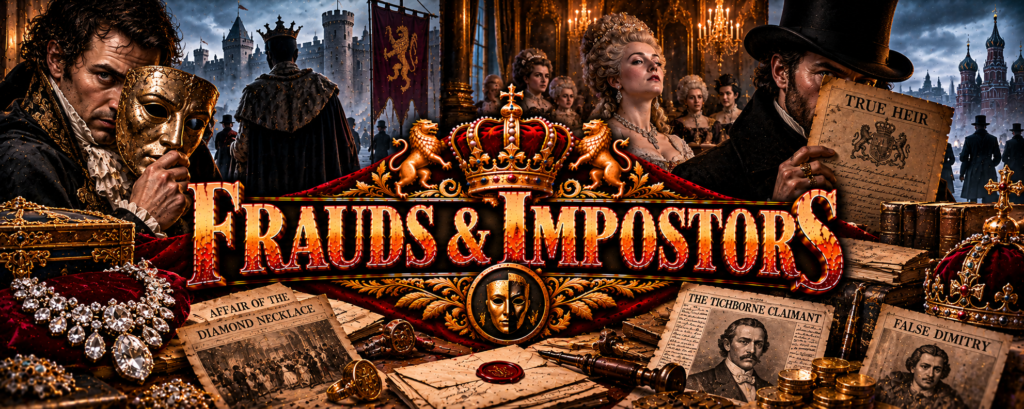
Throughout history, a convincing lie could be worth a fortune—or a kingdom. False princes appeared at royal courts claiming stolen birthrights, ambitious adventurers reinvented themselves as aristocrats, forged documents threatened governments, and ingenious confidence tricksters persuaded wealthy victims to surrender fortunes to people who did not really exist. From Perkin Warbeck’s extraordinary claim to be one of the lost Princes in the Tower and the succession of men who appeared in Russia claiming to be the supposedly surviving Dmitry Ivanovich to the bizarre saga of the Tichborne Claimant and the scandalous deception surrounding the Affair of the Diamond Necklace, discover the impostors, pretenders, swindlers, and fraudsters who convinced people to believe the unbelievable.
Royal imposture could be particularly dangerous because identity was inseparable from political power. In societies without photographs, fingerprints, DNA testing, or modern identification records, proving that someone was—or was not—a long-lost prince could be surprisingly difficult. A convincing claimant with the right appearance, knowledge, supporters, and political connections might attract nobles dissatisfied with the reigning monarch. What began as an audacious deception could therefore become a genuine threat to a throne.
Few stories demonstrate this better than Perkin Warbeck, who appeared during the reign of Henry VII claiming to be Richard, Duke of York, the younger of the Princes in the Tower. His claim attracted support from powerful figures across Europe and presented the Tudor monarchy with a serious political problem before Warbeck was ultimately captured and executed. In Russia, the mysterious death of the young Tsarevich Dmitry helped produce an even stranger phenomenon: a succession of False Dmitrys, pretenders who claimed to be the supposedly surviving prince during the chaotic Time of Troubles. One succeeded spectacularly enough to become Tsar of Russia before being overthrown and killed.
Other impostors sought fortunes rather than crowns. The nineteenth-century Tichborne Claimant became the center of one of Victorian Britain’s most sensational legal battles after an Australian butcher named Arthur Orton claimed to be Sir Roger Tichborne, the missing heir to a wealthy English family. Despite striking inconsistencies, his claim attracted passionate public support and resulted in enormous court proceedings, demonstrating how class resentment, celebrity, and the desire to believe an extraordinary story could transform an inheritance dispute into a national obsession.
Some of history’s greatest frauds required no false identity at all—only convincing documents, carefully constructed stories, and victims willing to believe them. Forged wills altered inheritances, counterfeit correspondence damaged reputations, fraudulent relics attracted pilgrims, and fabricated genealogies gave ambitious families prestigious ancestries they had never possessed. Political forgeries could be even more consequential, providing supposed evidence of conspiracies, secret agreements, or historical rights that never existed.
Financial fraud introduced another world of deception. Confidence tricksters sold nonexistent investments, promoted imaginary businesses, manipulated markets, and exploited periods of economic excitement to separate victims from their money. Charles Ponzi became so closely associated with one form of investment fraud that his name eventually became the generic term for schemes in which money from new investors is used to pay supposed returns to earlier participants. Yet Ponzi was neither the first nor the last to discover how effectively promises of extraordinary wealth could overwhelm skepticism.
Royal courts could be equally vulnerable to elaborate deception. The Affair of the Diamond Necklace in eighteenth-century France involved forged letters, impersonation, manipulation, and an extraordinarily expensive necklace supposedly intended for Queen Marie Antoinette. Although the queen herself was not responsible for the scheme, the scandal severely damaged her already troubled reputation and contributed to the atmosphere of hostility surrounding the monarchy in the years before the French Revolution. It remains one of history’s clearest demonstrations of how fraud could produce consequences far beyond the money involved.
Some impostures flourished because they offered people something they desperately wanted to believe. Survivors supposedly returned from the dead, missing heirs reappeared decades later, individuals claimed connections to famous families, and pretenders emerged after the violent deaths of rulers whose bodies had never been convincingly identified by the public. The execution of the Russian imperial family eventually produced numerous people claiming to be surviving Romanovs, most famously Anna Anderson, who insisted for decades that she was Grand Duchess Anastasia. Modern DNA evidence ultimately disproved her claim, but not before it had fascinated generations.
Then there were the historical hoaxes created not primarily for money or political power, but to deceive scholars and the public. Fabricated archaeological discoveries, forged manuscripts, invented antiquities, and supposed ancient artifacts occasionally fooled experts before inconsistencies exposed them. The Piltdown Man hoax, presented in the early twentieth century as an important prehistoric human discovery, survived for decades before scientific testing demonstrated that the remains had been deliberately manipulated. Such cases reveal an uncomfortable truth: experts can also be deceived, particularly when fraudulent evidence appears to confirm what they already expect or hope to find.
The most successful impostors understood that deception depended upon more than telling a convincing lie. They studied their victims, exploited existing political divisions, borrowed the appearance of authority, surrounded themselves with credible supporters, and provided just enough truth to make their fabrications believable. Some maintained their deceptions for years. Others watched elaborate schemes collapse because of a single forgotten detail, suspicious witness, contradictory document, or technological advance capable of exposing what earlier investigators could not prove.
Explore the extraordinary world of history’s frauds and impostors, from royal pretenders and false heirs to confidence tricksters, financial swindlers, forged documents, fabricated artifacts, and elaborate historical hoaxes. Follow the investigations, trials, scandals, political crises, and remarkable deceptions that allowed ordinary individuals to assume extraordinary identities—and sometimes convince thousands of people that their stories were true.
Separate genuine mysteries from deliberate fraud, contemporary accusations from proven deception, and historical evidence from the myths that grew around particularly successful impostors. These are the stories of people who lied their way into fortunes, noble families, history books, and sometimes even onto thrones—and of the moment when the illusion finally began to collapse.