
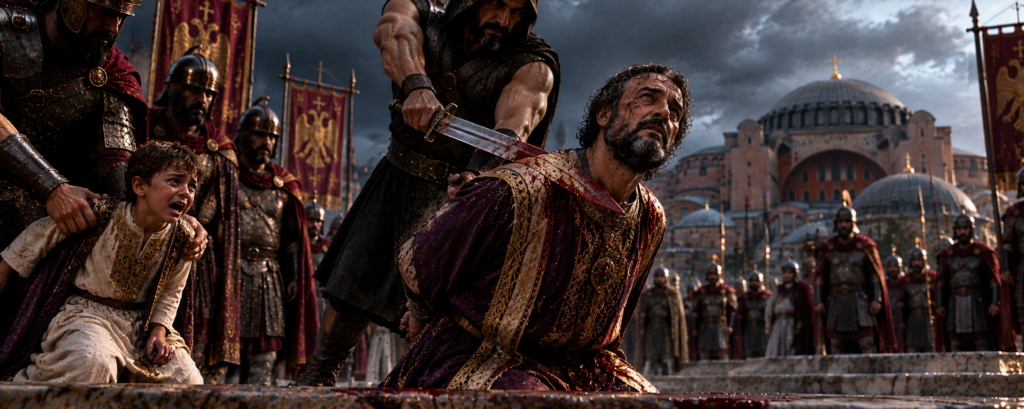
Justinian II: The Mutilated Emperor Who Reclaimed His Throne and Lost His Head
Justinian II Rhinotmetos (c. 668–711 CE) | Eastern Roman Emperor, 685–695 and 705–711 | Deposed, captured, and beheaded in 711; his young son Tiberius was subsequently murdered
The Emperor Who Refused to Stay Dead
In the autumn of 711, the emperor Justinian II was running out of enemies he could kill and allies he could trust. Rebellion had spread from the distant Crimean city of Cherson, an imperial expedition had turned against its own ruler, and a man named Philippikos Bardanes was preparing to claim the throne. Constantinople, the city Justinian had once recovered through an almost impossible act of determination, was slipping beyond his control for the second time. The emperor who had survived mutilation, exile, betrayal, and years of wandering was about to discover that there would be no third return.
For most men, the first overthrow would have ended everything. Sixteen years earlier, Justinian had been dragged from the imperial throne, publicly humiliated, and subjected to a punishment intended to make him permanently unfit to rule. His nose was cut off, leaving him disfigured and earning him the name Rhinotmetos, usually translated as the Slit-Nosed. He was then banished to Cherson, a remote Roman outpost on the northern shores of the Black Sea, where his enemies expected him to disappear into obscurity.
Instead, Justinian did something almost unprecedented. He escaped exile, secured the protection of foreign rulers, gathered an army, and returned to Constantinople in 705. The mutilated emperor entered the city through a concealed route and reclaimed the throne that had been taken from him a decade earlier. His return should have been the extraordinary conclusion to a story of survival against impossible odds.
Unfortunately for the people who had betrayed him, Justinian had not returned to forgive anyone. He had spent years remembering the men who had mutilated him, the officials who had abandoned him, and the political rivals who had occupied his throne. Once restored, he pursued vengeance with a determination that made his second reign notorious for cruelty and repression. Former emperors were humiliated and executed, military officers were punished, and suspicion increasingly poisoned the government.
By 711, the consequences had become impossible to contain. The emperor’s campaigns had created new enemies, his treatment of Cherson had helped provoke a rebellion, and his commanders were beginning to decide that removing him was safer than remaining loyal. When Philippikos Bardanes gained the support necessary to challenge him, Justinian found himself facing the same political nightmare that had destroyed his first reign. This time, however, his enemies had learned from their predecessors’ mistake.
They would not merely mutilate him.
Justinian II was captured and beheaded, bringing his second reign to a violent end. His head was reportedly sent to Constantinople and displayed as proof that the emperor who had once returned from exile would never return again. His young son Tiberius, approximately six years old, was also killed after seeking sanctuary in a church. The boy’s murder extinguished the immediate male line of the Heraclian dynasty, which had ruled the Eastern Roman Empire for more than a century.
The story of Justinian II is one of the darkest and most extraordinary in Byzantine history. It contains a disfigured emperor, a desperate escape across the Black Sea, a marriage among the Khazars, an alliance with a Bulgar ruler, a secret entry into Constantinople, public executions, and a final betrayal that destroyed both father and son. Yet beneath those dramatic events lies a more complicated history of imperial ambition, religious conflict, military disaster, and the dangerous belief that vengeance could secure a throne. Justinian survived almost everything his enemies did to him, but he never escaped the political violence that had made his remarkable return possible.
Born Into an Empire Fighting for Survival
Justinian was born around 668, the son of Emperor Constantine IV and a member of the Heraclian dynasty. His great-grandfather Heraclius had seized the throne in 610 and subsequently led the empire through a desperate war against Persia. Although Heraclius eventually defeated the Persians, the victory was followed by the rapid expansion of Arab Muslim armies into Roman territory. By the time Justinian was born, the empire had lost Syria, Palestine, and Egypt, territories that had once supplied enormous wealth and military strength.
The seventh century had transformed the Roman world almost beyond recognition. Constantinople remained a magnificent imperial capital, but the empire surrounding it was smaller, poorer, and increasingly dependent upon military organization. Arab forces threatened Anatolia and the Mediterranean, while Slavic settlements and Bulgar expansion complicated Roman control of the Balkans. The old dream of an empire dominating the entire Mediterranean had become impossible to sustain.
Justinian’s father, Constantine IV, nevertheless achieved important successes. His reign became associated with the successful defense of Constantinople against Arab naval pressure and a peace settlement that temporarily improved the empire’s strategic position. He also presided over the Sixth Ecumenical Council, held in Constantinople in 680–681, which condemned Monothelitism and attempted to settle a long-running theological controversy. These achievements helped restore a measure of stability after decades of military and religious upheaval.
Constantine IV was also determined to secure his son’s succession. He had brothers who possessed imperial rank, but their position threatened to complicate the future transfer of power. The emperor eventually removed them from their status as co-emperors and had their noses mutilated, preventing them from becoming credible rivals under the prevailing assumptions about imperial bodily integrity. Justinian therefore grew up in a dynasty where disfigurement was already an accepted instrument of political security.
The irony would later become almost unbearable. The father who mutilated relatives to protect Justinian’s inheritance helped reinforce a political custom that would eventually be used against Justinian himself. The young prince was surrounded by ceremonies celebrating imperial legitimacy, yet the dynasty’s internal history demonstrated how easily legitimacy could be destroyed through violence. He inherited not only the throne but also a dangerous understanding of how to defend it.
When Constantine IV died in 685, Justinian became emperor at approximately sixteen or seventeen years of age. He inherited a government that had recovered some stability but remained surrounded by serious threats. His youth did not prevent him from pursuing an ambitious political program. From the beginning, he displayed a determination to strengthen imperial authority, increase revenue, and restore Roman influence wherever possible.
The new emperor also possessed an unusually powerful dynastic name. He was named after Justinian I, the sixth-century ruler who had attempted to reconquer the western Mediterranean and codified Roman law. That earlier Justinian remained associated with imperial grandeur, religious authority, and the dream of Roman restoration. Whether Justinian II consciously modeled every aspect of his government upon his namesake is uncertain, but the comparison was impossible to avoid.
He was a young ruler bearing the name of an emperor whose achievements had become legendary. His own reign would produce a very different kind of legend. Where Justinian I was remembered for great buildings and ambitious conquests, Justinian II would become famous for mutilation, revenge, exile, and a return to power that seemed to defy the political rules of his age.
The Young Emperor Who Wanted More
Justinian’s first reign was not initially the uninterrupted disaster suggested by his later reputation. He inherited a relatively favorable diplomatic position from Constantine IV and attempted to use it to strengthen the empire. Relations with the Umayyad Caliphate included agreements concerning tribute and frontier arrangements, while the emperor pursued military and administrative policies intended to consolidate Roman territory. His early government demonstrated energy as well as ambition.
The Balkans became one of his principal concerns. Slavic communities had established themselves across regions that Constantinople still regarded as imperial territory, while the Bulgars had emerged as a significant power north and south of the Danube. Justinian launched a major expedition in 688–689, campaigning through Thrace and Macedonia. The operation achieved enough success for the emperor to enter Thessalonica and celebrate his accomplishments.
The campaign also involved the relocation of substantial numbers of Slavs into Asia Minor. Such transfers served several purposes, including strengthening military recruitment and increasing agricultural production in territories damaged by earlier warfare. Relocation could also weaken potentially rebellious communities by removing them from their original political environment. For the people affected, however, imperial resettlement could be profoundly disruptive.
Justinian attempted to incorporate relocated Slavs into the imperial military system. The policy initially offered the possibility of strengthening Roman forces through new manpower. Yet loyalty among these troops was not guaranteed, particularly when the empire’s enemies could offer alternative arrangements. The dangers became apparent during renewed conflict with the Arabs.
In 692, Roman and Arab armies fought at the Battle of Sebastopolis. The engagement ended in a serious Roman defeat, traditionally associated with the defection of a substantial contingent of Slavic troops. Later accounts describe Justinian reacting with severe reprisals against Slavic populations, although the precise scale and details of the punishments remain disputed. The defeat damaged the emperor’s military reputation and helped undermine his earlier successes.
The battle also exposed the limitations of his ambitious policies. Justinian could move populations, create military units, and demand obedience, but he could not manufacture loyalty through imperial command alone. The empire’s enemies understood how to exploit divisions within Roman forces. The young emperor responded to setbacks with increasing severity, a pattern that would become more pronounced as his reign continued.
At the same time, Justinian pursued administrative reforms and attempted to increase imperial revenue. His government needed money to maintain armies, fortifications, naval forces, and the court. Taxation was therefore not simply evidence of personal greed, although the methods used to collect it could provoke intense resentment. The emperor’s determination to strengthen the state placed growing pressure upon the people expected to finance it.
His early reign thus contained the ingredients of both achievement and disaster. He was energetic, militarily ambitious, and willing to undertake difficult reforms. He was also impatient with opposition and increasingly inclined toward coercion. Those qualities would eventually transform political dissatisfaction into rebellion.
The Price of Imperial Ambition
Money was one of the greatest problems facing the Eastern Roman Empire. The loss of wealthy provinces during the Arab conquests had reduced the government’s traditional revenue, while military expenses remained enormous. Justinian inherited a state that needed substantial resources simply to defend its surviving territories. His efforts to increase taxation therefore emerged from genuine financial pressures.
Nevertheless, the officials responsible for enforcing his fiscal policies became deeply unpopular. Two figures frequently associated with the harshness of his government were Stephen the Persian, a senior palace official, and Theodotos, a financial administrator. Later sources accuse them of severe abuses, intimidation, and brutal methods of extracting revenue. The details of individual accusations are difficult to verify because the surviving narratives were written within a tradition hostile to Justinian.
The broader problem was real enough. Heavy taxation could alienate landowners, urban populations, and provincial communities already struggling with economic disruption. Officials who enforced imperial demands often became targets of public anger. When the emperor refused to restrain them, resentment could turn against the throne itself.
Justinian also pursued ambitious building projects in Constantinople. He undertook alterations and additions to the Great Palace complex, including the ceremonial space associated with the name Justinianos or Justinian’s hall. Such projects reinforced imperial magnificence and provided settings for the elaborate ceremonies through which Byzantine rulers displayed authority. They also required money and labor at a time when financial burdens were already controversial.
The contrast between palace grandeur and public hardship was politically dangerous. Subjects might accept taxation when they believed it was necessary for military defense, but elaborate court construction could appear extravagant. Later historians emphasized this contrast when portraying Justinian as a ruler more interested in magnificence than the suffering of his people. That interpretation may be exaggerated, but it reflects a genuine tension within imperial government.
His reputation for harshness gradually became a political liability. A ruler could survive military defeats if important elites remained loyal, and he could impose heavy taxation if the army continued to support him. Justinian increasingly struggled to maintain both forms of cooperation. His determination to command obedience encouraged the resentment that would eventually make rebellion possible.
By 695, the emperor had accumulated enemies among soldiers, officials, and ordinary inhabitants of Constantinople. His dynasty remained legitimate, but legitimacy alone could not protect a ruler whose government had become deeply unpopular. The political atmosphere was becoming dangerously unstable. A man who had inherited the throne without serious opposition was approaching his first violent overthrow.
The Religious Emperor and the Council in Trullo
Justinian’s government was not concerned solely with armies and taxation. Like other Byzantine emperors, he regarded religious unity as essential to the stability of the state. The empire’s Christian identity shaped its laws, ceremonies, diplomacy, and political legitimacy. Religious disagreements could therefore become matters of imperial security.
In 691–692, Justinian convened the council commonly known as the Council in Trullo or Quinisext Council. It was intended to supplement the fifth and sixth ecumenical councils by addressing disciplinary and ecclesiastical matters. The council issued numerous canons concerning clerical conduct, marriage, fasting, religious practice, and church organization. Its decisions reflected the emperor’s desire to strengthen religious regulation across the empire.
Some of the canons conflicted with practices accepted in Rome. The differences concerned matters such as clerical marriage and fasting customs, but they also touched broader questions about ecclesiastical authority. Pope Sergius I refused to accept certain decisions. Justinian’s government responded by attempting to enforce imperial authority over the pope.
According to the surviving tradition, the emperor ordered the arrest of Sergius. The official sent to carry out the order encountered resistance from forces and communities loyal to the pope, and the attempt failed. The episode revealed the limits of Constantinople’s practical authority in Italy. The emperor could issue commands, but distant officials could not always enforce them.
The confrontation contributed to the complicated relationship between Rome and Constantinople. Both claimed to defend Christian orthodoxy, yet they disagreed over religious discipline and institutional authority. Justinian’s determination to impose uniformity created resistance that could not be resolved through ordinary imperial administration. Religious policy became another source of political friction.
The council itself remained historically important despite the controversy. Many of its canons became influential within Eastern Christianity, while the Roman church did not accept them in the same manner. Justinian’s role demonstrates that he was more than a military adventurer or vindictive tyrant. He participated actively in shaping the religious institutions of the empire.
Yet the controversy also reveals his governing temperament. He preferred decisive imperial intervention and expected religious authorities to cooperate. When they resisted, he was willing to use coercion. The same instinct appeared in his fiscal and military policies, where disagreement could quickly become a challenge to imperial authority.
The First Fall: Constantinople Turns Against Its Emperor
The crisis finally erupted in 695. Justinian’s enemies found a leader in Leontios, an experienced military commander who had previously fallen from favor. Leontios possessed the military reputation and political connections necessary to attract opposition. He also understood that public resentment could be transformed into a movement against the emperor.
The rebellion developed rapidly in Constantinople. Leontios gained support among discontented groups, including elements of the urban population and influential political circles. The city’s factions and crowds could become decisive during moments of imperial weakness. Justinian discovered that the capital he had ruled for a decade was no longer reliably loyal.
His financial officials became particular targets of anger. Theodotos and Stephen the Persian were seized and killed during the upheaval, according to later accounts. Their deaths symbolized the rejection of the oppressive administration associated with Justinian’s government. The emperor himself soon fell into the hands of the rebels.
Leontios did not order Justinian’s immediate execution. Instead, the deposed emperor was subjected to mutilation, a punishment intended to make him permanently unfit for the throne. His nose was cut off, and some traditions also describe injury to his tongue. The mutilation was both physical violence and a political declaration that his imperial career had ended.
The logic behind the punishment was rooted in the symbolic importance of bodily integrity. An emperor was expected to embody the dignity and perfection of his office, and severe disfigurement could be used to disqualify a rival. Byzantine rulers repeatedly employed mutilation as an alternative to execution. It allowed a victorious usurper to neutralize an opponent while avoiding the immediate stigma of killing him.
For Justinian, the humiliation was devastating. He had entered the throne as the legitimate son of Constantine IV and had ruled for ten years. Now he was disfigured, stripped of power, and condemned to exile. The punishment was designed to ensure that nobody would ever again regard him as a credible emperor.
Leontios sent him to Cherson, a distant Roman settlement in the Crimea. The city lay far from Constantinople, separated from the imperial capital by the Black Sea and surrounded by territories influenced by powerful neighboring peoples. Exile there removed Justinian from the political networks that might support a restoration. His enemies expected distance and disfigurement to finish what rebellion had begun.
They underestimated him.
Cherson: Exile at the Edge of the Empire
Cherson occupied a strategic but isolated position on the northern Black Sea coast. It was a place where Roman influence met the political world of the Khazars and other steppe powers. The city maintained commercial and diplomatic connections with Constantinople, but it was far removed from the ceremonial grandeur of the imperial palace. For a deposed emperor, it offered few comforts and many dangers.
Justinian arrived there as a mutilated exile whose political future appeared hopeless. He no longer commanded armies, controlled revenue, or possessed the machinery of imperial government. His enemies in Constantinople could assume that he would eventually disappear from public life. The punishment had reduced him from emperor to dependent prisoner.
Yet Justinian retained something that mutilation could not remove. He remained a member of the Heraclian dynasty and a former emperor whose claim could still attract supporters. Political legitimacy in Byzantium depended upon more than physical appearance, despite the assumptions behind mutilation. If Justinian could gather enough military support, his damaged face might become a symbol of suffering rather than disqualification.
The situation in Constantinople also changed dramatically after his exile. Leontios proved unable to stabilize the empire, and Arab forces captured Carthage in 697, ending effective Roman control over most of North Africa. The loss was a major strategic and psychological disaster. It undermined confidence in the new government and encouraged another military rebellion.
In 698, Leontios was overthrown by Apsimar, a naval commander who assumed the imperial name Tiberios III. The new ruler subjected Leontios to the same punishment that Leontios had inflicted upon Justinian. His nose was mutilated, and he was removed from power. The throne had passed from one usurper to another in only three years.
For Justinian, the upheaval created both danger and opportunity. His original enemy had fallen, but the new emperor had no reason to welcome the return of a legitimate dynastic rival. Rumors that Justinian was planning to reclaim the throne reportedly reached Constantinople. The exiled ruler’s determination was becoming impossible to ignore.
The authorities at Cherson eventually became concerned about his activities. Some accounts suggest that local officials considered surrendering him to the reigning emperor or otherwise eliminating the danger he represented. Justinian recognized that remaining in exile could become fatal. If he wanted to survive, he needed to escape.
The man whose nose had been cut off to prevent his return was preparing to challenge the entire political order. He possessed no imperial army and no secure territory from which to launch an invasion. His only real assets were his dynastic identity, his determination, and the possibility of finding powerful foreign allies. Those assets would prove unexpectedly effective.
Escape Across the Black Sea
Justinian fled Cherson and sought refuge among the Khazars, a powerful people whose influence extended across the northern Black Sea region. The Khazar Khaganate occupied a crucial position between the Byzantine Empire, the Eurasian steppe, and the territories of other regional powers. Its rulers could influence trade routes and military movements across a vast area. For an imperial exile, Khazar protection offered a chance to survive beyond the reach of Constantinople.
The Khazar ruler received Justinian and allowed him to establish a connection with the ruling family. Justinian married a Khazar princess who took the Christian name Theodora. The marriage provided the former emperor with prestige and a valuable political alliance. It also demonstrated his willingness to operate outside the traditional aristocratic networks of Constantinople.
The relationship was not entirely secure. According to Byzantine historical tradition, the reigning emperor Tiberios III attempted to persuade the Khazar ruler to surrender or kill Justinian. The Khagan reportedly agreed to cooperate, placing the exiled emperor in immediate danger. The details of the alleged plot are preserved in narratives written long afterward and should be treated cautiously.
Theodora became central to the escape story. Later accounts describe her warning Justinian that agents had been sent to kill him. The former emperor then supposedly killed the men assigned to murder him and fled before the Khazar authorities could act. The episode has the dramatic structure of an adventure story, but its exact details cannot be independently verified.
What is clear is that Justinian escaped from Khazar territory and continued searching for allies. His movements took him through the northern Black Sea region, where he sought assistance from rulers willing to challenge Constantinople. He had survived mutilation, exile, and another apparent attempt to eliminate him. Each escape strengthened the extraordinary legend developing around him.
His marriage to Theodora also gave the story a personal dimension. The former emperor had acquired a wife and, eventually, a family during the years when his enemies believed his political life was finished. Theodora would later become empress after Justinian’s restoration. Their relationship connected the Byzantine throne with the world of the Khazars in an unusually direct way.
Yet marriage and survival were not enough. Justinian wanted his throne back, and the Khazars could not guarantee the military assistance necessary to seize Constantinople. He therefore turned toward another powerful ruler whose interests might align with his own. The next stage of his journey would bring him into the political world of the Bulgars.
Tervel: The Foreign Ruler Who Helped Restore an Emperor
Justinian sought assistance from Tervel, the ruler of the Bulgars. The Bulgars had established a powerful state in the Balkans after defeating Roman attempts to prevent their settlement south of the Danube. Relations between Constantinople and the Bulgar leadership alternated between warfare, diplomacy, and negotiated agreements. Tervel possessed the military resources necessary to threaten the imperial capital.
The exiled emperor offered rewards in exchange for assistance. Later traditions describe promises involving money, titles, territorial concessions, and a possible dynastic marriage, although the details are not consistently preserved. What mattered was that Tervel recognized an opportunity. Supporting Justinian could bring prestige and substantial advantages to the Bulgar state.
The alliance was extraordinary. A former Roman emperor, mutilated and banished by his own people, was preparing to reclaim Constantinople with the help of a foreign ruler whose predecessors had fought against the empire. Justinian’s claim to legitimacy rested upon dynastic inheritance, but his practical route to power depended upon Bulgar military strength. The contradiction did not deter him.
In 705, Justinian and Tervel advanced toward Constantinople with an army. The city was protected by formidable walls that had resisted numerous attacks over the centuries. A direct assault would have been dangerous, especially against a government determined to prevent Justinian’s return. The former emperor needed a way to enter without fighting a prolonged siege.
The surviving narratives describe an audacious infiltration. Justinian and a small group of supporters reportedly entered Constantinople through a water conduit or aqueduct passage after identifying a vulnerable route into the city. The story has become one of the most famous episodes of Byzantine political history. Although the exact mechanics cannot be reconstructed with certainty, Justinian’s forces did gain entry and rapidly destabilized the government.
Tiberios III was caught off guard. The emperor who had replaced Leontios and ruled for seven years suddenly faced the return of a man supposedly rendered incapable of reigning. His defenses failed, and he fled Constantinople. Justinian entered the imperial palace and reclaimed the throne.
The restoration overturned the political logic of mutilation. The man whose nose had been cut off to prevent his return was once again emperor. The physical punishment intended to destroy his legitimacy had failed. Justinian’s survival demonstrated that military power could overcome even the most deeply established assumptions about imperial fitness.
Tervel received significant rewards for his assistance. Justinian granted him the prestigious title of Caesar, an extraordinary honor for a foreign ruler, and provided other concessions. The alliance temporarily transformed a former enemy into an essential partner of the restored emperor. Justinian had recovered his throne through a combination of dynastic ambition, foreign diplomacy, and extraordinary daring.
The Emperor Returns With a Face His Enemies Had Tried to Destroy
Justinian’s return to Constantinople was one of the most remarkable restorations in Roman history. Ten years earlier, he had been mutilated and sent into exile. Two other men had occupied the throne during his absence. Now he had returned to the palace from which he had been expelled.
Later tradition describes Justinian wearing an artificial nose made of gold. The image became closely associated with his nickname and his extraordinary political comeback. Whether he consistently wore such a prosthesis, or whether the detail was embellished in later accounts, remains uncertain. His mutilation itself is beyond serious doubt.
The physical symbolism of his return was impossible to ignore. His enemies had treated disfigurement as a permanent barrier to imperial power. Justinian demonstrated that the barrier could be broken. The same body that had been publicly humiliated now occupied the throne again.
His restoration also transformed the political meaning of his exile. What had once appeared to be proof of defeat could now be presented as evidence of endurance and rightful suffering. Justinian could portray himself as the legitimate emperor restored after years of injustice. The narrative was powerful because his return had required extraordinary persistence.
Yet the restored emperor faced a serious problem. Many of the people who had betrayed him still lived, and the institutions that had supported his overthrow continued to exist. Military commanders, senators, church officials, and palace servants had served the governments of Leontios and Tiberios III. Justinian had to decide whether to reconcile with them or punish them.
His decision would shape the rest of his reign.
The years of exile had not softened his political instincts. If anything, the experience appears to have intensified his determination to eliminate enemies. He had survived because his opponents failed to kill him, and he was unlikely to make the same mistake. The extraordinary restoration therefore became the beginning of a new period of violence.
The Hippodrome Becomes a Theater of Revenge
Justinian’s most famous acts of vengeance targeted the two men who had occupied his throne. Leontios had already been mutilated and exiled after losing power to Tiberios III. Tiberios himself had fled Constantinople after Justinian’s return but was eventually captured. Both former emperors were brought before the restored ruler.
Later accounts describe their public humiliation in the Hippodrome of Constantinople. The Hippodrome was far more than a sporting arena because it served as a major setting for imperial ceremony and public political expression. Emperors appeared before enormous crowds there, receiving acclamations and demonstrating their authority. Justinian turned the space into a theater of punishment.
The two defeated rulers were reportedly dragged before him in chains. Some traditions describe Justinian placing his feet upon their necks while the crowd witnessed their humiliation. The image was designed to demonstrate complete reversal of fortune. Men who had once worn the imperial purple were now physically beneath the emperor they had displaced.
The public spectacle ended with their execution. Leontios and Tiberios III were killed, eliminating the two most obvious rival claimants. Justinian had experienced firsthand the danger of leaving a defeated emperor alive. He was determined that neither man would imitate his own extraordinary return.
The executions were politically understandable within the brutal logic of Byzantine succession struggles. A surviving former emperor could become the focus of rebellion, especially if discontented military commanders sought a legitimate figurehead. Justinian’s own career had proved that exile and mutilation were not always sufficient. Killing his rivals removed that particular danger.
Yet the spectacle also established the tone of his second reign. The restored emperor did not begin with reconciliation or an attempt to heal the divisions of the previous decade. He began by publicly destroying the men who had ruled during his absence. The message was unmistakable: betrayal would be remembered, and punishment would be severe.
The crowd that watched the executions could hardly miss the deeper irony. Justinian had survived because Leontios chose mutilation rather than death. Now Justinian ensured that his defeated rivals would never receive the same opportunity. His return had broken the old rules, and his vengeance helped establish harsher ones.
A Reign Haunted by Betrayal
The executions of Leontios and Tiberios III did not satisfy Justinian’s desire for security. Numerous officials had served the usurpers, and some had actively participated in his first overthrow. The restored emperor regarded these men as potential threats. His government increasingly relied upon investigation, punishment, and the removal of suspected opponents.
Military commanders were particularly vulnerable. Justinian had learned that armies could elevate new emperors and overthrow established dynasties. Officers who had supported Tiberios III might do so again if they believed the restored ruler was weakening. The emperor therefore attempted to eliminate individuals whose loyalty appeared uncertain.
Later sources describe executions, mutilations, and other severe punishments. Among the victims were prominent military figures associated with the previous regime. The precise scale of the repression is difficult to establish because hostile chroniclers may have exaggerated individual atrocities. Nevertheless, the pattern of political violence is clear.
The patriarch of Constantinople also suffered. Callinicus, who had held office during the years of Justinian’s exile, was removed and punished, traditionally by blinding and exile. His treatment demonstrated that ecclesiastical rank did not protect a man from imperial vengeance. Justinian’s resentment extended beyond military and political officials.
Such punishments created a dangerous atmosphere. Officials who had served previous governments could not easily erase their past associations. Even men who had not actively opposed Justinian might fear that suspicion would eventually fall upon them. The emperor’s attempts to secure loyalty could therefore encourage concealment, resentment, and conspiracy.
The government also suffered from the loss of experienced personnel. Military officers and administrators were not easily replaced, especially during a period of renewed Arab pressure. Removing capable commanders for political reasons could weaken the empire’s defenses. Justinian’s desire for personal security increasingly conflicted with the practical needs of the state.
His enemies later portrayed the second reign as a period of almost limitless cruelty. That image was undoubtedly shaped by the victorious regime that replaced him, but it was not created from nothing. Justinian had returned with an extraordinary opportunity to rebuild his authority. Instead, his government became increasingly associated with fear.
The tragedy was that vengeance could never provide complete security. Every execution removed one possible enemy while creating new grievances among relatives, supporters, and colleagues. Every punishment reminded officials that their survival depended upon the emperor’s confidence. The more Justinian tried to eliminate betrayal, the more attractive rebellion could become.
Theodora and the Family He Had Built in Exile
Justinian’s restoration also transformed the position of his Khazar wife, Theodora. She had married him while he was a fugitive, when his chances of returning to the throne appeared remote. Her loyalty became an important part of the story of his survival. After his restoration, she entered the imperial world as empress.
The marriage was politically unusual because Theodora came from the ruling family of a powerful foreign people. Byzantine emperors frequently used marriage diplomacy, but the elevation of a Khazar princess to the position of empress was striking. Her presence demonstrated the international alliances that had made Justinian’s return possible. The restored dynasty now possessed direct family connections with the Khazar elite.
Their son Tiberius became the focus of Justinian’s dynastic ambitions. Born during the period surrounding his father’s exile and restoration, the boy represented the continuation of the Heraclian line. Justinian eventually elevated him to the rank of co-emperor. The child was intended to inherit a throne his father had recovered through extraordinary effort.
The decision was understandable. Justinian had witnessed the collapse of his first reign and understood how dangerous an uncertain succession could become. By publicly recognizing Tiberius as his heir, he hoped to strengthen the dynasty’s future. The boy’s imperial title gave him ceremonial status and a recognized claim.
Yet the elevation also made Tiberius vulnerable. A child emperor could become a rallying point for loyalists after his father’s death. Political enemies who wanted to establish a new dynasty might therefore regard him as a threat. The same logic that had led Justinian to execute former emperors would eventually be turned against his son.
Theodora’s later fate is not securely documented. The surviving sources focus primarily upon Justinian’s overthrow and the murder of Tiberius, leaving important gaps concerning the empress. It would be misleading to invent a dramatic final confrontation or assume details about her death that the evidence does not preserve. Her role in the story remains most visible during Justinian’s exile and restoration.
For Tiberius, however, the outcome is tragically clear. He was still a young child when his father’s second reign collapsed. His imperial title could not protect him. Instead, it helped make him a target.
The Empire Still Had Enemies Beyond the Palace
While Justinian pursued political vengeance, the empire continued facing serious external threats. The Umayyad Caliphate remained a formidable military power, and Arab armies repeatedly attacked Roman territories in Anatolia. The empire needed experienced commanders, reliable troops, and stable administration. Internal repression made those requirements harder to satisfy.
The Arab conquest of Tyana in Cappadocia became one of the significant setbacks of Justinian’s second reign. The city fell after a prolonged campaign around 707–708, although the chronology is sometimes presented differently in later summaries. Its loss demonstrated that Roman defenses remained vulnerable. The government struggled to maintain control over threatened frontier regions.
The Balkans also required attention. Relations with the Bulgars remained important because Tervel had helped restore Justinian. The alliance provided advantages, but it also created obligations and expectations. The emperor had to balance his dependence upon Bulgar support with the traditional Roman desire to control the peninsula.
The western provinces presented additional complications. Roman authority in Italy was fragmented, and local elites possessed interests that did not always align with Constantinople. The empire’s remaining territories around Ravenna, Rome, and southern Italy were difficult to administer from the eastern capital. Justinian’s attempts to assert authority could provoke resistance.
In 709, an imperial expedition attacked Ravenna. Later accounts describe the arrest of prominent citizens and their transportation to Constantinople, where several suffered severe punishment. The reasons for the operation remain uncertain, and the surviving narratives are shaped by local hostility toward the emperor. Nevertheless, the episode contributed to Justinian’s reputation for using military force against communities nominally under his own rule.
The attack on Ravenna was especially damaging because the empire could ill afford to alienate its remaining Italian subjects. Local support was essential for defending territories threatened by Lombard expansion. Punishing influential families could weaken cooperation with imperial officials. Once again, Justinian’s determination to enforce authority risked undermining the institutions upon which that authority depended.
His reign therefore became a struggle on multiple fronts. Arab armies threatened Anatolia, Balkan politics required careful diplomacy, Italian communities resisted imperial demands, and court officials feared punishment. Justinian remained energetic, but his government was increasingly unstable. The emperor who had once overcome exile through extraordinary political skill was losing the ability to maintain loyalty among his own subjects.
A Final Religious Reconciliation
Despite the violence of his second reign, Justinian achieved a notable diplomatic success in his relations with the papacy. Pope Constantine traveled to Constantinople in 710–711, becoming the last pope to visit the imperial capital for many centuries. The visit followed years of tension over the Council in Trullo and the relationship between Roman and Constantinopolitan ecclesiastical authority. It offered an opportunity to resolve disputes that had troubled Justinian’s first reign.
The pope received an elaborate welcome. Imperial officials participated in ceremonies honoring him, and Justinian eventually met him personally. The surviving accounts describe a reconciliation in which the emperor treated the pope with respect. The precise terms of the agreement remain debated, but the visit helped improve relations.
The episode complicates the image of Justinian as a ruler incapable of diplomacy. He could negotiate with foreign powers, cultivate religious alliances, and recognize the practical value of compromise. His earlier restoration had depended upon exactly those abilities. The problem was not that he lacked political intelligence.
Rather, his behavior varied dramatically according to circumstances and perceived threats. He could honor a pope while ordering severe punishment against political enemies. He could reward Tervel for loyalty while pursuing vengeance against officials who had betrayed him. His government combined calculated diplomacy with destructive suspicion.
The papal visit also occurred shortly before the final collapse. At the very moment Justinian appeared capable of resolving a longstanding religious dispute, rebellion was developing elsewhere in the empire. His diplomatic achievement could not repair the damage caused by years of repression. The throne remained vulnerable.
The contrast is one of the most revealing features of his reign. Justinian was not simply an irrational ruler making random decisions. He possessed the ability to pursue coherent policies and achieve important agreements. Yet his determination to punish perceived enemies repeatedly destroyed the trust necessary for stable government.
Cherson: The City That Had Seen Him Humiliated
The final crisis began in the region where Justinian had once endured exile. Cherson, the distant Crimean settlement that had housed him after his mutilation, again became central to his fate. The city occupied a politically sensitive position between Constantinople and the Khazar world. Its inhabitants had experience negotiating with powerful neighbors and maintaining a degree of local autonomy.
Justinian’s relationship with Cherson was deeply complicated. He had lived there as a prisoner and had eventually fled when his position became dangerous. Some local officials may have participated in efforts to surrender him to his enemies. Whether he personally remembered specific betrayals or regarded the city as strategically unreliable, his government eventually moved against it.
Around 710, Justinian dispatched an expedition to Cherson. The operation was intended to restore imperial control and punish opposition, although the precise motives remain debated. Later accounts portray the campaign as an act of revenge against the city that had humiliated him. That interpretation is plausible but should not be accepted as the only possible explanation.
The expedition became notorious for its brutality. Byzantine chronicles describe executions, torture, and the killing of prominent inhabitants. Some accounts include particularly gruesome punishments, such as burning prisoners or drowning them with weights attached. The exact numbers and individual details are difficult to verify, but the campaign clearly generated intense hostility.
The treatment of Cherson was politically disastrous. The city was not simply an enemy fortress captured in a foreign war. It was a Roman outpost whose cooperation was important for maintaining imperial influence in the northern Black Sea. Brutal punishment encouraged local inhabitants and military personnel to seek protection elsewhere.
The Khazars also became involved in the crisis. Their influence around Cherson meant that imperial operations could threaten their interests. Justinian had once depended upon Khazar protection during exile, but the political relationship had changed. Former allies could become opponents when circumstances shifted.
The emperor’s determination to impose authority upon Cherson therefore created a dangerous combination of local resentment, military discontent, and foreign involvement. The region that had once provided the setting for his extraordinary escape was becoming the birthplace of a new rebellion. Justinian had returned to power partly because his enemies failed to understand the political dangers of exile. He was now making a similar mistake by creating desperate opponents far from Constantinople.
The Expedition That Turned Against Its Emperor
The crisis escalated when imperial forces operating around Cherson began resisting Justinian’s authority. The surviving accounts describe a complicated sequence of military operations, local rebellions, and shifting loyalties. Commanders who had been sent to enforce the emperor’s will found themselves drawn into opposition. The government was losing control of the very forces intended to secure the region.
One important figure was Bardanes, a military officer who had previously fallen under suspicion. He became associated with the rebellion and eventually adopted the imperial name Philippikos. His elevation transformed the conflict from a provincial disturbance into a direct challenge to Justinian’s throne. The rebels now possessed a candidate around whom opposition could organize.
The choice of Bardanes was politically significant. A rebellion against an emperor becomes far more dangerous when it can present an alternative ruler. Soldiers and officials who might hesitate to support disorder can rally around a recognized claimant. Philippikos offered a future in which Justinian would no longer control the empire.
The emperor’s harsh treatment of Cherson had therefore produced the opposite of its intended effect. Instead of eliminating opposition, it encouraged a coalition of local inhabitants, military personnel, and political enemies. The rebellion gained momentum as imperial forces changed allegiance. Justinian’s authority was collapsing from the edges of the empire toward its center.
Later traditions describe another expedition being sent against the rebels, only for its personnel to defect or refuse obedience. The details vary, but the essential pattern is clear. Justinian could no longer trust the military forces upon which his government depended. His earlier purges and punishments had not created enduring loyalty.
The rebellion also demonstrated the danger of governing through fear. Officers who believed that failure might result in execution had little incentive to return to Constantinople and explain a defeat. Supporting a rival emperor could appear safer than submitting to Justinian’s judgment. The more severe the ruler’s reputation became, the more attractive rebellion could seem.
By 711, the crisis had developed into a full-scale challenge. Philippikos possessed military support and a political cause strengthened by resentment against Justinian. The emperor who had once reclaimed Constantinople through foreign assistance and military daring now faced a challenger using similar methods. The cycle of usurpation was beginning again.
Philippikos Bardanes: The Man Who Would End the Dynasty
Philippikos Bardanes was not an obscure servant suddenly elevated by chance. He belonged to the military and political world of the empire and had connections that made him a plausible candidate for imperial power. His exact background is not fully documented, but he was sufficiently prominent to attract support during the Cherson crisis. He also possessed religious views that would later influence his government.
Bardanes had reportedly been associated with earlier suspicions of political ambition. Justinian’s government had reason to regard him as dangerous, and some traditions suggest that he had previously suffered exile or punishment. His emergence as a rebel leader therefore fitted the broader pattern of Justinian creating enemies through coercion. A man once treated as a threat became the instrument of the emperor’s destruction.
The rebels proclaimed Bardanes emperor under the name Philippikos. The adoption of an imperial name signaled that the movement no longer sought merely to resist punishment or secure local autonomy. It intended to replace Justinian entirely. The struggle had become a contest for Constantinople.
Philippikos gained support among forces disillusioned with Justinian’s government. The emperor’s reputation for vengeance made reconciliation appear dangerous, while the new claimant offered an alternative. The rebellion also benefited from the strategic position of the Black Sea, which provided maritime routes toward the imperial capital. A fleet could carry political revolution directly to Constantinople.
The situation resembled Justinian’s own restoration in 705. He had approached the capital with foreign assistance and exploited weaknesses in the reigning government’s defenses. Philippikos now sought to exploit the weakness of Justinian’s second regime. The former usurper had become the threatened emperor.
Justinian’s personal history made the danger especially acute. He knew better than almost anyone that a deposed ruler could return if he retained supporters. He had executed Leontios and Tiberios III partly to prevent such a possibility. Philippikos and his allies would eventually apply the same logic to Justinian himself.
The difference was that Justinian had become politically isolated. His first return had depended upon extraordinary alliances and the determination of supporters willing to risk everything. In 711, many of the people who might have defended him were dead, alienated, or uncertain of his favor. The emperor’s own policies had narrowed the circle of men willing to fight for him.
Constantinople Opens Its Gates Again
As Philippikos advanced toward Constantinople, Justinian faced a crisis of loyalty. The capital had already witnessed multiple violent changes of government during his lifetime. Its inhabitants knew that imperial authority could collapse quickly when military support disappeared. The approach of another claimant encouraged officials and soldiers to reconsider their allegiance.
Justinian was away from the capital when the decisive events unfolded. His absence made it easier for opponents to organize without immediate interference. The government depended upon commanders and administrators willing to defend his interests. Their loyalty proved insufficient.
Philippikos’s forces gained control of Constantinople with comparatively limited resistance. The city that Justinian had recovered through an audacious infiltration in 705 now accepted another ruler. The palace, treasury, and central institutions passed into the hands of his enemies. His second reign had effectively ended before he could return to defend it.
The speed of the collapse was devastating. Justinian had spent six years attempting to eliminate political opposition, yet the capital still abandoned him when a credible challenger appeared. Public punishment had not created the loyalty he needed. It had merely concealed resentment until rebellion became possible.
The new regime understood that Justinian remained dangerous while alive. His first restoration had demonstrated that mutilation, exile, and distance could not guarantee his political destruction. A man who had once returned from Cherson with Bulgar assistance might conceivably attempt another comeback. Philippikos therefore had strong reasons to ensure that the former emperor never received a second opportunity.
The situation was also dangerous for Justinian’s family. His son Tiberius possessed the imperial title and represented the continuation of the Heraclian dynasty. Even if Justinian himself were killed, loyalists might attempt to rally around the boy. The new government faced the same brutal calculation that had shaped so many Byzantine successions.
For Justinian, the final irony was unmistakable. He had survived because Leontios chose mutilation rather than execution. He had then executed his own defeated rivals to prevent their return. Now the men who overthrew him were preparing to make the same decision. The political violence he had embraced was about to consume him.
The Final Capture of Justinian II
Justinian attempted to respond to the rebellion, but his position had become hopeless. The forces available to him were insufficient to reverse the loss of Constantinople. His enemies controlled the political center of the empire and possessed growing military support. The emperor who had once forced his way back onto the throne could no longer command the loyalty necessary to defend it.
Later accounts describe his final movements in the region of Damatrys or elsewhere near the approaches to Constantinople. The precise sequence varies among the surviving sources, and some details of his capture remain uncertain. What is clear is that Justinian was overtaken by forces loyal to the new regime. His second attempt to retain the throne failed.
He was captured and executed in 711, traditionally dated to November 4. Beheading is the method consistently associated with his death. The execution ended a political career that had included two reigns separated by ten years of exile. Justinian was approximately forty-three years old.
The manner of his death was deliberately final. His enemies did not repeat the mutilation that had failed in 695. They removed his head, eliminating any possibility that the former emperor could personally lead another restoration. The act was both execution and political insurance.
Accounts describe Justinian’s head being sent to Constantinople and displayed as proof of his death. Some traditions add that it was subsequently sent to other cities, including Rome and Ravenna, although the details differ. Such displays were intended to make the outcome unmistakable. The empire was being told that Justinian II would never return.
The symbolism was brutal. A man whose mutilated face had once become evidence of extraordinary survival was now reduced to a severed head. His first enemies had tried to destroy his political future by damaging his body. His final enemies destroyed the body itself.
The execution also completed a cycle of revenge. Justinian had ordered the deaths of Leontios and Tiberios III after recovering the throne. Philippikos now ordered the death of Justinian after taking it from him. Each ruler justified violence as necessary for political security. Each succession reinforced the expectation that defeated emperors might have to die.
Yet Justinian’s death did not entirely resolve the problem. His son remained alive in Constantinople, and the child possessed a legitimate claim through the Heraclian dynasty. The new regime had eliminated the father but not the heir. The final act of the tragedy would therefore take place not on a battlefield but inside a church.
The Six-Year-Old Emperor Who Sought Sanctuary
Tiberius, the young son of Justinian II and Theodora, was approximately six years old when his father’s government collapsed. He had been elevated to the rank of co-emperor, giving him a formal position within the imperial succession. His childhood offered no protection from the political consequences of that title. To the supporters of Philippikos, he represented a potential future rebellion.
The boy was placed under the protection of people associated with the imperial household. Later accounts identify his grandmother Anastasia, the mother of Justinian II, as an important figure in his final hours. She attempted to protect him as the new regime consolidated control of Constantinople. The surviving tradition presents her actions as a desperate effort to save the last young heir of the dynasty.
Tiberius sought sanctuary in the Church of St. Mary at Blachernae. The church was one of Constantinople’s most important religious sites, closely associated with the protection of the Virgin Mary and the imperial capital. Seeking refuge there was a meaningful act because churches possessed recognized traditions of sanctuary. The boy’s protectors may have hoped that the sacred setting would deter his enemies.
The hope proved futile. Agents of the new government entered the church and removed Tiberius despite the sanctuary he had sought. Later accounts describe the child clinging to the altar or sacred objects while those protecting him pleaded for his life. The precise gestures and words belong to a narrative tradition that cannot be independently verified, but the violation of sanctuary and killing of the boy are well established.
The child was executed, eliminating the immediate male heir of Justinian II. His death was not punishment for any personal political action. He had not commanded armies, ordered executions, or participated in his father’s controversial policies. He was killed because his existence threatened the security of the new ruler.
The murder of Tiberius transformed Justinian’s fall into a dynastic extinction. The father had been beheaded because he might reclaim the throne, while the son was killed because others might someday reclaim it in his name. Political necessity, as understood by the victorious regime, extended even to a child. The logic was cold, deliberate, and familiar within the history of imperial succession.
The setting made the killing especially disturbing. A church dedicated to the Virgin Mary, revered as a protector of Constantinople, became the place where an imperial child was taken from sanctuary and condemned. Later writers emphasized the sacrilege because it demonstrated the brutality of the new government. The murder also revealed how little protection religious institutions could offer when political power demanded a victim.
Tiberius’s death is essential to understanding the final overthrow of Justinian II. The assassination or execution of a ruler often leaves heirs who can continue the dynasty. In this case, the victorious regime deliberately removed the most obvious successor. The father lost his head, and the son lost his life because the new emperor feared what either might represent.
A Dynasty Ends in Blood
The death of Tiberius brought the direct male line of the Heraclian dynasty to an end. The dynasty had begun with Heraclius’s seizure of power in 610 and had survived some of the most catastrophic events in Roman history. Its rulers had fought Persia, endured the Arab conquests, defended Constantinople, and struggled to preserve imperial authority across a shrinking Mediterranean world. After more than a century, the family lost the throne through another violent succession.
The contrast between the dynasty’s beginning and ending was striking. Heraclius had overthrown Phocas, a ruler remembered for brutality and the murder of his predecessor Maurice. His descendants inherited a government that had survived enormous external threats. Yet the dynasty ultimately ended through the same kind of political violence that had accompanied its rise.
Justinian II had devoted much of his second reign to securing his authority through punishment. He executed former emperors, targeted officials associated with previous regimes, and attempted to eliminate potential rivals. These measures were intended to protect the throne he had recovered. Instead, they contributed to the atmosphere of fear and resentment that made another rebellion possible.
The murder of Tiberius demonstrated the ultimate failure of that strategy. Justinian had elevated his son to ensure dynastic continuity, but the boy’s imperial title made him a target. The father had tried to protect his family’s future through political violence. His enemies used political violence to destroy that future.
Theodora’s fate remains uncertain in the surviving sources. The historical record does not provide a reliable account of her final years or establish that she suffered the same fate as her husband and son. Her disappearance from the narrative is a reminder that Byzantine chronicles often focused upon rulers and succession struggles while leaving the experiences of women incompletely documented. The silence should not be filled with invented tragedy.
Anastasia, Justinian’s mother, is remembered chiefly through the attempt to protect Tiberius. Her presence connects the final catastrophe with the earlier generations of the dynasty. She had lived through the reign of Constantine IV, the rise of her son, his first overthrow, his restoration, and his final destruction. The murder of her grandson represented the collapse of everything the family had attempted to preserve.
The Heraclian dynasty had survived foreign invasions and internal conspiracies for generations. It could not survive the determination of Philippikos’s supporters to prevent another restoration. The killing of Tiberius closed the most obvious route through which the family might return to power. The throne passed to a new ruler, but the empire remained trapped in political instability.
Philippikos Inherits the Throne—and the Curse of Instability
Philippikos Bardanes became emperor after Justinian’s death, but his victory did not produce lasting stability. He inherited an empire still threatened by Arab military pressure, Balkan instability, and internal political divisions. The violent destruction of the Heraclian dynasty removed one source of rivalry without eliminating the deeper problems facing the state. The new emperor would soon discover that possessing the throne was easier than keeping it.
Philippikos also pursued a controversial religious policy. He favored Monothelite positions that had been condemned by the Sixth Ecumenical Council under Constantine IV. His government attempted to reverse aspects of the earlier theological settlement. The policy generated opposition among church leaders and other influential groups.
The emperor’s religious decisions further complicated his political position. The empire needed cooperation between military commanders, administrators, and ecclesiastical authorities. Renewing a divisive theological controversy created additional enemies. Philippikos’s government therefore repeated some of the mistakes that had weakened earlier rulers.
His reign lasted less than two years. In 713, a conspiracy overthrew him, and he was blinded rather than executed. The punishment echoed the mutilation inflicted upon Justinian in 695. Once again, political enemies attempted to make a deposed ruler permanently incapable of returning to power.
The succession struggles continued. Anastasius II replaced Philippikos, only to be overthrown in 715. Theodosius III then occupied the throne before yielding to Leo III in 717. The empire passed through a rapid succession of rulers while external threats remained severe.
Leo III eventually established a more durable government and helped defend Constantinople against a major Arab siege in 717–718. His accession marked the beginning of a new dynasty and a period of greater political stability. Yet the years preceding his reign had demonstrated the extraordinary fragility of imperial authority. Justinian’s violent end was one episode in a wider crisis that repeatedly destroyed emperors.
The lesson was not that Justinian alone had caused the instability. The empire faced enormous military, economic, and political pressures that no single ruler could easily resolve. Nevertheless, his harsh government and repeated acts of vengeance intensified the dangers. His extraordinary restoration became part of the very cycle of usurpation that eventually destroyed him.
Was Justinian II Truly a Monster?
Justinian II has often been portrayed as one of the most brutal and unstable emperors in Byzantine history. His reputation rests upon the harsh taxation of his first reign, the violent repression following his restoration, the executions of former emperors, and the notorious campaign against Cherson. Later historians frequently described him as cruel, vindictive, and increasingly irrational. The dramatic circumstances of his life encouraged an especially hostile portrait.
Some of that reputation is deserved. Justinian ordered political executions, pursued severe punishments against opponents, and presided over campaigns that generated widespread suffering. His second reign was marked by an atmosphere of fear that contributed to military and political rebellion. The consequences of his actions were often disastrous.
Yet the surviving sources require careful interpretation. Many accounts were written after his death, when the regimes that replaced him had strong reasons to justify his overthrow. A ruler executed by his enemies could easily become the villain of their historical narrative. Stories emphasizing grotesque cruelty or irrational behavior served that purpose.
The emperor’s extraordinary career also complicates any simple claim that he was incapable of rational political action. He negotiated alliances with the Khazars and Bulgars, organized a successful return from exile, and regained control of Constantinople against enormous odds. He pursued military campaigns, administrative reforms, and religious policies that reflected recognizable imperial objectives. These achievements required intelligence, determination, and political skill.
His failure lay partly in the way he used those abilities. Justinian could identify opportunities and exploit them brilliantly, but he struggled to distinguish between necessary political security and destructive revenge. He treated past betrayal as an enduring threat that required punishment. The resulting repression created new enemies faster than it eliminated old ones.
The label of madness is particularly problematic. Later writers sometimes portrayed Justinian as irrational or consumed by vengeance, but no reliable evidence permits a modern psychiatric diagnosis. His actions can be understood within the brutal political culture of Byzantine succession struggles without assuming a specific mental illness. Cruelty, ambition, and paranoia in the ordinary historical sense do not automatically establish clinical insanity.
A balanced assessment must therefore recognize both his abilities and his failures. Justinian was an unusually determined ruler whose restoration remains one of the most remarkable achievements in imperial history. He was also a vindictive emperor whose methods contributed to the collapse of his second government. His story is more disturbing when understood as the career of a capable man who repeatedly chose destructive policies than when reduced to a caricature of a mad tyrant.
The Political Meaning of Mutilation
The first overthrow of Justinian II reveals an important feature of Byzantine political culture. Mutilation was frequently used to remove potential rivals from the struggle for imperial power. Blinding, cutting off noses, and other punishments could permanently disfigure a defeated claimant. The practice rested partly upon assumptions about the bodily integrity expected of a ruler.
Such punishments were sometimes presented as alternatives to execution. A victorious emperor might avoid killing a relative or predecessor while still attempting to prevent his return. The result could be a brutal compromise between political necessity and the desire to avoid bloodshed. Victims survived physically but were expected to disappear from public life.
Justinian’s career demonstrated the limitations of that strategy. His nose was cut off in 695, yet he returned to the throne in 705. Military support and dynastic legitimacy proved more powerful than the symbolic disqualification imposed upon his body. The restored emperor exposed the fragility of the assumptions behind mutilation.
His enemies in 711 therefore faced a different calculation. They knew that Justinian had already overcome one attempt to render him politically harmless. Exile would not necessarily prevent another return, and mutilation had already failed. Execution offered the only certain way to eliminate him personally.
The decision to kill Tiberius followed the same logic. A child with an imperial title could become a figurehead for future rebellion. The boy’s innocence did not matter to men concerned about dynastic restoration. His existence was treated as a political danger.
The story therefore illustrates how one form of political violence could encourage another. Mutilation was intended to replace execution, but Justinian’s survival made later rulers less willing to rely upon it. His extraordinary return helped create the conditions in which his final enemies chose death rather than disfigurement. The success of his restoration may have sealed the fate of both himself and his son.
The Emperor Who Could Not Forgive
Revenge is the thread connecting the most dramatic episodes of Justinian’s life. He was overthrown, mutilated, and exiled in 695, experiences that would have destroyed the political ambitions of most men. Instead, he devoted years to recovering his throne. His determination was extraordinary, but it was accompanied by a powerful desire to punish those responsible for his humiliation.
When he returned in 705, he possessed an opportunity to rebuild the empire’s political institutions. The government had suffered years of instability, military setbacks, and rapid changes of leadership. A policy of reconciliation might have encouraged officials to accept the restored dynasty. Justinian chose a harsher path.
The executions of Leontios and Tiberios III eliminated obvious rivals, but they also announced that the emperor intended to settle old scores. Other officials suffered punishment because of their association with the governments that had ruled during his exile. The atmosphere encouraged fear rather than trust. Loyalty became difficult to distinguish from self-preservation.
The campaign against Cherson brought the pattern to its most destructive conclusion. The city had once been the place of his humiliation and exile. Years later, imperial forces attacked it with extraordinary severity, according to the surviving accounts. Whether revenge was the sole motive remains uncertain, but the operation helped create the rebellion that destroyed him.
The tragedy is that Justinian had already demonstrated the ability to survive through diplomacy and alliances. He had persuaded foreign rulers to support him, navigated dangerous political circumstances, and achieved an almost impossible restoration. Those abilities might have sustained a successful second reign. Instead, his government increasingly depended upon coercion.
His enemies learned from his example. Philippikos understood that a defeated emperor could return if left alive. The new regime therefore ordered Justinian’s execution and the killing of his young son. The cycle of vengeance reached its most devastating conclusion.
Justinian’s story is not simply a warning against personal cruelty. It demonstrates how political systems become unstable when rulers treat every opponent as an existential threat. Punishment creates resentment, resentment encourages conspiracy, and conspiracy justifies further punishment. Eventually the government becomes so dependent upon fear that its servants begin looking for another ruler.
A Father and Son Destroyed by the Same Political Logic
The final deaths of Justinian and Tiberius reveal the most disturbing feature of Byzantine succession politics. Justinian was killed because he had already demonstrated an extraordinary ability to reclaim power. Tiberius was killed because he might someday become the symbol of another restoration. Father and son were destroyed for different reasons rooted in the same fear.
The boy’s death was especially revealing because he had committed no political offense. His only dangerous quality was his ancestry. He belonged to a dynasty that had ruled for generations, and his father had elevated him to the imperial rank. Those facts were sufficient to make him a threat.
The violation of sanctuary at Blachernae intensified the horror. Churches were places where fugitives could seek protection, and the Virgin Mary’s association with Constantinople gave the sanctuary particular significance. Removing a child from such a setting demonstrated that the new regime placed political security above religious restraint. The act became one of the most memorable atrocities associated with Justinian’s overthrow.
The murder also echoed earlier episodes in Roman history. Maurice and several of his sons had been executed after Phocas seized the throne in 602. Other dynastic struggles had produced the killing or mutilation of imperial relatives. The logic of eliminating possible heirs repeatedly turned children into political victims.
Justinian himself had participated in that culture. He executed former emperors and punished officials whose past loyalties made them dangerous. He understood that surviving rivals could threaten a government. The men who killed Tiberius were applying a principle that Justinian had repeatedly used against others.
Yet recognizing that continuity does not diminish the child’s tragedy. Tiberius was not responsible for his father’s actions, and his death cannot be justified as personal punishment. He was killed because adults competing for power regarded his future as dangerous. His murder reveals the human cost of treating dynastic succession as a struggle in which no rival could be allowed to survive.
The image of the child seeking sanctuary is therefore central to Justinian’s story. The emperor’s own death ended a remarkable political career, but the murder of Tiberius extinguished the immediate future of his family. The dynasty that had survived generations of warfare ended through the killing of a young boy. The final victim was someone who had barely begun to live.
The Historical Mystery of His Final Days
Although the broad circumstances of Justinian’s overthrow are secure, several details remain uncertain. The exact sequence of military movements, the location of his final capture, and the chronology of events around his execution vary among surviving accounts. The political narrative is clear, but the final hours cannot be reconstructed with complete precision. Historians must distinguish between established events and later dramatic embellishment.
The date of his execution is commonly given as November 4, 711, although some chronological traditions differ. His death by beheading is firmly embedded in the historical record. The display of his head is also reported, but the precise route by which it was transported and exhibited is less certain. Such details should be treated according to the strength of the evidence rather than repeated uncritically.
The circumstances of Tiberius’s murder are similarly shaped by later narrative traditions. The boy’s death following his father’s overthrow is secure. The accounts of his refuge at Blachernae and removal from sanctuary are widely accepted, but individual gestures and conversations cannot be independently verified. The story does not require invented dialogue to convey its brutality.
The motives of Philippikos and his supporters also deserve careful treatment. They may have feared another restoration by Justinian, but political ambition and dissatisfaction with the emperor’s government were equally important. The rebellion emerged from a complex mixture of military, provincial, and personal grievances. Reducing it to a simple act of vengeance would obscure those forces.
The surviving sources are particularly hostile toward Justinian’s second reign. They describe him as increasingly cruel and sometimes irrational, emphasizing punishments that made his overthrow appear justified. Some accusations may preserve genuine atrocities, while others may have been exaggerated by political enemies. The historian must evaluate them without assuming either complete truth or complete fabrication.
The result is a story whose central tragedy is certain even when some details remain disputed. Justinian was overthrown twice, mutilated after the first deposition, restored in 705, and executed after the second. His young son was also killed, ending the immediate male line of the dynasty. The uncertainty concerns the precise texture of events, not the violent outcome.
The Last Emperor of the Heraclian Dynasty
Justinian II occupies a distinctive place in Byzantine history because he was both the last ruler of a long-established dynasty and one of the few emperors to regain power after deposition. His first reign began through legitimate succession, while his second began through military restoration. The two periods were separated by mutilation, exile, foreign alliances, and extraordinary personal determination. Few imperial careers followed such a dramatic course.
His achievements should not be ignored. He pursued military campaigns, attempted administrative reforms, supported religious legislation, and negotiated important alliances. His restoration demonstrated remarkable political resilience. Even hostile historians could not erase the audacity of his return.
Yet his failures were equally significant. His fiscal policies contributed to public resentment, his military campaigns produced mixed results, and his treatment of political opponents intensified instability. The repression of his second reign alienated officials and commanders whose loyalty he needed. His campaign against Cherson helped trigger the rebellion that destroyed him.
The fall of the Heraclian dynasty also reflected broader problems beyond Justinian’s personal character. The empire was struggling with external invasion, economic contraction, religious disputes, and the difficulty of maintaining political authority across distant provinces. Rapid changes of emperor were symptoms of those pressures as well as causes of further instability. Justinian’s reign intensified the crisis but did not create it from nothing.
His death marked the end of one chapter in Roman history. The dynasty founded by Heraclius had guided the empire through the Persian war and the first century of Arab expansion. Its final ruler died by beheading, while his young heir was killed in a church. The contrast between dynastic grandeur and violent extinction could hardly have been more severe.
The empire itself survived. Philippikos briefly ruled before being overthrown, and further instability continued until Leo III established a more durable government. Constantinople remained the center of a state that would endure for centuries. The destruction of Justinian’s family did not destroy Roman imperial continuity.
Yet the manner of the dynasty’s ending remained unforgettable. A mutilated emperor had returned from exile to reclaim his throne, only to lose it again through rebellion. His enemies ensured that he would never repeat the feat. The final execution closed a career that had repeatedly defied political expectations.
The Emperor Who Came Back From Exile but Could Not Escape Death
Justinian II began his reign as the young heir of a dynasty that had survived some of the greatest disasters in Roman history. His father had defended Constantinople against Arab pressure and restored a measure of stability to the empire. The young emperor inherited a throne that appeared secure through dynastic succession. He could not have imagined how violently his own political career would unfold.
His first reign revealed both ambition and severity. He campaigned in the Balkans, attempted to strengthen the military, pursued administrative reforms, and sought to increase imperial revenue. These policies reflected genuine problems facing the state. They also created resentment that his government struggled to contain.
In 695, that resentment erupted into rebellion. Leontios seized power, and Justinian was dragged from the throne. His nose was cut off, and he was sent into exile at Cherson. The punishment was intended to end his political future permanently.
Instead, the mutilated emperor refused to disappear. He escaped exile, found protection among the Khazars, married Theodora, and secured the assistance of Tervel. His return to Constantinople in 705 was an extraordinary achievement. A man whose enemies had attempted to destroy his legitimacy through disfigurement reclaimed the imperial crown.
The restoration should have offered an opportunity for renewal. Justinian could have used his remarkable survival to reconcile divided factions and strengthen the government. Instead, he devoted enormous energy to punishing those who had betrayed him. His enemies discovered that the emperor remembered every humiliation.
Leontios and Tiberios III were publicly humiliated and executed. Officials associated with the previous governments faced punishment, while military commanders increasingly feared imperial suspicion. The emperor’s determination to eliminate rivals created an atmosphere of insecurity. His second reign became notorious for violence.
The campaign against Cherson brought the consequences into focus. Justinian sent forces against the city where he had once endured exile, and the expedition became associated with severe repression. Instead of securing the region, the operation helped provoke rebellion. Military personnel and local opponents rallied around Philippikos Bardanes.
The rebellion spread toward Constantinople. The capital that Justinian had recovered through extraordinary daring now abandoned him for another claimant. His government collapsed with astonishing speed. The emperor who had once survived the loss of his throne discovered that he could not repeat the miracle indefinitely.
In 711, Justinian was captured and beheaded. His enemies had learned from the failure of mutilation and exile. They would not leave him alive to organize another restoration. The emperor’s severed head became proof that his political career had finally ended.
Yet the violence did not stop with him. His young son Tiberius remained alive, carrying the imperial title and the bloodline of the Heraclian dynasty. The boy sought sanctuary in the Church of St. Mary at Blachernae. The new regime refused to allow even that refuge to protect him.
Tiberius was taken from the church and killed. He was approximately six years old and had committed no crime beyond possessing a dangerous name. His murder extinguished the immediate male line of the dynasty. The political violence that destroyed his father also destroyed his future.
The tragedy reveals the terrible logic of imperial succession. Justinian had survived because his first enemies chose mutilation rather than execution. He later killed defeated rivals because he understood that surviving claimants could return. His final enemies applied the same reasoning to him and his son.
The cycle was not unique to Justinian. Roman and Byzantine history contains repeated examples of rulers who seized power through rebellion and then destroyed rivals to secure their position. Each act of violence could be justified as necessary for stability. Yet the repeated killings rarely eliminated the deeper causes of instability.
Justinian’s story is particularly disturbing because he possessed extraordinary abilities. His survival in exile required determination, political intelligence, and the capacity to build alliances across cultural and religious boundaries. His return to Constantinople demonstrated courage and resourcefulness. He was not a powerless victim carried helplessly through events.
Those same abilities made his failures more tragic. He understood how fragile imperial power could be, yet he relied increasingly upon punishment to preserve it. He knew that a ruler could return from exile, yet he created new enemies through repression. He had experienced the brutality of political mutilation, yet his government became associated with further cruelty.
The emperor’s final fate therefore cannot be separated from his own choices. He inherited serious problems and faced genuine threats, but his methods often intensified them. The rebellion of 711 emerged from circumstances shaped partly by his harsh government. His execution was the final consequence of a political world in which defeated rulers were treated as dangers that had to be eliminated.
His son, however, was an innocent victim of that world. Tiberius did not choose his father’s policies or participate in his acts of vengeance. He was killed because powerful men feared what his name might someday represent. The child’s death exposes the moral emptiness of political calculations that treat human lives as obstacles to security.
The end of Justinian II also marked the extinction of a dynasty that had ruled through extraordinary upheaval. The Heraclian emperors had faced Persian invasion, Arab conquest, religious conflict, and repeated military emergencies. They had preserved the Roman state when its survival seemed uncertain. Their line ended not through foreign conquest but through murder within the empire itself.
Justinian’s mutilated face became the symbol of his extraordinary survival. His severed head became the symbol of his final defeat. Between those two images lay sixteen years of ambition, exile, restoration, vengeance, and political catastrophe. Few emperors experienced such dramatic reversals of fortune.
His life also demonstrates the limits of personal determination. Justinian could overcome exile, disfigurement, foreign danger, and the loss of his throne. He could persuade powerful rulers to support him and force his way back into Constantinople. What he could not do was create the trust necessary to sustain his restored government.
The emperor who returned from Cherson had every reason to understand the dangers of political revenge. Instead, he made vengeance one of the defining features of his second reign. The enemies he punished were replaced by new enemies, and the fear he inspired encouraged further rebellion. His extraordinary survival ultimately became a warning to those who overthrew him.
When Philippikos’s supporters captured Justinian in 711, they did not repeat the mistake made by Leontios. They killed him and then eliminated his young heir. The result was a brutal certainty that mutilation and exile had failed to provide. Justinian would never again enter Constantinople as a restored emperor.
His story ends with two deaths that reveal the darkest side of imperial power. A father who had spent years fighting to reclaim his throne was beheaded, while his child was killed because he might someday inherit it. The empire survived, but the dynasty did not. The struggle for political security consumed the very family it was supposed to protect.
Justinian II proved that a mutilated emperor could return from exile, reclaim his crown, and force the world to recognize him again. He also proved that revenge could destroy the loyalty necessary to keep that crown. His enemies had once cut off his nose because they believed it would end his reign, but he returned to punish them for their mistake. When the throne was taken from him a second time, they made certain there would be no third reign—and the price of that certainty was paid not only with Justinian’s head, but with the life of his six-year-old son.