
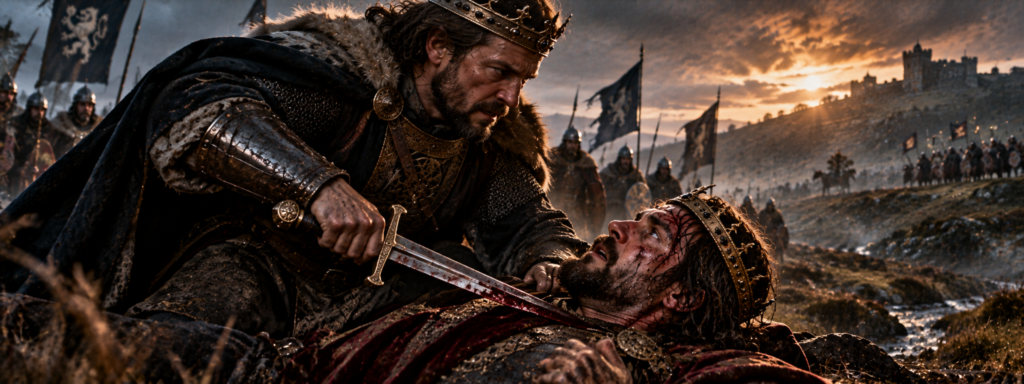
Lulach: The Forgotten King Hunted Down and Killed by Malcolm Canmore
Lulach mac Gille Coemgáin (c. 1030–1058) | King of Alba, 1057–1058 | Stepson and successor of Macbeth | Crowned after Macbeth’s death | Killed by Malcolm mac Donnchada, the future Malcolm III, on March 17, 1058, traditionally at Essie in Strathbogie near modern Huntly
The King Who Lasted Seven Months
Lulach inherited a crown already soaked in blood, and almost from the moment it touched him another claimant was coming to take it away. His stepfather Macbeth had been killed in August 1057 by Malcolm mac Donnchada, the son of the previous king Duncan I, after a long struggle for control of Alba. Malcolm might have expected Macbeth’s death to clear his path to the throne, but Scotland did not simply surrender itself to Duncan’s son. Instead, Macbeth’s surviving supporters turned to Lulach, recognized him as king, and forced Malcolm to continue fighting for a crown he believed belonged to his family.
Lulach would reign for only a matter of months, and later tradition treated that brevity as evidence that he was insignificant. Medieval writers attached humiliating epithets to him, remembering him as Lulach the Fool or Lulach the Simple, descriptions that have followed him for centuries despite the almost complete absence of evidence about his personality or intelligence. His enemies ultimately controlled the political future of Scotland, and the historical tradition that developed under the victorious dynasty had little reason to treat the defeated king generously. A ruler who lost his throne and his life could easily be turned into a weak-minded interruption between two supposedly more important kings.
Yet Lulach was not some bewildered provincial accidentally pushed onto a throne he had no right to occupy. He was the son of Gille Coemgáin, ruler of Moray, and Gruoch, the royal woman transformed centuries later into Shakespeare’s Lady Macbeth. Through his mother, Lulach descended from Kenneth III, a former king of Alba whose branch of the royal family had been violently displaced by Malcolm II. Through his stepfather Macbeth, he also stood at the center of a regime that had successfully ruled Scotland for approximately seventeen years.
When Macbeth fell, enough powerful men considered Lulach a legitimate successor to recognize him as king. That fact alone makes the traditional image of a helpless fool difficult to accept without question. His supporters were taking an enormous risk by choosing him because Malcolm was alive, militarily dangerous, and already responsible for Macbeth’s death. They nevertheless preferred Lulach to Duncan’s son, demonstrating that the struggle for Scotland was not simply a contest between an obvious rightful heir and an obvious usurper.
For roughly seven months, therefore, Scotland had a king whom Malcolm intended to remove. Malcolm had killed Macbeth, but the political order Macbeth represented had survived and produced another ruler. Every day Lulach remained alive complicated Malcolm’s claim and provided opponents of Duncan’s dynasty with an alternative around whom they could gather. The war could end only when one of the two men ceased to be a viable king.
On March 17, 1058, that question was settled violently. Irish annalistic sources associate Lulach’s death directly with Malcolm, while later Scottish tradition places the fatal encounter at Essie in Strathbogie, in the region of modern Huntly. The surviving evidence does not tell us whether Lulach died in a formal battle, a smaller armed clash, an ambush, or another kind of violent encounter. What it does tell us is that the reigning king died through Malcolm’s campaign, and Malcolm subsequently took the crown.
Before Shakespeare Distorted Everything
It is almost impossible to approach Lulach without first passing through the enormous cultural shadow of Macbeth. Shakespeare transformed an eleventh-century Scottish succession struggle into one of the most famous stories of murder, prophecy, ambition, madness, and guilt ever written. Macbeth became the archetypal usurper, Lady Macbeth became the ruthless wife driving her husband toward regicide, and Duncan became the gracious elderly king slaughtered while sleeping beneath his host’s roof. The play is magnificent drama, but it is a dangerous guide to the political world in which Lulach actually lived.
The historical Duncan I was not murdered in his sleep by Macbeth. He was killed in 1040 during military conflict against Macbeth’s forces, traditionally associated with the region near Elgin. Macbeth then became king and remained on the throne for approximately seventeen years, an extraordinarily long survival for a ruler supposedly regarded by everyone around him as nothing more than a murderous illegitimate tyrant. His longevity strongly suggests that he possessed meaningful political support and a claim contemporaries could take seriously.
The historical Gruoch was equally different from Shakespeare’s creation. She was a woman of royal descent whose first husband, Gille Coemgáin of Moray, died violently in 1032, after which she married Macbeth. She brought her son Lulach into Macbeth’s household, creating a family connection between the ruling house of Moray and a man who would later control the Scottish crown. Her importance came from ancestry, marriage, and dynastic politics rather than the murderous psychological drama invented centuries later.
Lulach disappears almost completely from Shakespeare’s version because his existence would complicate the play’s satisfying political ending. Shakespeare needed Macbeth to fall and Duncan’s son Malcolm to restore legitimate kingship, allowing the audience to leave with Scotland apparently rescued from tyranny. A recognized king ruling between Macbeth and Malcolm would interrupt that structure and raise awkward questions about how complete Malcolm’s restoration actually was. Historical reality was less convenient, because Macbeth’s death did not immediately put Duncan’s son on the throne.
After Macbeth fell at Lumphanan, Lulach became king. His accession proves that Macbeth’s political coalition retained enough strength to resist Malcolm even after losing its most powerful leader. Malcolm had won a major battle, but he had not yet won the kingdom, and another man now possessed the royal title he wanted. The seven months that followed formed the final and often forgotten stage of a dynastic struggle that had begun generations earlier.
The Blood of Moray
To understand why Lulach could become king, it is necessary to understand Moray as it existed during the eleventh century. Moray was not merely a remote northern district obediently governed by officials appointed from some centralized Scottish capital. It was a formidable regional power with its own ruling dynasty, military resources, aristocratic networks, and traditions of authority. Its rulers could challenge the kings of Alba and, as Macbeth demonstrated, could themselves become kings.
Lulach’s father, Gille Coemgáin, belonged to this powerful political world. He ruled Moray during a period of intense conflict within its leading families, and his position placed the young Lulach inside one of the most dangerous aristocratic networks in northern Britain. The surviving genealogies are complicated and sometimes contradictory, but there is no serious reason to treat Moray’s rulers as irrelevant outsiders. They were connected to the broader dynastic struggles from which Scottish kings emerged.
Lulach’s mother gave him an additional and particularly important source of legitimacy. Gruoch was descended from Kenneth III, the king defeated and killed by Malcolm II at Monzievaird in 1005. Malcolm II’s victory had pushed Kenneth’s branch away from the throne and helped establish the line that eventually produced Duncan I and Malcolm III. Through Gruoch, however, the blood of that displaced dynasty survived.
This ancestry meant that Lulach’s later kingship represented more than the continuation of Macbeth’s regime. It also brought an older royal branch back onto the throne after more than half a century. His claim could be understood through his mother’s descent, his father’s power in Moray, and his position as Macbeth’s stepson. Those three sources of legitimacy made him a much more formidable claimant than his later nickname suggests.
None of this means that every noble in Alba accepted Lulach’s right to rule. Medieval Scottish succession was not governed by a single uncontested rule comparable to later strict primogeniture, and rival adult males could possess plausible claims simultaneously. Kingship depended upon ancestry, support, military capacity, inauguration, and the ability to maintain authority. Lulach possessed enough of those things to become king, but Malcolm possessed enough of them to challenge him.
By 1057, therefore, two rival visions of Scottish kingship confronted one another. Malcolm represented the descendants of Malcolm II through Duncan, while Lulach represented a powerful Moravian dynasty combined with descent from Kenneth III and continuity with Macbeth. Neither man was simply an adventurer without royal connections. Their struggle was a collision between competing branches of the political elite, and only violence would determine which interpretation of legitimacy survived.
A Father Burned to Death
Lulach’s childhood was marked by political violence long before he became king. His father Gille Coemgáin died in 1032 under circumstances recorded with chilling brevity in the Irish annalistic tradition. He was burned to death along with approximately fifty of his men, suggesting either a deliberate attack or a violent episode connected with the feuds surrounding control of Moray. The sources preserve the horror of the event while telling us frustratingly little about precisely how it happened.
Later writers have sometimes suspected Macbeth of arranging Gille Coemgáin’s death because Macbeth subsequently married his widow Gruoch. The sequence naturally invites suspicion, particularly when viewed through the later literary reputation attached to Macbeth. Yet no reliable contemporary evidence proves that Macbeth ordered the burning, participated in it, or benefited from a prearranged conspiracy to remove Gruoch’s husband. Treating him as Gille Coemgáin’s murderer would therefore go beyond what the evidence can support.
The killing may instead have emerged from the violent internal politics of Moray. Gille Coemgáin himself belonged to a family engaged in bitter competition for regional authority, and previous deaths within that struggle had already demonstrated how dangerous the position could be. Medieval feuds did not end when one man died because brothers, cousins, sons, retainers, and allied families inherited the political consequences. Lulach grew up in a world where a father’s death could become a son’s grievance and where ancestry could function as both an inheritance and a threat.
After Gille Coemgáin’s death, Gruoch married Macbeth. The marriage may have helped reconcile competing factions within Moray or consolidate political control after years of instability. It also placed Lulach within the household of the man who would eventually defeat Duncan and become king. The child whose father had died in flames was now connected to another ruler whose own career would end violently.
There is no evidence that Macbeth mistreated Lulach or regarded him merely as inconvenient baggage from Gruoch’s first marriage. On the contrary, Lulach’s later succession suggests that his place within the family became politically significant. Macbeth had no securely documented surviving son who could inherit after him, while Lulach possessed valuable royal and Moravian ancestry. Over time, the stepson may have become the most obvious figure capable of continuing Macbeth’s political order.
That possibility gives Lulach’s childhood a darker significance. His father’s death removed one ruler of Moray, his mother’s second marriage connected him to another, and his ancestry placed him within reach of the Scottish throne. Long before he wore a crown, Lulach’s life had been shaped by men killing one another for power. Eventually, that same political culture would consume him.
Gruoch: The Woman Behind Two Kings
Gruoch has suffered one of history’s most extraordinary transformations. The real woman survives only faintly in medieval evidence, while Shakespeare turned her fictional counterpart into one of the most recognizable characters in Western literature. The name “Lady Macbeth” became shorthand for ruthless female ambition, psychological torment, and murderous persuasion. The historical Gruoch was more obscure, but her dynastic importance may have been far greater than the literary stereotype suggests.
Her ancestry connected her to Kenneth III. This meant that she carried royal blood from a branch displaced by Malcolm II’s victory at Monzievaird. Her first marriage to Gille Coemgáin united that ancestry with the powerful ruling house of Moray, while her second marriage to Macbeth connected the same bloodline to a future king. Gruoch therefore occupied the center of a web of relationships capable of producing a serious alternative to Duncan’s descendants.
There is no reliable evidence that Gruoch behaved like Shakespeare’s murderous queen. We possess no private correspondence revealing her personality, no contemporary narrative describing her encouraging regicide, and no trustworthy testimony allowing us to reconstruct her emotional relationship with Macbeth. Her importance comes instead from genealogy and the political consequences of her marriages. Separating that woman from the theatrical Lady Macbeth is essential if Lulach’s story is to make sense.
Gruoch and Macbeth appear together in connection with religious patronage, reminding us that their royal household participated in conventional acts of piety. Macbeth himself undertook a pilgrimage to Rome in 1050 and was remembered there for distributing money generously. These details do not prove that either ruler was unusually virtuous, but they sharply complicate the later picture of a demonic couple ruling through terror. The historical household in which Lulach lived was far more recognizably medieval than Shakespeare’s nightmare.
Gruoch’s greatest political legacy was ultimately her son. When Macbeth died, Lulach’s claim combined the blood of Kenneth III with the authority of Moray and the inheritance of his stepfather’s regime. Whether Gruoch personally organized or influenced his accession is unknown, and any confident claim about her actions would be speculation. Her genealogy alone, however, helped make his kingship possible.
If Gruoch survived long enough to witness Lulach’s death, her family history would have been almost unimaginably violent. Her first husband had been burned to death, her second husband had been killed by Malcolm, and her son would also be killed by Malcolm only seven months later. The sources do not preserve her grief, rage, or reaction, so none should be invented. What they leave behind is the stark outline of a family repeatedly shattered by the struggle for Scotland.
Duncan, Macbeth, and the War That Created Lulach’s Crown
Duncan I became king in 1034 after the death of his grandfather Malcolm II. His accession represented the success of Malcolm II’s efforts to keep royal authority within his own descendants, despite the absence of a surviving son. Duncan’s mother Bethóc was Malcolm’s daughter, while his father Crinan of Dunkeld belonged to another powerful family. The new king therefore possessed significant dynastic support, but his reign quickly exposed how contested Scottish kingship remained.
Duncan ruled for only six years before confronting Macbeth. In 1040, he campaigned into the north and was killed during military conflict, traditionally associated with the region around Elgin. The familiar image of Macbeth murdering a sleeping Duncan in a castle belongs to Shakespeare rather than historical evidence. The real Duncan died in a political and military struggle against a powerful rival.
Macbeth emerged victorious and became king. His claim was not necessarily understood by contemporaries as the naked seizure of power later literature made it. He possessed royal ancestry, controlled Moray, and had defeated the reigning king in the kind of conflict through which early medieval kingship was often decided. Most importantly, he then remained on the throne for approximately seventeen years.
A reign of that length is difficult to reconcile with the idea that Macbeth was universally rejected from the beginning. He clearly faced enemies, including Duncan’s surviving family, but he also possessed enough support to govern for nearly two decades. His pilgrimage to Rome in 1050 further suggests a ruler secure enough to leave Scotland for a significant journey. Whatever his enemies thought of him, Macbeth had become an established king.
For Lulach, these seventeen years were formative. He matured within a royal household and watched his stepfather maintain control over Alba despite the existence of Duncan’s sons. He also saw Moray’s political network elevated from regional power to the center of the kingdom. By the time Macbeth entered his final struggles, Lulach was not simply the son of a dead provincial ruler but a plausible dynastic successor.
Macbeth’s eventual defeat would therefore create a problem Malcolm may not have fully solved in advance. Killing Macbeth could remove the reigning king, but it could not automatically destroy the network supporting him. As long as another credible candidate existed, Macbeth’s followers could continue resisting. Lulach was that candidate.
Malcolm, Son of a Dead King
Malcolm mac Donnchada had his own powerful story of dispossession. His father Duncan had been killed when Malcolm was still young, and Macbeth had occupied the throne that Duncan’s sons might otherwise have expected to inherit. Later traditions describe Malcolm spending years away from Scotland, although the exact geography and chronology of his exile remain debated. What is clear is that he survived and eventually returned as a serious military challenger.
By the 1050s, Malcolm’s cause had become entangled with English interests. Edward the Confessor’s England had reasons to influence events north of the border, while the powerful earls of Northumbria had their own strategic concerns. In 1054, Siward, Earl of Northumbria, led a major invasion into Scotland. The campaign resulted in heavy casualties and significantly weakened Macbeth, although it did not immediately overthrow him.
The Anglo-Saxon Chronicle records the expedition and the death of Siward’s son Osbeorn among the English losses. Sources also refer to a Malcolm in connection with the campaign, and historians have debated precisely which Malcolm was intended in some accounts. Later tradition strongly connected Siward’s invasion with Duncan’s son and the attempt to restore him. The precise settlement after the campaign remains uncertain, but Macbeth survived and continued ruling.
That survival is important because Malcolm’s eventual triumph was not easy or inevitable. Macbeth withstood a major invasion and remained king for another three years. Malcolm needed persistence, allies, and further military success before he could defeat him. The struggle was a prolonged contest rather than a single heroic return.
In August 1057, Malcolm finally confronted Macbeth successfully. Their forces met at Lumphanan in Aberdeenshire, where Macbeth was killed. Seventeen years after Duncan’s death, Malcolm had destroyed the man who had replaced his father. Yet the victory did not produce the result later storytelling would lead us to expect.
Malcolm still did not become king. Macbeth’s supporters chose Lulach instead, and the crown remained outside Duncan’s line. The son who had spent years fighting to recover his father’s inheritance now discovered that another man stood between him and the throne.
Lumphanan and the Death of Macbeth
Macbeth’s death at Lumphanan on August 15, 1057, ended one of the most substantial Scottish reigns of the eleventh century. Later literature transformed the event into a climactic moral victory in which tyranny collapsed and legitimate monarchy returned. The historical aftermath immediately reveals how misleading that interpretation can be. Malcolm killed Macbeth, but he did not immediately control Scotland.
The surviving supporters of Macbeth moved quickly. Rather than submitting to Malcolm, they recognized Lulach as king. This decision demonstrates that Macbeth’s government had depended upon more than one man’s personal authority. A political coalition remained capable of continuing the struggle after its leader’s death.
Lulach was a logical figure around whom that coalition could reorganize. He possessed royal ancestry through Gruoch, direct ties to the ruling family of Moray through Gille Coemgáin, and a close dynastic connection to Macbeth as his stepson. He was also an adult rather than a child requiring a lengthy regency. These qualities made him a viable alternative to Malcolm.
The choice carried enormous risk. Malcolm had just demonstrated his military strength by killing Macbeth, and anyone supporting Lulach knew another confrontation was likely. Recognizing Lulach meant rejecting the victorious son of Duncan and committing to continued resistance. His supporters nevertheless believed their cause was strong enough to justify that danger.
This makes Lulach’s accession one of the clearest pieces of evidence against dismissing him as an irrelevant fool. Important men were willing to risk their lands, status, and lives to keep him on the throne. They could have accepted Malcolm after Lumphanan but refused to do so. Their decision forced Malcolm to fight another campaign.
The death of Macbeth therefore ended one reign without settling the succession. Scotland entered a period in which Malcolm possessed military momentum while Lulach possessed royal recognition. The kingdom had exchanged one conflict for another, and the next king to die would decide the outcome.
Crowned at Scone
Lulach’s accession was associated with Scone, one of the central ceremonial places of Scottish kingship. Later tradition provides a specific inauguration date, although the precise details of the ceremony cannot be reconstructed with certainty. What matters is that Lulach was not merely proclaimed by a handful of fugitives hiding in Moray. He was recognized through the political and ceremonial traditions of kingship.
Scone carried profound symbolic importance. Scottish kingship depended upon more than military possession of territory, and inauguration connected a ruler with sacred tradition, royal ancestry, and the political community expected to recognize him. By undergoing royal inauguration, Lulach’s supporters declared that Macbeth’s death had not transferred the crown to Malcolm. They had chosen another king.
The ceremony also complicated Malcolm’s political position. He could present himself as Duncan’s heir and avenger, but another man had been formally recognized as ruler. Every noble who feared Malcolm, resented Duncan’s dynasty, or remained loyal to Macbeth now possessed a crowned alternative. Lulach’s existence transformed opposition into loyalty to a rival king rather than mere rebellion.
His accession probably occurred soon after Macbeth’s death. Speed would have been essential because hesitation could allow Malcolm to consolidate support before the Moravian coalition acted. By recognizing Lulach quickly, Macbeth’s supporters attempted to preserve continuity and deny Malcolm the symbolic advantage of an uncontested vacancy. Their success lasted only months, but it was real.
The event also reveals how little later nicknames tell us about contemporary perceptions. Men do not normally risk civil war to crown someone they universally consider incapable of functioning. Lulach may have possessed weaknesses we can no longer identify, but his supporters clearly believed his blood, position, or abilities justified resistance. The surviving evidence gives us no basis for diagnosing him as mentally deficient or inherently incompetent.
For Malcolm, however, the inauguration created a simple problem. He could not securely become king while another recognized king remained alive. Macbeth’s death had been only the first half of his restoration. Lulach now had to be defeated.
The Problem With “Lulach the Fool”
Few medieval nicknames have damaged a reputation more efficiently than Lulach’s. Once a ruler is repeatedly called “the Fool” or “the Simple,” almost everything about his reign becomes interpreted through that label. A short reign becomes proof of incompetence, military defeat becomes proof of stupidity, and obscurity becomes evidence that contemporaries found him unworthy. The reasoning quickly becomes circular.
The evidence itself does not support such confidence. We possess almost no contemporary material describing Lulach’s personality, intellectual ability, behavior, or style of government. No reliable witness records conversations demonstrating foolishness. No administrative record reveals catastrophic incompetence during his few months in power.
The negative characterization comes from later historical traditions written after Malcolm III’s dynasty had triumphed. That context matters because defeated rulers were frequently described in ways that justified their removal. A foolish Lulach made Malcolm’s victory look like the correction of an obvious mistake rather than the destruction of a legitimate alternative monarchy. The insult therefore served a political narrative whether or not it originated as deliberate propaganda.
Lulach’s accession itself provides the strongest reason for caution. Powerful supporters of Macbeth could have surrendered after Lumphanan, negotiated with Malcolm, or selected another claimant. Instead, they placed Lulach on the throne and continued fighting. Their decision suggests that he possessed enough credibility to command serious loyalty.
Political failure does not prove personal stupidity. Kings could lose because opponents possessed stronger armies, better alliances, more resources, or greater luck. A reign lasting seven months during civil war offers almost no opportunity to judge ordinary governmental competence. Lulach’s defeat tells us that Malcolm won, not that Lulach was a fool.
A more responsible portrait therefore leaves his personality largely unknown. He may have been indecisive, intelligent, courageous, weak, charismatic, or painfully ordinary, but the sources cannot tell us. What they do reveal is a man considered important enough to crown and dangerous enough for Malcolm to pursue until he was dead.
Seven Months Under Threat
The surviving sources tell us frustratingly little about Lulach’s actual government. Seven months would be a short reign even in a documentary-rich period, and eleventh-century Scotland has left us only fragments. We cannot reconstruct his court in detail, identify every adviser, or follow a clear sequence of administrative decisions. His reign appears in the historical record primarily through its beginning and violent end.
This silence should not be confused with inactivity. Lulach inherited a kingdom in the middle of civil war, and his most urgent responsibility was almost certainly survival. He needed to preserve the coalition that had supported Macbeth, maintain control over strategic territory, and prevent Malcolm from converting military success into universal recognition. Ordinary administration would have continued somewhere beneath these existential concerns, but it has left little trace.
His strongest support probably lay in Moray and northeastern Scotland, where his family possessed deep roots. Yet his inauguration at Scone indicates that his kingship cannot be reduced to a purely regional rebellion. He claimed Alba as a whole and was treated by the annalistic tradition as a king rather than merely a provincial lord. Malcolm’s campaign against him was therefore a struggle over the monarchy itself.
The months between August 1057 and March 1058 must have involved intense political maneuvering. Nobles who had served Macbeth faced choices about whether to support Lulach, defect to Malcolm, or attempt neutrality. Families calculating the likely winner had to balance loyalty against survival. The decisions made during these months are largely invisible because the sources preserve outcomes rather than debates.
Malcolm continued pressing his advantage. The death of Macbeth had weakened the opposition, but Lulach’s coronation prevented the conflict from ending. Every month that passed gave the new king opportunities to strengthen himself, which made delay dangerous for Malcolm. The challenger had strong reasons to move quickly.
By the beginning of 1058, the struggle was approaching its conclusion. Lulach’s position appears to have contracted toward the northeast, although the exact sequence of movements is unknown. Eventually the two sides converged in Strathbogie. The king who had survived seven months after Macbeth’s death was running out of space.
Two Royal Bloodlines Collide
The conflict between Lulach and Malcolm was rooted in a dynastic rivalry stretching back more than half a century. Malcolm’s claim descended through Duncan I from Malcolm II. Lulach’s maternal ancestry connected him to Kenneth III, the king Malcolm II had defeated and killed at Monzievaird in 1005. Their confrontation therefore revived a division that had shaped Scottish politics long before either man was born.
Malcolm II’s victory over Kenneth III had allowed him to establish his own branch of the royal family more securely. Because Malcolm II lacked a surviving son, the succession eventually passed through his daughter Bethóc to Duncan. Duncan’s son Malcolm then inherited that dynastic expectation. The political project begun at Monzievaird therefore remained alive in Malcolm’s claim.
Kenneth III’s descendants had not simply disappeared. Through Gruoch, the displaced branch became connected to the ruling house of Moray. Her marriage to Gille Coemgáin produced Lulach, while her later marriage to Macbeth placed her family inside a successful royal regime. When Lulach became king, the line pushed aside in 1005 effectively returned to the throne.
The historical symmetry is remarkable even if contemporaries did not frame events exactly this way. Malcolm II had killed Kenneth III and taken the crown in 1005. More than fifty years later, Malcolm II’s descendant confronted a descendant of Kenneth III who had again become king. Violence would once more decide which branch survived.
Genealogy alone did not determine the conflict. Regional power, personal alliances, military strength, and the legacy of Macbeth’s reign all mattered. Yet royal ancestry gave both men a language of legitimacy through which supporters could justify fighting. Neither side needed to view itself as defending an obvious usurper.
This makes Lulach’s death much more significant than the elimination of a temporary placeholder. His fall represented another defeat for a royal line that had repeatedly challenged Malcolm II’s descendants. The killing near Huntly helped settle a dynastic argument that had remained unresolved for generations.
Malcolm’s Unfinished Victory
After Lumphanan, Malcolm possessed something extremely valuable: momentum. He had killed Macbeth, the ruler who had occupied the throne since Duncan’s death in 1040. Supporters who had waited years for the return of Duncan’s family could now rally openly around him. Yet momentum was not kingship.
Lulach’s coronation threatened to reverse Malcolm’s success. A living rival king could issue commands, reward supporters, negotiate alliances, and provide legitimacy to resistance. Even nobles who disliked Lulach personally could use him as a political alternative to Malcolm. His very existence prevented Malcolm from presenting the war as finished.
Malcolm therefore had powerful reasons to remove him permanently. Captivity might have been possible, but imprisoned royal claimants remained dangerous in medieval politics because supporters could attempt rescue or rebellion in their name. Exile merely transferred the problem abroad, where foreign rulers might someday provide troops for a restoration. Death eliminated possibilities that imprisonment could not.
There is no evidence that Malcolm secretly ordered an assassination in the modern sense. The sources do not describe hired killers, poison, or infiltration of Lulach’s household. They instead place the two men within a continuing armed struggle that culminated in Lulach’s death. Describing Malcolm’s action as a deliberate political killing is therefore safer than inventing a covert murder plot.
The distinction does not reduce the importance of the event. Malcolm was pursuing a reigning king whose removal directly benefited his own claim. Whether Lulach died in an ambush or on a battlefield, the political objective was identical. Malcolm needed a Scotland in which Lulach could no longer be king.
By early 1058, the conflict moved toward Strathbogie. The later geographical tradition places Lulach’s final encounter at Essie, near modern Huntly. There the unfinished victory over Macbeth would finally become Malcolm’s victory over the entire surviving regime.
Into Strathbogie
Strathbogie lies within northeastern Scotland, in a landscape of valleys, rivers, hills, and routes connecting Moray with territories farther south. The later town of Huntly and the great castle associated with the Gordon family belong to a much later historical world. Imagining Lulach’s death against those later stone fortifications would therefore be anachronistic. The landscape of 1058 contained smaller settlements, elite residences, religious sites, agricultural communities, and defensive places adapted to a very different society.
Later Scottish tradition places Lulach’s death at Essie in Strathbogie. The location fits the general geography of a conflict in which Lulach’s strongest support was connected to Moray and the northeast. Malcolm’s continued campaign after Macbeth’s death would naturally push toward regions where resistance remained strongest. The king’s final movements may therefore reflect a retreat toward supporters, an attempt to gather another army, or simply the shifting front of the war.
The surviving evidence does not tell us which explanation is correct. We cannot confidently say Lulach was fleeing, preparing an ambush, negotiating, or marching toward battle. Later storytellers sometimes supplied details that the annals themselves do not contain. Historical caution requires leaving those spaces empty.
What can be reconstructed is the political pressure surrounding him. Macbeth had been dead for seven months, Malcolm remained active, and defections may have weakened the coalition supporting the new king. Every defeat would reduce the territory from which Lulach could draw resources. The longer the war continued, the more difficult maintaining royal authority may have become.
Malcolm, meanwhile, had no incentive to allow the situation to stabilize. If Lulach survived another year, married strategically, secured new allies, or won a major battle, Malcolm’s opportunity could disappear. Rapid pursuit was politically rational. The challenger who had spent years waiting to recover his father’s throne was unlikely to stop with victory almost within reach.
Somewhere in Strathbogie, the two trajectories finally met. The sources become frustratingly brief at precisely the moment modern readers would most like detail. The result, however, is unmistakable. Lulach did not leave the encounter alive.
March 17, 1058
Lulach was killed on March 17, 1058, after a reign lasting only several months. Irish annalistic tradition directly attributes his death to Malcolm, son of Duncan. The statement is stark and offers none of the dramatic details that later historical writing often supplies. A reigning king was alive, Malcolm confronted him, and the king was killed.
We do not know what weapon caused Lulach’s death. No reliable source records a sword stroke, spear thrust, arrow, or execution after capture. We also do not know whether Malcolm personally struck him or whether the annals attribute responsibility to Malcolm because his forces carried out the killing. Early medieval statements that one ruler killed another can describe personal action or responsibility for the victorious side.
There is similarly no trustworthy account of Lulach’s final words. None should be invented, however tempting it might be to give a forgotten king a dramatic speech before death. His thoughts during the final encounter disappeared with him. The silence is part of the history.
The death was nevertheless politically decisive. Malcolm had already eliminated Macbeth, and now Macbeth’s successor was gone as well. The coalition opposing Duncan’s line had lost two kings in seven months. There was no equally successful third claimant ready to replace Lulach immediately.
For Malcolm, the path to kingship was finally open. Years of exile, campaigning, foreign support, and dynastic struggle had brought him to this point. His father had died fighting Macbeth eighteen years earlier, and Malcolm had now outlived and defeated both Macbeth and the man who inherited his crown. The restoration of Duncan’s line had required two royal deaths.
For Lulach’s family, the outcome was catastrophic. His father had died violently, his stepfather had died violently, and now Lulach himself had joined them. The ruling network of Moray survived, but its brief possession of the Scottish crown was over. Malcolm had won the struggle that would define the next generation.
Assassination, Regicide, or Death in Battle?
Lulach’s inclusion among assassinated rulers requires careful wording because the exact manner of his death is not securely known. He was deliberately killed during a dynastic conflict, and Malcolm was responsible for the campaign that ended his life. That makes the event unquestionably political. It does not automatically make it a covert assassination in the modern sense.
No contemporary source describes Malcolm sending a hidden killer into Lulach’s residence. There is no reliable story of poison, a treacherous feast, a secret stabbing, or a false negotiation ending in murder. Later traditions can make the event sound more like an ambush, but their details are not strong enough to be repeated as established fact. The safest reconstruction allows for a battle, skirmish, ambush, or other armed confrontation.
Regicide is a broader and more useful category. Lulach was a recognized king, and the man responsible for his death was a rival claimant who subsequently became king himself. His killing removed the principal obstacle to Malcolm’s accession. In political terms, it was the elimination of a crowned ruler for control of the kingdom.
The ambiguity also tells us something important about early medieval royal violence. Modern categories can become artificial when applied to a world where rulers personally led armies and succession disputes routinely became wars. A king could be murdered during a skirmish, killed while fleeing a battlefield, or deliberately targeted during combat without contemporaries drawing the distinctions modern readers expect. Political killing and warfare overlapped.
For the men fighting beside Lulach, terminology probably mattered less than the result. Their king had been killed by the faction seeking to replace him. Malcolm’s supporters could call the same event victory, restoration, or divine favor. The corpse did not change according to the vocabulary.
Lulach therefore belongs within the history of regicide even if “assassination” should be qualified. He was not an accidental casualty unrelated to the succession. He was the king Malcolm had to remove. Once he was dead, the political landscape changed immediately.
The Man Who Killed Two Kings
Malcolm III’s later reputation is dramatically different from Macbeth’s. Macbeth became immortalized as the murderer who seized a throne, while Malcolm became the prince who restored rightful monarchy. Historical reality is more uncomfortable because Malcolm’s own road to kingship was paved with the deaths of two consecutive rulers. He killed Macbeth in 1057 and was responsible for Lulach’s death in 1058.
This does not make Malcolm uniquely monstrous. Early medieval kings frequently established authority through warfare, and Malcolm possessed a serious hereditary claim as Duncan’s son. From his perspective and that of his supporters, the campaigns against Macbeth and Lulach could be understood as the recovery of an inheritance violently taken from his family. He had personal as well as political reasons to pursue them.
Lulach’s supporters could interpret the same events very differently. Macbeth had ruled for seventeen years and Lulach had been properly recognized as his successor. From their perspective, Malcolm was an armed challenger backed by enemies of the reigning dynasty. The label “restoration” therefore depends heavily upon which claimant one accepts as legitimate.
The victorious dynasty ultimately shaped historical memory. Malcolm’s descendants ruled for generations and transformed Scotland, while Lulach’s branch never recovered the crown. Later writers consequently had powerful reasons to view Malcolm’s success as inevitable or desirable. The kings he killed became obstacles in the story of his rightful return.
Removing that retrospective certainty changes the picture. In August 1057, Malcolm did not know that his descendants would dominate Scotland. Lulach’s supporters did not know their king would be dead within seven months. The future remained open until military victory closed it.
Malcolm survived both confrontations, and survival became legitimacy. Macbeth and Lulach could no longer defend their claims because dead kings cannot command armies. Malcolm’s long reign afterward made his triumph appear increasingly permanent. The man who killed two kings became the founder of a powerful royal future.
Malcolm III Takes the Crown
With Lulach dead, Malcolm finally possessed what victory over Macbeth had failed to deliver. No immediately recognized successor emerged capable of maintaining the same resistance, and Malcolm became king. His reign would last until 1093, approximately thirty-five years. The contrast with Lulach’s seven months could hardly have been greater.
Malcolm’s long rule allowed him to reshape the monarchy through warfare, diplomacy, marriage, and family strategy. His first known wife, Ingibiorg Finnsdottir, connected him to the powerful Norse aristocracy associated with Orkney. His later marriage to Margaret, sister of Edgar Ætheling, connected Scotland to the displaced Anglo-Saxon royal house after the Norman conquest of England. These relationships placed the Scottish monarchy inside an increasingly interconnected political world.
Margaret became one of the most influential royal women in Scottish history and was later canonized. Their children included future kings Edgar, Alexander I, and David I, while their daughter Matilda married Henry I of England. Through these descendants, Malcolm’s family became deeply embedded in British and European dynastic politics. The royal line established after Lulach’s death would shape Scotland for generations.
None of that future was inevitable on March 16, 1058. Malcolm still had a rival king alive in the northeast. Had Lulach defeated him, captured him, or forced him back into exile, the history of Scotland might have developed along an entirely different path. The importance of Lulach’s death lies partly in how dramatically it narrowed those possibilities.
Later success can make the defeated claimant look insignificant. Malcolm ruled for decades, while Lulach barely survived half a year. Yet every long dynasty begins at a moment when another outcome remains possible. For Malcolm’s dynasty, that moment came when Lulach died.
The new king would face further resistance, especially from northern families connected to the political world Lulach represented. Killing one man could not erase an entire regional tradition. Nevertheless, Malcolm had achieved the essential objective. Scotland no longer had another crowned ruler competing against him.
The Family Lulach Left Behind
Lulach’s death did not eliminate his bloodline. He appears to have left a son, usually identified as Máel Snechtai, who remained connected to Moray and represented a continuing source of regional power. The existence of a surviving son meant Malcolm could not assume that every dynastic threat disappeared with Lulach. Royal ancestry could survive in another generation.
Máel Snechtai later appears in connection with Moray and with Malcolm’s efforts to secure control in the north. The surviving evidence suggests that Malcolm eventually forced him into submission and that he entered religious life, although the precise circumstances are not entirely clear. Whatever settlement occurred, he did not succeed in reclaiming his father’s crown. The dynasty had been reduced from kingship to regional resistance.
Other members and descendants of the broader Moravian royal network continued to challenge Malcolm’s successors. The north repeatedly produced claimants who asserted rights derived from older dynastic traditions. Scottish kings of the twelfth century still had to campaign against families whose political ancestry reached back toward Macbeth and Lulach. The conflict Malcolm won in 1058 therefore did not erase its causes.
What changed was the scale of the opposition. Lulach had actually been crowned and recognized as king. Later descendants could rebel or claim the throne, but they struggled to achieve the same level of acceptance. The political center of gravity had shifted decisively toward Malcolm’s family.
This distinction makes Lulach’s death more consequential than it initially appears. A regional lord can resist royal authority, but a reigning king provides an alternative definition of royal authority. Malcolm’s supporters could describe opposition after 1058 as rebellion against the king rather than loyalty to another king. That change strengthened the ideological position of the victorious dynasty.
Lulach’s descendants therefore inherited a difficult legacy. They possessed blood that could support claims, but the crown itself had slipped away. Malcolm’s victory transformed them from the family of a king into the descendants of a defeated king. In medieval politics, that difference could determine everything.
Moray Loses Its Crown
For nearly two decades, Moray had stood at the center of Scottish kingship. Macbeth’s accession in 1040 elevated a ruler deeply connected to the northeast into control of Alba. His seventeen-year reign demonstrated that this was not a temporary military accident. Moray’s political network could sustain a king.
Lulach continued that possibility after Macbeth’s death. His accession proved that the coalition had enough strength to produce a successor rather than collapse immediately. For seven months, the Scottish crown remained associated with the same broad political world. Malcolm’s restoration was therefore delayed until he destroyed the second king.
Lulach’s death ended Moray’s successful possession of the crown. The region remained powerful and repeatedly troublesome to later monarchs, but it would increasingly be treated as a territory that kings needed to control rather than the center from which a reigning dynasty governed Scotland. That transformation unfolded gradually and often violently. It should not be imagined as complete in a single afternoon.
Northern resistance continued for generations. Royal armies repeatedly intervened in Moray, while descendants and relatives of older ruling families continued asserting claims. The monarchy’s attempts to impose greater control could themselves generate new rebellions. Malcolm’s victory solved one succession crisis while leaving deeper regional tensions unresolved.
Nevertheless, March 1058 marked a major turning point. Moray had lost not merely a commander but a crowned ruler. Without Lulach, opponents of Malcolm lacked the same immediate focal point for resistance. His death therefore weakened both a dynasty and a competing political center.
This was the larger meaning of the killing near Huntly. Malcolm was not simply settling a family vendetta against Macbeth’s household. He was dismantling the political structure capable of denying Duncan’s descendants the throne. Lulach’s body marked the point at which that alternative kingship ceased to function.
What Did Lulach Actually Do as King?
The frustrating answer is that the evidence tells us almost nothing about Lulach’s ordinary government. His reign was too short and the surviving records too sparse to reconstruct legislation, taxation, appointments, diplomacy, or religious patronage in meaningful detail. No substantial narrative chronicle follows him through the months of his rule. Most of what can be said concerns the circumstances surrounding his accession and death.
This absence has encouraged the assumption that he accomplished nothing. Such a judgment is unfair because seven months of civil war would leave little administrative evidence even for an exceptionally capable ruler. Lulach’s government was probably consumed by military survival, securing loyalties, and maintaining control over territories threatened by Malcolm. The absence of surviving charters or reforms does not demonstrate that no government existed.
His most important achievement was survival itself, however temporary. After Macbeth’s death, Lulach’s supporters managed to prevent Malcolm from taking the throne immediately. They organized an inauguration and maintained their king for several months despite facing an opponent who had just defeated Macbeth. That required some combination of political loyalty, military resources, and regional support.
His greatest failure was equally obvious. He could not defeat Malcolm. Whatever strategy he pursued, it ended with him isolated or confronted in Strathbogie and killed. Medieval kings were judged brutally by results, and death made every earlier success irrelevant to later chroniclers.
Had Lulach defeated Malcolm, the surviving evidence about him might look entirely different. A long reign could have produced religious foundations, diplomatic records, descendants, victories, and a historical tradition celebrating his legitimacy. Instead, Malcolm’s victory froze Lulach’s biography at its weakest moment. The loser never had time to create the archive that might have defended his reputation.
This is why his supposed foolishness should remain separate from the facts. We know that he lost, but we do not know that he was incapable. We know that his reign was short, but we do not know that it was chaotic. The evidence allows us to describe his predicament much more confidently than his personality.
The Ghost of Kenneth III
Lulach’s descent from Kenneth III gives his death one of the darkest historical symmetries in early Scottish history. Kenneth had ruled Alba from 997 until 1005 before being challenged by Malcolm II. At Monzievaird, Kenneth was killed and Malcolm took the crown. The defeated king’s descendants were pushed away from power.
More than half a century later, that bloodline returned through Gruoch’s son. Lulach’s kingship in 1057 restored a descendant of Kenneth III to the throne, although under very different political circumstances. His connection to Moray and Macbeth gave the old dynastic claim new strength. For several months, the branch defeated at Monzievaird had effectively returned.
Then another Malcolm destroyed it. Malcolm III descended from the family whose power Malcolm II had established through victory over Kenneth III. When he killed Lulach, the old rivalry produced another violent result. The descendants of the victor once again defeated the descendants of the vanquished.
It would be misleading to portray the conflict as nothing more than a fifty-year family vendetta. Medieval alliances were fluid, and neither Malcolm nor Lulach necessarily understood every political decision through the memory of Monzievaird. Yet genealogy mattered profoundly in determining who could plausibly claim kingship. The ancestry linking both men to earlier rulers was part of their legitimacy.
The pattern nevertheless reveals how long the consequences of royal violence could endure. Killing a rival king did not erase his bloodline. Children, grandchildren, and great-grandchildren could return with claims of their own. A battlefield victory might settle a succession only temporarily.
Lulach’s death finally pushed Kenneth III’s branch farther from successful kingship. Descendants connected to Moray would continue resisting, but they never again achieved the same recognized hold on the Scottish throne. The dynastic contest that had exploded at Monzievaird reached another bloody conclusion near Huntly.
The Mother Who Vanishes
Gruoch’s fate after the deaths of Macbeth and Lulach remains uncertain. This silence is especially striking because the fictional woman based loosely upon her became one of literature’s most famous queens. Shakespeare gave Lady Macbeth ambition, guilt, madness, sleepwalking, and an unforgettable death. The historical Gruoch simply fades from view.
We do not know with certainty whether she survived Macbeth. We cannot securely place her beside Lulach during his accession or prove that she participated in the political decisions that made him king. We also do not know whether she lived long enough to learn that Malcolm had killed her son. Any emotional reconstruction must therefore remain clearly imaginative rather than historical.
The facts surrounding her family are dramatic enough without invention. Gille Coemgáin, her first husband, died violently in 1032. Macbeth, her second husband, died fighting Malcolm in 1057. Lulach, her son, died through Malcolm’s campaign in 1058.
Three violent deaths surrounded the woman later transformed into the great instigator of murder. In historical reality, Gruoch may have experienced far more loss than the surviving evidence allows us to understand. She belonged to a royal branch already shaped by the death of Kenneth III and the subsequent struggles for Moray. Her life intersected repeatedly with men who fought and died for kingship.
Her son was the final member of her immediate family to wear the Scottish crown. Through him, her ancestry briefly returned to power. When he died, the dynastic possibilities surrounding Gruoch narrowed dramatically. Malcolm’s family would control the next era.
The contrast between historical silence and literary fame is almost cruel. Millions know Lady Macbeth’s imagined thoughts, while no one knows what Gruoch thought when the men closest to her died. Lulach’s story restores at least part of the real family that Shakespeare erased.
The Violence Hidden Inside Restoration
Royal genealogies create an illusion of orderly succession because names appear neatly one after another. Duncan I is followed by Macbeth, Macbeth by Lulach, and Lulach by Malcolm III. On paper, the sequence can look almost administrative. Adding the causes of death destroys that illusion.
Duncan was killed fighting Macbeth in 1040. Macbeth became king and ruled for seventeen years before Malcolm killed him in 1057. Lulach then became king and survived roughly seven months before Malcolm killed him as well. Only after those deaths did Malcolm’s reign begin.
This was not a peaceful hereditary monarchy temporarily interrupted by one villain. It was a political system in which multiple royal lines possessed plausible claims and military success could determine which one prevailed. Each ruler depended upon followers prepared to defend his legitimacy with weapons. The crown was both an honor and an invitation to violence.
Malcolm’s later success encouraged historians to describe his victory as restoration. From his perspective, that description made perfect sense because Macbeth had killed his father and taken the throne. Yet the word can hide the amount of blood required to make restoration possible. Malcolm did not simply return and receive a crown waiting for him.
He had to destroy the men who already possessed it. Macbeth was the first. Lulach was the second. Their deaths transformed Malcolm from claimant into king.
The process reveals how legitimacy could be created retrospectively. Once Malcolm ruled successfully for decades, his victory appeared increasingly natural. Once his descendants dominated Scotland, their ancestors’ enemies became easier to describe as usurpers, fools, or obstacles. Political survival reshaped moral memory.
Lulach’s seven-month reign exposes the violence beneath that process. His existence demonstrates that Scotland did not automatically recognize Malcolm after Macbeth’s death. Another king had to die before the restoration could become complete.
Where the Dead King Went
Tradition associates Lulach with burial on Iona, the sacred island long connected with Gaelic Christianity and royal memory. Iona’s monastery, founded by St. Columba in the sixth century, became one of the most prestigious religious centers in the North Atlantic world. Burial there linked rulers to a sacred landscape and to generations of royal predecessors. The association therefore fits Lulach’s recognized status as king.
If Lulach was indeed buried on Iona, the act is significant. His enemies had defeated him, but his death did not erase the fact that he had worn the crown. A defeated claimant treated as nothing more than a criminal rebel would not carry the same symbolic weight. Royal burial preserved a degree of dignity that later nicknames attempted to deny.
Unfortunately, no securely identified remains allow modern investigators to determine how Lulach died. The graves of early Scottish rulers are surrounded by centuries of disturbance, rebuilding, tradition, and uncertainty. There is no body that can confidently be subjected to forensic examination for sword wounds, spear injuries, or other evidence. The precise violence of March 1058 therefore remains inaccessible.
This absence leaves the written sources as our primary guide. Those sources tell us Malcolm was responsible but do not describe the fatal encounter in enough detail to settle whether it should be called assassination or battlefield death. Later traditions add geography and drama but must be treated cautiously. The king’s body cannot arbitrate between them.
There is something fittingly bleak about that uncertainty. Lulach’s reign is known only in fragments, and his death is known only in outline. Even the physical evidence that might restore detail has disappeared. History remembers that Malcolm killed him more clearly than it remembers the man Malcolm killed.
A King Reduced to a Footnote
Lulach occupies only a tiny space in most general histories of Scotland. Macbeth receives extensive attention because literature made him immortal, while Malcolm III receives attention because his long reign and descendants transformed the monarchy. Lulach is squeezed between them, often reduced to a sentence noting that he ruled briefly before being killed. His seven months become an inconvenience in a larger story.
Some of this imbalance is unavoidable. There simply is not enough surviving evidence to write Lulach’s life with the documentary richness available for later kings. Yet his obscurity also protects an appealingly simple narrative. Removing him allows history to move directly from Macbeth’s defeat to Malcolm’s restoration.
Restoring Lulach changes the meaning of the transition. Macbeth’s regime no longer appears to collapse the instant Macbeth dies. Malcolm’s claim no longer appears universally accepted. Moray’s political network becomes capable of producing another recognized king.
Most importantly, Malcolm’s rise becomes more violent. He did not merely defeat the man blamed for his father’s death. He then continued campaigning against Macbeth’s successor until that king was dead as well. The restoration of Duncan’s dynasty required a second act of royal killing.
Lulach therefore matters precisely because his reign was short. Those seven months reveal the resistance hidden between two famous reigns. They show that history could have gone another way after Lumphanan.
A forgotten king can sometimes expose more about a political system than a celebrated one. Lulach reveals how fragile legitimacy remained and how quickly a crown could pass from one bloody household to another. His obscurity should not be confused with insignificance.
The Last King of Macbeth’s Political World
Lulach can reasonably be understood as the final king produced by the political order that had sustained Macbeth. This does not mean their governments were identical or that every supporter of Macbeth automatically supported his stepson. The evidence is too thin to reconstruct such continuity in detail. It does mean that Lulach’s accession preserved the most important feature of Macbeth’s victory: exclusion of Duncan’s descendants from the throne.
For seven months, that exclusion continued. Malcolm had killed Macbeth but remained outside kingship. The crown belonged to a man connected to Moray and Kenneth III’s line. Scotland therefore still possessed a viable alternative to the dynasty Malcolm hoped to restore.
Had Lulach defeated Malcolm, his short reign might have become the beginning of something much larger. He could have consolidated support, produced or promoted heirs, negotiated with neighboring rulers, and gradually transformed temporary survival into established legitimacy. Macbeth’s seventeen-year reign demonstrated that a ruler from this political world could maintain the Scottish crown. Lulach needed time to attempt the same.
Malcolm denied him that time. The campaign ending at Strathbogie prevented the new king from converting inauguration into durable authority. Once Lulach was dead, his supporters lost the one figure who could claim both continuity with Macbeth and recognition as reigning king. Resistance survived, but the monarchy itself changed hands.
This is why the fatal encounter was larger than a personal duel. It closed an alternative dynastic future. Scotland would continue to experience northern rebellion, but no successor immediately recreated Lulach’s kingship. Malcolm’s line gained the breathing room necessary to establish itself.
The king who lasted seven months therefore stood at a genuine historical crossroads. One path led toward continued Moravian kingship. The other led toward Malcolm III and the dynasty associated with Margaret, David I, and later medieval Scotland. Lulach’s death closed the first road.
Malcolm’s Long Victory
Malcolm III ruled until 1093, and the sheer length of his reign helped erase the uncertainty surrounding his accession. Thirty-five years of kingship made the seven-month resistance of Lulach look insignificant in retrospect. The longer Malcolm survived, the easier it became to imagine that his victory had always been destined. Political longevity creates its own mythology.
His reign was anything but uneventful. Malcolm repeatedly interacted with England, first in the Anglo-Saxon world and then in the radically altered political landscape created by the Norman Conquest of 1066. His marriage to Margaret brought members of the displaced English royal family into Scotland. His military campaigns repeatedly crossed the border.
Malcolm’s children ensured that his dynasty survived beyond him. Although succession after his death was not entirely peaceful, several of his sons eventually became kings. David I in particular presided over major transformations in Scottish government, aristocratic society, monasticism, and royal administration. The dynasty that emerged from Malcolm’s victory became central to the construction of high medieval Scotland.
All of that history rests beyond Lulach’s grave. Had Malcolm died in 1058 instead, none of those developments would necessarily have unfolded in the same form. Margaret might never have become queen of Scotland. Their children would not have occupied the political positions later generations took for granted.
This does not mean Lulach would have produced a better or worse Scotland. Counterfactual history cannot answer that question. It simply reminds us that Malcolm’s later importance depended upon surviving a struggle whose outcome was not predetermined. Lulach’s death was one of the decisive conditions that made Malcolm’s future possible.
The victor received decades in which to shape institutions and memory. The loser received seven months and a hostile nickname. That imbalance explains much of what later generations think they know about both men.
What We Cannot Recover
There are basic questions about Lulach that will probably never receive answers. His precise birth date remains uncertain, and the details of his childhood are largely invisible. We cannot confidently describe his appearance, temperament, education, military experience, or relationship with Macbeth. The surviving record is simply too sparse.
His reign presents even larger gaps. We do not know the names of all the nobles who supported his coronation or which regions recognized him most enthusiastically. We cannot follow a clear military campaign between his accession and death. We do not know whether serious negotiations with Malcolm ever occurred.
The final encounter is equally obscure. We cannot say with confidence whether Lulach was surprised by an ambush, defeated in battle, caught while retreating, or killed during a smaller clash. We do not know whether Malcolm personally delivered the fatal blow. We cannot reconstruct a final conversation because none is recorded.
These limitations should not be treated as obstacles to be filled with imaginative certainty. The surviving facts already tell a compelling story. Lulach was the son of a violently killed ruler of Moray, the stepson of Macbeth, the descendant of Kenneth III, the successor to Macbeth’s throne, and the final king standing between Malcolm and his restoration. Seven months after taking the crown, he was dead through Malcolm’s campaign.
Historical silence can itself create atmosphere without fictional embellishment. We know Malcolm was coming, and we know Lulach’s support eventually failed to save him. Everything between those points has been swallowed by the eleventh century. The darkness lies in the missing evidence as much as in the violence we can document.
That uncertainty also protects Lulach from the most convenient later narratives. We cannot prove he was a fool. We cannot prove he was a brilliant lost king either. The most honest portrait is a man whose political significance is much clearer than his personality.
The King Malcolm Had to Remove
By early 1058, Malcolm’s political objective was brutally straightforward. He had spent years attempting to reverse the outcome of 1040, when Macbeth’s victory over Duncan had deprived his family of the throne. Killing Macbeth had brought him close to success. Lulach’s accession prevented him from completing it.
A living Lulach was more dangerous than a memory of Macbeth. Macbeth’s death could be celebrated as revenge, but Lulach represented an active government capable of issuing commands and rewarding loyalty. He transformed the old regime from a defeated past into a continuing present. Malcolm could not simply wait for that problem to disappear.
The situation also contained a dynastic danger. If Lulach survived long enough to consolidate his reign and secure the succession of his own descendants, Malcolm’s claim might become progressively harder to enforce. Time that benefited an established king harmed an excluded claimant. Malcolm therefore had strong incentives to act before Lulach’s kingship acquired deeper roots.
The campaign that followed ultimately reached Strathbogie. Whether Malcolm deliberately sought Lulach personally or simply continued military operations until their forces met cannot be established. The sources provide responsibility without operational detail. They tell us the outcome rather than the plan.
Once Lulach died, the entire political equation changed. Malcolm no longer confronted another crowned ruler. Supporters of the Moravian dynasty could continue resisting, but they lacked the immediate authority provided by an existing king. The crown could finally pass to Duncan’s son.
In that sense, Lulach’s death accomplished what Macbeth’s death had not. It transformed Malcolm’s claim from aspiration into kingship. The man remembered as an insignificant seven-month ruler was actually the final obstacle Malcolm had to remove.
Seven Months Between Two Dynasties
Lulach entered a world where kingship was inherited through blood but secured through survival. His father Gille Coemgáin ruled Moray and died violently while Lulach was still young. His mother Gruoch carried the blood of Kenneth III, a king whose own line had been driven from power after defeat at Monzievaird. From birth, Lulach belonged to a family in which ancestry promised authority while simultaneously placing a target on those who possessed it.
His mother’s marriage to Macbeth transformed his position. Macbeth was not yet the theatrical monster later generations would know, but a powerful ruler of Moray who eventually defeated Duncan I and became king. For approximately seventeen years, Lulach lived within the orbit of a successful royal regime. Those years gave him something more important than a famous stepfather: they gave him proximity to the crown and a political coalition capable of supporting him.
Malcolm, Duncan’s surviving son, never accepted the permanent loss of his family’s kingship. With allies and persistence, he spent years pushing against Macbeth’s rule. The English-backed invasion of 1054 weakened Macbeth without destroying him, demonstrating how difficult the king was to remove. Only in August 1057 did Malcolm finally achieve the decisive victory he had sought.
Macbeth died at Lumphanan, but Malcolm’s triumph remained incomplete. The crown did not immediately pass to Duncan’s son because Macbeth’s supporters still possessed another candidate. Lulach had the ancestry, family connections, and political position necessary to continue resistance. He was recognized as king and associated with royal inauguration at Scone.
That coronation should stand at the center of how Lulach is remembered. Whatever later chroniclers thought of him, contemporaries were willing to recognize his kingship while Malcolm remained alive and dangerous. Men risked their fortunes and possibly their lives by refusing Duncan’s son. Their decision makes sense only if Lulach represented a serious political alternative.
For roughly seven months, Malcolm had to live with another man wearing the crown he wanted. Every day strengthened the possibility that Lulach might consolidate his position. Every supporter who remained loyal to Moray complicated Malcolm’s restoration. The war therefore continued after the death later literature treats as its natural ending.
Lulach’s short reign has left almost no detailed narrative behind. We cannot watch him governing from day to day, and we cannot recover the arguments taking place among nobles deciding which king to support. We do not know whether he inspired loyalty through personality, ancestry, obligation, or hostility toward Malcolm. The sources preserve his political importance while withholding the man himself.
This silence later became fertile ground for insult. Lulach was called foolish and simple, and generations repeated those epithets as though they were objective descriptions. Yet nothing in the surviving evidence allows us to diagnose his intelligence. A king who loses quickly is not necessarily a stupid king, just as a king who survives for decades is not necessarily wise.
Lulach’s greatest problem was not stupidity that can be demonstrated. It was Malcolm. Duncan’s son had already survived exile, warfare, and years of waiting, and he had finally killed Macbeth. There was little reason to believe he would stop because another man had been crowned.
The conflict moved toward the northeast, into the political landscape from which Lulach’s family drew much of its strength. Later tradition places the final encounter at Essie in Strathbogie near modern Huntly. We cannot reconstruct the route that brought Lulach there or know exactly what he expected to happen. We know only that Malcolm reached him.
On March 17, 1058, Lulach was killed. The annals give us the essential fact and leave almost everything else unanswered. They do not preserve a weapon, a final speech, or a detailed account of the fighting. They do not even tell us with certainty whether Malcolm personally struck the fatal blow or received credit as the commander responsible.
That uncertainty means the word assassination must be used carefully. Lulach may have died in battle, in an ambush, or during another kind of armed encounter. Later traditions make his death sound more explicitly treacherous, but they cannot safely be treated as eyewitness evidence. What can be stated without hesitation is that Malcolm’s campaign deliberately removed a reigning king.
In political terms, the result was regicide. Lulach was not an irrelevant soldier killed accidentally during someone else’s war. He was the king around whom resistance to Malcolm had organized. His death directly opened the path to Malcolm’s accession.
The consequences were immediate and enormous. Malcolm became Malcolm III and ruled for approximately thirty-five years. His marriages and children connected Scotland to Norse, Anglo-Saxon, and eventually broader European political networks. His descendants would reshape the kingdom in ways impossible for Lulach to have anticipated during his seven-month reign.
Later history therefore made Malcolm look inevitable. His long rule dwarfed Lulach’s brief appearance, while the success of his children reinforced the idea that Duncan’s dynasty represented Scotland’s natural future. Yet history was not inevitable when Lulach was crowned. Another dynasty possessed the throne, and Malcolm still had to destroy it.
The violence required to accomplish that has been softened by the language of restoration. Malcolm was Duncan’s son, and his desire to recover his father’s kingdom is understandable. But understanding his claim does not erase the men who died to make it successful. Macbeth was a king when Malcolm killed him, and Lulach was a king when Malcolm’s campaign killed him.
Two consecutive rulers therefore stood between Malcolm and the crown. Both died. Only after the second death did Duncan’s son finally become king.
For Moray, the loss was larger than Lulach himself. Macbeth and Lulach had demonstrated that the northeast could produce rulers of Alba. Their combined reigns represented nearly eighteen years during which a political order associated with Moray controlled the crown. Malcolm’s victory ended that remarkable period.
Resistance did not vanish. Lulach’s descendants and other northern families continued to possess influence, and later Scottish kings repeatedly confronted claimants emerging from Moray. The old royal traditions could be suppressed more easily than forgotten. Bloodlines outlived the men who carried them into battle.
Yet Lulach was the last of this political world to achieve actual kingship. His descendants could challenge, rebel, and threaten, but they never again occupied the throne as he had. The seven-month king therefore stands at the end of something rather than merely between two more famous reigns. His death marks the closing of one path Scottish monarchy might have followed.
There is an additional cruelty in how cultural memory treated him. Macbeth, his stepfather, became one of the most famous kings who ever lived, although almost everyone knows a fictional version of him. Gruoch became immortal as Lady Macbeth, although the personality attached to that name belongs overwhelmingly to literature. Malcolm became remembered as the victorious king who founded a powerful dynasty.
Lulach received almost nothing comparable. No great tragedy bears his name. No universally familiar painting fixes his final moment in the imagination. No famous speech gives him words before death.
Perhaps that absence is appropriate. The real Lulach survives precisely where the mythology surrounding his family becomes weakest. He forces us to confront the sparse, difficult historical record beneath the drama created centuries afterward. His story cannot be completed by Shakespeare because Shakespeare effectively removed him.
What remains is darker than a theatrical villain because it is politically real. A young or relatively young king inherited a regime after his stepfather was killed. He was crowned while the man who wanted his throne remained in the field. For months he tried to survive.
Then Malcolm found him.
The exact scene is lost, but the political meaning is not. Lulach’s death completed the destruction of the royal order Macbeth had maintained for seventeen years. It removed the surviving crowned representative of the Moravian alternative. It gave Malcolm the opportunity to begin the reign that would transform his family into Scotland’s dominant dynasty.
The insult attached to Lulach afterward may therefore be the least interesting thing about him. Whether he was clever or foolish mattered less than what he represented. He was a living king whose existence proved that Malcolm’s victory over Macbeth had not settled the succession.
That made him dangerous enough to pursue.
His ancestry made him legitimate enough to crown.
His supporters made him strong enough to delay Malcolm for months.
His death made Malcolm king.
For generations afterward, the descendants of the victor would possess the time and authority to shape how the struggle was remembered. Lulach became a shadow between Macbeth and Malcolm, a strange name attached to a reign so short that it could be dismissed almost without explanation. The complexity of his claim faded while the insult survived.
But the crown he wore was real.
So was the threat he posed.
And so was the violence that ended his reign.
On March 17, 1058, somewhere in the northeastern landscape traditionally associated with Essie and Strathbogie, the last king standing between Malcolm Canmore and the Scottish throne was killed. No trustworthy source records what Lulach saw in his final moments, whether he fought desperately, or whether he understood that his death would end far more than his own short reign. Those details disappeared with the men who witnessed them.
What survived was the result. Malcolm walked away from the conflict and into thirty-five years of kingship, while Lulach passed into history as the forgotten ruler who had occupied the throne for only seven months. One man’s death became another man’s dynasty.
That is the grim arithmetic beneath so much medieval kingship. Crowns passed through genealogy, ceremony, alliance, and tradition, but when rival claims could not be reconciled, the final argument was often made with armed men. Lulach possessed royal blood and royal recognition, yet neither could protect him when Malcolm’s forces reached him.
The forgotten king did not lose because history had already decided he was illegitimate. History decided he was unimportant because he lost. Malcolm survived long enough for his descendants to define the future, while Lulach survived only long enough to show that another future had once been possible.
For seven months, that possibility wore a crown.
Then Malcolm killed the king who wore it, and Scotland moved on without him.