
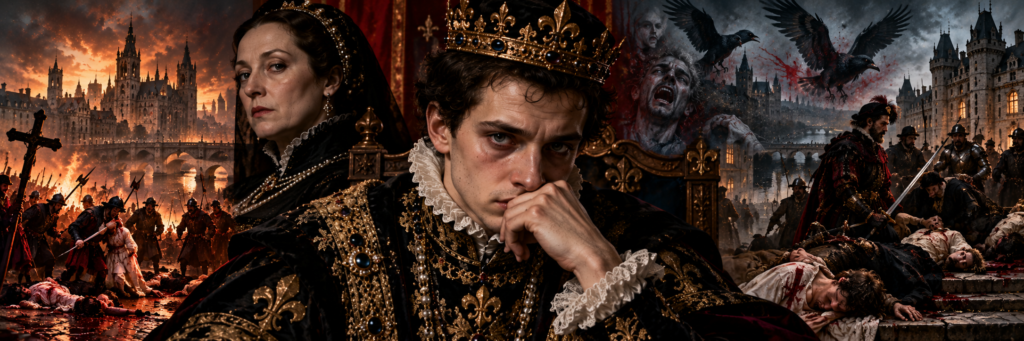
Charles IX of France: The Blood-Soaked King, the St. Bartholomew’s Day Massacre, and the Madness of a Dying Monarchy
King of France, 1560–1574
France had witnessed the cruelty of kings before, but few events in its history would become as infamous as the bloodshed that engulfed Paris in August 1572. Protestant noblemen who had traveled to the capital for a royal wedding were murdered, ordinary citizens were dragged from their homes, and bodies were thrown into the Seine. What began with a decision to eliminate selected Protestant leaders became a much wider massacre, spreading beyond Paris into provincial towns and leaving thousands dead. At the center of the catastrophe stood Charles IX, a twenty-two-year-old king whose authority was entangled with the ambitions of his mother, Catherine de’ Medici, the rivalries of powerful noble families, and the bitter religious divisions tearing France apart. The young monarch had inherited the crown as a child and spent most of his life surrounded by conspiracies, assassinations, and civil warfare. His reign would become inseparable from one of the darkest episodes of the French Renaissance.
Charles has frequently been portrayed as emotionally unstable, violent, easily manipulated, and eventually overwhelmed by guilt. Stories describe him raging at advisers, exhausting himself through hunting and physical labor, slaughtering animals in sudden bursts of anger, and hearing the imagined cries of the people killed during the massacre. Some accounts even claim that his remorse became so unbearable that blood seeped from his skin as he approached death. These images have helped establish his reputation as a disturbed monarch whose mind collapsed beneath the consequences of his own decisions. Yet the historical record is more complicated than the familiar portrait of a hysterical young king driven insane by his mother and haunted by thousands of murdered subjects. Contemporary descriptions of his temperament deserve attention, but many of the most sensational stories emerged from hostile political literature, retrospective moral narratives, and traditions that developed after his death.
Charles IX was not another Charles VI, the earlier French king whose recurrent episodes of severe mental disturbance disrupted royal government. No comparable clinical history establishes that Charles IX experienced psychosis or a progressive psychiatric disorder. His life was nevertheless marked by extraordinary pressures, serious physical illness, and participation in decisions that produced devastating consequences. His mother exercised substantial political influence, but she was not the all-powerful manipulator of popular legend, and Charles was not simply a helpless instrument of her will. The St. Bartholomew’s Day massacre resulted from political calculations, fear, religious hatred, and decisions made by identifiable people within a dangerously unstable environment. Understanding Charles requires examining both the troubled young man and the violent political world in which he ruled, without allowing either his personality or his illness to excuse the responsibilities of kingship.
A Crown Inherited From Death: The Childhood of Charles IX
Charles was born on June 27, 1550, at Saint-Germain-en-Laye, the son of Henry II of France and Catherine de’ Medici. He entered a royal household that combined Renaissance magnificence with intense political competition, religious anxiety, and the ambitions of influential aristocratic families. His father was an energetic monarch who valued hunting, tournaments, and military achievement, while his mother belonged to the powerful Medici family of Florence. Charles was not initially expected to inherit the throne, since his elder brothers Francis and Louis stood ahead of him in the succession, although Louis died in infancy. His childhood therefore began without the certainty that he would eventually become king. Yet the Valois dynasty was vulnerable to the sudden deaths that repeatedly transformed royal succession, and Charles would inherit the crown under circumstances that left little room for a peaceful transition into adulthood.
The first catastrophe occurred in June 1559, when Henry II suffered a devastating injury during a tournament celebrating the Peace of Cateau-Cambrésis. A shattered lance penetrated the king’s helmet and struck his face near the eye, producing injuries that proved fatal despite the efforts of distinguished physicians. Henry survived for eleven days before dying on July 10, leaving the throne to his fifteen-year-old son Francis II. The succession placed the monarchy in the hands of an inexperienced teenager whose marriage to Mary, Queen of Scots, strengthened the influence of her maternal relatives, the powerful Guise family. Catherine remained an important member of the royal household, but the Guise brothers occupied prominent positions in government. Their ascendancy intensified existing aristocratic rivalries at a time when Protestantism was spreading and religious tensions were becoming increasingly difficult to contain.
Francis II’s reign lasted little more than a year. He died in December 1560 after a serious illness, leaving the crown to his younger brother Charles, who was only ten years old. The sudden succession transformed the boy into the ruler of a kingdom already divided by religious suspicion and political competition. Catherine de’ Medici assumed a leading role in government as regent, working with advisers and royal institutions to maintain authority during her son’s minority. Charles inherited not only the crown but also the unresolved conflicts that had accumulated under his father and brother. His childhood would be spent amid political negotiations, religious disputes, and the threat of rebellion, with little opportunity to experience a life separate from the demands of monarchy. The circumstances were unsettling, but they do not by themselves establish that he developed a psychiatric disorder.
The court into which Charles entered as king was dominated by powerful families whose rivalries could threaten royal stability. The Guise dynasty possessed substantial military and ecclesiastical influence, while the Bourbon family included princes with important claims to status and authority within the kingdom. Anne de Montmorency and his associates represented another major political network, and the emerging Protestant movement attracted supporters among sections of the nobility. Catherine attempted to navigate these competing interests while preserving the position of her young son. Her task was complicated by the fact that religious identity increasingly shaped political alliances, although family ambitions and personal rivalries could still cross confessional boundaries. Charles grew up observing a world in which loyalty could be conditional, royal authority could be challenged, and the consequences of political failure could be fatal. Later writers would interpret his temper and emotional volatility through this childhood environment, but the surviving evidence does not permit a simple diagnosis of trauma-induced instability.
Catherine de’ Medici: The Mother Who Governed in Her Son’s Name
Catherine de’ Medici became one of the most influential figures in sixteenth-century French politics because her children inherited the throne while young and vulnerable. Her authority did not arise from a single secret conspiracy or an unlimited ability to manipulate the monarchy. It developed through her position as queen mother, her experience of court politics, her relationships with royal officials, and the practical need for experienced leadership during successive minorities. She worked closely with advisers such as Michel de L’Hôpital, whose involvement reflected attempts to stabilize the kingdom through legal and political measures. Catherine also cultivated relationships with aristocratic factions, sometimes balancing rival interests against one another in an effort to prevent any single group from dominating the crown. Her policies were not consistently successful, and her decisions could be contradictory, but they emerged from a recognizable struggle to preserve dynastic authority. The image of Catherine as a sinister woman controlling every event from behind a curtain oversimplifies the institutional and political realities of her position.
During Charles’s minority, Catherine supported efforts to reduce religious tensions through limited concessions and negotiation. The Edict of January 1562, sometimes called the Edict of Saint-Germain, permitted restricted Protestant worship under specified conditions. The measure reflected an attempt to create a legal framework for coexistence, although it satisfied neither militant Catholics nor Protestants seeking greater freedom. Its implementation became increasingly difficult because religious hostility had already penetrated local communities and aristocratic networks. In March 1562, violence at Vassy, where troops associated with Francis, Duke of Guise, killed Protestant worshippers, helped trigger the outbreak of the first French War of Religion. The event demonstrated how quickly local violence could develop into national conflict when powerful nobles and religious communities were prepared to mobilize. Catherine’s attempts at compromise were overwhelmed by forces that neither she nor her young son could easily control.
Charles formally reached his majority in 1563, but Catherine continued to exercise considerable influence over government. Her authority depended upon experience, access, and the trust she had developed within the royal household rather than a permanent legal right to govern in place of an adult king. She participated in diplomatic negotiations, advised on appointments, and helped coordinate policies intended to preserve the monarchy. Charles gradually developed his own relationships with advisers and courtiers, sometimes supporting positions that differed from those associated with his mother. Their relationship therefore cannot be reduced to one of absolute domination and passive obedience. Catherine remained influential because the political situation was dangerous and because Charles relied upon experienced counsel, but he possessed royal authority and increasingly exercised it. The distinction becomes essential when examining responsibility for the massacre of 1572.
Catherine’s reputation deteriorated dramatically after the St. Bartholomew’s Day massacre. Protestant writers portrayed her as a calculating architect of slaughter, sometimes connecting her Italian origins with familiar stereotypes of poison, deceit, and political corruption. These accusations became central to the hostile mythology surrounding her name, particularly in literature that treated the massacre as evidence of a long-planned conspiracy. Catholic defenders of the monarchy offered different explanations, emphasizing threats against the crown and the supposed necessity of preventive action. Historians have spent generations evaluating these competing accounts, and the evidence does not support the simple conclusion that Catherine secretly planned the extermination of French Protestants from the beginning. She was almost certainly involved in the crucial royal deliberations preceding the killings of selected leaders, but the extent of her initiative and the details of those discussions remain disputed. Her responsibility must be examined within the collective decisions of the royal council and the political circumstances immediately preceding the violence.
A Kingdom Divided by Faith: The Religious Wars That Shaped a Young King
The French Wars of Religion began during Charles’s childhood and became the defining political crisis of his reign. Protestantism had spread through France during the preceding decades, attracting adherents among merchants, artisans, scholars, and members of the nobility. The movement challenged established Catholic religious authority and raised difficult questions about the relationship between worship, law, and royal government. Catholic communities frequently regarded Protestant practices as heretical and threatening, while Protestants feared persecution and sought legal protection. Local disputes over churches, preaching, processions, and public ceremonies could develop into violence, particularly when political authorities were unable or unwilling to enforce compromise. The conflict was therefore not confined to theological disagreement among scholars. It affected ordinary communities whose religious identities increasingly became associated with political loyalty and social belonging.
The first war began in 1562 and continued until the following year, when a settlement attempted to establish limited conditions for Protestant worship. The assassination of Francis, Duke of Guise, during the conflict intensified existing resentments and created a lasting grievance within his powerful family. The young king’s government faced the difficult task of maintaining peace between communities whose leaders distrusted one another and whose followers remembered recent violence. Further wars erupted in 1567 and 1568, demonstrating the fragility of earlier agreements. Protestant military leaders, including Louis I, Prince of Condé, and Admiral Gaspard de Coligny, became central figures in the conflict, while Catholic commanders sought to defend royal and religious authority. Battles, sieges, assassinations, and local atrocities repeatedly undermined attempts at reconciliation. Charles spent his adolescence watching negotiations collapse and armies mobilize, experiences that undoubtedly shaped his understanding of kingship.
Catherine organized an extensive royal progress through France between 1564 and 1566, accompanied by Charles and members of the court. The journey was intended to display royal authority, strengthen relationships with provincial elites, and reinforce the presence of the monarchy in regions affected by political uncertainty. The court traveled through numerous towns and cities, participating in ceremonies and receiving representatives of local institutions. Charles encountered a kingdom whose religious and political divisions varied considerably from place to place. The journey also provided opportunities for hunting and other aristocratic activities, which formed an important part of royal life. Later stories associated some of his more disturbing behavior with this progress, including an anecdote about an encounter with an aggressive sow. Such accounts should be evaluated cautiously because the details are not always securely documented and may have been embellished to illustrate an already established reputation for volatility.
The wars intensified again in the late 1560s. Condé was killed after the Battle of Jarnac in 1569, and Protestant leadership increasingly centered upon Coligny and the young Henry of Navarre, among others. The Peace of Saint-Germain in 1570 brought another attempt at settlement, granting Protestants specified rights and several fortified places as guarantees of security. The agreement did not eliminate distrust, but it created an opportunity for renewed negotiation and reconciliation. Charles’s government sought to restore stability through arrangements that acknowledged the political strength of Protestant interests without abandoning Catholic monarchy. The possibility of peace depended upon maintaining confidence among leaders who had spent years fighting one another. This fragile settlement formed the background to the royal wedding of August 1572, an event intended to symbolize reconciliation but destined to become associated with extraordinary violence.
The King’s Temper: Rage, Melancholy, and the Problem of Hostile Portraits
Charles IX acquired a reputation for emotional volatility, and contemporary observers sometimes described him as excitable, impatient, or quick to anger. Such descriptions have encouraged later writers to portray him as a monarch whose moods changed unpredictably between violent rage and tearful sensitivity. Yet the language of sixteenth-century character writing differed considerably from modern psychiatric terminology. Chroniclers and diplomats frequently described rulers through moral categories such as courage, weakness, melancholy, cruelty, or excessive passion, often with political purposes in mind. A king regarded as insufficiently decisive might be condemned as weak, while a forceful ruler could be accused of uncontrolled anger. Charles’s youth, physical health, and dependence upon advisers made him particularly vulnerable to judgments about temperament. These accounts deserve consideration, but they cannot be transformed into a diagnosis of bipolar disorder, psychosis, or another specific condition without evidence that the sources do not provide.
The political pressures surrounding Charles were considerable. He inherited the crown at ten, reached adolescence during civil war, and became responsible for a kingdom in which powerful nobles commanded armed followers and religious communities increasingly distrusted royal intentions. His mother remained influential, while his younger brother Henry, Duke of Anjou, acquired military prestige and an increasingly important political position. Such circumstances created opportunities for rivalry and resentment, particularly because the king’s authority depended upon recognition by nobles who possessed substantial independent power. Later accounts describe Charles becoming angry when his brother received praise or when courtiers appeared to challenge his decisions. Some of these tensions were genuine features of Valois court politics, but the most theatrical descriptions of tantrums and uncontrollable jealousy require caution. The evidence supports the existence of rivalry and occasional conflict, not a complete portrait of a monarch incapable of governing his emotions.
Charles also possessed interests that contrasted with the image of a ruler consumed entirely by rage. He enjoyed poetry, music, and literary culture, and he maintained relationships with writers who participated in the intellectual life of the French Renaissance. He was especially associated with Pierre de Ronsard, one of the most celebrated poets of the period. His appreciation of literature does not prove exceptional emotional sensitivity, just as his enthusiasm for hunting does not prove sadism. Renaissance court culture valued both artistic refinement and martial vigor, and aristocratic men were expected to participate in activities that modern observers might consider contradictory. Charles could therefore admire poetry while also enjoying physically demanding sports without demonstrating psychiatric instability. The problem arises when later narratives treat ordinary contrasts in royal behavior as evidence of a disturbed personality.
The most sensational portraits of Charles often emerged after the massacre, when his character became inseparable from the violence committed under his authority. Protestant polemicists had powerful reasons to depict him as a tyrant, while Catholic writers sometimes sought to defend royal decisions by emphasizing threats against the monarchy. Later historians and novelists added psychological explanations that made the story more dramatic and morally satisfying. A young king driven into madness by guilt offers a compelling narrative, particularly when contrasted with the slaughter of thousands of innocent people. Yet historical responsibility does not depend upon proving that Charles was mentally unstable, and the suffering of the victims does not become more significant if their king experienced nightmares. The challenge is to distinguish documented actions from stories created to explain or condemn those actions. Charles’s reputation for volatility must therefore be examined alongside the political interests of those who described him.
The Royal Forge: Blacksmithing, Physical Labor, and an Unusual King’s Pastimes
One of the more distinctive traditions associated with Charles IX concerns his interest in metalworking and manual craftsmanship. Later descriptions portray him spending hours at a forge, working with tools and metal in a manner that seemed unusual for a monarch. The image is striking because Renaissance kings were generally expected to demonstrate authority through command, ceremony, patronage, and aristocratic recreation rather than sustained physical labor. Yet practical craftsmanship was not inherently incompatible with elite culture. European princes sometimes took interests in mechanics, weapons, architecture, and technical processes, especially in an age when engineering and military innovation attracted royal attention. Charles’s reported enthusiasm for forge work therefore deserves examination as a personal interest rather than immediate evidence of psychological abnormality. The precise scale of his activities, including claims that he regularly forged chains, keys, or armor inside a palace workshop, is less securely documented than popular retellings suggest.
The story has often been used to illustrate Charles’s supposed inability to remain still or concentrate upon government. According to this interpretation, he sought physical exhaustion through manual labor because he could not tolerate the anxieties of political responsibility. Such an explanation is possible as speculation, but it cannot be established from the surviving evidence. A ruler might enjoy practical work because of curiosity, personal satisfaction, technical interest, or the desire to escape formal ceremony, and none of these motives can automatically be treated as pathological. Renaissance monarchs were surrounded by artisans whose skills supported warfare, architecture, and luxury production, making direct exposure to craftsmanship entirely plausible. Charles’s interest would have been unusual enough to attract comment, particularly from courtiers concerned with royal dignity. Nevertheless, unusual hobbies are not psychiatric symptoms, and the existence of a workshop does not demonstrate a compulsive need to exhaust himself.
The same caution applies to descriptions of Charles emerging from physical activity covered in sweat or soot. Such images have been repeated because they contrast dramatically with the expected appearance of a king dressed in magnificent fabrics and surrounded by servants. They also fit the later portrayal of Charles as a monarch attempting to escape emotional torment through relentless activity. Yet the surviving record does not allow historians to establish a continuous pattern of manic exertion or a direct connection between metalworking and psychological distress. The forge belongs to the history of his reported interests, but its transformation into evidence of mental illness reflects later interpretation. What makes the anecdote valuable is the insight it offers into expectations of royal behavior. A king who engaged in work associated with craftsmen could appear eccentric precisely because monarchy depended so heavily upon the performance of social distinction.
The Hunting King: Blood, Violence, and the Stories That Followed Him
Hunting occupied an important place in Charles’s life, as it had in the lives of his father and grandfather. Royal hunts provided opportunities for physical exercise, aristocratic companionship, and the display of authority over extensive forests and estates. They also involved the pursuit and killing of animals, practices that were accepted within elite culture even when they appear disturbing to modern readers. Charles was reportedly an enthusiastic hunter, and later accounts sometimes describe him pursuing the activity with exceptional intensity. His interest in hunting became especially significant after the massacre, when writers interpreted his behavior through the image of a ruler already associated with mass killing. The distinction between conventional aristocratic sport and unusual cruelty became blurred in these narratives. As a result, hunting stories were frequently used to suggest that Charles possessed a natural appetite for bloodshed.
Among the more sensational anecdotes is the claim that Charles violently killed a sow after it threatened him when he approached her piglets during the royal progress of the 1560s. Other stories describe him testing weapons upon domestic animals or slaughtering livestock in sudden bursts of anger. These accounts have circulated widely, but their details require careful verification before they can be treated as established events. A single anecdote repeated in later histories does not necessarily represent reliable evidence of habitual conduct, especially when it serves an obvious moral purpose. The image of a king who kills animals without restraint can easily become a symbolic explanation for his later association with human slaughter. Yet the historical record does not justify treating every such story as proof of a persistent psychological condition. It is important to distinguish his documented enthusiasm for hunting from claims of uncontrolled violence that may have been exaggerated or shaped by hostile commentary.
The allegation that Charles deliberately drove himself and his horses to exhaustion also belongs to this uncertain tradition. Some writers describe him hunting for extraordinary periods, ignoring physical weakness, and refusing the advice of physicians. He did suffer from serious illness during the later years of his reign, and strenuous activity could have affected his health. However, the claim that he repeatedly remained awake for days because of a manic compulsion cannot be established with confidence. Nor is there sufficient evidence to conclude that he used hunting specifically to escape guilt or his mother’s influence. Such explanations may appeal to modern psychological storytelling, but they attribute motives that contemporary sources do not securely reveal. His hunting interests should be understood within aristocratic culture and evaluated according to the reliability of individual accounts.
The Poet King: Ronsard, Literature, and the Unexpected Sensitivity of Charles IX
Charles’s relationship with literature complicates the familiar portrait of a young monarch defined entirely by anger and violence. He was associated with the French Renaissance literary world and particularly with Pierre de Ronsard, whose poetry had achieved considerable prestige at court. Ronsard and other writers depended upon aristocratic and royal patronage, making their relationships with monarchs both artistic and political. Charles’s interest in poetry therefore reflected the cultural expectations of Renaissance kingship, but it also suggests that he appreciated forms of expression beyond military competition and court intrigue. The king himself was credited with literary interests and poetic compositions, although questions of attribution and the extent of his personal involvement require care. His patronage connected him to a cultural movement that sought to elevate French language and literature through classical models and ambitious poetic experimentation. This intellectual environment existed alongside the religious violence that repeatedly disrupted his reign.
Ronsard’s writings about monarchy and religious conflict reveal the complicated position of a court poet during the French Wars of Religion. His political and religious commitments were not those of a neutral observer, and his literary work could defend Catholic positions while also lamenting the destruction caused by civil war. Poetry offered a means of praising royal authority, expressing concern about disorder, and participating in public debate. Charles’s appreciation of such writing should not be interpreted as evidence that he was incapable of cruelty or that his private emotions were unusually refined. Renaissance courts could celebrate literature while supporting severe punishment and military violence, and the same ruler could patronize artists while making harsh political decisions. The contrast is historically important because it challenges the assumption that cultural sophistication necessarily produces tolerance. Charles’s literary interests formed part of his identity, but they did not prevent the catastrophe of 1572.
Later descriptions sometimes claim that Charles wept openly over poetry or sermons before returning almost immediately to violent behavior. Such stories have been used to suggest extreme emotional instability, with the king supposedly moving between sentimentality and bloodlust in rapid succession. Yet their evidentiary value depends upon the reliability and context of the original accounts. Public displays of emotion were not necessarily understood in the same way in sixteenth-century court culture as they are today, and literary sensitivity was not incompatible with martial ideals. A monarch might express grief, devotion, admiration, or anger without those responses indicating a psychiatric disorder. The tendency to combine isolated anecdotes into a continuous psychological profile creates a misleading impression of clinical certainty. Charles’s relationship with poetry is better understood as evidence of his participation in Renaissance culture than as proof of an unstable mind.
The Marriage Intended to Save France: Henry of Navarre and Marguerite de Valois
By 1572, the French monarchy had endured a decade of intermittent religious warfare, and another attempt at reconciliation appeared essential. The marriage of Henry of Navarre, a prominent Protestant prince, to Marguerite de Valois, Charles IX’s sister, was intended to strengthen political ties between Catholic and Protestant interests. Henry belonged to the Bourbon dynasty and possessed an important position within the Protestant political world, while Marguerite was a member of the reigning Catholic royal family. Their union offered a visible symbol of reconciliation after years of violence. The wedding attracted numerous Protestant nobles to Paris, including leaders who had recently fought against royal forces. Their presence created opportunities for diplomatic contact but also intensified anxiety among militant Catholics who regarded the gathering with suspicion. The capital was already a difficult environment because religious hostility remained strong among sections of its population.
The marriage took place on August 18, 1572, amid elaborate ceremonies and considerable political tension. Henry of Navarre was Protestant, while Marguerite was Catholic, making the religious arrangements surrounding the ceremony sensitive. The union had been negotiated within a broader strategy of peace, but it did not resolve the underlying distrust between rival communities. Protestant nobles expected protection under royal authority, while Catholic opponents feared that the growing influence of Protestant leaders threatened the kingdom’s religious identity. Admiral Gaspard de Coligny, one of the most prominent Protestant commanders, had developed a relationship with Charles IX and gained access to the royal court. His presence became particularly controversial because he supported policies that could redirect French foreign affairs toward confrontation with Spain in the Netherlands. The combination of religious rivalry and international strategy made Coligny a powerful but vulnerable figure.
Coligny’s relationship with Charles has sometimes been described as almost paternal, with the admiral supposedly replacing the emotional authority of the king’s deceased father. The two men did develop political contact, and Charles appeared receptive to some of Coligny’s views, but the precise emotional character of their relationship cannot be established. The suggestion that Catherine feared losing all influence over her son to Coligny has become central to popular explanations of the massacre. Yet royal politics involved more than a personal struggle between a mother and an admiral. Catherine and other advisers were concerned about the risks of war with Spain, the influence of Protestant leaders, and the possibility that renewed conflict might destabilize the kingdom. Coligny’s position therefore threatened established political calculations as well as individual relationships. These tensions would become critical after an assassination attempt transformed the atmosphere in Paris.
The Shot That Changed Everything: The Attempted Murder of Admiral Coligny
On August 22, 1572, Admiral Coligny was wounded by gunfire while traveling through Paris. The shot struck him but did not immediately kill him, leaving the Protestant leader injured and his supporters furious. The attempted assassination occurred only days after the royal wedding, when numerous Protestant nobles remained in the capital. Suspicion quickly fell upon Catholic enemies of Coligny, particularly those associated with the Guise family, whose grievances included the earlier assassination of Francis, Duke of Guise. The precise responsibility for the attack remains disputed, and historians have considered several possible participants and motives. Some interpretations emphasize the Guise faction, while others examine the possibility of wider political involvement. The surviving evidence does not establish every detail of the conspiracy with certainty.
The attack created an immediate political crisis because Protestant leaders demanded justice and feared that the royal government could not protect them. Charles reportedly expressed anger at the attempt and ordered inquiries, although the reliability and precise wording of contemporary accounts must be considered. The presence of armed noble households in Paris increased anxiety, while rumors circulated about possible retaliation and further violence. Catherine and the royal council confronted the danger that the assassination attempt might destroy the peace established only two years earlier. The king’s government faced several difficult questions: who had ordered the attack, whether Protestant leaders would accept royal assurances, and whether the situation could be contained without renewed civil war. These concerns unfolded in an atmosphere of intense suspicion where political rumors could acquire immediate military significance. The decisions made during the following days would become among the most consequential in French history.
Popular accounts frequently describe Catherine convincing Charles that Protestant leaders were preparing an immediate coup to murder the royal family. This explanation reflects one influential interpretation of the events, but the exact conversations within the royal council are not preserved in a form that permits certainty. Historians continue to debate whether the monarchy genuinely feared an imminent Protestant uprising, used that fear to justify a planned strike, or responded to a combination of rumors and political pressure. Catherine was involved in the deliberations, but the roles of other advisers and members of the royal family were also important. The decision-making process cannot be reconstructed as a simple scene in which a hysterical young king was cornered by his mother and forced to surrender his judgment. Such a narrative may be dramatically satisfying, but it risks concealing the collective political responsibility involved. What followed was not an accidental misunderstanding but a deliberate decision to kill selected Protestant leaders, followed by violence on a far greater scale.
The Night of St. Bartholomew: Paris Descends Into Slaughter
During the night of August 23–24, 1572, royal authorities moved against prominent Protestant leaders in Paris. The decision to eliminate selected figures was connected to the crisis following the attempt on Coligny’s life, although historians continue to debate the precise motives and the extent of the original plan. Armed men entered the admiral’s lodging, and Coligny was murdered. His body was subjected to further indignities, reflecting the hatred directed toward him by his enemies. Other Protestant nobles were killed, including men who had traveled to Paris under the expectation of royal protection. The violence soon expanded beyond the initial targets, drawing in militia members, armed groups, and civilians who attacked Protestants throughout the capital. The distinction between an organized political killing and a wider religious massacre rapidly collapsed.
Paris became the scene of extraordinary brutality as Protestant residents and visitors were pursued through streets, houses, and neighborhoods. Victims were killed in their homes, attacked while attempting to escape, or murdered after being identified as members of the Protestant community. Some bodies were thrown into the Seine, while others were left in public places, contributing to the terror experienced by survivors. The violence involved a mixture of organized action, local initiative, religious hostility, personal grievances, and opportunism. Not every killing followed a direct royal command, but the initial decision to eliminate Protestant leaders helped create the conditions in which wider slaughter became possible. The monarchy’s inability or unwillingness to halt the violence immediately remains central to historical assessments of responsibility. Thousands of people died in Paris and in subsequent massacres elsewhere in France, although exact totals remain disputed.
The violence spread to provincial towns during the following weeks, sometimes after news of the Paris killings reached local authorities and communities. Massacres occurred in places including Orléans, Lyon, Rouen, Bordeaux, and Toulouse, although their timing, circumstances, and scale varied. Some local officials resisted demands for violence or attempted to protect threatened residents, demonstrating that the killings were not an inevitable response to royal policy. Elsewhere, existing religious hostility and political rivalry contributed to further attacks. The provincial massacres reveal how decisions made at the center of government could interact with local tensions in unpredictable and devastating ways. Historians disagree over the total number of victims, with estimates varying substantially according to the sources and methods used. A commonly cited broad range is several thousand to perhaps ten thousand or more across France, but no precise figure can be established with confidence.
The St. Bartholomew’s Day massacre became one of the defining atrocities of the European Reformation era. It destroyed confidence in royal promises of protection among many Protestants and strengthened fears that reconciliation with Catholic authorities could prove fatal. The violence also complicated relations among Catholic powers, because reactions varied according to political interests and interpretations of what had occurred. Some celebrated the apparent defeat of a perceived Protestant threat, while others were disturbed by the scale of the bloodshed and the damage to France’s international reputation. The massacre was not simply a spontaneous eruption of hatred, nor was every death necessarily part of a detailed royal plan. It resulted from a combination of deliberate political decisions, religious hostility, institutional weakness, and local violence. Charles IX stood at the center of the royal government responsible for initiating the killings of selected leaders, even though the wider massacre exceeded the immediate scope of those decisions.
Did Charles Order the Massacre? The Disputed Command to Kill Them All
One of the most famous stories associated with the massacre concerns Charles supposedly shouting that all Protestants should be killed so that none would remain to reproach him. Versions of the alleged command appear in later narratives, often presented as the moment when the king’s emotional instability overwhelmed his judgment. The wording varies, and the circumstances of the supposed outburst cannot be established with certainty. It is therefore misleading to present the quotation as a verified statement recorded during the royal council’s deliberations. The story became powerful because it offered a single dramatic explanation for an event involving many participants and complicated decisions. A young king screaming for universal slaughter provides a memorable image, but historical responsibility cannot be determined through an uncertain quotation. The evidence must instead be evaluated through the decisions and actions that can be more securely reconstructed.
Charles’s government initially attempted to explain the violence in ways that limited the appearance of royal responsibility. Early statements associated the killings with private feuds and disorder, reflecting the monarchy’s concern about how events would be interpreted. On August 26, Charles publicly accepted responsibility for action against selected Protestant leaders, presenting it as a necessary response to an alleged conspiracy threatening the crown. This declaration was politically significant because it transformed the official explanation from an account of uncontrolled factional violence into a justification of royal action. The king’s statement did not mean that he had personally ordered every killing committed in Paris or the provinces. It did, however, associate the monarchy with the decision to eliminate Protestant leaders and defend that decision as an act of political necessity. The changing explanations reveal a government attempting to manage the consequences of an event whose scale and international implications had become enormous.
Historians continue to debate how the decision was reached and who played the leading role. Catherine de’ Medici was undoubtedly influential, but the evidence does not support treating her as the sole architect while Charles remained entirely passive. The king possessed formal authority, participated in the political environment, and publicly defended the action against Protestant leaders. Other advisers and noble figures also contributed to the decisions and their implementation, while the Guise family played an important role in the violence surrounding Coligny’s murder. The massacre therefore requires an assessment of collective responsibility rather than a search for one psychologically unstable individual whose breakdown supposedly explains everything. Charles’s youth and political pressures matter, but they do not eliminate his position as sovereign. The tragedy lies partly in the fact that royal authority, which should have offered protection to subjects attending a reconciliation ceremony, became associated with their destruction.
Catherine’s Exact Role: Political Calculation or a Mother’s Conspiracy?
Catherine’s involvement in the events of August 1572 remains one of the most contested questions in French Renaissance history. She had spent years attempting to preserve the monarchy through negotiation, limited religious concessions, and the balancing of rival aristocratic interests. Her support for the marriage between Henry of Navarre and Marguerite de Valois demonstrated that she was willing to pursue reconciliation when it served dynastic stability. Yet the attempted assassination of Coligny created a crisis that threatened to overturn the settlement. Catherine and other advisers may have feared that Protestant leaders would retaliate against the crown or that Coligny’s influence would draw France into a dangerous war with Spain. These concerns were not necessarily imaginary, but the extent to which they justified immediate action remains a separate question. The decision to eliminate Protestant leaders reflected a willingness to use lethal violence against perceived political threats.
The popular image of Catherine manipulating her son through fabricated warnings belongs partly to the hostile tradition that developed after the massacre. Protestant writers portrayed her as a calculating foreign woman whose ambition and deceit corrupted the monarchy, drawing upon stereotypes associated with Italian politics. Later historians and novelists repeated these themes, sometimes presenting her as the architect of a carefully planned extermination campaign. Modern scholarship has generally approached the question with greater caution, recognizing the difficulty of reconstructing private deliberations and the importance of other political actors. Catherine’s involvement in the decision against selected leaders is widely accepted, but the claim that she planned every subsequent killing across France is not supported by the evidence. Nor can historians establish that she deliberately sought to destroy the Protestant population through a long-prepared national conspiracy. Her responsibility lies in the decisions she helped shape and the consequences of those decisions, not in every allegation circulated by hostile writers.
The distinction between planning and escalation is particularly important. The royal decision to kill selected Protestant leaders created a political and moral catastrophe even before the violence spread through Paris. Once armed groups began attacking a wider population, local religious hostility and personal grievances contributed to killings that the crown did not necessarily anticipate in their full extent. Nevertheless, the monarchy bore responsibility for initiating the violence and for the failures that allowed it to expand. Catherine’s political calculations must therefore be examined without reducing her to either a helpless participant or a supernatural figure of evil. She was an experienced stateswoman who made consequential decisions in an environment of fear and instability. Those decisions helped produce one of the most devastating episodes of her son’s reign. The fact that the wider massacre may not have been planned in every detail does not erase the responsibility associated with the original operation.
Europe Reacts: Celebration, Horror, and Diplomatic Damage
News of the massacre spread across Europe through diplomatic correspondence, merchant networks, religious communities, and printed accounts. The reaction was far from uniform, reflecting the deep confessional divisions of the period. In some Catholic circles, the destruction of prominent Protestant leaders was interpreted as a victory against heresy or a successful defense of royal authority. Pope Gregory XIII received reports that presented the events in terms favorable to the French crown, and celebrations in Rome included religious observances associated with the apparent defeat of a Protestant threat. A commemorative medal was issued depicting the destruction of the Huguenots, while artistic representations of the massacre later formed part of the visual record associated with the papacy. These responses became particularly notorious in Protestant accounts, which interpreted them as evidence that Catholic authorities welcomed the slaughter. The historical context is important because information reaching Rome initially emphasized the alleged suppression of a conspiracy rather than providing a complete and impartial account of the killings.
Protestant Europe reacted with horror and anger. Reports of the massacre reinforced fears that Catholic rulers could not be trusted to protect Protestant subjects, even when formal agreements promised security. In England, the court of Elizabeth I received news with alarm, and the events complicated diplomatic relations with France. The English queen’s government had its own strategic reasons for maintaining communication with the French monarchy, but the massacre made cooperation politically sensitive. Protestant writers circulated accounts emphasizing the betrayal of guests who had traveled to Paris for a royal wedding under assurances of protection. The violence became a powerful symbol of Catholic treachery within Protestant political literature, influencing perceptions of France for generations. The massacre also strengthened arguments among some Protestants that resistance to tyrannical rulers could be justified under certain circumstances.
The political consequences extended beyond immediate outrage. The massacre damaged the credibility of royal reconciliation policies and encouraged the development of resistance theories among Protestant intellectuals. Works produced in the following years examined the responsibilities of rulers, the rights of subjects, and the circumstances under which obedience might be withdrawn. These arguments contributed to a broader European debate about sovereignty and legitimate resistance, particularly when monarchs were accused of violating their obligations to protect their people. Within France, surviving Protestant communities became increasingly distrustful of royal promises, complicating subsequent peace negotiations. The monarchy’s international reputation suffered because the killings appeared to contradict the reconciliation symbolized by the marriage of Henry of Navarre and Marguerite de Valois. Charles’s government had sought to eliminate perceived political threats, but the result was a crisis of legitimacy that extended far beyond the kingdom’s borders.
The King After the Massacre: Guilt, Nightmares, and the Legends of a Haunted Mind
Charles’s psychological condition after the massacre became a major subject of later historical storytelling. Popular accounts describe him suffering terrifying nightmares, hearing the cries of murdered Protestants, and becoming unable to escape the memory of the violence committed under his authority. One famous tradition claims that he interpreted the cries of birds near the Louvre as the voices of the dead, while another depicts him weeping uncontrollably and begging forgiveness for the slaughter. These stories are emotionally powerful because they suggest that the king experienced the suffering of his victims through overwhelming remorse. Yet the reliability of such accounts is uncertain, and many were shaped by the desire to portray the massacre as a crime that inevitably destroyed its perpetrator. The image of a guilty monarch tormented by supernatural or psychological punishment became an effective moral narrative. It should not be mistaken for a securely documented clinical history.
Charles did experience serious physical deterioration during the final years of his life, and contemporary observers described illness and weakness that affected his activities. However, the claim that guilt over the massacre directly caused his decline cannot be established. His health problems had a medical dimension that requires consideration independently of his political conduct. Later writers frequently connected his physical suffering with divine punishment, suggesting that the bloodshed of 1572 returned to torment him through his own body. Such interpretations reflected religious and moral assumptions rather than medical evidence. They also allowed the massacre to be transformed into a story of cosmic justice, in which the king’s suffering symbolically compensated for the deaths of his victims. Historical analysis must resist that temptation, because the victims’ experiences and the king’s illness were distinct realities.
The story that Charles sweated blood during his final illness belongs to this tradition of dramatic moral punishment. Accounts of blood emerging from the skin have been associated with the rare condition sometimes called hematidrosis, but the historical descriptions do not provide adequate evidence for diagnosing it in Charles. Severe illness, coughing blood, and other forms of bleeding could also be misunderstood or embellished in later retellings. The claim that he physically bled from guilt is therefore a legend rather than an established medical conclusion. Similarly, reports of auditory hallucinations cannot be accepted as proof of psychosis without reliable contemporary documentation. Charles may have experienced fear, regret, anxiety, or emotional distress, but his private mental state cannot be reconstructed with the certainty suggested by popular narratives. His reputation as a haunted king reflects the enduring moral weight of the massacre as much as it reflects evidence about his actual condition.
The Final Illness: Tuberculosis, Exhaustion, and Medical Uncertainty
Charles IX died young, and his declining health has long encouraged speculation about the medical conditions that affected him. Tuberculosis is commonly identified as the probable cause of his death, particularly because accounts describe respiratory illness and episodes of bleeding. The disease was widespread in early modern Europe and could produce prolonged weakness, fever, weight loss, coughing, and serious pulmonary complications. Yet retrospective diagnosis remains uncertain because surviving descriptions lack the detail available in modern clinical records. Other conditions or complications may have contributed to his deterioration, and historians cannot establish every aspect of his illness. What is clear is that Charles became increasingly unwell during the final years of his reign. His physical weakness complicated government at a time when France remained politically unstable and religious conflict continued.
The relationship between illness and behavior is especially difficult to assess. Serious respiratory disease can produce exhaustion, discomfort, disturbed sleep, and emotional strain, particularly when accompanied by fever or repeated bleeding. Such symptoms might affect a ruler’s capacity to participate in ceremonies, travel, or attend lengthy council meetings. However, they do not establish that Charles suffered from a particular psychiatric disorder or that his political decisions resulted from neurological deterioration. The suggestion that tuberculosis caused manic behavior, hallucinations, or uncontrollable rage is unsupported by the available evidence. Likewise, claims that his hunting habits deliberately destroyed his lungs require more precise documentation than popular accounts usually provide. His health problems were real, but the temptation to transform them into a complete explanation for his personality should be resisted.
Modern historians have sometimes considered whether Charles’s reported mood changes reflected psychological distress associated with childhood instability, political pressure, or chronic illness. Such interpretations may offer useful questions, but they cannot produce a reliable diagnosis. The sources do not provide systematic descriptions of symptoms, duration, frequency, or functional impairment sufficient to distinguish among modern psychiatric conditions. Contemporary observers also interpreted behavior through political and moral expectations that differed from present-day medical frameworks. A ruler described as melancholy might have been grieving, physically ill, temperamentally reserved, or simply failing to meet expectations of royal confidence. Anger could reflect political frustration, personal temperament, or the deliberate performance of authority rather than a psychiatric episode. The most responsible conclusion is that Charles’s psychological condition remains uncertain, while his serious physical illness is much more securely established.
The Siege of La Rochelle: War Returns After the Massacre
The massacre did not end religious conflict in France. Instead, it intensified distrust and contributed to renewed resistance among Protestant communities that feared further persecution. La Rochelle, an important Protestant stronghold on the Atlantic coast, became a central focus of royal military operations. The city possessed strategic and commercial importance, and its resistance demonstrated that the monarchy had failed to eliminate organized Protestant opposition. In 1573, royal forces besieged La Rochelle under the command of Henry, Duke of Anjou, the king’s younger brother. The campaign involved substantial military resources and produced heavy losses without achieving the decisive result the crown desired. The siege illustrated the continuing strength of Protestant resistance and the limitations of coercive policy after the catastrophe of 1572.
The conflict also revealed tensions within the royal family and the government. Henry, Duke of Anjou, had acquired considerable military experience and political prestige, making him an important figure within the Valois dynasty. His relationship with Charles has sometimes been portrayed as one of intense jealousy, with the king supposedly resenting his brother’s achievements and Catherine’s affection for him. Rivalry between royal siblings was certainly possible, especially when one brother commanded armies while another struggled with illness and political difficulties. Nevertheless, the most sensational accounts of uncontrolled jealousy and violent tantrums require caution. The brothers operated within a political environment where military command, dynastic succession, and international opportunities could create genuine competition. Their relationship cannot be reduced to a psychiatric drama without overlooking the practical interests involved.
The siege of La Rochelle ended without the complete destruction of Protestant resistance. Negotiations produced the Edict of Boulogne in 1573, which granted limited religious concessions under conditions more restrictive than earlier settlements. The agreement reflected the monarchy’s continuing difficulty in imposing a lasting solution through military force. Protestant communities remained suspicious of royal intentions, while Catholic opponents of toleration continued to resist compromise. The political consequences of the massacre therefore persisted in the form of renewed warfare, distrust, and unstable peace arrangements. Charles’s government had failed to achieve the security that the killings of August 1572 were supposedly intended to protect. Instead, the monarchy faced a kingdom in which reconciliation had become more difficult than ever.
A Brother Becomes a King: Henry of Anjou and the Polish Crown
In 1573, Henry, Duke of Anjou, was elected king of the Polish-Lithuanian Commonwealth, creating an unusual development within the Valois family. His election reflected the political arrangements of the Commonwealth, where the monarchy was elective and foreign candidates could compete for the throne. For France, the opportunity offered diplomatic prestige and the possibility of extending Valois influence beyond western Europe. Henry eventually traveled to assume his new position, leaving France while his brother’s health continued to deteriorate. The circumstances added another layer of uncertainty to the succession because Charles had no surviving legitimate son. The possibility that Henry might eventually inherit the French crown remained politically important despite his election abroad. The brothers’ positions therefore became linked through dynastic calculations extending across Europe.
Charles had married Elisabeth of Austria in 1570, a union intended to strengthen relations with the Habsburg dynasty. Their marriage produced a daughter, Marie Elisabeth, born in 1572, but no surviving male heir. Charles also had an illegitimate son, Charles de Valois, born to Marie Touchet, who later became Count of Auvergne and Duke of Angoulême. The existence of an illegitimate son did not resolve the succession because legitimate dynastic rules determined inheritance of the French crown. As Charles’s illness worsened, the question of succession became increasingly urgent. Henry of Anjou’s absence in Poland complicated the immediate political situation, although his position as the next surviving brother made him the expected successor. Catherine once again faced the prospect of managing a transition during a period of instability.
The succession problem demonstrated the vulnerability of the Valois monarchy despite Catherine’s earlier success in producing numerous children. Henry II and Catherine had several sons, but premature deaths repeatedly altered the line of inheritance. Francis II had died after a brief reign, Charles was now gravely ill, and Henry of Anjou remained the principal surviving candidate for the crown. The dynasty’s future depended upon men whose personal circumstances and political responsibilities were increasingly complicated. The monarchy had endured decades of religious warfare while relying upon a succession that appeared secure in childhood but became uncertain through illness and death. Charles’s final months unfolded against this background of dynastic anxiety. His death would bring another brother to the throne, but it would not resolve the conflicts threatening the kingdom.
The Death of Charles IX: A Young King Leaves a Broken Kingdom
Charles IX died on May 30, 1574, at the Château de Vincennes, shortly before his twenty-fourth birthday. He had ruled France for more than thirteen years, although much of his early reign had been conducted under the influence and direction of his mother. His final illness left the monarchy facing another succession crisis, with Henry of Anjou absent in Poland. Catherine de’ Medici again assumed a central role in maintaining government during the transition. The kingdom Charles left behind remained divided by religious hostility, aristocratic rivalry, and distrust of royal authority. The massacre of 1572 had become an enduring symbol of the dangers faced by Protestants under Catholic monarchy, while subsequent warfare demonstrated the failure of violence to produce lasting unity. Charles died without securing the peace that his government had repeatedly attempted to establish.
The circumstances of his death quickly became entangled with stories of supernatural punishment and unbearable remorse. Writers described the young king suffering terrifying visions, bleeding excessively, and approaching death under the weight of the massacre. Some accounts presented his illness as divine judgment, transforming his physical decline into a moral lesson about the consequences of bloodshed. Such interpretations were understandable within a religious culture that frequently connected illness and misfortune with providential meaning. Yet they should not be confused with reliable medical evidence. Charles’s probable respiratory disease offers a more plausible explanation for his physical deterioration than the claim that guilt literally caused him to bleed from his skin. His emotional condition during his final months remains uncertain, and historians cannot establish the precise extent of his remorse.
Henry of Anjou returned to France and succeeded as Henry III, continuing the Valois dynasty under increasingly difficult circumstances. Catherine remained politically influential, but the religious divisions that had dominated Charles’s reign continued to threaten the kingdom. Protestant communities retained military and political strength, while militant Catholic interests became increasingly organized. The monarchy struggled to preserve authority amid conflicts that would eventually contribute to the assassination of Henry III in 1589 and the extinction of the Valois male line. Charles’s reign therefore occupied a critical position within a longer period of dynastic instability and civil warfare. The massacre was its most infamous event, but the underlying crisis involved the inability of the monarchy to reconcile competing religious identities and aristocratic ambitions. His death marked another stage in that struggle rather than its conclusion.
Was Charles IX Mad? The Difference Between Psychological Distress and Historical Responsibility
Charles IX’s reputation for madness rests upon a mixture of contemporary observations, political accusations, later anecdotes, and retrospective psychological interpretation. His youth, serious illness, reported temper, enthusiasm for hunting, and unusual interests have all been used to construct a portrait of emotional instability. The St. Bartholomew’s Day massacre then provided a moral framework through which these characteristics could be interpreted as symptoms of a disturbed mind. Stories of hallucinations, uncontrollable rage, and bleeding caused by guilt reinforced the image of a monarch psychologically destroyed by his own crimes. Yet the historical evidence does not establish a specific psychiatric disorder, nor does it demonstrate that Charles experienced the recurrent psychosis associated with his ancestor Charles VI. The most sensational accounts frequently depend upon sources shaped by political hostility or moral storytelling. They deserve examination, but they should not be accepted as clinical evidence.
The king’s relationship with Catherine de’ Medici has also encouraged explanations that remove much of his personal responsibility. Popular narratives describe Catherine manipulating an emotionally fragile son into authorizing violence he did not understand or genuinely desire. The historical reality was more complicated because Charles possessed royal authority, participated in government, and publicly defended action against Protestant leaders after the massacre. Catherine exercised considerable influence, and the precise dynamics of the royal council remain disputed, but her involvement does not establish that Charles was incapable of independent judgment. Other advisers and noble factions also played important roles in the crisis, while local participants expanded the violence beyond its initial political targets. The massacre cannot be explained as the product of one unstable mind or one calculating mother. It emerged from decisions made within a political system already weakened by religious hatred and repeated civil warfare.
The question of Charles’s guilt is similarly difficult. He may have experienced regret, fear, distress, or anger after the massacre, but the evidence does not permit historians to reconstruct his private emotions with certainty. Stories of nightmares and hallucinations became powerful because they offered an image of moral punishment that appeared appropriate to the scale of the violence. Yet the victims’ suffering does not depend upon whether Charles was haunted by their deaths, and his responsibility does not disappear if he was frightened or remorseful. His illness should be understood as a medical reality rather than proof of divine vengeance or psychological collapse. The most meaningful historical assessment must therefore separate his physical condition, uncertain emotional state, and documented political actions. Charles belongs in the Mad Monarchs category because of the reputation that developed around his temperament and reign, not because a reliable diagnosis of insanity can be established.
The King Who Could Not Escape the Blood: Charles IX’s Final Legacy
Charles IX inherited the French crown as a child and spent his reign attempting to govern a kingdom divided by religious conflict and aristocratic rivalry. His mother, Catherine de’ Medici, exercised substantial influence because of his youth and the dangerous political environment, but the monarchy remained dependent upon institutions, advisers, and powerful noble families whose interests frequently conflicted. Repeated attempts at religious settlement failed to produce lasting peace, while Protestant and Catholic communities became increasingly suspicious of one another. Charles’s government sought reconciliation through legislation, negotiation, and dynastic marriage, yet those efforts repeatedly collapsed under the pressure of violence. The marriage of Henry of Navarre and Marguerite de Valois appeared to offer an opportunity for renewed stability, but the assassination attempt against Coligny transformed the atmosphere in Paris. Within days, the monarchy became associated with a massacre whose consequences would shape European political and religious thought for generations.
The St. Bartholomew’s Day massacre remains the defining event of Charles’s reign because it exposed the catastrophic consequences of political decisions made within an atmosphere of fear and religious hatred. The royal decision to eliminate selected Protestant leaders helped unleash violence that spread through Paris and beyond, killing thousands and destroying confidence in the monarchy’s promises of protection. Catherine’s involvement was significant, but the massacre cannot be attributed solely to her manipulation of an emotionally unstable son. Charles possessed royal authority and publicly defended the action against Protestant leaders, while other advisers, noble factions, and local participants contributed to the violence. The event damaged France’s international reputation, intensified Protestant distrust, and encouraged debates about the legitimacy of resistance to rulers who failed to protect their subjects. Its consequences extended far beyond the immediate killings, shaping political relationships and religious identities throughout the remainder of the century. The monarchy survived, but its claim to act as an impartial guardian of peace had been profoundly weakened.
Charles’s final illness added another layer to his historical reputation, encouraging stories of guilt, hallucinations, and supernatural punishment. His probable tuberculosis and physical deterioration were real, but the claim that remorse caused his death cannot be established. The image of a young king tormented by the voices of murdered Protestants became a powerful moral narrative because it offered an apparent form of justice for victims whose suffering could never be undone. Yet historical truth is not necessarily arranged to provide such satisfying conclusions. Charles may have experienced private distress, but the surviving evidence does not reveal the full contents of his conscience. His death at twenty-three ended a troubled reign without resolving the conflicts that had dominated it. France remained divided, and the violence that had defined his government continued under his successors.
Charles IX was not demonstrably insane, but his reign became inseparable from an event so horrifying that later generations struggled to explain it without imagining a disturbed mind behind the crown. He was a young monarch raised amid political instability, influenced by experienced advisers, burdened by serious illness, and responsible for decisions made during one of the most dangerous crises of the French Renaissance. His reported temper and eccentric interests became part of a larger legend, while stories of unbearable guilt transformed his death into a dramatic tale of punishment. The historical reality is more disturbing because it requires no hallucinations, supernatural warnings, or clinical madness to explain the catastrophe. The massacre emerged from political fear, religious hatred, deliberate violence, and the failure of royal authority to protect those who had placed their trust in it. Charles died in 1574, leaving behind a kingdom that would continue tearing itself apart for years to come. His story raises a question more unsettling than whether he was mad: how could a monarchy that claimed to preserve order and justice become an instrument of slaughter against its own subjects? The answer lies not in a single troubled mind, but in the dangerous intersection of power, fear, fanaticism, and the willingness to treat human lives as expendable when political survival appeared to be at stake.