
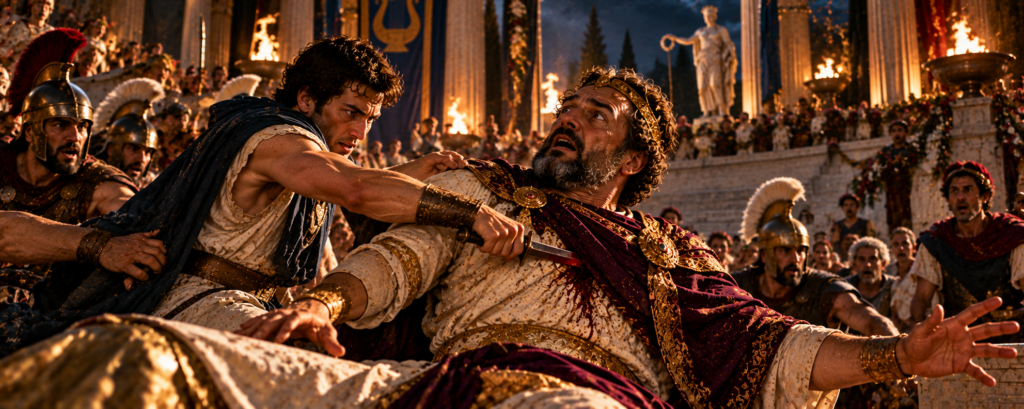
Clearchus of Heraclea: The Philosopher-Tyrant Murdered by His Own Students of Freedom
Clearchus of Heraclea (c. 410–352 BCE) | Tyrant of Heraclea Pontica, c. 364/363–353/352 BCE
The Day the Tyrant’s Enemies Finally Reached Him
The tyrant had spent years protecting himself against assassination, but on the day his enemies finally struck, the men who wanted him dead were already close enough to reach him. Clearchus of Heraclea ruled a wealthy Greek city on the southern coast of the Black Sea, where he had transformed political unrest into an opportunity for personal power. His enemies accused him of cruelty, arrogance, and an almost obsessive determination to surround himself with the trappings of monarchy. He had imprisoned opponents, destroyed powerful families, and cultivated a reputation that made resistance seem both necessary and suicidal.
His most dangerous enemy was a young aristocrat named Chion, a man whose education had connected him to the philosophical world of Athens. Chion had reportedly studied under Plato, whose teachings encouraged reflection upon justice, virtue, and the proper government of cities. Clearchus himself had also been associated with distinguished intellectual circles, making their conflict particularly striking. The struggle between them would later be remembered as a confrontation between philosophy and tyranny, although the political reality was considerably more complicated.
By 353 or 352 BCE, Chion and a group of companions had decided that Clearchus must die. Their conspiracy required secrecy, careful preparation, and a willingness to sacrifice their own lives. The tyrant was surrounded by guards and had become increasingly suspicious of threats against his person. An unsuccessful attempt would almost certainly bring imprisonment, torture, and execution.
The conspirators chose a moment connected with the festival of Dionysus, when religious observances and public activity created opportunities for approaching the ruler. Ancient accounts differ in their details, but they agree that Chion and his associates succeeded in attacking Clearchus. The tyrant was mortally wounded, bringing an abrupt end to approximately twelve years of personal rule. His killers, however, would not live to celebrate the freedom they claimed to seek.
The bodyguards responded with deadly force. Several conspirators were killed during the attack, while others were reportedly captured and subjected to torture before execution. Chion himself did not survive the enterprise. The assassination had succeeded in removing Clearchus, but the conspiracy was destroyed almost as quickly as it had acted.
Even more bitterly, the city did not regain its freedom. Clearchus’s brother Satyrus assumed control, governing on behalf of the dead tyrant’s young sons. The dynasty survived the murder of its founder, and the political system Chion hoped to overthrow remained intact. The man had been killed, but the tyranny endured.
That contradiction makes the assassination of Clearchus one of antiquity’s most revealing stories of political violence. It raises uncomfortable questions about the relationship between philosophy and power, the moral justification of tyrannicide, and the difference between killing an oppressive ruler and dismantling the government that sustains him. It also reveals how easily the language of liberation can become entangled with aristocratic ambition. Chion struck down a tyrant, but he could not guarantee that the city would be free.
Heraclea Pontica: A Wealthy City on a Dangerous Frontier
Heraclea Pontica stood on the southern coast of the Black Sea, in the region corresponding to modern northern Turkey. Founded by Greek settlers during the archaic period, it developed into an important commercial and political center. Its position provided access to maritime trade, fertile surrounding territories, and routes connecting the coast with the interior of Asia Minor. These advantages made the city prosperous, but they also exposed it to competition and political instability.
The Black Sea world was a complex network of Greek settlements, indigenous communities, Persian-controlled territories, and regional powers. Greek cities along the coast maintained commercial and cultural connections with the wider Mediterranean while developing distinctive local political traditions. Heraclea belonged to this world, where prosperity could coexist with fierce disputes over citizenship, land, and political authority. Its inhabitants were accustomed to negotiating relationships with powerful neighbors.
The city possessed a particularly important relationship with the Mariandynians, an indigenous population living in the surrounding region. Ancient sources describe the Mariandynians as occupying a dependent or servile position within the Heraclean political and economic system. Their labor contributed to the prosperity of the city, although the precise development of their status remains debated. Heraclea’s wealth therefore rested partly upon inequalities extending beyond its citizen community.
Within the Greek citizen body, political power was concentrated among influential families. Aristocratic institutions dominated much of the city’s early political history, and disputes over the distribution of authority became increasingly severe. Wealthy citizens sought to preserve their privileges, while other groups demanded greater participation or relief from economic pressures. Such conflicts were common in Greek cities during the fourth century BCE.
Heraclea’s location added another layer of complexity. The city existed within the wider sphere of the Achaemenid Persian Empire, whose satraps exercised authority over much of Asia Minor. Persian officials could influence local politics through military power, diplomacy, and alliances with prominent citizens. Greek communities sometimes resisted this influence, but they also frequently cooperated with Persian representatives when doing so served their interests.
Clearchus would exploit these overlapping tensions with remarkable effectiveness. He understood the grievances dividing Heraclea’s population and recognized the ambitions of neighboring Persian authorities. His rise depended upon presenting himself as useful to competing factions. Once he had acquired the necessary military strength, he would turn against those who had helped him.
The city that eventually celebrated his assassination had therefore played a role in creating his power. Its internal divisions allowed an ambitious individual to emerge as an apparently necessary mediator. Its wealthy aristocrats feared popular unrest, while ordinary citizens feared continued domination by powerful families. Clearchus offered each side a solution.
What neither side fully anticipated was that he intended to become master of them all.
The Young Scholar Who Learned from Greece’s Greatest Minds
Clearchus’s early life presents one of the most unusual features of his career. Ancient tradition associates him with the intellectual circles of Athens, particularly those surrounding Isocrates and Plato. These men represented different approaches to education, political thought, and the cultivation of elite character. Their reputations make Clearchus’s later transformation into a notorious tyrant especially striking.
Isocrates was one of the most influential teachers and political writers of the fourth century BCE. His educational program emphasized rhetoric, practical judgment, civic responsibility, and the ability to participate effectively in public life. Students associated with his school came from prominent families throughout the Greek world. An ambitious young man from Heraclea could gain both intellectual training and valuable connections through such an education.
Plato offered a different intellectual environment. His Academy encouraged philosophical inquiry into justice, virtue, knowledge, and the organization of political communities. Plato’s writings repeatedly examined the dangers of tyranny and the corruption produced by unchecked desire. His philosophical ideal of government emphasized the importance of reason and moral education.
Clearchus’s reported association with both intellectual traditions is preserved in later sources, particularly the local historian Memnon. The precise duration and nature of his studies cannot be reconstructed with certainty. Some traditions present him as a student of both Plato and Isocrates, while modern scholars remain cautious about treating every detail as established. Nevertheless, his reputation as an educated ruler was important enough to survive in the historical record.
The irony was obvious to ancient writers. A man exposed to teachings about justice and political virtue had become associated with coercion and cruelty. His education had not prevented him from pursuing personal domination. Indeed, his intelligence may have made him more effective at manipulating the political divisions of his city.
Clearchus was also remembered as a patron of learning. Memnon credits him with establishing a public library, an achievement sometimes described as an early example of a civic collection of books. The exact institutional nature of this library is uncertain, and the claim that it was the first of its kind should be treated cautiously. Still, the tradition suggests that Clearchus maintained an interest in intellectual culture after acquiring power.
This combination complicates the familiar image of the tyrant as an ignorant brute. Clearchus could value books, education, and intellectual prestige while employing violence against political opponents. Cultural refinement did not necessarily produce moral restraint. A ruler could admire philosophy without accepting its limitations upon his own authority.
His later assassin would also be associated with Plato’s Academy. The two men thus became linked through a shared intellectual world while standing on opposite sides of a deadly political struggle. Ancient writers found the contrast irresistible. One student of philosophy had become a tyrant, while another would die attempting to kill him.
Exile, Mercenaries, and the Road to Power
Before becoming ruler of Heraclea, Clearchus experienced the dangers of political exclusion. Ancient accounts indicate that he became involved in factional struggles within his native city and was eventually driven into exile. The exact circumstances are not fully preserved, but his removal suggests that he had already become a controversial figure. Exile did not end his ambitions.
Like many politically displaced Greeks of the fourth century BCE, Clearchus found opportunities in military service. Mercenary armies played an increasingly important role throughout the Greek and Persian worlds. Skilled commanders could acquire soldiers, wealth, and influential patrons without possessing an independent state. For an ambitious exile, such service offered a possible route back to power.
Clearchus became associated with Mithridates, a Persian official connected to the neighboring region of Pontic Phrygia. The political environment was unstable because the Persian Empire was experiencing tensions involving provincial governors and regional interests. Greek cities along the coast could become valuable prizes in these struggles. A commander familiar with Heraclea might be especially useful to a Persian patron.
According to the surviving tradition, Clearchus and Mithridates developed plans involving control of Heraclea. Their cooperation gave Clearchus military resources and an opportunity to return to the city from which he had been excluded. Yet the alliance was never necessarily one of genuine loyalty. Clearchus intended to use Persian support for his own purposes.
His opportunity emerged from conflict between Heraclea’s ruling oligarchs and the broader population. The aristocratic authorities faced increasing pressure and feared that unrest might threaten their position. Rather than resolve the crisis through concessions, they sought assistance from a man with military experience and local connections. Clearchus appeared capable of restoring order.
The decision was catastrophic for the oligarchs. They believed they were inviting a protector who would preserve their authority. Clearchus recognized that their desperation made them vulnerable. Once he entered the city with sufficient power, he could choose which faction to support.
He chose neither faction in any lasting sense. Instead, he positioned himself as the indispensable leader who could settle the conflict. His military strength allowed him to transform a temporary political role into permanent personal authority. The citizens who expected protection soon discovered that they had invited a new master.
The transition from exile to ruler demonstrated Clearchus’s political intelligence. He had identified the fears of the aristocracy, the grievances of the people, and the opportunities created by Persian involvement. He used each to strengthen his position. When the moment arrived, he discarded the alliances that had made his return possible.
The Betrayal That Created a Tyrant
Clearchus’s seizure of power was not a simple military conquest. It involved a calculated exploitation of Heraclea’s internal political crisis. The oligarchs had invited him to help preserve their authority, while sections of the population hoped for relief from aristocratic domination. Clearchus presented himself as a solution to both problems.
Ancient accounts describe him turning against the oligarchic faction after establishing his position. Prominent citizens were imprisoned, expelled, or killed, and their political influence was destroyed. The measures weakened the group most capable of challenging his authority. They also allowed him to present himself as a defender of the people against wealthy oppressors.
Such rhetoric had a long history in Greek politics. Ambitious individuals sometimes gained popular support by promising to restrain aristocratic privilege. They could redistribute resources, cancel debts, or attack unpopular families. Yet these policies did not necessarily lead to democratic government.
Clearchus’s rise followed that dangerous pattern. He used popular grievances to undermine the existing ruling class, but he did not surrender power to the citizen body afterward. Instead, he consolidated authority around himself and his military supporters. The city exchanged oligarchic domination for personal tyranny.
The betrayal of Mithridates added another dimension to the story. Clearchus had benefited from his relationship with the Persian official but ultimately pursued his own independent position. Ancient traditions describe him frustrating or deceiving the plans of his former patron. The details vary, but the broader picture is clear: Clearchus was willing to abandon allies when they ceased to serve his ambitions.
His conduct revealed a sophisticated understanding of political dependency. The oligarchs needed military protection, the populace needed a champion, and Mithridates wanted influence over Heraclea. Clearchus made himself useful to all three. Once he possessed armed power inside the city, their expectations mattered far less.
By approximately 364 or 363 BCE, Clearchus had established himself as tyrant. His authority depended upon soldiers, political intimidation, and the elimination of organized opposition. The city remained prosperous and strategically important, but its citizens no longer possessed the same ability to determine their government. The ruler who had promised protection now demanded obedience.
For the aristocrats who had invited him back, the betrayal was especially bitter. They had attempted to preserve their privileges by empowering a military strongman. Instead, they helped create a government that targeted them. Their miscalculation would become a recurring lesson in ancient accounts of tyranny.
The Purge of Heraclea’s Aristocracy
Once Clearchus secured power, he moved against the families most likely to oppose him. The aristocracy possessed wealth, local influence, and established political networks. Such resources made its members dangerous to a ruler seeking personal domination. Clearchus therefore had strong incentives to weaken them.
Ancient sources describe severe measures against prominent citizens. Some were executed, others were imprisoned, and many lost their property or were forced into exile. These actions destroyed established political relationships and redistributed power toward the tyrant’s supporters. They also created a large community of enemies who remembered what had been taken from them.
The confiscation of property was particularly significant. Wealth provided the means to finance political opposition, hire soldiers, and cultivate alliances. By seizing aristocratic estates, Clearchus could weaken rivals while increasing his own resources. The policy also allowed him to reward followers whose loyalty depended upon material advantage.
Yet such measures had consequences beyond immediate political control. Families that lost relatives or property developed powerful motives for revenge. Exiles could seek assistance from neighboring rulers or foreign powers. Those who remained within the city might outwardly submit while privately waiting for an opportunity to strike.
Clearchus’s government therefore created the conditions for conspiracy. His violence made resistance dangerous, but it also made resistance emotionally compelling. The families most injured by his policies possessed memories of status and influence that had been destroyed. Their younger members might regard assassination as the only remaining path to restoration.
Chion belonged to the kind of aristocratic environment from which such resistance could emerge. His later reputation emphasized philosophical commitment to liberty, but his social background also mattered. He was not simply an anonymous citizen protesting injustice. He belonged to a community whose political position had been transformed by Clearchus’s seizure of power.
This does not mean his opposition was insincere. Aristocratic resentment and genuine hatred of tyranny could exist together. A man could wish to restore his family’s influence while also believing that personal rule violated the proper order of the city. The distinction between political principle and social interest was rarely simple.
Clearchus’s treatment of the aristocracy therefore helped create a dangerous opposition. His enemies were deprived of open political influence but not of ambition, memory, or connections. Their grievances survived beneath the surface of the city. Eventually, some would conclude that only his death could resolve them.
The Tyrant Who Wanted to Be a God
Clearchus’s reputation for arrogance became one of the most distinctive features of his rule. Ancient writers accused him of adopting elaborate royal displays and claiming a special relationship with Zeus. Some traditions describe him presenting himself as a son of the supreme god. Such behavior appeared particularly offensive to Greek authors who regarded the excesses of personal monarchy with suspicion.
The precise nature of Clearchus’s claims is difficult to establish. Greek rulers could use religious imagery, heroic ancestry, and divine associations to strengthen their authority without necessarily demanding literal worship. Later historians sometimes exaggerated these practices to portray tyrants as irrationally arrogant. Nevertheless, the tradition concerning Clearchus’s divine pretensions is persistent enough to deserve attention.
His alleged identification with Zeus was especially provocative. Zeus represented supreme divine authority, and a ruler claiming descent from him could imply that ordinary political restraints did not apply. Such symbolism might intimidate subjects and elevate the monarch above competing aristocratic families. It also provided critics with evidence of extraordinary pride.
Ancient accounts associate Clearchus with elaborate clothing and ceremonial behavior resembling the customs of eastern monarchies. Greek writers frequently described Persian court practices as luxurious, hierarchical, and incompatible with civic freedom. These descriptions were often shaped by cultural prejudice. Yet Clearchus’s adoption of conspicuous royal display may have been a deliberate political strategy.
Heraclea stood within a region where Greek and Persian political traditions interacted. Persian kingship provided examples of elaborate court ceremony and concentrated authority. A ruler seeking to distinguish himself from ordinary citizens could borrow aspects of that model. Such borrowing did not necessarily indicate personal delusion.
The claim that Clearchus named a son Keraunos, meaning “Thunderbolt,” also appears in ancient tradition. The name evoked the weapon of Zeus and reinforced the image of a ruler fascinated by divine symbolism. Its precise significance is uncertain. It may have reflected dynastic ambition rather than an actual belief that the family possessed supernatural powers.
For opponents, however, these displays were politically useful evidence. They could portray Clearchus as a man who had forgotten the limits of human authority. His magnificent clothing and divine pretensions became symbols of a government that placed one individual above the city. The ruler’s image offered his enemies a powerful target.
Chion’s later literary reputation would exploit this contrast. Philosophy was presented as teaching humility, justice, and service to the community, while Clearchus embodied arrogance and domination. The conflict became more than a struggle over government. It became a contest between competing ideas of what a human being should be.
A Library in the Palace of a Tyrant
One of the most surprising traditions about Clearchus concerns his patronage of learning. Memnon credits him with establishing a library at Heraclea, an achievement sometimes described as the foundation of a public collection. The details of the institution are poorly documented, and the precise meaning of “public” in this context remains uncertain. Nevertheless, the report suggests that Clearchus valued intellectual prestige.
The apparent contradiction is striking. A ruler accused of suppressing political opposition also supported the preservation of books. A man remembered for cruelty had once associated with distinguished teachers. His government could promote learning while denying citizens meaningful political freedom.
Modern readers may find this difficult to reconcile, but ancient rulers frequently combined cultural patronage with authoritarian government. Libraries, temples, monuments, and educational institutions could enhance a ruler’s reputation. They also demonstrated wealth and encouraged admiration among intellectual elites. Such projects did not necessarily require political tolerance.
Clearchus may have regarded his library as evidence of personal refinement. His education in Athens would have exposed him to the prestige associated with philosophical and literary culture. Establishing a collection in Heraclea could strengthen the city’s cultural standing while associating that achievement with his own name. The project might therefore serve both genuine intellectual interests and political self-promotion.
The tradition also raises questions about the relationship between knowledge and virtue. Plato’s philosophical writings emphasized the importance of wisdom in government, but Clearchus’s career suggests that education alone could not guarantee just behavior. Intellectual training might sharpen judgment without restraining ambition. A ruler could understand arguments against tyranny while choosing to ignore them.
Ancient writers recognized this problem. The figure of an educated tyrant was especially disturbing because he could not easily be excused as ignorant. Clearchus had reportedly encountered teachings about justice and the proper organization of political communities. His later conduct appeared to represent a conscious rejection of those ideals.
The library therefore became an ambiguous part of his legacy. It suggested cultural ambition and perhaps genuine appreciation of scholarship. It also exposed the limitations of intellectual achievement as evidence of moral character. Books could be collected under a government that punished dissent.
For Chion, the contrast would become particularly important in later literary tradition. The assassin was portrayed as someone who transformed philosophical education into political action. Clearchus, by comparison, had supposedly transformed education into an ornament of personal power. The same intellectual world had produced two men remembered for radically different choices.
The Persian Connection and the Politics of Survival
Clearchus’s relationship with the Persian Empire was complicated by the circumstances of his rise. He had originally benefited from association with Mithridates, a Persian official whose interests extended toward Heraclea. Yet his eventual seizure of power frustrated the expectations of those who had supported him. The result was a government that had to navigate both local opposition and the ambitions of powerful neighbors.
The Achaemenid Empire remained one of the dominant political forces of the eastern Mediterranean. Its satraps controlled extensive territories and could influence Greek cities through diplomacy, financial support, and military pressure. Heraclea’s coastal position made it strategically valuable. A ruler who wished to preserve independence needed to manage these relationships carefully.
Clearchus appears to have maintained contacts with the Persian court. Ancient traditions mention diplomatic exchanges involving Persian kings, including Artaxerxes II and Artaxerxes III. Such relations do not necessarily mean that Heraclea was completely subordinate to Persia. They demonstrate the practical importance of cooperation with a neighboring imperial power.
For Clearchus, diplomacy could provide legitimacy and protection. A recognized relationship with Persian authorities might discourage external intervention against his government. It could also help secure trade and regional stability. The same ruler who presented himself as an independent master of Heraclea therefore operated within a wider political system.
His enemies may have viewed these connections differently. Greek political rhetoric frequently associated Persian influence with luxury, corruption, and threats to civic freedom. Opponents could portray a tyrant’s Persian-style court as evidence that he had abandoned Greek political traditions. Such accusations were often exaggerated, but they carried emotional force.
Clearchus’s position required constant calculation. He had to maintain control over the city, manage aristocratic hostility, and avoid provoking stronger regional powers. Military resources remained essential, but diplomacy could reduce the number of enemies he faced simultaneously. His survival for approximately twelve years suggests that he possessed considerable political ability.
The same ability, however, could intensify resentment. A ruler skilled at manipulating alliances might appear untrustworthy to those who remembered earlier betrayals. His opponents could interpret every diplomatic maneuver as another attempt to strengthen personal domination. His political intelligence became part of the reputation that made him feared.
By the final years of his reign, Clearchus had created a government capable of surviving external pressures but vulnerable to internal hatred. The city remained important and prosperous, yet the ruling household depended upon armed protection. His enemies could not easily overthrow him through ordinary political means. Assassination became an increasingly attractive possibility.
Chion of Heraclea: The Aristocrat Who Studied Philosophy
Chion, the man most closely associated with Clearchus’s assassination, came from a prominent Heraclean family. Ancient tradition identifies his father as Matris and connects him with the philosophical circles of Athens. He was remembered as a student of Plato, an association that became central to his later reputation. His education provided the framework through which subsequent writers interpreted his decision to kill the tyrant.
The historical Chion is much less clearly documented than the literary character later created in his name. The surviving evidence establishes his involvement in the conspiracy against Clearchus, but many details of his life remain uncertain. His precise age, movements, personal relationships, and conversations cannot be reconstructed with confidence. Later writers filled these gaps with an elaborate narrative of philosophical awakening.
His aristocratic background is important. Clearchus’s government had targeted powerful families, making young men from that social environment potential opponents. Chion may have regarded the tyrant as a threat to his family and class. He may also have believed that personal rule violated the political ideals he encountered during his education.
These motives were not mutually exclusive. Greek political thought frequently connected liberty with the ability of citizens to participate in government, but the definition of citizenship was often restricted. Aristocrats could oppose tyranny while favoring political systems that preserved their own influence. The language of freedom did not necessarily imply modern democratic equality.
Chion’s association with Plato gave his story a distinctive moral character. Plato’s writings examined the dangers of tyranny and the corruption produced by uncontrolled desire. The tyrant appeared as a person enslaved by appetites despite possessing outward power. A student influenced by such ideas might regard the removal of a tyrant as a moral obligation.
Yet Plato’s own political philosophy did not simply advocate assassination as the solution to bad government. His writings explored education, law, virtue, and the difficult task of establishing just institutions. The decision to kill Clearchus therefore cannot be treated as a direct command derived from Platonic teaching. Later literary tradition made the connection far more explicit than the historical evidence allows.
Chion’s reputation grew because he appeared to embody philosophy translated into action. He did not merely criticize tyranny in conversation. He joined a conspiracy that risked his life. His death made him an attractive subject for writers interested in courage, sacrifice, and civic duty.
The historical question is whether Chion acted primarily as a philosopher defending freedom, an aristocrat seeking revenge, or a conspirator combining both identities. The evidence does not provide a definitive answer. What survives is the memory of a man who believed Clearchus’s rule had become intolerable enough to justify murder.
The Other Conspirators: Men Prepared to Die
Chion did not act alone. Ancient accounts associate him with several companions, including a man named Leon and others from prominent Heraclean families. Their participation suggests that the assassination emerged from a network of political opposition rather than a purely individual grievance. The conspiracy required cooperation among people willing to accept extraordinary risks.
The surviving sources differ over the precise names and number of participants. Some traditions mention Leon or Leonides, while others identify additional conspirators such as Euxenon. These variations reflect the fragmentary transmission of the ancient evidence. It would be misleading to present a complete list as securely established.
What matters is that the conspirators possessed a shared objective. They wanted to remove Clearchus from power, and they believed assassination offered a realistic means of achieving that goal. His guards and political control made open rebellion difficult. A carefully planned attack could succeed where public opposition might fail.
Their willingness to risk death became central to later portrayals of the event. Ancient Greek culture placed considerable value upon courage displayed in defense of the community. Men who killed tyrants could be celebrated as liberators, particularly when they sacrificed their lives. The conspirators’ fate therefore contributed to their heroic reputation.
Yet their social position complicates the story. They appear to have belonged largely to elite circles whose families had suffered under Clearchus. Their political objectives may have included restoration of aristocratic influence. The assassination could therefore serve both public and private interests.
The planning itself remains obscure. The surviving historical sources do not preserve a reliable detailed account of secret meetings, weapons preparation, or the conspirators’ final discussions. Later fictional letters attributed to Chion supply such material, but those scenes cannot be treated as eyewitness testimony. The historical conspiracy must be reconstructed more cautiously.
The men nevertheless achieved something remarkable. They penetrated the defenses of a ruler who was reportedly obsessed with personal security. They struck him during a public religious occasion. Their attack inflicted wounds from which he would not recover.
The price was devastating. The bodyguards responded immediately, and the conspirators were killed or captured. The assassination became a sacrifice rather than a successful revolution. Their deaths would later provide material for a powerful literary legend.
The Letters of Chion: A Murder Story Written Centuries Later
One of the most fascinating aspects of the assassination is the survival of seventeen letters attributed to Chion. At first glance, they appear to offer an extraordinary opportunity to hear the conspirator describe his education, political beliefs, and preparations for murder. The letters create an intimate narrative of a young philosopher moving toward a dangerous decision. They are also almost certainly not authentic correspondence from the fourth century BCE.
Modern scholarship generally treats the collection as a later literary work, often described as an epistolary novel. Its precise date remains debated, with proposals ranging across the Roman imperial period and later antiquity. Linguistic features, philosophical themes, and literary conventions distinguish it from genuine contemporary documents. The anonymous author used Chion’s historical reputation to construct a dramatic story about virtue and resistance.
The letters begin with the young man’s experiences away from home. They describe his intellectual development, encounters with prominent figures, and growing commitment to philosophical ideals. As the narrative progresses, the political situation in Heraclea becomes increasingly important. Chion eventually resolves to return and confront the tyrant.
The later letters intensify the atmosphere of danger. The fictional Chion becomes aware that Clearchus’s government threatens the freedom of his city. He considers the responsibilities imposed by philosophical education and the possibility that justice may require personal sacrifice. The narrative moves steadily toward assassination.
This literary structure is highly effective. Readers follow the apparent transformation of an educated young man into a determined political killer. His private thoughts are presented as evidence of moral seriousness rather than ambition. The approaching murder becomes the culmination of philosophical conviction.
Yet the letters cannot establish what the historical Chion actually thought. Their author lived long after the events and wrote within a tradition that celebrated resistance to tyranny. Conversations, private reflections, and dramatic episodes may have been invented to illustrate ethical themes. Treating them as authentic would create a false sense of certainty.
The collection remains valuable for a different reason. It reveals how later generations interpreted the assassination and the relationship between philosophy and political action. Chion became a literary hero whose willingness to die demonstrated the superiority of virtue over fear. Clearchus became the embodiment of corrupt power.
The historical event was therefore transformed into a moral drama. The real Chion had died in an unsuccessful attempt to end tyranny. The fictional Chion could explain why such a sacrifice was meaningful. Literature supplied the triumph that politics had denied.
A Philosopher’s Education Becomes a Weapon
The contrast between Clearchus and Chion became especially powerful because both men were associated with philosophical education. Clearchus had reportedly studied with distinguished teachers before becoming a tyrant. Chion had also encountered the intellectual world of Athens before joining the conspiracy against him. Their lives seemed to offer opposing answers to the question of what education should accomplish.
For Clearchus, intellectual culture could coexist with personal domination. His reported library and philosophical associations suggested refinement, but his political methods inspired accusations of cruelty. He could appreciate learning while denying opponents the freedom to challenge his authority. Ancient writers found this contradiction morally troubling.
For Chion, later tradition presented education as the source of political courage. The fictional letters portray philosophy as teaching him to value justice above personal safety. His willingness to die becomes evidence that philosophical instruction has transformed his character. He appears as the student who understands what his tyrannical predecessor failed to learn.
This contrast was attractive to ancient moralists because it turned assassination into a lesson about education. Books and teachers alone were not enough. True philosophy supposedly required action consistent with its principles. A person who understood justice but refused to resist oppression might be accused of possessing knowledge without virtue.
Yet the historical situation was more ambiguous. Chion’s aristocratic interests may have shaped his opposition, and Clearchus’s cultural patronage may have been sincere. Neither man can be reduced entirely to the moral role assigned by later writers. Their conflict involved power, class, family, and political institutions as well as ideas.
The decision to kill a ruler also raises difficult philosophical questions. If tyranny is unjust, does assassination become justified? Can murder restore civic freedom, or does it simply introduce another cycle of violence? What responsibilities do conspirators have toward the political order that will follow?
The historical Chion did not leave surviving answers to these questions. The fictional letters provide an imagined response, but they belong to later literary interpretation. Their author presents sacrifice as noble because the protagonist acts from conviction. The actual consequences were far less satisfying.
Clearchus died, but his brother inherited power. The conspirators were killed, and the city remained under dynastic government. The contrast between intention and outcome makes the event especially important. Moral courage alone could not guarantee political success.
The assassination therefore exposes both the attraction and the limitations of heroic tyrannicide. Chion could strike down the ruler, but he could not control the future. His philosophy, whether accurately represented or not, could inspire action without providing the institutions necessary to preserve freedom.
The Festival of Dionysus and the Fatal Opportunity
The assassination occurred during celebrations associated with Dionysus, the Greek god connected with wine, theater, transformation, and ecstatic religious experience. Such festivals could bring large numbers of citizens into public spaces. Processions, sacrifices, and communal gatherings created occasions when political leaders appeared before the population. For conspirators, these events offered opportunities that were difficult to obtain during ordinary days.
Clearchus reportedly maintained extensive precautions against assassination. His reputation for cruelty and the number of enemies he had created gave him reason to fear attack. Guards protected his person, and access to him was controlled. A public religious occasion could temporarily alter those arrangements.
Ancient accounts differ over the precise circumstances of the attack. The surviving tradition places the assassination in connection with Dionysiac celebrations, but it does not provide a universally consistent reconstruction of the setting or sequence. Some details found in later retellings may reflect embellishment. The safest conclusion is that the conspirators exploited a public ceremonial opportunity.
The festival setting carried symbolic significance. Dionysian celebrations involved moments when ordinary social boundaries could become less rigid. Crowds gathered, religious excitement intensified, and public attention focused upon ritual activity. Such conditions might make it easier for conspirators to approach a guarded ruler.
The irony would have appealed to ancient storytellers. Clearchus had cultivated extraordinary personal authority and reportedly claimed divine associations. Yet he was attacked during a festival honoring an actual god. The ruler who elevated himself above ordinary citizens was mortally wounded amid a communal religious celebration.
There is no reliable evidence that the conspirators selected the festival primarily for symbolic reasons. Practical considerations may have been decisive. They needed an occasion when Clearchus would appear publicly and his movements could be anticipated. Religious celebrations provided precisely such opportunities.
The conspirators therefore prepared to strike at a moment when the ruler’s attention was divided between ceremonial obligations and personal security. They understood that an assassination required only a brief opening. Their success depended upon reaching Clearchus before his guards could intervene. Their survival depended upon escaping the response.
The first objective was achieved. The second was not.
The Attack on Clearchus
The conspirators approached Clearchus during the festival and launched their attack. Chion was remembered as the leader, with Leon and other companions participating. The tyrant was wounded severely enough that he eventually died. The surviving evidence does not justify a detailed reconstruction of every movement or blow.
The attack was a remarkable breach of security. Clearchus had reportedly become deeply suspicious of assassination attempts and surrounded himself with protective measures. His enemies nevertheless reached him during a public occasion. Their willingness to act in the presence of guards suggests that they expected little opportunity for escape.
The ancient accounts emphasize the conspirators’ determination. They were not attempting merely to frighten Clearchus or force concessions. Their objective was his death. The attack was therefore a deliberate act of political murder.
The bodyguards responded violently. Some conspirators were killed immediately, while others were captured. Ancient traditions describe severe punishment, including torture and execution, for those who survived the initial struggle. The response demonstrated that Clearchus’s government retained the means to defend itself even after the ruler had been struck.
The tyrant did not necessarily die at the exact instant of the attack. Some accounts indicate that he survived his wounds for a period before succumbing. The precise interval is uncertain. What matters is that the injuries proved fatal.
The death of Clearchus ended approximately twelve years of personal rule. He had risen through political manipulation, military strength, and the destruction of rivals. His government had survived external pressures and internal resentment. Yet a small group of determined conspirators accomplished what organized opposition had failed to achieve.
The assassination did not produce an immediate popular uprising capable of overthrowing the regime. The guards remained loyal to the ruling household, and the conspirators were destroyed. The machinery of government continued functioning. The political consequences would therefore depend upon the surviving members of Clearchus’s family.
For Chion and his companions, the outcome was tragically incomplete. They had killed the man they regarded as the source of oppression. They had not removed the institutions that allowed his family to govern. Their sacrifice became the foundation of a heroic legend precisely because their practical objective remained unfulfilled.
The Conspirators Pay for Their Victory
The killing of Clearchus triggered an immediate and brutal response against the conspirators. Ancient accounts indicate that several were slain by the tyrant’s bodyguards during the attack. Others were captured and subjected to severe punishment. The government treated the assassination as an assault upon the ruling dynasty rather than a legitimate act of liberation.
Chion himself was among those who died. His fate transformed him from political conspirator into a figure of sacrifice. Later writers emphasized that he had willingly risked his life for the freedom of his city. The fact that he did not survive made his commitment appear especially complete.
Yet the deaths also deprived the opposition of its most determined leaders. The conspirators had organized the attack, but they were no longer available to direct a broader political movement. Their supporters faced a government still equipped with soldiers and administrative resources. The assassination therefore created a leadership vacuum among the very people who hoped to benefit from it.
Torture and execution served a political purpose beyond punishment. They warned other citizens that resistance would bring terrible consequences. A regime threatened by assassination could respond by intensifying repression. The surviving rulers had strong incentives to demonstrate that the dynasty remained powerful.
The contrast between the conspirators’ intentions and their fate became central to later literature. Chion’s imagined letters present his willingness to die as evidence of philosophical virtue. His death is not portrayed as failure but as the fulfillment of a moral obligation. Such interpretation allowed the story to remain heroic despite the absence of political liberation.
From a historical perspective, however, the consequences were devastating. The men who had organized the attack were dead, the ruling household survived, and the city’s political institutions remained under dynastic control. The assassination removed an individual without creating a viable alternative government. The conspirators had underestimated the resilience of the system they opposed.
Their deaths also ensured that the surviving record would be shaped by others. Chion left no authenticated personal testimony explaining his motives. The ruling dynasty had little reason to preserve sympathetic accounts of the conspirators. Later writers reconstructed the event through moral and political traditions.
The result is a story in which the most vivid descriptions of the assassins’ inner lives come from fiction. The historical men remain partly obscured behind the ideals they came to represent. Their courage may have been genuine, but their thoughts cannot be recovered with certainty. Their deaths left a legacy of admiration rather than freedom.
Satyrus: The Brother Who Inherited the Tyranny
Clearchus’s death created a succession crisis, but the ruling family responded effectively. His brother Satyrus assumed control of Heraclea and governed on behalf of Clearchus’s young sons. The arrangement preserved the dynasty rather than restoring civic government. Chion’s assassination had therefore failed to achieve its central political objective.
Satyrus acquired a reputation for severity in ancient accounts. Some writers portrayed him as even harsher than Clearchus. Such judgments reflect hostile traditions and should be treated cautiously, but they indicate that the new regime did not become associated with political liberation. The family maintained its hold upon power.
The succession demonstrates that Clearchus had established more than a purely personal dictatorship. His government possessed military supporters, administrative structures, and dynastic interests capable of surviving his death. The assassination removed the founder but did not dismantle the institutions supporting his authority. Satyrus could therefore continue governing without immediately surrendering power to the citizens.
This outcome reveals a central weakness of the conspiracy. Killing Clearchus was a clear objective, but establishing a replacement government required broader organization. The conspirators would have needed support from soldiers, influential families, and ordinary citizens. The surviving evidence does not show that they had secured such support.
Satyrus’s regency also protected the interests of Clearchus’s sons. Timotheus and Dionysius were too young to rule independently when their father died. Their uncle therefore acted as guardian of the dynasty. The arrangement ensured continuity and reduced opportunities for rival claimants.
Ancient accounts suggest that Satyrus governed for several years before Timotheus assumed greater authority. The precise chronology varies slightly across modern reconstructions. What is clear is that the dynasty remained in control throughout the transition. The assassination did not produce the political rupture Chion had sought.
The survival of the regime also shaped the memory of the conspirators. Their deaths could be celebrated as noble sacrifices, but their immediate practical failure was undeniable. The city remained under the authority of the family they had attacked. The tyrant’s brother became the beneficiary of their inability to organize a broader revolution.
Satyrus’s succession therefore provides the darkest irony of the story. Chion and his companions had risked everything to eliminate a ruler they considered intolerable. Their actions succeeded in killing Clearchus. Yet the government they hated survived, and its new leader continued the dynasty’s authority.
The Sons of Clearchus and the Dynasty That Refused to Die
Clearchus left behind sons whose political futures were protected by Satyrus. Timotheus eventually emerged as ruler, followed by his brother Dionysius. Their careers demonstrate that the dynasty established by Clearchus remained a significant force in Heraclea for decades after his assassination. The family’s survival transformed a failed conspiracy into a long historical lesson about the durability of political institutions.
Timotheus is remembered more favorably than his father in some ancient traditions. His government appears to have been associated with a less oppressive style of rule. Such assessments must be treated carefully because later historians often contrasted rulers within a dynasty to illustrate different moral qualities. Nevertheless, the possibility that Timotheus moderated some of the regime’s harsher practices is historically significant.
His succession also shows that dynastic government could evolve. A regime founded through violence did not necessarily remain identical under every ruler. Political circumstances, personal character, and relationships with the citizen body could change. The survival of the dynasty therefore involved adaptation as well as coercion.
Dionysius later became an important ruler in the changing political world created by Alexander the Great’s conquests. He expanded Heraclea’s influence and navigated relationships with powerful Hellenistic figures. Eventually, he adopted the royal title, reflecting the transformation of political culture after the collapse of the Persian Empire. The family that began with Clearchus’s seizure of power had become part of the wider world of Hellenistic monarchy.
The dynasty’s history also involved Amastris, a woman of Persian royal connections who became an important figure in Heraclea’s later government. Her political career demonstrates the city’s continued significance within regional power struggles. Her eventual murder by her sons introduced another episode of dynastic violence. The family history remained marked by the dangers of succession and personal ambition.
Heraclea’s tyranny eventually ended in 280 BCE, long after Clearchus’s assassination. The intervening decades included changes of ruler, political alliances, and conflicts involving larger powers. The city did not achieve freedom through Chion’s single act of violence. Its political transformation required circumstances far beyond the original conspiracy.
This long aftermath is essential to understanding the assassination’s significance. Clearchus died, but his dynasty continued for generations. The political system he created proved far more durable than his own life. His killers had underestimated the strength of the institutions and family interests sustaining it.
The contrast between the assassination and the dynasty’s survival is striking. Chion became famous for killing a tyrant, yet the city remained under tyrannical rule. Clearchus became notorious for cruelty, yet his family preserved political authority long after his death. The murder changed the ruler without immediately changing the regime.
Tyrannicide or Aristocratic Revenge?
The assassination of Clearchus was remembered as an act of tyrannicide, but the term requires careful examination. In Greek political thought, a tyrant was generally a ruler who exercised personal power outside the traditional constitutional order. The word did not always carry exactly the same meaning as the modern term, although it increasingly became associated with oppression and arbitrary government. Killing such a ruler could be celebrated as an act of liberation.
Chion and his companions appear to have embraced that interpretation. Their conspiracy targeted a man who had seized power through manipulation and violence. Clearchus had destroyed aristocratic opponents and concentrated authority around himself. Removing him could therefore be presented as a defense of civic freedom.
Yet the conspirators’ social background complicates the picture. They belonged to prominent families whose influence had been threatened by the tyranny. Their opposition may have reflected resentment over lost privileges as well as concern for the wider community. Aristocratic revenge and political principle were not necessarily separate motives.
Ancient Greek history contains many examples of elites opposing tyrants without supporting broad democratic participation. A wealthy citizen might reject personal monarchy because it excluded his family from government. Such opposition could be sincere while remaining limited in its understanding of freedom. The language of liberation could therefore conceal competing visions of political authority.
The historical Chion’s exact political program is unknown. The later fictional letters portray him as a philosophical idealist, but they cannot establish what he intended to create after Clearchus’s death. The surviving evidence does not show that the conspirators possessed a detailed plan for constitutional reform. Their immediate objective was the removal of the ruler.
This absence matters because successful political transformation requires more than assassination. A new government needs institutions, leadership, military support, and public acceptance. Chion’s conspiracy appears to have concentrated upon the killing itself. Once the conspirators died, the ruling dynasty retained the advantage.
The assassination can therefore be understood as both resistance to tyranny and an unsuccessful attempt to alter the balance of power. The motives of individual conspirators may have varied. Some may have been driven by philosophical conviction, others by family grievances, and others by personal ambition. The evidence does not allow these possibilities to be separated completely.
The most important distinction is between the moral meaning assigned to the act and its political consequences. Chion was remembered as a liberator because he killed a tyrant. Heraclea, however, remained under the tyrant’s family. The assassination achieved a symbolic victory while failing to establish freedom.
Why Killing a Tyrant Did Not End the Tyranny
The failure of Chion’s conspiracy illustrates a recurring problem in the history of political assassination. A government centered upon one ruler may appear vulnerable because that ruler is mortal. Yet personal regimes often develop networks of soldiers, officials, relatives, and beneficiaries who possess strong interests in preserving the system. Removing the leader does not automatically remove those interests.
Clearchus had spent approximately twelve years consolidating power. He had weakened opponents, rewarded supporters, and established control over the city’s political institutions. His family occupied a privileged position within that structure. When he died, the surviving members could rely upon existing resources.
The conspirators faced a very different situation. Their attack required secrecy, limiting their ability to organize broad public support openly. They could not easily assemble a replacement government without risking discovery. Their plan therefore depended heavily upon the assumption that the ruler’s death would create an opportunity for liberation.
That assumption proved mistaken. The guards remained loyal to the ruling household and responded immediately. Satyrus assumed authority, and the dynasty continued. The population did not successfully overturn the regime in the immediate aftermath.
The result does not necessarily mean that ordinary citizens supported the tyranny. Fear, uncertainty, and the absence of organized leadership could prevent resistance even when resentment was widespread. People might welcome Clearchus’s death while doubting that rebellion could succeed. The survival of armed government forces made caution understandable.
The assassination also removed the conspirators themselves. Their deaths deprived the opposition of leaders who might have organized further action. The government could punish suspected supporters and discourage additional resistance. The failed transition therefore strengthened the position of the surviving dynasty.
The episode reveals the difference between destroying a person and transforming a political system. Chion and his companions could reach Clearchus with weapons, but they could not dismantle the structures sustaining his authority. Their courage was not matched by a successful strategy for governing afterward. The result was a dead tyrant and a surviving tyranny.
This distinction makes the story relevant far beyond ancient Heraclea. Political movements have repeatedly discovered that removing a hated ruler does not guarantee freedom. Institutions, armies, economic interests, and rival factions continue operating after the leader disappears. The death of one individual may create an opportunity for change, but it cannot accomplish that change by itself.
The Philosopher Who Became a Literary Martyr
Chion’s failure in practical politics contributed to his later success as a literary hero. Because the conspiracy did not liberate Heraclea, writers could emphasize the purity of his intentions rather than the achievements of his government. His death became evidence of self-sacrifice. The absence of a successful political career protected his reputation from the compromises that power often demands.
The fictional letters attributed to him developed this image with considerable sophistication. They portrayed a young man educated in philosophy who gradually recognized the moral necessity of confronting tyranny. His private reflections became a narrative of intellectual growth. The assassination appeared as the final expression of a life devoted to virtue.
This literary transformation was particularly attractive in the Roman imperial world. Greek intellectuals living under monarchy could reflect upon freedom, civic responsibility, and the relationship between philosophy and political authority. Chion’s story provided a historical setting for those questions. The distant Greek tyrant became a figure through whom later readers could examine their own political concerns.
The letters also offered a way to dramatize philosophical education. Instead of presenting abstract arguments about courage and justice, the author created a protagonist forced to make dangerous choices. Chion had to decide whether personal safety mattered more than the freedom of his city. His willingness to die demonstrated the seriousness of his convictions.
The narrative was not neutral history. It was designed to make readers admire the protagonist and condemn the tyrant. Clearchus became the embodiment of corrupt authority, while Chion represented moral resistance. The complexities of aristocratic politics and dynastic succession receded into the background.
Modern historians therefore approach the letters as evidence of later intellectual culture rather than direct testimony about the assassination. Their value lies in showing how the event was remembered and reinterpreted. They reveal the ideals that later writers attached to tyrannicide. They do not reveal Chion’s authentic private thoughts.
The distinction is especially important because the letters are so compelling. Their apparent intimacy can create the illusion that the reader is hearing the assassin’s own voice. The narrative provides motivations, fears, and resolutions that the historical sources cannot establish. Without caution, literary invention can become mistaken for fact.
Chion’s historical reputation thus exists in two overlapping forms. One belongs to a real conspirator who helped kill Clearchus and died in the attempt. The other belongs to a fictional philosopher whose letters explain the moral significance of his sacrifice. Both are important, but they must not be confused.
Clearchus and the Corruption of Political Education
Clearchus’s career raises an uncomfortable question about the relationship between education and political character. He had reportedly studied with distinguished teachers and maintained an interest in intellectual culture. Yet his government became associated with coercion, arrogance, and the suppression of opponents. His education did not prevent him from becoming the kind of ruler philosophers warned against.
Ancient writers often treated this contradiction as evidence of moral failure. Knowledge could be acquired without being properly applied. A person might understand arguments about justice while choosing to pursue wealth, power, and personal gratification. The tyrant’s intelligence could make his wrongdoing more deliberate.
The problem was particularly important within Platonic thought. Plato’s political philosophy emphasized the need for rulers whose souls were governed by reason rather than uncontrolled desire. Tyranny represented the opposite condition, in which appetites dominated the individual and corrupted the city. Clearchus appeared to embody that danger.
Yet the historical Clearchus cannot be reduced to a philosophical example. He operated within a complicated political environment shaped by class conflict, Persian influence, and military competition. His decisions reflected practical calculations as well as personal ambition. His government may have combined genuine administrative achievements with severe repression.
The tradition concerning his library illustrates that complexity. Clearchus could support learning because he valued intellectual culture, because it enhanced his prestige, or because both motives were present. The same ruler could sponsor books while punishing political opponents. Such contradictions are common in history.
Chion’s later reputation offered a contrasting model. His philosophical education supposedly led him to resist tyranny rather than imitate it. The fictional letters presented the assassin as someone who understood that knowledge imposed obligations. He became the moral opposite of Clearchus.
Yet this contrast also risks oversimplification. Political violence is not automatically virtuous because its perpetrator has studied philosophy. The decision to kill a ruler raises difficult ethical questions, especially when the consequences may include further repression. Chion’s sincerity does not eliminate those questions.
The story therefore demonstrates the limits of education as a guarantee of political wisdom. Clearchus used his abilities to acquire and maintain power. Chion used his abilities to organize resistance. Neither man’s intellectual background determined the outcome of his choices.
Their conflict became famous because it dramatized the possibility that philosophy could produce both a tyrant and his assassin. The deeper lesson is that knowledge alone does not settle the question of how power should be used. Character, institutions, interests, and circumstances remain decisive.
The Fear That Followed Clearchus Everywhere
Ancient accounts emphasize Clearchus’s concern about assassination. His government had created numerous enemies, including exiled aristocrats and families injured by his purges. He therefore relied upon guards and precautions to protect his person. The ruler’s fear was not necessarily irrational, given the hostility his policies had generated.
Personal security became an essential part of his political existence. A tyrant who lacked broad consent could not rely upon ordinary civic loyalty. Soldiers and trusted attendants provided protection against visible threats. Yet their presence also reminded the population that the ruler feared his own subjects.
Such precautions could become self-defeating. Heavy security made Clearchus appear distant and suspicious, reinforcing the image of a man who governed through intimidation. Citizens might interpret his fear as evidence that he knew his rule was unjust. Opponents could become more determined to find weaknesses in his defenses.
The conspirators eventually succeeded because no security system could eliminate every opportunity. Public ceremonies required the ruler to appear before others. Religious obligations and political display created predictable movements. A small group of determined men could exploit such occasions.
The assassination also demonstrates the difference between controlling a city and controlling the intentions of its inhabitants. Clearchus possessed soldiers and political authority, but he could not prevent resentment from developing. His enemies could remain outwardly obedient while secretly planning his death. The more dangerous open resistance became, the more attractive conspiracy appeared.
His reported divine pretensions made the contrast especially dramatic. A ruler who presented himself as favored by Zeus remained vulnerable to ordinary human weapons. Elaborate ceremony could not guarantee safety. The authority he claimed was greater than the protection he possessed.
Yet the conspirators’ fate shows that Clearchus’s security apparatus remained effective even after his death. The guards could not prevent the attack, but they could kill the attackers and preserve the ruling household. The regime survived because its power extended beyond the individual ruler. His personal vulnerability did not equal institutional weakness.
The assassination therefore reveals both the limits and the strength of tyranny. Clearchus could not protect himself from determined enemies. His family could nevertheless preserve the government he had created. The ruler died because he was vulnerable, while the regime survived because it was organized.
Heraclea’s Long Memory of Violence
The history of Heraclea after Clearchus demonstrates how political violence could become embedded within a ruling dynasty. His brother Satyrus preserved the regime, and his sons continued governing. Later generations became involved in regional conflicts and dynastic struggles. The city’s political life remained closely connected to the fortunes of its ruling family.
This continuity shaped the memory of Clearchus’s assassination. The event could be remembered as a courageous act without being celebrated as the beginning of freedom. The city remained under personal government for decades. Its eventual political transformation occurred under very different circumstances.
Heraclea’s later rulers also faced the challenges created by the rise of Macedonia and the Hellenistic kingdoms. Alexander the Great’s conquests transformed the political world of Asia Minor and the Black Sea. Regional dynasts had to negotiate relationships with powerful successors and expanding states. The dynasty founded by Clearchus adapted to these changes.
Dionysius, one of Clearchus’s sons, became particularly important during this period. His adoption of the royal title reflected the growing prestige of monarchy in the Hellenistic world. The political language that earlier Greek writers associated with tyranny became increasingly common among powerful rulers. Heraclea’s dynasty thus participated in a broader transformation of political culture.
The city’s history also involved marriages, alliances, and betrayals that extended the cycle of violence. Amastris, connected to the Persian royal world, became a significant ruler before being murdered by her sons. Her death echoed the dangers of dynastic ambition that had shaped Clearchus’s own career. Political authority remained inseparable from family conflict.
These later events should not be treated as inevitable consequences of Clearchus’s actions. Generations of rulers faced different circumstances and made independent decisions. Nevertheless, the dynasty’s history illustrates the instability of personal government. Succession could become a struggle over life and death.
The eventual end of the tyranny in 280 BCE marked a political transformation that Chion had failed to achieve more than seventy years earlier. The circumstances were shaped by wider regional developments rather than a simple continuation of his conspiracy. Heraclea’s citizens finally experienced a change in political order. The memory of Chion’s sacrifice survived independently of that later outcome.
The long chronology exposes the limitations of viewing history through individual assassinations. Clearchus’s death was dramatic, but the city’s political development extended far beyond it. Institutions, family networks, and external powers mattered more than the survival of any single ruler. The assassination was one episode in a much longer struggle over authority.
Was Chion a Hero or a Political Assassin?
Chion’s reputation depends heavily upon the perspective from which his actions are judged. To opponents of Clearchus, he could appear as a courageous citizen willing to sacrifice his life for freedom. To the ruling dynasty, he was a conspirator who murdered the head of government. To later philosophers, he became an example of moral conviction translated into action.
The historical evidence supports his involvement in a deliberate assassination. He and his companions planned to kill Clearchus and succeeded in inflicting fatal wounds. Their attack was political because it targeted the ruler and sought to change the government. It was not an accidental killing or a private quarrel unrelated to public authority.
The moral justification is more complicated. Clearchus had acquired power through coercion and was remembered for severe treatment of opponents. His government restricted the political independence of Heraclea’s citizens. Resistance to such authority could be understood as an attempt to restore civic freedom.
Yet the conspiracy did not produce that result. The assassins were killed, and Satyrus preserved the dynasty. Their actions may have intensified repression against surviving opponents. The city remained under personal rule.
This outcome does not necessarily invalidate their motives. People can act courageously for a cause and fail to achieve it. Historical judgment should distinguish intention from consequence. Chion may have sincerely believed that killing Clearchus would liberate Heraclea.
The problem is that his authentic intentions are not fully recoverable. The later fictional letters present a noble philosophical program, but they were written centuries after the event. His aristocratic background suggests possible personal and family interests. Both factors must remain part of the analysis.
Chion therefore occupies an ambiguous position between heroic tyrannicide and failed political conspiracy. His willingness to risk death was extraordinary, but the assassination did not dismantle the regime. His reputation was shaped by later writers who emphasized moral courage over political results. The historical event remains more complicated than the legend.
The question of whether he was a hero cannot be answered simply by pointing to the death of Clearchus. It requires examining the nature of the tyranny, the conspirators’ motives, and the consequences for the city. The surviving evidence allows admiration for courage without demanding certainty about every motive. It also allows recognition that assassination alone was insufficient to create freedom.
The Assassination That Became a Warning
Clearchus’s murder became part of a wider ancient tradition celebrating the killing of tyrants. Greek political memory included famous examples such as Harmodius and Aristogeiton, whose assassination of Hipparchus at Athens became associated with the struggle against tyranny. Such stories offered powerful symbols of resistance. They also frequently simplified complicated political histories.
Chion’s story followed a similar pattern. The assassination was remembered as an act of liberation even though the city remained under dynastic government. Later literature emphasized the courage of the conspirators and the wickedness of the ruler. The political failure became less important than the moral example.
This transformation reveals how historical memory operates. Dramatic acts are easier to commemorate than complicated institutional changes. A young philosopher risking his life to kill a tyrant provides a compelling narrative. The slow process of building a stable government is less easily reduced to a memorable scene.
The fictional letters attributed to Chion strengthened this tendency. They gave the assassin an imagined voice and presented his actions as the culmination of philosophical education. Readers could admire his willingness to die without confronting every political consequence. The story became a lesson about courage rather than a complete account of Heraclea’s government.
Yet the historical aftermath provides a warning that the literary legend cannot erase. Clearchus’s death did not destroy the ruling family. His brother continued governing, and his sons inherited authority. The institutions of tyranny survived the assassination.
The event therefore illustrates the difference between symbolic and practical victory. Chion succeeded in killing the man he opposed. He failed to create the political order he desired. His sacrifice became famous because of its moral meaning, not because it immediately liberated the city.
Clearchus’s own legacy is similarly divided. He was remembered as a cruel ruler who adopted extravagant royal honors, yet he also supported learning and established a durable dynasty. His government combined cultural ambition with coercive power. The complexity makes him more historically interesting than a simple caricature of evil.
Together, Clearchus and Chion reveal the unstable relationship between ideals and political reality. One man used education and military skill to acquire personal power. The other became famous for using philosophical conviction to justify killing him. Neither controlled the long-term consequences of the struggle.
The Tyrant Died, but the Chains Remained
Clearchus of Heraclea rose to power by exploiting the divisions of a prosperous Greek city. He returned from exile with military experience, manipulated the fears of the oligarchy, appealed to popular grievances, and transformed political crisis into personal domination. His government destroyed opponents and concentrated authority within his own household. The man who had once associated with distinguished philosophers became remembered as a ruler whose cruelty and arrogance inspired hatred.
His career was filled with contradictions. He cultivated intellectual prestige and was credited with establishing a library, yet his political opponents faced imprisonment, exile, and death. He maintained diplomatic relationships with powerful Persian authorities while presenting himself as master of Heraclea. He reportedly adopted divine associations and elaborate royal displays, but he remained vulnerable to ordinary human enemies.
Those enemies eventually found a leader in Chion. The young aristocrat was associated with Plato’s philosophical circle and belonged to the social world most deeply affected by Clearchus’s political purges. His opposition may have combined genuine commitment to civic freedom with personal and family grievances. The surviving evidence does not allow every motive to be separated.
Chion and his companions decided that the tyrant must die. They organized a conspiracy, exploited a public religious occasion, and succeeded in mortally wounding Clearchus. Their attack demonstrated that even a ruler surrounded by guards could not eliminate every threat. The political power he had accumulated over twelve years could not save his life.
Yet the conspirators paid a terrible price. Several were killed during the attack, while others were captured and punished. Chion himself did not survive. The men who hoped to liberate Heraclea were destroyed before they could establish a new government.
The most bitter consequence came afterward. Clearchus’s brother Satyrus assumed control, preserving the dynasty for the dead ruler’s young sons. The city did not regain its freedom. The political system that Chion had attacked continued functioning.
That outcome transforms the assassination from a simple story of heroic liberation into something far more unsettling. Chion killed the tyrant but could not destroy the tyranny. His courage was real enough to become legendary, yet courage alone could not dismantle the institutions that sustained personal power. The regime survived because it possessed soldiers, family interests, and political structures extending beyond one man.
Later writers attempted to give the sacrifice a more satisfying meaning. The fictional Letters of Chion transformed the assassin into a philosophical hero whose education led him toward moral action. The narrative allowed readers to imagine his fears, convictions, and determination. It also concealed much of the uncertainty surrounding the historical man.
Clearchus, meanwhile, became an example of the corruption associated with unchecked authority. His education made his reputation more disturbing because he had supposedly encountered teachings about justice before choosing domination. His cultural patronage did not erase the violence of his government. His alleged divine pretensions only heightened the contrast between his ambitions and his mortality.
The assassination therefore raises questions that remain relevant wherever political power becomes concentrated in individuals. Can killing a ruler restore freedom if the institutions of oppression remain intact? Can philosophical conviction justify violence when the consequences are uncertain? Can a courageous act become historically meaningful even when it fails to achieve its immediate purpose?
Chion’s story offers no simple answer. His willingness to die for a political ideal became the foundation of a lasting reputation. Yet the people of Heraclea continued living under the dynasty he had tried to destroy. The difference between the legend and the reality is the most important part of the story.
Clearchus had believed that military strength, political manipulation, and elaborate displays of authority could secure his position. His enemies proved that even a heavily guarded ruler could be reached. But the conspirators made an equally consequential miscalculation. They believed that removing the man would be enough to remove the government.
The assassination succeeded in its immediate objective and failed in its larger purpose. The tyrant died, his killers were destroyed, and his family retained power. Heraclea would remain under dynastic rule for decades before a different political future emerged. The death of Clearchus was therefore not the end of tyranny but another violent chapter in its history.
That is what makes the story so memorable. Chion entered the conspiracy believing that a single decisive act could free his city. Clearchus faced the consequences of a reign that had created enemies willing to sacrifice everything for his death. Both men discovered, in different ways, that political power was more complicated than the fate of one individual.
Chion succeeded in killing Clearchus, but he could not kill the system Clearchus had created. The tyrant fell, the assassins died, and Heraclea remained in chains—a grim reminder that removing a ruler is not the same as winning freedom.