
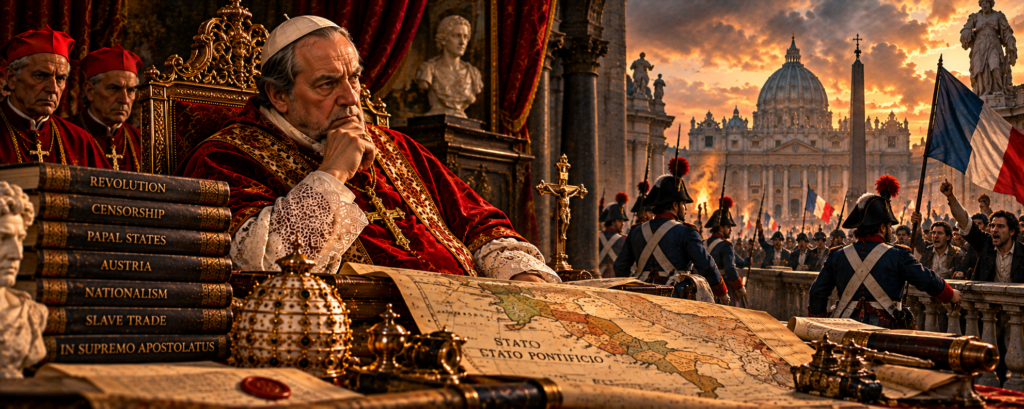
Gregory XVI: The Pope Who Tried to Hold Back the Revolution
Pope Gregory XVI (1765–1846) | Reigned 1831–1846
The Revolution Waiting Outside the Vatican
When Gregory XVI became pope in February 1831, revolution was already moving through his kingdom. Within days of his election, insurgents in the Papal States were challenging the government he had just inherited, demanding political change while papal officials struggled to keep control of cities that had begun slipping from their hands. The new pontiff had spent most of his life as a monk, theologian, and churchman, yet he suddenly found himself responsible for an unstable Italian state in an age of nationalism, secret societies, constitutional agitation, and armed revolt. Before he had enjoyed even a few peaceful weeks on the throne of St. Peter, he was confronting the possibility that the temporal government of the papacy might collapse around him.
Gregory’s response would define his reputation. He did not interpret liberal nationalism as an irresistible political development that the Church needed to accommodate, but as part of a revolutionary ideology capable of destroying legitimate authority, undermining religion, and repeating the horrors Europe associated with the French Revolution. His government resisted representative institutions, restricted political expression, maintained censorship, and pursued opponents whom officials considered revolutionary conspirators. When papal forces proved unable to restore order by themselves, Austrian soldiers entered the Papal States and helped preserve the government.
To Gregory and his defenders, these policies protected society from revolution. To his liberal and nationalist opponents, they turned the Papal States into one of Europe’s most notorious symbols of reactionary government. Both interpretations emerged from genuine features of his reign, because revolutionary movements of the period could involve violence and conspiracy while the papal response could involve repression, censorship, arrests, and dependence upon foreign military intervention. The struggle was never simply between innocent reformers and irrational tyrants, but Gregory’s refusal to accept meaningful political liberalization ensured that moderate dissatisfaction and revolutionary opposition increasingly became entangled.
His pontificate contained other contradictions that make him difficult to reduce to a caricature. Gregory supported missionary activity, scholarship, museums, and certain technological and administrative improvements, while rejecting political philosophies he believed threatened Christian civilization. In 1839 he issued In supremo apostolatus, condemning participation in the slave trade and criticizing the enslavement of Indigenous peoples and others, although historians have debated the precise scope of its language and its implications for existing systems of slavery. The pope who became famous for resisting liberalism was therefore capable of condemning one of the most brutal forms of human exploitation while defending a political order increasingly attacked as archaic.
Gregory XVI belongs in the Wicked Popes category for reasons very different from Alexander VI, Benedict IX, or the scandalous pontiffs of Renaissance Rome. There were no notorious mistresses governing his court, no acknowledged children transformed into princes, and no credible story of a pope using murder to build a family dynasty. His darkness lies instead in government: in his determination to preserve papal temporal sovereignty against political movements that he believed threatened religion itself, and in the repressive machinery used to defend that sovereignty. His story asks a more uncomfortable question than tales of personal depravity usually do—what happens when a ruler becomes convinced that resisting political change is not merely prudent, but a sacred duty?
Bartolomeo Cappellari: The Monk Before the Monarch
The future Gregory XVI was born Bartolomeo Alberto Cappellari on September 18, 1765, in Belluno, a town within the territories of the Republic of Venice. His family occupied a respectable social position, but Cappellari was not born into one of the great Roman dynasties that had traditionally supplied the Church with cardinals and popes. His path toward power would come through religious life, scholarship, and ecclesiastical advancement rather than inherited political influence. That background distinguished him from many earlier occupants of the papal throne.
At eighteen, Cappellari entered the Camaldolese branch of the Benedictine tradition and eventually took the religious name Mauro. Monastic life shaped his intellectual development and his understanding of authority, obedience, and the Church. He became known as a capable theologian and scholar, and his career unfolded during one of the most traumatic periods in modern Catholic history. The French Revolution and the Napoleonic wars were not distant events to his generation of churchmen; they were catastrophes that seemed to demonstrate what could happen when traditional religious and political authority collapsed.
The experiences of the papacy during those years were particularly dramatic. Pius VI had been driven from Rome and died a prisoner in France in 1799, while his successor Pius VII endured repeated conflicts with Napoleon and was himself imprisoned. Religious houses were suppressed, church property confiscated, and ancient institutions reorganized by revolutionary and Napoleonic governments. For conservative Catholic thinkers such as Cappellari, these events provided a terrifying example of where radical political theories might lead.
Cappellari’s theological writing reflected this environment. In 1799, he published Il trionfo della Santa Sede e della Chiesa contro gli assalti dei novatori, generally translated as The Triumph of the Holy See and the Church Against the Attacks of the Innovators. The work defended papal authority at precisely the moment when the temporal position of the papacy appeared shattered. Its arguments demonstrated a conviction that the Church possessed a divinely established structure that should not be surrendered to the political theories of the age.
This was not merely abstract theology. Cappellari belonged to a generation that had watched governments confiscate monasteries, imprison popes, and attempt to reorganize religious institutions from above. The connection he drew between political revolution and religious danger therefore emerged from lived historical experience. Later critics could reasonably regard his conclusions as excessively rigid, but they were not inexplicable.
After the restoration of papal government following Napoleon’s defeat, Cappellari’s career advanced steadily. He became increasingly important within the Roman Curia and eventually served as prefect of the Congregation for the Propagation of the Faith, commonly known as Propaganda Fide. That office placed him at the center of the Catholic Church’s global missionary activities. It also gave him experience dealing with religious questions extending far beyond the boundaries of the Papal States.
Pope Leo XII created Cappellari a cardinal in 1825. By then he had developed a reputation as a defender of papal authority and theological orthodoxy. He was not primarily known as a political administrator or economic reformer. His intellectual instincts remained those of a churchman who viewed the defense of religious authority as his central responsibility.
Those instincts would matter enormously after his election. Gregory XVI did not enter office as a cynical politician pretending to fear revolution in order to preserve his privileges. He genuinely believed that revolutionary liberalism could endanger both society and the Church. That conviction made his resistance more understandable, but it also made compromise far more difficult.
A Conclave While Europe Was Burning
Pope Pius VIII died on November 30, 1830, after a pontificate lasting less than two years. The conclave that followed unfolded against a backdrop of extraordinary political instability. The July Revolution had recently overthrown Charles X of France and replaced the Bourbon king with Louis-Philippe. Belgium was breaking away from the United Kingdom of the Netherlands, while unrest spread through parts of Italy and central Europe.
The cardinals gathering in Rome therefore understood that they were choosing more than a spiritual leader. The pope was also sovereign of the Papal States, a territory stretching across central Italy whose political stability was increasingly uncertain. Secret societies such as the Carbonari had attracted men committed to constitutional government, nationalism, or resistance to existing regimes. The question of Italian political unity, still far from resolved, was becoming impossible to ignore.
The conclave lasted for weeks as different factions struggled to agree upon a candidate. European governments maintained strong interests in papal elections, and the cardinals themselves differed over the qualities needed in the next pontiff. Eventually, on February 2, 1831, Cappellari was elected and chose the name Gregory XVI. He was sixty-five years old and had never been a diocesan bishop.
His election placed a monk and theologian at the head of a state already moving toward rebellion. The timing could scarcely have been more difficult. News traveled more slowly than modern readers are accustomed to, but political agitation was spreading rapidly through northern and central Italy. The new pope had barely assumed his office when revolution erupted within his territories.
Gregory’s previous experiences predisposed him to interpret the uprising through the memory of the revolutionary era. To him, demands for political reform could not easily be separated from the ideological currents that had produced anti-clericalism, confiscations, and attacks upon the papacy during the previous generation. He saw a dangerous continuity between revolutionary philosophy and political rebellion. His opponents, meanwhile, increasingly saw the papal government as an obstacle to Italy’s future.
Neither side possessed the benefit of knowing how the nineteenth century would unfold. Italian unification was not inevitable in 1831, and constitutional government had not yet become the uncontested standard of European legitimacy. Conservative monarchies remained powerful, and the settlement created after Napoleon’s defeat still shaped continental politics. Gregory’s policies therefore belonged to a broader European conservative order rather than representing an isolated papal eccentricity.
Nevertheless, the Papal States presented special problems. They were governed by an ecclesiastical hierarchy whose senior offices were dominated by clergy, creating resentment among lay elites who sought greater participation. Administrative inefficiency and regional grievances added to political dissatisfaction. Demands for reform could therefore emerge from practical concerns as well as revolutionary ideology.
Gregory inherited all of these tensions at once. His reaction would reveal the limits of a government attempting to preserve eighteenth-century assumptions in a nineteenth-century political environment. Before his coronation celebrations had faded, the test had begun.
The Revolt of 1831
The uprising spread through the northern Papal Legations, including Bologna, shortly after Gregory’s election. Revolutionaries challenged papal officials and established provisional governments in areas where the existing authorities lost control. The movement became associated with demands for political reform and greater independence from clerical administration. Some participants also connected their cause with the broader project of Italian nationalism.
Bologna was particularly important because it was one of the largest and most politically active cities under papal rule. Its elites possessed traditions of local government and often resented centralized control from Rome. When revolutionary movements spread through the region, papal authority weakened with alarming speed. Other cities followed, creating the possibility of a broader collapse.
The insurgents attempted to coordinate their movement, and a provisional political structure emerged. Their objectives were not always identical, because nineteenth-century Italian opposition included moderates seeking constitutional reforms, republicans demanding more fundamental change, and nationalists imagining some form of Italian unity. These differences would repeatedly weaken revolutionary movements throughout the period. Nevertheless, they shared opposition to the existing political arrangements.
Gregory’s government regarded the rebellion as illegitimate and dangerous. From the papal perspective, insurgents had not merely requested administrative improvements but had rejected lawful authority and seized control of territory. Officials feared that successful revolt would encourage further uprisings and eventually destroy the Papal States. The memory of revolutionary France made such fears particularly intense.
The papal government initially lacked sufficient military power to suppress the revolt quickly. Its armed forces were relatively weak and not designed for a major internal conflict. Gregory therefore turned toward Austria, the dominant conservative military power in northern Italy. Austrian intervention would save his government, but at a serious political cost.
Austrian troops entered the rebellious territories and restored papal authority during 1831. The intervention demonstrated that Gregory’s temporal government could survive when supported by foreign military strength. It simultaneously provided his opponents with powerful evidence that papal rule depended upon outside bayonets. For Italian nationalists, Austrian involvement made opposition to the pope increasingly difficult to separate from opposition to foreign domination.
The revolt had been defeated, but the political problem had not been solved. Military occupation could restore officials to their offices and dismantle revolutionary governments. It could not eliminate the grievances that had produced rebellion. Gregory now faced the question that would haunt his entire reign: whether to respond to unrest through substantial reform or through tighter control.
His instincts favored control. The result would be fifteen years of uneasy government in which rebellion never entirely disappeared beneath the surface. The pope had won the first confrontation, but his victory ensured that many of his subjects would increasingly view reform and papal sovereignty as incompatible.
Austrian Bayonets and Papal Sovereignty
The dependence upon Austria created an obvious contradiction for a government claiming sovereign authority. Gregory insisted upon the legitimate independence of the Papal States, yet his government had required soldiers of the Austrian Empire to restore control over its own provinces. The arrangement was understandable from the perspective of immediate survival. Politically, however, it gave Italian nationalists an enduring grievance.
Austria had emerged from the Napoleonic wars as the dominant power in much of Italy. It directly controlled Lombardy-Venetia and exercised enormous influence over several other Italian states. Chancellor Klemens von Metternich regarded revolutionary nationalism and constitutional liberalism as threats to European stability. His government therefore had strong reasons to prevent successful revolutions in the Papal States.
Gregory and Metternich did not need to agree on every question for their interests to overlap. Both feared revolutionary movements capable of destabilizing the Italian peninsula. Austria wanted to preserve the political settlement that protected its influence, while Gregory wanted to preserve the temporal sovereignty of the papacy. Cooperation followed naturally from those shared concerns.
To the revolutionaries, however, Austrian intervention appeared to confirm the worst accusations against papal government. The pope was an Italian ruler relying upon a foreign empire to suppress Italians demanding political change. As nationalist sentiment grew, this association became increasingly damaging. The spiritual head of the Catholic Church risked being identified with one of the principal obstacles to Italian independence.
The situation also complicated the Church’s broader position. Catholicism was deeply rooted throughout Italy, and many nationalists remained religious believers. Opposition to papal temporal government did not automatically imply rejection of Catholic faith. Yet Gregory’s determination to defend both spiritual authority and territorial sovereignty often encouraged his government to treat political opposition as though it threatened the entire Catholic order.
This conflation created long-term problems. A person could believe that the pope possessed legitimate spiritual authority while also believing that the Papal States required constitutional reform. Gregory’s political system offered limited room for such distinctions. Opposition therefore risked being pushed toward more radical forms.
Austrian intervention solved the immediate military crisis but deepened the ideological one. The government remained in power, but its survival increasingly appeared dependent upon a conservative international order that nationalists wanted to overthrow. Each foreign soldier restoring papal authority could become evidence for the argument that papal temporal rule lacked sufficient domestic support.
Gregory accepted that cost because he considered revolution the greater danger. His choice was consistent with his worldview and with the political assumptions of many contemporary conservative rulers. Yet the consequences would extend beyond his lifetime. The association between papal government and Austrian military power became one of the forces shaping the revolutionary upheavals of 1848 and the later struggle over Italian unification.
France Enters the Game
Austria was not the only foreign power interested in the Papal States. France watched Austrian intervention with suspicion because an expanded Austrian military presence in central Italy threatened the European balance of power. The government of Louis-Philippe had its own reasons for limiting Vienna’s influence. What followed demonstrated how thoroughly Gregory’s territories had become entangled in international rivalry.
In 1832, Austrian troops again intervened after renewed disturbances. France responded by occupying Ancona, a major Adriatic port within the Papal States. French forces entered the city in February, creating an extraordinary situation in which two foreign powers maintained military presences inside papal territory. Gregory protested the French action, which had occurred without his approval.
The occupation of Ancona continued for years. France presented its presence as a counterweight to Austria rather than an attempt to destroy papal sovereignty. Nevertheless, the spectacle was humiliating for the pope. His state had become an arena in which European powers balanced one another through military occupation.
The situation exposed the weakness of papal temporal rule more clearly than any theological controversy could. Gregory might condemn revolutionary theories and insist upon the legitimate sovereignty of the Holy See, but his government lacked the military strength to prevent powerful neighbors from entering its territory. Independence existed partly because the European powers preferred preserving the Papal States to allowing a rival to dominate them.
The foreign occupations eventually ended in 1838, when Austrian and French forces withdrew. Gregory’s government survived, and no revolutionary movement had succeeded in overthrowing it. Yet the underlying weakness remained. Papal authority depended heavily upon a European diplomatic system that could not be assumed to last forever.
For critics, the episode strengthened the image of the Papal States as politically backward and artificially preserved. For Gregory, it demonstrated the dangers of instability and the need to resist movements capable of inviting foreign intervention. Once again, the same events produced opposite lessons depending upon one’s assumptions. The pope concluded that revolution endangered independence, while nationalists concluded that papal rule itself invited foreign domination.
The cycle was becoming difficult to escape. Repression encouraged opposition, opposition encouraged instability, instability invited foreign intervention, and foreign intervention strengthened nationalist resentment. Gregory’s government repeatedly responded to the consequences of this cycle without fundamentally changing the political structure that helped sustain it. The Papal States survived, but survival was increasingly confused with successful government.
Governing Through Fear of Revolution
Gregory’s political philosophy cannot be understood without recognizing how deeply he feared revolutionary disorder. He had lived through the upheavals of the French Revolution and Napoleonic occupation, and he regarded those experiences as warnings rather than as unfortunate excesses accompanying otherwise desirable reforms. Revolutionary ideology appeared to him capable of destroying religion, monarchy, property, and social order together. Preventing another catastrophe therefore seemed more important than experimenting with political liberalization.
This outlook shaped the administration of the Papal States. Political associations considered subversive were restricted, revolutionary networks were investigated, and suspected conspirators could face arrest or imprisonment. Censorship attempted to prevent the circulation of publications deemed dangerous to religion or government. Police surveillance became part of the broader effort to contain political opposition.
Such practices were not unique to the Papal States. Austria, Russia, several German states, and other European governments also employed censorship and political policing during the Restoration era. Fear of revolutionary conspiracy shaped conservative policy across the continent. Gregory’s government belonged to that broader system.
Nevertheless, the clerical character of papal rule gave repression a distinctive quality. Political authority was exercised in the name of a government whose sovereign was also the supreme spiritual leader of Catholicism. Opposition could therefore acquire religious implications that did not exist in an ordinary monarchy. Critics accused churchmen of using spiritual authority to defend political privilege.
The problem became especially serious when moderate reformers were treated with suspicion similar to that directed at revolutionaries. Not everyone seeking administrative modernization wanted to overthrow the papacy. Some hoped to strengthen the government by expanding lay participation, improving institutions, and addressing economic grievances. A political system unwilling to distinguish sufficiently between reform and revolution risked radicalizing people who might otherwise have remained loyal.
Gregory did permit administrative changes in certain areas, and his reign should not be portrayed as fifteen years of absolute institutional paralysis. Yet political reform remained tightly constrained because he feared that concessions would encourage further demands. The revolutionary experiences of France seemed to provide a cautionary example: reforms begun under a monarchy had eventually contributed to the monarchy’s destruction. Gregory saw little reason to repeat that experiment.
His opponents saw exactly the opposite lesson. They believed that refusal to reform made revolution more likely because peaceful political participation remained limited. The more the government resisted moderate change, the more attractive underground movements could become. Political repression therefore risked producing the instability it was intended to prevent.
This conflict of interpretation became one of the central tragedies of Gregory’s reign. He believed he was defending society against catastrophe. Many of his subjects increasingly believed his defense of society was itself preventing a more stable future. Between those positions stood prisons, censorship offices, police investigations, conspiracies, and recurring unrest.
The Memorandum of the Great Powers
After the upheavals of 1831, representatives of major European powers recognized that simply restoring papal authority would not resolve the underlying instability. Austria, France, Britain, Prussia, and Russia participated in diplomatic discussions concerning reforms within the Papal States. In May 1831, their representatives produced a memorandum recommending administrative changes. The intervention was remarkable because foreign governments were effectively advising the pope on how to govern his own territory.
Among the recommendations were proposals for greater lay participation in administration, improvements to judicial institutions, and reforms intended to address grievances contributing to unrest. The diplomats did not demand the abolition of papal sovereignty. Their goal was to strengthen stability by making the government more effective and acceptable to its subjects. Even conservative powers recognized that military suppression alone offered no permanent solution.
Gregory’s government implemented some changes, but reform proceeded cautiously and incompletely. The pope remained suspicious of measures that might weaken clerical authority or create representative institutions capable of challenging the sovereignty of the Holy See. Administrative modernization was acceptable only when it did not become a pathway toward constitutional government. This distinction sharply limited what could be achieved.
Foreign diplomats became frustrated by the slow pace of change. Critics argued that the papal administration failed to address the causes of political discontent. Supporters of Gregory could respond that foreign powers had no right to dictate the internal organization of an independent state. The issue therefore involved sovereignty as well as reform.
The situation placed Gregory in another contradiction. He depended upon Austria to suppress rebellion but resisted European pressure when the same international system urged administrative change. Foreign intervention was welcome when it preserved papal sovereignty but objectionable when it attempted to reshape papal government. From Gregory’s perspective, however, military assistance against rebels and interference in the constitutional structure of his state were fundamentally different matters.
The limited reform program failed to reconcile many opponents. Lay elites continued complaining about clerical dominance, while nationalist movements remained hostile to Austrian influence. Economic difficulties added to dissatisfaction. The government’s reputation for stagnation hardened.
Modern portrayals sometimes exaggerate the Papal States as though nothing changed whatsoever under Gregory. Roads, ports, administrative practices, museums, and certain economic institutions did develop during his reign. The problem was that these improvements did not address the central political question confronting his government. Modernization without meaningful political participation could not satisfy those who wanted a fundamentally different relationship between ruler and ruled.
The memorandum episode therefore became another missed opportunity in the eyes of Gregory’s critics. Whether more ambitious reforms could actually have preserved papal temporal sovereignty is impossible to know. What is clear is that Gregory chose caution over political experimentation. The decision bought time, but it did not resolve the crisis waiting for his successor.
Censorship and the Dangerous Printed Word
Gregory understood that revolutions were fought with ideas long before they were fought with weapons. Newspapers, pamphlets, books, and clandestine publications could spread political arguments across borders and connect dissatisfied individuals who might otherwise remain isolated. The revolutionary movements of the previous decades had demonstrated the power of print. His government therefore regarded censorship as a necessary instrument of political and religious defense.
Publications considered hostile to Catholic teaching or papal authority faced restrictions. The Church already possessed a long tradition of regulating books through mechanisms including the Index of Forbidden Books, while secular administration added political concerns to theological ones. Liberal political theory, nationalist agitation, anti-clerical literature, and revolutionary propaganda all attracted scrutiny. Printers and booksellers operated within a system that limited the free circulation of ideas.
To modern readers, such restrictions naturally appear deeply repressive. Freedom of expression had become an important demand of nineteenth-century liberal movements precisely because governments across Europe controlled publication. Gregory rejected the assumption that unrestricted expression was inherently beneficial. He believed that governments and church authorities possessed a duty to prevent dangerous error from damaging society.
His position was expressed particularly forcefully in the 1832 encyclical Mirari vos. The document condemned religious indifferentism and attacked ideas associated with unrestricted liberty of conscience and the press. Gregory feared that treating all religious claims as equally legitimate would undermine the truth claims of Catholicism. He likewise rejected the idea that every publication should circulate without restraint regardless of its effects.
The encyclical must be read within the theological and political vocabulary of its time, but its implications were unmistakably hostile to major elements of liberal thought. Gregory saw certain modern liberties not as neutral protections but as pathways through which error and social disorder could spread. His critics interpreted this position as proof that the papacy had become an enemy of intellectual and political freedom. The conflict widened the gulf between Rome and liberal Catholic thinkers who hoped to reconcile their faith with constitutional society.
One of the most important figures caught in this struggle was the French priest and thinker Félicité de Lamennais. Lamennais had once been an ardent defender of papal authority but increasingly embraced ideas involving freedom of conscience, press liberty, and political reform. His newspaper L’Avenir promoted a vision of Catholicism separated from dependence upon conservative monarchy. Gregory regarded aspects of this program as unacceptable.
Mirari vos did not name Lamennais directly, but it effectively rejected central principles associated with his movement. Lamennais eventually broke dramatically with the Church after further condemnation of his writings. The episode demonstrated the difficulty faced by Catholics who hoped to embrace liberal political institutions while remaining loyal to Rome. Gregory’s response helped establish a confrontation between papal authority and liberal Catholicism that would echo throughout the nineteenth century.
Censorship could slow the circulation of ideas, but it could not make those ideas disappear. Books crossed borders, secret societies communicated, and political arguments circulated through private networks. Every effort to suppress liberalism could also strengthen its identity as a forbidden alternative to clerical government. Gregory’s battle against the printed word therefore became another war he could contain without truly winning.
Mirari Vos: When Liberalism Became a Religious Threat
Published on August 15, 1832, Mirari vos became one of the defining documents of Gregory XVI’s pontificate. The encyclical addressed a range of religious and political concerns that the pope believed threatened Catholic society. It condemned religious indifferentism, warned against challenges to ecclesiastical discipline, and criticized expansive claims regarding freedom of conscience and publication. The document reflected Gregory’s conviction that the Church was confronting an interconnected ideological assault.
To understand its severity, it is important to remember what Gregory associated with revolutionary liberty. He did not encounter the concept merely through philosophical treatises discussing individual rights. His generation had watched the French Revolution produce dechristianization campaigns, the confiscation of church property, persecution of clergy, and political violence. When liberal writers demanded freedoms that had been invoked during revolutionary upheavals, Gregory remembered the consequences rather than only the principles.
This historical memory helps explain his position without making every conclusion defensible. The fact that some revolutions became violent did not mean that constitutional government, freedom of the press, or religious liberty inevitably produced terror. Liberalism itself encompassed a wide spectrum of ideas and movements. Gregory’s tendency to treat many of them as part of a common revolutionary danger prevented him from recognizing distinctions that would later become increasingly important.
The encyclical also reflected the Church’s concern about religious indifferentism, the idea that differences between religions were ultimately insignificant. Gregory insisted that Catholic truth could not be reduced to one equally valid opinion among many. That theological concern was distinct from the political question of whether governments should legally tolerate religious diversity. Yet the two issues often became intertwined.
For liberal Catholics, this presented a serious dilemma. They could argue that legal freedom did not require theological relativism and that the Church could flourish without state coercion. Gregory remained deeply suspicious of such reasoning. He feared that political liberalism would eventually reshape religious belief itself.
His opposition contributed to an image of the papacy as the ideological headquarters of European reaction. Protestant critics, secular liberals, and Italian nationalists could all point toward Gregory’s writings as evidence that Rome opposed modern liberty. The pope’s defenders countered that liberal governments were hardly innocent of coercion and that revolutionary movements frequently persecuted the Church. Both observations could be true simultaneously.
The political consequences were significant because Gregory transformed his resistance into an explicit intellectual position. He was not merely an elderly ruler reluctantly suppressing occasional revolts. He articulated a broader critique of the philosophical assumptions behind liberal political culture. His pontificate therefore became part of the ideological battle over Europe’s future.
That battle would continue long after his death. Later popes would refine, intensify, or eventually reconsider aspects of the Church’s relationship with modern political liberty. Gregory stood near the beginning of that long confrontation. His response was shaped by fear, theology, historical memory, and a conviction that compromise with error could be more dangerous than political isolation.
The Carbonari and the Underground Italy
The Papal States existed within a peninsula filled with secret political networks. The Carbonari had become among the best-known clandestine organizations associated with opposition to Restoration governments. Their exact aims and organization varied across regions and periods, making it misleading to imagine a single perfectly coordinated revolutionary conspiracy. Nevertheless, governments regarded them as a serious threat.
Secret societies flourished partly because open political organization was restricted. Men unable to advocate constitutional reform publicly could gather clandestinely, exchange forbidden literature, and plan resistance. Oaths, rituals, coded communications, and hidden networks gave these movements an atmosphere that terrified conservative governments. The secrecy also made it difficult for authorities to distinguish genuine conspirators from sympathizers or people merely suspected of involvement.
Papal police attempted to identify and disrupt such networks. Informants, surveillance, arrests, and interrogations formed part of the government’s response. Political prisoners became symbols of resistance, while exiles carried stories of papal repression beyond the borders of the state. Every prosecution risked creating new martyrs for the nationalist cause.
Some conspirators genuinely contemplated or participated in armed rebellion. The threat was therefore not imaginary. Governments across Italy had experienced revolts, assassination plots, and attempts to overthrow existing regimes. Gregory’s officials had legitimate reasons to investigate organizations committed to revolutionary action.
The problem lay in the breadth of suspicion. When governments operate in fear of conspiracy, political policing can expand beyond individuals preparing violence to encompass critics, writers, reformers, and associates whose intentions are less dangerous. Secret proceedings make abuses harder to detect. The result can be a political environment in which fear circulates on both sides.
This atmosphere contributed to the dark reputation of Gregory’s Papal States. Liberal accounts described prisons filled with patriots suffering under clerical tyranny. Conservative accounts portrayed revolutionaries as dangerous conspirators attempting to unleash chaos. Each side produced propaganda, and individual stories sometimes became exaggerated in retelling.
The underlying conflict, however, was real enough. Italy contained growing numbers of people who no longer accepted the existing political map or the governments that maintained it. Gregory’s state sat across the geographical center of the peninsula, making papal temporal sovereignty a central obstacle to certain visions of national unification. Political repression could not eliminate that geographical reality.
The underground Italy of Gregory’s reign would eventually emerge into open revolution. Many of the movements suppressed during the 1830s and 1840s contributed ideas, networks, and personalities to the Risorgimento. Gregory succeeded in preventing them from overthrowing his government during his lifetime. He did not prevent them from shaping the future.
Giuseppe Mazzini and the Dream of a United Italy
Among the most influential nationalist thinkers of Gregory’s age was Giuseppe Mazzini. Born in Genoa in 1805, Mazzini developed a vision of Italy as a unified republican nation rather than a collection of kingdoms, duchies, and papal territories. His organization Young Italy sought to inspire national insurrection and political transformation. To conservative governments, his movement represented precisely the revolutionary danger they feared.
Mazzini’s nationalism possessed an almost religious intensity. He imagined nations as instruments through which humanity could progress, and he believed Italians had a moral duty to create political unity. His ideas attracted young activists frustrated by foreign domination and fragmented government. The Papal States inevitably became part of the national question because they physically divided northern and southern Italy.
Gregory could not accept Mazzini’s program without accepting the destruction of his own temporal sovereignty. A unified republican Italy had little room for an independent papal state extending across the center of the peninsula. The conflict was therefore structural rather than merely personal. Nationalism threatened the political existence of the government Gregory had sworn to preserve.
Mazzinian insurrections frequently failed during Gregory’s lifetime. Revolutionary organizers struggled with limited resources, government surveillance, poor coordination, and insufficient popular support. Their defeats allowed conservative rulers to dismiss them as dangerous conspirators incapable of creating stable government. Yet repeated failure did not destroy the nationalist idea.
The papal government’s repression of nationalist activity could temporarily prevent insurrection. It could not answer the emotional appeal of Italian unity. Younger generations increasingly asked why the peninsula should remain divided among governments protected by foreign powers. The presence of Austrian soldiers made that question especially powerful.
Catholicism complicated the nationalist movement because many Italians remained deeply religious. Some thinkers imagined that the pope might eventually play a leading role in a federation or national revival. Such hopes would become especially important during the opening years of Pius IX’s pontificate. Gregory’s unwavering conservatism offered little encouragement to these possibilities.
His refusal may have been politically rational from the standpoint of preserving the Papal States. Supporting nationalism would have unleashed forces impossible to control and could have destroyed the pope’s territorial independence. Yet resisting nationalism also ensured that the papacy increasingly appeared on the wrong side of a movement gaining emotional and political strength. The dilemma had no easy solution.
Gregory chose institutional survival over nationalist experimentation. During his lifetime, the choice succeeded in the narrowest possible sense: the Papal States remained intact. Within a quarter-century of his death, most of their territory would be absorbed into the Kingdom of Italy. The revolution he had spent fifteen years suppressing had merely outlived him.
The Myth of the Pope Who Hated Railways
Few stories about Gregory XVI have been repeated more often than the claim that he opposed railways with the dismissive phrase chemins de fer, chemins d’enfer—roughly, “roads of iron, roads of hell.” It is a memorable story because it perfectly fits the popular image of a reactionary pope terrified by modern technology. The problem is that the famous phrase is not securely documented as something Gregory actually said. It belongs more comfortably to the folklore surrounding his reputation than to established historical fact.
Gregory did not introduce railways into the Papal States during his reign, and his government was cautious about railway proposals. That caution contributed to the later image of a pope who wanted to keep steam engines away from Rome. Yet hesitation over rail development could involve financial, political, and strategic concerns as well as technological hostility. Railway construction required enormous capital and could increase foreign influence over infrastructure.
The broader accusation of technological stagnation also requires qualification. Gregory’s government did not reject every modern innovation. His reign witnessed developments involving steam navigation, roads, industrial activity, scientific institutions, and other practical improvements. The Papal States were not sealed inside a medieval world untouched by nineteenth-century technology.
Nevertheless, they lagged behind some more rapidly developing parts of Europe. Administrative weaknesses, limited capital, and political caution hindered modernization. Gregory’s suspicion of developments that might carry political consequences could reinforce economic conservatism. His government therefore acquired a reputation for resisting modernity that was not entirely invented, even if particular anecdotes were.
The railway legend is historically useful precisely because it reveals how reputations are constructed. Critics took genuine features of Gregory’s conservative government and condensed them into a witty line that made him appear absurd. Once repeated often enough, the phrase began functioning as evidence of the very reputation that had produced it. The story became more famous than the uncertain evidence behind it.
Gregory deserves criticism for aspects of his political resistance without requiring fabricated quotations. His censorship, opposition to liberal political principles, and reliance upon Austrian intervention are documented. Those policies provide ample material for evaluating his government. Inventing technological superstitions only weakens the historical case.
The distinction matters especially in a darker historical narrative. Dramatic stories are tempting because they make historical figures easier to characterize. Yet Gregory’s actual choices are more interesting than a cartoon of a pope frightened by locomotives. He was not simply afraid of machines; he feared the social and political transformations that seemed to accompany the modern world.
That fear was far more consequential than any supposed hatred of railways. Steam engines could eventually be admitted into the Papal States by a successor. Political nationalism and constitutional liberalism posed challenges that could not be solved by approving a construction project. Gregory’s real battle was not against technology but against the political future arriving alongside it.
A Pope Who Loved Scholarship and Ancient Civilizations
Gregory’s reputation as a reactionary ruler can obscure another side of his personality. He possessed serious scholarly interests and supported the expansion of Vatican collections devoted to cultures far removed from nineteenth-century European politics. During his reign, important museums and collections were reorganized or established. His patronage reflected intellectual curiosity as well as the Church’s global interests.
The Museo Gregoriano Etrusco was founded in 1837 to house important Etruscan discoveries. Archaeological excavations had produced objects illuminating civilizations that flourished in Italy before Roman domination. Collecting and studying these materials contributed to the rapidly developing field of archaeology. The Vatican became an important center for preserving them.
Gregory also established the Museo Gregoriano Egizio in 1839. European fascination with ancient Egypt had intensified following Napoleon’s Egyptian campaign and the subsequent growth of Egyptology. The Vatican possessed Egyptian and Egyptianizing objects that could now be presented within a more systematic collection. Once again, the supposedly anti-modern pope supported an institution devoted to historical scholarship.
His background in Propaganda Fide also gave him a global perspective unusual among secular Italian rulers. Catholic missions operated across Asia, Africa, the Americas, and Oceania. Reports, languages, cultures, and political circumstances from distant regions reached Roman officials. Gregory’s Church was intellectually conservative in some respects while simultaneously functioning through a worldwide network.
This combination challenges simplistic assumptions about modernity. A person could reject liberal political philosophy while enthusiastically supporting archaeology, missionary scholarship, and scientific collection. Nineteenth-century conservatism did not necessarily mean opposition to every form of intellectual inquiry. Gregory distinguished between knowledge he considered beneficial and ideas he believed socially or religiously destructive.
The distinction does not erase the consequences of censorship. Scholars and writers whose work crossed theological or political boundaries could still face restrictions. Intellectual curiosity existed within limits determined by ecclesiastical authority. The Vatican museum could expand while political newspapers remained controlled.
Gregory’s cultural patronage nevertheless deserves recognition because it complicates the portrait. He was not an ignorant recluse incapable of appreciating learning. He belonged to an old tradition of scholarly churchmen who considered knowledge valuable when ordered toward what they regarded as truth. His conflict with modernity concerned authority and ideology more than education itself.
This contradiction is one reason Gregory makes such an interesting historical figure. The same pope who condemned aspects of liberal thought could open museums dedicated to civilizations thousands of years old. The ruler accused of imprisoning his state in the past was actively preserving and studying the distant past through modern archaeological institutions. History rarely provides villains simple enough to remain inside the caricatures created by their enemies.
The Slave Trade and In Supremo Apostolatus
One of the most important documents of Gregory’s pontificate appeared on December 3, 1839. In the apostolic letter In supremo apostolatus, the pope condemned participation in the slave trade and invoked earlier papal statements opposing the enslavement of Indigenous peoples and others. He urged Catholics not to engage in the trade or defend it. The document complicates any attempt to portray Gregory simply as an opponent of every moral or social development associated with the nineteenth century.
The Atlantic slave trade had inflicted immense suffering over centuries, transporting millions of Africans through systems built upon kidnapping, violence, sale, forced labor, and hereditary enslavement. By Gregory’s reign, Britain had abolished its slave trade and was using diplomatic and naval pressure against continued trafficking, while slavery itself remained legal across significant parts of the Americas. International opposition to the trade had grown, but the institution remained powerful. A papal condemnation therefore carried moral significance.
Gregory’s language drew upon earlier Catholic condemnations of unjust enslavement and slave trading. He denounced those who reduced people to slavery, bought and sold them, or participated in the trade. The document rejected attempts to treat human beings as commodities. In that respect, it stands among the most morally important statements of his pontificate.
The historical interpretation of In supremo nevertheless requires care. Some nineteenth-century Catholics, particularly in the United States, interpreted the document narrowly as condemning the international slave trade rather than declaring the immediate illegitimacy of every existing slaveholding relationship. Historians continue examining the relationship between its wording, earlier papal teachings, and contemporary Catholic responses. It would therefore be inaccurate to claim simply that Gregory abolished slavery throughout the Catholic world or that every Catholic authority understood the document identically.
The reception of the letter reveals the limitations of papal influence. Catholic slaveholders did not suddenly free enslaved people because Rome had issued a condemnation of trafficking. Local bishops and theologians interpreted the text within political environments shaped by slavery. Moral teaching could be resisted, narrowed, or ignored when it threatened powerful economic interests.
Nevertheless, Gregory’s position matters. The pope frequently portrayed as the embodiment of reaction used his authority to condemn a system of human trafficking deeply entrenched in the Atlantic world. His opposition cannot be dismissed merely because it did not immediately destroy slavery. It demonstrates that political conservatism did not determine his position on every moral question.
The episode also prevents the Wicked Popes narrative from becoming dishonest. Gregory’s repressive political policies deserve examination, but historical figures must be allowed to possess virtues alongside failures. A pope capable of restricting political expression could also condemn the buying and selling of human beings. Those positions existed within the same man.
Indeed, the contradiction makes his pontificate more unsettling rather than less interesting. Gregory possessed a powerful moral vocabulary concerning human dignity in one context while defending a political system that denied many of his own subjects meaningful participation in government. He could recognize the evil of human trafficking without accepting the liberal political framework increasingly associated with individual rights. History is full of people whose moral vision expanded in one direction while remaining tightly constrained in another.
The Jews of the Papal States
Gregory XVI also governed Jewish communities living under a system of legal restrictions inherited from earlier centuries. Rome’s Jewish population remained associated with the ghetto established in the sixteenth century, and papal legislation continued to regulate where Jews could live, what occupations they could pursue, and aspects of their relationship with Christian society. These restrictions formed part of a confessional political order in which equal citizenship regardless of religion was not yet accepted. For Jewish residents, that order imposed real and persistent disadvantages.
The revolutionary and Napoleonic periods had temporarily disrupted some traditional restrictions in parts of Italy. Restoration governments subsequently reimposed elements of the older system. Gregory’s pontificate did not establish a modern regime of religious equality. His broader rejection of liberal political principles made such a transformation unlikely.
Anti-Jewish restrictions under papal government were not identical to the racial antisemitism that would develop with particular force later in the nineteenth and twentieth centuries. They emerged primarily from religious discrimination and the legal structures of a confessional state. That distinction is historically important, but it does not make the restrictions harmless. People experienced limitations upon residence, economic activity, civic status, and social freedom because they were Jewish.
Gregory’s government must therefore be evaluated within the darker history of papal treatment of religious minorities. The Church’s theological claims about religious truth became embedded in laws that denied equal civic status to those outside the dominant faith. Such policies reflected longstanding European practices, but longevity does not remove their human consequences. The preservation of tradition could itself perpetuate injustice.
The issue also exposes another contradiction in Gregory’s reign. His 1839 condemnation of slave trading invoked moral concern for people subjected to exploitation and dehumanization. Yet his government maintained discriminatory restrictions against a religious minority within its own territory. Moral insight was not applied uniformly across every category of human rights later generations would recognize.
It would be anachronistic to expect Gregory to possess a fully developed twenty-first-century conception of religious equality. It would be equally misleading to pretend that contemporaries had no alternative ideas available. Liberal thinkers were already arguing for civil equality, and revolutionary governments had challenged older confessional restrictions. Gregory consciously resisted much of that political philosophy.
For Jewish residents of Rome and other papal territories, the consequences were not theoretical. They lived within laws shaped by the pope’s understanding of Christian society. The system survived because the government considered religious differentiation legitimate. It would take later political transformations to dismantle much of this structure.
This aspect of Gregory’s rule belongs within any serious examination of his darker legacy. The absence of spectacular personal scandal does not mean the absence of institutional injustice. A government can harm people through laws and inherited structures as effectively as through the personal cruelty of an individual ruler. Gregory’s commitment to preserving tradition included traditions whose burdens fell heavily upon minorities.
Bandits, Rebels, and the Violence of the Papal Countryside
Political unrest was not the only challenge confronting Gregory’s government. Parts of the Papal States had longstanding problems with brigandage, smuggling, local violence, and weak enforcement of central authority. Mountainous terrain and uneven administration could provide refuge for armed bands. Criminal violence therefore complicated the already unstable political environment.
Authorities responded with police operations, military patrols, arrests, and harsh criminal penalties. Maintaining public order was a legitimate responsibility, particularly when travelers and rural communities faced robbery or violence. Yet nineteenth-century criminal justice could be severe by modern standards. Capital punishment remained part of the legal system.
The Papal States possessed an executioner whose office later became particularly famous through Giovanni Battista Bugatti, commonly known as Mastro Titta. Bugatti served as official executioner from the late eighteenth century until 1864, spanning Gregory’s entire pontificate. His surviving records document numerous executions carried out under papal governments. The figure of the executioner became one of the darker symbols of nineteenth-century Rome.
Not every person executed during Gregory’s reign was a political dissident, and it would be misleading to describe ordinary murderers and violent criminals as victims of political repression. Capital punishment was widely used by European governments during this period. Nevertheless, executions formed part of the coercive authority through which papal law was maintained. Public punishment communicated the state’s power over life and death.
Political violence could blur categories further. Rebels might commit ordinary crimes, while governments could prosecute political opponents under laws concerning conspiracy or public order. The distinction between criminal justice and political repression therefore required careful attention to individual cases. Propaganda from both supporters and opponents of papal rule often simplified these distinctions.
Gregory did not personally supervise every arrest, prosecution, or execution conducted within his state. Like other sovereigns, he governed through officials, courts, police, and provincial administrators. Responsibility for the system nevertheless ultimately belonged to the government he headed. The pope’s commitment to preserving order shaped the environment in which coercive institutions operated.
The darker atmosphere of the Papal States came partly from this combination of ordinary criminal justice and political suspicion. Travelers could encounter magnificent churches and ancient ruins while hearing stories of bandits, prisons, executions, and secret conspiracies. Rome remained one of Europe’s great cultural capitals, but its government increasingly seemed disconnected from the political expectations developing elsewhere. Beauty and repression occupied the same landscape.
That contrast would later become central to romantic portrayals of nineteenth-century Italy. Foreign writers imagined a country of ruins, priests, revolutionaries, brigands, and ancient passions. Such images could be exaggerated, but they drew upon genuine tensions. Gregory ruled a state in which the past remained visibly magnificent while the future was becoming increasingly impatient.
The Clerical State and the Problem of Lay Government
One of the most persistent criticisms of the Papal States concerned the dominance of clergy within senior administration. Because the pope’s government developed from ecclesiastical institutions, cardinals and other churchmen occupied positions that elsewhere might have been held by secular ministers. This arrangement made sense within the historical development of papal sovereignty. By the nineteenth century, however, it increasingly appeared anomalous.
Educated laymen wanted greater access to political and administrative responsibility. They could serve the state in various capacities, but the highest levels remained closely associated with clerical authority. Critics argued that men trained primarily for ecclesiastical careers were not necessarily the best people to administer finances, infrastructure, commerce, or modern political institutions. The complaint was both practical and ideological.
Gregory feared that transferring substantial authority to lay political bodies could weaken the distinctive character of papal government. The Papal States existed partly to guarantee the independence of the pope as head of the Church. If secular representative institutions gained enough power, they might eventually challenge the sovereignty required to preserve that independence. Political reform therefore seemed capable of undermining the reason the state existed.
This concern was not entirely irrational. Later events would demonstrate that nationalist governments genuinely intended to absorb papal territory into a larger Italian state. Gregory’s fear that political liberalization might eventually threaten temporal sovereignty was therefore not imaginary. The difficulty was that refusing reform could also strengthen the nationalist movements seeking precisely that outcome.
Lay exclusion created resentment among people who might otherwise have supported the papacy. Administrative talent existed outside the clergy, and governments elsewhere were developing increasingly professional bureaucracies. The Papal States did undertake bureaucratic reforms, but the perception of clerical monopoly remained powerful. Political opposition could therefore present itself as a struggle against government by priests rather than against Catholicism itself.
This distinction mattered because many Italians remained practicing Catholics. Nationalists could oppose the temporal power of the pope without rejecting his spiritual authority. Gregory’s political theology made that separation difficult to accept. He feared that weakening temporal sovereignty would ultimately weaken the Church.
The debate would become even more intense under his successor. Pius IX initially experimented with reforms that generated enormous enthusiasm before the revolutions of 1848 transformed the political situation. The speed with which expectations expanded suggested that Gregory had correctly understood how difficult reform would be to control. It also suggested that years of repression had allowed demands to accumulate behind a political dam.
Gregory’s clerical state survived until his death because the European balance of power protected it and its opponents remained divided. Survival, however, should not be confused with resolution. The basic question of how the pope could govern a modern population while preserving absolute temporal sovereignty remained unanswered. Gregory left that problem to the future.
Another Insurrection: Rimini, 1845
As Gregory approached the end of his life, political unrest remained alive. In September 1845, revolutionaries launched an uprising at Rimini and attempted to spread revolt through the Romagna. The movement was poorly positioned to overthrow the government and was quickly defeated. Yet its existence demonstrated that fifteen years of conservative rule had not extinguished opposition.
The insurgents issued demands reflecting familiar grievances. They wanted reforms in administration and government, and their movement belonged to the broader political agitation spreading through Italy. The uprising did not represent the entire population of the Papal States, nor did it prove that Gregory’s government lacked all support. It did show that revolutionary networks remained capable of action.
Papal authorities suppressed the movement, and participants faced the consequences of failed rebellion. Some escaped into exile, while others were arrested or otherwise pursued. As with earlier revolts, the government’s victory restored immediate order. The political ideas motivating opposition survived.
By 1845, Gregory was nearly eighty years old. He had spent his entire pontificate confronting versions of the same crisis that greeted him in 1831. Rebels demanded change, the government suppressed them, foreign powers watched closely, and dissatisfaction resurfaced elsewhere. The repetition itself revealed the limitations of the strategy.
The broader Italian nationalist movement was also becoming more sophisticated. Writers, activists, and political thinkers proposed competing paths toward reform and unity. Some advocated republican revolution, while moderates considered federal arrangements or constitutional monarchies. The future of Italy remained uncertain, but the assumption that nothing should fundamentally change was becoming increasingly difficult to sustain.
Gregory remained committed to his principles. He had not survived the revolutions of his youth only to embrace political theories he associated with them in old age. From his perspective, consistency represented fidelity. From the perspective of his opponents, it represented obstinacy.
The Rimini uprising was therefore an ominous final warning. Gregory’s government could still suppress individual revolts, but the political environment surrounding the Papal States was moving toward another continental crisis. Within three years, revolutions would erupt across Europe. The papacy would be caught directly in the storm.
Gregory would not live to see it. His death in 1846 spared him from witnessing the Roman Republic of 1849, the flight of his successor from Rome, and another foreign military intervention restoring papal rule. Yet the conditions producing those events had developed throughout his reign. His victories over revolution proved temporary because the conflict itself remained unresolved.
Gregory’s Personal Life: The Scandals That Were Not There
A Wicked Popes article naturally invites the search for lurid personal scandal, but Gregory XVI provides remarkably little material of that kind. His enemies criticized his politics, administration, and associates, yet his private life did not produce the credible catalogue of sexual misconduct associated with some Renaissance pontiffs. He remained fundamentally shaped by his monastic identity. Attempts to transform him into a libertine would distort the historical evidence.
He was known for enjoying food and wine, and hostile caricatures sometimes emphasized his physical habits or portrayed him as indulgent. Such attacks were common weapons of nineteenth-century political satire. They reveal how opponents viewed him but should not automatically be treated as reliable evidence of serious moral corruption. Political caricature often exaggerates personal traits to symbolize broader accusations.
Gregory also possessed friendships and relied upon advisers whose influence could attract criticism. As in every court, access to the sovereign mattered. Yet his government was not dominated by a notorious papal mistress or a dynasty of acknowledged children. The traditional scandal of papal nepotism was also far less central to his reign than it had been under many earlier popes.
This absence is historically important because it shifts attention from personal morality to institutional power. Gregory’s controversial legacy does not depend upon what he did in private bedrooms or upon rumors whispered about his relatives. It depends upon documented policies affecting thousands of people. Censorship, political policing, resistance to representative government, and foreign military intervention require no sensational embellishment.
Indeed, focusing excessively upon private scandal would weaken the story. Gregory’s significance lies precisely in the possibility that a personally disciplined and sincerely religious man could preside over a government many contemporaries experienced as oppressive. Personal virtue does not automatically produce political wisdom. A ruler can believe himself morally responsible while enforcing policies that deepen resentment and suffering.
This distinction also separates Gregory from the easiest villains in papal history. Alexander VI can be approached through family ambition, sexual scandal, and Renaissance power politics. Urban VI can be examined through violence and paranoia within the Great Western Schism. Gregory XVI requires a more institutional form of historical judgment.
That makes him a particularly valuable subject for Wicked Popes. Darkness in history does not always arrive through grotesque individuals committing spectacular crimes. Sometimes it emerges from respectable officials enforcing systems they sincerely believe necessary. Gregory’s story is unsettling precisely because his harshest policies did not require personal depravity.
The monk who became pope appears to have remained convinced that he was defending something sacred. His opponents were equally convinced that he was obstructing the future of Italy. The tragedy of his reign developed in the space between those convictions. Neither requires invented scandal to become compelling.
Was Gregory Really Against Modernity?
Calling Gregory XVI an enemy of modernity is tempting but too broad. He opposed specific political and religious ideas associated with modern liberalism, particularly when they challenged papal authority or Catholic doctrine. He feared revolutionary nationalism, unrestricted political expression, and constitutional developments that might undermine the Papal States. Those positions undeniably placed him in conflict with major nineteenth-century political trends.
Yet modernity was not a single package that rulers either accepted or rejected. Gregory could support archaeology, museums, missionary scholarship, improved infrastructure, and certain technological developments while opposing representative government. Many contemporary monarchs pursued economic modernization without embracing political liberalism. The combination was not unique.
His resistance becomes clearer when understood as a defense of hierarchy rather than an irrational hatred of novelty. Gregory believed that legitimate authority originated within a divinely ordered social structure rather than from unrestricted popular sovereignty. Political systems that made authority dependent upon revolutionary movements or shifting public opinion appeared fundamentally unstable to him. The violence of the previous half-century seemed to confirm his fears.
The weakness in his reasoning was his tendency to treat too many different movements as parts of the same threat. Constitutional reform was not identical to Jacobin terror. Freedom of the press did not inevitably produce attacks upon churches. Italian nationalism could coexist with Catholic belief, even if its territorial ambitions threatened the Papal States.
By resisting these distinctions, Gregory helped turn moderate reformers into political opponents. People seeking administrative participation could find themselves treated as potential revolutionaries. Liberal Catholics discovered that attempts to reconcile constitutional liberty with faith attracted papal suspicion. Nationalists increasingly concluded that papal temporal government could not voluntarily adapt.
His government therefore became reactionary not because every policy rejected every innovation, but because its fundamental political objective was preservation. Change was acceptable when it strengthened existing authority. Change became dangerous when it redistributed authority. That distinction governed much of Gregory’s approach.
This strategy achieved short-term success. He remained pope and sovereign until his death, and no revolution permanently displaced him. The Papal States survived his fifteen-year reign intact enough to pass to his successor. From the narrow perspective of regime preservation, his policies worked.
From a longer perspective, however, preservation merely postponed the reckoning. The forces Gregory resisted grew stronger during the years he suppressed them. Nationalism, liberalism, and demands for lay participation did not disappear. They waited for another opportunity.
Death in Rome
By 1846, Gregory XVI was an elderly man whose health had begun deteriorating. He had ruled for fifteen turbulent years and had become one of Europe’s most recognizable conservative sovereigns. Political unrest continued beneath the surface of his territories, while expectations for change intensified. The government remained standing, but few informed observers could believe that the Italian political question had been permanently settled.
Gregory became seriously ill in late May 1846. His condition worsened rapidly, and he died on June 1 at the age of eighty. His death ended a pontificate that had begun amid revolution and concluded with revolutionary pressures still unresolved. He had successfully prevented the political transformation he feared from occurring during his own lifetime.
The conclave that followed elected Giovanni Maria Mastai-Ferretti, who became Pius IX. The contrast initially appeared dramatic. Pius IX introduced reforms, granted an amnesty to political prisoners, and inspired extraordinary enthusiasm among Italian moderates and nationalists who imagined that a pope might lead political renewal. Crowds celebrated a future Gregory had spent his reign trying to prevent.
Yet events soon became far more complicated. The revolutions of 1848 spread across Europe, war erupted in Italy, and political pressures upon Pius IX escalated. His prime minister Pellegrino Rossi was assassinated in November 1848, and the pope fled Rome for Gaeta. In 1849, revolutionaries proclaimed a Roman Republic.
French troops eventually restored Pius IX to Rome. The experience transformed his political outlook and helped produce a far more conservative phase of his pontificate. In a grim historical irony, some of Gregory XVI’s fears about revolutionary escalation appeared to receive confirmation. Reform had not produced the peaceful constitutional evolution optimists hoped for.
Yet that did not prove Gregory’s entire strategy correct. The revolutions of 1848 emerged from complicated economic, social, nationalist, and political causes across Europe. Years of suppressed demands contributed to the explosive character of the crisis. A more flexible government might have altered some developments, although counterfactual certainty is impossible.
Gregory escaped that final confrontation by dying two years before it began. He left behind a state outwardly preserved but internally restless. His successor inherited the accumulated pressures of an entire generation. The revolution outside the Vatican gates had never really gone away.
How Wicked Was Gregory XVI?
Gregory XVI is not among the papacy’s great monsters. There is no responsible historical basis for placing him beside pontiffs associated with murder, sexual exploitation, spectacular family corruption, or deliberate campaigns of personal brutality. He appears to have been sincerely religious, intellectually capable, and personally committed to the responsibilities of his office. His inclusion among controversial popes therefore requires a different standard.
The case against his government rests primarily upon political repression and resistance to reform. Censorship restricted intellectual and political expression. Police measures targeted revolutionary networks and created an atmosphere of suspicion. Foreign soldiers repeatedly helped maintain a political system many of its subjects wanted changed.
His treatment of liberal ideas also contributed to a damaging intellectual confrontation. By condemning broad concepts associated with liberty of conscience and the press, Gregory reinforced the perception that Catholicism and political freedom were natural enemies. Liberal Catholics who hoped to reconcile the two found themselves in an increasingly difficult position. The consequences of that divide extended well beyond the Papal States.
Yet his fears cannot simply be dismissed as fantasies. Revolutionary movements had persecuted clergy, confiscated church property, overthrown governments, and used political violence. Secret societies genuinely plotted insurrections. Nationalist movements genuinely threatened the territorial existence of the Papal States.
Gregory therefore faced real dangers and often drew excessively broad conclusions from them. Because some revolutionaries were violent, he distrusted reformers who were not. Because certain forms of liberalism challenged Catholic teaching, he treated liberal political institutions themselves with deep suspicion. Because nationalism threatened his state, he resisted a movement that would eventually redraw the entire Italian peninsula.
His moral record was similarly complicated. In supremo apostolatus provided a significant papal condemnation of the slave trade and the reduction of human beings into slavery. His cultural patronage preserved important archaeological materials and expanded Vatican scholarship. These achievements cannot simply be erased because they complicate a darker narrative.
The fairest place for Gregory within Wicked Popes is therefore as a controversial secondary figure rather than a personally depraved pontiff. His reign demonstrates how an institution can become oppressive through fear of losing control. He believed he was preserving order, faith, and independence. Many of his opponents experienced that preservation as censorship, exclusion, imprisonment, and foreign occupation.
The distinction is crucial. Wickedness in government does not always require a wicked personality. Systems can produce suffering while being administered by people convinced they are acting responsibly. Gregory XVI’s pontificate provides a powerful example of how that can happen.
The Pope Who Tried to Stop the Future
Gregory XVI spent his pontificate fighting ghosts that were not entirely imaginary. Behind the liberal newspapers and nationalist conspiracies he could still see the French Revolution, the confiscated monasteries, the imprisoned popes, and the armies of Napoleon. He had lived through a period when institutions that appeared eternal disappeared almost overnight. His determination to prevent history from repeating itself was therefore rooted in memory as much as ideology.
The tragedy was that Europe had changed since 1793. The political movements confronting him in the 1830s and 1840s were not simply replicas of Jacobin France. Constitutional liberals, Catholic reformers, Italian nationalists, republicans, monarchists, and revolutionaries possessed different objectives. Gregory’s tendency to view them through a common lens of revolutionary danger narrowed his political options.
Every revolt seemed to justify tighter control. Every conspiracy confirmed his suspicion of political liberty. Every foreign intervention proved that disorder threatened papal independence. Yet the same measures produced new grievances that made further rebellion more likely.
The cycle preserved his throne while weakening the legitimacy beneath it. Austrian troops could restore Bologna, but they could not make Italians stop discussing national independence. Censors could prohibit newspapers, but they could not prevent political ideas from crossing borders. Police could arrest conspirators, but they could not imprison an entire generation’s expectations.
Gregory nevertheless remained convinced that surrendering principle would be more dangerous than resisting change. His consistency was extraordinary. Through fifteen years of rebellion, diplomatic pressure, ideological controversy, and criticism, he never transformed himself into the liberal pope his opponents wanted. He died with the political structure of his state still largely intact.
That achievement looked impressive in June 1846. It looked far less secure two years later when Europe erupted in revolution. Rome itself became a republic in 1849, and another pope fled his capital. Gregory had prevented the explosion during his own lifetime, but he had not removed the forces that caused it.
Within another generation, the Papal States would disappear almost completely. Most papal territory was annexed to the emerging Kingdom of Italy in 1860, and Rome itself became part of the kingdom in 1870. The temporal sovereignty Gregory had treated as essential to the Church’s independence could no longer survive in its traditional form. The political future he resisted eventually arrived.
The Gates Could Not Stay Closed Forever
Gregory XVI began his pontificate with rebellion in the streets and ended it with rebellion still smoldering beneath the surface. Between those two moments stretched fifteen years of censorship, police surveillance, Austrian intervention, diplomatic tension, theological controversy, cultural patronage, missionary expansion, and stubborn resistance to political liberalization. He preserved the Papal States throughout his lifetime, but preservation came at the cost of leaving many of their fundamental problems unresolved. His reign became a prolonged attempt to hold a political line while Europe changed around him.
He was not the caricature his enemies sometimes created. The famous story of a pope supposedly condemning railways as roads to hell should not be treated as established fact, and his government was not completely devoid of technological or administrative development. He supported scholarship and archaeological preservation, expanded important Vatican collections, and possessed intellectual interests incompatible with the image of a mindless enemy of knowledge. His 1839 condemnation of the slave trade further complicates any attempt to reduce him to a simple villain.
Yet complexity does not erase responsibility. Gregory consciously resisted representative political reform, defended a government dominated by ecclesiastical authority, and maintained extensive controls upon political expression. His state relied repeatedly upon Austrian military intervention when internal opposition threatened papal rule. Jewish communities remained subject to discriminatory restrictions, while political opponents operated within an environment of censorship, surveillance, prosecution, and exile.
The pope believed these measures defended something larger than his own power. To Gregory, the temporal independence of the Holy See protected the spiritual freedom of the Church, while revolutionary ideologies threatened both religion and social order. His lifetime had provided terrifying evidence that revolutions could indeed become violent, anti-clerical, and authoritarian. The mistake was not imagining that revolutionary danger existed, but treating resistance to liberalization as though it could permanently prevent political transformation.
His government repeatedly won the immediate battle. Bologna could be retaken, conspiracies dismantled, newspapers suppressed, and revolutionary movements driven underground. Yet every victory left the underlying conflict alive. The Papal States remained standing because foreign powers and conservative institutions possessed enough strength to keep them standing.
Gregory’s story therefore belongs among the darker chapters of papal history precisely because it is not a tale of spectacular personal evil. There is something more unsettling about a government that represses change while sincerely believing repression serves a moral purpose. A corrupt ruler knows that power benefits him; a conscientious reactionary may believe that surrendering power would endanger everyone. Conviction can make compromise harder than cynicism ever could.
The old monk never became the libertine prince of Renaissance legend. He did not fill Rome with illegitimate children, build a family empire from church offices, or become notorious for private debauchery. Instead, he spent fifteen years guarding the political walls of the papacy against ideas he believed capable of destroying Christian civilization. Outside those walls, nationalism and liberalism continued gathering strength.
When Gregory died in 1846, the gates were still closed. The Austrian Empire still possessed the military strength to intervene in Italy, the pope still ruled central territories stretching across the peninsula, and revolutionary organizations had failed repeatedly to achieve their ambitions. To anyone looking only at the map, Gregory might have appeared to have won.
History was already preparing a different verdict. Within two years, revolution would force his successor from Rome; within fourteen, much of the Papal States would disappear into a new Italian kingdom; within twenty-four, Rome itself would cease to be governed by the pope. Gregory XVI had spent his reign trying to prevent that political future from arriving, and for fifteen years he succeeded in delaying it. What he could never do was make it disappear, because beyond the censors, prisons, soldiers, and ancient walls of Rome, the nineteenth century was still coming.