
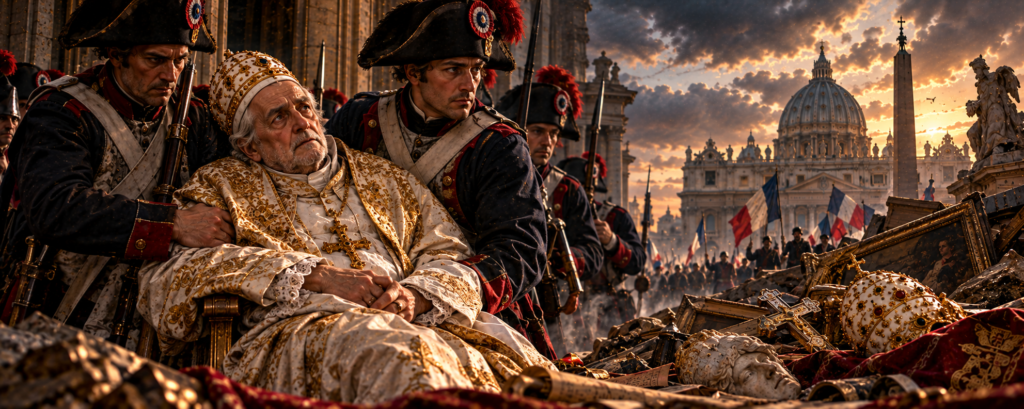
Pius VI: The Pope Who Built a Dynasty and Died a Prisoner of the Revolution
Pope Pius VI (1717–1799) | Reigned 1775–1799
The Pope Who Lost Everything
In February 1798, French soldiers entered Rome, and the world that Pope Pius VI had spent more than twenty years defending began collapsing around him. The elderly pontiff had once presided over one of Europe’s most magnificent courts, surrounded by cardinals, aristocrats, priceless works of art, and the elaborate ceremonies of an institution that claimed nearly eighteen centuries of spiritual authority. Now revolutionary armies occupied his capital, republican leaders proclaimed the end of his temporal government, and the palace that had symbolized his power offered little protection. The pope who had distributed privileges to relatives, commissioned grand monuments, and struggled to preserve the authority of the Holy See was about to discover how quickly centuries of tradition could be swept aside by military force.
Pius VI was eighty years old when the French occupation destroyed his position as sovereign of the Papal States. His health was failing, his treasury had been drained by years of financial difficulties and military demands, and many of the European monarchies upon which the papacy had traditionally relied were either weakened or consumed by their own struggles. The French Republic regarded the temporal power of the pope as a relic of an oppressive political order, and its representatives were determined to eliminate it. When Pius refused to surrender his position voluntarily, he was removed from Rome and sent into captivity.
The journey that followed was a grim reversal of everything the papacy represented. Instead of traveling beneath ceremonial canopies, surrounded by elaborate processions and crowds seeking blessings, the pope was transported from one place of confinement to another under the authority of a government that considered his political position obsolete. He was elderly, increasingly frail, and dependent upon the decisions of officials who had little reason to respect his former sovereignty. By the time he reached the French city of Valence in 1799, the man who had once ruled Rome was approaching the end of his life.
He died there on August 29, 1799, far from the Vatican and the ceremonial splendor that had defined his reign. For a moment, the papacy itself appeared to be approaching extinction, its territorial government abolished and its supreme leader dead in foreign custody. Revolutionary opponents could reasonably believe that they had witnessed the final collapse of an institution that had survived emperors, kings, religious wars, and political upheavals. Yet the Church would survive, and another pope would eventually be elected.
The extraordinary ending of Pius VI’s life has often overshadowed the controversies of his earlier pontificate. Long before French soldiers entered Rome, he had attracted criticism for nepotism, extravagant spending, and an attachment to aristocratic privilege that appeared increasingly out of touch with the changing political world. His ambitious public works and artistic patronage created monuments that endured, but they also contributed to arguments about financial mismanagement. His efforts to defend traditional papal authority repeatedly brought him into conflict with reforming monarchs, revolutionary governments, and intellectual movements that questioned the foundations of the old European order.
Unlike the most notorious Renaissance popes, Pius VI was not remembered primarily for sexual scandal, spectacular cruelty, or a deliberate campaign of personal violence. His failings were those of an aristocratic ruler who inherited an aging political system and struggled to understand how profoundly the world was changing. He could be generous, cultivated, devout, and sincerely committed to the Church while also favoring relatives, spending lavishly, and defending privileges that many Europeans increasingly regarded as indefensible. His story belongs among the darker histories of the papacy not because he was a monster, but because his reign exposed the weaknesses of a system that had confused spiritual authority with dynastic wealth and political sovereignty.
The tragedy of Pius VI is that he spent much of his life protecting a world that was already beginning to disappear. He believed in the dignity of the papal office, the legitimacy of the Papal States, and the importance of preserving the Church’s traditional rights against interference by secular rulers. Yet the final years of his pontificate demonstrated that those rights could no longer be defended through ceremony, diplomatic protest, or appeals to ancient custom alone. By the time the Revolution reached Rome, the pope had become both a symbol of the old order and one of its most vulnerable victims.
Giovanni Angelo Braschi: The Making of an Aristocratic Pope
Giovanni Angelo Braschi was born on December 27, 1717, in Cesena, a town within the Papal States. His family belonged to the lesser nobility, possessing respectable social standing without the immense wealth enjoyed by some of Italy’s great aristocratic houses. The Braschi family valued education and ecclesiastical advancement, recognizing that service to the Church could provide opportunities unavailable through inherited fortune alone. Giovanni Angelo grew up in a society where religious institutions, noble families, and political authority were deeply intertwined.
His education prepared him for a career in administration rather than one devoted exclusively to pastoral work. He studied with the Jesuits in Cesena and pursued legal studies at Ferrara, developing the intellectual and practical skills valued within the Roman Curia. Law was especially important in papal government because the pope was not merely a religious leader but also the sovereign of a substantial Italian territory. Officials who understood finance, diplomacy, property, and ecclesiastical jurisdiction could rise to positions of considerable influence.
Braschi eventually entered the service of Cardinal Tommaso Ruffo, whose patronage helped introduce him to the complicated world of Roman politics. Under Ruffo, he gained experience in administration and became familiar with the networks through which ambitious churchmen advanced. Personal connections mattered enormously in eighteenth-century Rome, where formal qualifications rarely operated independently of aristocratic relationships. Braschi learned early that success depended upon the ability to navigate both institutional responsibilities and the expectations of powerful patrons.
His career progressed steadily, although it was not without difficulties. He served in administrative and diplomatic capacities, including work connected with the Kingdom of Naples, where relations between the monarchy and the papacy were frequently contentious. Such assignments exposed him to the growing determination of Catholic rulers to control ecclesiastical affairs within their territories. They also taught him how limited papal influence could become when confronted by governments willing to challenge Rome.
In 1766, Braschi became treasurer of the Apostolic Camera, an office associated with the financial administration of the Papal States. The appointment placed him near the center of papal government and gave him direct experience with the economic problems confronting the territory. The Papal States suffered from longstanding administrative inefficiencies, uneven taxation, regional inequalities, and difficulties raising sufficient revenue. These problems would later become particularly important during his pontificate.
His position also exposed him to criticism and political rivalry. Financial administration involved decisions that could anger powerful families, officials, and local interests, while reform attempts often encountered resistance. Braschi developed a reputation for administrative ability, but he also learned the dangers of challenging entrenched privileges. His career demonstrated how difficult it could be to govern a state in which aristocratic influence and ecclesiastical office were so closely connected.
Pope Clement XIV elevated Braschi to the cardinalate in April 1773. The appointment represented the culmination of decades of service and placed him among the men eligible to succeed the pope. Yet the political circumstances surrounding Clement XIV’s reign were exceptionally difficult, particularly because of the suppression of the Society of Jesus. Braschi’s perceived sympathy toward the Jesuits would influence the complicated conclave that followed Clement’s death.
By the time he became pope, Braschi had spent much of his adult life within the machinery of papal government. He understood its ceremonies, its administrative structures, and its dependence upon aristocratic patronage. He was intelligent, experienced, and familiar with the political difficulties facing Rome. What remained uncertain was whether those qualities would be sufficient for an age in which the very foundations of papal temporal authority were beginning to crumble.
The Conclave of 1775: A Compromise Candidate Takes the Throne
Pope Clement XIV died on September 22, 1774, leaving behind a Church divided by the suppression of the Jesuits. The Society of Jesus had been one of Catholicism’s most influential religious orders, renowned for education, missionary activity, and its close association with papal authority. Yet the Jesuits had also attracted powerful enemies among European monarchies, whose governments accused them of political interference and excessive independence. Under sustained pressure from Catholic rulers, Clement XIV had formally suppressed the order in 1773.
The suppression created deep divisions within the College of Cardinals. Some churchmen believed the Jesuits had been unjustly sacrificed to satisfy hostile governments, while others feared that restoring the order would provoke a diplomatic crisis. The conclave therefore became a struggle over the future direction of the Church. European courts attempted to influence the election because the next pope’s position toward the Jesuits could affect relations with several major Catholic powers.
The conclave lasted approximately four and a half months. Cardinals maneuvered between factions, candidates emerged and disappeared, and political considerations repeatedly complicated the search for a successor. Braschi was regarded as sympathetic toward the Jesuits, which made him attractive to some electors but suspicious to governments that had demanded the order’s suppression. His eventual election reflected a compromise rather than the overwhelming victory of a single faction.
On February 15, 1775, Braschi was elected pope and chose the name Pius VI. He was fifty-seven years old, relatively young compared with many previous pontiffs, and possessed the administrative experience expected of a capable ruler. His election raised hopes that he might restore stability to the Church after years of controversy. It also placed him at the head of an institution facing challenges more profound than many cardinals understood.
The new pope inherited a difficult relationship with the Catholic monarchies of Europe. France, Spain, Portugal, Austria, and Naples had increasingly asserted control over ecclesiastical institutions within their territories. Governments wanted authority over church appointments, religious orders, education, taxation, and the administration of ecclesiastical property. The papacy’s traditional claims to independence were being challenged by rulers who considered religious institutions part of the machinery of the state.
Pius VI was personally inclined to defend the rights of the Holy See. He believed that the pope possessed responsibilities that secular governments could not legitimately override. Yet he also understood that Rome lacked the military and economic strength to confront Europe’s major monarchies directly. His reign would therefore become a prolonged struggle between principle and political necessity.
The Jesuit question illustrated the problem immediately. Pius was sympathetic toward the suppressed order, but he did not reverse Clement XIV’s decision. Doing so would have risked provoking the very monarchies whose cooperation the papacy needed. His reluctance disappointed those who hoped for a restoration, while demonstrating the practical limits of his independence.
The new pontiff entered office with considerable dignity and confidence. He possessed an imposing presence, appreciated ceremony, and believed that the papacy should display the grandeur appropriate to its spiritual and political position. Those qualities would shape his patronage of art, architecture, and public works. They would also contribute to accusations that he was more interested in magnificent appearances than in the financial realities of the state he governed.
A Court of Splendor in an Age of Financial Anxiety
Eighteenth-century Rome remained one of Europe’s great ceremonial capitals. The papal court possessed elaborate traditions, magnificent palaces, celebrated artistic collections, and an aristocratic society whose fortunes were closely connected with ecclesiastical patronage. Visitors encountered churches filled with marble, paintings, and sculpture, while noble families competed to display wealth and influence. The pope stood at the center of this world, combining religious authority with the responsibilities of a secular prince.
Pius VI embraced the ceremonial dignity of his office. He believed that public magnificence could reinforce the prestige of the papacy and demonstrate the continuing importance of Rome. Artistic patronage was not simply personal indulgence within the political culture he inherited. It was also a traditional means through which rulers displayed legitimacy, devotion, and authority.
Yet the economic foundations of the Papal States were far less impressive than their monuments suggested. Agriculture remained central to much of the economy, while taxation and administration varied considerably between regions. Local privileges complicated attempts at reform, and the government faced persistent difficulties raising revenue. The splendor of Rome therefore existed alongside substantial financial weakness.
Pius inherited these problems rather than creating them. Nevertheless, his spending priorities became a legitimate subject of criticism. Large artistic and architectural projects required substantial resources, while family patronage placed additional demands upon the political system. Critics argued that the pope devoted too much attention to prestige when the state needed administrative reform and financial restraint.
His supporters offered a different interpretation. They regarded artistic patronage as an investment in Rome’s cultural importance and believed that public works could stimulate employment and improve infrastructure. Some projects had genuine practical purposes, particularly those connected with roads and agricultural development. The difficulty lay in distinguishing useful investment from expenditure driven primarily by prestige.
The pope’s attachment to ceremony also reflected his personality. He was conscious of the dignity of his office and reluctant to abandon traditions that had defined papal sovereignty for centuries. To him, grandeur could symbolize the continuity of the Church in an increasingly uncertain world. To critics influenced by Enlightenment ideas, the same grandeur could appear wasteful, archaic, and disconnected from the needs of ordinary people.
The tension would become increasingly damaging as political pressure mounted. A government already struggling with finances could ill afford expensive military crises or demands for indemnities. The French Revolution would eventually expose these weaknesses with devastating force. Long before that catastrophe, however, Pius had already created an image of aristocratic magnificence that made him an easy target for accusations of extravagance.
The Braschi Family: Nepotism Returns to the Vatican
Nepotism had been one of the most persistent scandals in papal history. Earlier pontiffs had elevated nephews, brothers, cousins, and other relatives to positions of extraordinary wealth and influence, sometimes transforming modest families into powerful aristocratic dynasties. Reforming popes had attempted to restrict these practices, and the most spectacular excesses of the Renaissance and Baroque periods had become increasingly difficult to defend. Nevertheless, family patronage remained deeply embedded in Roman political culture.
Pius VI demonstrated that the temptation had not disappeared. His relatives benefited from his elevation to the papacy, and the Braschi family acquired new prominence within Roman aristocratic society. The most important beneficiary was his nephew Luigi Braschi Onesti, whose position became closely associated with the family’s rise. Through titles, property, and advantageous connections, the family established itself among Rome’s wealthy elite.
Luigi’s marriage into the Falconieri family strengthened these connections. Aristocratic marriages were not merely private arrangements but political instruments through which families consolidated property, prestige, and influence. For a family elevated by a papal relative, such alliances could secure advantages that outlasted the pontificate itself. The Braschi were following a pattern familiar from earlier papal dynasties.
The family’s advancement attracted criticism because it appeared to contradict the growing expectation that ecclesiastical government should serve public rather than private interests. The pope’s relatives possessed opportunities unavailable to ordinary subjects, and their prosperity was inseparable from his position. Even when individual appointments or financial arrangements could be defended as lawful, the broader pattern raised questions about favoritism. The papacy continued to function partly as a source of aristocratic advancement.
The most visible symbol of the family’s ambitions was Palazzo Braschi in Rome. Construction began during the final years of Pius VI’s reign, creating a magnificent residence intended to express the family’s new status. The palace was built on a prominent site near Piazza Navona and became one of the last great aristocratic palaces constructed in papal Rome. Its existence embodied the persistence of dynastic ambition on the eve of revolutionary upheaval.
The contrast was striking. Across Europe, intellectuals and reformers were increasingly questioning inherited privilege, aristocratic exemptions, and the concentration of wealth within ruling families. In Rome, the pope’s relatives were establishing themselves through precisely the networks of privilege that critics of the old order condemned. The Braschi family’s rise therefore became part of a larger historical contradiction.
It would be inaccurate to portray Pius VI’s nepotism as identical to the worst excesses of Alexander VI or the Barberini papacy. The scale, methods, and political circumstances were different, and accusations should not be inflated beyond the evidence. Nevertheless, his favoritism was substantial enough to damage his reputation. It demonstrated that even after centuries of criticism, the papacy had not entirely separated public authority from family ambition.
The irony would become cruel during the final years of his life. The pope who had helped elevate his family would eventually lose the political position that made such advancement possible. French soldiers would enter Rome, the papal government would collapse, and aristocratic privilege would provide little protection against revolutionary power. The grandeur of the Braschi family stood as a monument to a world whose foundations were already cracking.
The Pontine Marshes: An Ambitious Dream of Reclaiming the Land
One of Pius VI’s most important public works projects involved the Pontine Marshes, a vast area of wetlands southeast of Rome. For centuries, the region had been associated with stagnant water, difficult travel, and malaria. Earlier rulers had attempted drainage schemes, but the marshes repeatedly frustrated efforts to transform them into productive agricultural land. Successful reclamation promised economic benefits, improved transportation, and the possibility of settlement.
Pius approached the problem with considerable ambition. He believed that drainage and land improvement could increase agricultural production and demonstrate the practical value of papal government. The project also offered an opportunity to associate his name with an achievement of lasting significance. Unlike purely decorative building projects, the reclamation of the marshes addressed a genuine economic and environmental challenge.
Work began on a substantial scale, involving canals, drainage systems, roads, and engineering efforts intended to control water. The project required labor, technical expertise, and considerable financial investment. Conditions were difficult, and malaria posed serious risks to workers and residents. The challenges were not simply administrative but environmental, involving a landscape that had resisted repeated attempts at transformation.
Pius devoted substantial resources to the undertaking. His government hoped that reclaimed land would eventually produce revenue and improve the condition of the region. The project also contributed to improvements along the Appian Way, the ancient Roman road that passed through the area. Such work reflected the pope’s desire to connect practical improvement with the grandeur of Rome’s historical inheritance.
Yet the results were mixed. Drainage works achieved some improvements, but the marshes were not permanently reclaimed during his lifetime. Environmental conditions, maintenance requirements, and financial limitations prevented the complete transformation he envisioned. The project consumed considerable resources without producing all the anticipated benefits.
Critics later portrayed the undertaking as evidence of extravagance and poor judgment. They argued that the pope had spent too much money on a project whose difficulties were already well known. Supporters emphasized that reclamation was a legitimate public objective and that partial improvements should not be dismissed. Both interpretations contain elements of truth.
The project reveals an important distinction in judging Pius VI. He was not merely wasting money on personal luxury or aristocratic display. Some of his most expensive initiatives were intended to improve the Papal States and create lasting public benefits. Nevertheless, good intentions did not guarantee sound financial management, and ambitious projects could become dangerous when pursued by a government with limited resources.
The Pontine Marshes remained a challenge long after Pius died. Their eventual large-scale reclamation required later technological, administrative, and political developments. His efforts formed part of a much longer history rather than a definitive solution. The project became a symbol of both the possibilities and the limitations of papal reform.
The Vatican’s Treasures and the Price of Magnificence
Pius VI was an important patron of the arts, particularly through his support for the Vatican’s collections of classical sculpture. The Museo Pio-Clementino, begun under Clement XIV, developed substantially during his pontificate. Its galleries displayed celebrated ancient statues and helped establish the Vatican as one of Europe’s great centers for the study of classical art. The project reflected the eighteenth-century fascination with antiquity and the prestige associated with possessing masterpieces of Greek and Roman sculpture.
The museum was more than a collection of expensive objects. It contributed to the intellectual culture of Rome and attracted scholars, artists, and travelers from across Europe. Classical sculpture played an important role in artistic education, and the Vatican’s collections influenced the development of neoclassical taste. Pius understood that cultural prestige could reinforce the importance of Rome even as its political influence declined.
The galleries themselves became expressions of papal magnificence. Marble, architectural decoration, and carefully arranged sculptures created an environment designed to impress visitors. The museum presented the papacy as the guardian of antiquity, linking Christian Rome with the artistic achievements of the ancient world. Such patronage helped preserve and display objects of enduring historical importance.
Yet the museum also required substantial expenditure. At a time when the Papal States faced economic difficulties, lavish cultural projects could appear difficult to justify. Critics questioned whether the government should devote so many resources to artistic prestige while struggling with financial administration. The debate reflected a broader tension between the cultural responsibilities of a capital city and the practical needs of its population.
Pius also supported restoration and improvement projects elsewhere in Rome. His pontificate continued the tradition of using architecture to express papal authority and the city’s religious significance. These projects employed artists, architects, craftsmen, and laborers, providing economic activity alongside cultural benefits. Nevertheless, they reinforced the image of a pope deeply attached to visible grandeur.
The irony of his artistic patronage would become especially bitter during the French invasion. The treasures that demonstrated Rome’s cultural importance became objects of political and military bargaining. French authorities demanded valuable works of art as part of the settlements imposed upon the defeated papacy. The collections Pius had helped enrich became vulnerable to removal.
The seizure of artworks was not merely an economic loss. It represented an assault upon the prestige of the papal court and the cultural identity of Rome. Masterpieces that had symbolized the pope’s role as a patron of civilization were transformed into trophies of revolutionary victory. The museum that had embodied his ambitions became part of the story of his humiliation.
Pius could not have anticipated every consequence of the French Revolution when he began expanding the Vatican collections. Nevertheless, the later confiscations reveal the vulnerability of a government that invested heavily in cultural prestige without possessing the military strength to protect its treasures. The splendor of Rome attracted admiration, but it also attracted conquerors. In the final years of his reign, art became another form of wealth that stronger powers could seize.
Joseph II: The Emperor Who Wanted to Control the Church
Long before the French Revolution threatened Rome, Pius VI confronted a different challenge from one of Europe’s most powerful Catholic monarchs. Joseph II, Holy Roman Emperor and ruler of the Habsburg lands, pursued an ambitious program of religious and administrative reform. Influenced by Enlightenment ideas, he believed that institutions should serve practical social purposes and operate under the authority of the state. His policies brought him into direct conflict with the traditional independence of the Catholic Church.
Joseph’s reforms became associated with the term Josephinism. They included measures affecting monasteries, religious education, ecclesiastical jurisdiction, and the relationship between bishops and Rome. The emperor regarded many religious institutions as inefficient or insufficiently useful to society. He sought to reorganize them according to the needs of his government.
One of his most controversial policies involved the suppression of monasteries considered insufficiently engaged in practical activities such as education, nursing, or pastoral service. Monastic property could be redirected toward religious and social purposes approved by the state. Joseph also expanded religious toleration for certain non-Catholic communities and sought greater government control over clerical training. These policies challenged established assumptions about the relationship between Catholicism and political authority.
To supporters of reform, Joseph represented an enlightened ruler attempting to modernize an outdated system. They believed that religious institutions had accumulated privileges that interfered with effective government. Monasteries that contributed little to public welfare could be reorganized, while greater toleration might reduce religious conflict. From this perspective, papal resistance appeared reactionary.
Pius viewed the situation differently. He believed that the emperor was interfering with matters properly belonging to the Church. The suppression of religious houses, control over seminaries, and restrictions upon ecclesiastical jurisdiction threatened the independence of Catholic institutions. The pope feared that the Church would become little more than an administrative department of the state.
The conflict was particularly troubling because Joseph was a Catholic ruler. Pius could not portray the dispute as a straightforward struggle against Protestantism or religious unbelief. Instead, he faced a monarch who claimed to be improving Catholic life while reducing the authority of Rome. The challenge was therefore both political and theological.
Joseph’s determination exposed the declining influence of the papacy over Catholic governments. Earlier popes had sometimes threatened rulers with excommunication or other spiritual sanctions. By the late eighteenth century, such measures were less likely to compel obedience from a powerful monarchy. Pius needed a different approach.
He eventually decided upon an extraordinary personal intervention. Rather than relying solely upon correspondence and diplomatic representatives, he would travel to Vienna and confront the emperor directly. The journey would become one of the most remarkable episodes of his pontificate. It would also reveal how little power the pope possessed to reverse policies that a determined ruler considered essential.
The Journey to Vienna: A Pope Goes Begging for Influence
In 1782, Pius VI undertook a journey to Vienna to negotiate personally with Joseph II. The decision was unusual because popes rarely left Rome, particularly for diplomatic missions to foreign courts. Pius hoped that his presence would impress the emperor and encourage reconsideration of the religious reforms. He believed that personal persuasion might succeed where official protests had failed.
The journey attracted enormous attention. Crowds gathered along the route to see the pope, and his arrival in Vienna became a major public event. The spectacle demonstrated that the papacy retained considerable religious prestige among ordinary Catholics. Even those who disagreed with Rome’s political positions could recognize the extraordinary significance of a reigning pope traveling through central Europe.
Joseph received Pius with outward courtesy. The emperor understood the importance of the visit and had no desire to provoke unnecessary public hostility. Yet he remained determined to preserve his reform program. The contrast between ceremonial respect and political resistance became one of the defining features of the encounter.
The pope spent several weeks in Vienna during March and April 1782. Discussions addressed the emperor’s policies toward monasteries, ecclesiastical jurisdiction, and the administration of religious institutions. Pius attempted to persuade Joseph that the reforms threatened the Church’s independence. The emperor maintained that his government possessed legitimate authority to regulate institutions operating within its territories.
The negotiations produced no major reversal of Joseph’s policies. Pius returned to Rome without securing the concessions he had hoped to obtain. The visit had demonstrated the pope’s willingness to take extraordinary measures, but it had also exposed the limits of his influence. A Catholic emperor had respectfully received the head of the Church and then continued pursuing policies the pope opposed.
The episode was humiliating in a subtle way. Pius had not been imprisoned, insulted, or publicly expelled. He had been treated with the dignity appropriate to his office. Yet the emperor’s refusal to yield made clear that ceremonial respect no longer implied political obedience.
Joseph’s reforms themselves produced resistance within parts of his territories. Religious communities and populations attached to traditional practices sometimes opposed measures they considered unnecessarily disruptive. Some policies were modified or weakened after Joseph’s death. Nevertheless, the broader trend toward stronger state control over ecclesiastical affairs continued.
For Pius, the journey to Vienna was an early warning. The papacy could still command crowds, inspire devotion, and represent an ancient spiritual tradition. It could not necessarily compel Catholic rulers to obey its political preferences. That distinction would become even more important when revolutionary governments began challenging the very legitimacy of papal temporal power.
Tuscany and the Synod of Pistoia
The reforming spirit associated with Joseph II also influenced Tuscany, where his brother Leopold governed as grand duke. Leopold pursued policies intended to modernize administration and reduce the influence of traditional ecclesiastical structures. His reforms reflected a belief that religious institutions should be more closely integrated into the needs of the state. These ideas brought him into conflict with defenders of papal authority.
One of Leopold’s most important ecclesiastical allies was Scipione de’ Ricci, bishop of Pistoia and Prato. Ricci supported a program of religious reform influenced by Jansenist and Gallican ideas. He believed that aspects of Catholic worship, discipline, and administration required substantial change. His position challenged the centralized authority of Rome.
In September 1786, Ricci presided over the Synod of Pistoia. The gathering adopted proposals concerning ecclesiastical reform, liturgy, devotion, and the relationship between bishops and the papacy. Some measures reflected longstanding theological disputes, while others were associated with Enlightenment criticism of traditional religious practices. The synod became a symbol of reformist Catholicism within Italy.
Pius regarded the developments with increasing alarm. The controversy was particularly troubling because it occurred relatively close to Rome and involved a bishop operating within the Catholic hierarchy. The pope feared that the proposals would weaken doctrinal unity and encourage resistance to the Holy See. The dispute therefore concerned both theology and ecclesiastical authority.
The synod’s proposals did not enjoy universal support among Tuscan bishops or clergy. Opposition developed, and the reform movement encountered practical difficulties. Political changes eventually weakened Ricci’s position. Nevertheless, the controversy continued to trouble Rome.
In 1794, Pius issued the constitution Auctorem fidei, condemning eighty-five propositions associated with the Synod of Pistoia. The document represented a major assertion of papal authority against reformist theology and ecclesiastical policies. It addressed issues involving grace, worship, church government, and religious discipline. The condemnation became an important event in the history of Catholic resistance to certain Enlightenment-inspired reforms.
The timing was extraordinary. By 1794, the French Revolution had already transformed European politics and threatened the foundations of traditional monarchy. Yet Pius remained deeply engaged in theological disputes over ecclesiastical authority. His attention to these questions reflected his conviction that doctrinal unity was essential even during political crisis.
The Synod of Pistoia controversy illustrates the difficulties of judging his reign. Some reform proposals were connected with genuine concerns about religious practice and institutional administration. Others raised serious theological questions within Catholic teaching. Pius’s condemnation cannot be reduced to a simple rejection of every possible reform.
Nevertheless, the episode reinforced his reputation as a defender of traditional authority. He was increasingly identified with resistance to movements that sought to reduce Roman control over national churches. In an age when governments and intellectuals were challenging inherited institutions, the pope appeared determined to preserve the structures of the past. The coming Revolution would turn that image into a political liability.
The French Revolution: A Threat Unlike Any Other
In 1789, the French Revolution began transforming one of Europe’s most powerful Catholic monarchies. The crisis emerged from financial problems, social inequalities, political conflict, and demands for fundamental reform. What began as an effort to address the monarchy’s difficulties developed into a challenge to the structure of the old regime. The consequences for the Catholic Church would be profound.
The Church in France possessed extensive property, privileges, and institutional influence. It played a major role in education, charity, religious life, and social organization. At the same time, its wealth and exemptions attracted criticism from reformers who believed that the old system distributed burdens unfairly. The revolutionary movement therefore regarded ecclesiastical property and authority as important subjects for reform.
In November 1789, the National Assembly placed church property at the disposal of the nation. The measure was intended partly to address the government’s financial crisis. It represented a dramatic transfer of control over ecclesiastical wealth. For Pius, it raised serious concerns about the independence of the Church and the legitimacy of revolutionary authority.
The Revolution soon moved beyond property. Reformers sought to reorganize the French Church according to new administrative principles. Diocesan boundaries were altered, ecclesiastical offices were restructured, and the relationship between clergy and the state was fundamentally changed. The measures challenged the authority of Rome over the French hierarchy.
Pius initially responded cautiously. The political situation was unstable, and the pope understood that immediate confrontation could worsen the position of French Catholics. He also had to consider the complicated relationship between the monarchy, the National Assembly, and the clergy. The Revolution was developing rapidly, making it difficult to predict which institutions would survive.
Nevertheless, the pope increasingly regarded the reforms as unacceptable interference in ecclesiastical affairs. The conflict was no longer merely about taxation or property. It concerned who possessed the authority to appoint bishops, regulate religious institutions, and determine the structure of the Church. Pius believed that the Revolution was crossing boundaries that secular government had no right to ignore.
The confrontation became one of the central struggles of his final decade. Unlike Joseph II, the revolutionary government did not necessarily accept the traditional legitimacy of monarchy or ecclesiastical privilege. Its more radical factions increasingly challenged the religious foundations of the old order. The pope was facing a movement that could threaten not merely his influence but the political system upon which the papacy’s temporal sovereignty depended.
The Civil Constitution of the Clergy: France Divides Its Priests
In July 1790, the French National Assembly adopted the Civil Constitution of the Clergy. The measure reorganized the Catholic Church in France and brought its administration under the authority of the revolutionary state. It altered diocesan structures, provided for the election of bishops and priests, and restricted the traditional role of papal authority. The legislation became one of the most divisive acts of the Revolution.
Supporters believed that the reforms would create a more accountable and rational ecclesiastical system. They argued that the Church should serve the nation and operate within the new political order. Some clergy welcomed aspects of the legislation, particularly those associated with administrative reform. Others feared that the state was attempting to subordinate religion to political authority.
The requirement that clergy swear an oath supporting the new constitutional arrangements intensified the conflict. Priests and bishops faced a difficult choice between obedience to the revolutionary government and loyalty to traditional ecclesiastical authority. Those who accepted the oath became known as constitutional or jururing clergy. Those who refused became known as refractory or non-juring clergy.
Pius condemned the Civil Constitution of the Clergy in 1791. He rejected the government’s attempt to reorganize the Church without legitimate ecclesiastical authority. His opposition reflected longstanding Catholic concerns about the independence of the hierarchy. It also aligned him increasingly with opponents of the revolutionary religious settlement.
The consequences were devastating for religious unity in France. Communities divided over whether to recognize constitutional priests or remain loyal to clergy who refused the oath. Families, parishes, and local authorities became involved in disputes that could carry serious political consequences. Religious allegiance increasingly became associated with loyalty or hostility to the Revolution.
The conflict also contributed to violence and repression. As the Revolution became more radical and France entered war with foreign powers, refractory clergy were increasingly suspected of counterrevolutionary sympathies. Some were imprisoned, deported, or killed. The suffering of clergy and religious believers became one of the darkest aspects of the revolutionary period.
Yet the historical picture was complicated. Not every supporter of the Revolution opposed Catholicism, and not every constitutional priest regarded himself as an enemy of the Church. Some sincerely believed that religious reform and political liberty could coexist. The division reflected competing understandings of authority as well as political loyalties.
Pius’s condemnation deepened the institutional conflict, but it did not create the revolutionary government’s coercive policies. Responsibility for persecution belongs to those who enacted and carried out such measures. The pope’s position was rooted in his defense of ecclesiastical independence, even though it contributed to the broader polarization. The tragedy was that ordinary believers increasingly found themselves caught between religious conscience and political demands.
Avignon: The Pope Loses His French Possessions
The Revolution also threatened territories historically associated with papal sovereignty. Avignon and the Comtat Venaissin had long been connected with the Holy See, forming an unusual papal possession within the geographical world of France. Their political status had survived centuries of changing dynastic relationships. By the late eighteenth century, however, revolutionary ideas encouraged demands for incorporation into France.
The situation became increasingly unstable after 1789. Political factions within the territories disagreed over their future, and violence accompanied the struggle. Some inhabitants supported union with France, while others defended the existing papal connection. The dispute reflected broader conflicts over sovereignty, political representation, and the legitimacy of inherited rule.
In 1791, the French National Assembly incorporated Avignon and the Comtat Venaissin into France. The decision deprived the pope of territories that had long symbolized the international reach of papal temporal authority. Pius protested, but his government lacked the power to reverse the annexation. The loss was both practical and symbolic.
For the Revolution, incorporation represented the triumph of national sovereignty over an old political arrangement. For Pius, it was an unjust seizure of papal territory. The competing interpretations reflected fundamentally different understandings of legitimate government. One side appealed to revolutionary principles and political integration, while the other defended historical rights and established sovereignty.
The loss of Avignon foreshadowed the catastrophe that would later strike Rome. If revolutionary France could absorb papal territory without respecting traditional claims, the Papal States themselves might eventually face similar treatment. Pius understood the danger, but his options were limited. Diplomatic protests could not overcome the determination of a revolutionary government supported by military power.
The annexation also damaged relations between Rome and Paris. It reinforced the pope’s conviction that the Revolution threatened both the Church and the political rights of the Holy See. French revolutionaries increasingly regarded the papacy as an enemy of their new order. The distance between the two sides widened.
The struggle over Avignon demonstrates that Pius’s conflict with the Revolution was not purely theological. He was defending territory, political sovereignty, and the privileges of a state he governed. Those interests were intertwined with his religious office, but they were not identical to it. The distinction would become crucial when French armies eventually abolished his temporal government while leaving the Catholic Church itself in existence.
The Execution of Louis XVI and the Collapse of the Old Order
The French Revolution entered an even more radical phase with the overthrow of the monarchy. King Louis XVI, once one of Europe’s most powerful Catholic rulers, became a prisoner of the revolutionary government. His trial and execution represented an extraordinary challenge to the principle of hereditary monarchy. On January 21, 1793, he was executed by guillotine in Paris.
For Pius VI, the execution was a horrifying demonstration of revolutionary power. The French monarchy had long been associated with Catholic identity, despite frequent disputes between the crown and Rome. The killing of a reigning monarch suggested that no traditional institution was beyond the reach of revolutionary violence. The pope regarded the event as a grave moral and political catastrophe.
Pius publicly condemned the execution and honored Louis as a victim of revolutionary injustice. His response reflected both religious conviction and attachment to the legitimacy of monarchy. He viewed the destruction of the French crown as part of a broader assault upon established Christian society. The Revolution appeared increasingly hostile to the principles upon which the old European order rested.
Yet the French monarchy had not been an uncomplicated defender of papal authority. Earlier kings had challenged Rome, restricted ecclesiastical independence, and pursued political interests that conflicted with those of the Holy See. The alliance between monarchy and papacy was therefore more complex than a simple partnership of shared values. Pius’s defense of Louis reflected the extraordinary threat posed by revolutionary republicanism rather than an absence of earlier tensions.
The execution also intensified the political isolation of the pope. Revolutionary France increasingly regarded monarchist sympathies as evidence of hostility to the Republic. Pius’s condemnation reinforced the perception that Rome belonged to the counterrevolutionary camp. The papacy became more closely associated with governments seeking to contain or defeat the Revolution.
The wider European conflict was already expanding. France faced war against coalitions of monarchies, and the struggle increasingly involved the Italian peninsula. The Papal States occupied a vulnerable position between competing powers. Pius could not remain insulated from events that were reshaping the continent.
The execution of Louis XVI was therefore more than a distant tragedy for the pope. It was a warning that revolutionary governments could destroy institutions once considered permanent. If a king could be tried and executed by his former subjects, the political sovereignty of the pope might also be challenged. The old order was no longer merely under pressure; it was being dismantled.
Revolutionary Violence and the Murder of Nicolas de Basseville
Relations between revolutionary France and Rome deteriorated further during the early 1790s. Revolutionary symbols, political demonstrations, and diplomatic tensions created an increasingly volatile atmosphere in the papal capital. Roman authorities feared the spread of revolutionary ideas, while French representatives complained of hostility and obstruction. The city became a dangerous place for anyone associated with the French Republic.
In January 1793, Nicolas Jean Hugou de Basseville, a French diplomatic representative in Rome, became involved in a confrontation that ended in his death. Basseville had been associated with the display of revolutionary symbols, provoking hostility among sections of the Roman population. During the disturbances, he was attacked and fatally wounded. The incident became a major diplomatic grievance.
French authorities blamed the papal government for failing to protect their representative. The killing reinforced revolutionary claims that Rome was hostile to France and unable or unwilling to control violence against republican agents. Papal officials faced accusations that they had tolerated an atmosphere encouraging attacks. The precise allocation of responsibility became a subject of political controversy.
There is no sound basis for claiming that Pius VI personally ordered Basseville’s murder. The killing occurred amid popular unrest and intense political hostility, and responsibility should not be assigned through speculation. Nevertheless, the incident damaged the papacy’s position. It provided revolutionary France with another grievance that could later be used to justify demands against Rome.
The episode also revealed the dangerous atmosphere within the Papal States. Revolutionary ideas frightened conservative groups, while supporters of France challenged traditional authority. Political disagreement could rapidly become street violence. The papal government struggled to maintain order in a city increasingly divided by events beyond its borders.
The murder of Basseville would remain important in later negotiations between France and the Holy See. French demands for compensation became part of the pressure imposed upon the papacy. The incident demonstrated how local violence could acquire international consequences. It also foreshadowed the later killing of General Duphot, which would provide the immediate pretext for the final occupation of Rome.
For Pius, the growing hostility toward French representatives created an impossible situation. He needed to defend his government against revolutionary pressure while preventing incidents that could justify military retaliation. Yet the political passions unleashed by the Revolution were difficult to control. Rome was becoming a battlefield of ideas before it became a battlefield of armies.
Napoleon Bonaparte: The General Who Changed Everything
The most dangerous threat to Pius VI emerged from the military campaigns of Napoleon Bonaparte. In 1796, the young French general took command of the Army of Italy and launched a series of campaigns that transformed the political situation in northern Italy. His victories weakened Austrian influence and brought revolutionary French power directly into the Italian peninsula. The Papal States suddenly faced a military force far more dangerous than any diplomatic dispute.
Napoleon’s campaigns were remarkable for their speed and effectiveness. French armies defeated opponents, occupied territories, and imposed political settlements that reflected the interests of the Republic. Italian governments that had relied upon traditional alliances discovered that their security could collapse within weeks. The pope’s position became increasingly precarious.
The Papal States possessed limited military resources compared with the French army. Their forces were not prepared to resist a successful modern campaign led by an aggressive commander. Pius could appeal to diplomatic relationships and historical rights, but neither offered reliable protection against military invasion. The imbalance was overwhelming.
Napoleon also understood the political value of the papacy. Rome possessed immense symbolic importance, and the pope remained influential among Catholics throughout Europe. Destroying the papal government might satisfy radical revolutionaries, but it could also provoke resistance among religious populations. Napoleon therefore approached the question with a mixture of military calculation and political pragmatism.
The French campaign placed Pius under increasing pressure to negotiate. Territories were occupied, demands were issued, and the papal government struggled to preserve what remained of its independence. The pope faced the possibility of losing far more than money or disputed border regions. The very survival of the Papal States was at stake.
Napoleon’s rise also exposed the weakness of the traditional Italian political order. Small states, aristocratic governments, and ecclesiastical territories could no longer rely upon diplomatic arrangements that had survived for generations. French military power was creating new republics and dismantling old institutions. The papacy stood directly in the path of that transformation.
Pius was not the only Italian ruler overwhelmed by these developments. Governments throughout the peninsula faced military defeat, political upheaval, and demands for financial contributions. Yet the pope’s position carried exceptional symbolic significance because he was both a sovereign and the head of the Catholic Church. His humiliation would therefore resonate far beyond Italy.
The Armistice of Bologna: Rome Pays for Survival
In June 1796, the papal government negotiated an armistice with French forces. The agreement, commonly associated with Bologna, imposed heavy demands upon the Holy See. The pope was required to make financial payments and surrender valuable works of art and manuscripts. The settlement also involved territorial concessions and French occupation of strategically important areas.
For Pius, the agreement represented a painful attempt to preserve the remainder of his state. He lacked the military strength to resist Napoleon effectively and hoped that concessions might prevent a more destructive invasion. The decision reflected political necessity rather than genuine agreement with revolutionary principles. Yet the terms demonstrated how little bargaining power Rome possessed.
The demands for artworks were particularly humiliating. The Vatican’s collections represented centuries of papal patronage and cultural prestige. Their removal transformed masterpieces into trophies of French military success. Objects that had symbolized Rome’s intellectual and artistic importance were now being treated as assets available for confiscation.
The financial demands also placed additional pressure upon an already troubled treasury. Pius had spent heavily on public works and artistic projects, while the Papal States faced longstanding economic weaknesses. Military indemnities intensified the crisis. The government was forced to raise money under circumstances that offered little opportunity for orderly financial planning.
The armistice did not provide lasting security. Relations between France and the papacy remained tense, and further military developments threatened the territories still under papal control. The pope continued seeking diplomatic solutions, but Napoleon’s position strengthened. The possibility of a more severe settlement remained.
The agreement marked a turning point in the decline of papal sovereignty. Earlier popes had occasionally lost territory or paid indemnities after military defeats. Pius now faced an adversary whose political ideology challenged the legitimacy of the old order itself. The danger extended beyond temporary occupation or financial punishment.
The humiliation also exposed the limitations of papal magnificence. Rome possessed extraordinary cultural treasures, but it could not defend them against a victorious army. The pope could commission monuments and preside over elaborate ceremonies, but he could not compel Napoleon to respect his sovereignty. The contrast between ceremonial grandeur and military weakness had become impossible to ignore.
Tolentino: The Treaty That Stripped the Papacy Bare
The crisis deepened in early 1797 when French forces renewed pressure upon the Papal States. Napoleon’s victories made further resistance increasingly unrealistic. Pius faced the possibility of a direct assault upon Rome and the destruction of his government. Negotiations produced the Treaty of Tolentino, signed on February 19, 1797.
The treaty imposed severe territorial and financial losses. The pope formally surrendered his claims to Avignon and the Comtat Venaissin, which France had already annexed. He also relinquished important territories in northern Italy, including Bologna, Ferrara, and the Romagna. The settlement represented a major reduction in the territorial extent of the Papal States.
Financial demands were equally punishing. The papal government was required to make substantial payments and surrender valuable artistic and cultural objects. The treaty intensified the depletion of resources already strained by earlier concessions. For a government struggling to maintain financial stability, the burden was severe.
The loss of territory had consequences beyond prestige. The Papal States depended upon their lands for taxation, administration, and political influence. Surrendering important regions weakened the government’s economic base and reduced its ability to function as an independent state. The pope’s position became increasingly vulnerable.
The treaty also demonstrated the political transformation taking place in Italy. Revolutionary France was redistributing territories according to military victory and diplomatic calculation. Ancient claims and ecclesiastical privileges carried little weight when they conflicted with French objectives. The pope was being treated as a defeated secular ruler rather than as an authority entitled to special protection.
Pius accepted the settlement because he had few alternatives. Refusal might have brought immediate military occupation of Rome. His decision was therefore an attempt to preserve the remainder of his sovereignty through painful concessions. Yet the treaty did not remove the underlying hostility between the papacy and revolutionary France.
The humiliation was especially bitter because Pius had spent much of his pontificate defending the dignity of the papal office. He had resisted interference by Catholic monarchs and condemned revolutionary attacks upon ecclesiastical authority. Now he was forced to surrender territory, money, and cultural treasures to a government that rejected the political foundations of his rule. The pope’s traditional claims had been reduced to bargaining positions in a military negotiation.
Tolentino did not immediately end the Papal States, but it brought them close to collapse. The government survived in a weakened form, financially strained and politically isolated. French influence continued expanding throughout Italy. The final catastrophe was approaching.
The Death of General Duphot: The Spark That Set Rome Ablaze
In December 1797, another violent incident transformed the political situation. French General Léonard Duphot was in Rome during a period of intense revolutionary agitation and diplomatic tension. The city contained supporters of republican ideas as well as defenders of papal authority. Demonstrations and confrontations created an atmosphere in which violence could erupt quickly.
On December 28, Duphot was killed during disturbances involving French representatives and papal forces. The incident occurred amid efforts by revolutionary sympathizers to challenge the existing government. The precise circumstances were politically contested, and accounts differed over the responsibility of those involved. What mattered immediately was that a French general had died in the papal capital.
The French Directory seized upon the killing as justification for decisive intervention. Revolutionary authorities accused the papal government of responsibility and demanded action. The incident provided an immediate pretext for military occupation, although French hostility toward the papacy had developed long before Duphot’s death. The destruction of papal temporal power was therefore not simply an impulsive response to one violent episode.
There is no reliable evidence that Pius VI personally ordered Duphot’s killing. The pope’s government faced a volatile situation in which revolutionary agitation and efforts to preserve public order collided. Responsibility for the fatal confrontation should not be simplified into a claim of deliberate papal assassination. Nevertheless, the death gave France a powerful diplomatic and military argument.
The papal government was in no position to resist effectively. Its finances had been weakened, its territories reduced, and its military resources remained inadequate. French forces were already established in Italy and could move against Rome with relative ease. The balance of power left Pius almost defenseless.
The killing of Duphot became the final step in a process that had unfolded over several years. Revolutionary France had challenged papal authority, annexed papal territory, demanded money and artworks, and imposed humiliating treaties. The pope had attempted to preserve his position through negotiation and concession. Now even that limited strategy was failing.
The tragedy was that Rome’s fate had become dependent upon decisions made by a government fundamentally hostile to papal sovereignty. Pius could not restore the lost balance of power or rebuild his military strength in time. The French Directory possessed both the means and the political justification it needed to act. The ancient capital of the papacy was about to fall.
February 1798: The French Enter Rome
On February 10, 1798, French forces under General Louis-Alexandre Berthier entered Rome. The occupation marked the effective collapse of the pope’s temporal government. The city that had served as the center of papal sovereignty for centuries was now controlled by soldiers representing a revolutionary republic. Pius VI remained in the Vatican, but his political authority was rapidly disappearing.
Five days later, on February 15, the Roman Republic was proclaimed. The date carried particular symbolism because it marked the anniversary of Pius’s election to the papacy in 1775. The proclamation announced the replacement of papal government with a republican political order supported by French military power. The old system of ecclesiastical sovereignty had been formally overthrown.
The new republic adopted institutions and symbols associated with revolutionary France. Its supporters celebrated the end of papal temporal rule as a victory over aristocratic privilege and clerical government. They believed that Rome could be reorganized according to principles of republican citizenship and political reform. For opponents, the new regime represented foreign occupation and the destruction of legitimate authority.
The population of Rome did not respond with a single unified opinion. Some welcomed the overthrow of papal government, while others remained loyal to the pope or resented French interference. Economic difficulties, political rivalries, and religious loyalties complicated the situation. The city was not simply divided between enlightened republicans and ignorant defenders of the old order.
French occupation also brought financial demands and the removal of valuable property. Military governments frequently required conquered territories to support occupying forces, and Rome was no exception. The burden fell upon a population already affected by economic uncertainty. The promised benefits of political liberation were therefore accompanied by the realities of foreign military control.
For Pius, the proclamation of the republic was a devastating personal and institutional humiliation. He had spent more than twenty years governing the Papal States and defending the traditional rights of the Holy See. Now those rights had been abolished by a foreign army. His position as spiritual head of the Catholic Church remained, but his sovereignty over Rome had been destroyed.
The occupation also created a question that revolutionary leaders could not ignore. What should be done with the pope himself? Allowing him to remain in Rome might encourage resistance to the new republic. Removing him would demonstrate the triumph of revolutionary authority but risk provoking Catholic outrage.
The French authorities chose removal. The decision would transform the elderly pontiff from a defeated sovereign into a prisoner. His final journey was about to begin.
The Night the Pope Was Taken Away
On the night of February 20, 1798, Pius VI was removed from Rome under French authority. The elderly pope was no longer permitted to remain in the city he had governed for more than two decades. His departure represented the final destruction of his practical independence. The head of the Catholic Church was being transported away from the Vatican by a revolutionary government.
The circumstances were humiliating, although later accounts sometimes embellished the episode with dramatic details that cannot always be verified. The essential facts are clear: Pius was compelled to leave Rome, his freedom was restricted, and his movements were controlled by political authorities hostile to his former sovereignty. He was not traveling as an honored diplomatic guest. He was being removed because the new regime regarded his presence as politically dangerous.
The pope’s age made the ordeal particularly severe. He had passed his eightieth birthday and suffered from declining health. Travel in the late eighteenth century could be physically demanding even under favorable circumstances. For an elderly man already weakened by illness and political stress, forced movement between places of confinement presented serious risks.
His departure also carried immense symbolic weight. For centuries, the pope had occupied a position that combined spiritual leadership with temporal sovereignty. The French Revolution had separated those two forms of authority through military force. Pius remained pope, but he no longer possessed the territory that had supported the political independence of the papacy.
The removal was intended partly to prevent the pope from becoming a rallying point for resistance. His continued presence in Rome might encourage loyalists to challenge the republic. French officials therefore considered his exile a political necessity. The decision reflected the fear that spiritual authority could remain influential even after temporal power had been abolished.
For Catholics attached to the papacy, the spectacle was deeply disturbing. The pope had been driven from his capital by soldiers representing a government associated with revolutionary attacks upon the Church. His suffering could be interpreted as persecution rather than merely the defeat of a secular ruler. The distinction would become central to later Catholic memory of his pontificate.
Yet the episode should not be reduced to a simple religious martyrdom without considering its political context. Pius was both a spiritual leader and a sovereign whose government had been overthrown. French authorities acted against him partly because of his political position and his opposition to revolutionary policies. His captivity emerged from the collision of religious authority, temporal sovereignty, and revolutionary power.
The journey away from Rome marked the beginning of his final ordeal. He would never return to the Vatican alive. The pope who had once traveled to Vienna in hopes of persuading an emperor was now traveling under compulsion, with no power to determine his destination. His remaining months would be governed by the decisions of others.
Siena and Florence: A Sovereign Without a Kingdom
After leaving Rome, Pius was taken first to Siena and later to the Florence area. His confinement was shaped by the shifting political situation in Italy and the concerns of the authorities responsible for him. He retained the dignity of his religious office, but his movements were restricted. The distinction between a guest under supervision and a prisoner became increasingly difficult to maintain.
During this period, the pope remained physically weakened and emotionally burdened by the loss of Rome. He had witnessed the collapse of the government he had spent decades administering. Reports of political developments and the fate of the Papal States could only reinforce his uncertainty. His ability to influence events was severely limited.
The situation also affected the College of Cardinals and the administration of the Church. With the pope removed from Rome and the traditional institutions of papal government disrupted, officials faced difficult questions about communication and authority. The Church continued functioning, but the political framework supporting its central administration had been damaged. The possibility of the pope dying in captivity raised concerns about how a successor could be elected.
Pius’s captivity was not uniformly characterized by deliberate physical brutality. Some individuals responsible for his care treated him with consideration, and the circumstances varied between locations. Nevertheless, the fundamental injustice from his perspective remained unchanged. He was an elderly man deprived of freedom and forced to live under the authority of a government that had overthrown his sovereignty.
His presence in Tuscany also became politically sensitive. The expansion of French power and the instability of Italian governments meant that no place of confinement could be considered permanently secure. Officials feared that military developments might alter the situation. The pope’s movements were therefore influenced by strategic calculations over which he had little control.
The contrast with his earlier life was extraordinary. As pope, he had received ambassadors, negotiated with monarchs, and presided over elaborate ceremonies. Now he depended upon officials who determined where he could reside and when he would move. The loss of political independence was complete.
The ordeal also exposed the vulnerability of the papacy as an institution dependent upon a particular territorial base. Rome had provided administrative continuity, financial resources, and symbolic authority. Without it, the Church faced an unprecedented modern crisis. The survival of the papacy would depend upon its ability to function beyond the political structures that had long supported it.
For Pius personally, however, the larger institutional questions were overshadowed by age and illness. He had little prospect of recovering his former position. The Revolution continued reshaping Europe, and the French Republic remained powerful. His captivity was becoming less a temporary political arrangement than the final condition of his life.
Across the Alps: The Pope’s Final Ordeal
In 1799, the political and military situation changed again, and French authorities decided to move Pius farther from Italy. The pope was already seriously ill, making the journey particularly dangerous. Nevertheless, he was transported through northern Italy toward France. The decision reflected the continuing importance attached to controlling his movements.
The journey took him through several cities, including Parma, Piacenza, and Turin, before he was carried across the Alps. Travel over mountainous routes was physically demanding, especially for someone of his age and condition. The pope’s health deteriorated under the strain. His attendants could provide care, but they could not remove the hardships imposed by repeated relocation.
He passed through Briançon and Grenoble before reaching Valence. Each stage carried him farther from Rome and the political world in which he had spent his career. The journey also placed him increasingly within French territory, where the revolutionary government exercised direct authority. His prospects of returning to Italy diminished.
Accounts of the journey often emphasize his suffering, and the broad picture is supported by the circumstances of his age, illness, and forced travel. Nevertheless, some later devotional narratives embellished particular episodes to heighten the image of martyrdom. The historical record should be distinguished from dramatic retellings. The documented ordeal is sufficiently severe without adding invented scenes or dialogue.
The pope’s physical condition became a matter of growing concern. He had endured months of displacement and uncertainty, and the journey placed further strain upon an already weakened body. French officials faced the practical problem of transporting a prisoner who might die before reaching his intended destination. The political significance of his captivity was now inseparable from the likelihood of his death.
The journey also transformed Pius’s public image. Earlier critics had portrayed him as an extravagant aristocratic pope who favored relatives and defended obsolete privileges. Now he appeared as a frail old man subjected to the power of a revolutionary state. His suffering encouraged sympathy even among people who might not have approved of every aspect of his government.
The contrast became central to his historical legacy. Pius had certainly participated in the political culture of nepotism and aristocratic privilege. He had also been defeated, dispossessed, and carried into exile by forces far stronger than his government. Both realities belonged to the same life.
By the time he reached Valence, the end was near. The pope had lost his capital, his territory, and his freedom. What remained was the spiritual office he continued to hold and the personal dignity with which he attempted to endure his circumstances. His final days would become one of the most poignant episodes in the history of the modern papacy.
Valence, 1799: The Death of a Captive Pope
Pius VI arrived in Valence in southern France during the summer of 1799. He was housed under conditions of confinement and remained seriously ill. The French authorities controlled his circumstances, although he was not simply abandoned without care. His physical decline continued, and recovery became increasingly unlikely.
The city was far removed from the ceremonial world of Rome. There were no great papal processions, no College of Cardinals assembled around his throne, and no possibility of exercising the temporal authority he had once possessed. The pope who had presided over magnificent galleries and aristocratic receptions was approaching death in foreign custody. His final surroundings offered a stark contrast to the splendor of his earlier reign.
On August 29, 1799, Pius VI died at the age of eighty-one. His death ended a pontificate of more than twenty-four years, one of the longest of the eighteenth century. It also created an extraordinary institutional crisis because the papacy’s traditional capital remained under revolutionary influence. The Church had to determine how to elect a successor without relying upon the usual political and ceremonial arrangements.
The pope’s death was widely interpreted by Catholics as the culmination of his persecution. His forced removal from Rome, repeated journeys, and confinement made him a powerful symbol of resistance to revolutionary hostility. Supporters regarded his suffering as evidence of fidelity to the Church. His earlier controversies became less prominent in accounts emphasizing the tragedy of his final months.
The French Republic had achieved the immediate political objective of eliminating papal temporal sovereignty in Rome. Yet the death of Pius did not destroy the papacy. The Church continued to possess bishops, clergy, institutions, and communities throughout the world. The spiritual office survived the loss of its traditional territorial government.
His remains were initially buried in Valence. They were later transferred to Rome, where the restoration of papal authority allowed a more fitting commemoration. The return of his body symbolized the survival of an institution that revolutionary opponents had believed might disappear. Death in exile had not been the final chapter of the papacy.
The circumstances of his death also complicated historical judgment. Pius had been an aristocratic ruler whose government possessed genuine weaknesses. He had favored relatives, spent heavily, and resisted reforms that threatened traditional ecclesiastical authority. Yet none of those failings justified treating an elderly captive as though his personal dignity had disappeared with his political power.
His death therefore belongs to two overlapping histories. It was the end of a controversial pontificate marked by nepotism, financial strain, and resistance to political change. It was also the death of a defeated sovereign subjected to forced exile during a period of revolutionary upheaval. The darker significance of his reign cannot be understood without acknowledging both.
The Papacy Without Rome
The death of Pius VI raised an unsettling question: could the Catholic Church elect a new pope while Rome remained politically unstable and the traditional papal government had collapsed? For centuries, the city had served as the central location of papal elections and administration. The loss of Rome created practical difficulties and symbolic uncertainty. Revolutionary opponents hoped that the institution might be too weakened to recover.
The cardinals nevertheless moved toward electing a successor. Their ability to assemble depended upon the political circumstances of Europe and the assistance of governments willing to provide a suitable location. Venice, then under Austrian control, became the setting for the conclave. The election would take place far from the Vatican.
The conclave opened in November 1799 at the Benedictine monastery of San Giorgio Maggiore. The setting was extraordinary because it demonstrated that the papacy could continue without immediate possession of Rome. The cardinals faced difficult political divisions and uncertainty about the future. Yet they remained determined to preserve institutional continuity.
On March 14, 1800, they elected Cardinal Barnaba Luigi Chiaramonti, who took the name Pius VII. His election demonstrated that the papacy had survived the death of its imprisoned predecessor. The institution remained capable of choosing a leader even after the destruction of its temporal government. Revolutionary predictions of its immediate extinction had proved premature.
Pius VII would confront Napoleon in a new phase of the struggle between the papacy and French power. His pontificate would include negotiations, the Concordat of 1801, further conflicts, and his own periods of captivity. The problems inherited from Pius VI had not disappeared. They had merely entered a new chapter.
The survival of the papacy also changed how Pius VI was remembered. His death could be presented as a moment of apparent defeat followed by institutional recovery. The Church had endured the loss of Rome and the captivity of its leader. The narrative became one of suffering, continuity, and eventual restoration.
Yet the restoration did not erase the political transformation that had occurred. The French Revolution and Napoleonic era demonstrated that papal temporal sovereignty could be destroyed by military force. Even when the Papal States were later restored, their vulnerability remained apparent. The old relationship between spiritual authority and territorial rule had been fundamentally shaken.
Pius VI therefore stands at a turning point in papal history. He was among the last popes to govern with the assumptions of the old aristocratic order largely intact. His successor would be forced to negotiate with a political world transformed by revolution. The transition was painful, and Pius paid for it with the loss of his freedom and ultimately his life.
Was Pius VI Responsible for His Own Downfall?
It would be tempting to explain the fall of Pius VI as the inevitable punishment for nepotism and extravagance. His favoritism toward relatives and attachment to aristocratic magnificence certainly damaged his reputation. His financial policies did not adequately resolve the longstanding weaknesses of the Papal States. Yet the French occupation cannot be understood as a simple consequence of his personal failings.
The Papal States had faced structural problems for generations. Their economy was uneven, administrative privileges complicated reform, and their military resources were limited. Pius inherited these weaknesses within a European political environment increasingly hostile to ecclesiastical sovereignty. Even a more financially disciplined pope would have struggled to resist the armies of revolutionary France.
The Revolution itself arose from causes far beyond Rome. Financial crisis, social inequality, political conflict, intellectual change, and the collapse of royal authority transformed France. Napoleon’s Italian campaigns were part of a broader struggle for European power. The papacy became vulnerable because it occupied territory within the path of French military expansion.
Pius’s decisions nevertheless mattered. His spending priorities placed additional pressure upon the treasury, while his attachment to traditional privileges limited the political flexibility of his government. His opposition to revolutionary policies reinforced French hostility, although that opposition was rooted partly in legitimate concerns about ecclesiastical independence. His government struggled to respond effectively to a crisis that demanded extraordinary adaptation.
The pope also lacked reliable allies. Catholic monarchies had spent decades challenging Rome’s authority, and the European powers were divided by war. Austria, Naples, and other states pursued their own interests. The papacy could not assume that religious solidarity would translate into military protection.
His downfall therefore resulted from a combination of personal limitations, institutional weaknesses, and overwhelming external forces. Nepotism and extravagance contributed to the image of a decaying political system, but they did not cause the French Revolution. The loss of Rome was primarily the result of military conquest and revolutionary political objectives. Historical responsibility must be assigned accordingly.
The tragedy is that Pius understood the importance of defending papal independence but lacked the resources and political imagination to secure it. He could negotiate, protest, and make concessions, but he could not transform the Papal States into a power capable of resisting Napoleon. His government belonged to an older political world. The Revolution destroyed that world faster than he could adapt.
The Human Cost of Papal Grandeur
Pius VI’s reputation for extravagance raises questions about the relationship between public magnificence and the responsibilities of government. Rome’s artistic achievements were real, and the Vatican’s collections became treasures of international importance. Public works such as the Pontine Marshes project pursued legitimate economic objectives. Nevertheless, the government responsible for these initiatives operated within a society marked by inequality and financial weakness.
The Papal States were not a uniformly prosperous territory. Rural communities faced agricultural difficulties, while taxation and administrative privileges created uneven burdens. Local elites possessed advantages that ordinary inhabitants could not easily challenge. Reforming such a system required sustained political effort and the willingness to confront powerful interests.
Pius attempted some practical improvements, but his attachment to aristocratic patronage limited the image of reform. The advancement of the Braschi family demonstrated that access to power remained closely connected with kinship. The construction of magnificent residences reinforced the impression that the ruling elite continued benefiting from privileges unavailable to the wider population. These practices were increasingly vulnerable to criticism in an age shaped by Enlightenment ideas.
The pope’s defenders could reasonably point to the economic activity generated by public works and artistic patronage. Architects, artists, laborers, and craftsmen benefited from commissions. Infrastructure improvements could support trade and agriculture. The problem was not that all expenditure on art or public works was inherently wasteful.
The deeper issue concerned priorities and financial sustainability. A government already struggling with revenue needed to balance cultural ambition against administrative reform and economic resilience. Pius’s spending became especially controversial because the state later proved unable to withstand severe military demands. The French indemnities exposed how limited its financial resources had become.
Yet the human cost of the Revolution should not be used to excuse every weakness of the old regime. The suffering inflicted upon Pius and other victims of revolutionary coercion was real. So were the inequalities and privileges that made traditional governments vulnerable to criticism. Both realities must be acknowledged without turning history into a simple morality play.
The pope’s life illustrates the difficulty of separating personal virtue from institutional responsibility. He could be devout and generous while governing through a system that favored aristocratic families. He could commission valuable cultural works while failing to resolve serious economic problems. His character and his policies therefore require different forms of judgment.
The darker history of Pius VI lies partly in this contradiction. He represented an institution that claimed moral authority while participating in the privileges of an unequal political order. His downfall did not make every criticism of that order disappear. It did, however, reveal that the destruction of an imperfect system could produce suffering and injustice of its own.
A Wicked Pope or a Tragic One?
Pius VI is an unusual candidate for the Wicked Popes category because the most dramatic events of his life involve suffering inflicted upon him rather than atrocities committed by him. His nepotism was substantial, and his spending priorities attracted legitimate criticism. He defended aristocratic privilege and resisted reforms that threatened traditional papal authority. Yet he was not notorious for the personal depravity or spectacular violence associated with some earlier pontiffs.
His reputation must therefore be judged with care. The advancement of the Braschi family demonstrated the persistence of favoritism within papal government. His artistic and architectural ambitions contributed to concerns about financial management. His political decisions reflected an attachment to the old order that limited his ability to respond to revolutionary change.
Nevertheless, the collapse of his temporal government was not a just punishment for those failings. French military occupation, territorial confiscation, and forced exile were acts of political coercion carried out by a victorious power. The pope’s age and declining health made his treatment particularly troubling. His suffering should not be dismissed because his government had been imperfect.
Nor should his captivity automatically transform him into a flawless hero. Later accounts emphasizing his persecution sometimes minimized the controversies of his earlier reign. The temptation to portray him solely as a martyr can obscure the financial problems, nepotism, and political misjudgments that shaped his pontificate. Historical sympathy should not require historical amnesia.
Pius was a complicated figure. He possessed genuine religious conviction, valued scholarship and art, and attempted practical improvements within the Papal States. He also benefited his relatives, maintained aristocratic traditions, and struggled to recognize the extent of the political transformation occurring around him. His virtues and failings existed together.
His reign also demonstrates the dangers of judging historical figures solely by their endings. A tragic death can overshadow decades of controversial government. Conversely, legitimate criticism of a ruler’s policies can make later suffering seem less deserving of sympathy. Neither approach produces a balanced understanding.
For a collection devoted to the darker side of papal history, Pius VI belongs as a secondary but compelling subject. His story reveals the persistence of nepotism, the financial weaknesses of papal government, and the extraordinary violence with which revolutionary power could destroy traditional institutions. He is not among the most wicked popes in personal conduct. He is among the most tragic in the manner of his downfall.
The Last Pope of the Old World
Pius VI’s pontificate marks the end of an era in which the papacy could still imagine itself as an enduring aristocratic monarchy protected by centuries of tradition. He inherited a political system built upon ecclesiastical sovereignty, noble patronage, elaborate ceremony, and the cultural prestige of Rome. Those institutions had survived enormous upheavals, including religious wars, dynastic conflicts, and repeated foreign interventions. Yet the French Revolution challenged their legitimacy in a fundamentally different way.
Earlier conquerors had often sought concessions from the pope while leaving the institution itself intact. Revolutionary France increasingly regarded papal temporal sovereignty as incompatible with the political order it wished to create. The occupation of Rome and proclamation of the Roman Republic therefore represented more than another military defeat. They announced the possibility that the pope might continue as a religious leader without possessing a sovereign state.
That distinction would shape the future of the papacy. The Church survived Pius’s captivity and death, demonstrating that its spiritual identity did not depend entirely upon territorial government. Yet the loss of the Papal States also exposed the practical difficulties of maintaining independence without political sovereignty. The relationship between spiritual authority and secular power would remain a central issue throughout the nineteenth century.
Pius himself had been poorly prepared for such a transformation. His career had developed within the traditional structures of Roman government, and his instincts favored the preservation of established rights. He believed that the dignity of the papal office required visible magnificence and political independence. The Revolution challenged both assumptions.
His nephew’s palace, the Vatican’s artistic collections, and the public works of his reign belonged to a world that valued the display of authority through material grandeur. French revolutionary power operated through armies, republican institutions, and claims of popular sovereignty. The collision was not simply between an old man and a young general. It was between competing visions of political legitimacy.
The outcome was devastating for Pius. He lost his capital, his government, and his freedom. His final months were spent under the authority of the state that had destroyed his temporal position. Yet the institution he represented survived.
The survival of the papacy does not mean that the old order emerged unchanged. The Revolution had demonstrated that centuries of tradition could be overturned through political and military force. The papacy would eventually recover territory, but it could never entirely forget the vulnerability revealed in 1798. Pius VI became the symbol of that painful awakening.
The Pope Who Built Palaces and Died Without a Throne
When Giovanni Angelo Braschi became Pope Pius VI in 1775, he inherited a world that still appeared to possess a recognizable political order. Kings ruled by hereditary right, aristocratic families dominated public life, and the papacy governed a substantial territory in central Italy. Rome remained a magnificent capital whose churches, palaces, and artistic treasures proclaimed centuries of accumulated authority. The new pope believed that the dignity of his office required him to preserve and enhance that inheritance.
He spent much of his pontificate doing precisely that. He expanded the Vatican’s artistic collections, pursued ambitious public works, defended ecclesiastical rights, and elevated members of his family into Roman aristocratic society. His projects left visible traces of his reign, while his patronage helped secure the Braschi family’s prominence. Yet the same policies contributed to criticism that he was more concerned with grandeur and privilege than with the financial realities confronting his state.
The world around him was changing faster than he could control. Joseph II challenged the independence of ecclesiastical institutions, reformers in Tuscany questioned traditional authority, and the French Revolution attacked the political foundations of the old regime. Pius resisted these developments because he believed they threatened the Church and the legitimate rights of the Holy See. His resistance was sincere, but sincerity could not overcome the military and political forces gathering against him.
Napoleon’s victories exposed the weakness of papal sovereignty with brutal clarity. The pope surrendered territory, paid indemnities, and watched valuable artworks removed from Rome. Each concession was intended to preserve what remained of his government. None prevented the final occupation.
The proclamation of the Roman Republic in February 1798 destroyed the political world Pius had spent his life defending. The pope who had presided over elaborate ceremonies was stripped of temporal authority and removed from his capital. His age and illness made the ordeal especially cruel. The final journey across Italy and into France transformed a once-powerful sovereign into a dependent prisoner.
He died at Valence in August 1799, far from the Vatican and the monuments associated with his reign. The circumstances encouraged later generations to remember him primarily as a victim of revolutionary persecution. That interpretation captures an important part of his story, but it is not the whole story. His nepotism, financial priorities, and attachment to aristocratic privilege remain essential to understanding the government that collapsed.
Pius VI was not a monster who deserved the suffering inflicted upon him. He was a flawed ruler whose personal convictions and political assumptions belonged to an increasingly vulnerable world. His failures contributed to the weaknesses of the Papal States, but they did not justify his captivity or explain the Revolution by themselves. His downfall resulted from forces far larger than one man’s character.
The most haunting aspect of his life is the contrast between its beginning and its end. He entered the papacy as an experienced administrator determined to preserve the dignity of Rome. He left it as an elderly exile whose government had been abolished and whose movements were controlled by foreign officials. The distance between those two moments reveals how completely the eighteenth century transformed Europe.
His death also exposed a truth that neither his supporters nor his enemies fully understood. The papacy could survive the destruction of its temporal government, but it could not preserve the political world that had made that government possible. The institution endured, while the assumptions of the old regime were permanently shaken. Pius VI became both a casualty of that transformation and a symbol of its consequences.
In the history of the Wicked Popes, he occupies a place unlike the tyrants, libertines, and ruthless political manipulators who came before him. His darkness lies in the privileges he preserved, the family interests he advanced, and the financial weaknesses he failed to overcome. His tragedy lies in the humiliation, captivity, and suffering that followed the destruction of his political power. Both belong to the same historical portrait.
The final image of Pius VI is not the magnificent pope surrounded by cardinals and marble statues, nor the aristocratic patron whose relatives enjoyed the rewards of his office. It is an exhausted old man, far from Rome, confronting death in a country whose revolution had destroyed his throne. The palaces remained, the artworks survived, and the Church eventually elected another pope, but the world he had spent his life defending was gone. Pius VI had ruled as though the papacy’s ancient political order might endure forever, only to discover that even the throne of St. Peter could be carried away by the armies of history.