
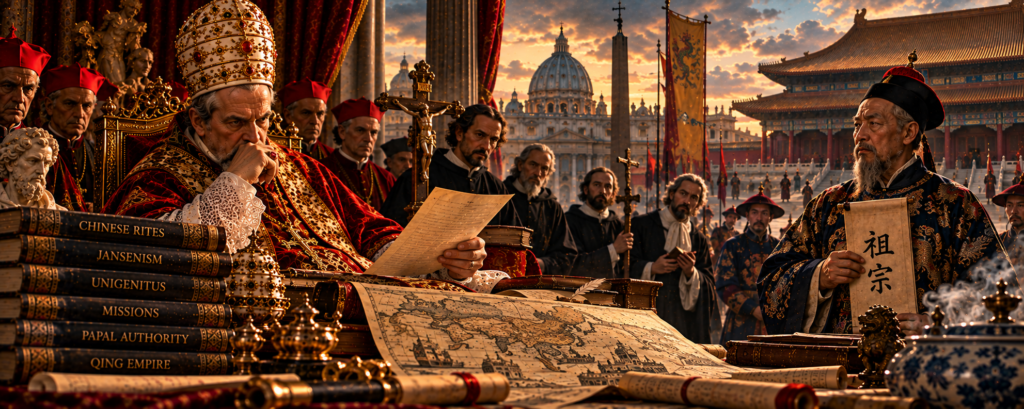
Clement XI: The Pope Who Defied an Emperor and Helped Destroy a Mission
Pope Clement XI (1649–1721) | Reigned 1700–1721
The Emperor Who Lost Patience With Rome
In the early eighteenth century, a remarkable religious experiment was beginning to unravel on the other side of the world. For generations, Catholic missionaries had worked to establish Christianity in China, carefully navigating the customs, intellectual traditions, and political expectations of one of the world’s most sophisticated civilizations. Some had learned Chinese, studied Confucian philosophy, served at the imperial court, and argued that becoming Christian did not require abandoning every aspect of Chinese cultural identity. Their work had attracted influential converts and earned a degree of imperial tolerance that earlier missionaries could scarcely have imagined.
Then Rome intervened.
Pope Clement XI, ruling from the Vatican thousands of miles away, became convinced that certain practices permitted by missionaries in China were incompatible with Christianity. The controversy centered upon ceremonies honoring ancestors, expressions of respect for Confucius, and Chinese terminology used to describe God. To many Chinese participants, these practices were bound up with family duty, education, morality, and the social order. To their opponents within the Catholic Church, they appeared dangerously close to religious worship directed toward someone other than the Christian God.
Clement chose prohibition. In 1704, the Holy Office issued a decree approved by the pope restricting the disputed practices, and in 1715 he reinforced the position through the papal constitution Ex illa die. Missionaries were required to obey, and those who refused faced severe ecclesiastical penalties. The decision was intended to preserve the purity and unity of Catholic teaching, but it helped produce one of the most damaging confrontations in the history of Christian missions.
The Kangxi Emperor, who had previously shown considerable interest in Western learning and permitted Catholic missionaries to operate under certain conditions, reacted with increasing anger. He regarded Rome’s interference as a misunderstanding of Chinese traditions and an unacceptable challenge to imperial authority. The dispute deteriorated until missionaries faced a terrible choice between obedience to the pope and compliance with the emperor whose permission allowed them to remain in China. The fragile accommodation that had taken decades to construct began collapsing.
For Clement XI, the controversy was a question of religious truth and ecclesiastical authority. For the Kangxi Emperor, it was also a question of whether foreigners could dictate how Chinese subjects honored their ancestors and respected their civilization. For Chinese Catholics, it was something more intimate: whether they could remain faithful to Christianity without severing practices that connected them to their families and communities. The consequences would extend far beyond Clement’s lifetime.
Yet the Chinese Rites controversy was only one of the crises that consumed his twenty-year pontificate. In Europe, Clement struggled through the War of the Spanish Succession, watched foreign armies threaten the Papal States, and discovered that Catholic monarchs could ignore papal protests whenever political interests demanded it. In France, his condemnation of Jansenist theology through the bull Unigenitus provoked decades of religious resistance. Across the world, disputes over missionary methods raised fundamental questions about how Christianity should interact with unfamiliar cultures.
Clement was not a notorious libertine, a murderous tyrant, or an extravagant prince who openly treated the papacy as a source of personal pleasure. He was widely regarded as devout, intellectually serious, and personally conscientious. His controversial reputation rests instead upon decisions made in the name of religious responsibility, decisions whose consequences proved far more damaging than he intended. His story is a reminder that a ruler does not need to be personally depraved to exercise power in ways that leave a painful historical legacy.
Giovanni Francesco Albani: The Scholar Who Became Pope
Giovanni Francesco Albani was born on July 23, 1649, in Urbino, a city with a distinguished Renaissance heritage. His family belonged to the local nobility and traced its ancestry to Albanian origins, a connection that would remain important to his identity and later religious interests. The Albani possessed status and connections, although they were not among the most spectacularly wealthy dynasties associated with earlier papacies. Giovanni Francesco grew up in an environment where education, family honor, and ecclesiastical advancement were closely connected.
As a young man, he was sent to Rome to pursue his education. He studied at the Collegio Romano and developed a strong interest in classical literature, philosophy, theology, and law. His intellectual ability attracted attention, and he became associated with scholarly circles that valued historical learning and careful argument. Unlike some notorious Renaissance popes, whose early careers were shaped by military ambitions or spectacular family maneuvering, Albani’s reputation rested heavily upon learning and administrative competence.
He entered papal service and gradually advanced through the Roman Curia. His abilities made him useful in the preparation of official documents, theological discussions, and matters requiring legal expertise. He served under several popes, acquiring a detailed understanding of how the Church’s central government operated. This long apprenticeship would later influence both his strengths and his limitations as pontiff.
Albani became a cardinal in 1690 under Alexander VIII. He was not yet a priest when he received the cardinalate, something permitted within the ecclesiastical structures of the period. His clerical career subsequently progressed, and he was ordained a priest shortly before his election to the papacy. The sequence illustrates how different the early modern cardinalate could be from modern expectations about ecclesiastical advancement.
His reputation was generally favorable. Contemporaries described him as learned, courteous, devout, and capable of sustained attention to complex questions. He was not known primarily for personal scandal or extravagant indulgence. His intellectual seriousness made him attractive to cardinals who wanted a pope capable of confronting the challenges facing the Church.
Yet learning could become a liability when a ruler mistook institutional expertise for universal understanding. Albani knew the traditions of the Roman Church intimately, but he had never lived among the communities whose religious practices he would later regulate in China. His training prepared him to distinguish theological propositions and legal obligations. It did not necessarily prepare him to interpret the cultural meaning of ceremonies performed thousands of miles from Rome.
That tension would define his pontificate. Clement possessed considerable knowledge, but the most consequential dispute of his reign concerned the limits of what Rome knew about another civilization. His education gave him confidence in the Church’s ability to settle religious controversies. The Chinese Rites affair would expose the danger of applying that confidence to a situation in which the facts themselves were deeply contested.
The Conclave of 1700: A Pope Elected as Europe Approached War
The death of Innocent XII in September 1700 brought the cardinals together at a moment of extraordinary European uncertainty. Charles II of Spain was gravely ill and had no children, leaving the succession to one of Europe’s greatest monarchies unresolved. The Spanish empire included territories in Europe and overseas, and its inheritance threatened to upset the balance of power between the Bourbon and Habsburg dynasties. The cardinals knew that the next pope would face an international crisis almost immediately.
The conclave lasted several weeks. European political interests influenced the proceedings, as they had influenced papal elections for generations. France and the Habsburg powers watched carefully because the pope’s position could affect disputes involving Italy, ecclesiastical appointments, and the legitimacy of rival dynastic claims. Even when cardinals spoke of spiritual qualifications, the political implications of their choice remained impossible to ignore.
Albani emerged as a compromise candidate. His reputation for learning, personal piety, and administrative experience made him acceptable to competing factions. He was elected on November 23, 1700, and took the name Clement XI. At fifty-one, he was relatively young for a pope of the period, raising the possibility of a long and influential reign.
His election occurred shortly after the death of Charles II of Spain on November 1. The Spanish king’s will designated Philip, Duke of Anjou, a grandson of Louis XIV, as his successor. The decision alarmed the Austrian Habsburgs and other European powers, which feared that Bourbon control of Spain could make France dangerously dominant. The crisis would soon become a continent-wide war.
Clement inherited the difficult position of a pope expected to defend ecclesiastical interests while navigating rival Catholic monarchies. France and Austria were both powerful Catholic states, but their dynastic ambitions were incompatible. The pope could not satisfy one without risking the anger of the other. His spiritual authority did not free him from the political consequences of choosing sides.
The new pontiff initially attempted to maintain a degree of diplomatic balance. Yet the struggle over the Spanish throne would repeatedly force decisions upon him. Armies moved through Italy, governments demanded recognition, and territories traditionally associated with papal influence became bargaining pieces in a larger conflict. Clement’s long pontificate began with a reminder that the pope was no longer the unquestioned arbiter of Catholic Europe’s political affairs.
A Religious Mission Built on an Unusual Compromise
To understand Clement’s most consequential controversy, it is necessary to return to China long before his election. Catholic missionaries had entered the country during earlier centuries, but the Jesuit mission established in the late sixteenth century developed an especially influential approach. Its most famous pioneer was Matteo Ricci, an Italian Jesuit who arrived in China in 1583 and eventually gained access to the intellectual and political circles of the Ming empire. Ricci believed that Christianity could be presented through serious engagement with Chinese learning rather than through the wholesale rejection of Chinese civilization.
Ricci studied the Chinese language and immersed himself in Confucian texts. He adopted the appearance and manners of a learned scholar, recognizing that intellectual credibility mattered enormously among China’s educated elite. His approach differed from missionary methods that treated local customs primarily as obstacles to conversion. He attempted to distinguish between practices he considered incompatible with Christianity and customs that could be understood as civil, ethical, or social obligations.
The distinction was crucial. Chinese society placed enormous importance upon filial piety, the duty of children and descendants to honor their parents and ancestors. Ceremonies associated with ancestral remembrance were embedded in family life, social hierarchy, and moral education. Respect for Confucius likewise occupied an important place within the intellectual traditions of the educated classes.
Ricci and some of his successors argued that certain ceremonies could be understood as expressions of respect rather than religious worship. If that interpretation was correct, Chinese Christians might participate without violating the commandment against worshiping other gods. The approach allowed converts to remain connected to important elements of their cultural identity. It also made Christianity more acceptable to people who might otherwise regard conversion as a rejection of family obligations.
The Jesuits’ success was never universal, and the mission faced considerable obstacles. China possessed its own sophisticated religious, philosophical, and political traditions, and Christianity remained a minority faith. Nevertheless, Jesuit missionaries established relationships with influential scholars and officials. Their knowledge of astronomy, mathematics, cartography, and other sciences helped secure opportunities at the imperial court.
The missionary experiment therefore depended upon more than theological compromise. It rested upon trust, cultural translation, and the belief that Christianity could coexist with aspects of Chinese civilization. The Jesuits did not abandon Catholic doctrine, but they sought to distinguish doctrine from European custom. That distinction would become the central battlefield of the Chinese Rites controversy.
The Chinese Catholics Caught Between Two Worlds
For Chinese converts, Christianity was not simply a European institution transplanted into unfamiliar soil. It became part of their personal religious lives, family relationships, and intellectual commitments. Some converts came from educated backgrounds and participated actively in discussions about how Christian belief related to Confucian ethics. They were not merely passive recipients of missionary instruction. They helped interpret, defend, and adapt the faith within their own cultural environment.
The question of ancestor ceremonies carried particularly serious consequences. A Chinese Christian who refused to participate in established family practices could be regarded as neglecting duties toward parents and ancestors. Such refusal might damage family relationships and provoke accusations of disrespect. Conversion therefore threatened to become socially disruptive if missionaries insisted that every traditional ceremony was religiously forbidden.
Supporters of accommodation believed this danger could be avoided through careful interpretation. They argued that honoring ancestors did not necessarily mean worshiping them as gods. The ceremonies could be understood as expressions of gratitude, remembrance, and filial duty. In that understanding, Christianity and Chinese moral traditions were not inherently incompatible.
Opponents feared that the distinction was too convenient. They worried that ceremonies involving offerings, ritual gestures, and traditional language might carry religious meanings regardless of how converts explained them. A missionary who permitted such practices could unintentionally encourage participation in what Catholic theology considered idolatry. From that perspective, accommodation threatened the integrity of Christian worship.
Both sides claimed to be protecting Chinese converts. The Jesuits and their allies feared that unnecessary prohibitions would alienate converts from their families and destroy the mission’s credibility. Critics feared that permissive policies would create a compromised form of Christianity that retained unacceptable religious practices. The dispute was therefore not simply between people who understood China and people who did not care about it.
Yet the balance of experience was unequal. Missionaries who had spent years studying Chinese language and customs often possessed detailed knowledge unavailable to officials in Rome. Chinese Christians themselves had direct experience of the ceremonies under debate. Their interpretations deserved serious attention, even when European theologians ultimately disagreed with them.
The tragedy was that the dispute increasingly became a struggle over ecclesiastical authority. Once rival missionary groups appealed to Rome, the question was no longer merely what Chinese ceremonies meant. It became a test of whether missionaries would obey decisions issued by the Church’s central government. The people whose cultural practices were being judged risked losing control over the discussion.
Jesuits, Dominicans, and Franciscans: A Mission Divided Against Itself
The Chinese Rites controversy was intensified by rivalry among Catholic missionary orders. Jesuits had developed the most influential accommodationist approach, but Dominicans and Franciscans arriving in China often questioned its theological foundations. Some believed the Jesuits had compromised too much in their efforts to win influential converts. Others were concerned about missionary methods, terminology, and the relationship between Christianity and Chinese society.
These disagreements were not entirely uniform. Missionaries within the same order could hold different views, and positions evolved over time. Some Dominicans and Franciscans eventually became more sympathetic to accommodation, while not every Jesuit supported precisely the same practices. The familiar image of all Jesuits defending Chinese rites against all members of other orders oversimplifies a long and complicated debate.
Nevertheless, institutional rivalry contributed to the conflict. Different missionary groups competed for influence, converts, resources, and ecclesiastical authority. Disputes about doctrine could become entangled with questions of jurisdiction and prestige. Each side had reasons to portray its interpretation as the one most faithful to Catholic teaching.
The controversy reached Rome well before Clement XI became pope. In 1645, Roman authorities issued restrictions after receiving critical reports about Chinese practices. In 1656, a different decision permitted certain ceremonies under specified interpretations. The apparently contradictory rulings reflected differences in the questions presented and the descriptions of the practices being examined.
Those earlier decisions reveal how difficult the problem was. Rome was being asked to judge ceremonies whose meaning depended upon language, intention, social context, and historical tradition. Different witnesses described the same practices in different ways. The resulting uncertainty created opportunities for both theological argument and institutional conflict.
By the late seventeenth century, the controversy had become increasingly bitter. Missionaries appealed to Roman congregations, published defenses, and accused opponents of misunderstanding or endangering the faith. Chinese converts also participated in the debate, defending the interpretation of their traditions that they believed compatible with Christianity. The dispute was no longer a minor disagreement among isolated missionaries.
Clement inherited this tangled history. He did not invent the Chinese Rites controversy, and the divisions had developed over many decades. His responsibility lay in the decisions he made when asked to settle it. Those decisions would transform a difficult internal dispute into a confrontation with the Qing imperial government.
Charles Maigrot and the Campaign Against Accommodation
One of the most important opponents of the accommodationist position was Charles Maigrot, a French missionary associated with the Paris Foreign Missions Society. He served as an apostolic vicar in China and became convinced that certain practices tolerated by Jesuit missionaries were incompatible with Christianity. His objections focused upon ancestral ceremonies, honors paid to Confucius, and terminology used for God. He believed that missionary concessions had crossed the boundary between cultural adaptation and religious compromise.
In 1693, Maigrot issued a mandate condemning aspects of the Chinese rites. The decision intensified controversy among missionaries and helped bring the dispute before Roman authorities again. Supporters of accommodation regarded his interpretation as insufficiently informed by Chinese language and culture. His allies considered him a courageous defender of Christian orthodoxy.
Maigrot’s position became especially significant because it offered Rome a framework for decisive intervention. The controversy could be presented as a choice between permitting idolatrous practices and preserving doctrinal purity. Such a formulation favored prohibition because the Church had a clear obligation to oppose idolatry. The more difficult question was whether the disputed ceremonies actually constituted idolatry.
That distinction was never merely academic. A ceremony could carry different meanings in different contexts, and participants might understand it differently from outside observers. The same outward gesture could be interpreted as religious worship, civic respect, or family remembrance. Determining its meaning required more than identifying its physical form.
Maigrot and his supporters feared that accommodationists were accepting explanations that concealed unacceptable religious elements. Jesuits countered that critics were imposing European categories upon Chinese practices without sufficient understanding. Both positions could appeal to legitimate theological concerns. The disagreement concerned how those concerns should be applied.
Rome eventually favored the restrictive interpretation. The decision would give Maigrot’s position enormous institutional authority, even though his understanding of Chinese traditions remained contested. Once the pope approved a prohibition, missionaries were expected to comply regardless of their personal assessment. The conflict moved from debate toward enforcement.
The consequences would soon become international. The Qing court did not regard these ceremonies as matters that foreign religious authorities could freely redefine. The emperor considered himself responsible for maintaining the moral and political order of his realm. Rome’s intervention therefore challenged more than missionary practice.
The Kangxi Emperor: A Ruler Who Had Welcomed Western Knowledge
The Kangxi Emperor was one of the most important rulers of the Qing dynasty. He ascended the throne as a child in 1661 and eventually exercised personal authority over an expanding and increasingly consolidated empire. His reign was marked by military campaigns, administrative development, intellectual interests, and efforts to strengthen Qing rule. He was neither an isolated despot ignorant of foreign ideas nor a ruler automatically hostile to Christianity.
Kangxi took a serious interest in Western science and technology. Jesuit missionaries provided expertise in astronomy, mathematics, calendar reform, cartography, and other fields valued at court. Their knowledge helped establish relationships that gave some missionaries access unavailable to ordinary foreigners. The emperor could appreciate their technical abilities without accepting Christianity himself.
In 1692, Kangxi issued an edict that permitted Catholic missionary activity under favorable conditions. The decision reflected a willingness to tolerate the religion when it appeared compatible with public order. It did not mean that Christianity enjoyed unrestricted freedom or that the emperor had surrendered control over religious affairs. Tolerance remained dependent upon imperial authority.
The arrangement nevertheless represented a major opportunity. Missionaries could operate with a degree of security, and Chinese Christians could practice their religion without automatically facing official hostility. The Jesuits believed their patient efforts at cultural engagement were bearing fruit. The mission’s future appeared more promising than it had during many earlier periods.
Kangxi’s tolerance also depended upon his understanding of the missionaries’ relationship to Chinese traditions. He regarded Confucian ceremonies and ancestral observances as important elements of social and moral life. If Christianity required Chinese subjects to reject those practices, the religion would become more difficult to reconcile with imperial order. The distinction mattered deeply to him.
The emperor therefore had a direct interest in the controversy unfolding among European missionaries. He was not simply waiting for Rome to decide what Chinese culture meant. He possessed his own interpretation, informed by the political and intellectual traditions of his empire. When papal representatives eventually arrived to enforce prohibitions, they encountered a ruler unwilling to accept foreign judgments without challenge.
This was the collision Clement XI failed to manage. The pope believed he was exercising legitimate authority over Catholic worship. Kangxi believed foreign missionaries were attempting to impose restrictions upon practices central to Chinese civilization. Neither ruler was accustomed to accepting another authority’s judgment in matters he considered fundamental.
The Decree of 1704: Rome Makes Its Decision
On November 20, 1704, the Holy Office issued a decree approved by Clement XI that rejected important elements of the accommodationist position. The ruling restricted Chinese Catholics from participating in specified ceremonies honoring Confucius and ancestors. It also addressed terminology used to refer to the Christian God. The decision marked a major turning point in the controversy.
The terminology question was particularly revealing. Jesuit missionaries had used Chinese expressions such as Tian and Shangdi in efforts to communicate Christian ideas about God. Opponents argued that these terms carried associations with Chinese religious and philosophical traditions that made them unsuitable. Rome favored Tianzhu, commonly translated as “Lord of Heaven,” as the acceptable designation.
To European theologians, the dispute concerned the precision of religious language. Words used for God had to convey the correct theological meaning. A term associated with non-Christian beliefs might introduce confusion or encourage religious syncretism. From that perspective, restrictions could appear prudent.
Yet translation always involves interpreting unfamiliar concepts. Chinese words possessed histories and meanings that could not be reduced neatly to European theological categories. Missionaries who had studied the language disagreed about which expressions best communicated Christian belief. The decree therefore imposed a particular judgment upon a complex linguistic problem.
The restrictions on ceremonies were even more consequential. Ancestral observances touched family life, education, and social expectations. Prohibiting them could force converts into conflict with relatives and local authorities. What Rome regarded as a doctrinal clarification could become a deeply disruptive social command.
Clement approved the decision because he believed the Church had to prevent religious error. There is no sound reason to assume he intended to destroy the Chinese mission. The tragedy lies in the distance between intention and consequence. A ruling meant to preserve Christianity’s integrity helped undermine the conditions that had allowed Christianity to spread.
The decree also demonstrated the power imbalance within the missionary system. Chinese converts had participated in defending their traditions, but the final decision came from Rome. Their interpretations could be rejected by officials who had never experienced the ceremonies in their original setting. The universal claims of the Church were now being asserted in a way that the Qing government would increasingly regard as intolerable.
The Papal Envoy Who Carried Rome’s Judgment to China
Clement XI sent Charles-Thomas Maillard de Tournon as his representative to Asia. Tournon had been entrusted with broad authority to address missionary disputes and enforce papal decisions. His mission was ambitious, involving travel across vast distances and negotiations within political environments very different from Europe. The pope expected his envoy to restore discipline and bring clarity to controversies that had divided missionaries for decades.
Tournon departed Europe in 1703 and traveled first to India. There he became involved in another controversy over local customs, commonly known as the Malabar Rites dispute. In 1704, he issued restrictions on practices associated with Catholic communities in southern India. The episode revealed his determination to enforce strict interpretations of acceptable Christian behavior.
He subsequently continued toward China, arriving in Macau in 1705 and reaching Beijing later that year. His mission placed him in direct contact with the Kangxi Emperor. At first, the possibility of a diplomatic understanding had not entirely disappeared. The emperor had previously welcomed Jesuit expertise and was accustomed to dealing with foreign specialists.
Yet Tournon’s authority rested upon instructions from Rome, while Kangxi expected foreign missionaries to respect Chinese political and cultural norms. The two sides approached the controversy from fundamentally different positions. Tournon regarded papal decisions as binding upon Catholic missionaries and converts. Kangxi regarded the interpretation of Chinese rites as a matter on which Chinese authorities possessed superior knowledge.
The negotiations deteriorated. The emperor questioned the competence of those condemning practices they did not adequately understand. Tournon could not simply disregard Rome’s position without undermining the authority he had been sent to represent. The conflict became increasingly personal and political.
The situation was worsened by disagreements among the missionaries themselves. Jesuits familiar with the court feared that rigid enforcement would destroy their relationships with Chinese officials. Opponents of accommodation believed that compromise would perpetuate theological error. Tournon found himself surrounded by competing accounts and conflicting loyalties.
By the time he left Beijing, the mission had failed to secure the agreement Clement desired. Instead of reconciling Rome and the Qing court, it had deepened suspicion. The emperor was increasingly convinced that some European missionaries were unwilling to respect Chinese traditions. Tournon remained determined to enforce the papal position.
The Edict of Nanjing: A Missionary’s Choice Becomes Impossible
In January 1707, Tournon issued a mandate at Nanjing enforcing restrictions upon the Chinese rites. The measure threatened ecclesiastical penalties against missionaries who permitted prohibited practices. It reflected the restrictive position adopted in Rome and made obedience a central issue. Missionaries who had spent years building relationships through accommodation now faced an institutional command that threatened their work.
The Kangxi Emperor responded by tightening control over missionary activity. Missionaries wishing to remain in China were required to obtain imperial permission, commonly associated with the piao system. The emperor expected them to accept the interpretation of Chinese rites that had supported the earlier accommodationist approach. Those unwilling to comply faced expulsion.
The result was a devastating conflict of obligations. A missionary could obey Rome and risk losing permission to work in China. Alternatively, he could satisfy the emperor and risk violating papal restrictions. The situation placed priests in a position where loyalty to one authority could be interpreted as betrayal of another.
For Chinese Catholics, the consequences were equally serious. Their religious communities depended upon missionaries for sacraments, instruction, and connections with the wider Church. If missionaries were expelled or forced to suspend their activities, converts could lose access to essential religious services. The dispute threatened communities that had taken generations to establish.
Tournon himself suffered the consequences of the confrontation. He was sent to Macau, where he remained under confinement and restrictions imposed through the Portuguese authorities governing the settlement. His position was complicated by the competing jurisdictions and interests of Portugal, the Qing government, and the Holy See. The man sent to impose Rome’s authority had become trapped within the political world he was supposed to regulate.
In 1707, Clement elevated Tournon to the cardinalate, although the envoy’s circumstances prevented him from enjoying the ordinary privileges of that rank. He died in Macau on June 8, 1710. His death became another source of bitterness within the controversy. Supporters portrayed him as a faithful servant who had suffered for defending the Church’s authority.
Later polemical accounts circulated accusations concerning responsibility for his suffering and death. Such claims should not be accepted without careful evidence, particularly when they emerged from bitter rivalries among missionary factions. Tournon’s confinement and death were real, but sensational allegations of deliberate murder belong to the contested history of the dispute. His fate nevertheless demonstrated how badly the mission had deteriorated.
A Pope Who Refused to Retreat
Tournon’s failure did not persuade Clement XI to abandon the restrictive policy. Instead, Rome reinforced the decisions already made. In September 1710, a further decree supported the earlier prohibitions and the authority exercised by the papal legate. The measures also restricted unauthorized publications and renewed the threat of ecclesiastical penalties. Clement appeared determined to prevent the controversy from continuing indefinitely.
From the pope’s perspective, retreat carried serious dangers. If missionaries could disregard Roman decisions whenever they considered local customs compatible with Christianity, ecclesiastical unity might become difficult to maintain. The Church’s central government feared that competing missionary interpretations would produce inconsistent religious practices. Clement believed that clarity and obedience were essential.
Yet the controversy had never been simply a question of disobedient missionaries. It involved disputed evidence about the meaning of Chinese ceremonies. Missionaries with long experience in China continued to believe that the restrictive interpretation was mistaken. Chinese Christians also had reasons to reject the assumption that honoring ancestors necessarily constituted idolatry.
The papal response increasingly treated continued disagreement as a threat to authority. Once Rome had issued a ruling, further debate could appear to challenge the legitimacy of the decision itself. The possibility that the original judgment might have been based upon incomplete cultural understanding became harder to acknowledge. Institutional self-defense began shaping the response.
This pattern was not unique to the Chinese Rites controversy. Early modern religious institutions frequently treated doctrinal disputes as tests of obedience. The distinction between a sincere disagreement and an act of rebellion could become blurred. Clement’s government was especially concerned with preserving the authority of decisions made by the Holy Office.
The result was a narrowing of possible solutions. Accommodationists could no longer argue freely for their interpretation without risking suspicion. Missionaries were expected to implement restrictions that threatened their ability to remain in China. The emperor, meanwhile, had little reason to accept that Rome possessed superior authority over Chinese ceremonial life.
Clement’s persistence was therefore both understandable within his institutional worldview and damaging in its consequences. He believed he was defending a universal faith against unacceptable compromise. The Qing government saw a foreign authority refusing to respect the traditions of the empire. The missionaries and converts caught between them bore the practical cost.
Ex Illa Die: The Decree That Deepened the Rupture
On March 19, 1715, Clement XI issued the papal constitution Ex illa die. The document reaffirmed the restrictions on Chinese rites and terminology. It required missionaries to accept the prescribed rules and reinforced the obligation of obedience. The pope intended the constitution to provide a definitive settlement.
The decision came after years of controversy, failed negotiations, and increasingly strained relations with the Qing court. Clement had received reports describing the difficulties caused by earlier restrictions. He knew that the issue was affecting missionary activity and imperial tolerance. Nevertheless, he concluded that the Church could not permit the disputed practices.
The constitution prohibited certain forms of participation in ceremonies honoring Confucius and ancestors. It also reinforced restrictions upon Chinese terminology for God. Missionaries were required to take an oath of compliance. Those who resisted faced the possibility of excommunication and exclusion from missionary work.
The oath was especially significant because it transformed a disputed interpretation into a personal obligation. Missionaries could no longer simply follow the approach they believed best supported by their experience. They were required to affirm the Roman judgment as a condition of legitimate ministry. The controversy became a test of loyalty.
For the Qing government, the constitution confirmed the fears that had developed during Tournon’s mission. Rome was not merely advising its missionaries on private theological matters. It was issuing commands that affected the conduct of Chinese subjects within Chinese society. The emperor regarded that interference as an affront to his authority.
The document also created difficulties for Chinese Christians. Their ability to participate in ancestral and Confucian ceremonies was restricted by a foreign religious institution. Practices that many regarded as expressions of family duty became potential grounds for ecclesiastical punishment. Conversion could therefore require a painful separation from important aspects of ordinary social life.
The consequences were not instantaneous or uniform. Some missionaries continued operating under imperial permission, and Catholic communities did not simply disappear. The Chinese mission had already developed local roots that could survive periods of official hostility. Nevertheless, Clement’s decision seriously weakened the accommodationist framework that had helped make the mission possible.
The pope had sought certainty. What he produced was a more rigid conflict between religious authority and cultural practice. The document became one of the defining acts of his pontificate and one of the most controversial decisions in the history of Catholic missions. Its legacy would endure for more than two centuries.
The Emperor’s Anger and the Closing of Doors
The Kangxi Emperor’s reaction to the Roman restrictions was shaped by both cultural disagreement and political authority. He believed the ceremonies under dispute were integral to Chinese civilization and had been misunderstood by European religious officials. He also resented the implication that the pope could regulate the conduct of Chinese subjects without regard for imperial judgment. The controversy therefore became a challenge to the relationship between the Qing state and foreign missionaries.
Kangxi did not initially respond by eliminating every Catholic presence in China. His government distinguished between missionaries who complied with imperial requirements and those who opposed the accepted interpretation of Chinese rites. Some Jesuits continued serving at court because their scientific and technical expertise remained valuable. The situation was therefore more complicated than a sudden universal expulsion.
Nevertheless, restrictions increased and the climate became less favorable. Missionaries who refused to accept the imperial conditions risked removal. The emperor’s earlier willingness to tolerate Christianity was undermined by his growing distrust of Roman interference. A relationship built upon accommodation was being replaced by suspicion.
The emperor’s position was not merely an emotional reaction to a religious insult. Qing rulers had strong reasons to control foreign organizations operating within their territories. A religious institution claiming authority over Chinese subjects could appear politically dangerous if its commands conflicted with imperial expectations. The Chinese Rites controversy made that potential conflict unmistakable.
Kangxi’s later statements expressed profound frustration with the European understanding of Chinese customs. He regarded the Roman restrictions as evidence that foreign religious authorities did not adequately comprehend the civilization they were judging. His objections were not simply that Christianity differed from Chinese traditions. They concerned the insistence that Chinese practices be condemned through categories he considered mistaken.
The controversy helped prepare the way for stronger anti-Christian policies after Clement’s death. In 1724, under the Yongzheng Emperor, Christianity faced a broader imperial prohibition. The later policy had multiple causes, including concerns about foreign influence and religious organization. It should not be attributed exclusively to Clement XI.
Even with that qualification, the pope’s decisions contributed substantially to the deterioration of relations. They damaged the credibility of missionaries who had argued that Christianity could coexist with Chinese moral traditions. They also reinforced the Qing court’s concern that foreign religious authority could interfere with imperial governance. Clement did not single-handedly destroy Christianity in China, but he helped close a door that earlier missionaries had worked hard to open.
The Chinese Christians Whose Voices Were Overruled
The most painful aspect of the controversy is that Chinese Christians were not merely objects of missionary policy. They possessed their own religious convictions and interpretations of Chinese traditions. Educated converts had participated in arguments about the compatibility of Confucian ethics and Christianity. Some defended ancestral ceremonies as expressions of respect rather than worship.
Their participation complicates the familiar story of European missionaries debating foreign customs among themselves. Chinese Catholics were capable of explaining their practices and defending their understanding of them. They could distinguish between honoring ancestors and treating them as divine beings. Their arguments were part of the intellectual history of the mission.
Yet their influence upon the final Roman decision was limited. Ecclesiastical authority remained concentrated in European institutions, and reports reaching Rome passed through missionary networks shaped by rivalry. Chinese testimony could be filtered, challenged, or dismissed. The decision-making process therefore reflected inequalities within the global Church.
For converts who had accepted Christianity through accommodationist teaching, the restrictions could be bewildering. Practices previously permitted by missionaries were suddenly condemned. Religious obligations appeared to change because officials thousands of miles away had reached a different conclusion. The result could undermine confidence in the missionaries themselves.
Some converts faced pressure from relatives who regarded Christianity as hostile to filial duty. Others had to navigate conflicting instructions from different priests. The dispute could divide communities that had already experienced the difficulties of belonging to a minority religion. The cost was borne in households and local relationships, not merely in theological correspondence.
The controversy also raised a question that would become increasingly important in later missionary history. Could Christianity take root within a non-European civilization without requiring converts to adopt European cultural assumptions? The Jesuit accommodationists believed that substantial adaptation was possible. Clement’s decisions imposed much narrower boundaries.
It would be misleading to portray all Chinese Christians as supporters of the same position. Converts differed in background, belief, and interpretation, just as European missionaries did. Some may have welcomed stricter separation from traditional ceremonies. Nevertheless, the controversy demonstrates the danger of allowing distant authorities to define a culture without giving sufficient weight to the people who live within it.
The tragedy was therefore not simply that Rome offended an emperor. It was that a religious mission increasingly lost the flexibility required to engage the society in which it operated. Chinese Catholics found themselves caught between a Church demanding obedience and a government demanding respect for Chinese traditions. Their predicament was the human consequence of a dispute that European authorities often discussed in abstract theological terms.
The Last Attempt at Compromise
Clement eventually recognized that the situation in China required further diplomatic attention. In 1719, he sent another papal representative, Carlo Ambrogio Mezzabarba, to attempt to ease the conflict. The mission was intended to address the damage caused by earlier decisions while preserving Rome’s doctrinal authority. It reflected the difficulty of reconciling two positions that had become increasingly rigid.
Mezzabarba reached China and attempted negotiations with the Qing court. The Kangxi Emperor remained dissatisfied with the Roman restrictions and skeptical of the willingness of papal representatives to understand Chinese traditions. The legate therefore faced many of the same obstacles that had defeated Tournon. The central disagreement had not disappeared.
The mission failed to secure a durable settlement. Mezzabarba eventually left the imperial court without obtaining the reconciliation Clement desired. During his return journey, he issued permissions concerning certain practices in an effort to ease the difficulties faced by missionaries. These concessions became another source of controversy because their relationship to the earlier prohibitions was disputed.
The timing is important. Clement died in March 1721, before Mezzabarba issued his well-known permissions at Macau later that year. The pope therefore cannot be credited with personally approving every concession associated with the legate’s return. Subsequent Roman authorities would revisit and eventually restrict those permissions. The controversy continued beyond Clement’s lifetime.
The failed mission illustrates the limits of compromise after positions have hardened. Rome wanted to preserve the authority of its earlier rulings. The Qing court wanted recognition that Chinese ceremonies had been misunderstood and that imperial authority could not be overridden. Neither side was prepared to concede the central principle.
Mezzabarba’s efforts also show that the papacy was not indifferent to the mission’s survival. Clement had reasons to seek a workable settlement and did not simply abandon Chinese Catholics. His problem was that he wanted reconciliation without substantially reversing the decision that had helped produce the rupture. That combination proved extraordinarily difficult.
The dispute remained unresolved when Clement died. The mission’s future was uncertain, and relations with the Qing government had deteriorated badly. Later popes would inherit the same problem. The Chinese Rites controversy had become one of the most enduring consequences of Clement’s reign.
A Second Asian Controversy: The Malabar Rites
China was not the only place where Catholic missionaries debated accommodation to local customs. In southern India, missionaries had developed practices intended to distinguish Christianity from European social habits. The most famous example involved Roberto de Nobili, a Jesuit who adopted aspects of Indian scholarly and ascetic culture while seeking to communicate Christianity to local communities. His methods raised questions about caste, social customs, religious symbols, and the boundaries of acceptable adaptation.
The Malabar Rites controversy involved practices associated with Indian social and religious life. Some missionaries believed that certain customs could be separated from their non-Christian religious meanings and permitted among converts. Others argued that the practices remained inseparable from beliefs incompatible with Christianity. The dispute resembled the Chinese controversy in its underlying tension between adaptation and doctrinal uniformity.
Tournon addressed the issue during his journey to Asia. In 1704, he issued a decree at Pondicherry restricting practices associated with the Malabar rites. His intervention demonstrated the strict approach he would later apply in China. It also showed that Rome’s concerns extended beyond one civilization or one missionary order.
The controversy was complicated by the social realities of caste. Missionaries had to decide whether converts could retain markers of social identity that were deeply embedded in local communities. Some accommodations risked preserving social discrimination within Christian congregations. Others involved customs whose religious meaning was contested. The questions were therefore not identical to those surrounding Chinese ancestral ceremonies.
Clement’s broader missionary policy favored stronger central control over disputed practices. The intention was to prevent Christianity from becoming entangled with beliefs considered incompatible with Catholic doctrine. Yet such control could also make the religion appear foreign and socially disruptive. Missionaries working among local populations faced consequences that officials in Rome could not always anticipate.
The Indian controversy reinforces the larger significance of Clement’s reign. The pope was participating in a global debate over whether Catholicism could become culturally diverse while remaining doctrinally unified. His decisions tended toward restricting practices whose meanings appeared uncertain or dangerous. That approach protected one understanding of religious consistency while limiting opportunities for cultural accommodation.
The issue would remain unresolved long after Clement’s death. Later popes continued issuing rulings concerning Asian missionary practices. The persistence of these disputes demonstrates that they could not be settled simply by commanding obedience. They involved fundamental questions about religion, culture, and the interpretation of human behavior.
France and the Religious War That Never Quite Ended
While Clement struggled with China, he faced another controversy much closer to Rome. Jansenism had divided French Catholicism for decades, producing disputes over grace, free will, salvation, ecclesiastical authority, and the interpretation of St. Augustine. Earlier popes had condemned propositions associated with the movement, but opposition persisted. The conflict became increasingly entangled with French political and religious life.
Jansenism took its name from Cornelius Jansen, whose posthumously published work Augustinus emphasized humanity’s dependence upon divine grace. Supporters regarded themselves as defenders of authentic Augustinian theology. Opponents accused them of advancing ideas that undermined free will and approached Calvinist positions. The theological arguments were intricate and often difficult for outsiders to follow.
The controversy was not merely a disagreement among scholars. It involved influential religious communities, bishops, political officials, and the French monarchy. Port-Royal became especially associated with Jansenist spirituality and intellectual life. Its supporters included prominent writers and thinkers whose influence extended far beyond the convent’s walls.
Louis XIV regarded religious division as a threat to political stability. The king wanted unity within the French Church and increasingly supported measures against Jansenist resistance. His position was complicated by the Gallican tradition, which defended certain rights of the French Church and monarchy against Roman intervention. France could therefore resist papal authority in one dispute while demanding papal condemnation in another.
Clement inherited this unstable relationship. He was expected to defend Catholic doctrine while navigating the ambitions of a powerful monarch. The pope’s decisions could strengthen royal efforts to suppress religious opposition. They could also provoke resistance from French clergy who feared excessive centralization of authority in Rome.
The conflict would become one of the defining struggles of Clement’s pontificate. Like the Chinese Rites controversy, it involved disputed interpretations and the demand for obedience. Unlike the Chinese dispute, however, it unfolded within a Catholic society whose bishops and theologians possessed considerable influence. Rome could issue condemnations, but enforcing them was another matter.
Vineam Domini: The Pope Rejects Silence
In 1705, Clement issued the constitution Vineam Domini Sabaoth, addressing disputes connected with Jansenism. The document reaffirmed earlier condemnations and challenged attempts to avoid clear acceptance of the Church’s judgments. One contested issue concerned the practice of maintaining respectful silence about whether condemned propositions were actually present in Jansen’s writings. Clement’s intervention sought to prevent that position from undermining ecclesiastical authority.
Supporters of the disputed approach argued that they could accept the Church’s doctrinal condemnation while questioning the factual attribution of propositions to a particular author. The distinction appeared reasonable to some theologians. Rome feared that it allowed opponents to evade the practical force of earlier rulings. The disagreement therefore concerned the relationship between doctrine, historical fact, and obedience.
Clement’s decision did not end the controversy. French theologians continued debating the scope of papal authority, and resistance remained concentrated among influential circles. The dispute increasingly involved questions about whether Rome could demand acceptance of judgments concerning the meaning of particular texts. These issues would become even more explosive in the following decade.
The pope’s approach reflected a strong concern for unity. He believed that persistent qualifications and evasions threatened the authority of ecclesiastical decisions. From his perspective, endless argument could weaken the Church’s ability to teach consistently. His opponents feared that the same demand for certainty could suppress legitimate theological distinctions.
The situation resembled the Chinese controversy in an important respect. Clement encountered a dispute in which participants disagreed not only about doctrine but about how evidence should be interpreted. In China, the evidence concerned the meaning of ceremonies. In France, it concerned the meaning and attribution of theological propositions. In both cases, Rome increasingly treated disagreement as a problem of obedience.
The result was not the peace Clement desired. Instead, the dispute prepared the way for a more sweeping condemnation. Louis XIV continued pressing for decisive action against Jansenist influence. Clement would eventually respond with one of the most controversial papal documents of the eighteenth century.
Pasquier Quesnel and the Book That Alarmed Rome
Pasquier Quesnel was a French theologian associated with Jansenist thought whose writings attracted a substantial readership. His most influential work, commonly known as Moral Reflections on the New Testament, combined biblical passages with spiritual commentary. The book encouraged serious engagement with Scripture and emphasized themes associated with grace, devotion, and Christian moral life. Its popularity made it especially troubling to opponents who considered its theology dangerous.
Quesnel’s career had already been marked by conflict with ecclesiastical authorities. He resisted demands associated with earlier anti-Jansenist measures and eventually lived outside France. His writings circulated despite opposition. The controversy surrounding him became a test of whether Rome and the French monarchy could suppress a theological movement whose ideas had spread widely.
The book’s appeal complicated the issue. It was not simply an obscure technical treatise read by a handful of specialists. Its devotional character made it accessible to clergy and educated laypeople. Readers could encounter spiritual reflections that seemed edifying without recognizing the doctrinal implications critics attributed to them.
Opponents selected propositions they considered unacceptable and pressed for condemnation. The process raised questions about context and interpretation. A sentence extracted from a larger work might appear more extreme when separated from the argument surrounding it. Supporters of Quesnel insisted that some disputed statements could be understood in an orthodox sense.
Clement faced pressure from Louis XIV to issue a definitive judgment. The king wanted to eliminate a source of religious resistance that he regarded as politically dangerous. The pope also had independent theological concerns about the propositions associated with Quesnel. Their interests therefore converged, even though Rome and Versailles disagreed over other matters.
The resulting condemnation would become far more controversial than either ruler anticipated. It was intended to settle a dispute that had troubled French Catholicism for generations. Instead, it created a new crisis over papal authority, episcopal rights, and the limits of doctrinal enforcement. Clement was about to discover that issuing a decree was much easier than persuading everyone to accept it.
Unigenitus: One Hundred and One Propositions Condemned
On September 8, 1713, Clement XI issued the bull Unigenitus Dei Filius. The document condemned 101 propositions drawn from Quesnel’s writings. It represented one of the most important papal interventions in the Jansenist controversy. Clement intended it to provide a decisive answer to teachings he considered incompatible with Catholic doctrine.
The condemned propositions concerned grace, salvation, the Church, Scripture, and religious life. Some reflected theological positions long associated with Jansenism. Others appeared to critics of the bull to resemble statements that could be interpreted in an orthodox Augustinian sense. The range of condemned material contributed to the controversy that followed.
The document did not assign a separate, precisely defined theological censure to every proposition. Instead, it condemned the collection through a range of qualifications. This approach created uncertainty about the exact reason particular statements were unacceptable. Opponents argued that the lack of precision made the bull difficult to interpret and accept.
The Archbishop of Paris, Cardinal Louis-Antoine de Noailles, became one of the most important figures resisting unconditional acceptance. He had previously supported aspects of Quesnel’s work and was reluctant to condemn it without further clarification. Other French bishops and theologians shared concerns. Their resistance was not simply a refusal to acknowledge the pope’s authority.
Louis XIV strongly supported the bull and attempted to secure its acceptance. The king regarded opposition as a threat to religious unity and royal authority. Yet the involvement of the monarchy made the controversy even more political. Critics could portray the condemnation as part of a campaign to suppress legitimate theological discussion.
Clement expected the document to strengthen unity. Instead, it divided the French Church into supporters and opponents of the bull. The dispute involved bishops, universities, religious communities, and political institutions. It became a struggle over who possessed the authority to determine the boundaries of acceptable Catholic belief.
The consequences extended far beyond the immediate condemnation of Quesnel. Unigenitus became a symbol of papal centralization and the suppression of theological dissent. Its opponents would continue resisting long after Clement’s death. A document intended to end controversy became the foundation of a new one.
The Destruction of Port-Royal
The campaign against Jansenism had already produced one of the most disturbing episodes in French religious history. Port-Royal-des-Champs, a convent associated with Jansenist spirituality, had become a symbol of resistance to royal and ecclesiastical pressure. Its community included women committed to a demanding religious life, while its intellectual connections extended into influential circles. Louis XIV regarded the institution as a center of persistent opposition.
In 1709, the remaining nuns were removed from Port-Royal-des-Champs and dispersed to other convents. The decision was carried out under royal authority and formed part of the broader campaign against Jansenism. The women lost their community and the religious environment in which they had lived. The episode demonstrated the coercive power available to a monarchy determined to enforce religious conformity.
The buildings were subsequently demolished in 1710. The destruction transformed an institutional conflict into a physical erasure of a place associated with religious dissent. Port-Royal’s intellectual and spiritual legacy survived, but the community itself was dismantled. The ruins became a symbol of persecution for its supporters.
Clement XI did not personally command every step of the destruction. The principal responsibility for the suppression and demolition lay with Louis XIV’s government. Nevertheless, the events occurred within the broader campaign against Jansenism that Clement supported through doctrinal measures. The pope and king shared an interest in eliminating what they considered dangerous religious error.
The episode illustrates how theological disputes could produce consequences far beyond books and arguments. Women who had devoted their lives to religious practice were forcibly separated from their community. Buildings associated with their identity were destroyed. The campaign sought not merely to refute ideas but to eliminate an institution that preserved them.
For critics of the anti-Jansenist movement, Port-Royal became evidence of authoritarian excess. Supporters of suppression regarded the measures as necessary to end persistent disobedience. The disagreement reflected fundamentally different understandings of religious authority. Clement’s pontificate became inseparable from this wider struggle.
The destruction also foreshadowed the reception of Unigenitus. Suppression could eliminate buildings and disperse communities, but it could not automatically erase beliefs. Jansenist sympathies continued circulating through writings, personal networks, and ecclesiastical resistance. The attempt to impose unity through coercion often intensified the determination of opponents.
The Appeal Against the Pope
The death of Louis XIV in September 1715 changed the political environment surrounding Unigenitus. The king had been one of the strongest supporters of enforcing the bull. His successor was a child, and government passed into the hands of a regency led by Philippe II, Duke of Orléans. The new political circumstances created opportunities for opponents of the papal condemnation.
Resistance intensified among clergy and theologians who considered the bull insufficiently clear or excessively authoritarian. In 1717, a group of opponents appealed to a future general council of the Church. The appeal challenged the finality of Clement’s decision and raised questions about the relationship between papal authority and the wider episcopate. The controversy now threatened the structure of ecclesiastical government itself.
Clement responded firmly. In 1718, the bull Pastoralis Officii condemned the appeals and imposed ecclesiastical penalties upon those who persisted. The pope regarded the challenge as an unacceptable attempt to undermine the authority of the Holy See. His opponents believed they were defending legitimate rights within the Church.
The dispute became increasingly bitter. French Catholics were divided over a document issued by the pope but resisted by important members of the clergy. Political factions used the controversy to advance their interests. Theological disagreement became inseparable from questions of national authority and institutional loyalty.
Clement’s position was consistent with his broader approach to contested religious practices. He believed that the Church required a final authority capable of resolving disputes. Once that authority had spoken, continued resistance threatened unity. His critics argued that such reasoning could turn questionable interpretations into obligations of conscience.
The conflict remained unresolved when Clement died in 1721. Later popes continued defending Unigenitus, while opposition persisted for decades. In France, the controversy contributed to long-term tensions between religious authority, royal government, and influential intellectual circles. The effects reached well beyond the original dispute over Quesnel’s writings.
The pope who had sought to end Jansenism through definitive condemnation left behind a Church still divided by the question. His determination had produced clarity at the level of official doctrine but not peace among those expected to accept it. The pattern was painfully familiar. In China and France alike, Clement discovered that commands could be issued more easily than consensus could be created.
The War of the Spanish Succession: A Pope Between Two Dynasties
While Clement struggled with theological controversies, Europe was consumed by the War of the Spanish Succession. The conflict began after the death of Charles II of Spain and the designation of Philip of Anjou as his heir. France supported Philip, while the Austrian Habsburgs advanced their own claim. England, the Dutch Republic, and other powers became involved because the balance of European power was at stake.
The war placed Clement in an almost impossible diplomatic position. Both Bourbon and Habsburg rulers were Catholic, and both expected the pope to respect their claims. Supporting one side risked alienating the other. Attempting neutrality became increasingly difficult as armies moved through Italy and threatened territories associated with papal authority.
Clement initially showed sympathy toward Philip V’s claim to the Spanish throne. His position reflected legal and diplomatic considerations as well as the pressure of events. Yet the Habsburg cause remained powerful, particularly in Italy. The pope could not control the military developments that would eventually force him to reconsider.
The Papal States were vulnerable because they occupied territory within a peninsula contested by major European powers. Foreign armies could threaten papal lands without needing to conquer Rome itself. Clement possessed limited military resources compared with the great monarchies. His diplomatic independence therefore depended partly upon the willingness of stronger powers to respect it.
As the war progressed, that willingness weakened. Austrian military successes in Italy increased pressure upon the pope. The conflict revealed that Catholic rulers could treat the Papal States as strategically vulnerable territory despite the religious authority of their sovereign. Clement’s position became increasingly precarious.
The war also damaged the pope’s ability to influence the broader settlement. European governments negotiated according to dynastic, territorial, and commercial interests. Papal objections could be considered inconvenient rather than decisive. The political world in which Clement operated had moved far from the age when popes claimed the authority to settle disputes among Christian monarchs.
His diplomatic difficulties were not simply the result of poor judgment. The papacy’s temporal power had declined relative to the major European states. Nevertheless, Clement’s changing position between rival claimants alienated powerful governments and weakened confidence in his diplomacy. He struggled to preserve independence in a conflict that offered little room for it.
1709: The Pope Forced to Yield
By 1709, Austrian military pressure had brought Clement’s diplomatic difficulties to a crisis. Imperial forces had established a strong position in Italy, and the Papal States faced direct threats. The pope could no longer maintain his earlier position without risking serious consequences. The military imbalance was overwhelming.
Clement was compelled to recognize the Habsburg claimant, Archduke Charles, as king of Spain. The concession represented a humiliating reversal from his earlier recognition of Philip V. It demonstrated that the pope’s political decisions could be forced by military pressure. His spiritual office offered no effective shield against the demands of a powerful army.
The reversal angered the Bourbon courts. Louis XIV and Philip V regarded Clement’s conduct as a betrayal of their interests. Relations deteriorated, and the pope faced retaliation from governments whose support he could not afford to lose. The attempt to satisfy Austria had created new enemies.
Clement therefore found himself in the worst possible diplomatic position. He had yielded to one side without securing lasting protection and had alienated the other without gaining a decisive advantage. His authority appeared diminished. European rulers increasingly treated papal diplomacy as a factor to be managed rather than a power to be obeyed.
The crisis also exposed the vulnerability of the Papal States as a temporal monarchy. The pope could issue spiritual judgments, appoint bishops, and govern the Church, but he could not defend his territory against a major European army. His political independence depended upon circumstances beyond his control. The contradiction was increasingly difficult to conceal.
Clement’s experience echoed the humiliation suffered by earlier popes in conflicts with France and other monarchies. Alexander VII had been forced into concessions after Louis XIV occupied papal territory. Clement now faced a similar demonstration of secular power. The papacy remained spiritually influential but militarily weak.
The episode left a lasting mark upon his pontificate. Clement was a conscientious administrator who disliked conflict, yet he had become entangled in a war he could neither control nor escape. His diplomacy appeared hesitant and inconsistent because the available choices were so dangerous. The result was a painful demonstration of the limits of papal sovereignty.
Utrecht: Europe Makes Peace Without the Pope
The treaties associated with the Peace of Utrecht in 1713 helped bring the War of the Spanish Succession toward an end. The settlement recognized Philip V as king of Spain while imposing arrangements intended to prevent the crowns of France and Spain from being united. European territories were redistributed, and major powers secured advantages reflecting the military and diplomatic outcome of the conflict. The settlement reshaped the political map of Europe.
Clement had limited influence over the negotiations. The great powers pursued their interests without treating papal approval as essential. Territorial arrangements affecting regions traditionally connected with papal claims were made despite Roman objections. The pope discovered once again that the international order was being determined largely without him.
The disposition of Sicily was especially troubling. The island was transferred to the Duke of Savoy, raising disputes over ecclesiastical privileges and jurisdiction. The pope objected to arrangements that he believed disregarded the rights of the Holy See. His protests had little practical effect upon the political settlement.
The treaty also reflected broader changes in European diplomacy. Protestant and Catholic powers negotiated together according to political interests. The pope’s religious authority no longer provided a decisive framework for international agreements. States increasingly treated sovereignty and territorial advantage as matters independent of papal approval.
Clement’s inability to shape Utrecht was not unique. Earlier popes had experienced similar frustrations during the Peace of Westphalia. Nevertheless, the repetition demonstrated that the decline in papal diplomatic influence was not temporary. It had become a structural feature of European politics.
The pope could still influence Catholic religious life, appoint representatives, and negotiate with monarchies. He could not compel the major powers to organize Europe according to his preferences. His position had become increasingly dependent upon persuasion rather than command. Clement’s long pontificate made that limitation painfully visible.
The contrast with his missionary policies is striking. In China, Clement insisted upon the authority of Rome to regulate religious practices across enormous cultural distances. In Europe, Catholic rulers repeatedly ignored or overrode his political objections. The pope asserted universal spiritual authority at the same time that his temporal power was becoming increasingly constrained.
Sicily and the Struggle Over Ecclesiastical Authority
The dispute over Sicily became one of the most difficult church-state conflicts of Clement’s reign. The island possessed a long history of contested ecclesiastical privileges, including claims associated with the so-called Sicilian Monarchy. Secular rulers asserted extensive authority over church affairs through arrangements whose origins and interpretation were disputed. Rome regarded some of those claims as unacceptable limitations upon papal jurisdiction.
The controversy intensified during the political changes associated with the Spanish Succession settlement. Clement sought to defend ecclesiastical rights against the claims of secular authorities. The dispute involved appointments, jurisdiction, and the practical administration of the Church. It was therefore more than a ceremonial disagreement.
The pope employed ecclesiastical sanctions, including an interdict connected with the conflict. Such measures were intended to pressure secular rulers by restricting religious activity. Yet their effects could fall heavily upon ordinary Catholics. Communities became caught between the demands of their rulers and those of the pope.
Clergy who supported the Roman position faced serious difficulties. Some were expelled or forced to leave their posts, creating problems for religious administration. Clement attempted to assist those affected, but the dispute remained bitter. The conflict demonstrated how ecclesiastical penalties could produce hardship without necessarily compelling political submission.
The Sicilian controversy resembled other struggles between the papacy and Catholic monarchies. Secular rulers wanted control over institutions operating within their territories. Rome insisted that the Church possessed rights that governments could not simply override. Both sides regarded the dispute as a matter of legitimate authority.
Clement’s position was consistent with his understanding of papal responsibility. He believed that defending ecclesiastical jurisdiction was essential to preserving the Church’s independence. Yet the methods available to him were limited. Spiritual sanctions could intensify conflict without resolving the political disagreement.
The dispute continued beyond his lifetime. Like the Chinese Rites controversy and Jansenism, it became another unresolved struggle inherited by his successors. Clement’s pontificate was repeatedly consumed by efforts to establish boundaries that other authorities refused to accept. His determination was substantial, but his ability to impose settlements was much less impressive.
The Ottoman Threat and the Pope’s Hopes for Christian Unity
Clement also confronted the continuing rivalry between European powers and the Ottoman Empire. The Ottoman state remained a major military force, and conflicts in southeastern Europe and the Mediterranean threatened territories under Christian rule. The pope regarded resistance to Ottoman expansion as an important religious and political responsibility. He sought to encourage cooperation among Catholic powers.
The problem was that those powers were frequently occupied with their own rivalries. France and Austria had spent years fighting over the Spanish succession. Venice possessed interests in the eastern Mediterranean, while the Habsburg monarchy pursued its own strategic objectives. Religious solidarity did not eliminate political calculation.
Clement supported efforts to strengthen resistance against Ottoman military campaigns. His diplomacy and financial assistance contributed to broader Catholic initiatives. The victories achieved by Habsburg and Venetian forces during the later years of his pontificate offered some encouragement. Yet the successes belonged to complex military campaigns conducted by secular powers rather than to a papal crusade under direct Roman command.
The conflict also carried human costs that should not be hidden behind the language of religious triumph. Warfare devastated communities, displaced populations, and exposed civilians to violence. Both Christian and Ottoman states pursued territorial and political interests alongside religious objectives. The struggle was not simply a contest between faith and unbelief.
For Clement, the Ottoman threat offered an opportunity to promote cooperation among Catholic monarchies. It also revealed how difficult such cooperation had become. The pope could urge unity, but he could not erase dynastic rivalries or dictate military strategy. His influence depended upon the willingness of rulers to act.
The episode demonstrates that Clement’s international concerns extended well beyond doctrinal disputes. He remained engaged with the security of Christian territories and the balance of power in Europe. His intentions were often sincere, even when his influence proved limited. The broader problem was the declining capacity of the papacy to coordinate political action among states that increasingly followed their own interests.
Albania and the Faith of His Ancestors
Clement’s Albanian family origins contributed to his interest in Catholic communities in the Balkans. The Albani family preserved a tradition of descent from Albanian ancestors, and the pope maintained concern for the religious situation in regions affected by Ottoman rule. This personal connection gave particular significance to his support for ecclesiastical initiatives involving Albanian Catholics. It also distinguished his pontificate from those of many predecessors whose interests were concentrated primarily upon Italy and western Europe.
In 1703, a provincial council was held in northern Albania, commonly associated with the Council of Arbën. The gathering addressed questions of ecclesiastical discipline, religious instruction, and the condition of Catholic communities living under difficult political circumstances. Clement supported the initiative as part of efforts to strengthen the Church in the region. The council became an important event in Albanian Catholic history.
The circumstances were challenging. Catholic communities operated within a predominantly Ottoman political environment, and religious identity could be affected by taxation, local authority, social pressure, and changing patterns of conversion. Clergy faced practical difficulties in maintaining institutions and providing instruction. The council sought to address these problems through clearer organization and discipline.
Clement’s support reflected genuine concern for communities whose circumstances differed greatly from those of Rome. His policies aimed to preserve Catholic practice and strengthen religious education. The initiative demonstrates that his missionary interests were not limited to Asia. He regarded the Church as an international institution with responsibilities across diverse political environments.
The Albanian connection also illustrates how personal identity could shape papal priorities. Clement did not abandon his family’s origins upon becoming pope. Instead, those origins informed part of his understanding of the Church’s wider responsibilities. His concern for Albanian Catholics became one of the more constructive aspects of his reign.
The contrast with China is instructive. In Albania, Clement supported efforts to preserve a vulnerable Catholic community within a non-Catholic political environment. In China, his restrictive decisions helped undermine a fragile accommodation with another powerful state. Both policies emerged from concern for the faith. Their different consequences reveal how much depended upon local circumstances and the methods chosen.
A Pope Who Collected Books While Europe Burned
Despite the controversies surrounding his pontificate, Clement remained a serious patron of scholarship and the arts. He took an active interest in the Vatican Library and the preservation of historical and literary materials. His intellectual background made such pursuits more than a matter of ceremonial prestige. He genuinely valued learning and believed that the Church had a responsibility to preserve knowledge.
The Vatican’s collections benefited from his attention. Manuscripts, books, and historical records represented the accumulated memory of Christian civilization and the wider intellectual world. Their preservation required money, skilled personnel, and institutional commitment. Clement’s support contributed to the continuing importance of Rome as a center of scholarship.
He also encouraged artistic and architectural projects. Rome remained a city in which papal patronage shaped public spaces, churches, and monuments. The artistic culture of his reign differed in emphasis from the most extravagant phases of the Baroque period, but it remained active and significant. Religious devotion, dynastic prestige, and cultural ambition continued to overlap.
Clement’s personal habits were generally regarded as restrained. He was not famous for the spectacular private excesses associated with some earlier popes. His devotion and scholarship contributed to a reputation for seriousness. Even critics of his political judgment often acknowledged his good intentions.
Yet the coexistence of learning and controversial policy is one of the central tensions of his reign. A man devoted to scholarship could still support decisions that narrowed the possibilities for cultural exchange. The pope who valued manuscripts and intellectual tradition rejected interpretations of Chinese ceremonies defended by missionaries with extensive local experience. Knowledge did not automatically produce openness.
His patronage also served institutional purposes. Libraries and monuments strengthened the prestige of the papacy at a time when its political influence was under pressure. Cultural achievement could reinforce Rome’s identity as a spiritual and intellectual center. The Church might be ignored at diplomatic conferences, but its artistic and scholarly institutions continued commanding respect.
Clement’s achievements in these areas deserve recognition. They prevent his reign from being reduced to a series of failures. Nevertheless, they do not erase the consequences of his more controversial decisions. His legacy remains divided between the preservation of knowledge and the restriction of practices he believed threatened religious truth.
The Albani Family and the Question of Nepotism
Clement XI did not become notorious for family enrichment on the scale associated with some earlier papal dynasties. Nevertheless, the Albani family benefited from his pontificate, and relatives acquired ecclesiastical opportunities and influence. The most prominent example was his nephew Annibale Albani, who became a cardinal in 1711. His advancement demonstrated that family patronage remained part of papal government.
Annibale developed a significant ecclesiastical and diplomatic career. He also became associated with scholarship and the preservation of his uncle’s writings. His position reflected both family connection and personal ability. As with other cardinal-nephews, the existence of competence did not eliminate the advantages conferred by kinship.
The Albani family’s influence should not be exaggerated into a claim that Clement’s entire pontificate was dominated by nepotism. His major controversies concerned theology, diplomacy, and missionary policy rather than spectacular family corruption. The scale and character of his relatives’ advancement differed from the excesses associated with the Barberini or Pamphilj. Historical comparison requires attention to those differences.
Nevertheless, the presence of family patronage reveals the persistence of older practices. Even as the papacy entered the eighteenth century, relatives continued to occupy privileged positions. The institution had not fully separated ecclesiastical government from aristocratic networks. Clement’s reign therefore retained elements of the political culture that had shaped earlier pontificates.
His personal reputation for restraint may have limited the appearance of scandal. He did not cultivate the image of a pope determined to enrich his household at any cost. Yet family connections still mattered in appointments and advancement. The boundary between legitimate patronage and nepotism remained difficult to define.
For the Wicked Popes category, this aspect of his reign is secondary. Clement’s historical significance rests far more heavily upon the consequences of his doctrinal and missionary decisions. His family connections are part of the broader political environment rather than the central scandal. The distinction matters because not every controversial pope belongs to the same historical pattern.
The Pope Who Could Not Make Everyone Obey
By the final years of his reign, Clement had accumulated an extraordinary collection of unresolved disputes. In China, the Kangxi Emperor remained hostile to Roman restrictions. In France, opponents of Unigenitus continued challenging papal authority. In Europe, powerful monarchies had repeatedly ignored his political objections. In Sicily, disputes over ecclesiastical jurisdiction remained bitter.
The common theme was authority. Clement believed that the papacy possessed responsibilities that required clear judgments and the defense of established rights. He was not indifferent to the consequences of conflict, but he feared that excessive compromise would weaken the Church. His decisions repeatedly attempted to draw boundaries that others refused to accept.
Yet authority depends upon more than issuing commands. It also requires legitimacy in the eyes of those expected to obey. Chinese officials rejected Rome’s interpretation of their ceremonies. French theologians questioned the precision and scope of papal condemnations. Catholic monarchs pursued political interests that overrode papal preferences.
Clement’s response often involved reaffirming the original decision. He believed persistence could preserve doctrinal and institutional integrity. Sometimes that determination prevented immediate compromise. In other cases, it hardened opposition and reduced opportunities for reconciliation.
The pope’s predicament was intensified by the changing world around him. European states were becoming more assertive in their control over religious affairs. Missionary activity brought Christianity into contact with civilizations whose traditions could not be easily understood through European categories. Intellectual movements within Catholicism challenged inherited assumptions about authority and interpretation.
Clement confronted these developments with the tools available to an early eighteenth-century pope. Those tools included decrees, condemnations, diplomatic missions, ecclesiastical penalties, and appeals to rulers. They could establish official positions, but they could not guarantee acceptance. The limits of centralized religious authority became increasingly visible.
His reign therefore reveals a paradox. Clement insisted upon the universal authority of the Church at precisely the moment when the practical exercise of that authority was becoming more difficult. The stronger his declarations became, the more clearly resistance appeared. His pontificate was consumed by efforts to defend an authority whose reach exceeded its ability to compel obedience.
The Final Years of a Troubled Pontificate
As Clement approached his seventies, the burdens of his long pontificate became increasingly apparent. He had governed through major wars, diplomatic humiliations, theological disputes, and missionary crises. His personal devotion remained strong, but the controversies surrounding his decisions had not disappeared. The Church he led was still divided over questions he had hoped to settle.
His health declined during the final years of his life. The responsibilities of government continued, and his advisers remained engaged in the unresolved disputes inherited from earlier decades. The papacy faced a world in which political and religious authority were becoming increasingly contested. Clement could not simply withdraw from those struggles.
The Chinese mission remained in difficulty. The Kangxi Emperor had not accepted Rome’s position, and the attempt to repair relations through Mezzabarba’s mission had failed to produce a lasting agreement. Catholic communities continued existing, but the political environment had become more dangerous. The long-term consequences of the restrictions were still unfolding.
In France, Unigenitus remained a source of division. The appeal to a future general council had challenged papal authority, and Clement’s response had intensified the dispute. His successors would inherit a controversy that continued shaping French Catholicism for decades. The condemnation had not produced the unity he intended.
European diplomacy offered little consolation. The War of the Spanish Succession had ended through settlements in which the pope possessed limited influence. The Papal States had survived, but Clement’s political position had been repeatedly weakened. The great Catholic monarchies had demonstrated that they would not automatically subordinate their interests to Rome.
Clement died on March 19, 1721, after more than twenty years as pope. He was seventy-one years old. His pontificate had been one of the longest of the period, giving him ample opportunity to shape the Church’s policies. Yet many of his most important decisions remained controversial at his death.
He was succeeded by Innocent XIII. The new pope inherited the consequences of Clement’s missionary restrictions, the continuing Jansenist controversy, and the difficult relationship between Rome and Europe’s major powers. Clement had left behind a substantial body of official documents and a reputation for learning and devotion. He had also left problems that would trouble the Church long after his burial.
Two Centuries Before Rome Reconsidered
The Chinese Rites controversy did not end with Clement XI. In 1742, Pope Benedict XIV issued Ex quo singulari, reaffirming the restrictions and attempting to bring the dispute to a definitive conclusion. The decree reinforced the prohibitions associated with Clement’s decisions and restricted further debate. Rome remained committed to the position that the disputed practices were incompatible with Catholic worship.
The policy continued shaping Catholic missionary activity for generations. Chinese Christians faced restrictions on ceremonies that many regarded as expressions of family respect and cultural identity. Missionaries operated under rules that limited accommodation. The controversy became an enduring example of the difficulty of reconciling universal religious claims with local traditions.
The broader political situation in China also changed. Qing restrictions on Christianity intensified under later emperors, and missionary activity faced repeated obstacles. Those developments had multiple causes, including concerns about foreign influence, political authority, and religious organization. Clement’s policies contributed to the deterioration of relations but cannot explain every later act of repression.
The Catholic Church eventually reconsidered the interpretation of Chinese ancestral and Confucian ceremonies. In 1939, under Pope Pius XII, the Holy See authorized participation in certain rites understood as civil expressions of respect rather than religious worship. The decision represented a major change from the restrictions imposed during Clement’s pontificate. It acknowledged that practices previously condemned could be understood differently within their cultural setting.
The reversal did not mean that every theological concern raised by earlier missionaries had been imaginary. Religious ceremonies can carry complex meanings, and determining whether a particular practice is compatible with Christian belief may require careful examination. What changed was the Church’s assessment of the ceremonies in question. The earlier judgment had proved far less permanent than Clement intended.
The passage of more than two centuries makes the controversy especially striking. Generations of missionaries and converts lived under restrictions that later authorities substantially revised. The historical consequences of those restrictions could not simply be undone. Relationships had been damaged, opportunities lost, and communities placed under pressure.
Clement’s legacy therefore raises a difficult question about religious certainty. What happens when an institution treats a disputed cultural interpretation as an unchangeable obligation? The Chinese Rites controversy demonstrates how such decisions can shape lives for generations. It also shows that later reconsideration cannot erase the costs imposed by earlier confidence.
Was Clement XI a Wicked Pope?
Clement XI does not belong among the most personally scandalous popes in history. There is no compelling evidence that he lived a life of spectacular sexual corruption, deliberately enriched himself through notorious abuses, or ruled through the kind of cruelty associated with some earlier pontiffs. His contemporaries often recognized his piety, learning, and administrative diligence. His controversial reputation rests primarily upon the policies he adopted and the consequences that followed.
The Chinese Rites controversy provides the strongest reason to examine him critically. Clement approved restrictions that undermined a missionary strategy developed through long engagement with Chinese culture. His decisions contributed to worsening relations with the Kangxi Emperor and placed Chinese Catholics in a difficult position. The damage was substantial, even though the pope believed he was protecting the integrity of the faith.
His responsibility should not be exaggerated into a claim that he personally destroyed Christianity in China. Catholic communities continued existing, and later Qing policies had causes beyond the papal decrees. The controversy also predated his election and involved disagreements among missionaries whose positions were often sincerely held. Clement inherited a difficult problem rather than creating it from nothing.
Nevertheless, he possessed the authority to choose how the dispute would be handled. He approved the restrictive interpretation, supported enforcement, and reaffirmed the policy despite mounting evidence of diplomatic damage. His decisions helped transform a theological controversy into a confrontation with imperial power. That responsibility cannot be dismissed simply because his intentions were religious.
The Jansenist controversy reveals a similar pattern. Clement sought to preserve doctrinal unity through official condemnation. Yet Unigenitus generated prolonged resistance and intensified disputes over ecclesiastical authority. His determination to settle the matter produced a document that became a source of division.
His diplomatic failures require a different judgment. The War of the Spanish Succession placed the papacy in an extremely difficult position, and Clement faced military pressure from powers far stronger than the Papal States. His concessions were humiliating, but they were not necessarily evidence of moral wickedness. They demonstrated the declining political influence of the papacy and the dangers of attempting to navigate rival monarchies.
Clement’s historical importance lies in the gap between conviction and consequence. He believed that defending religious truth required decisive action. Yet his decisions sometimes intensified the very problems they were intended to resolve. His reign illustrates how sincere devotion can coexist with policies that produce lasting harm.
He is therefore better understood as a controversial pope than as a personally depraved one. His inclusion in the Wicked Popes category is justified by the darker consequences of his governance, particularly in China and France. The story is not about a monster hiding beneath sacred robes. It is about a conscientious ruler whose certainty could become an instrument of division.
The Danger of Being Certain
Clement XI’s pontificate exposes a problem that extends far beyond the eighteenth-century Catholic Church. Institutions often face situations in which established principles must be applied to unfamiliar circumstances. Leaders may believe that consistency requires firm decisions. Yet certainty can become dangerous when the facts being judged are incomplete or disputed.
The Chinese Rites controversy illustrates that danger with unusual clarity. Missionaries and Chinese converts disagreed about the meaning of ceremonies, while Roman authorities sought a definitive theological answer. The pope approved restrictions intended to prevent religious error. The decision contributed to a diplomatic rupture and weakened the conditions under which the mission had flourished.
The problem was not that Rome cared about doctrine. Religious institutions necessarily make judgments about belief and practice. The problem was the difficulty of distinguishing universal theological principles from culturally specific interpretations. Clement’s government treated certain Chinese ceremonies as religiously unacceptable despite substantial disagreement about their meaning.
The Jansenist controversy involved a related difficulty. Clement condemned propositions he considered dangerous, but opponents disputed how particular statements should be interpreted and whether the condemnation was sufficiently precise. The pope demanded acceptance, while critics argued that their objections remained legitimate. The result was a prolonged struggle over authority.
In both controversies, the demand for obedience became increasingly important. Once a decision had been issued, continued disagreement appeared to threaten the institution itself. The possibility of reconsideration became politically and theologically difficult. Authority was defended partly by refusing to reopen the question.
That pattern can produce a dangerous cycle. A controversial judgment generates resistance, and resistance is interpreted as evidence that stronger enforcement is necessary. Stronger enforcement then deepens resentment and reduces opportunities for compromise. The institution becomes increasingly committed to a decision whose consequences are growing more damaging.
Clement’s reign does not prove that all compromise is wise or that every cultural practice should be accepted without examination. It demonstrates the importance of understanding what is being judged before making obedience mandatory. The distinction is essential. Without it, the defense of principle can become the enforcement of misunderstanding.
The Pope Who Won the Argument and Lost the Mission
When Clement XI died in March 1721, he left behind a Church that had survived two decades of extraordinary political and theological turmoil. He had governed during a major European war, defended ecclesiastical rights against powerful monarchies, supported scholarship, and attempted to strengthen Catholic communities across the world. His personal devotion was widely recognized, and his intellectual abilities were substantial. Yet the controversies that defined his reign remained unresolved.
In France, Unigenitus had become a source of bitter division rather than the final settlement Clement intended. Bishops, theologians, and political factions continued arguing over its authority and interpretation. The pope had condemned 101 propositions, but he had not persuaded every Catholic that the condemnation was justified. The conflict would outlive him by decades.
In China, the consequences were even more far-reaching. The accommodationist approach associated with Matteo Ricci had attempted to establish Christianity through serious engagement with Chinese language, philosophy, and social traditions. Clement’s restrictions undermined that approach and contributed to the deterioration of relations with the Qing court. Missionaries and converts found themselves trapped between competing authorities whose demands could not easily be reconciled.
The Kangxi Emperor had not been an enemy determined from the beginning to eliminate Christianity. He had welcomed Western scientific expertise and permitted Catholic missionaries to operate under favorable conditions. His hostility intensified when Rome condemned practices he regarded as legitimate elements of Chinese civilization. The tragedy was therefore not simply that Christianity encountered an intolerant ruler, but that a relationship offering genuine possibilities deteriorated through mutual distrust and conflicting claims of authority.
Clement believed he was protecting the faith from unacceptable compromise. His opponents believed he was condemning practices he did not adequately understand. The historical evidence does not require us to portray either side as entirely dishonest. The dispute involved sincere theological concerns, competing cultural interpretations, missionary rivalries, and political interests that became increasingly difficult to separate.
Yet good intentions do not erase responsibility. Clement possessed the authority to approve the restrictions and chose to reaffirm them as the consequences became apparent. He could not control every response from the Qing court, but his decisions helped create the conditions in which confrontation became more likely. The distinction between intention and consequence is central to judging his reign.
The later reversal of the Chinese Rites restrictions makes his story particularly unsettling. More than two centuries after Clement’s decisions, the Catholic Church accepted that certain ancestral and Confucian ceremonies could be understood as civil expressions of respect. The practices had not suddenly appeared in 1939. What changed was the official interpretation of their meaning.
That reconsideration cannot restore the opportunities lost during the intervening generations. It cannot undo the distrust that developed between Rome and the Qing government or erase the difficulties faced by Chinese Catholics. The consequences of a decision can endure long after the institution responsible has revised its position. History rarely offers the luxury of beginning again.
Clement XI was not a monster in the traditional sense of the Wicked Popes category. He was a learned, devout, and conscientious man who believed that religious authority carried an obligation to defend truth. His tragedy was that he sometimes confused the defense of truth with the enforcement of a particular interpretation. In doing so, he helped turn theological disagreements into lasting institutional crises.
His pontificate also revealed the limits of papal power. European monarchs ignored his political objections, French Catholics resisted his doctrinal condemnations, and the Kangxi Emperor rejected Rome’s authority to define Chinese traditions. Clement could issue commands across continents, but he could not guarantee that those commands would be accepted. The gap between universal claims and practical influence grew increasingly visible throughout his reign.
The most powerful image of Clement’s legacy is therefore not a scene of personal corruption or spectacular cruelty. It is the image of missionaries standing between two authorities, each demanding obedience, while Chinese Christians struggled to preserve both their faith and their place within their own society. The pope believed he had settled the question by issuing a decree. For the people who had to live with that decree, the struggle was only beginning.
Clement XI belongs in the darker history of the papacy because his reign demonstrates how much harm can emerge from decisions made with sincere conviction and insufficient understanding. He did not need to hate China, despise converts, or desire the destruction of the mission for his policies to contribute to its decline. He needed only to believe that Rome’s judgment was certain enough to override the interpretations of those who knew the culture more intimately. The result was a tragedy measured not in a single dramatic act of violence, but in generations of damaged trust and lost possibility.
In the end, Clement’s greatest failure was not that he lacked faith or intelligence. It was that he possessed both, yet struggled to recognize the limits of his own understanding. His story leaves behind a question more troubling than the scandals of many openly corrupt popes: what happens when a powerful institution is so certain it is defending the truth that it cannot recognize the damage being done in truth’s name?