
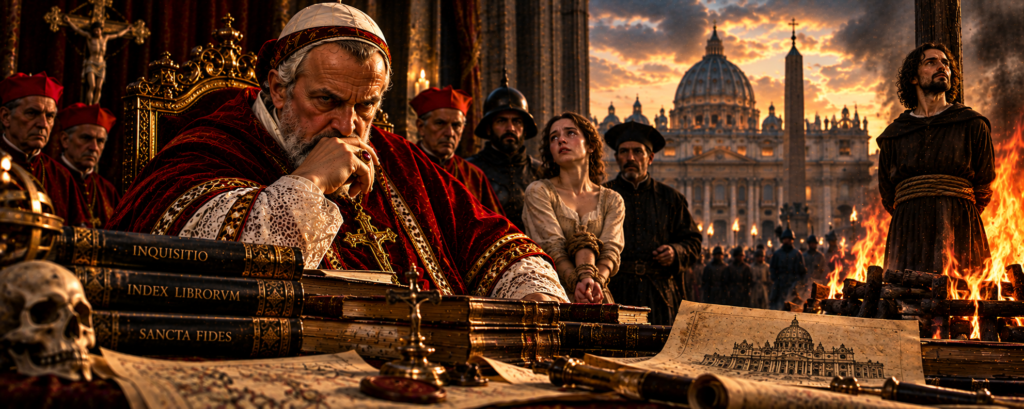
Clement VIII: The Pope Who Refused Mercy and Sent a Philosopher to the Flames
Pope Clement VIII (1536–1605) | Reigned 1592–1605
Two Executions That Haunted a Papacy
On September 11, 1599, the people of Rome witnessed an execution that would become one of the most notorious tragedies in the city’s history. Beatrice Cenci, a young noblewoman whose family had endured the cruelty of an abusive father, was brought to the scaffold after being convicted of participating in his murder. Her stepmother and brother had also been condemned, and desperate appeals for mercy had failed to save them. The final decision rested with a pope whose chosen name meant clemency, but whose government had decided that an example must be made.
Less than six months later, another condemned prisoner faced an even more terrible death. On February 17, 1600, the philosopher Giordano Bruno was taken to Rome’s Campo de’ Fiori and burned alive after years of imprisonment and proceedings before the Roman Inquisition. His ideas about the universe, religion, and the nature of God had brought him into conflict with Catholic authorities. The institution responsible for his condemnation operated under Pope Clement VIII, who had personally presided over the decisive meeting that ordered Bruno handed over for punishment.
The two cases were very different. Beatrice had been convicted of involvement in an actual killing, although the circumstances surrounding her father’s violence made her case morally troubling. Bruno had been condemned for religious beliefs and intellectual positions judged heretical by the Church. One execution raised questions about abuse, desperation, and the limits of mercy, while the other exposed the lethal consequences of religious persecution.
Yet both occurred under a pope celebrated by many contemporaries for his piety, personal discipline, and devotion to Catholic reform. Clement VIII was not a notorious libertine or a ruler whose private scandals overwhelmed his religious responsibilities. He worked diligently, supported charitable institutions, strengthened church discipline, and helped bring a measure of peace to a Europe devastated by religious conflict. His achievements were substantial enough that a history focused exclusively on executions would give a distorted picture of his reign.
That contrast makes his pontificate particularly disturbing. Clement could show compassion toward the poor, negotiate reconciliation with a former Protestant enemy, and concern himself deeply with the spiritual welfare of ordinary Catholics. Yet he also governed a system that punished religious dissent with death and refused mercy in a case that generations would remember as an extraordinary miscarriage of compassion. The darkness of his reign did not emerge from an absence of religious conviction, but from the severity with which religious and political authority could be exercised.
Clement VIII therefore belongs among the Wicked Popes for reasons very different from those associated with Alexander VI or Julius II. His story is not primarily one of personal decadence, extravagant warfare, or sexual scandal. It is the story of a conscientious ruler whose understanding of justice could become frighteningly unforgiving. Under his government, the machinery of law and religion produced two executions that would eventually overshadow much of what he accomplished.
Ippolito Aldobrandini: The Man Before the Tiara
The future Clement VIII was born Ippolito Aldobrandini on February 24, 1536, in Fano, a town within the Papal States. His family belonged to the distinguished Aldobrandini lineage, originally associated with Florence. Although not among the most powerful ruling dynasties of Renaissance Italy, the family possessed education, social connections, and considerable professional ambition. Ippolito grew up in an environment where law, politics, and ecclesiastical advancement were familiar subjects.
His father, Silvestro Aldobrandini, was a respected lawyer whose career had been affected by the political struggles surrounding the Medici domination of Florence. The family consequently understood the dangers of political instability and the importance of cultivating influential patrons. Ippolito received an excellent education and pursued legal studies at major Italian universities. His training would become one of the defining strengths of his later career.
Unlike popes who entered high ecclesiastical office primarily through family influence, Aldobrandini developed a reputation for serious legal ability. He worked within the institutions responsible for administering papal justice and government. His knowledge of canon law and legal procedure made him valuable to powerful churchmen. The habits of careful investigation and administrative discipline would remain visible throughout his pontificate.
His career advanced under Pius V, the austere Dominican pope remembered for his uncompromising Counter-Reformation policies. Aldobrandini became an advocate in the papal court and subsequently an auditor of the Roman Rota, one of the Church’s principal judicial institutions. These positions exposed him to complicated legal disputes involving marriage, property, ecclesiastical authority, and political privilege. They also familiarized him with a system in which religious law and secular government were closely connected.
This legal background matters when examining his later decisions. Clement VIII was not an inexperienced ruler who stumbled into difficult judicial controversies without understanding their implications. He had spent decades working within the institutions that interpreted and enforced the law. When the Cenci family appealed for mercy, the pope approached their case with the instincts of a trained jurist as well as those of a religious ruler.
His religious life was also taken seriously. Aldobrandini developed friendships with prominent figures associated with Catholic renewal, including Philip Neri. He acquired a reputation for personal morality, disciplined habits, and sincere devotion. Those qualities distinguished him from the extravagant Renaissance popes whose behavior had helped fuel criticism of the Church.
Yet personal virtue did not necessarily produce lenient government. A ruler convinced of the moral importance of law could become especially severe when confronted with actions he believed threatened the foundations of society. Aldobrandini’s later decisions would reveal the danger of treating legal authority and moral certainty as nearly interchangeable. His seriousness was both a strength and a potential source of rigidity.
The Cardinal Who Understood the Machinery of Power
Aldobrandini’s advancement continued during the pontificate of Sixtus V. In December 1585, he was created a cardinal, bringing him into the highest ranks of the Catholic hierarchy. His appointment recognized his administrative experience and legal expertise. It also placed him within the complicated political world of papal elections and international diplomacy.
Sixtus V had transformed papal government through aggressive administrative reform and harsh criminal enforcement. His death in 1590 produced a period of instability marked by rapid papal succession. Urban VII died after only thirteen days, Gregory XIV reigned for less than a year, and Innocent IX survived only two months. The Church desperately needed a pontiff capable of providing continuity.
European politics made the choice particularly difficult. Spain exercised enormous influence in Catholic affairs, while France remained divided by religious conflict. The Holy Roman Empire, Venice, Tuscany, and other Italian states also possessed interests in the election. Cardinals were expected to consider spiritual leadership while navigating a network of political pressures.
Aldobrandini had already demonstrated diplomatic ability. During an important mission connected with the Polish succession dispute, he had helped negotiate the release of Archduke Maximilian, whose failed attempt to secure the Polish throne had resulted in imprisonment. The episode enhanced his reputation as a capable negotiator. He was not simply a legal scholar isolated from international affairs.
His combination of experience, piety, and political independence made him attractive to cardinals concerned about excessive Spanish influence. Philip II of Spain had long sought to shape papal elections and Catholic policy. Some cardinals feared that the papacy might become too dependent upon Madrid. Aldobrandini appeared capable of maintaining a more independent position.
On January 30, 1592, he was elected pope after a difficult conclave. He chose the name Clement VIII, a name that would become deeply ironic in the eyes of those who remembered Beatrice Cenci. At fifty-five, he was younger than many recent popes and possessed the energy required for a substantial pontificate. His election promised stability after years of uncertainty.
Rome initially had reason to welcome him. He was respected for his personal conduct and administrative seriousness. He appeared less likely to indulge in the extravagance or reckless violence associated with some earlier pontiffs. Yet the city would eventually discover that a morally disciplined pope could still preside over acts of extraordinary severity.
A Pious Pope in a Dangerous World
Clement VIII inherited a Catholic Church still struggling with the consequences of the Protestant Reformation. The Council of Trent had established important doctrinal and disciplinary reforms, but implementing them across Europe remained a difficult undertaking. Bishops needed supervision, seminaries required support, and religious orders were expected to observe stricter standards. The Roman Inquisition and censorship institutions continued defending Catholic orthodoxy.
The political situation was equally dangerous. France remained divided by civil war, England was firmly Protestant under Elizabeth I, and the Ottoman Empire continued threatening Habsburg territories. Catholic rulers frequently disagreed with one another despite their shared religion. The pope had to balance spiritual objectives against the competing interests of powerful monarchies.
Clement approached these responsibilities with remarkable diligence. He worked long hours, reviewed administrative matters closely, and participated actively in religious affairs. His reputation for personal austerity was genuine, and he did not transform the Vatican into a court notorious for lavish entertainment. He also demonstrated concern for charitable institutions and the welfare of the poor.
His religious devotion was reinforced by friendships with important Catholic reformers. Philip Neri, founder of the Oratory, represented a style of spirituality emphasizing pastoral care, personal holiness, and religious instruction. Clement valued such figures and supported the broader movement of Catholic renewal. His pontificate belonged to a period when the Church was increasingly concerned with the moral conduct of its clergy.
Yet the same reforming environment encouraged strict religious conformity. Catholic authorities believed that heresy threatened not merely individual salvation but the stability of Christian society. Religious disagreement could therefore be treated as a public danger requiring punishment. The distinction between pastoral correction and coercion was often blurred.
Clement’s government embodied both tendencies. He could support spiritual renewal while expanding the machinery used to suppress religious dissent. He could encourage charity while maintaining laws that exposed convicted heretics to execution. His pontificate demonstrates that religious reform and religious persecution were not necessarily opposing forces in early modern Catholic politics.
The contradiction would become impossible to ignore in 1600. By then, Clement had governed for eight years and established a reputation as an effective pope. Yet a Dominican philosopher imprisoned in Rome was approaching the end of a long confrontation with the Inquisition. His death would permanently complicate the pope’s reputation.
France: The Protestant King Clement Could Not Ignore
One of Clement’s greatest political challenges concerned Henry IV of France. Henry had inherited the French crown in 1589, but his Protestant faith made him unacceptable to many Catholic subjects. France had endured decades of religious warfare, assassination, massacres, and competing claims to political legitimacy. The possibility of a Protestant monarch ruling the kingdom threatened to prolong the catastrophe.
The Catholic League opposed Henry and enjoyed substantial support from Spain. Philip II hoped to prevent the consolidation of a French monarchy that might challenge Spanish power. The papacy faced an uncomfortable choice between supporting uncompromising Catholic resistance and accepting a ruler whose political legitimacy was increasingly difficult to deny. Clement understood that endless civil war threatened the future of French Catholicism.
Henry recognized the political necessity of conversion. In July 1593, he publicly embraced Catholicism, opening the possibility of reconciliation with Rome. His motives have been debated ever since, particularly because his conversion also served obvious political interests. Clement nevertheless had to determine whether accepting Henry would benefit the Church more than continuing to oppose him.
The decision required careful negotiation. Spanish interests resisted any settlement that strengthened Henry’s position. Some Catholic leaders questioned the sincerity of the king’s conversion. Others believed that reconciliation offered the only realistic path toward peace.
Clement eventually chose accommodation. On September 17, 1595, he formally absolved Henry IV, recognizing his reconciliation with the Catholic Church. The decision helped strengthen Henry’s legitimacy and weakened the political position of those who continued opposing him in the name of religion. It also reduced the influence Spain could exercise over French affairs.
This was one of Clement’s most important achievements. He demonstrated a willingness to accept political realities rather than demand an impossible religious settlement. The decision contributed to the stabilization of France and improved relations between Paris and Rome. It also showed that Clement was capable of flexibility when he believed the future of the Church required it.
The contrast with his later judicial decisions is striking. Clement could reconcile with a former Protestant monarch whose position had been condemned by earlier popes. He could recognize that compromise sometimes served religious and political interests better than continued confrontation. Yet when Beatrice Cenci appealed for mercy, that flexibility would prove far more difficult to obtain.
The Peace of France and the Limits of Tolerance
Henry IV’s reconciliation with Rome did not immediately end France’s religious divisions. Protestant communities remained powerful in several regions, and memories of earlier massacres continued shaping political relationships. Henry needed a settlement that would allow Catholics and Protestants to coexist without returning to civil war. The result was the Edict of Nantes in 1598.
The edict granted French Protestants limited rights of worship and important legal protections under specified conditions. It did not establish modern religious equality, but it represented a significant attempt to contain religious conflict through political compromise. Henry remained a Catholic monarch while allowing Protestant subjects a recognized place within the kingdom. The settlement helped bring the French Wars of Religion toward an end.
Clement did not embrace the edict’s concessions as an ideal religious arrangement. Catholic authorities remained committed to the eventual restoration of religious unity. Nevertheless, the pope avoided destroying the reconciliation with Henry over the settlement. His diplomacy reflected a recognition that political stability sometimes required tolerating circumstances the Church did not approve.
The relationship also served broader European interests. France provided a counterweight to Spain, whose power in Italy concerned the papacy. Clement wanted to preserve the independence of the Holy See while avoiding a direct confrontation with the Spanish monarchy. Henry IV became an important partner in that strategy.
This political calculation should not be mistaken for modern tolerance. Clement’s willingness to accommodate French Protestants reflected the realities of governing a divided kingdom beyond his direct control. Within papal territory, religious dissent remained subject to much stricter enforcement. The distinction between diplomatic compromise abroad and coercive authority at home would become painfully clear.
His treatment of France nevertheless demonstrates that Clement was not incapable of mercy or pragmatism. He could reconsider inherited policies, resist powerful Catholic factions, and pursue reconciliation when circumstances demanded it. That makes his refusal to spare Beatrice Cenci more difficult to explain as the unavoidable behavior of his age. The pope possessed the ability to choose a different course.
The Aldobrandini Family Rises With the Papacy
Clement VIII’s reputation for personal austerity did not prevent him from advancing his relatives. Nepotism remained deeply embedded in papal government, even after the reforms of the Council of Trent. Popes frequently relied upon family members to manage political affairs and protect their interests. Clement followed this tradition through the elevation of the Aldobrandini family.
His nephew Pietro Aldobrandini became a cardinal in 1593. Still a young man, Pietro rapidly acquired influence within the papal administration and emerged as one of Clement’s most important advisers. His appointment reflected family loyalty as much as ecclesiastical experience. The elevation gave the Aldobrandini household a powerful position within the Church.
Another nephew, Cinzio Passeri Aldobrandini, also became a cardinal. The two men participated in the political and administrative networks surrounding their uncle. Their influence sometimes created rivalry and complicated the management of papal affairs. Family advancement remained a source of both strength and tension.
Clement also supported advantageous marriages and property arrangements that enhanced the family’s social standing. The Aldobrandini name became increasingly prominent among Rome’s aristocratic households. Wealth, titles, and influence accumulated around relatives of the reigning pope. The pattern was familiar from earlier pontificates.
Yet Clement’s nepotism differed from the most extreme examples associated with the Renaissance papacy. He did not build an independent territorial kingdom for an illegitimate son or use the papal office primarily to finance extravagant family adventures. His relatives benefited considerably, but his broader religious and political responsibilities remained central. The distinction matters when evaluating his conduct.
Nevertheless, the contradiction cannot be ignored. Clement expected strict discipline from clergy and subjects while allowing kinship to influence appointments to high ecclesiastical office. The practice exposed the limits of Counter-Reformation reform. Personal morality had improved in some areas, but family patronage remained deeply entrenched.
This system also influenced the distribution of wealth and opportunity. Ordinary clerics might spend decades pursuing advancement, while a papal nephew could become a cardinal at a remarkably young age. Such inequalities were accepted as part of political life. Clement’s government was not free from the privileges it inherited.
The Aldobrandini family’s rise therefore belongs within the darker aspects of his pontificate, although it was not the central scandal. It demonstrates that even a pope celebrated for reform could preserve practices that blurred the boundary between public office and private family advantage. The Church had changed since the days of Alexander VI, but it had not entirely escaped the political habits of Renaissance Rome.
Ferrara: The Pope Who Claimed a Duchy
In 1597, Clement VIII faced an opportunity to expand the territorial power of the papacy. Alfonso II d’Este, Duke of Ferrara, died without a legitimate direct heir. The Este family had ruled Ferrara for centuries, creating a distinguished court famous for its art, literature, and political influence. The succession now became a dispute involving feudal rights and dynastic claims.
Cesare d’Este sought to inherit the duchy, but Clement refused to recognize his claim to Ferrara. The pope argued that the territory should revert to direct papal control because of the circumstances surrounding the succession. The dispute threatened military confrontation. Ferrara was too valuable for either side to surrender casually.
Clement prepared to enforce his position. Papal forces mobilized, and diplomatic pressure increased. Henry IV of France supported the pope’s claims, strengthening Clement’s position against potential opposition. Cesare eventually withdrew from Ferrara and retained control of Modena and Reggio, which were held under different feudal arrangements.
In 1598, Ferrara passed into direct papal administration. The acquisition substantially strengthened the Papal States, adding a wealthy and strategically important territory. Clement achieved the result without the prolonged devastation that a major war might have caused. His diplomatic success enhanced the prestige of the papacy.
The annexation also revealed the worldly nature of papal government. Clement was not merely the spiritual head of the Catholic Church. He was a territorial prince capable of mobilizing armies and enforcing feudal claims. The same institution responsible for religious reform also competed for land, revenue, and political advantage.
Ferrara’s absorption into the Papal States had consequences for the city’s cultural and political life. The Este court departed, taking much of its patronage network to Modena. Papal officials replaced the dynasty’s administration. The change altered the character of a city long associated with Renaissance aristocratic culture.
Clement’s success strengthened his reputation as an effective ruler. He had expanded papal territory and demonstrated the usefulness of his French alliance. Yet it also illustrated the contradictions of the papacy as both religious institution and political state. Spiritual authority could become inseparable from territorial ambition.
The acquisition of Ferrara remains one of the major achievements of his reign. It demonstrates why Clement cannot be reduced to the pope who condemned Bruno or refused mercy to Beatrice. He was an important political actor whose decisions reshaped central Italy. His legacy contains successful statecraft alongside judicial severity.
The Cenci Family: Violence Behind Noble Walls
The tragedy of Beatrice Cenci began long before her execution. Her father, Francesco Cenci, was a wealthy Roman nobleman notorious for his violent temperament and abusive behavior. He possessed substantial property and enjoyed the privileges associated with aristocratic status. Within his household, however, wealth offered little protection to those subjected to his authority.
Francesco’s treatment of his family became central to the later case. Accounts describe cruelty, intimidation, and serious mistreatment of his children and second wife, Lucrezia Petroni. Beatrice’s suffering would eventually become the most famous part of the story. Later retellings emphasized allegations of sexual abuse, although the surviving evidence does not establish every detail repeated in literature and popular legend.
The distinction between documented abuse and later embellishment is important. Francesco’s reputation for brutality was not simply invented by Romantic writers centuries afterward. His conduct had generated complaints and legal difficulties during his lifetime. Nevertheless, some of the most dramatic accusations against him survive through sources shaped by the family’s defense or subsequent storytelling.
Beatrice grew up in a household where paternal authority could become a weapon. Women and younger family members possessed limited legal and practical independence. A wealthy father could exercise enormous control over marriage arrangements, residence, property, and personal freedom. Escaping such control was difficult even when abuse became severe.
Francesco’s violence reportedly extended beyond ordinary domestic tyranny. His conduct brought him into conflict with authorities, although wealth and influence helped him navigate legal consequences. The family had reason to fear both his anger and the limited protection available from outside institutions. Their situation became increasingly desperate.
Eventually, Francesco confined Beatrice and Lucrezia at the family’s remote castle of Petrella Salto in the Kingdom of Naples. The isolation intensified their vulnerability. Distance from Rome reduced opportunities to seek assistance. The castle became the setting for the murder that would destroy the family.
Later generations transformed Beatrice into an almost saintly victim of paternal cruelty. The historical woman was more complicated than the idealized figure found in poems and paintings. She became involved in a deliberate killing, and the details of her participation remain subject to historical interpretation. Understanding the violence she endured does not require denying the seriousness of the crime.
The tragedy lies partly in the collision between those realities. Francesco Cenci could be both a victim of murder and a man whose own cruelty helped create the circumstances leading to his death. Beatrice could be both a participant in a criminal conspiracy and a young woman trapped within an abusive household. Clement VIII’s government would ultimately confront that complexity with a punishment remembered for its severity.
The Murder at Petrella Salto
In September 1598, Francesco Cenci was killed at the family’s castle. The murder involved members of his household and accomplices recruited to carry out the plan. Accounts of the precise sequence vary, but the killing was deliberate rather than an accidental death. The conspirators attempted to make Francesco’s death appear to have resulted from a fall.
The plot involved Beatrice, Lucrezia, and members of the family, including Giacomo Cenci. Other participants assisted in the killing or its concealment. The conspirators apparently hoped that Francesco’s death would free them from his tyranny while allowing the family to retain its property. The plan depended upon authorities accepting the appearance of an accident.
Suspicion developed quickly. Circumstances surrounding the death raised questions, and investigators began examining the household. The attempt to disguise the killing proved unsuccessful. The case eventually reached Roman authorities.
The investigation exposed the family’s internal conflicts and the violence that had preceded the murder. Testimony implicated several participants. Confessions were obtained, although the use of torture in early modern criminal procedure complicates the interpretation of some statements. The surviving record requires careful attention to how evidence was produced.
Beatrice initially denied involvement. Under the pressure of the investigation, she eventually confessed. The prosecution treated the murder as an especially serious offense because it involved the killing of a father by members of his own family. Parricide carried profound religious, legal, and social significance.
In early modern society, paternal authority was closely connected with broader ideas of hierarchy and obedience. The father governed the household, just as rulers governed their subjects. Murdering a father could therefore be interpreted as an attack upon the foundations of social order. The severity of the legal response reflected those assumptions.
The family’s defenders emphasized Francesco’s cruelty. They argued that the circumstances deserved extraordinary consideration and that the accused had suffered grievously. The defense did not necessarily deny every element of the conspiracy. Instead, it sought to persuade authorities that punishment should reflect the abuse preceding the crime.
The case soon became more than an ordinary murder prosecution. It exposed tensions between family authority, personal suffering, criminal responsibility, and the possibility of mercy. Rome watched as the proceedings moved toward judgment. The ultimate decision would reveal how Clement VIII understood the obligations of justice.
The Trial That Captivated Rome
The Cenci proceedings attracted extraordinary attention because the defendants belonged to a prominent family. Noble status made the scandal more visible, while Francesco’s reputation encouraged sympathy for those accused of killing him. The case contained nearly every element capable of gripping public imagination: wealth, abuse, conspiracy, murder, and the threatened execution of a young woman. Rome followed developments with intense interest.
The legal process was shaped by the criminal procedures of the period. Investigators questioned witnesses, examined circumstances, and obtained confessions. Torture was an accepted part of judicial practice under certain conditions, although its use raises obvious concerns about reliability. The proceedings cannot be evaluated as though they followed modern standards of criminal justice.
The prosecution possessed substantial evidence of a planned killing. Beatrice and her relatives were not condemned merely because of rumor or religious hostility. The conspiracy had resulted in Francesco’s death, and participants had attempted to conceal the crime. The central legal question concerned whether the circumstances justified mitigation.
The defense emphasized the father’s cruelty and the desperation of his household. Supporters argued that the defendants had endured extraordinary suffering. Some believed the authorities had failed to protect the family while Francesco was alive. Punishing those who had escaped his violence through murder therefore appeared morally troubling.
Public sympathy developed particularly around Beatrice. Her youth and the allegations of abuse made her a powerful symbol of vulnerability. The spectacle of a young noblewoman facing execution encouraged emotional identification. Later accounts would greatly magnify this sympathy, sometimes portraying Rome as almost unanimously opposed to her death.
The actual scale of contemporary public support is difficult to measure precisely. Popular narratives written long afterward often dramatized the crowds and appeals surrounding the case. Nevertheless, the existence of petitions and efforts to secure clemency is well established. The defendants had supporters who hoped the pope would intervene.
Clement possessed the authority to grant mercy. As sovereign of the Papal States, he could commute sentences or pardon offenders. The case therefore became a test of his personal judgment as well as the legal system. The decision could not be attributed entirely to anonymous judges.
For a pope whose reputation emphasized charity and moral seriousness, the dilemma was profound. Sparing the defendants might acknowledge the extraordinary abuse they had suffered. Executing them would affirm that even severe mistreatment did not justify the deliberate murder of a parent. Clement ultimately chose the second principle.
The Pope Who Would Not Spare Beatrice
Clement VIII refused to grant the pardon that supporters of the Cenci family desperately sought. The decision has remained one of the most controversial acts of his pontificate. His government treated the killing of Francesco Cenci as a crime requiring exemplary punishment. The circumstances of the father’s cruelty did not outweigh the perceived necessity of defending legal and familial authority.
Some historical accounts suggest that Clement initially considered commuting the women’s sentences. According to this interpretation, another contemporary case involving the murder of a parent reinforced his fear that leniency would encourage similar crimes. The details of this episode are not equally secure in every retelling, and the pope’s private reasoning cannot be reconstructed with complete certainty. What is clear is that the final appeals failed.
The severity of the decision reflected the legal and moral culture of the period. Parricide was regarded as an exceptionally grave offense. Allowing the perpetrators to escape execution could be interpreted as weakening paternal authority and encouraging violence within households. Clement’s government considered deterrence a legitimate concern.
Yet the decision also revealed the limits of sympathy within that system. Francesco’s abuse could be acknowledged without fundamentally changing the punishment imposed upon those who killed him. The law protected the authority of the father even when that authority had been exercised cruelly. The victims of his conduct received little practical benefit from the recognition of their suffering.
The pope’s refusal became particularly controversial because he possessed the power to choose otherwise. He was not simply carrying out a sentence beyond his control. Clement could have commuted the punishments while preserving the legal judgment of guilt. His decision to allow the executions therefore carried personal responsibility.
Later writers sometimes claimed that the papacy was motivated primarily by a desire to confiscate the Cenci family’s wealth. The family’s property was indeed affected by the proceedings, and financial interests formed part of the wider context of criminal forfeiture. However, reducing Clement’s decision to a simple scheme for acquiring wealth goes beyond what can safely be established. His motives likely included legal, political, and moral considerations.
The result was nevertheless devastating. Beatrice, Lucrezia, and Giacomo faced execution, while the younger Bernardo received a lesser sentence. The family’s attempt to escape Francesco’s tyranny had ended in catastrophe. The pope who had reconciled with Henry IV of France would not reconcile justice with mercy in the Cenci case.
September 11, 1599: The Death of Beatrice Cenci
On September 11, 1599, the condemned members of the Cenci family were brought to execution in Rome. The event attracted considerable public attention. Beatrice and Lucrezia were beheaded, while Giacomo suffered a more brutal punishment. Bernardo, who had also been implicated, was spared execution but forced to endure the consequences of the family’s conviction.
The spectacle was intended to demonstrate the authority of papal justice. Public executions communicated the seriousness of crimes and the government’s determination to punish them. The suffering of the condemned became part of a broader warning to society. The state wanted observers to remember what happened to those who violated fundamental legal obligations.
For Beatrice, the execution created a legacy far larger than her short life. Later generations portrayed her as a martyr to paternal tyranny and judicial cruelty. Her story inspired poetry, drama, painting, and historical fiction. The young woman who had participated in a murder conspiracy became a symbol of innocence destroyed by an unforgiving system.
The reality was more complicated than the legend. Beatrice was not executed merely for refusing to submit to abuse. She was convicted of involvement in the deliberate killing of her father. Yet the circumstances surrounding that killing made the punishment deeply troubling to many observers.
The distinction matters because historical sympathy should not depend upon inventing innocence. A person can bear responsibility for a serious crime while still deserving consideration of the circumstances that led to it. Modern legal systems recognize varying degrees of mitigation, coercion, and diminished responsibility. Clement’s government possessed mechanisms for mercy but chose not to use them.
The executions also exposed the gendered realities of early modern society. Women possessed limited means of escaping violent male authority. Their legal and economic dependence could make abusive households extraordinarily difficult to leave. The Cenci case became infamous partly because the system appeared more capable of punishing resistance than preventing cruelty.
Clement VIII survived the controversy, and his government continued. The execution did not destroy his reputation among Catholic reformers or European rulers. Yet Beatrice’s story refused to disappear. Long after the pope’s diplomatic achievements faded from popular memory, the image of the young woman on the scaffold remained.
Beatrice Cenci Becomes a Legend
The centuries following Beatrice’s death transformed her into one of Rome’s most famous tragic figures. Writers emphasized her beauty, innocence, suffering, and courage. The details of her father’s cruelty became increasingly dramatic. Her execution was portrayed as the final injustice inflicted upon a victim who had never possessed a meaningful chance of escape.
Percy Bysshe Shelley helped popularize the story through his tragedy The Cenci, published in 1819. His work presented the family drama as a confrontation between monstrous paternal authority and desperate resistance. The play became one of the most influential literary interpretations of the case. Its emotional power contributed to the enduring image of Beatrice as a tragic heroine.
Visual art also shaped her reputation. A famous portrait traditionally identified as Beatrice Cenci was long attributed to Guido Reni and associated with the period immediately before her execution. The identification and attribution have been questioned by art historians. The romantic story of an artist capturing her final expression should therefore not be treated as established fact.
The portrait nevertheless became inseparable from the legend. Its youthful subject, often interpreted as vulnerable and sorrowful, encouraged viewers to imagine the condemned woman awaiting death. The image helped transform a complicated criminal case into a universal story of innocence and suffering. Historical uncertainty did little to weaken its emotional appeal.
Popular tradition also attached ghost stories to Beatrice’s memory. Some accounts claimed that her spirit returned to the area near the site of her execution. Such tales belong to folklore rather than documented history. They demonstrate how strongly the tragedy entered Rome’s cultural imagination.
Clement VIII became the villain in many of these retellings. His refusal of mercy provided a clear moral contrast with the suffering young woman. Literary works often simplified his motives and ignored the broader legal context. The pope became a symbol of cold institutional authority.
The legend should not replace historical investigation, but neither should its emotional force be dismissed. Beatrice’s story survived because it exposed genuine tensions between power, abuse, law, and compassion. Her execution raised questions that remained meaningful long after the institutions responsible for it had changed. Clement’s name became permanently attached to those questions.
Giordano Bruno: The Philosopher Who Refused to Be Silent
While the Cenci tragedy unfolded, another prisoner remained confined within the machinery of the Roman Inquisition. Giordano Bruno had already spent years defending his religious and philosophical ideas before ecclesiastical authorities. His case was complicated, prolonged, and increasingly dangerous. By the end of 1599, it was approaching a decisive conclusion.
Bruno was born in 1548 at Nola, near Naples. He entered the Dominican order as a young man and received extensive theological education. His intellectual interests soon carried him beyond the boundaries of conventional scholastic teaching. He questioned established interpretations of philosophy, theology, and the structure of the universe.
His temperament made conflict almost inevitable. Bruno was brilliant, combative, and frequently contemptuous of opponents he considered intellectually inferior. He challenged Aristotelian philosophy and embraced elements of the Copernican model of the cosmos. He also developed religious ideas that departed sharply from orthodox Catholic doctrine.
Bruno eventually abandoned his Dominican convent and spent years traveling across Europe. He lived and worked in Protestant as well as Catholic territories, encountering conflict in both environments. His controversial opinions did not fit comfortably within any of the major religious confessions of the period. He repeatedly found himself at odds with religious and academic authorities.
His writings explored an infinite universe containing innumerable worlds. He rejected the traditional picture of a finite cosmos organized around a unique central Earth. He also developed complex ideas about the relationship between God, nature, matter, and the soul. His philosophical system drew upon Neoplatonic, Hermetic, and other intellectual traditions.
Bruno’s significance cannot be reduced to a single astronomical claim. He was not simply a modern scientist persecuted for stating that the Earth revolves around the Sun. His cosmology was intertwined with theological and metaphysical positions that Catholic authorities considered profoundly dangerous. Some of those positions concerned the Trinity, the Incarnation, the Eucharist, and the nature of the soul.
That distinction does not justify his execution. It explains why the case developed as it did. Bruno’s conflict with the Church concerned a broad intellectual and religious system rather than one isolated scientific proposition. His refusal to abandon that system would ultimately cost him his life.
The Betrayal in Venice
In 1591, Bruno returned to Italy after years abroad. He entered the household of Giovanni Mocenigo, a Venetian nobleman interested in learning techniques associated with memory and intellectual mastery. Bruno had developed a reputation for unusual mnemonic methods. Mocenigo hoped to benefit from his knowledge.
The relationship deteriorated. Mocenigo became dissatisfied and suspicious of Bruno’s teachings. He accused the philosopher of expressing dangerous religious opinions. In May 1592, he denounced Bruno to the Venetian Inquisition.
The denunciation transformed Bruno’s circumstances. Instead of pursuing scholarly opportunities, he found himself under investigation for heresy. Venetian authorities questioned him about his beliefs and writings. Bruno attempted to explain or qualify some of the statements attributed to him.
The Roman Inquisition soon demanded his transfer. Venice initially hesitated because the republic guarded its jurisdictional independence. The dispute reflected longstanding tensions between Venetian political authority and Roman ecclesiastical institutions. Eventually, the Venetian government agreed to surrender Bruno.
In January 1593, Bruno was transferred to Rome. His imprisonment there would continue for approximately seven years. The length of the proceedings reflected the complexity of the accusations and the difficulty of obtaining a satisfactory recantation. The authorities wanted him to abandon positions they considered heretical.
Bruno sometimes appeared willing to clarify or retract particular statements. At other moments, he defended his views with renewed determination. His responses complicated the proceedings because the inquisitors sought an unequivocal submission. Partial concessions did not necessarily satisfy them.
The case developed into a confrontation between institutional authority and intellectual conscience. Bruno believed that his philosophical system possessed truth that could not simply be abandoned. The Inquisition believed that his persistence threatened religious orthodoxy. Neither side was prepared to accept the other’s fundamental position.
Clement VIII did not personally conduct every interrogation. The proceedings were managed through the institutions and officials of the Roman Inquisition. Yet the pope stood at the head of that system and ultimately participated in the decisive stage. His responsibility cannot be erased by distinguishing him from the officials who questioned Bruno.
Seven Years Inside the Roman Inquisition
Bruno’s imprisonment in Rome was prolonged and intellectually exhausting. The inquisitors examined his writings and compared them with statements obtained during questioning. They sought to identify propositions that could be formally condemned. The process required repeated theological evaluation.
Among the important figures involved was Cardinal Robert Bellarmine, a prominent Jesuit theologian and defender of Catholic orthodoxy. Bellarmine participated in the examination of Bruno’s positions. The case involved complex doctrinal questions rather than a straightforward accusation based upon one statement. The surviving documentation is incomplete, which limits certainty about every stage.
By January 1599, the Inquisition had identified eight propositions requiring Bruno’s submission. The precise text of the complete list has not survived. Historians therefore must be cautious when claiming to know exactly which beliefs formed the final basis of condemnation. The available evidence nevertheless demonstrates that the dispute involved serious theological disagreements.
Bruno was asked to renounce the propositions. He initially offered responses that appeared to concede some points while defending or qualifying others. The inquisitors regarded such answers as insufficient. They wanted clear abandonment of the condemned positions.
The philosopher’s resistance continued. In December 1599, he indicated that he would not make the required recantation. His position left little room for compromise under the procedures of the Roman Inquisition. The authorities increasingly regarded him as obstinate.
The final decision approached. Bruno had spent years in confinement, and his opportunities for escape had disappeared. The Church considered persistent heresy a grave offense. Under the legal and religious assumptions of the period, a person judged an unrepentant heretic could be handed to secular authorities for capital punishment.
The language of the procedure could obscure the reality. Ecclesiastical courts formally transferred condemned heretics to secular officials rather than conducting executions themselves. Yet the transfer occurred within a system that understood the likely punishment. The distinction between ecclesiastical condemnation and secular execution did not remove institutional responsibility.
Bruno’s case reached the highest level of papal authority in January 1600. Clement VIII was no longer merely a distant figure presiding over an institution in general terms. He participated in the meeting that authorized the final disposition of the case. The philosopher’s fate was now sealed.
January 1600: Clement VIII and the Final Decision
On January 20, 1600, the Congregation of the Holy Office met with Clement VIII presiding. The decision concerning Bruno was decisive. His writings were ordered placed on the Index of Prohibited Books, and he was to be handed over to the secular authorities as an obstinate and unrepentant heretic. The proceedings had reached the point from which execution was the expected outcome.
This detail is important because Clement’s role is sometimes minimized in popular summaries. He did not personally conduct the entire investigation, and the case had begun before Bruno arrived in Rome. Nevertheless, the surviving record places him at the decisive meeting. His involvement was more direct than merely being pope when the execution occurred.
The authorities had offered Bruno opportunities to recant. From their perspective, his refusal demonstrated dangerous persistence in condemned beliefs. They regarded submission to ecclesiastical judgment as necessary for reconciliation. Bruno did not provide the unequivocal recantation they demanded.
The moral issue extends beyond whether the procedures followed contemporary law. The central question is whether a person should be killed for refusing to surrender religious and philosophical convictions. Clement’s government answered that question through the legal structures inherited from earlier centuries. The result was a death sentence carried out in the name of religious orthodoxy.
Bruno’s final written appeal to the pope was opened but not read at the decisive meeting, according to the surviving account of the proceedings. The detail has become one of the most chilling aspects of the case. A prisoner facing death had attempted one final communication with the highest authority in the Church. The process moved forward without its contents being considered in that setting.
The decision also reflected the broader Counter-Reformation environment. Catholic authorities were determined to defend doctrinal boundaries after decades of religious division. Protestant and Catholic governments alike punished forms of religious dissent, although their methods and legal systems differed. Bruno’s fate belonged to that wider culture of coercive religious conformity.
Historical context explains why Clement and his advisers considered the punishment legitimate. It does not require modern readers to accept their conclusion. The execution remains a stark example of the danger created when religious institutions possess the power to extinguish dissenting voices. Clement’s personal piety did nothing to prevent that outcome.
February 17, 1600: The Fire at Campo de’ Fiori
On February 17, 1600, Giordano Bruno was taken to the Campo de’ Fiori in Rome. The square was a public space associated with commerce and urban life. On that morning, it became the setting for an execution intended to demonstrate the consequences of persistent heresy. Bruno was burned alive.
Accounts of his final moments have been shaped by centuries of admiration and controversy. Famous statements attributed to him at sentencing or execution circulate widely, but their precise wording and circumstances require careful treatment. Some derive from early reports, while others have been embellished through later retellings. His refusal to recant is better documented than every dramatic sentence placed in his mouth.
The execution itself is not disputed. Bruno was condemned by the Roman Inquisition and delivered to secular authorities for punishment. He died by burning after years of imprisonment. The event became one of the most famous cases of religious persecution in European intellectual history.
The location acquired enormous symbolic importance. Campo de’ Fiori eventually became associated with freedom of thought and resistance to religious censorship. A monument to Bruno was erected there in 1889, centuries after his death. Its presence reflected later political and cultural struggles over the authority of the Church.
Bruno’s philosophical reputation also evolved. Some admirers portrayed him as a martyr for modern science, while critics emphasized the speculative and religious elements of his writings. Neither simplification captures the full complexity of his thought. His cosmology, theology, and philosophy were deeply interconnected.
He was not executed solely because he believed the Earth moved around the Sun. The accusations against him concerned a broader range of positions judged incompatible with Catholic doctrine. Yet the fact that his beliefs were complex does not make the punishment less severe. The central historical reality remains that a man was killed for refusing to renounce ideas.
Clement VIII’s role in the final decision places the execution firmly within his pontificate. The pope did not stand in Campo de’ Fiori holding a torch, but the institution he governed authorized the process that ended there. His participation in the January meeting establishes direct involvement at the highest level. Bruno’s death cannot be separated from Clement’s exercise of papal authority.
The contrast with the pope’s reputation is extraordinary. Clement was admired for his discipline, charity, and religious seriousness. He had helped reconcile France and supported important reforms within the Church. Yet his government also extinguished the life of a philosopher whose convictions could not be accommodated within its understanding of orthodoxy.
The Inquisition and the Price of Religious Certainty
The Roman Inquisition had been established in 1542 under Paul III. Its purpose was to defend Catholic doctrine against heresy and investigate beliefs considered dangerous. Over subsequent decades, it developed into an influential institution with procedures, officials, and extensive authority. Clement VIII inherited a mature system rather than creating it himself.
The Inquisition’s work extended beyond famous executions. It investigated religious opinions, examined books, questioned suspects, and required recantations. Some defendants received penances or other punishments rather than death. The outcomes varied according to accusations, evidence, and willingness to submit.
Nevertheless, the possibility of capital punishment gave the institution extraordinary coercive power. A defendant accused of persistent heresy could face consequences far beyond intellectual condemnation. Religious conformity was enforced through the threat of imprisonment and, in extreme cases, execution. The boundary between spiritual correction and physical punishment remained dangerously narrow.
Clement supported the institution’s authority. His pontificate witnessed continued inquisitorial activity and the enforcement of religious orthodoxy. He did not attempt to dismantle the system or remove its capacity to deliver condemned heretics to secular punishment. Bruno’s execution demonstrates the consequences of that position.
The Inquisition also operated within a society where religious identity was closely tied to political loyalty. Rulers feared that doctrinal disagreement could encourage rebellion or undermine public order. The memory of Europe’s religious wars reinforced those anxieties. Authorities often treated religious uniformity as essential to peace.
Yet coercion could produce its own injustices. Investigations encouraged denunciations, suspicion, and the policing of intellectual boundaries. People accused of dangerous beliefs might face years of confinement while their statements were examined. The system placed enormous power in the hands of those authorized to define orthodoxy.
Clement’s responsibility must be understood within this institutional framework. He was not personally responsible for every investigation conducted during his reign. He was, however, responsible for maintaining and supporting the system. In Bruno’s case, his participation in the final decision makes that connection particularly clear.
The execution remains one of the strongest reasons to include Clement VIII among the Wicked Popes. His personal life may have been disciplined, but the government he led could treat religious disagreement as a capital offense. The danger lay not in private corruption but in institutional certainty backed by lethal power.
The Index of Forbidden Books
Clement VIII’s concern with religious orthodoxy extended into the world of books. Printing had transformed European intellectual life, allowing ideas to circulate more rapidly than ever before. Catholic authorities feared that unauthorized theological works could spread heresy among readers. Censorship therefore became an important part of Counter-Reformation policy.
In 1596, Clement promulgated a revised Index of Prohibited Books. The Index identified works considered dangerous to Catholic faith or morals and established restrictions upon their circulation. The system sought to control what Catholics could read and publish. It also influenced the activities of printers, booksellers, scholars, and religious institutions.
The Index did not consist solely of a list of authors condemned for scientific discoveries. It included theological, philosophical, and literary works judged objectionable for various reasons. Some texts could be corrected or expurgated, while others were prohibited more comprehensively. The rules reflected a broad effort to supervise intellectual culture.
Clement’s revised Index belonged to a longer history of Catholic censorship. Earlier popes had established similar restrictions, and later pontiffs would continue modifying them. The policy was therefore not his invention. His responsibility lay in strengthening and maintaining it.
The relationship between censorship and the Inquisition was significant. Both institutions sought to defend religious boundaries. Books could become evidence in investigations, while condemned authors might find their works prohibited. Intellectual disagreement could therefore produce both personal and literary consequences.
Bruno’s writings were ordered placed on the Index as part of the final proceedings against him. The decision attempted to suppress his ideas as well as punish their author. His execution destroyed his life, while censorship sought to limit the survival and circulation of his work. Neither effort ultimately prevented later generations from reading and debating his philosophy.
The Index reveals the broader significance of Clement’s religious policy. The pope did not merely punish a few notorious individuals. He supported an institutional system designed to regulate belief and expression across Catholic society. The power of the Church extended into libraries, classrooms, printing houses, and private study.
From the perspective of Catholic reformers, such supervision protected the faithful from dangerous error. From a modern perspective, it also restricted intellectual freedom and encouraged conformity through fear of punishment. Both interpretations are necessary to understand the historical setting. Clement’s government regarded censorship as a religious duty, but its consequences reached far beyond theology.
The Pope Who Corrected the Bible
Clement VIII also played an important role in the history of the Latin Bible. His predecessor Sixtus V had attempted to produce an authoritative edition of the Vulgate, the traditional Latin biblical text used by the Western Church. The project had encountered serious problems. Errors and disputed editorial decisions made the edition unsuitable for continued use without revision.
Clement inherited the responsibility for resolving the controversy. In 1592, a corrected edition appeared under his authority. It became commonly known as the Clementine Vulgate, although its relationship to the earlier Sixtine edition remained part of its history. The text would exercise enormous influence upon Catholic biblical scholarship and worship.
The project demonstrated Clement’s administrative seriousness. He understood the importance of establishing a reliable official text for church use. Scholars and ecclesiastical authorities had spent years examining manuscripts and editorial questions. Clement helped bring the work to completion.
The corrected Vulgate also reflected the Church’s desire for doctrinal and liturgical uniformity. A standardized biblical text supported consistent teaching and interpretation. It strengthened the institutional framework created by the Council of Trent. Clement regarded such stability as essential to Catholic renewal.
The achievement contrasts sharply with his association with censorship. The pope supported scholarly work when it served the Church’s approved objectives. He could encourage textual accuracy while restricting writings judged dangerous. Intellectual activity was welcomed within boundaries defined by ecclesiastical authority.
This was not an unusual contradiction in early modern religious institutions. Catholic and Protestant authorities alike sponsored education while policing doctrine. Scholarship and censorship frequently existed within the same system. Clement’s pontificate illustrates that relationship particularly clearly.
The Clementine Vulgate became one of the enduring achievements of his reign. It influenced Catholic religious life for centuries. Unlike the execution of Bruno, it demonstrated the constructive potential of organized ecclesiastical scholarship. Both events nevertheless emerged from the same commitment to doctrinal authority.
Clement wanted the Church to possess reliable texts and clear teachings. He also wanted dangerous ideas prevented from undermining that certainty. The difference between scholarship and heresy was determined by institutional judgment. For Bruno, that judgment proved fatal.
The Jesuits, the Dominicans, and a Battle Over Grace
Clement VIII’s pontificate witnessed an intense theological dispute between Jesuit and Dominican scholars. The controversy concerned divine grace, human freedom, and the relationship between God’s action and human choice. These questions had occupied Christian theologians for centuries. By the late sixteenth century, disagreements had become serious enough to threaten divisions within Catholic intellectual life.
The dispute was associated particularly with the writings of the Jesuit theologian Luis de Molina. Dominican critics argued that aspects of his teaching endangered traditional understandings of divine grace. Jesuit defenders maintained that their position preserved genuine human freedom without denying God’s sovereignty. Both sides claimed fidelity to Catholic doctrine.
The arguments became increasingly heated. Each party feared that the other’s position could undermine essential theological principles. Accusations and counteraccusations circulated. The controversy threatened to damage the unity that Counter-Reformation authorities were determined to preserve.
Clement established a commission to investigate the dispute. The resulting proceedings became associated with the Congregatio de auxiliis, a series of discussions concerning divine assistance and grace. The pope followed the controversy closely and attended important sessions. His personal involvement reflected the seriousness with which he approached doctrinal questions.
Yet the dispute proved extraordinarily difficult to resolve. Scholars presented intricate arguments based upon Scripture, theology, and philosophical reasoning. Neither side could easily be dismissed without creating further controversy. Clement faced a problem that resisted simple authoritative settlement.
Despite his reputation for firmness, he did not issue a final condemnation resolving the dispute. The controversy continued beyond his death. His successor Paul V eventually imposed restrictions upon mutual accusations without definitively settling every theological question. The result allowed competing schools of thought to continue within the Church.
This episode reveals another side of Clement’s personality. He could be cautious when confronted with a complex disagreement between influential Catholic theologians. He understood that an excessively rigid decision might create new divisions. His willingness to delay judgment contrasts with the severity shown toward Bruno.
The difference lay partly in institutional boundaries. Jesuits and Dominicans argued within the recognized framework of Catholic theology. Bruno challenged doctrines the Church regarded as fundamental. Clement tolerated unresolved disagreement in one setting while supporting lethal punishment in the other.
The Holy Year of 1600
The year 1600 was an important moment in Clement VIII’s pontificate. Rome celebrated a Jubilee, drawing large numbers of pilgrims from across Catholic Europe. The event proclaimed the vitality of the post-Tridentine Church. Religious ceremonies, processions, confessions, and charitable activities filled the city.
Clement participated actively in the observances. He emphasized penitence, spiritual renewal, and devotion. The Jubilee provided an opportunity to display the achievements of Catholic reform. Rome presented itself as the center of a revitalized religious world.
The city had undergone substantial transformation during the preceding decades. Sixtus V’s roads, fountains, and monumental projects had made pilgrimage routes more accessible. Churches had been restored or enlarged, and religious institutions had expanded their activities. The Jubilee brought these developments into public view.
Pilgrims encountered a Church determined to demonstrate both spiritual authority and institutional strength. Religious orders organized services and assistance for visitors. The pope’s personal participation reinforced his reputation for devotion. Contemporary accounts celebrated the event as a major success.
Yet the Jubilee year also witnessed Bruno’s execution. The contrast is difficult to ignore. While Rome proclaimed spiritual renewal and welcomed pilgrims seeking forgiveness, a philosopher was burned for refusing to renounce condemned beliefs. The same religious system offered reconciliation to some while denying it to others.
This juxtaposition should not be reduced to simple hypocrisy. Clement and his advisers believed that defending orthodoxy was part of protecting the faithful. They did not necessarily perceive an inconsistency between spiritual celebration and punishment for heresy. That conviction is precisely what makes the episode historically revealing.
The Jubilee also reinforced papal prestige after decades of religious conflict. Clement had reconciled with Henry IV, strengthened Catholic institutions, and helped restore Rome’s international importance. The celebrations presented a confident Church moving into a new century. Yet the fire at Campo de’ Fiori became one of the most enduring memories of that same year.
For later generations, the contrast acquired symbolic force. The Church celebrated salvation while a condemned thinker died nearby. Clement’s pontificate embodied both the spiritual energy and the coercive power of Counter-Reformation Catholicism. The two histories cannot be separated without distorting the period.
War Against the Ottoman Empire
Clement VIII’s international ambitions extended beyond Western Europe. The Ottoman Empire remained a major military power, and conflict along the Habsburg frontier threatened Christian territories in central Europe. The Long Turkish War, which began in 1593, became an important concern of his pontificate. Clement sought to encourage Catholic resistance to Ottoman expansion.
The pope supported efforts to organize military assistance for the Habsburg cause. Papal troops and financial contributions formed part of the broader response. Clement also attempted to encourage cooperation among Christian rulers. The project reflected the longstanding papal ambition to organize united action against Ottoman power.
Such efforts were complicated by European rivalries. Catholic monarchs disagreed over strategy, resources, and political priorities. France and Spain remained suspicious of one another. The Habsburg monarchy faced enormous financial and military pressures.
Clement nevertheless continued supporting the war. He regarded the Ottoman threat as both a political and religious challenge. The defense of Christian territories formed part of his understanding of papal responsibility. His government therefore participated in military affairs despite his personal reputation for piety and moderation.
The conflict produced suffering on a large scale. Armies devastated territory, civilians endured displacement, and military campaigns consumed enormous resources. The pope’s involvement illustrates the continuing connection between religion and warfare. Catholic leadership could include the organization of armed force.
Clement’s military efforts did not produce a decisive Christian victory during his lifetime. The war continued after his death and eventually ended through negotiation. His participation nevertheless reinforced the papacy’s role in European geopolitics. Rome remained a political actor capable of supporting military campaigns.
The contrast with his domestic reputation is again significant. Clement could be personally gentle while supporting war abroad. He could promote charity while financing military operations. Early modern rulers rarely separated religious conviction from the use of force.
His policies toward the Ottoman Empire therefore belong within the broader evaluation of his reign. They were not equivalent to the execution of Bruno or the Cenci case, but they demonstrate the range of coercive power available to the papacy. Clement governed a Church that remained deeply involved in the military struggles of Europe.
The Union of Brest and the Expansion of Catholic Influence
Clement’s pontificate also witnessed important developments in Eastern Europe. In 1596, the Union of Brest brought a group of bishops from the Ruthenian Orthodox tradition into communion with Rome while retaining their Byzantine liturgical heritage. The agreement created a significant new relationship between Eastern Christian communities and the papacy. It became a major event in the religious history of the Polish-Lithuanian Commonwealth.
The union emerged from complicated political and ecclesiastical circumstances. Orthodox communities faced pressures involving Catholic institutions, local rulers, and internal church reform. Some bishops believed union with Rome could strengthen their position. Others regarded it as a betrayal of their religious tradition.
Clement welcomed the development as an expansion of Catholic unity. The agreement appeared to demonstrate that communion with Rome could accommodate different liturgical traditions. It also strengthened papal influence in a region contested by several religious and political powers. The pope viewed the union as an important success.
Yet the settlement did not create universal agreement among Eastern Christians. Opposition emerged from clergy, nobles, and lay communities who rejected the union. Religious tensions intensified in some areas. The consequences extended far beyond Clement’s lifetime.
The episode reveals the broader ambitions of Counter-Reformation Catholicism. Rome sought not merely to defend existing communities but to expand its authority. Diplomatic negotiation, ecclesiastical reform, and political pressure could all contribute to that objective. Clement supported such efforts with considerable energy.
The Union of Brest remains historically significant because it helped shape the development of Eastern Catholic communities. Its legacy has also been contested because of the conflicts surrounding religious identity and authority. Clement’s role belongs within that complicated history. The achievement cannot be understood simply as either peaceful reconciliation or coercive expansion.
For the pope, however, the union reinforced the sense that his pontificate was strengthening the Church. France had been reconciled, Ferrara acquired, and new communities brought into communion with Rome. The institution appeared increasingly confident. The executions of 1599 and 1600 occurred within this broader atmosphere of Catholic consolidation.
The English Problem After Elizabeth I
England remained a persistent concern for Clement VIII. Elizabeth I had maintained a Protestant religious settlement and resisted efforts to restore Catholic authority. English Catholics faced legal restrictions and, in some circumstances, severe persecution. The papacy continued hoping that political change might eventually produce reconciliation.
Clement’s government supported Catholic missionary efforts and maintained interest in English affairs. Religious orders and seminaries trained priests for service in England. Such activities were dangerous because English authorities often associated Catholic missions with foreign political threats. The legacy of earlier conspiracies and papal interventions intensified suspicion.
Elizabeth died in March 1603, creating a new opportunity for diplomatic speculation. James VI of Scotland inherited the English throne as James I. His accession united the crowns of England and Scotland under one monarch. Catholic observers hoped that the new king might adopt a more accommodating religious policy.
James did not restore Catholicism. He remained committed to the Protestant settlement, although his policies initially created uncertainty among different religious groups. Clement’s hopes for a major change were disappointed. The papacy continued confronting the reality of a Protestant English monarchy.
The situation reflected the limits of papal authority in northern Europe. Clement could negotiate with Catholic rulers and influence religious institutions, but he could not compel England to return to Rome. The failure of earlier attempts at intervention remained a warning. Political circumstances constrained his ambitions.
His English policy also demonstrates the continuing relationship between religion and dynastic politics. The faith of a monarch could determine the religious future of an entire kingdom. Catholic authorities therefore watched successions with extraordinary interest. The possibility of conversion or reconciliation remained a diplomatic objective.
Clement died before the Gunpowder Plot of 1605, which unfolded later that year under Paul V. It would therefore be historically incorrect to associate him directly with that conspiracy. Nevertheless, his pontificate formed part of the wider period of Catholic-Protestant tension that preceded it. England remained outside papal obedience when he died.
The failure to restore Catholicism in England contrasted with his success in France. Henry IV had converted and reconciled with Rome, while James I maintained Protestant rule. Clement’s diplomacy could influence outcomes but could not determine them. The difference reinforced the importance of political circumstances beyond papal control.
Charity, Reform, and the Other Clement VIII
It would be misleading to portray Clement VIII as a ruler interested only in punishment. Contemporary Catholic accounts repeatedly emphasize his charitable activities, personal devotion, and concern for religious reform. He supported institutions caring for the poor and sick. His reputation for moral seriousness was widely recognized.
He also encouraged improvements in clerical discipline. The reforms of the Council of Trent required continued implementation, and Clement supported efforts to strengthen the education and conduct of priests. Bishops were expected to take their responsibilities seriously. Religious orders received attention as part of the broader movement of Catholic renewal.
His personal habits reinforced his public image. Clement was known for prayer, fasting, and religious observance. He reportedly suffered from painful gout, yet continued working despite physical difficulties. His dedication impressed observers who valued the model of a disciplined Christian ruler.
He also supported figures associated with pastoral reform. Francis de Sales, who would become one of the most influential Catholic spiritual writers of the seventeenth century, received important recognition during Clement’s pontificate. The pope appointed him bishop of Geneva in 1602. Such decisions contributed to the development of post-Tridentine Catholic spirituality.
Clement’s government therefore possessed genuine constructive achievements. He helped stabilize relations with France, strengthened papal administration, supported religious institutions, and contributed to the renewal of Catholic life. His personal conduct contrasted favorably with the scandals of some earlier popes. These accomplishments should not be erased because of the executions associated with his reign.
Yet they also make those executions more troubling. Clement was not a ruler who lacked any understanding of charity or mercy. He valued those virtues and supported institutions devoted to them. The problem was that his understanding of justice could place severe limits upon their application.
In the Cenci case, mercy yielded to the perceived necessity of defending paternal authority and punishing murder. In Bruno’s case, religious orthodoxy outweighed the life of a man who refused to recant. Clement could act compassionately within a system that remained capable of extraordinary cruelty. His pontificate demonstrates how personal virtue and institutional violence can coexist.
Coffee, Legend, and the Unexpected Reputation of a Pope
One of the most frequently repeated stories about Clement VIII concerns coffee. According to popular tradition, some advisers urged him to condemn the drink because of its association with Muslim societies. The pope supposedly tasted it, found it enjoyable, and refused to prohibit it. Later versions claim that he effectively gave coffee papal approval.
The story is entertaining and widely circulated, but its historical foundation is uncertain. Reliable contemporary evidence establishing the famous scene is lacking. The anecdote should therefore be treated as a legend rather than a documented event. It reflects later fascination with the spread of coffee into Christian Europe.
The legend nevertheless contributes to Clement’s complicated popular image. It portrays him as a practical and good-humored ruler capable of rejecting unreasonable prejudice. Such a figure seems far removed from the pope associated with Bruno’s execution. The contrast has encouraged simplified interpretations of his personality.
Historical rulers rarely fit neatly into a single moral category. Clement could be pragmatic in diplomacy and severe in matters of religious orthodoxy. He could support charity while refusing clemency in a notorious criminal case. His conduct varied according to the principles and interests he believed were at stake.
The coffee story should not be used as evidence that Clement possessed modern ideas of religious tolerance. Even if he approved of the drink, that would reveal little about his treatment of dissenting beliefs. Enjoying a beverage associated with another culture is not equivalent to accepting religious freedom. The distinction is important.
The persistence of the anecdote also demonstrates how historical memory favors memorable contrasts. A pope who supposedly approved coffee makes an appealing curiosity. A pope who presided over the condemnation of Bruno presents a more difficult subject. Both stories circulate, but only one rests upon firmly documented events.
Clement’s reputation therefore requires careful separation of fact and folklore. The dramatic details surrounding Beatrice Cenci have also been embellished, while Bruno’s final words are often repeated without sufficient qualification. Responsible storytelling can preserve the emotional force of these events without inventing certainty. The documented history is compelling enough.
The Final Years of Clement VIII
By the beginning of the seventeenth century, Clement VIII had become one of the most experienced rulers in Europe. His pontificate had survived major diplomatic crises, religious controversies, and territorial disputes. He had helped reconcile France with Rome and incorporated Ferrara into the Papal States. His government had also witnessed the executions that would later dominate popular memory.
His health gradually deteriorated. Gout caused considerable suffering, particularly in his hands and feet. Despite the pain, he continued attending to ecclesiastical and political affairs. His determination to work remained one of his defining characteristics.
The pope’s attention to detail could become exhausting for those around him. He involved himself in complicated theological questions and administrative matters. The dispute between Jesuits and Dominicans over divine grace remained unresolved. International politics continued demanding attention.
The Aldobrandini family retained considerable influence. Pietro Aldobrandini had become an important figure in papal diplomacy and administration. The family’s position demonstrated how successfully Clement had established a powerful political network. Nepotism remained part of the structure of papal government.
Clement also continued supporting Catholic reform. His concern for religious discipline and institutional stability did not diminish. He remained committed to the principles that had guided his pontificate from the beginning. Those principles had produced both constructive achievements and severe punishments.
On March 5, 1605, Clement VIII died in Rome at the age of sixty-nine. He had reigned for more than thirteen years, far longer than several of his immediate predecessors. His death ended a period of relative stability after the turbulent papal succession of 1590–1591. The Church had gained an experienced administrator and diplomat.
His successor, Leo XI, would reign for less than a month. The papacy soon passed to Paul V, whose pontificate brought new political and religious conflicts. Clement’s policies continued influencing the Church, particularly through his administrative and doctrinal legacy. Yet the memory of Beatrice Cenci and Giordano Bruno remained attached to his name.
The Pope History Remembered Differently
Clement VIII’s historical reputation has changed considerably over time. Catholic historians traditionally emphasized his piety, administrative competence, and diplomatic achievements. His reconciliation with Henry IV was regarded as a major success. His support for religious reform strengthened the institutional Church.
Later writers increasingly focused upon the executions of Beatrice Cenci and Giordano Bruno. The rise of Romantic literature transformed Beatrice into a tragic heroine. The growth of modern debates about intellectual freedom made Bruno an important symbol of resistance to religious persecution. Clement became associated with the forces that had destroyed them.
These later interpretations sometimes simplified the historical record. Beatrice’s involvement in murder could disappear beneath the image of complete innocence. Bruno could be portrayed as a modern scientist executed solely for supporting heliocentrism. Clement could become a one-dimensional villain motivated entirely by cruelty.
Such simplifications weaken rather than strengthen the historical argument. Beatrice’s case remains troubling even when her participation in the murder is acknowledged. Bruno’s execution remains a profound example of religious persecution even when the theological complexity of his beliefs is recognized. Clement’s responsibility remains significant without inventing motives or actions.
The pope’s genuine achievements also deserve attention. He helped bring political stability to France, strengthened the Papal States, supported Catholic reform, and contributed to the institutional development of the Church. His personal conduct was widely admired. He was not simply a corrupt ruler hiding behind religious language.
The more unsettling truth is that his virtues did not prevent severe injustice. Clement’s seriousness about religion and law helped sustain a system in which mercy could be denied and dissent could be punished with death. He believed that defending authority was part of defending the moral order. That conviction could produce outcomes later generations regarded with horror.
His pontificate therefore challenges the assumption that wickedness in government must arise from obvious personal vice. A ruler may be disciplined, charitable, intelligent, and sincerely devout while still supporting institutions capable of terrible cruelty. The danger can emerge from certainty rather than corruption. Clement VIII illustrates that possibility with unusual clarity.
Was Clement VIII a Wicked Pope?
Clement VIII presents a difficult case because his personal life does not fit the conventional image of a wicked pontiff. He was not notorious for sexual scandal, extravagant indulgence, or reckless personal cruelty. His contemporaries often praised his religious devotion and moral conduct. His diplomatic achievements were substantial.
He also made decisions that helped reduce religious conflict. His reconciliation with Henry IV contributed to the stabilization of France after decades of civil war. He recognized that political compromise could sometimes serve the Church better than uncompromising confrontation. His approach demonstrated intelligence and practical judgment.
Yet the Cenci case reveals a different side of his understanding of justice. Clement possessed the authority to commute the death sentences of a family whose crimes emerged from a history of serious abuse. He refused to exercise that mercy. The executions became infamous because the legal punishment appeared to ignore the extraordinary suffering preceding the crime.
The Bruno case is even more direct in its implications for religious freedom. The philosopher was condemned for beliefs and writings judged heretical. Clement presided over the decisive meeting that ordered his works prohibited and his transfer to secular authorities for punishment. Bruno was subsequently burned alive.
It is important not to claim that Clement personally conducted the trial or physically ordered every step of the execution. The Roman Inquisition operated through established procedures and officials. Nevertheless, his participation in the final decision is documented. His responsibility was institutional and, at that decisive stage, direct.
The pope also supported censorship and the enforcement of religious orthodoxy. His revised Index of Prohibited Books reflected a broader system of intellectual control. The Church sought to regulate the circulation of ideas considered dangerous. Bruno’s execution represented the most extreme possible consequence of that environment.
Clement’s nepotism further complicates his reputation. He advanced members of the Aldobrandini family into positions of influence despite his commitment to ecclesiastical reform. The practice was common, but it remained an example of family privilege within religious government. His personal austerity did not eliminate the political advantages of kinship.
For the Wicked Popes category, Clement belongs primarily because of the coercive judicial and religious policies maintained under his authority. He was not a decadent tyrant in the traditional Renaissance mold. He was a serious and often effective ruler whose government could be terrifyingly unforgiving. His story demonstrates that institutional cruelty can coexist with personal virtue.
Justice Without Mercy
The cases of Beatrice Cenci and Giordano Bruno raise different questions, but both expose the consequences of authority exercised without sufficient restraint. Beatrice’s case concerned the relationship between criminal responsibility and the suffering that preceded a crime. Bruno’s case concerned the right of religious institutions to punish dissenting beliefs. Clement’s government treated both matters through systems that ultimately permitted execution.
In the Cenci proceedings, the pope had to weigh the deliberate killing of Francesco Cenci against the violence and abuse attributed to him. The law regarded parricide as an exceptionally grave offense. Clement refused to allow the family’s circumstances to prevent the executions. His decision affirmed the authority of the legal system but created a lasting impression of mercilessness.
In Bruno’s case, the conflict concerned intellectual and religious conviction. The philosopher had been imprisoned for years and repeatedly questioned about his beliefs. He refused the recantation demanded by the Inquisition. The authorities treated that refusal as sufficient grounds for handing him over to a punishment they knew could be fatal.
Both cases demonstrate how early modern institutions understood justice differently from modern legal systems. Religious conformity and paternal authority were treated as foundations of social order. Challenging those foundations could be interpreted as a danger extending beyond the individual case. Punishment therefore served symbolic as well as practical purposes.
Yet the existence of contemporary legal standards does not eliminate the possibility of criticism. Clement possessed discretion in the Cenci case and participated in the final decision concerning Bruno. He was not a powerless observer trapped within institutions beyond his influence. His authority helped determine the outcomes.
The contrast with his diplomatic achievements is especially revealing. Clement could accept Henry IV’s conversion and reconcile with a ruler whose earlier Protestantism had made him unacceptable to Rome. He understood the political value of accommodation when dealing with a powerful monarch. The same willingness to compromise did not save a young woman or an imprisoned philosopher.
Power and status influenced the possibilities available to different people. Henry IV commanded armies and governed a kingdom. Beatrice Cenci and Giordano Bruno possessed no comparable leverage. The pope could negotiate with one while allowing the others to die.
This imbalance is one of the darkest aspects of Clement’s legacy. Mercy was possible, but its application depended upon circumstances shaped by politics, law, and institutional priorities. The powerful could become partners in reconciliation. The vulnerable could become examples.
The Two Faces of the Counter-Reformation
Clement VIII’s pontificate reveals the extraordinary complexity of the Catholic Counter-Reformation. The movement produced genuine spiritual renewal, improved clerical education, supported charitable institutions, and encouraged new forms of religious devotion. It also strengthened censorship, inquisitorial enforcement, and systems of religious discipline. These developments occurred together rather than in separate historical worlds.
Clement embodied the constructive side through his support for reform and pastoral activity. He encouraged religious institutions, promoted disciplined clergy, and contributed to the stabilization of Catholic government. His personal devotion provided an example admired by contemporaries. His reign helped consolidate the reforms associated with the Council of Trent.
He embodied the coercive side through the institutions he maintained. The Roman Inquisition possessed authority to investigate and condemn heresy. The Index restricted books and ideas. Criminal justice within the Papal States could impose spectacular punishments.
The executions of Beatrice and Bruno therefore were not inexplicable departures from an otherwise gentle age. They emerged from legal and religious assumptions deeply embedded within early modern government. Clement’s personal character did not remove those assumptions. In some circumstances, his commitment to order reinforced them.
This does not mean that all Catholic reformers supported identical policies. Religious leaders disagreed over punishment, censorship, diplomacy, and pastoral care. The Church contained competing tendencies toward severity and accommodation. Clement himself demonstrated both within his pontificate.
The historical significance lies in that coexistence. Reform did not automatically produce tolerance. Administrative competence did not guarantee humane justice. Personal devotion did not prevent participation in institutional violence.
Clement VIII is therefore more than a historical figure associated with two famous deaths. He represents a broader problem concerning the relationship between moral certainty and political power. When institutions believe that protecting truth requires coercion, the boundaries of acceptable punishment can become dangerously wide. His pontificate provides a particularly vivid example.
The Pope Who Could Forgive a King but Not Spare the Condemned
Clement VIII left behind a pontificate filled with genuine achievements. He helped reconcile Henry IV of France with the Catholic Church, strengthened papal independence from Spain, incorporated Ferrara into the Papal States, supported religious reform, and oversaw the publication of an influential edition of the Latin Bible. His personal discipline and devotion earned widespread admiration. He was an intelligent and capable ruler whose government contributed significantly to the consolidation of Counter-Reformation Catholicism.
Yet two executions cast a shadow across those accomplishments. Beatrice Cenci died after the pope refused clemency in a case shaped by domestic abuse, desperation, and murder. Giordano Bruno was burned after years of imprisonment and a final condemnation in which Clement personally participated. Their circumstances differed, but both deaths demonstrated the terrifying reach of papal authority.
The contrast between Clement’s reputation and his decisions makes the story especially unsettling. He was not a pope whose cruelty could easily be dismissed as the product of personal depravity. He was serious about justice, sincere in his religious convictions, and capable of acts of charity. Yet those qualities did not prevent him from supporting punishments that later generations would remember with horror.
His treatment of Henry IV reveals the limits of the argument that mercy was simply impossible in his age. Clement could compromise when political necessity and religious reconciliation demanded it. He could accept the conversion of a former Protestant ruler and help bring stability to a divided kingdom. The same flexibility did not extend to the condemned individuals whose fates became inseparable from his name.
Beatrice Cenci entered history as a symbol of suffering beneath abusive authority. Giordano Bruno became a symbol of intellectual defiance against religious coercion. Their later reputations were shaped by legend and political interpretation, but the essential facts of their executions remain. Both died under the government of a pope who possessed enormous spiritual and temporal power.
Clement VIII’s darkest legacy is therefore not that he lacked virtue, but that virtue proved insufficient to restrain the machinery of punishment he governed. His reign demonstrates how a conscientious ruler can defend institutions whose actions become profoundly unjust. He helped restore peace to France and strengthen the Catholic Church, yet he also presided over a system that denied mercy and extinguished dissent. History remembers the contradiction because it remains deeply uncomfortable: a pope celebrated for piety and reform could still leave behind a scaffold, a burning stake, and two names that refused to disappear.