
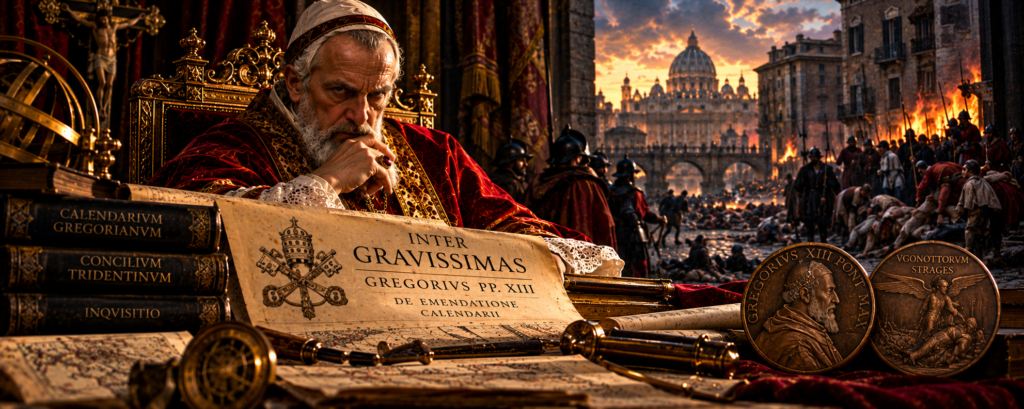
Gregory XIII: The Pope Who Changed the Calendar and Commemorated a Massacre
Pope Gregory XIII (1502–1585) | Reigned 1572–1585
A Massacre in Paris, a Celebration in Rome
In the final days of August 1572, horrifying reports began spreading across Europe about what had happened in Paris. Thousands of French Protestants were being hunted, dragged from their homes, and murdered in a wave of religious violence that began during the celebrations surrounding a royal wedding. The killings had started with an attack on prominent Protestant leaders, but the bloodshed quickly spread far beyond the original targets. Bodies filled the streets, terrified families searched for places to hide, and the violence eventually reached other French cities.
In Rome, however, the news produced a very different public response. Pope Gregory XIII, who had occupied the papal throne for barely three months, received reports presenting the events as a victory for the Catholic monarchy over dangerous Protestant enemies. Thanksgiving ceremonies were organized, and the city witnessed celebrations of what appeared to be a major triumph for the Catholic cause. The pope participated in the religious observances, while the papal court helped transform the news into an event worthy of public commemoration.
The celebrations did not end with prayers and ceremonial displays. A commemorative medal was produced bearing Gregory’s image on one side and a scene representing the destruction of the Huguenots on the other. Its inscription, Ugonottorum Strages, referred to the slaughter or defeat of the French Protestants. The imagery included an armed heavenly figure striking down enemies, presenting the event through the language of religious victory.
Even more disturbing to later generations was the decision to commemorate the events through paintings inside the Vatican itself. Giorgio Vasari, one of the most celebrated artists of the Italian Renaissance, produced a series of frescoes depicting episodes associated with the massacre. These paintings were installed in the Sala Regia, a ceremonial hall used for important papal occasions. The violence in France had been transformed into a permanent visual statement within the heart of Catholic authority.
Yet Gregory’s responsibility requires careful examination. There is no reliable evidence that he planned the St. Bartholomew’s Day Massacre, ordered the killings, or possessed advance knowledge of the operation that triggered them. The information initially reaching Rome was incomplete, politically manipulated, and influenced by claims that the French crown had suppressed a Protestant conspiracy. Historians continue debating exactly what Gregory understood about the nature and scale of the violence when the celebrations began.
That uncertainty matters, but it does not make the papal response insignificant. Whatever Gregory initially believed, the thanksgiving ceremonies, commemorative medal, and Vatican paintings became enduring evidence of how his government publicly interpreted the destruction of French Protestants. The celebration of a supposed Catholic victory became inseparable from one of the most notorious episodes of religious mass killing in European history. The contrast between the pope’s intentions and the suffering of the victims remains central to understanding his legacy.
Gregory XIII is remembered today primarily for introducing the calendar that much of the world still uses. His reign also witnessed major advances in Catholic education, missionary activity, and the implementation of the Council of Trent. He was a capable administrator, a generous patron of scholarship, and an energetic supporter of religious reform. Yet the same pope whose name became attached to a remarkable scientific achievement also presided over a court that commemorated news arising from the slaughter of thousands.
His story reveals the contradictions of the Counter-Reformation papacy. Gregory could support intellectual learning while pursuing aggressive religious policies against Protestant governments. He could promote education and institutional reform while advancing members of his own family. Most unsettling of all, he could participate in public celebrations of events whose human consequences were far darker than the political victory his court believed it was honoring.
Ugo Boncompagni: The Lawyer Who Would Become Pope
The future Gregory XIII was born Ugo Boncompagni on January 1, 1502, in Bologna, a city renowned for its university and its traditions of legal scholarship. His family enjoyed respectable standing, although it did not possess the immense wealth or international power associated with the great ruling dynasties of Renaissance Italy. His father, Cristoforo Boncompagni, was a merchant, while his mother, Angela Marescalchi, belonged to another established family. Ugo’s early prospects depended heavily upon education and professional advancement.
Bologna provided an ideal environment for an ambitious young man interested in law. Its university was among Europe’s most distinguished centers for the study of civil and canon law. These disciplines were particularly valuable within the Catholic Church, which governed not only religious institutions but also extensive territories and complicated legal systems. A skilled lawyer could rise through the papal administration without beginning life as a powerful aristocrat.
Boncompagni pursued legal studies with considerable success. He earned a doctorate in civil and canon law and eventually became a professor at the University of Bologna. His teaching career brought him into contact with students who would later become influential figures within the Church. Among those associated with his academic career were future cardinals and important ecclesiastical administrators.
His professional reputation developed during a period of profound religious upheaval. Martin Luther’s challenge to Rome had already divided Western Christianity, while Protestant movements were spreading through Germany, Switzerland, and other regions. Catholic authorities faced increasingly difficult questions concerning doctrine, government, and religious obedience. Lawyers trained in ecclesiastical administration became especially valuable.
Boncompagni’s intellectual interests were practical rather than revolutionary. He did not emerge as a major theological innovator or an outspoken religious radical. His strengths lay in legal reasoning, administration, and the ability to navigate complicated institutional problems. These qualities would later make him attractive to popes seeking dependable officials.
His early life also contained a personal detail that complicates the image of the future reforming pontiff. Before entering the priesthood, Boncompagni fathered a son named Giacomo. The child was born outside marriage, a circumstance that later attracted attention because Gregory would become an important figure in enforcing Catholic moral and ecclesiastical discipline. His relationship with Giacomo would also become significant when he began distributing offices and honors as pope.
The existence of his son was not a rumor invented by Protestant enemies. Giacomo Boncompagni was a recognized member of the pope’s family and later received important appointments. The circumstances of his birth belonged to Ugo’s life before his priestly ordination. Nevertheless, his later advancement illustrates the persistence of family patronage within the supposedly reformed papacy.
Boncompagni’s path to Rome began through the connections he established as a respected legal scholar. In 1539, he entered papal service, beginning a career that would last more than three decades before his election. He was already an experienced professional when he joined the administration. His rise would be gradual, shaped by legal competence and service under successive pontiffs.
A Career Through the Courts of Renaissance Rome
Boncompagni entered the papal administration during the reign of Paul III, the Farnese pope who combined major reforming initiatives with extensive family patronage. Rome remained a political capital as well as the spiritual center of Catholic Christianity. Its government required officials capable of managing courts, diplomatic correspondence, financial disputes, and territorial administration. Boncompagni’s legal expertise made him well suited to this environment.
He received a series of appointments that expanded his responsibilities. His work included judicial and administrative functions, and he developed experience with the complicated legal affairs of the Papal States. He also became involved in matters connected with the Council of Trent. These assignments introduced him to the central problems facing the Catholic Church.
The Council of Trent had first opened in 1545 in response to the religious crisis created by the Reformation. Its proceedings were repeatedly interrupted by political disputes, warfare, and disagreements among Catholic rulers. Boncompagni witnessed the difficulties involved in coordinating institutional reform across a divided Europe. The experience strengthened his understanding of diplomacy and ecclesiastical government.
His career continued under Julius III and Paul IV. During Paul IV’s pontificate, Boncompagni served in diplomatic assignments associated with Cardinal Carlo Carafa, the pope’s powerful nephew. Carlo’s political activities eventually contributed to the disastrous reputation of the Carafa government. Boncompagni, however, survived the family’s downfall without becoming a principal target of the subsequent prosecutions.
This survival demonstrated political caution. The Carafa family had accumulated powerful enemies, and their collapse under Pius IV led to executions and prolonged controversy. Boncompagni had been connected with their administration but avoided being destroyed alongside them. His ability to navigate such dangerous circumstances reflected considerable practical judgment.
In 1558, he became bishop of Vieste. The appointment formally strengthened his position within the ecclesiastical hierarchy. His legal career had already established him as a capable administrator, but episcopal office brought additional religious responsibilities. He continued moving toward the highest ranks of the Church.
Under Pius IV, Boncompagni participated in the final phase of the Council of Trent. He was sent to the council in 1561 as an expert in canon law, contributing to the legal and administrative work surrounding its deliberations. The council concluded in 1563, establishing the foundations of Catholic reform for generations. Boncompagni’s experience would later influence his own efforts to implement its decrees.
Pius IV elevated him to the College of Cardinals in March 1565. The promotion recognized decades of service and brought him into the body responsible for electing future popes. Boncompagni was already in his sixties and possessed extensive administrative experience. He was not a young aristocrat suddenly raised to prominence through family influence.
His advancement continued under Pius V, the austere Dominican pope whose government emphasized strict religious discipline. Boncompagni served in important administrative capacities and remained respected for his legal knowledge. He was familiar with both the moderate approach of Pius IV and the uncompromising religious policies of Pius V. His own pontificate would combine elements of both traditions.
The Conclave of 1572: A New Pope for a Divided Europe
Pius V died on May 1, 1572, leaving behind a Church that had become more disciplined but also more confrontational toward Protestant governments. His pontificate had strengthened inquisitorial enforcement, expelled Jewish communities from much of the Papal States, and challenged Elizabeth I’s legitimacy through excommunication. He had also helped organize the Holy League that defeated an Ottoman fleet at Lepanto. His successor would inherit both the achievements and the tensions of that government.
The College of Cardinals faced a complicated political environment. Spain remained the dominant Catholic monarchy, while France was divided by religious conflict. England had established Protestant government, and the Netherlands were increasingly unstable. The papacy needed a leader capable of managing these challenges without losing control of its own institutions.
Boncompagni emerged as an attractive candidate because of his experience and administrative competence. He was respected as a lawyer and had served several popes. His temperament appeared less severe than that of Pius V, although he remained committed to Catholic orthodoxy. His candidacy also benefited from support among influential cardinals and Catholic political interests.
The conclave proved unusually brief. On May 13, 1572, Boncompagni was elected pope, and his pontificate is commonly dated from that day, with his coronation following shortly afterward. He chose the name Gregory XIII, invoking a tradition associated with earlier reforming pontiffs. The new pope was seventy years old.
His election appeared to promise experienced government rather than dramatic personal innovation. Gregory understood the machinery of the papacy and possessed the legal skills necessary to supervise it. He was interested in education, scholarship, and institutional reform. He also believed that Catholicism needed to defend itself vigorously against Protestant expansion.
His first months were filled with the ordinary demands of papal administration. He began organizing his government, reviewing appointments, and establishing relationships with European rulers. The Church’s international responsibilities required constant diplomatic attention. Gregory had little reason to expect that his reputation would soon become permanently associated with a massacre in France.
Yet the religious conflict unfolding beyond the Alps was already approaching catastrophe. France had experienced a decade of civil warfare between Catholics and Protestants. A royal marriage intended to encourage reconciliation had brought prominent Protestant nobles into Paris. Within weeks of Gregory’s election, that gathering would become the setting for one of Europe’s most infamous outbreaks of mass violence.
France Before the Massacre: A Kingdom Poisoned by Religious Hatred
The French Wars of Religion began in 1562 and developed into a prolonged struggle involving religious conviction, aristocratic rivalry, and the authority of the monarchy. French Protestants, known as Huguenots, had gained influence among sections of the nobility and urban population. Catholic leaders feared that Protestant expansion threatened the religious identity of the kingdom. Both sides developed networks of political and military support.
The French monarchy struggled to maintain control. King Charles IX was young, and his mother, Catherine de’ Medici, remained a central figure in royal government. Catherine pursued various attempts at compromise, although her policies were shaped by changing political circumstances and the need to preserve royal authority. Her position was complicated by rival noble families whose religious loyalties overlapped with ambitions for power.
One of the most influential Protestant leaders was Admiral Gaspard de Coligny. He had become a prominent adviser to Charles IX and supported policies that alarmed Catholic opponents. His growing influence at court created resentment among powerful Catholic nobles. The Guise family, in particular, had longstanding reasons to regard him as an enemy.
By 1572, the monarchy hoped that a dynastic marriage might help reduce religious tensions. Marguerite de Valois, the king’s Catholic sister, was to marry Henry of Navarre, a leading Protestant prince. The wedding brought numerous Huguenot nobles to Paris. It also placed many of their most important leaders within a city where Catholic hostility remained intense.
The marriage took place on August 18, 1572. Its political purpose was reconciliation, but the atmosphere surrounding the celebration was deeply unstable. Many Parisian Catholics resented the presence of Protestant nobles. Rumors and suspicions circulated through the city.
The royal court was also divided. Coligny’s influence upon Charles IX troubled Catherine and other political figures, although historians continue debating the precise motivations behind the decisions that followed. The relationship between the crown, the Guise family, and the Protestant leadership was extraordinarily tense. The wedding had temporarily gathered these rival interests in one place.
The situation deteriorated dramatically on August 22. An assassin fired upon Coligny, wounding him but failing to kill him. The attack created panic among the Huguenot nobles and intensified demands for justice. The possibility of renewed civil war suddenly appeared imminent.
What followed remains the subject of extensive historical debate. The royal government decided to eliminate selected Protestant leaders, apparently fearing a dangerous political confrontation. Yet the resulting violence quickly escaped the boundaries of a limited operation. The decision to kill prominent individuals became the trigger for a much wider massacre.
August 24, 1572: Paris Descends Into Bloodshed
During the night of August 23–24, armed men moved against Protestant leaders in Paris. Coligny was among the first and most important targets. He was killed in his lodgings, and his body was subjected to further indignities. His death became a symbol of the destruction of the Huguenot leadership.
The violence rapidly spread beyond the original targets. Catholic militants and other participants attacked Protestant residents and visitors throughout the city. Homes were invaded, people were killed in the streets, and bodies were thrown into the Seine. The attacks involved religious hatred, political fear, personal grievances, and opportunities for violence.
The massacre did not remain confined to prominent nobles. Ordinary Protestants were murdered because of their religious identity. Women, men, and children became victims as the violence spread. The distinction between political assassination and indiscriminate slaughter collapsed.
The royal government’s precise intentions remain debated. Historians distinguish the initial decision to eliminate selected leaders from the broader violence carried out by crowds and local militants. The massacre cannot be explained adequately as a single operation executed according to a completely predetermined plan. It developed through interacting decisions, fears, and acts of violence.
The killings continued in Paris for several days. News and political orders then contributed to further massacres in other French cities. Violence occurred in places including Orléans, Lyon, Rouen, and Bordeaux, although local circumstances differed. The death toll across France reached many thousands.
Precise figures remain uncertain. Estimates vary because contemporary accounts were incomplete, politically charged, and sometimes exaggerated. Historians generally agree that thousands of Protestants died, but the total cannot be established with precision. The uncertainty should not obscure the enormous scale of the atrocity.
For survivors, the massacre shattered hopes of religious reconciliation. Families had lost relatives, communities had been devastated, and trust in the monarchy was profoundly damaged. Protestant writers increasingly portrayed the French crown as capable of treacherous violence against its own subjects. The events transformed the political and religious landscape of France.
The massacre also produced an international crisis of interpretation. Catholic and Protestant governments received conflicting reports about what had happened. Each side evaluated the news through its own fears and political interests. Rome would become one of the most important centers in which the event was publicly interpreted.
The News Reaches Rome
Information traveled slowly across sixteenth-century Europe, particularly when events were unfolding amid violence and political confusion. Diplomatic couriers carried reports between courts, but the messages they delivered reflected the knowledge and interests of their senders. Rumors could spread faster than reliable explanations. Political authorities frequently attempted to shape how distant governments understood controversial events.
The first reports reaching Rome presented the killings in a framework favorable to the French monarchy. They emphasized the supposed discovery and suppression of a dangerous Huguenot conspiracy. Such accounts suggested that the crown had acted to protect itself from Protestant treachery. They did not necessarily convey the full extent of the indiscriminate violence taking place.
Gregory XIII and his advisers therefore encountered the news through a politically constructed narrative. The French government had strong reasons to justify its actions to Catholic allies. The suggestion that the king had escaped a conspiracy offered a convenient explanation for the deaths of prominent Protestant leaders. It also encouraged the interpretation of the events as a victory for Catholic authority.
The pope’s initial understanding remains an important historical question. There is no reliable evidence that he had advance knowledge of the massacre or participated in planning it. Contemporary communications indicate that Rome received reports emphasizing a supposed threat to the French royal family. The extent to which Gregory understood the broader killings when celebrations began is less certain.
This distinction is essential because later accounts sometimes present the pope as though he had personally ordered the slaughter. Such claims go beyond the available evidence. Gregory’s responsibility lies in his government’s response to the news and its subsequent public commemoration. That response can be criticized without inventing a role in the original planning.
The papal court did not merely receive the reports privately. It organized public religious observances and celebrated what it understood as a Catholic political victory. The ceremonies helped establish an official interpretation of the events. Rome became an important stage upon which the French monarchy’s explanation was transformed into a religious triumph.
The problem was that the underlying event was not a conventional military victory. It involved the killing of thousands of people, including civilians who posed no immediate threat to the French crown. The official interpretation obscured that reality. The resulting celebrations would become one of the most troubling features of Gregory’s pontificate.
The Thanksgiving That Became a Scandal
The papal response included solemn thanksgiving ceremonies, most famously the singing of the Te Deum. The hymn was traditionally associated with major religious celebrations and expressions of gratitude. In the context of the news from France, its performance conveyed the impression that the events deserved thanksgiving. The symbolism was unmistakably political as well as religious.
Gregory participated in ceremonies connected with the reported Catholic victory. The French diplomatic presence in Rome helped promote the interpretation that the monarchy had defeated a dangerous conspiracy. Cardinals and other prominent churchmen took part in the public observances. The events demonstrated the close relationship between religious ceremony and international politics.
The celebrations were not simply spontaneous reactions by ordinary Romans. They involved the papal court and were given official significance. Religious rituals provided a framework through which the reported events could be understood as providential. The political survival of a Catholic monarch was presented as a cause for gratitude.
Historians have emphasized that the news reaching Rome was incomplete and politically manipulated. Gregory may initially have believed that the French crown had suppressed an imminent rebellion rather than unleashed a broad massacre. This possibility complicates any attempt to describe his reaction as a straightforward celebration of civilian slaughter. The evidence requires attention to what was known, when it was known, and how the information was presented.
Nevertheless, the celebrations remain disturbing. They transformed news associated with mass killing into an occasion for public religious triumph. The ceremonies offered little visible recognition of the suffering of Protestant civilians. The official language emphasized victory rather than tragedy.
Some later accounts describe Gregory as expressing sorrow or horror when he learned more about the violence. Such claims appear in historical traditions that seek to distinguish his initial reaction from his response to fuller information. They deserve consideration but should not be treated as conclusive proof of his private emotions. The surviving evidence does not permit a simple reconstruction of everything he thought or felt.
The public record is clearer than the private one. Thanksgiving ceremonies occurred, and the papal court participated in commemorating the news. Those actions helped shape the event’s meaning within Catholic Europe. Whatever Gregory’s intentions, the spectacle became inseparable from the massacre itself.
The Medal That Preserved the Shame
One of the most enduring objects associated with Gregory XIII is the medal commemorating the events of 1572. Its obverse bears the pope’s portrait, identifying the reigning pontiff. The reverse depicts a heavenly figure striking down enemies. The inscription refers to the destruction or slaughter of the Huguenots.
The medal is important because it survives as material evidence of the papal court’s interpretation. Unlike later accounts written by supporters or critics, it is an object produced within the political culture of Gregory’s reign. Its imagery presents the event as a victory over religious enemies. The use of a heavenly figure gives that victory a sacred dimension.
Commemorative medals were common instruments of Renaissance political communication. Popes and princes used them to celebrate military successes, building projects, diplomatic achievements, and important events. Their designs condensed complex political messages into images and inscriptions. The Gregory medal belongs to that tradition.
Its subject, however, was extraordinarily troubling. The event being commemorated was associated with the killing of thousands of Protestants. The medal did not distinguish between the assassination of selected political leaders and the wider slaughter of civilians. Its message was triumphal rather than mournful.
The inscription has been translated in different ways, including references to the slaughter or defeat of the Huguenots. The Latin word strages can evoke destruction, carnage, or slaughter. The imagery reinforces the violent character of the commemoration. It is difficult to interpret the object as a neutral record of political events.
Yet the medal should not be used to prove that Gregory planned the massacre. It was produced after the event and reflects the interpretation adopted by the papal court. Its significance lies in commemoration rather than advance conspiracy. The distinction is necessary for responsible historical analysis.
The object remains one of the strongest reasons Gregory appears in discussions of controversial popes. It demonstrates how the papacy publicly associated itself with the reported destruction of Protestant enemies. The medal turned a violent political event into a symbol of religious victory. Centuries later, that symbolism remains deeply unsettling.
Vasari’s Frescoes: When Violence Became Vatican Art
The commemorative medal was not the only lasting artistic response to the massacre. Gregory XIII also commissioned frescoes from Giorgio Vasari depicting episodes associated with the events in France. The paintings were installed in the Sala Regia of the Vatican Palace. Their placement gave the subject extraordinary ceremonial prominence.
Vasari was already famous as a painter, architect, and author of biographies of Renaissance artists. His career had brought him into the service of powerful patrons. He understood how visual art could communicate political authority. The commission therefore placed a major artistic talent at the service of papal commemoration.
The frescoes depicted episodes connected with the attempted assassination of Coligny and the subsequent violence. Their composition presented the events within a political and religious framework favorable to the Catholic cause. The paintings did not function as neutral historical reporting. They transformed selected episodes into a visual narrative of victory and authority.
The location mattered enormously. The Sala Regia was used for important papal ceremonies and diplomatic occasions. Visitors entering the hall encountered images celebrating significant events in the history of papal and Catholic power. The inclusion of the French massacre placed it within that tradition. Violence against Huguenots became part of the visual memory of the papal monarchy.
The frescoes also reveal how historical events could be reshaped through artistic patronage. A complicated and chaotic massacre became a series of carefully organized scenes. The suffering of victims was subordinated to a narrative of political triumph. The paintings helped establish an official memory that differed sharply from Protestant accounts of the slaughter.
Historians have examined the relationship between the frescoes and the political claims made by the French monarchy. The papal court was not simply recording what had happened. It was participating in the creation of a particular interpretation. The resulting images served religious, diplomatic, and ceremonial purposes.
The paintings remain especially disturbing because they were not temporary decorations produced during a moment of excitement. They became permanent features of an important Vatican space. Their survival allows later generations to examine how the papal government chose to remember the events. The commission demonstrates that the celebration extended beyond the first confused reports.
It is possible to acknowledge uncertainty about Gregory’s initial knowledge while recognizing the significance of this later artistic program. The frescoes required planning, patronage, and approval. They reveal a sustained willingness to present the events as a triumph. That decision forms an essential part of Gregory’s historical responsibility.
What Did Gregory XIII Actually Know?
The question of Gregory’s knowledge has generated controversy for centuries. Protestant polemicists often portrayed the papacy as directly responsible for the massacre, while Catholic defenders emphasized the misleading reports received in Rome. Both traditions sometimes simplified a complicated sequence of events. Modern historians have attempted to reconstruct the flow of information more carefully.
The evidence does not support the claim that Gregory ordered the massacre. The violence emerged from French political circumstances involving the monarchy, noble factions, and local militants. The initial decision to kill selected Protestant leaders was made within the French political environment. The wider massacre developed through actions that extended beyond the original operation.
The pope’s response must therefore be evaluated separately. He received news through diplomatic channels that presented the events as the suppression of a Protestant conspiracy. Such reports could reasonably have influenced his initial interpretation. The public celebrations reflected that framework.
Yet the scale of the violence became increasingly difficult to ignore as information circulated. Reports from France described killings extending beyond the original political targets. The papal court’s commemorative program nevertheless preserved the triumphal interpretation. This creates a more complicated moral question than the simple issue of whether Gregory knew the full facts on the first day.
Some historical accounts suggest that Gregory later expressed distress over the indiscriminate killings. Others emphasize the continuing official celebration. These accounts need not be treated as mutually exclusive in every respect. A ruler could condemn unauthorized violence while still regarding the destruction of Protestant political influence as beneficial.
The distinction between private feeling and public action is especially important. Historians cannot reliably reconstruct every emotion Gregory experienced. They can examine the ceremonies, medal, frescoes, and diplomatic communications associated with his government. Those records demonstrate the public position adopted by the papal court.
The strongest criticism therefore does not require portraying Gregory as the secret architect of the massacre. It concerns the willingness of his government to celebrate a supposed victory emerging from mass religious violence. The official commemoration helped normalize the destruction of Protestant enemies as a legitimate cause for rejoicing. That legacy remains troubling even when the uncertainties surrounding his initial knowledge are acknowledged.
The Massacre’s Aftermath: France Moves Toward More War
The St. Bartholomew’s Day Massacre did not end the French Wars of Religion. Instead, it intensified Protestant distrust of the monarchy and deepened the divisions already threatening the kingdom. Surviving Huguenots faced the knowledge that royal protection could fail catastrophically. The possibility of peaceful coexistence appeared increasingly uncertain.
The massacre also transformed Protestant political thought. Writers began developing arguments about resistance to rulers who violated their obligations to subjects. The legitimacy of monarchy itself became a subject of intense debate. Religious persecution encouraged political theories that challenged absolute obedience.
The French crown struggled to restore stability. Charles IX remained king until his death in 1574, while Catherine de’ Medici continued exercising substantial influence. Henry III succeeded his brother and inherited the unresolved religious crisis. The kingdom remained divided by competing religious and political loyalties.
Gregory XIII supported Catholic interests in France throughout his pontificate. He regarded Protestant expansion as a threat to religious unity. His government maintained diplomatic relations with Catholic political leaders and opposed settlements that appeared to strengthen the Huguenots. The papacy remained involved in the wider conflict.
Yet Catholic politics in France were not unified. The monarchy sometimes pursued compromise to preserve royal authority, while militant Catholic factions demanded stronger action. The Guise family and other noble houses pursued their own ambitions. Rome had to navigate these rivalries while maintaining its religious objectives.
The massacre’s memory continued shaping political behavior. Protestant communities regarded it as evidence of the danger posed by Catholic authorities. Catholic militants sometimes interpreted it as a decisive blow against heresy. The competing memories made reconciliation more difficult.
Gregory’s public response became part of this wider struggle over meaning. The papal celebrations reinforced Protestant fears that Catholic authorities approved violent suppression. Catholic defenders offered different explanations emphasizing political conspiracy and the pope’s incomplete knowledge. The controversy extended far beyond Gregory’s lifetime.
A Pope With a Son: Giacomo Boncompagni and Family Advancement
Gregory XIII’s reputation is not defined by sexual scandal during his pontificate, but his family life complicates the image of a purely austere reformer. Before becoming a priest, he fathered a son named Giacomo Boncompagni. Giacomo’s existence was acknowledged rather than concealed. When Ugo became pope, his son benefited substantially from the new family’s position.
Giacomo received important military and administrative appointments. He became governor of Castel Sant’Angelo and held the position of gonfalonier of the Church, a title associated with military leadership in the Papal States. These appointments gave him status and influence. They also demonstrated that family patronage remained an accepted feature of papal government.
Gregory’s nepotism was not as extravagant as that of some Renaissance predecessors. He did not transform the papacy into an enormous family empire on the scale associated with Alexander VI or Paul III. Nevertheless, he advanced relatives and sought to strengthen the Boncompagni family’s position. His government did not entirely abandon the political habits reformers had criticized.
The advancement of Giacomo was especially striking because of his birth outside marriage. Gregory had become a leading figure in a Church increasingly committed to enforcing moral discipline. His son’s position revealed how personal history and public religious authority could coexist uneasily. The pope did not attempt to erase the past but incorporated Giacomo into his political household.
Giacomo’s career also reflected the practical logic of Renaissance patronage. Popes needed trusted officials, particularly in military and territorial affairs. Family loyalty offered a degree of security in an environment filled with rival factions. The system encouraged rulers to rely upon relatives even when those appointments raised questions of fairness.
Gregory’s nephews also benefited from ecclesiastical advancement. Two received cardinalates during his pontificate. Such appointments strengthened family influence within the College of Cardinals. They continued a tradition that had survived repeated calls for reform.
The significance lies less in spectacular corruption than in institutional contradiction. Gregory supported the implementation of the Council of Trent and encouraged better clerical discipline. Yet he remained willing to use papal office to advance his family. The reformed Church still operated within a political culture shaped by kinship and privilege.
The Gregorian Calendar: Ten Days Disappear
Gregory XIII’s most enduring achievement came in 1582, when he introduced the calendar reform that now bears his name. The problem had been recognized for centuries. The Julian calendar, established under Julius Caesar, treated the average year as slightly longer than the actual solar year. Over time, the discrepancy accumulated and caused the calendar to drift relative to the seasons.
The difference was small in any single year but significant across centuries. By the sixteenth century, the calendar’s relationship to the spring equinox had shifted by approximately ten days from the position assumed in earlier Christian calculations. This mattered particularly for determining the date of Easter. The Church wanted its liturgical calendar to remain aligned with the astronomical seasons.
Gregory appointed and supported experts who examined possible solutions. The reform drew upon the work of the Italian physician and astronomer Luigi Lilio, also known as Aloysius Lilius. The Jesuit mathematician Christoph Clavius became an important defender and explainer of the new system. The achievement was therefore collaborative rather than the personal scientific invention of the pope.
The solution required correcting both the accumulated error and the underlying rule for leap years. The calendar would omit ten dates in October 1582. In territories adopting the reform immediately, Thursday, October 4, was followed by Friday, October 15. The missing dates were a deliberate adjustment rather than an accidental disappearance.
The reform also changed the calculation of leap years. Under the Gregorian system, years divisible by four generally remain leap years, but century years are exceptions unless divisible by four hundred. This adjustment produces a more accurate approximation of the solar year. It greatly reduces the long-term drift that had affected the Julian calendar.
Gregory promulgated the reform through the bull Inter gravissimas, dated February 24, 1582. Catholic countries began adopting the new calendar, although implementation varied according to political circumstances. Protestant and Orthodox territories were initially more reluctant. The reform became entangled with the religious divisions of Europe.
The achievement was extraordinary because it extended beyond Catholic worship. The calendar eventually became the dominant civil system for measuring dates across much of the world. Its use spread through international commerce, diplomacy, science, and government. Gregory’s name became attached to an institution used daily by billions of people.
The irony is difficult to ignore. A pope remembered for celebrating news associated with religious massacre also sponsored one of history’s most successful scientific and administrative reforms. His calendar helped standardize time across religious and national boundaries. His political and religious policies, meanwhile, often reinforced the divisions separating those communities.
The Science Behind the Reform
The Gregorian calendar was not an arbitrary papal decree imposed without intellectual preparation. It emerged from centuries of astronomical observation and mathematical discussion. Scholars had long recognized that the Julian calendar did not perfectly match the solar year. Earlier proposals had attempted to correct the discrepancy.
Luigi Lilio’s calculations provided the foundation for the reform eventually adopted. His proposals addressed both the accumulated calendar drift and the calculation of Easter. After his death, his work continued influencing the commission responsible for the project. The final system incorporated the efforts of several scholars.
Christoph Clavius played a particularly important role. As a Jesuit mathematician, he possessed the expertise necessary to explain and defend the reform. He responded to criticisms and clarified the mathematical reasoning behind the new calendar. His work helped establish the reform’s intellectual credibility.
The adjustment was designed to preserve the relationship between the calendar and the seasons. The Gregorian year averages 365.2425 days, much closer to the actual tropical year than the Julian average of 365.25 days. The remaining discrepancy is small enough that the calendar remains highly effective over long periods. Its durability demonstrates the quality of the underlying calculations.
The reform also reveals the importance of scientific scholarship within the Catholic Church. The Counter-Reformation was not simply a period of censorship and religious coercion. Catholic institutions supported mathematicians, astronomers, and educators whose work contributed to important intellectual developments. Gregory’s patronage belonged to that tradition.
Yet acceptance of the calendar was shaped by religious politics. Protestant governments sometimes resisted a system associated with papal authority, even when its mathematical advantages were clear. The dispute demonstrated how confessional hostility could affect practical scientific decisions. A correction to the measurement of time became another issue in the struggle between Catholic and Protestant Europe.
England and its colonies did not adopt the Gregorian calendar until 1752. Other countries made the transition at different times, sometimes centuries after Gregory’s decree. The reform’s eventual success therefore required a long process of political and cultural acceptance. Its worldwide influence developed gradually.
Gregory deserves credit for authorizing and implementing the reform, but not for personally inventing its mathematics. His achievement was recognizing the value of expert work and using papal authority to establish a practical solution. It remains one of the most constructive acts of his pontificate. The calendar’s success also demonstrates how the papacy could contribute to intellectual progress even during an era of intense religious conflict.
The Jesuits and the Expansion of Catholic Education
Gregory XIII became one of the most important papal patrons of the Society of Jesus. The Jesuits had been approved under Paul III and had developed a strong reputation for education, missionary work, and the defense of Catholic doctrine. Their schools attracted students from across Europe. Their international organization made them particularly valuable to the Counter-Reformation.
Gregory recognized the importance of education in confronting Protestant influence. He believed that well-trained clergy could defend Catholic teaching more effectively than poorly educated priests. Schools and seminaries offered a practical means of strengthening the Church. His government therefore devoted substantial resources to educational institutions.
The Roman College became a particular focus of his patronage. Gregory supported its development and provided resources for its expansion. The institution eventually became known as the Gregorian University in his honor. Its influence extended far beyond Rome.
He also supported colleges intended to train clergy for specific regions. The German College received important assistance, while institutions serving English, Greek, and other communities developed during his pontificate. These colleges prepared priests for work in territories where Catholicism faced political or religious challenges. Their students often returned home to difficult circumstances.
The English College was especially significant. England’s Protestant government had restricted Catholic institutions, and the training of priests abroad became increasingly important. Gregory supported the preparation of clergy who could serve English Catholics. Their missions would eventually become entangled with the political conflict between Rome and Elizabeth I.
The pope’s educational patronage was substantial and enduring. It helped create networks of trained clergy capable of teaching, preaching, and organizing Catholic communities. These institutions became central to the Catholic Reformation. Their influence continued long after Gregory’s death.
Yet education also served confessional competition. The colleges were not neutral institutions devoted solely to intellectual inquiry. They trained clergy committed to Catholic doctrine and, in some cases, to restoring Catholic influence in Protestant territories. Scholarship and religious politics operated together.
Gregory’s educational legacy therefore contains both constructive and confrontational elements. He supported institutions that advanced learning and professional training. He also used education as part of a broader campaign to strengthen Catholicism against rival religious movements. The same schools that improved clerical knowledge could become instruments in Europe’s confessional struggles.
The English Mission: Priests Sent Into Danger
Gregory XIII’s relationship with England was shaped by the continuing conflict between the papacy and Elizabeth I. His predecessor, Pius V, had excommunicated Elizabeth in 1570 and declared her subjects released from allegiance. The bull had intensified the political danger surrounding English Catholicism. Gregory inherited the consequences of that confrontation.
English Catholics faced increasing restrictions upon public religious practice. Many continued observing their faith privately, while others refused participation in official Protestant worship. The government feared that Catholic allegiance might provide support for foreign intervention or domestic rebellion. The distinction between religious devotion and political disloyalty became increasingly contested.
Gregory supported the training of English priests abroad. The English College in Rome became an important institution for preparing clergy to minister to Catholics in England. These priests often entered the country secretly because their work could expose them to arrest. Their mission required considerable courage and carried serious risks.
The Jesuit mission associated with Edmund Campion and Robert Persons began in 1580. Campion was an accomplished scholar and preacher whose activities attracted government attention. He sought to defend Catholic belief and minister to Catholics who lacked access to priests. His work unfolded within an environment of intense political suspicion.
Campion was arrested in 1581 and eventually executed after being convicted of treason. His supporters regarded him as a martyr for religious faith, while the English government treated his activities within the framework of political security. The circumstances of his prosecution remain central to the history of Catholic persecution in Elizabethan England. His death became an important event in Catholic memory.
Gregory’s support for missionary activity was not identical to direct responsibility for every political conspiracy associated with English Catholicism. The papacy pursued several objectives, including spiritual ministry and the restoration of Catholic influence. Individual missionaries also differed in their attitudes toward political resistance. These distinctions matter when evaluating the period.
Nevertheless, Gregory’s government did not confine itself entirely to pastoral activity. It also supported efforts to challenge Protestant rule through political and military means. The combination made the position of English Catholics increasingly difficult. Religious missions could be suspected of serving wider papal ambitions.
The pope’s policy therefore produced a complicated legacy. His support helped sustain Catholic religious life under persecution. At the same time, his hostility toward Elizabeth’s government contributed to the political tensions that made Catholic ministry dangerous. The Church’s spiritual objectives remained entangled with struggles over sovereignty and allegiance.
Ireland: A Failed Intervention With Bloody Consequences
Gregory XIII also became involved in efforts to challenge English authority in Ireland. The island remained predominantly Catholic, although English political control and religious policy were expanding. Resistance to English government involved local dynastic interests, land disputes, and religious conflict. Catholic powers viewed Ireland as a possible point of pressure against Elizabeth I.
The pope supported initiatives intended to strengthen Catholic resistance. One early scheme involved Thomas Stukeley, an English adventurer whose plans for an Irish expedition became entangled with wider Mediterranean politics. The proposed intervention failed to develop as intended. Stukeley ultimately died in 1578 during a Portuguese campaign in Morocco.
A more direct effort followed in 1579, when James Fitzmaurice Fitzgerald returned to Ireland with a small force and papal support. His landing helped ignite the Second Desmond Rebellion. The conflict combined resistance to English authority with Catholic religious objectives. It soon became a devastating struggle.
Fitzmaurice was killed shortly after his return, but the rebellion continued. Papal and other foreign assistance remained part of the conflict. In 1580, a force associated with the papal intervention landed at Smerwick in County Kerry. The expedition was small and unable to overcome English military superiority.
English forces eventually besieged the foreign troops at Smerwick. After the defenders surrendered in November 1580, many were killed. The event became one of the most notorious episodes of the conflict. Its circumstances have been examined through competing contemporary accounts.
The wider rebellion brought enormous suffering to Ireland. Military campaigns devastated parts of Munster, while famine, disease, and displacement followed the destruction of agricultural resources. Civilians bore much of the cost. The conflict demonstrated the consequences of combining local resistance with international religious rivalry.
Gregory did not personally command the military operations or control every decision made by the rebels. Nevertheless, his government supported intervention against English authority. The effort failed to restore Catholic political control and contributed to a conflict that caused severe suffering. His policy illustrates the dangers of pursuing religious objectives through military schemes beyond the papacy’s practical control.
The Irish intervention also revealed the limits of papal power. Gregory could provide encouragement, legitimacy, and some resources, but he could not guarantee military success. Local conditions and English military strength determined the outcome. The failure damaged the prospects of Catholic resistance while leaving the population exposed to devastating reprisals.
A Pope Who Wanted Protestant Europe Back
Gregory XIII’s ambitions extended beyond England and Ireland. He hoped to strengthen Catholicism in Germany, Poland, the Netherlands, and other regions affected by the Reformation. His government used diplomacy, education, and ecclesiastical appointments to pursue these objectives. The pope regarded the recovery of Protestant territories as a central responsibility.
In the Holy Roman Empire, religious politics were extraordinarily complicated. Catholic and Protestant princes possessed substantial territorial authority, while imperial institutions struggled to preserve stability. Gregory supported Catholic rulers and churchmen seeking to strengthen their position. Jesuit education became an important part of that strategy.
The pope also intervened diplomatically in disputes concerning ecclesiastical territories. The Cologne conflict became especially significant during the final years of his pontificate. When Archbishop-Elector Gebhard Truchsess von Waldburg converted to Protestantism and attempted to retain his ecclesiastical principality, the resulting crisis threatened the political balance of the empire. Gregory supported Catholic efforts to prevent the territory from becoming Protestant.
The conflict developed into the Cologne War, beginning in 1583. Catholic and Protestant forces fought over the future of the archbishopric. The struggle demonstrated how religious conversion could become a question of territorial sovereignty. The papacy regarded the preservation of Catholic ecclesiastical principalities as essential.
Gregory also pursued contacts with rulers in northern and eastern Europe. Negotiations involving Sweden and Russia explored possibilities for religious reconciliation or closer relations with Rome. These efforts achieved limited success. Political and theological differences remained substantial.
In Poland, Catholic institutions benefited from educational and diplomatic initiatives. Jesuit activity helped strengthen Catholic influence among elites and within important centers of learning. The country’s religious environment remained complex, but Catholic reform gained momentum. Gregory regarded these developments as encouraging.
His broader strategy combined persuasion with political pressure. Education and diplomacy could strengthen Catholic institutions without immediate violence. Yet the pope also supported military and political efforts against Protestant rulers. The methods varied according to circumstances.
The common objective was religious restoration. Gregory wanted Catholicism to regain influence in territories where Protestantism had become established. His policies reflected the Counter-Reformation conviction that the Church should actively resist religious division. The result was a papacy deeply involved in Europe’s confessional conflicts.
The Missionary Pope and the Wider World
Gregory XIII’s religious ambitions were not confined to Europe. He supported missionary activity in Asia, Africa, and the Americas, particularly through the Jesuits and other religious orders. The expansion of European maritime empires had created new opportunities for Catholic missions. Rome increasingly regarded these territories as part of its spiritual responsibilities.
Jesuit missionaries were active in India, Japan, and other parts of Asia during his pontificate. Their work involved preaching, education, cultural encounters, and relationships with local rulers. Missionary success depended heavily upon political conditions and the willingness of communities to engage with Christianity. The results varied considerably.
Gregory supported the development of institutions intended to sustain these missions. Colleges trained clergy, while correspondence networks connected distant communities with Rome. The papacy became increasingly involved in coordinating international religious activity. The expansion reflected the growing global reach of Catholicism.
The missions also operated within the context of European imperial expansion. Portuguese and Spanish political power frequently shaped the circumstances in which missionaries worked. Religious conversion could become entangled with colonial authority and commercial interests. The relationship between mission and empire was complex.
Some missionaries developed sophisticated approaches to local languages and cultures. Others participated in systems that assumed the superiority of European religious institutions. The experiences of local populations varied according to region and individual circumstances. It would be misleading to portray the entire missionary movement as either purely benevolent or uniformly coercive.
Gregory’s patronage helped establish lasting Catholic communities beyond Europe. Educational institutions and religious networks continued developing after his death. The expansion became one of the important features of the post-Tridentine Church. It also reinforced Rome’s claim to international spiritual authority.
His missionary legacy therefore resembles his educational achievements. He supported institutions that produced enduring cultural and religious developments. Yet those institutions operated within a worldview committed to expanding Catholic influence. The pope’s commitment to religious truth remained closely connected with the desire for institutional growth.
The Roman College and the Making of a Catholic Intellectual Empire
Gregory XIII understood that the future of Catholicism depended partly upon education. The Protestant Reformation had demonstrated the power of universities, printing, and trained preachers. Catholic authorities needed institutions capable of responding to theological arguments and preparing clergy for difficult environments. Gregory devoted substantial resources to that objective.
The Roman College became one of the most important beneficiaries of his patronage. Founded by the Jesuits in the sixteenth century, it developed into a major center of Catholic learning. Gregory supported its expansion and helped provide the resources necessary for its continued growth. The institution later adopted his name.
Its curriculum included philosophy, theology, languages, and other disciplines considered essential to clerical education. Students came from different regions and entered networks that extended across Catholic Europe. The college helped create a common intellectual culture among educated Catholic clergy. Its influence continued for centuries.
Gregory also supported national colleges that trained priests for particular communities. The German College became an important institution for clergy destined for territories affected by Protestantism. The English College prepared priests for ministry under difficult political conditions. Other institutions served communities connected with eastern Christianity and the wider Catholic world.
These colleges were practical instruments of reform. Better-trained priests could preach more effectively, administer sacraments responsibly, and supervise religious communities. The educational deficiencies criticized before Trent were gradually being addressed. Gregory’s investment contributed to that transformation.
The institutions also served diplomatic and political purposes. Students trained in Rome developed loyalty to papal authority and connections with international Catholic networks. Their careers could strengthen Rome’s influence in distant territories. Education became a means of institutional consolidation.
Gregory’s achievement was substantial. He helped establish an educational infrastructure that outlived his pontificate and influenced generations of clergy. His support for scholarship demonstrated genuine intellectual ambition. It also showed how education could be used to strengthen a particular religious and political order.
The contrast with the massacre celebrations remains troubling. A pope capable of supporting sophisticated learning also presided over a court that commemorated the destruction of religious opponents. Intellectual accomplishment did not necessarily produce tolerance. Gregory’s reign demonstrates how scholarship and confessional hostility could flourish within the same institution.
Philip Neri, Teresa of Ávila, and the Reforming Church
Gregory XIII supported important religious movements that emphasized spiritual renewal. Among them was the Oratory associated with Philip Neri, a priest whose work in Rome focused upon prayer, pastoral care, and religious community. Neri’s approach differed in temperament from the severe inquisitorial methods associated with some Counter-Reformation leaders. His influence reflected the diversity of Catholic reform.
In 1575, Gregory formally approved the Congregation of the Oratory. The institution brought priests together in a community devoted to religious life and pastoral service. Its members emphasized preaching, prayer, and personal spiritual development. The approval helped establish a movement that would influence Catholic religious culture.
Gregory also supported the reforming work associated with Teresa of Ávila and the Discalced Carmelites. Teresa sought a stricter form of Carmelite religious life emphasizing prayer, poverty, and contemplative discipline. Her efforts encountered opposition within existing institutions. Papal support contributed to the movement’s eventual development.
These initiatives reveal an important aspect of Gregory’s religious priorities. He did not rely exclusively upon political pressure or inquisitorial enforcement. He recognized the value of spiritual renewal through communities devoted to education, prayer, and pastoral service. Such movements contributed to the vitality of post-Tridentine Catholicism.
The pope’s patronage also helped strengthen religious orders involved in missionary work and charitable activity. These communities offered different forms of service within Catholic society. Their achievements cannot be reduced to the coercive policies of papal diplomacy. They formed an important part of the broader Catholic Reformation.
Nevertheless, Gregory expected these movements to operate within the doctrinal authority of the Church. Spiritual renewal did not imply freedom to reject established Catholic teaching. Reform was encouraged when it strengthened institutional unity. The boundaries of acceptable innovation remained carefully supervised.
The result was a Church undergoing genuine transformation. New and reformed religious communities expanded opportunities for education and spiritual practice. Gregory’s government helped support those developments. His pontificate therefore combined creative religious renewal with aggressive resistance to Protestantism.
Rome’s Magnificent Buildings and Emptying Treasury
Gregory XIII was also a major patron of architecture and urban development. His government supported projects intended to strengthen Rome’s position as the center of Catholic Christianity. Churches, palaces, fountains, and institutional buildings contributed to the city’s changing appearance. These works reflected both religious ambition and papal magnificence.
One of his important projects was the development of the Quirinal Palace. The complex eventually became a major papal residence and later served other governmental purposes. Its construction reflected the continuing expansion of papal ceremonial and administrative space. Gregory’s patronage contributed to Rome’s architectural transformation.
He also supported work associated with St. Peter’s Basilica and the Vatican. The Gregorian Chapel became an important part of the basilica’s interior development. Such projects connected his pontificate with the long tradition of Renaissance papal building. Architecture remained a means of expressing religious authority.
The pope’s educational institutions also required substantial expenditure. Colleges needed buildings, teachers, libraries, and financial support. Missionary activity and international diplomacy added further costs. Gregory’s ambitions extended across many areas of government.
These expenses placed considerable pressure upon papal finances. The treasury had to support building projects, educational institutions, diplomatic initiatives, and political interventions. Revenue collection became increasingly important. Gregory’s government sought additional income through fiscal measures that could provoke resentment.
The pope’s financial policies included efforts to reclaim revenues and rights associated with feudal holdings. Such measures threatened the interests of powerful landowners. Disputes over property and taxation contributed to growing hostility. Some dispossessed or aggrieved nobles became associated with armed resistance and banditry.
The contrast between Rome’s magnificence and the financial pressures beneath it became increasingly visible. Gregory supported institutions that strengthened Catholicism but struggled to control the costs. His government achieved impressive cultural and educational results while accumulating administrative problems. The consequences would become particularly serious during his final years.
Bandits, Noble Feuds, and a Papal State Losing Control
One of the greatest weaknesses of Gregory XIII’s government was its failure to control banditry and disorder within the Papal States. Armed groups operated in rural territories, exploiting weak administration and conflicts among powerful families. Some were associated with dispossessed nobles or men involved in feudal disputes. Their activities threatened commerce and public security.
The problem developed partly from the complicated structure of papal government. Local elites possessed longstanding privileges, while central authorities attempted to strengthen control over taxation and property. Disputes could become violent when noble families resisted intervention. The papacy lacked the resources necessary to enforce its decisions consistently.
Gregory’s fiscal policies contributed to these tensions. Efforts to recover revenues and feudal rights angered influential landowners. Some resisted through legal challenges, while others became involved in armed opposition. The resulting disorder weakened the authority of the government.
Banditry affected ordinary people as well as political elites. Travelers faced robbery, merchants encountered dangerous roads, and rural communities suffered from violence. Economic activity declined in areas where security deteriorated. The government’s inability to protect its subjects damaged confidence in papal administration.
The situation became increasingly serious during Gregory’s later years. Armed groups operated with a degree of impunity that alarmed observers. The pope’s government struggled to suppress them. Its failure contrasted sharply with the efficiency displayed in other areas of administration.
The disorder also exposed the limits of Gregory’s political judgment. He was an experienced lawyer and administrator, yet his government could not resolve the growing security crisis. Financial pressures and noble resistance complicated enforcement. The problems accumulated as his pontificate continued.
His successor, Sixtus V, would become famous for adopting much harsher measures against banditry. The contrast helped shape later assessments of Gregory’s government. His reign appeared generous and intellectually productive but increasingly weak in matters of public order. The same pope who reorganized the calendar struggled to maintain security on the roads of his own territories.
The Jews of Rome Under Gregory XIII
Gregory’s policies toward Jewish communities were less consistently severe than those of Paul IV or Pius V, but they remained shaped by the discriminatory assumptions of the period. Jewish residents of Rome continued living under restrictions inherited from earlier pontificates. The ghetto remained an important feature of their legal and social position. Religious equality was not part of papal policy.
At certain moments, Gregory intervened to protect Jewish residents from violence or arbitrary treatment. His government issued measures intended to prevent unauthorized attacks upon the Roman ghetto. Such actions demonstrated that the pope could recognize the need to protect communities living under his authority. They also reflected the practical responsibilities of maintaining public order.
He sometimes moderated particular restrictions. Jewish communities could receive limited relief concerning books, travel, or other matters. These concessions varied according to circumstances and did not establish a general policy of toleration. The underlying system of segregation remained intact.
Other measures were restrictive. Jewish physicians faced limitations upon treating Christian patients, and religious authorities continued supervising aspects of Jewish communal life. The Church maintained policies intended to encourage conversion and reinforce Christian dominance. Gregory did not fundamentally challenge these assumptions.
The inconsistency reflected the interaction between religious prejudice and practical government. Jewish communities contributed to commerce and possessed skills valued by Christian society. Authorities sometimes protected them when economic or political interests required it. At other moments, discriminatory policies prevailed.
Gregory’s government therefore occupied an intermediate position between the severe expulsions of Pius V and more limited forms of administrative accommodation. It did not restore the rights lost under earlier popes. Jewish residents remained legally subordinate. Their security depended heavily upon decisions made by Christian rulers.
The significance for Gregory’s reputation lies in the contrast between selective protection and continuing discrimination. He could intervene against unauthorized violence while maintaining institutions that restricted Jewish freedom. His policies were not uniformly cruel, but neither were they based upon equal rights. They reflected the contradictions of a government capable of moderation without embracing religious tolerance.
The Vatican Becomes a Theater of Catholic Victory
Gregory XIII understood the power of ceremony and visual culture. Rome was not merely the administrative center of the Catholic Church. It was a city in which architecture, ritual, painting, and public celebrations communicated papal authority. The pope used these instruments extensively.
The commemorations of the St. Bartholomew’s Day Massacre were part of this wider political culture. Thanksgiving ceremonies transformed diplomatic news into religious spectacle. The medal condensed the interpretation into a portable object. The Vasari frescoes made the message permanent within a major Vatican ceremonial space.
Other events received similarly elaborate treatment. The Holy Year of 1575 brought large numbers of pilgrims to Rome, reinforcing the city’s importance as a center of Catholic devotion. Public ceremonies celebrated religious renewal and papal authority. The pope’s government understood the importance of visible demonstrations of unity.
The artistic program of the Vatican also reflected the Counter-Reformation emphasis on communicating religious messages clearly. Images could present complex ideas to audiences who did not read theological treatises. Ceremonial spaces became instruments of instruction and political persuasion. Gregory’s patronage contributed to this development.
Yet the same techniques could be used to glorify violence. The massacre frescoes demonstrate how artistic skill could transform disturbing events into images of triumph. The victims’ experiences were subordinated to the official interpretation. The paintings became part of a broader visual language of Catholic victory.
This does not mean that every artistic commission under Gregory was morally compromised. His support for architecture, education, and religious art produced achievements of genuine cultural value. The problem lies in the particular choices made about what deserved celebration. The massacre commemorations reveal the limits of the papal court’s sympathy toward religious opponents.
Gregory’s use of art therefore illustrates the relationship between memory and power. Rulers could shape how events were remembered by commissioning images that presented their preferred interpretation. The Vatican frescoes helped preserve a triumphal account of the events in France. Their survival allows later generations to question the moral assumptions behind that account.
The Last Years of a Long Pontificate
By the early 1580s, Gregory XIII had governed the Church for more than a decade. His pontificate had produced major achievements in education, missionary activity, and institutional reform. The calendar revision of 1582 had given his name an enduring place in world history. His patronage had transformed important parts of Rome.
Yet political and financial problems were accumulating. The Papal States suffered from banditry, while the treasury faced pressure from extensive expenditures. European religious conflicts remained unresolved. The pope’s efforts to restore Catholic influence in Protestant territories had achieved mixed results.
France continued experiencing religious division. England remained under Elizabeth I, and the papacy’s hopes for Catholic restoration had not succeeded. Ireland had suffered devastating conflict following unsuccessful foreign-supported intervention. The Netherlands remained a major theater of war between Spanish authority and Protestant resistance.
Gregory’s diplomatic ambitions often exceeded the practical resources available to him. He could encourage Catholic rulers, support missionaries, and provide limited financial assistance. He could not compel powerful monarchs to follow his preferred policies. The political fragmentation of Europe restricted papal influence.
His government nevertheless remained active. Educational institutions continued expanding, and Catholic reform gained strength in several regions. The Jesuits developed increasingly extensive international networks. Gregory’s commitment to scholarship and religious renewal remained substantial.
The pope’s age eventually became an important factor. Born in 1502, he was in his eighties during the final years of his reign. His long administrative experience remained valuable, but the demands of government were considerable. The problems facing the Papal States required energetic intervention.
Gregory died on April 10, 1585, at the age of eighty-three. His pontificate had lasted nearly thirteen years, making it one of the longer reigns of the sixteenth-century papacy. He left behind important reforms and unresolved political difficulties. His successor would inherit both.
Sixtus V Inherits a Troubled Papal State
The conclave following Gregory’s death elected Felice Peretti, who became Pope Sixtus V. The new pontiff was known for a forceful temperament and a determination to impose order. His government would become associated with harsh measures against banditry and criminal violence. The contrast with Gregory’s final years was immediate.
Sixtus inherited a Papal State troubled by insecurity and financial pressures. Armed groups had become a serious problem, and the authority of the government had weakened in some territories. The new pope pursued aggressive policies intended to restore control. His severity became a defining feature of his reputation.
Gregory’s achievements in education and calendar reform remained intact. The Gregorian calendar continued spreading, while the institutions he supported retained their influence. The Roman College and other educational foundations became important parts of Catholic life. His cultural legacy survived the change of government.
The massacre commemorations also remained. The medal continued existing as a material record of the papal response, and the frescoes remained within the Vatican. Their significance did not disappear with Gregory’s death. They became part of the historical evidence through which later generations judged his reign.
His reputation developed along different lines. Catholic historians often emphasized his reforming achievements and the extraordinary success of the calendar. Protestant writers focused more heavily upon the papal celebrations following the St. Bartholomew’s Day Massacre. The resulting portraits could appear almost irreconcilable.
Modern historical analysis must consider both traditions critically. Gregory was neither simply the benevolent inventor of a calendar nor the secret mastermind of a massacre. He was a capable Counter-Reformation pope whose government combined constructive institutional reform with aggressive religious politics. His public response to the killings in France remains one of the most serious controversies of his pontificate.
Was Gregory XIII Really a Wicked Pope?
Gregory XIII does not belong among the Wicked Popes because of extraordinary personal decadence. His private life was comparatively restrained during his pontificate, and he possessed genuine administrative ability. His support for education and scholarship produced institutions of lasting importance. His calendar reform remains one of the most successful administrative achievements associated with any pope.
His family patronage deserves criticism, although it was less extravagant than that of some predecessors. He advanced his son Giacomo and other relatives, continuing a practice that reformers had repeatedly questioned. These appointments reflected the persistence of Renaissance political habits within the post-Tridentine papacy. They complicate his reforming reputation without defining the entirety of his reign.
His religious policies also reflected the aggressive objectives of the Counter-Reformation. Gregory supported efforts to restore Catholic influence in Protestant territories and became involved in political schemes against Elizabethan England. His support for intervention in Ireland contributed to a conflict that brought severe suffering. His government was willing to use political and military means in pursuit of religious objectives.
Yet the St. Bartholomew’s Day Massacre remains the most troubling issue. Gregory did not order the killings, and the evidence does not establish that he knew of the plan beforehand. The initial reports reaching Rome were shaped by claims that the French crown had suppressed a Protestant conspiracy. These circumstances are essential to understanding the pope’s immediate reaction.
The subsequent commemorations, however, cannot be ignored. Thanksgiving ceremonies were held, a medal celebrated the destruction of the Huguenots, and Vasari’s frescoes presented the events within a triumphal narrative. The papal court helped transform news associated with mass killing into a symbol of Catholic victory. That decision remains deeply disturbing.
The strongest criticism is therefore not that Gregory secretly organized the massacre. It is that his government publicly celebrated an event whose reality included the murder of thousands of religious opponents. The commemorations reveal a political and religious culture in which the destruction of Protestant enemies could be interpreted as providential success. The suffering of civilians was overshadowed by the language of triumph.
Gregory’s achievements make this contradiction more significant. He was capable of supporting serious scholarship, sophisticated scientific work, and important educational institutions. He possessed the intelligence and administrative experience necessary to recognize complicated political circumstances. Yet his government participated in commemorations that remain morally troubling.
His inclusion among the Wicked Popes should therefore rest upon documented actions rather than sensational accusations. He was a reformer, patron, diplomat, and capable administrator. He was also a ruler whose response to religious violence became one of the most controversial episodes in papal history. His legacy demonstrates that institutional achievement does not erase responsibility for the public celebration of persecution.
The Pope Who Changed Time but Could Not Escape History
Gregory XIII left behind a legacy of extraordinary contradictions. His calendar reform changed the way much of the world measures time, while his support for education helped shape Catholic intellectual life for centuries. He strengthened missionary institutions, encouraged religious reform, and sponsored important artistic and architectural projects. These achievements were genuine, substantial, and enduring.
Yet the celebrations following the St. Bartholomew’s Day Massacre remain inseparable from his reign. Gregory did not plan the slaughter, and the evidence concerning his initial knowledge requires careful interpretation. Nevertheless, the thanksgiving ceremonies, commemorative medal, and Vatican frescoes reveal how his government publicly transformed news associated with mass killing into a religious triumph. The victims’ suffering was overshadowed by a political narrative of Catholic victory.
The most unsettling feature of Gregory’s story is not that he was uniquely monstrous among the rulers of his age. It is that a learned, capable, and reform-minded pope could participate in a political culture that treated the destruction of religious opponents as cause for celebration. His achievements in science and education did not prevent that response. The same papal court that supported mathematical precision and intellectual scholarship also commissioned images commemorating violence.
Gregory XIII remains a reminder that historical greatness and moral failure can occupy the same life. The calendar bearing his name continues to organize the days of billions of people, while the medal and frescoes associated with 1572 preserve a darker memory of his government. His reign helped shape the modern world, but it also exposed the cruelty that could emerge when religious rivalry overwhelmed concern for human suffering. The pope changed the calendar, yet the passage of centuries has not erased the questions raised by what his court chose to celebrate.