
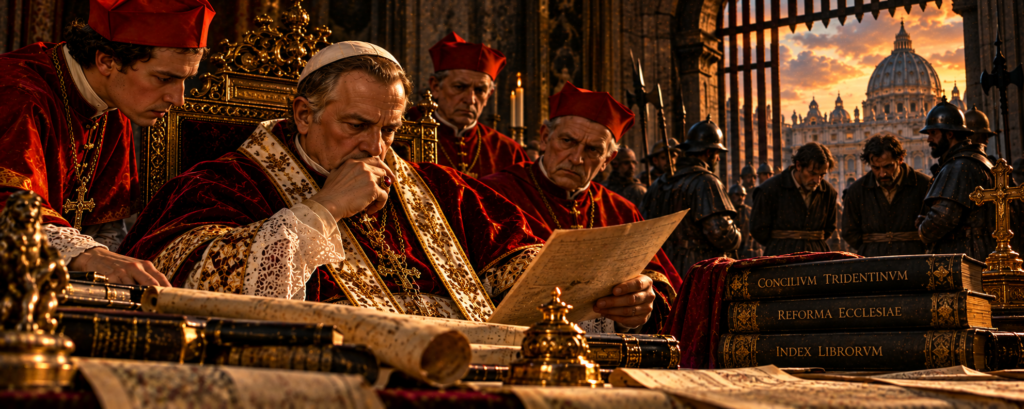
Pius IV: The Pope Who Executed His Predecessor’s Family and Rebuilt the Catholic Church
Pope Pius IV (1499–1565) | Reigned 1559–1565
The Cardinal Who Went to His Death
On March 4, 1561, Cardinal Carlo Carafa was executed inside Castel Sant’Angelo, the imposing fortress overlooking the Tiber in Rome. Only a few years earlier, he had been one of the most powerful men in the Catholic Church, a papal nephew whose influence extended into diplomacy, warfare, and the government of the Papal States. Now he was a condemned prisoner, stripped of the protection that had once made him almost untouchable. His death by strangulation marked the extraordinary collapse of a family that had dominated Rome under Pope Paul IV.
Carlo was not the only member of the Carafa dynasty facing death. His brother Giovanni, Duke of Paliano, was executed the same day, following proceedings that examined accusations of treason, violence, and murder. Other members of the family’s circle also suffered punishment, and the scandal surrounding them had become one of the most notorious episodes in recent papal history. The men who had once enjoyed the privileges of papal kinship discovered how quickly those privileges could disappear when a new pope inherited the throne.
The man who authorized their destruction was Pope Pius IV, Giovanni Angelo de’ Medici, elected in December 1559 after the deeply unpopular reign of Paul IV. He had promised a different kind of government, one less dominated by suspicion, religious severity, and the aggressive political ambitions of the Carafa family. Yet his decision to prosecute his predecessor’s relatives revealed that moderation did not necessarily mean mercy. Pius was perfectly capable of using the formidable powers of the papacy against those he considered dangerous.
The executions initially appeared to represent justice finally catching up with a corrupt dynasty. Carlo Carafa had acquired a reputation for political manipulation and misconduct, while Giovanni’s household had become associated with a particularly shocking murder. Their downfall offered Pius an opportunity to distance his government from the scandals of his predecessor. It also allowed him to demonstrate that even a cardinal could be brought to account for serious offenses.
But the story did not end with the executions. In 1567, Pope Pius V ordered a reconsideration of important aspects of the proceedings, and the Carafa family received a measure of formal rehabilitation. The later review raised serious questions about the legal and political foundations of the original case, particularly the charges of treason and offenses against sovereign authority. It did not establish that every accusation against the brothers was false, but it complicated the claim that their deaths had been the straightforward triumph of justice.
That uncertainty makes Pius IV one of the more fascinating figures in the history of the Renaissance and Counter-Reformation papacy. He was not a ruler whose entire reign can be reduced to corruption, cruelty, or scandal. He successfully brought the Council of Trent to its conclusion, moderated some of the harshest policies of Paul IV, and helped establish reforms that would shape Catholicism for centuries. At the same time, he practiced nepotism, protected the political interests of his family, and approved executions whose legitimacy would later be challenged.
His story is therefore one of uncomfortable contradictions. The pope who helped complete one of the most important reforming councils in Christian history also governed through family patronage and political calculation. The man who reduced the atmosphere of fear surrounding the Roman Inquisition was willing to send a cardinal to his death. Pius IV was neither the monster his predecessor’s enemies had feared nor the spotless reformer his admirers might have preferred.
He was something more complicated: a capable Renaissance politician who understood that the Catholic Church needed to change, but who remained thoroughly comfortable exercising the extraordinary powers of the old papal monarchy.
Giovanni Angelo de’ Medici: A Pope From a Different Medici Family
Giovanni Angelo de’ Medici was born on March 31, 1499, in Milan, a city whose political fortunes were repeatedly overturned by the wars between France and the Habsburg Empire. His father, Bernardino de’ Medici, belonged to a Milanese family whose name was associated with the much more famous Medici dynasty of Florence. Although the families claimed connections, Giovanni Angelo did not belong to the ruling Florentine branch that had produced Leo X and Clement VII. His background was respectable and well connected, but he did not inherit the same extraordinary political position enjoyed by those earlier Medici popes.
His mother, Cecilia Serbelloni, came from another established family, and her relatives would later benefit from Giovanni Angelo’s rise. The household into which he was born possessed social standing, but its resources were not unlimited. His career would depend heavily upon education, professional ability, and the cultivation of influential patrons. This distinguished him from aristocratic churchmen whose advancement was almost guaranteed by birth.
Giovanni Angelo studied law, eventually receiving a doctorate in civil and canon law from the University of Bologna. Legal expertise was one of the most valuable qualifications for a career in the Renaissance Church. The papacy governed territories, collected revenues, negotiated treaties, administered courts, and supervised an enormous network of religious institutions. A capable lawyer could rise through its administration without possessing exceptional theological learning.
The young Medici entered ecclesiastical service during a period of extraordinary upheaval. Martin Luther’s challenge to Rome had already divided Western Christianity, while the Italian Wars continued destabilizing the peninsula. Popes struggled to preserve their independence between France and the Habsburg monarchy. The Church needed administrators who could manage complicated political and legal disputes.
Giovanni Angelo proved well suited to this environment. He developed a reputation for practical intelligence, diplomatic flexibility, and administrative competence. Unlike Gian Pietro Carafa, the future Paul IV, he was not primarily defined by an uncompromising commitment to inquisitorial severity. His temperament was more adaptable, and he was willing to negotiate where others preferred confrontation.
These qualities would become essential during his pontificate. Pius IV inherited a Church divided by religious conflict and exhausted by the political mistakes of his predecessor. His legal training helped him navigate disputes that required careful compromise. Yet the same experience also made him comfortable with the concentrated authority of papal government, including its ability to reward allies and punish enemies.
A Career Built Inside the Papal Government
Giovanni Angelo’s rise through the Church was gradual rather than spectacular. He entered the service of Clement VII and subsequently held important administrative responsibilities under Paul III. His career included diplomatic and governmental assignments in the Papal States. These positions exposed him to the practical problems of governing territories where noble families, local authorities, and papal officials competed for influence.
He served in regions where papal authority was frequently contested. The Papal States were not a unified modern country but a collection of territories with complicated political traditions and competing interests. Governors had to negotiate with local elites while enforcing the authority of Rome. Giovanni Angelo’s experience in such positions strengthened his reputation as a capable administrator.
Paul III recognized his abilities and promoted him to increasingly important offices. In 1549, he was elevated to the College of Cardinals. The appointment brought him into the highest ranks of the Church shortly before Paul III’s death. His legal knowledge and political experience made him a valuable figure within the College.
The following decade brought further responsibilities and increasing prominence. Giovanni Angelo witnessed the troubled pontificate of Julius III, whose reign was overshadowed by the scandal surrounding Innocenzo del Monte. He also experienced the severity of Paul IV’s government. These contrasting pontificates provided lessons about the dangers of both personal favoritism and excessive rigidity.
Under Paul IV, Giovanni Angelo did not become one of the pope’s most trusted political intimates. Their temperaments differed substantially, and the Carafa government was dominated by a relatively narrow circle of relatives and allies. Nevertheless, he survived the pontificate without suffering the fate of reform-minded cardinals who attracted inquisitorial suspicion. His ability to navigate the political environment demonstrated considerable caution.
By 1559, Giovanni Angelo was an experienced churchman in his early sixties. He had served under several popes and understood the internal workings of Roman government. He possessed the legal and diplomatic skills necessary to manage complex disputes. What he lacked was the reputation for uncompromising spiritual severity that had defined Paul IV.
For many cardinals, that difference would become a powerful argument in his favor.
Rome After Paul IV: A City Exhausted by Fear
Paul IV died on August 18, 1559, leaving behind a deeply troubled papacy. His government had strengthened the Roman Inquisition, imposed harsh censorship, and created the Roman Ghetto through the bull Cum nimis absurdum. His hostility toward Spanish power had drawn the Papal States into a disastrous war. His nephews had acquired extraordinary influence before becoming embroiled in scandals that eventually destroyed their position.
The reaction to his death was explosive. Crowds attacked symbols of his authority, including his statue, and rioters targeted the headquarters of the Inquisition. Prisoners were released, and records were destroyed during the unrest. The violence revealed the depth of resentment that had accumulated under his government.
Rome’s political elite also faced uncertainty. The Carafa family had dominated the previous pontificate, but its influence had collapsed during Paul’s final months. Other factions were eager to regain positions they had lost. The next pope would inherit a city filled with rivalries, grievances, and demands for change.
The College of Cardinals understood that the election would have consequences far beyond Rome. France and Spain remained competing powers, and the Catholic Church faced a growing Protestant challenge. The Council of Trent had been suspended since 1552. A new pope would need to decide whether to resume the council and how to manage the competing demands of Catholic monarchs.
Paul IV’s severity had also alienated important churchmen. Cardinal Giovanni Morone had been imprisoned on suspicion of heresy, while Reginald Pole had faced papal hostility despite his role in England’s temporary return to Catholicism. The atmosphere of suspicion had damaged trust within the Church’s leadership. Many cardinals wanted a government less inclined to treat disagreement as evidence of treachery.
Yet a complete rejection of Paul IV’s policies was neither possible nor universally desired. The Church remained committed to defending Catholic doctrine against Protestantism. The Inquisition continued to possess powerful supporters, and many reformers considered strict discipline essential. The challenge was to reduce the most destructive aspects of Paul’s government without abandoning Catholic reform.
Giovanni Angelo de’ Medici appeared capable of striking that balance. He was experienced, politically flexible, and less closely associated with the extremes of the previous pontificate. His election would offer Rome a change in temperament without requiring a fundamental surrender of papal authority. That combination made him increasingly attractive as the conclave continued.
The Conclave That Chose a Different Kind of Pope
The conclave following Paul IV’s death began in September 1559 and continued for more than three months. The prolonged negotiations reflected divisions among the cardinals and the competing interests of European monarchs. Spanish and French factions sought a candidate favorable to their political objectives. Other cardinals wanted a pope capable of restoring stability within the Church.
Giovanni Angelo de’ Medici emerged as a compromise candidate. His administrative experience reassured those who wanted competent government, while his moderate temperament appealed to churchmen exhausted by Paul’s severity. He was not entirely free from political associations, but he was sufficiently flexible to attract support across factional lines. His election represented a preference for practical leadership over ideological confrontation.
On December 25, 1559, the cardinals elected him pope. He chose the name Pius IV, a decision that associated him with the tradition of papal dignity and religious responsibility. The election took place on Christmas Day, giving the beginning of his pontificate a powerful symbolic setting. Rome had endured months of uncertainty and now possessed a new ruler.
Pius was sixty years old and had spent much of his adult life working within the papal administration. He understood that his predecessor’s policies had created resentment. He also recognized that the Church’s long-delayed reforming council could not remain suspended indefinitely. His immediate priorities would therefore include restoring stability and rebuilding relationships with important Catholic powers.
The new pope’s personality differed noticeably from that of Paul IV. He was more approachable, more willing to compromise, and less inclined toward the aggressive suspicion that had characterized the previous reign. He enjoyed conversation and cultivated relationships with scholars, artists, and diplomats. His government would be more flexible, though not necessarily less political.
The change was welcomed by many who had suffered under Paul IV. Churchmen previously viewed with suspicion regained influence, and the most severe features of inquisitorial government were moderated. Yet Pius did not intend to dismantle the institutions of Catholic authority. His objective was to make them function more effectively under his leadership.
The distinction would define his pontificate. Pius was not a revolutionary reformer seeking to transform the papacy into something entirely new. He was a skilled administrator who believed that stability required selective change. His government would combine genuine institutional reform with the familiar political practices of Renaissance Rome.
The First Reversal: The Inquisition Loses Its Favorite Pope
One of Pius IV’s earliest priorities was to reduce the atmosphere of fear associated with Paul IV’s government. The Roman Inquisition remained an important institution, but its influence had expanded dramatically under the previous pope. Paul had personally involved himself in investigations and treated suspected doctrinal error with extraordinary severity. Pius preferred a less confrontational approach.
The change did not mean that the Inquisition was abolished or that religious tolerance suddenly became papal policy. Catholic authorities continued investigating suspected heresy, and the Church remained committed to enforcing doctrinal conformity. Pius accepted the legitimacy of inquisitorial jurisdiction. What changed was the degree of personal encouragement and authority the institution received from the pope.
He was less inclined than Paul to treat every theological disagreement as a dangerous conspiracy. Some churchmen who had suffered under the previous government regained influence. The restoration of Cardinal Giovanni Morone became especially significant. Morone’s rehabilitation demonstrated that the new pope was willing to reconsider judgments made under his predecessor.
Pius also sought to revise the severe censorship policies introduced during Paul’s reign. The Pauline Index of Forbidden Books had alarmed scholars and churchmen because of its sweeping restrictions. Pius recognized that excessively broad censorship could interfere with legitimate learning. His government would eventually approve a revised Index in 1564.
These changes reflected practical judgment as much as personal moderation. The Church needed educated clergy and capable theologians to confront Protestant arguments. A climate in which scholars feared prosecution for discussing difficult questions could undermine that objective. Pius understood that intellectual discipline required more than indiscriminate suppression.
Nevertheless, his policies should not be mistaken for modern religious freedom. The revised Index continued prohibiting books considered dangerous to Catholic doctrine. The Inquisition retained authority, and the Church continued enforcing religious conformity. Pius moderated the machinery of repression without rejecting its underlying principles.
The contrast with Paul IV was still substantial. Rome was no longer governed by a pope whose personal identity was inseparable from inquisitorial severity. Important officials could conduct their work with greater confidence. The change helped restore stability within the Church’s leadership, even as other forms of political coercion remained firmly in place.
The Carafa Family: A Dynasty Waiting for Revenge
The most explosive problem inherited by Pius IV concerned the Carafa family. Under Paul IV, the pope’s nephews had acquired extraordinary power, particularly Cardinal Carlo Carafa and his brother Giovanni, Duke of Paliano. Carlo had played a central role in the previous government’s anti-Spanish policy. Giovanni had benefited from territorial appointments and become involved in the violent politics of the Italian aristocracy.
Their influence had collapsed before Paul IV died. The aging pope eventually became convinced that his relatives had abused his trust and damaged his government. In January 1559, he expelled Carlo and other members of the family from Rome. The disgrace was humiliating, but the brothers remained alive and retained powerful connections.
After Paul’s death, the Carafa hoped that a new pontificate might restore their position. Carlo had participated in the political maneuvering surrounding the conclave and expected that his influence might prove useful. The election of Pius IV initially offered the possibility of reconciliation. Yet the new pope had reasons to distrust the family.
The Carafa were associated with the failures of the previous reign. Their anti-Spanish policy had helped bring military danger to the Papal States, and their personal conduct had generated scandal. Powerful enemies wanted them punished. The new pope also had an opportunity to demonstrate that his government would not tolerate the abuses associated with Paul IV.
The political environment was especially dangerous because the family had alienated important interests. Spain had strong reasons to resent Carlo’s diplomatic activities. Rival Roman factions remembered the privileges the Carafa had enjoyed. Their former power made them attractive targets for those seeking revenge.
Yet the brothers were not merely innocent victims of political hostility. Giovanni’s household had become associated with a genuine murder, while Carlo’s political career included conduct that raised serious questions. Their reputations had been damaged by documented events as well as hostile accusations. The challenge was determining which offenses could be legally established and what punishments were justified.
Pius would soon decide that the Carafa represented a threat best addressed through prosecution. The decision transformed a disgraced family into defendants in one of the most controversial criminal proceedings of the sixteenth-century papacy. The outcome would demonstrate that a change in papal leadership could be fatal to those who had flourished under the previous ruler.
The Murder of the Duchess of Paliano
The most disturbing scandal surrounding the Carafa family involved Violante di Cardona, Duchess of Paliano, wife of Giovanni Carafa. Her marriage placed her within a powerful aristocratic household whose political fortunes depended heavily upon papal favor. The family’s reputation was already troubled by violence, ambition, and allegations of misconduct. In 1559, accusations concerning Violante’s fidelity culminated in murder.
The events unfolded within the brutal culture of aristocratic honor that shaped many noble families in Renaissance Italy. A wife’s alleged infidelity could be treated as an intolerable injury to her husband’s reputation. Such accusations sometimes led to confinement, coercion, or violence. The standards were profoundly unequal, with women facing punishments rarely imposed upon powerful men for comparable conduct.
Violante was accused of an improper relationship with a man connected to the household. The accusations became part of a wider family crisis. Giovanni and other relatives treated the matter as a threat to their honor. The resulting decisions led to her death.
In August 1559, Violante was strangled in circumstances involving members of the Carafa family. The killing was not merely a rumor invented by political enemies. It became a central subject of subsequent judicial proceedings. The surviving evidence establishes that the duchess was murdered, although the precise responsibility of individual family members must be evaluated through the records of the case.
The murder revealed the violent assumptions underlying aristocratic privilege. Men who possessed political authority could regard the killing of a female relative as an acceptable means of protecting family honor. Violante’s own perspective is difficult to recover because the surviving records were produced largely within male-dominated institutions. Her death became part of a struggle over the reputation and survival of the Carafa dynasty.
The scandal also damaged Giovanni’s position. He had already lost much of the protection provided by his uncle, and the murder supplied his enemies with a powerful accusation. The case could no longer be dismissed as a dispute over political influence. It involved the deliberate killing of a noblewoman.
For Pius IV, the murder created an opportunity and a dilemma. Prosecuting the Carafa could demonstrate that powerful relatives of a former pope were not above the law. Yet the proceedings would unfold amid intense political hostility, raising questions about whether justice could be separated from revenge. The distinction would become increasingly important as the investigation expanded.
The Arrests That Shook the College of Cardinals
On June 7, 1560, Pius IV ordered the arrest of Carlo Carafa and other members of the disgraced family. The detention of a cardinal was an extraordinary assertion of papal authority. Carlo had once been among the most influential men in Rome, able to shape diplomacy and military policy through his relationship with Paul IV. Now he was a prisoner of the institution he had helped govern.
The arrests signaled that Pius intended to pursue the case seriously. Investigators examined allegations involving political betrayal, abuse of office, and criminal misconduct. The inquiry extended beyond the murder of Violante to Carlo’s activities during the previous pontificate. His diplomatic dealings and relationships with foreign powers came under scrutiny.
The proceedings reflected the complicated nature of papal justice. The pope possessed supreme authority within the Papal States and exercised considerable influence over ecclesiastical courts. Political crimes and offenses against sovereign authority could carry severe penalties. The boundaries between criminal prosecution and political judgment were therefore difficult to separate.
Carlo’s enemies had substantial reasons to seek his destruction. His anti-Spanish policies had angered Philip II and his supporters, while his behavior under Paul IV had alienated Roman rivals. Some cardinals regarded him as a dangerous figure whose return to influence had to be prevented. The new pope faced pressure from those who wanted a decisive reckoning with the Carafa.
Yet the investigation also involved genuine wrongdoing. The murder of Violante was a serious crime, and the conduct of the Carafa household had been scandalous. It would be misleading to portray the entire case as a fabrication. The more difficult question concerns the legal foundations of the charges and the extent to which political hostility influenced the outcome.
The proceedings continued through 1560 and into the following year. Carlo and Giovanni faced the possibility of capital punishment. Their former status offered little protection once Pius had decided to proceed. The case became a demonstration of the extraordinary power possessed by a reigning pope over the relatives of his predecessor.
The spectacle was unsettling even by Renaissance standards. A cardinal could be elevated through family influence and later destroyed through the authority of another pope. The same institution that had rewarded Carlo with power now controlled his imprisonment and prosecution. His fate revealed the dangerous instability of a political system built around personal relationships with the papal throne.
The Trial: Justice, Politics, and the Problem of Evidence
The Carafa proceedings combined allegations of serious criminal misconduct with accusations concerning political loyalty. Carlo’s diplomatic activities under Paul IV were examined for evidence of betrayal and abuse of authority. Giovanni faced charges connected with the murder of his wife and other violent acts. The resulting case was complicated by the overlap between family scandal and international politics.
The charges against Carlo included offenses described in the language of treason and violations of sovereign authority. Such accusations were particularly serious because they implied that a cardinal had acted against the interests of the papacy itself. His earlier political influence made the allegations plausible to enemies who already regarded him as unscrupulous. Yet political decisions that appeared disloyal under one government could have been made with the approval of a previous pope.
This distinction was central to the later controversy. Carlo had exercised authority under Paul IV, whose political policies were themselves aggressive and frequently unsuccessful. Actions undertaken as part of that government could later be reinterpreted as evidence of personal betrayal. The problem was determining whether Carlo had genuinely violated his obligations or had become a convenient scapegoat for policies the new government wished to condemn.
The proceedings also reflected the difficulty of obtaining impartial judgment in a politically charged environment. The defendants had powerful enemies, and the new pope possessed an interest in distancing himself from the scandals of the previous reign. Legal procedures existed, but they operated within a system where political authority could influence prosecution. The appearance of justice did not necessarily guarantee independence from political pressure.
Giovanni’s case involved more direct evidence of violent misconduct. The murder of Violante had occurred within the Carafa family network, and those involved faced serious accusations. Nevertheless, responsibility for individual acts still required careful examination. The existence of a murder did not automatically establish the guilt of every person accused in connection with it.
Later criticism of the proceedings therefore focused on important legal questions rather than simply denying that the Carafa had behaved badly. The family had been deeply compromised by scandal, but the legitimacy of particular charges remained open to dispute. The difference between moral guilt and legally established guilt was crucial. A corrupt political career did not automatically justify execution for treason.
Pius IV nevertheless approved the resulting sentences. His decision reflected confidence in the prosecution and a willingness to impose the most severe punishment. The pope who had promised a more moderate government was prepared to authorize the deaths of men whose political influence had once seemed almost unlimited. The outcome would become one of the darkest episodes of his pontificate.
March 4, 1561: The Fall of the Carafa Brothers
The executions took place on March 4, 1561, bringing the Carafa scandal to its violent conclusion. Carlo Carafa was strangled in Castel Sant’Angelo, the fortress that had imprisoned countless political and religious prisoners. His rank as a cardinal did not save him from death. The man who had once represented papal authority abroad now died under the authority of a different pope.
Giovanni Carafa, Duke of Paliano, was also executed. His death followed proceedings involving the murder of his wife and other accusations. The fall of the brothers destroyed the political ambitions that had flourished under Paul IV. Their family name, once associated with extraordinary influence, became a symbol of disgrace.
The executions were intended to settle the scandal. Pius could present the punishment as evidence that his government would not protect corruption merely because the accused possessed powerful relatives. The Carafa had enjoyed privileges that ordinary subjects could never have imagined. Their deaths appeared to demonstrate that even the highest-ranking offenders could be held accountable.
Yet the severity of the sentences also served political purposes. The executions eliminated figures associated with the previous government’s most controversial policies. They reassured enemies of the Carafa that the family would not return to power. They also strengthened Pius’s position by removing a potentially dangerous faction.
The distinction between justice and political convenience was difficult to maintain. The Carafa were not innocent of all wrongdoing, but their prosecution occurred within an environment shaped by revenge and factional rivalry. The charges against Carlo in particular raised questions that would not disappear with his death. His execution settled the immediate political problem without resolving the underlying legal controversy.
For Rome, the spectacle reinforced a familiar lesson about papal power. A pope could elevate relatives into positions of immense authority, but his successor could dismantle their fortunes with equal speed. The institutions of the Church provided both the means of advancement and the instruments of destruction. The Carafa brothers had experienced both extremes.
Pius IV emerged from the affair with his authority strengthened, at least temporarily. The most notorious remnants of Paul IV’s government had been punished. Yet the executions left a stain that later efforts at rehabilitation would bring back into view. The pope had achieved political closure at the cost of a controversy that would outlive him.
The Rehabilitation That Complicated Everything
The Carafa case did not remain closed after Pius IV’s death. His successor, Pius V, ordered a reconsideration of important aspects of the proceedings. The review reflected concerns about the legitimacy of the charges and the treatment of the disgraced family. It also occurred within a different political environment, under a pope who admired Paul IV and was more sympathetic to aspects of his legacy.
On December 26, 1567, the Carafa received a measure of formal rehabilitation. The reconsideration addressed charges involving treason and related offenses against sovereign authority. It did not amount to a blanket declaration that every accusation against the family had been false. In particular, the murder-related issues were not simply erased by the review.
The distinction is essential. Later accounts sometimes describe the Carafa brothers as having been completely exonerated, but that exaggerates the historical record. The reconsideration challenged important legal foundations of the original prosecution. It did not transform the entire family into innocent victims of an invented conspiracy.
Nevertheless, the review seriously damaged the reputation of Pius IV’s proceedings. A subsequent pope had found sufficient reason to reconsider charges that had helped justify capital punishment. The fact that the condemned men were already dead made the controversy especially disturbing. No later judgment could restore their lives.
The episode revealed the political nature of justice within the papal monarchy. Different popes could evaluate the same events through different legal and political perspectives. The authority of the reigning pontiff remained enormous, and the independence of judicial proceedings could be difficult to establish. The Carafa case demonstrated how dangerous that concentration of power could become.
Pius IV’s responsibility cannot be dismissed merely because he inherited a genuine scandal. He approved the prosecutions and executions, making their consequences part of his pontificate. The later reconsideration raises legitimate questions about whether the punishments were legally justified. His role in the affair remains one of the strongest reasons for including him among the more controversial popes of the sixteenth century.
The story also exposes the limits of historical certainty. The Carafa brothers were deeply compromised figures, but the exact relationship between their misconduct and the charges that led to execution remains complicated. Their downfall was neither a simple triumph of justice nor an entirely fabricated persecution. It was a deadly collision of criminal accusations, family rivalry, and papal politics.
The New Pope’s Own Family Arrives in Rome
While Pius IV prosecuted the relatives of his predecessor, members of his own family began receiving important positions. The pattern was familiar throughout Renaissance papal history. Popes relied upon relatives to manage government, supervise finances, and maintain political loyalty. Pius did not reject that tradition.
His family connections included the Medici, Serbelloni, Borromeo, and Hohenems families. These relatives benefited from his elevation to the papacy through appointments, honors, and access to influence. The distribution of offices strengthened the pope’s personal network. It also created opportunities for criticism from those who believed the Church should abandon nepotism.
The contrast with the Carafa prosecutions was obvious. Pius condemned the abuses associated with his predecessor’s family while promoting members of his own. He could argue that his relatives were more capable and trustworthy, and in some cases that argument had merit. Nevertheless, the underlying system remained largely unchanged.
One of the most important beneficiaries was his nephew Charles Borromeo, the son of Pius’s sister Margherita. Charles was young, educated, and closely connected to the pope through family loyalty. Pius rapidly elevated him to positions of extraordinary responsibility. The appointment would become one of the most consequential examples of papal nepotism in Catholic history.
Another nephew, Mark Sittich von Hohenems, also known as Cardinal Altemps, received advancement through the pope’s favor. Other relatives benefited from military, administrative, and ecclesiastical opportunities. The papal household became a center of family influence. Pius was therefore continuing a political practice that had repeatedly damaged the Church’s reputation.
Yet the outcomes were not identical to those under Paul IV. Charles Borromeo proved to be an exceptionally serious and influential reformer. His abilities contributed significantly to the implementation of the Council of Trent. Pius’s nepotism therefore produced a figure whose achievements would later be celebrated rather than condemned.
The distinction does not eliminate the ethical problem. Charles’s eventual accomplishments did not make family favoritism a fair method of appointment. His rise depended upon access unavailable to equally talented men without papal relatives. The case illustrates how nepotism could sometimes produce capable leaders while remaining a fundamentally unequal system.
Charles Borromeo: The Nephew Who Became a Saint
Charles Borromeo was born in 1538 into a wealthy and influential family associated with northern Italy. He received a substantial education and studied law at Pavia, developing skills that would later prove valuable in ecclesiastical administration. His family connections made a church career likely from an early age. The election of his uncle as pope transformed that possibility into extraordinary advancement.
In 1560, Pius IV elevated Charles to the cardinalate. He was only twenty-one years old, an age that would ordinarily have made such an appointment remarkable. Yet Renaissance papal history contained numerous examples of young relatives receiving high office. Charles’s elevation therefore followed an established, if increasingly criticized, tradition.
The pope entrusted him with major administrative responsibilities. Charles became one of the most important figures in the papal government and played a central role in managing correspondence connected with the Council of Trent. His legal education, organizational ability, and personal discipline made him unusually effective. Pius relied upon him without surrendering ultimate control of policy.
Charles initially participated in the cultivated social world of the Renaissance court. He appreciated scholarship, music, and intellectual discussion, and he organized gatherings that reflected humanist interests. His early career did not immediately resemble the austere image later associated with him. The transformation came gradually through personal experience and religious commitment.
The death of his elder brother Federico in November 1562 had a profound effect upon Charles. The loss encouraged him to adopt a more explicitly ascetic religious life. He subsequently received priestly ordination in 1563. His growing seriousness distinguished him from many young aristocratic churchmen.
Charles eventually became one of the leading figures of the Catholic Reformation. As archbishop of Milan, he pursued clerical education, diocesan discipline, pastoral reform, and the implementation of Tridentine decrees. His work would influence Catholic institutions long after Pius IV’s death. He was canonized in 1610.
The irony is striking. Pius IV practiced nepotism, yet his most famous beneficiary became a symbol of Catholic reform. Charles’s achievements cannot excuse every aspect of the system that advanced him. Nevertheless, they demonstrate that family patronage did not always produce incompetent or corrupt officials.
The Council of Trent: A Crisis Waiting to Be Resolved
The Council of Trent had become the central unfinished project of Catholic reform. It first opened in 1545 under Paul III, resumed under Julius III, and then fell silent amid political conflict. Paul IV had preferred reform through direct papal authority rather than relying heavily upon a general council. By the time Pius IV became pope, the assembly had been suspended for nearly a decade.
The religious situation had changed dramatically during those years. Protestantism had become firmly established in large parts of northern Europe. Calvinism was gaining influence in France, while Germany remained divided between Catholic and Protestant territories. England had returned to Protestant government under Elizabeth I.
Catholic rulers increasingly recognized the need for institutional reform. The Church required clearer doctrinal definitions, better-trained clergy, and more consistent discipline. Yet the council could not resume without agreement among monarchs whose political interests frequently conflicted. The problem was as diplomatic as it was theological.
Pius understood the importance of bringing the council to completion. His administrative experience made him particularly well suited to the task. He was willing to negotiate with Catholic powers while preserving papal authority. His approach differed from the rigid suspicion that had characterized Paul IV.
The most difficult question concerned whether the assembly should be treated as a continuation of the earlier council or an entirely new gathering. Spain favored continuity because earlier sessions had produced doctrinal decisions it wanted preserved. France and Emperor Ferdinand I were more receptive to the idea of a new council. The distinction carried enormous theological and political consequences.
A new council might reopen decisions already made concerning controversial doctrines. That possibility alarmed churchmen who regarded earlier decrees as settled. A continuation, however, could discourage participation from those who hoped for renewed discussion. Pius needed a formula that would allow negotiations to proceed without forcing an immediate confrontation.
His solution was careful ambiguity. He avoided making the disputed issue unnecessarily explicit while arranging for the council to reconvene. The strategy allowed different parties to accept the reopening without publicly abandoning their positions. It was a characteristic example of his practical diplomacy.
The Council Reopens After Ten Years
On November 29, 1560, Pius IV issued the bull arranging the council’s resumption. Extensive diplomatic negotiations followed, involving representatives of major Catholic powers. The pope selected experienced cardinals to preside over the proceedings and maintain communication with Rome. Charles Borromeo played an important role in coordinating the papal government’s involvement.
The Council of Trent formally reopened on January 18, 1562. The event marked a major achievement for Pius IV. An institution that had repeatedly collapsed under political pressure was functioning again. Its successful completion would become the defining accomplishment of his pontificate.
The gathering included bishops and theologians from across Catholic Europe, although representation remained uneven. Political circumstances affected attendance, and Protestant participation was effectively absent. The council therefore became primarily an instrument of Catholic doctrinal clarification and internal reform. Its decisions would shape the Church’s response to Protestantism.
The delegates faced difficult theological questions. They debated the Eucharist, the sacrifice of the Mass, holy orders, marriage, and other matters disputed during the Reformation. They also addressed the conduct of bishops, the education of clergy, and the administration of dioceses. The combination of doctrine and discipline made the council extraordinarily important.
Pius governed the proceedings indirectly through his legates. He remained in Rome while receiving reports and issuing instructions. This arrangement allowed him to influence decisions without personally participating in every debate. His legal and diplomatic experience proved valuable in managing disagreements.
The council was far from harmonious. Bishops disagreed over the authority of the pope, the obligations of episcopal residence, and the relationship between church reform and national interests. Spanish, French, and imperial representatives pursued competing objectives. The assembly repeatedly approached serious political and theological deadlock.
Pius’s achievement lay partly in preventing those disagreements from destroying the council. He negotiated, compromised, and occasionally intervened firmly when debates threatened papal authority. His willingness to manage conflict distinguished him from predecessors whose confrontational methods had worsened political divisions. The council survived because its participants eventually found ways to proceed despite unresolved tensions.
The Battle Over Bishops Who Refused to Live in Their Dioceses
One of the most contentious issues at Trent concerned episcopal residence. Many bishops held dioceses while spending much of their time elsewhere, often at royal courts or in Rome. Their absence could leave local churches poorly supervised and contribute to clerical neglect. Reformers regarded the problem as a major cause of institutional weakness.
The disagreement concerned the theological basis of the obligation. Some bishops argued that residence was required by divine law, meaning that the duty arose directly from the nature of episcopal office. Others feared that such a declaration might limit papal authority to grant exemptions. The dispute therefore touched upon the relationship between bishops and the pope.
Pius IV was particularly sensitive to any proposal that might weaken papal control. He supported improved discipline but resisted formulations that could undermine the authority of Rome. His position reflected the longstanding tension between reform and centralization. He wanted better bishops without surrendering the pope’s power over them.
The debate became heated. Some council participants believed that meaningful reform required acknowledging the divine basis of episcopal responsibilities. Others preferred disciplinary regulations that preserved papal flexibility. The disagreement threatened to divide the assembly.
Pius intervened to prevent the controversy from becoming destructive. His actions disappointed reformers who wanted a stronger theological declaration. Nevertheless, the council eventually adopted measures intended to improve episcopal residence and pastoral responsibility. The resulting reforms were significant even if they did not satisfy every participant.
The episode reveals the limits of Pius’s reforming vision. He supported practical improvements but remained determined to preserve papal supremacy. His willingness to compromise had boundaries, especially when institutional authority was at stake. The Church could be reformed, but not at the expense of the pope’s governing position.
The same principle appeared throughout his pontificate. Pius was more moderate than Paul IV, yet he remained a powerful Renaissance monarch. His reforms strengthened the Church while preserving the centralized authority through which he governed it. The Council of Trent became both an instrument of renewal and a foundation for stronger Roman control.
The Marriage Decrees That Changed Catholic Life
The Council of Trent’s decisions concerning marriage had lasting consequences for Catholic society. Marriage had long been regarded as a sacrament, but disputes concerning clandestine unions created serious legal and social problems. Couples could exchange consent privately, leaving families and authorities uncertain about the validity of relationships. Such marriages could generate disputes over inheritance, legitimacy, and property.
The council addressed these problems through the decree commonly known as Tametsi, adopted in November 1563. It established requirements for the public celebration of marriage before an authorized priest and witnesses in places where the decree was properly promulgated. The rules were intended to reduce clandestine marriages and provide clearer evidence of valid unions. Their implementation varied according to local circumstances.
The reform strengthened ecclesiastical supervision of marriage. Couples were increasingly expected to follow procedures recognized by church authorities. The resulting records helped establish legal certainty concerning family relationships. The measures also expanded the Church’s role in regulating intimate aspects of ordinary life.
The decree reflected the broader Tridentine emphasis on discipline and institutional order. Catholic reformers wanted religious practices to be more consistent and easier to supervise. Marriage was particularly important because it shaped family structures, inheritance, and social stability. The council sought to bring greater uniformity to a complicated area of law.
Yet the reforms also limited forms of personal autonomy. Couples who had previously relied upon private consent could face new obstacles when marrying without family approval. The requirement for recognized public procedures gave ecclesiastical authorities greater influence over relationships. The consequences were therefore both stabilizing and restrictive.
Pius IV’s role was not to invent these reforms personally. The decrees emerged from extensive debate among bishops and theologians. His achievement was helping create the conditions in which the council could complete its work. The resulting changes would affect Catholic communities for generations.
The marriage legislation illustrates why the Council of Trent mattered beyond theological controversy. Its decisions reached into households, parishes, and ordinary social relationships. Catholic reform was not simply a struggle between popes and Protestant leaders. It reshaped the daily lives of millions of people.
December 1563: The Council Finally Ends
After years of interrupted sessions, diplomatic crises, and theological disputes, the Council of Trent finally concluded on December 4, 1563. The achievement was extraordinary. An assembly that had first opened eighteen years earlier had survived the deaths of several popes and repeated political upheavals. Its final decrees established the foundations of Catholic reform for centuries.
Pius IV played a central role in bringing the council to completion. His diplomacy helped prevent disagreements among Catholic monarchs from destroying the proceedings. His legates guided debates, while Charles Borromeo coordinated communications between Rome and Trent. The pope’s willingness to negotiate proved essential.
The final sessions addressed important matters of doctrine and discipline. The council reaffirmed Catholic teachings concerning the sacraments, clarified aspects of ecclesiastical practice, and established reforms intended to improve clerical conduct. It strengthened expectations concerning episcopal residence and priestly education. Its decisions would shape Catholic institutions across Europe and beyond.
The council also confirmed the importance of seminaries for training future priests. The inadequate education of clergy had been a longstanding complaint. Establishing institutions devoted to systematic preparation offered a practical response. The reform would eventually transform the Catholic priesthood.
The council’s completion did not restore Christian unity. Protestant churches remained established across northern Europe, and religious conflict continued. The Catholic Church emerged with clearer doctrinal boundaries rather than a negotiated reconciliation with its opponents. The division of Western Christianity had become a lasting reality.
Nevertheless, the achievement was immense. Catholic leaders now possessed a comprehensive framework for reform and institutional renewal. The decrees provided standards that bishops, religious orders, and papal officials could implement. The council became one of the defining events of the Counter-Reformation.
Pius IV had accomplished something his predecessors had repeatedly failed to achieve. Paul III opened the council, Julius III resumed it, and Paul IV largely neglected it. Pius brought it to a successful conclusion. Whatever criticism his personal government deserves, this accomplishment remains central to his historical reputation.
The Pope Who Confirmed the Tridentine Reforms
The conclusion of the council did not automatically transform the Church. Its decrees required papal confirmation, administrative interpretation, and practical enforcement. Pius IV recognized that the council’s success would be meaningless without implementation. He therefore moved to establish mechanisms for applying its decisions.
In January 1564, he confirmed the council’s decrees through the bull Benedictus Deus. The confirmation gave the decisions formal papal authority. It also emphasized the pope’s role in interpreting and implementing the council’s work. The reforming assembly had completed its deliberations, but Rome would supervise their application.
Pius established a commission of cardinals to oversee the interpretation and enforcement of the decrees. This body became the foundation of the Congregation of the Council. Its work helped create a more systematic approach to ecclesiastical administration. The institution strengthened the centralized machinery of Catholic reform.
The pope also supported the preparation of materials intended to communicate the council’s teachings. These included efforts that would eventually produce the Roman Catechism, published after his death. The objective was to provide priests with clearer guidance concerning Catholic doctrine. Better education was considered essential to confronting Protestant influence.
The reforms also affected liturgical practice, clerical discipline, and diocesan administration. Their implementation would take decades and vary considerably across Catholic territories. Some bishops embraced the new standards enthusiastically, while others resisted changes that threatened established privileges. The transformation was gradual rather than immediate.
Charles Borromeo became one of the most important figures in this process. His work in Milan demonstrated how Tridentine principles could be applied through diocesan administration, seminaries, pastoral visits, and clerical reform. His achievements extended far beyond Pius IV’s lifetime. The pope’s decision to promote him therefore had lasting consequences.
The implementation of Trent was not simply a victory for reform over corruption. It also strengthened Roman authority and reinforced the boundaries separating Catholicism from Protestantism. The Church became more disciplined, but it also became more institutionally centralized. Pius IV helped shape both developments.
The Tridentine Profession of Faith
In 1564, Pius IV issued the profession of faith associated with his name, commonly called the Tridentine Profession of Faith. The formula summarized central Catholic teachings and required acceptance of doctrines reaffirmed by the Council of Trent. It became an important instrument for establishing religious conformity among clergy and other officials. The profession reflected the Church’s determination to define its identity clearly in opposition to Protestantism.
The document addressed beliefs concerning Scripture, tradition, the sacraments, and ecclesiastical authority. Those required to make the profession publicly affirmed their adherence to Catholic doctrine. The formula helped establish common standards across territories where religious controversy had created uncertainty. It also reinforced the authority of Rome.
The profession represented a significant stage in the development of confessional Catholicism. Religious identity was increasingly defined through explicit doctrinal commitments. The boundaries between Catholic and Protestant communities became more formalized. The possibility of broad theological compromise diminished.
For Pius IV, the measure was a practical extension of the council’s work. The Church needed ways to ensure that its officials accepted the teachings established at Trent. A formal profession provided a clear standard. It also reduced ambiguity concerning the obligations of clergy and teachers.
The consequences were far-reaching. Catholic institutions increasingly required adherence to defined doctrinal formulas. The profession became part of the religious culture of the Counter-Reformation. Its influence continued long after Pius’s death.
The measure also illustrates the dual nature of Catholic reform. Clearer doctrine could strengthen institutional coherence and improve religious education. At the same time, formalized confessional boundaries reduced space for theological disagreement. Pius IV’s reforms therefore combined renewal with stricter definitions of acceptable belief.
A Softer Index, but Not Freedom to Read
Pius IV also addressed the controversial censorship system inherited from Paul IV. The Pauline Index of 1559 had imposed sweeping restrictions upon books and authors considered dangerous to Catholic doctrine. Its severity alarmed scholars and churchmen who feared that legitimate learning would suffer. Pius recognized the need for a more workable approach.
In 1564, his government issued a revised Index of Forbidden Books. The new version incorporated principles associated with the Council of Trent and provided a more systematic framework for censorship. It was generally less rigid than the Pauline Index. Nevertheless, it continued prohibiting works considered incompatible with Catholic teaching.
The reform reflected Pius’s preference for practical regulation rather than indiscriminate severity. He understood that the Church required educated clergy capable of responding to Protestant arguments. Excessively broad censorship could undermine scholarship and intellectual development. A more carefully organized system appeared preferable.
Yet the revised Index did not establish freedom of expression. Authors and printers remained subject to ecclesiastical restrictions, and readers could face consequences for possessing prohibited works. The Church continued asserting authority over religious and intellectual life. Censorship remained an important instrument of Catholic government.
The distinction between Paul IV and Pius IV was therefore one of degree rather than fundamental principle. Paul had favored an exceptionally severe approach, while Pius sought a more manageable system. Both accepted the legitimacy of restricting books in defense of religious orthodoxy. Neither embraced the modern principle that individuals should be free to read and publish without religious supervision.
The Index would continue evolving under later popes. Its regulations affected scholarship, literature, and theological discussion for centuries. Pius’s contribution helped establish a more enduring framework. The policy became another example of reform that improved administration while preserving coercive authority.
Elizabeth I and the Lost Hope of England
Pius IV inherited a difficult situation in England. Queen Mary I had restored Catholicism and reconciled the kingdom with Rome, but her death in November 1558 brought Elizabeth I to the throne. Elizabeth’s government began restoring Protestant religious policies. The possibility of preserving England within Catholic obedience rapidly diminished.
Pius approached the situation with greater diplomatic flexibility than Paul IV had displayed. He explored possibilities for communication and reconciliation with Elizabeth’s government. The pope understood that open confrontation might make the division permanent. His initial approach therefore reflected caution rather than immediate condemnation.
The difficulties were substantial. Elizabeth’s religious settlement established royal authority over the English Church and rejected papal jurisdiction. Her government also faced political pressure from Protestant supporters and fears of foreign intervention. Any return to Roman obedience would have threatened the foundations of her authority. The chances of reconciliation were therefore limited.
Pius did not issue the famous bull excommunicating Elizabeth. That action came later, under Pius V, in 1570. Confusing the two popes obscures the important differences in their policies. Pius IV pursued a more cautious approach during the early years of Elizabeth’s reign.
The pope nevertheless remained concerned about the spread of Protestantism. England represented a major loss for Catholic influence, and the fate of English Catholics remained uncertain. Diplomatic efforts failed to produce a settlement. The religious division continued deepening.
Pius also watched developments in Scotland, where Mary Stuart remained a Catholic monarch amid growing Protestant influence. The political and religious struggles of the British Isles were closely connected to the wider European conflict. Rome hoped to preserve Catholic influence wherever possible. Yet papal authority had limited practical means of reversing the changes.
The English question remained unresolved when Pius died. His moderation did not restore the kingdom to Rome. Nevertheless, his approach differed from the more confrontational policies adopted by later popes. The episode illustrates his willingness to consider diplomacy even when religious disagreements were profound.
France on the Edge of Religious War
France presented another major challenge. Protestantism, particularly Calvinism, had gained substantial support among sections of the nobility and urban population. Religious tensions threatened the authority of the monarchy and the stability of the kingdom. The outbreak of the French Wars of Religion in 1562 made the danger unmistakable.
Pius IV supported Catholic interests but had to consider the complicated politics of the French court. Catherine de’ Medici, acting as regent, attempted to manage conflict between Catholic and Protestant factions. Her policies sometimes involved limited concessions intended to preserve peace. Such compromises alarmed Catholic hardliners.
The pope’s government maintained diplomatic contact with France while supporting the defense of Catholicism. Pius recognized that religious division could not easily be resolved through papal decrees alone. The French monarchy possessed its own political priorities. Rome had to negotiate rather than simply command.
The Council of Trent was affected by these developments. French representatives pursued positions influenced by the kingdom’s religious crisis. Questions concerning the authority of bishops, the relationship between Church and monarchy, and the possibility of reconciliation became politically sensitive. Pius had to manage these pressures while keeping the council functioning.
The violence in France demonstrated the limits of institutional reform. Even as Trent approached completion, Catholics and Protestants were killing one another in conflicts shaped by religion and political rivalry. The Church’s doctrinal clarity did not produce immediate peace. The Counter-Reformation unfolded within a Europe increasingly divided by confessional hostility.
Pius’s response was more diplomatic than that of Paul IV, but it did not remove the underlying conflict. Catholic rulers and churchmen continued disagreeing over how to confront Protestantism. Some favored negotiation, while others demanded repression. The pope attempted to preserve Catholic interests without provoking unnecessary political disaster.
France would remain divided long after his death. The wars continued for decades, producing massacres, assassinations, and repeated attempts at settlement. Pius IV witnessed the beginning of this prolonged catastrophe. His pontificate therefore occupied a critical moment in the transformation of religious disagreement into sustained civil warfare.
The Nepotism That Reform Could Not Eliminate
The Council of Trent condemned many abuses associated with Renaissance ecclesiastical government. It demanded better-qualified clergy, greater discipline, and more responsible administration. Yet the papacy itself continued relying upon family patronage. Pius IV’s government demonstrated how difficult it was to separate reform from the political habits of the institution.
His promotion of Charles Borromeo was the most famous example. Charles possessed genuine ability and eventually became a major reformer. Nevertheless, his extraordinary advancement depended upon being the pope’s nephew. The appointment reflected family privilege as much as merit.
Other relatives also benefited. Mark Sittich von Hohenems received the cardinalate and important responsibilities, while members of the Serbelloni family gained influence. The pope’s household became a center of family advancement. These practices resembled those of earlier Renaissance pontificates, even if their consequences were less disastrous than the Carafa scandal.
Pius could justify reliance upon relatives as a practical necessity. Papal government required trusted officials, and family loyalty offered a form of security in an environment filled with competing factions. Relatives could manage correspondence, supervise territories, and protect the pope’s interests. Such arguments had been used for generations.
The difficulty was that trust did not guarantee competence or integrity. The history of the Borgias, Farnese, and Carafa demonstrated how family ambition could distort ecclesiastical government. Pius was familiar with those examples. His willingness to continue the practice reveals how deeply nepotism remained embedded in papal political culture.
The distinction between his government and that of Paul IV was therefore partly a matter of outcomes. Charles Borromeo became a respected reformer, while Carlo Carafa became notorious for corruption and political intrigue. Yet both men received extraordinary opportunities because of their relationships to reigning popes. The system that elevated them was fundamentally similar.
Pius IV’s nepotism complicates his reputation as a reformer. He helped establish higher standards for the Church while continuing to distribute power through family connections. His government was more effective than that of his predecessor, but it was not free from the contradictions of Renaissance papal politics. Reform and privilege continued existing side by side.
The Death That Changed Charles Borromeo
In November 1562, Charles Borromeo suffered a personal tragedy that transformed his religious life. His elder brother Federico died unexpectedly, leaving the family without the heir upon whom much of its secular future had depended. The loss affected Charles deeply. He increasingly turned away from the pleasures and ambitions associated with aristocratic court life.
Before Federico’s death, Charles had participated in intellectual gatherings and cultivated the interests expected of a wealthy young churchman. He enjoyed scholarship and organized discussions that reflected the humanist culture of Renaissance Rome. His position as cardinal-nephew offered access to privilege and influence. His life could easily have followed the familiar pattern of aristocratic ecclesiastical advancement.
The tragedy encouraged a different direction. Charles adopted stricter personal discipline and devoted himself more intensely to religious responsibilities. He received priestly ordination in July 1563. His commitment to reform became increasingly central to his identity.
Pius IV did not oppose this transformation, but he remained dependent upon Charles’s administrative abilities. The pope wanted his nephew to continue assisting with the government of the Church. Charles, however, increasingly believed that bishops should reside in their dioceses and fulfill pastoral responsibilities. The tension reflected the very reforms being debated at Trent.
Charles was archbishop of Milan, but his responsibilities in Rome delayed his full commitment to the diocese. The contradiction was significant because the council had emphasized the importance of episcopal residence. A leading advocate of reform remained tied to the papal court through family obligation. The situation demonstrated how institutional habits could obstruct the implementation of reforming principles.
Eventually, Charles would devote himself to Milan and become one of the most influential bishops of the Counter-Reformation. His work included seminaries, diocesan visitations, clerical discipline, and pastoral care. He became a model for the implementation of Tridentine reforms. His later reputation as a saint contrasted sharply with the worldly system that had originally elevated him.
The relationship between Pius and Charles therefore illustrates both the strengths and weaknesses of papal nepotism. Family patronage gave Charles extraordinary opportunities, but his achievements depended upon personal ability and religious commitment. His career helped redeem aspects of the system without eliminating its fundamental unfairness. Pius’s most important family appointment became one of the enduring successes of his reign.
Rome Becomes a Renaissance Capital Again
Pius IV’s pontificate also witnessed significant artistic and architectural activity. Unlike Paul IV, whose government was dominated by religious severity and political conflict, Pius showed greater interest in the cultural life of Rome. He supported building projects and employed distinguished artists and architects. His patronage contributed to the city’s continuing transformation.
One of the most notable projects was the Casino of Pius IV in the Vatican Gardens. The elegant building, associated with the architect Pirro Ligorio, reflected the sophisticated tastes of late Renaissance Rome. Its decorative program combined classical inspiration with papal magnificence. The structure became an enduring monument to Pius’s cultural interests.
The pope also supported improvements to the city’s defenses and infrastructure. Rome remained vulnerable to military threats, and the memory of earlier invasions continued influencing papal planning. Architectural projects therefore served practical as well as ceremonial purposes. Pius understood that the appearance and security of the city were closely connected to papal prestige.
Michelangelo remained active during the early years of the pontificate. The aging artist contributed to important architectural projects, including the design associated with Porta Pia. His work helped shape the monumental character of Rome. Pius’s patronage continued the long tradition of papal support for Renaissance art.
The pope also supported the transformation of part of the ancient Baths of Diocletian into the church of Santa Maria degli Angeli. Michelangelo played a major role in adapting the ancient structure for Christian worship. The project symbolized the appropriation of Rome’s classical heritage by the Catholic Church. Ancient imperial architecture became the setting for a new religious institution.
Such projects were not inherently scandalous. Artistic patronage could serve religious, civic, and political purposes. Nevertheless, it also reflected the continuing magnificence of the papal monarchy. Pius’s government remained comfortable displaying authority through architecture and ceremonial grandeur.
The contrast with his reforming achievements is revealing. The same pope who helped establish stricter standards for clergy also commissioned elegant buildings that celebrated papal power. Renaissance magnificence and Counter-Reformation discipline were not mutually exclusive. Under Pius IV, they developed together.
Michelangelo’s Final Years Under Pius IV
Michelangelo was already an elderly man when Pius IV became pope. His extraordinary career had spanned the reigns of several pontiffs, beginning with the great commissions of Julius II. He had painted the Sistine Chapel ceiling, created the Last Judgment, and contributed to the rebuilding of St. Peter’s Basilica. By the 1560s, he was one of the most celebrated artists in Europe.
Pius continued supporting important architectural projects associated with Michelangelo. The artist remained involved in the development of St. Peter’s, although age and illness increasingly limited his activity. His designs influenced the basilica’s continuing construction. The pope recognized the importance of preserving his contributions.
Michelangelo’s work on Santa Maria degli Angeli demonstrated his ability to transform ancient architecture into a setting for Christian worship. The project required sensitivity to the enormous surviving structure of the Baths of Diocletian. Rather than simply destroying the ancient remains, the design adapted them to a new religious purpose. The result became one of Rome’s most distinctive churches.
Porta Pia also reflected the artist’s late architectural imagination. The gateway formed part of Rome’s defensive and ceremonial landscape. Its design combined practical urban function with expressive architectural detail. The project demonstrated that papal patronage continued encouraging artistic innovation.
Michelangelo died in February 1564, during Pius IV’s pontificate. His death marked the end of an extraordinary artistic era. The Renaissance culture that had flourished under Julius II and Leo X was giving way to the more disciplined religious environment of the Counter-Reformation. Pius stood at the intersection of those two worlds.
The pope’s support for Michelangelo’s projects formed part of his cultural legacy. It also demonstrated his ability to recognize artistic excellence. His government was not defined solely by criminal prosecutions and ecclesiastical reform. Rome continued developing as a center of art and architecture under his leadership.
The contrast with the Carafa executions remains striking. Pius could authorize the death of a cardinal while supporting some of the most magnificent artistic achievements of his age. His reign combined cultural refinement with the ruthless exercise of political power. That contradiction was characteristic of the Renaissance papacy.
The Conspiracy Against the Pope
In 1565, Pius IV became the target of an assassination conspiracy. The plot involved Benedetto Accolti and a small circle of associates who planned to murder the pope. Their motives have been interpreted through a mixture of personal grievances, religious ideas, and political dissatisfaction. The surviving accounts do not support every sensational explanation later attached to the affair.
The conspirators intended to attack Pius during an opportunity when they could gain access to him. Their plans were discovered before they could be carried out. The authorities arrested those involved and investigated the conspiracy. The episode demonstrated that even a relatively moderate pope could inspire dangerous hostility.
The plot occurred within a political environment where papal authority remained highly personal. A pope’s death could transform the fortunes of entire families and factions. Those who believed themselves injured by his government might see assassination as a means of changing the political order. The possibility was not entirely unfamiliar in Renaissance Italy.
The authorities treated the conspiracy as a serious crime. The principal participants faced prosecution and severe punishment. Accolti and other conspirators were executed. Their deaths demonstrated that Pius was willing to respond decisively to threats against his person.
The episode also reinforced the atmosphere of danger surrounding papal government. Even after the completion of Trent, Rome remained a city of political rivalries and personal resentments. Religious reform had not eliminated the violent assumptions of Renaissance politics. The pope continued ruling within a world where assassination could be contemplated as a political solution.
Pius survived the conspiracy, but his health was already declining. He suffered from recurring gout and other illnesses that increasingly affected his strength. The discovery of the plot added another troubling episode to the final year of his reign. His government had achieved substantial reforms, yet the threat of violence remained.
The conspiracy is sometimes overshadowed by the Carafa affair and the Council of Trent. Nevertheless, it reveals the continuing vulnerability of the papal monarchy. The pope possessed enormous authority, but his personal security could never be taken for granted. Political power remained inseparable from danger.
The Final Illness of Pius IV
By late 1565, Pius IV’s health had deteriorated significantly. He had suffered from recurring gout and complications associated with advancing age. The demands of government and the strain of political responsibility had taken their toll. His final months were increasingly dominated by illness.
Charles Borromeo remained closely involved in the pope’s affairs. The nephew who had become one of his most trusted advisers returned to assist him during his final illness. Their relationship had been central to the pontificate. Charles’s presence reflected both family loyalty and the importance of his position within the Church.
Pius died on December 9, 1565, at the age of sixty-six. His pontificate had lasted almost six years. During that relatively brief period, he had overseen the completion of the Council of Trent and established important mechanisms for implementing its reforms. His government had also been marked by nepotism, political prosecutions, and controversial executions.
The pope was initially buried in St. Peter’s Basilica. His remains were later transferred to Santa Maria degli Angeli, the church associated with one of his major architectural projects. The burial location reflected his cultural and religious interests. It also connected his memory with the transformation of ancient Roman architecture into Christian worship.
His death opened another conclave. Charles Borromeo played an important role in the election of the next pope. The cardinals chose Michele Ghislieri, who became Pius V in January 1566. The new pontiff represented a more austere and uncompromising approach to Catholic discipline.
The succession revealed the continuing diversity within Catholic reform. Pius IV had favored diplomacy and administrative flexibility, while Pius V was more closely associated with inquisitorial severity. Both supported the implementation of Trent, but their temperaments differed substantially. The Church’s future would be shaped by the interaction of these approaches.
Pius IV therefore left behind a mixed inheritance. His greatest achievement provided the framework for Catholic reform, while his most controversial political decisions continued attracting criticism. His successor would eventually reconsider aspects of the Carafa prosecutions. The pope’s death did not settle the moral questions surrounding his government.
Was Pius IV Really a Wicked Pope?
Pius IV does not fit neatly into the same category as the most notorious Renaissance pontiffs. He was not remembered for extravagant sexual scandals, the sale of the papacy, or a government dominated entirely by personal indulgence. His administrative competence and diplomatic flexibility helped resolve one of the Church’s most difficult institutional crises. His role in completing the Council of Trent remains a major historical achievement.
Nevertheless, his reign included serious abuses of power. The prosecution and execution of the Carafa brothers occurred within a politically charged environment, and important aspects of the case were later reconsidered. Pius approved capital punishment against a cardinal and a nobleman whose guilt on particular charges remains historically controversial. The affair raises legitimate questions about the relationship between justice and political revenge.
His nepotism also deserves criticism. He elevated relatives to positions of extraordinary influence, continuing a practice that reformers had repeatedly condemned. Charles Borromeo’s later achievements do not eliminate the unfairness of the system that advanced him. Pius remained willing to distribute ecclesiastical authority through family connections.
His moderation toward the Inquisition and censorship was significant but limited. He reduced some of the severity associated with Paul IV, yet he did not reject religious coercion. The revised Index continued restricting books, and the Church remained committed to enforcing doctrinal conformity. His reforms made the system more manageable without transforming its fundamental assumptions.
The pope’s achievements must therefore be weighed against the darker aspects of his government. He strengthened Catholic institutions, supported education, and helped establish reforms that would endure for centuries. He also exercised political authority in ways that could destroy the lives of his opponents. The combination was not unusual in Renaissance Rome, but it remains morally significant.
Pius IV belongs among the Wicked Popes as a more ambiguous figure than many of his predecessors. His wrongdoing was not the defining feature of every aspect of his reign. Instead, his story reveals how a capable and genuinely reforming pope could remain entangled in nepotism, political calculation, and questionable justice. His pontificate demonstrates that institutional achievement does not automatically guarantee moral integrity.
The Pope Who Reformed the Church and Sent a Cardinal to His Death
Pius IV inherited a papacy exhausted by fear, religious persecution, and political disaster. He restored a measure of stability, moderated some of his predecessor’s harshest policies, and brought the long-delayed Council of Trent to its conclusion. His achievements helped establish the foundations of modern Catholic institutional life. Few sixteenth-century popes could claim a reforming accomplishment of comparable importance.
Yet the executions of Carlo and Giovanni Carafa cast a lasting shadow over his government. Their misconduct was real enough to justify serious investigation, but the proceedings that led to their deaths were later challenged on important legal grounds. Pius’s decision to approve the sentences demonstrated the extraordinary power of the papal monarchy. The subsequent reconsideration revealed how uncertain justice could become when political rivalry shaped the courtroom.
His nepotism exposed another contradiction. Pius promoted relatives while helping establish stricter standards for ecclesiastical government. Charles Borromeo became one of the great reformers of Catholic history, but his advancement still depended upon family privilege. The pope could recognize talent and encourage reform without abandoning the political habits of his predecessors.
The legacy of Pius IV therefore resists simple judgment. He was neither a ruthless tyrant comparable to Paul IV nor a spotless reformer whose achievements erased every questionable decision. He was a skilled administrator who helped transform the Catholic Church while continuing to exercise power through the methods of Renaissance politics. His reign demonstrates how genuine reform and serious injustice could exist within the same government.
The most revealing contrast lies between two events separated by less than three years. In March 1561, a cardinal died by strangulation in Castel Sant’Angelo under the authority of Pius IV. In December 1563, the Council of Trent completed its work, giving Catholicism a reforming framework that would endure for centuries. Both events belonged to the same pontificate, and both were consequences of the same pope’s decisions. Pius IV helped rebuild the Church, but the shadow of the execution chamber remained part of the price of his rule.