
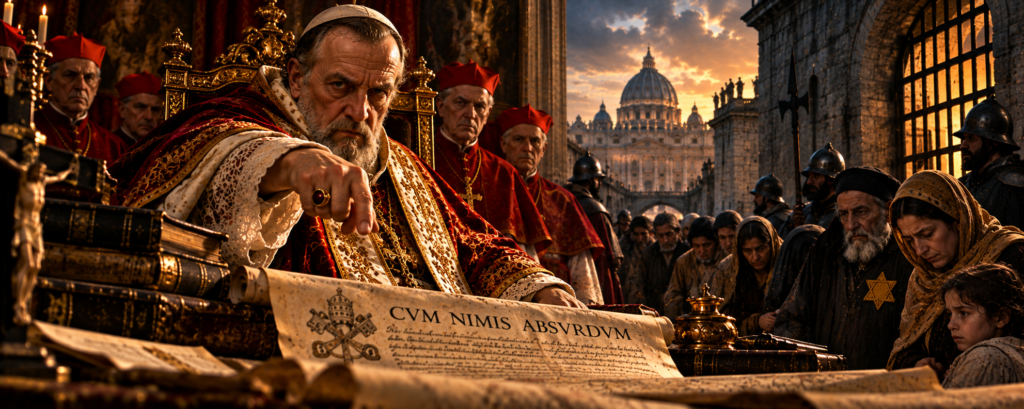
Paul IV: The Ruthless Pope Who Imprisoned Rome, Unleashed the Inquisition, and Turned His Own City Against Him
Pope Paul IV (1476–1559) | Reigned 1555–1559
The Pope Whose Death Became a Celebration
When Pope Paul IV died on August 18, 1559, Rome did not respond with the universal mourning normally expected after the death of the supreme pontiff. Instead, crowds poured into the streets, their anger directed toward the institutions and symbols of a government they had come to despise. The pope’s statue was attacked and mutilated, while rioters targeted the headquarters of the Roman Inquisition, freeing prisoners and destroying records. The extraordinary violence revealed just how deeply resentment had accumulated during the four years of his reign.
The spectacle was almost unimaginable for a city that had spent centuries presenting the pope as the spiritual father of Western Christianity. Paul IV had demanded obedience, imposed severe restrictions upon religious life, and pursued suspected heretics with uncompromising determination. He had imprisoned prominent churchmen, empowered relatives whose corruption became notorious, and forced Rome’s Jewish population into a confined neighborhood where their lives would remain restricted for generations. Now that he was dead, some of the people who had lived under his authority openly celebrated his disappearance.
The anger was not merely directed at one unpopular ruler. The Inquisition had become a symbol of surveillance, interrogation, imprisonment, and religious fear, and its headquarters represented the machinery through which Paul’s severity had been enforced. Crowds attacked the institution because they understood it as an extension of the dead pope’s will. The destruction of records was especially significant, since inquisitorial documents could preserve accusations capable of destroying reputations and livelihoods long after an investigation began.
The attack on Paul’s statue carried an equally unmistakable message. Renaissance popes commissioned monuments to project authority, magnificence, and permanence, expecting their images to survive as reminders of their achievements. The destruction of a papal statue inverted that purpose, turning an object of public honor into a target of collective hatred. Rome was symbolically dismantling the image of the man who had ruled it.
Yet Paul IV had not entered the papacy as a frivolous Renaissance prince interested primarily in luxury and pleasure. He was a committed religious reformer, an ascetic by inclination, and a man who believed the Catholic Church had been weakened by corruption and doctrinal compromise. Long before his election, he had helped establish a religious order dedicated to clerical renewal and had become one of the leading architects of the Roman Inquisition. His severity emerged from convictions he considered deeply religious rather than from simple indifference to Christianity.
That makes his story particularly disturbing. Paul IV was not a pope who ignored the Church’s teachings while indulging himself in scandalous pleasures. He was a pope who believed so fiercely in his own understanding of religious truth that he became willing to use extraordinary coercive power against those who challenged it. His determination to purify the Church helped produce a government remembered for fear, persecution, censorship, and repression.
His reign also exposed a contradiction that had plagued the papacy for generations. Despite his reputation for personal austerity and his contempt for corruption, Paul elevated members of the Carafa family into positions of enormous power. His nephews exploited their influence, became entangled in political intrigue, and acquired reputations for greed and misconduct. The pope who distrusted so many others proved disastrously willing to trust his own relatives.
Paul IV therefore belongs among the Wicked Popes for reasons far more substantial than hostile gossip or exaggerated stories. His persecution of Jewish communities, his expansion of inquisitorial authority, his censorship policies, and his disastrous political decisions are matters of historical record. His personal motives may have been religious, but the consequences of his government were often brutal. By the time he died, the distance between the pope’s vision of a purified Church and the misery associated with his rule had become impossible to ignore.
Gian Pietro Carafa: Born Into Power and Religious Ambition
Gian Pietro Carafa was born on June 28, 1476, into the powerful Carafa family of the Kingdom of Naples. His birthplace is generally identified as Capriglia, near Avellino, in southern Italy. The Carafa belonged to the aristocratic world that supplied the Church with bishops, cardinals, diplomats, and political advisers. Their family connections gave the young Gian Pietro access to opportunities that would have been unavailable to most aspiring churchmen.
His upbringing exposed him to the close relationship between religion and aristocratic politics. In Renaissance Italy, noble families frequently treated ecclesiastical careers as instruments of influence, placing younger sons and relatives in church offices that offered wealth and prestige. The Carafa were no exception to this wider pattern. Gian Pietro’s later hostility toward corruption did not erase the fact that his own advancement depended partly upon aristocratic connections.
One of his most important early patrons was his uncle, Cardinal Oliviero Carafa. The cardinal was an influential figure in Roman politics and helped guide Gian Pietro toward an ecclesiastical career. Through his uncle’s connections, the young man entered circles where church government, diplomacy, and noble ambition overlapped. He learned the workings of an institution whose corruption he would eventually condemn with extraordinary intensity.
Carafa developed a reputation for intelligence, determination, and religious seriousness. Unlike some Renaissance churchmen who treated ecclesiastical office primarily as a route to luxury, he became increasingly concerned with discipline and moral reform. He believed that the Church’s failures were not merely embarrassing but spiritually dangerous. His temperament favored uncompromising judgment rather than patient accommodation.
This severity would become one of his defining characteristics. Carafa was capable of intense loyalty to principles and equally intense hostility toward those he considered dangerous. He distrusted compromise, especially when religious doctrine was involved. Over time, his certainty hardened into a governing philosophy in which disagreement could easily appear indistinguishable from disobedience.
The young aristocrat could not have known that he would eventually become pope. He was born during the pontificate of Sixtus IV, decades before Martin Luther challenged the authority of Rome. The world of his childhood still assumed the religious unity of Western Christendom, despite its political conflicts and internal abuses. By the time Carafa reached old age, that unity would have shattered.
The Bishop Who Became a Reformer
Carafa entered the higher ranks of ecclesiastical administration while still relatively young. In 1505, he became bishop of Chieti, an appointment that placed him in a position of substantial religious and administrative responsibility. His career subsequently included diplomatic service and other assignments connected with the papal government. These experiences exposed him to the difficulties of reforming a Church whose institutions were deeply entangled with politics.
He served in an era dominated by powerful Renaissance popes. Julius II conducted military campaigns to strengthen the Papal States, while Leo X presided over an expensive court famous for artistic patronage. The political ambitions and financial practices of the papacy increasingly attracted criticism. Carafa became convinced that the Church required much stricter discipline.
His concern was not limited to the misconduct of individual priests. He believed that weaknesses in ecclesiastical leadership threatened the entire institution. Bishops who neglected their dioceses, clergy who accumulated benefices without performing their duties, and churchmen who pursued luxury instead of spiritual responsibility all represented symptoms of a deeper problem. Reform, in his view, required restoring authority and enforcing obedience.
Carafa’s approach differed from that of more conciliatory reformers. Some Catholic intellectuals hoped that dialogue with Protestants might resolve theological disagreements and preserve Christian unity. Carafa increasingly regarded such compromise as dangerous. He believed that doctrinal uncertainty encouraged heresy and that religious leaders had a duty to suppress it.
These convictions made him both influential and controversial. Supporters admired his seriousness and willingness to confront abuses that others ignored. Critics found him rigid, suspicious, and intolerant of disagreement. Both judgments contained elements of truth.
His eventual papacy would reveal the darker consequences of this temperament. A reformer who believed that moral weakness endangered the Church could become a ruler determined to police the conduct and beliefs of everyone under his authority. Carafa’s religious seriousness was genuine, but it contained the seeds of an increasingly coercive vision of government. His path toward the papal throne was also a path toward the concentration of religious power.
The Theatines: A Different Vision of the Priesthood
One of Carafa’s most important achievements before becoming pope was his involvement in establishing the Theatines. In 1524, he joined Gaetano da Thiene, better known as Saint Cajetan, and other reform-minded churchmen in founding a community dedicated to religious discipline. The order received papal approval during the pontificate of Clement VII. Its members sought to restore seriousness to clerical life through prayer, poverty, and pastoral service.
The Theatines represented a rejection of the worldly habits associated with much of the Renaissance clergy. Their members were expected to live with greater simplicity and devote themselves to religious responsibilities. They emphasized personal discipline and spiritual renewal rather than the accumulation of wealth. The movement emerged from a broader Catholic reforming impulse that existed before the Council of Trent.
Carafa’s participation demonstrated that his concern for reform was not merely rhetorical. He was willing to abandon certain privileges and support a demanding religious community. His commitment to austerity distinguished him from churchmen whose lifestyles seemed indistinguishable from those of secular aristocrats. He believed that the Church could recover authority only by becoming more disciplined.
The order’s name came from Carafa’s episcopal see of Chieti, known in Latin as Theate. Its establishment linked his personal religious identity to a movement that would outlive him. The Theatines contributed to the development of a more rigorous Catholic priesthood. Their existence reflected the Church’s capacity for renewal from within.
Yet the qualities that made Carafa an effective reformer could also make him a harsh ruler. His belief in discipline left limited room for weakness, ambiguity, or compromise. He increasingly viewed religious reform as something that required enforcement from above. The voluntary austerity of a religious community would eventually become the compulsory discipline of a papal government.
The difference was enormous. Members of the Theatines chose to embrace a demanding religious life, but ordinary residents of the Papal States did not choose the restrictions Paul IV later imposed upon them. The transformation from voluntary reform to coercive government would define his pontificate. Carafa’s religious ideals remained recognizable, but their application changed dramatically when he acquired supreme authority.
The Inquisition Becomes His Great Weapon
In 1542, Pope Paul III established the Roman Inquisition in a more centralized form through the bull Licet ab initio. Carafa became one of the leading figures associated with the new institution. Its purpose was to investigate and suppress heresy within territories subject to papal influence. The creation of this centralized body marked a significant development in the Catholic response to Protestantism.
Carafa regarded the Inquisition as essential to defending religious truth. Protestant ideas were spreading across Europe, and Catholic authorities feared that similar beliefs might gain influence within Italy. Theological discussions concerning justification, Scripture, and ecclesiastical authority had already created divisions among educated churchmen. Carafa believed that tolerating such uncertainty threatened the survival of Catholic orthodoxy.
His approach emphasized investigation, surveillance, and punishment. Suspected heretics could be questioned, imprisoned, and subjected to judicial proceedings. The Roman Inquisition operated within legal procedures that varied according to circumstances, and not every investigation ended in execution. Nevertheless, its coercive powers were substantial, and the threat of prosecution could profoundly affect intellectual and religious life.
Carafa’s suspicion extended beyond openly Protestant figures. He also distrusted Catholic reformers whose theological language appeared too accommodating toward Protestant positions. Men who believed themselves loyal to Rome could nevertheless become targets of investigation. The boundary between legitimate reform and suspected heresy became increasingly dangerous to cross.
This was especially significant because the Catholic reform movement contained competing tendencies. Some reformers emphasized pastoral improvement, education, and dialogue, while others demanded strict doctrinal enforcement. Carafa represented the latter tendency with exceptional intensity. His influence helped move Catholic reform toward a more confrontational relationship with dissent.
The Inquisition also offered Carafa a powerful institutional base. Long before he became pope, he had acquired experience directing investigations and evaluating accusations. He developed relationships with officials who shared his concerns. When he eventually reached the papal throne, he already possessed a machinery of religious enforcement capable of carrying out his policies.
The institution would become inseparable from his reputation. Paul IV did not invent the Inquisition, and inquisitorial courts had existed for centuries. His significance lay in the intensity with which he supported and expanded its authority. Under his leadership, the defense of orthodoxy increasingly became a matter of fear as well as faith.
The Suspicion That Reached Into the College of Cardinals
Carafa’s distrust of theological compromise placed him in conflict with prominent Catholic churchmen. One of the most important was Cardinal Reginald Pole, an English reformer who had opposed Henry VIII’s break with Rome. Pole was respected for his learning and religious seriousness, but his theological positions aroused suspicion among more uncompromising defenders of orthodoxy. Carafa regarded certain reformist approaches as dangerously close to Protestantism.
The conflict illustrates how deeply divided Catholic reformers had become. Pole and others hoped that careful theological discussion might preserve elements of Christian unity. Carafa feared that such accommodation would weaken Catholic doctrine. Their disagreement was not simply personal but concerned the future direction of the Church.
Another prominent figure, Cardinal Giovanni Morone, would eventually suffer directly from Paul’s suspicions. Morone had been involved in efforts to negotiate with Protestants and was associated with reform-minded Catholic circles. His diplomatic and theological activities attracted scrutiny. Under Paul IV, suspicion hardened into prosecution.
The willingness to investigate senior cardinals demonstrated how far Carafa’s commitment to doctrinal enforcement extended. Membership in the highest ranks of the Church did not guarantee safety. A distinguished career and reputation for learning could be overshadowed by accusations of theological error. The atmosphere encouraged caution among those whose views might be misunderstood.
This suspicion would become even more consequential once Carafa became pope. As cardinal, he had influence within the Inquisition, but papal authority allowed him to direct policy on a much larger scale. His personal judgments could shape investigations involving some of Europe’s most prominent churchmen. The consequences for Catholic intellectual life were profound.
The Church needed reform, but Carafa increasingly treated disagreement among reformers as evidence of danger. The distinction between correcting abuses and suppressing alternative approaches narrowed. By the time he was elected pope, his understanding of reform had become closely associated with punishment. The future Paul IV was prepared to govern through the institutions he had helped strengthen.
The Election of an Eighty-Year-Old Hardliner
The death of Julius III in March 1555 opened a period of rapid change within the papacy. The cardinals first elected Marcello Cervini, who became Marcellus II, a respected reformer with a reputation for personal integrity. His election raised hopes that the Church might receive the disciplined leadership many believed it needed. Those hopes were shattered when Marcellus died after only twenty-two days.
A second conclave followed in May. The cardinals faced the same political pressures that had complicated earlier elections, including rivalry between France and the Habsburg Empire. They also confronted the urgent question of Catholic reform. The next pope would need to respond to Protestantism while preserving the political independence of Rome.
Gian Pietro Carafa was an unlikely candidate in several respects. He was seventy-eight years old, known for his severity, and deeply hostile to Spanish influence in Italy. His uncompromising temperament made him controversial among churchmen who preferred a more diplomatic leader. Yet his reputation for personal austerity and religious determination appealed to those demanding reform.
On May 23, 1555, the cardinals elected him pope. He took the name Paul IV, becoming one of the oldest men to ascend the papal throne. His election placed the machinery of the Roman Church in the hands of a man who had spent years preparing to enforce doctrinal discipline. Rome was about to discover what happened when an inquisitor acquired supreme political and religious authority.
Paul did not intend to govern as a pleasure-loving Renaissance prince. He disliked many of the courtly habits associated with his predecessors and wanted to impose stricter standards upon clergy and officials. His supporters hoped that he would eliminate corruption and restore the dignity of the papacy. His enemies feared that his severity would become oppressive.
Both expectations would prove justified in different ways. Paul pursued genuine disciplinary reform, but he also created an atmosphere of suspicion and fear. His hostility toward Spain would draw the papacy into a disastrous war. His trust in his nephews would produce the very corruption he claimed to despise.
The new pope’s reign would last only four years. That was enough time to leave wounds that endured for centuries.
The First Months: Rome Learns What Severity Means
Paul IV moved quickly to impose his vision of discipline upon the papal court. He criticized luxury, demanded greater seriousness from clergy, and sought to eliminate practices he regarded as morally corrupt. Officials accustomed to the more relaxed atmosphere of earlier pontificates faced a ruler with little patience for excuses. The change in tone was immediate.
His approach extended to religious institutions throughout the Papal States. Clergy who neglected their responsibilities or violated disciplinary expectations risked investigation and punishment. Paul believed that reform required visible examples of authority. He was determined to demonstrate that ecclesiastical rank would not automatically protect misconduct.
Yet the pope’s severity was selective in ways that would eventually become disastrous. He distrusted many experienced officials but placed extraordinary confidence in members of his own family. His nephews received positions that allowed them to influence diplomacy, military affairs, and the distribution of patronage. The contradiction became increasingly obvious as their behavior attracted criticism.
Paul’s government also pursued religious conformity with unusual intensity. The Inquisition received strong papal support, and suspected heretics faced a dangerous environment. Intellectuals and clergy became increasingly cautious about expressing controversial theological opinions. Religious discussion could carry consequences far beyond ordinary disagreement.
The pope’s uncompromising temperament made negotiation difficult. He tended to interpret opposition as evidence of disobedience or bad faith. Such an attitude could be effective when confronting genuine administrative abuses, but it was dangerous in diplomacy. European monarchs were not accustomed to being treated as subordinate officials who could simply be ordered into compliance.
Rome therefore entered a period of increasing tension. The new pope promised purification, but his methods created resentment among those subjected to his authority. His government was disciplined in intention but frequently harsh in execution. The atmosphere would become darker as his policies extended beyond the clergy to entire religious communities.
The Bull That Changed Jewish Life in Rome
On July 14, 1555, less than two months after his election, Paul IV issued the bull Cum nimis absurdum. The document imposed sweeping restrictions upon Jewish communities within the Papal States. Its provisions reflected longstanding Christian anti-Jewish prejudice, but their systematic enforcement marked a particularly severe turning point. The consequences for Rome’s Jewish population would endure for more than three centuries.
The bull required Jews to live in designated, segregated areas separated from Christian neighborhoods. In Rome, this policy led to the establishment of the Roman Ghetto near the Tiber River. The area was enclosed and controlled through gates that were shut at night. Jewish residents were compelled to organize their daily lives within a confined space determined by papal authority.
The decree also required Jews to wear identifying clothing. Men were ordered to display yellow headwear, while women were required to wear distinctive yellow coverings. These requirements were designed to make Jewish identity immediately visible in public. They institutionalized humiliation and reinforced the idea that Jews occupied an inferior position within Christian society.
Economic restrictions were equally severe. Jews were prohibited from owning real estate and were forced to dispose of property under conditions that could be financially damaging. Their opportunities for trade were sharply restricted, with secondhand goods becoming one of the few permitted areas of commerce. The measures attacked the economic foundations of Jewish families.
The bull also limited ordinary social relationships between Jews and Christians. It prohibited certain forms of employment and imposed restrictions intended to reinforce separation. Jewish communities were subjected to a system that regulated where they could live, how they could dress, and how they could earn a living. Religious difference became the basis for compulsory legal inequality.
Paul did not invent anti-Jewish segregation. Venice had established a compulsory Jewish ghetto in 1516, and medieval Christian governments had imposed discriminatory regulations for centuries. What made Paul’s action especially significant was its application within the territories governed by the pope himself. The spiritual leader of Western Catholicism had turned religious prejudice into a comprehensive system of urban confinement.
The Roman Ghetto became one of the most enduring consequences of his pontificate. Although restrictions varied under later governments and periods of temporary relief occurred, compulsory segregation remained a defining feature of Jewish life in Rome until the nineteenth century. The walls and gates became physical expressions of papal authority. Paul’s decision reshaped the lives of generations who had never known his name.
Behind the Walls of the Roman Ghetto
The creation of the Roman Ghetto was not simply an administrative rearrangement of the city. It uprooted families from established neighborhoods and forced them into a restricted district where space was limited. Homes, businesses, religious institutions, and social networks had to adapt to the new conditions. The policy transformed everyday life.
The designated area lay near the Tiber, where flooding and unhealthy conditions could make living difficult. As the Jewish population grew, restrictions on expansion contributed to overcrowding. Families occupied increasingly cramped residences, and buildings were altered to accommodate more people. The physical environment reflected the legal confinement imposed upon the community.
The gates controlled movement between Jewish and Christian Rome. Their closure at night made segregation visible and enforceable. Residents could leave during permitted hours to conduct authorized business, but their freedom was restricted by regulations imposed from outside the community. The neighborhood became both a place of residence and an instrument of surveillance.
Economic limitations compounded the hardship. Families who had previously owned property or participated in a wider range of trades faced severe restrictions. Forced sales could destroy accumulated wealth, while the narrowing of permitted occupations made economic survival more precarious. Poverty was not merely an accidental consequence of the policy but a predictable result of its design.
The requirement to wear identifying clothing reinforced exclusion beyond the ghetto walls. Jewish residents entering Christian neighborhoods could be recognized immediately. Such markers exposed individuals to humiliation and made it easier for authorities to enforce discriminatory regulations. The policy ensured that segregation followed Jewish residents even when they were physically outside the enclosed district.
Jewish communities nevertheless preserved religious traditions, family networks, education, and communal institutions under these conditions. Their survival should not be confused with acceptance of the restrictions imposed upon them. The ghetto became a place of resilience because its residents had to adapt to coercion. Their ability to sustain communal life does not lessen the injustice of the system.
Paul IV regarded the restrictions as expressions of Christian religious order. From a modern historical perspective, they constituted systematic persecution based upon religious identity. The distinction between his intentions and their consequences is essential. A pope who believed himself to be defending the Church created a structure that deprived an entire community of basic freedoms.
The Persecution at Ancona
The Roman Ghetto was not the only devastating policy directed against Jews during Paul’s reign. In the Adriatic port of Ancona, the papal government pursued a campaign against Portuguese and other Iberian Jews who had lived as Christians under coercive conditions or whose families had been forced to convert. These people are often described historically as conversos or New Christians, although their religious experiences varied considerably. Some had returned openly to Judaism after reaching more tolerant environments.
Ancona had attracted merchants and refugees because of its commercial importance. Previous papal policies had offered certain protections intended to encourage trade. The port connected Italian markets with the eastern Mediterranean and benefited from the activities of Jewish and converso merchants. Its prosperity depended partly upon the international networks these communities maintained.
Paul IV reversed the more accommodating approach of his predecessors. His government investigated people accused of returning to Judaism after baptism, treating such conduct as apostasy under Catholic law. Arrests followed, and prisoners faced inquisitorial proceedings. The campaign created fear among families who had believed they could practice Judaism more openly in Italy.
In 1556, approximately twenty-five people were executed by burning in connection with the Ancona persecutions. Historical accounts differ on some details of the proceedings and the total number of those arrested, but the executions themselves are well documented. The victims were condemned because authorities regarded their religious practice as a violation of Christian obligations. Their deaths became one of the most notorious episodes of Paul’s pontificate.
The persecution provoked outrage among Jewish communities beyond the Papal States. Efforts were made to organize a commercial boycott of Ancona, with particular involvement from Jewish networks connected to the Ottoman Empire. The response reflected the international significance of the port and the broader Jewish world’s concern for the victims. Economic pressure became one of the few available means of protest.
The boycott encountered practical difficulties and disagreements among merchants. Competing commercial interests limited its effectiveness, and the campaign did not produce a decisive reversal of papal policy. Nevertheless, the attempt demonstrated that the persecution had consequences beyond Ancona itself. Jewish communities were searching for ways to respond collectively to religious violence.
The executions at Ancona reveal the lethal consequences of Paul’s understanding of orthodoxy. The pope’s government did not merely restrict Jewish residence or commerce. It used the machinery of the Inquisition to prosecute people whose religious identities had been shaped by generations of forced conversion and persecution. The resulting deaths remain among the clearest examples of the cruelty associated with his reign.
The Inquisition Tightens Its Grip
Paul IV’s commitment to the Roman Inquisition intensified after his election. He had helped shape the institution before becoming pope, and he regarded it as essential to the defense of Catholic doctrine. Once he possessed supreme authority, he could strengthen its influence without the limitations imposed by another pontiff. The result was an increasingly intimidating atmosphere for suspected religious dissenters.
The Inquisition investigated theological opinions, religious practices, and allegations of heresy. Its officials could summon witnesses, examine writings, interrogate suspects, and impose penalties. Proceedings often operated under rules of secrecy intended to protect investigations but capable of leaving accused individuals uncertain about the evidence against them. The institution’s power extended far beyond public trials.
Paul believed that even prominent churchmen should face investigation if their orthodoxy was questioned. His determination to pursue suspected heresy within the highest ranks of the Church distinguished him from rulers more inclined to protect influential colleagues. Seniority and reputation did not necessarily provide safety. A cardinal could become a prisoner if the pope considered his beliefs dangerous.
The atmosphere encouraged denunciation. Individuals who feared that a neighbor, colleague, or rival held suspect opinions could bring accusations before religious authorities. Not every accusation resulted in conviction, and the institution maintained formal procedures. Nevertheless, the possibility of investigation created powerful incentives for silence and conformity.
The consequences extended into scholarship and religious discussion. Theologians became cautious about exploring ideas associated with Protestant reform. Books could be examined for suspicious passages, and authors risked attracting official attention. Intellectual uncertainty became dangerous in a Church increasingly determined to establish doctrinal boundaries.
Paul’s supporters considered these measures necessary. They believed that Protestantism had spread partly because earlier church leaders had tolerated dangerous ideas. In their view, strict enforcement protected ordinary believers from error. The pope’s severity could therefore be presented as pastoral responsibility rather than cruelty.
The experience of those investigated was often very different. Imprisonment, interrogation, loss of office, and public disgrace could destroy careers and families. Even individuals eventually cleared of suspicion might suffer lasting damage. Paul’s government made religious orthodoxy a matter of institutional surveillance.
Cardinal Morone: A Prince of the Church Becomes a Prisoner
One of the most striking examples of Paul’s severity was his treatment of Cardinal Giovanni Morone. Morone was a distinguished diplomat and churchman who had participated in efforts to address the religious divisions of Germany. His career had placed him among the most important Catholic figures involved in negotiations with Protestants. He was respected by many contemporaries for his intelligence and experience.
Paul viewed Morone’s theological associations with deep suspicion. The cardinal had been connected with reform-minded circles that discussed justification and other controversial questions. Such discussions did not necessarily make him Protestant, but they alarmed hardliners who feared doctrinal compromise. Paul increasingly regarded Morone as a potential danger to Catholic orthodoxy.
In 1557, Morone was arrested and imprisoned in Castel Sant’Angelo. The imprisonment of a cardinal was an extraordinary event, especially when the accused had held such important diplomatic responsibilities. His detention demonstrated that Paul was willing to use coercive power against senior members of the Church. The pope’s suspicion had become a direct instrument of government.
Morone denied the accusations against him. The investigation involved complex theological questions and disputes over his earlier associations. His defenders regarded the prosecution as unjust, while Paul’s supporters believed that rank should not prevent scrutiny. The case became a symbol of the conflict between moderate Catholic reform and inquisitorial severity.
The proceedings remained unresolved during Paul’s lifetime. Morone spent a substantial period in confinement before eventually being released after the pope’s death. Under the succeeding pontificate, his position was restored. He later played an important role in the final phase of the Council of Trent.
Morone’s subsequent career makes the episode especially revealing. A man imprisoned under Paul IV as a suspected heretic became a central figure in the completion of Catholic reform. His rehabilitation does not prove that every theological concern raised during the investigation was imaginary. It does demonstrate that Paul’s judgment was far from universally accepted within the Church.
The case also exposed the dangers of allowing personal suspicion to shape ecclesiastical justice. Paul believed he was protecting orthodoxy, but his actions threatened one of the Church’s most capable diplomats. The imprisonment of Morone damaged the atmosphere of trust necessary for serious theological discussion. Reform became more difficult when respected reformers feared prosecution.
Reginald Pole and the English Crisis
Paul IV’s suspicion also affected Cardinal Reginald Pole, another prominent Catholic reformer. Pole had opposed Henry VIII’s break with Rome and later played a central role in restoring Catholic authority under Queen Mary I. His long career made him one of the most important English churchmen of the sixteenth century. Yet his theological associations placed him under suspicion in Paul’s eyes.
Pole had been connected with reform-minded circles that emphasized spiritual renewal and discussed doctrines associated with the broader European Reformation. Some of these ideas were controversial within Catholicism, especially among those who demanded strict separation from Protestant theology. Paul distrusted Pole’s approach. The pope’s suspicion complicated the relationship between Rome and Mary’s government.
In 1557, Paul recalled Pole’s authority as papal legate. The decision created difficulties for the English Catholic restoration, which depended heavily upon Pole’s leadership. Mary continued supporting him, but the pope’s action undermined one of the most important representatives of Roman authority in England. The conflict revealed how Paul’s hostility toward suspected doctrinal compromise could interfere with his own religious objectives.
The timing was particularly unfortunate. England had only recently returned to papal obedience after decades of separation. The restoration remained politically fragile, and Protestant resistance had not disappeared. Undermining Pole weakened a churchman whose experience was valuable to the Catholic cause.
Paul’s hostility toward the Habsburg dynasty also complicated matters. Mary was married to Philip II of Spain, whose political interests the pope increasingly opposed. Religious policy became entangled with international rivalry. The pope’s distrust of Spain affected his treatment of an English churchman closely connected with a Habsburg queen.
Pole died in November 1558, on the same day as Mary I. Their deaths brought the English Catholic restoration to an end. Elizabeth I succeeded Mary and gradually reestablished a Protestant religious settlement. Paul’s pontificate therefore witnessed the collapse of an opportunity that Rome had briefly celebrated.
The English crisis illustrates the limits of his governing philosophy. Paul wanted to defend Catholicism but was willing to weaken important Catholic allies because he distrusted their theology or political associations. His insistence upon doctrinal purity sometimes undermined practical efforts to preserve Catholic influence. The result was a papacy increasingly isolated by its own uncompromising judgments.
The Pope Who Hated Spanish Power
Paul IV’s political hostility toward Spain became one of the most destructive features of his reign. As a member of the Neapolitan aristocracy, he had long resented the dominance of foreign powers in southern Italy. The Habsburg monarchy controlled Naples and Milan, giving it enormous influence throughout the peninsula. Paul regarded this dominance as a threat to Italian and papal independence.
His hostility was especially intense toward Emperor Charles V and his son Philip II. Although both were Catholic rulers, Paul did not consider their religious identity sufficient reason for political cooperation. He believed that Habsburg power endangered the freedom of the Papal States. His resentment sometimes appeared stronger than his concern for maintaining unity among Catholic monarchs.
The contradiction was obvious. Protestantism was spreading across Europe, and the Catholic Church faced a profound religious crisis. Yet the pope was prepared to confront one of the most powerful Catholic dynasties in the world. Political independence took precedence over the practical advantages of cooperation.
Paul’s relatives encouraged his anti-Spanish ambitions. Members of the Carafa family hoped that a successful campaign might increase their own power and territorial influence. French support offered the possibility of challenging Habsburg dominance in Italy. The pope’s personal convictions therefore aligned with the ambitions of his nephews.
France, ruled by Henry II, remained the principal European rival of the Habsburgs. French monarchs had repeatedly intervened in Italy, seeking territories and influence. Paul considered an alliance with France a means of weakening Spanish power. The strategy revived the dangerous diplomatic patterns that had contributed to earlier papal disasters.
The pope’s determination was remarkable given his age and the limited military resources of the Papal States. He was nearly eighty when he entered office and possessed little realistic prospect of defeating Spain independently. His confidence depended upon French assistance and the assumption that political pressure could force concessions. Those assumptions would prove dangerously optimistic.
The resulting conflict became one of the great failures of his pontificate. Paul had promised to purify the Church but instead drew it into a war driven by dynastic rivalry and resentment. The consequences would expose Rome to military danger. His hatred of Spanish influence would ultimately achieve almost the opposite of what he intended.
The Carafa Nephews: Corruption Returns Through the Family Door
Paul IV’s reliance upon his relatives became one of the most damaging contradictions of his government. Despite his contempt for ecclesiastical corruption, he elevated members of the Carafa family to positions of extraordinary influence. His nephew Carlo Carafa became a cardinal and an important political adviser. Another nephew, Giovanni Carafa, received military and territorial responsibilities.
Carlo Carafa was particularly controversial. Before his ecclesiastical advancement, he had pursued a military career and acquired a reputation for violent and unscrupulous conduct. His experience in warfare and diplomacy made him useful to a pope determined to confront Spain. Yet his character and ambitions made him a dangerous figure to place near the center of papal government.
Paul elevated Carlo to the cardinalate in 1555. The appointment gave him access to enormous political influence despite a background that hardly reflected the spiritual ideals the pope claimed to defend. Carlo became involved in diplomatic negotiations and the direction of papal policy. His position allowed family ambition to shape decisions affecting the entire Church.
Giovanni Carafa also benefited from the pope’s favor. He received the title of Duke of Paliano and became involved in the family’s territorial ambitions. The Carafa were attempting to strengthen their position within the aristocratic politics of Italy. Papal authority supplied the means.
The nephews’ conduct attracted accusations of corruption, extortion, abuse of office, and political manipulation. Not every hostile allegation can be accepted without examination, but the broader pattern of misconduct was substantial enough to provoke serious consequences. Their enrichment and influence became increasingly difficult to reconcile with Paul’s reforming rhetoric. The pope’s government appeared to tolerate within his own family what it condemned elsewhere.
Paul’s confidence in Carlo was especially damaging because the cardinal played an important role in the anti-Spanish policy. The nephew’s ambitions reinforced the pope’s hostility toward the Habsburgs. Diplomatic decisions were influenced by a family network whose interests did not necessarily coincide with those of the Church. Nepotism had become a source of international danger.
The situation recalled earlier Renaissance pontificates. Alexander VI had promoted the Borgias, Paul III had advanced the Farnese, and Julius III had elevated Innocenzo del Monte. Paul IV claimed to represent a stricter age, but his own family benefited from the familiar machinery of papal patronage. The old corruption had returned under the leadership of a man who considered himself its enemy.
The War That Brought Spanish Troops Toward Rome
In 1556, the conflict between Paul IV and the Habsburg monarchy escalated into open warfare. The pope aligned himself with France in an effort to challenge Spanish power in Italy. The decision exposed the Papal States to retaliation from a far stronger military opponent. It also threatened to repeat the catastrophe that had devastated Rome in 1527.
Philip II’s forces in Italy were commanded by Fernando Álvarez de Toledo, Duke of Alba. Alba was an experienced military leader who understood the strategic weakness of the Papal States. Spanish forces advanced into papal territory, placing Rome under serious pressure. The pope’s government had underestimated the danger.
The campaign revealed the limitations of Paul’s military position. French assistance did not produce the decisive victory he had hoped for. The Papal States lacked the resources to sustain a prolonged confrontation with Spain. The pope’s confidence increasingly collided with military reality.
The memory of the Sack of Rome made the threat especially frightening. Less than thirty years earlier, imperial troops had entered the city and unleashed extraordinary violence. Residents understood what another invasion might mean. The possibility of renewed devastation exposed the recklessness of Paul’s strategy.
Alba did not repeat the sack of 1527. His campaign applied military pressure while avoiding the wholesale destruction that had made the earlier invasion infamous. Nevertheless, Spanish advances forced the pope into a humiliating position. His attempt to weaken Habsburg influence had instead demonstrated the vulnerability of his own state.
The conflict was eventually resolved through the Peace of Cave in September 1557. Paul had to accept terms that effectively acknowledged the failure of his anti-Spanish policy. The settlement preserved the papacy but did not achieve the ambitious objectives that had inspired the war. Spain remained the dominant power in much of Italy.
The outcome was a profound humiliation. Paul had challenged a Catholic monarch while claiming to defend the Church against religious enemies. His campaign endangered Rome and strengthened the impression that papal politics remained trapped in Renaissance rivalries. The war consumed resources and damaged his authority without producing a meaningful strategic success.
The Cardinal Who Helped Ruin the Pope’s War
Carlo Carafa’s role in the conflict became increasingly controversial. As the pope’s influential nephew and political adviser, he helped shape diplomatic relationships and military policy. His personal ambitions encouraged the pursuit of alliances that promised advantages for the Carafa family. The interests of the Church and those of the pope’s relatives became dangerously intertwined.
Carlo’s reputation suffered from allegations of financial misconduct and political manipulation. He was accused of using his position to accumulate wealth and influence. Contemporary hostility toward him was intense, and some accusations were undoubtedly shaped by factional rivalries. Nevertheless, his conduct created serious embarrassment for a pontificate supposedly dedicated to eliminating corruption.
The failed war made the situation worse. Paul had relied upon Carlo’s advice while confronting Spain, and the outcome exposed the weakness of that policy. The pope’s trust in his nephew had contributed to decisions that endangered the Papal States. The family relationship that was supposed to provide loyalty had instead become a source of vulnerability.
Giovanni Carafa’s conduct also generated scandal. His position as Duke of Paliano placed him within the violent politics of Italian aristocratic society. Family disputes, accusations of sexual misconduct, and acts of violence surrounded his household. The atmosphere was far removed from the moral discipline Paul demanded of ordinary clergy.
The most notorious episode involved Giovanni’s wife, Violante di Cardona, Duchess of Paliano. She became entangled in accusations of adultery that culminated in her murder in 1559. The killing was connected to the violent enforcement of aristocratic honor within the Carafa family. It later became central to criminal proceedings against members of the family.
The precise distribution of responsibility among the individuals involved requires careful attention to the surviving evidence. Nevertheless, the murder was a real event, not merely an invention of hostile pamphleteers. It exposed the brutality of the family network that had flourished under Paul’s patronage. The pope’s relatives had become associated with conduct far more shocking than the ordinary favoritism of ecclesiastical appointments.
By the end of the reign, the Carafa name had become a source of disgrace. The family that Paul had trusted to strengthen his government was undermining its reputation. His attempt to impose moral discipline upon the Church had been compromised by the actions of those closest to him. The contradiction was becoming impossible to conceal.
The Pope Finally Turns Against His Own Blood
Paul IV eventually became convinced that his nephews had abused his trust. Reports of misconduct, financial irregularities, and political manipulation accumulated. The failure of the anti-Spanish war further damaged Carlo’s position. The pope could no longer ignore the consequences of the power he had granted his relatives.
In 1559, Paul moved decisively against members of the Carafa family. Carlo and Giovanni were deprived of much of their influence and expelled from the center of papal government. Their fall was dramatic because they had previously enjoyed extraordinary access to the pope. The family network that had dominated much of the pontificate was suddenly dismantled.
Paul’s reaction reflected genuine anger at corruption, but it also exposed his earlier failure of judgment. He had placed immense confidence in relatives whose conduct was already controversial. Their abuses had flourished under his protection. The eventual purge could not undo the damage.
The pope’s defenders might argue that his willingness to punish relatives demonstrated commitment to reform. There is some truth in that interpretation because he did ultimately act against men who had benefited from his favor. Yet the action came after years of misconduct and political disaster. It was an admission that his trust had been misplaced.
The collapse of the Carafa faction also revealed the instability of nepotistic government. Relatives could accumulate power rapidly because of their connection to the pope, but that power remained vulnerable to changes in personal favor. When the relationship broke down, the consequences could be catastrophic. The family had risen through papal patronage and now faced ruin through papal anger.
Paul did not live to see the full consequences. After his death, his successor’s government pursued proceedings against Carlo and Giovanni. Both were executed in 1561 under Pope Pius IV, although later developments raised serious questions about aspects of the prosecutions and their political motivations. Their fate demonstrated how dangerous the collapse of papal protection could become.
The executions also completed the grim trajectory of Paul’s nepotism. A pope who had devoted himself to punishing corruption had empowered relatives whose conduct brought disgrace upon his government. He eventually turned against them, but the damage was irreversible. The Carafa family became one of the most notorious examples of the very abuses he claimed to oppose.
The Index of Forbidden Books
Paul IV’s determination to control religious thought culminated in the publication of the Roman Index of Forbidden Books in 1559. Earlier lists of prohibited writings had existed in various Catholic jurisdictions, but the Pauline Index represented an especially severe attempt to regulate reading under Roman authority. It identified works and authors considered dangerous to Catholic doctrine. The measure became one of the defining expressions of Counter-Reformation censorship.
The spread of printing had transformed European intellectual life. Books could circulate rapidly across political and religious boundaries, carrying theological arguments to audiences far beyond universities and monasteries. Protestant reformers had used print with extraordinary effectiveness. Catholic authorities increasingly regarded control over printed material as essential to defending orthodoxy.
Paul’s Index sought to restrict access to writings associated with Protestantism and other condemned ideas. It also included works by authors whose theological positions were considered suspect. The categories of prohibition could be broad, extending beyond explicitly Protestant religious texts. The result was a system capable of affecting scholarship, literature, and intellectual exchange.
The severity of the Pauline Index alarmed even some Catholics. Scholars and churchmen worried that excessively broad prohibitions would interfere with legitimate learning. The inclusion of respected authors created difficulties for educated readers. The policy reflected Paul’s preference for strict boundaries over intellectual flexibility.
The Index also demonstrated the growing power of the Roman Inquisition. Censorship and inquisitorial investigation reinforced one another. Books could provide evidence of suspected heresy, while the threat of prosecution encouraged printers and readers to avoid controversial material. The result was an increasingly controlled intellectual environment.
Paul’s Index did not remain unchanged after his death. The Council of Trent and later papal authorities revised the system, producing a different Index in 1564. Nevertheless, the principle of centralized Catholic censorship survived. The Church continued maintaining lists of prohibited books for centuries.
The long-term consequences were substantial. Authors, printers, scholars, and readers had to consider the possibility of ecclesiastical condemnation. Intellectual life developed under the shadow of religious authority. Paul’s pontificate helped establish censorship as a central instrument of Catholic institutional control.
The Council of Trent Remains Unfinished
Paul IV inherited a Church whose reforming program remained incomplete. The Council of Trent had begun under Paul III and resumed under Julius III, but political conflict had repeatedly interrupted its work. By the time Paul became pope, the council had been suspended for several years. Its eventual completion remained uncertain.
Given his reputation as a reformer, some contemporaries might have expected Paul to make the council a priority. Instead, he showed limited enthusiasm for restoring an assembly whose authority might complicate direct papal control. He preferred reform directed through the papacy and the institutions already under his influence. His understanding of ecclesiastical government emphasized centralized authority.
This preference reflected longstanding tensions between popes and general councils. Earlier centuries had witnessed disputes over whether councils could exercise authority superior to the pope. Renaissance pontiffs remained wary of institutions that might challenge papal independence. Paul shared that concern despite his commitment to reform.
He believed that the Church could be purified through direct enforcement of discipline and orthodoxy. The Inquisition offered a mechanism for identifying error and punishing disobedience. Papal decrees could impose rules without prolonged debate among bishops. Such methods suited his temperament.
The difficulty was that the Council of Trent had become an essential symbol of Catholic renewal. Its deliberations offered a broader institutional foundation for reform than the personal judgments of one pope. Suspending its work indefinitely risked delaying changes that many Catholic leaders considered necessary. Paul’s reluctance therefore frustrated aspects of the reform movement.
The council would not resume until after his death. Under Pius IV, it reconvened in 1562 and completed its work in 1563. Its decrees became foundational to post-Tridentine Catholicism. Paul IV’s contribution to Catholic reform was therefore significant but distinct from the conciliar achievements associated with other popes.
His preference for inquisitorial enforcement over conciliar deliberation reveals much about his governing philosophy. He trusted authority more readily than negotiation and discipline more readily than compromise. The Church needed reform, but Paul believed that reform should proceed through obedience to Rome. His reign demonstrated both the power and the dangers of that approach.
The Strange Contradiction of an Austere Pope
Paul IV’s personal austerity distinguished him from many Renaissance predecessors. He did not become notorious for extravagant banquets, elaborate mistresses, or a luxurious artistic court. His reputation rested upon severity, religious seriousness, and hostility toward moral laxity. In that sense, he represented a genuine departure from the more pleasure-oriented culture of earlier pontificates.
Yet personal austerity did not prevent his government from becoming oppressive. His determination to enforce religious conformity produced persecution and censorship. His hostility toward Spain led to a disastrous war. His trust in relatives allowed corruption to flourish at the center of power.
The contradiction challenges a common assumption about historical wrongdoing. Corrupt rulers are often imagined as selfish pleasure-seekers who knowingly ignore moral principles. Paul IV was different because he appears to have believed deeply in the righteousness of many of his actions. His certainty made him less willing to question their consequences.
He could regard the confinement of Jewish communities as an appropriate expression of Christian order. He could view the prosecution of suspected heretics as a necessary defense of religious truth. He could interpret opposition to his policies as evidence of disobedience rather than a warning that his judgment might be flawed. The moral confidence behind his actions made them more difficult to restrain.
His personal discipline also encouraged him to demand severe standards from others. A pope who rejected luxury might consider himself justified in punishing churchmen who embraced it. A reformer who believed compromise endangered souls might regard theological tolerance as irresponsibility. His own sacrifices became part of the authority with which he judged others.
Yet his family policy exposed the limits of that self-image. Paul could condemn corruption in general while overlooking misconduct among the Carafa. He eventually recognized the problem, but only after his relatives had acquired enormous influence. His moral certainty did not protect him from favoritism.
The result was a pontificate in which religious conviction and institutional cruelty existed side by side. Paul IV was not simply pretending to care about reform. He cared intensely, but his understanding of reform permitted coercion on a vast scale. His reign demonstrates how dangerous uncompromising certainty can become when joined to unchecked authority.
Rome Under the Shadow of the Holy Office
The Roman Inquisition became one of the most feared institutions associated with Paul’s government. Its authority extended into questions of belief, religious practice, and intellectual expression. The possibility of denunciation created uncertainty among clergy and educated laypeople. Even those who considered themselves orthodox could fear that a careless statement might attract suspicion.
The institution’s headquarters became a physical symbol of that anxiety. Prisoners could be detained while investigations proceeded, and records preserved accusations and testimony. The secrecy surrounding proceedings made the institution especially intimidating. Ordinary Romans did not necessarily know what happened behind its walls.
Paul’s support gave inquisitorial officials considerable confidence. They operated under a pope who regarded their mission as central to the survival of the Church. Their work was not peripheral to his government but one of its defining purposes. The machinery of religious enforcement acquired exceptional prominence.
The atmosphere affected relationships among churchmen. Theological disagreement could become politically dangerous, especially when rivals used accusations of heresy against one another. Personal hostility and religious suspicion sometimes overlapped. The Inquisition’s authority could therefore influence disputes far beyond purely doctrinal questions.
Not every investigation was arbitrary, and the Roman Inquisition operated through legal procedures that historians continue to study carefully. Its records reveal a complex institution rather than a single undifferentiated system of terror. Nevertheless, the power to imprison, interrogate, and punish religious dissent was real. Paul’s personal commitment to that power shaped how it was exercised.
The resentment that accumulated in Rome would eventually erupt after his death. The attack upon the Inquisition’s headquarters was not a random act of vandalism. It represented anger toward an institution associated with the dead pope’s severity. The crowd’s actions revealed how deeply the Holy Office had become identified with his rule.
The destruction of records was particularly telling. Documents that had once served as instruments of investigation became targets of public fury. The rioters understood that written accusations could preserve the power of the institution even after individual officials disappeared. Destroying them was an attempt to break the hold of a feared system.
The Final Months of a Hated Pontificate
By 1559, Paul IV was approaching his eighty-third birthday. His anti-Spanish war had ended in humiliation, and his relations with important Catholic rulers remained strained. The Carafa nephews had become a source of scandal, forcing him to turn against members of his own family. His government continued pursuing strict religious policies, but its political achievements were limited.
The pope’s health deteriorated during the summer. He remained determined to defend his understanding of Catholic orthodoxy, but his physical strength was failing. The institutions he had strengthened would survive him, although their future direction remained uncertain. Rome waited for the end of a reign that many residents had come to resent.
Paul died on August 18, 1559. His death ended a pontificate lasting slightly more than four years. The brevity of his reign makes its consequences especially striking. Few popes accomplished so much that was both institutionally significant and deeply controversial in such a short period.
The reaction in Rome was extraordinary. Crowds attacked symbols of his authority, including his statue. The headquarters of the Inquisition became a target, and prisoners were released amid the unrest. Records were destroyed as anger against the institution erupted into violence.
The disturbances were not necessarily a spontaneous expression of every Roman’s feelings. Urban unrest could involve organized interests, political factions, and groups with specific grievances. Nevertheless, the scale and symbolism of the attacks demonstrated widespread hostility toward Paul’s government. His death created an opportunity for people to express resentment that had been dangerous during his lifetime.
The violence also exposed the fragility of authority based heavily upon fear. While Paul lived, his office and institutions commanded obedience. Once he died, some of those who had submitted to his rule turned against its symbols. The transition from enforced silence to public destruction was dramatic.
The pope who had spent years demanding obedience could no longer control the response to his memory. His statue, intended to project authority, became an object of contempt. The Inquisition, which had inspired fear, became vulnerable to attack. Rome’s reaction transformed his death into a final judgment upon his government.
The Fall of the Carafa Dynasty
Paul’s death also exposed the vulnerability of the relatives he had promoted. Carlo and Giovanni Carafa had already lost much of their influence during the pope’s final months. Without his protection, they faced powerful enemies determined to investigate their conduct. Their former prominence became a liability.
The new pope, Pius IV, was elected in December 1559. His government pursued proceedings against members of the Carafa family. Accusations involved corruption, abuse of office, and violent crimes. The prosecutions reflected genuine scandals but also unfolded within a political environment shaped by factional hostility.
Carlo Carafa was arrested and eventually condemned. Giovanni faced charges connected with the murder of his wife and other acts of violence. Both men were executed in March 1561. Their deaths marked the catastrophic collapse of the family network that had dominated Paul’s pontificate.
The trials and executions were controversial. Later developments raised questions about the fairness and political motivations of aspects of the proceedings. The surviving record requires historians to distinguish documented misconduct from charges shaped by rivalry. Nevertheless, the family’s fall was unmistakable.
The episode demonstrated how quickly papal nepotism could become dangerous. Relatives elevated through the favor of one pope often faced hostility under his successor. Their wealth and influence depended upon political protection that could disappear overnight. The Carafa experienced that vulnerability in its most extreme form.
Paul had hoped to strengthen his family while purifying the Church. Instead, his relatives became associated with corruption, violence, and eventual execution. Their fate exposed the contradiction at the heart of his government. The pope who demanded discipline from others had failed to impose it upon those closest to him.
The Legacy of the Roman Ghetto
Among the many consequences of Paul’s reign, the Roman Ghetto had one of the longest and most painful histories. The restrictions imposed in 1555 shaped Jewish life in Rome for centuries. Later popes sometimes modified individual regulations, but compulsory segregation remained a defining feature of the city’s social order. The system outlived the ruler who created it by more than three hundred years.
The ghetto became increasingly overcrowded as generations of families lived within restricted boundaries. Economic limitations contributed to poverty, while legal discrimination reinforced social exclusion. Jewish residents nevertheless maintained religious institutions, cultural traditions, and communal networks. Their endurance reflected resilience under conditions imposed by an unequal legal system.
The restrictions also affected relationships between Jewish and Christian Romans. Segregation made religious difference visible through walls, gates, and identifying clothing. It encouraged the idea that Jews occupied a separate and inferior position within the city. The system transformed prejudice into the physical organization of urban life.
Changes came gradually and unevenly. Periods of reform and political upheaval sometimes brought relief, while restorations of papal authority could revive restrictions. The nineteenth century witnessed increasing challenges to the ghetto system. Its final abolition came with the end of papal temporal rule in Rome in 1870.
The long duration of the ghetto makes Paul’s responsibility especially significant. His bull did not merely affect the Jewish families living in Rome during his pontificate. It established a structure that governed the lives of their descendants for generations. The consequences extended far beyond the four years he occupied the papal throne.
The history also complicates attempts to portray his policies as simply ordinary expressions of sixteenth-century religious prejudice. Anti-Jewish discrimination was widespread, but Paul made specific decisions that intensified and institutionalized it. Other rulers and churchmen adopted different approaches, even within the limitations of their age. His choices mattered.
The Roman Ghetto therefore stands as one of the clearest and most enduring monuments to the darker side of his pontificate. Unlike a statue or palace, it was not created to celebrate the pope’s magnificence. It was created to control a vulnerable population. Its history reveals the human consequences of religious authority exercised without regard for equal freedom.
Was Paul IV a Wicked Pope?
Paul IV presents a different kind of moral problem from the notorious Renaissance popes who preceded him. He was not famous for sexual scandal or extravagant personal indulgence. His commitment to religious discipline was genuine, and he helped shape important institutions of Catholic reform. He believed that the Church needed purification and that doctrinal error threatened its survival.
Yet the methods he employed were often severe and destructive. His government imposed compulsory segregation upon Jewish communities, prosecuted converts accused of returning to Judaism, and supported the execution of religious offenders. His Inquisition pursued suspected heretics within the highest ranks of the Church. His censorship policies restricted intellectual life.
These were not merely allegations circulated by hostile contemporaries. The bull Cum nimis absurdum, the Ancona executions, Morone’s imprisonment, and the Pauline Index are documented features of his reign. Their consequences can be studied without relying upon sensational legends. The historical record is already sufficiently disturbing.
His political conduct also deserves criticism. The anti-Spanish war endangered the Papal States and achieved little. His hostility toward the Habsburgs complicated relations with important Catholic rulers at a moment of religious crisis. His reliance upon the Carafa nephews allowed family ambition to distort papal government.
The corruption of his relatives made his reforming rhetoric appear deeply inconsistent. Paul condemned abuses while empowering men who exploited their connection to him. He eventually turned against them, but only after substantial damage had occurred. His failure was not simply that he trusted the wrong people but that he allowed family loyalty to override the standards he demanded from others.
His personal austerity does not erase these failures. A ruler may live simply while governing harshly, and religious conviction does not guarantee justice. Paul IV’s certainty made him willing to impose severe restrictions upon people whose beliefs he considered dangerous. The sincerity of his motives cannot excuse the suffering produced by his policies.
He therefore belongs among the Wicked Popes for reasons that are historically substantial. His reign demonstrates that cruelty can emerge from a sincere desire to defend religious truth. It also shows how reforming zeal can coexist with nepotism, political recklessness, and institutional oppression. Paul IV was a reformer, but the methods through which he pursued reform made him one of the most feared pontiffs of his age.
The Pope Who Tried to Purify Rome and Left It in Revolt
Paul IV entered the papacy convinced that the Catholic Church had been weakened by corruption, compromise, and insufficient discipline. He possessed genuine religious convictions and had spent decades promoting reform before his election. Yet when he acquired supreme authority, his determination to purify the Church became inseparable from coercion. He treated doctrinal disagreement as danger, religious difference as a justification for discrimination, and opposition as something to be suppressed rather than understood.
The consequences were profound. Jewish families were forced into the Roman Ghetto, where restrictions on residence, property, employment, and movement shaped their lives for centuries. At Ancona, people accused of returning to Judaism after baptism were executed. Within the Church, respected cardinals faced suspicion and imprisonment, while censorship restricted the circulation of ideas. Paul’s vision of religious order produced a government remembered by many of those subjected to it for fear rather than spiritual renewal.
His family policy exposed an equally destructive contradiction. The pope who demanded discipline from clergy entrusted extraordinary power to nephews whose corruption and violence became notorious. Their influence contributed to political disaster, and their eventual disgrace demonstrated how badly he had misjudged them. Even his final attempt to remove them could not undo the damage. The Carafa dynasty became a monument to the nepotism Paul claimed to despise.
When he died in August 1559, Rome’s reaction revealed the depth of the resentment his government had created. Crowds attacked his statue and the headquarters of the Inquisition, turning symbols of papal authority into targets of public anger. The spectacle was not a formal historical verdict, and the rioters did not represent every inhabitant of the city. Nevertheless, their actions exposed the extraordinary hostility generated by a pontificate that had relied so heavily upon fear and punishment.
Paul IV’s legacy is a warning about the dangers of absolute moral certainty joined to political power. He did not need to be personally extravagant or openly irreligious to become an oppressive ruler. His conviction that he possessed the truth made him willing to deny freedom to others, while his confidence in his own judgment blinded him to the corruption of his family. He sought to make Rome obedient, disciplined, and pure, but when death finally removed him from power, the city answered by tearing down the symbols of his authority.