
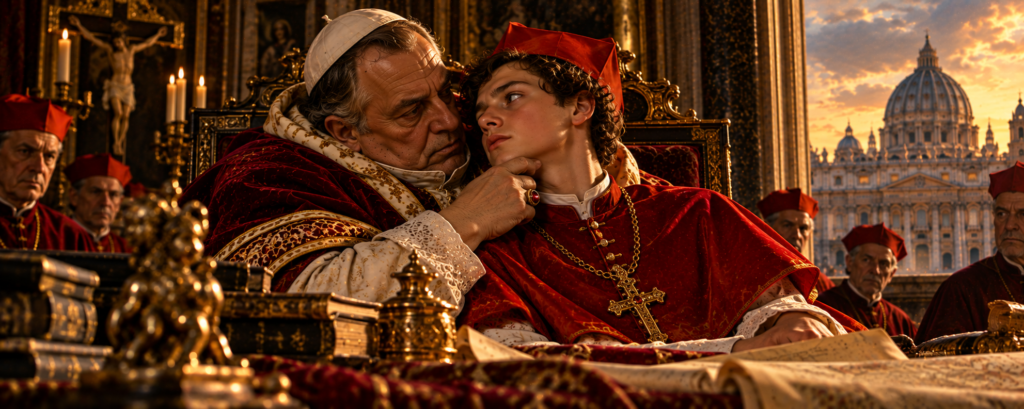
Julius III: The Pope Who Made a Teenage Favorite a Cardinal and Scandalized Rome
Pope Julius III (1487–1555) | Reigned 1550–1555
The Boy Who Became a Prince of the Church
In the autumn of 1550, the Catholic Church was struggling to recover from one of the greatest crises in its history. Protestantism had divided Western Christianity, religious warfare threatened the Holy Roman Empire, and the Council of Trent had become the centerpiece of Rome’s attempt to restore Catholic authority. Reformers were demanding better-qualified clergy, greater discipline, and an end to the blatant favoritism that had made the Renaissance papacy notorious. Against this troubled background, Pope Julius III decided that a teenage favorite with little meaningful ecclesiastical preparation should become a cardinal.
The young man’s name was Innocenzo Ciocchi del Monte, and his elevation immediately provoked controversy. He came from obscure circumstances, had been taken into the household of Giovanni Maria Ciocchi del Monte before the latter became pope, and had benefited from an extraordinary degree of personal favor. He was approximately seventeen years old when Julius placed him among the princes of the Church. His qualifications were so questionable that even observers accustomed to Renaissance nepotism found the appointment difficult to defend.
The scandal did not end with his youth or lack of preparation. Julius displayed an attachment to Innocenzo that contemporaries considered unusually intense, and the relationship became the subject of damaging speculation. Critics suggested that the pope’s affection might be sexual, while others interpreted it as an excessive paternal attachment or an especially flagrant example of favoritism. The surviving evidence does not establish that Julius and Innocenzo had a sexual relationship, but the rumors became inseparable from the pope’s reputation.
What makes the affair remarkable is that Julius was not an inexperienced churchman who had stumbled into the papacy without understanding its responsibilities. He had spent decades in ecclesiastical administration, served as a senior diplomat, and presided over the opening of the Council of Trent. He knew that the Church’s credibility had been damaged by precisely the sort of patronage he was now practicing. Nevertheless, he chose to elevate Innocenzo and continued protecting him despite the embarrassment.
The resulting controversy exposed the contradictions of the mid-sixteenth-century papacy. Rome was attempting to persuade Europe that Catholic reform was serious, yet the pope’s own household appeared to operate according to the familiar rules of personal favor and aristocratic privilege. The Church was developing stricter standards for clergy while its supreme leader promoted someone whose suitability was openly questioned. Julius III became a symbol of the distance between reforming ideals and the habits of those expected to enforce them.
His pontificate, however, cannot be reduced entirely to Innocenzo. Julius reopened the Council of Trent, became entangled in a costly war over Parma, supported the Jesuits, participated in the temporary restoration of Catholicism in England, and commissioned one of the most elegant villas of Renaissance Rome. His reign also witnessed the burning of Jewish religious books, revealing another troubling dimension of Catholic authority during the Counter-Reformation. Behind the scandal of his favorite stood a larger story of political frustration, religious coercion, cultural brilliance, and a pope increasingly drawn toward the comforts of private life.
Julius III belongs among the Wicked Popes not because every rumor about him can be proved, but because the documented record reveals an extraordinary failure of judgment. His treatment of Innocenzo was a public act of favoritism carried out at the highest level of the Church. His inability to manage the political crises surrounding Trent and Parma weakened his larger ambitions. The pope who had helped inaugurate Catholic reform would spend much of his own reign demonstrating how difficult it was for Renaissance churchmen to abandon the culture that had produced them.
Giovanni Maria del Monte: A Future Pope Born Into the Church’s Machinery
Giovanni Maria Ciocchi del Monte was born in Rome on September 10, 1487, into a family closely associated with the legal and administrative world of the papacy. His father, Vincenzo Ciocchi del Monte, was a distinguished jurist, and the family’s connections provided Giovanni Maria with opportunities unavailable to most young men. He received a humanist education before studying law at Perugia and Bologna. These studies prepared him for a career in the increasingly complicated government of the Renaissance Church.
Law was an especially valuable qualification for an ambitious ecclesiastical administrator. The papacy governed not only religious institutions but also extensive territories, courts, revenues, diplomatic relationships, and political disputes. Men capable of navigating canon law and civil law were essential to its functioning. Giovanni Maria developed precisely the expertise needed to advance within that system.
His uncle, Cardinal Antonio Maria Ciocchi del Monte, played an important role in his early career. The elder del Monte possessed substantial influence and helped secure opportunities for his nephew. Such family assistance was normal in Renaissance ecclesiastical politics, where advancement frequently depended upon patronage. Giovanni Maria therefore entered the Church through the same network of family influence that he would later exploit as pope.
In 1511, he succeeded his uncle in the archiepiscopal see of Siponto, although the ecclesiastical arrangements surrounding such appointments were often complicated by age, administration, and other offices. He subsequently received additional responsibilities, including the bishopric of Pavia. His legal knowledge and administrative competence made him useful to successive popes. Unlike Innocenzo, whom he would later elevate, Giovanni Maria possessed a substantial professional background.
His career unfolded during one of the most turbulent periods in papal history. He served under Julius II, whose military campaigns demonstrated the political ambitions of the Renaissance papacy. He witnessed the extravagance of Leo X and the beginnings of the Protestant Reformation. He also experienced the increasingly dangerous struggle between France and the Habsburg Empire.
The Sack of Rome in 1527 left a particularly powerful impression on those who survived it. Imperial troops entered the city, unleashing widespread killing, plunder, and destruction while Pope Clement VII sheltered in Castel Sant’Angelo. Giovanni Maria belonged to the generation of churchmen who understood that papal power could collapse with terrifying speed. The experience reinforced the importance of diplomacy, military security, and careful political calculation.
Yet the same world also encouraged habits that reformers increasingly condemned. Clerical office could provide wealth, status, and opportunities for relatives. Churchmen operated within aristocratic households and cultivated personal dependents. Giovanni Maria learned to navigate this environment successfully, and he never entirely escaped its assumptions.
The Cardinal Who Helped Open the Council of Trent
Giovanni Maria’s most important responsibilities before becoming pope involved the Catholic response to the Reformation. Under Paul III, he acquired increasing prominence as an administrator and diplomat. In December 1536, Paul elevated him to the College of Cardinals. His experience made him a valuable figure in the difficult negotiations surrounding a general church council.
The idea of convening a council had circulated for decades. Protestant reformers demanded serious consideration of theological controversies, while Catholic reformers hoped a council would address abuses within the Church. Emperor Charles V believed that some form of religious settlement might help stabilize Germany. The papacy, however, feared that a council could become an instrument of imperial domination or revive arguments that councils possessed authority superior to popes.
Paul III eventually accepted the need for a council but struggled to arrange its location and political conditions. Giovanni Maria del Monte became deeply involved in the preparations. His legal training, diplomatic experience, and loyalty to papal authority made him an obvious choice for a senior role. He understood both the theological importance of the gathering and the political dangers surrounding it.
When the Council of Trent finally opened on December 13, 1545, del Monte served as one of its papal presidents. He helped direct proceedings alongside other senior churchmen, including Marcello Cervini and Reginald Pole. The council began addressing doctrinal controversies and proposals for reform. Its decisions would eventually shape Catholicism for centuries.
Del Monte’s role required considerable political skill. Charles V wanted the council to help resolve religious divisions within his empire, while the papacy wanted to preserve control over doctrinal decisions. Bishops disagreed over the order in which theological and disciplinary questions should be considered. Protestant participation remained uncertain, and French political interests complicated negotiations.
The council’s early sessions produced important decrees, including its treatment of Scripture, tradition, original sin, and justification. Del Monte participated in an institution that was beginning to define the Catholic response to Protestant theology. His experience gave him genuine credentials as a leader of ecclesiastical reform. This was not a man unfamiliar with the problems facing the Church.
In 1547, the council was transferred from Trent to Bologna amid concerns about disease and growing political conflict. The move angered Charles V, who preferred the assembly to remain in imperial territory. Del Monte supported the transfer and consequently became associated with papal resistance to imperial pressure. His relationship with the emperor would remain complicated when he later became pope.
The experience also revealed the limitations of ecclesiastical reform in an age of dynastic warfare. Theological discussions could be interrupted by military campaigns, territorial disputes, and rivalries among Catholic rulers. Even when participants agreed that reform was necessary, they often disagreed about who should control it. Del Monte entered the papacy knowing that the Council of Trent was as much a political battlefield as a religious assembly.
The Conclave That Could Not Agree
Paul III died on November 10, 1549, leaving behind an unfinished reform program and a dangerous political dispute over the Farnese family’s control of Parma. His death opened a conclave divided among competing factions. Cardinals sympathetic to Charles V wanted a pope favorable to imperial interests, while French supporters sought to prevent Habsburg domination. The Farnese faction remained determined to protect the territorial inheritance Paul had created for his descendants.
The conclave began on November 29, 1549, and continued for more than two months. Giovanni Maria del Monte was a plausible candidate, but his association with the transfer of the Council of Trent to Bologna made him unpopular with some imperial supporters. Other candidates attracted support without securing the necessary majority. The prolonged deadlock reflected the extent to which European politics had penetrated papal elections.
The Farnese question was especially important. Paul III had established Parma and Piacenza as a hereditary duchy for his son Pier Luigi Farnese. After Pier Luigi’s assassination in 1547, his son Ottavio sought to secure the family’s position. The dispute involved imperial strategic interests and threatened to destabilize northern Italy.
Cardinals therefore considered the future of Parma while choosing the next spiritual leader of Western Catholicism. Promises concerning territories, offices, and political alignments influenced negotiations. This was not unusual in Renaissance conclaves, but it exposed the worldly interests shaping papal government. The election of a pope remained inseparable from the distribution of secular power.
Del Monte eventually emerged as a compromise candidate. On February 7, 1550, he was elected pope and chose the name Julius III. He was sixty-two years old and possessed decades of experience. His supporters could reasonably expect him to continue the Council of Trent and manage the Church’s difficult political position.
The choice of name carried historical associations. Julius II had been one of the most forceful Renaissance popes, combining military ambition with extraordinary artistic patronage. Julius III would also become involved in warfare and commission magnificent architecture. Yet his temperament and achievements would differ considerably from those of the formidable Warrior Pope.
The new pontiff inherited an institution caught between two eras. The magnificent Renaissance court still existed, but its moral credibility had been badly damaged. Catholic reform was advancing, yet political conflicts threatened its progress. Julius’s election offered an opportunity to strengthen the reforming movement, but his personal choices would soon undermine his reputation.
The Pope’s Favorite: Who Was Innocenzo del Monte?
The origins of Innocenzo Ciocchi del Monte remain one of the most discussed aspects of Julius III’s life. Contemporary and later accounts describe the young man as coming from humble or obscure circumstances, although details of his birth and childhood are uncertain. Some stories portray him as a boy encountered in Parma, while others offer more elaborate explanations of how he entered Giovanni Maria’s household. The precise circumstances cannot be reconstructed with complete confidence.
What is clear is that Giovanni Maria developed an extraordinary attachment to him. Innocenzo entered the del Monte household and received the family’s protection. Giovanni Maria’s brother, Baldovino del Monte, formally adopted him, giving the young man a recognized place within the family network. This adoption was important because it allowed Innocenzo to be treated as a relative rather than merely a household dependent.
The arrangement was unusual but not entirely without precedent. Renaissance aristocratic households often included dependents, protégés, adopted relatives, servants, and young people whose futures depended upon powerful patrons. Personal affection could become closely intertwined with political advancement. The difficulty in Innocenzo’s case was the extraordinary speed and scale of his promotion.
Innocenzo did not possess the education normally associated with an important ecclesiastical career. His preparation for senior church office was widely considered inadequate. He lacked the scholarly achievements, administrative experience, and established reputation that might have justified rapid advancement. His principal qualification appeared to be the affection of Giovanni Maria del Monte.
The relationship became more consequential after Giovanni Maria’s election as pope. A powerful cardinal could advance a favorite, but a pope could transform that favorite into one of the highest-ranking men in the Church. Julius possessed the authority to distribute offices and honors on an enormous scale. Innocenzo stood to benefit from the full power of papal patronage.
Observers quickly recognized the danger. The Church was attempting to establish higher standards for its clergy, yet the pope seemed prepared to ignore those standards for someone close to him. The issue was not merely whether Innocenzo deserved financial support. It was whether personal affection should qualify an inexperienced teenager for a position carrying immense ecclesiastical authority.
A Cardinal at Seventeen
On May 30, 1550, Julius III elevated Innocenzo del Monte to the College of Cardinals. The young man was approximately seventeen years old. His appointment came only a few months after Julius’s election, making the pope’s priorities unmistakable. The decision immediately became one of the defining scandals of the pontificate.
The College of Cardinals was not simply a collection of ceremonial dignitaries. Its members advised the pope, governed important institutions, represented the Church diplomatically, and participated in the election of future popes. Cardinals could accumulate extensive revenues and exercise influence across Europe. Elevating an inexperienced teenager therefore carried serious institutional consequences.
Youth alone did not make Innocenzo’s appointment unprecedented. Renaissance popes had elevated young relatives before, sometimes at ages even more startling. Paul III had made his grandson Alessandro Farnese a cardinal at fourteen, while other papal families had benefited from similar promotions. The difference was that Innocenzo lacked the aristocratic standing and political preparation that had often been used to rationalize such appointments.
His elevation also occurred at an especially sensitive moment. The Council of Trent had already begun addressing the need for better clerical discipline. Catholic reformers were arguing that ecclesiastical offices should be filled by men capable of performing their duties. Julius’s decision appeared to contradict the principles he had helped promote.
The pope nevertheless proceeded. Innocenzo received the title and privileges associated with the cardinalate. His position placed him among senior churchmen who had spent decades studying theology, law, and administration. The contrast was impossible to ignore.
Criticism came from several directions. Some observers objected to the appointment as an example of outrageous favoritism. Others questioned Innocenzo’s character and suitability. The controversy intensified because the pope’s affection for him was already attracting attention.
Julius’s defenders could argue that he was following established practices of family patronage. They might also suggest that a young cardinal could receive further education and eventually become competent. Yet neither argument adequately explained why Innocenzo needed to be elevated so quickly. His appointment seemed designed primarily to reward personal closeness rather than serve the Church.
The Rumors That Followed Them
The relationship between Julius III and Innocenzo del Monte generated rumors of sexual intimacy. These allegations became among the most damaging elements of the pope’s later reputation. Writers hostile to Julius portrayed his affection as scandalous and suggested that the young cardinal enjoyed privileges extending beyond ordinary patronage. Such accusations circulated in a world where political enemies frequently used sexual allegations to destroy reputations.
The surviving evidence does not establish that Julius and Innocenzo engaged in a sexual relationship. Contemporary suspicion is historically significant, but suspicion is not proof. The fact that observers found their relationship unusual does not allow historians to determine what occurred privately. Any responsible account must distinguish the documented favoritism from the unproven sexual allegations.
This distinction is particularly important because early modern political culture encouraged the circulation of damaging rumors. Accusations involving sexual misconduct, especially conduct considered forbidden by religious and social norms, could be devastating to a pope’s reputation. Such allegations did not require reliable witnesses to become influential. Once repeated by diplomats, pamphleteers, or hostile chroniclers, they could acquire a life of their own.
Julius made the rumors easier to believe by refusing to distance himself from Innocenzo. He continued favoring the young man despite criticism. His attachment appeared sufficiently strong that observers interpreted it as something beyond ordinary family loyalty. Yet the motives behind that attachment remain uncertain.
The relationship may have involved paternal affection, emotional dependence, personal favoritism, or other private feelings that the surviving sources cannot establish. None of these possibilities should be presented as proven merely because the pope’s behavior was unusual. The strongest historical conclusion is narrower but still damning. Julius elevated an unqualified favorite and persisted in protecting him despite the damage to the Church’s reputation.
The sexual allegations nevertheless became central to later portrayals of Julius III. Protestant polemicists and anti-papal writers had obvious reasons to emphasize them. A pope accused of sexual misconduct offered a powerful symbol of the corruption reformers claimed existed in Rome. The story therefore spread far beyond the original political environment.
The scandal’s endurance reveals how reputations are constructed. Documented actions create a foundation, while rumor supplies increasingly sensational explanations. Over time, readers may forget which details were witnessed and which were merely alleged. Julius III’s relationship with Innocenzo illustrates precisely why historical caution matters.
Nepotism Without the Excuse of Dynasty
Traditional papal nepotism usually involved the promotion of recognized relatives. Popes elevated nephews, cousins, brothers, and other family members to strengthen their political position. The practice could be defended, however imperfectly, as a means of securing trustworthy advisers in a dangerous political environment. Family members were presumed to have interests aligned with those of the pope.
Innocenzo’s position complicated that explanation. He was not a natural son or nephew of Julius, although his adoption into the del Monte family created a formal relationship. His promotion therefore depended upon a deliberately constructed family connection. The pope had effectively transformed personal favoritism into a form of nepotism.
This did not make the practice less objectionable. The essential problem was that ecclesiastical office was being distributed according to personal attachment rather than demonstrated suitability. Innocenzo’s adoption supplied a family identity, but it did not provide the education or experience expected of a senior churchman. His cardinalate exposed the flexibility of Renaissance patronage.
Julius also advanced other members of the del Monte family. His relatives received offices, revenues, and political opportunities through his authority. Such behavior placed him within the broader tradition of Renaissance popes who treated the Church as a resource for family advancement. Innocenzo became the most notorious beneficiary because his qualifications were especially weak.
The pope’s favoritism was therefore not an isolated personal eccentricity. It reflected an institutional culture in which spiritual office could serve private interests. Reformers had been criticizing this culture for decades. Julius’s actions demonstrated how deeply it remained embedded within the papacy.
The scandal also damaged the moral authority of Catholic reform. Protestant critics could point to Innocenzo as evidence that Rome had not changed. Catholic reformers who sincerely wanted higher standards had to confront the embarrassing behavior of their own leader. The pope’s personal choices weakened the credibility of the institutional program he was supposed to advance.
The Council of Trent Opens Again
Despite the controversy surrounding Innocenzo, Julius III initially demonstrated a serious interest in continuing Catholic reform. He had been one of the original presidents of the Council of Trent and understood its importance. Soon after his election, he began negotiating the council’s resumption. The effort required cooperation from Charles V and careful management of French opposition.
In November 1550, Julius issued the bull arranging the council’s return to Trent. The assembly formally resumed on May 1, 1551. Its reopening represented a significant achievement after the political deadlock that had followed the transfer to Bologna. Julius had succeeded in reviving an institution that many feared might remain suspended indefinitely.
The council continued addressing doctrinal questions central to the Catholic response to Protestantism. Discussions focused on the Eucharist, penance, extreme unction, and related matters. Theologians debated the meaning of the sacraments and the authority of Catholic tradition. These issues were fundamental to the religious divisions of sixteenth-century Europe.
The council’s thirteenth session, held in October 1551, produced important decrees concerning the Eucharist. The fourteenth session, in November, addressed penance and extreme unction. These decisions contributed to the doctrinal framework that would later define post-Tridentine Catholicism. Julius’s pontificate therefore produced substantive religious achievements.
The pope also supported efforts to encourage Protestant participation. Safe-conduct arrangements were issued for Protestant representatives who wished to attend. Ambassadors from several German Protestant territories appeared and presented demands. The possibility of meaningful reconciliation remained uncertain, but the attempt was historically important.
The Protestant representatives wanted earlier decisions reconsidered and questioned the authority of a council controlled by the pope. Catholic leaders were unwilling to accept demands that would undermine the council’s previous decrees or papal authority. The negotiations revealed how far the opposing sides had moved apart. The hope of restoring Western Christian unity through a single council was becoming increasingly remote.
Julius nevertheless deserved credit for reopening the assembly. His personal scandals did not erase the institutional significance of the decision. The same pope who elevated Innocenzo also helped advance Catholic doctrinal reform. His reign was therefore more complicated than a simple story of moral decline.
Charles V and the Emperor’s Impossible Dream
Emperor Charles V wanted the Council of Trent to help resolve the religious divisions of Germany. His empire contained territories that had embraced Protestantism and others that remained Catholic. Religious conflict threatened political stability and complicated his struggle against France and the Ottoman Empire. A successful council might strengthen imperial unity.
Julius shared the desire to restore Catholic authority but did not necessarily share the emperor’s political priorities. The papacy wanted doctrinal clarity and institutional reform under Roman leadership. Charles hoped for a settlement that could stabilize his territories. Their objectives overlapped without being identical.
The emperor’s influence over the council remained a sensitive issue. Julius did not want the assembly becoming an instrument of Habsburg power. The memory of Clement VII’s disastrous confrontation with Charles remained vivid in Rome. Papal independence was therefore a central concern.
At the same time, Julius needed imperial cooperation. Protestant rulers possessed military power, and France remained a dangerous rival. The papacy lacked the resources to impose religious unity independently. Julius had to navigate between protecting papal authority and relying upon the emperor.
These tensions were familiar from the pontificate of Paul III. They became more difficult when the conflict over Parma erupted. The pope’s territorial interests drew him toward military cooperation with Charles even as he feared excessive imperial influence. The contradiction would undermine both his diplomacy and the council’s progress.
Charles’s dream of restoring religious unity through imperial authority ultimately failed. Protestantism had become too deeply rooted, and the political interests of German princes could not easily be reversed. Julius’s council faced problems that no single pope could solve. The collapse of its second period would reflect the larger failure of Catholic and imperial leaders to impose a common religious settlement.
Parma: The War That Consumed the Pope’s Ambitions
The conflict over Parma was one of the most damaging political episodes of Julius III’s reign. The territory had been granted to the Farnese family under Paul III, whose son Pier Luigi became its duke. After Pier Luigi’s assassination, his son Ottavio Farnese struggled to maintain control. The dispute involved papal claims, Farnese ambitions, and imperial strategic interests.
Julius initially sought a settlement that would preserve papal authority while avoiding unnecessary conflict. The negotiations surrounding his election had included commitments relevant to the Farnese position. Yet the political situation quickly deteriorated. Ottavio’s determination to retain Parma collided with the interests of Charles V.
In 1551, Ottavio aligned himself with France. King Henry II of France saw an opportunity to challenge Habsburg power in northern Italy. The alliance transformed a local territorial dispute into part of the wider struggle between France and the emperor. Julius now faced the prospect of French influence expanding near the Papal States.
The pope responded by supporting military action against the Farnese position. Papal forces cooperated with imperial troops under Ferrante Gonzaga, governor of Milan. Julius’s nephew Giambattista del Monte played a role in the campaign. The pope who had promised to revive Catholic reform was once again participating in the familiar wars of Italian princes.
The conflict proved costly and frustrating. French forces threatened papal territories, while military operations failed to produce the decisive result Julius wanted. The war drained resources and complicated diplomatic relationships. It also damaged the pope’s ability to focus on ecclesiastical reform.
The involvement of papal relatives added another layer of irony. Julius had become notorious for promoting Innocenzo, yet his wider family also benefited from political and military appointments. The war therefore displayed the same mixture of family interest and ecclesiastical authority that reformers criticized. Papal policy remained deeply entangled with personal networks.
By 1552, Julius was forced to accept a compromise. The truce concluded in April left Ottavio Farnese in possession of Parma for a limited period and addressed other territorial disputes. The outcome fell far short of the pope’s ambitions. Julius had committed himself to war without securing the result he desired.
The failure appears to have affected him deeply. His confidence in political intervention diminished, and he increasingly withdrew from active involvement in Italian affairs. The experience reinforced the difficulty of maintaining papal independence between France and the Habsburg Empire. Julius’s reign began with ambitious plans for reform but became burdened by a war that achieved little.
The Council Falls Silent Again
The political crisis surrounding Parma coincided with renewed instability in Germany. Charles V faced a serious challenge from Protestant princes, including Maurice of Saxony. Military developments threatened the emperor’s position and endangered the region around Trent. The council’s ability to continue became increasingly uncertain.
French opposition also complicated proceedings. Henry II refused to allow French bishops to participate under conditions he regarded as politically unfavorable. The council therefore lacked the broad representation necessary for its most ambitious objectives. Its claim to speak for the entire Western Church remained contested.
In April 1552, the council was suspended again. The decision reflected military danger and political circumstances rather than simply Julius’s personal unwillingness to continue reform. Nevertheless, the suspension was a major disappointment. The institution he had successfully reopened was once more unable to function.
The interruption would last far longer than initially expected. Julius died before the council could resume. It would not reconvene until 1562, under Pope Pius IV. The delay deprived Julius of the opportunity to oversee a completed reform settlement.
The suspension also damaged his reputation. He had begun his pontificate with the credentials of an experienced council president. His ability to revive Trent had seemed to promise a continuation of Paul III’s reforming momentum. Yet political conflict and military danger prevented him from fulfilling those expectations.
It would be unfair to blame Julius alone for the council’s collapse. The rivalry between France and the Habsburg Empire, the resistance of Protestant rulers, and the complexity of doctrinal negotiations created obstacles beyond his control. Even a more determined pope might have struggled to overcome them. Still, Julius’s involvement in the Parma conflict contributed to the instability surrounding his reform program.
The council’s suspension marked a turning point in his reign. After 1552, Julius appeared increasingly inclined toward withdrawal from political conflict. His government continued administrative and religious work, but the grand ambitions of the early pontificate faded. The pope’s attention turned more visibly toward the comforts of his Roman residences.
The Pope Who Retreated Into Pleasure
Julius III developed a reputation for enjoying the pleasures of Renaissance court life. He appreciated elegant surroundings, elaborate meals, conversation, gardens, and artistic patronage. Such tastes were common among aristocratic churchmen, but they became increasingly controversial as Catholic reform emphasized clerical discipline. Julius’s lifestyle therefore attracted criticism beyond the scandal involving Innocenzo.
His retreat from political activity after the Parma war strengthened the impression that he preferred comfort to responsibility. Contemporary observers described a pope increasingly occupied with private pleasures and the management of his household. The degree to which this reflected genuine indifference, illness, or political discouragement is difficult to determine. Julius suffered from recurring health problems, including gout, which may have limited his activity.
The distinction matters because later accounts sometimes portray him as abandoning government entirely. That is an exaggeration. Papal administration continued, reform measures were considered, and important religious decisions were made. Nevertheless, the contrast between the ambitions of his early pontificate and the atmosphere of his later years was striking.
Julius’s personal tastes became especially visible through his architectural patronage. He commissioned a magnificent suburban villa near the northern approach to Rome. The residence was designed as a place of retreat and entertainment, combining gardens, fountains, sculpture, and elegant architectural spaces. It became one of the most celebrated examples of mid-sixteenth-century Roman architecture.
The villa’s beauty was undeniable. Its association with a pope accused of excessive favoritism, however, made it vulnerable to criticism. Reformers could ask why the head of the Church devoted so much attention to luxury while religious division continued spreading across Europe. The question echoed criticisms directed at earlier Renaissance popes.
Julius’s retreat into refined private life therefore became part of his historical image. He was not remembered as a warrior pope or a relentless reformer. Instead, he appeared as a cultivated but increasingly disengaged ruler whose personal preferences overshadowed his institutional responsibilities. The scandal surrounding Innocenzo made that image especially damaging.
Villa Giulia: A Palace Built for Escape
Villa Giulia stands among the most important architectural achievements of Julius III’s pontificate. Located near the northern edge of Renaissance Rome, it was designed as a suburban retreat away from the pressures of the Vatican. The project involved distinguished architects and artists, including Giacomo Barozzi da Vignola, Bartolomeo Ammannati, and Giorgio Vasari. Michelangelo also contributed advice to aspects of the design.
The villa combined architecture, gardens, sculpture, and water features in an elegant composition. Its famous nymphaeum created a theatrical setting in which architecture and flowing water interacted. The design reflected the sophisticated artistic culture of mid-sixteenth-century Italy. Julius’s patronage helped produce a masterpiece.
The residence also expressed the pope’s desire for privacy and pleasure. Renaissance villas were designed for recreation, conversation, and escape from formal court obligations. They allowed wealthy patrons to display refined taste while enjoying a more relaxed environment. Julius embraced that tradition enthusiastically.
The project was not inherently scandalous. Popes had commissioned magnificent buildings for centuries, and artistic patronage was considered a legitimate expression of religious and political authority. Julius’s predecessors had transformed Rome through architecture and painting. His villa belonged to that broader cultural tradition.
The controversy arose from context. The Church was facing a crisis of authority, the Council of Trent had been suspended, and the pope’s favorite had become a source of public embarrassment. Against that background, a luxurious retreat could appear to symbolize misplaced priorities. The villa became associated with the pope’s withdrawal from difficult responsibilities.
Later writers sometimes treated Villa Giulia as evidence of moral decadence. Such interpretations should not obscure the building’s artistic significance or assume that every gathering held there was scandalous. The villa’s surviving architecture tells us much about Julius’s taste but little about the private conduct alleged by hostile observers. Its beauty is documented; the more sensational stories attached to the pope require separate scrutiny.
The contrast remains powerful. Julius could recognize and support extraordinary artistic talent while displaying questionable judgment in ecclesiastical appointments. His patronage enriched Rome’s cultural landscape even as his favoritism damaged the papacy’s reputation. Villa Giulia became a monument to both his refinement and the contradictions of his reign.
Michelangelo and the Continuing Glory of Rome
Julius III inherited an artistic world shaped by the great Renaissance popes. Julius II had commissioned Michelangelo’s Sistine Chapel ceiling and initiated the rebuilding of St. Peter’s Basilica. Leo X had supported artists and scholars on an extravagant scale. Paul III had overseen Michelangelo’s Last Judgment and appointed him chief architect of St. Peter’s.
Julius III continued supporting important artistic projects. Michelangelo remained associated with the rebuilding of St. Peter’s, although the aging artist’s work was frequently complicated by disputes over design and administration. The pope’s support helped protect the project during a period of institutional uncertainty. Construction continued as Rome slowly transformed into the monumental city of the Counter-Reformation.
The pope’s artistic interests extended beyond architecture. He appreciated music, painting, sculpture, and the cultivated pleasures of court life. His household reflected the humanist tastes of the Renaissance aristocracy. This cultural refinement was genuine and should not be dismissed merely because his ecclesiastical judgment was questionable.
Yet artistic magnificence could no longer shield popes from moral criticism as effectively as it once had. The Reformation had changed the terms of debate. Protestant critics frequently portrayed Roman luxury as evidence that the papacy had abandoned apostolic simplicity. Catholic reformers increasingly demanded that bishops and clergy demonstrate greater seriousness.
Julius therefore occupied an uncomfortable position. His patronage continued traditions that had made Renaissance Rome culturally magnificent. At the same time, those traditions were becoming associated with the corruption that reformers wanted to eliminate. The pope’s love of beauty existed within a Church struggling to redefine its public identity.
The contradiction did not disappear after his death. Catholicism would continue producing extraordinary art during the Counter-Reformation, often using visual magnificence to communicate religious authority. Julius’s villa and architectural patronage belonged to the transition between Renaissance court culture and the more explicitly devotional art of later decades. His cultural legacy was substantial even if his personal reputation remained compromised.
Palestrina and the Music of the Papal Chapel
Julius III also played an important role in the career of Giovanni Pierluigi da Palestrina, one of the most celebrated composers of Renaissance sacred music. Palestrina had already developed a reputation as a talented musician. Julius recognized his abilities and helped advance his career. Their association became an important episode in the history of Catholic church music.
In 1551, Palestrina was appointed maestro di cappella of the Cappella Giulia, the choir associated with St. Peter’s Basilica. The position provided an important platform for his musical development. He later entered the papal chapel under Julius’s patronage. These appointments helped establish his connection with Rome’s leading religious institutions.
Palestrina’s later reputation became closely associated with the musical culture of the Counter-Reformation. His compositions were admired for their balance, clarity, and sophisticated polyphony. Later traditions sometimes exaggerated his role in supposedly saving polyphonic church music from condemnation. Nevertheless, his importance to Catholic sacred music is beyond dispute.
Julius’s support illustrates another dimension of his pontificate. He was capable of recognizing artistic excellence and promoting talented individuals. His patronage contributed to a musical tradition that would become central to Catholic worship. This achievement deserves recognition alongside his more controversial decisions.
The contrast with Innocenzo is revealing. Palestrina possessed genuine musical ability that justified his advancement. Innocenzo’s elevation depended primarily upon personal favor rather than comparable qualifications. Julius could therefore distinguish merit when it suited him, but he did not consistently apply that standard to ecclesiastical office.
The pope’s musical patronage also complicates the image of a ruler interested only in pleasure. Sacred music served religious purposes as well as aesthetic ones. Supporting Palestrina helped enrich Catholic worship during a period of intense religious conflict. Julius’s reign contained meaningful cultural contributions even while his personal favoritism undermined his moral authority.
The Jesuits and the German College
Julius III continued supporting the Society of Jesus, which had received formal papal approval under Paul III. The Jesuits were becoming increasingly important in education, missionary activity, and Catholic reform. Their emphasis on disciplined religious life contrasted sharply with the more indulgent habits associated with parts of the Renaissance court. Julius recognized their usefulness to the Church.
One of his most significant contributions was support for the German College in Rome. Established in 1552 at the initiative of Ignatius of Loyola, the institution was intended to educate clergy for service in German-speaking territories. These regions had been deeply affected by the Reformation. Better-trained Catholic priests were considered essential to strengthening the Church’s position.
Julius granted the college papal support and financial assistance. The institution became part of the wider Catholic effort to improve clerical education. Its graduates would contribute to religious life in territories where Catholic and Protestant communities competed for influence. The project represented a practical response to one of the Church’s most pressing problems.
The pope also confirmed and supported aspects of Jesuit organization. His relationship with the order demonstrates that he did not abandon Catholic reform entirely after the Council of Trent was suspended. Important institutional developments continued during his reign. The Jesuits benefited from papal protection and encouragement.
This support again reveals the contradictions of Julius’s leadership. He could promote disciplined education for future priests while elevating an inadequately prepared favorite to the cardinalate. He understood the importance of competent clergy in Germany but ignored comparable concerns within his own household. His reforming instincts were genuine but inconsistently applied.
The German College became one of the more durable achievements associated with his pontificate. Unlike the failed Parma campaign, it addressed a long-term institutional need. Its significance extended beyond Julius’s lifetime. The pope’s reputation would have been considerably stronger had his personal appointments reflected the same concern for education and competence.
England Returns to Rome—For a Moment
Julius III’s pontificate coincided with a dramatic reversal in English religious politics. Henry VIII had broken with Rome, and his son Edward VI had presided over increasingly Protestant reforms. When Edward died in 1553, his Catholic half-sister Mary Tudor became queen. Her accession created the possibility of restoring England to papal obedience.
Mary was deeply committed to Catholicism and regarded the religious changes of her father and brother as illegitimate. She sought to reverse Protestant reforms and restore the authority of the pope. Julius welcomed the opportunity. The return of England would represent an enormous symbolic victory for Rome.
Cardinal Reginald Pole became central to the restoration. Pole had opposed Henry VIII’s religious policies and spent years in exile. Julius appointed him papal legate with authority to assist in reconciling England to the Church. His return became one of the most important events of Mary’s reign.
In November 1554, Parliament formally participated in the reconciliation with Rome, and Pole pronounced absolution from schism. The restoration was a remarkable achievement for the papacy. A kingdom that had rejected Roman authority was publicly returning to communion with the Catholic Church. Julius lived to see a victory that earlier popes had been unable to secure.
The restoration, however, was politically fragile. English religious opinion remained divided, and Protestantism had acquired substantial support. Mary’s marriage to Philip of Spain also generated suspicion among those who feared foreign influence. The return to Rome depended heavily upon the queen’s authority and the stability of her government.
Julius died before the full consequences of Mary’s religious policies became apparent. The Marian persecutions, which intensified after his death, would leave a deeply controversial legacy. Mary’s own death in 1558 brought Elizabeth I to the throne and reversed the restoration. England’s return to Rome proved temporary.
Nevertheless, the episode was significant during Julius’s lifetime. It offered evidence that Protestant expansion was not irreversible. The pope could reasonably regard Mary’s accession and reconciliation as a major success. His pontificate therefore included an important, if short-lived, Catholic recovery.
The Burning of the Talmud
One of the darker episodes of Julius III’s reign involved the suppression of Jewish religious literature. In 1553, papal authorities ordered the confiscation and burning of copies of the Talmud. The campaign followed accusations concerning passages considered offensive to Christianity. It became a major act of religious censorship.
The Talmud is a foundational collection of Jewish legal discussion, interpretation, and tradition. Its importance to Jewish religious life made its destruction particularly damaging. Confiscating and burning copies was not merely an attack upon individual books. It threatened the transmission of learning and the intellectual foundations of Jewish communities.
The controversy involved rivalries among printers, accusations by converts from Judaism, and longstanding Christian hostility toward Jewish religious texts. These pressures encouraged authorities to investigate the Talmud. Julius’s government accepted the argument that certain passages were unacceptable. The resulting policy led to public destruction of Jewish books.
The most famous burnings occurred in Rome in 1553, with further confiscations and destruction elsewhere in Italy. The campaign represented a severe assault upon Jewish scholarship. Jewish communities faced the loss of valuable manuscripts and printed volumes. The consequences extended beyond the immediate spectacle of burning books.
Julius’s policies toward Jews were not uniformly hostile in every respect. His government also issued measures protecting Jewish children from forced baptism and permitted certain forms of Jewish residence and activity. Such protections reflected the complicated legal position of Jews within papal territories. Nevertheless, they do not erase the significance of the Talmud burnings.
The episode illustrates the coercive side of Catholic reform. Authorities increasingly sought to control religious texts and suppress beliefs regarded as dangerous. The campaign against the Talmud emerged from a broader environment of confessional anxiety. Jewish communities suffered as Christian authorities tightened the boundaries of acceptable religious expression.
Julius’s responsibility is therefore historically significant. He presided over a papacy that sanctioned the destruction of central Jewish religious literature. Unlike the rumors concerning Innocenzo, this was a documented exercise of institutional power. It deserves a prominent place in any assessment of the darker aspects of his reign.
Innocenzo’s Conduct and the Cost of Protection
Innocenzo del Monte’s career did little to silence criticism of his elevation. His behavior attracted further controversy, and later accounts describe a young cardinal whose conduct was frequently regarded as unsuitable for his office. The precise details of every accusation require caution because hostile observers had strong reasons to emphasize his failures. Nevertheless, his reputation remained poor.
The problem was not simply that Innocenzo lacked theological learning. Cardinals were expected to maintain a level of dignity appropriate to their position. They represented the Church before rulers, clergy, and ordinary believers. Public misconduct could therefore damage the authority of the institution itself.
Julius’s protection made the situation worse. The pope had invested his personal authority in Innocenzo’s advancement. Removing or disciplining him would have amounted to acknowledging a serious error of judgment. Julius appeared unwilling to make that concession.
The scandal became an example of how favoritism can trap powerful leaders. Once a patron elevates an unsuitable dependent, the dependent’s failures reflect upon the patron. Further protection may be offered to avoid embarrassment, but that protection creates additional criticism. The relationship becomes increasingly difficult to manage.
Innocenzo’s later life would confirm that concerns about his character were not entirely imaginary. After Julius’s death, he became involved in serious scandals, including violent misconduct. His subsequent career was troubled by disciplinary problems and loss of favor. These later events do not prove the sexual allegations concerning Julius, but they reinforce doubts about Innocenzo’s suitability for the cardinalate.
The pope’s decision therefore had consequences extending beyond his lifetime. Innocenzo remained a cardinal and continued carrying the status Julius had given him. His behavior became part of the institutional legacy of the appointment. The Church inherited a problem created by the personal favoritism of its former leader.
The Later Crimes of Innocenzo del Monte
Innocenzo survived Julius III by more than two decades, dying in 1577. His later career was marked by scandal and disciplinary intervention. Among the most serious episodes was his involvement in a killing during the pontificate of Pius IV. The circumstances have been described differently in historical accounts, but the incident contributed substantially to his disgrace.
He also faced accusations of sexual misconduct and other behavior considered incompatible with his position. Some allegations involved coercion or abuse, although the surviving descriptions must be evaluated carefully rather than repeated as unquestionable fact. His reputation deteriorated significantly. Later popes had little reason to protect him with the same determination Julius had shown.
Innocenzo was subjected to restrictions and periods of confinement or exclusion from ordinary cardinalatial privileges. His difficulties demonstrated the practical consequences of placing an unsuitable person in high office. The title of cardinal could not transform character or supply the discipline that education and experience had failed to provide. Julius’s original decision remained difficult to defend.
These later events are sometimes used to support sensational claims about Innocenzo’s earlier relationship with Julius. That reasoning is unsound. Misconduct committed years afterward cannot establish the nature of a private relationship during the pope’s lifetime. Historical evidence must be evaluated according to what it actually demonstrates.
What Innocenzo’s later career does show is that the concerns surrounding his appointment were not merely the product of jealous rivals. He proved capable of conduct that brought serious disgrace upon himself. His position had been granted through favor rather than earned through demonstrated suitability. The consequences became increasingly visible after his protector died.
Innocenzo therefore occupies a peculiar place in papal history. He was neither a great theologian nor an influential reformer, yet his name remains closely associated with one of the most controversial papal relationships of the sixteenth century. His importance lies largely in what his promotion reveals about Julius III. The young cardinal became a lasting symbol of the dangers of unchecked personal patronage.
The Pope’s Health and His Withdrawal From Government
Julius III suffered from recurring health problems during his pontificate. Gout was particularly troublesome and could cause severe pain and periods of incapacity. Such illness may help explain some of his withdrawal from active political life. It would be misleading to interpret every period of inactivity as simple laziness or indulgence.
Nevertheless, the pope’s reputation for retreating into comfort became increasingly established. After the failures of the Parma campaign and the suspension of the Council of Trent, he appeared less eager to involve himself in major European conflicts. His villa offered a setting far removed from the exhausting disputes of diplomacy. He increasingly preferred the quieter pleasures of his household.
The contrast with Paul III was noticeable. Paul had remained deeply engaged in dynastic politics and ecclesiastical reform into advanced old age. Julius possessed considerable experience but seemed less willing to continue fighting political battles after repeated disappointments. His temperament was more inclined toward compromise and personal comfort than relentless confrontation.
This did not mean that government ceased functioning. Cardinals, officials, and diplomatic representatives continued managing the affairs of the Church. Reform commissions considered administrative changes, and papal decisions continued affecting religious institutions. The machinery of government was larger than the personality of the pope.
Yet papal leadership mattered enormously during the Counter-Reformation. The Church needed direction, consistency, and public credibility. Julius’s personal scandals and political retreat weakened the impression of determined leadership. His pontificate lacked the sustained reforming momentum associated with Paul III.
The pope’s final years therefore acquired a melancholy quality. He had entered office with substantial experience and genuine opportunities. He had reopened Trent and witnessed England’s return to Rome. Yet his reputation was increasingly dominated by Innocenzo, failed warfare, and luxurious retirement.
The Death of Julius III
By early 1555, Julius III’s health had deteriorated. He had endured recurring illness and the disappointments of a troubled pontificate. The Council of Trent remained suspended, and the political situation in Europe continued to change rapidly. The pope’s final months offered little prospect of resolving the major problems he had inherited.
Julius died on March 23, 1555, at the age of sixty-seven. His pontificate had lasted just over five years. The Church he left behind remained divided by the Reformation, while the Council of Trent’s work was unfinished. His personal reputation had been damaged by favoritism and scandal.
His death opened another conclave. The cardinals elected Marcello Cervini, who became Marcellus II. The new pope was widely respected for his seriousness and reforming credentials. His election suggested that the College of Cardinals recognized the need for a different style of leadership.
Marcellus II, however, died after only twenty-two days as pope. His brief pontificate prevented any substantial reform program from developing. The cardinals then elected Gian Pietro Carafa as Paul IV. Carafa would pursue a far more austere and uncompromising approach to Catholic discipline.
The contrast between Julius and Paul IV was striking. Julius had been associated with personal favoritism, artistic pleasure, and political retreat. Paul IV became known for severity, doctrinal rigidity, and aggressive use of the Inquisition. The succession reflected the competing directions available to the Catholic Church.
Julius’s death did not end the consequences of his decisions. Innocenzo remained a cardinal, Villa Giulia continued standing as a monument to his patronage, and the Council of Trent would eventually resume under another pope. His reign left behind achievements and embarrassments in almost equal measure. The most damaging of those embarrassments would continue shaping his reputation for centuries.
How Much of the Scandal Can Be Believed?
The historical reputation of Julius III presents a difficult problem because documented favoritism became intertwined with allegations of sexual misconduct. His promotion of Innocenzo is beyond serious dispute. The young man’s lack of qualifications and extraordinary advancement were widely recognized. Julius’s willingness to protect him despite criticism is also central to the historical record.
The sexual allegations are different. Contemporary observers suspected an improper relationship, and later writers repeated those suspicions. Yet the surviving evidence does not establish sexual contact between Julius and Innocenzo. Historians should therefore describe the allegations as allegations rather than confirmed events.
The distinction does not require minimizing the scandal. A pope who elevated an inexperienced teenager because of personal affection was already abusing the spirit of ecclesiastical office. The Church was attempting to establish stricter standards of clerical competence and discipline. Julius’s behavior contradicted those goals regardless of the private nature of his attachment.
It is also important to recognize how political hostility shaped contemporary accounts. Protestant critics had strong incentives to portray Catholic leaders as morally corrupt. Rival Catholic factions could also exploit personal scandal for political advantage. Accusations circulated through diplomatic correspondence, court gossip, and later polemical histories.
This does not mean every hostile report should be dismissed. Political enemies sometimes preserved genuine information that sympathetic writers preferred to conceal. The challenge is to distinguish corroborated actions from interpretations and rumors. Julius’s favoritism is well documented, while the sexual nature of his relationship with Innocenzo remains unproven.
The most responsible historical judgment therefore rests upon what can be established. Julius made a deeply questionable appointment and allowed personal attachment to override the interests of the Church. His decision damaged his credibility at a moment when Catholic reform desperately needed credible leadership. That documented failure is substantial enough without adding claims the evidence cannot support.
Julius III and the Failure of Renaissance Habits to Disappear
Julius III became pope during a transitional moment in Catholic history. The extravagant culture of the Renaissance papacy had not disappeared, but the Reformation had made its contradictions increasingly dangerous. Reformers demanded better clergy, greater discipline, and stronger institutional responsibility. The Church was beginning to change, but its leaders remained shaped by older assumptions.
Julius embodied that tension. His experience at Trent demonstrated genuine knowledge of Catholic reform. His support for the Jesuits and German College showed that he understood the importance of education. His role in England’s temporary reconciliation with Rome also reflected serious engagement with the religious crisis.
At the same time, his treatment of Innocenzo revealed how deeply personal patronage remained embedded within papal government. He acted as though his affection for a dependent justified granting one of the Church’s highest offices. The appointment ignored the standards of competence that reformers wanted applied elsewhere. It suggested that the pope considered himself exempt from principles he helped promote.
His political conduct displayed similar contradictions. Julius wanted to continue the Council of Trent but became involved in a territorial war that contributed to wider instability. He sought to protect papal interests but failed to achieve his objectives in Parma. His diplomatic frustrations encouraged withdrawal rather than sustained leadership.
His artistic patronage also belonged to the older Renaissance world. Villa Giulia was magnificent, and his support for musicians and artists enriched Rome’s cultural life. Yet such magnificence became increasingly difficult to reconcile with demands for clerical simplicity. The Church was moving toward a more disciplined public identity while its pope continued enjoying aristocratic pleasures.
The result was not a pontificate devoid of achievement. Julius reopened Trent, supported important institutions, and contributed to Catholic cultural life. His failures were nevertheless conspicuous because they occurred at such a sensitive historical moment. The Church needed a leader capable of embodying reform, and Julius repeatedly demonstrated the persistence of the habits reform was supposed to overcome.
The Cardinal’s Hat That Defined a Papacy
Julius III entered the papacy with qualifications that should have made him an effective leader. He possessed decades of administrative experience, had presided over the opening of the Council of Trent, and understood the political dangers facing Catholic Europe. His election offered an opportunity to continue the reforming momentum established under Paul III. Instead, his reign became overshadowed by a personal appointment that exposed the stubborn survival of Renaissance favoritism.
The elevation of Innocenzo del Monte was not a minor embarrassment invented by hostile writers. Julius genuinely placed an inexperienced teenage favorite among the highest-ranking officials of the Church and continued protecting him despite criticism. Whether their relationship was sexual remains unproven, and responsible history must resist turning suspicion into certainty. Yet the documented favoritism was already an extraordinary failure of judgment.
The wider pontificate was equally contradictory. Julius reopened the Council of Trent and supported Catholic education, but his involvement in the Parma conflict contributed to political instability. He witnessed England’s temporary return to Rome while presiding over the destruction of Jewish religious books. He supported magnificent architecture and sacred music while becoming increasingly associated with personal comfort and political withdrawal.
His story reveals a Church struggling to escape the habits of its own past. Reform was advancing, but the culture of privilege that had shaped generations of Renaissance churchmen remained powerful. Julius understood the need for better-qualified clergy, yet he failed to apply that principle when personal affection intervened. The result was a scandal that damaged not only his reputation but also the credibility of the institution he governed.
The enduring lesson of Julius III is therefore not found in the most sensational rumors about his private life. It lies in the spectacle of a pope who knew what reform required but could not consistently practice it himself. At a moment when the Catholic Church was attempting to rebuild its moral authority, he demonstrated how easily personal favoritism could undermine institutional renewal. The cardinal’s hat he placed upon Innocenzo del Monte became the most enduring symbol of his reign, a reminder that even the highest office in Christendom could still be governed by the private attachments of the man who occupied it.