
Paul III: The Pope Who Reformed the Church While Building a Dynasty
Pope Paul III (1468–1549) | Reigned 1534–1549
The Reformer Who Put His Grandsons in Red
When Alessandro Farnese became Pope Paul III in October 1534, the Catholic Church was facing a crisis that could no longer be dismissed as the work of a troublesome German monk. Martin Luther’s challenge had survived condemnation, Protestant movements were spreading across northern Europe, England was breaking from papal authority, and Rome itself was still haunted by memories of the catastrophic sack of 1527. Calls for reform were coming from inside the Church as well as from its enemies, and the old Renaissance habits of luxury, patronage, political intrigue, and family advancement had become increasingly difficult to defend. The new pope understood that something had to change, and unlike several of his predecessors, he would eventually take measures that helped transform Catholicism for generations.
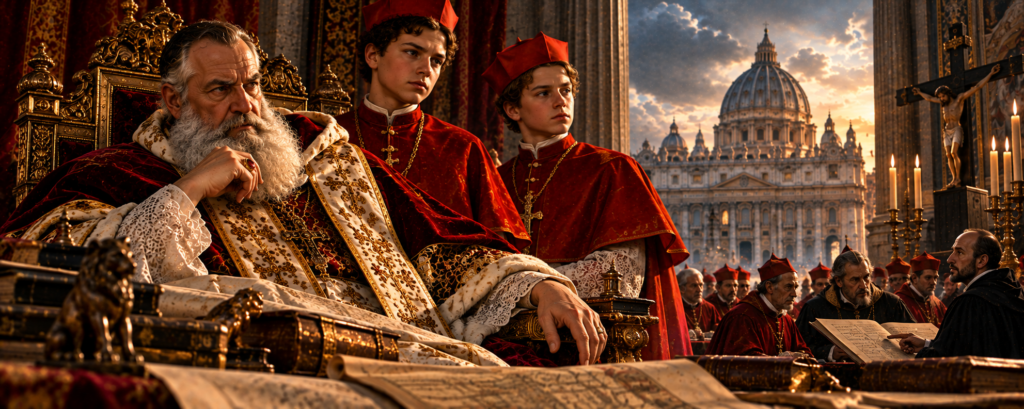
Then, only weeks after his election, Paul III did something that seemed to embody the very corruption reformers had been denouncing. He elevated two of his grandsons to the College of Cardinals, placing members of the Farnese family inside the institution that would advise him and eventually choose his successor. One of them, Alessandro Farnese the Younger, was only fourteen years old. The other, Guido Ascanio Sforza, was about sixteen.
There was nothing accidental about these appointments. Paul was an experienced Renaissance churchman who understood exactly what a cardinal’s hat could do for a family. Cardinals controlled wealth, benefices, influence, diplomatic networks, and access to the machinery of papal government. By placing teenage grandsons among them, the pope was securing the Farnese dynasty’s position at the highest level of the Church.
Yet this same man would appoint respected reformers to positions of influence, establish a commission that produced a remarkably frank assessment of abuses within the Church, approve the Society of Jesus, strengthen mechanisms for combating heresy, and finally convene the Council of Trent. Under Paul III, the Catholic Church began the institutional transformation usually associated with the Counter-Reformation or Catholic Reformation. Some of the most important reforms of sixteenth-century Catholicism therefore emerged from the pontificate of a man who practiced nepotism with breathtaking confidence.
That contradiction makes Paul III one of the most revealing figures of the Renaissance papacy. He cannot easily be divided into the categories of corrupt pope or reforming pope because he was unmistakably both. He could recognize that the Church desperately needed moral and institutional renewal while apparently seeing no contradiction in using ecclesiastical power to enrich and elevate his own descendants. The standards he wanted applied to the wider Church did not always interfere with the privileges he considered appropriate for the Farnese.
His pontificate therefore offers something more interesting than a simple story of hypocrisy. Paul III stood at the boundary between two ages of the papacy, carrying many of the assumptions of the Renaissance court into a period demanding stricter discipline and religious seriousness. He had been formed in the world of Alexander VI, Julius II, Leo X, and Clement VII, where popes behaved as Italian princes and family advancement was treated as an ordinary function of power. Yet he lived long enough to recognize that the Protestant Reformation had made that world impossible to preserve unchanged.
The result was a papacy in which reform and corruption did not merely alternate but existed simultaneously. Jesuits received papal approval while Farnese relatives accumulated honors. Cardinals investigated ecclesiastical abuses while the pope carved territories from the Papal States for his family. The Council of Trent opened while Paul maneuvered to secure the political future of his son and grandsons.
Paul III did not simply inherit the contradictions of the Renaissance papacy. He embodied them.
Alessandro Farnese: The Young Man Behind the Pope
Alessandro Farnese was born on February 29, 1468, into a noble family whose estates lay primarily in northern Lazio. The Farnese were respectable and increasingly influential, but they did not yet possess the international prestige of families such as the Medici or the great Roman dynasties. Alessandro’s eventual rise would transform their fortunes dramatically. By the time of his death, the Farnese name would be associated with cardinals, dukes, palaces, territories, and one of the most powerful dynastic networks in Italy.
His education prepared him for an elite career. Alessandro studied in Rome and Florence and absorbed the humanist culture that shaped educated aristocrats of his generation. He acquired knowledge of classical literature and developed the polished manners expected of a Renaissance courtier. His intelligence and social connections made an ecclesiastical career attractive even though his early life hardly resembled the later ideal of a disciplined Catholic reformer.
The most famous connection in Alessandro’s early advancement involved his sister Giulia Farnese. Giulia became the mistress of Pope Alexander VI, Rodrigo Borgia, whose pontificate was notorious for the open advancement of his children and relatives. Alessandro received a cardinal’s hat in 1493, only a year after Alexander’s election. The timing encouraged contemporaries and later historians to connect his promotion directly to his sister’s relationship with the pope.
The association became so notorious that Alessandro acquired mocking nicknames implying that his cardinalate had been obtained through Giulia’s bed. It is difficult to determine precisely how decisive her influence was because ecclesiastical promotions usually involved multiple political considerations. Nevertheless, the relationship unquestionably placed the Farnese family close to Alexander VI, and Giulia’s position almost certainly benefited her brother. The episode would follow Alessandro’s reputation for the rest of his life.
The future pope therefore entered the College of Cardinals under circumstances that hardly anticipated the age of Catholic reform. His career was connected to the Borgia court, one of the most scandalous environments in Renaissance papal history. He learned politics among churchmen who openly accumulated wealth, maintained family networks, and competed for secular power. The young cardinal belonged fully to that world rather than standing outside it as a critic.
He also developed a reputation for personal elegance and political adaptability. Alessandro survived the fall of the Borgias and remained influential under succeeding popes whose policies differed dramatically. He served under Julius II, Leo X, Adrian VI, and Clement VII, steadily accumulating experience. His ability to survive these changing regimes demonstrated patience that would later become one of his defining political characteristics.
By the time he reached the papal throne, Alessandro Farnese had spent more than forty years as a cardinal. Few newly elected popes possessed comparable knowledge of Roman politics, ecclesiastical administration, and European diplomacy. He had watched dynasties rise and fall, witnessed the Reformation begin, and survived the Sack of Rome. Paul III entered the papacy as a man shaped by nearly every triumph and failure of the Renaissance Church.
The Cardinal Who Had Children
Alessandro’s early clerical career included another feature that would later sit awkwardly beside his reputation as a Catholic reformer. Before becoming pope and before embracing a more disciplined clerical life, he fathered several children. Four are generally recognized: Pier Luigi, Paolo, Ranuccio, and Costanza Farnese. Their mother is traditionally identified as Silvia Ruffini, a Roman noblewoman with whom Alessandro maintained a relationship.
Such behavior was forbidden by the clerical ideal, but it was hardly unprecedented among Renaissance churchmen. Senior clerics sometimes maintained mistresses and openly acknowledged children despite formal requirements of celibacy. Alexander VI had made his children Cesare, Juan, Lucrezia, and Jofré central figures of his pontificate. Alessandro Farnese operated within a culture in which the distance between official morality and aristocratic clerical behavior could be enormous.
What makes Alessandro particularly interesting is that his personal conduct appears to have changed over time. As he grew older, especially after ordination to the priesthood, he adopted a more conventionally disciplined religious life. He became associated increasingly with serious ecclesiastical responsibilities and reform-minded churchmen. The transformation was real enough that later observers could regard him as capable of leading Catholic renewal.
His children, however, did not disappear when his lifestyle changed. They became the foundation of the Farnese dynasty he would later promote as pope. Pier Luigi in particular became central to his father’s political ambitions. The pope’s affection for his descendants and determination to secure their position would profoundly shape his pontificate.
This created a peculiar moral arrangement. Paul III could abandon the behavior that had produced his children while continuing to use the resources of the Church to advance those same children and grandchildren. Personal reform did not require dynastic renunciation. The Farnese family remained one of his highest political priorities.
The distinction matters because Paul III’s nepotism was not merely a matter of helping distant nephews. He was advancing his own direct descendants. The pope who would preside over a Catholic movement emphasizing clerical discipline was simultaneously constructing a territorial and ecclesiastical inheritance for children born from his earlier violation of that discipline. Few examples better illustrate the contradictions of Renaissance Catholicism.
Forty Years Watching Popes Rise and Fall
Alessandro Farnese’s long cardinalate gave him a remarkable education in the dangers of papal politics. He witnessed Alexander VI’s aggressive Borgia nepotism and the collapse of Cesare Borgia’s territorial empire after his father’s death. He watched Julius II rebuild papal authority through warfare and diplomacy. He observed Leo X combine magnificent cultural patronage with financial extravagance while Luther’s challenge began to spread.
He also lived through the brief pontificate of Adrian VI, whose attempts at reform demonstrated how difficult it was to change entrenched institutions. Adrian openly acknowledged corruption within the Church and sought greater discipline, but his foreign background and austere manner made him unpopular in Rome. His early death prevented his program from developing fully. Alessandro could see that reform required more than moral condemnation.
Under Clement VII, the situation became catastrophic. Alessandro witnessed the papacy become trapped between Francis I of France and Emperor Charles V. He experienced the political turmoil surrounding the League of Cognac and the imperial invasion that culminated in the Sack of Rome. The destruction of 1527 exposed the vulnerability of the papal state and shattered the confidence of the High Renaissance court.
These experiences helped shape Paul III’s later caution. He had watched popes make reckless commitments and suffer devastating consequences. He understood that the papacy needed stronger institutions, more reliable alliances, and a serious response to Protestantism. He also understood the importance of ensuring that one’s family possessed power independent of the uncertain fortunes of individual pontificates.
His survival reflected extraordinary political flexibility. Alessandro rarely committed himself so completely to a faction that a change of regime destroyed him. He cultivated relationships across competing networks and accumulated offices, revenues, and prestige. His patience eventually made him an acceptable candidate for factions that might have rejected a more polarizing figure.
By 1534, he was sixty-six years old and one of the most experienced members of the College of Cardinals. Clement VII’s death left the Church facing enormous problems that required a politically capable pope. Alessandro appeared to offer stability, experience, and enough reformist credibility to satisfy those demanding change. The cardinals would soon discover that they had also elected a patriarch determined to transform his family into a ruling dynasty.
The Election of 1534
Clement VII died on September 25, 1534, leaving behind a papacy weakened by war and religious division. Rome had recovered physically from much of the destruction of 1527, but the psychological damage remained. England was moving rapidly away from papal jurisdiction, while Protestantism had established deep roots in German territories and elsewhere. The next pope would inherit a Church facing problems that could no longer be solved through ordinary Renaissance diplomacy.
The conclave moved unusually quickly. Alessandro Farnese possessed broad support and was elected on October 13, 1534. He took the name Paul III and was crowned shortly afterward. After decades of waiting, the cardinal who had entered the College under Alexander VI finally occupied the throne of Saint Peter.
Expectations for his pontificate were substantial. Paul was experienced, intelligent, and familiar with the weaknesses of the papal government. Reformers hoped that he would address abuses that had provided ammunition to Protestant critics. European rulers wanted a pope capable of navigating the continuing rivalry between France and the Habsburg Empire.
Paul initially appeared capable of satisfying several competing demands. He surrounded himself with talented advisers and demonstrated greater interest in reform than many Renaissance predecessors. He recognized that Protestantism could not simply be eliminated by issuing condemnations from Rome. The Catholic Church needed to confront its own institutional failures.
Yet the new pope’s understanding of reform had clear limits. He did not believe that strengthening the Church required abandoning the dynastic practices of Renaissance politics. Within weeks of his election, he demonstrated that the Farnese family would occupy a privileged place in his government. Reforming the Church and enriching his descendants were, in his mind, apparently compatible objectives.
That contradiction would define the next fifteen years. Paul III would become one of the most important popes in the history of Catholic renewal. He would also become one of the most unapologetic practitioners of papal nepotism in the sixteenth century. His pontificate began the transformation of Catholicism while simultaneously building a secular Farnese state.
Fourteen Years Old and Already a Cardinal
One of Paul III’s earliest major acts revealed how aggressively he intended to promote his family. On December 18, 1534, he elevated his grandsons Alessandro Farnese the Younger and Guido Ascanio Sforza to the College of Cardinals. Alessandro was fourteen years old, while Guido Ascanio was approximately sixteen. Neither possessed anything resembling the experience normally expected of a senior prince of the Church.
The appointments were extraordinary even by the permissive standards of Renaissance nepotism. A cardinal was not merely an honorary churchman dressed in red. Cardinals advised the pope, controlled major ecclesiastical revenues, served as diplomats and administrators, and participated in conclaves choosing future popes. Granting that position to adolescents demonstrated that family loyalty could outweigh age and experience.
Alessandro Farnese the Younger became especially important. Over time, he developed into a capable diplomat, administrator, and patron of the arts. He accumulated major benefices and became one of the most powerful cardinals of his generation. His later competence, however, does not erase the nepotistic nature of his initial promotion.
The young cardinal’s advancement was breathtaking. Paul ensured that his grandson received wealthy offices and ecclesiastical revenues, giving him the resources necessary to maintain a magnificent household. Alessandro eventually became known as the “Great Cardinal” and played a major role in European diplomacy. His career demonstrated how a nepotistic appointment could produce a genuinely capable statesman while remaining fundamentally nepotistic.
Guido Ascanio Sforza likewise benefited from his relationship to the pope. Through his mother, Costanza Farnese, he belonged to Paul’s direct family line. His cardinalate strengthened connections between the Farnese and Sforza families. Ecclesiastical office once again served dynastic strategy.
Paul did not appear embarrassed by these appointments. Nepotism was deeply embedded within papal government, partly because popes lacked legitimate hereditary heirs and often relied upon relatives as trusted agents. Yet elevating teenagers so quickly revealed how little the new reforming pope intended to challenge this particular abuse. The Church might be reformed, but the Farnese would prosper while it happened.
Pier Luigi Farnese: The Pope’s Son
If the teenage cardinals represented ecclesiastical nepotism, Pier Luigi Farnese represented something even more ambitious. Born in 1503, Pier Luigi was Paul’s eldest son and the principal vehicle for establishing the family as a secular ruling dynasty. His father wanted him to possess territory, titles, military authority, and political standing. The papacy would provide the means.
Pier Luigi’s reputation among contemporaries was deeply controversial. Hostile sources accused him of brutality, sexual violence, and extreme personal depravity. Some of the most lurid stories, including allegations involving the bishop of Fano, circulated in politically charged environments and should not automatically be treated as established fact. Pier Luigi certainly had enemies who benefited from portraying him as monstrous.
What is beyond dispute is that Paul advanced him aggressively. Pier Luigi received important territorial positions and military responsibilities. His status rose dramatically because his father controlled the resources of the Papal States. The pope’s family policy was becoming increasingly difficult to distinguish from the dynastic politics of secular princes.
In 1537, Paul created the Duchy of Castro for Pier Luigi. The Farnese already possessed lands in the region, but the creation of the duchy consolidated and elevated the family’s territorial power. Castro became a hereditary Farnese possession. The pope had effectively used his authority to establish a principality for his descendants.
Pier Luigi also became involved in papal military affairs. His father entrusted him with commands and responsibilities despite the hostility his advancement generated among established Italian families. The Farnese were no longer merely aristocrats seeking favor. They were becoming territorial rulers.
Paul’s commitment to his son would eventually create one of the most dangerous political crises of his pontificate. The desire to secure a permanent state for Pier Luigi brought the pope into conflict with imperial interests in northern Italy. That struggle would end in assassination. Before reaching that bloody conclusion, however, Paul would pursue his dynastic project with extraordinary determination.
The Reformers Enter the Vatican
Paul III’s nepotism did not prevent him from recognizing that the Church faced genuine institutional problems. He began elevating respected reformers to the College of Cardinals and surrounding himself with men who possessed reputations for learning and religious seriousness. Among the most important were Gasparo Contarini, Reginald Pole, Jacopo Sadoleto, and Gian Pietro Carafa. Their theological positions differed, but they shared concern about the condition of the Church.
Contarini represented a moderate reforming tendency that hoped some disputes with Protestants might be resolved through dialogue and clarification. He was widely respected for his personal integrity and intellectual ability. His elevation signaled that Paul was willing to bring serious critics of ecclesiastical abuses into the highest levels of government. This was not merely cosmetic reform.
Reginald Pole was another significant figure. An English churchman of royal blood, Pole had become an opponent of Henry VIII’s break with Rome. His criticism placed him in danger from the English crown and made him an important symbol of resistance to royal supremacy. Paul made him a cardinal in 1536.
Carafa represented a harsher approach. Deeply committed to doctrinal orthodoxy and suspicious of Protestant influence, he favored stronger mechanisms for identifying and suppressing heresy. He would later become Pope Paul IV and pursue an uncompromising program of Catholic discipline. Under Paul III, his influence helped push the papacy toward more aggressive enforcement of orthodoxy.
The combination of these figures illustrates the complexity of Catholic reform. There was no single agreed strategy for responding to Protestantism. Some reformers emphasized dialogue and internal renewal, while others believed doctrinal compromise was dangerous and repression necessary. Paul attempted to use different approaches at different moments.
The pope’s willingness to promote serious reformers distinguishes him from caricatures of Renaissance corruption. He understood that the crisis was real and that the Church needed credible leaders. Yet the contrast remained impossible to ignore. Men demanding reform sat in the same College of Cardinals as teenagers elevated because they happened to be the pope’s grandsons.
The Secret Report That Admitted the Church Was Sick
In 1536, Paul III appointed a commission of cardinals and other churchmen to investigate abuses within the Church and recommend reforms. The commission included respected figures such as Contarini, Carafa, Sadoleto, and Pole. Its members were not asked merely to defend the papacy against Protestant accusations. They were expected to identify genuine failures.
The resulting document, commonly known as the Consilium de emendanda ecclesia, or Advice on Reforming the Church, was completed in 1537. Its assessment was strikingly frank. The commission identified abuses involving the appointment of unsuitable clergy, accumulation of benefices, failures of episcopal residence, financial practices, and weaknesses in ecclesiastical discipline. It acknowledged that problems existed within the highest levels of the Church.
This mattered because Protestant critics had spent years arguing that Rome was corrupt beyond reform. The commission effectively conceded that some criticisms of ecclesiastical practice were justified. It did not accept Protestant theology or reject papal authority, but it recognized that institutional abuses had damaged the Church’s credibility. Reform could no longer be treated as an optional concession.
The report also reflected the growing belief that bishops and clergy should actually perform the duties attached to their offices. Absenteeism and pluralism allowed churchmen to collect revenues from positions they rarely visited. Such practices were particularly offensive to reformers who emphasized pastoral responsibility. The commission recommended stronger discipline.
Paul received the report but did not immediately implement all its recommendations. Reform threatened entrenched interests, including practices upon which the papal government itself depended financially. Some recommendations would have required substantial changes to the culture of patronage that supported families such as the Farnese. The pope’s enthusiasm therefore encountered practical and personal limits.
Copies of the report circulated beyond Rome, including among Protestants, who used its admissions as evidence against the papacy. What reformers intended as an internal diagnosis became ammunition for critics. Yet the document remained important because it demonstrated that Catholic leaders recognized serious institutional failures. The Church was beginning to examine itself with an honesty that would eventually contribute to broader reform.
Reforming Everyone Except the Farnese
The contradiction between Paul’s reform program and his family policy became increasingly obvious. The reform commission criticized the accumulation and misuse of ecclesiastical offices. Meanwhile, members of the Farnese family accumulated offices and revenues through the pope’s favor. The same papacy could condemn abuses in principle while practicing related forms of privilege in reality.
This does not mean Paul regarded himself as a hypocrite. Renaissance political culture treated family loyalty as a legitimate obligation, especially for rulers whose authority could disappear with their death. A pope could not pass the Papal States to his children as a hereditary monarchy, but he could establish relatives in positions capable of surviving the next conclave. Nepotism therefore served as a substitute for ordinary dynastic succession.
Paul’s direct descendants made that temptation especially powerful. Unlike popes whose “nephews” were sometimes rumored to be their sons, Paul openly possessed children from his earlier life. Their existence gave his dynastic ambitions unusual clarity. He was not merely strengthening a clan but building the future of his own bloodline.
The problem was that Catholic reform increasingly emphasized standards incompatible with such behavior. If ecclesiastical office required spiritual responsibility, then distributing offices primarily because of family relationships became difficult to defend. If church revenues existed for religious purposes, using them to construct a dynasty appeared corrupt. The intellectual foundations of Renaissance nepotism were beginning to erode.
Paul stood directly within that transition. He could recognize the need for stricter standards without fully accepting that those standards should destroy the political privileges of his household. His reforms therefore moved forward unevenly. The institutional Church was changing faster than the pope’s assumptions about family.
This tension would continue throughout the pontificate. Paul could be bold when reform did not threaten Farnese interests and cautious when it did. His achievements were nevertheless substantial, proving that compromised leaders can produce genuine institutional change. The darker lesson is that genuine reform does not necessarily eliminate the self-interest of those directing it.
Ignatius Loyola and a New Kind of Religious Army
Among the most consequential decisions of Paul III’s reign was his approval of the Society of Jesus. The group developed around Ignatius of Loyola, a former soldier whose religious conversion led him toward education, spiritual discipline, and missionary work. Ignatius gathered companions who shared his commitment to serving the Church. Their organization would eventually become one of the most influential religious orders in Catholic history.
On September 27, 1540, Paul issued the bull Regimini militantis Ecclesiae, formally approving the Society of Jesus. The new order initially operated under limitations concerning its size, but those restrictions were later relaxed. Its members took vows of poverty, chastity, and obedience while emphasizing a special readiness to serve the pope. Their mobility made them particularly useful in an age of religious conflict.
The Jesuits quickly became important in education. They founded schools and colleges designed to combine humanist learning with Catholic doctrine. Their educational network eventually extended across Europe and beyond. Generations of Catholic elites would be shaped by Jesuit teaching.
Missionary work became another defining feature. Jesuits traveled to Asia, Africa, and the Americas, participating in the global expansion of Catholic Christianity. Francis Xavier, one of Ignatius’s original companions, became especially famous for his missions in Asia. The order’s international reach would become extraordinary.
The Jesuits also played a major role in the Catholic response to Protestantism. Their theologians, preachers, confessors, and educators helped strengthen Catholic institutions in contested regions. They did not single-handedly reverse Protestant expansion, but they became among the most effective instruments of Catholic renewal. Their influence continued long after Paul III’s death.
Approving the Society of Jesus was therefore one of the most enduring achievements of his pontificate. The decision reveals a pope capable of recognizing innovative forms of religious organization. While he promoted his own family through traditional patronage, he also supported a movement based upon discipline, education, and missionary service. Once again, the two faces of Paul III existed at the same time.
The Roman Inquisition Returns With Teeth
Paul’s response to Protestantism became increasingly severe as hopes for reconciliation diminished. In 1542, he established the Roman Inquisition in a more centralized form through the bull Licet ab initio. A commission of cardinals received authority to investigate and prosecute heresy. Gian Pietro Carafa became one of the institution’s leading figures.
The Roman Inquisition differed in important ways from the medieval inquisitorial systems that had operated in various regions. It was designed to provide centralized supervision over doctrinal enforcement within territories subject to papal influence. Its procedures evolved over time, and its reach varied according to local political conditions. Nevertheless, its creation marked a significant strengthening of institutional repression.
The establishment reflected growing fear that Protestant ideas were spreading within Italy itself. Networks of reform-minded intellectuals and clergy discussed theological positions that Roman authorities increasingly regarded as dangerous. Some hoped for reconciliation with Protestants on questions such as justification. Others moved toward positions clearly incompatible with Catholic doctrine.
Paul’s government initially contained reformers with a range of views, but the space for theological experimentation narrowed during the 1540s. Contarini’s efforts at dialogue had failed to produce lasting agreement, while Carafa’s more uncompromising approach gained influence. The Church increasingly defined reform as renewal within clear doctrinal boundaries. Those who crossed those boundaries risked investigation.
The Inquisition would become controversial for its censorship, trials, and punishments. It represented the coercive side of Catholic reform, demonstrating that renewal would be accompanied by enforcement. The same Church that founded schools and encouraged new religious orders also strengthened institutions designed to suppress theological dissent. Paul III supported both developments.
His pontificate therefore helped establish the dual character of the Counter-Reformation. Catholicism would renew itself through education, pastoral reform, missionary activity, and spiritual movements. It would also defend doctrinal conformity through censorship and prosecution. The boundaries of acceptable belief were becoming more clearly defined and more aggressively policed.
Francis I, Charles V, and the Old Italian Nightmare
Paul inherited the same international rivalry that had tormented Clement VII. Francis I of France and Charles V continued competing for influence across Europe, particularly in Italy. Their conflict repeatedly complicated papal diplomacy. Paul understood from his predecessor’s experience how dangerous it could be to become trapped between them.
The pope generally attempted to maintain enough neutrality to preserve his independence. He negotiated with both monarchs and sought opportunities to mediate their conflicts. His age and diplomatic experience made him well suited to the role of senior statesman. Yet neutrality was difficult when every major political decision affected the balance between France and the Habsburg Empire.
Paul’s family interests further complicated matters. The territorial ambitions of Pier Luigi Farnese affected regions where Charles possessed strategic concerns. The pope wanted imperial cooperation on religious matters while resisting excessive Habsburg influence in Italy. These objectives were not always compatible.
In 1538, Paul helped facilitate a truce between Charles and Francis at Nice. The pope personally participated in the diplomatic efforts, demonstrating his continuing ambition to serve as mediator between Europe’s most powerful Catholic rulers. The truce did not permanently end their rivalry. Nevertheless, it represented one of Paul’s more successful diplomatic moments.
The Ottoman threat added another layer of complexity. Sultan Suleiman the Magnificent’s empire remained a formidable military power in the Mediterranean and central Europe. Catholic rulers who might otherwise have cooperated against Ottoman expansion remained divided by their own conflicts. Paul repeatedly confronted the frustrating reality that Christian unity was easier to proclaim than achieve.
His diplomacy was generally more cautious than Clement VII’s disastrous alliance politics. Paul had learned from the Sack of Rome that the papacy could not afford reckless military commitments. Yet his dynastic ambitions eventually pushed him toward another dangerous confrontation. The struggle over Parma and Piacenza would show that even an experienced pope could gamble when his family’s future was at stake.
Michelangelo and the Terrible Judgment on the Chapel Wall
Paul III inherited Michelangelo from the great age of Renaissance papal patronage. Clement VII had commissioned the artist to create a monumental depiction of the Last Judgment on the altar wall of the Sistine Chapel. Clement died before the project was completed, leaving his successor to oversee its execution. Paul strongly supported Michelangelo and allowed the work to continue.
The resulting fresco, completed in 1541, was overwhelming in scale and emotional intensity. Christ appears as a powerful judge surrounded by saints, while the dead rise and souls ascend toward salvation or fall toward damnation. The serene balance associated with earlier Renaissance art gives way to muscular bodies, violent movement, terror, and uncertainty. It was a fitting masterpiece for an age shaken by war and religious division.
The work immediately provoked controversy. Critics objected to the extensive nudity and questioned whether such imagery was appropriate in one of Christianity’s most sacred spaces. Supporters admired Michelangelo’s extraordinary achievement. The debate reflected changing attitudes toward religious art as Catholic reform gathered momentum.
Paul defended Michelangelo against some criticism and continued employing him. In 1546, he appointed the aging artist chief architect of St. Peter’s Basilica. Michelangelo inherited a project that had passed through several architects and undergone repeated changes. His work helped establish the structural direction that would eventually produce the basilica familiar today.
The pope also commissioned Michelangelo’s frescoes in the Pauline Chapel, including The Conversion of Saul and The Crucifixion of Saint Peter. These works possessed a darker and more introspective quality than much of the art associated with the earlier Renaissance court. Their spiritual intensity matched the changing religious atmosphere. Rome was becoming less confident, more disciplined, and increasingly preoccupied with judgment and sacrifice.
Paul’s patronage demonstrates continuity with the Renaissance popes who preceded him. He understood art as an instrument of religious authority and papal magnificence. Yet the emotional character of the works produced during his reign reflected a transformed world. The Church that commissioned Michelangelo’s Last Judgment was no longer the carefree court that had greeted the early years of Leo X.
The Council That Europe Had Waited Decades to See
Calls for a general council had circulated for years before Paul III’s election. Protestants demanded a forum in which religious controversies might be addressed, Charles V hoped a council could help restore unity within the empire, and Catholic reformers believed institutional change required collective action. Previous popes had hesitated because councils carried political risks. Paul eventually accepted that postponement could no longer continue indefinitely.
Organizing the council proved extremely difficult. Disputes arose over location, representation, political conditions, and the relationship between papal and imperial authority. Paul initially summoned a council to Mantua for 1537, but practical and political obstacles prevented it from meeting as planned. Further attempts also encountered delays.
The pope continued negotiating. Charles V wanted a council capable of addressing German religious divisions, while France remained suspicious of arrangements that might strengthen imperial influence. Protestant rulers questioned whether a council controlled by the pope could judge their claims fairly. Italian states worried about the political consequences of hosting such an assembly.
Eventually, the city of Trent emerged as an acceptable compromise. Located within the Holy Roman Empire but south of the Alps, it offered geographic and political advantages. Paul formally convoked the council, and after additional delays, it opened on December 13, 1545. The gathering would become one of the most important councils in Catholic history.
The opening was modest compared with the enormous significance later attached to the event. Attendance was initially limited, and political disputes continued affecting its proceedings. Nevertheless, the council began addressing fundamental questions of doctrine and reform. The Catholic response to the Reformation was becoming institutionalized.
Paul did not simply hand control of the council to Charles. He wanted reform and doctrinal clarification while preserving papal authority. This tension would repeatedly affect proceedings. The council therefore became both a religious assembly and an arena in which the political interests of pope, emperor, bishops, and monarchs collided.
Trent Defines the Catholic Response
The early sessions of the Council of Trent addressed some of the theological controversies raised by Protestant reformers. Questions concerning Scripture, tradition, original sin, and justification received careful attention. Catholic theologians sought to define positions clearly while avoiding unnecessary ambiguity. The council’s decrees would eventually establish doctrinal standards that shaped Catholic teaching for centuries.
The decree on justification was particularly important. Protestants had emphasized justification by faith in ways that challenged Catholic understandings of grace, works, and human cooperation. Trent rejected interpretations it considered incompatible with Catholic teaching while developing a detailed account of justification. The resulting formulation became one of the council’s most significant theological achievements.
Reform remained equally important. Bishops and other participants debated clerical discipline, education, residence requirements, and abuses involving ecclesiastical offices. The council recognized that doctrinal defense would be meaningless if the Church refused to correct obvious institutional failures. Protestant criticism had exposed weaknesses that could no longer be ignored.
Paul supported reform but remained determined to control the council’s relationship with papal authority. He did not want the assembly reviving conciliar claims that councils could dominate popes. Papal legates presided over proceedings and maintained communication with Rome. The pope’s support for reform therefore existed alongside careful protection of his office.
Tensions with Charles V grew over the council’s priorities. The emperor wanted measures that might facilitate religious reconciliation within Germany and strengthen his political position. Paul was less willing to compromise on doctrine and increasingly suspicious of imperial pressure. Their disagreements would eventually affect the council’s location and progress.
Even with these limitations, convening Trent was an enormous achievement. Earlier popes had repeatedly delayed a council because of political fears. Paul finally brought one into existence and allowed substantive doctrinal and reform discussions to begin. The institution he helped launch would continue, with interruptions, long after his death.
The Pope Who Wanted Parma for His Son
While Catholic bishops debated reform at Trent, Paul III pursued one of the most controversial dynastic projects of his reign. He wanted to secure a major hereditary territory for Pier Luigi Farnese. The Duchy of Castro had already strengthened the family, but Paul desired something more prestigious and strategically important. His attention turned toward Parma and Piacenza.
These territories formed part of the Papal States but occupied an area of intense strategic interest. In 1545, Paul separated Parma and Piacenza from direct papal administration and established them as a duchy for Pier Luigi. The decision effectively converted Church territory into a hereditary principality for the pope’s son. Even by Renaissance standards, the move was audacious.
The arrangement strengthened the Farnese dramatically. Pier Luigi now possessed a state capable of supporting a lasting dynasty. His descendants could rule independently of future popes who might be hostile to the family. Paul had achieved what many papal families desired: transforming temporary ecclesiastical influence into permanent secular power.
The cost to the Church was obvious. Territory belonging to the Papal States had been used to secure the pope’s descendants. Critics could reasonably ask how such a decision differed from the abuses reformers condemned. The pope was simultaneously convening a council dedicated partly to ecclesiastical discipline while alienating Church lands for his family.
Charles V had strategic interests in northern Italy and viewed the Farnese expansion with suspicion. Milan was under imperial control, making Parma and Piacenza particularly sensitive. The emperor did not welcome the creation of a powerful Farnese state positioned near his territories. Tension between Paul and Charles increased.
The dispute demonstrates how dynastic ambition could undermine Paul’s broader policies. He needed Charles’s cooperation in confronting Protestantism and managing European affairs. Yet he risked conflict with the emperor to secure his son’s inheritance. The Farnese dynasty repeatedly competed with the Church’s larger diplomatic priorities.
Pier Luigi’s Bloody End
Pier Luigi’s rule in Parma and Piacenza generated opposition among local nobles. His efforts to strengthen ducal authority threatened established privileges and created resentment. Political hostility combined with wider imperial concerns about the Farnese state. The atmosphere became increasingly dangerous.
On September 10, 1547, conspirators assassinated Pier Luigi in Piacenza. He was attacked inside the citadel, killed, and his body was thrown down from a window. The murder was brutal even by the violent standards of Renaissance Italian politics. The pope’s beloved son had been eliminated by men determined to destroy his rule.
Imperial forces quickly took control of Piacenza. Ferrante Gonzaga, the imperial governor of Milan, had connections to the political environment surrounding the conspiracy, and suspicions of imperial involvement were immediate. The precise degree of responsibility reaching Charles V personally remains a matter requiring caution. What was undeniable was that the emperor benefited strategically from Pier Luigi’s removal.
Paul was devastated and furious. The assassination transformed an already serious political dispute into a deeply personal conflict. He demanded the restoration of Piacenza to the Farnese and suspected imperial complicity. Relations with Charles deteriorated sharply.
The murder also destabilized the pope’s family strategy. Pier Luigi’s son Ottavio Farnese had married Margaret of Austria, Charles V’s illegitimate daughter, creating a complicated relationship between the families. Ottavio wanted Parma for himself and was prepared to maneuver independently to obtain it. Paul now found his own grandson’s ambitions difficult to control.
The dynasty Paul had constructed was developing interests of its own. Family members were no longer simply obedient beneficiaries of papal favor. They were princes, cardinals, and political actors capable of defying the patriarch who had elevated them. The machinery of nepotism had produced a family powerful enough to challenge its creator.
The Murder That Poisoned the Final Years
Pier Luigi’s assassination came during an already difficult period. The Council of Trent had become entangled in disputes between Paul and Charles V, while the emperor’s military victory over Protestant forces at Mühlberg in April 1547 strengthened his position in Germany. Paul feared that Charles might become too powerful both politically and religiously. The old Renaissance anxiety about Habsburg domination had returned.
The council was transferred from Trent to Bologna in 1547, officially because of concerns about disease. Political considerations also surrounded the move, and Charles opposed the transfer. The emperor wanted the council to remain in imperial territory. Paul preferred a location where papal influence would be stronger.
The resulting dispute damaged the council’s effectiveness. Some bishops remained at Trent while others moved to Bologna, creating an institutional impasse. Important work continued, but the momentum of the earlier sessions weakened. The council would eventually be suspended in 1549.
At the same time, Paul struggled to manage Parma. He considered arrangements that might return the duchy to direct papal control rather than allowing Ottavio to inherit it freely. Ottavio resisted, believing the territory belonged to his family. The disagreement became increasingly bitter.
The elderly pope found himself fighting with the very descendants whose advancement had consumed so much of his energy. Ottavio’s determination demonstrated the success and danger of Paul’s dynastic project. The Farnese now possessed enough political identity to pursue their own interests against the wishes of the pope. Family loyalty had become family rivalry.
The final years of Paul’s reign were therefore marked by frustration. The emperor resisted him, the council faltered, his son had been murdered, and his grandson refused to surrender his ambitions. The dynasty that was supposed to preserve Paul’s legacy became a source of conflict. The old pope had built a powerful family and discovered that power could not always be controlled.
The Pope and the Enslavement of Indigenous Peoples
Paul III’s pontificate also produced important statements concerning the treatment of Indigenous peoples in the Americas. European conquest had created profound moral and theological questions concerning the status of the populations encountered by Spanish and Portuguese colonizers. Reports of exploitation, forced labor, and brutality generated debate within the Catholic world. Missionaries and theologians argued over the rights and humanity of Indigenous communities.
In 1537, Paul issued Sublimis Deus, declaring that Indigenous peoples were fully human, capable of receiving the Christian faith, and should not be deprived of liberty or property simply because they were not Christians. The document condemned the idea that they could legitimately be reduced to slavery on that basis. It represented an important papal affirmation of Indigenous humanity. Its language stood against arguments used to justify exploitation.
The practical effect of the decree was limited by political realities and the complexity of colonial systems. European conquest continued, and forms of coerced labor and enslavement persisted. Papal declarations could not by themselves overturn economic and imperial structures operating thousands of miles from Rome. Enforcement remained a profound problem.
The surrounding documentary history is also complicated. Another document connected with the issue, Pastorale officium, imposed ecclesiastical penalties related to enslavement but was later revoked amid disputes involving the Spanish Crown. That revocation did not simply erase the theological affirmation contained in Sublimis Deus. Nevertheless, it demonstrates the political limits surrounding papal intervention.
Paul’s position therefore deserves neither cynical dismissal nor romantic exaggeration. He did make an important statement recognizing the rights and rational humanity of Indigenous peoples. At the same time, the Catholic empires within which colonization occurred continued systems that inflicted enormous suffering. The distance between papal principle and colonial practice remained immense.
The episode resembles other contradictions of Paul’s reign. He could articulate a principle of human dignity while governing through institutions deeply embedded in aristocratic privilege and coercive politics. His papacy repeatedly contained impulses toward reform that collided with existing structures of power. The result was progress that remained incomplete and compromised.
England, Reginald Pole, and the Shadow of Henry VIII
The English crisis inherited from Clement VII continued under Paul III. Henry VIII had already rejected papal supremacy and established royal control over the Church of England. Paul regarded the separation as both a religious and political disaster. Restoring England to Roman obedience became an important objective.
Reginald Pole emerged as one of the pope’s most valuable English allies. Pole possessed royal Plantagenet ancestry and had once enjoyed Henry’s favor, but he became a fierce critic of the king’s religious policies. Paul made him a cardinal in 1536. The appointment transformed Pole into an internationally prominent opponent of Henry’s regime.
Paul also named Pole as papal legate for a mission connected with efforts to organize opposition to Henry. The situation was extraordinarily dangerous for Pole’s family members who remained in England. Henry increasingly regarded them with suspicion because of their relationship to a cardinal actively opposing his policies. Political and religious conflict became entangled with dynastic paranoia.
Pole’s mother, Margaret Pole, Countess of Salisbury, was eventually imprisoned and executed in 1541. She was elderly and had not been convicted through an ordinary trial in the conventional sense, instead being condemned through an act of attainder. Her execution became one of the most notorious acts of Henry’s later reign. The conflict between the English king and the papacy had acquired a deeply personal cost.
Paul formally excommunicated Henry VIII, with the sentence associated with the bull Eius qui immobilis and its eventual publication after earlier delays. Papal condemnation, however, did not restore England to Roman obedience. Henry possessed sufficient control over his kingdom to resist ecclesiastical sanctions. The papacy could denounce him but could not remove him.
England remained outside papal jurisdiction when Henry died in 1547. Under his son Edward VI, Protestant reform accelerated significantly. Paul therefore lived to see the English religious settlement move even further from Rome. The rupture that had begun under Clement VII had become increasingly difficult to reverse.
Money, Offices, and the Machinery of Renaissance Government
Paul inherited financial problems common to the Renaissance papacy. Maintaining the Papal States, supporting diplomatic missions, financing military preparations, patronizing artists, administering Rome, and responding to religious crises required enormous resources. The papal government relied upon complex systems of taxation, fees, benefices, and offices. Reforming financial abuses therefore threatened the machinery upon which government depended.
The sale and accumulation of offices had long been controversial. Positions within the papal administration could provide revenues and social prestige, making them valuable commodities. Earlier popes had expanded such practices to raise money. Reformers criticized them because financial considerations could outweigh competence and spiritual responsibility.
Paul did not completely dismantle this system. His government continued using financial mechanisms inherited from predecessors. The costs of Farnese advancement added another burden. Establishing territories, supporting relatives, and maintaining magnificent households required substantial resources.
Yet the pope also recognized that unchecked financial exploitation damaged the Church’s reputation. His reform commissions addressed abuses associated with benefices and administration. The problem was structural rather than merely personal. Rome depended upon practices that reformers increasingly regarded as corrupt.
This tension limited the speed of reform. Eliminating a profitable abuse could create an immediate budgetary crisis. Officials who had purchased offices expected returns on their investments and resisted changes threatening their income. Powerful families depended upon ecclesiastical revenues.
Paul therefore governed an institution attempting to reform itself without destroying the financial structures that sustained it. The process was inevitably uneven. His personal nepotism made the contradiction even sharper because he benefited politically from the same patronage culture reformers wanted restrained. Catholic renewal emerged not from a clean break with the past but from a prolonged struggle inside institutions still shaped by it.
The Farnese Palace: Power Carved in Stone
Few monuments express the ambitions of the Farnese family more clearly than the Palazzo Farnese in Rome. Construction had begun before Alessandro became pope, but his election transformed the scale and prestige of the project. The palace became one of the grandest residences of Renaissance Rome. Architecture served as a permanent declaration that the Farnese had arrived among Italy’s great dynasties.
Antonio da Sangallo the Younger played a major role in its design, and Michelangelo later contributed to the building after Sangallo’s death. Its massive façade projected stability, wealth, and aristocratic confidence. The structure was not simply a comfortable family residence. It was political propaganda in stone.
Paul’s papacy supplied the prestige that made such magnificence possible. His relatives occupied powerful positions throughout the Church and Italian politics. The family displayed its status through art, architecture, ceremonies, and patronage. Cultural achievement and nepotism were intertwined rather than separate.
This was characteristic of Renaissance elite culture. Great families demonstrated legitimacy through buildings designed to outlast individual rulers. Palaces, churches, tombs, and artworks transformed temporary political success into visible historical memory. Paul understood that a dynasty needed symbols as well as titles.
The irony is difficult to miss. While reformers demanded a Church less concerned with worldly display, the pope’s family constructed one of Rome’s greatest palaces. Yet the artistic result was genuinely magnificent. Corrupt systems of patronage could produce works of extraordinary beauty.
That tension runs through the history of the Renaissance papacy. Some of its most questionable political practices financed or encouraged achievements now regarded as masterpieces. Recognizing the beauty does not require ignoring the mechanisms that produced it. Paul III’s Rome makes it impossible to separate cultural brilliance neatly from aristocratic power.
An Aging Pope Surrounded by His Own Dynasty
By the late 1540s, Paul was more than eighty years old. He had spent decades constructing the Farnese family’s position, but the dynasty was becoming increasingly difficult to manage. His grandson Cardinal Alessandro possessed enormous ecclesiastical influence. Ottavio Farnese pursued control of Parma with determination that sometimes conflicted directly with his grandfather’s wishes.
The pope considered bringing Parma back under direct papal administration after Pier Luigi’s murder. Ottavio refused to surrender his claim easily. His marriage to Margaret of Austria connected him directly to Charles V’s family, giving him political options independent of the pope. The grandson could maneuver between Farnese loyalty and imperial support.
Paul was furious at this resistance. The family he had empowered no longer functioned simply as an extension of his will. Dynastic politics had created competing interests among his descendants. The old patriarch discovered that blood ties did not guarantee obedience.
His relationship with Cardinal Alessandro also became strained over the Parma dispute. The cardinal had reasons to support his brother Ottavio’s position. Paul reportedly reacted with intense anger as family members resisted his plans. The final months of his life were darkened by conflicts within the dynasty he had spent his pontificate building.
The stress coincided with declining health. Paul had reached an advanced age for the sixteenth century and had endured years of exhausting political disputes. In November 1549, he became seriously ill. The struggle over Parma remained unresolved.
He died on November 10, 1549. Rome had been transformed during his fifteen-year reign, and the Catholic Church had begun a process of reform that would continue for decades. Yet the pope’s final political thoughts were entangled with the fate of his family. Even at the end, the Farnese dynasty and the Church remained inseparable in his world.
What Paul III Actually Changed
It would be easy to allow Paul’s nepotism to overshadow everything else, but doing so would distort the historical importance of his pontificate. He elevated reform-minded cardinals whose influence helped change the culture of Catholic leadership. He authorized a serious investigation into ecclesiastical abuses. He approved the Society of Jesus and supported new religious energies within the Church.
He also established the Roman Inquisition in its more centralized sixteenth-century form. Modern readers may regard this development very differently from the approval of the Jesuits, but both emerged from the same desire to strengthen Catholic identity. Reform and repression were interconnected within the Counter-Reformation. The Church sought to improve itself while defining more rigidly what beliefs it would tolerate.
Most importantly, Paul convened the Council of Trent. The council did not complete its work during his lifetime, and political conflicts repeatedly disrupted its proceedings. Nevertheless, opening it broke decades of hesitation. Catholicism finally possessed an institutional forum capable of addressing both doctrinal controversy and internal reform.
His patronage of Michelangelo also left a permanent cultural legacy. The Last Judgment, the Pauline Chapel frescoes, and Michelangelo’s work on St. Peter’s belong among the most important artistic projects associated with sixteenth-century Rome. Paul continued the tradition of papal cultural patronage even as the religious atmosphere surrounding that patronage changed dramatically. The artistic world of Julius II survived, but it had acquired a darker spiritual tone.
His policies toward Indigenous peoples also produced an important statement against their enslavement on the basis of unbelief. Although enforcement was limited and colonial exploitation continued, Sublimis Deus remains significant. Paul was capable of articulating principles that challenged powerful interests. Once again, his pontificate refuses to fit comfortably into a single moral category.
The Catholic Church that emerged after Paul III was not the same institution he had inherited in 1534. Reform remained incomplete, but the direction had changed. Greater emphasis on clerical discipline, education, doctrinal clarity, and institutional enforcement was becoming unmistakable. Paul helped begin that transformation even while remaining personally attached to practices the reformed Church would increasingly reject.
Was Paul III a Wicked Pope?
Calling Paul III wicked requires more care than applying the label to a pope associated primarily with violence or notorious personal misconduct. He was not simply a decadent aristocrat indifferent to religion. His support for reform was substantial and historically consequential. He recognized serious problems within the Church and empowered people capable of addressing them.
Yet his nepotism was equally real. Elevating adolescent grandsons to the cardinalate was not a hostile Protestant invention. Creating territories for his son and using papal resources to establish a hereditary Farnese dynasty were deliberate policies. These actions placed family interests at the center of ecclesiastical government.
The most revealing feature of his reign is that he apparently saw no impossible contradiction between these objectives. Paul could believe sincerely that bishops should fulfill their duties while simultaneously granting extraordinary privileges to his relatives. He could condemn abuses in ecclesiastical administration while ensuring that his grandson accumulated lucrative benefices. Renaissance assumptions about family and authority allowed him to compartmentalize behavior that later reformers would find increasingly indefensible.
His creation of Parma and Piacenza for Pier Luigi pushed nepotism into territorial politics. Church lands became the foundation of a hereditary state. The resulting conflict contributed to Pier Luigi’s assassination and poisoned relations with Charles V. Paul’s family policy therefore created consequences extending well beyond private favoritism.
The darker institutions of his reform program must also be acknowledged. The Roman Inquisition strengthened mechanisms for investigating and punishing religious dissent. Catholic renewal was not achieved solely through better schools, spiritual devotion, and improved clerical standards. It also involved censorship, prosecution, and coercive enforcement of orthodoxy.
Paul therefore belongs among controversial Renaissance popes precisely because his record is so contradictory. He helped rescue the Catholic Church from institutional paralysis while exploiting that same Church for his descendants. He promoted spiritual renewal while consolidating aristocratic privilege. He opened the Council of Trent while carving a duchy from papal territory for his son.
His story challenges the comforting assumption that reformers must themselves be free from corruption. History rarely works so neatly. Institutions can be improved by people who benefit from their abuses, and leaders can recognize injustice selectively while remaining blind to their own privileges. Paul III may be one of the clearest examples the Renaissance papacy provides.
The Legacy of the Farnese Pope
The Farnese dynasty survived Paul III’s death. Ottavio eventually secured Parma, and his descendants continued ruling the duchy for generations. Cardinal Alessandro Farnese became one of the great ecclesiastical princes of the sixteenth century, renowned for diplomacy, wealth, architecture, and artistic patronage. The pope’s dynastic project therefore succeeded in ways many papal families could only envy.
The Council of Trent also survived him. After periods of suspension and renewed political difficulty, it resumed under later popes and eventually concluded in 1563. Its decrees shaped Catholic doctrine, clerical education, episcopal responsibilities, sacramental practice, and religious culture. The council became a cornerstone of Catholic identity for centuries.
The Society of Jesus expanded with extraordinary speed. Jesuit schools appeared across Europe, missionaries traveled throughout the world, and members of the order became influential advisers, confessors, scholars, and theologians. Their role in Catholic renewal far exceeded anything that could have been predicted when Paul approved the small community in 1540. One papal decision helped create a global institution.
The Roman Inquisition likewise endured. It became a major instrument of doctrinal control within Italy and influenced the intellectual climate of Catholic Europe. Its investigations and censorship would affect theologians, writers, scientists, and ordinary believers. The institution represented the harder edge of the religious transformation Paul helped initiate.
His artistic legacy remained visible across Rome. Michelangelo’s works continued confronting visitors with images of judgment, conversion, martyrdom, and divine power. The Palazzo Farnese proclaimed the triumph of the family Paul had elevated. St. Peter’s continued rising according to plans shaped substantially by the artist he appointed.
Few popes left so many different kinds of monuments behind them. Some were spiritual, some institutional, some artistic, and some dynastic. Together they reveal a ruler whose ambitions extended in several directions at once. Paul III wanted to save the Church, strengthen the papacy, immortalize Renaissance culture, and secure his descendants, and he pursued all four goals without believing he had to choose among them.
Reform Beneath the Farnese Shadow
Paul III came to the papacy carrying the habits of the Renaissance Church with him. He had fathered children, benefited from family connections, and risen through a political culture in which ecclesiastical office could function as aristocratic currency. Once pope, he did not renounce that world completely. Instead, he placed his descendants at the summit of the Church and transformed papal power into a foundation for Farnese dynastic rule.
At the same time, he recognized something several predecessors had failed to confront with sufficient seriousness: the Catholic Church could not survive the Reformation simply by condemning its enemies. Its own abuses had to be examined, its clergy disciplined, its doctrine clarified, and its institutions strengthened. Paul invited respected reformers into government, permitted them to diagnose corruption, approved the Jesuits, and finally opened the Council of Trent. Those were not empty gestures, and their consequences reached far beyond his lifetime.
That is what makes his pontificate so unsettling. Paul III demonstrates that corruption and reform are not always opposites occupying different periods of history. They can exist in the same government, the same family, and even the same individual. A ruler can understand perfectly well that an institution needs reform while remaining unable or unwilling to surrender the privileges he personally draws from it.
The teenage cardinals capture the contradiction with almost brutal clarity. Paul could look upon a Church damaged by favoritism and absenteeism, commission a report condemning those abuses, and still place fourteen-year-old Alessandro Farnese among its highest-ranking princes. He could demand greater seriousness from bishops while using ecclesiastical revenues to secure his descendants. The rules were changing, but the pope was not yet prepared to let them change everything.
His treatment of Pier Luigi carried that contradiction into secular politics and ultimately into bloodshed. By creating Parma and Piacenza as a hereditary duchy, Paul converted ecclesiastical territory into a foundation for his son’s dynasty and provoked powerful enemies. Pier Luigi’s assassination exposed the dangers of the project, while the subsequent struggle with Ottavio showed that the family Paul had empowered had acquired ambitions beyond his control. Nepotism had ceased to be merely favoritism and become state-building.
Yet when Paul III died in 1549, the Catholic Church was better prepared to confront its crisis than it had been when he was elected fifteen years earlier. Trent had begun, the Jesuits were growing, institutional reform had acquired momentum, and a new generation of Catholic leaders was emerging. The transformation was incomplete and often coercive, but it was real. The pope responsible for much of it remained, to the end, a Renaissance patriarch surrounded by the dynasty he had built from the resources of the Church.
That is why Paul III belongs in the story of the Wicked Popes without needing to be transformed into a monster. His documented life is more revealing than any legend could make it. He shows how a corrupt system can begin reforming itself without immediately abandoning corruption, and how a leader can help repair an institution while continuing to exploit it for those closest to him. Beneath the solemn sessions of Trent and the terrifying figures of Michelangelo’s Last Judgment, the shadow of the Farnese family remained, reminding Rome that even the age of reform had not yet escaped the age of nepotism.