
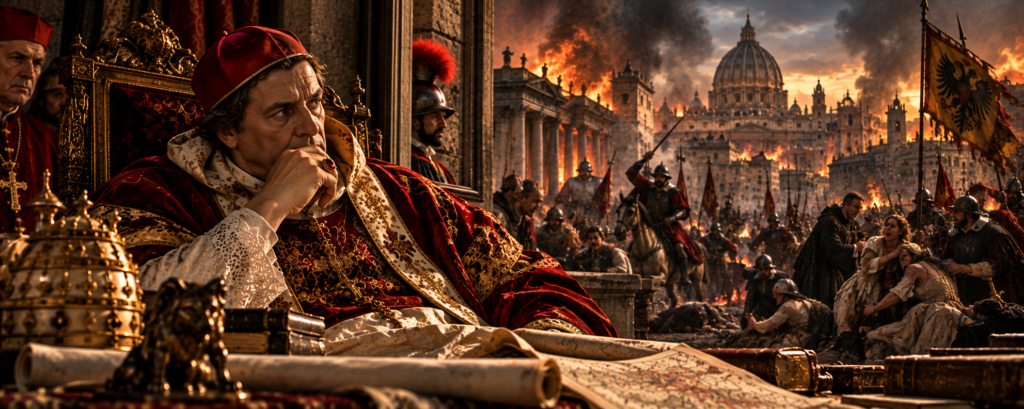
Clement VII: The Medici Pope Who Lost Rome and Helped Tear England From the Church
Pope Clement VII (1478–1534) | Reigned 1523–1534
The Pope Who Watched Rome Burn
On the morning of May 6, 1527, the most sacred city in western Christianity became a battlefield. Imperial soldiers stormed the defenses of Rome, overwhelmed its defenders, and unleashed a wave of violence that would haunt the city for generations. Men were murdered in streets and houses, women were subjected to sexual violence, churches were stripped of their treasures, and wealthy citizens were tortured or threatened until they surrendered their possessions. The soldiers belonged to an army fighting in the interests of Holy Roman Emperor Charles V, a ruler who presented himself as a defender of Catholic Christianity, yet their attack devastated the very city from which the pope governed the Church.
Inside the Vatican, Pope Clement VII faced a terrifying reality. His diplomatic maneuvers had failed, the military alliance upon which he had depended was unable to save him, and the enemy was breaking into the heart of his capital. As the defenders struggled to hold back the attackers, Clement escaped toward Castel Sant’Angelo, the massive fortress overlooking the Tiber. He reached its protection while much of the city was abandoned to soldiers whose discipline had collapsed and whose demands for money and plunder seemed almost limitless.
The scene was a grotesque reversal of everything the Renaissance papacy had attempted to represent. Rome had spent decades transforming itself into a magnificent capital of art, scholarship, religious ceremony, and princely power. Popes had commissioned extraordinary buildings, surrounded themselves with artists, and competed with European monarchs for prestige. Now the city was being plundered by men who regarded its treasures as compensation for unpaid wages and its inhabitants as potential sources of ransom.
For Clement, the catastrophe was deeply personal. He had spent years attempting to preserve the independence of the papacy between the competing ambitions of France and the Habsburg Empire. Instead, his policies had helped bring an imperial army to the gates of Rome, while his supposed allies proved incapable of preventing disaster. The pope who had tried to control the balance of power in Italy found himself trapped inside a fortress, surrounded by the ruins of his own political calculations.
The Sack of Rome would have been enough to define an entire pontificate, but Clement VII’s troubles did not end there. Across the Alps, Martin Luther’s challenge to Rome was developing into a permanent religious division, while in England, King Henry VIII was demanding the annulment of his marriage to Catherine of Aragon. Catherine happened to be the aunt of Charles V, the same emperor whose forces had humiliated Clement and whose political influence now overshadowed the papacy. The pope would soon discover that the decisions he made about one royal marriage could help determine the religious future of an entire kingdom.
Clement VII was not another Alexander VI, surrounded by notorious children and lurid accusations of sexual scandal. Nor was he a Julius II, personally directing military campaigns with the confidence of a seasoned commander. He was intelligent, educated, politically experienced, and capable of careful administration, but he governed during a period when hesitation could be as dangerous as recklessness. His tragedy was that he repeatedly attempted to preserve every possible advantage until events left him with almost nothing.
His reign became one of the darkest episodes in the history of the Renaissance papacy. Rome was devastated, Florence rebelled against the Medici, England moved toward separation from papal authority, and Protestantism continued spreading across Europe. Clement did not create all these crises, and several developed from forces far beyond his control. Nevertheless, his decisions became entangled with their most disastrous consequences, leaving him remembered as the pope who could neither protect his capital nor prevent the fragmentation of the Christian world he claimed to lead.
Born Into Blood: The Illegitimate Son of a Murdered Medici
Long before Giulio de’ Medici became Pope Clement VII, violence had already shaped his life. He was born in Florence on May 26, 1478, approximately one month after his father, Giuliano de’ Medici, was murdered during the infamous Pazzi conspiracy. Giuliano had been attacked inside Florence Cathedral during Mass, while his brother Lorenzo de’ Medici narrowly escaped assassination. The conspiracy was intended to destroy the political dominance of the Medici family, but its failure ultimately strengthened Lorenzo’s position in Florence.
Giulio was born outside marriage, a circumstance that complicated his prospects within a society deeply concerned with legitimacy and inheritance. His mother is commonly identified as Fioretta Gorini, although details of her identity and relationship with Giuliano are not entirely secure in the surviving evidence. What is certain is that Giulio was recognized as Giuliano’s son and brought into the orbit of the powerful Medici household. Lorenzo the Magnificent, who had survived the attack that killed Giulio’s father, took responsibility for the boy’s upbringing.
Growing up under Lorenzo’s protection offered Giulio extraordinary opportunities. Florence was one of the intellectual and artistic centers of Renaissance Europe, and the Medici household attracted distinguished scholars, poets, philosophers, and artists. Giulio received an education suited to someone expected to occupy a prominent position in the family’s political network. He learned the language of diplomacy and patronage in an environment where culture and power were closely connected.
Yet the family into which he had been born was far from secure. The Medici dominated Florence through influence rather than an uncontested hereditary monarchy, and their position depended upon carefully managed alliances. Rival families resented their power, while foreign rulers increasingly regarded Italy as a territory to be contested. Giulio’s childhood was therefore shaped by both extraordinary privilege and the knowledge that political fortunes could collapse with terrifying speed.
The murder of his father also left a lasting connection between his personal history and the violent rivalries of Renaissance Italy. Giuliano’s death was not simply a family tragedy; it was part of a struggle involving Florentine factions, powerful banking interests, and figures connected to the papal court of Sixtus IV. The precise extent of Sixtus’s knowledge of the assassination plan remains disputed, but the conspiracy exposed the willingness of political actors to use extreme violence. Giulio entered adulthood in a world where sacred buildings offered little protection against ambition.
His illegitimate birth initially presented an obstacle to certain ecclesiastical offices. The Church imposed restrictions on candidates born outside marriage, although dispensations could remove those barriers. The Medici possessed the influence necessary to secure favorable treatment when circumstances allowed. In Giulio’s case, the problem of legitimacy would eventually be resolved through papal action and a disputed declaration concerning his parents’ marital intentions.
The future pope’s early life therefore contained a contradiction that would follow him into his career. He belonged to one of Europe’s most prestigious families, yet his personal status required careful management. He enjoyed access to extraordinary political connections, but those connections existed within a dangerous and unstable environment. From the beginning, Giulio learned that authority depended not merely upon possessing power but upon persuading others to recognize it.
Exile, Humiliation, and the Long Road Back to Florence
The death of Lorenzo the Magnificent in 1492 deprived the Medici family of its most skillful political leader. His eldest son Piero inherited the family’s leading position in Florence but struggled to maintain the delicate balance Lorenzo had established. When King Charles VIII of France invaded Italy in 1494, Piero’s handling of the crisis provoked widespread anger. The Medici were expelled from Florence, and their political dominance temporarily collapsed.
For Giulio, the expulsion was a profound reversal. The household that had provided his security and education was suddenly deprived of its position, forcing its members to depend upon relatives, supporters, and foreign patrons. He spent years associated with the family’s efforts to recover its influence. The experience reinforced his understanding that political survival required patience and the cultivation of powerful allies.
Florence itself underwent dramatic changes during the Medici exile. The Dominican preacher Girolamo Savonarola became an influential voice in the city’s political and religious life, condemning corruption, luxury, and the moral failures of contemporary society. His movement offered a vision of Christian renewal that stood in sharp contrast to the aristocratic culture of the Medici household. Savonarola’s eventual execution in 1498 demonstrated how violently religious conviction and political authority could collide.
Giulio’s prospects improved as his cousin Giovanni de’ Medici advanced within the Church. Giovanni had been appointed a cardinal while still a child, reflecting the extraordinary influence of the family before its expulsion. His ecclesiastical position provided the Medici with connections that survived the loss of Florence. Giulio gradually became an important member of the same network.
The decisive change came in 1512, when the Medici returned to Florence with the assistance of forces opposed to French influence in Italy. The restoration followed military operations that included the brutal sack of Prato by Spanish troops. The violence helped break resistance to the family’s return and revealed the terrible price that could accompany political restoration. Giulio’s family regained its position, but the victory depended heavily upon foreign military intervention.
Only a year later, Giovanni de’ Medici was elected pope as Leo X. The family’s fortunes had undergone an astonishing transformation, moving from exile to the summit of the Catholic hierarchy. For Giulio, the election opened opportunities that had previously seemed almost unimaginable. He was about to become one of the most influential men in the papal government.
The Man Behind Leo X
Leo X quickly advanced Giulio’s ecclesiastical career. In 1513, Giulio became archbishop of Florence and was elevated to the College of Cardinals after the necessary arrangements concerning his birth status. His position placed him close to the center of papal authority. More importantly, he possessed the confidence of a pope who was also his cousin and family ally.
Giulio soon demonstrated considerable administrative and diplomatic ability. Leo enjoyed art, scholarship, ceremony, and the pleasures of an elaborate Renaissance court, while Giulio became increasingly involved in the practical business of government. He helped manage political negotiations and ecclesiastical affairs during a period of intense international rivalry. His influence grew as the papacy struggled to balance its ambitions against the expanding power of France and the Habsburg dynasty.
In 1517, Giulio became vice-chancellor of the Church, one of the most important offices in the papal administration. The position gave him substantial responsibility for official documents and government business. It also reinforced his reputation as an experienced political operator. By the later years of Leo’s pontificate, Giulio was among the most powerful figures in Rome.
His prominence did not mean that every policy of Leo X originated with him. The papal government involved numerous advisers, cardinals, diplomats, and competing interests, while Leo retained final authority. Nevertheless, Giulio participated in the political culture that shaped the Medici pontificate. He understood the use of ecclesiastical office to strengthen family influence and protect territorial interests.
The death of Leo X in December 1521 created another moment of uncertainty. Giulio was an obvious candidate for the papacy, but the cardinals elected Adrian VI, a Dutch-born theologian associated with Emperor Charles V. Adrian represented a striking contrast to the lavish culture of the Medici court. He attempted to confront ecclesiastical abuses while navigating the continuing spread of Lutheran ideas.
Adrian’s pontificate lasted less than two years. He died in September 1523, leaving the Church once again without a pope. Giulio entered the next conclave with extensive experience, powerful connections, and a strong claim to leadership. This time, the opportunity would be his.
A Medici Returns to the Throne of Saint Peter
The conclave following Adrian VI’s death was prolonged and politically contentious. Cardinals divided into factions influenced by personal loyalties, Italian rivalries, and the competing interests of European monarchs. Giulio de’ Medici possessed substantial support but also faced opposition from those suspicious of renewed Medici dominance. Negotiations continued for weeks before the necessary agreement emerged.
On November 19, 1523, Giulio was elected pope and took the name Clement VII. He was forty-five years old and had spent much of his adult life at the center of ecclesiastical government. Unlike an inexperienced outsider, he understood the papal administration and the political dangers surrounding it. His election appeared to promise a return to sophisticated Medici leadership after Adrian’s austere and troubled pontificate.
Clement inherited a Church facing extraordinary challenges. Martin Luther had already been excommunicated, but the religious movement associated with his teachings was spreading through German territories. The papal treasury remained burdened by the financial consequences of earlier wars and extravagant expenditure. Meanwhile, France and the Habsburg Empire were competing for dominance over Italy, threatening the independence of the Papal States.
The new pope’s central political problem was the overwhelming strength of Emperor Charles V. Charles ruled Spain and its overseas possessions, controlled extensive Habsburg territories, and held the imperial title. His influence extended across much of Europe, while his armies competed with France for control of northern Italy. Clement feared that an unchecked Habsburg victory would leave the papacy surrounded by imperial power.
France offered a possible counterweight. King Francis I had repeatedly attempted to establish French influence in Italy and remained determined to challenge Charles. Yet France was not a reliable protector of papal independence, and its ambitions could be just as threatening under different circumstances. Clement therefore attempted to preserve his freedom by maneuvering between the two rulers.
The strategy was understandable in principle. Italian states had long survived by balancing stronger powers against one another, shifting alliances when necessary to prevent any single ruler from becoming dominant. The danger was that Clement was operating in an age when the military resources of France and the Habsburg Empire dwarfed those of most Italian states. Diplomatic flexibility could preserve independence only if the pope possessed sufficient leverage to make his choices matter.
Clement’s tragedy was that he repeatedly attempted to play the old Italian political game against opponents whose resources had become too great. He was capable of subtle negotiation, but subtlety could not always compensate for military weakness. His decisions increasingly depended upon predictions about the intentions of monarchs and commanders whom he could not control. When those predictions failed, the consequences were devastating.
Two Kings, One Empire, and a Pope Caught Between Them
The rivalry between Francis I and Charles V dominated European politics throughout Clement’s pontificate. Both rulers possessed enormous ambitions, and northern Italy was among their principal battlegrounds. Milan was particularly important because its possession affected communications between Habsburg territories and the balance of power across the peninsula. The struggle had already produced years of warfare before Clement became pope.
Francis was charismatic, ambitious, and determined to recover French influence in Italy. Charles was equally determined to prevent France from dominating the region and threatening his territories. Neither ruler regarded the papacy as an entirely independent spiritual institution whose interests must always take precedence. Both sought papal support when useful and applied pressure when Clement’s policies became inconvenient.
Clement initially attempted to avoid an irrevocable commitment. He negotiated with both sides while seeking assurances concerning the security of the Papal States and the Medici position in Florence. His diplomacy reflected genuine fears about the future of Italy. Yet the constant maneuvering encouraged suspicion among rulers who wanted dependable allies.
The situation became especially dangerous when Francis invaded Italy in 1524. The French king hoped to recover Milan and reverse earlier defeats. Charles’s forces responded, bringing the rival armies toward a decisive confrontation. Clement’s political calculations were soon overtaken by events on the battlefield.
The Battle of Pavia on February 24, 1525, transformed the balance of power. Imperial forces defeated the French army, and Francis himself was captured. The king of France, one of Europe’s most powerful monarchs, became a prisoner of his greatest rival. Charles suddenly appeared capable of dominating Italy without effective opposition.
For Clement, the victory was deeply alarming. He had feared Habsburg expansion before Pavia, but the defeat of France made the danger far more immediate. The pope now faced an emperor whose military power seemed almost irresistible. His attempts to preserve independence would lead him toward the alliance that ultimately brought disaster to Rome.
The Battle of Pavia and the Fear of Habsburg Domination
The capture of Francis I created an extraordinary diplomatic crisis. Charles V possessed the French king and could demand sweeping concessions as the price of his release. Italian rulers watched anxiously as the balance of power shifted toward the Habsburg dynasty. Clement feared that the emperor might become the unquestioned master of the peninsula.
The pope’s concerns were not entirely imaginary. Charles controlled territories surrounding Italy and possessed the military resources to intervene repeatedly in its affairs. Imperial dominance threatened the political autonomy of the Papal States and the Medici government in Florence. Clement also worried about the broader consequences of allowing one monarch to exercise overwhelming influence over the Church.
Yet his response created new dangers. Clement entered negotiations designed to limit imperial power while attempting to avoid direct confrontation. He sought assurances from Charles but also maintained contacts with France and other Italian states. The resulting diplomacy was complicated, secretive, and vulnerable to misunderstanding.
Francis eventually secured his release through the Treaty of Madrid in January 1526. The agreement imposed severe conditions, including major territorial concessions. Once free, however, Francis repudiated important parts of the treaty, arguing that the terms had been imposed under coercion. His refusal reopened the conflict with Charles.
Clement saw an opportunity to construct a coalition capable of resisting Habsburg dominance. France would provide military strength, while Italian states would contribute their resources and strategic positions. The plan depended upon cooperation among rulers whose interests were far from identical. Nevertheless, the pope committed himself to the project.
The decision would become the central political gamble of his reign. Clement believed that an alliance could restore the balance of power and protect the independence of the papacy. Instead, it helped provoke a confrontation for which Rome was disastrously unprepared. The path toward the Sack of Rome began with a diplomatic agreement intended to prevent imperial domination.
The League of Cognac: The Alliance That Became a Death Sentence
On May 22, 1526, Clement VII joined the League of Cognac, an alliance directed against the growing power of Charles V. The coalition included France, Venice, Florence, and Francesco II Sforza of Milan, although the practical commitments of its members differed considerably. Its purpose was to prevent the emperor from establishing overwhelming control over Italy. Clement hoped that collective action would force Charles to negotiate from a weaker position.
The alliance appeared formidable on paper. France possessed substantial military resources, Venice was a major regional power, and the Italian states had strong reasons to fear imperial expansion. The papacy contributed political legitimacy and its own territorial resources. Together, the members seemed capable of challenging Charles’s position.
The problem was that the coalition lacked unity. Its members pursued different territorial and political objectives, and their willingness to make sacrifices varied. French priorities did not always align with papal interests, while Venice remained attentive to its own security. The alliance depended upon coordinated military action that proved difficult to achieve.
Charles regarded the coalition as a serious challenge. Imperial commanders continued military operations in Italy, while political pressure increased upon Clement and his allies. The conflict spread through territories already exhausted by years of warfare. Armies required money, food, and supplies, and their commanders often struggled to maintain discipline.
The pope had entered the alliance believing that diplomacy could restrain imperial power. Instead, he found himself exposed to retaliation while his partners failed to provide dependable protection. The military balance increasingly favored Charles’s forces. Clement’s political maneuver had become a dangerous commitment.
The League of Cognac did not directly order the Sack of Rome, nor was the catastrophe an inevitable consequence of its formation. The attack resulted from several interacting factors, including unpaid soldiers, military indiscipline, command decisions, and the collapse of effective resistance. Nevertheless, Clement’s participation in the alliance placed the papacy in direct conflict with imperial forces. The pope had helped create the political circumstances in which Rome became a target.
The First Warning: Rome Attacked in 1526
The disaster of 1527 was preceded by a warning that should have revealed Rome’s vulnerability. In September 1526, forces associated with the powerful Colonna family attacked the city. The Colonna were longstanding rivals of the Medici and possessed connections with the imperial faction. Their action demonstrated that Clement’s enemies could threaten Rome even before a major imperial army approached.
The attackers entered the city and caused considerable alarm. Clement was forced to seek security while the papal government struggled to respond. The raid exposed weaknesses in Rome’s defenses and the unreliability of political arrangements intended to protect the capital. It also revealed the willingness of powerful Italian families to exploit the wider conflict.
Clement negotiated under pressure and agreed to terms intended to secure the withdrawal of the attackers. The settlement did not resolve the underlying rivalry. Instead, it reinforced the impression that the pope could be intimidated through military force. His authority had been challenged in the very city from which he governed the Church.
The raid also deepened Clement’s distrust of his enemies. He sought ways to restore papal prestige and protect his territories, but his options were limited. Military preparations required money that the papal government could scarcely afford. Diplomatic agreements offered temporary relief without guaranteeing lasting security.
Rome remained vulnerable as the conflict continued. The city possessed fortifications and defenders, but it was not prepared to withstand a determined assault by a large, experienced army. Clement’s reliance upon alliances had not produced the military protection he needed. The danger was becoming increasingly obvious.
Yet the pope continued attempting to maneuver between negotiation and resistance. He hoped that agreements with imperial representatives might prevent a direct attack. The difficulty was that imperial forces in Italy were not always under effective centralized control. The army moving toward Rome would soon demonstrate how little authority even its own commanders could exercise over desperate soldiers.
The Army That Was No Longer Under Control
The imperial army that advanced toward Rome in 1527 was a multinational force composed of Spanish, German, Italian, and other soldiers. Many had endured difficult campaigns and long periods without adequate payment. Their commanders struggled to obtain the money necessary to satisfy them. Hunger, exhaustion, and resentment created an increasingly dangerous atmosphere.
Among the German troops were Landsknechts, mercenary infantrymen whose military reputation was formidable. Some were sympathetic to Lutheran ideas and regarded the papacy with religious hostility. Others were primarily motivated by wages, survival, and the prospect of plunder. It would be inaccurate to describe the entire army as a unified Protestant force, because its soldiers came from different religious and national backgrounds.
The army was commanded by Charles III, Duke of Bourbon, a French nobleman who had entered imperial service after breaking with Francis I. Bourbon was an experienced military leader, but he faced serious difficulties maintaining discipline. His troops demanded payment that he could not provide. The prospect of attacking Rome offered the possibility of obtaining wealth through force.
The decision to march toward the city emerged from this unstable combination of military ambition and financial desperation. Charles V had political reasons to pressure Clement, but historians continue debating the extent to which the emperor personally authorized or intended the attack. The army’s immediate behavior cannot simply be treated as the execution of a carefully controlled imperial plan. Its commanders were operating amid conditions that increasingly limited their authority.
Clement attempted to negotiate a truce with imperial representatives. In March 1527, he reached an agreement with Charles de Lannoy, the imperial viceroy of Naples. The settlement appeared to offer a means of avoiding direct confrontation. Unfortunately, Bourbon’s army did not accept the arrangement as binding upon its immediate course of action.
The troops continued moving south. Their progress created panic in territories along the route, while Rome struggled to prepare for the approaching threat. Clement’s allies failed to assemble an effective force capable of stopping the advance. The pope was discovering that agreements signed by diplomats could be worthless when confronted by an army determined to obtain money.
May 6, 1527: The Gates of Rome
The imperial army reached Rome in early May 1527. Its soldiers were exhausted, poorly supplied, and increasingly desperate for payment. The city possessed defenders, including papal troops and members of the Swiss Guard, but its military resources were inadequate for the approaching confrontation. The attackers prepared to assault the walls.
On the morning of May 6, the imperial forces launched their attack. Fighting erupted around the defenses near the Vatican and the Borgo district. The Duke of Bourbon was killed during the assault, reportedly while attempting to encourage his men near the walls. His death removed a commander whose authority had already been strained.
The loss of Bourbon contributed to the collapse of discipline. Soldiers who had expected payment and plunder now faced little effective restraint. The assault continued, and the defenders were overwhelmed. The attackers entered the city and began spreading through its streets.
The Swiss Guard became central to the memory of the disaster. Members of the force fought to protect the pope and help secure his escape. Many were killed during the fighting, and their sacrifice became an enduring part of the Guard’s history. The familiar figure of 147 Swiss Guards dying in defense of Clement belongs to the traditional account, although the precise details of the fighting are not equally secure in every source.
Clement escaped through the fortified passage connecting the Vatican with Castel Sant’Angelo. The passage, known as the Passetto di Borgo, provided a protected route to the fortress. Its existence reflected earlier papal fears of attack, but it had rarely been needed under circumstances so desperate. The pope reached safety while the city around him fell into chaos.
Inside Castel Sant’Angelo, Clement and his companions faced an uncertain future. The fortress offered protection against immediate capture, but it could not save the population outside its walls. Imperial soldiers now controlled much of Rome. The city was about to experience one of the most destructive episodes in its history.
The Sack Begins: A City Abandoned to Violence
Once the imperial soldiers entered Rome, organized resistance collapsed in many areas. The attackers began looting houses, churches, palaces, and monasteries, searching for money and valuables. Wealthy residents became targets for extortion and ransom demands. Those unable or unwilling to pay faced threats, imprisonment, and violence.
The sack was not confined to ordinary theft. Contemporary accounts describe killings, sexual assaults, beatings, torture, and the desecration of religious spaces. Soldiers forced their way into buildings that inhabitants had hoped would provide sanctuary. Clergy and religious communities were not automatically spared. The violence shattered the assumption that the sacred character of Rome would protect it from the worst consequences of war.
The city’s wealthy households were especially vulnerable. Soldiers knew that aristocratic families and senior churchmen possessed valuables that could be seized or exchanged for money. Captives were sometimes held until relatives or associates produced ransom payments. The search for wealth encouraged repeated assaults upon the same victims.
The violence also affected people with little money. Ordinary residents could lose their homes, possessions, and means of survival. Families were separated during the fighting and disorder, while refugees sought shelter wherever they could find it. The disruption of food supplies and public services added to the suffering.
Religious buildings suffered extensive plundering. Sacred vessels, ornaments, and other valuable objects were stolen or destroyed. Churches that had served as places of worship and refuge became scenes of humiliation and terror. The spectacle was especially shocking because many of the attackers served an emperor who claimed to defend the Catholic faith.
The initial violence was particularly intense, but the city’s suffering did not end after a few days. Occupation, extortion, disease, and insecurity continued for months. The army’s presence imposed an enormous burden upon a population already devastated by the assault. Rome had fallen, but its ordeal was only beginning.
Churches Desecrated and Priests Humiliated
The religious character of Rome made the sack especially shocking to contemporary observers. The city contained some of Christianity’s most important churches, relics, and institutions. Pilgrims had traveled there for centuries seeking spiritual benefits and access to sacred sites. Now those same places were exposed to the violence of soldiers whose immediate interests centered upon money and survival.
Accounts describe the plundering of churches and the humiliation of clergy. Religious objects were treated as valuables rather than sacred possessions, and buildings were searched for hidden wealth. Some soldiers mocked Catholic ceremonies or attacked symbols associated with the papacy. Such actions could reflect religious hostility, but the desire for plunder remained a major motive.
The participation of Lutheran sympathizers among the German troops gave the sack an additional religious dimension. Protestant criticism of Rome had become increasingly fierce, and some attackers regarded the city as a symbol of ecclesiastical corruption. Yet the army also included Catholic soldiers who participated in the violence. The catastrophe cannot be reduced to a simple conflict between Protestants and Catholics.
Contemporary writers interpreted the sack through different religious frameworks. Some regarded it as divine punishment for the corruption of the papal court. Others condemned it as an outrageous assault upon Christianity. Even defenders of the papacy sometimes acknowledged that the moral condition of the Church had contributed to the sense of crisis surrounding the event.
The religious interpretations reveal how deeply the sack damaged papal prestige. Rome was supposed to represent the spiritual center of western Christianity, yet its government had failed to protect the city. The pope himself was trapped inside a fortress while sacred buildings were violated. The contrast between the claims of papal authority and the reality of military helplessness was impossible to ignore.
For Clement, the humiliation was devastating. His office carried immense spiritual significance, but that authority could not stop soldiers from looting churches or threatening civilians. The disaster exposed the difference between religious prestige and practical military power. The pope had discovered that the sacred status of Rome offered no guarantee of physical security.
The Terror of Ransom and the Destruction of Ordinary Lives
One of the most disturbing features of the sack was the systematic search for ransom money. Wealthy citizens, churchmen, merchants, and members of prominent households were especially valuable to soldiers seeking payment. Captives could be threatened with torture or death unless money was produced. The process transformed human suffering into a source of military revenue.
The pressure extended beyond those who were personally wealthy. Families could be forced to borrow money, sell possessions, or appeal to distant relatives to secure the release of loved ones. The destruction of property made payment even more difficult. Some victims endured repeated demands after already surrendering substantial sums.
Women faced particular dangers during the occupation. Contemporary accounts describe widespread sexual violence, including assaults upon women who had sought refuge in religious buildings or private homes. The surviving evidence does not permit an exact count of victims, and sensational later narratives sometimes embellished particular episodes. Nevertheless, the occurrence of extensive sexual violence is not seriously in doubt.
The consequences extended beyond the immediate physical injuries. Families lost homes, livelihoods, and social security, while survivors faced the psychological burden of terror and displacement. Religious communities were disrupted, and charitable institutions struggled to function. The city’s economy suffered from the destruction of property and the interruption of ordinary commerce.
Disease and hunger compounded the disaster. Large numbers of soldiers crowded into a city whose infrastructure had been damaged and whose food supplies were under pressure. Unsanitary conditions encouraged illness, while the movement of refugees spread suffering beyond Rome itself. The catastrophe therefore continued claiming victims after the most intense fighting had ended.
The human cost cannot be reduced to a single reliable death toll. Estimates vary, and the surviving sources were written by observers with different levels of knowledge and different political interests. What is certain is that the sack caused extensive loss of life, widespread abuse, and severe economic destruction. Rome’s population and cultural life were profoundly affected.
The pope’s personal survival offered little comfort to those who had suffered outside Castel Sant’Angelo. Clement remained the head of the Church, but his government had been unable to protect its own capital. The violence exposed the consequences of political decisions made far above the lives of ordinary Romans. For many inhabitants, the struggle between Charles V and Francis I had become a nightmare imposed upon their homes.
The Pope Becomes a Prisoner in His Own City
Castel Sant’Angelo had been built originally as the mausoleum of Emperor Hadrian and later transformed into a fortress. Its massive walls and strategic position made it an important refuge for popes during periods of danger. Clement VII reached the stronghold as the imperial assault overwhelmed Rome. Inside, he found physical protection but little freedom.
The fortress became a place of confinement. Imperial forces controlled the surrounding city, and Clement could not govern normally or move freely. His communications and negotiations were constrained by the military situation. The pope was effectively a prisoner within the walls of his own capital.
The contrast was extraordinary. Clement occupied the highest office in the Catholic Church, claiming spiritual authority over rulers and believers throughout western Christendom. Yet his immediate circumstances depended upon the willingness of soldiers to negotiate and the ability of his defenders to hold a fortress. The political weakness of the papacy had become visible to the entire European world.
Negotiations eventually produced a capitulation in early June 1527. Clement agreed to severe terms, including large financial payments and concessions intended to satisfy imperial demands. The settlement did not immediately restore his liberty. He remained confined in Castel Sant’Angelo for months afterward.
The pope’s confinement created serious difficulties for ecclesiastical government. Decisions requiring his authority were delayed or complicated, while diplomats struggled to communicate with him. His inability to act freely became especially significant as political and religious crises continued elsewhere in Europe. The head of the Church was trapped at the very moment when his leadership was desperately needed.
Clement finally escaped from Castel Sant’Angelo in December 1527. Disguised and assisted by supporters, he left the fortress and made his way out of Rome. He eventually established himself at Orvieto, where the papal court operated under difficult conditions. The escape ended his immediate captivity but did not restore the prestige he had lost.
The experience left a lasting mark upon his pontificate. Clement had attempted to preserve papal independence through diplomacy and alliances. Instead, he had endured military defeat, humiliation, and confinement. The pope who had feared becoming dependent upon Charles V was now more vulnerable to imperial pressure than ever.
Was Charles V Responsible for the Sack?
The role of Emperor Charles V in the Sack of Rome has remained a subject of historical debate. The attacking army operated in his interests and included forces serving under imperial commanders. Its advance occurred within a war created by the rivalry between Charles and the League of Cognac. The emperor therefore cannot be separated from the political and military circumstances that produced the catastrophe.
The question of direct responsibility is more complicated. Charles was not personally present at the assault, and the army’s behavior reflected severe problems of payment and discipline. The death of the Duke of Bourbon further weakened command during the attack. Historians have debated whether Charles intended Rome to be assaulted or whether events escaped effective imperial control.
Charles publicly expressed horror at the atrocities. Such expressions must be considered within the political context, because the sack damaged the emperor’s reputation as a Catholic ruler. Condemning the violence was diplomatically useful even if the military victory strengthened his position. His statements therefore do not settle the question of responsibility.
The emperor also benefited politically from Clement’s humiliation. The papacy had joined an alliance against him, and the sack effectively destroyed its ability to resist imperial pressure in the immediate future. Clement’s captivity gave Charles enormous leverage. The resulting settlement helped establish Habsburg dominance in Italy.
The catastrophe therefore involved different levels of responsibility. Charles’s policies and military campaigns contributed to the circumstances that brought the army to Rome. The immediate violence was carried out by soldiers whose motives included unpaid wages, plunder, and religious hostility. Command failures and the collapse of discipline intensified the destruction.
Reducing the sack to a single order from the emperor would oversimplify the evidence. Equally, treating it as an entirely accidental outbreak of violence would obscure the political conflict that made Rome vulnerable. The event emerged from the dangerous interaction of imperial ambition, papal diplomacy, military desperation, and inadequate control. Clement’s decisions were part of that chain, but he was not the sole author of the disaster.
The Ruins of the Renaissance
The Sack of Rome transformed the cultural life of the city. During the preceding decades, the papacy had attracted extraordinary artists, architects, scholars, and craftsmen. The reigns of Julius II and Leo X had helped establish Rome as one of Europe’s greatest artistic centers. Clement inherited that cultural environment and continued important projects before the catastrophe.
The invasion shattered the confidence upon which much of this activity depended. Artists and scholars fled the city, seeking safety and employment elsewhere. Workshops were disrupted, patrons lost wealth, and major projects were delayed. The movement of displaced artists helped spread Roman Renaissance styles to other regions, but the immediate effect upon Rome was devastating.
Among those affected were artists associated with the sophisticated culture of the High Renaissance. Rosso Fiorentino endured the violence and later pursued his career elsewhere, while other figures left the city during the period of instability. The dispersal of talent contributed to changes in artistic production across Italy and beyond. Rome would eventually recover its cultural importance, but the world that existed before 1527 had been profoundly altered.
The destruction also affected libraries, collections, and private households containing valuable manuscripts and works of art. Some objects were stolen, damaged, or dispersed during the occupation. Others survived through concealment, ransom, or the efforts of their owners. The full scale of cultural loss cannot be reconstructed precisely.
The psychological impact was equally significant. Renaissance Rome had cultivated an image of magnificence, confidence, and renewal. The sack replaced that image with memories of violence and humiliation. Writers struggled to explain how the capital of western Christianity could have suffered such a catastrophe.
Some contemporaries interpreted the event as divine judgment upon a corrupt Church. Others emphasized the brutality of soldiers and the failures of political leadership. The explanations differed, but many agreed that the sack marked the end of an era. Clement’s pontificate became associated with the collapse of the optimism that had characterized the High Renaissance papacy.
Florence Turns Against the Medici
The disaster in Rome had immediate consequences for Clement’s family in Florence. The Medici had regained power in 1512 through military and political support from outside the city. Their position remained vulnerable to republican opposition and resentment of dynastic control. The pope’s defeat weakened the authority upon which the family depended.
In May 1527, news of the Sack of Rome encouraged a revolt against Medici rule in Florence. The family was expelled, and a republican government was restored. Clement had lost not only control over his capital but also the political position of his dynasty in its ancestral city. The reversal was deeply humiliating for a pope whose career had been shaped by Medici ambitions.
The Florentine republic attempted to preserve its independence amid the continuing struggle between France and the Habsburg Empire. Its leaders understood that the Medici might return with foreign assistance. They therefore sought diplomatic and military support while preparing to defend the city. The situation became increasingly dangerous as Clement’s relationship with Charles V changed.
The pope’s response revealed the enduring importance of family interests. Despite the catastrophe in Rome, he remained determined to restore Medici authority in Florence. His political calculations increasingly centered upon securing imperial assistance for that purpose. The independence of the city became a bargaining issue in negotiations between the papacy and Charles.
The restoration would not come peacefully. Florence eventually faced a major siege by imperial and papal forces. The conflict brought suffering to the population and ended the republic’s attempt to preserve its independence. Clement’s determination to recover his family’s position contributed to another violent episode in the history of Renaissance Italy.
The Florentine crisis demonstrated that the pope had not abandoned dynastic politics after the Sack of Rome. His personal and family interests remained closely connected to his conduct of government. The disaster had changed the balance of power, but it had not removed the ambitions that helped shape his earlier decisions. Clement would now pursue those ambitions through cooperation with the emperor he had previously opposed.
From Imperial Enemy to Imperial Ally
After escaping captivity, Clement gradually recognized that his political position had fundamentally changed. France had failed to protect him, while Charles V possessed overwhelming influence in Italy. Continuing direct resistance risked further disaster. The pope therefore moved toward reconciliation with the emperor.
The negotiations culminated in the Treaty of Barcelona in June 1529. The agreement helped establish a new relationship between Clement and Charles. The pope accepted the realities of imperial power, while the emperor offered support for important papal and Medici interests. The settlement represented a dramatic reversal of Clement’s earlier policy.
The alliance had major consequences for Florence. Charles agreed to support the restoration of Medici authority, and imperial forces became involved in the campaign against the republic. Clement had effectively exchanged opposition to Habsburg dominance for imperial assistance in recovering his family’s position. The arrangement strengthened his immediate political prospects while revealing how dependent he had become.
The change also affected the wider European balance. The papacy could no longer function as an effective independent counterweight to Charles in Italy. Clement’s diplomacy increasingly reflected the need to accommodate imperial interests. His earlier attempts to prevent Habsburg dominance had ended by reinforcing it.
The pope’s reconciliation was not necessarily irrational. After the sack, his military resources were limited, and France had proved an unreliable ally. Cooperation with Charles offered a means of restoring stability and recovering lost influence. The problem was that the terms of survival required Clement to accept the power he had spent years attempting to restrain.
The consequences would become especially important in England. Catherine of Aragon, the wife Henry VIII wanted to set aside, was Charles V’s aunt. Clement’s dependence upon the emperor complicated an already difficult legal and theological dispute. The pope’s political defeat in Italy would now influence his handling of a royal marriage hundreds of miles away.
The Siege of Florence and the Return of the Medici
The Florentine republic faced increasing pressure after Clement reconciled with Charles V. Imperial and papal forces moved against the city in 1529, beginning a siege that lasted into the following year. Florence prepared a determined defense, drawing upon its resources and the loyalty of citizens committed to republican government. The struggle became a contest over whether the city would remain independent or return to Medici control.
The siege placed enormous strain upon the population. Food supplies became increasingly difficult to maintain, while military operations disrupted ordinary life. Disease and hardship added to the suffering caused by the fighting. The city’s defenders resisted for months despite the growing imbalance of power.
Michelangelo, who had longstanding connections with the Medici, became involved in Florence’s defensive preparations. His work on fortifications reflected the extraordinary circumstances of the conflict. The artist who had produced masterpieces for Medici patrons was now contributing to the defense of a republic resisting their restoration. His position illustrates the complicated personal loyalties created by Renaissance politics.
Florence finally surrendered in August 1530. The defeat ended the republican government and opened the way for the return of Medici authority. Clement had achieved one of his central dynastic objectives. Yet the victory depended upon imperial military power and followed a prolonged struggle that had inflicted suffering upon the city.
Alessandro de’ Medici emerged as the principal beneficiary of the restoration. His parentage has long been debated, with some traditions identifying him as an illegitimate son of Lorenzo II de’ Medici and others suggesting that Clement himself was his father. The evidence does not permit the latter claim to be treated as established fact. What is clear is that Clement strongly supported Alessandro’s advancement.
Alessandro eventually became Duke of Florence, marking a major transformation in the city’s political structure. The Medici were moving toward hereditary princely rule rather than the informal dominance they had exercised under Lorenzo the Magnificent. Clement’s efforts helped secure that transition. The restoration represented a dynastic success achieved through foreign military intervention.
The episode remains one of the most revealing contradictions of his reign. Clement had justified his opposition to Charles partly through concern for Italian independence. Yet he later relied upon the emperor’s armies to impose Medici authority upon Florence. His commitment to family power could override the principles he had invoked in earlier diplomatic struggles.
The Emperor Kneels Before the Pope
On February 24, 1530, Clement VII crowned Charles V as Holy Roman Emperor in Bologna. The ceremony was magnificent, filled with the religious symbolism and political grandeur associated with imperial coronations. It represented a formal reconciliation between two rulers whose conflict had helped produce the devastation of Rome. The spectacle was extraordinary precisely because of what had happened only three years earlier.
The emperor who received the crown had been the sovereign in whose interests the army that sacked Rome had fought. The pope who placed it upon his head had endured months of captivity after that army’s victory. Their reconciliation reflected the practical demands of European politics rather than the disappearance of earlier grievances. Both men had reasons to present their relationship as restored.
For Charles, the coronation reinforced his imperial prestige. It connected his authority to the traditions of Christian empire and papal recognition. For Clement, the ceremony offered an opportunity to recover dignity after years of humiliation. The public display suggested that the papacy remained an essential institution within European political life.
Yet the balance of power had changed. Charles possessed overwhelming influence in Italy, while Clement depended upon imperial cooperation for important political objectives. The pope retained spiritual authority and diplomatic significance, but his practical independence had been weakened. The coronation could not erase the consequences of the sack.
The ceremony also possessed lasting historical importance. Charles V was the last Holy Roman Emperor to receive a coronation from a pope. The tradition had linked papal and imperial authority for centuries, often amid bitter conflict. Its final great expression occurred during a pontificate marked by the collapse of papal political confidence.
The image of Clement crowning Charles captures the paradox of his reign. The pope appeared to exercise supreme ceremonial authority, yet the emperor held the stronger political position. The man who had feared imperial domination now publicly honored the ruler whose forces had devastated his capital. Renaissance diplomacy had produced a reconciliation that looked magnificent but concealed a profound reversal of power.
Henry VIII and the Marriage That Threatened a Kingdom
While Clement struggled with the consequences of the Sack of Rome, a crisis was developing in England that would become equally important to his historical reputation. King Henry VIII had been married to Catherine of Aragon since 1509. Their marriage had produced several children, but only their daughter Mary survived into adulthood. Henry increasingly feared that the absence of a legitimate surviving son threatened the security of the Tudor dynasty.
Henry’s concern was not entirely imaginary. The Tudor monarchy was relatively young, and memories of the Wars of the Roses remained politically significant. A disputed succession could produce instability and renewed conflict. The king believed that obtaining a male heir was essential to the future of his dynasty.
By the later 1520s, Henry had also become deeply interested in Anne Boleyn, a woman serving in Catherine’s household. Anne came from an ambitious family with important court connections and had attracted the king’s attention. Henry’s desire to marry her became inseparable from his efforts to end his existing marriage. The political problem of succession was therefore intertwined with personal ambition.
Henry began arguing that his marriage to Catherine had been invalid from the beginning. Catherine had previously been married to his elder brother Arthur, who died in 1502. Henry maintained that the biblical prohibition against marrying a brother’s wife rendered their union unlawful. The argument depended upon disputed interpretations of Scripture and canon law.
The marriage had originally been permitted through a papal dispensation issued by Julius II. Henry now challenged whether that dispensation had been sufficient to overcome the alleged impediment. Catherine insisted that her marriage to Arthur had never been consummated, a claim that complicated the legal argument. She also maintained that her marriage to Henry was valid and refused to accept the suggestion that she should surrender her position as queen.
The dispute therefore involved more than the king’s wish to replace one wife with another. It raised questions about the authority of previous papal decisions, the interpretation of biblical law, and the legal status of a marriage that had existed for nearly two decades. Clement was being asked to declare that an arrangement authorized by an earlier pope had never been valid. The consequences would extend far beyond the private lives of the royal couple.
Catherine of Aragon: The Queen Who Would Not Disappear
Catherine of Aragon was not a powerless woman who could simply be dismissed from the English court. She was the daughter of Ferdinand II of Aragon and Isabella I of Castile, rulers whose marriage had helped unite the Spanish kingdoms. Her upbringing had prepared her for royal responsibility, and she possessed a strong understanding of dynastic politics. She also enjoyed considerable respect among many English subjects.
Her marriage to Henry had lasted for years, and she had fulfilled important public duties as queen. She had acted as regent during Henry’s absence in 1513 and played a role in the political life of the kingdom. Her surviving daughter Mary was recognized as the king’s legitimate heir. Catherine therefore had powerful reasons to resist any attempt to invalidate her marriage.
The queen also possessed an extraordinarily important family connection. Her nephew was Charles V, the Holy Roman Emperor and king of Spain. Charles regarded Catherine’s treatment as a matter involving family honor and political prestige. His influence became especially significant after the Sack of Rome placed Clement in a position of vulnerability.
Catherine’s resistance complicated Henry’s plans. She refused to accept that her marriage had been unlawful and appealed to the authority of the Church. Her position was supported by arguments concerning the original dispensation and the circumstances of her marriage to Arthur. The legal issues were serious and cannot be dismissed as a mere pretext invented by the pope.
Henry’s determination created a confrontation between two people who each believed their position was justified. The king argued that his conscience and the security of the dynasty required a new marriage. Catherine maintained that she was his lawful wife and that their daughter was legitimate. Clement was expected to decide a case in which every possible outcome carried enormous political consequences.
The pope’s difficulty was intensified by the emperor’s influence. A decision favoring Henry could offend Charles and undermine Clement’s fragile political recovery. A decision favoring Catherine would anger the English king and risk losing an important Catholic monarchy’s cooperation. The pope attempted to preserve room for negotiation, but the dispute became increasingly resistant to compromise.
Anne Boleyn and the King Who Would Not Wait
Anne Boleyn’s role in the crisis has often been distorted by later legend. She was not simply a passive figure manipulated by Henry, nor can the entire English Reformation be explained as the result of her personal ambition. Anne possessed intelligence, political connections, and a strong sense of her own position. Her relationship with Henry developed within a court already filled with rivalries and competing religious ideas.
Henry became determined to marry Anne rather than maintain her indefinitely as a mistress. That decision increased the urgency of obtaining an annulment from Catherine. The king’s advisers searched for legal and theological arguments that might persuade Rome to approve the separation. Their efforts gradually became more confrontational as the pope failed to provide the desired result.
Anne’s family benefited from the king’s favor, but her position remained precarious. Without a valid marriage to Henry, she could not become queen or produce an undisputed legitimate heir. The delays therefore threatened both her ambitions and the king’s plans. The longer the case continued, the more politically dangerous it became.
The English court divided around the issue. Some supported Catherine and regarded the proposed annulment as unjust. Others favored Anne or believed that the king’s dynastic concerns justified a new marriage. Religious reformers increasingly recognized that the dispute could create opportunities to challenge papal authority.
Clement understood that Henry’s determination was growing. Yet the pope also knew that granting the annulment would involve serious legal difficulties and the possibility of imperial retaliation. His attempts to delay a final decision reflected both political caution and the complexity of the case. Unfortunately, delay did not reduce the king’s determination.
Instead, the prolonged negotiations encouraged Henry to consider alternatives. If Rome would not provide the judgment he wanted, the king might seek a way to obtain it through institutions under his own control. The possibility represented a direct threat to papal jurisdiction. Clement’s attempt to avoid an immediate crisis was helping create a larger one.
Cardinal Wolsey and the Failed Search for a Solution
Cardinal Thomas Wolsey had been one of the most powerful figures in England for many years. As lord chancellor and a senior churchman, he exercised enormous influence over Henry VIII’s government. Wolsey understood the importance of maintaining good relations with Rome while satisfying the king’s demands. The annulment crisis placed him in an increasingly impossible position.
Wolsey sought a legal solution that would allow Henry to end his marriage without openly challenging papal authority. His position depended upon obtaining cooperation from Clement VII. Yet the pope’s political circumstances made decisive action difficult. Every delay increased the king’s frustration.
In 1528, Clement sent Cardinal Lorenzo Campeggio to England to participate in proceedings concerning the marriage. Campeggio was an experienced diplomat and churchman who understood the sensitivity of the case. He was instructed to proceed cautiously, and his actions reflected the pope’s reluctance to reach an immediate conclusion. The mission offered the appearance of progress without guaranteeing a final judgment.
A legatine court eventually assembled at Blackfriars in London in 1529. Wolsey and Campeggio presided over proceedings that attracted enormous attention. Catherine appeared and defended the validity of her marriage. Henry’s supporters continued presenting arguments intended to establish that the union had been unlawful.
The court failed to produce the annulment Henry wanted. Campeggio suspended the proceedings, and the case was eventually removed to Rome. The decision represented a devastating failure for Wolsey, whose political survival depended upon satisfying the king. Henry increasingly regarded him as responsible for the lack of progress.
Wolsey fell from power in 1529. He lost the lord chancellorship and much of the influence he had exercised for years. His enemies at court exploited the king’s anger, while Anne Boleyn’s supporters became increasingly powerful. The cardinal’s failure demonstrated how dangerous the marriage crisis had become for anyone caught between Henry and Clement.
Wolsey died in 1530 while traveling south to answer charges against him. His death spared him the possibility of a trial with potentially fatal consequences. The collapse of his career marked the end of one approach to resolving the crisis through traditional papal diplomacy. Henry would increasingly rely upon advisers willing to challenge Rome more directly.
Why Clement Could Not Simply Grant the Annulment
Clement’s refusal to grant Henry’s request is sometimes explained entirely through fear of Charles V. The emperor’s influence was certainly important, especially after the Sack of Rome and the pope’s subsequent political dependence. Catherine was Charles’s aunt, and a judgment against her could have serious diplomatic consequences. Yet the legal and theological issues were also substantial.
Henry’s marriage had been authorized by a papal dispensation. Declaring it invalid required an argument that the original dispensation had been ineffective or that the marriage violated a prohibition beyond the pope’s power to dispense. Catholic canon lawyers disagreed about the relevant principles. The case therefore involved genuine questions about ecclesiastical authority.
Catherine’s claim that her marriage to Arthur had not been consummated further complicated the matter. If the first marriage had remained unconsummated, some of the legal arguments advanced by Henry became more difficult to sustain. The original dispensation had also addressed impediments in terms that were relevant to the controversy. The pope could not simply ignore these details without undermining the credibility of the legal process.
Political pressure nevertheless influenced the proceedings. Clement understood that Charles would strongly oppose an annulment that dishonored his aunt and threatened her daughter’s status. The pope also hoped that Henry’s interest in Anne Boleyn might diminish with time. Such calculations encouraged delay even when the king demanded immediate action.
The problem was that delay carried its own risks. Henry increasingly interpreted the absence of a favorable judgment as evidence that Rome was unwilling to treat him fairly. His advisers began developing arguments that the English crown possessed authority independent of papal jurisdiction. The dispute moved from the validity of one marriage toward the constitutional relationship between England and the Church.
Clement’s position was therefore more complicated than simple cowardice. He faced genuine legal questions and powerful political pressures, while Henry was demanding a result that the pope could not easily justify. Nevertheless, the repeated postponements helped radicalize the English response. The pope’s inability to resolve the dispute became a major factor in the development of the break with Rome.
The English Crown Begins to Challenge Rome
After Wolsey’s fall, Henry’s government increasingly pursued a strategy of pressuring the English clergy and limiting papal authority. Thomas Cromwell emerged as an important adviser, helping develop legal and parliamentary measures that strengthened royal control over ecclesiastical affairs. The king’s ministers began presenting the dispute as a question of national sovereignty. England, they argued, should not be subject to interference from a foreign jurisdiction in matters touching the crown.
The Reformation Parliament, which began sitting in 1529, became central to this transformation. Its legislation addressed ecclesiastical abuses, financial obligations, and the relationship between the English Church and Rome. Some measures initially appeared to concern administrative reform. Together, however, they gradually weakened the legal foundations of papal authority.
Henry’s government also applied pressure to the English clergy. In 1531, the clergy acknowledged the king as supreme head of the Church in England, subject to an important qualification concerning the law of Christ. The formulation revealed the tension between royal ambition and traditional ecclesiastical authority. It also marked a significant movement toward the king’s later claim of supremacy.
Clement continued attempting to preserve papal jurisdiction. The marriage case remained unresolved, and the pope resisted demands that would effectively surrender his authority to Henry. Yet events in England were moving beyond the original legal dispute. The king’s advisers were constructing a framework in which the English crown could act without papal approval.
The process was gradual rather than instantaneous. Henry had previously defended Catholic doctrine against Luther and had received the title Defender of the Faith from Leo X. He did not begin the crisis intending to establish a Protestant church in the later doctrinal sense. His immediate objective was to secure his marriage plans and control ecclesiastical authority within his kingdom.
Nevertheless, the constitutional consequences were enormous. By challenging Rome’s jurisdiction, Henry opened the way for a permanent transformation of the English Church. Clement’s inability to secure a settlement helped accelerate that development. The pope was losing influence over a kingdom that had remained within the western Catholic Church for centuries.
The Marriage That Rome Would Not Recognize
By 1532, Henry’s patience with the papal process had largely disappeared. He continued seeking ways to end his marriage to Catherine while preparing to marry Anne Boleyn. The king’s government increasingly relied upon arguments that English ecclesiastical courts possessed authority to determine the matter. The papacy’s ability to influence the outcome was rapidly diminishing.
Henry and Anne married in early 1533, although the precise sequence of ceremonies has been the subject of historical discussion. Anne was pregnant, increasing the urgency of securing recognition for the marriage. The king could no longer afford indefinite delay if he wanted the child to be regarded as legitimate. His government therefore moved to establish the legal foundations of the new union.
In May 1533, Archbishop Thomas Cranmer declared Henry’s marriage to Catherine invalid. Cranmer then recognized the marriage to Anne as lawful. The decision was made under English authority rather than through a papal judgment. It represented a decisive challenge to Rome’s jurisdiction.
Anne was crowned queen in June 1533. The ceremony publicly established her position, even though Catherine continued to maintain that she was Henry’s lawful wife. The country now faced competing claims concerning the legitimacy of the royal marriage. The dispute also affected the status of Catherine’s daughter Mary.
In September 1533, Anne gave birth to a daughter, Elizabeth. Henry had hoped for a son, but the child would eventually become one of England’s most famous monarchs. At the time, however, her birth did not resolve the succession concerns that had helped drive the crisis. The king remained determined to secure the legitimacy of his new marriage.
Clement’s government rejected the English proceedings. The pope maintained that Henry’s marriage to Catherine had not been lawfully dissolved. The dispute had now become an open confrontation between papal and royal authority. The possibility of restoring the previous relationship was rapidly disappearing.
England Breaks From Rome
In 1533, the English Parliament passed the Act in Restraint of Appeals, which restricted appeals from English ecclesiastical courts to Rome. The legislation asserted that England possessed sufficient authority within its own jurisdiction to resolve legal disputes. Its significance extended far beyond Henry’s marriage. It challenged the traditional position of the papacy as a court of final appeal.
The following year brought further decisive measures. The Act of Succession recognized the children of Henry’s marriage to Anne as legitimate heirs and excluded Mary from the succession. The legislation required subjects to accept the new dynastic settlement. Resistance could carry serious legal consequences.
In March 1534, Clement’s tribunal formally upheld the validity of Henry’s marriage to Catherine. The judgment came after years of delay and after Henry had already married Anne. It represented the papacy’s definitive rejection of the king’s position. By then, however, the English government had established mechanisms intended to prevent Rome from exercising effective authority over the matter.
The Act of Supremacy later in 1534 declared Henry supreme head on earth of the Church of England. The legislation was enacted after Clement’s death, but the political and legal developments leading to it had unfolded during his pontificate. It completed a major stage in the separation of the English Church from papal jurisdiction. The consequences would transform English religion, politics, and society.
The break did not immediately make England Protestant in every doctrinal respect. Henry remained attached to many traditional Catholic teachings and practices. The initial separation centered heavily upon authority, jurisdiction, and the royal succession. More extensive religious changes developed through later reigns and conflicts.
Nevertheless, the institutional rupture was profound. A kingdom that had recognized papal authority for centuries was now asserting the supremacy of its monarch over the national Church. The pope’s refusal to approve Henry’s annulment had become intertwined with a much larger transformation. Clement died before witnessing the full consequences, but the break was already well advanced.
Was Clement Responsible for Losing England?
The question of Clement’s responsibility for England’s separation from Rome requires careful distinction between causes and consequences. His refusal to grant Henry’s annulment was a central element of the crisis. His delays and diplomatic calculations contributed to the king’s frustration. Yet the decision to reject papal authority was ultimately made by Henry and his government.
Henry possessed political ambitions that extended beyond the marriage dispute. His advisers developed arguments for royal supremacy that transformed the constitutional position of the English Church. Parliament enacted legislation that weakened and eventually rejected papal jurisdiction. These were deliberate actions taken within England, not unavoidable consequences imposed by Clement.
The pope also faced serious legal difficulties. Catherine’s marriage had been authorized by a previous papal dispensation, and she maintained that it was valid. Granting an annulment without adequate grounds could have undermined the credibility of ecclesiastical law. Clement’s refusal therefore cannot simply be treated as an arbitrary act of political spite.
Nevertheless, his dependence upon Charles V made the dispute more difficult to resolve. The emperor’s relationship to Catherine and his dominance in Italy placed the pope under intense pressure. Clement’s earlier diplomatic failures had reduced his freedom to maneuver. The consequences of the Sack of Rome therefore extended directly into the English marriage crisis.
The episode reveals the limits of papal authority in an age of increasingly powerful monarchies. Clement could pronounce judgments and assert traditional rights, but he could not compel Henry to obey. The English crown possessed the institutions necessary to challenge Rome within its own territory. The pope’s spiritual claims were becoming vulnerable to political resistance.
Clement did not personally create the Church of England, and the English Reformation developed through many later decisions. Yet his pontificate was the setting in which the decisive rupture began. The marriage controversy exposed the consequences of a papacy weakened by military defeat and diplomatic dependence. It became another example of Clement’s inability to control events once they moved beyond the boundaries of traditional negotiation.
The Reformation Spreads While Rome Struggles to Survive
The crisis in England unfolded against the wider background of the Protestant Reformation. Luther’s teachings had spread through German territories, attracting support from princes, theologians, and ordinary believers. The movement challenged important aspects of Catholic doctrine and ecclesiastical authority. Clement inherited the controversy from Leo X and Adrian VI, but he struggled to contain it.
The political situation within the Holy Roman Empire complicated efforts at suppression. Charles V wished to preserve religious unity, but he also faced wars with France and threats from the Ottoman Empire. German princes possessed considerable autonomy and did not always cooperate with imperial religious policy. The result was an environment in which Protestant movements could establish stronger political foundations.
Clement supported measures intended to defend Catholic doctrine, but he was reluctant to summon a general council under circumstances that might weaken papal authority. Councils had previously challenged popes, and the memory of conciliarism remained politically sensitive. The pope also feared that a council might become an instrument of imperial influence. His caution delayed a major institutional response to the crisis.
Calls for reform continued within Catholic circles. Religious communities and individual churchmen sought to improve clerical discipline, spiritual life, and pastoral practice. Some reform initiatives received encouragement during Clement’s pontificate. Yet the papal government lacked the stability and resources necessary to undertake a comprehensive transformation.
The Sack of Rome intensified the difficulties. The destruction of the capital disrupted ecclesiastical administration and scattered members of the papal court. Financial resources were diverted toward survival and reconstruction. The pope’s political attention remained focused upon relations with Charles and the restoration of Medici power.
The Reformation therefore advanced while Clement struggled with immediate political emergencies. His inability to address the religious crisis decisively contributed to the impression that Rome was incapable of reforming itself. Yet the movement had already acquired momentum before his election. The pope’s failures were significant, but they occurred within a much broader transformation of European Christianity.
A Pope Afraid of a General Council
The idea of summoning a general council became increasingly important as religious divisions deepened. Charles V regarded a council as a possible means of restoring unity and addressing doctrinal disputes. Some Catholic reformers also believed that the Church required a major institutional gathering to confront abuses. Clement remained deeply cautious about the proposal.
His fears had historical foundations. During the fifteenth century, councils had challenged papal authority and asserted that the wider Church could exercise power over a pope. The memory of those conflicts remained important within the Roman curia. A general council convened under unfavorable circumstances might threaten Clement’s independence.
The emperor’s influence created another concern. Charles possessed enormous political power and might attempt to shape the council’s proceedings. Clement feared that the assembly could become an instrument of imperial policy. His reluctance therefore reflected both institutional self-preservation and the broader struggle over European authority.
The pope also faced opposition from rulers whose interests did not align with those of Charles. Francis I was reluctant to support arrangements that might strengthen the emperor. Religious reform had become entangled with international rivalry. A council intended to restore Christian unity could itself become another arena of political conflict.
Clement therefore postponed decisive action. His government discussed reform and maintained diplomatic contacts, but the major council that would eventually define the Catholic response to Protestantism did not meet during his lifetime. The Council of Trent would open in 1545, more than a decade after his death. Its delay reflected many political obstacles, but Clement’s reluctance was one of them.
The failure to convene a council during his pontificate became part of his troubled legacy. The Church faced a growing crisis of doctrine and authority, yet its leadership struggled to create an effective collective response. Clement feared that reform might weaken the papacy at a moment when its political position was already precarious. His efforts to preserve authority contributed to the delay of measures intended to restore confidence in it.
The Medici Pope and the Art He Refused to Abandon
Despite the disasters of his reign, Clement VII remained an important patron of Renaissance art. He had been raised within the cultural world of the Medici and shared the family’s appreciation for artistic achievement. His connections with Michelangelo were particularly significant. Even amid political turmoil, he continued supporting projects intended to glorify the family and the Church.
Clement commissioned Michelangelo to work on the Medici Chapel in Florence, a project associated with the family’s dynastic memory. The chapel’s sculptures and architectural design became among the most celebrated achievements of Renaissance art. The project reflected the desire to present Medici power through magnificent funerary monuments. It also demonstrated the close relationship between artistic patronage and political legitimacy.
The Sack of Rome interrupted many artistic activities, but Clement’s interest in culture survived the catastrophe. He continued commissioning and supporting important work after his return to power. His patronage helped maintain the connection between the papacy and the artistic traditions of the High Renaissance. The cultural achievements of his reign should not be ignored simply because its political history was disastrous.
One of his most consequential artistic decisions concerned Michelangelo’s Last Judgment. Clement commissioned the work for the altar wall of the Sistine Chapel, although its execution took place primarily under his successor, Paul III. The painting would become one of the defining masterpieces of Renaissance religious art. Its themes of judgment, salvation, and damnation acquired particular resonance in an age of religious upheaval.
The commission also offers a striking contrast with Clement’s political experience. The pope who had witnessed Rome’s humiliation sought to sponsor an image of divine judgment on an extraordinary scale. The artistic project cannot be reduced to a direct response to the sack, but the historical context gives it additional significance. Renaissance magnificence continued even as the political world that had sustained it was changing.
Clement’s patronage reveals that his pontificate was not devoid of achievement. He supported important artists and maintained cultural ambitions despite financial and diplomatic difficulties. Yet the same Medici attachment to prestige and dynastic memory also shaped his political conduct. His love of art existed alongside the determination to preserve family power through alliances and military intervention.
Catherine de’ Medici and the Final Diplomatic Triumph
In the final years of his reign, Clement achieved a significant dynastic success through the marriage of Catherine de’ Medici. Catherine was a young member of the family whose future had become closely connected to the political ambitions of the papacy. Clement sought a marriage that would strengthen Medici prestige and improve relations with a major European monarchy. France offered an especially valuable opportunity.
In October 1533, Catherine married Henry, Duke of Orléans, the second son of Francis I of France. The marriage took place at Marseille, where Clement participated in the ceremonies. At the time, Henry was not expected to inherit the French throne, because his elder brother remained alive. Nevertheless, the union represented an extraordinary alliance between the Medici family and the French royal house.
Catherine would eventually become queen of France after her husband’s accession as Henry II in 1547. She later exercised enormous political influence during the French Wars of Religion. Her historical reputation became associated with some of the most controversial episodes of sixteenth-century French history. Those later developments lay beyond Clement’s lifetime, but the marriage he arranged helped place her at the center of European politics.
The alliance also demonstrated Clement’s continuing skill in dynastic diplomacy. Despite the disasters of 1527 and the difficulties of his later reign, he remained capable of negotiating prestigious marriages. The Medici family continued expanding its influence through connections with powerful ruling houses. The pope’s political ambitions had not disappeared.
Yet the marriage also reflected the priorities that had shaped his pontificate from the beginning. Clement remained deeply concerned with the fortunes of his family, even while the Church faced religious division and political instability. His ability to secure Catherine’s marriage was a genuine diplomatic achievement. It also reinforced the impression that dynastic interests occupied an unusually prominent place in his government.
The contrast with England was particularly striking. Clement successfully negotiated a prestigious marriage involving his own family while remaining unable to resolve the royal marriage dispute that threatened papal authority in England. One alliance strengthened Medici influence, while another kingdom moved toward separation from Rome. His diplomatic successes and failures existed side by side.
The Last Years of a Broken Pontificate
By the early 1530s, Clement had recovered some measure of political stability. His relationship with Charles V had improved, Medici authority had been restored in Florence, and the papal government was functioning again in Rome. The city had begun recovering from the devastation of 1527. Yet the damage to papal prestige remained profound.
The religious situation continued deteriorating. Protestant movements were becoming more firmly established in parts of northern Europe, while England was moving toward open rejection of papal jurisdiction. Clement’s government struggled to respond to both crises. The pope’s earlier political defeats had reduced his ability to influence rulers who no longer feared Roman authority as they once had.
His health also became increasingly fragile. Contemporary accounts describe periods of illness that limited his activities. The exact nature of his medical problems remains uncertain, and later claims concerning particular treatments or causes of death require caution. What is clear is that his physical condition deteriorated during the final year of his life.
Clement continued conducting diplomatic business despite his declining health. His court remained involved in negotiations concerning European alliances, ecclesiastical affairs, and Medici interests. The pope had spent much of his life managing political crises, and his final months were no exception. The problems confronting the Church remained unresolved.
On September 25, 1534, Clement VII died in Rome at the age of fifty-six. His death ended a pontificate marked by extraordinary humiliation and political upheaval. He had survived the Sack of Rome and recovered some of his authority, but he had not restored the position the papacy had enjoyed before the catastrophe. The religious divisions developing across Europe were becoming increasingly permanent.
The College of Cardinals elected Alessandro Farnese as his successor, who took the name Paul III. The new pope inherited a Church facing the consequences of decades of institutional weakness and religious conflict. He would eventually play an important role in the beginnings of the Catholic Reformation and the convening of the Council of Trent. Clement’s death therefore marked the end of one troubled phase and the beginning of another.
The Reputation of Clement VII: Coward, Victim, or Failed Statesman?
Clement VII has often been remembered as one of the most unfortunate popes in history. His pontificate coincided with the Sack of Rome, the expansion of Protestantism, and the beginning of England’s separation from papal authority. These events were so consequential that they overshadowed nearly everything else he accomplished. His reputation became closely associated with hesitation and political failure.
Yet the image of Clement as merely weak or cowardly is too simple. He possessed considerable administrative experience and had played an important role in the government of Leo X. His diplomatic concerns were often reasonable, particularly his fear that Habsburg dominance would destroy Italian independence. The difficulty was that his methods repeatedly failed to achieve the security he sought.
His decision to join the League of Cognac was a calculated attempt to preserve the balance of power. The alliance appeared capable of challenging Charles V, but its members failed to cooperate effectively. The resulting military disaster exposed the limits of Clement’s judgment. His policies helped place Rome in danger without ensuring that sufficient forces would defend it.
The Sack of Rome also involved factors beyond his control. The imperial army suffered from severe financial and disciplinary problems, and its commanders struggled to restrain the soldiers. Charles V’s precise intentions remain debated, while the behavior of the troops cannot be reduced to a single political decision. Clement’s mistakes contributed to the catastrophe, but they did not make every atrocity inevitable.
His handling of Henry VIII’s marriage presents a similarly complicated picture. The pope faced genuine legal difficulties and pressure from the emperor, while Henry was determined to obtain a result favorable to his dynastic ambitions. Clement’s delays contributed to the escalation of the crisis. Yet Henry and his advisers were responsible for the legislation that rejected papal authority in England.
The pope’s dynastic ambitions provide stronger grounds for criticism. His determination to restore Medici control over Florence led him to rely upon imperial military intervention after the Sack of Rome. The siege of Florence imposed suffering upon the population and ended the republic’s independence. Clement’s willingness to pursue family power through force reveals a political ruthlessness that complicates the image of a helpless victim.
He was therefore neither an innocent bystander overwhelmed by history nor the sole architect of the disasters that occurred during his reign. He was an experienced Renaissance statesman whose calculations repeatedly failed under extraordinary pressure. His strengths in negotiation and administration proved inadequate against the military and religious transformations of the sixteenth century. The consequences of those failures became inseparable from his historical identity.
Why Clement VII Belongs Among the Wicked Popes
Clement VII’s place in a history of controversial popes requires a different explanation from that of rulers notorious for sexual scandal, cruelty, or blatant personal corruption. His reputation rests primarily upon political decisions and their consequences. He repeatedly prioritized dynastic security and the preservation of papal power while struggling to manage the larger dangers surrounding him. The results included military catastrophe, political humiliation, and the weakening of papal authority.
The Sack of Rome remains the defining event of his pontificate. Clement’s alliance against Charles V helped create the conflict that brought imperial forces toward the city, although the army’s subsequent atrocities involved additional causes and decisions. The pope failed to secure effective protection for Rome and was forced to shelter inside Castel Sant’Angelo while the population suffered. His inability to defend the capital became a devastating symbol of the weakness of Renaissance papal government.
His determination to restore Medici authority in Florence also deserves scrutiny. After surviving the sack, he reconciled with Charles and relied upon imperial military assistance to recover his family’s position. The resulting siege ended the Florentine republic and imposed serious hardship upon the city. Clement’s conduct demonstrated that dynastic ambition remained central to his political priorities even after the disasters of 1527.
The English marriage crisis revealed another dimension of his troubled leadership. His refusal to grant Henry VIII’s annulment involved genuine legal and theological questions, but his political dependence upon Charles V complicated the proceedings. His repeated delays contributed to Henry’s growing determination to challenge papal jurisdiction. The resulting break with Rome was ultimately an English political decision, yet Clement’s pontificate provided the setting in which the rupture became unavoidable.
His reluctance to summon a general council further complicated the Church’s response to the Reformation. Clement feared threats to papal authority and the possibility of imperial interference. Those concerns were understandable, but the delay weakened the prospects for a coordinated institutional response. Religious division continued expanding while the papacy struggled to preserve its political independence.
Clement’s failures were therefore failures of government rather than evidence of exceptional personal depravity. He was not responsible for every disaster that occurred during his reign, and some of his decisions reflected legitimate concerns. Nevertheless, his choices repeatedly placed dynastic and political calculations at the center of ecclesiastical leadership. His pontificate became a warning about the dangers of treating the papacy primarily as an Italian principality during an age of profound religious transformation.
The Pope Who Lost His City and His World
Clement VII began life as the illegitimate son of a murdered Medici, raised within a family that had survived assassination, exile, and political collapse. Through intelligence, patience, and powerful connections, he rose to become one of the most influential churchmen in Europe before ascending the papal throne. He inherited a world in which the pope still possessed enormous spiritual prestige and substantial political authority. Yet the forces transforming sixteenth-century Europe were already undermining the assumptions upon which that authority depended.
His greatest catastrophe came when the diplomatic system he trusted failed to protect Rome. The League of Cognac was intended to preserve Italian independence, but its weakness left the papacy exposed to an imperial army whose soldiers were desperate for money and increasingly beyond effective control. The Sack of Rome destroyed lives, devastated neighborhoods, scattered artists, and humiliated the papacy before the Christian world. Clement survived behind the walls of Castel Sant’Angelo, but the city he governed emerged from the ordeal permanently changed.
The disasters did not end when the soldiers withdrew. Clement reconciled with Charles V and restored Medici authority in Florence, but the price was a deeper dependence upon imperial power. In England, Henry VIII’s determination to end his marriage to Catherine of Aragon collided with the pope’s legal responsibilities and political vulnerability. The resulting confrontation helped bring about a separation from Rome whose consequences would extend across centuries.
Clement’s tragedy was not that he lacked intelligence or political experience. He possessed both, and several of his concerns were entirely reasonable. His failure lay in the repeated belief that careful negotiation could preserve every essential interest even when the balance of power had changed beyond recognition. By trying to avoid decisive losses, he sometimes allowed events to develop until the losses became catastrophic.
His reign also exposed the dangerous relationship between family ambition and ecclesiastical government. The Medici had used the Church to secure influence for generations, and Clement continued treating the family’s fortunes as a central political responsibility. His determination to recover Florence contributed to another destructive conflict after Rome had already suffered its greatest humiliation. The pope who had been unable to defend his own capital helped impose military force upon the city of his birth.
When Clement died in 1534, the papacy remained an important religious and political institution, but the confidence of the High Renaissance had been shattered. Rome was recovering from devastation, Protestant movements were becoming established across northern Europe, and England was moving beyond papal control. His successors would confront problems that could no longer be resolved through the diplomatic methods of an earlier age. Clement VII had witnessed the collapse of a political world that the Medici had spent generations learning to master.
The most haunting image of his pontificate remains the pope trapped inside Castel Sant’Angelo while Rome suffered below. Beyond the fortress walls, soldiers looted the city that Renaissance popes had spent decades transforming into a monument to their magnificence. Clement possessed the title of supreme pontiff, but his authority could not protect the churches, households, and people entrusted to his government. The distance between the grandeur of his office and the helplessness of his position revealed the central contradiction of his reign.
Clement VII did not destroy the Renaissance papacy by himself, nor did he single-handedly cause England’s break with Rome or the spread of Protestantism. He inherited an institution already burdened by political ambition, financial weakness, and unresolved religious tensions. Yet his decisions helped turn those vulnerabilities into disasters whose consequences reached far beyond his lifetime. He remains one of history’s most compelling examples of a ruler whose efforts to preserve power contributed to the destruction of the world he was trying to save.