
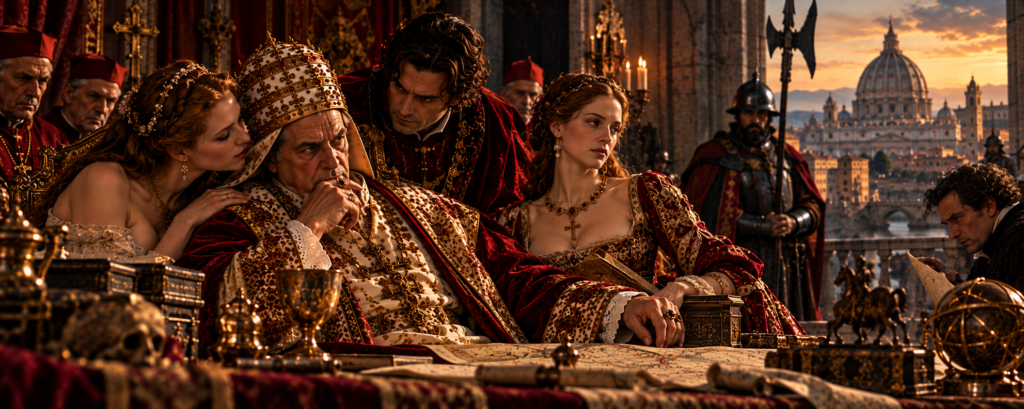
Alexander VI: The Borgia Pope Who Turned the Vatican Into a Family Empire
Alexander VI — 1492–1503
The Pope Who Made the Vatican a Family Kingdom
On the morning of August 18, 1503, Rome awakened to the news that Pope Alexander VI was dead. Behind the walls of the Vatican, servants, cardinals, soldiers, and courtiers confronted the sudden collapse of a political empire built around one extraordinarily ambitious family. The pope’s son Cesare Borgia, whose armies had conquered much of central Italy, was dangerously ill himself. The relatives and allies who had prospered under Alexander understood that the death of their protector might destroy everything they had accumulated.
Rumors began circulating almost immediately. Some claimed the pope had accidentally swallowed poison intended for a wealthy cardinal, while others described his body swelling and darkening in a manner supposedly revealing a violent death. Later writers embroidered the story with tales of poisoned wine, secret murders, and the terrible consequences of a lifetime spent eliminating enemies. The reality was probably less theatrical, although no less consequential: Alexander died after a sudden feverish illness during a season when malaria and other infections were common in Rome.
The rumors were believable because Rodrigo Borgia had spent eleven years creating a reputation unlike that of almost any other Renaissance pope. He openly acknowledged children born during his ecclesiastical career, promoted them into extraordinary positions, and used papal authority to build a territorial dynasty. His son Cesare abandoned the cardinalate to become a military commander, while his daughter Lucrezia entered a succession of marriages serving the family’s political ambitions. His pontificate witnessed assassinations, disputed disappearances, military campaigns, sexual scandals, political betrayals, and accusations of corruption reaching into the papal election itself.
Yet the most sensational stories about Alexander VI are not necessarily the most reliable. Accusations of incest involving Lucrezia, elaborate poisoning conspiracies, and the notorious Banquet of Chestnuts were shaped by hostile propaganda, scandal-loving chroniclers, and centuries of retelling. Some allegations remain impossible to verify, while others have been exaggerated far beyond the surviving evidence. The documented reality, however, is already extraordinary enough to explain why the Borgia name became synonymous with Renaissance corruption.
Alexander VI was not simply a pope who behaved badly. He was a brilliant political operator who treated the papacy as an instrument for constructing a family empire, using ecclesiastical appointments, marriage alliances, diplomacy, military force, and enormous financial resources to advance his children. His ambitions helped transform the political landscape of Italy, while his decisions concerning European expansion across the Atlantic had consequences reaching far beyond the Mediterranean. The story of his reign is therefore much larger than a collection of sexual scandals and suspicious deaths.
To understand how a man with such an openly unconventional private life became the head of the Catholic Church, it is necessary to return to a powerful family in fifteenth-century Spain.
Rodrigo Borgia: The Making of a Renaissance Prince
Rodrigo de Borja was born on January 1, 1431, in Xàtiva, near Valencia, in the Crown of Aragon. His family belonged to the Valencian nobility and possessed connections that would become increasingly valuable as Rodrigo advanced through the Church. The surname Borja was later Italianized into Borgia, the form that would become notorious throughout Europe. His early circumstances were comfortable enough to provide opportunities, but his family’s spectacular rise depended upon the career of one particularly influential relative.
That relative was Alfonso de Borja, Rodrigo’s maternal uncle, who became Pope Callixtus III in 1455. Alfonso had already established himself as a distinguished churchman and royal adviser before his election. Once he occupied the papal throne, he promoted members of his family with remarkable speed. Rodrigo became one of the greatest beneficiaries of this patronage.
Rodrigo studied law, including at Bologna, and developed the administrative abilities that would distinguish his career. He was intelligent, energetic, socially skilled, and unusually effective at cultivating influential relationships. His charm impressed contemporaries, while his appetite for wealth and pleasure became increasingly visible. He possessed the qualities of a successful Renaissance statesman, although his profession was supposedly dedicated to spiritual leadership.
The contrast between religious office and personal ambition would define his life. Rodrigo understood that ecclesiastical advancement offered opportunities unavailable to most secular nobles. A bishopric provided income, a cardinalate offered political influence, and high office within the papal administration could generate enormous wealth. He would spend decades mastering that system before attempting to control it completely.
Callixtus III and the Family’s First Papal Triumph
When Callixtus III became pope, Rodrigo’s career accelerated dramatically. In 1456, the young man was created a cardinal, despite being only twenty-five years old. The appointment placed him among the highest-ranking figures in the Church before he had accumulated the experience normally associated with such authority. His family connection mattered far more than his age.
Callixtus also promoted another nephew, Luis Juan de Milà, demonstrating that the advancement of relatives was central to his understanding of papal government. Such nepotism was hardly unique to the Borgias, but the family’s rise was particularly rapid. The pope used ecclesiastical appointments to strengthen a Valencian network within an Italian-dominated institution. His decisions created resentment among those who feared foreign influence.
Rodrigo’s most important appointment came in 1457, when he became vice-chancellor of the Church. The position placed him near the center of papal administration and gave him access to an enormous network of ecclesiastical business. He learned how documents, appointments, revenues, and diplomatic relationships moved through the Roman curia. The office would remain the foundation of his influence for decades.
Callixtus died in 1458, but Rodrigo survived the political backlash against his family. His ability to preserve his position demonstrated considerable skill. A less capable beneficiary of nepotism might have disappeared when his uncle died. Rodrigo instead transformed a fortunate appointment into a lasting political career.
The papal throne would eventually become his own, but the road to it required thirty-five years of patience.
The Cardinal Who Outlived His Rivals
Rodrigo served under five popes before becoming pontiff himself. During those decades, he accumulated benefices, strengthened alliances, and became one of the wealthiest members of the College of Cardinals. His residence in Rome reflected the magnificence expected of a Renaissance prince. He maintained a substantial household and cultivated a reputation for lavish hospitality.
His administrative position gave him influence over appointments and documents passing through the papal government. It also brought him into contact with rulers, ambassadors, and powerful Italian families. Rodrigo understood how to negotiate, flatter, threaten, and reward. He became indispensable to people seeking favors from Rome.
His political survival was remarkable because papal elections regularly transformed the balance of power. A cardinal closely associated with one pontiff might become vulnerable under the next. Rodrigo navigated these transitions through flexibility and careful relationship-building. He was willing to cooperate with men whose interests differed from his own.
His reputation for sexual misconduct did not prevent this advancement. Critics condemned his relationships with women, but his administrative value and political influence remained substantial. Renaissance church government often tolerated behavior that contradicted official religious ideals. Rodrigo exploited that contradiction more openly than most.
By the time Innocent VIII died in 1492, Rodrigo had become one of the most formidable candidates for the papacy.
Vannozza dei Cattanei: The Woman Behind the Borgia Dynasty
One of the most important relationships in Rodrigo’s life was with Vannozza dei Cattanei, a Roman woman who became the mother of four of his best-known children. Their relationship began while Rodrigo was a cardinal and continued through years in which he accumulated wealth and influence. Vannozza occupied an unusual position because her children would eventually become central figures in European politics. She was not merely a passing figure in the cardinal’s private life.
Rodrigo and Vannozza had four children generally recognized as theirs: Cesare, Juan, Lucrezia, and Jofré. Their births occurred during the 1470s and early 1480s, although some precise dates remain disputed. Rodrigo acknowledged and supported them, arranging education and opportunities appropriate to children he intended to advance. Their future became one of his principal concerns.
Vannozza herself entered marriages with other men, arrangements that helped provide social respectability and protection. Such marriages were not unusual within the complicated private lives of Renaissance elites. Rodrigo continued supporting the children, whose relationship to him was widely understood. The family arrangement reflected a world in which official moral rules and aristocratic practice often existed in uneasy separation.
Vannozza would live long enough to witness the extraordinary rise and eventual collapse of Borgia power. Her children became a cardinal, a duke, a duchess, and a prince connected to the Kingdom of Naples. Yet their advancement brought danger alongside prestige. The family she helped create would experience murder, imprisonment, exile, and political ruin.
Rodrigo’s affection for his children appears genuine, but it would become inseparable from his political ambitions.
Cesare, Juan, Lucrezia, and Jofré
The four children occupied different positions within Rodrigo’s dynastic plans. Cesare was initially directed toward an ecclesiastical career, while Juan was intended for secular power and military prestige. Lucrezia became a valuable figure in marriage negotiations, and Jofré was used to strengthen connections with the ruling dynasty of Naples. Each child represented a potential instrument of family advancement.
Cesare was intelligent, ambitious, and increasingly frustrated by the restrictions of church office. His temperament suited the violent politics of Renaissance Italy more naturally than the responsibilities of a bishop. Juan enjoyed his father’s favor and received titles that placed him among the aristocratic rulers of Europe. The rivalry between the brothers would later become one of the most troubling elements of Borgia history.
Lucrezia was educated within the sophisticated world of the papal court. She learned languages, participated in aristocratic society, and became familiar with the political expectations placed upon high-ranking women. Later legends would portray her as a poisoner and sexual conspirator, but contemporary evidence supports a more complicated figure. She was both a participant in family politics and someone whose marriages were repeatedly arranged according to the interests of powerful men.
Jofré was the youngest and often the least prominent of the four. His marriage into the Neapolitan royal family nevertheless made him important to Rodrigo’s diplomatic plans. His career demonstrates how even children who did not dominate the historical narrative could serve significant political purposes. The Borgia dynasty operated through the advancement of the entire family.
Rodrigo’s ambition was not simply to become pope, but to create a lasting political inheritance for his descendants.
Giulia Farnese and the Scandal of the Papal Bedroom
Rodrigo’s relationship with Giulia Farnese became one of the most famous sexual scandals of his later life. Giulia was a young noblewoman from the Farnese family, celebrated by contemporaries for her beauty. Their relationship developed while Rodrigo was approaching or had reached the papal throne. She became closely associated with the Borgia court.
Giulia was married to Orsino Orsini, whose family connections placed him within the Roman aristocracy. Her relationship with Rodrigo nevertheless became widely discussed. Contemporary observers understood that she enjoyed exceptional favor. The situation exposed the extraordinary gap between the pope’s official role and his private conduct.
Giulia’s brother Alessandro Farnese received a cardinalate in 1493. His advancement encouraged accusations that his sister’s relationship with Alexander had influenced the appointment. The association became so notorious that hostile observers mocked Alessandro with a nickname suggesting that his ecclesiastical career depended upon his sister’s beauty. The precise weight of Giulia’s influence cannot be measured, but the appearance of favoritism was unmistakable.
Alessandro would eventually become Pope Paul III in 1534. This meant that Alexander’s intimate relationships helped connect the Borgia story to another future pontificate. Renaissance papal politics repeatedly transformed private relationships into public power. The bedroom and the consistory were not always separate worlds.
Giulia’s story is therefore important not merely because it was scandalous, but because it illustrates how personal favor could become political advancement.
The Conclave of 1492: Was the Papacy Bought?
Pope Innocent VIII died on July 25, 1492, opening a conclave filled with powerful rivalries. Rodrigo Borgia entered the election as one of the wealthiest and most experienced cardinals. Giuliano della Rovere, the nephew of Sixtus IV, was among his principal rivals. Both men understood that the election would determine the future distribution of enormous ecclesiastical and political resources.
Rodrigo secured election on August 11, 1492, and chose the name Alexander VI. Accusations of simony appeared almost immediately. His opponents claimed that he had purchased votes through promises of offices, benefices, and other rewards. The most famous allegations involved Ascanio Sforza, whose support was particularly important.
The charge was plausible because Renaissance conclaves were deeply political, and Rodrigo possessed extensive resources for rewarding supporters. Evidence of negotiations and subsequent distributions of offices strengthens the suspicion that material inducements played a role. Nevertheless, the precise details of individual bargains remain difficult to establish. Historians should distinguish the strong probability of corrupt electoral bargaining from sensational accounts that claim to know every transaction.
Alexander’s election was therefore surrounded by a serious cloud of suspicion. Even if every accusation cannot be verified, the broader pattern reveals a conclave shaped by wealth, influence, and political exchange. The man who had spent decades mastering the papal administration now controlled it. His rivals had lost, but they would not necessarily accept defeat quietly.
The election created a pope with extraordinary political skills and an equally extraordinary collection of enemies.
A Pope Who Knew How to Govern
Alexander’s reputation for corruption can obscure the fact that he was an effective administrator. He understood the machinery of papal government better than many men who had occupied the throne before him. His decades as vice-chancellor had given him experience in diplomacy, finance, and ecclesiastical procedure. He could be decisive when circumstances required it.
Early in his pontificate, Alexander attempted to improve public order in Rome. The city suffered from factional violence, and powerful noble families often behaved as though papal authority barely existed. He reorganized aspects of judicial administration and supported measures intended to strengthen security. These efforts complicate the image of a ruler concerned only with pleasure.
He also invested in the defense of the papal capital. Castel Sant’Angelo, the great fortress beside the Tiber, became increasingly important as political tensions intensified. Alexander understood that Rome could become vulnerable to invasion or rebellion. His later experiences would prove that concern justified.
Yet his administrative ability served two purposes. It strengthened the papal government while also providing the resources necessary for his family ambitions. Alexander was not an incompetent ruler accidentally surrounded by scandal. He was a capable political operator who deliberately placed dynastic interests near the center of his government.
That combination made him more formidable than a merely corrupt or pleasure-loving pope.
The Borgia Apartments: Splendor Behind the Vatican Walls
Alexander commissioned lavish decoration for his private apartments in the Vatican. The painter Pinturicchio and his workshop created an elaborate cycle of frescoes combining religious subjects, classical imagery, and symbols associated with Borgia authority. The rooms reflected the pope’s wealth, taste, and desire for magnificence. They also helped establish the visual identity of his pontificate.
The apartments became associated with the private world of the Borgia family. Their decoration offered a setting appropriate to a Renaissance prince rather than a humble spiritual shepherd. Rich colors, intricate ornament, and sophisticated imagery celebrated the pope’s position. The symbolism reinforced the authority of the man who occupied the rooms.
Artistic patronage was an important feature of Renaissance papal government. Earlier popes had commissioned magnificent buildings and paintings, while later pontiffs would transform Rome even more dramatically. Alexander participated in this tradition. His artistic interests were genuine, even if his political conduct invited criticism.
The contrast between sacred imagery and private scandal would become irresistible to later writers. The same rooms that displayed religious scenes became associated with stories of sexual excess and intrigue. Some of those stories were exaggerated, but the symbolism remained powerful. The Vatican had become both a spiritual capital and the residence of an ambitious ruling family.
Alexander’s court possessed the magnificence of a monarchy without abandoning the authority of the papacy.
The First Borgia Marriage: Lucrezia and Giovanni Sforza
Lucrezia Borgia’s first marriage was arranged in 1493, when she was still very young. Her husband, Giovanni Sforza, belonged to the powerful Sforza family and ruled Pesaro. The marriage strengthened Alexander’s relationship with Milanese interests. It was a political arrangement rather than a union based primarily upon personal choice.
Lucrezia entered the marriage as a teenager whose father had recently become pope. Her position made her extraordinarily valuable in diplomatic negotiations. The Borgia family could offer access to Rome, while the Sforza connection provided important political support. The arrangement reflected the unstable alliances of Renaissance Italy.
The marriage soon became inconvenient. As Alexander’s political priorities changed, the Sforza connection lost much of its value. The pope and Cesare increasingly favored different alliances. Giovanni Sforza found himself in a dangerous position because his marriage had become an obstacle to the family’s plans.
The eventual dissolution of the marriage would produce some of the most notorious accusations in Borgia history. Giovanni resisted efforts to annul the union and retaliated with scandalous claims. His allegations would help create the enduring myth of incest within the Borgia family. The historical evidence, however, is far less decisive than the legend suggests.
Lucrezia’s first marriage demonstrates how dynastic ambition could destroy personal relationships when political circumstances changed.
The French Invasion That Nearly Destroyed the Papacy
In 1494, King Charles VIII of France invaded Italy with a powerful army. His objective was the Kingdom of Naples, which he claimed through Angevin inheritance. The invasion transformed Italian politics and exposed the vulnerability of states that had long relied upon shifting alliances. Alexander found himself caught between powerful foreign ambitions.
The French army advanced rapidly through Italy. Its artillery and military organization shocked observers accustomed to the fragmented warfare of Italian states. Rulers who had expected to negotiate from positions of strength suddenly confronted overwhelming force. The invasion marked the beginning of the Italian Wars, a prolonged series of conflicts that would reshape Europe.
Alexander’s relationship with Charles was deeply uncertain. The French king possessed allies among the pope’s enemies, including Giuliano della Rovere. Some opponents hoped Charles might pressure Alexander into resignation or support a council challenging his legitimacy. The pope faced the possibility that foreign military power could be used against him.
Charles entered Rome at the end of 1494. Alexander negotiated under intense pressure, balancing concessions against the need to preserve his office. The encounter revealed the limits of papal political power. Even a skilled pope could be forced into dangerous compromises when confronted by a foreign army.
Alexander survived the crisis, but the invasion changed the course of his reign.
Rome Under the Shadow of Charles VIII
The French occupation of Rome placed Alexander in an extraordinarily vulnerable position. Charles VIII arrived with an army capable of intimidating the papal government. His supporters included men hostile to the Borgia pope. The possibility of deposition or forced concessions hung over the negotiations.
Alexander sought refuge and security while maintaining diplomatic contact with the French king. The negotiations involved political guarantees, military passage, and the fate of Cem Sultan, the Ottoman prince held in papal custody. Charles wanted control of Cem because the prince might prove useful in a future campaign against the Ottomans. Alexander eventually surrendered him to the French.
The episode illustrates the brutal realities of Renaissance diplomacy. Cem had spent years as a valuable hostage whose presence generated money and influence. Now his custody became a bargaining chip in a confrontation between pope and king. The prince’s own wishes mattered little.
Cem died in 1495 while accompanying the French expedition. Rumors of poisoning circulated, and later accounts sometimes implicated the Borgias. The evidence does not establish that Alexander arranged his death. Illness and the hardships of the campaign offer plausible explanations.
The pope emerged from the confrontation weakened but still in office. His political survival demonstrated considerable skill, even as the crisis exposed the dangers surrounding his family.
The Holy League and the Reversal of Fortune
After Charles VIII advanced toward Naples, Italian rulers began organizing resistance. Alexander joined the League of Venice in 1495, aligning the papacy with powers determined to check French expansion. The coalition included Venice, Milan, Spain, and the Holy Roman emperor. Its formation reflected widespread fear that France might dominate the peninsula.
Charles eventually withdrew northward. The Battle of Fornovo in July 1495 became a contested encounter in which both sides claimed elements of success. The French army continued its retreat, while the coalition presented the campaign as a defense of Italian independence. Alexander had survived the immediate threat.
The episode strengthened his confidence in diplomatic maneuvering. He had negotiated with Charles when necessary and joined his enemies when circumstances changed. Such flexibility was characteristic of Renaissance statecraft. It also reinforced the perception that papal policy served political survival rather than consistent principle.
The invasion had lasting consequences. Italy became a battleground for French and Spanish ambitions, and the papacy would repeatedly be forced to choose sides. Alexander increasingly understood that his family’s future depended upon military strength. Cesare Borgia would eventually become the instrument of that ambition.
The Borgia dynasty was moving toward open territorial conquest.
Juan Borgia: The Favored Son
Juan Borgia, often called Giovanni in Italian sources, was Alexander’s son and the recipient of important secular honors. He inherited the title Duke of Gandía, connecting the family to Spanish aristocratic power. Alexander intended him to become a major military and political figure. His advancement reflected the pope’s determination to establish a durable dynasty.
Juan received military responsibilities despite questions about his experience and ability. His campaigns did not produce the kind of success Alexander had hoped for. Contemporary observers sometimes criticized his conduct and judgment. The pope nevertheless continued favoring him.
The relationship between Juan and Cesare has attracted enormous speculation. Later writers imagined bitter jealousy between the brothers, especially because Cesare had been directed toward the Church while Juan enjoyed secular power. Some rivalry is plausible within such an ambitious family. Yet the precise emotional dynamics cannot be reconstructed confidently.
Juan’s position remained privileged until a sudden catastrophe in 1497. His death would become one of the great unsolved murders of Renaissance Rome. The event devastated Alexander and transformed the family’s future. It also opened the way for Cesare to pursue a very different career.
The murder remains one of the most compelling mysteries of the Borgia story.
The Murder of Juan Borgia
On the night of June 14, 1497, Juan Borgia disappeared in Rome. He had spent part of the evening in the company of relatives and acquaintances before separating from them. When he failed to return, concern spread through the papal household. Alexander ordered a search.
Juan’s body was eventually recovered from the Tiber. He had suffered multiple stab wounds, and his clothing and possessions suggested that robbery was not the obvious motive. The murder appeared deliberate. The discovery plunged the pope into grief.
Contemporary reports describe Alexander reacting with extraordinary anguish. He withdrew from ordinary business and expressed horror at the killing. His grief appears genuine, even allowing for the ceremonial language used in descriptions of papal mourning. The murder struck at the center of his dynastic ambitions.
The identity of the killer remains uncertain. Suspicion fell upon various enemies, including members of the Orsini family and men connected to political rivalries. Later tradition increasingly accused Cesare of murdering his brother out of jealousy. That accusation became famous but has never been conclusively established.
The murder is a genuine historical mystery, not a solved case concealed beneath Borgia legend.
Did Cesare Murder His Brother?
The theory that Cesare killed Juan became one of the most enduring accusations against the Borgia family. Its dramatic appeal is obvious. Cesare had been pushed into an ecclesiastical career, while Juan received military titles and his father’s favor. Juan’s death eventually allowed Cesare to pursue the secular ambitions he had long desired.
Yet motive alone does not establish guilt. The surviving evidence does not identify Cesare as the murderer beyond reasonable doubt. Contemporary suspicions were varied, and later accounts often relied upon political hostility or retrospective interpretation. The accusation should therefore remain a theory rather than a fact.
Other possible motives existed. Juan’s relationships and political activities may have created enemies. The Orsini and other Roman families had reasons to resent Borgia power. Personal disputes could also have played a role.
Alexander’s failure to identify and punish the murderer deepened the mystery. A pope with extensive resources and political authority could not produce a convincing public resolution. The crime became a permanent wound in the family’s history. It also helped create the atmosphere of suspicion that later surrounded every Borgia death.
The truth remains hidden behind the violence of Renaissance Rome.
Alexander’s Moment of Grief and Promised Reform
Juan’s murder briefly produced an extraordinary change in Alexander’s public behavior. The pope expressed grief and spoke of reforming the Church. He acknowledged the need to address abuses within ecclesiastical government. The moment suggested that personal tragedy might lead to institutional transformation.
A reform commission was established, and proposals were discussed concerning clerical conduct, financial practices, and administrative abuses. The effort reflected problems that had troubled the papacy for generations. Nepotism, venality, and moral scandal were increasingly difficult to ignore. Alexander appeared willing to confront at least some of them.
Yet the reform initiative produced little lasting change. Political pressures and family ambitions soon regained their importance. The pope’s attention returned to alliances, appointments, and territorial strategy. The opportunity for meaningful reform passed.
The episode is revealing because it demonstrates that Alexander was not entirely indifferent to the moral problems surrounding his office. He could recognize corruption and express a desire to address it. His failure lay in the inability or unwillingness to subordinate dynastic interests to reform. The same man who mourned his son would soon devote even greater energy to building a family state.
Grief changed the direction of Borgia ambition, but it did not end it.
Cesare Borgia: The Cardinal Who Wanted a Sword
Cesare had been placed on an ecclesiastical path while still young. He received important church offices and became a cardinal in 1493. His advancement was extraordinary, reflecting his father’s determination to provide him with wealth and influence. Yet Cesare’s ambitions increasingly pointed toward military and political power.
After Juan’s death, Cesare’s position changed. The family needed a capable secular leader, and Cesare possessed qualities that suited the role. He was intelligent, ruthless, energetic, and skilled at exploiting political opportunities. His reputation for personal ambition was formidable.
In 1498, Cesare resigned the cardinalate. The decision was unprecedented in its circumstances and deeply revealing of the Borgia family’s priorities. A man who had occupied one of the Church’s highest offices abandoned it to pursue territorial conquest. His father’s support made the transformation possible.
Cesare traveled to France and entered negotiations with King Louis XII. The new French king wanted papal assistance with the annulment of his marriage to Jeanne of France so he could marry Anne of Brittany. Alexander’s cooperation became part of a wider diplomatic bargain. Cesare would receive French support for his political ambitions.
The former cardinal was becoming a prince of war.
The French Alliance and the Duke of Valentinois
Cesare’s negotiations with Louis XII transformed his prospects. The French king granted him the title Duke of Valentinois, from which the nickname Valentino emerged. Cesare also married Charlotte d’Albret, connecting himself to French aristocratic interests. The marriage strengthened the alliance between the Borgias and the French crown.
Alexander supported the arrangement because French military power could help establish Cesare as a territorial ruler in Italy. The pope wanted to strengthen control over the Papal States, where local dynasties often exercised considerable independence. Cesare’s campaigns could be presented as the recovery of legitimate papal authority. At the same time, conquered territories could become the foundation of a Borgia principality.
The arrangement illustrates the central contradiction of Alexander’s government. Strengthening papal control over rebellious territories could serve legitimate institutional interests. Yet the military commander responsible was the pope’s son, whose personal dynasty stood to benefit. The interests of the Church and the Borgia family were deliberately intertwined.
Cesare returned to Italy with French support and growing confidence. He possessed military resources, diplomatic connections, and the backing of the pope. His enemies would soon discover that the former cardinal had become a dangerous opponent. The Borgia family was entering its most aggressive phase.
Lucrezia’s First Marriage Is Destroyed
While Cesare pursued military power, Lucrezia’s marriage to Giovanni Sforza became politically inconvenient. The alliance with Milanese interests no longer served Alexander’s changing strategy. The pope wanted to dissolve the marriage and use Lucrezia in a new arrangement. Giovanni resisted.
The annulment proceedings centered upon the claim that the marriage had not been consummated. Giovanni denied the implication that he was incapable of consummating the union. The dispute became humiliating and politically dangerous. Eventually, under pressure, he accepted the annulment in 1497.
Giovanni retaliated with allegations that would haunt the Borgia family for centuries. He accused Alexander of wanting Lucrezia for himself, helping spread the claim of an incestuous relationship. Such accusations were politically useful because they transformed a dynastic dispute into a scandal capable of destroying reputations. They also appealed to an audience already suspicious of the pope’s sexual conduct.
The evidence does not establish that Alexander had an incestuous relationship with Lucrezia. Giovanni had obvious reasons to damage the family that had humiliated him. Later writers repeated and embellished the accusations, often treating hostile claims as proven fact. Responsible history must preserve the distinction.
Lucrezia emerged from the annulment with her reputation damaged by accusations she had little power to control.
The Mystery of the Roman Infant
Another scandal developed around a child known as Giovanni Borgia, sometimes called the Roman Infant. Papal documents issued in 1501 created extraordinary confusion concerning his parentage. One bull identified Cesare as the father, while another attributed paternity to Alexander himself. The contradictory documents became a source of speculation.
Later writers suggested that the child might have been Lucrezia’s son, possibly conceived through an incestuous relationship. These theories became part of the wider mythology surrounding the family. Yet the surviving evidence does not establish Lucrezia as the mother. The child’s parentage remains disputed.
The episode is important because the confusion was not invented entirely by later enemies. The papal documents themselves contain contradictory claims. Such inconsistencies suggest efforts to manage the child’s legal status or protect particular interests. They do not, however, reveal a clear and complete account of the circumstances.
The scandal demonstrates how the Borgias’ own secrecy encouraged hostile interpretation. When powerful families concealed relationships or manipulated official documents, observers naturally suspected wrongdoing. Political enemies could then fill the gaps with sensational allegations. The resulting stories often became more famous than the limited facts from which they emerged.
Giovanni Borgia remains a genuine historical puzzle rather than proof of incest.
Lucrezia’s Second Marriage: Alfonso of Aragon
After the annulment of her first marriage, Lucrezia married Alfonso of Aragon in 1498. Alfonso was an illegitimate son of Alfonso II of Naples and belonged to the Neapolitan royal family. The marriage reflected Alexander’s shifting political alliances. It also offered Lucrezia a husband closer to her own age.
Contemporary accounts suggest that Lucrezia and Alfonso developed a genuine attachment. Their marriage produced a son, Rodrigo. For a time, the relationship appeared to offer greater personal stability than her first marriage. Yet the political environment surrounding them remained dangerous.
The alliance with Naples soon became inconvenient as Alexander and Cesare strengthened their relationship with France. Alfonso’s family connections placed him on the wrong side of the changing political landscape. He became increasingly vulnerable. His position within the Vatican no longer guaranteed protection.
In July 1500, Alfonso was attacked and seriously wounded in Rome. He survived the initial assault but remained in danger. Lucrezia reportedly cared for him during his recovery. The violence had transformed another Borgia marriage into a political crisis.
The final outcome would be devastating.
The Murder of Alfonso of Aragon
Alfonso of Aragon was murdered in August 1500 after surviving an earlier attack. The circumstances strongly implicate men connected to Cesare Borgia, particularly his associate Michelotto Corella. Contemporary observers widely suspected Cesare’s responsibility. The killing served the political interests of a family moving away from Naples and toward France.
The precise sequence of decisions remains uncertain, but the evidence of Borgia involvement is considerably stronger than in many other alleged family murders. Alfonso had become politically inconvenient. Cesare possessed both motive and the means to eliminate him. The killing occurred within a court dominated by the pope and his son.
Lucrezia’s reaction was reportedly one of profound distress. She had already endured the humiliating destruction of her first marriage. Now her second husband had been violently killed. Her personal life had become a casualty of the family’s political calculations.
Alexander’s responsibility is more difficult to define precisely. The murder occurred under his authority, and his son was strongly implicated. Whether the pope ordered it, approved it in advance, or tolerated it afterward remains debated. His failure to bring the perpetrators to meaningful justice nevertheless reveals the protection enjoyed by powerful members of his family.
The death of Alfonso stands among the darkest documented episodes of Borgia history.
Savonarola: The Preacher Who Denounced Rome
Girolamo Savonarola was a Dominican friar whose preaching transformed Florence during the 1490s. He condemned luxury, corruption, sexual immorality, and the moral failures of the Church. His sermons attracted large audiences and helped shape the political atmosphere after the expulsion of the Medici in 1494. Savonarola believed Florence had a providential role in the renewal of Christianity.
His criticism of Rome brought him into conflict with Alexander VI. The pope’s private life and family ambitions made him an obvious target for a preacher demanding moral reform. Savonarola’s followers regarded him as a prophetic voice. His enemies considered him a dangerous fanatic.
The dispute was not simply a confrontation between holiness and corruption. Savonarola was deeply involved in Florentine politics and made controversial claims about prophecy and divine judgment. His influence threatened established interests, while his support for the French complicated relations with Rome. Alexander had political as well as religious reasons to oppose him.
The conflict escalated through warnings, restrictions, and demands that Savonarola submit to papal authority. The friar resisted in various ways, insisting upon the legitimacy of his mission. His defiance became increasingly difficult for the pope to tolerate. The struggle would end with one of the most famous executions of the Renaissance.
Excommunication and the Fall of Savonarola
Alexander excommunicated Savonarola in 1497. The measure reflected the breakdown of relations between the preacher and papal authority. Savonarola continued challenging the moral legitimacy of the pope and sought support for broader ecclesiastical reform. His position became increasingly precarious.
In Florence, political opposition to Savonarola grew. His influence depended upon a coalition that could not remain united indefinitely. Economic problems, factional disputes, and frustration with his religious program weakened his supporters. The city became increasingly divided.
In 1498, Savonarola was arrested and subjected to interrogation involving torture. His statements under coercion must be interpreted cautiously. He was eventually condemned alongside two Dominican companions. The proceedings involved both Florentine authorities and papal representatives.
On May 23, 1498, Savonarola and his companions were executed in Florence. They were hanged and their bodies burned in the Piazza della Signoria. The execution destroyed the preacher’s political movement but did not end debate over his legacy. Supporters later remembered him as a martyr to reform, while opponents regarded him as a dangerous religious agitator.
Alexander had defeated one of his most outspoken critics, but the moral questions Savonarola raised would survive.
Cesare’s War for the Romagna
By 1499, Cesare Borgia was ready to pursue territorial conquest on a major scale. The Romagna contained numerous cities whose rulers exercised power while formally owing allegiance to the papacy. Alexander and Cesare argued that these territories should be brought under effective papal control. The campaign offered a legal justification for military expansion.
Cesare received French assistance and assembled forces capable of confronting local rulers. His campaigns targeted cities including Imola, Forlì, Rimini, Pesaro, and Faenza. Some rulers fled, while others resisted. The speed of his successes impressed observers.
The conquest of Imola and Forlì brought Cesare into conflict with Caterina Sforza, one of the most formidable women of Renaissance Italy. Caterina defended her position with determination but eventually lost her territories. Cesare’s forces captured Forlì in January 1500. Her defeat became an important symbol of the Borgia advance.
Cesare’s military career demonstrated considerable ability. He understood the importance of artillery, diplomacy, intimidation, and rapid movement. He also benefited enormously from French support and his father’s authority. His victories were therefore products of both personal skill and exceptional political privilege.
The former cardinal was becoming one of Italy’s most feared commanders.
Caterina Sforza and the Fall of Forlì
Caterina Sforza had inherited a dangerous political position after the assassination of her husband Girolamo Riario in 1488. She defended the interests of her children and ruled with considerable determination. Her reputation for courage and defiance made her famous throughout Italy. She was not easily intimidated.
Cesare’s campaign threatened the territories she had fought to preserve. Imola and Forlì became targets of Borgia expansion. Caterina attempted to resist through military preparation and diplomacy. Her position, however, was weakened by the scale of the forces assembled against her.
The siege of Forlì ended in Cesare’s victory. Caterina was captured and eventually transferred into custody. Her defeat removed one of the most prominent independent rulers in the region. It also demonstrated the ruthless efficiency of Cesare’s campaign.
Later accounts sometimes describe sensational episodes involving Caterina and Cesare, including allegations of sexual violence. The surviving evidence is difficult and contested, and such claims should not be repeated as unquestioned fact. The documented conquest and imprisonment are already significant. Caterina lost her political power because the Borgia family possessed superior military and diplomatic resources.
Her fall marked another step toward the territorial empire Alexander hoped to create for his son.
The Prince Who Inspired Machiavelli
Cesare Borgia’s career attracted the attention of Niccolò Machiavelli, the Florentine diplomat and political thinker. Machiavelli encountered Cesare during diplomatic missions and observed his methods closely. The former cardinal’s combination of ambition, calculation, and violence made him an extraordinary subject. His actions later influenced discussions in The Prince.
Machiavelli did not simply celebrate Cesare as an ideal ruler. He examined the relationship between political skill, fortune, military strength, and the ability to control circumstances. Cesare possessed remarkable qualities but depended heavily upon the power of his father and foreign allies. His eventual failure demonstrated the dangers of that dependence.
The Borgia campaigns offered examples of decisive action and calculated brutality. Cesare understood that local rulers could be intimidated, isolated, or destroyed. He also recognized the importance of appearing to restore order after conquest. His methods combined violence with political theater.
Alexander supported these campaigns because they promised to strengthen both papal authority and Borgia dynastic power. The pope could describe the conquest as recovery of Church territory. Cesare could use the same victories to construct his own principality. Their interests overlapped so completely that distinguishing them became increasingly difficult.
Machiavelli recognized the political significance of this experiment, even as its moral implications remained disturbing.
Ramiro de Lorqua and the Body in the Square
One of the most famous episodes associated with Cesare’s government involved Ramiro de Lorqua, also known as Ramiro d’Orco. Cesare appointed him to impose order in conquered territories. Ramiro developed a reputation for harshness and severe punishment. His methods helped establish control but also generated resentment.
In December 1502, Ramiro was found executed and displayed in the public square of Cesena. His body had been cut in two, creating a terrifying spectacle. The execution was widely interpreted as a deliberate demonstration of Cesare’s authority. The man who had enforced harsh rule was suddenly presented as its victim.
Machiavelli later used the episode to illustrate the political value of separating necessary cruelty from the ruler who benefits from it. Cesare could employ a severe official to establish order and then eliminate him to satisfy public anger. Whether every detail of that interpretation reflects Cesare’s actual intentions remains uncertain. The political effect, however, was unmistakable.
The episode belongs primarily to Cesare’s record rather than Alexander’s personal conduct. Yet the pope’s support enabled the system of conquest within which such violence occurred. The Borgia dynasty relied upon methods that combined military force, intimidation, and calculated displays of power. Ramiro’s death became one of the most chilling symbols of that political culture.
The Conspiracy at Magione
Cesare’s rapid expansion alarmed other Italian rulers and military commanders. Men who had once cooperated with him began fearing that they might become his next victims. In 1502, several opponents gathered at Magione to organize resistance. Their conspiracy threatened the foundations of his growing power.
The participants included members of the Orsini family and other figures who had reasons to distrust Cesare. They sought to coordinate military opposition and prevent further Borgia expansion. Their alliance reflected the fear created by Cesare’s success. The former cardinal had become too powerful for his neighbors to ignore.
Cesare responded through a combination of diplomacy and deception. He negotiated with some conspirators while rebuilding his military position. His apparent willingness to reconcile encouraged opponents to lower their guard. The situation created an opportunity for retaliation.
The conspiracy would culminate in one of the most notorious episodes of Cesare’s career. His enemies believed they had secured an agreement. Cesare intended to destroy them. The resulting events at Senigallia would become famous as an example of calculated political treachery.
Alexander’s family empire was being defended through methods far removed from ordinary ecclesiastical government.
Senigallia: The Trap Closes
At the end of December 1502, Cesare moved against several former allies at Senigallia. The men included Vitellozzo Vitelli, Oliverotto da Fermo, and members of the Orsini faction. They believed they were entering negotiations or reconciliation with Cesare. Instead, they were seized.
Vitellozzo and Oliverotto were executed shortly afterward. The Orsini prisoners faced imprisonment and later death. The operation eliminated important opponents and demonstrated Cesare’s willingness to use deception as a political weapon. It also terrified other rulers who feared similar treatment.
Machiavelli observed the broader political situation and later described Cesare’s methods with considerable interest. The episode became central to the reputation of the Borgia prince as a master of calculated violence. His success depended upon persuading enemies that reconciliation was possible before destroying them. The strategy was effective but morally brutal.
Alexander’s role in the wider campaign remains important. The pope supported Cesare’s territorial ambitions and used ecclesiastical authority to weaken hostile families. The elimination of the Orsini faction served both papal and dynastic interests. The violence was therefore not merely the independent adventure of an ambitious son.
The Borgia family was approaching the height of its power.
The Orsini Purge
The Orsini were one of Rome’s most powerful aristocratic families. Their territories, castles, and political connections made them formidable opponents of papal centralization. Alexander and Cesare increasingly regarded them as obstacles to Borgia expansion. The conspiracy against Cesare provided an opportunity for retaliation.
In early 1503, Cardinal Giovanni Battista Orsini was arrested. He died while imprisoned in Castel Sant’Angelo. Rumors of poisoning circulated, as they did after many politically convenient deaths during the Borgia pontificate. The evidence does not establish poisoning as the cause.
Other members of the Orsini faction were executed or dispossessed. Their territories became targets for Borgia control. The campaign weakened one of the great Roman families and strengthened the pope’s position. It also deepened the atmosphere of fear surrounding the Vatican.
The Orsini purge illustrates the political violence that can be documented without relying upon legendary poisonings. Powerful opponents were arrested, imprisoned, executed, or stripped of their possessions. Alexander’s government used its authority to reshape the balance of power in central Italy. The family dynasty was becoming a territorial state.
Yet the very speed of its rise concealed a fatal weakness.
Lucrezia’s Third Marriage: From Scandal to Ferrara
Lucrezia’s third marriage was arranged in 1501, when she became the wife of Alfonso d’Este, heir to the Duchy of Ferrara. The negotiations were complicated because the Este family understood the scandal surrounding the Borgias. They demanded substantial financial concessions and political guarantees. Alexander was willing to pay for a prestigious alliance.
The marriage transformed Lucrezia’s position. Ferrara offered a court with established aristocratic traditions and greater distance from the violent politics of Rome. She eventually became duchess of Ferrara and developed a reputation for cultural patronage, religious devotion, and capable administration. Her later life complicates the image of a woman supposedly defined by poison and sexual scandal.
Lucrezia was not entirely powerless during her father’s pontificate. Alexander entrusted her with responsibilities in his absence, including administrative duties that demonstrated confidence in her judgment. She understood the political world around her and could act within it. Yet her marriages were repeatedly determined by the family’s changing alliances.
Her move to Ferrara also proved fortunate. When Alexander died and Cesare’s power collapsed, Lucrezia remained protected by her position within the Este dynasty. She outlived the political catastrophe that destroyed much of her family’s empire. Her later reputation in Ferrara differed sharply from the lurid stories attached to her youth.
The historical Lucrezia was far more complex than the legendary poisoner of popular imagination.
The Legend of Lucrezia Borgia the Poisoner
Lucrezia’s name became associated with poisoned rings, secret compartments, and elaborate murders. Later novels, plays, and operas transformed her into a beautiful and deadly conspirator. The image proved irresistible because it combined sexuality, aristocratic intrigue, and the notorious Borgia reputation. Yet reliable evidence for her personal involvement in poisoning plots is lacking.
The legend developed partly through the family’s political enemies. Lucrezia’s marriages, the murder of Alfonso of Aragon, and the scandal surrounding the Roman Infant provided material for hostile interpretation. Writers connected these events into narratives of sexual corruption and murder. The resulting character bore only a partial resemblance to the historical woman.
Poisoning certainly occurred in Renaissance Europe, and fears of secret poisoning were widespread. Powerful families employed physicians, servants, and agents whose access to food and medicine could create opportunities for murder. Yet the existence of poisoning as a political method does not prove that Lucrezia used it. Specific accusations require specific evidence.
Her documented career includes political marriages, family loyalty, administrative responsibilities, and later cultural patronage. She was implicated in a dangerous political world but cannot simply be described as a serial poisoner. The distinction matters because sensational myths have often erased her actual life. The Borgia story becomes more interesting when its women are treated as historical people rather than gothic inventions.
The Banquet of Chestnuts
One of the most notorious stories associated with Alexander VI concerns an alleged gathering held in the Vatican in 1501. According to the account, courtesans attended an evening entertainment involving sexual contests and prizes. Chestnuts were supposedly scattered across the floor during the festivities. The episode became known as the Banquet of Chestnuts.
The principal source is the diary associated with Johann Burchard, the papal master of ceremonies. Burchard recorded many events at the papal court and remains an important witness to the period. Yet the banquet account presents difficulties concerning transmission, context, and reliability. Historians disagree about how confidently it can be treated as a factual description.
Even if some form of scandalous entertainment occurred, the most sensational details cannot be independently verified. Later writers embellished the episode and used it as proof of complete moral collapse within the Vatican. The story became especially attractive to critics who wished to portray the papacy as irredeemably corrupt. Its popularity often exceeded the strength of the evidence.
Alexander’s documented sexual conduct and family politics provide substantial grounds for criticism. There is no need to treat every lurid anecdote as established truth. The Banquet of Chestnuts belongs in the story because it shaped the Borgia legend, but it should be presented with clear historical caution. Its uncertain details must not be confused with documented events.
The difference between scandal and evidence is particularly important when dealing with the Borgias.
Incest: The Accusation That Would Not Die
Accusations of incest became central to the mythology surrounding Alexander, Cesare, and Lucrezia. The claims emerged in an environment of bitter political rivalry and personal humiliation. Giovanni Sforza’s reaction to the annulment of his marriage helped spread allegations against the family. Later enemies repeated and expanded them.
The accusations were devastating because they attacked the moral legitimacy of the pope at the most intimate level. A pontiff who already acknowledged children and maintained controversial relationships was vulnerable to further sexual scandal. Political opponents understood that incest allegations could destroy reputations even without proof. The claims became weapons.
Modern historians generally treat the most sensational incest stories with substantial skepticism. The surviving evidence does not establish sexual relationships between Alexander and Lucrezia or between Cesare and his sister. The contradictory documents concerning Giovanni Borgia have encouraged speculation but do not resolve the matter. Rumor cannot substitute for proof.
This does not mean the Borgia household was free of sexual misconduct or manipulation. Alexander’s relationships with women are documented, and his daughter’s marriages were shaped by dynastic interests. The family operated within a political culture that often subordinated personal autonomy to ambition. Those realities are serious enough without inventing incest.
The persistence of the accusations reveals how thoroughly the Borgias became symbols of forbidden desire and moral corruption.
Poison: The Borgia Family’s Most Famous Weapon
Poison became almost inseparable from the Borgia name. Later stories described secret powders, poisoned wine, contaminated rings, and elaborate methods of eliminating wealthy cardinals. The substance sometimes called cantarella acquired a legendary association with the family. Alexander and Cesare were portrayed as masters of invisible murder.
The historical evidence is far less straightforward. Sudden deaths were common in Renaissance Italy because of infectious disease, poor sanitation, contaminated food, and limited medical knowledge. Political enemies frequently interpreted unexpected deaths as poisoning. The Borgias’ reputation made them particularly vulnerable to such accusations.
Some deaths during Alexander’s pontificate were unquestionably violent or suspicious. Alfonso of Aragon was murdered, Juan Borgia was assassinated, and political opponents died in custody or after capture. Yet documented violence does not prove every alleged poisoning. Each case requires separate examination.
The legend of universal Borgia poisoning developed partly because it offered a convenient explanation for political success. Whenever an enemy died, the family could be blamed. Such accusations were difficult to disprove and easy to repeat. Over time, suspicion hardened into popular certainty.
The documented Borgia methods were often more direct than poison: armies, imprisonment, execution, intimidation, and political betrayal.
The Jubilee of 1500
Alexander presided over the Jubilee of 1500, an important religious event that attracted pilgrims to Rome. The holy year emphasized repentance, pilgrimage, and spiritual renewal. It also provided an opportunity for the papacy to display its authority and magnificence. The city prepared for large numbers of visitors.
The Jubilee became associated with the ceremonial opening of the Holy Door at St. Peter’s Basilica. Alexander participated in the rituals that helped establish traditions later continued by his successors. The ceremonies demonstrated his capacity to perform the spiritual responsibilities of his office. His public role as pope remained significant despite the scandals surrounding his family.
Pilgrims encountered a Rome filled with churches, relics, processions, and religious observances. They also entered a city dominated by political factions and the ambitions of the Borgia dynasty. The contrast between sacred ceremony and secular power was particularly visible. Alexander moved between these worlds without apparent difficulty.
The Jubilee illustrates why his pontificate cannot be reduced to a simple story of irreligion. Alexander was capable of supporting religious ceremonies and institutional traditions. He did not need to reject Christianity in order to abuse ecclesiastical power. The contradiction lay in using the same office for spiritual leadership and family conquest.
His reign demonstrated that religious belief and political corruption could coexist within a single ruler.
The Pope Who Claimed Lands Across the Ocean
One of Alexander’s most consequential decisions occurred in 1493, when he issued papal bulls addressing Spanish and Portuguese claims to territories reached through Atlantic exploration. Christopher Columbus had returned from his first voyage, and the Spanish monarchy sought recognition of its rights. Portugal possessed competing interests based upon earlier exploration and papal grants. The dispute threatened relations between two powerful Catholic kingdoms.
Alexander’s bulls, including Inter caetera, supported Castilian claims to lands beyond a specified Atlantic line, subject to existing Christian claims and obligations concerning conversion. The documents reflected a European assumption that papal authority could help determine rights over territories inhabited by non-Christian peoples. Indigenous sovereignty was not treated as an equal consideration. The implications were enormous.
The Spanish and Portuguese monarchies subsequently negotiated the Treaty of Tordesillas in 1494, shifting the line of demarcation farther west. The treaty was an agreement between the crowns rather than simply a papal decree. Its consequences helped shape the later division of colonial expansion, including Portuguese claims in Brazil. Alexander’s intervention formed part of the legal and diplomatic framework.
The moral problem extends beyond European rivalry. The territories involved were already inhabited by societies possessing their own governments, cultures, religions, and political relationships. European rulers claimed authority over lands they had not previously controlled. Papal language concerning evangelization helped provide religious justification for expansion.
Alexander’s decisions therefore contributed to a historical process whose consequences included conquest, dispossession, forced labor, and profound demographic catastrophe.
The Indigenous Peoples Who Had No Voice
The papal documents of 1493 were negotiated within a European political framework. Spain and Portugal argued over claims, navigation, and the right to establish authority. The people living in the affected territories were not participants in those negotiations. Their existing political systems were largely disregarded.
This exclusion reflected broader assumptions within late medieval European legal and religious thought. Christian rulers frequently claimed special rights in territories considered outside established Christian sovereignty. Missionary obligations were used to justify political expansion. The language of conversion could coexist with ambitions for wealth and territorial control.
Alexander did not personally direct every later conquest or atrocity committed in the Americas. Many of the most destructive events occurred after his death and involved decisions by monarchs, colonial officials, soldiers, and settlers. Nevertheless, his bulls helped legitimize European claims that facilitated expansion. Their significance cannot be dismissed as a minor diplomatic episode.
The consequences were far greater than the territorial ambitions of Cesare Borgia. The papacy’s intervention became part of the legal history of European colonialism. Indigenous peoples would experience the effects of claims made in Rome without their consent. The scale of that legacy makes the Atlantic bulls among Alexander’s most consequential acts.
The Borgia pope’s influence reached far beyond the Italian wars that dominated his daily attention.
The Jews of Rome and the Spanish Expulsions
Alexander became pope in the same year that Ferdinand and Isabella ordered the expulsion of Jews who refused conversion from their kingdoms. The Spanish decree of 1492 created a major crisis for Jewish communities. Many refugees sought safety in other Mediterranean territories, including Italy. Rome became one of the places where displaced people could seek residence.
Alexander’s policies toward Jews were more complicated than his reputation for corruption might suggest. He permitted Jewish refugees to settle in papal territories, continuing a tradition in which popes sometimes offered protection even while maintaining discriminatory religious restrictions. Such protection was not equivalent to modern religious equality. Jewish communities remained subject to special legal and social conditions.
The episode demonstrates the danger of reducing historical rulers to a single moral category. Alexander could engage in ruthless dynastic politics while permitting refuge to people expelled by another Christian monarchy. His decisions reflected practical, political, and religious considerations. They do not fit neatly into a portrait of universal cruelty.
His willingness to receive Jewish refugees also contrasts with the exclusionary assumptions underlying European expansion overseas. Renaissance papal policy was filled with contradictions. Protection in one context could coexist with domination in another. Alexander’s reign offers numerous examples of that complexity.
Historical judgment becomes stronger when such contradictions are acknowledged rather than erased.
The Financial Machinery of Borgia Power
Alexander’s ambitions required enormous financial resources. Cesare’s campaigns demanded soldiers, artillery, supplies, and payments to allies. Marriage alliances required dowries, while the papal court maintained expensive ceremonial and administrative obligations. The family dynasty could not survive on prestige alone.
The creation of cardinals and distribution of ecclesiastical offices became important elements of the financial system. Alexander was accused of using appointments to generate money and reward political supporters. Some allegations concerning specific payments remain difficult to verify, but the broader pattern of venality is well established. Ecclesiastical authority was deeply entangled with financial exchange.
The wealth of deceased cardinals also attracted attention. Papal claims over certain assets and opportunities to redistribute benefices could produce substantial revenue. Later legends transformed these practices into stories of systematic poisoning for inheritance. The financial incentives were real, but they do not prove the alleged murders.
The system encouraged corruption because spiritual office became a source of political and economic capital. A cardinalate could reward loyalty, strengthen an alliance, or provide access to revenue. Alexander understood these mechanisms intimately. He had spent decades benefiting from them before becoming pope.
The Borgia dynasty was financed through the institutional resources of the Church.
The Pope’s Other Children and the Wider Family
The four children of Vannozza dei Cattanei dominate most accounts of Alexander’s private life, but they were not his only acknowledged or attributed offspring. Other children, including figures such as Giovanni Borgia, appear in records surrounded by varying degrees of certainty. Some later genealogies expanded the family through disputed claims. Careful historians distinguish documented relationships from uncertain attributions.
Alexander’s concern for family advancement extended beyond his immediate children. Relatives received ecclesiastical positions, political support, and opportunities connected to the papal court. Marriage alliances brought the Borgias into relationships with established ruling houses. The family became a network rather than merely a household.
This pattern reflected the wider political culture of Renaissance Italy. The Medici, della Rovere, Sforza, Orsini, and other families pursued similar strategies. Alexander was not unique in understanding power through kinship. What distinguished him was the intensity with which he combined papal authority and dynastic ambition.
His children were not simply beneficiaries of wealth. They became instruments through which the pope attempted to reshape central Italy. Their marriages, offices, and military careers served a larger political project. The family empire depended upon the continuing authority of its founder.
That dependence would ultimately prove fatal.
The Final Year: Power at Its Height
By 1503, Cesare Borgia controlled or dominated much of the Romagna. His campaigns had removed several local dynasties and weakened powerful opponents. Alexander had supported the expansion through diplomacy, ecclesiastical authority, and political pressure. The family appeared close to establishing a durable territorial state.
Yet the position remained precarious. Cesare depended upon his father’s papacy, foreign alliances, and the loyalty of military commanders. His enemies had not disappeared; many were merely waiting for an opportunity. The death of Alexander could transform the political landscape overnight. Every successful conquest therefore increased the stakes of the succession.
The pope was seventy-two years old. His health had endured considerable strain, and Rome’s summer climate posed serious risks. Cesare was still consolidating his territories. The dynasty needed time that it might not receive.
Alexander continued pursuing political objectives despite the danger. His confidence reflected decades of successful maneuvering. He had survived hostile cardinals, foreign invasion, family tragedy, and repeated political crises. It was tempting to believe that the Borgias could overcome any obstacle.
The catastrophe arrived suddenly.
The Fatal Illness of August 1503
In August 1503, Alexander and Cesare became seriously ill. The illness followed a period of intense summer heat and conditions favorable to infectious disease. Contemporary observers described fever and rapid deterioration. The pope’s condition worsened dramatically.
Alexander died on August 18, 1503. Cesare survived but remained too ill to respond effectively to the political crisis. The timing was disastrous for the family. Their enemies immediately began calculating how to recover lost territories and influence.
Rumors of poisoning spread almost at once. The most famous version claimed that Alexander and Cesare had intended to poison a wealthy cardinal but accidentally consumed the fatal substance themselves. The story offered an irresistible moral ending: the supposed poisoner destroyed by his own weapon. Its dramatic symmetry helped ensure its survival.
The evidence, however, does not establish that Alexander died from poison. Malaria or another infectious disease is generally considered a more plausible explanation. Cesare’s simultaneous illness supports the possibility of a shared environmental or infectious cause. The precise diagnosis cannot be recovered with certainty.
The death was sudden, but sudden death in Renaissance Rome did not require assassination.
The Corpse That Fed a Legend
Accounts of Alexander’s body became increasingly sensational after his death. Some described swelling, discoloration, and rapid decomposition. Later writers interpreted these details as proof of poisoning or divine punishment. The corpse became another object of Borgia mythology.
Rapid decomposition was not unusual in the heat of a Roman summer, particularly before modern preservation techniques. Descriptions written by hostile observers may also have emphasized grotesque details. The body of a notorious pope offered an opportunity for moral storytelling. Physical decay could be presented as evidence that God had exposed his corruption.
Alexander’s funeral arrangements were complicated by political tensions and the speed with which his enemies moved against the family. His remains were eventually associated with the Spanish national church in Rome, where his memory remained linked to his Valencian origins. The circumstances of burial became part of the larger story of his fallen dynasty. His death deprived the family of the authority that had protected it.
The legends surrounding the corpse reveal how deeply his reputation had become entangled with expectations of punishment. People wanted a dramatic ending appropriate to the life they believed he had lived. Disease was less satisfying than poisoned wine. History, however, is not obligated to provide poetic justice.
The documented political consequences were dramatic enough.
Cesare’s Empire Begins to Collapse
Cesare’s illness prevented him from controlling events immediately after Alexander’s death. His enemies moved quickly to recover territories and challenge Borgia authority. Local dynasties returned, alliances shifted, and military commanders reconsidered their loyalties. The empire that had appeared formidable only weeks earlier began disintegrating.
The papal succession intensified the danger. Pius III was elected but died after a very short pontificate. Giuliano della Rovere then became Pope Julius II in November 1503. The new pope had long been an enemy of the Borgias. Cesare’s prospects deteriorated rapidly.
Julius initially negotiated with Cesare but ultimately moved to recover territories for the papacy without preserving Borgia dynastic control. Cesare was arrested and lost much of his political position. His former allies abandoned him as his father’s protection disappeared. The family empire proved unable to survive the change of pontiff.
Cesare eventually escaped captivity and entered the service of his brother-in-law, King John III of Navarre. He died in battle near Viana in 1507. The former cardinal who had dreamed of ruling central Italy ended his life far from the territories he had conquered. His career became a dramatic example of ambition destroyed by political fortune.
Alexander’s greatest dynastic project had lasted only as long as the pope who sustained it.
Lucrezia After the Fall
Lucrezia Borgia survived the collapse because her marriage to Alfonso d’Este had established her within the ruling family of Ferrara. She remained politically secure while Cesare lost his territories. Her later life was marked by courtly responsibilities, cultural patronage, religious interests, and repeated pregnancies. She became an important figure within the Este court.
Her reputation in Ferrara differed considerably from the scandals associated with her youth. Contemporary observers praised aspects of her intelligence, generosity, and administrative ability. She supported artists and writers while participating in the political life of the duchy. Her correspondence reveals a woman capable of managing complex relationships.
Lucrezia died in 1519 after complications following childbirth. She was thirty-nine years old. Her life had been shaped by extraordinary privilege and repeated personal tragedy. Two marriages had been destroyed by political calculations, and her second husband had been murdered.
The later legend of Lucrezia as a poisoner obscured much of this history. She had lived within a ruthless family system but was not simply its embodiment. Her survival in Ferrara demonstrated that the Borgia children could develop lives beyond their father’s immediate control. She became one of the most complicated figures of the Renaissance.
Her story also reveals the human cost of Alexander’s dynastic ambitions.
The Borgia Myth Takes Shape
The collapse of Borgia power created ideal conditions for hostile storytelling. Political enemies had little reason to protect Alexander’s reputation. Rival families wanted to justify the recovery of territories and offices. Writers found enormous appeal in stories combining sex, murder, poison, and papal corruption.
The Borgias became a symbol through which critics could condemn the Renaissance Church. Protestant polemicists later used Alexander as evidence of papal immorality, while Catholic reformers also had reasons to distance themselves from his conduct. Romantic writers transformed the family into characters of gothic melodrama. Each generation added new layers to the legend.
The result was a mixture of documented events, plausible suspicions, hostile accusations, and outright invention. Cesare’s military campaigns were real, as were the murder of Alfonso of Aragon and the advancement of Alexander’s children. The supposed incestuous relationships and universal poisoning system remain unsupported or highly disputed. The Banquet of Chestnuts occupies a similarly uncertain position.
Separating these layers does not make Alexander innocent. It makes his history more precise. The documented record reveals a pope who used religious authority for family advancement and supported violent territorial expansion. That is a serious historical indictment without the need for fictional embellishment.
The real Borgia story is disturbing because it shows how political power actually operated.
Was Alexander VI the Worst Pope in History?
Alexander VI is frequently described as one of the worst popes ever to occupy the throne of Saint Peter. The judgment reflects his acknowledged children, nepotism, political violence, financial corruption, and the scandals surrounding his family. His reign provides substantial evidence of a papacy deeply entangled in secular ambition. Yet comparing wickedness across centuries requires caution.
Earlier popes had ordered wars, authorized persecution, and participated in political violence. Some were accused of murder or sexual misconduct, while others used ecclesiastical authority to advance relatives. Alexander inherited a system already shaped by nepotism and territorial politics. He intensified existing practices rather than inventing them.
His particular distinction was the scale and visibility of his family project. Cesare’s campaigns transformed papal territorial policy into an attempt to create a Borgia principality. Lucrezia’s marriages became instruments of shifting alliances. Ecclesiastical appointments rewarded relatives and supporters. The pope’s private life remained inseparable from public government.
Alexander also possessed genuine administrative and diplomatic abilities. He could negotiate effectively, maintain political relationships, and respond decisively to threats. His cultural patronage and religious ceremonies were not imaginary. These qualities make him more complex than a simple caricature of depravity.
The central failure was not incompetence but the deliberate subordination of spiritual office to dynastic ambition.
The Pope Who Helped Divide the Atlantic World
Alexander’s legacy extends beyond the Italian peninsula because his bulls concerning Atlantic exploration became part of the legal framework of European colonial expansion. The documents supported Spanish claims while recognizing certain Portuguese interests. They assumed that Christian rulers could receive authority over territories inhabited by non-Christian peoples. The resulting claims helped shape later imperial policy.
The Treaty of Tordesillas modified the division through direct negotiation between Spain and Portugal. It became a major reference point in the history of Atlantic empire. The people living in the affected territories were excluded from the process. Their political rights and sovereignty were subordinated to European claims.
The consequences unfolded over generations. Conquest, disease, forced labor, religious conversion, and economic exploitation transformed societies throughout the Americas. Alexander did not personally direct those later events, but his papal documents contributed to the framework used to justify expansion. The moral significance of that role is enormous.
This dimension of his pontificate is often overshadowed by stories about poison and incest. Yet the Atlantic bulls affected far more people than the political intrigues of the Vatican. They demonstrate how papal authority could be used to support claims with global consequences. Alexander’s decisions helped shape the world beyond Europe.
His historical importance therefore cannot be measured solely through the scandals of his household.
The Human Cost of the Borgia Dynasty
Alexander’s ambitions affected people far beyond his immediate family. Cities in the Romagna experienced military conquest, changes of government, and the disruption of established political relationships. Rival rulers were imprisoned, executed, or driven into exile. Soldiers and civilians endured the consequences of campaigns fought to strengthen Borgia power.
His children also paid a price. Juan was murdered, Cesare lost his empire and died in battle, and Lucrezia endured marriages shaped by political necessity. Jofré’s position depended upon alliances that could change without warning. The family’s extraordinary privilege did not protect it from tragedy.
Alexander himself experienced genuine grief after Juan’s death. His reaction suggests that dynastic ambition did not eliminate personal affection. He loved his children while using their careers to pursue power. That contradiction is central to understanding him.
The family system created opportunities that ordinary people could scarcely imagine. It also exposed its members to danger because their identities became inseparable from political competition. A marriage could become a diplomatic treaty, while a brother’s death could alter the succession of power. Personal relationships were constantly vulnerable to public ambition.
The Borgia dynasty was built through family loyalty, but that loyalty operated within a world of violence.
Why Alexander VI Belongs at the Center of Wicked Popes
Alexander VI belongs at the center of the Wicked Popes category because the documented record reveals an extraordinary misuse of ecclesiastical authority. He openly acknowledged children and advanced them through offices, marriages, and territorial opportunities. He supported Cesare’s military campaigns and used papal resources to strengthen the family dynasty. His pontificate was marked by financial corruption, political violence, and repeated conflicts of interest.
The accusations surrounding his election add another serious dimension. Rodrigo Borgia almost certainly benefited from the transactional culture of Renaissance conclaves, and allegations of simony were widespread. The precise details of every alleged payment remain disputed. Nevertheless, his election reflected a political system in which ecclesiastical authority could be negotiated through wealth and patronage.
His personal relationships further undermined the moral credibility of the papacy. The acknowledged children and relationship with Giulia Farnese were not inventions of later enemies. They contradicted the ideals associated with clerical celibacy and spiritual leadership. His willingness to promote relatives connected private conduct directly to public government.
Yet the strongest case against Alexander does not depend upon incest, poisoned wine, or the Banquet of Chestnuts. Those stories require skepticism because the evidence is uncertain or shaped by hostile propaganda. The documented murders, wars, appointments, and political bargains are sufficient. His reign illustrates how a capable ruler could transform spiritual authority into an instrument of family power.
The Borgia legend is darker when its most reliable facts are allowed to speak for themselves.
The Pope Who Tried to Give His Family a Kingdom
Alexander VI died believing, or at least hoping, that he had secured an extraordinary future for his family. Cesare controlled important territories in central Italy, Lucrezia occupied a prestigious position in Ferrara, and the Borgia name commanded influence across Europe. The pope had spent eleven years using the resources of the Church to create a dynasty capable of surviving beyond his lifetime. His death exposed how fragile that achievement really was.
Within months, the political structure he had built began collapsing. Cesare’s illness prevented him from responding effectively, while enemies moved to recover territories and settle old grievances. Julius II eventually took control of the papacy and pursued policies that destroyed much of the Borgia position. The empire Alexander had imagined did not survive its founder.
That failure provides a fitting conclusion to his dynastic ambitions, but it should not obscure the damage produced along the way. His campaigns helped destabilize central Italy and encouraged a political culture in which imprisonment, execution, and deception became instruments of government. His family alliances repeatedly subordinated personal relationships to political advantage. His ecclesiastical appointments demonstrated how church office could become a reward for kinship and loyalty.
The murder of Alfonso of Aragon remains among the most disturbing episodes of the reign. A young man married to the pope’s daughter became politically inconvenient and was violently eliminated. Cesare’s associates were strongly implicated, while the papal government failed to provide meaningful justice. The episode reveals the danger of a court where family interests could override ordinary restraints.
Juan Borgia’s murder exposes a different aspect of the family’s world. The pope’s favored son disappeared and was found stabbed to death in the Tiber. His killer was never conclusively identified, and later accusations against Cesare remain unproven. The uncertainty became part of the mythology surrounding the family.
Lucrezia’s life illustrates the difference between historical reality and sensational legend. She was married repeatedly to serve political alliances, endured the murder of her second husband, and eventually established a respected position in Ferrara. Claims that she was a serial poisoner or participated in incestuous relationships lack convincing evidence. Her actual experiences reveal the human consequences of dynastic ambition more clearly than the myths.
The same distinction applies to Alexander’s death. The story of a poisoned banquet provides a dramatic ending suited to the legend of a murderous pope. Yet the evidence more strongly supports death from infectious illness, possibly malaria. The supposed poetic justice of a poisoner accidentally killing himself belongs to storytelling rather than established history.
Alexander’s reputation became so notorious that almost any accusation could attach itself to his name. Hostile chroniclers, political enemies, religious polemicists, and later novelists contributed to the mythology. Their stories often reflected genuine fears about corruption within the Renaissance Church. Yet they also transformed a complicated historical figure into a symbol of universal depravity.
The real Alexander was more formidable than that caricature. He possessed intelligence, charm, administrative experience, and considerable diplomatic skill. He could govern effectively when his interests required it. His political survival during the French invasion demonstrated remarkable flexibility.
Those abilities make his failures more serious rather than less. Alexander understood the power of the office he occupied and deliberately used it to advance his family. He did not simply stumble into nepotism or become the helpless victim of corrupt advisers. His dynastic project was sustained through conscious political choices.
The papacy had already been shaped by similar practices under earlier pontiffs. Sixtus IV had promoted relatives and involved the Church in territorial conflicts, while Innocent VIII openly acknowledged children and arranged advantageous family marriages. Alexander inherited that environment and pushed its possibilities further. His reign became the most notorious expression of a system that had developed over generations.
His support for Cesare transformed papal territorial policy into a family military enterprise. Conquered cities were presented as territories restored to legitimate papal authority, but they also became the foundation of a Borgia principality. The distinction between institutional government and private ambition nearly disappeared. The Church’s resources supported the advancement of the pope’s son.
Alexander’s decisions concerning Atlantic exploration reveal an even broader problem. Papal authority was used to support European claims over territories inhabited by peoples who had no voice in the negotiations. The resulting framework contributed to the expansion of Spanish and Portuguese imperial power. Its consequences extended far beyond the political struggles of Renaissance Italy.
This global dimension makes Alexander’s legacy larger than the familiar scandals of the Vatican. The Borgia family’s private conduct fascinated contemporaries, but the papal bulls of 1493 helped shape centuries of colonial history. Their implications involved sovereignty, conquest, religion, and the rights of Indigenous peoples. The scale of those consequences demands attention.
The reign also demonstrates how religious institutions can be compromised without abandoning religious ceremony. Alexander presided over jubilees, performed papal duties, and supported artistic projects. His public role remained that of the spiritual head of western Christianity. His private ambitions operated alongside those responsibilities rather than replacing them entirely.
That coexistence is the central contradiction of his pontificate. A man could conduct sacred ceremonies while promoting military conquest for his son. He could speak of Christian authority while negotiating political marriages for his children. He could occupy the throne of Saint Peter while behaving like a Renaissance prince determined to establish a hereditary dynasty.
The result was a papacy whose moral credibility suffered enormous damage. Critics could point to acknowledged children, disputed electoral bargains, violent family politics, and the use of ecclesiastical wealth for dynastic purposes. These were not merely hostile inventions. They were visible features of Alexander’s government.
Yet the Borgia story also warns against accepting scandal simply because it fits an established reputation. Once a ruler becomes notorious, every unexplained death can become murder and every political relationship can become sexual corruption. Rumors harden into facts through repetition. Responsible history must resist that process.
Alexander VI needs no invented crimes to justify his place among the Wicked Popes. His documented conduct provides an extraordinary record of nepotism, political manipulation, and the subordination of ecclesiastical authority to family ambition. His support for Cesare’s campaigns helped create a territorial empire sustained through warfare and intimidation. His private relationships repeatedly became instruments of public power.
The collapse after his death exposed the weakness of the dynasty he had created. Cesare lost the territories he had conquered, while enemies who had feared the family returned to power. Lucrezia survived through her marriage into the Este dynasty, but the political empire centered upon Rome disappeared. The family had gained extraordinary influence without securing lasting control.
Alexander’s life therefore ends with a paradox. He was one of the most successful political operators ever to become pope, yet his greatest personal ambition failed almost immediately after his death. He possessed enormous authority but could not guarantee the survival of his own dynasty. The institution he had used for family advancement outlived the family empire he tried to build.
The Vatican remained, the papacy continued, and the Borgia name became a warning. Later generations remembered the poison legends, incest accusations, and scandalous banquets, often without distinguishing rumor from evidence. The stories survived because they expressed something people feared about the corruption of sacred authority. A pope who behaved like a prince could become the embodiment of everything critics believed was wrong with Rome.
The documented reality is more revealing than the mythology. Alexander VI was not simply a monster hiding behind religious vestments, but a highly capable man who treated the highest office in western Christianity as the foundation of a family kingdom. His intelligence made him effective, his ambition made him dangerous, and his devotion to his children helped turn the papacy into an instrument of dynastic power. His reign remains one of history’s clearest examples of what happens when spiritual authority becomes inseparable from personal ambition.
In the end, the Borgia pope left behind neither the secure dynasty he desired nor the moral legacy his office demanded. His son died far from the territories he had conquered, his daughter survived under another family’s protection, and his enemies dismantled much of his political achievement. Yet the consequences of his decisions continued shaping Italy, the Church, and the wider world. Alexander VI remains infamous not because every scandal told about him was true, but because enough of the documented story was extraordinary, ruthless, and deeply troubling to make the legends almost unnecessary.