
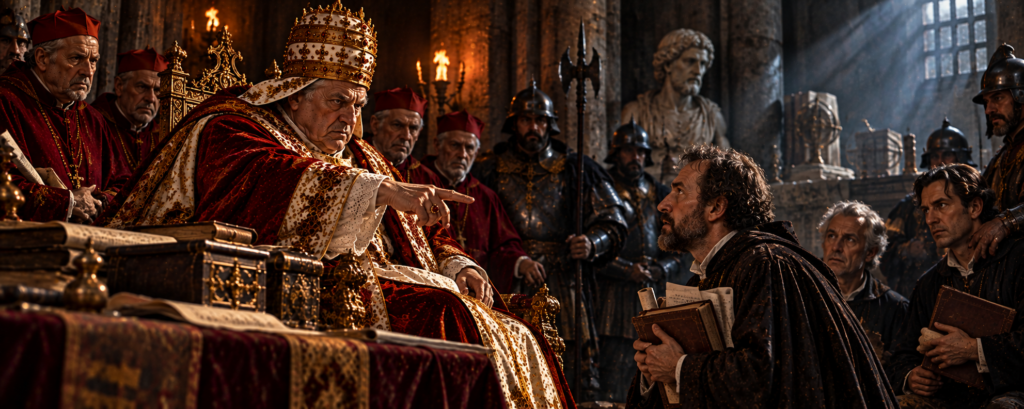
Paul II: The Pope Who Turned Rome’s Scholars Into Enemies
Paul II — 1464–1471
In February 1468, fear spread through the intellectual circles of Renaissance Rome. Men who had spent their evenings discussing ancient poetry, Roman history, philosophy, and the vanished glories of the classical world suddenly found themselves accused of plotting against the pope. Members of the Roman Academy were arrested, interrogated, and imprisoned inside Castel Sant’Angelo, the formidable fortress overlooking the Tiber. Among them was Bartolomeo Platina, a scholar who had already experienced the unpleasant consequences of crossing Pope Paul II and who would eventually make certain that the pontiff’s reputation suffered long after his death.
The accusations were extraordinary. Investigators suspected that the scholars had formed a conspiracy against the pope, while allegations of irreligion, pagan sympathies, and sexual misconduct added a darker dimension to the affair. Some prisoners were subjected to torture, although the surviving accounts differ in their details and cannot all be accepted without qualification. What began as a confrontation between an authoritarian pontiff and a circle of outspoken intellectuals became one of the most notorious episodes in the relationship between Renaissance scholarship and papal power.
At the center stood Pietro Barbo, the Venetian cardinal who had become Pope Paul II in 1464. He was a man of considerable wealth, imposing appearance, expensive tastes, and an unusually strong belief in the authority of his office. He loved magnificent clothing, precious stones, public celebrations, and the ceremonial splendor of the papacy. Yet beneath that glittering exterior was a ruler increasingly suspicious of criticism, reluctant to share authority, and prepared to use imprisonment against men who challenged him.
His enemies portrayed him as vain, ignorant, vindictive, and morally corrupt. Some circulated sensational allegations about his private life, while others mocked his supposed obsession with jewelry and beautiful clothing. His sudden death in 1471 inspired still more scandalous stories, including claims about the circumstances in which he died. Many of these accusations came from hostile writers whose personal grievances make them unreliable witnesses.
The truth is more complicated, and in some respects more disturbing. Paul II was not simply a foolish pope who hated learning, nor can every lurid allegation against him be treated as established fact. He patronized architecture, collected antiquities, supported printing, and provided elaborate public entertainments for the people of Rome. At the same time, his confrontation with the Roman humanists revealed how dangerous intellectual independence could become when it collided with a ruler determined to defend his authority.
For the Wicked Popes, Paul II offers something different from the familiar stories of poisoned rivals, murderous dynasties, and scandalous lovers. His darkest legacy concerns the use of papal power against critics, the criminalization of suspected dissent, and the destruction of trust between a ruler and the intellectual community surrounding him. He also illustrates how easily political enemies could turn personal grievances into enduring historical reputations. The story of Paul II is therefore both an account of authoritarian government and a warning about the dangerous power of those who write history.
The Venetian Who Was Born Into Privilege
Pietro Barbo was born in Venice in 1417, although some older accounts give 1418. His family belonged to the wealthy and influential Venetian patriciate, a world in which commercial success, political office, and aristocratic prestige were closely connected. Venice was one of Europe’s richest cities, and its governing families possessed international connections extending throughout the Mediterranean. Pietro grew up in an environment where wealth and political influence were familiar rather than distant ambitions.
His father, Niccolò Barbo, belonged to an established Venetian family, while his mother, Polissena Condulmer, connected him to another important patrician lineage. Through his mother’s family, Pietro was related to Gabriele Condulmer, who would become Pope Eugenius IV. That relationship transformed his prospects. In a Church where family patronage could determine the direction of an entire career, having a pope for an uncle was an extraordinary advantage.
Pietro’s early life did not suggest that he was destined to become one of the great intellectual figures of Renaissance Christianity. He was associated with the commercial world of Venice before his ecclesiastical career accelerated. Later hostile writers mocked his education and suggested that he lacked the learning expected of a pope. Such criticisms must be approached carefully because they came from humanists who judged rulers partly according to their command of classical scholarship.
What mattered most for Pietro’s advancement was not literary brilliance but family connection. His uncle’s election to the papacy in 1431 opened doors that would otherwise have remained closed. The young Venetian entered the ecclesiastical hierarchy and began accumulating important appointments. His career demonstrated the same system of papal nepotism that would later become a recurring source of scandal throughout Renaissance Rome.
The Uncle Who Changed Everything
When Gabriele Condulmer became Pope Eugenius IV, Pietro Barbo’s fortunes changed dramatically. The new pope faced enormous political difficulties, including conflict with the Council of Basel and struggles involving Italian rulers. He needed trusted associates and loyal administrators. Family members offered a degree of personal reliability that ambitious outsiders could not always provide.
Pietro benefited from this environment. He received ecclesiastical offices and entered the ranks of churchmen whose careers depended upon papal patronage. His rise was unusually rapid, particularly given his youth. By the time he reached his early twenties, he was already moving toward the highest levels of ecclesiastical government.
In 1440, Eugenius IV created him a cardinal. Pietro was only about twenty-three years old, an age at which most churchmen had barely begun their careers. The appointment placed him within the College of Cardinals, the institution responsible for electing future popes. It also provided him with prestige, influence, and opportunities for substantial income.
His elevation was a clear example of family favoritism. Pietro possessed abilities of his own, but his connection to Eugenius IV was decisive. The young cardinal had gained access to power through the very institution he would later govern with such determination. His experience offered an early lesson in how authority, wealth, and personal loyalty operated within the papal court.
A Cardinal Who Loved Magnificence
As a cardinal, Pietro Barbo developed a reputation for wealth and magnificent display. He accumulated valuable objects, cultivated an impressive household, and showed particular enthusiasm for jewels and precious stones. His taste for luxury was conspicuous even within the wealthy environment of Renaissance ecclesiastical politics. These interests would remain central to his public image.
The cardinal’s appearance attracted attention. He was described as physically imposing and handsome, qualities that hostile writers later used to portray him as excessively vain. His expensive clothing and ceremonial splendor became subjects of ridicule. The distinction between appropriate ecclesiastical dignity and personal extravagance was not always clear.
Renaissance churchmen frequently displayed wealth through architecture, clothing, manuscripts, and collections of art. Such magnificence could be understood as an expression of institutional prestige rather than merely private indulgence. A cardinal’s household was expected to reflect his rank. Pietro’s tastes nevertheless made him an easy target for critics who believed that a churchman should display greater restraint.
His fascination with precious objects would later contribute to some of the strangest stories surrounding his pontificate. Enemies suggested that he spent excessive time admiring jewels and adorning himself with elaborate ornaments. These accounts often reveal more about the prejudices and resentments of their authors than about the cardinal’s private behavior. What is securely established is that he possessed a substantial collection of valuable antiquities and luxury objects.
The Palace That Became a Monument
One of Pietro Barbo’s most enduring legacies began before he became pope. As cardinal of San Marco, he developed an ambitious architectural complex in Rome that would eventually become known as Palazzo Venezia. The building combined the functions of an aristocratic residence, ecclesiastical palace, and political statement. Its imposing design reflected the growing confidence of Renaissance architecture.
Construction began during his cardinalate and continued after his election. The palace became one of the most important architectural projects associated with his career. Its massive walls, carefully arranged courtyards, and monumental spaces reflected the desire to create a residence worthy of a powerful ruler. The building also provided a setting for his collections of antiquities and precious objects.
The project demonstrates that Paul II was not simply hostile to Renaissance culture. He invested heavily in architecture and possessed a serious interest in material remains from the ancient world. His tastes were not identical to those of literary humanists, but they belonged to the same broader cultural transformation. He appreciated the prestige and beauty associated with classical objects.
This distinction matters because his later conflict with scholars has sometimes been interpreted as evidence that he hated all learning. The surviving record does not support such a sweeping conclusion. Paul could admire ancient coins, gems, and architecture while distrusting intellectual circles that appeared politically independent. His hostility was selective, though its consequences were severe.
The Death of Pius II
Pope Pius II died at Ancona on August 15, 1464, after attempting to organize a crusade against the Ottoman Empire. His death ended one of the most intellectually remarkable pontificates of the fifteenth century. Pius had been a celebrated humanist, historian, diplomat, and author before becoming pope. His court had provided opportunities for scholars whose literary abilities were valued within ecclesiastical administration.
The cardinals who assembled to elect his successor faced several difficult questions. The Ottoman threat remained serious, particularly after the fall of Constantinople in 1453. Italian politics continued to be dominated by competing territorial interests. The relationship between the pope and the College of Cardinals was also a source of tension.
Many cardinals wanted to prevent the next pope from exercising unrestricted authority. They feared excessive appointments, uncontrolled expenditure, and decisions made without consultation. Before the election, they agreed upon a series of commitments intended to restrain the future pontiff. These arrangements became known as the conclave capitulation.
Pietro Barbo participated in the election and accepted the agreed conditions. On August 30, 1464, he was elected pope. He chose the name Paul II. The conflict between the authority he now possessed and the restrictions he had promised to observe began almost immediately.
The Promises Made Before the Election
The conclave capitulation contained provisions intended to limit papal independence. The cardinals sought a stronger voice in important appointments and decisions. They also wanted restrictions on the creation of new cardinals and on the promotion of papal relatives. The arrangements reflected anxiety about the concentration of power in the hands of a single pontiff.
Such agreements were not entirely new. Cardinals had attempted to impose conditions upon papal candidates during earlier elections. The underlying problem was that a man who became pope might subsequently argue that his office could not be restricted by promises made while he was still a cardinal. The constitutional status of these capitulations remained disputed.
Paul II adopted precisely this position. After his election, he refused to treat the agreement as permanently binding in the manner his colleagues had expected. He maintained that papal authority could not be subordinated to restrictions imposed by the electors. The decision immediately damaged relations with members of the College.
His defenders could argue that the cardinals had attempted to impose illegitimate limits upon the papacy. His critics could respond that Paul had accepted conditions to secure election and then discarded them when they became inconvenient. The dispute was therefore both constitutional and personal. It established a pattern in which the new pope’s determination to defend his authority appeared to others as arrogance and bad faith.
A Pope Who Would Not Be Controlled
Paul II’s approach to government was shaped by a strong conviction that the pope possessed supreme authority within the Church. He resisted attempts by cardinals to control his decisions. He also preferred to keep certain matters within a relatively restricted circle of advisers. This style encouraged the impression that he was secretive and unwilling to accept criticism.
The College of Cardinals was not a unified body of disinterested reformers. Its members possessed their own ambitions, family connections, and political loyalties. Some had supported restrictions upon the pope because they wanted greater influence for themselves. Paul therefore faced genuine institutional competition rather than merely principled opposition.
Nevertheless, his response aggravated tensions. A ruler who repeatedly invokes supreme authority may succeed in silencing objections without securing genuine cooperation. Cardinals who felt excluded could become suspicious of every appointment and policy. The atmosphere surrounding the papal court grew increasingly distrustful.
This conflict helps explain the events that followed. Paul did not suddenly become hostile toward criticism in 1468. His difficulties with the humanists developed within a broader struggle over authority, patronage, and control of ecclesiastical administration. The arrests of scholars were the most dramatic expression of a political style already visible during the opening years of his reign.
The Humanists Who Expected a Different Pope
Renaissance humanists occupied an important place within the papal bureaucracy. Their command of elegant Latin made them valuable for drafting letters, composing official documents, and presenting papal decisions to European rulers. Many also worked as teachers, historians, poets, and collectors of ancient manuscripts. The papal court offered them employment, prestige, and opportunities for advancement.
Under Pius II, humanist learning had enjoyed particular prominence. The pope himself was a celebrated writer who understood the intellectual culture of his secretaries and advisers. Scholars could reasonably expect their literary abilities to be appreciated. Some had invested substantial sums in purchasing offices within the papal administration.
Paul II did not share his predecessor’s enthusiasm for literary humanism. His own interests lay more heavily in administration, ceremony, architecture, and collections of precious objects. He did not necessarily regard elegant Latin prose as sufficient justification for maintaining an expensive bureaucracy. This difference in priorities created immediate resentment.
For scholars whose livelihoods depended upon papal employment, the change was more than a matter of taste. A position in the curia could represent years of investment and the foundation of a family’s financial security. Losing such an office could be economically devastating. Paul was about to make a decision that transformed disappointed employees into determined enemies.
The College of Abbreviators
The College of Abbreviators was associated with the preparation and drafting of papal documents. Its members performed specialized administrative work, and many possessed the literary training valued by Renaissance humanists. Offices within the institution could be purchased or acquired through patronage. Their holders therefore regarded them as valuable possessions as well as positions of employment.
Paul II moved to suppress or reorganize the college. The decision was justified in administrative terms, including concerns about unnecessary offices and the costs of the papal bureaucracy. From the pope’s perspective, reducing an institution he considered excessive could appear a reasonable exercise of authority. From the perspective of the officeholders, it was an attack upon their livelihoods.
The affected men reacted with anger. Some had paid substantial amounts for their positions and expected the investment to provide continuing income. They believed that the pope had deprived them of rights or privileges that should have been respected. The dispute quickly became a confrontation over the limits of papal power.
Among those affected was Bartolomeo Sacchi, better known by the name Platina. He was an accomplished humanist with powerful connections and a strong sense of his own intellectual standing. He had entered the papal bureaucracy under Pius II and expected his position to provide security. Paul II’s decision turned him into one of the pope’s most persistent critics.
Bartolomeo Platina: The Scholar Who Would Not Submit
Platina was born in 1421 near Cremona and had experienced a varied career before entering papal service. He had served in military environments, pursued humanist education, and worked as a teacher. His intellectual interests included history, philosophy, literature, and the study of classical antiquity. By the early 1460s, he had become associated with influential humanist circles in Rome.
His connections included the young Cardinal Francesco Gonzaga and scholars associated with the Roman Academy. These relationships gave him access to patrons who might protect him during political difficulties. They also placed him within a community that valued intellectual independence and personal reputation. Platina was not inclined to accept humiliation quietly.
After losing his position, he sought redress from Paul II. His attempts to secure an audience were unsuccessful, and his frustration increased. Eventually, he sent the pope a sharply worded letter challenging the decision. The communication included a threat to appeal to rulers and seek the intervention of a general council.
That threat was particularly provocative. The papacy had spent decades resisting arguments that councils could override papal authority. Pius II had condemned appeals to future councils in 1460. Platina’s letter therefore challenged not merely an administrative decision but the constitutional authority Paul believed he possessed.
The Letter That Led to Prison
Platina’s protest crossed a dangerous boundary. A disappointed official could petition for compensation or restoration, but threatening to summon a council against the pope carried far greater implications. Paul regarded the letter as an act of defiance. The scholar’s willingness to challenge papal authority publicly made the dispute impossible to ignore.
Platina was arrested and imprisoned in Castel Sant’Angelo during the opening months of the pontificate. He remained confined for several months before securing release through the intervention of influential supporters, including Cardinal Francesco Gonzaga. The experience was humiliating and frightening. It also deepened his resentment toward Paul.
The imprisonment reveals the disproportionate power available to the pope. Platina had written an offensive and politically threatening letter, but he was not commanding an army or leading an armed rebellion. His principal weapon was language. Paul responded by placing him inside one of Rome’s most formidable prisons.
From the pope’s perspective, the issue concerned obedience and the defense of legitimate authority. From Platina’s perspective, it was an act of arbitrary punishment against a scholar seeking justice. The conflict established a personal hostility that would shape the historical memory of the pontificate. Neither man would forget it.
Castel Sant’Angelo: The Fortress Above the Tiber
Castel Sant’Angelo had begun as the mausoleum of Emperor Hadrian before becoming one of Rome’s most important fortifications. By the fifteenth century, it served as a military stronghold, a refuge for popes, and a prison for politically significant captives. Its massive walls and commanding position made escape extremely difficult. Imprisonment there carried a powerful symbolic message.
For a scholar accustomed to libraries, correspondence, and intellectual conversation, confinement inside the fortress represented a brutal change. The conditions of imprisonment varied according to the prisoner’s status and circumstances. Some captives enjoyed privileges, while others faced severe restrictions. The possibility of interrogation and physical coercion made the experience especially threatening.
Platina’s first imprisonment did not destroy his career permanently, but it transformed his relationship with the papacy. He had entered Rome seeking advancement through learning. He now discovered that literary ability offered little protection against a ruler who considered him insolent. The lesson would become even more painful several years later.
Castel Sant’Angelo would return to the center of his story in 1468. This time, Platina would not be arrested merely for protesting the loss of employment. He would become implicated in allegations involving conspiracy, irreligion, and threats against the pope’s life. The stakes would be considerably higher.
The Roman Academy and the Cult of Antiquity
The Roman Academy was an informal circle of humanists associated particularly with the scholar Pomponio Leto. Its members shared a passionate interest in ancient Rome, classical literature, archaeology, and the revival of Latin learning. They adopted classical names and cultivated ceremonies inspired by the ancient world. Their activities could appear eccentric, provocative, or irreverent to observers unfamiliar with humanist culture.
Pomponio Leto was especially devoted to Roman antiquity. He studied ancient ruins, taught classical literature, and encouraged his associates to immerse themselves in the language and customs of the Roman past. The academy’s gatherings included literary discussions, commemorations, performances, and celebrations associated with ancient Roman traditions. The group offered a community for scholars who believed that antiquity contained lessons worth recovering.
Some members celebrated the anniversary of Rome’s legendary foundation and adopted practices that resembled pagan ceremonies. Such activities did not necessarily mean they had abandoned Christianity. Renaissance humanists frequently borrowed classical forms while remaining within Christian society. Nevertheless, the distinction could be difficult to explain to suspicious ecclesiastical authorities.
The academy’s intellectual culture also encouraged irreverent jokes and criticism of contemporary institutions. Scholars who admired ancient republican Rome could express disdain for the corruption or pretensions of modern rulers. Their language might be theatrical rather than revolutionary. Yet in a politically tense city, the celebration of ancient liberty could sound dangerously close to criticism of papal government.
When Classical Enthusiasm Became Suspicious
Paul II did not regard the Roman Academy as merely a harmless literary society. Its members had connections with men already hostile to his administration, including Platina. Some adopted pagan-sounding names and participated in ceremonies inspired by ancient Roman religion. Their conversations and writings could be interpreted as attacks upon Christian belief or papal authority.
The political environment made these suspicions more serious. Rome remained vulnerable to aristocratic factionalism, conspiracies, and interference from neighboring rulers. The papacy was not simply a spiritual institution but a territorial government whose ruler faced real political dangers. An informal association of educated men with influential connections could appear threatening.
Nevertheless, suspicion is not proof. Admiration for ancient Rome does not establish a conspiracy to overthrow the pope. Nor does the use of classical names demonstrate genuine pagan religious practice. Humanist culture often blurred literary performance and personal identity in ways that invited misunderstanding.
Paul’s reaction therefore requires careful examination. He may have believed that the academy concealed a genuine political threat. He may also have interpreted provocative intellectual behavior through an excessively suspicious understanding of dissent. The surviving evidence does not permit every accusation to be accepted as fact.
The Rumors of Conspiracy
By early 1468, reports circulated concerning an alleged conspiracy against Paul II. Informants suggested that certain members of the Roman Academy were involved in dangerous political discussions. Some accusations concerned the possibility of assassinating the pope. Others involved irreligion, immoral conduct, or hostility toward ecclesiastical authority.
The details of the supposed plot remain uncertain. Contemporary testimony was shaped by fear, interrogation, personal rivalry, and the interests of those conducting the investigation. Some scholars have suggested that political discussions within the academy may have been more serious than later defenders admitted. Others regard the allegations as exaggerated or largely unfounded.
What is clear is that Paul considered the reports serious enough to authorize arrests. The accusations were no longer confined to literary irreverence or dissatisfaction over lost offices. They concerned the safety of the pope and the stability of his government. The investigation therefore acquired the character of a political emergency.
The atmosphere of uncertainty made the situation especially dangerous for the accused. A scholar who had criticized the pope could be portrayed as a conspirator. A classical celebration could be interpreted as evidence of paganism. Private jokes, literary performances, and political conversations could acquire sinister meanings once investigators began searching for a plot.
February 1468: The Arrests Begin
In February 1468, authorities arrested several men associated with the Roman Academy. Platina was among those detained. Other suspects were questioned or sought by investigators, while some individuals avoided arrest by leaving the city. The crackdown sent a powerful warning through Rome’s intellectual community.
Pomponio Leto was away from Rome when the investigation began. He had been living in Venice, where he worked as a teacher. Papal authorities sought his return, and the Venetian government eventually surrendered him. He was taken to Rome and imprisoned in Castel Sant’Angelo.
The arrests transformed the academy’s reputation overnight. Men previously known for studying classical literature were now publicly associated with accusations of conspiracy and irreligion. Their intellectual activities became evidence to be examined by investigators. The possibility of torture added an atmosphere of terror.
The scale of the crackdown has sometimes been exaggerated in popular accounts. It is misleading to imagine that every Roman humanist was imprisoned or that the entire intellectual life of the city ceased. Nevertheless, the arrests were significant and deeply intimidating. They demonstrated that membership in an intellectual circle could become dangerous when the pope suspected political disloyalty.
The Scholar Who Was Arrested Twice
For Platina, the second imprisonment was especially bitter. He had already suffered confinement after challenging the abolition of the abbreviators. Now he faced accusations far more serious than an insolent letter. His earlier conflict with Paul made him an obvious suspect in any investigation involving papal enemies.
The circumstances also created a problem for historians. Platina had strong reasons to resent the pope and later became one of the principal sources for the most hostile accounts of his pontificate. His descriptions of the investigation therefore require critical scrutiny. Personal suffering does not automatically make a witness dishonest, but it can influence interpretation.
Platina was a capable writer who understood the power of narrative. He could portray events vividly and frame his own conduct as principled resistance against arbitrary authority. His account of imprisonment helped establish Paul as a cruel and vindictive ruler. Later historians often repeated that portrayal.
Yet the central facts of his persecution are not simply inventions. He was dismissed from office, imprisoned, arrested again, and subjected to an investigation involving grave accusations. The dispute between him and Paul was real. The challenge is to distinguish documented treatment from the embellishments that accumulated around it.
Torture Behind the Fortress Walls
The most disturbing aspect of the 1468 investigation concerns the use of torture. Accounts associated with Platina and other sources describe coercive interrogation of prisoners. Modern historical scholarship generally accepts that torture occurred during the proceedings, although the precise experiences of individual prisoners and the reliability of particular dramatic descriptions remain disputed. The surviving evidence does not justify treating every detail of later narratives as certain.
Judicial torture was not unusual in fifteenth-century Europe. Secular and ecclesiastical authorities employed it under legal systems that regarded coerced testimony as potentially useful evidence, subject to various procedural rules. Such practices were deeply vulnerable to abuse. A prisoner in pain might confess to actions never committed or accuse others in the hope of ending the ordeal.
The use of torture in a case involving suspected political dissent raises particularly serious questions. The accused were not captured enemy soldiers or men caught carrying out an assassination. They were scholars whose conversations, associations, and writings had become objects of suspicion. The gap between intellectual activity and criminal conspiracy remained uncertain.
Paul’s responsibility cannot be dismissed merely because torture was common in his age. The investigation took place under papal authority, and prisoners were subjected to coercive procedures within the pope’s government. Even if he sincerely feared a conspiracy, the treatment of the accused remains one of the darkest episodes of his pontificate. The case illustrates how readily a ruler’s fear could become another person’s suffering.
The Accusation of Paganism
The investigation also focused upon allegations that members of the Roman Academy had embraced pagan beliefs. Their enthusiasm for ancient Roman customs made the accusation superficially plausible to suspicious observers. They celebrated classical festivals, adopted ancient names, and sometimes used language that appeared irreverent toward Christian institutions. Yet cultural imitation was not necessarily religious apostasy.
Renaissance humanism frequently drew upon pagan antiquity without rejecting Christianity. Scholars studied ancient gods as literary and historical subjects, not always as objects of worship. They could admire Roman republican ideals while remaining practicing Christians. The distinction between intellectual fascination and religious belief was essential.
The charge of paganism also carried political advantages. A group suspected of conspiracy might appear more dangerous if its members could be portrayed as enemies of Christianity itself. The accusation transformed an administrative or political dispute into a struggle over religious loyalty. It made harsh measures easier to justify.
The evidence does not establish that the Roman Academy operated as a coherent pagan religious movement. Some members may have expressed heterodox or provocative opinions, but the group was not a unified conspiracy to restore ancient Roman worship. Its activities were varied, and its members did not necessarily share identical beliefs. Treating the academy as a secret pagan cult would reproduce the most sensational elements of the prosecution without adequate support.
Pomponio Leto Under Suspicion
Pomponio Leto occupied a central place in the investigation because he was the academy’s most prominent intellectual figure. His devotion to classical antiquity made him vulnerable to accusations of paganism. His teaching activities in Venice also brought allegations concerning sexual misconduct. These accusations became entangled with the broader political case.
Leto’s arrest required cooperation between papal and Venetian authorities. The Venetian government agreed to surrender him, demonstrating that the investigation extended beyond Rome. He was transported to Castel Sant’Angelo and detained for an extended period. His imprisonment became one of the defining episodes of his career.
The accusations against him were never established in a manner that justifies treating them as proven historical facts. Modern historians disagree about the significance of some evidence concerning the alleged conspiracy. The claims of paganism and sexual misconduct also require careful separation from hostile or coercive testimony. His scholarly eccentricity cannot be equated with criminal guilt.
Leto eventually regained his freedom and resumed his intellectual activities. His later career demonstrates that the investigation did not permanently destroy the Roman Academy’s leading figure. Nevertheless, the experience exposed the vulnerability of scholars who depended upon the tolerance of political authorities. Intellectual reputation offered limited protection when a ruler became convinced that learning concealed disloyalty.
Was There Really a Plot to Kill the Pope?
The central question remains whether the Roman Academy contained a genuine conspiracy against Paul II. Some contemporary reports suggested that particular individuals discussed violence or political action. The possibility cannot simply be dismissed because the accused were scholars. Renaissance intellectuals could participate in factional politics, and admiration for ancient republican heroes sometimes carried political implications.
Yet the evidence falls short of establishing a coordinated assassination plot involving the academy as a whole. The investigation produced allegations that were difficult to verify independently. Confessions or accusations obtained under coercive conditions require particular caution. The eventual release of the prisoners further complicates claims that authorities uncovered a fully developed conspiracy.
It is possible that some members engaged in reckless political talk. It is also possible that informants exaggerated conversations to secure favor or settle personal grievances. A hostile joke about the pope could become a supposed threat when repeated to suspicious officials. The surviving record cannot resolve every uncertainty.
The most defensible conclusion is therefore limited. Paul II’s government believed, or at least claimed, that it faced a serious threat. Several scholars were arrested and interrogated, and the proceedings included coercive treatment. The existence of a broad academy-led conspiracy to assassinate the pope remains unproven.
The Prisoners Are Released
The investigation did not end with the execution of the accused scholars. Over time, the prisoners were released, and the most serious allegations failed to produce lasting convictions. Pomponio Leto regained his freedom in 1469. Platina also emerged from confinement, although his relationship with the papal court remained damaged.
Their release does not prove that every suspicion was invented. Political investigations can collapse for many reasons, including insufficient evidence, intervention by powerful patrons, or changes in the ruler’s priorities. Nevertheless, the outcome makes the severity of the arrests difficult to justify retrospectively. The prisoners had endured confinement and interrogation without the alleged conspiracy being securely established.
For Platina, freedom did not bring immediate restoration. He hoped to regain a place within papal employment, but Paul did not provide the advancement he desired. The scholar remained alienated from the pontiff. His resentment would become an important factor in the history written after Paul’s death.
The Roman Academy eventually resumed its activities. Its survival demonstrates that Paul did not permanently eliminate humanist scholarship from Rome. Yet the experience left a lasting mark upon relations between intellectuals and papal authority. The scholars had learned that a ruler’s suspicion could turn literary association into criminal danger.
The Pope Who Feared His Critics
Paul’s confrontation with the humanists was not merely a dispute over ancient literature. It concerned the political implications of independent intellectual communities. Scholars possessed networks of patrons, access to powerful families, and the ability to influence public reputation. Their writings could challenge authority in ways that military force could not easily suppress.
Platina’s earlier threat to appeal to a council demonstrated this danger clearly. A scholar deprived of office could invoke constitutional arguments against the pope. He could communicate with rulers and cardinals who shared his grievances. His education gave him access to forms of opposition unavailable to ordinary subjects.
Paul’s response suggests a ruler uncomfortable with criticism that escaped his control. He did not need to believe that every humanist was a pagan or assassin to regard the group as politically troublesome. Their independence, satire, and connections could appear threatening. The alleged conspiracy provided an opportunity to investigate and intimidate them.
Yet repression created its own danger. Imprisoning scholars could silence them temporarily, but it also gave them powerful stories to tell afterward. A writer who survived persecution might devote years to exposing the ruler responsible. Paul would discover that the reputation of a dead pope could be shaped by men he had failed to destroy.
The Palace of Splendor
While scholars complained of persecution, Paul continued cultivating a magnificent public image. His residence at Palazzo Venezia reflected his taste for architecture and ceremonial grandeur. He collected ancient coins, gems, carved stones, and other valuable objects. The palace became a setting in which Renaissance luxury and papal authority were displayed together.
His collection was not merely a random accumulation of expensive possessions. Ancient coins and carved gems carried historical and artistic significance. Renaissance collectors regarded such objects as evidence of the achievements of classical civilization. Paul appreciated their beauty and prestige.
Yet hostile writers transformed this interest into an accusation of vanity. They portrayed him as a man who preferred jewels to books and beautiful objects to serious thought. Stories circulated about his supposed habit of admiring treasures late into the night. The image was memorable because it contrasted sharply with the intellectual values of his humanist critics.
The contrast was also misleading. Paul could be a serious collector without being an ignorant fool. His appreciation of antiquities demonstrates a form of cultural engagement different from the literary scholarship practiced by Platina and Leto. The real conflict concerned authority and patronage more than a simple opposition between learning and ignorance.
The Pope and the Carnival
Paul II became associated with elaborate public celebrations in Rome. He expanded the magnificence of carnival festivities and supported spectacles designed to attract crowds. Races, processions, and public entertainments helped transform the city’s ceremonial life. The celebrations also strengthened the visibility of papal authority.
The Roman carnival included races involving different groups of participants, and some events reflected social prejudices that modern readers would find disturbing. Public spectacle in Renaissance Rome could involve humiliation as well as entertainment. The festivities were not simply harmless expressions of communal joy. They reflected the hierarchies and attitudes of the society that organized them.
Paul understood the political value of spectacle. A pope who provided impressive celebrations could cultivate popularity among ordinary Romans even while alienating scholars and cardinals. Public generosity helped create a relationship between ruler and populace. It also demonstrated the wealth and power of the papal court.
His enthusiasm for carnival complicates the image of a universally hated tyrant. Some Romans benefited from his public entertainments and appreciated the opportunities they provided. The pope who imprisoned humanists could simultaneously appear generous and magnificent to the crowds. His reputation depended heavily upon the social position of the observer.
A City That Loved Spectacle
Renaissance Rome was a city of striking contrasts. Ancient ruins stood beside medieval churches and new palaces, while aristocratic families competed for political influence. Pilgrims arrived seeking spiritual benefits, and merchants profited from the presence of the papal court. Public festivals offered moments when different social groups participated in a shared urban experience.
Paul’s celebrations belonged to this wider culture. They helped present the papacy as the center of Roman civic life. Processions and races filled public spaces with color, movement, and excitement. The ruler who organized them gained prestige.
Yet the celebrations also reinforced social hierarchy. The pope occupied the position of generous patron, while participants and spectators received entertainment through his authority. Public generosity could therefore coexist with political control. The same ruler who provided festivities could imprison critics.
This combination was not unique to Paul II. Renaissance princes frequently used architecture, ceremony, and public entertainment to strengthen their legitimacy. The papacy operated within the same political culture while claiming a higher spiritual mission. Paul’s reign offers a particularly vivid example of the tension between magnificence and coercion.
The Pope Who Changed the Jubilee
Paul II also made an important decision concerning the Roman Jubilee. The Jubilee offered pilgrims special spiritual benefits and attracted large numbers of visitors to Rome. Earlier popes had established different intervals between celebrations. The timing of the event therefore carried both religious and economic significance.
In 1470, Paul established a twenty-five-year interval for ordinary Jubilees. The arrangement became an enduring feature of Catholic practice. By making Jubilees more frequent than the earlier fifty-year cycle, the papacy increased opportunities for successive generations of believers to participate. The decision also promised economic benefits for Rome through pilgrimage.
The change demonstrates that Paul’s pontificate cannot be reduced to his conflict with scholars. He made institutional decisions with lasting consequences. The Jubilee reform affected religious life far beyond the immediate political disputes of his reign. It also reinforced Rome’s importance as a center of pilgrimage.
His motives may have included both pastoral and practical considerations. More frequent Jubilees offered spiritual opportunities while attracting visitors and resources to the city. Such combinations were common in papal government. Religious policy and economic interest were rarely entirely separate.
The Printing Press Comes to Rome
One of the strongest arguments against portraying Paul II as an enemy of all learning concerns the development of printing in Rome. The new technology had begun transforming the production of books across Europe. German printers introduced movable-type printing to Italy during the 1460s. Their work would soon revolutionize the circulation of classical and religious texts.
Printing reached Rome during Paul’s pontificate. Conrad Sweynheym and Arnold Pannartz, who had previously worked at Subiaco, established operations in the city. Their publications included classical authors and important works of Christian scholarship. The arrival of printing created new opportunities for intellectual culture.
Paul did not attempt to suppress the technology. His government operated during a period when printing expanded in Rome, and papal support helped establish a favorable environment for its development. The relationship between individual printing ventures and direct papal patronage should not be exaggerated. Nevertheless, the broader record contradicts the image of a ruler determined to destroy every form of scholarship.
The irony is striking. Paul persecuted particular humanists while the city under his authority became an important center for reproducing ancient texts. He could distrust intellectual circles without rejecting books as objects of value. His policies were inconsistent from the perspective of scholars who expected cultural patronage to include personal freedom. For the pope, supporting learning did not require tolerating political defiance.
The Cardinals Who Resented Him
Paul’s authoritarian reputation extended beyond the humanists. Members of the College of Cardinals resented his refusal to honor the conclave capitulation. His approach to appointments and consultation encouraged suspicion. The pope’s preference for personal control clashed with the expectations of men who believed they should share in government.
The creation of new cardinals became a particular source of tension. The capitulation had attempted to restrict the pope’s freedom in this area. Paul resisted those limitations and eventually promoted men whose loyalty he valued. Some appointments reflected diplomatic considerations involving European rulers, while others benefited relatives and trusted associates.
His use of secret cardinal appointments added to the atmosphere of distrust. Creating cardinals without immediately publishing their names allowed a pope to make arrangements that remained concealed from the wider College. Such practices were not invented by Paul, but his reliance upon secrecy reinforced criticism of his governing style. Opponents interpreted the behavior as evidence of excessive personal control.
The underlying conflict concerned the nature of papal monarchy. Cardinals wanted influence over decisions affecting the Church and their own political positions. Paul believed the pope possessed authority that could not be permanently constrained by electoral agreements. The dispute remained unresolved throughout much of his reign.
Nepotism Beneath the Magnificence
Paul II had benefited enormously from nepotism during his youth. His uncle Eugenius IV had made him a cardinal while he was still in his early twenties. Once pope, Paul also promoted relatives and trusted associates. His conduct therefore reflected the same family-centered political culture that had shaped his own career.
Among those advanced was his nephew Marco Barbo, who became a cardinal in 1467. Other relatives also received important positions. The appointments helped create a network of loyalty within the papal government. They also demonstrated the limits of promises intended to restrain nepotism.
Paul’s family patronage was not identical in scale or ambition to the later dynastic projects of Alexander VI. He did not create a territorial empire for an acknowledged son or pursue the same spectacular family policies associated with the Borgias. Nevertheless, the principle remained familiar. Papal office provided opportunities to advance relatives.
The contradiction was particularly awkward because the conclave capitulation had attempted to restrict such practices. Paul had accepted the agreement before his election and subsequently rejected its binding force. His opponents could therefore portray family appointments as evidence that he had broken his promises. The issue strengthened the broader accusation that he governed according to personal preference rather than shared institutional responsibility.
Bohemia and the King Who Defied Rome
One of Paul’s most consequential political conflicts involved George of Poděbrady, king of Bohemia. George ruled a kingdom shaped by the legacy of the Hussite movement and the religious conflicts of the previous century. Many Bohemians followed the Utraquist tradition, which defended communion under both kinds for the laity. The arrangement remained controversial within the wider Catholic Church.
Pius II had already taken a hard line against the religious settlement associated with the Council of Basel. Paul continued the confrontation. He regarded George’s religious position as incompatible with the demands of papal authority. The dispute involved theology, political legitimacy, and the independence of the Bohemian crown.
In 1466, Paul pronounced severe measures against George, including deposition and excommunication. The papacy supported efforts to undermine his position and encouraged opposition among Catholic powers. The conflict contributed to military struggles that destabilized the region. It also demonstrated Paul’s willingness to use spiritual sanctions for major political purposes.
From the papal perspective, George represented a ruler who refused to conform to the religious authority of Rome. From the king’s perspective, the papacy threatened the political and religious settlement upon which his government depended. The confrontation cannot be understood as a simple dispute between good and evil. It was a struggle over sovereignty, religious compromise, and the limits of papal power.
The Crown of Bohemia Becomes a Battlefield
The campaign against George of Poděbrady drew neighboring rulers into the conflict. Matthias Corvinus of Hungary became a major opponent of the Bohemian king. Military operations and rival claims to authority intensified political instability. The papacy’s intervention helped transform a religious dispute into a wider struggle over kingship.
Paul’s policy reflected a conviction that religious unity justified strong action against rulers considered disobedient. He did not view the Bohemian question as a minor local disagreement. The Hussite legacy had challenged ecclesiastical authority for decades. A king who maintained disputed religious arrangements appeared to threaten the wider structure of the Church.
Yet the consequences were destructive. Warfare imposed burdens upon populations whose interests were not identical with those of competing rulers. Religious sanctions became instruments within territorial struggles. The pursuit of uniformity contributed to further division.
This episode deserves attention because it reveals a form of papal severity more consequential than disputes over jewels or ceremonial clothing. Paul was prepared to challenge a reigning monarch and support political action against him. His authority extended into questions of war, succession, and religious coercion. The same determination to defend papal power visible in Rome operated on an international scale.
The Ottoman Threat Returns
Paul inherited the unresolved crusading ambitions of Pius II. The Ottoman Empire remained a formidable power, and the fall of Constantinople continued to influence European politics. Christian rulers feared further Ottoman expansion, particularly in the Balkans and eastern Mediterranean. The papacy continued seeking ways to organize resistance.
Paul supported crusading initiatives and attempted to encourage cooperation among European powers. His efforts faced the same obstacles that had frustrated his predecessor. Rulers pursued competing territorial interests, while financial and military commitments remained uncertain. The pope could exhort but not command a united European army.
The Ottoman conquest of Negroponte, or Euboea, in 1470 intensified alarm. The island had been an important Venetian possession in the Aegean. Its loss demonstrated the continuing strength of Ottoman military power. Venice faced serious strategic difficulties, and the papacy renewed appeals for resistance.
Paul’s crusading policy was therefore not merely ceremonial. He understood the significance of Ottoman expansion and sought to respond. Yet his government never produced the kind of decisive coalition that Pius II had imagined. The problem lay partly in the limits of papal authority and partly in the competing priorities of Europe’s rulers.
The Fall of Negroponte
The Ottoman capture of Negroponte in July 1470 shocked Christian observers. The island’s principal fortress had been defended by Venetian forces, but the Ottoman campaign overwhelmed the defenders. Reports of the conquest circulated through Italy and intensified fears of further attacks. The event exposed the vulnerability of Venetian possessions in the eastern Mediterranean.
Paul responded within the broader framework of crusading diplomacy. The papacy sought to encourage military cooperation and financial support. The loss of Negroponte provided powerful material for appeals to Christian rulers. Yet the response remained constrained by political divisions.
The disaster also highlighted the tension between Paul’s international ambitions and his conflicts closer to home. He was deeply involved in Italian politics and ecclesiastical disputes while attempting to mobilize resistance against the Ottomans. Resources and attention were limited. Every regional conflict weakened the possibility of a coordinated campaign.
His pontificate therefore continued a pattern familiar from earlier popes. Religious appeals called for unity, while political realities produced fragmentation. Paul possessed spiritual authority but lacked the means to compel Europe’s rulers to act together. The Ottoman advance exposed that weakness repeatedly.
The Pope’s Private World
Paul’s private life became a favorite subject of hostile writers. They mocked his appearance, his love of jewelry, and his supposed vanity. Some accused him of excessive eating or luxurious habits. Others circulated allegations concerning sexual behavior that were far more sensational.
These stories must be separated from established facts. Paul was wealthy, collected valuable objects, and cultivated magnificent ceremonial display. Those interests are documented. Claims that he engaged in particular sexual acts or maintained scandalous private relationships are much less secure.
The problem is especially serious because several of the most damaging accounts originated with men who had suffered under his government. Platina had been imprisoned twice and possessed strong reasons to hate him. Other humanists resented the loss of patronage or the investigation of the Roman Academy. Their writings cannot be treated as neutral observations.
This does not mean that every hostile allegation was necessarily false. Political enemies can report genuine misconduct, and personal resentment does not automatically invalidate testimony. The difficulty is that independent corroboration is often lacking. Responsible history must acknowledge uncertainty rather than transform rumor into certainty.
The Stories About His Sexuality
Later accounts sometimes alleged that Paul II engaged in sexual misconduct with men. Such claims were connected to broader attacks upon his character and occasionally appeared in stories about his death. The allegations became part of a tradition portraying him as hypocritical, vain, and morally compromised. They have been repeated frequently in sensational histories of the papacy.
The evidence is insufficient to establish these claims as fact. Hostile Renaissance writers often used accusations of sexual misconduct to discredit political opponents. Allegations involving same-sex behavior could function as weapons of humiliation within a culture that strongly condemned such acts. Their appearance in a hostile source does not prove the behavior occurred.
It is also important to distinguish historical conduct from modern categories of sexual identity. Fifteenth-century accusations were framed through legal, religious, and moral assumptions very different from contemporary understandings. Applying modern labels to Paul would create a false impression of certainty. The surviving evidence does not justify doing so.
The allegations remain historically relevant because they influenced his reputation. They show how personal scandal could become a political weapon. They also demonstrate the need to examine who produced an accusation and why. Paul’s enemies had compelling reasons to portray him in the most humiliating terms available.
The Strange Rumors About His Death
Paul II died suddenly on July 26, 1471, at the age of approximately fifty-four. His death surprised contemporaries because he had not reached an advanced age. The unexpected event encouraged speculation. Hostile writers soon circulated stories about the circumstances in which he died.
One tradition associated his death with an excessive meal or digestive illness. Other accounts introduced sensational allegations concerning sexual activity. These stories became part of the wider hostile mythology surrounding his private life. Their dramatic character made them attractive to later writers.
The precise medical cause of Paul’s death cannot be established with confidence from the surviving evidence. Sudden death in the fifteenth century could result from many conditions that contemporary observers lacked the means to diagnose accurately. Reports involving food or sexual scandal should therefore be treated as allegations rather than established explanations. The certainty sometimes displayed in popular retellings is unjustified.
What is secure is that Paul died unexpectedly and that his death transformed the political circumstances of his enemies. The men who had suffered under his government now faced the possibility of rehabilitation. A new pope would soon occupy the throne. The struggle over Paul’s reputation was about to enter a new phase.
The Election of Sixtus IV
After Paul’s death, the cardinals elected Francesco della Rovere, who became Pope Sixtus IV. The new pontiff had been created a cardinal during Paul’s reign. His election introduced a different network of patronage and political relationships. For scholars alienated by Paul, the change offered opportunities.
Platina benefited enormously. Under Sixtus IV, he regained favor and eventually became the first prefect of the Vatican Library in its reorganized Renaissance form. The appointment restored his prestige and placed him at the center of one of the most important scholarly institutions in Rome. The former prisoner had become a leading figure within papal intellectual life.
The reversal was striking. A man once suspected of conspiracy against the pope now received an important position from the pope’s successor. His abilities had not disappeared during imprisonment. What changed was the political environment in which those abilities were judged.
Platina also received opportunities to write about the history of the papacy. This development would prove especially consequential for Paul II. The scholar who had suffered under him now possessed both the literary skill and institutional support necessary to influence how future generations remembered his reign. The balance of power between ruler and critic had changed.
Platina Takes His Revenge
Platina’s history of the popes became one of the most influential works of its kind. His account of Paul II was sharply critical and reflected the personal hostility created by imprisonment and lost employment. He portrayed the dead pontiff as vain, authoritarian, and hostile to learning. His narrative helped establish an enduring negative reputation.
The work circulated widely and reached readers far beyond Rome. Later historians often relied upon Platina’s descriptions when discussing the pontificate. His judgments were repeated, elaborated, and incorporated into broader narratives about Renaissance papal corruption. The image of Paul as an ignorant persecutor became increasingly familiar.
Yet Platina’s account was not simply a transparent record of events. He had been personally involved in the disputes he described. His grievances shaped his interpretation, and his literary talent made the resulting portrait especially persuasive. The work must therefore be read as both historical testimony and an act of reputation-making.
The irony is difficult to miss. Paul had used imprisonment to punish a scholar who challenged him. After the pope’s death, the scholar used history to punish the ruler. The fortress had given Paul temporary power over Platina’s body, but the written word gave Platina influence over the pope’s memory.
The Pope Who Lost the Battle for His Reputation
Paul’s historical reputation suffered partly because his enemies were unusually skilled writers. Humanists possessed the language and literary techniques necessary to create memorable portraits. They could transform personal grievances into moral narratives about tyranny, ignorance, and corruption. Their accounts reached audiences long after the immediate political conflicts had disappeared.
Paul himself was not a comparable literary figure. He did not leave behind an autobiography capable of competing with Platina’s narrative. His defenders produced accounts, but these did not achieve the same enduring influence. The imbalance shaped the way later generations understood his pontificate.
Modern historians have therefore reassessed aspects of his reputation. His architectural patronage, antiquarian interests, support for public celebrations, and relationship with printing complicate the image of a pope who despised culture. His administrative decisions can also be examined within the practical problems of papal government. Such reassessment does not erase the arrests or the use of torture.
The challenge is to avoid replacing one distortion with another. Paul was not necessarily the ignorant monster portrayed by hostile humanists. He was also not an innocent victim whose critics invented every grievance. His government genuinely imprisoned scholars and pursued an investigation whose most serious accusations were not securely established. Both realities belong in the historical judgment.
Was Paul II an Authoritarian Pope?
Paul’s governing style provides strong grounds for describing him as authoritarian. He resisted restrictions imposed by the College of Cardinals and defended a broad understanding of papal authority. He reacted harshly to Platina’s challenge and authorized the investigation of the Roman Academy. His government used imprisonment and coercive interrogation against suspected opponents.
Nevertheless, the term should be understood within the political culture of the fifteenth century. Renaissance popes were territorial rulers as well as spiritual leaders. They faced aristocratic factions, foreign interference, and genuine threats to their security. Strong personal government was common among contemporary princes.
Paul’s conduct was therefore not entirely exceptional for his age. Other rulers imprisoned critics, suppressed suspected conspiracies, and resisted attempts to limit their authority. The existence of such practices does not make them morally harmless. It provides context for understanding why Paul may have considered his actions legitimate.
His particular failure lay in allowing suspicion and personal authority to dominate relations with influential intellectuals. The Roman Academy affair damaged his reputation and exposed the dangers of coercive government. Even if he believed he faced a genuine conspiracy, the evidence did not establish the sweeping allegations made against the scholars. His response became a lasting symbol of papal intolerance.
The Difference Between Fear and Evidence
The Roman Academy investigation illustrates a recurring danger in political history. A ruler receives reports of disloyalty and begins interpreting ambiguous behavior as evidence of conspiracy. Ordinary associations become suspicious, private conversations acquire sinister meanings, and criticism is treated as a threat to public order. The investigation then produces more accusations, sometimes through coercive interrogation.
Paul’s fears were not necessarily invented. Rome was politically unstable, and plots against rulers were a genuine feature of Italian politics. The pope had reason to take credible threats seriously. Yet credible fear does not eliminate the need for reliable evidence.
The accused humanists inhabited a culture that celebrated ancient Roman liberty and sometimes mocked contemporary authority. Their activities could appear provocative without constituting a criminal conspiracy. Some individuals may have expressed dangerous political ideas, but that does not establish collective guilt. The distinction between dissent and treason was crucial.
Paul’s government failed to preserve that distinction convincingly. The arrests and interrogation created an atmosphere in which intellectual independence became dangerous. The eventual release of the prisoners left the most serious accusations unresolved. The case remains troubling precisely because the punishment was real while the alleged conspiracy remains uncertain.
The Humanists Were Not Innocent Saints
A balanced account should also resist transforming Platina and his associates into flawless defenders of modern intellectual freedom. Renaissance humanists were ambitious men competing for patronage, prestige, and employment. Their rivalries could be bitter, and their writings sometimes contained personal attacks. They were not necessarily committed to universal tolerance or equality.
Platina’s protest over the abbreviators was partly a dispute about money and office. He had lost a valuable position and wanted it restored. His threat to appeal to a council was a political tactic as well as a constitutional argument. His later hostility toward Paul reflected personal grievances alongside broader intellectual concerns.
Members of the Roman Academy also cultivated provocative behavior. Their fascination with ancient religion and republican ideals could be deliberately theatrical. Some may have enjoyed shocking conventional churchmen. Such behavior did not justify torture, but it helps explain why suspicion developed.
Recognizing these complexities strengthens rather than weakens the criticism of Paul. The accused did not need to be perfect individuals to deserve fair treatment. A ruler’s authority should not depend upon the moral perfection of those he governs. The central issue remains whether the government’s response was justified by reliable evidence.
The Contradiction of a Renaissance Pope
Paul II embodied several contradictions of the Renaissance papacy. He admired ancient objects while distrusting scholars devoted to ancient literature. He provided magnificent public celebrations while imprisoning critics. He supported the expansion of printing in Rome while suppressing a particular intellectual circle. His cultural interests coexisted with a determination to control political dissent.
These contradictions were not entirely unusual. Renaissance rulers frequently patronized art and learning while exercising coercive authority. A prince could commission magnificent architecture and order the imprisonment of political opponents. Cultural sophistication did not necessarily produce political tolerance. The papacy participated in the same political world.
Paul’s distinctive problem was that his enemies were among the people best equipped to record his failures. The scholars he persecuted possessed literary skills capable of reaching future generations. Their accounts became part of the historical tradition. His magnificence could not protect him from their judgments.
The resulting reputation was darker than some aspects of his government warrant. Yet the central episode of repression remains undeniable. Paul may have been more cultivated than his enemies admitted, but he was also more willing to punish intellectual opposition than his admirers might wish to acknowledge. His story resists both simple condemnation and complete rehabilitation.
The Price of Magnificence
Paul’s taste for luxury became one of the most memorable features of his reputation. He possessed valuable collections and invested in impressive architecture. His ceremonial display reflected the wealth and prestige of the papacy. To critics, however, such magnificence appeared incompatible with the humility expected of a spiritual leader.
The accusation was not unique to Paul. Renaissance popes regularly faced criticism for expensive courts, elaborate clothing, and the accumulation of precious objects. The papacy’s dual identity as spiritual institution and territorial monarchy created an enduring tension. Magnificence could be defended as an expression of institutional dignity while condemned as personal vanity.
Paul’s particular enthusiasm for jewels made the criticism especially effective. Precious stones were visible symbols of wealth and beauty, but they could also suggest vanity and self-indulgence. Hostile writers used them to construct an image of a pope more interested in ornament than learning. The contrast was memorable even when exaggerated.
The deeper issue concerned priorities. A pope who spent heavily on ceremonial display while alienating scholars invited questions about the purpose of ecclesiastical wealth. Yet architecture, collections, and public celebrations also produced cultural and civic benefits. The historical judgment cannot rest solely upon the existence of luxury. It must consider how wealth was acquired, distributed, and used.
The Darkness Beneath the Ceremonies
The most unsettling image of Paul’s pontificate is not the pope admiring jewels in a magnificent palace. It is the contrast between public splendor and the imprisonment of scholars inside Castel Sant’Angelo. Rome’s streets could fill with carnival crowds while intellectuals remembered the dangers of criticizing papal authority. The same government that sponsored entertainment could authorize coercive interrogation.
This contrast reveals the complexity of political power. Public generosity can create affection without eliminating repression. Cultural patronage can coexist with intolerance. A ruler may be popular among some subjects while feared by others.
Paul’s reign demonstrates that reputation depends heavily upon social position. A Roman citizen who enjoyed public festivals might remember him favorably. A scholar deprived of employment or imprisoned during the academy investigation would possess a very different memory. A cardinal excluded from decisions might resent his authority, while a relative promoted to office might praise his judgment.
History must therefore examine more than a single hostile biography. It must consider institutions, policies, surviving documents, and the circumstances of those who recorded events. The darkness of Paul’s reign lies not in every rumor told about him but in the documented consequences of his government. Those consequences are substantial enough without embellishment.
The Pope Who Could Not Silence History
Paul II died believing, presumably, that he had defended the authority and dignity of the papacy. He had resisted restrictions upon his office, confronted political opponents, and pursued policies he considered necessary for ecclesiastical government. His architectural projects and public celebrations left visible marks upon Rome. His decisions concerning the Jubilee also produced a lasting institutional legacy.
Yet his conflict with the humanists shaped his reputation more powerfully than many of these achievements. Platina survived imprisonment and regained influence under Sixtus IV. His writings presented Paul as an enemy of learning and a cruel ruler. Later generations encountered that portrait repeatedly.
The irony is that Paul’s attempts to control criticism helped create the conditions for his posthumous humiliation. Had he treated Platina’s protest differently, the scholar might never have become such a determined enemy. Had the Roman Academy investigation not involved imprisonment and coercion, its members might have remembered the pontificate less bitterly. Repression gave their hostility a powerful narrative foundation.
The result was a historical defeat that Paul could not prevent. He had possessed the authority to imprison a scholar but not the power to control what the scholar wrote after his death. His magnificent palace survived, but so did the hostile stories. The ruler who feared intellectual opposition became one of its most enduring targets.
The Pope Who Feared the Men With Pens
When Pope Paul II died in July 1471, Rome lost a ruler whose seven-year pontificate had been marked by magnificence, political conflict, and deep suspicion of intellectual opposition. He left behind impressive architecture, valuable collections, elaborate public celebrations, and important institutional decisions. He had also imprisoned scholars, clashed with cardinals, and pursued a controversial investigation into the Roman Academy. His reputation would be shaped as much by the men he angered as by the policies he enacted.
The most sensational stories about Paul concern his vanity and private life. Hostile writers mocked his jewelry, his appearance, and his supposed indulgence in luxury. Some circulated allegations of sexual misconduct and scandalous explanations for his sudden death. These stories became memorable precisely because they offered a humiliating contrast with the dignity of the papal office.
Yet many of the lurid accusations cannot be verified. They emerged within a political and literary culture where personal scandal was a powerful weapon. Paul had enemies with strong motives to damage his memory. Repeating their allegations as established fact would reproduce the very distortions that make his reputation difficult to assess.
The documented events are serious enough. Paul resisted the restrictions imposed by the College of Cardinals and defended a broad understanding of papal authority. He dismissed officials whose positions had been valuable sources of income and prestige. When Platina challenged him, the scholar was imprisoned.
The confrontation escalated in 1468. Members of the Roman Academy were arrested amid allegations of conspiracy, paganism, and immoral conduct. Some prisoners experienced coercive interrogation, including torture. The most serious accusations against the group were never securely established.
The episode exposes the danger of confusing intellectual independence with political rebellion. The academy’s members admired ancient Rome and sometimes adopted provocative classical customs. Their behavior could offend conservative churchmen or alarm a suspicious ruler. Yet admiration for antiquity did not automatically make them assassins or enemies of Christianity.
Paul governed in a world where conspiracies were real and political violence was common. His fears therefore cannot be dismissed as entirely irrational. A pope responsible for Rome’s security had legitimate reasons to investigate credible threats. The difficulty was distinguishing genuine danger from hostile conversation, literary eccentricity, and personal resentment.
His government failed to make that distinction convincingly. Scholars were imprisoned and interrogated while the evidence for a coordinated conspiracy remained uncertain. The severity of the response damaged relations between the papacy and the intellectual community. It also gave Paul’s enemies powerful material for later attacks.
The conflict with Platina became especially consequential. The scholar had lost his position, suffered imprisonment, and endured the humiliation of being treated as a political suspect. After Paul’s death, he regained influence and wrote a history of the popes that portrayed his former persecutor harshly. His literary skill helped ensure that the portrait endured.
This does not mean that Platina invented every criticism. Paul genuinely exercised authority in ways that provoked resentment and fear. The academy investigation was not a fictional episode created after his death. The challenge is to recognize that documented abuses and hostile exaggerations can coexist within the same historical tradition.
Paul’s cultural achievements complicate the familiar image of an ignorant enemy of learning. He supported impressive architecture and collected objects from the ancient world. Printing expanded in Rome during his pontificate, and his public celebrations became important features of the city’s ceremonial life. He was not simply a ruler who hated everything associated with Renaissance culture.
His hostility was directed more specifically toward intellectuals whose activities appeared politically troublesome. He could admire an ancient coin while distrusting a scholar who celebrated ancient republican ideals. He could value magnificent architecture while resenting men who challenged his administrative decisions. His cultural interests did not require him to tolerate independent criticism.
That contradiction is central to his story. Renaissance magnificence did not guarantee intellectual freedom. A ruler could surround himself with beautiful objects and still govern through fear. The splendor of the papal court could conceal a political environment in which criticism carried serious risks.
Paul’s policies beyond Rome also reveal a determined defender of papal authority. His confrontation with George of Poděbrady helped intensify religious and political conflict in Bohemia. His crusading efforts reflected continuing concern over Ottoman expansion. His government operated within a world where spiritual claims and territorial politics were inseparable.
These broader responsibilities provide context but do not erase the academy affair. A ruler may face genuine threats and still respond disproportionately. A pope may defend legitimate institutional interests while violating the rights or security of individuals. The existence of political danger does not make every act of repression necessary.
Paul II therefore belongs among the Wicked Popes primarily because of his authoritarian conduct and the treatment of suspected intellectual opponents. His personal scandals remain uncertain, and his cultural achievements deserve recognition. Yet the imprisonment and interrogation of scholars reveal a troubling willingness to use coercive power against men whose guilt was not securely established. That is a more substantial basis for criticism than any sensational rumor about his private life.
His story also demonstrates the limitations of repression. Paul possessed the authority to dismiss officials, imprison critics, and investigate suspected conspiracies. He could control access to papal employment and determine the immediate fate of men who offended him. He could not guarantee that their memories would disappear.
Platina survived and eventually became one of the most influential writers about the papacy. His hostile account shaped Paul’s reputation for centuries. The pope’s enemies had lost their freedom temporarily, but they retained the ability to influence history. The written word became a form of power that survived the ruler who had attempted to silence it.
The final irony is therefore profound. Paul II loved magnificent objects that could preserve the prestige of his office. He invested in architecture intended to endure and collected treasures associated with the ancient past. Yet the most persistent image of his reign was created not by stone, gold, or precious gems but by the words of a scholar he had imprisoned.
His legacy is neither the monstrous caricature created by hostile writers nor the innocent portrait imagined by those who dismiss every criticism as propaganda. He was a cultivated and politically forceful pope whose government could be generous, magnificent, suspicious, and coercive. His treatment of the Roman humanists remains a genuine stain upon his pontificate. His enemies’ exaggerations do not make that stain disappear.
The history of Paul II reminds us that a ruler’s greatest danger may not come from the people who openly threaten his throne. It may come from his inability to distinguish criticism from conspiracy and independence from disloyalty. By treating intellectual opponents as enemies of the state, he helped create the bitterness that would define his memory. His response to dissent became more historically consequential than many of the offenses he believed he was punishing.
The scholars of the Roman Academy did not need to overthrow Paul II to damage him. They survived his suspicions, emerged from his prisons, and continued writing. The pope died with the full authority of his office, but that authority ended with his life. The reputations constructed by his enemies continued long afterward.
Paul II had possessed palaces, fortresses, jewels, and the obedience owed to the head of the western Church. He could command guards to arrest a scholar and order an investigation into suspected disloyalty. Yet he could not imprison the historical memory that followed him into death. The pope who feared the men with pens discovered, too late, that their words could outlast his power.