
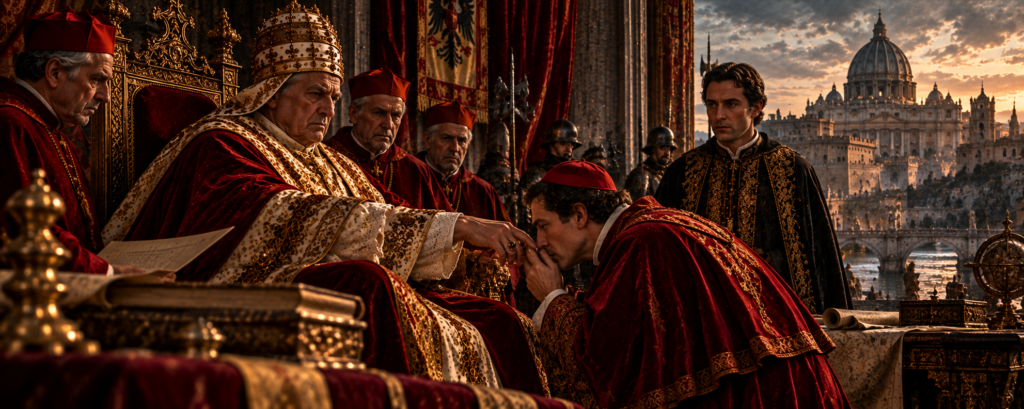
Callixtus III: The Pope Who Built the Borgia Dynasty
Callixtus III — 1455–1458
When Pope Callixtus III died on August 6, 1458, Rome did not mourn him quietly. Hostility toward the Spanish and Valencian officials who had prospered under his protection erupted into disorder, and members of the powerful Borgia family suddenly discovered how quickly papal favor could disappear. His nephew Pedro Luis Borgia, who had accumulated an extraordinary collection of military commands, governorships, and titles, fled the city as enemies moved against the men who had dominated its government. Another nephew, the young Cardinal Rodrigo Borgia, faced a far more uncertain future than anyone could have imagined while his uncle was alive.
Only three years earlier, the election of an elderly Valencian cardinal had transformed the fortunes of an ambitious but relatively modest noble family. Alfonso de Borja, who became Callixtus III in 1455, had spent decades building a reputation as a skilled lawyer, diplomat, and ecclesiastical administrator. He was not famous for sexual scandals, extravagant banquets, or the spectacular cruelty associated with some of the papacy’s darkest figures. Yet once he occupied the throne of Saint Peter, he used the extraordinary powers of that office to elevate his relatives with a speed and determination that alarmed the Roman establishment.
The most consequential beneficiary was Rodrigo Borgia, a young man whose future would become inseparable from the darker legends of Renaissance Rome. Callixtus made him a cardinal and then appointed him vice-chancellor of the Church, placing him at the center of papal administration and giving him access to wealth, influence, and an international network of powerful connections. Rodrigo would hold that enormously important office for thirty-five years before becoming Pope Alexander VI in 1492. Without his uncle’s intervention, the political foundations of the later Borgia papacy might never have existed.
Yet Callixtus III was not simply a corrupt old man distributing church offices to his family. He was also a pope consumed by the Ottoman conquest of Constantinople, determined to organize a new crusade, and willing to sacrifice substantial resources to support military resistance against Ottoman expansion. During his pontificate, the papacy supported the defense of Belgrade in 1456, one of the most important Christian victories against Sultan Mehmed II during the period. Callixtus also authorized the proceedings that overturned the condemnation of Joan of Arc, whose execution for heresy had occurred twenty-four years earlier.
These contradictions make Callixtus III a fascinating figure for the darker history of the papacy. He was capable of genuine religious commitment and serious administrative effort while simultaneously treating important offices of the Church as instruments for establishing family power. He did not personally commit the notorious crimes later associated with Alexander VI and Cesare Borgia. Instead, he helped construct the political machinery that made their extraordinary rise possible.
Before the Borgias Became Infamous
Long before the Borgia name became associated with poison, ambition, scandal, and Renaissance intrigue, it belonged to a noble family rooted in the Kingdom of Valencia. Alfonso de Borja was born on December 31, 1378, in the Valencian region of the Crown of Aragon, traditionally identified with Canals near Xàtiva. His family possessed respectable local standing but did not belong to the highest ranks of European royalty. Nothing about his birth guaranteed that he would one day govern the Catholic Church.
The name itself would eventually acquire two familiar forms. In the Valencian and Aragonese world, the family was known as Borja, while Italian usage transformed the name into Borgia. That Italian form became internationally notorious because later members of the family established themselves so prominently in Rome. Alfonso therefore belonged to the same family remembered through Rodrigo, Cesare, and Lucrezia Borgia, although his own career began in a very different political and cultural environment.
He pursued an education in law, studying at the University of Lleida, where he became associated with the sophisticated legal culture of the Crown of Aragon. Medieval ecclesiastical government depended heavily upon trained lawyers because questions of jurisdiction, property, appointments, marriage, inheritance, and political authority regularly required expert interpretation. Alfonso proved exceptionally capable in this field. His legal knowledge would eventually become the foundation of his advancement.
Unlike the popular image of the Renaissance Borgia as an adventurer advancing through seduction or murder, Alfonso’s early career was marked primarily by education, administration, and diplomacy. He was intelligent, disciplined, and capable of navigating complicated disputes between rulers and churchmen. These qualities brought him into the service of the Aragonese monarchy. They also placed him at the center of one of the most difficult ecclesiastical controversies of the early fifteenth century.
The Last Years of the Western Schism
Alfonso grew up during the Western Schism, when rival claimants to the papacy divided western Christianity. The crisis began in 1378, the year of his birth, and continued through decades of competing obediences, political alliances, and bitter arguments over legitimacy. By the early fifteenth century, several generations of Christians had lived without universal agreement over who possessed the authority of Saint Peter. The situation was particularly complicated within the Crown of Aragon, where loyalty to the Avignon claimant Benedict XIII remained politically significant.
Benedict XIII, born Pedro de Luna, was himself an Aragonese churchman whose stubborn refusal to surrender became one of the defining obstacles to ending the Schism. Even after the Council of Constance elected Martin V in 1417 and most of western Christianity accepted the settlement, Benedict continued maintaining his claim from Peñíscola. Alfonso de Borja became involved in the efforts to resolve the remaining division. His legal abilities made him valuable in negotiations where every detail of authority and procedure mattered.
The final reconciliation of the Aragonese territories with the recognized papacy required careful diplomacy. Alfonso played an important role in the negotiations surrounding the withdrawal of support from the surviving Avignon succession. The claimant Clement VIII, elected by a small group of Benedict XIII’s remaining cardinals, eventually resigned in 1429. Alfonso’s involvement in these efforts helped establish his reputation as an effective church diplomat.
This experience mattered for his later career because it introduced him to the highest levels of ecclesiastical politics. He witnessed how papal legitimacy depended upon more than theology alone. Kings, cardinals, lawyers, and territorial rulers could determine whether a claimant possessed a functioning government or merely an empty title. Alfonso learned that authority required political support, administrative machinery, and loyal individuals capable of enforcing decisions.
The Service of Alfonso V of Aragon
Alfonso de Borja developed a close relationship with King Alfonso V of Aragon, one of the most ambitious rulers of his generation. The king sought to expand his influence throughout the Mediterranean and eventually secured the Kingdom of Naples. His political ambitions brought him into repeated contact with the papacy, which claimed important rights concerning the Neapolitan crown. A capable ecclesiastical diplomat could therefore become indispensable.
Borja served the king in important administrative and diplomatic capacities. His ability to reconcile conflicting interests made him valuable during negotiations with Rome. He was not merely a cleric waiting for promotion through church hierarchy. He was a political adviser operating in the difficult territory where royal ambitions and papal authority collided.
In 1429, Alfonso became bishop of Valencia, an important and prestigious ecclesiastical position. The appointment reflected both his religious career and the political influence he had acquired through royal service. He continued to work within the complicated relationship between the Aragonese monarchy and the papacy. His rise demonstrated how closely ecclesiastical advancement could depend upon royal patronage.
The connection with Alfonso V would later become particularly significant because the king conquered Naples in 1442. This placed the Aragonese monarchy at the heart of Italian politics and intensified the importance of negotiations with Rome. Borja’s familiarity with both worlds gave him an advantage. He understood Italian political realities long before he became pope.
From Valencia to the College of Cardinals
In 1444, Pope Eugenius IV created Alfonso de Borja a cardinal. The appointment marked his arrival among the highest-ranking officials of the Church. By this time, he was already in his mid-sixties, an age at which many men might have expected to conclude rather than transform their careers. Yet the cardinalate placed him in Rome’s intensely competitive political environment.
Borja was not initially the most flamboyant or obviously powerful figure within the College of Cardinals. Italian aristocratic families had long dominated the papal court, and the major European monarchies maintained their own interests in papal elections. A Valencian cardinal without a vast Italian territorial base could appear less threatening than candidates backed by entrenched Roman factions. That relative independence would eventually help him.
His reputation rested largely upon legal competence, administrative experience, and a serious manner. He was not celebrated as a great Renaissance humanist, nor did he cultivate the same reputation for artistic patronage as some contemporary churchmen. His priorities were shaped by ecclesiastical government and Mediterranean politics. Those interests would remain visible throughout his short pontificate.
Nevertheless, the cardinalate also brought opportunities for family advancement. Powerful churchmen regularly used benefices and appointments to support relatives, and Alfonso was no exception. Before becoming pope, he had already taken an interest in the careers of younger members of the Borja family. His election would transform that ordinary pattern of patronage into something far more dramatic.
Constantinople Falls
On May 29, 1453, the Ottoman army of Sultan Mehmed II captured Constantinople. The fall of the Byzantine capital sent shock waves throughout Christian Europe. For centuries, Constantinople had been one of the most important cities in the Christian world, even though relations between the Eastern and Western Churches had long been strained. Its conquest raised fears that Ottoman expansion might threaten other territories across the Mediterranean and southeastern Europe.
The news had an especially powerful effect upon Alfonso de Borja. He belonged to a generation for whom crusading remained an important religious and political ideal. The Ottoman conquest appeared not merely as a military defeat but as a catastrophe demanding a united Christian response. The divided and competitive rulers of Europe, however, were poorly positioned to organize such an undertaking.
Kingdoms pursued their own wars and territorial interests. Italian states competed for influence, while France, England, and the Holy Roman Empire faced their own political difficulties. The papacy possessed spiritual authority and diplomatic reach, but it lacked the military resources necessary to defeat the Ottoman Empire alone. Any major crusade would require cooperation among rulers who often distrusted one another more than they feared a distant enemy.
The conquest of Constantinople would become the central obsession of Callixtus III’s pontificate. His determination to organize resistance was genuine and sustained. It also created another reason for him to concentrate authority in the hands of trusted relatives. The crusading pope and the nepotistic pope were not separate personalities but two aspects of the same ruler.
The Conclave of 1455
Pope Nicholas V died on March 24, 1455, leaving the cardinals to choose his successor. Nicholas had been associated with the restoration of Rome, scholarship, architecture, and the cultural ambitions of the early Renaissance papacy. His successor would inherit both the prestige of the office and the political tensions surrounding the Papal States. The conclave therefore attracted considerable interest from rival factions.
The College of Cardinals contained powerful Italian interests, including those connected with major aristocratic families and regional rulers. A candidate strongly identified with one faction could provoke opposition from another. Alfonso de Borja offered a possible compromise. He was elderly, experienced, and relatively detached from the most entrenched Roman family rivalries.
On April 8, 1455, the cardinals elected him pope. He took the name Callixtus III. At seventy-six years old, he was one of the oldest men to assume the papacy during the period.
His age influenced expectations surrounding the election. Some cardinals may have assumed that an elderly compromise candidate would govern briefly without fundamentally altering the balance of power. Others likely valued his experience and apparent seriousness. Whatever their calculations, the new pope would prove considerably more energetic than his age suggested.
Callixtus immediately confronted the enormous responsibilities of his office. The Ottoman threat dominated his imagination, while the Roman political establishment remained suspicious of an outsider. He needed loyal administrators, military commanders, and trusted advisers. His answer was to turn toward his family.
The Pope Who Trusted His Blood
Nepotism was not invented by Callixtus III. Medieval and Renaissance popes had long promoted nephews, cousins, and other relatives to important positions. Family members offered a form of loyalty that could seem more dependable than the shifting alliances of ambitious cardinals and Roman noble houses. In a political environment where betrayal could mean imprisonment, exile, or death, kinship was an important source of security.
Callixtus nevertheless carried the practice to an extraordinary degree. His election opened the papal court to relatives and compatriots from the Valencian and Aragonese world. Men who had previously possessed limited influence in Italy suddenly received access to offices, revenues, military commands, and prestigious appointments. The transformation alarmed established Italian families who had expected to benefit from the new pontificate.
The pope’s reliance upon his relatives was partly defensive. As a foreign-born ruler in Rome, he lacked the deep local networks enjoyed by many Italian cardinals. He also faced the enormous challenge of organizing a crusade while governing politically unstable territories. Trusted family members appeared capable of solving both problems.
Yet the scale of their promotion created obvious conflicts of interest. Offices that should have served the Church also became instruments for establishing Borgia power. The distinction between papal government and family advancement grew increasingly difficult to maintain. What Callixtus considered loyalty, his opponents increasingly considered dynastic occupation.
Rodrigo Borgia Arrives in Rome
Among the young relatives whose fortunes changed was Rodrigo de Borja, born in 1431 in Xàtiva. Rodrigo was the son of Jofré de Borja and Isabel de Borja, the pope’s sister, making him Callixtus’s nephew. He had already benefited from his uncle’s patronage before 1455, but the election transformed his prospects. The young Valencian now possessed direct access to the most powerful ecclesiastical office in western Christianity.
Rodrigo was intelligent, ambitious, personable, and capable of navigating the sophisticated world of Italian politics. He had studied law at Bologna and would develop formidable administrative abilities. His later reputation for luxury and sexual scandal should not be projected automatically backward onto every stage of his youth. What mattered in 1455 was that he was a promising young relative whom the pope trusted.
Callixtus recognized the value of placing Rodrigo within the College of Cardinals. A cardinal nephew could represent the pope’s interests within the institution that would eventually elect his successor. He could also protect family influence after the pope’s death. Such an appointment offered advantages extending far beyond immediate personal favor.
The decision would become one of the most consequential acts of Callixtus’s pontificate. Rodrigo did not merely receive a comfortable benefice or ceremonial title. He entered the institution from which he would eventually seize the papacy himself. The Borgia dynasty acquired its most durable political foundation through the cardinal’s hat.
The Cardinals of 1456
On February 20, 1456, Callixtus III created Rodrigo Borgia a cardinal. He also elevated another nephew, Luis Juan de Milà, alongside Jaime of Portugal. The appointments were controversial because the two relatives were young and owed their rapid advancement overwhelmingly to their uncle. Experienced churchmen who had spent decades building their careers could reasonably resent such promotions.
Rodrigo was only twenty-four years old. His youth made the appointment especially conspicuous, although young cardinals were not unknown in the Renaissance Church. The cardinalate provided him with status, access to revenues, and influence within the highest circles of ecclesiastical government. It also made him a permanent political figure rather than merely a temporary member of his uncle’s household.
The elevation of Luis Juan de Milà reinforced the impression that Callixtus was building a family bloc within the College. Two relatives could cooperate in defending Borgia interests and supporting papal policies. Their presence also reduced the pope’s dependence upon older cardinals whose loyalties might be uncertain. From Callixtus’s perspective, the appointments strengthened his administration.
From the perspective of critics, however, the message was disturbing. The highest offices of the Church appeared available to young men primarily because they shared the pope’s blood. Personal merit could not be entirely excluded, particularly in Rodrigo’s case, but merit was plainly not the only consideration. The Church’s spiritual hierarchy was being used to consolidate family power.
Rodrigo Becomes Vice-Chancellor
The most important appointment followed in 1457. Callixtus made Rodrigo vice-chancellor of the Holy Roman Church, one of the most powerful administrative offices within the papal government. The position placed him at the center of the chancery, the institution responsible for producing and managing many of the documents through which papal authority operated. It also provided opportunities to develop extensive networks of patronage and influence.
This was not a minor reward. The vice-chancellorship was a prestigious, influential, and potentially lucrative position. Rodrigo would hold it for thirty-five years, surviving successive popes and becoming one of the most experienced administrators in the College of Cardinals. His long tenure allowed him to accumulate knowledge, wealth, and political relationships that would prove invaluable.
Callixtus could not have known every detail of Rodrigo’s future. He did not foresee the precise scandals surrounding Alexander VI or the military ambitions of Cesare Borgia. Yet he deliberately placed his nephew in an office capable of sustaining family influence beyond his own lifetime. The decision was therefore more than an act of affection.
It was an investment in dynastic continuity. A pope’s reign ended with his death, but a cardinal’s career could continue through several pontificates. Rodrigo’s appointment ensured that the Borgia family would remain deeply embedded in papal government even after Callixtus disappeared. The result would reshape the history of Renaissance Rome.
Pedro Luis Borgia: The Pope’s Secular Favorite
Rodrigo was not the only nephew whose career flourished. His brother Pedro Luis Borgia became the principal beneficiary of Callixtus’s secular patronage. Unlike Rodrigo, Pedro Luis was not being prepared primarily for a career within the ecclesiastical hierarchy. His uncle intended him to exercise military and territorial power.
Callixtus appointed Pedro Luis to important positions within the Papal States. He became captain-general of the Church’s military forces and castellan of Castel Sant’Angelo, the formidable fortress overlooking the Tiber near the Vatican. He also received authority over numerous cities and territories. The accumulation of offices gave him a political position far beyond what his earlier career would have suggested.
The contrast between the brothers was significant. Rodrigo received the cardinalate and vice-chancellorship, positions capable of surviving changes in papal leadership. Pedro Luis received military commands and territorial governorships dependent upon his uncle’s continuing authority. Both benefited enormously, but their positions carried very different levels of long-term security.
Pedro Luis soon became one of the most hated figures associated with the pontificate. Roman aristocrats resented his rapid advancement, while established political families feared the emergence of a new foreign-backed power. His offices placed him directly into conflicts over castles, cities, and territorial jurisdiction. Unlike Rodrigo’s administrative career, Pedro Luis’s authority could provoke immediate armed resistance.
The Fortress of Castel Sant’Angelo
Control of Castel Sant’Angelo was especially important. The fortress served as a military stronghold, a refuge, and a symbol of papal security. Whoever commanded it possessed a powerful position within Rome’s political landscape. Placing Pedro Luis in charge demonstrated the degree of trust Callixtus invested in his nephew.
The appointment also made political sense from the pope’s perspective. Rome had a long history of aristocratic violence, and the papacy could not always rely upon the loyalty of local noble families. A trusted relative commanding the fortress offered protection against rebellion or betrayal. Callixtus wanted someone whose fortunes were inseparable from his own.
Yet the arrangement also intensified resentment. The pope had effectively placed one of Rome’s most important military positions into the hands of a young foreign relative. To Roman nobles accustomed to competing for influence over papal government, the decision appeared threatening. The fortress became another symbol of Borgia advancement.
This illustrates the central contradiction of Callixtus’s nepotism. Family appointments could strengthen a pope’s immediate security while undermining broader political legitimacy. The more authority Pedro Luis received, the more enemies the family acquired. The very measures intended to protect the pontificate helped make its final collapse more violent.
The Orsini and the Borgias
Among the families most alarmed by Pedro Luis’s rise were the Orsini. The Orsini possessed extensive territorial interests and had long competed for influence within Rome and the Papal States. They were accustomed to negotiating with popes as powerful political actors rather than simply obeying them as subjects. The arrival of an ambitious Borgia nephew threatened established arrangements.
Conflict intensified over castles and territories claimed by the papacy. Callixtus argued that certain fortresses should return to direct ecclesiastical control, while members of the Orsini family defended their own claims. Pedro Luis became the instrument through which the pope attempted to enforce his position. Military operations followed.
In 1457, Pedro Luis participated in campaigns against Orsini-held positions, including operations around San Gregorio and San Crispino. The fighting was not simply a private family quarrel, because the papacy possessed genuine territorial claims and responsibilities. Nevertheless, the fact that the pope’s nephew commanded the operations made the conflict inseparable from Borgia advancement. Enemies could easily portray papal policy as a campaign to enrich the family.
The dispute helped create enduring hostility. The Orsini did not view Pedro Luis as a neutral official enforcing the rights of the Church. They saw a rapidly promoted outsider whose authority threatened their own position. When Callixtus died, that resentment would become dangerous.
Prefect of Rome
In August 1457, Callixtus appointed Pedro Luis prefect of Rome. The office carried considerable prestige and historical associations with secular authority in the city. For a young Valencian nobleman whose position depended heavily upon his uncle, the promotion was extraordinary. It represented another step toward establishing him as a major Italian political figure.
The appointment displaced established expectations surrounding Roman aristocratic influence. It also raised questions about whether Callixtus intended to create a lasting territorial principality for his nephew. Contemporary observers speculated about increasingly ambitious plans. Some even suggested that the pope dreamed of securing a royal crown for Pedro Luis.
Such stories require caution. Diplomatic rumors and hostile commentary are not proof that every proposed marriage, kingdom, or imperial title formed part of a concrete papal strategy. Nevertheless, the rumors reveal how contemporaries understood the scale of Borgia ambition. Pedro Luis’s advancement seemed so extraordinary that observers could imagine almost any further elevation.
Callixtus also granted his nephew additional titles and territorial privileges, including the dukedom of Spoleto. The accumulation of honors made Pedro Luis one of the most conspicuous examples of papal nepotism in the period. His position appeared formidable while Callixtus lived. It would prove astonishingly fragile once the pope died.
The Dream of a Borgia Principality
The possibility that Callixtus intended to establish Pedro Luis as a territorial prince has fascinated historians because it anticipates later Borgia ambitions. Decades afterward, Cesare Borgia would attempt to carve out a powerful state in central Italy under the protection of his father, Alexander VI. Pedro Luis’s career provides an earlier example of a papal relative receiving military authority and territorial responsibilities. The similarities are striking.
Yet the two careers should not be treated as identical. Pedro Luis’s governorships were often offices exercised on behalf of the Church rather than outright hereditary possessions. His power depended heavily upon papal appointment and could therefore be revoked or challenged after his uncle’s death. Cesare’s later campaigns involved different political circumstances and more explicit efforts to consolidate territorial rule.
Even so, Callixtus demonstrated how papal authority could be used to elevate a relative toward princely status. Military commands, governorships, castles, and ceremonial honors could create the appearance of a new dynasty almost overnight. The pope possessed resources that ordinary noble families could scarcely imagine. He could transform a nephew’s prospects through a series of appointments.
The danger was that papal power was not hereditary. A pope could make his nephew powerful, but he could not guarantee that the next pope would protect him. Pedro Luis’s fate would expose this weakness with devastating clarity.
The Foreigners in Rome
Callixtus’s reliance upon Valencian and Aragonese officials created resentment extending beyond the major Roman noble families. Italians frequently referred to the newcomers collectively as Catalans, although their backgrounds and identities were more varied than that label suggests. The term could carry hostility toward outsiders who appeared to be taking offices and revenues away from established local interests. Foreignness became an important weapon in the struggle against the Borgia household.
This hostility was not simply a principled objection to nepotism. Roman politics had long tolerated family patronage when the beneficiaries belonged to familiar Italian networks. The elevation of outsiders threatened existing distributions of power. Resentment therefore combined genuine criticism of favoritism with ethnic and regional prejudice.
Callixtus increasingly surrounded himself with people whose loyalty he trusted. Some were relatives, while others were compatriots or associates from the Aragonese world. Their appointments reinforced the impression that the papal court was becoming dominated by foreigners. Every new promotion made the political atmosphere more dangerous.
The pope appears to have recognized the problem but did not fundamentally change course. His age, his lack of deep Roman family connections, and his determination to pursue difficult policies all encouraged continued reliance upon trusted men. He had created a government that depended upon the same patronage system generating its enemies. The resulting tensions would erupt after his death.
A Pope Obsessed With Constantinople
While Callixtus promoted his family, he devoted extraordinary energy to the struggle against Ottoman expansion. The fall of Constantinople remained a profound shock, and he believed the papacy had a responsibility to organize Christian resistance. His determination distinguished him from rulers who expressed alarm but hesitated to commit resources. Callixtus wanted action.
He called for a crusade and attempted to raise money, ships, and soldiers. Papal representatives traveled through Europe seeking support from kings and princes. Preachers encouraged participation, while financial arrangements were made to sustain military operations. The project consumed enormous diplomatic effort.
The pope’s ambitions were far greater than the resources available to him. European rulers remained divided by their own interests, and enthusiasm for crusading did not always translate into armies or fleets. Some governments offered promises that produced little practical assistance. Others feared that military commitments would weaken their position against neighboring rivals.
Callixtus nevertheless persisted. He treated the Ottoman threat as the defining emergency of his pontificate. His determination complicates any portrayal of him as a pope interested only in enriching the Borgias. The same man who advanced his nephews was also prepared to devote significant resources to a religious and military cause he considered urgent.
Selling Luxury to Finance War
Callixtus’s crusading efforts brought him into conflict with the cultural priorities of the Renaissance papacy. Nicholas V had been an enthusiastic patron of scholarship, architecture, and the restoration of Rome. Callixtus placed greater emphasis upon military preparations against the Ottomans. The contrast was striking.
He reduced certain expenditures and directed resources toward the crusading campaign. Contemporary and later accounts describe the sale or melting down of valuable objects to finance military efforts, although individual stories should be evaluated carefully rather than accepted in every dramatic detail. The broader policy of prioritizing crusading finance over artistic magnificence is well established. Callixtus believed that defending Christian territories mattered more than preserving luxury.
This austerity creates an important contradiction. A pope capable of sacrificing valuable possessions for a religious campaign was simultaneously willing to grant enormous privileges to relatives. He could be financially severe toward some projects while extraordinarily generous toward his family. His priorities were selective rather than consistently self-denying.
The distinction matters because corruption does not always take the form of personal luxury. Callixtus was not notorious for the extravagant pleasures associated with later Renaissance popes. His questionable use of power lay chiefly in distributing offices and influence through family connections. A man can live comparatively austerely while still practicing aggressive nepotism.
The Siege of Belgrade
The most important military event of Callixtus’s pontificate occurred in 1456. Sultan Mehmed II, whose conquest of Constantinople had transformed the balance of power in the eastern Mediterranean, advanced against Belgrade. The fortress occupied a strategically vital position near the confluence of the Danube and Sava rivers. Its capture would have opened important routes toward Hungary and central Europe.
Christian resistance centered upon the Hungarian commander John Hunyadi and the Franciscan preacher John of Capistrano. Hunyadi organized military preparations, while Capistrano helped mobilize religious enthusiasm and irregular forces. The defenders faced a formidable Ottoman army equipped with substantial artillery. The outcome was far from certain.
Callixtus supported the broader effort to resist Ottoman expansion. Papal diplomacy, financial assistance, and religious mobilization contributed to the campaign, although the victory should not be credited to the pope alone. Hunyadi’s military leadership, the defenders’ determination, and the circumstances of the battle were decisive. The pope’s role was important but indirect.
In July 1456, the defenders achieved a remarkable victory. Ottoman forces withdrew, and the immediate threat to Belgrade was lifted. News of the triumph produced celebration throughout Christian Europe. For Callixtus, the victory offered powerful evidence that his crusading commitment had not been futile.
The Bells of Victory
Callixtus had ordered prayers and the ringing of bells as part of the mobilization against the Ottoman threat. The association between the noon bell and the victory at Belgrade became an enduring part of Catholic historical memory. The chronology is more complicated than popular retellings sometimes suggest, because the papal order for prayers preceded the arrival of news of the victory. The custom should therefore not be presented simply as a spontaneous order issued after the battle.
The victory itself carried enormous symbolic importance. Constantinople had fallen only three years earlier, and many Europeans feared that Ottoman armies might continue advancing almost unchecked. Belgrade demonstrated that resistance remained possible. The triumph encouraged hopes for a broader crusading campaign.
Yet those hopes were not fully realized. European rulers continued pursuing conflicting interests, and the papacy lacked the resources to sustain a massive offensive alone. Hunyadi died shortly after the victory during an outbreak of disease among the forces. John of Capistrano also died later that year.
The triumph therefore contained an element of tragedy. The men who had led the defense did not live to transform it into a sustained campaign. Callixtus continued seeking support, but the political unity necessary for his larger ambitions remained elusive. Belgrade was a genuine success within a crusading project that never achieved its ultimate objective.
A Victory That Complicates the Verdict
Belgrade prevents any fair assessment of Callixtus from reducing him to a dynastic opportunist. His concern over Ottoman expansion was not merely a convenient slogan. He invested time, money, diplomatic effort, and personal attention in the cause. His actions reflected a sincere understanding of papal responsibility as he perceived it.
That does not mean the crusading program was beyond criticism. Religious warfare carried its own moral and political complexities, and calls for crusades could encourage coercion, taxation, and conflict. The interests of Christian rulers were not always identical with the interests of populations living near the Ottoman frontier. A historically responsible account should not treat every papal military ambition as automatically noble.
Nevertheless, Callixtus’s commitment was genuine. He did not abandon the crusade whenever a family appointment became available. Both priorities operated simultaneously. The pontificate was shaped by an elderly pope who believed he was defending Christendom while also securing his relatives’ future.
This combination makes him more historically interesting than a simple villain. He could pursue a cause he considered sacred while using methods that damaged the integrity of ecclesiastical government. Good intentions in one sphere did not prevent questionable decisions in another. His story demonstrates how easily religious commitment and family ambition could coexist.
Joan of Arc and the Reversal of a Condemnation
Another significant event of Callixtus’s pontificate concerned Joan of Arc. Joan had been executed at Rouen in 1431 after an ecclesiastical trial that condemned her for heresy and related offenses. Her death became one of the most controversial episodes of the Hundred Years’ War. Supporters increasingly challenged the legitimacy of the proceedings that had led to her execution.
The process of reviewing Joan’s condemnation began before Callixtus became pope. Earlier investigations and petitions had already questioned the original trial. Under Callixtus, the rehabilitation proceedings advanced through an authorized ecclesiastical process. Testimony was gathered, the earlier proceedings were examined, and the case received formal reconsideration.
In July 1456, the original condemnation was declared null and void. The judgment did not mean that Callixtus personally conducted every stage of the investigation or independently discovered the errors in the original trial. Rather, his pontificate provided the authority under which the rehabilitation was completed. The decision restored Joan’s reputation within the Church.
The episode deserves attention because it reveals another side of Callixtus’s government. The same pope who promoted his relatives also presided over the formal correction of a notorious ecclesiastical injustice. The rehabilitation did not erase Joan’s execution, but it publicly rejected the judgment that had condemned her. For a Church struggling with its own authority, that reversal carried enormous significance.
The Problem of Judging Callixtus
Callixtus presents a challenge for any category devoted to wicked popes. His most conspicuous wrongdoing was nepotism, a practice deeply embedded in medieval and Renaissance ecclesiastical politics. He did not acquire a reputation comparable to Alexander VI for sexual scandal or spectacular dynastic warfare. His pontificate lasted only three years, limiting the time available for his policies to develop.
Yet nepotism should not be dismissed merely because it was common. The fact that many popes promoted relatives does not make every appointment harmless. Church offices carried spiritual responsibilities, administrative power, revenues, and sometimes military authority. Distributing them primarily through kinship could undermine confidence in the institution.
Callixtus’s appointments were especially consequential because they established two different forms of Borgia power. Pedro Luis received territorial and military authority that depended upon the pope’s survival. Rodrigo received ecclesiastical rank and administrative office capable of lasting for decades. The first arrangement collapsed almost immediately after Callixtus died, while the second became the foundation of a future papacy.
This difference is central to his historical legacy. Callixtus’s nepotism did not simply reward relatives for a few comfortable years. It helped create a durable political network that would influence Rome for generations. The later Borgia story begins not with Alexander VI’s election in 1492 but with the decisions of his uncle in the 1450s.
The Dangerous Logic of Nepotism
From Callixtus’s perspective, reliance upon relatives solved practical problems. He was an elderly outsider governing a city dominated by powerful families. He faced military threats, difficult territorial disputes, and the challenge of financing a crusade. Trustworthy administrators were essential.
A nephew whose fortune depended upon the pope could appear more dependable than a Roman nobleman with competing loyalties. Family loyalty could reduce the risk of betrayal and provide continuity within the administration. In the short term, such appointments might make government more efficient. Callixtus was not irrational to value trusted relatives.
The problem was that personal loyalty could replace institutional accountability. A nephew promoted because of blood might receive responsibilities beyond his experience. Other capable officials could be excluded, while resentment accumulated among those who believed offices were being monopolized. Family interests could gradually become confused with the interests of the Church.
Callixtus’s government displayed these dangers clearly. Rodrigo’s abilities eventually justified his reputation as an effective administrator, but his original elevation was inseparable from his uncle’s favor. Pedro Luis received an extraordinary concentration of military and territorial power despite his youth. Their promotions made the family stronger while making the papacy politically more vulnerable.
The Pope and the King of Naples
Callixtus’s relationship with Alfonso V of Aragon became increasingly complicated after his election. The king had played an important role in the pope’s earlier career, but papal authority introduced competing interests. Naples remained a kingdom over which the papacy claimed feudal rights. Questions surrounding succession and royal recognition therefore created tension.
Alfonso V wished to secure the future of his Neapolitan possessions, particularly through his son Ferrante, also known as Ferdinand. The pope was reluctant to accept every arrangement the king desired. Their disagreements demonstrated that Callixtus was not simply a puppet of the Aragonese monarchy. He possessed his own understanding of papal rights.
The conflict also intersected with the ambitions surrounding Pedro Luis Borgia. Rumors circulated about possible territorial rewards or royal arrangements involving the pope’s nephew. Some observers suspected that Callixtus hoped to use the uncertainty surrounding Naples to create opportunities for his family. Such claims must be distinguished from policies that can be documented securely.
What is clear is that the relationship between the pope and his former royal patron deteriorated. Callixtus was prepared to defend papal interests even against a ruler who had helped advance his career. Yet the presence of ambitious relatives made his motives vulnerable to suspicion. In Renaissance politics, dynastic ambition could easily become entangled with arguments about legitimate sovereignty.
The Death of Alfonso V
King Alfonso V died in June 1458. His death intensified the question of succession in Naples and created new opportunities for political maneuvering. Ferrante sought to secure the kingdom, while rival claims and papal rights complicated the situation. Callixtus did not live long enough to resolve the dispute.
The pope’s final weeks were therefore marked by uncertainty over the future of southern Italy. His crusading ambitions remained unfinished, his family had accumulated dangerous enemies, and the Neapolitan succession threatened further conflict. The elderly pontiff was increasingly ill. His government had become heavily dependent upon men whose authority rested upon his continued survival.
For Pedro Luis Borgia, the danger was particularly severe. His offices and territories could become vulnerable once a new pope assumed power. Roman nobles who resented him would have an opportunity to strike. The death of his uncle would remove the protection that had made his extraordinary rise possible.
Rodrigo’s position was different. His cardinalate could not simply be erased by a change of pope, and his vice-chancellorship gave him an institutional foundation. He faced political hostility, but his career possessed a durability his brother’s did not. The contrast would become painfully obvious within weeks.
August 1458: The Borgia Protector Dies
Callixtus III died on August 6, 1458. His death ended a short but unusually consequential pontificate. The crusade he had hoped to organize remained incomplete, while the Borgia family occupied positions that had seemed almost unimaginable three years earlier. The pope’s passing immediately exposed how much of that power depended upon his personal authority.
Hostility toward the Catalan and Valencian officials associated with his government erupted in Rome. Contemporary accounts describe disorder and attacks upon the political network that had flourished under Callixtus. Some later narratives heighten the violence for dramatic effect, but the general collapse of Borgia influence is well established. The city was not prepared to preserve the arrangements the dead pope had created.
Pedro Luis fled Rome. His military and territorial offices could no longer protect him against the enemies who had waited for his uncle’s death. The man who had commanded papal troops and accumulated prestigious titles was suddenly vulnerable. His career collapsed with astonishing speed.
Rodrigo also faced hostility, but his ecclesiastical status gave him a different path forward. He remained a cardinal and retained the possibility of influence under future popes. His uncle had given him something far more durable than a temporary governorship. That distinction would ultimately determine the family’s future.
The Fall of Pedro Luis Borgia
Pedro Luis’s flight became one of the most dramatic consequences of Callixtus’s death. The young nobleman had risen with extraordinary speed, receiving military commands, governorships, and prestigious honors through papal patronage. Yet once his uncle died, his enemies moved against the political arrangements that sustained him. The apparent strength of his position dissolved.
He reached Civitavecchia, where he died on September 26, 1458, only weeks after Callixtus. Accounts differ over the precise cause of his death. Some sources associate it with illness, including malaria, while others preserve suspicions of violence. The evidence does not justify presenting assassination as established fact.
His death ended the most immediate attempt to establish a powerful secular Borgia presence in central Italy. Titles and appointments had elevated him rapidly, but they had not created a stable hereditary principality capable of surviving political upheaval. The pope’s favor had made him powerful. The pope’s death left him exposed.
Pedro Luis therefore became a warning about the fragility of papal nepotism. A relative could receive extraordinary authority during one pontificate and lose almost everything during the next. The political system that created such opportunities also made them dangerously unstable. His brother Rodrigo would learn from a very different experience.
Rodrigo Survives
Rodrigo Borgia was still a young man when Callixtus died. His future was uncertain, and hostility toward the Borgia household threatened his position. Yet the cardinalate gave him a permanent place within the governing elite of the Church. He could not simply be dismissed as another foreign official whose patron had disappeared.
The vice-chancellorship proved even more important. Rodrigo remained connected to the central machinery of papal administration. Over the following decades, he developed relationships with successive popes, cardinals, rulers, bankers, and powerful families. His knowledge of ecclesiastical government became extraordinary.
Rodrigo also learned the importance of political flexibility. His uncle had relied heavily upon Valencian relatives and compatriots, creating resentment among established Italian interests. Rodrigo would eventually cultivate a far broader network. He understood that surviving in Rome required alliances extending beyond family loyalty.
His career after 1458 was not an uninterrupted triumph, and he faced scandals, rivalries, and political dangers of his own. Nevertheless, the foundation Callixtus provided remained intact. Rodrigo possessed rank, office, and access to resources that would sustain his ambitions. The Borgia family had survived its first great Roman catastrophe.
The Election of Pius II
The conclave following Callixtus’s death elected Enea Silvio Piccolomini, who became Pope Pius II. The new pope was a distinguished humanist, diplomat, and churchman whose background differed sharply from that of his predecessor. His election marked a change in the atmosphere of the papal court. It also demonstrated that the College of Cardinals was not prepared simply to continue Callixtus’s family-centered political arrangements.
Pius II possessed his own interests and ambitions. Like Callixtus, he was concerned about Ottoman expansion and would later pursue plans for a crusade. Yet his approach to papal government reflected different personal relationships and priorities. The Borgia relatives could no longer assume automatic favor.
Rodrigo nevertheless retained his position and gradually established himself as an important figure under the new pontificate. His administrative abilities made him useful. The vice-chancellorship provided institutional continuity across the transition. He was learning how to remain powerful without depending entirely upon one pope.
This survival was one of the most important consequences of Callixtus’s nepotism. Pedro Luis represented the danger of power tied too closely to a single patron. Rodrigo represented the possibility of converting family favor into a lasting career. The latter would prove far more consequential.
The Thirty-Five-Year Investment
Rodrigo Borgia held the vice-chancellorship from 1457 until his election as pope in 1492. During those thirty-five years, he became one of the most experienced and influential members of the College of Cardinals. He accumulated benefices, wealth, and political connections. His administrative expertise made him difficult to ignore.
The office provided more than money. It placed Rodrigo at the center of the papal bureaucracy, where he could understand the interests of powerful families and the mechanisms through which ecclesiastical favors were distributed. He learned how appointments, diplomatic negotiations, and financial arrangements shaped political loyalty. These skills would become essential when he sought the papacy.
Callixtus’s decision therefore produced consequences extending far beyond his three-year reign. A single appointment helped sustain Rodrigo through five subsequent pontificates before his own election. The uncle who died in 1458 remained indirectly influential through the institutional position he had secured for his nephew. Few acts of papal patronage had such lasting effects.
This is the strongest argument for treating Callixtus as the beginning of the Borgia papal dynasty. He did not merely introduce Rodrigo to Rome. He placed him in an office from which a determined and talented man could build a political empire. The later scandals of Alexander VI would unfold upon foundations laid decades earlier.
From Rodrigo to Alexander VI
In August 1492, Rodrigo Borgia was elected pope and took the name Alexander VI. His election transformed the Borgia family from an influential ecclesiastical network into the ruling household of the papacy. By then, Rodrigo had spent decades mastering the political culture of Rome. He possessed the experience, wealth, and alliances necessary to compete for the highest office.
Alexander’s pontificate would become one of the most notorious in Renaissance history. His acknowledged children, including Cesare and Lucrezia Borgia, became central figures in dynastic marriages, military campaigns, and political intrigues. Accusations of simony, corruption, sexual misconduct, and ruthless ambition surrounded his reign. Some stories were exaggerated by enemies, while others reflected genuine and serious abuses of power.
Callixtus should not be held personally responsible for every action of his nephew. Rodrigo made his own decisions, developed his own political methods, and governed under circumstances very different from those of the 1450s. The future Alexander VI was not simply carrying out a plan written by his uncle. He had thirty-five years to construct his own career.
Nevertheless, the connection remains unmistakable. Without Callixtus’s elevation of Rodrigo to the cardinalate and vice-chancellorship, the later Borgia papacy would have been far less likely. The uncle provided access to the institution. The nephew transformed that access into supreme power.
The Shadow of Cesare Borgia
The career of Cesare Borgia offers an especially striking comparison with Pedro Luis. Both men benefited from papal relatives who used ecclesiastical authority to support secular ambitions. Both became associated with military power and territorial government in central Italy. Both confronted the problem of creating lasting political authority within a system where papal protection could disappear suddenly.
Cesare’s campaigns under Alexander VI were more extensive and better documented than Pedro Luis’s brief rise. He sought to consolidate territories in the Romagna and became one of the most formidable political figures of his generation. His methods inspired fascination and horror, and his career later attracted the attention of Niccolò Machiavelli. Yet his position remained dangerously dependent upon his father’s survival.
When Alexander VI died in 1503, Cesare’s political world began collapsing. Illness, hostile successors, and shifting alliances destroyed much of what he had built. The pattern resembled Pedro Luis’s downfall after Callixtus died. Papal nepotism could produce spectacular advancement without guaranteeing durable succession.
This recurring weakness makes the Borgia story especially tragic. Callixtus and Alexander both attempted to use papal authority to secure family power. Their relatives could become immensely influential while the pope lived. Yet the death of the patron repeatedly exposed the fragility of the entire arrangement.
Was Callixtus III Personally Corrupt?
The word corruption can describe several different kinds of behavior. A pope who sells spiritual offices for money engages in one form of corruption. A pope who uses ecclesiastical revenues to maintain a lavish private lifestyle engages in another. A pope who promotes relatives into positions of extraordinary power may practice institutional favoritism even without personally living extravagantly.
Callixtus’s strongest claim to notoriety lies in the third category. His appointments benefited his family on an extraordinary scale. Rodrigo and Luis Juan received cardinalates, while Pedro Luis accumulated military commands and territorial authority. The concentration of power was too conspicuous to dismiss as routine family assistance.
At the same time, Callixtus does not fit the popular image of a Renaissance libertine. His pontificate was marked by serious concern over Ottoman expansion and a willingness to redirect resources toward military preparations. His personal conduct did not generate the same enduring sexual scandals associated with Alexander VI. He should not be portrayed as guilty of his nephew’s later behavior.
A nuanced judgment must therefore distinguish personal austerity from institutional integrity. Callixtus could be relatively restrained in his own lifestyle while using the papacy to strengthen his family. He could sincerely pursue a crusade while making appointments that favored blood over broader institutional considerations. These contradictions are not excuses but essential features of his historical character.
Why Nepotism Mattered So Much
Papal nepotism had consequences extending far beyond resentment among disappointed cardinals. The Church claimed to govern according to spiritual principles, yet important appointments could depend upon family relationships. This undermined confidence in the fairness and legitimacy of ecclesiastical administration. It also encouraged powerful families to treat the papacy as an opportunity for dynastic advancement.
The problem became particularly serious when offices carried military or territorial authority. A nephew appointed to govern a city could become involved in conflicts that served family interests as much as ecclesiastical ones. Rival noble houses might resist not because they opposed the Church but because they feared the emergence of a new political dynasty. Religious authority could then become a weapon within secular power struggles.
Callixtus’s relationship with the Orsini demonstrates this danger. Papal claims over castles and territories may have possessed genuine legal foundations. Yet enforcement through Pedro Luis made the operations appear inseparable from Borgia ambition. The resulting hostility threatened the stability of papal government.
Nepotism also created problems of succession. A pope could promote relatives, but he could not guarantee that his successor would preserve their offices. Every papal death therefore risked becoming a political upheaval. The disorder following Callixtus’s death exposed that danger dramatically.
The Pope Who Was Not Alexander VI
It is important to resist the temptation to read Callixtus’s life entirely through the later reputation of his nephew. Alexander VI became notorious for his relationships, children, political intrigues, and aggressive use of papal power. Those scandals have shaped the public image of the Borgia family for centuries. Callixtus’s own personality and priorities were different.
He was elderly when elected and had spent decades building a reputation as a lawyer and diplomat. His central religious concern was the Ottoman threat, not the cultivation of a spectacular Renaissance court. His nepotism was serious, but his personal lifestyle was not the primary source of scandal. His historical significance lies in the way he combined sincere religious commitment with aggressive family patronage.
This distinction makes him more interesting rather than less. A pope who openly pursued pleasure and wealth would fit a familiar pattern of ecclesiastical corruption. Callixtus presents a more complicated example. He could believe himself devoted to the Church while making decisions that transformed it into an instrument of dynastic advancement.
His legacy also demonstrates that institutional damage need not be immediately visible. Rodrigo’s cardinalate did not create the scandals of Alexander VI overnight. The consequences unfolded over decades. Callixtus planted a political seed whose full significance became apparent long after his death.
A Family That Refused to Disappear
The death of Callixtus might have ended the Borgia family’s Roman ambitions. Pedro Luis was dead within weeks, hostile factions had moved against the Valencian household, and a new pope occupied the throne. Many families whose fortunes depended upon a single pontiff disappeared from prominence under similar circumstances. The Borgias did not.
Rodrigo remained. His cardinalate gave him a permanent institutional identity, while his administrative position provided access to the machinery of government. He cultivated alliances and accumulated resources. Over time, the hostility surrounding his uncle’s death became only one episode in a much longer career.
This survival reveals the extraordinary importance of Callixtus’s decision to make Rodrigo a cardinal. Secular offices could be lost when a pope died, but membership in the College offered a degree of continuity. Rodrigo could participate in conclaves, influence appointments, and negotiate with successive pontiffs. His position allowed him to remain politically relevant even when the Borgia name was unpopular.
The family therefore emerged from the crisis transformed rather than destroyed. Pedro Luis’s branch of immediate territorial ambition had collapsed. Rodrigo’s ecclesiastical career continued. The future of the dynasty had shifted decisively toward the cardinal who would become Alexander VI.
The Beginning of a Dark Dynasty
The Borgia dynasty did not emerge fully formed in 1492. Its rise depended upon earlier generations, family connections, royal patronage, ecclesiastical appointments, and the ability to navigate the politics of Italy. Callixtus III occupies a central position in that development. He transformed the family from a regional noble house into a force within the highest levels of the Church.
His methods were not unique, but their consequences were extraordinary. Other popes promoted nephews who disappeared from history after their patron’s death. Callixtus promoted a nephew who survived for decades and eventually became pope himself. The resulting continuity gave the Borgia family a significance far beyond the duration of Callixtus’s pontificate.
The later careers of Alexander VI and Cesare Borgia would make the family notorious throughout Europe. Political enemies circulated accusations of poisoning, sexual scandal, murder, and corruption. Some allegations were grounded in real events, while others became exaggerated through hostile propaganda. The Borgia name gradually acquired an almost mythical association with Renaissance wickedness.
Callixtus belongs at the beginning of that story, but he should not be transformed into its most monstrous figure. His wrongdoing was more institutional than theatrical. He used papal authority to elevate his relatives and created the foundations for a powerful ecclesiastical dynasty. The full consequences unfolded after he was gone.
The Pope’s Unfinished Crusade
Callixtus died without achieving his ambition of organizing a great campaign to reverse the Ottoman conquest of Constantinople. Belgrade had been a major victory, but it did not lead to the sweeping Christian offensive he desired. European rulers remained divided, and the resources available to the papacy were insufficient for the scale of his plans. The dream that had dominated his pontificate remained unfinished.
This failure should not obscure the seriousness of his efforts. Callixtus devoted substantial attention to diplomacy, military finance, and the organization of resistance. He believed the papacy possessed a duty to defend Christian territories threatened by Ottoman expansion. His commitment was not merely rhetorical.
Yet the crusading program also demonstrates the limitations of papal power. The pope could issue calls for action, authorize taxation, send representatives, and contribute resources, but he could not force Europe’s rulers to cooperate effectively. Political rivalry repeatedly frustrated religious ambition. The result was a mixture of genuine achievement and profound disappointment.
The contrast with his family policy is revealing. Callixtus could not create a united Christian army, but he could create cardinals and appoint military commanders. He could not compel Europe’s monarchs to obey his crusading plans, but he could place relatives in important offices. The powers he could exercise most directly became the instruments of his most enduring legacy.
The Strange Balance of His Pontificate
Callixtus’s reign lasted only from April 1455 to August 1458. In that short period, he supported the defense of Belgrade, pursued a major crusading program, authorized the rehabilitation proceedings that cleared Joan of Arc, and elevated members of his family to extraordinary positions. These achievements and controversies unfolded simultaneously. None can be separated entirely from the others.
His crusading determination helps explain his reliance upon trusted administrators. His foreign background helps explain why he preferred relatives and compatriots. His advanced age helps explain why he may have felt urgency about securing both his policies and his family’s future. These circumstances provide context without eliminating responsibility.
A pope does not cease to be accountable for nepotism because he fears betrayal. Nor does a genuine commitment to defending Christian territories make every family appointment legitimate. Callixtus possessed enormous authority and chose to use part of it to advance his relatives. The consequences were politically significant.
His pontificate therefore resists a simple moral label. He was neither an innocent reformer unfairly condemned by jealous Italians nor a depraved tyrant whose every action served the Borgias. He was a serious churchman whose family favoritism became one of the defining features of his government. The contradiction lies at the center of his story.
The Legacy of a Three-Year Reign
Three years is a short period in which to shape centuries of history. Many popes governed longer without leaving a comparable dynastic legacy. Callixtus achieved his lasting influence through a small number of appointments rather than through an extensive program of institutional reform. Rodrigo’s cardinalate and vice-chancellorship mattered more to the future Borgia dynasty than any temporary territorial grant.
The consequences were not inevitable. Rodrigo might have died young, lost influence, or failed to secure the papacy. His later election depended upon decades of political maneuvering and circumstances Callixtus could not control. The uncle provided opportunity rather than destiny.
Nevertheless, opportunity is often the decisive element in political history. Rodrigo possessed talent and ambition, but without high ecclesiastical rank he would have faced a very different future. Callixtus gave him access to wealth, networks, and institutional authority. The young nephew used those advantages with extraordinary effectiveness.
The story therefore illustrates how personal patronage can alter the direction of an institution. A pope’s decision to favor a relative may appear ordinary within the politics of his own age. Its consequences can become visible only decades later. Callixtus’s appointments helped make possible one of the most notorious papacies in history.
The Pope Who Opened the Door
When people hear the name Borgia, they usually think of Alexander VI, Cesare Borgia, or Lucrezia Borgia. They imagine Renaissance palaces filled with intrigue, powerful families arranging marriages, ambitious princes conquering cities, and rumors of poison circulating through candlelit chambers. The family has become almost inseparable from the darker legends of the Renaissance papacy. Yet the extraordinary rise of the Borgias began before those famous figures reached the height of their power.
It began with Alfonso de Borja, a lawyer and diplomat from the Kingdom of Valencia who became Pope Callixtus III in 1455. He was already elderly, and his pontificate would last only three years. He did not possess the scandalous personal reputation later attached to Alexander VI. His ambitions were shaped as much by the Ottoman conquest of Constantinople as by the fortunes of his family.
Callixtus wanted to defend Christian Europe against Ottoman expansion. He devoted serious effort to raising money, organizing diplomacy, and supporting military resistance. The victory at Belgrade in 1456 gave his pontificate one of its most important achievements. His involvement in the rehabilitation of Joan of Arc also deserves a place in any balanced assessment.
Yet the same pope used the offices of the Church to elevate his relatives. Rodrigo Borgia became a cardinal at twenty-four and received the powerful vice-chancellorship the following year. Luis Juan de Milà also entered the College of Cardinals. Pedro Luis Borgia accumulated military commands, governorships, and prestigious titles at a speed that alarmed the Roman establishment.
These appointments were not simply gestures of family affection. They redistributed authority within the papal government and challenged established political interests. The Orsini and other Roman families saw the rise of the Borgias as a threat. Hostility toward the pope’s Valencian household grew steadily.
Callixtus may have believed that trusted relatives were essential to his security. He governed as an outsider in a city where powerful families could make or destroy political careers. The crusading project required loyal officials capable of managing resources and military preparations. His reliance upon family therefore possessed a practical explanation.
But practical explanations do not erase institutional consequences. The Church’s highest offices were not intended to exist primarily for the advancement of one household. When young relatives received extraordinary authority because of their connection to the pope, the distinction between ecclesiastical service and dynastic ambition became dangerously blurred. Callixtus helped normalize that confusion on a remarkable scale.
His death exposed the fragility of the system he had constructed. Pedro Luis fled Rome as enemies moved against the family. Within weeks, he was dead at Civitavecchia, his spectacular career reduced to a brief episode of papal favoritism. The political world that had elevated him disappeared almost overnight.
Rodrigo survived because his uncle had given him something more durable. The cardinalate placed him within the institution that elected popes, while the vice-chancellorship gave him access to the central machinery of papal administration. He remained influential through successive pontificates. Over thirty-five years, he transformed his inherited opportunity into a formidable political career.
In 1492, Rodrigo became Alexander VI. The Borgia family returned to the papal throne, this time under a man whose reign would become infamous for political ambition, dynastic maneuvering, and scandal. The younger generation would carry the family name into conflicts far beyond anything Callixtus had experienced. Cesare Borgia’s military campaigns would eventually echo the earlier ambitions surrounding Pedro Luis.
Callixtus did not personally create every scandal of the later dynasty. He cannot fairly be blamed for decisions made decades after his death by relatives acting under different circumstances. Yet his role in establishing the family’s ecclesiastical power is undeniable. He opened the door through which Rodrigo eventually walked.
That is why Callixtus III belongs in the darker history of the papacy. His wrongdoing was not spectacular cruelty or notorious personal debauchery. It was the use of spiritual authority to consolidate family influence. He demonstrated how easily a pope could confuse the security of the Church with the advancement of his own bloodline.
His story is also a reminder that historical figures rarely fit perfectly into categories of virtue and wickedness. Callixtus could be sincere in his religious commitments and deeply compromised in his appointments. He could support the defense of Belgrade while distributing offices to nephews. He could authorize the rehabilitation of Joan of Arc while creating political resentment through nepotism.
Those contradictions do not cancel one another. They reveal a man whose understanding of duty included both the defense of Christendom and the elevation of his family. The first ambition gave his pontificate genuine achievements. The second created a legacy that would eventually overshadow almost everything else.
When Callixtus died, his enemies believed the Borgia experiment had ended. Pedro Luis’s fall seemed to prove that the family’s extraordinary rise had depended entirely upon one elderly pope. Rome could return to its familiar rivalries, and the Valencian outsiders could be pushed aside. For a moment, the Borgia name appeared destined to fade from the center of papal politics.
But Rodrigo remained within the College of Cardinals. He possessed wealth, influence, administrative experience, and decades of opportunity ahead of him. His uncle’s greatest political gift had survived the collapse of the rest of the family’s power. The foundation of a future dynasty remained intact.
Callixtus III therefore left two very different legacies. One belonged to the defense of Belgrade, the effort to organize a crusade, and the rehabilitation of Joan of Arc. The other belonged to the rise of the Borgia family and the increasingly dynastic character of Renaissance papal government. Both deserve to be remembered.
His place among the Wicked Popes is not that of a monster whose crimes shocked Europe. It is the place of an intelligent and serious ruler who allowed family loyalty to shape the distribution of ecclesiastical power. His actions were understandable within the political culture of his age, but they were not without consequences. The papacy became a means through which the Borgias could build influence extending far beyond his own lifetime.
The darkest aspect of his story is how ordinary the process initially appeared. A pope promoted a nephew, appointed a trusted relative to command troops, and placed family members in offices where their loyalty would be useful. Each decision could be defended individually. Together, they helped establish one of the most controversial dynasties in Christian history.
Callixtus never lived to see Alexander VI elected pope. He never witnessed Cesare Borgia’s campaigns or the scandals that would make his family’s name notorious across Europe. He died believing that he had served the Church during a dangerous period and secured the future of those closest to him. History would reveal how consequential that second achievement had been.
The old Valencian pope did not leave behind the most sensational scandals of the Borgia dynasty. He left something more enduring: the offices, connections, and institutional foothold that allowed his nephew to rise. His pontificate demonstrates that a dynasty’s darkest chapters do not always begin with murder, betrayal, or spectacular corruption. Sometimes they begin with a powerful man deciding that the people he trusts most should also become the people who govern.
Callixtus III was not Alexander VI, and he should never be judged as though he were. His genuine achievements deserve recognition, and his personal reputation should not be buried beneath scandals belonging to another generation. Yet the Borgia papacy that later horrified and fascinated Europe did not emerge from nowhere. Its foundations were laid during the brief reign of an elderly pope who placed extraordinary power into the hands of his family.
He wanted loyal servants, capable administrators, and a secure future for his relatives. What he helped create was a dynasty whose name would become synonymous with the darkest intrigues of Renaissance Rome. The road to Alexander VI began with the cardinal’s hat Callixtus placed upon the young Rodrigo Borgia. And long after the old pope was buried, the consequences of that decision continued to unfold.