
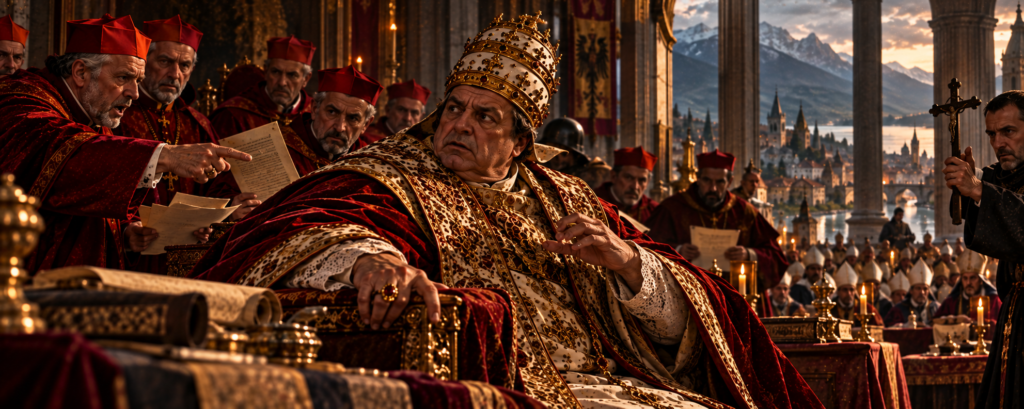
John XXIII: The Antipope Who Fled the Council Meant to Save the Church
John XXIII — Antipope, 1410–1415
In March 1415, the man who called himself Pope John XXIII slipped away from the greatest church council of his age. Baldassarre Cossa had arrived at Constance surrounded by cardinals, servants, officials, and the ceremonial magnificence expected of a pope, but he left secretly under the protection of Frederick IV, Duke of Austria, hoping that his disappearance would weaken the gathering that increasingly threatened his position. The escape failed spectacularly, and the council continued without him, eventually stripping him of the papal title he had held for almost five years. Soon the accusations came pouring out: simony, corruption, murder, sexual misconduct, betrayal, violence, and a seemingly endless catalogue of crimes that transformed Cossa into one of the most notorious churchmen of the later Middle Ages.
Some of those accusations became so lurid that they should immediately make a careful historian suspicious. Cossa’s enemies had powerful reasons to destroy his reputation, and the Council of Constance needed to demonstrate that removing a claimant to the papacy was justified. Later writers enthusiastically embroidered the picture, turning him into a pirate, murderer, libertine, poisoner, and almost theatrical embodiment of ecclesiastical depravity. The historical Baldassarre Cossa was certainly worldly, politically ruthless, financially aggressive, and deeply entangled in the violent factional struggles of Italy, but not every accusation made against him deserves to be repeated as established fact.
The truth is more interesting than the legend because Cossa did not stumble accidentally into the papal crisis. He rose through a world in which cardinals governed cities, popes hired soldiers, noble families fought for territory, church offices carried enormous political value, and the Western Schism had already shattered the assumption that there could be only one universally recognized pope. Cossa learned to survive in that world exceptionally well. By the time he became John XXIII in 1410, he was less a contemplative churchman than an experienced administrator, diplomat, financier, political operator, and prince of the Church accustomed to getting results in dangerous circumstances.
His fall was equally revealing. John agreed to summon the Council of Constance partly because he hoped the gathering would confirm his own legitimacy and eliminate his rivals, but the council gradually turned against him. When he realized that the solution to the Schism might require his own resignation, his cooperation faltered, suspicion deepened, and finally he ran. His attempt to escape judgment instead helped create the circumstances in which a church council claimed extraordinary authority over a pope and removed him.
There is one essential clarification before going further. This John XXIII was not Angelo Giuseppe Roncalli, the widely respected twentieth-century Pope John XXIII who reigned from 1958 to 1963 and convened the Second Vatican Council. Baldassarre Cossa’s claim was eventually excluded from the recognized papal succession, which is why Roncalli could take the name John XXIII centuries later. The two men share a papal name, but almost nothing else about their careers should be confused.
Baldassarre Cossa Before the Tiara
Baldassarre Cossa was born on the island of Procida, near Naples, probably around 1360 or somewhat later, into a noble Neapolitan family. The precise details of his early life are obscured by hostile traditions that developed after his fall, and this is where some of the most colorful legends begin. Later writers claimed that he had been a pirate or corsair in his youth, sometimes portraying the entire Cossa family as maritime predators. His family did possess strong connections to the maritime and military world of southern Italy, but the popular image of the future antipope beginning his career as a swashbuckling pirate is much less securely established than it is often presented.
What can be said with greater confidence is that Baldassarre came from a family accustomed to politics, warfare, and the turbulent affairs of the Kingdom of Naples. Southern Italy during his lifetime was not a peaceful environment in which ecclesiastical careers unfolded separately from dynastic conflict. Rival claimants fought over Naples, noble families maneuvered for advantage, and papal politics became deeply entangled with competing royal houses. A young aristocrat seeking advancement could move between military, administrative, and ecclesiastical worlds without encountering the sharp boundaries a modern reader might expect.
Cossa eventually studied law at Bologna, one of Europe’s greatest centers of legal learning. That education mattered because canon and civil law provided essential tools for anyone seeking power within the late medieval Church. Cossa was never remembered as a great theologian, but he became highly capable in administration and political negotiation. His strengths were practical rather than contemplative, and they would serve him extremely well.
His association with the Roman papal court deepened under Boniface IX, one of the popes of the Roman obedience during the Western Schism. Cossa entered papal service and rose through positions that brought him close to the machinery of government. Money, patronage, political connections, and administrative talent all contributed to advancement in this world. By 1402, Boniface IX had created him cardinal-deacon of Sant’Eustachio.
A Church Already Broken
Cossa’s career cannot be understood without the Western Schism. Since 1378, western Christianity had been divided between competing papal obediences, each insisting that its pope alone was legitimate. Urban VI had ruled from Rome while Clement VII established the rival Avignon line, and both obediences had subsequently elected successors. By the time Cossa became a cardinal, division had already lasted for nearly a quarter of a century.
The consequences were profound. Rival popes appointed rival bishops, created rival cardinals, collected revenues from different territories, and excommunicated one another’s supporters. Kingdoms chose sides according to mixtures of political interest and genuine canonical conviction. Ordinary Christians inherited a crisis that the men governing the Church seemed incapable of resolving.
Cossa belonged initially to the Roman obedience. Yet his loyalty was never detached from the political realities of central Italy. The papacy was not merely a spiritual institution but a territorial government struggling to control the Papal States. Whoever represented the pope in a city such as Bologna therefore needed political and sometimes military skills as much as ecclesiastical ones.
Cossa possessed precisely those abilities. His career as papal legate in Bologna would transform him into one of the most powerful cardinals in Italy. It would also establish the reputation for hard-edged political management that followed him into the papacy.
The Cardinal Who Ruled Bologna
In 1403, Cossa went to Bologna as papal legate. Bologna was one of the most important cities within the northern Papal States, wealthy, strategically located, politically restless, and accustomed to factional conflict. Governing it required far more than delivering sermons or presiding over ceremonies. A legate had to manage taxation, noble rivalries, military threats, diplomacy, and the constant possibility of rebellion.
Cossa proved extremely capable. Even hostile traditions generally concede his effectiveness as an administrator and political leader. He understood finance, cultivated allies, commanded or organized military resources, and maintained papal authority within a difficult environment. These were precisely the qualities that made him valuable to the papacy.
They also contributed to his sinister reputation. Government in Bologna could be coercive, and Cossa was not remembered as a gentle administrator reluctant to use pressure. Opponents later accused him of financial exploitation, brutality, and corruption on a large scale. Some accusations are difficult to verify independently, but there is little reason to imagine him as a reluctant participant in the political violence of his age.
The distinction matters. Cossa does not need to have committed every crime later attributed to him in order to qualify as a profoundly worldly church prince. His documented career already shows a man comfortable operating through money, patronage, alliances, military force, and political intimidation. The cardinal’s robes did not remove him from the violent world around him; they gave him additional authority within it.
The Search for a Third Way
By the first decade of the fifteenth century, frustration with the Schism had reached a breaking point. Gregory XII occupied the Roman papacy, while Benedict XIII maintained the Avignon claim. Both men professed interest in restoring unity, yet negotiations repeatedly failed. Increasing numbers of cardinals began to conclude that the rival popes themselves had become obstacles.
Cardinals from both obediences therefore took an extraordinary step. They abandoned their respective claimants and summoned a council at Pisa in 1409. The plan was radical but straightforward: declare both Gregory and Benedict deposed, then elect a single new pope whom all Christendom could recognize. If successful, the Schism would end through collective action by the cardinals and council.
Cossa became one of the most important figures behind the Pisan movement. His political ability, resources, and control of Bologna made him exceptionally useful. He was not simply an observer watching reform-minded churchmen solve the crisis. He helped create the political conditions under which the council could function.
Pisa proceeded against both existing claimants and declared them deposed. The cardinals then elected Pietro Philargi, a Franciscan cardinal who became Alexander V. The council believed it had restored unity, but neither Gregory XII nor Benedict XIII accepted its authority. Instead of reducing two popes to one, Pisa had produced three.
Alexander V and the Man Behind Him
Alexander V depended heavily upon Cossa. The relationship gave the cardinal enormous influence within the new Pisan obedience. Cossa’s political network in Bologna provided Alexander with a secure base, and the new pope eventually established his court there. For opponents, this made Alexander appear dangerously dependent upon the powerful cardinal.
The Pisan papacy also became involved immediately in Italian politics. Ladislaus of Naples supported Gregory XII and posed a serious threat to Pisan interests. Alexander and Cossa backed Louis II of Anjou as a rival claimant to Naples. Once again, the effort to heal the spiritual division of Christendom became entangled with armies, dynastic claims, and territorial war.
Alexander’s pontificate lasted less than a year. He died in Bologna on May 3, 1410. Almost immediately, rumors arose that Cossa had somehow arranged his death so that he could seize the papacy himself. Poisoning became the most sensational version of the story.
There is no reliable evidence establishing that Baldassarre Cossa murdered Alexander V. The accusation belonged to the hostile traditions later assembled against him and should not be presented as fact. Alexander’s death certainly benefited Cossa, but benefiting from a death is not proof of causing it.
The Conclave at Bologna
Alexander’s death required the Pisan cardinals to decide whether they should elect another pope at all. Their movement had been created to end the Schism, yet the existence of Gregory XII and Benedict XIII demonstrated that the Pisan solution had failed to achieve universal recognition. Some argued that another election might merely perpetuate the three-way division. The cardinals proceeded anyway.
Baldassarre Cossa possessed enormous advantages. He controlled the political environment surrounding the conclave, enjoyed support from important allies, and had played a central role in the Pisan movement. On May 17, 1410, the cardinals elected him. He chose the name John XXIII.
Cossa was not yet a priest when elected. This was unusual to modern eyes but not automatically disqualifying within the medieval Church, where cardinals could hold high ecclesiastical rank without priestly ordination. He was ordained priest on May 24 and consecrated and crowned shortly afterward. The politician who had governed Bologna now possessed the ceremonial identity of a pope.
Yet two other men claimed exactly the same authority. Gregory XII remained the Roman claimant. Benedict XIII remained the Avignon claimant. John XXIII therefore inherited a papacy whose legitimacy depended upon accepting the controversial authority of the Council of Pisa.
Three Popes, Three Claims
John’s position was stronger politically than the phrase “antipope” may suggest. A substantial portion of Europe recognized the Pisan obedience, and important churchmen considered Pisa’s intervention a legitimate response to an unprecedented emergency. John possessed cardinals, territories, diplomatic recognition, revenues, and the apparatus of papal government. He was not a lone pretender surrounded by mercenaries while the Christian world ignored him.
Nevertheless, his legal position contained a serious weakness. If Pisa lacked authority to depose Gregory XII and Benedict XIII, then Alexander V’s election had been invalid, and John’s succession from Alexander was equally defective. John therefore depended upon the proposition that a general council could act against rival papal claimants when the unity of the Church required it. Ironically, that principle would later be used against John himself.
For the moment, he behaved as pope. He issued appointments, conducted diplomacy, pursued political alliances, and attempted to strengthen his control of Rome and the Papal States. His experience as a political operator seemed almost perfectly suited to the immediate demands of the office. The problem was that political skill alone could not solve the constitutional crisis consuming the Church.
John needed to eliminate or marginalize his rivals. He also needed to survive the ambitions of Ladislaus of Naples. These two challenges became intertwined and would eventually drive him toward the council that destroyed him.
War With Ladislaus of Naples
Ladislaus of Naples was one of the most formidable secular rulers in Italy and a supporter of Gregory XII. His ambitions extended into central Italy, where papal weakness created opportunities for expansion. John regarded him as both a political enemy and a threat to the territorial foundations of the Pisan papacy. The conflict quickly became military.
John allied himself with Louis II of Anjou, Ladislaus’s dynastic rival. In 1411, Angevin and allied forces defeated Ladislaus at Roccasecca. The victory appeared to strengthen John’s position and offered the possibility of breaking the Neapolitan king’s power. Yet the advantage was not decisively exploited.
Politics shifted again. John eventually reached an accommodation with Ladislaus, recognizing political realities and attempting to secure his own position. The settlement demonstrated Cossa’s pragmatism, but it did not create lasting stability. Ladislaus remained ambitious, and alliances in Italian politics rarely survived when circumstances changed.
By 1413, Ladislaus turned against John and occupied Rome. The pope was forced to flee. The spectacle was humiliating: the claimant who hoped to establish himself as the universally recognized bishop of Rome could not even remain securely within Rome itself.
A Pope Without Rome
John’s flight from Rome exposed the fragility beneath his political confidence. The Pisan papacy possessed significant international recognition, but its territorial foundation in Italy remained vulnerable. Ladislaus could threaten the pope militarily in ways theological argument could not solve. John needed stronger allies.
This brought him increasingly close to Sigismund, king of the Romans and future Holy Roman Emperor. Sigismund wanted the Western Schism ended, partly from sincere concern for Christian unity and partly because resolving the crisis would enormously enhance his own political prestige. He possessed the authority and diplomatic reach necessary to bring rulers and churchmen together on a scale no individual pope had achieved. John needed Sigismund’s support, but accepting it carried obvious dangers.
A general council offered the best hope of resolving the Schism. John could imagine a council confirming the Pisan solution, recognizing him as the legitimate pope, and removing Gregory and Benedict permanently. Sigismund imagined something broader. For him, the council’s purpose was unity, even if unity required John to disappear along with the others.
The two men therefore entered cooperation with different expectations. John believed he was helping summon a gathering that could strengthen his papacy. Sigismund was helping summon a gathering that might decide the Church no longer needed John.
The Road to Constance
Constance was selected as the site of the council, a decision that placed John far from the Italian territories where his political influence was strongest. The city lay within the imperial sphere, giving Sigismund considerable influence over the environment. John understood the danger but had limited alternatives. His dependence upon imperial support made resistance difficult.
The council opened in November 1414. It became one of the largest and most consequential ecclesiastical gatherings of the Middle Ages. Cardinals, bishops, abbots, theologians, canon lawyers, representatives of universities, ambassadors, princes, merchants, servants, and countless others flooded into Constance. The city became a temporary capital of European Christianity.
John entered with substantial support, especially among Italian churchmen. He could reasonably hope that his status as the sitting Pisan pope would give him an advantage over Gregory and Benedict, neither of whom attended personally. He also controlled the papal curia and possessed the institutional prestige of a reigning pontiff. At first, the situation did not necessarily appear hopeless.
Yet Constance developed its own momentum. The council had not assembled merely to validate one claimant. Its members wanted the Schism ended. Increasingly, that meant considering the removal of all three.
The Nations Change the Balance
One procedural development proved particularly dangerous for John. Rather than voting simply by individual prelates, which might have favored the numerous Italian clergy sympathetic to him, the council organized much of its decision-making through national groupings. The English, French, German, and Italian nations became major voting blocs, with additional arrangements developing as the council continued. This prevented John’s Italian supporters from dominating by sheer numbers.
The change altered the political arithmetic. John could no longer rely upon packing the council with bishops and officials favorable to his position. Broader European opinion mattered more directly. Much of that opinion favored ending the Schism through the resignation or removal of every claimant.
John began to understand that the council he had helped convene might not behave as his instrument. Sigismund’s presence strengthened the reforming and unifying pressure. Criticism of John’s character and government also intensified. Old enemies now had a stage upon which to present their accusations before Europe.
The atmosphere became increasingly threatening. John was no longer merely defending his legitimacy against Gregory and Benedict. He was defending himself against a council beginning to believe that Christian unity required his removal.
The Catalogue of Sins
The accusations against John XXIII eventually became extraordinary. Hostile documents and proceedings associated with Constance charged him with simony, corruption, dishonesty, scandalous sexual behavior, violence, murder, and other serious offenses. Later summaries sometimes present the list as though every allegation were proven beyond doubt. That is not responsible history.
Some charges fit what is independently known about Cossa’s worldly and aggressive political career. Financial exploitation and patronage were deeply embedded in late medieval papal government, and Cossa appears to have operated comfortably within that environment. His political methods were often hard, and contemporary observers had ample reason to regard him as more prince than pastor. His private morality also attracted criticism well before later romanticized retellings.
Other allegations are much harder to evaluate. Accusations of spectacular sexual depravity, systematic murder, incest, rape, and other extreme crimes circulated within an intensely political process whose objective was removing him from office. Medieval polemic regularly attacked enemies through sexual and moral accusations because such charges destroyed honor as effectively as military defeat. The fact that a council recorded allegations does not automatically transform each accusation into verified biography.
The correct conclusion lies between whitewashing and sensationalism. Cossa was not an innocent saint destroyed entirely by fabricated propaganda. Neither was he necessarily the almost superhuman criminal imagined by later hostile legend. He was a profoundly worldly church prince whose genuine faults gave his enemies fertile ground upon which to build something even darker.
A Reputation Made for Propaganda
Cossa’s background made the accusations especially effective. He came from southern Italian nobility, had been associated with maritime warfare, had governed Bologna with a hard hand, had engaged in military politics, and had risen rapidly through an ecclesiastical system frequently criticized for corruption. To reform-minded observers, he already looked like everything wrong with the late medieval papacy. Constance merely assembled the image into a prosecutorial narrative.
The pirate legend illustrates how this process works. Cossa’s family had maritime connections, and some relatives participated in naval warfare. From that foundation grew the far more memorable claim that Baldassarre himself had been a pirate before becoming cardinal. The story is irresistible because it creates the perfect wicked-pope biography: pirate becomes cardinal, cardinal becomes pope, pope becomes criminal defendant.
Historical evidence is rarely so cooperative. The strongest versions of the pirate story rely heavily upon hostile tradition rather than secure contemporary documentation. It is safer to describe the accusation and explain why it became attached to him than to repeat it as settled fact. Cossa’s real career already contained enough warfare to make invented piracy unnecessary.
The same caution applies to the rumor that he poisoned Alexander V. Cossa benefited from Alexander’s death and succeeded him almost immediately, creating obvious suspicion. Yet no reliable evidence demonstrates that he murdered his predecessor. Political convenience is not proof of poison.
The Promise to Resign
Pressure at Constance eventually forced John toward a concession he had desperately hoped to avoid. If Christian unity required all claimants to step aside, then John might have to resign alongside Gregory XII and Benedict XIII. The council increasingly expected precisely that. Sigismund also pressed for a solution capable of ending the decades-long scandal.
On March 2, 1415, John publicly promised to resign if Gregory and Benedict would do likewise. He repeated the commitment formally in the days that followed. The announcement appeared to offer a breakthrough. If all three claimants could be removed, a universally recognized election might finally become possible.
Yet John soon became suspicious of what would happen after his resignation. Would Gregory actually step aside? Would Benedict cooperate? Would the council guarantee John’s safety, status, and future? These were not entirely unreasonable questions, but they also provided reasons for delay.
The accusations against him were becoming increasingly dangerous. Resignation might not end proceedings against his person. John began to fear that losing the papacy would leave him exposed to enemies eager for revenge.
The Decision to Run
By March 1415, John concluded that remaining at Constance was more dangerous than fleeing. He had an ally nearby in Frederick IV, Duke of Austria-Tyrol, whose territories could provide protection. Plans were made secretly. A tournament and other distractions helped create an opportunity.
On March 20, John escaped from Constance and reached Schaffhausen. Contemporary accounts differ in colorful details about his disguise and manner of travel, and later writers embellished the episode enthusiastically. The essential fact is secure: the pope secretly abandoned the council whose cooperation he had publicly promised.
The flight shocked Constance. Many feared the council would collapse because medieval councils were ordinarily understood to operate in close relationship with papal authority. John apparently hoped his departure would weaken the assembly and perhaps allow him to renegotiate from a safer position. Instead, the opposite happened.
Sigismund acted decisively to prevent dissolution. The council remained in session. John’s attempt to escape its authority forced the gathering to confront the fundamental question of whether it could continue without him.
The Council Refuses to Die
John’s flight inadvertently strengthened the most radical understanding of conciliar authority. If a pope could destroy a general council simply by leaving, then any papal claimant threatened by reform could prevent collective action indefinitely. Many at Constance found that conclusion intolerable. The emergency of the Schism seemed to demand another constitutional principle.
In April 1415, the council issued the famous decree commonly known as Haec Sancta. It declared, in the context of the crisis, that the general council represented the Church and possessed authority that even a pope was bound to obey in matters concerning faith, ending the Schism, and reform. The later theological and canonical status of the decree became deeply contested. At the time, however, it provided the council with the ideological foundation necessary to continue without John.
This was an extraordinary reversal. John had helped create the Pisan obedience through a council that claimed authority to remove rival popes. Now another council was applying a related logic to him. The weapon he had benefited from at Pisa had turned in his hands.
His escape therefore became more than a failed political maneuver. It accelerated a constitutional revolution. By trying to prevent the council from controlling his fate, John helped provoke it into asserting that his cooperation was unnecessary.
Frederick of Austria Pays the Price
John’s protector Frederick IV quickly discovered how dangerous his alliance had become. Sigismund placed enormous pressure upon him, and political enemies moved against his territories. Frederick faced the prospect of losing lands and status for protecting the fugitive pope. The balance of power shifted rapidly.
John moved from place to place as the protective network around him weakened. Schaffhausen no longer offered permanent security. He traveled through territories associated with Frederick while attempting to negotiate with the council. The man who had arrived at Constance as pope was becoming a fugitive.
Frederick eventually submitted to Sigismund and withdrew effective protection. John lost the secular shield upon which his escape depended. Without military power capable of defending him, legal protests could accomplish little. His flight had bought time but destroyed much of his remaining credibility.
He finally surrendered to representatives of the council. The journey from papal throne to prisoner had taken only a few months. Constance could now proceed against him without worrying that he might dissolve the assembly from a position of strength.
The Trial of John XXIII
Proceedings against John concentrated both on his conduct and on his role in perpetuating the Schism. A lengthy series of accusations was assembled. Some were considered too scandalous even to be emphasized publicly, while others became part of the formal case against him. The cumulative purpose was unmistakable: demonstrate that John was unfit to remain pope.
The allegations included simony, misuse of church property, immoral conduct, dishonesty, scandalous government, and serious criminal behavior. His enemies also revived stories from earlier periods of his life. The resulting portrait was devastating. Cossa appeared not merely as an unsuccessful claimant but as a man whose entire career had been corrupt.
Modern historians have good reason to treat the catalogue cautiously. Constance was not a neutral modern criminal court operating under evidentiary rules designed to test each allegation independently. It was an ecclesiastical and political body confronting an institutional emergency. Removing John was becoming part of the solution to the Schism.
This does not mean the charges were meaningless. Cossa’s career provides independent reasons to regard him as highly worldly, ambitious, politically ruthless, and comfortable with financial practices vulnerable to accusations of corruption. The mistake lies in moving from that well-supported assessment to the assumption that every sensational accusation must therefore be true.
Deposed
On May 29, 1415, the Council of Constance formally deposed John XXIII. The sentence cited scandalous conduct as well as his failure to fulfill commitments connected with ending the Schism. The man who had entered Constance as one of Europe’s most powerful ecclesiastical figures was once again Baldassarre Cossa. His papal title had been taken from him.
John eventually accepted the council’s judgment and submitted. Resistance had become hopeless. Frederick could no longer protect him, his political coalition had disintegrated, and the council had demonstrated that it would continue regardless of his wishes. The escape that was supposed to save his papacy had accelerated its destruction.
His deposition did not immediately produce complete unity. Gregory XII still represented the Roman obedience, while Benedict XIII continued claiming the papacy from the Avignon line. Yet the removal of John simplified the crisis. One of the three claimants was gone.
Gregory XII would soon take a very different path. Through carefully arranged procedures, he authorized the council and resigned in July 1415. Benedict XIII refused to do the same, leaving the council eventually to proceed without him.
The Prisoner Who Had Been Pope
Cossa spent the years following his deposition in custody. He was held under the authority of Louis III, Elector Palatine, and moved among several locations. The conditions were restrictive, although later dramatic retellings sometimes exaggerate his imprisonment into something resembling a dungeon legend. He was a politically dangerous former claimant whose freedom could potentially destabilize the settlement.
The reversal was extraordinary. Cossa had governed Bologna, influenced Alexander V, commanded papal resources, negotiated with princes, and worn the papal tiara. Now other men decided where he could live. His correspondence and movements were controlled.
Meanwhile, Constance continued without him. The council dealt with Gregory XII, Benedict XIII, church reform, and the controversial proceedings against Jan Hus and Jerome of Prague. John XXIII, once central to the entire gathering, became almost peripheral to the final solution. History was moving forward while he remained confined.
In November 1417, the council elected Oddone Colonna as Martin V. The Western Church now possessed a pope capable of receiving broad international recognition. The long Schism was effectively ending. Cossa’s claim had become part of the past.
The Man Who Submitted
Cossa eventually regained his freedom in 1418. What happened next is one of the most striking episodes of his career because he did something Benedict XIII never managed to do. He accepted defeat. He traveled to Florence, where Martin V was staying, and acknowledged him as pope.
There was no attempt to revive the Pisan succession. Cossa did not gather surviving supporters and retreat into a fortress while continuing to issue papal documents. He did not claim that Constance lacked authority and therefore everything that had happened was void. He submitted to the new ecclesiastical reality.
Martin responded with remarkable generosity. In 1419, he made Cossa cardinal-bishop of Tusculum, restoring him to high ecclesiastical rank without restoring his papal claim. The former John XXIII became Cardinal Baldassarre Cossa once more. The settlement gave him dignity while making clear that Martin alone was pope.
Cossa did not enjoy his restored position for long. He died in Florence on December 22, 1419. His extraordinary career had ended only four years after his humiliating flight from Constance.
The Magnificent Tomb
Cossa was buried in the Baptistery of Florence, where his tomb remains one of the most remarkable monuments associated with the Western Schism. The monument was commissioned by the Medici, with whom Cossa had developed important financial and political connections. Donatello and Michelozzo created the elaborate tomb in the 1420s. Its artistic magnificence contrasts sharply with the disgrace surrounding Cossa’s deposition.
The inscription became historically interesting because it identified him in connection with his former papal dignity. Martin V reportedly objected to aspects of the wording, which could be interpreted as granting Cossa a status the restored papacy preferred to treat carefully. Even in death, the question of how to describe him remained politically sensitive. Was he a former pope, an antipope, or simply a cardinal who had once claimed the papacy?
Modern Catholic chronology resolves the question by listing him as an antipope. The Pisan line represented by Alexander V and John XXIII is excluded from the recognized succession. Gregory XII remains the legitimate Roman pope until his resignation in 1415. Martin V becomes the broadly recognized successor after Constance.
Yet the tomb reminds us that lived history was more complicated. Cossa had been treated as pope by governments, bishops, cardinals, cities, and enormous numbers of Christians. Erasing his claim from the official succession did not erase the years during which people obeyed him.
The Pirate Who Probably Wasn’t
No legend attached to Cossa has proved more durable than the story that he was once a pirate. It appears in countless popular accounts because it is almost impossibly entertaining. A pirate who becomes pope sounds like something invented for historical fiction. The temptation to repeat it without qualification is enormous.
The evidence does not justify such confidence. The Cossa family had maritime connections, and Baldassarre grew up within the turbulent political environment of the Neapolitan world. Relatives participated in naval operations, and hostile writers later transformed those associations into a more dramatic personal biography. That is not enough to establish that Baldassarre himself spent his youth as a corsair.
The responsible approach is therefore to mention the tradition while identifying its uncertainty. Cossa certainly inhabited a world in which naval warfare and private violence were common. He later demonstrated considerable comfort with military politics. Neither fact proves piracy.
Ironically, removing the pirate legend makes his story more historically revealing. He did not need an exotic criminal youth to become the kind of churchman who eventually emerged. The ordinary political culture of late medieval Italy was capable of producing Baldassarre Cossa without requiring a pirate ship.
Did He Murder Alexander V?
The alleged poisoning of Alexander V presents a similar problem. Alexander died in Bologna while heavily dependent upon Cossa’s political support. Cossa succeeded him almost immediately. Suspicion was therefore inevitable.
Hostile accusations later suggested that Cossa had poisoned Alexander to obtain the papacy. The allegation fit perfectly into the broader portrait of a ruthless man willing to commit any crime for power. It also gave his enemies a murder with which to explain an otherwise convenient death.
No persuasive evidence proves the poisoning. Alexander may simply have died from natural illness, as medieval people frequently did. The accusation should therefore remain exactly what it is: an accusation generated within a hostile political environment.
This distinction is particularly important for Wicked Popes. A dark-history article becomes stronger, not weaker, when uncertain murder stories are identified as uncertain. Readers do not need to be tricked into finding Cossa fascinating.
Sex, Scandal, and Polemic
The sexual allegations against Cossa became even more extravagant than the murder stories. He was accused of maintaining numerous sexual relationships and committing acts ranging from ordinary clerical fornication to far more serious offenses. Some later accounts repeat enormous numbers of women supposedly involved, as though a reliable ledger of his sexual life survived. Such precision is deeply suspect.
There is reasonable evidence that Cossa’s personal life did not conform neatly to the clerical ideals expected of a cardinal and pope. Even sources relatively sympathetic to the institutional Church have traditionally acknowledged that his moral reputation was poor. He was a worldly churchman in an era when clerical sexual misconduct was neither unknown nor difficult for enemies to exploit. It would therefore be equally misleading to portray every accusation as invented.
The difficulty lies in distinguishing probable misconduct from prosecutorial amplification. Sexual accusations were powerful political weapons because they attacked both moral character and ecclesiastical fitness. Once Cossa’s enemies needed to remove him, stories about women, adultery, and other offenses acquired enormous rhetorical usefulness. The most sensational claims should therefore be handled cautiously.
His reputation became larger than the evidence. By the time later historians inherited the Constance material, John XXIII could be portrayed as almost uniquely depraved. The wicked antipope became a convenient foil for the council that restored unity.
Simony and Money
Financial corruption is easier to connect with the structures surrounding Cossa’s career. Late medieval papal government depended upon complicated systems of fees, benefices, reservations, taxes, patronage, and appointments. Critics routinely accused the curia of turning spiritual office into a marketplace. Cossa operated effectively within that world and developed a reputation for aggressive financial management.
Simony, properly speaking, involved buying or selling spiritual things or ecclesiastical office. Accusations of simony were therefore extraordinarily serious. Cossa’s enemies claimed that money played an improper role in his advancement and administration. His political relationships with wealthy banking interests reinforced suspicion.
Yet financial patronage should not automatically be treated as proof of every simoniacal accusation. Medieval ecclesiastical finance was complicated, and practices considered administratively normal could still appear corrupt to reformers. Cossa’s career almost certainly involved forms of patronage that modern readers would regard as ethically compromised, but individual charges require evidence.
The broader picture remains damaging. Cossa understood money as an instrument of power. He used resources to sustain alliances, government, military operations, and political influence. The man later accused of buying spiritual things had spent his career in a system where money and ecclesiastical authority were deeply intertwined.
A Soldier in Cardinal’s Robes
One of the most persistent descriptions of Cossa portrays him as more soldier than priest. This is exaggerated if taken literally, but it captures something important about his public career. He governed territory, dealt with armies, confronted rebellious cities, supported dynastic wars, and negotiated with military rulers. These were not peripheral episodes.
His effectiveness in Bologna depended partly upon precisely these qualities. A timid scholar with no understanding of force might not have survived long as legate there. The Papal States required administrators capable of dealing with armed factions. Cossa succeeded because he understood that world.
The problem was that the same skills looked deeply inappropriate when attached to the universal spiritual office. Christians expected a pope to be a political ruler in the Middle Ages, but they also expected him to embody spiritual authority. Cossa’s biography made the political side overwhelming. His enemies could plausibly ask where the pastor ended and the warlord began.
That tension helps explain the intensity of his reputation. Cossa represented an ecclesiastical system so entangled with secular power that a highly capable political operator could rise almost naturally to the papacy. His career was scandalous partly because it exposed what the institution had become.
The Council He Could Not Control
John’s greatest political miscalculation was believing that the Council of Constance could remain manageable. He needed the council because only a broad ecclesiastical settlement could eliminate his rivals. Yet any council powerful enough to remove Gregory XII and Benedict XIII was potentially powerful enough to remove John as well. The logic contained its own trap.
At Pisa, Cossa had benefited from the claim that extraordinary circumstances allowed collective ecclesiastical authority to judge rival popes. At Constance, he confronted the consequences of that precedent. If the Church could act above a disputed pope for the sake of unity, John’s title offered limited protection. His legitimacy depended upon a principle that threatened him.
His flight made the contradiction impossible to ignore. By abandoning Constance, he tried to reclaim control over the process. Instead, the council responded by asserting authority independent of him. Cossa’s tactical retreat became a constitutional disaster.
This is one of the most satisfying ironies in his story. The political operator who had manipulated circumstances throughout his career finally encountered an institution he could not manipulate successfully. Constance survived him, judged him, removed him, and then helped build a settlement in which his papacy became officially illegitimate.
The Flight That Defined Him
John’s escape from Constance became the dramatic centerpiece of his downfall because it seemed to confirm every suspicion about him. A righteous pope confident in his innocence was expected to face the council, not flee secretly under aristocratic protection. Whatever legitimate concerns John possessed about his safety or the fairness of proceedings, the optics were catastrophic. He looked like a guilty man running from judgment.
The details accumulated rapidly. Stories described disguises, secret horses, carefully planned diversions, and covert movement toward Schaffhausen. Some accounts emphasize a tournament associated with Frederick of Austria as part of the distraction. Later narrators naturally made the episode increasingly cinematic.
The basic event requires little embellishment. John promised cooperation and then secretly left. His disappearance threatened to derail the council at the precise moment Europe desperately needed it to succeed.
Instead of destroying Constance, the flight liberated it. Members who might previously have hesitated to act without papal approval now confronted a stark choice between surrendering the entire reform effort and claiming authority over the fugitive pope. They chose the latter.
The Council Turns the Weapon Around
There is a profound irony in the fact that Cossa owed his papacy to conciliar action. The Council of Pisa had declared two existing popes deposed and created the line through which John claimed legitimacy. If councils possessed no authority to act against papal claimants, John’s own position became difficult to defend. If they did possess such authority, Constance could potentially act against him.
Cossa tried to distinguish the situations. Lawyers can always identify differences between cases, and some differences were genuine. Pisa and Constance did not operate under identical circumstances. Nevertheless, the political logic was obvious.
The Church had spent decades discovering that rival popes could not be trusted to solve a crisis in which their own offices were at stake. Councils emerged because someone needed authority to act when popes would not. John had benefited from that desperation once. Now he became its target.
The council’s assertion of superiority in the emergency of the Schism would generate enormous later controversy. Conciliarism became one of the major constitutional debates of the fifteenth-century Church. Cossa’s flight helped force that debate into the open.
Gregory XII Shows Another Path
The contrast between John and Gregory XII became increasingly damaging to Cossa’s reputation. Gregory represented the Roman obedience and had his own history of failed negotiations and broken expectations. He was hardly an uncomplicated hero of the Schism. Yet at Constance his supporters eventually arranged a dignified resignation.
Gregory formally authorized the council through his representatives before stepping aside. This allowed the Roman obedience to argue that the council derived legitimate authority through the recognized pope rather than simply standing above him. The procedural distinction mattered enormously to canonists. Gregory then resigned in July 1415.
John had already been deposed. His flight made his removal appear coerced and humiliating. Gregory’s resignation, by contrast, could be presented as a voluntary sacrifice for unity.
Historical memory rewarded the difference. Gregory remained in the recognized papal succession, while Cossa became an antipope. The man who surrendered his claim preserved more legitimacy than the man who ran.
Benedict XIII Refuses Everything
Benedict XIII provided yet another contrast. Unlike John, Benedict never accepted the council’s authority over him and never surrendered his claim. He retreated eventually to Peñíscola and continued calling himself pope even after Martin V received broad recognition. His stubbornness extended the final remnants of the Schism beyond Constance.
Cossa did not follow that path. Once defeated, imprisoned, and eventually released, he submitted to Martin V. This is an important point in his favor and prevents his story from ending as Benedict’s did. Cossa knew when resistance had become hopeless.
Whether submission reflected genuine repentance, political realism, exhaustion, or some mixture of all three cannot be known. The action itself mattered. He did not create another miniature papacy after 1417. He accepted the restored order.
For a man so often described as uniquely wicked, this final surrender complicates the picture. Cossa had spent much of his career fighting for power, but he eventually lived without the papal title. Benedict XIII never managed the same act.
Was John XXIII a Wicked Pope?
The answer depends partly upon what the category means. If “wicked” requires proving every sensational accusation made at Constance, then the historical case becomes unstable. Too many allegations arose from hostile proceedings and polemical traditions to be accepted without qualification. The pirate-poisoner-sexual-monster version of Cossa is partly a construction.
If wickedness instead includes ruthless political ambition, deeply worldly ecclesiastical government, aggressive financial practices, military entanglement, manipulation of church politics, and willingness to place personal survival ahead of institutional stability, then Cossa belongs comfortably. His career demonstrates how far the late medieval papacy had drifted into the political culture of Italian princely government. He did not need to commit every legendary crime to become a disturbing figure.
He was also a product of institutional failure. The Western Schism created incentives for ambitious men to present political maneuvering as defense of ecclesiastical legitimacy. Pisa produced a third obedience because churchmen desperate for unity believed another papal election could solve the problem. Cossa inherited that contradiction and exploited it.
His personal failings and the institutional crisis therefore reinforced one another. The Church produced opportunities for a man like Cossa, and Cossa’s methods deepened the Church’s credibility problem. Wickedness here belongs partly to a person and partly to a system.
A Name Reclaimed Centuries Later
When Angelo Giuseppe Roncalli was elected pope in 1958 and chose the name John XXIII, the decision quietly confirmed how the Church ultimately classified Baldassarre Cossa. If Cossa had been counted as a legitimate pope, Roncalli would have been John XXIV. Instead, the number XXIII was used again. The medieval claimant had been excluded from the official succession.
Roncalli’s personality and reputation could hardly have been more different. He became known for warmth, pastoral accessibility, humor, and the decision to summon the Second Vatican Council. The contrast between the two Johns has occasionally created confusion for people encountering medieval history. It should be made explicit whenever Cossa is discussed.
The reuse of the name also illustrates how completely Cossa’s papacy had been demoted historically. During his lifetime, powerful governments treated him as the pope. Centuries later, his regnal number could be reassigned without acknowledging him as a predecessor. Institutional memory had rendered judgment.
Yet historians should resist allowing that later judgment to simplify the lived reality of 1410. Cossa’s contemporaries did not possess a future list of legitimate popes. They had to decide which obedience they believed. Many chose John.
Cossa and the Medici
Cossa’s relationship with the Medici adds another fascinating layer to his story. The family was not yet the princely dynasty that would dominate Renaissance Florence, but its banking interests were becoming increasingly important. Cossa developed connections with the Medici that survived his fall. Those relationships contributed to the dignified treatment of his memory in Florence.
His magnificent tomb in the Baptistery stands as physical evidence that disgrace did not erase his social importance. A completely despised criminal would not ordinarily receive such an extraordinary monument in one of Florence’s most prestigious sacred spaces. Cossa remained connected to powerful patrons capable of shaping how he was remembered. Memory, like politics, depended upon resources.
The tomb’s beauty creates a striking contrast with the accusations made at Constance. Bronze and marble transformed the disgraced antipope into a solemn ecclesiastical figure resting beneath an elaborate monument. Art provided dignity that polemic had tried to destroy.
This does not prove innocence. It demonstrates that historical reputations are contested. Constance created one Cossa, Florence commemorated another, and later historians inherited both.
The Monster and the Man
The legendary John XXIII is easy to describe. He was supposedly a pirate who bought his cardinalate, tyrannized Bologna, poisoned his predecessor, purchased the papacy, maintained countless mistresses, committed murder, looted the Church, betrayed everyone around him, and finally fled justice in disguise. It is a magnificent villain story. It is also too neat.
The historical Baldassarre Cossa is more difficult. He was aristocratic, legally educated, politically gifted, militarily experienced, financially astute, ambitious, and comfortable with methods that reformers considered deeply corrupt. He governed rather than merely prayed. He maneuvered rather than merely preached.
His moral reputation was genuinely poor. His political conduct provides substantial grounds for criticism. His willingness to flee Constance after promising cooperation damaged his credibility enormously. None of this requires accepting every charge produced by his enemies.
The difference between legend and history therefore does not rescue Cossa. It changes the nature of the indictment. He becomes less like a fictional criminal mastermind and more like a disturbing example of what ecclesiastical power could reward during a period of institutional breakdown.
When Competence Becomes Dangerous
Cossa’s career demonstrates that competence is morally neutral. He was effective in Bologna because he understood administration, finance, diplomacy, factional politics, and force. Those abilities brought him influence. They also enabled him to operate within systems that were themselves deeply compromised.
A less capable man might never have become cardinal. A less politically skilled cardinal might never have become central to Pisa. A less formidable operator might never have succeeded Alexander V. Cossa rose because he was useful.
This is an important pattern in the history of corrupt institutions. Advancement does not always reward the most virtuous person. It often rewards the person best able to perform the tasks the institution actually requires. If those tasks involve political bargaining, coercive taxation, military organization, and patronage, then a highly worldly man may outperform a saint.
Cossa’s rise therefore tells us something about the papacy surrounding him. He was not an alien invader who somehow penetrated an otherwise serene spiritual institution. He was promoted repeatedly because his abilities fit the world in which the Church was operating.
The Schism’s Perfect Creature
In many ways, Cossa was the perfect product of the Western Schism. The crisis blurred distinctions between theological legitimacy and political survival. Every obedience needed money, diplomats, territorial control, and alliances. A cardinal capable of delivering those things became invaluable.
Pisa itself embodied the contradiction. The council sought unity through an act that created another pope. Its reformers attempted to solve institutional division by establishing another institution. Cossa prospered within that ambiguity because he understood how to convert emergency into opportunity.
When Alexander V died, the same logic elevated Cossa. The Pisan obedience needed a strong leader capable of surviving Italian politics. It chose a man whose greatest strengths were precisely political. The decision made sense in the short term.
Constance revealed the long-term problem. A pope selected because he was skilled at political survival was unlikely to surrender quietly when political survival demanded it. Cossa behaved exactly as his career had trained him to behave.
The Final Humiliation
After deposition, imprisonment stripped away the elaborate identity Cossa had constructed. He was no longer addressed universally as Holy Father. He could no longer command cardinals or threaten opponents with papal censures. Other people controlled his movement.
For a man whose career had revolved around authority, the psychological reversal must have been enormous, although we should not invent private emotions for which evidence does not survive. His behavior after release nevertheless suggests acceptance of the new reality. He did not launch another campaign to recover the throne. He went to Martin V.
Martin’s decision to restore him as a cardinal offered a form of reconciliation. The former antipope could retain honor without reopening the Schism. Cossa accepted that compromise. It was perhaps the most constructive political decision of his career.
He died soon afterward. There was little time for a long second career or dramatic rehabilitation. The legend had already begun hardening around him.
The Wickedness of a Political Church
Cossa’s story is ultimately larger than one man’s morality. His rise exposes a Church functioning as a territorial, financial, diplomatic, and military power while simultaneously claiming supreme spiritual authority. Those roles had coexisted for centuries, but the Western Schism placed the contradictions under extraordinary pressure. The papacy needed politicians precisely when Christians most desperately wanted spiritual leadership.
Cossa provided politics in abundance. He could manage cities, negotiate alliances, cultivate bankers, confront kings, and maneuver through conclaves. He could survive factional conflict and exploit institutional uncertainty. These were impressive abilities.
What he could not do was make the papacy appear spiritually whole. His very presence on the throne intensified the impression that ecclesiastical government had become another arena for ambitious princes. The accusations at Constance gained force because they seemed plausible within the world Cossa represented.
His fall therefore became useful symbolically. Removing John XXIII allowed the council to present itself as purging one manifestation of corruption while restoring unity. Whether every accusation was true mattered less politically than whether Europe believed the Church needed a different future.
The Council That Survived the Pope
Constance is remembered partly because it accomplished what decades of papal negotiation had failed to achieve. It removed John, accepted Gregory XII’s resignation, marginalized Benedict XIII, and eventually elected Martin V. The solution was imperfect and raised enormous constitutional questions, but it restored broad unity. John had tried to escape the process and discovered that the process no longer required him.
That outcome would have been difficult to imagine when he entered the city in 1414. He arrived as pope, surrounded by the visible machinery of authority. The council technically existed through arrangements in which his papal role had been central. He expected to shape its work.
Months later, he was gone and the council remained. The symbolism was devastating. The institution claiming to represent the wider Church had demonstrated that it could survive the departure of the man claiming to be its supreme head.
John’s flight therefore marks one of those moments when a political tactic changes constitutional history. He intended to weaken Constance. Instead, he strengthened the argument that the council possessed authority independent of him.
What His Enemies Got Right
Hostile sources should not be rejected merely because they are hostile. Enemies often preserve genuine information, especially when accusations can be compared with independent evidence. Cossa’s critics were correct that he was extraordinarily worldly for a man claiming supreme spiritual office. They were correct that political ambition shaped his career.
They were also correct that his government relied heavily upon money, patronage, alliances, and force. His role in Bologna demonstrates administrative ruthlessness rather than contemplative detachment. His involvement in Italian dynastic warfare demonstrates willingness to use the papacy as a political actor. His flight from Constance demonstrates that self-preservation eventually outweighed his public commitment to the council.
These are substantial criticisms. They provide a coherent explanation for why reformers found him intolerable. Cossa did not become notorious solely because a conspiracy invented everything after his fall.
The historical task is to stop where the evidence stops. Being politically ruthless does not prove murder. Being sexually disreputable does not prove every lurid sexual allegation. Being connected with naval warfare does not automatically make someone a pirate.
What His Enemies Probably Exaggerated
The most spectacular accusations should receive the greatest scrutiny. Charges of poisoning Alexander V conveniently explained Cossa’s succession. Tales of piracy transformed a politically violent youth into a criminal adventure. Enormous catalogues of sexual offenses made his moral unfitness seem almost limitless.
Such stories performed political work. They reassured observers that deposing John was not merely an expedient constitutional maneuver but the removal of a profoundly wicked man. The worse Cossa appeared, the easier it became to justify extraordinary action against him. Polemic and institutional necessity reinforced each other.
Later historians sometimes inherited the charges without preserving the original uncertainty. A statement that Cossa “was accused of” something gradually became a statement that he “did” it. Repetition hardened allegation into apparent fact. Popular history then added dramatic details because the story was already irresistible.
A careful Wicked Popes article should reverse that process. The accusations belong in the story because they shaped Cossa’s reputation and downfall. They should not be silently converted into convictions.
The Antipope Who Helped End the Schism
There is one final paradox in Cossa’s career. He helped perpetuate the Schism by accepting election as the successor of Alexander V. Yet his collapse at Constance also became part of the process through which the Schism finally ended. His failure contributed to a successful solution.
Had John remained powerful enough to destroy the council, western Christianity might have continued with competing obediences for many more years. His flight failed, Sigismund held the assembly together, and conciliar authority expanded. John’s weakness created space for the council’s strength.
His eventual submission to Martin V also mattered. Unlike Benedict XIII, he did not spend his remaining life maintaining a rival succession. Once the settlement had become irreversible, he accepted it. That decision prevented the Pisan line from continuing through another claimant chosen in his name.
Cossa therefore participated in both the disease and the cure. He helped create a third papal obedience, then became the first of the three major claimants removed during the Constance settlement. Few careers better capture the contradictions of the Western Schism.
The Pope Who Ran From His Own Council
Baldassarre Cossa did not need to be a pirate to become notorious. He did not need to poison Alexander V, murder political enemies personally, or commit every sexual offense later attributed to him. The historically defensible version of his life already contains ambition, war, money, political manipulation, disputed legitimacy, institutional corruption, betrayal, flight, deposition, and imprisonment. Stripping away the legends does not make his story tame; it makes the real darkness easier to see.
He emerged from the violent political culture of southern Italy and found an institution in which his talents were valuable. The late medieval Church needed men who could administer territory, raise money, negotiate with princes, control cities, and survive factional warfare. Cossa could do all of those things. His advancement was therefore not inexplicable corruption so much as an uncomfortable reflection of what papal government actually required.
Bologna showed his abilities clearly. He could govern a difficult city and maintain papal interests amid competing factions. He could organize resources and understand the political landscape better than many more spiritually minded churchmen. Competence carried him upward.
The Western Schism gave that competence an even larger stage. With Rome and Avignon already divided, frustrated cardinals sought another solution. Pisa offered one.
Cossa became central to the Pisan movement. The council declared Gregory XII and Benedict XIII deposed and elected Alexander V. Instead of healing the Church, the experiment created a third pope.
Cossa nevertheless benefited. Alexander depended heavily upon him and established himself in Bologna. When Alexander died, Cossa was positioned perfectly to succeed him.
The poisoning accusation followed almost inevitably. A powerful cardinal had hosted a pope who died unexpectedly, and that cardinal then became pope himself. Medieval political culture needed little encouragement to imagine poison.
But suspicion is not evidence. Alexander’s death cannot responsibly be turned into murder merely because Cossa profited from it. The story remains an allegation.
Cossa’s election itself was real enough. Cardinals gathered and chose him. Powerful territories recognized him.
He took the name John XXIII. He was ordained, consecrated, crowned, and treated by much of Europe as pope. For almost five years, the title was not theatrical.
His problem was that Gregory and Benedict remained. Three men now occupied parallel versions of the same office. Each possessed supporters capable of explaining why the other two were illegitimate.
John attempted to solve the problem politically. That was what he knew best. Alliances were negotiated, wars fought, kings courted, and territories contested.
Ladislaus of Naples became one of his greatest enemies. John supported Louis of Anjou against him. Victory and defeat followed in succession.
Eventually Ladislaus drove John from Rome. The man claiming to be bishop of Rome became a refugee from the city that gave his office its name. Political reality had exposed the weakness beneath papal ceremony.
Sigismund offered another path. A great council could gather the powers of western Christianity and finally settle the Schism. John agreed.
That agreement contained the seed of his destruction. Any council strong enough to remove Gregory and Benedict could ask why John should remain. Once that question was spoken openly, his position became precarious.
Constance filled with churchmen and ambassadors from across Europe. The gathering developed its own political life. John’s Italian supporters could no longer guarantee control.
Then came the accusations. Old stories returned. New charges joined them.
Cossa became pirate, murderer, fornicator, simoniac, tyrant, and almost every other kind of sinner his enemies could imagine. Some accusations probably rested upon genuine misconduct. Others grew through the fertile soil of political hatred.
The distinction remains essential. Cossa’s reputation was bad before Constance. His enemies did not invent his worldliness from nothing.
But bad reputations attract stories. Once someone becomes known as corrupt, every additional accusation becomes easier to believe. Cossa’s legend expanded accordingly.
He could have remained at Constance and fought the charges. Instead, he promised resignation and then fled. That decision changed everything.
His escape looked like confession even if it was not one. A man confident in his cause had abandoned the assembly he had helped summon. Europe watched.
Cossa probably hoped his departure would cripple the council. Medieval ecclesiastical assemblies traditionally depended heavily upon papal authority. Remove the pope, and perhaps the structure would collapse.
Sigismund refused to allow that outcome. The council remained. Its members asserted that their authority did not disappear simply because John had left.
The constitutional consequences were enormous. Constance moved toward the proposition that, in the emergency confronting the Church, a general council possessed authority that even a pope had to obey. John’s escape had provoked the council into becoming stronger.
There is a bitter symmetry here. Cossa’s papal claim existed because Pisa had asserted extraordinary authority over existing popes. Now Constance asserted extraordinary authority over him. The principle that had helped create John XXIII became the principle that destroyed him.
Frederick of Austria could not save him. Political pressure broke the alliance. John became a fugitive moving through shrinking circles of protection.
Eventually there was nowhere useful left to run. He surrendered. The pope became a prisoner.
Constance then assembled its case. The accusations were devastating. John was presented as morally unfit, politically dangerous, and an obstacle to unity.
The council deposed him on May 29, 1415. The title disappeared with remarkable speed. John XXIII became Baldassarre Cossa again.
This was not merely a personal humiliation. It demonstrated that the papal crisis had reached a point at which Europe was willing to act against individual claimants rather than wait indefinitely for voluntary agreement. The Schism had exhausted patience.
Gregory XII understood the changing reality. He eventually resigned through carefully negotiated procedures. His willingness to step aside preserved his place within the recognized succession.
Benedict XIII refused. He retreated into increasingly isolated resistance and continued claiming the papacy even after Martin V’s election. His stubbornness became his defining legacy.
Cossa chose a third path. He resisted until resistance failed, but once defeat became irreversible, he submitted. That distinction deserves recognition.
After imprisonment, he approached Martin V. He acknowledged the man who now possessed broad recognition as pope. Martin responded by restoring Cossa to the College of Cardinals.
The gesture created an extraordinary final chapter. The former John XXIII did not die as a rival pope surrounded by a miniature court. He died as Cardinal Baldassarre Cossa within the reunited Church.
This does not erase his earlier career. Submission at the end does not transform decades of political ambition into sainthood. It does reveal that he possessed a capacity for practical acceptance Benedict XIII lacked.
Perhaps Cossa was simply realistic. He had always understood power. By 1418, power belonged to Martin V.
Perhaps there was genuine repentance as well. The surviving evidence cannot measure inner transformation. Historians should resist inventing a deathbed morality play.
What remains visible is behavior. Cossa bowed to the settlement. He did not reopen the Schism.
His magnificent Florentine tomb then complicated his memory further. A man denounced at Constance as profoundly corrupt received one of the most distinguished funerary monuments of the early Renaissance. Powerful friends had not forgotten him.
The tomb does not declare him innocent. Art cannot overturn historical evidence. It does remind us that Cossa remained more than the caricature created by his enemies.
To some people, he had been a patron. To others, a political ally. To still others, for years, the pope.
History eventually chose another classification. He became an antipope. His papal name was effectively erased from the official numerical succession.
Centuries later, Angelo Roncalli chose John XXIII. The decision placed the medieval Cossa firmly outside the accepted papal line. The number could be used again because his claim was no longer counted.
That later John would become associated with a very different council. Roncalli summoned Vatican II as a recognized pope seeking renewal within a unified Church. Cossa fled Constance while a divided Church sought to remove him.
The contrast is almost unnaturally perfect, but it should not encourage confusion between the men. Baldassarre Cossa belongs to the violent, unstable political landscape of the early fifteenth century. Angelo Roncalli belongs to an entirely different world.
For Wicked Popes, Cossa offers something especially valuable. He demonstrates how historical reputation is manufactured. The man and the legend can be studied side by side.
The legend says pirate. The evidence says aristocrat from a maritime and politically turbulent Neapolitan family, with the personal piracy story uncertain.
The legend says poisoner. The evidence says Alexander V died conveniently for Cossa, but murder is unproven.
The legend says sexual monster. The evidence supports a poor moral reputation but not unquestioning acceptance of every sensational charge.
The legend says simoniac. The evidence shows a churchman deeply immersed in financial patronage and a system widely vulnerable to corruption, while individual allegations still require scrutiny.
The legend says coward. The evidence shows a politician who fled Constance because he believed escape might preserve his position, only to discover that it destroyed it.
None of these qualifications rehabilitates him completely. They replace a cartoon with a human being. Human beings are capable of subtler forms of corruption than cartoons.
Cossa’s deepest failure may have been that he treated the Church with the instincts of a political survivor. Problems were managed. Enemies were outmaneuvered.
Alliances were purchased or cultivated. Territory mattered. Money mattered.
When Constance threatened him, his instinct was not sacrificial surrender but escape. That instinct had served him throughout his career. This time it failed.
The Church needed someone willing to disappear for the sake of unity. Cossa initially behaved like someone determined to survive instead. The difference proved fatal to his papacy.
His flight also revealed how completely the crisis had outgrown him. Once he left, Constance continued. Once he was deposed, negotiations continued.
Once he was imprisoned, the Church continued. The man who had fought so hard to preserve his position discovered that the institution did not require him.
That realization may be one of the most brutal forms of political defeat. A ruler imagines his removal will cause collapse. Instead, meetings continue without him.
Documents are issued. Elections occur. A successor appears.
Cossa experienced exactly that. Martin V emerged from Constance and became the center of restored unity. The former John XXIII eventually had to approach him not as rival but as subordinate.
The wickedness of Baldassarre Cossa therefore should not be measured by how many lurid accusations can be stacked against him. It should be measured through the world he inhabited and the choices he made within it. He was an ambitious ecclesiastical prince shaped by violence, money, factional politics, and institutional crisis.
He was capable. He was pragmatic. He was politically formidable.
He was also profoundly unsuited to becoming a symbol of spiritual reform. At the precise moment when Christianity needed the papacy to rise above political self-interest, John XXIII looked painfully like another Italian prince protecting his position.
That was enough to make his enemies’ accusations believable. It was enough to make Constance dangerous. It was enough to make his escape disastrous.
The pirate stories added color. The poisoning stories added menace. The sexual charges added scandal.
But the real historical indictment is quieter. Cossa rose because he understood power better than many churchmen around him. When power could no longer save him, the structure of his career collapsed.
His final submission prevented that collapse from becoming another permanent schism. That deserves to be remembered alongside his failures. Even deeply compromised men can eventually make decisions that reduce the damage they helped create.
Cossa died only months after Martin V restored him to the cardinalate. There was no long retirement in which he could reshape his reputation. Constance remained the defining judgment.
His enemies had won. Their most extravagant accusations survived because winners often inherit the privilege of describing the defeated. Later generations repeated them until Cossa became one of the great villains of papal history.
A careful history should neither accept that portrait whole nor tear it down completely. Baldassarre Cossa was not innocent simply because propaganda existed. Propaganda works best when attached to vulnerabilities people already recognize.
His vulnerability was enormous. He really was worldly. He really was ambitious.
He really was a political operator. He really did flee the council. He really was deposed.
Those facts are enough. They place him securely within the dark history of the medieval papacy without requiring fictional crimes. They also make his story more meaningful because they connect individual character to institutional breakdown.
The Western Schism had produced three competing papal systems by the time Cossa took the name John XXIII. He did not create the original fracture. He did, however, become one of its most extraordinary products.
Pisa had attempted to cure division and instead multiplied it. Cossa inherited that failure. Constance finally forced the problem toward resolution.
Between those councils stood Baldassarre Cossa. At Pisa, conciliar authority helped make his papacy possible. At Constance, conciliar authority destroyed it.
Few historical careers contain such perfect irony. The machinery that raised him eventually turned upon him. The political intelligence that carried him toward power could not rescue him once Europe decided unity mattered more than his survival.
His story therefore ends not with the sensational monster described in hostile charges, but with something more human and more unsettling. An ambitious man entered an institution already broken by decades of rivalry and learned to thrive inside the fracture. He rose higher than almost anyone around him.
Then the institution began healing. Healing required his removal. He tried to escape.
The council did not follow him. It stayed.
It judged him. It stripped him of the title.
Years later, Baldassarre Cossa returned to the reunited Church and bowed before the man it now recognized as pope. The former John XXIII had finally accepted the thing he had once fled Constance to prevent. He could remain a cardinal, but he could no longer remain pope.
That is the image worth preserving. Not a pirate swinging aboard a ship, not a poisoner leaning over Alexander V’s cup, and not the exaggerated sexual monster created by generations of polemic. The strongest image is the politician who believed he could control a council and discovered too late that the council had learned to continue without him.
For most of his career, Baldassarre Cossa had survived because he understood how power worked. At Constance, power changed its rules. His escape could not stop it, his title could not command it, and his allies could not protect him from it.
The antipope who had once governed Bologna, influenced kings, commanded cardinals, and claimed the keys of Saint Peter ended his life beneath another pope’s authority. His reputation remained stained by accusations whose truth ranges from plausible to doubtful to openly polemical, but his documented political career needs little embellishment. It already reveals a Church so entangled with money, warfare, and faction that one of its most effective political operators could reach the papal throne.
Baldassarre Cossa was not the monster every enemy said he was. He was something historically more believable: a talented, ambitious, compromised man who became exceptionally successful inside a compromised system. That system elevated him until its own crisis demanded that he be sacrificed.
He tried to run from that reckoning. Constance followed him with judgment instead.
The pope disappeared. The council remained.
And the man who had called himself John XXIII became Baldassarre Cossa once again.