
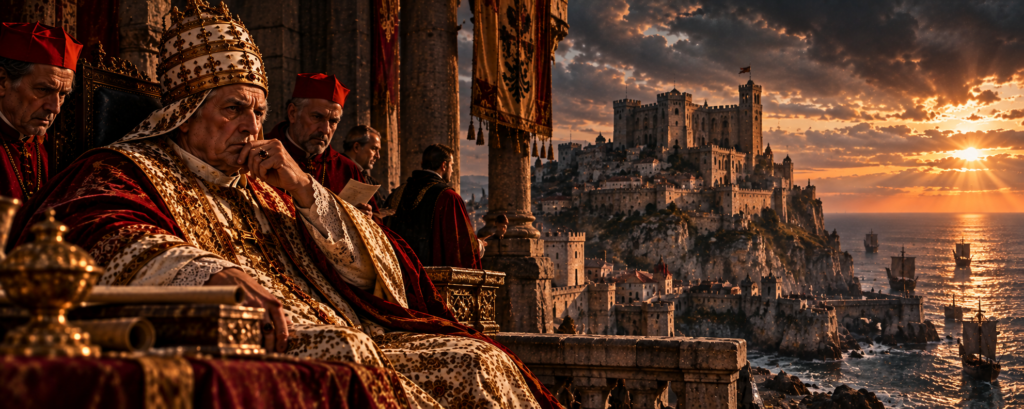
Benedict XIII: The Last Pope of Avignon Who Refused to Surrender
Benedict XIII — Antipope, 1394–1423
By the final years of his life, almost everyone had left him. Kings who had once addressed him as pope had withdrawn their obedience, cardinals who had once surrounded his throne had deserted him, and the great Council of Constance had formally declared that his claim to the papacy was finished. Western Christianity, exhausted by decades of division, had finally recognized Martin V as the man around whom the fractured Church could reunite. Yet inside the formidable seaside fortress of Peñíscola, an elderly Pedro de Luna continued to insist upon an astonishing proposition: everyone else was wrong, and he alone remained the true pope.
He had not begun as an obvious fraud or an opportunistic pretender. Pedro was one of the finest canon lawyers of his generation, a highly educated aristocrat whose original claim emerged from a genuinely complicated dispute over the papal election of 1378. For years he had defended the Avignon obedience with intelligence, discipline, and arguments serious enough to persuade kings, scholars, bishops, and saints. His tragedy was that the qualities that made him such a formidable defender of his cause eventually made him almost incapable of abandoning it.
By the time Benedict XIII withdrew to Peñíscola, however, the situation had changed almost beyond recognition. His original Roman opponent was dead, his Avignon predecessor was dead, successive attempts at compromise had failed, rival councils had intervened, and most of the governments that once supported him had concluded that Christian unity mattered more than his increasingly isolated claim. Benedict nevertheless refused to surrender. He continued issuing documents, maintaining a tiny court, appointing cardinals, and behaving as though the vast institutional collapse surrounding him had changed nothing essential.
There would be no massacre like Cesena attached to his name, no corpse placed on trial, and no notorious chamber filled with tortured enemies. Benedict’s darkness was quieter and, in some ways, more psychologically fascinating. It was the darkness of absolute certainty hardened over decades until compromise became almost impossible. One of Christianity’s greatest institutional disasters continued partly because an extraordinarily intelligent man could not accept that the solution might require him to stop being pope.
Pedro de Luna Before Benedict XIII
Pedro Martínez de Luna was born into the powerful Luna family of Aragon, probably in 1328, although medieval biographical details surrounding his early years are not always perfectly secure. His birthplace was Illueca, in the Kingdom of Aragon, and his aristocratic background immediately placed him within a world where family connections, ecclesiastical office, and political influence regularly overlapped. The Luna were not obscure provincial nobles hoping that a fortunate son might stumble into advancement. Pedro entered adulthood carrying a name already capable of opening important doors.
Unlike some churchmen whose careers depended more heavily upon family influence than intellectual ability, Pedro possessed formidable academic credentials of his own. He studied canon law at the University of Montpellier and eventually taught there, acquiring the legal training that would define his entire approach to the papal crisis. Canon law was not merely an academic subject in medieval Europe. It provided the language through which church government, elections, jurisdiction, marriage, discipline, property, and ecclesiastical authority were understood.
Pedro became known as an intelligent, controlled, and exceptionally capable legal mind. Those qualities would later distinguish him sharply from men such as Urban VI, whose explosive temperament became one of the defining problems of his pontificate. Pedro’s danger was not uncontrolled rage. It was the ability to construct sophisticated arguments around a position and then defend that position with extraordinary endurance.
Pope Gregory XI made Pedro a cardinal in 1375. That appointment placed him at the center of church government just as the Avignon papacy was approaching its greatest crisis. Gregory returned the papal court from Avignon to Rome in 1377, ending more than six decades during which successive popes had resided principally beside the Rhône rather than in the city whose bishop they claimed to be. When Gregory died the following year, Pedro de Luna would become a participant in the election that shattered western Christianity.
The Election That Changed Everything
The conclave of April 1378 took place in an atmosphere of extraordinary tension. Romans feared that the predominantly French College of Cardinals might elect another French pope who would return immediately to Avignon. Crowds demanded a Roman or at least an Italian candidate, and the cardinals had legitimate reasons to fear violence if they ignored those demands. The central question that later consumed Europe was whether that pressure had merely influenced the election or had actually deprived the cardinals of the freedom required for a valid choice.
Bartolomeo Prignano, archbishop of Bari, was elected and took the name Urban VI. Pedro de Luna participated in the election and, like the other cardinals, initially recognized Urban. This later became a serious difficulty for the men who claimed that the conclave had been invalid from the beginning. If the election had obviously been coerced, their opponents asked, why had the cardinals continued treating Urban as pope after the immediate danger had passed?
Urban soon made the question far more explosive through his own conduct. He attacked the luxury, privileges, and lifestyles of the cardinals with a harshness that rapidly alienated many of them. Contemporary reports describe angry confrontations and humiliating treatment, although hostile accounts must be read with appropriate caution. Whatever the exact details, the relationship between Urban and much of his College collapsed with remarkable speed.
The dissident cardinals eventually declared that the April election had been invalid because intimidation had destroyed their freedom. In September 1378 they gathered at Fondi and elected Robert of Geneva, who became Clement VII. Pedro de Luna joined Clement’s obedience and would spend the next sixteen years defending it. The Western Schism had begun, and Pedro’s legal brilliance would become one of the Avignon cause’s greatest assets.
Defending Clement VII
Pedro did not drift casually into Clement’s camp. He became one of its most committed defenders and diplomats, arguing that the original election of Urban VI had been canonically defective. His position was not inherently absurd. The circumstances of the 1378 conclave were sufficiently confused and threatening that serious medieval jurists could disagree over whether the cardinals had possessed genuine electoral freedom.
This distinction is essential when judging Pedro’s later career. He was not originally defending a claim that everyone knew to be fraudulent. Clement VII received recognition from France, Scotland, Castile, Aragon, Navarre, and other territories at different times, while Urban’s obedience included England and much of the Holy Roman Empire. Intelligent and devout Christians could sincerely reach opposite conclusions about which claimant was legitimate.
Pedro became one of Clement’s most valuable diplomatic agents. His legal expertise allowed him to explain the Avignon case with far greater sophistication than simple appeals to political loyalty. He traveled, negotiated, cultivated rulers, and helped strengthen Clement’s obedience, particularly in the Iberian kingdoms. His effectiveness made him indispensable.
Yet the very strength of Pedro’s argument planted the seed of his later tragedy. If he became convinced that Urban had never been pope, then Clement was not merely one plausible claimant among two. Clement was the pope, and the Roman line represented an illegitimate intrusion. Once that conclusion became embedded within Pedro’s understanding of law and conscience, surrendering the Avignon claim could appear not as compromise but as betrayal.
When Clement VII Died
Clement VII died at Avignon in September 1394. His death presented the Avignon cardinals with an obvious opportunity to reconsider whether continuing their separate papal succession would deepen the Schism. By then western Christianity had endured sixteen years of rival popes. Increasing numbers of theologians and political leaders were desperate for a solution.
The Avignon cardinals nevertheless entered a conclave. Before the election, they committed themselves to working toward the restoration of unity, including resignation under appropriate circumstances if that proved necessary. The precise implications of these promises would become fiercely disputed. Pedro himself had long understood how dangerous an unrestricted commitment to resignation could become.
On September 28, 1394, the cardinals elected Pedro de Luna. He took the name Benedict XIII. The brilliant canon lawyer who had spent sixteen years explaining why Clement VII was the legitimate pope now inherited Clement’s claim.
His election was overwhelming within the Avignon College. This mattered because Benedict could plausibly see himself not as an adventurer seizing a vacant title but as the lawful successor elected by the cardinals of the true obedience. Everything he had argued since 1378 now pointed toward himself. The legal theory he had spent years constructing had become inseparable from his own identity.
The Promise to End the Schism
Benedict began his pontificate facing enormous pressure to restore unity. One increasingly popular solution was the via cessionis, the way of resignation, under which both rival claimants would abdicate so that a single universally acceptable pope could be elected. On paper, the plan possessed elegant simplicity. In practice, it required two men who each believed himself legitimate to surrender simultaneously without allowing the rival obedience to manipulate the process.
Benedict repeatedly expressed willingness to work toward unity. He could speak persuasively about the need to heal the Church and showed interest in direct negotiations with the Roman claimant. Yet every proposed mechanism encountered legal qualifications, procedural objections, political complications, or demands for guarantees. His critics increasingly concluded that he supported reunion only when reunion preserved his own claim.
Benedict saw the matter differently. From his perspective, simply resigning while the Roman claimant remained in place could surrender the Church to a line originating in an invalid election. Even simultaneous resignation required safeguards ensuring that the subsequent election would itself be unquestionably canonical. A canon lawyer trained to examine every jurisdictional weakness could find endless dangers inside apparently straightforward solutions.
That legal caution eventually became indistinguishable from obstruction. Benedict could always identify another reason why the proposed conditions were inadequate. Every delay could be defended individually. Collectively, the delays kept the Schism alive.
France Loses Patience
France had provided the political foundation of the Avignon obedience, but patience with Benedict deteriorated rapidly. The University of Paris became an especially important center of proposals for ending the Schism. Scholars debated several possible solutions, including mutual resignation, arbitration, and eventually a general council. Increasingly, the assumption was that Christian unity could not depend forever upon the voluntary cooperation of two rival claimants.
King Charles VI and the French clergy placed growing pressure upon Benedict. They expected the pope they had supported to demonstrate that unity mattered more than possession of office. Benedict continued negotiating but resisted demands that he surrender under conditions he considered unacceptable. His legal precision, once one of his greatest strengths, began to look like calculated evasion.
In 1398, France withdrew obedience from Benedict. Most of his cardinals also abandoned him. The decision represented a devastating blow because Avignon itself lay surrounded by territories under French influence, while the Avignon papacy had depended heavily upon French political support.
Benedict suddenly found himself transformed from the head of a powerful international obedience into a claimant besieged within his own palace. Yet he did not resign. The first great test of his stubbornness had arrived, and Pedro de Luna proved almost impossible to break.
The Pope Under Siege
The papal palace at Avignon was not merely a luxurious residence. It was an enormous fortified complex capable of functioning as a defensive stronghold. When pressure upon Benedict became military, the architecture that had symbolized Avignon papal magnificence became his fortress.
For years Benedict remained effectively trapped within the palace while forces hostile to him controlled the surrounding situation. The confrontation was not an uninterrupted dramatic assault but a prolonged political and military strangulation. Supplies, access, communications, and negotiations became part of a grinding contest of endurance. Benedict’s enemies expected isolation eventually to force him into surrender.
They underestimated him. Pedro de Luna possessed precisely the temperament required to survive a siege of wills. He could wait, argue, negotiate, protest, and reinterpret agreements while refusing the one concession his opponents wanted most. Physical confinement did not weaken his certainty.
At points Benedict agreed conditionally to arrangements involving resignation if his rival did the same. He also made legal protests against commitments he believed had been extracted under coercion. To his defenders, this demonstrated a canon lawyer protecting the freedom of the papacy against political force. To his enemies, it demonstrated a master of technicalities using legal ingenuity to escape every promise.
Escape From Avignon
By 1403, political opinion had begun shifting again. The treatment of Benedict increasingly appeared excessive to some observers, and critics questioned whether secular powers had the right to imprison a man who still possessed a serious claim to the papacy. Sympathy returned in places where frustration had previously dominated. Benedict waited for the opportunity this changing climate provided.
In March 1403, he escaped from Avignon. The episode dramatically reversed his fortunes. Once free, he recovered the allegiance of cardinals and supporters who had abandoned him, while France restored obedience to him.
The escape strengthened Benedict’s confidence enormously. He had survived political abandonment, military pressure, and confinement, only to watch his cause revive. A man already convinced of his legitimacy could interpret such a reversal as confirmation that endurance had been justified. His refusal to surrender had apparently worked.
This moment may help explain the extraordinary stubbornness of his later years. Benedict had learned that apparent isolation could be temporary. When almost everyone eventually abandoned him again, he had personal experience suggesting that patience might still produce another reversal.
Negotiations Without an Ending
Benedict renewed efforts to negotiate with the Roman obedience. Boniface IX occupied the Roman throne until his death in 1404, after which Innocent VII succeeded him. When Innocent died in 1406, the Roman cardinals elected Gregory XII. Each succession demonstrated how the rival institutions had become capable of perpetuating themselves.
Gregory XII was elected amid promises that he would work toward ending the Schism. Benedict likewise continued to profess willingness to pursue unity. The obvious solution appeared to be a personal meeting between the two claimants followed by coordinated resignation. Preparations began for what could have become one of the most consequential encounters in medieval history.
The meeting never occurred. Questions arose concerning location, security, political control, entourages, and the conditions under which either man would resign. Each claimant feared entering circumstances that might leave him vulnerable to capture or manipulation. Supporters on both sides increasingly suspected that neither pope truly wanted an agreement requiring his own disappearance.
The spectacle became humiliating. Two elderly churchmen claimed to desire unity while maneuvering around Italy without successfully meeting. The longer negotiations continued, the harder it became to blame the entire failure upon circumstances. Patience among their own cardinals began collapsing.
The Cardinals Rebel
Cardinals from both obediences gradually reached a radical conclusion. If the popes would not end the Schism, perhaps the cardinals themselves would have to act. Members of Gregory’s College and Benedict’s College began communicating with one another. The men whose offices depended upon rival papal lines were now contemplating action against both.
This was an extraordinary development. The papal monarchy had spent centuries strengthening claims of supreme authority within the Church. Now cardinals were considering whether the emergency created by competing popes justified bypassing both of them. The Schism was forcing medieval Christianity to confront constitutional questions it had never satisfactorily resolved.
Benedict reacted defensively. He regarded rebellious cardinals as violating the obedience owed to the legitimate pope. Gregory reacted similarly toward members of his own College. Each claimant could interpret resistance as another conspiracy rather than evidence that confidence in both papacies was collapsing.
The cardinals pressed ahead. They summoned a general council to meet at Pisa in 1409. Their objective was breathtakingly ambitious: remove both existing claimants and elect a single pope who could reunite Christendom.
The Council of Pisa
The Council of Pisa attracted substantial support. Bishops, theologians, representatives of universities, and political authorities had grown desperate after more than thirty years of schism. The idea that the Church collectively possessed some emergency authority above rival papal claimants seemed increasingly attractive. Neither Benedict nor Gregory accepted the council’s jurisdiction over him.
Benedict summoned his own council at Perpignan, while Gregory arranged a separate gathering of his supporters. These competing councils only emphasized the problem. Even attempts to create unity were becoming divided according to obedience.
At Pisa, proceedings continued against both claimants. In June 1409, the council declared Gregory XII and Benedict XIII deposed. The assembled cardinals then elected Pietro Philargi, who took the name Alexander V.
Instead of two popes, Christianity now effectively had three. Benedict remained in place, Gregory refused to surrender, and Alexander claimed that Pisa had removed both of them. An attempt to end the Schism had made its visible structure even more absurd.
Three Popes and One Church
The three-popes situation exposed the institutional nightmare in its starkest form. Each claimant possessed arguments against the others. Benedict maintained that Pisa lacked authority to judge the legitimate pope. Gregory made essentially the same objection from the Roman side, while Alexander’s supporters argued that necessity allowed the Church to act when rival claimants had made normal government impossible.
Alexander V died in 1410 after a short pontificate. The Pisan cardinals then elected Baldassare Cossa, who became John XXIII, not to be confused with the universally recognized twentieth-century pope of the same name. Cossa was a politically formidable figure whose reputation became deeply controversial. His election ensured that the Pisan obedience, like the others, could reproduce itself.
Benedict’s support was shrinking, but he remained far from irrelevant. Aragon, Castile, Scotland, and other territories continued recognizing him for a time. He could still point toward kingdoms, bishops, clergy, and scholars who accepted his legitimacy. Pisa had condemned him, but condemnation was meaningful only if one accepted Pisa’s authority.
Once again, Benedict’s legal mind supplied a fortress stronger than stone. If the council lacked jurisdiction over the true pope, then its sentence against him was void. If its sentence was void, Alexander and John were illegitimate. From inside Benedict’s argument, nothing essential had changed.
The Man Who Could Always Find a Legal Door
This pattern became the defining feature of Benedict’s career. Every institution attempting to remove him confronted an argument explaining why it lacked authority. Kings could withdraw obedience, but kings did not create popes. Cardinals could desert him, but cardinals could not simply destroy a valid pontificate because they regretted their choice.
A council could declare him deposed, but whether a council possessed authority over a pope was itself disputed. If Benedict truly was pope, he could argue that an improperly constituted council had no jurisdiction over him. If he was not pope, the entire discussion changed, but that was precisely the point Benedict refused to concede. Every solution depended upon answering the question he considered already settled.
This made him extraordinarily difficult to defeat intellectually. Pedro de Luna understood canon law too well to be cornered by simplistic arguments. He could distinguish circumstances, challenge jurisdiction, question procedure, and demand legal consistency. Opponents who thought they had trapped him repeatedly discovered another layer of resistance.
Yet legal brilliance can become a form of blindness when the purpose of law disappears behind the defense of a position. By the second decade of the fifteenth century, the Church had been divided for more than thirty years. Benedict’s insistence upon perfect legal vindication was imposing an enormous institutional cost. A technically defensible objection could still produce disastrous consequences.
Sigismund and the Search for Unity
The man who would help transform the crisis was Sigismund, king of the Romans and later Holy Roman Emperor. Sigismund recognized that the Schism could not continue indefinitely without devastating the authority of the western Church. He worked with the Pisan claimant John XXIII and other political and ecclesiastical leaders to bring about a new general council. That gathering opened at Constance in 1414.
The Council of Constance faced far more than the papal schism. The teachings and trial of Jan Hus became one of its most famous and controversial episodes, while broader questions of church reform and conciliar authority occupied the assembly. Yet ending the multiple papacies remained central. After decades of failure, there was growing determination that no claimant would be allowed to prevent reunion indefinitely.
John XXIII initially hoped the council might strengthen his position. Instead, his situation deteriorated, and he fled Constance in 1415. The council continued without him and eventually deposed him. The Pisan line had been removed from the equation.
Gregory XII handled the crisis very differently. Through carefully arranged procedures preserving his understanding of papal legitimacy, he authorized the council and resigned in July 1415. His withdrawal was crucial because it allowed the Roman obedience to participate in reunion without simply admitting that Pisa had possessed unquestionable authority to depose him. One major claimant had voluntarily stepped aside.
That left Benedict.
The Moment Benedict Could Have Ended It
By 1415, Benedict had an opportunity to transform his historical reputation. He could argue that he had defended what he sincerely believed to be the legitimate Avignon succession for decades but that Christian unity now required personal sacrifice. Gregory XII had resigned. John XXIII had been removed.
If Benedict had followed Gregory’s example, he might have been remembered as stubborn but ultimately selfless. The long Schism could have ended with each surviving claimant relinquishing his position for the sake of the Church. Pedro de Luna would have surrendered the office while preserving the argument that his original cause had been sincere.
He refused. This refusal is the central reason his story belongs among the darker papal biographies. By this stage, maintaining his personal claim was becoming increasingly difficult to distinguish from placing his own certainty above the unity of the institution he claimed to lead.
Benedict still possessed arguments. He had been a cardinal before the Schism began and had participated in the 1378 election, giving him a unique connection to the pre-schism College. He could construct a theory under which the legitimate line of succession had passed through Clement VII to himself while rival creations were compromised. But the practical result of insisting upon that theory was continued division.
Sigismund Comes to Benedict
Sigismund personally traveled to meet Benedict in 1415. The journey demonstrated how seriously the emperor treated the remaining obstacle. If persuasion could convince the old claimant to resign, the most destructive institutional crisis in recent church history might finally end. Benedict now confronted not merely hostile theologians but one of Europe’s most powerful rulers asking him to yield.
The discussions failed. Benedict remained unwilling to resign on terms that denied his legitimacy. His position had become extraordinarily rigid. He could imagine reunion, but only through mechanisms consistent with the proposition that he remained the lawful pope.
Sigismund eventually departed without obtaining the concession he wanted. The failure had profound consequences for Benedict. Governments that had continued supporting him increasingly concluded that his refusal, rather than uncertainty over 1378, had become the principal obstacle to unity. The distinction between defending legitimacy and perpetuating schism was collapsing.
Negotiations at Narbonne helped organize the withdrawal of obedience from Benedict by territories that had remained loyal. His political world contracted dramatically. One by one, the pillars supporting the Avignon claimant disappeared.
Even Saint Vincent Ferrer Walks Away
Among Benedict’s most famous supporters had been Vincent Ferrer, the Dominican preacher later canonized as a saint. Vincent had sincerely accepted the legitimacy of the Avignon obedience and maintained a close relationship with Benedict. His support demonstrates again that following Benedict cannot simply be dismissed as obvious corruption or stupidity. Serious religious figures believed Pedro de Luna’s claim.
Over time, however, Vincent became convinced that Benedict’s refusal to resign was doing intolerable damage to the Church. The man who had once defended him now helped support withdrawal of obedience. The break carried enormous symbolic importance because Benedict was losing not merely opportunistic politicians but people who had defended him from conviction.
For Pedro, such desertions must have been painful, although the surviving evidence does not allow us to reconstruct his private emotions confidently. His public response remained consistent. Other people could abandon him, but abandonment did not change canonical truth. Majorities did not determine legitimacy.
That principle possessed a certain intellectual nobility. Truth is not always decided by popularity, and institutions can indeed persecute people who are right. Yet the same principle can become dangerous when it renders a person incapable of recognizing any evidence that he may be wrong.
Peñíscola
Benedict eventually withdrew to the fortress of Peñíscola on the Mediterranean coast of the Kingdom of Valencia. The location was spectacular and defensive, a stone stronghold rising above the sea on a rocky promontory. It was geographically remote from the great political centers deciding the future of the Church. Symbolically, it was almost too perfect.
Here the shrinking papal court continued. Benedict still called himself pope. Documents were issued, a household remained around him, and the routines of ecclesiastical government persisted on a miniature scale.
The contrast with earlier Avignon magnificence was enormous. Clement VII had governed an obedience stretching across major European kingdoms from one of Christendom’s grandest palaces. Benedict now occupied a coastal fortress while the governments that once recognized him transferred their allegiance elsewhere. The papacy he claimed had contracted from an international institution into something approaching an island.
Yet Benedict did not interpret isolation as defeat. Peñíscola became a final fortress not only of stone but of argument. As long as Pedro de Luna remained alive and convinced that his election was valid, the Avignon claim could theoretically survive.
The Council of Constance Acts
The Council of Constance eventually proceeded formally against Benedict. Delegations and negotiations had failed to secure his voluntary resignation. His remaining political support had largely disappeared. The council now treated him not as one of several equal claimants requiring delicate negotiation but as an obstacle to the restoration of unity.
In July 1417, the council declared Pedro de Luna deposed. Its condemnation was extraordinarily severe, accusing him of perpetuating schism, obstructing peace, and refusing correction. The language reflected years of accumulated frustration. Benedict, naturally, rejected the judgment.
From his perspective, Constance suffered from the same fundamental defect as Pisa. A council could not simply strip the legitimate pope of an office bestowed through a valid election. If Pedro was pope, his enemies could gather as many bishops and princes as they liked without changing that fact.
The council proceeded anyway. By late 1417, the institutional momentum of western Christianity had turned decisively against Benedict. The question was no longer whether he would agree with the solution. The Church was preparing to reunite without him.
Martin V
On November 11, 1417, the Council of Constance elected Oddone Colonna as Pope Martin V. His election represented the practical end of the Western Schism for most of western Christianity. Martin possessed broad recognition capable of restoring a single papal government. The rival structures that had dominated church politics since 1378 finally began collapsing.
For millions of Christians, this was the resolution they had waited nearly forty years to see. A person born at the beginning of the Schism could now be approaching middle age. Generations of clergy had served under disputed obediences. Martin’s election offered the possibility that the question of which pope was pope might finally stop poisoning ecclesiastical life.
Benedict XIII did not recognize Martin. In Peñíscola, he continued insisting that the newly elected pope possessed no legitimate claim superior to his own. The rest of Europe could celebrate reunion, but Pedro de Luna remained outside it.
This is the point at which his stubbornness becomes almost surreal. The Roman claimant had resigned, the Pisan claimant had been deposed, a great council had acted, and a new pope had received widespread recognition. Benedict still would not yield.
Was Benedict Simply Power Hungry?
It is tempting to explain Benedict’s behavior through naked ambition. He enjoyed being pope and refused to surrender because he wanted to keep the title. Personal pride and attachment to authority almost certainly mattered, as they would for most people who had spent decades exercising supreme office. Yet ambition alone does not fully explain the extraordinary persistence of Pedro de Luna.
By the time he reached Peñíscola, the practical rewards of his papal claim had diminished dramatically. He no longer controlled a magnificent international court comparable to the old Avignon papacy. Most major rulers had abandoned him. Recognition had become so limited that continuing the claim brought humiliation as readily as power.
A purely cynical opportunist might have negotiated a comfortable retirement. Benedict was elderly, aristocratic, learned, and potentially capable of securing honorable terms. Resignation could have allowed him to spend his final years in dignity rather than becoming a symbol of obstinacy.
He refused because his claim had become something deeper than ordinary political advantage. Pedro appears to have believed, with extraordinary intensity, that the legal foundation of his papacy remained valid. That conviction makes him less cartoonishly wicked but potentially more disturbing.
The Prison of Certainty
Benedict’s greatest strength had always been his legal mind. He could identify flaws in arguments that others considered decisive. He understood that popular opinion did not determine canonical validity and that political pressure could not transform an unlawful act into a lawful one. Those were serious principles.
The problem was that his reasoning became increasingly closed. Every challenge could be absorbed into a system that already assumed his legitimacy. If cardinals deserted him, they were disobedient. If kings abandoned him, they were acting politically.
If a council deposed him, the council lacked jurisdiction. If Europe recognized Martin V, Europe was mistaken. No conceivable external development could disprove the proposition around which Benedict had organized his life.
This is not evidence of mental illness, and modern psychiatric labels would be inappropriate. It is evidence of intellectual rigidity reinforced by decades of institutional conflict. A brilliant mind can construct an extraordinarily durable prison when every door leading outward is classified as legally invalid.
The Last Cardinals
Benedict understood that his death presented a dangerous problem. If he alone represented the legitimate papal succession, then the Church required a mechanism for electing his successor. Without loyal cardinals, the line would simply disappear. Pedro therefore continued creating or maintaining a tiny College around himself.
Near the end of his life, he appointed additional cardinals capable of continuing the succession. This decision is among the clearest demonstrations that he did not regard his claim as a symbolic protest. He intended the papacy he represented to survive his death. Europe might recognize Martin V, but Benedict believed another pope should succeed him.
This action extended the potential for schism beyond his own lifetime. He could have allowed his claim to die with him, creating a quiet path toward complete reunion. Instead, he deliberately provided the machinery necessary for another election. The institutional logic that had prolonged the Western Schism was being reproduced one final time.
After Benedict’s death, several of his cardinals elected Gil Sánchez Muñoz, who took the name Clement VIII. Another cardinal, Jean Carrier, disputed aspects of that election and eventually supported an even more obscure rival claimant. The final remnants of the Avignon succession had become almost microscopic, but they persisted.
When Did Benedict Die?
Even Benedict’s death carries some chronological uncertainty. Older works sometimes give 1424, while modern scholarship commonly places his death in 1423, with May 23 frequently accepted. The surviving evidence has produced disagreements over the precise date. What is certain is that Pedro de Luna died at Peñíscola at an advanced age, still refusing to recognize Martin V.
There was no final reconciliation with Rome. Benedict did not dramatically renounce his claim in the last hours of his life. He died maintaining the position he had defended for nearly three decades as pope and for even longer as a cardinal of the Avignon obedience.
His persistence outlived almost everyone who had participated in the original crisis. Urban VI had been dead for more than thirty years. Clement VII had been dead for nearly three decades. Many of the cardinals who had experienced the terrifying conclave of 1378 were gone.
Pedro remained. He had become one of the last living human links to the moment when the Schism began. Perhaps that fact strengthened his certainty, because few people alive could claim his firsthand knowledge of the disputed election.
Clement VIII and the Ghost Papacy
The tiny succession created after Benedict’s death demonstrates the strange power of institutional legitimacy. Sánchez Muñoz became Clement VIII and continued the Avignon claim from the Iberian world. His papacy possessed only a fraction of the support Benedict had once commanded. Yet even this shadow administration required diplomacy before it disappeared.
Political circumstances eventually encouraged the Crown of Aragon to reconcile fully with Martin V. Clement VIII abdicated in 1429 and recognized Martin’s authority. In return, arrangements were made that allowed him to continue an ecclesiastical career. The main surviving Avignon line finally ended through resignation rather than annihilation.
The irony is striking. The concession Pedro de Luna had resisted for decades was eventually made by his successor. Clement VIII could step aside because political and ecclesiastical circumstances made continuation pointless. Benedict had been unable or unwilling to reach the same conclusion.
The Western Schism therefore possessed a long afterlife. Martin V’s election in 1417 restored practical unity for most of Christendom, but Benedict’s stubborn survival ensured that a remnant of the rival claim continued. Even death did not immediately silence it.
What Benedict Believed
Understanding Benedict requires resisting the temptation to read his mind too confidently. No historian can prove exactly how much of his conduct came from sincere conviction, personal pride, legal rigidity, institutional interest, or political ambition. Human motivations rarely arrive in neat proportions. Pedro himself may not have been capable of separating them.
His actions nevertheless suggest genuine belief in his own legitimacy. He endured circumstances in which the practical advantages of maintaining the claim became remarkably small. He survived siege, desertion, deposition, and isolation without abandoning it. Such persistence is difficult to explain entirely through material self-interest.
Yet sincerity cannot function as absolution. A ruler can sincerely believe a disastrous policy is necessary. A religious leader can sincerely believe that compromise would betray truth. The consequences remain real.
Benedict’s tragedy was that conviction became increasingly detached from proportion. The more the Church sacrificed in pursuit of unity, the more he insisted that unity could not be purchased at the price of his claim. Eventually nearly everyone else decided the opposite.
The Wickedness of Refusing to Leave
Benedict XIII belongs uneasily within a category called Wicked Popes because he lacks many of the sensational characteristics associated with its darkest figures. He was not notorious for sexual excess, spectacular nepotistic violence, or personal sadism. There is no need to surround him with fabricated murders or demonic legends. His historical significance lies somewhere more uncomfortable.
He demonstrates that immense harm can result from refusing to relinquish power even when the refusal is defended by principle. For decades, Benedict could explain why surrendering was legally dangerous. He could point toward genuine problems in the arguments of his opponents. He could insist that truth did not change merely because majorities abandoned him.
All of those statements could contain elements of truth while still producing a destructive result. Christianity remained divided. Ecclesiastical authority remained contested. Enormous diplomatic energy and institutional resources were consumed trying to solve a crisis that individual resignation could have helped end.
The darkness here is therefore not theatrical. It is bureaucratic, legal, and institutional. Benedict could prolong a catastrophe without ordering a massacre because his signature, claim, and refusal were enough.
The Difference Between Being Right and Doing Right
Pedro de Luna’s career raises an uncomfortable moral question. Suppose he genuinely believed his election was valid. Suppose he even possessed better canonical arguments than some of his opponents. At what point should the practical destruction caused by defending a right outweigh the right itself?
Medieval churchmen wrestled with precisely this problem. The unity of the Church was not merely an administrative convenience but a theological good. Schism itself was considered profoundly dangerous. A pope who insisted upon his rights while perpetuating division could therefore undermine the institution whose authority he claimed to defend.
Gregory XII eventually accepted that logic. His resignation at Constance allowed the Roman obedience to participate in reunion while preserving as much canonical dignity as possible. Whatever one thinks of his earlier conduct, that final act strengthened his historical reputation.
Benedict chose differently. He prioritized the continuity of what he believed to be the legitimate succession over the practical unity being constructed at Constance. History judged that decision harshly.
Peñíscola as a Symbol
Few settings could better symbolize Benedict’s final years than Peñíscola. The fortress rises dramatically above the Mediterranean, its walls facing the sea while the town clusters below. It offered physical security to a man whose political world had collapsed. The landscape itself seems to turn isolation into architecture.
Inside those walls, Benedict could maintain the forms of papal government. He had attendants, documents, liturgy, cardinals, and the memory of decades in which powerful kingdoms had acknowledged him. The external world might call him Pedro de Luna, antipope. Within his remaining court, he was Benedict XIII.
This difference between internal and external reality is one of the most fascinating aspects of his story. Institutions can shrink dramatically without changing how their remaining members understand themselves. A court of thousands can become a household of dozens while preserving the same titles. The rituals continue even as the world moves on.
Peñíscola therefore became more than Benedict’s refuge. It became a miniature universe in which his legal understanding of the Church could continue to exist. Beyond the walls, Martin V governed an increasingly reunited Christendom. Inside them, the Western Schism was not over.
The Last Man of 1378
There is something haunting about Benedict’s longevity. He had been present when Gregory XI’s death opened the disputed succession. He had experienced the Roman crowds, participated in Urban VI’s election, joined the cardinals who rejected Urban, and supported Clement VII. Decades later, younger churchmen were telling him what the events of 1378 meant.
Pedro could reasonably believe that he knew those events better than they did. He had not learned about the conclave from documents or testimony. He had been there. That personal memory gave his legal certainty an emotional foundation that later generations could never share.
Yet firsthand experience does not guarantee correct interpretation. Participants can become more committed to their understanding of events precisely because they experienced them personally. Memory and identity reinforce each other. To admit error after forty years would mean reevaluating almost an entire adult life.
Benedict therefore became not merely the defender of an office but the defender of his own history. If the Avignon succession was illegitimate, what had decades of his service meant? The cost of changing his mind increased with every year he refused.
No Monster Is Required
It would be easy to make Benedict more dramatic by inventing secret murders, torture chambers, or conspiracies. None of that is necessary. His documented life already provides a powerful dark-history narrative. The danger lies not in hidden crimes but in visible obstinacy.
Nor should he be portrayed as a ridiculous old man shouting into an empty castle. Pedro remained intellectually formidable and capable of articulating a coherent legal case. Even his enemies recognized his extraordinary intelligence. His isolation did not erase his abilities.
That is precisely why the story works. A foolish man refusing to understand an obvious situation would be less interesting. Benedict understood the legal complexities better than almost anyone alive. He simply drew conclusions that made surrender almost impossible.
His intelligence became part of the mechanism trapping him. Every objection could be answered. Every compromise could be dissected. Every defeat could be declared jurisdictionally irrelevant.
The Cost of Forty Years
The Western Schism began in 1378 and was substantially resolved only with Martin V’s election in 1417. Nearly four decades of competing papal claims damaged confidence in ecclesiastical government. The spectacle of popes excommunicating rival popes inevitably invited questions about how ordinary Christians could know whose commands possessed authority. The crisis did not destroy the medieval Church, but it left scars.
Benedict did not create the Schism. Urban VI, the cardinals who rejected him, Clement VII, secular rulers, and later claimants all contributed to its continuation. Blaming Pedro alone would be historically absurd. He inherited a disaster already sixteen years old when elected in 1394.
His responsibility lies instead in opportunities refused. As pressure for mutual resignation grew, Benedict repeatedly resisted. As cardinals deserted him, he held on. As councils attempted solutions, he rejected their authority.
By Constance, the context had changed decisively. Continuing the claim no longer protected a large functioning obedience against an equally entrenched rival. It protected Pedro de Luna’s interpretation of legitimacy against an emerging consensus desperate for unity. His refusal became increasingly personal even when expressed through universal principles.
A Different Kind of Wicked Pope
Many notorious popes are remembered through appetite. They wanted money, lovers, territory, revenge, or dynastic power. Benedict XIII is more unsettling because his defining appetite may have been certainty. He wanted the Church to recognize that his understanding of legitimacy was correct.
There is little theatrical pleasure in this kind of wrongdoing. No drunken banquet is required, and no corpse needs to be dragged through Rome. The damage happens through meetings that fail, resignations that never occur, letters rejecting jurisdiction, and years passing while institutions remain divided. History can bleed slowly.
Benedict’s story therefore broadens what a Wicked Popes category can mean. Wickedness need not consist solely of obvious cruelty. Leadership can become destructive when preservation of one’s own authority overwhelms every competing obligation. A person can damage an institution precisely while insisting that he alone is protecting it.
That paradox defines Pedro de Luna. He defended the papacy until his defense helped make papal unity impossible. He protected legitimacy until almost everyone else concluded that his claim had become the greatest remaining obstacle to legitimate government.
The Man Who Outlasted His World
Pedro de Luna survived political worlds that had once seemed permanent. The France that supported the Avignon papacy eventually abandoned him. Cardinals who had elected him walked away. Rulers who once called him Holy Father recognized someone else.
He endured all of it. Siege did not break him. Diplomatic humiliation did not break him. Deposition did not break him.
Even near-total isolation did not break him. This endurance can appear admirable when separated from its consequences. Persistence is often celebrated as courage. But persistence in a destructive position can become its own form of irresponsibility.
Benedict never discovered, or never accepted, the point at which endurance should become surrender. Every previous survival encouraged him to wait for another reversal. Peñíscola became the final expression of that instinct.
The reversal never came. Europe did not return to him. Martin V remained pope.
The Pope Who Would Not Stop Being Pope
Pedro de Luna began his career with nearly everything required for greatness. He possessed noble birth, formidable intelligence, legal training, discipline, political experience, and a reputation capable of carrying him into the highest circles of the medieval Church. When the Western Schism erupted in 1378, he did not merely choose a side out of convenience. He studied, defended, and eventually embodied one of the competing theories of papal legitimacy.
That matters because Benedict XIII was not born as the lonely old antipope of Peñíscola. He became that man slowly. Every stage of his journey could be justified by arguments that seemed reasonable from inside his own understanding of the crisis. The transformation from respected cardinal to isolated claimant was made through dozens of decisions, not one dramatic act.
He had legitimate reasons to question the election of Urban VI. The conclave of 1378 had occurred under frightening popular pressure. Serious churchmen believed that the cardinals’ freedom had been compromised.
He had legitimate reasons to defend Clement VII. Much of Europe recognized the Avignon pope. Kings, bishops, scholars, and religious figures accepted the same conclusion Pedro did.
He even had legitimate reasons to distrust simplistic plans for simultaneous resignation. Papal succession was not a game in which two men could simply throw their crowns onto a table and assume everything afterward would proceed peacefully. Procedures mattered.
But history did not stop while Pedro examined procedures. Years became decades. Rival popes died and were replaced.
The Church remained divided. Christians continued living beneath competing obediences. Every proposed solution encountered another obstacle.
Benedict became pope in 1394 promising to work toward unity. France expected action. His cardinals expected action.
Instead, negotiations stretched on. The brilliant lawyer could always explain why the latest proposal contained unacceptable risks. Each explanation bought time.
Eventually France withdrew obedience. Most of Benedict’s cardinals abandoned him. He found himself besieged inside the papal palace at Avignon.
He still refused to surrender. When he escaped in 1403 and recovered much of his obedience, his stubbornness appeared vindicated. The lesson was dangerous.
He had waited before and survived. Why should he not wait again? Political abandonment could reverse.
That experience may have strengthened a conviction already deeply rooted in his personality. Every apparent defeat could be temporary. Every majority could be wrong.
When negotiations with Gregory XII failed, Benedict did not yield. When cardinals from both obediences rebelled, he did not yield. When Pisa attempted to depose him, he did not yield.
The result was grotesque. A council convened to eliminate two popes produced a third. Western Christianity had transformed its crisis from schism into something approaching institutional absurdity.
Still Benedict remained. His case narrowed, but it did not disappear in his mind. Canon law supplied another argument.
Then came Constance. This time the determination to end the crisis was stronger. John XXIII fell.
Gregory XII resigned. A path toward reunion opened. Benedict needed only to step aside.
He refused. That refusal transformed the moral character of his claim.
Whatever uncertainty surrounded 1378, the Church of 1415 faced a different problem. An entire generation had grown up beneath schism. The original cardinals were disappearing.
Political alliances had changed. The competing papacies had damaged their own credibility. Unity had become an urgent institutional necessity.
Gregory XII recognized that necessity sufficiently to resign. Benedict did not. He continued treating his personal legitimacy as the indispensable foundation upon which unity had to be built.
When Sigismund traveled to meet him, Benedict remained unmoved. When former supporters pleaded with him, he remained unmoved. When kingdoms withdrew their obedience, he remained unmoved.
Even Vincent Ferrer, one of the most famous religious figures associated with Benedict’s cause, eventually abandoned him. Pedro’s response was effectively the same as it had always been. Desertion could not change truth.
There is something intellectually formidable about that position. History contains countless examples in which minorities were right and overwhelming majorities were wrong. A man should not surrender a conviction merely because powerful people demand it.
But leadership imposes another responsibility. A leader must consider whether his certainty is destroying the institution he claims to protect. Benedict seems increasingly to have lost the ability to make that distinction.
By 1417, almost the entire western Church was prepared to move forward without him. The Council of Constance declared him deposed. Martin V was elected.
The Schism, for most Christians, was finally over. Pedro de Luna disagreed.
So he withdrew to Peñíscola. The image is one of the most extraordinary in papal history. An elderly man occupied a fortress above the Mediterranean while the Christian world he claimed to govern increasingly treated him as irrelevant.
He still possessed vestments. He still possessed seals. He still possessed attendants.
He still possessed cardinals. Most importantly, he still possessed certainty. Everything else could disappear.
From Peñíscola, Benedict continued acting as pope. Documents went out in his name. The tiny machinery of his obedience continued functioning.
He did not treat himself as a retired claimant. He treated Martin V as the intruder. Constance had not settled anything because, in Pedro’s legal universe, Constance had never possessed the authority to judge him.
This was the final fortress. The walls of Peñíscola could protect his body, but canon law protected his identity. Neither emperor nor council could penetrate an argument whose first premise was that Benedict alone remained pope.
He eventually prepared for succession. That decision reveals the depth of his conviction more clearly than almost anything else. Pedro did not expect his death to end the claim.
He appointed cardinals capable of electing another pope. He ensured that the line could continue. Even mortality would not be permitted to solve the dispute automatically.
After his death in 1423, a tiny group did exactly what he had enabled them to do. They elected another claimant, Clement VIII. The ghost of the Avignon papacy continued walking.
Eventually Clement VIII resigned. Aragon reconciled with Martin V. The surviving institutional remnants of the Schism faded.
Pedro could have helped accomplish that result years earlier. He chose not to. His successor eventually performed the act he had resisted.
This is why Benedict XIII deserves a place among the Wicked Popes even though his story lacks the spectacular brutality attached to many others. He demonstrates how power can become destructive without becoming visibly violent. Sometimes the weapon is simply refusal.
A pope can imprison an enemy. A pope can order soldiers into a city. A pope can enrich his relatives or sell offices.
Benedict’s power worked differently. He could keep a crisis alive by continuing to say no. The consequences spread outward from that refusal.
Every failed negotiation consumed time. Every rejected compromise hardened factions. Every continuation of the rival succession made reunion more difficult.
His defenders could always point toward the law. His critics could always point toward the consequences. The two sides were speaking different moral languages.
Pedro asked whether his claim was valid. Increasingly, Europe asked whether his claim was worth the continued division of Christianity. Those were not the same question.
Perhaps Benedict never fully understood that distinction. Perhaps he understood it perfectly and believed legitimacy mattered more. The surviving evidence cannot tell us exactly what occurred within his conscience.
What history can judge is behavior. Benedict had opportunities to resign. He refused them.
He had opportunities to cooperate with solutions. He repeatedly imposed conditions or objections that prevented them from succeeding. When almost everyone abandoned him, he continued.
When a council condemned him, he continued. When a broadly recognized pope was elected, he continued. When his claim had shrunk to a fortress on the Spanish coast, he continued.
There is a kind of grandeur in such endurance, but grandeur is not goodness. The same quality that allows someone to resist unjust pressure can make him incapable of accepting necessary defeat. Benedict XIII crossed that line.
His intelligence made the crossing harder to recognize. Foolish stubbornness can be exposed easily. Brilliant stubbornness constructs arguments.
Pedro de Luna could build those arguments better than almost anyone. Every path toward resignation encountered a legal barricade. Every demand for unity encountered a qualification.
In the end, however, the Church reunited without accepting his conclusion. Martin V governed. Benedict remained at Peñíscola.
The contrast could hardly be sharper. One papacy possessed Europe. The other possessed a fortress.
Yet inside the fortress, Pedro’s world remained intact. He was still Benedict XIII. The people around him still addressed him as pope.
The rituals still continued. The documents still bore his authority. The sea still crashed against the rock below.
Perhaps that is the most unsettling image with which to remember him. Not as a raving tyrant and not as a blood-covered monster, but as an extraordinarily intelligent old man seated inside an increasingly empty structure of legitimacy. Beyond the walls, history had moved on.
Pedro de Luna had not. He had spent so many decades defending his claim that surrender may have become indistinguishable from admitting that his life’s work had been built upon error. Few human beings find such an admission easy.
For a pope, the consequences were enormous. His identity was attached not merely to personal pride but to the supposed continuity of apostolic authority. If he was wrong, generations of decisions became questionable.
So he remained right. At least within Peñíscola, he remained right. That was enough to keep the final fragment of the Schism alive.
The story of Benedict XIII therefore carries a warning broader than medieval church politics. Intelligence does not guarantee wisdom. Conviction does not guarantee righteousness.
Legal correctness does not automatically produce moral correctness. Persistence does not automatically become courage. Sometimes the nobler act is surrender.
Benedict never made that surrender. He outlasted rivals, sieges, cardinals, political alliances, councils, and almost the entire international obedience that had once sustained him. His extraordinary endurance became his defining failure.
Other wicked popes left bodies behind them. Benedict left arguments. Other popes terrified enemies through soldiers, prisons, or executions.
Benedict could hold Christianity hostage to a question of legitimacy. As long as he insisted the question remained open, complete closure remained impossible. His weapon was a claim that refused to die.
The Western Schism had begun before he became pope, and it would be unfair to place its entire burden upon him. Robert of Geneva, Urban VI, their cardinals, their successors, and the secular powers of Europe all contributed to the catastrophe. Pedro inherited a broken Church.
But he also inherited opportunities to help repair it. That is where judgment becomes unavoidable. He repeatedly chose preservation of his claim over solutions requiring his disappearance.
Perhaps he believed he was preserving the Church itself. That belief would make the tragedy greater rather than smaller. Some of history’s most destructive decisions have been made by people convinced that surrendering power would destroy everything they were responsible for protecting.
Benedict XIII died without discovering that the Church could survive without him. In fact, it already had. Martin V was governing a reunited papacy while Pedro remained behind the walls of Peñíscola.
The world outside had answered the question Benedict refused to stop asking. His legal case no longer determined political reality. His obedience had become a remnant.
Yet he arranged for the remnant to continue. Even approaching death, he could not allow his claim simply to expire. Another conclave would follow.
That final decision is perhaps the clearest expression of the man. Pedro de Luna did not merely refuse to surrender personally. He attempted to ensure that surrender would remain unnecessary after he was gone.
His successors eventually abandoned the fight. The castle remained. The Schism became history.
Pedro’s name endured as one of its most extraordinary symbols. He became the pope who could lose France, cardinals, councils, kingdoms, and nearly the entire Christian world without losing confidence in himself.
There is no need to call him insane. There is no need to invent cruelty. There is no need to transform him into something more theatrical than he was.
The truth is darker in a quieter way. Benedict XIII was intelligent enough to understand every argument against him and determined enough to reject them all. He defended his legitimacy until legitimacy itself became an obstacle to unity.
For decades, Christianity had asked which man was truly pope. By the end of Benedict’s life, almost everyone had arrived at an answer. Pedro de Luna simply refused to accept it.
So the old antipope remained above the Mediterranean, surrounded by stone walls and the fading ceremonial fragments of a vanished obedience. He had begun his career amid the immense machinery of the medieval Church and ended it defending a papacy reduced almost to the dimensions of his own conviction. The world could take his kingdoms, his cardinals, his revenues, and his recognition, but it could not compel him to surrender the title he believed belonged to him.
That is Benedict XIII’s place in the darker history of the papacy. He was not the bloodiest pope, nor the most corrupt, nor the most personally vicious. His failure was the terrible inability to recognize when defending one’s right to rule has become more destructive than relinquishing it.
The Western Schism required many men to create it. It required fewer men to prolong it. Near the end, Pedro de Luna stood almost alone.
And still he would not move.