
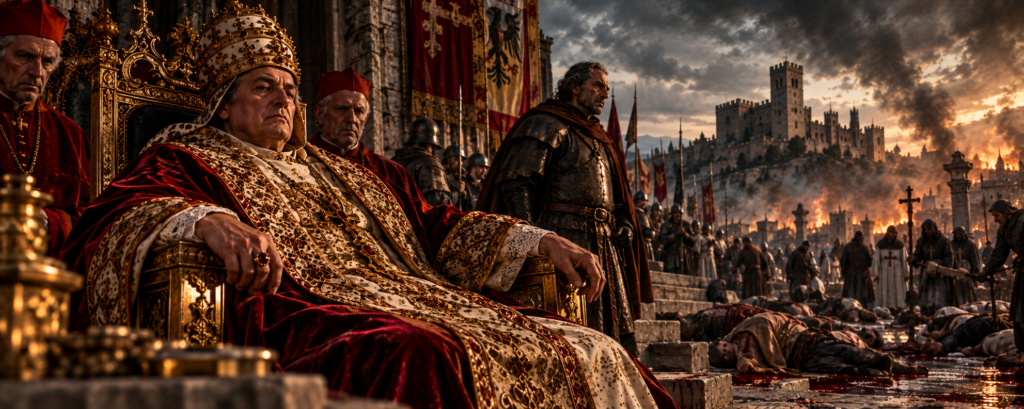
Clement VII: The Butcher of Cesena Who Became an Antipope
Clement VII — Antipope, 1378–1394
Before Robert of Geneva claimed to be the rightful pope, before Europe divided into rival obediences, and before two men simultaneously excommunicated one another while each insisted that he alone occupied the throne of Saint Peter, there was Cesena. In February 1377, the small Italian city became the scene of a massacre carried out by mercenary soldiers serving the papal cause after its inhabitants rebelled against the forces occupying their city. Robert, then a cardinal and papal legate, was the senior representative of papal authority associated with the suppression, while the famous English mercenary captain John Hawkwood commanded troops involved in the killing. Thousands were reportedly slaughtered according to some medieval accounts, although the precise death toll cannot be established with certainty, and Robert emerged from the horror with a reputation so black that later generations remembered him as the “Butcher” or “Executioner of Cesena.”
Less than two years later, this same cardinal was elected pope by men who had already elected another pope. Robert took the name Clement VII and claimed that the previous election of Urban VI had been invalid because the cardinals had acted under violent pressure from the Roman population. Urban refused to surrender, Clement refused to recognize him, and western Christianity fractured into two competing papal obediences. The division would become known as the Western Schism, and it would outlive both men by decades.
Clement’s story is therefore darker than the biography of an ambitious churchman who happened to lose a disputed election. He had already been associated with one of the most notorious atrocities committed during the papal wars in Italy before becoming one of the principal architects of a crisis that left Christians uncertain about who actually governed their Church. Kings, bishops, universities, monasteries, saints, theologians, and ordinary believers eventually divided between Rome and Avignon. Each side possessed its own pope, cardinals, administrators, appointments, taxes, diplomatic networks, and declarations that the other side stood outside legitimate obedience.
Yet Clement should not be reduced to a medieval caricature dripping with blood. The evidence surrounding Cesena requires careful handling, because responsibility for a massacre carried out by mercenary troops is more complicated than the later nickname “Butcher of Cesena” suggests. The legitimacy dispute of 1378 was also genuine rather than an obvious fraud manufactured entirely by cynical French cardinals. Robert of Geneva was ruthless, politically sophisticated, aristocratic, and deeply implicated in the disasters surrounding him, but the most compelling version of his story is the one that preserves those complications.
What emerges is disturbing enough. Robert served a papacy trying to reconquer rebellious Italian territories and became associated with mass killing in the process. He participated in the election of Urban VI, helped abandon him, and then accepted election as Urban’s rival. He spent the next sixteen years maintaining a competing papal monarchy from Avignon while Europe fractured around the question of which pope Christians were supposed to obey.
The blood at Cesena did not make Robert pope. It did, however, cast a shadow over everything that followed. When the man associated with that massacre eventually dressed himself in papal white and declared that his rival was an impostor, the Western Schism acquired one of its most unsettling figures.
Born Into the World of Princes
Robert was born in 1342 into the ruling house of Geneva, a family connected through blood and marriage to some of the most powerful aristocratic networks in Europe. His father was Amadeus III, Count of Geneva, while his mother, Mahaut or Matilda of Auvergne and Boulogne, connected him with another important noble lineage. Robert was therefore not an obscure cleric climbing slowly from poverty toward ecclesiastical power. He entered church life already possessing the social connections that made high office attainable at a remarkably young age.
The fourteenth-century Church offered enormous opportunities to aristocratic younger sons. Noble families frequently directed sons who were unlikely to inherit the principal family lands toward ecclesiastical careers, where bishoprics, abbeys, cardinalates, and court offices could provide wealth and influence comparable to secular lordship. Such arrangements were not considered inherently scandalous in the medieval world, although critics repeatedly complained that aristocratic patronage filled senior church offices with men selected for birth rather than spiritual merit. Robert’s career unfolded comfortably within this system.
He became a papal protonotary while still young and was appointed bishop of Thérouanne in 1361, when he was only about nineteen years old. Seven years later he became archbishop of Cambrai, another prestigious position located within a politically important region. Pope Gregory XI elevated him to the cardinalate in 1371. Before Robert had reached forty, he had already accumulated a career that many churchmen could never have imagined.
His advancement was not simply ornamental. Robert developed experience in administration, diplomacy, and the brutal politics surrounding papal attempts to govern central Italy. He belonged to a generation of churchmen for whom the boundary between spiritual leadership and temporal warfare could be extraordinarily thin. Bishops negotiated treaties, cardinals commanded political operations, popes hired mercenaries, and ecclesiastical territories had to be defended like those of any secular prince.
That world would shape Robert far more decisively than theological scholarship or pastoral care. His greatest notoriety before 1378 came not from preaching, writing, or reforming monasteries but from serving as papal legate in a war. The road toward the papal throne would pass through rebellious cities, mercenary companies, political terror, and eventually Cesena. Long before he called himself Clement VII, Robert of Geneva had learned that church government could be enforced at sword point.
The Papacy Returns to a Hostile Italy
For most of the fourteenth century, the popes had resided not in Rome but at Avignon. Beginning with Clement V in 1309, the papal court developed an elaborate administrative center there, and generations of cardinals became accustomed to a world culturally and politically tied to France. Rome remained spiritually central, but the physical absence of the pope weakened direct papal control over territories in Italy. Local lords, communes, and rival political factions filled the vacuum.
Successive popes attempted to restore their authority in the Papal States. Cardinal Gil Álvarez Carrillo de Albornoz had achieved considerable success earlier in the century through a combination of diplomacy and military force. Yet papal rule remained fragile, especially when local communities resented foreign officials, taxation, and military occupation. The attempt to reconstruct papal sovereignty therefore produced repeated confrontation.
By the 1370s, relations between Pope Gregory XI and Florence had deteriorated dramatically. Florence feared expanding papal power and helped encourage resistance in papal territories, producing the conflict known as the War of the Eight Saints. Cities revolted, alliances shifted, and papal officials confronted a widening challenge to their authority. Gregory responded with spiritual sanctions, diplomacy, and military force.
Robert of Geneva became one of the principal papal agents in this struggle. As legate in Italy, he was responsible for restoring papal authority in rebellious regions. He possessed neither the luxury nor perhaps the inclination to behave solely as a spiritual mediator. He operated as a political governor in a landscape where mercenary armies determined whether papal commands meant anything.
Among those mercenaries was John Hawkwood, one of the most famous soldiers of fortune of the fourteenth century. An Englishman who had built a formidable career in Italy, Hawkwood commanded professional fighting men whose loyalty depended heavily upon contracts, payment, opportunity, and survival. Such companies could be extremely effective military instruments. They could also become terrifying predators when unleashed upon civilian populations.
The Road to Cesena
Cesena belonged to the territories the papacy was struggling to control. Papal authority there depended partly upon foreign troops, including Breton soldiers whose presence became increasingly hated by the local population. Tension between inhabitants and the garrison eventually erupted into open rebellion in early February 1377. Residents attacked the soldiers and temporarily gained the upper hand.
The situation placed Robert of Geneva in an ugly position. As papal legate, he represented the government whose troops had been attacked and whose authority had been challenged. A weak response might encourage additional revolts across territories already destabilized by war. A savage response, however, risked transforming punishment into atrocity.
Robert chose repression. Forces including troops associated with John Hawkwood entered the city after arrangements that apparently led inhabitants to believe some form of restraint or settlement might be possible. What followed became one of the most infamous episodes of the conflict. Soldiers killed inhabitants, looted property, and turned Cesena into a scene of terror.
Medieval and later accounts commonly give death tolls in the thousands, with figures around four thousand frequently repeated. Such numbers should be approached cautiously because medieval chroniclers often lacked reliable methods for counting casualties and could use enormous figures to communicate horror rather than statistical precision. There is no serious reason, however, to doubt that the killing was extensive. Even allowing for exaggeration in particular numbers, Cesena experienced a massacre.
Blood in the Streets
The massacre did not consist merely of combatants dying while defending barricades. Accounts describe indiscriminate killing extending to inhabitants who posed no military threat. Houses were looted, civilians were attacked, and the violence continued beyond what was necessary to regain control of the city. Cesena became an example of what happened when mercenary warfare, political vengeance, and terror converged.
John Hawkwood’s precise attitude toward the massacre has also been debated. Some traditions portray him as initially reluctant to carry out wholesale slaughter and Robert as the more uncompromising figure demanding punishment. The famous command sometimes attributed to Robert in later retellings, demanding blood and justice, belongs to the hostile tradition surrounding the episode and should not be treated as though a stenographer recorded his exact words. What can be established more safely is that Hawkwood’s forces participated in the killing while Robert was the papal legate responsible for the suppression.
That distinction does not absolve Robert. A commander does not need to swing a sword personally to bear responsibility for violence carried out in the political operation he directs or authorizes. Robert represented papal authority, had called upon military forces to crush resistance, and did not emerge from Cesena as a horrified outsider who had unsuccessfully attempted to stop an unforeseeable atrocity. His reputation became permanently connected with the massacre because contemporaries understood him as one of the central authorities behind the repression.
At the same time, describing Robert as personally slaughtering civilians or commanding every individual killing would go beyond what the evidence can establish. Medieval warfare involved complicated chains of authority, and mercenary troops could become difficult to control once plunder began. Hawkwood was an experienced independent commander rather than a passive weapon in Robert’s hand. Historical responsibility therefore needs to be distributed without being diluted.
Robert’s later nickname captures reputation more clearly than administrative detail. Calling him the “Butcher of Cesena” or “Executioner of Cesena” tells us how powerfully the massacre became attached to his memory. It does not prove every later anecdote about his behavior during the killing. The distinction matters because the documented reality is already grim enough.
A Cardinal Stained by Cesena
The massacre did not destroy Robert’s ecclesiastical career. This alone reveals something about the political culture surrounding the medieval papacy. A cardinal associated with mass violence against a rebellious city could remain a major figure in church government because restoring territorial authority was considered a legitimate papal objective. Cesena became a stain on Robert’s reputation without automatically making him unusable to the institution he served.
Gregory XI, meanwhile, was preparing one of the most consequential decisions of the century. After decades at Avignon, the pope returned the papal court to Rome in 1377. The move answered longstanding demands that the bishop of Rome should actually reside in Rome, but it also placed the papacy within a politically unstable city. Gregory’s health was poor, and the future remained uncertain.
He died on March 27, 1378. His death left the College of Cardinals facing a question that terrified Rome. Would they elect another French pope who might return immediately to Avignon? After decades of papal absence, Romans were determined not to allow that possibility without resistance.
Robert of Geneva entered the coming conclave with Cesena behind him and extraordinary political experience already acquired. He had seen rebellion, war, mercenary violence, and the fragility of papal authority. He understood how quickly ecclesiastical disputes could become military struggles. Within months, he would help create one on a continental scale.
The Conclave That Broke the Church
The papal election of April 1378 occurred beneath intense pressure from the Roman population. Crowds demanded a Roman or at least an Italian pope, and the cardinals had legitimate reasons to fear what might happen if they elected another Frenchman. The atmosphere was noisy, threatening, and confused. Whether the pressure legally invalidated the election would soon become one of the most consequential questions in European history.
The cardinals selected Bartolomeo Prignano, archbishop of Bari, an experienced Italian church administrator who was not himself a cardinal. Prignano took the name Urban VI. Robert participated in the process and initially recognized the new pope. The cardinals attended Urban’s coronation and for a time behaved publicly as though his election were valid.
This later became one of the greatest problems for the cardinals who rejected him. If fear had made the election invalid, why had they subsequently treated Urban as pope after the immediate pressure of the conclave had passed? They would argue that coercion and continuing danger had compromised their freedom. Urban’s supporters responded that dissatisfaction with the new pope’s personality and reforms, rather than genuine concern about the election, motivated their change of position.
Robert himself initially communicated recognition of Urban. This makes any claim that he instantly regarded Prignano as an obvious usurper difficult to sustain. Something changed during the weeks following the election. Much of that change can be traced to Urban himself.
Urban VI Turns on the Cardinals
Urban entered office determined to reform the College of Cardinals. He criticized their luxurious lifestyles, their large households, their accumulation of wealth, and their attachment to privileges acquired during the Avignon period. Some of these criticisms were justified. The problem was the increasingly aggressive manner in which the pope delivered them.
Contemporary accounts describe Urban publicly humiliating cardinals and responding to disagreement with anger. His behavior seemed startlingly different from the administrator many had known before his election. Some contemporaries eventually described him as irrational or mentally disturbed, although modern psychiatric diagnosis is impossible and should not be projected backward onto fragmentary and politically hostile evidence. What can be said safely is that Urban rapidly alienated men whose cooperation he desperately needed.
Robert of Geneva became one of his opponents. The cardinal who had helped suppress rebellion in Italy was hardly an obvious champion of gentle government, but even he found Urban increasingly unacceptable. Other cardinals shared the same conclusion. By the summer of 1378, much of the College was withdrawing from Rome.
They gathered first at Anagni and then moved toward the protection of Queen Joanna I of Naples. Away from Urban’s immediate control, they reconsidered the April election. Their conclusion was explosive. They declared that Prignano had never been legitimately elected because fear of the Roman crowd had deprived them of the freedom required for a valid conclave.
A Second Election
Declaring Urban’s election invalid created an immediate question. If Urban had never been pope, then the papal throne was still vacant. The cardinals therefore possessed not merely the right but, in their view, the obligation to conduct another election. They gathered at Fondi under the protection of Onorato Caetani.
On September 20, 1378, they elected Robert of Geneva. He chose the name Clement VII. A cardinal associated only nineteen months earlier with the bloodshed at Cesena now claimed to be the supreme spiritual authority of western Christianity.
Robert’s selection made political sense. He was aristocratic, internationally connected, experienced, energetic, and capable of commanding loyalty. He was also not French in the narrow geographical sense, despite his deep connections to the French-speaking aristocratic world. His family ties and political experience made him a candidate capable of appealing to powerful courts.
His election did not resolve the crisis because Urban remained alive, in possession of Rome, and completely unwilling to accept the cardinals’ verdict. Urban regarded Clement not as a successor but as an antipope. Clement regarded Urban not as a rival pope but as an intruder whose election had never been valid.
The Western Schism had begun.
Two Men, One Throne
The word “schism” can sound bloodless compared with the reality it describes. Christianity in western Europe was built around the idea that there was one legitimate pope, successor of Saint Peter and visible head of the western Church. Suddenly two men claimed that office. Each possessed cardinals prepared to defend his legitimacy.
The problem could not be solved simply by consulting an official list. No universally recognized authority existed above the competing popes capable of issuing an immediately binding judgment. Canon lawyers could debate whether coercion invalidated Urban’s election, but establishing exactly how frightened individual cardinals had been in April was extraordinarily difficult. Their initial recognition of Urban further complicated the issue.
Clement’s supporters insisted that the original conclave had lacked freedom. Urban’s supporters emphasized the cardinals’ subsequent acceptance of him and argued that they had invented the coercion argument only after his reforming behavior angered them. Both positions contained evidence capable of persuading intelligent contemporaries. This uncertainty explains why respected Christians could end up on opposite sides without necessarily acting cynically.
Modern Catholic chronology recognizes Urban VI and the Roman line while classifying Clement VII as an antipope. That later classification should not erase the confusion experienced by people living through the crisis. Clement was not a man wandering around Europe claiming to be pope while everyone laughed at him. He governed an enormous obedience containing kingdoms, bishops, religious houses, universities, and millions of Christians who regarded him as the true pope.
The Butcher Becomes a Pope
Clement’s coronation transformed Robert of Geneva into something unprecedented in his career. He no longer served another pope as legate or cardinal. He claimed the plenitude of papal authority for himself. Every decision he made now depended upon the proposition that Urban VI was not pope at all.
The memory of Cesena followed him. A man associated with the slaughter of a rebellious city now presented himself as guardian of Christian unity. The contradiction was irresistible to opponents. Urbanist propaganda could portray Clement as a bloodstained usurper whose previous actions revealed the nature of the rival papacy.
Clement’s supporters had their own propaganda weapons. Urban’s explosive temper and treatment of the cardinals made it possible to portray him as an intolerable ruler whose election had been compromised from the beginning. His later imprisonment and torture of cardinals would make Clementine accusations seem even more plausible. Neither obedience lacked material with which to blacken the other.
The two rival popes therefore became mirrors reflecting the worst accusations of their enemies. Urban was depicted as unstable, tyrannical, and cruel. Clement was depicted as ambitious, murderous, and stained by Cesena. The tragedy was that both men’s documented careers contained enough violence and political ruthlessness to make some of the propaganda believable.
The Battle for Rome
Clement could claim the papacy, but possessing Rome would have made his claim far more convincing. He therefore attempted to establish himself militarily in Italy. The dispute over spiritual legitimacy quickly became a war over territory. Once again, Robert of Geneva turned toward armed force.
Queen Joanna I of Naples recognized Clement, providing crucial political support. Her kingdom gave the Avignon claimant a powerful ally close to Rome. Clement hoped that military pressure could dislodge Urban and allow him to occupy the city. Had he succeeded quickly, the Schism might have developed very differently.
Urban’s supporters resisted. Fighting culminated in the defeat of Clementine forces at the Battle of Marino in April 1379, where troops supporting the Roman obedience gained a decisive advantage. Clement’s prospects of seizing Rome collapsed. The man who had once helped restore papal authority through mercenary violence discovered that military force could work against him as effectively as for him.
His position in Italy became increasingly untenable. Naples could provide temporary refuge, but even there his presence was politically difficult. Clement eventually withdrew from the peninsula. His destination was the place from which Gregory XI had only recently returned.
Avignon was about to become a papal capital again.
Back to Avignon
Clement arrived at Avignon in 1379 and established his court there. The move gave him security, administrative infrastructure, and proximity to powerful supporters. It also reinforced the perception that the Schism represented a revival of the old French-dominated Avignon papacy. Urban remained in Italy while Clement governed from the Rhône.
Avignon was not an improvised refuge. Decades of papal residence had transformed the city into a sophisticated center of ecclesiastical administration. The enormous papal palace, networks of officials, financial systems, archives, and diplomatic connections could all support a functioning papal government. Clement could therefore operate not as an exile pretending to possess authority but as the head of a substantial rival institution.
This institutional strength made the Schism much harder to end. If Clement had been merely a defeated claimant surrounded by a few followers, his cause might have collapsed after Marino. Instead, Avignon gave him the machinery necessary to create cardinals, appoint bishops, issue documents, collect revenues, dispatch legates, and negotiate with kings. The rival papacy became sustainable.
The same was true in Rome. Urban created new cardinals after the original College deserted him, ensuring that the Roman obedience could perpetuate itself. Each pope now possessed a body capable of electing a successor. A temporary dispute had become structurally capable of surviving both claimants.
Europe Chooses Sides
France recognized Clement, providing the political foundation of his obedience. Scotland, bound to France through its long rivalry with England, also supported Avignon. Castile, Aragon, Navarre, Savoy, and other territories eventually recognized Clement as well, although allegiance could shift and political circumstances varied. The map of papal obedience became entangled with the diplomatic rivalries of Europe.
England supported Urban, making the Schism another arena in the long Anglo-French struggle. Much of the Holy Roman Empire also recognized the Roman pope, although imperial politics were never perfectly uniform. Hungary and Poland generally stood with Rome. Individual rulers could change positions when political calculations changed.
Portugal became a particularly striking example of shifting allegiance. Its rulers moved between Roman and Avignonese obedience as diplomatic circumstances evolved. Such changes demonstrate how difficult it is to portray the Schism as a simple theological disagreement. Papal legitimacy became intertwined with dynastic alliances and international strategy.
Yet politics should not be allowed to explain everything. Theological conviction mattered as well. Scholars, clergy, and religious figures studied the circumstances of the 1378 election and reached genuinely different conclusions. A kingdom’s political allegiance might influence its clergy, but intelligent people could sincerely believe either Urban or Clement possessed the stronger canonical claim.
Saints Against Saints
The confusion reached even people later remembered for extraordinary holiness. Catherine of Siena passionately supported Urban VI and denounced the cardinals who had abandoned him. On the other side, respected religious figures accepted Clement’s legitimacy. The Schism therefore could not be reduced to good Christians recognizing the obvious pope while corrupt politicians followed an obvious impostor.
This division was spiritually devastating. Medieval Christians believed papal authority mattered for ecclesiastical appointments, dispensations, discipline, and the unity of the Church. A bishop appointed by Clement might be rejected by Urban, while a bishop appointed by Urban might be regarded as an intruder within Clementine territory. Monasteries and cathedral chapters could become caught between rival claims.
Each obedience excommunicated or condemned supporters of the other. The terrifying implication was that Christians attempting sincerely to remain within the true Church could be told that they had placed themselves outside legitimate obedience. There was no simple method for ordinary believers to investigate the conclave of 1378 personally. They depended upon rulers, bishops, theologians, and local institutions that were themselves divided.
Clement bore responsibility for perpetuating this condition because he never abandoned his claim. Urban bore responsibility for doing the same. Each man believed, or at least maintained publicly, that surrendering would hand the Church to an illegitimate rival. Their certainty transformed uncertainty for everyone else into a permanent condition.
The Shadow of Cesena Returns
Clement’s enemies never forgot his earlier military career. Cesena provided the perfect symbol for an Urbanist portrayal of the Avignon claimant as a violent aristocrat disguised as a spiritual father. The massacre could be invoked as evidence that Robert had always valued power more than mercy. His elevation to the papacy made the earlier atrocity politically useful in a way it had never been before.
The nickname “Butcher of Cesena” must nevertheless be handled with precision. Labels of this kind often become more famous than the documentary evidence behind them. Robert was unquestionably the papal legate associated with the suppression, and troops commanded by Hawkwood carried out extensive killing. That establishes grave responsibility without requiring every lurid later detail to be accepted.
It is particularly important not to pretend that Robert personally wandered the streets killing civilians. Nothing about the historical case requires such an invention. His power operated at a higher and arguably more consequential level. He represented the authority that decided rebellion would be answered militarily.
The horror of Cesena lies partly in that distance. Political leaders rarely need to wield the weapons through which their decisions become bloody. Orders, permissions, expectations, and the choice of forces can accomplish violence from rooms far removed from the victims. Robert’s association with Cesena therefore illustrates institutional violence more powerfully than any fictional image of a cardinal holding a sword.
The War for Naples
Queen Joanna’s support for Clement placed Naples squarely within the struggle between the two obediences. Urban responded by declaring against her and supporting Charles of Durazzo as a rival claimant to the Neapolitan crown. Charles invaded, defeated Joanna’s position, and eventually captured her. She died in captivity in 1382, almost certainly killed at the direction or with the approval of her enemies.
Clement needed a counterweight to Charles. He turned toward Louis of Anjou, brother of the French king Charles V, and supported Angevin claims in southern Italy. The result transformed the papal dispute into another dynastic war. Men could now fight and die for rival candidates to Naples whose legitimacy was tied to rival popes.
Clement offered extensive political incentives to Louis. Plans associated with a proposed “Kingdom of Adria” would have rearranged territories within or connected to the Papal States in order to secure military assistance. Such schemes reveal how readily spiritual claims became entangled with territorial bargaining. The pope who claimed universal religious authority also behaved like a prince seeking armies through grants of land.
Louis entered Italy but failed to secure decisive success. His campaign consumed enormous resources and ended with his death in 1384. Clement’s hope that French-backed military intervention would overturn the Roman obedience remained unfulfilled. The Schism survived another attempted solution by force.
A Papal Court That Needed Money
Maintaining a rival papal court was enormously expensive. Clement required administrators, diplomats, cardinals, household officials, military resources, messengers, and patronage. He also needed to reward supporters and maintain the appearance of a fully legitimate papacy. Spiritual authority had substantial operating costs.
The division of Europe reduced the revenues available to either obedience. Clement could collect effectively only from territories recognizing him, while Urban and his successors controlled revenues from Roman-obedient lands. Competing appointments and benefice claims complicated the financial situation further. Each papal government needed money while possessing only part of the resources once available to a unified Church.
Critics accused Clement’s administration of aggressive financial practices, including simony and exploitation of benefices. Some accusations originated from opponents and should be approached with the same caution applied to hostile claims against other controversial popes. Nevertheless, the Avignon court undeniably depended upon sophisticated revenue collection and extensive use of ecclesiastical patronage. Financial pressure became one of the defining burdens of the Schism.
This had consequences far beyond Clement’s household. Church offices could become tied to payments, expectations, and political loyalty. Supporters needed rewards, while diplomatic campaigns required funds. The spiritual crisis therefore acquired an increasingly financial character.
For critics, this made the rival papacies look grotesque. Two men claimed to be the unique successor of Saint Peter while both maintained expensive courts and demanded revenues from Christians to finance their competing claims. The longer the Schism continued, the more difficult it became to distinguish defense of principle from defense of institutional interests.
Clement the Diplomat
Clement was more politically polished than Urban VI. His aristocratic upbringing, family connections, and long experience in diplomacy made him comfortable dealing with royal courts. He could cultivate alliances rather than merely demand obedience. This helped explain why his cause survived military defeat in Italy.
France remained indispensable. Clement’s proximity to the French monarchy gave his enemies an obvious reason to accuse him of being little more than a French pope. The reality was more complicated because Clement possessed his own agenda and could not simply be reduced to a royal puppet. Yet dependence creates influence even when it does not create complete control.
Clement also worked energetically to secure recognition in the Iberian kingdoms. Legates traveled, courts debated, and diplomatic pressure was applied. Pedro de Luna, the future Benedict XIII, became one of the most important Clementine diplomats. His skill helped strengthen the Avignon obedience in Spain.
These efforts demonstrate that Clement was not merely sitting inside the palace at Avignon waiting for history to vindicate him. He actively constructed an international coalition. Every kingdom gained made his papacy more credible and the Schism more difficult to end. Success therefore carried an uncomfortable paradox: strengthening Clement’s position also strengthened the division of Christendom.
The Man Behind the Antipope
Robert of Geneva’s personality is less dramatically documented than Urban VI’s. He was not remembered primarily for volcanic rages or the torture of his own cardinals. Instead, his career suggests a controlled, aristocratic, politically calculating man comfortable with power. He could use diplomacy, patronage, and military force according to circumstance.
His conduct at Cesena reveals the harder edge beneath that polish. Whether or not he issued every brutal order later attributed to him, he was willing to participate in a system that answered rebellion with devastating violence. His subsequent papal career showed the same readiness to pursue political objectives through secular means. Armies, dynastic claims, territorial grants, and royal alliances all became tools of the Clementine cause.
This does not mean Clement lacked religious conviction. Medieval political churchmen could sincerely believe in their spiritual mission while behaving in ways modern readers find profoundly worldly. Clement may genuinely have believed that Urban’s election was invalid and that defending his own claim meant defending the legitimate Church. Sincerity and ambition are not mutually exclusive.
That combination makes him more interesting than a simple fraud. If Clement knew with absolute certainty that Urban was legitimate and claimed the papacy solely for personal gain, his story would be straightforward. The evidence does not allow such confidence. The darker possibility is that he believed himself justified while helping perpetuate a disaster.
Urban VI Dies
In October 1389, Urban VI died. His death presented one of the clearest opportunities yet to end the Schism. If the Roman cardinals had recognized Clement rather than electing another pope, western Christianity could have returned to a single obedience. Clement therefore had reason to hope that his rival’s death might finally vindicate him.
The Roman cardinals did not cooperate. They elected Pietro Tomacelli, who became Boniface IX. The Roman succession continued without acknowledging Clement’s claim. What had begun as a personal dispute between Urban and Clement had now survived one of its founders.
This moment reveals how thoroughly the Schism had become institutionalized. Urban’s cardinals had received their positions from a pope whose legitimacy depended upon rejecting Clement. Accepting Clement after Urban’s death could call their own appointments and actions into question. Their interests were now tied to continuation.
Clement faced the same structural problem at Avignon. His cardinals owed their status to his obedience and had careers built upon its legitimacy. The two rival systems had become self-reproducing. Removing one individual pope was no longer sufficient.
Why Clement Would Not Resign
As the years passed, pressure increased for a negotiated solution. Scholars proposed different methods, including voluntary resignation, arbitration, or a general council. The University of Paris became particularly important in developing and debating possible ways to restore unity. The idea that both claimants might resign gained increasing appeal.
For Clement, resignation presented profound problems. If he sincerely believed Urban’s election had been invalid, surrender could appear to abandon the legitimate papacy to a rival line. It would also jeopardize the cardinals, bishops, and officials whose positions depended upon his authority. Personal conviction and institutional interest pointed in the same direction.
There was also the matter of pride. Clement had spent years presenting himself before kings and Christians as the true pope. He had maintained a court, created cardinals, issued judgments, collected revenues, and sponsored military campaigns. Voluntary resignation would require acknowledging that the unity of the Church mattered more than his continued possession of the office.
Neither obedience proved eager to make that sacrifice. The result was a moral trap in which each side could claim that the other should resign first. Every year of delay made the eventual solution more complicated. Clement became both prisoner and beneficiary of the institution he had created.
The Schism Becomes a Generation
By the early 1390s, children born after 1378 were approaching adulthood. For them, a divided papacy was not an emergency remembered from the recent past but the normal structure of Christian life. Clergy had been ordained, bishops appointed, and political alliances formed entirely within the Schism. Division was becoming generational.
This normalization frightened reformers. The longer rival obediences existed, the greater the risk that Christianity might never return peacefully to a single papal government. Each succession could create another generation of claimants. The very mechanisms designed to ensure continuity of the papacy now ensured continuity of the schism.
Clement continued ruling from Avignon. He maintained considerable support and did not experience a collapse that would force surrender. His ability to govern effectively enough to survive became part of the problem. An incompetent rival might have disappeared, but Clement possessed enough political skill to endure.
Cesena again offers a grim parallel. Robert had once demonstrated how effectively organized force could restore political authority after rebellion. At Avignon he demonstrated how effectively organized administration could preserve disputed authority. In both cases, competence served outcomes with devastating consequences.
Death at Avignon
Clement VII died at Avignon on September 16, 1394. He was only about fifty-two years old. His sixteen-year claim to the papacy had lasted longer than Urban VI’s pontificate and had become deeply embedded within European politics. Yet the Church remained divided exactly as it had been when he first accepted election at Fondi.
His death created another opportunity for unity. The Avignon cardinals could have refused to elect a successor and sought terms with Boniface IX in Rome. Growing pressure for an end to the Schism made such a course increasingly attractive to outsiders. The cardinals nevertheless proceeded with another election.
They chose Pedro de Luna, who became Benedict XIII. He was an intelligent, formidable canon lawyer who had served Clement loyally and possessed extensive diplomatic experience. Hopes that he might help end the Schism would eventually collapse as Benedict became one of the most stubborn claimants in its history. Clement’s institutional creation therefore survived him.
The Western Schism would continue until 1417. By the time Martin V emerged from the Council of Constance as the broadly recognized pope, Robert of Geneva had been dead for twenty-three years. The division he helped begin lasted almost four decades.
Was Clement VII Really an Antipope?
Calling Clement an antipope is correct within the modern conventional chronology of the Roman Catholic Church. Urban VI is recognized as the legitimate pope elected in 1378, while Robert of Geneva appears as Clement VII, antipope of the Avignon obedience. The later Medici pope Giulio de’ Medici could therefore take the name Clement VII in 1523 without being numbered Clement VIII. Robert’s claim is excluded from the official papal succession.
Historical experience in 1378 was much less tidy. The cardinals had genuinely faced threats during Urban’s election, and freedom of election mattered under canon law. Determining whether fear had been severe enough to invalidate their votes was not simple. The cardinals’ later recognition of Urban created powerful evidence against them, but it did not make the original intimidation imaginary.
Clement therefore possessed a plausible enough case to convince major kingdoms, respected theologians, bishops, and religious figures. France did not recognize him merely because everyone knew he was fraudulent and found fraud politically convenient. Many people sincerely believed the cardinals’ explanation that the April election had been coerced. Others sincerely believed their later reversal was self-serving.
Using the word antipope should therefore identify Clement’s place in the accepted succession rather than flattening the historical controversy. He was an antipope who functioned as pope for a vast portion of western Christendom. That distinction makes his story more disturbing rather than less.
Cesena and the Problem of Responsibility
Any judgment of Clement must eventually return to Cesena because it remains the most violent episode personally associated with him. The massacre occurred before the Schism and therefore cannot be dismissed as propaganda invented solely by Urban’s supporters. Robert was papal legate in the region and played a central role in the campaign to restore papal authority. Hawkwood’s troops carried out the killing within that political operation.
The precise casualty total remains uncertain. Numbers in medieval accounts can be unreliable, and repeating “four thousand dead” as unquestionable statistical fact would create false precision. What matters is the scale and character of the violence. Contemporary memory regarded Cesena as an atrocity.
Robert’s degree of direct operational responsibility is likewise debated. Hawkwood commanded the soldiers, and mercenary troops possessed agency of their own. Robert nevertheless occupied the political position from which the repression had been demanded and supported. Separating command responsibility from physical action is essential.
This makes Cesena a particularly useful dark-history subject because it resists simplistic storytelling. Robert does not need to have personally murdered anyone to bear grave responsibility. Political violence often operates through hierarchy. The person whose hands remain clean can still stand at the center of the bloodshed.
The Making of the “Butcher”
Nicknames are dangerous historical evidence because they compress complicated lives into memorable judgments. “Butcher of Cesena” instantly tells the reader how Robert came to be remembered, but it can also create the impression that the phrase followed him universally from the moment of the massacre. Medieval reputations developed through chronicles, polemic, political rivalry, and later historical retelling. Labels could become sharper with time.
For an article about Clement, the nickname should therefore be used as a doorway rather than a verdict. It introduces the horror of Cesena and the remarkable contrast between massacre and papal election. It should not replace analysis of what Robert actually did. The distinction between reputation and evidence remains essential.
The same principle applies to accusations of corruption during his Avignon pontificate. Rival papacies generated propaganda almost automatically. Every financial demand could be called extortion, every appointment simony, and every diplomatic maneuver proof of political servitude. Some criticisms were justified, but the environment encouraged exaggeration.
Clement’s strongest case for inclusion among the Wicked Popes does not depend upon accepting every accusation. His documented association with Cesena, willingness to pursue papal claims through warfare, participation in the creation and perpetuation of the Western Schism, and maintenance of an expensive rival ecclesiastical government provide ample material. History becomes darker when unnecessary legends are removed and the real structures of power become visible.
A Pope Built by War
Robert’s career had been shaped by violence before his election, and violence remained close to his papal strategy afterward. His service in Italy taught him that territorial authority depended upon soldiers. His attempt to defeat Urban showed that he was willing to apply the same lesson to the papal succession. When military defeat drove him from Italy, he changed methods rather than abandoning his claim.
This adaptability distinguished him from Urban. Clement could retreat strategically, cultivate courts, deploy diplomats, and wait. He did not need to win every confrontation personally. His strength lay in constructing a coalition capable of keeping his cause alive.
That made him dangerous in a different way from his Roman rival. Urban’s aggression could explode openly and destroy relationships. Clement’s political skill made division sustainable. One man helped ignite the Schism through confrontation, while the other gave the rival obedience the structure necessary to survive.
This distinction also explains why Clement’s legacy extends beyond Cesena. The massacre reveals his willingness to participate in extreme coercion. Avignon reveals his capacity to turn disputed legitimacy into durable government. Together they show a churchman exceptionally comfortable with the instruments of power.
The Price Paid by Ordinary Christians
The great political drama of the Schism can obscure the people who had no influence over papal elections. Ordinary clergy and laypeople were expected to obey whichever pope their local church recognized. They might never meet a cardinal or understand the canon-law arguments surrounding coercion at the 1378 conclave. Nevertheless, the consequences reached them.
Competing papal appointments could create confusion within dioceses. Financial demands flowed toward rival administrations. Religious houses could become divided, while political changes could suddenly alter which obedience local authorities expected people to follow. A question created by a few cardinals in Rome became part of everyday ecclesiastical life.
The spiritual anxiety was equally serious. Medieval Christianity placed enormous importance upon remaining within the unity of the Church. Yet each pope could accuse the other’s followers of schism. A sincere believer might therefore wonder whether obedience itself had become dangerous.
Clement never solved this problem because solving it would have required relinquishing or successfully proving his claim. He did neither. For sixteen years he maintained that Christians owed obedience to him while Urban and Boniface IX insisted the opposite. The uncertainty became part of his legacy.
The Dark Irony of Clement VII
Robert of Geneva spent his career defending papal authority, yet his greatest historical contribution was helping fracture it. At Cesena he served a pope determined to restore control over rebellious territories. At Fondi he accepted election from cardinals who had rejected the pope they had chosen only months earlier. At Avignon he built a rival papacy strong enough to prevent either side from achieving unity.
The irony deepens because Clement may have believed every major step was justified. Cesena could be rationalized as punishment necessary to restore order. Rejecting Urban could be rationalized as defense of a free papal election. Maintaining the Avignon obedience could be rationalized as refusal to surrender the Church to an intruder.
Each individual justification could sound plausible within its own narrow frame. The accumulated result was catastrophe. A city was massacred, the papacy split, Europe divided, and the institutional crisis continued after Clement’s death.
This is one of the recurring themes of dark history. People rarely need to believe themselves wicked before participating in terrible events. Power provides its own language of necessity.
Robert of Geneva understood that language extremely well. Rebellion required suppression, illegitimacy required resistance, and papal authority required defense. The bodies at Cesena and the divided churches of Europe were the consequences left behind by those necessities.
A Rival to an Unstable Pope
Clement’s reputation also benefited from the increasingly disturbing behavior of Urban VI. Urban’s later conflict with his own cardinals, including arrests and torture, made the Roman pope difficult to present as a serene defender of ecclesiastical order. Several cardinals imprisoned by Urban eventually disappeared and were probably killed. Such events strengthened the argument that something had gone terribly wrong with Urban’s government.
Yet Urban’s cruelty does not automatically validate Clement. Two rivals can both behave badly. The Western Schism is particularly fascinating because neither side fits comfortably into the role of obvious righteous alternative. The Roman obedience possessed legitimate arguments while Urban behaved destructively, and the Avignon obedience possessed plausible canonical arguments while Clement carried the shadow of Cesena.
This moral ambiguity helped perpetuate the conflict. Supporters could always point toward the sins of the opposing claimant. Urbanists remembered Cesena and Clement’s dependence upon France. Clementines pointed toward Urban’s rage, torture, and alienation of his own cardinals.
Each pope became evidence for the other’s propaganda. The worse either man behaved, the more convinced his enemies became that they had chosen correctly. Scandal therefore reinforced division rather than producing reform.
The Court at Avignon
Clement’s Avignon was not merely a headquarters for conspiracy. It became a functioning cultural and ecclesiastical court with cardinals, scholars, administrators, diplomats, and artists. Patronage continued despite the Schism. People pursued careers and religious projects within Clement’s obedience as though his papacy were entirely legitimate.
This normality is crucial to understanding the crisis. Evil rarely announces itself through constant chaos. Institutions can operate smoothly while resting upon disputed or destructive foundations. Documents are issued, salaries paid, petitions processed, and ceremonies performed.
Clement’s court therefore looked remarkably papal because it was designed to be papal. Cardinals wore their insignia, ambassadors arrived, petitions were heard, benefices granted, and solemn religious rituals surrounded the claimant. The architecture and memory of the earlier Avignon popes gave the entire system historical continuity. Visitors could easily experience Clement’s court as the center of Christendom.
Meanwhile, Rome possessed its own pope performing the same role. Two convincing versions of papal normality existed simultaneously. That was the true horror of the Schism.
When Division Becomes Profitable
Once rival institutions existed, people inevitably developed interests in their survival. Cardinals appointed by Clement depended upon the validity of Clement’s authority. Bishops receiving benefices from him possessed similar stakes. Officials employed at Avignon could lose careers if the obedience collapsed.
The same dynamics existed in Rome. Urban’s new College had every reason to reject Clement because recognizing him could undermine their own legitimacy. Papal officials, bishops, and political allies became invested in the Roman line. Institutional self-preservation gradually joined theological conviction.
This does not mean everyone involved acted cynically. A cardinal could sincerely believe Clement was pope while also benefiting from that belief. Human motives rarely separate themselves so conveniently. Principle and advantage can reinforce each other until distinguishing them becomes nearly impossible.
Clement’s ability to distribute patronage therefore strengthened his claim. Every appointment created another relationship between the claimant and the wider Church. The papacy had always used patronage, but during the Schism patronage helped manufacture permanence. A disputed election became an ecosystem.
The Seeds of Conciliarism
The inability of either pope to end the Schism encouraged theologians to reconsider the structure of church authority. If the pope was the supreme earthly authority in the Church, what happened when no one could establish which pope possessed that supremacy? If rival claimants refused to resign, who could judge them? The crisis exposed a constitutional problem hidden beneath medieval papal monarchy.
Thinkers increasingly explored the possibility that a general council representing the wider Church might possess authority sufficient to resolve an emergency even against papal resistance. These ideas would eventually contribute to the conciliar movement. Clement did not invent conciliarism, but his refusal to abandon his claim helped create the circumstances in which it flourished. Papal division generated arguments for limiting papal power.
The University of Paris became especially influential in discussions of possible solutions. Scholars considered resignation, arbitration, and conciliar judgment. The fact that such proposals were necessary demonstrated how badly the ordinary machinery of papal succession had failed. No one had designed the system expecting two durable papal monarchies to coexist.
Clement died before the conciliar solution reached its greatest power. His successor Benedict XIII would experience increasingly intense pressure to end the division. Eventually the Council of Constance would help dismantle the competing obediences and restore broadly recognized unity under Martin V. The solution required mechanisms Clement had spent his life avoiding.
Death Without Resolution
There was no dramatic reckoning at Clement’s deathbed that healed the Church. He did not summon his cardinals and command them to abandon the Avignon obedience. He died still claiming the papacy. The system continued almost automatically.
This makes his death strangely anticlimactic after such a dramatic career. The cardinal associated with Cesena, the rival elected at Fondi, and the pope of Avignon simply passed from the stage while the crisis remained. His personal ambition or conviction no longer mattered. The institution had learned how to reproduce itself.
Pedro de Luna’s election as Benedict XIII proved the point. The cardinals could have treated Clement’s death as an opportunity to restore unity. Instead, they chose another pope because that was what a College of Cardinals did when its pope died. Routine perpetuated catastrophe.
Clement’s greatest success was therefore also his most damaging achievement. He made the Avignon obedience normal enough to survive him. A rival papacy born in emergency became a dynasty of claimants.
Clement VII and the Wicked Popes
Clement occupies an unusual place in a collection of Wicked Popes because technically he is remembered as an antipope. Yet excluding him on that basis would miss one of the darkest stories produced by medieval papal politics. For millions of Christians during his lifetime, Clement was not an antipope at all. He was simply the pope.
His inclusion should also avoid the easy temptation to make Cesena the only reason he matters. The massacre is crucial because it reveals the violence surrounding his rise. The Schism is equally important because it reveals what he did with authority afterward. Together they create a career in which coercion and institutional ambition repeatedly intersect.
He was not a decadent libertine like the later caricatures attached to certain Renaissance popes. His story contains no need for poisoned banquets, secret lovers, or supernatural legends. His darkness is political. Armies, massacres, disputed elections, rival courts, dynastic wars, taxation, excommunication, and institutional division provide the material.
That form of wickedness can be less visually sensational than personal debauchery but more consequential. Clement helped maintain a division affecting entire kingdoms. His choices shaped the religious lives of millions of people who would never know his face. Power magnified the consequences of his certainty.
The Cardinal Who Never Escaped Cesena
However grand Clement’s court became, Cesena remained behind it. The massacre occurred before he could claim that defending his own papacy required desperate measures. He was acting as representative of Gregory XI, a pope whose legitimacy was not disputed. The episode therefore offers a view of Robert exercising power before the Western Schism complicated everything.
What we see is not a helpless churchman dragged unwillingly into violence. Robert accepted the responsibilities of a papal legate operating in a military conflict. When rebellion threatened papal control, overwhelming force was used. Civilians died in enormous numbers.
His later defenders could point toward the brutality of warfare, the rebellion of the inhabitants, the dangers facing the garrison, and the independent role of Hawkwood’s troops. Those factors matter historically. None makes the massacre disappear. Political context can explain violence without cleansing it.
Robert’s reputation understood this. The memory of Cesena became attached to him because people recognized that authority carries responsibility. The man who later claimed to be father of the Christian world had once stood on the side of those who answered a rebellious city with slaughter.
The Pope Who Could Not Prove He Was Pope
Clement’s entire pontificate rested upon a proposition he could never make universally convincing. Urban’s election, he argued, had been invalid because the cardinals were coerced. The claim was plausible enough to divide Europe but not decisive enough to reunite it. That was the worst possible combination.
Had Clement possessed an obviously fraudulent case, his support might have collapsed quickly. Had he possessed an overwhelmingly convincing case, Urban’s support might have disappeared. Instead, both sides possessed arguments strong enough to survive. Ambiguity became fuel.
Clement spent sixteen years trying to convert disputed legitimacy into accepted legitimacy. Diplomacy, alliances, patronage, military campaigns, and ecclesiastical administration all served that objective. He never achieved universal recognition. The Roman line survived every attempt to dislodge it.
His failure became Europe’s burden. Clement could not prove himself strongly enough to eliminate Urban, but he was powerful enough to prevent Urban from eliminating him. The Schism lived inside that balance.
Blood Before the Schism, Division After It
Robert of Geneva’s story begins with privilege. Born into one of Europe’s interconnected aristocratic families, he entered the Church with advantages few men possessed and rose through its hierarchy with remarkable speed. Bishop, archbishop, cardinal, legate, and eventually claimant to the papacy, he moved through offices in which spiritual authority and political power were inseparable. By his mid-thirties, he was already accustomed to commanding in the name of the Church.
Then came Cesena. A rebellious city confronted papal authority, and the response became a massacre. John Hawkwood’s soldiers performed much of the killing, but Robert stood at the center of the papal operation that brought force down upon the city.
The precise number of victims cannot be known. Medieval casualty estimates are too uncertain to justify false precision. Yet uncertainty about whether thousands died in one exact numerical quantity does not turn massacre into ordinary battle.
Men, women, and other inhabitants were caught in violence that exceeded the requirements of simply retaking the city. Looting accompanied killing. The suppression became terror.
Robert’s exact words cannot be recovered with confidence. Later chroniclers and hostile traditions sharpened his image, as they often did with controversial rulers. The famous bloodthirsty commands attributed to him should therefore be treated cautiously.
But historical caution has limits. It should prevent invention, not erase responsibility. Robert was the papal legate whose authority surrounded the operation.
He survived Cesena politically. There was no collapse of his career and no permanent exile from church government. Within a year, he was participating in one of the most consequential papal elections in history.
That election occurred under frightening circumstances. Romans feared another French pope would return the papacy to Avignon, and the cardinals faced intense popular pressure to choose an Italian. Bartolomeo Prignano emerged as Urban VI.
Robert accepted him at first. That fact matters. It prevents the later Clementine story from being reduced to an immediate, unwavering conviction that Urban had never been pope.
Urban then alienated the cardinals with astonishing speed. His reforming criticisms contained legitimate concerns, but his treatment of the College became increasingly hostile. The cardinals fled.
Away from Rome, they reexamined the election. They concluded that fear had invalidated their votes. Then they did something whose consequences none of them could fully control.
They elected another pope. The man they chose was Robert of Geneva.
There is a terrible historical symmetry in that choice. The cardinal associated with restoring papal authority through massacre now became the figure around whom an alternative papal authority would be constructed. Violence had defined one chapter of his career.
Division would define the next. Robert became Clement VII and demanded recognition from the Christian world.
Urban refused. Neither man could eliminate the other. Europe divided.
France recognized Clement. England recognized Urban. Scotland followed the Avignon side while other kingdoms and principalities made their own choices according to mixtures of law, conviction, alliance, and political interest.
The division reached far below royal courts. Bishops, monasteries, clergy, universities, and ordinary Christians inherited a question created by the cardinals. Which pope was actually pope?
There was no universally accepted judge capable of answering. Urban claimed that Clement was an antipope. Clement claimed that Urban had never been validly elected.
Each possessed cardinals. Each created more cardinals. Each appointed bishops.
Each issued papal documents. Each collected revenues. Each behaved as though the other’s existence were an aberration that would eventually disappear.
Neither disappeared. Instead, the abnormal became normal.
Clement’s defeat in Italy should have ended his cause if his papacy had depended only upon military strength. Marino demonstrated that he could not simply march into Rome and remove Urban. His withdrawal to Avignon looked like defeat.
Instead, it became transformation. Clement exchanged the uncertain battlefield of Italy for the administrative machinery of Avignon.
There he built something capable of surviving. The old papal capital still possessed the architecture, personnel, habits, and international connections necessary for ecclesiastical government. Clement occupied that inheritance.
This may have been more consequential than winning a battle. An army could be defeated in a day. An institution could reproduce itself for generations.
Clement created cardinals who depended upon his legitimacy. He appointed churchmen whose offices rested upon his authority. He cultivated rulers whose diplomatic interests became connected with his survival.
Rome did exactly the same thing. The Schism acquired roots.
That is why the deaths of the original rivals could not solve it. Urban died in 1389, and the Roman cardinals simply elected Boniface IX. Clement remained in Avignon.
When Clement died in 1394, his cardinals elected Benedict XIII. The two men who had begun the contest were becoming almost irrelevant to its continuation.
The system had learned to live without them. This is one of the most disturbing features of institutional conflict. A crisis can begin with individual choices and eventually develop mechanisms that perpetuate it automatically.
Clement deserves significant responsibility for making that possible. He could always argue that he was defending legitimacy rather than personal ambition. Perhaps he sincerely believed it.
That possibility does not diminish the consequences. People can cause extraordinary harm while believing they are protecting something sacred.
Indeed, sacred justification can make compromise harder. If Clement had regarded the papacy as merely a political prize, perhaps some sufficiently attractive settlement could have persuaded him to surrender. If he regarded himself as the genuine successor of Saint Peter, surrender could look like betrayal of the Church itself.
Urban possessed the same problem. Each claimant could interpret compromise as treason against truth. Their certainty trapped everyone else.
This is why the Western Schism became more than an embarrassing argument between clerics. It exposed a structural weakness in medieval papal government. The Church possessed elaborate mechanisms for electing a pope but no universally accepted mechanism for resolving a situation in which two durable claimants existed.
The crisis encouraged theologians to search for another authority. General councils increasingly appeared capable of representing the Church when the papacy itself could not provide unity. Conciliarism gained strength from the failure of rival popes to solve the problem they embodied.
Clement therefore contributed indirectly to challenges against the very papal monarchy he claimed to defend. By maintaining a rival papacy, he helped demonstrate why an authority above individual papal claimants might become necessary in an emergency. His determination strengthened the arguments of those seeking limits upon papal supremacy.
That is another dark irony of his career. At Cesena, Robert fought to strengthen papal government in Italy. At Avignon, Clement helped create conditions that encouraged Christians to question whether popes could always be trusted to resolve crises involving themselves.
He defended papal authority so vigorously that he helped weaken confidence in it. The contradiction followed him from battlefield to palace.
Yet Cesena remains the image from which his reputation cannot completely escape. Before Europe knew Clement VII, Italy knew Cardinal Robert of Geneva. Before he claimed to unite Christians beneath his obedience, he had been associated with the violent punishment of a rebellious Christian city.
The title “Butcher of Cesena” may simplify a complicated chain of military responsibility. It may reflect later hostility as well as contemporary horror. It must not be used carelessly.
But the massacre happened. Hawkwood’s troops entered Cesena, and inhabitants died in appalling numbers.
Robert was not an innocent spectator. He represented the papal power responsible for suppressing the revolt. Whatever uncertainties remain about particular orders, his association with the event is historically substantial.
That should be enough. Dark history does not need false precision when the truth already contains mass killing.
Nor does Clement’s papal career need to be presented as an obvious fraud. The election of Urban genuinely occurred under pressure. The cardinals genuinely had canonical reasons to care about whether their freedom had been compromised.
Their later conduct genuinely weakened their argument. The resulting legal question was difficult enough that intelligent contemporaries divided over it.
Clement’s supporters were not necessarily fools or conspirators. Some believed him. Some regarded his election as the restoration of legitimate order.
That fact makes the Schism more tragic. Europe was not divided simply because half the continent knowingly followed a fake pope. It was divided because the evidence allowed competing narratives of legitimacy to survive.
Clement exploited and inhabited that ambiguity. Whether he thought of himself as exploiting it is another matter. Historical actors rarely describe their own ambitions in the language their enemies use.
He called himself pope. His court called him pope.
Kings called him pope. Bishops called him pope.
Millions of Christians called him pope. Yet Rome called him antipope.
The modern historical list sides with Rome. Robert of Geneva appears outside the accepted papal succession. His name Clement VII would later be used again by a recognized pope.
But classification cannot erase lived reality. For sixteen years, the Avignon Clement governed as a pope because an enormous portion of Europe treated him as one. His antipope story therefore reveals something more unsettling than a failed pretender.
It reveals how legitimacy is experienced before history has decided the winner. People living through the Schism did not possess the clean chronological tables available centuries later. They had arguments, rumors, letters, sermons, royal commands, episcopal instructions, and their own consciences.
Clement stood at the center of that uncertainty. Every year he remained at Avignon reinforced it. Every cardinal he created gave the rival obedience another defender.
Every bishop he appointed extended his claim into another local church. Every king he persuaded transformed canonical argument into geopolitical reality.
His political skill therefore became part of the tragedy. A less capable claimant might have failed quickly. Clement endured.
His aristocratic connections helped him. His diplomatic instincts helped him. The administrative strength of Avignon helped him.
Even his experience of violence and political crisis probably helped him. Robert of Geneva understood power.
That may be the thread connecting Cesena and Avignon most clearly. At Cesena, power meant soldiers capable of forcing a rebellious city back into obedience. At Avignon, power meant institutions capable of convincing kingdoms that one papal claimant was legitimate.
The instruments changed. The objective remained authority.
This does not mean Robert spent his life pursuing power without any religious conviction. Such a conclusion would be psychologically simplistic and historically impossible to prove. Medieval churchmen could inhabit spiritual and political worlds simultaneously without experiencing the contradiction as modern readers might.
Robert could believe in papal authority and use mercenaries. Clement could believe in Christian unity and refuse to resign.
Those contradictions are precisely what make him fascinating. Wickedness in history does not always belong to people who reject the values they claim to serve. Sometimes it emerges from the methods they consider acceptable in defending those values.
Robert believed rebellion could be crushed. Clement believed disputed authority could be defended. The consequences accumulated around him.
Cesena was left with its dead. Christendom was left with two popes.
Neither disaster can be reduced entirely to him. Hawkwood and his soldiers possessed responsibility for the massacre, while local rebellion and the wider papal war created the circumstances surrounding it. Urban VI, the dissident cardinals, kings, and later papal claimants all shared responsibility for prolonging the Schism.
History rarely offers a single villain powerful enough to cause everything alone. Clement’s story should not be forced into that shape.
His responsibility remains substantial precisely because it is specific. He was a senior papal authority associated with the suppression of Cesena. He accepted election against a living man previously elected by the same College.
He attempted to enforce his claim militarily. When that failed, he built a rival papal government capable of surviving for decades.
He never solved the division. He died inside it.
The institution he left behind elected another claimant almost immediately. The Church remained divided for twenty-three more years.
By the time unity returned, an entire generation had lived and died beneath rival popes. The crisis had required councils, royal diplomacy, resignations, depositions, and extraordinary constitutional experimentation.
Clement had wanted recognition. Instead, his career helped force Christianity to reconsider how papal authority itself should be controlled during a crisis.
That legacy reaches far beyond the nickname attached to Cesena. The massacre made Robert infamous. The Schism made him consequential.
Together they make him one of the darkest figures associated with the medieval papacy. He was neither a fictional monster nor an innocent victim of hostile history.
He was an aristocratic cardinal who knew how power worked. He had seen cities disciplined by soldiers and rulers persuaded by diplomacy.
When the opportunity came to claim the highest spiritual office in western Christianity, he accepted it. Once he possessed that claim, he would not surrender it.
Perhaps he believed completely that he was right. Perhaps ambition and conviction became so intertwined that even Robert could no longer have separated them. History cannot enter his mind deeply enough to know.
It can examine what remained after him. Cesena remained a name associated with massacre.
Avignon remained the capital of a rival obedience. Europe remained divided.
The most haunting image of Clement VII is therefore not necessarily the bloodstained cardinal imagined by later polemicists. It is the composed pope sitting inside the magnificent palace at Avignon, surrounded by cardinals, clerks, ambassadors, petitions, ceremonies, and every outward sign of legitimate authority. Somewhere far away, another man sat beneath the same symbols and made the same claim.
Both called the other an impostor. Both demanded obedience.
Millions of Christians had to choose between them. That choice continued long after Robert of Geneva was buried.
His story began with a Church using violence to impose unity upon a rebellious city. It ended with a Church incapable of achieving unity within itself. Between those two moments stood Robert of Geneva, the cardinal remembered for Cesena and the antipope remembered as Clement VII.
He spent much of his life defending authority. The legacy he left was division.
That is what makes Clement VII such a fitting figure for Wicked Popes. His darkness does not depend upon accepting every hostile accusation, exaggerating the number of dead at Cesena, or pretending the legitimacy dispute of 1378 was simple. The documented history is far more unsettling because it shows how violence, conviction, ambition, and institutional power can coexist inside a man who believed himself entitled to speak for the Church.
At Cesena, papal authority arrived behind mercenary swords. At Fondi, disputed authority placed a crown upon Robert’s head. At Avignon, that authority built a second papacy powerful enough to divide western Christianity.
The massacre eventually ended. The Schism did not.
Robert of Geneva could leave Cesena behind geographically, but he could never entirely leave behind what it revealed about his understanding of power. When resistance stood in the way, he had already learned that authority could be defended with whatever instruments were available.
As Clement VII, those instruments became larger than an army. They became kingdoms, cardinals, benefices, diplomacy, money, dynastic warfare, and the consciences of Christians across Europe. The battlefield expanded until half of western Christendom stood on one side and half on the other.
Clement died without seeing the division healed. He left no final victory capable of proving that sixteen years of conflict had been justified. His followers simply elected another claimant and continued.
Perhaps that is the darkest ending possible. There was no revelation that made the bloodshed meaningful and no triumph that settled the argument. There was only another conclave.
Another pope appeared in Avignon. Another pope remained in Rome.
The machinery continued turning.
Long after the streets of Cesena had been cleaned, the consequences of Robert of Geneva’s choices remained embedded in the government of the Church. His career demonstrated how quickly authority defended by violence could become authority divided by ambition, fear, and certainty. The man remembered as the Butcher of Cesena eventually claimed to be the shepherd of Christendom, but when he died, the flock was more divided than when he had begun.
That contradiction is his real epitaph. Robert of Geneva rose through a Church struggling desperately to enforce obedience and became one of the men who made universal obedience impossible. He helped suppress one rebellion with blood, only to spend the rest of his career presiding over a rebellion in papal government itself.
He called himself Clement VII. History remembers him as an antipope.
Cesena remembered something darker.