
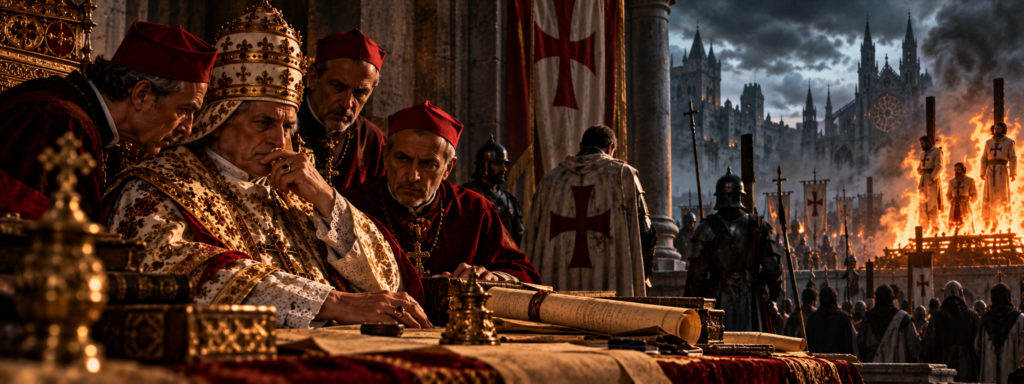
Clement V: The Pope Who Watched the Knights Templar Burn
Clement V — 1305–1314
On the morning of Friday, October 13, 1307, the machinery of the French monarchy moved with terrifying precision. Across France, royal officials opened sealed orders that had been distributed in advance under strict instructions, and soldiers descended upon houses belonging to the Knights Templar. Men who had spent their lives as members of one of Christianity’s most celebrated military religious orders were dragged from their beds, arrested, chained, and accused of crimes so monstrous that they seemed designed to make sympathy impossible. Heresy, blasphemy, denial of Christ, obscene initiation rituals, idolatry, sexual misconduct, and secret worship of a mysterious head were among the charges that suddenly transformed warriors of the Cross into alleged enemies of Christianity.
The arrests had not been ordered by Pope Clement V. They had been ordered by Philip IV of France, the same formidable king whose government had fought Clement’s predecessor Boniface VIII and whose agents had helped seize that pope at Anagni. Philip did not wait for Clement to determine whether the accusations against the Templars were credible, nor did he politely surrender the prisoners when questions of ecclesiastical jurisdiction arose. The king acted first, seized hundreds of men, took control of Templar property, and then placed the pope in the increasingly uncomfortable position of responding to a persecution that was already underway.
Interrogations followed, and torture transformed accusation into confession. Men subjected to physical agony admitted to acts that many later retracted when they were no longer under the immediate control of their interrogators. Others refused to confess despite terrible pressure, while still others repeated versions of the allegations under circumstances that make it extremely difficult to determine precisely what they genuinely believed they had done. The resulting documentary record is enormous, contradictory, disturbing, and permanently contaminated by coercion.
At the center of the gathering storm stood Clement V, a pope whose reputation would become inseparable from the destruction of the Templars. He was not the architect of Philip’s initial assault, and portraying him as simply ordering the French king’s persecution reverses the actual sequence of events. Clement repeatedly attempted to recover control of the proceedings, challenged aspects of royal behavior, arranged papal investigations, and at one crucial moment had leading Templars questioned by his own representatives. Yet when the struggle finally ended, the order had been abolished, its property redistributed, many of its members ruined, and its last grand master burned alive in Paris.
Clement’s role is therefore darker because it is complicated. He was neither an innocent spectator nor the omnipotent mastermind imagined by some later legends. He was a pope trapped between institutional responsibility, political weakness, suspicion that at least some irregular Templar practices might have existed, and relentless pressure from one of Europe’s most powerful kings. His decisions helped determine whether an ancient religious order would survive, and ultimately he chose suppression.
The destruction of the Knights Templar became one of the most haunting episodes of medieval history precisely because no single explanation comfortably contains it. Royal greed mattered, but money alone does not explain everything. Political power mattered, torture mattered, genuine concerns about secret initiation practices may have mattered, and Clement’s inability or unwillingness to confront Philip decisively mattered enormously. By the time the smoke cleared, the Templars had disappeared and the pope who might have saved them had instead issued the decree that ended their existence.
Bertrand de Got Before the Papacy
Clement V was born Bertrand de Got around the middle of the thirteenth century, probably about 1264, into a noble family in Gascony. The region occupied a politically complicated position because Gascony was connected to the English crown while also existing within the broader French feudal world. Bertrand therefore grew up in an environment where competing jurisdictions were not abstract legal problems but ordinary political realities. That background would prove grimly appropriate for a pope whose reign became dominated by conflicts over who possessed the right to judge whom.
Bertrand pursued an ecclesiastical career and received a serious education in canon and civil law. He eventually became bishop of Comminges and then, in 1299, archbishop of Bordeaux. His advancement placed him within the upper ranks of the medieval Church without making him an obvious creature of Philip IV. Bordeaux itself lay within territory associated with the English king, complicating later portrayals of Clement as a French royal puppet from the beginning.
The papacy Bertrand eventually inherited had been badly wounded by the conflict between Boniface VIII and Philip IV. Boniface’s sweeping claims concerning papal authority had collided with a French monarchy increasingly capable of resisting ecclesiastical intervention. The attack at Anagni in 1303 had demonstrated that royal agents could physically seize a pope and survive the consequences. Boniface died shortly afterward, leaving his successors to deal with the wreckage.
Benedict XI succeeded Boniface and attempted to reduce tensions, but his pontificate lasted less than a year. When Benedict died in 1304, the cardinals entered a bitterly divided conclave. French and Italian interests, attitudes toward Boniface, and broader political rivalries made agreement extremely difficult. The vacancy continued for almost eleven months.
Bertrand de Got finally emerged as the compromise candidate and was elected on June 5, 1305. He took the name Clement V and was crowned at Lyon in November. The coronation itself was marred by disaster when a wall or structure collapsed during the procession, killing and injuring several people. Medieval observers naturally interpreted catastrophes surrounding rulers as possible omens, and Clement’s reign would provide later storytellers with more than enough darkness to make the accident seem prophetic.
A Pope Under the Shadow of Philip the Fair
Clement’s relationship with Philip IV has generated centuries of suspicion. Later stories claimed that before his election Bertrand secretly met Philip and agreed to a list of humiliating conditions in exchange for French support. These tales depict Clement as effectively purchasing the papacy by promising to serve the king. The evidence for such a secret bargain is weak, and the dramatic versions should not be treated as established fact.
What is beyond dispute is that Clement faced enormous pressure from Philip after becoming pope. The French king wanted the memory of Boniface VIII condemned and sought vindication for his own conduct during the previous conflict. Philip’s advisers continued advancing accusations that Boniface had been a heretic and criminal. Clement therefore inherited not merely a diplomatic disagreement but a royal campaign aimed at rewriting the moral meaning of the previous pontificate.
Clement tried to navigate between defending papal dignity and avoiding another catastrophic confrontation with France. He made concessions to Philip, including measures affecting Boniface’s actions against the French king and his supporters, while resisting the most extreme demand for a formal condemnation of Boniface as a heretic. The balancing act required patience, ambiguity, and repeated compromise. It also taught Philip that sustained pressure upon Clement could produce results.
The pope remained largely outside Rome throughout his pontificate. Political instability in Italy, Clement’s health, French influence, and the practical circumstances of his court all contributed to this decision. In 1309, he established the papal residence at Avignon, although the territory itself was not then simply part of Philip’s royal domain. The move began the period later known as the Avignon Papacy, during which successive popes remained in the region for most of the fourteenth century.
Calling Clement merely a prisoner of France oversimplifies his position. He retained independent interests and sometimes resisted Philip vigorously. Yet physical proximity to French power and the predominance of Frenchmen among Clement’s cardinal appointments inevitably strengthened perceptions that the papacy had moved into the French political orbit. Those perceptions became particularly damaging when Philip turned his attention toward the Knights Templar.
The king had already demonstrated at Anagni that he was willing to attack a pope when persuasion failed. Clement knew exactly what kind of monarch he was dealing with. That knowledge hung over every stage of the Templar affair.
The Knights of the Temple
The Knights Templar had been founded in the early twelfth century in the aftermath of the First Crusade. Their original purpose centered upon protecting Christian pilgrims and defending the Latin presence in the Holy Land. Over time, they developed into an international religious military order possessing houses, estates, castles, farms, financial networks, and privileges across Europe and the eastern Mediterranean. Their members took religious vows while also participating in warfare.
The Templars became famous for their distinctive white mantles marked by a red cross. Their reputation for military courage grew during the Crusades, even though victories and defeats varied dramatically over the order’s long history. Donations from nobles and monarchs accumulated as supporters gave land, money, and property for religious reasons or in connection with crusading enthusiasm. The order consequently became wealthy in collective resources despite the personal poverty expected of individual brothers.
Their international structure made them unusually useful. Templar houses could receive deposits, transfer funds, manage royal treasure, lend money, and provide financial services across considerable distances. This has sometimes led popular accounts to describe them as medieval bankers in an overly modern sense, but their financial activities were unquestionably sophisticated. Kings, nobles, pilgrims, and churchmen could all make use of their network.
The fall of Acre in 1291 devastated the remaining major Latin Christian presence in the Holy Land. The Templars relocated their headquarters to Cyprus, and the loss of their original territorial mission created uncomfortable questions about the future of the military orders. Proposals circulated for combining the Templars with their great rivals, the Hospitallers, in preparation for renewed crusading efforts. Jacques de Molay, grand master of the Templars, opposed a merger and argued for the continued independence of his order.
By the early fourteenth century, the Templars were therefore powerful but vulnerable. Their military purpose had become less obvious to western Europeans who no longer saw them defending Jerusalem. Their wealth attracted attention, their privileges irritated local authorities, and the secrecy surrounding internal ceremonies encouraged rumors. An institution created to fight for the Holy Land now possessed enemies in a Europe increasingly dominated by strong monarchies.
Philip IV was about to transform those vulnerabilities into a death sentence.
A King Deep in Debt and Hungry for Control
Philip IV’s financial problems were chronic. His wars, administration, diplomacy, and ambitious monarchy required enormous sums of money. During his reign he taxed clergy, manipulated currency, expelled Jews while seizing property, and pursued other extraordinary financial measures. His government had already shown that institutions possessing wealth could become targets when royal necessity and political opportunity aligned.
The Templars had financial connections with the French monarchy, and their Paris Temple was an important financial center. It is tempting to reduce Philip’s entire campaign to a simple desire to erase royal debts and steal Templar treasure. Wealth was almost certainly an important factor, but the surviving evidence does not justify treating greed as the sole explanation. Philip and his advisers also appear to have taken at least some allegations of Templar misconduct seriously, or found it politically useful to behave as though they did.
Rumors concerning the order had circulated before the arrests. A former Templar or other informants provided allegations concerning initiation ceremonies in which recruits supposedly denied Christ, spat upon or near a cross, exchanged improper kisses, or participated in other secret acts. Some testimony later suggested that distorted rituals intended to test obedience or prepare members for capture by Muslims may have existed in parts of the order. Whether such practices were widespread, officially sanctioned, locally improvised, misunderstood, or largely constructed under interrogation remains intensely debated.
Philip did not wait for a normal ecclesiastical investigation to resolve those questions. His government prepared a coordinated operation in secrecy. Orders were distributed throughout France instructing officials to open them simultaneously on a predetermined date. The planning alone demonstrates that the attack was a royal initiative rather than a papal prosecution merely carried out by secular authorities.
On October 13, 1307, the trap closed. Jacques de Molay and large numbers of Templars were arrested. Their houses and property were seized into royal custody, and the accusations were publicly framed in language designed to produce horror.
Clement was reportedly furious at the violation of ecclesiastical jurisdiction. The Templars were a religious order answerable ultimately to the pope, not an organization Philip possessed unquestioned authority to abolish. Yet by the time Clement could respond, the king controlled the prisoners. That fact would shape everything that followed.
Friday the Thirteenth
The date October 13, 1307, has become one of the most famous dates associated with the Templars. Modern popular culture frequently claims that the superstition surrounding Friday the thirteenth originated directly from the arrests. There is no convincing historical evidence for such a simple origin, and the association appears to be much later. The real events of that Friday require no supernatural embellishment.
Royal officials moved against Templar establishments across France with remarkable coordination. The arrests deprived the order of the ability to organize an immediate collective defense. Documents, property, money, horses, weapons, and other assets fell under royal control. The government had transformed accusation into physical domination before an ecclesiastical court had determined guilt.
Jacques de Molay was among those captured in Paris. Only the previous day he had participated publicly in the funeral ceremonies of Catherine of Courtenay, a royal relative, an indication that the Templars had not been openly treated as enemies immediately before the arrests. The sudden reversal must have been extraordinary. Men accustomed to religious prestige found themselves accused of secretly betraying the faith they publicly claimed to defend.
The charges were carefully chosen for maximum destructive power. Denial of Christ attacked the very foundation of Templar identity, while accusations of spitting upon the cross transformed crusading knights into blasphemers. Charges of obscene kisses, homosexual acts, and idol worship added sexual and supernatural horror. The mysterious alleged head sometimes called Baphomet would later become one of the most distorted elements of Templar mythology.
Modern images of Templars secretly practicing an organized alternative religion, worshipping demons, or possessing forbidden occult knowledge owe far more to later imagination than to secure medieval evidence. The trial records contain accusations of strange objects and heads, but they do not establish the elaborate occult system invented by later writers. Torture, leading questions, rumor, and repeated accusation make the evidentiary record exceptionally difficult to interpret. The safest conclusion is that some unusual initiation practices may have existed, while the sweeping portrait of the order as a secret heretical cult remains unsupported.
Philip’s officials were not interested in waiting for historians to reach cautious conclusions. They needed confessions. Torture helped provide them.
Confessions in the Torture Chamber
Medieval judicial torture was designed to produce information or confession under legal procedures that varied by jurisdiction. In practice, it created an obvious and devastating problem: people experiencing unbearable pain have powerful reasons to say whatever interrogators want to hear. The Templar trials provide one of history’s clearest demonstrations of this problem. Confessions multiplied in places where torture was aggressively used and often became less impressive where prisoners were questioned under different conditions.
French interrogators employed methods capable of inflicting extreme suffering. Prisoners could be stretched, suspended, shackled, deprived, threatened, or subjected to fire and other forms of physical coercion. The precise experience varied among prisoners, and not every confession was necessarily obtained through direct torture. Yet coercion permeated the atmosphere even for men who had not yet been physically tortured because they knew what refusal might bring.
Many Templars confessed to at least some charges. Jacques de Molay initially admitted that during his reception into the order he had been instructed to deny Christ and spit near a cross, although accounts and wording varied. Other brothers made similar admissions. Philip immediately possessed the propaganda victory he needed.
Confession under torture did not end the problem for the king because ecclesiastical authorities still had to evaluate the case. Some Templars later retracted their statements, explaining that fear or torture had caused them to confess falsely. Retraction was dangerous because medieval law could treat a relapsed heretic with extreme severity. A prisoner could therefore become trapped between maintaining a coerced confession and risking death by withdrawing it.
The torture records make certainty difficult even when multiple witnesses describe similar practices. Interrogators often asked standardized questions based upon a predetermined list of accusations. Prisoners housed together or exposed to public allegations could know what others had said. Similarity among confessions can therefore indicate a shared practice, a shared interrogation script, or some combination of both.
Clement understood at least part of this evidentiary problem. He was not prepared simply to accept everything Philip’s officials produced. The pope began trying to pull the case back under ecclesiastical control. For the Templars, that offered a brief possibility that the outcome had not yet been decided.
Clement Pushes Back
Clement’s first responses demonstrate why portraying him as Philip’s obedient partner from the beginning is inaccurate. The king had arrested members of a papally protected religious order without proper papal authorization. Clement protested the violation of ecclesiastical jurisdiction and objected to the unilateral royal action. He had good reason to fear the precedent created if kings could simply arrest entire religious orders whenever they claimed heresy.
The pope eventually ordered a broader investigation, but this should not be confused with endorsement of every French procedure. Once accusations of heresy had become public and numerous confessions existed, Clement could not simply order everyone released without examining the allegations. Doing so would expose him to charges that the papacy was protecting heretics. Philip had created a situation in which investigation itself became almost unavoidable.
Clement therefore attempted to place proceedings under ecclesiastical authority. He temporarily suspended aspects of the inquisitorial process when he became dissatisfied with royal interference. Papal commissioners and bishops would eventually be assigned different responsibilities for investigating the order as an institution and individual members. The legal complexity of the process reflected the pope’s effort to regain jurisdiction over a case Philip had already seized politically.
Philip responded with pressure rather than obedience. His government mobilized public opinion, clergy, theologians, and political assemblies to support the prosecution. The king’s advisers portrayed delay as dangerous leniency toward heresy. Clement risked appearing to protect enemies of the faith if he resisted too openly.
This was a tactic Philip’s government understood extremely well. During the struggle with Boniface VIII, royal propagandists had converted political resistance into allegations of heresy and moral corruption. The same basic mechanism could now be directed against the Templars. Once an opponent had been labeled an enemy of Christianity, anyone defending legal procedure could be accused of defending evil.
Clement was therefore playing a dangerous game. He wanted control of the prosecution without appearing hostile to the prosecution itself. Philip controlled the prisoners, much of the evidence, and the political atmosphere in France. The pope possessed legal authority, but the king possessed bodies in chains.
Chinon: The Document That Complicated the Legend
One of the most important episodes in the Templar affair occurred at Chinon in August 1308. Several leading members of the order, including Jacques de Molay, were being held there. Clement intended to examine the Templar leadership, but illness or practical circumstances prevented him from personally conducting the interrogation. He sent three cardinals as his representatives.
The cardinals questioned the leaders and received confessions concerning improper initiation practices. The surviving record indicates that the Templars sought reconciliation with the Church and received absolution from excommunication after expressing repentance. This document, often called the Chinon Parchment in modern discussion, became especially famous after renewed scholarly attention to it. It demonstrates that Clement did not simply regard the senior Templars as irredeemable convicted heretics at that stage.
The meaning of Chinon must nevertheless be handled carefully. Papal absolution did not amount to a declaration that the entire order was innocent of every accusation. The Templar leaders admitted conduct that church authorities regarded as sinful or improper, and the wider investigation continued. Clement’s willingness to reconcile them indicates something more nuanced than either complete exoneration or unquestioned guilt.
The episode also exposes the difference between the papal and royal approaches. Philip wanted the Templars’ alleged crimes to justify decisive destruction. Clement still appeared interested in determining whether misconduct could be corrected within ecclesiastical structures. The order’s fate was therefore not yet completely sealed in 1308.
This makes Clement’s later suppression of the Templars more significant. He possessed evidence complicated enough to prevent a simple declaration that the order had been conclusively proven heretical. He knew confessions had been produced under coercive circumstances, and he knew leading Templars had been reconciled to the Church. Nevertheless, political pressure continued building.
Chinon destroys the easy caricature of Clement as a pope who believed every royal accusation and eagerly demanded Templar blood. It does not transform him into their savior. Instead, it reveals a pope who understood that the case was murkier than Philip wanted it to appear and who still ultimately allowed the order to disappear.
The Trials Spread Across Europe
Clement ordered investigations of the Templars beyond France. This mattered because the order was international, and accusations supposedly describing its fundamental religious practices should have appeared consistently across different territories. The results were far less uniform than Philip’s prosecution suggested. In several regions, authorities found little evidence supporting the most extreme charges.
Proceedings occurred in England, the Iberian kingdoms, Italy, Cyprus, and elsewhere. Local rulers and church officials varied enormously in their enthusiasm for prosecution. Some Templars confessed to irregular practices, while others denied the allegations. Torture was used differently from place to place, affecting the character of the resulting testimony.
The international evidence weakened the idea that the entire order operated as a coherent secret heretical religion. If every Templar initiation systematically involved denial of Christ and idol worship, investigators might have expected overwhelming consistency across Europe. Instead, the evidence was fragmented. This does not prove that no abuses existed, but it makes the sweeping French narrative difficult to sustain.
Clement could see these discrepancies. He also faced the political reality that the French prosecution had become far more than a criminal investigation. Philip’s prestige was invested in proving the Templars guilty. A complete papal exoneration would effectively accuse the king of having imprisoned, tortured, defamed, and dispossessed innocent religious men on a massive scale.
Such a conclusion could reopen the wider struggle between monarchy and papacy that had nearly destroyed Boniface VIII. Clement had spent his pontificate trying to prevent another Anagni. The Templars therefore became entangled with the pope’s need to preserve a workable relationship with France. Justice for the order was competing with the political survival of papal authority.
The contradiction grew increasingly severe. The more uncertain the evidence became, the harder outright condemnation was to justify. The more politically entrenched Philip became, the harder acquittal was to imagine. Clement searched for a solution between those extremes.
That solution would eventually be suppression without a definitive judicial conviction of the order for heresy. Legally, it was subtle. For the Templars, the practical result was annihilation.
The Templars Attempt to Defend Themselves
By 1309 and 1310, proceedings in France entered a new phase. Templars were given opportunities to defend their order before a papal commission. Hundreds expressed willingness to do so. Their emergence as organized defenders threatened the narrative Philip’s government had spent years constructing.
The defense argued that coerced confessions could not establish the guilt of the entire order. Templars challenged the accusations and sought to demonstrate their orthodoxy. Some men who had previously confessed withdrew or modified their statements. The possibility of an actual adversarial process began changing the atmosphere.
This development created a serious problem for royal authorities. If the defense succeeded in exposing torture and contradictions, Philip’s entire prosecution could unravel. Men previously presented as confessed heretics were now publicly claiming that coercion had produced false statements. The king needed to prevent the process from escaping his control.
The decisive intervention came through Philippe de Marigny, archbishop of Sens and brother of one of Philip’s most powerful ministers, Enguerrand de Marigny. A provincial council under the archbishop’s authority considered the cases of individual Templars who had previously confessed and later returned to defending the order. Under medieval heresy law, such men could be classified as relapsed heretics. The consequences were lethal.
On May 12, 1310, fifty-four Templars were burned outside Paris. Other executions followed. The men were not burned because the papal commission had completed a fair investigation proving the entire order heretical. They were executed through a separate jurisdictional process that devastated the defense at precisely the moment it was becoming organized.
The psychological effect was obvious. A Templar considering retracting an earlier confession now knew exactly what could happen. Defending the order could lead to the stake. The legal process continued, but the smell of burning bodies had entered the courtroom.
Fifty-Four Fires Outside Paris
The mass execution of May 1310 is one of the darkest moments in the entire Templar affair. Fifty-four men were taken out and burned as relapsed heretics because they had returned to defending their order after earlier confessions. Medieval execution by burning was deliberately public, physically horrifying, and spiritually charged. It destroyed the body while presenting the condemned as a threat to Christian society.
Clement did not personally order these executions. The distinction matters because responsibility should not be transferred from the authorities who made the immediate decision simply because Clement was pope. The executions occurred within a French ecclesiastical and political environment heavily influenced by royal interests. Yet Clement’s inability to protect men participating in a papally authorized defense process revealed the weakness of his control.
The timing was devastating. The Templars had begun assembling a serious defense when the executions demonstrated that retracting confession could mean death. The number of men willing to continue defending the order diminished. Fear accomplished what argument had not.
Some contemporaries recognized the procedural problem. The burning of defenders while the broader case remained unresolved could hardly create confidence in the fairness of the investigation. Yet Philip’s political position remained formidable. Clement did not break with him over the executions.
This moment is central to evaluating the pope. Clement had not initiated the original arrests, had challenged royal procedure, and had attempted to establish independent investigations. Nevertheless, his legal authority proved unable to prevent royal-aligned institutions from terrorizing defendants whose testimony might have altered the outcome. Papal caution was losing against royal determination.
The fires outside Paris therefore illuminate the difference between formal authority and practical power. Clement remained supreme head of the Church in theory. Philip’s political network could still create facts on the ground faster than the pope could reverse them. Fifty-four dead Templars were among those facts.
The Council of Vienne
Clement eventually summoned a general church council to meet at Vienne in southeastern France. The council opened in October 1311 and considered several major issues, including plans for a new crusade, church reform, and the fate of the Templars. Bishops and other ecclesiastical leaders arrived with access to evidence gathered during years of investigation. The question before them was enormous: should an international religious order be condemned and abolished?
The evidence did not produce the unanimous result Philip desired. A substantial number of council fathers reportedly believed the Templars should be allowed a proper defense before any definitive condemnation. This was a serious obstacle because the king wanted suppression, not an extended trial capable of producing acquittal or endless legal dispute. Clement again found himself between judicial uncertainty and political pressure.
Philip increased that pressure dramatically. In March 1312, he traveled toward Vienne accompanied by a formidable entourage. The physical presence of the French king and his forces near a church council debating the fate of his prisoners could hardly be politically neutral. Clement knew that continued resistance might provoke another confrontation.
The pope ultimately chose not to condemn the Templar Order through a final judicial finding of proven heresy. Instead, he suppressed it by apostolic provision. This distinction is crucial. Clement’s bull Vox in excelso, issued in 1312, dissolved the order because the scandal, suspicion, and circumstances had made its continuation effectively impossible, rather than declaring that the charges had been conclusively proven against the institution through ordinary judicial process.
Legally, this allowed Clement to avoid affirming the strongest version of Philip’s case. Politically, it gave Philip the outcome he wanted. The Knights Templar ceased to exist as a recognized religious order.
For the men who had spent years imprisoned, the subtle distinction offered little comfort. Their institution had been destroyed. The pope had found a legal formula that avoided declaring them collectively guilty while ensuring they would never collectively exist again.
Vox in Excelso: Death Without Conviction
The suppression of the Templars remains one of Clement V’s most consequential decisions. Vox in excelso acknowledged the scandal surrounding the order, the confessions, suspicions, and enormous controversy that had accumulated. Clement did not claim that a judicial sentence had established the order’s guilt beyond dispute. He instead used papal authority to suppress it provisionally and administratively for the perceived good of the Church.
This distinction has sometimes been interpreted as evidence that Clement knew the Templars were innocent. That goes too far. He clearly regarded at least some testimony concerning irregular practices as credible enough to require serious action. His own representatives had heard admissions from senior Templars at Chinon, even though those men had later been reconciled to the Church.
The more defensible conclusion is that Clement did not believe the evidence allowed the simple institutional conviction Philip wanted. The pope faced a mixture of confessions, retractions, torture, contradictory international testimony, scandal, and political pressure. Rather than complete the uncertain judicial process, he eliminated the institution around which the controversy revolved. It was a political solution expressed through ecclesiastical law.
The decision protected Clement from several dangers at once. He did not have to declare Philip’s entire prosecution fraudulent, which might have provoked a catastrophic conflict with France. He did not have to issue an unqualified judgment that the Templars as an order were proven heretics, which the evidence made difficult. He could claim to be acting for the peace and reputation of the Church.
The people who paid for that compromise were the Templars. Their collective identity disappeared despite the absence of a definitive institutional conviction for heresy. Individual members could be assigned penances, absorbed elsewhere, imprisoned, pensioned, or otherwise handled according to local judgments. The order itself was finished.
Clement had found the middle path. It led directly through the ruins of the Temple.
Who Got the Templar Wealth?
The fate of Templar property has inspired almost as many legends as the trials themselves. Popular stories often imagine Philip IV immediately seizing a fabulous hidden treasure and solving his financial problems with mountains of Templar gold. The reality was considerably more complicated. Templar wealth consisted heavily of land, buildings, agricultural rights, rents, equipment, and institutional assets rather than an enormous portable hoard waiting in a vault.
Clement’s policy was that much of the former Templar property should pass to the Knights Hospitaller, another military religious order. The bull Ad providam established the general transfer, although implementation varied and was complicated by local rulers, expenses, claims, and resistance. In some regions, property eventually went to newly created military orders rather than directly to the Hospitallers. The distribution process could continue for years.
Philip nevertheless benefited financially from the prosecution. Royal authorities had controlled Templar assets during the proceedings and claimed substantial expenses for maintaining prisoners and administering seized property. Debts and financial relationships were affected, while the monarchy extracted advantages from the process. It would therefore be equally misleading to claim that money played no role.
The image of Philip discovering a secret Templar treasure remains unsupported. Legends later claimed that ships escaped from La Rochelle carrying gold or sacred relics, sometimes linking the fugitives to Scotland, Switzerland, America, Freemasonry, or other destinations. These stories belong largely to later mythmaking. No reliable evidence demonstrates the escape of a vast hidden Templar fortune.
The real financial story is less romantic and more revealing. A wealthy international institution was placed under arrest, its property administration disrupted, and its assets subjected to years of competing claims. Royal and ecclesiastical authorities fought over control while individual Templars lost the institutional structure that had sustained them. Wealth did not need to disappear into a mysterious ship to become part of the tragedy.
For Clement, transferring assets to the Hospitallers offered a way to preserve the religious purpose for which much of the property had originally been donated. It also demonstrated that suppression was not officially supposed to become simple royal confiscation. Yet the years of seizure and administration had already ensured that the process could never be financially clean.
Jacques de Molay Waits
Jacques de Molay had become grand master of the Knights Templar around 1292, after the loss of Acre had forced the order to reconsider its future. He spent years attempting to organize support for renewed crusading efforts and defending the continued independence of the Templars. When Clement summoned him west to discuss crusading plans and the possible merger of the military orders, de Molay could not have known that he was approaching the destruction of everything he represented. By October 1307, he was a prisoner.
His conduct during the proceedings was inconsistent, which is hardly surprising given the circumstances. He made admissions, withdrew or challenged aspects of them, appealed to papal authority, and struggled to defend himself while moving through years of confinement. Later legend transformed him into a perfectly steadfast martyr who never wavered. The historical man was more human and more vulnerable.
Clement did not personally sentence de Molay to death. The pope reserved judgment concerning the leading Templar dignitaries, and a commission of cardinals eventually considered their cases. In March 1314, de Molay and several other senior Templars were brought publicly before authorities in Paris. They were sentenced to perpetual imprisonment rather than execution.
What happened next changed everything. Jacques de Molay and Geoffroi de Charney, preceptor of Normandy, publicly repudiated the confessions or judgments upon which their punishment rested and asserted the innocence of the order. By retracting previous confessions, they exposed themselves to classification as relapsed heretics. Under the legal framework of the time, that could mean death.
Philip did not wait for a lengthy new papal deliberation. That same day, the king ordered de Molay and de Charney burned on an island in the Seine. The last grand master of the Templars went to the fire not because Clement had personally condemned him to burn but because royal authority acted swiftly once his public retraction changed his legal status. The distinction matters, although it does little to brighten the final scene.
Clement had suppressed the institution two years earlier. Now the most famous man associated with it was consumed by flames. The destruction of the Templars had reached its unforgettable conclusion.
The Burning of the Grand Master
The execution of Jacques de Molay in March 1314 became one of the defining images of medieval persecution. Later chroniclers described him facing death with remarkable courage, asking to be positioned so that he could look toward Notre-Dame and pray. Some details may preserve authentic memory, while others were shaped by the natural tendency to turn dramatic executions into moral theater. No invented final speech is necessary to understand the horror of the event.
Burning alive was a punishment designed to terrify spectators as well as destroy the condemned. Fire carried religious symbolism associated with purification and punishment, while the absence of an intact burial could intensify the disgrace imposed upon a convicted heretic. Crowds watching de Molay’s execution were witnessing the final humiliation of a man who had once led one of Christendom’s most prestigious military orders. The distance between grand master and condemned prisoner could hardly have been greater.
Later legend claimed that de Molay summoned Clement V and Philip IV to appear before God’s judgment within a year. The story became famous because both men did, in fact, die before the end of 1314. Clement died in April, only weeks after de Molay, while Philip died in November. The coincidence was almost irresistible to storytellers.
There is no reliable contemporary evidence establishing the famous curse in the elaborate form later tradition gave it. Medieval and later writers naturally interpreted the rapid deaths as divine retribution. The destruction of the Templars already seemed morally charged, and the deaths of their two most powerful opponents offered a perfect supernatural ending. Legend supplied the words history had not securely recorded.
The curse became even more elaborate over time. Some versions extended it to Philip’s descendants, connecting the troubled succession of the Capetian monarchy with Templar vengeance. Others folded the story into occult traditions, secret societies, and supposed Templar survival. Historical evidence does not support these expansions.
The real sequence remains striking without supernatural intervention. De Molay burned in March 1314. Clement V was dead the following month. Philip IV followed before the year was over.
Clement’s Final Weeks
Clement’s health had never been particularly robust, and illness troubled him throughout his pontificate. By 1314, he was seriously unwell. After leaving the region around Avignon, he traveled toward his native Gascony but did not complete the journey. He died at Roquemaure on April 20, 1314.
His death came so soon after Jacques de Molay’s execution that later writers inevitably connected the two events. Stories of divine vengeance flourished, especially once Philip died later that year. Some legends claimed that Clement suffered horribly as the Templar curse took effect. Such narratives belong to the moral mythology surrounding the order rather than reliable medical history.
Clement’s body was eventually buried at Uzeste, where his tomb became his principal memorial. His death was followed by another prolonged papal vacancy, demonstrating how politically fractured the College of Cardinals remained. John XXII was not elected until 1316. The Avignon papacy continued.
Clement left behind a mixed administrative legacy extending far beyond the Templar affair. The Council of Vienne addressed questions involving religious orders, church discipline, crusading, education, and theology. Clement also promoted the study of eastern languages in certain major centers of learning as part of wider missionary and intellectual goals. His pontificate cannot historically be reduced to one prosecution.
Yet the Templars overwhelmed almost everything else in his memory. The image of white mantles disappearing into prisons and flames was more powerful than administrative legislation. Clement became the pope under whom the Temple fell.
His death prevented him from controlling the story that followed. Philip’s enemies, defenders of the Templars, critics of the Avignon papacy, occult writers, novelists, and conspiracy theorists would all create different versions of Clement. Few were interested in the uncomfortable middle ground where the historical pope actually stood.
Was Clement V Philip’s Puppet?
Calling Clement a puppet is appealing because it makes the Templar story simple. Philip wanted the order destroyed, Clement obeyed, and the Templars died. The historical record does not support such a completely passive pope. Clement resisted Philip often enough to demonstrate that he possessed independent judgment.
He objected to the original royal arrests and attempted to restore ecclesiastical jurisdiction. He suspended proceedings when royal interference became excessive, sent his own representatives to question Templar leaders, and received information that complicated Philip’s accusations. At Vienne, he did not simply pronounce the order judicially convicted of heresy. These actions mattered.
Yet independence should not be confused with effectiveness. Clement repeatedly yielded when resistance became politically dangerous. Philip created pressure through assemblies, legal arguments, public accusations, physical control of prisoners, and the implied possibility of renewed conflict with the papacy. Clement’s room for maneuver narrowed because the king constantly created new facts that the pope then had to manage.
The relationship therefore resembles coercive negotiation more than simple obedience. Clement could resist details while Philip controlled the overall direction of events. The pope could insist upon proper procedure, but the king possessed the prisoners. Clement could refuse to declare the entire order conclusively heretical, but Philip could make its continued existence politically intolerable.
The result satisfied Philip far more than it satisfied the Templars. Their order disappeared, its leaders remained imprisoned, and its reputation was destroyed. Clement preserved legal distinctions and some degree of papal jurisdiction. The men whose lives depended upon those distinctions received much less.
A puppet would bear little moral responsibility because a puppet has no meaningful choice. Clement did possess choices, even if every choice carried danger. His tragedy lies partly in how he used them.
Could Clement Have Saved the Templars?
This question has haunted assessments of Clement for centuries. As pope, he possessed supreme authority over the Templars as a religious order. In theory, he could have declared Philip’s unilateral arrests illegitimate, demanded the release of prisoners, condemned the use of torture, and insisted upon an independent ecclesiastical trial. The question is what would have happened next.
Philip had already demonstrated his willingness to defy a pope. His agents had participated in the attack on Boniface VIII, and his government had spent years attempting to brand that pope a heretic. A direct confrontation over the Templars might therefore have triggered another major rupture between France and Rome. Clement had reason to fear that papal commands unsupported by military power might simply be ignored.
The pope also could not know with certainty that every allegation was fabricated. Some Templars admitted to irregular initiation practices even outside the most obvious moments of torture. Clement’s representatives at Chinon heard admissions from senior leaders. A responsible church authority could not simply pretend these statements did not exist.
What Clement could have done more forcefully was defend procedural fairness. The use of torture, royal control of prisoners, execution of men attempting to defend the order, and political pressure surrounding Vienne all compromised the investigation. Clement recognized some of these problems but failed to stop them. His compromises allowed coercion to shape the evidence upon which further decisions depended.
Saving the Templars would therefore have required more than issuing a document. Clement would have needed to confront Philip politically, protect defendants physically, and risk a renewed crisis between papacy and monarchy. He chose not to take that risk.
Whether that decision was prudent or cowardly depends partly upon how one evaluates the realistic power available to him. What cannot be denied is the consequence. The order Clement had authority to protect ceased to exist during his pontificate.
Torture and the Manufacture of Certainty
The Templar affair demonstrates one of the most dangerous characteristics of judicial torture: it can manufacture the appearance of certainty. Investigators begin with an accusation, torture produces confession, and confession is then treated as confirmation that the original accusation was correct. Once enough prisoners confess, the accumulation of statements creates the impression of overwhelming evidence. The fact that the method itself encourages false confession becomes almost invisible.
This does not mean every Templar confession was false. Some initiation practices described by multiple witnesses may reflect genuine customs that had developed within portions of the order. Certain brothers may indeed have been instructed to perform symbolic acts involving denial or spitting as part of bizarre tests of obedience. Historians continue debating the evidence because the records are too complicated for absolute conclusions.
What torture destroys is confidence. A statement produced after a man has been suspended, burned, stretched, threatened, or shown what awaits him cannot be evaluated like voluntary testimony. Even a true confession becomes difficult to distinguish from a false one. Coercion poisons the evidentiary well.
Clement’s proceedings existed within this contaminated environment. The pope could order new examinations, but prisoners remembered what had happened to them. They knew fifty-four defenders had been burned. Fear did not disappear simply because a cardinal entered the room instead of a royal interrogator.
The tragedy therefore extends beyond the possibility that innocent men confessed falsely. The process made reliable truth increasingly difficult to recover. By the time Clement needed to decide the order’s fate, years of coercion had buried whatever actually happened during Templar initiations beneath mountains of compromised testimony.
Philip could live with that uncertainty because he wanted destruction. Clement should have been more troubled by it because he was supposed to judge. His ultimate decision avoided a judicial declaration of collective guilt, but it did not undo the consequences of the corrupted process.
The Heresy That May Not Have Been Heresy
One of the most intriguing possibilities raised by the trial records is that some Templar initiation ceremonies may genuinely have contained irregular acts without representing an organized heretical theology. Recruits sometimes described being told to deny Christ or spit near a cross, but explanations varied. Some claimed the acts were tests, jokes, traditions, or preparations for what a knight might be forced to do if captured by Muslim enemies. These explanations cannot be verified universally, but they demonstrate that ritual misconduct and theological heresy are not necessarily identical.
The distinction mattered enormously. A secret initiation practice could be improper, scandalous, and worthy of reform without proving that the entire order had abandoned Christianity. Templars attended Mass, supported churches, venerated relics, fought in crusading campaigns, and lived within a deeply Christian institutional culture. The claim that this entire public identity concealed a coherent anti-Christian religion requires strong evidence.
The alleged idol or mysterious head presents similar problems. Trial records contain references to heads of varying descriptions, but no single consistent object emerges convincingly as the universal god of the order. Later imagination transformed these scattered allegations into Baphomet, an occult figure with a cultural afterlife vastly exceeding the medieval evidence. The famous goat-headed Baphomet image belongs to the nineteenth century, not to the documented religious world of the medieval Templars.
Charges of systematic homosexual activity were likewise useful within the prosecution because they added moral horror to accusations of heresy. Templar communities consisted of celibate men living together, making sexual allegations easy to weaponize. Individual violations of chastity may certainly have occurred, as they did within other religious institutions. That is very different from proving that homosexual acts formed an official component of Templar ritual.
The prosecution repeatedly blurred these distinctions. Individual misconduct could become institutional doctrine, local custom could become universal practice, and coerced confession could become evidence of conspiracy. Philip benefited from the broadest possible interpretation. Clement never completely accepted it.
Yet the pope ultimately decided that the accumulation of scandal itself had become fatal. The distinction between proven heresy and unbearable suspicion allowed him to suppress the order without resolving every allegation. It was legally convenient and historically devastating.
Clement, Nepotism, and the Wealth of the Papal Court
The Templars were not the only source of controversy surrounding Clement V. Like many medieval and later popes, Clement promoted relatives and filled important positions with men connected to his family and regional networks. His cardinal appointments heavily favored Frenchmen, reinforcing the impression that the papacy was becoming increasingly French. Critics saw this as another sign that the universal Church had been captured by local interests.
Nepotism in Clement’s pontificate must be understood within the same political culture that shaped Nicholas III and Boniface VIII. Popes needed trusted administrators, and relatives offered loyalty in a world of unstable alliances. Yet repeated family advancement inevitably created conflicts between institutional and private interests. Clement was not immune to that temptation.
His court also attracted criticism for financial practices and the distribution of benefices. Medieval papal administration required substantial revenue, while the growing complexity of church government created countless opportunities for fees, reservations, appointments, and patronage. Critics could easily interpret the system as commercialization of spiritual office. Some accusations were polemical, but concerns about ecclesiastical wealth were real.
These controversies contributed to the darker reputation of the Avignon papacy. Later critics would portray the period as one of luxury, corruption, French domination, and spiritual decline. That sweeping judgment is too simplistic because the Avignon popes were also capable administrators who developed important institutions. Clement nevertheless helped create the conditions from which the negative image emerged.
The contrast with the Templars is striking. The order was destroyed partly amid accusations concerning wealth, secrecy, and corruption while the papal and royal institutions judging it possessed enormous material interests of their own. Templar property became a subject of negotiation almost immediately. Spiritual judgment unfolded alongside financial calculation.
That does not prove the charges were fabricated solely to steal property. It demonstrates why financial motives cannot be removed from the story. Too many powerful institutions stood to gain or lose too much wealth for money to remain irrelevant.
The Avignon Question
Clement V is often described as the pope who moved the papacy to Avignon. The statement is broadly understandable but can create misleading impressions if imagined as a single dramatic decision to abandon Rome permanently. Clement’s court moved through several locations, and the establishment at Avignon developed within a complicated political environment. He did not necessarily intend to create a papal residence that would last for nearly seven decades.
Rome and central Italy were politically unstable. Rival aristocratic families and factional violence made papal government difficult, while Clement’s health and French connections encouraged him to remain north of the Alps and eventually near Avignon. The city offered practical advantages. Its proximity to the Comtat Venaissin, which was papal territory, made the region particularly useful.
Avignon itself at the beginning of Clement’s residence was associated with the Angevin rulers of Naples through the county of Provence rather than being simply a possession of Philip IV. This distinction matters because descriptions of Clement moving directly into the French king’s territory exaggerate royal control. The papacy retained institutional independence. Political influence and legal ownership were not the same thing.
Nevertheless, geography mattered. A pope residing close to France inevitably interacted more heavily with French political networks than one governing from Rome. Clement’s College of Cardinals became increasingly French, and the Templar proceedings unfolded within a world where Philip could apply pressure more easily. The appearance of dependence became almost as damaging as dependence itself.
The Avignon residence also contributed to the long-term transformation of papal administration. The papal court became more centralized, bureaucratic, and financially organized during the fourteenth century. These developments cannot simply be dismissed as corruption. Yet critics increasingly associated administrative sophistication with money and worldly power.
Clement therefore stands at the beginning of another controversial chapter in papal history. The pope who failed to save the Templars also became associated with the papacy’s departure from Rome. Both developments strengthened the image of a Church retreating before French royal power.
The Trial of Boniface VIII’s Memory
While the Templars languished in prison, Clement was simultaneously dealing with Philip’s campaign against the memory of Boniface VIII. The king wanted his previous enemy formally condemned, partly because such a judgment would vindicate French actions at Anagni. Clement could not easily allow a secular monarch to dictate that a deceased pope be declared a heretic. Doing so would damage the institution he himself now led.
The resulting negotiations dragged on through much of Clement’s pontificate. Testimony against Boniface included lurid accusations of heresy, sexual misconduct, blasphemy, and other crimes. Many claims emerged from deeply hostile political circumstances. Clement had to manage them without provoking Philip or sacrificing papal dignity.
The parallels with the Templar prosecution are revealing. In both cases, Philip’s government used accusations of religious deviance against an institutional enemy. In both cases, legal procedure became inseparable from political pressure. In both cases, Clement attempted to moderate the king without confronting him so decisively that cooperation became impossible.
Clement ultimately avoided formally condemning Boniface as the monster Philip’s propaganda described. The result demonstrated that the pope could resist the king when institutional papal legitimacy was directly at stake. Yet the prolonged process also consumed political energy and forced Clement into repeated negotiation. Philip learned that persistence worked.
The Templars lacked the institutional protection enjoyed by a deceased pope whose condemnation might threaten the legitimacy of the papacy itself. Clement could defend Boniface’s office even if he disliked aspects of Boniface’s conduct. Defending the Templars carried fewer institutional advantages and greater political risks. Their survival became negotiable.
This comparison makes Clement’s choices uncomfortable. He knew Philip’s methods. He had watched the king use religious accusations against another pope. When similar methods were directed against the Templars, Clement challenged them but did not stop them.
The Wickedness of Compromise
Clement V does not fit comfortably beside popes remembered for spectacular personal cruelty. There is no need to portray him as delighting in torture chambers or personally demanding that Templars burn. His darkness lies somewhere less theatrical. It lies in compromise under pressure.
Political leaders frequently inherit situations they did not create. Clement did not order the dawn raids of October 1307, did not design the original French torture program, and did not invent the charges against the order. Philip forced the crisis upon him. The pope’s responsibility begins with what he did after the crisis existed.
At several stages, Clement resisted. Those moments matter because they prove he understood that Philip’s conduct could not simply be accepted without question. He objected to jurisdictional violations, sought independent investigations, and preserved legal distinctions that prevented the entire order from being straightforwardly convicted as heretical. He was not blind.
Yet every resistance eventually encountered a limit. Clement did not force the release of the prisoners, did not prevent the burning of Templar defenders, did not insist upon a fully independent process before suppressing the order, and did not preserve the institution once Philip made its survival politically intolerable. He repeatedly chose accommodation over rupture. Each choice may have appeared defensible individually.
Taken together, they produced catastrophe for the Templars. This is what makes Clement an unusually compelling Wicked Pope. He illustrates how devastating outcomes can emerge not from one monstrous command but from a chain of cautious decisions made by a leader who continually tells himself that the alternative might be worse.
The machinery of persecution did not require Clement to love it. It required him to stop short of breaking it. He did.
Philip IV: The King Behind the Destruction
Any account focusing upon Clement must avoid allowing Philip IV to disappear behind the pope. The French king was the primary driving force behind the initial prosecution. His officials planned the arrests, seized the Templars, conducted interrogations, employed torture, controlled property, and created political pressure designed to force ecclesiastical acceptance of the campaign. Without Philip, there is little reason to believe the order would have been destroyed in 1312.
Philip was an extraordinarily formidable ruler. His government included skilled lawyers capable of turning political conflicts into elaborate legal cases. Guillaume de Nogaret, who had participated in the assault upon Boniface VIII, again played an important role in royal policy. The monarchy understood the power of documentation, accusation, assembly, and public justification.
The Templar affair therefore formed part of a broader pattern. Philip confronted Boniface with charges of criminality and heresy, attacked the Templars through a similar vocabulary, and repeatedly asserted royal authority against institutions possessing independent privileges. He was building a monarchy less willing to tolerate competing jurisdictions. The Templars’ international character made them particularly vulnerable to such a ruler.
Financial motives intensified the attraction. Philip’s government desperately needed resources and had already pursued aggressive financial measures against other groups. Templar wealth and financial infrastructure were impossible to ignore. Even if genuine religious suspicions existed, material advantage accompanied prosecution from the beginning.
The king’s behavior after arrests further demonstrates that he wanted control of the outcome. When Clement attempted to assert jurisdiction, Philip applied pressure. When Templars organized a defense, royal-aligned authorities created lethal consequences for recanting earlier confessions. When the Council of Vienne hesitated, Philip approached with political and military weight behind him.
Clement may have signed the document suppressing the order, but Philip built the road leading to the signature. The moral responsibility of the pope should never become an excuse to minimize the king’s. The destruction of the Temple required both royal aggression and papal capitulation.
The Curse That Would Not Die
The deaths of Jacques de Molay, Clement V, and Philip IV within the same year created the perfect environment for legend. Medieval people were deeply accustomed to interpreting sudden reversals through providence, divine justice, and supernatural signs. A grand master burned unjustly could easily become a martyr whose final appeal reached heaven. The rapid deaths of his persecutors appeared to confirm the story.
Later versions of the curse became increasingly specific. De Molay was said to have summoned Clement to God’s judgment within forty days and Philip within a year. Clement died roughly a month after the execution, while Philip died in November. The chronology made the legend irresistible even though secure contemporary evidence for the exact curse is lacking.
Philip’s dynasty then experienced a remarkable succession crisis. His three sons each became king but failed to establish a lasting male line, contributing eventually to the end of the direct Capetian succession and the dynastic disputes preceding the Hundred Years’ War. Later storytellers expanded the Templar curse to encompass these events. A judicial persecution had become a supernatural explanation for the fate of a dynasty.
Modern fiction has carried the legend even further. Templars have been linked to hidden treasure, the Holy Grail, secret descendants, Freemasonry, lost fleets, Scotland, America, occult societies, and conspiracies supposedly operating across centuries. The historical order has become almost impossible to separate from the enormous mythology constructed around it. Clement often appears in these stories as the corrupt pope who knowingly destroyed guardians of some forbidden secret.
The actual history is darker precisely because it requires none of this. No supernatural curse is needed to make torture horrifying. No hidden Grail is needed to make suppression unjust. No secret survival is needed to make the disappearance of an international order extraordinary.
The Templar legend distracts from the most unsettling fact. Institutions with legal protections, enormous prestige, and international influence can be destroyed when enough political power is directed against them. Clement V occupied the office theoretically capable of stopping that process. He did not stop it.
Did the Templars Deserve Suppression?
A responsible historical account should resist simply reversing Philip’s propaganda and turning every Templar into an innocent saint. Religious orders were human institutions capable of misconduct, secrecy, internal abuse, financial conflict, and ritual practices that outsiders might legitimately question. Some testimony concerning irregular initiation customs may reflect genuine behavior. The Templars were not necessarily spotless simply because their prosecution was compromised.
The key question is whether the evidence justified destroying the entire order. Here the case becomes much weaker. Torture contaminated confessions, international investigations produced inconsistent results, organized defense was disrupted by executions, and Clement himself avoided issuing a straightforward judicial condemnation of the order as proven heretical. These facts make Philip’s sweeping portrayal difficult to accept.
Reform would have been an obvious alternative. If improper initiation customs existed, the papacy could have prohibited them, punished responsible officials, reorganized leadership, merged military orders, or imposed closer supervision. Religious institutions had survived serious scandals before. Suppression was not the only imaginable response.
The reason suppression became the chosen response was political as much as religious. Philip had invested too much authority in the prosecution to accept a mild reform that implied his dramatic accusations had been exaggerated. Clement needed a solution that would end the conflict. Eliminating the order satisfied that political requirement.
This is why Vox in excelso matters so much. The Templars were not destroyed because an uncontested judicial process had established beyond doubt that the order collectively practiced heresy. They were suppressed because scandal and political circumstances had made continuation intolerable to the authorities deciding their fate. The difference is enormous.
An institution can therefore be destroyed without its guilt ever being fully established. Clement’s pontificate provides one of medieval history’s clearest examples. That is a darker lesson than any story about Baphomet.
Clement V and the Meaning of Papal Responsibility
How should responsibility be assigned when a leader acts under intense external pressure? Clement did not possess unlimited freedom. Philip controlled the most powerful kingdom in western Europe, had already humiliated one pope, and could mobilize legal, political, military, and financial resources against another. Pretending Clement could simply issue a command and expect obedience would misunderstand the political world of 1307.
Yet limitation does not eliminate responsibility. Clement possessed unique authority over the Templars and repeatedly exercised that authority. He ordered investigations, appointed commissions, dealt with their property, presided over the wider ecclesiastical process, and ultimately suppressed the order. He was not merely a hostage signing papers with a sword at his throat.
His choices reveal priorities. Preserving a workable relationship with France mattered. Protecting papal jurisdiction mattered. Avoiding a definitive declaration that questionable evidence had proven institutional heresy mattered. Preserving the Templars eventually mattered less.
This hierarchy of priorities may have seemed rational from Clement’s perspective. A renewed war between France and the papacy could destabilize the Church across Europe. Philip might simply ignore a papal order exonerating the Templars, making Clement appear powerless. Suppression offered an escape from a confrontation the pope feared he could not win.
The moral problem is that institutional self-preservation can become a reason to sacrifice weaker parties. The Templars had become politically expendable. Clement could protect the papacy by allowing the order to disappear. The solution worked for the institution making the decision.
It did not work for the men in prison.
A Pope Who Chose the Survivable Outcome
Clement V survived the Templar controversy almost to the end of his pontificate because he repeatedly chose outcomes the political system around him could tolerate. He did not openly embrace Philip’s most extreme claims, which preserved some papal independence. He did not openly exonerate the Templars, which avoided an irreconcilable break with France. He maneuvered between absolution and condemnation until suppression offered a path out.
Politically, this strategy can be described as pragmatic. Popes were responsible for far more than one religious order, and Clement had to consider the stability of the entire Church. A catastrophic confrontation with France might have produced schism, rebellion, violence, or another physical assault upon the papacy. Leaders often make decisions in which every available option carries serious harm.
The problem with pragmatic compromise is that its victims rarely experience it as moderation. A Templar tortured into confession did not benefit from Clement’s refusal to endorse every royal accusation. A defender watching fifty-four brothers burn did not experience papal caution as protection. Jacques de Molay received no comfort from the technical distinction between suppression and judicial condemnation.
This gap between institutional reasoning and human consequence is central to Clement’s dark legacy. From the papal court, suppression could appear like a carefully constructed solution to an impossible problem. From a prison cell, the same decision meant that the institution to which a man had given his life no longer existed. Legal subtlety and lived reality diverged completely.
Clement therefore demonstrates how leaders can participate in injustice without embracing its most extreme ideology. He did not need to believe the Templars were demon-worshipping monsters. He needed only to conclude that saving them was more dangerous than sacrificing them. Once that calculation was made, the end followed.
The pope had avoided another Anagni. The Templars paid the price.
The Long Afterlife of the Temple
Suppressing the Templars did not destroy their cultural existence. Instead, disappearance made them infinitely more mysterious. An order that had operated openly for nearly two centuries suddenly vanished amid torture, accusations, confiscation, and fire. The circumstances practically invited conspiracy theories.
Later writers imagined surviving Templars escaping with secret knowledge. Freemasonry was linked retrospectively to the order despite the lack of reliable evidence for direct institutional continuity. Legends connected the Templars with the Holy Grail, the Ark of the Covenant, lost treasure, occult wisdom, and secret religious traditions. Every gap in the documentary record became a doorway through which another legend could enter.
Clement became part of these stories because someone needed to play the corrupt institutional villain. The cautious and politically pressured historical pope was less satisfying than a sinister pontiff deliberately suppressing men who knew a terrifying secret. Fiction simplified the complicated relationship between Clement and Philip into conspiracy. The historical struggle for jurisdiction disappeared beneath occult fantasy.
Ironically, the myths can obscure the strongest case against Clement. If the Templars were guardians of supernatural secrets, their destruction becomes an adventure story. If they were instead members of a real religious institution caught between a predatory monarchy, compromised judicial methods, and a pope unwilling to risk everything for their defense, the story becomes far more disturbing. It begins to resemble political persecutions recognizable in many periods of history.
The Templar affair requires no hidden chambers. Its darkness lies in sealed arrest orders, interrogation records, legal commissions, confiscated estates, frightened witnesses, and public executions. Bureaucracy did most of the work.
Clement’s signature on suppression completed what torture had begun. The order disappeared not in a single dramatic battle but through paperwork, prisons, councils, and decrees. That administrative quality may be the most chilling feature of all.
The Pope Who Let the Temple Fall
Clement V did not create the persecution that defines his memory. On October 13, 1307, Philip IV acted without waiting for papal authorization, sending royal officials across France to arrest men belonging to an order theoretically protected by the Church. The king seized the initiative, the prisoners, and their property. By the time Clement could intervene, the prosecution already possessed physical momentum.
The pope objected, and that objection must remain part of any fair account. He challenged the violation of ecclesiastical jurisdiction and attempted to bring the proceedings under papal control. He suspended aspects of the process when royal interference became intolerable and sent his own representatives to examine senior Templars. The historical Clement was not simply Philip’s clerk wearing a tiara.
Chinon makes that especially clear. Jacques de Molay and other leaders confessed to certain improper practices but received ecclesiastical reconciliation from papal representatives. Clement knew the evidence did not support the uncomplicated story of an entire order united in deliberate worship of evil. The case was already fractured by contradiction.
Torture fractured it further. Every confession obtained through extreme pain created another piece of evidence that could never be trusted completely. Some statements may have been true, some partly true, and some entirely false. The method made distinguishing among them extraordinarily difficult.
Philip benefited from that uncertainty because his prosecution did not require philosophical certainty. It required enough confession to make destruction politically possible. Once men admitted denying Christ, spitting near the cross, or participating in strange ceremonies, the king could publicize the admissions. The conditions under which those words had been extracted became secondary.
Clement faced a different responsibility. A pope judging alleged heresy was supposed to care whether the accusations were true. He could not responsibly treat torture as though it produced transparent evidence. His hesitation demonstrates that he understood at least part of the problem.
Yet hesitation never became decisive protection. Philip retained control of prisoners and continued applying political pressure. The French monarchy had learned during the conflict with Boniface VIII that religious accusation could become an extraordinarily powerful political weapon. Clement knew that history because he had inherited its consequences.
The execution of fifty-four Templar defenders in 1310 should have revealed how deeply the process had been compromised. Men attempting to defend their order after retracting earlier confessions could be classified as relapsed heretics and burned. Their deaths sent a message more persuasive than any legal argument. Defense itself had become dangerous.
Clement did not order those fires, but the papal system failed to protect the men standing before its own commissions. Formal jurisdiction meant little when local authorities could destroy witnesses. The pope’s inability to control the process became part of the process. Weakness had consequences as real as intention.
At Vienne, Clement finally confronted the institutional question directly. The evidence had not produced the simple consensus Philip wanted. Many churchmen believed the Templars should receive a proper defense before collective condemnation. The possibility remained that a genuine judicial process might fail to destroy the order.
Philip arrived with political pressure impossible to overlook. Clement then chose a path that avoided declaring the order judicially proven heretical while still ensuring it ceased to exist. Vox in excelso suppressed the Templars through papal authority. The legal distinction was sophisticated, but the practical result was absolute.
This is where Clement’s responsibility becomes impossible to evade. He did not merely fail to save the Templars from someone else’s decree. He issued the decree that dissolved them. Whatever pressure preceded it, the final ecclesiastical act bore papal authority.
The decision may have prevented a renewed confrontation between France and the papacy. It may have spared Clement from a struggle he feared would end as Boniface VIII’s had ended at Anagni. It may have preserved institutional stability at a moment when another open rupture could have produced unpredictable consequences. Political prudence can explain the choice.
Explanation does not resurrect the order. The Templars disappeared after almost two centuries of existence. Their houses were redistributed, their members scattered, and their name became permanently associated with accusations never conclusively established against the institution as a whole.
Their wealth complicated every judgment. Philip’s financial difficulties and the value of Templar property make it impossible to pretend material interests were irrelevant. Yet the fantasy of a single enormous treasure seized by the king should be rejected. The real assets were dispersed through land, buildings, revenues, financial claims, and institutional property.
Much of that property was officially directed toward the Hospitallers, although implementation varied. Philip nevertheless extracted financial benefits and expenses from the process. The prosecution therefore combined religious accusation with material opportunity. Those two forces are particularly dangerous when they reinforce one another.
Clement could see that danger, but he could not master it. He attempted to preserve the distinction between papal jurisdiction and royal ambition while repeatedly negotiating with the monarch who had created the crisis. Each compromise reduced the possibility of returning to the world that existed before October 1307. Eventually there was nothing left to preserve except legal language.
Jacques de Molay survived the formal suppression of his order for almost two years. When he was finally brought before authorities in Paris in March 1314, he faced perpetual imprisonment rather than immediate execution. His public repudiation of the judgment transformed the situation. Philip moved quickly.
De Molay and Geoffroi de Charney burned before Clement could meaningfully intervene. Their deaths became the emotional conclusion of the entire affair. The grand master who had once commanded an international religious military order died as a condemned relapsed heretic beside the Seine.
Later generations gave him a curse. According to the legend, de Molay summoned Clement and Philip before the judgment of God. The story is too weakly supported to be presented as a reliable account of his final words. Its survival reveals something important nevertheless.
People wanted the Templar story to contain justice because the historical process seemed to contain so little. Clement died within weeks. Philip died before the end of the year. The coincidence allowed legend to create the judgment that earthly institutions had failed to provide.
Clement’s death itself needs no supernatural explanation. He had suffered from poor health and died while traveling toward his native region. The curse belongs to the afterlife of the Templar story rather than secure biography. Yet its popularity became part of the verdict rendered upon his memory.
That verdict has often been harsher and simpler than the historical evidence allows. Clement becomes the cowardly French pope who obediently murdered the Templars because Philip wanted their gold. Philip becomes the greedy king who invented every accusation. The Templars become entirely innocent guardians of mysterious wisdom.
History is messier. Some Templar practices may genuinely have been irregular, Philip’s motives were broader than a treasure hunt, and Clement resisted the king more than the puppet narrative acknowledges. Complexity does not make the outcome less dark. It makes responsibility harder to distribute.
Philip carries the greatest responsibility for initiating the persecution. His government planned the arrests, controlled the early interrogations, employed torture, exploited confessions, and relentlessly pressed for destruction. He transformed allegations into a political campaign before the Church had independently judged them. Without him, the Templar catastrophe almost certainly would not have unfolded in the same way.
Clement’s responsibility is different. He was the institutional authority who could challenge what Philip had begun. He did challenge it, but only to a point. When resistance threatened a larger confrontation, he repeatedly compromised.
That pattern defines his pontificate more accurately than the word “puppet.” Puppets do not resist. Clement resisted, negotiated, delayed, investigated, and then yielded. His agency makes his story morally more difficult.
The darkest decisions in history are not always made by people enthusiastically choosing evil over good. Sometimes they are made by people choosing what appears safer over what appears just. Clement faced a king who had already demonstrated his capacity for extraordinary aggression against the papacy. Saving the Templars might have required a confrontation Clement believed the Church could not afford.
He chose the survivable outcome for the papacy. The Templars received the unsurvivable one.
That distinction makes Clement V an unusually powerful subject for the Wicked Popes category. He was not a grotesque libertine, a murderous tyrant, or an obvious religious fraud. He was educated, cautious, administratively capable, and painfully aware of political limitations. None of those qualities prevented him from participating in an institutional catastrophe.
His story therefore raises a more unsettling question than whether a wicked man did wicked things. It asks what responsibility belongs to a leader who recognizes injustice but believes resisting it completely would create an even greater danger. Clement never possessed perfect freedom. He still possessed choices.
He chose investigation over immediate capitulation, which deserves recognition. He chose reconciliation for the Templar leaders at Chinon, which complicates the claim that he regarded them as irredeemable heretics. He chose not to declare the entire order judicially convicted of the accusations made against it. Then he chose to abolish it anyway.
That final choice swallowed the others. The order did not survive because Clement had once resisted Philip. The burned men did not return because the pope had worried about procedure. The legal record could preserve nuance, but history preserved the outcome.
The outcome was an international religious order destroyed after proceedings saturated with torture and political pressure. Its wealth was redistributed, its members scattered, and its grand master eventually burned. The king who initiated the persecution strengthened royal authority. The pope who hesitated ultimately signed the order’s institutional death warrant.
Clement may have believed he was preventing something worse. Perhaps another war between papacy and monarchy would have devastated the Church. Perhaps Philip would have ignored an acquittal and destroyed the French Templars anyway. Perhaps a schism or renewed attack upon the pope might have followed.
History cannot rerun the decision with different choices. It can only observe what Clement’s choice produced. The Temple fell.
The great irony is that suppression failed to destroy the Templars in memory. Philip could seize their houses, Clement could dissolve their institution, and fire could consume their final grand master, but none of them could control what happened to the story afterward. The Templars became more mysterious in extinction than they had ever been in life.
Legends filled every silence. Hidden treasure escaped France, secret knights survived underground, forbidden knowledge passed into later societies, and de Molay’s curse pursued the men who destroyed him. Almost none of this is necessary to explain the actual history. The documented events are darker than the fantasy.
Men were arrested before their guilt had been established. Torture produced confessions that were then used to justify further prosecution. Defenders were burned, frightening others into silence. Political power narrowed the range of outcomes until suppression appeared to be the easiest escape.
A pope stood at the center of that machinery with enough authority to slow it but not enough determination, power, or willingness to break it. Clement’s resistance was real. So was his surrender.
That is why the image of Clement V should not be one of a pope gleefully watching Templars burn. It should be something more uncomfortable: a pope surrounded by documents, accusations, royal demands, frightened witnesses, contradictory confessions, and reports of torture, searching for a compromise that would preserve the Church from confrontation. The solution he found preserved his institution and destroyed another.
There is no need to imagine him smiling. There is no need to imagine secret treasure changing hands beneath the papal table. There is no need for Baphomet, hidden Grails, surviving fleets, or ancient curses. The real story is built from ordinary instruments of institutional power.
Sealed orders were opened. Prisoners were questioned. Confessions were written down. Councils assembled. Property was inventoried. Decrees were issued.
Behind those administrative acts stood human bodies capable of feeling fear and pain. The distance between bureaucratic language and physical suffering is one of the darkest features of persecution. Clement’s documents could discuss procedure while prisoners waited in chains. A papal bull could dissolve an institution without describing every man whose life collapsed when the seal was attached.
The Templars had once guarded roads to Jerusalem and fought on the battlefields of the Crusader states. Their order had survived defeats, sieges, political disasters, and the final loss of Acre. What armies had failed to destroy, legal machinery accomplished in less than five years.
Philip supplied the pressure. Torture supplied confessions. Fear supplied silence. Clement supplied the final authority.
None of those forces alone explains everything, but together they ended the Knights Templar. That combination of monarchy, coercion, wealth, law, religion, and institutional compromise makes the affair one of the great dark episodes of medieval history. It also makes Clement V impossible to dismiss as either innocent victim or simple villain.
His papacy survived Philip IV. His Church survived the scandal. The institution he suppressed did not.
Clement died only weeks after Jacques de Molay burned, leaving later generations to imagine that the grand master’s final curse had found him. The supernatural judgment is legend, but the historical judgment remains open. Clement V was not the man who began the destruction of the Templars, and he was not the man most responsible for the torture that poisoned their trials. He was the man who eventually decided that preserving them was no longer worth the political cost.
That decision is darker than a curse because it required no magic at all. It required only fear of confrontation, institutional calculation, political pressure, and a signature. When Clement placed papal authority behind the suppression of the Temple, one of medieval Christianity’s most famous orders passed into history, while the unanswered questions surrounding its destruction passed into legend.
More than seven centuries later, those questions still cling to Clement’s name. How much injustice may a leader tolerate to prevent a greater crisis, and when does caution become complicity? At what point does a compromise made under pressure cease to be prudence and become surrender? Clement V never left us an answer capable of resolving those questions.
He left something more tangible. He left a dissolved order, a compromised judicial record, scattered property, ruined men, and the memory of fires burning outside Paris. He also left the haunting spectacle of a pope who understood that the case before him was not as simple as a powerful king claimed, yet could not bring himself to stake the full authority of his office upon that knowledge.
The Knights Templar were not destroyed because Clement V hated them enough to burn them. They were destroyed because Philip IV wanted them gone badly enough to build a machinery of prosecution around them, while Clement V ultimately decided that stopping that machinery completely would cost too much. Between royal determination and papal compromise, there was nowhere left for the Temple to stand.
That is Clement V’s place in the darker history of the papacy. His reign reminds us that wicked outcomes do not always require wicked intentions, and that institutions can commit devastating acts through leaders who believe they are choosing the least dangerous path. The fires that consumed Jacques de Molay eventually died beside the Seine, but the decision that made those flames possible has never entirely stopped burning in Clement V’s reputation.