
Boniface VIII: The Pope Who Challenged a King and Was Broken at Anagni
Boniface VIII — 1294–1303
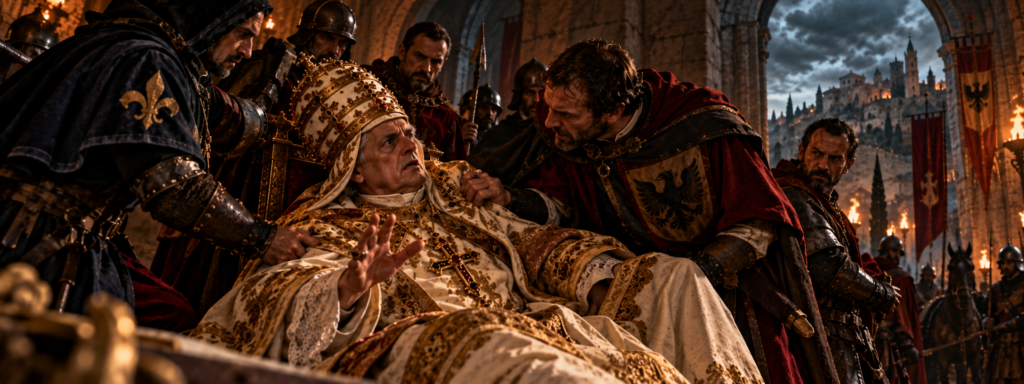
In September 1303, armed men forced their way into the hill town of Anagni, where Pope Boniface VIII had taken refuge. They came not as petitioners seeking an audience with the Vicar of Christ, but as enemies determined to seize one of the most formidable popes of the Middle Ages. Among their leaders were Guillaume de Nogaret, an agent of King Philip IV of France, and Sciarra Colonna, a member of the Roman family that Boniface had pursued with extraordinary ferocity. By the time they reached the papal residence, decades of ambition, family rivalry, legal argument, political hatred, and increasingly extravagant claims about the authority of the papacy had converged upon one frightened Italian town.
Boniface was now an old man, probably in his late sixties or early seventies, and the enemies surrounding him wanted more than political concessions. Nogaret represented a French king whom Boniface had threatened with ecclesiastical punishment, while Sciarra represented a family whose castles the pope had attacked and whose cardinals he had stripped of office. The details of what happened when they confronted Boniface became embroidered almost immediately, and the famous story that Sciarra physically slapped the pope may be legendary rather than securely documented. What is certain is dramatic enough: the reigning pope was captured, detained, threatened, and publicly humiliated by men acting against him in the name of one of Europe’s most powerful kings.
The people of Anagni eventually turned against the attackers and freed Boniface after several days. He returned to Rome, but there would be no triumphant recovery and no opportunity to rebuild the authority that had been shattered so spectacularly. On October 11, 1303, scarcely a month after the attack, Boniface VIII died. The pope who had proclaimed one of the most uncompromising visions of papal supremacy in medieval history had ended his career as a prisoner in his own stronghold.
His enemies celebrated, but they were not finished with him. After his death, accusations continued multiplying until Boniface was charged with simony, sexual immorality, blasphemy, heresy, idolatry, demonic practices, and statements so shocking that they seem almost designed to transform a political enemy into an enemy of Christianity itself. Some accusations may preserve genuine contemporary hostility or rumors about his behavior, but many emerged from an organized campaign by opponents with powerful reasons to destroy his memory. They cannot responsibly be repeated as established facts merely because medieval witnesses or later polemicists recorded them.
There is no need to accept the most lurid accusations to understand why Boniface belongs among the Wicked Popes. His documented career already contains extraordinary material: an aggressive conception of papal monarchy, extensive advancement of his Caetani relatives, a bitter feud with the Colonna family, the destruction of Palestrina, escalating confrontation with Philip IV of France, and the extraordinary bull Unam sanctam. He could be brilliant, legally sophisticated, politically audacious, vindictive, and disastrously unwilling to recognize when an opponent possessed enough power to resist him. His pontificate became one of the great cautionary tales of medieval papal authority.
Boniface VIII did not fall because he lacked power. He fell because he believed papal power could reach farther than the political world around him was prepared to allow. The tragedy of his reign was therefore not simply that a king attacked a pope, nor that a proud pope underestimated a king. It was that two increasingly centralized monarchies, one spiritual and one secular, collided until compromise became almost impossible.
Benedetto Caetani: The Lawyer Behind the Tiara
Boniface VIII was born Benedetto Caetani, probably around 1230, into a family with connections to the region around Anagni. The Caetani were not yet among the greatest dynasties of Italy, but they possessed enough status and ambition to provide Benedetto with opportunities for education and ecclesiastical advancement. He studied law and developed the formidable legal expertise that would become one of the defining features of his career. Long before he became pope, he learned to understand power through jurisdiction, precedent, privilege, and written authority.
Benedetto’s ecclesiastical career brought him into the complicated diplomatic world of the thirteenth-century Church. He served on papal missions and acquired experience in France and elsewhere, becoming familiar with the courts and political structures that the papacy attempted to influence. In 1281, Pope Martin IV made him a cardinal-deacon, and in 1291 he became cardinal-priest of Santi Silvestro e Martino ai Monti. By then he had become one of the more experienced and intellectually formidable members of the College of Cardinals.
His personality is difficult to reconstruct because many descriptions come from hostile sources written during or after his political conflicts. Boniface acquired a reputation for arrogance, sharpness, ambition, and an extraordinary sense of his own authority, but polemical exaggeration must always be considered. What emerges more securely from his actions is a man with enormous confidence in law and hierarchy. He believed authority mattered, and he believed the papacy occupied a uniquely elevated place within the Christian order.
This legal mentality shaped everything that followed. Boniface did not behave like a pope improvising power from moment to moment. He inherited centuries of increasingly sophisticated claims concerning papal jurisdiction, including the legacy of Gregory VII, Innocent III, Innocent IV, and other pontiffs who had asserted broad authority over Christian rulers. Boniface’s great mistake was not inventing papal monarchy but pushing its implications at a moment when secular monarchies were becoming increasingly capable of pushing back.
His family background also mattered. Like Nicholas III before him, Boniface understood politics through kinship as well as institutions. Once he became pope, the Caetani would rise dramatically in wealth and influence. The lawyer who insisted upon the universal dignity of the papal office would prove remarkably willing to use that office to strengthen his own relatives.
That contradiction would become one of the central scandals of his pontificate. Boniface could speak as the guardian of an office transcending earthly dynasties while behaving like the head of an ambitious Italian family. The pope who challenged kings for subordinating the Church to secular interests was not always equally troubled when papal resources served Caetani interests. His enemies noticed.
The Strange Abdication of Celestine V
Boniface’s path to the papacy began with one of the strangest pontificates in medieval history. After Pope Nicholas IV died in 1292, divisions among the cardinals produced a vacancy lasting more than two years. Roman aristocratic rivalries, particularly those involving the Colonna and Orsini factions, helped make agreement difficult. Eventually the exhausted cardinals turned to an extraordinary outsider.
In July 1294, they elected Pietro del Morrone, an elderly hermit renowned for ascetic holiness. He became Celestine V, a pope whose personal spirituality was almost completely mismatched with the administrative and political demands of the medieval papacy. Celestine possessed little experience with the legal machinery of the Curia and quickly became vulnerable to stronger personalities around him. King Charles II of Naples exercised particularly significant influence over the new pope.
Celestine soon concluded that he was incapable of performing the office effectively and began considering resignation. The canonical possibility of a pope voluntarily leaving office was not entirely without precedent, but the situation was sufficiently unusual to raise serious questions. Benedetto Caetani, as an eminent canon lawyer, was associated with the legal discussion surrounding whether abdication was permissible. Celestine ultimately issued a constitution confirming a pope’s right to resign and then abdicated on December 13, 1294.
Eleven days later, the cardinals elected Benedetto Caetani, who became Boniface VIII. The speed with which a prominent legal adviser connected with the abdication became Celestine’s successor inevitably generated suspicion. Later enemies alleged that Benedetto had manipulated or frightened the elderly hermit into resigning, and colorful legends claimed that deceptive voices had been used to convince Celestine that God commanded him to leave office. Such stories are dramatic but cannot be treated as established historical fact.
Celestine’s resignation appears to have arisen primarily from his genuine inability and unwillingness to continue governing. He had already demonstrated deep discomfort with the papal office and possessed strong spiritual reasons for wanting to return to his former life. Benedetto certainly benefited from the abdication and probably supported the legal legitimacy of resignation. Benefit and involvement, however, are not proof that he engineered Celestine’s decision through fraud.
The controversy did not end when Boniface was elected. A living former pope represented a potential political danger because opponents could claim Celestine’s resignation had been invalid and rally around him. Boniface therefore faced an uncomfortable question almost immediately. What should be done with a saintly old hermit whose mere existence could undermine the legitimacy of the new pontificate?
The Prisoner in the Castle
Celestine attempted to return to the secluded religious life he had wanted before his election, but Boniface did not trust the situation. The former pope’s holiness made him popular, and political enemies of Boniface might use him whether Celestine wanted to participate or not. Celestine attempted to escape across the Adriatic but was captured. Boniface eventually ordered him confined at the castle of Fumone.
The conditions of Celestine’s confinement have been described in dramatically different ways. Hostile traditions portray him as imprisoned cruelly in a tiny, miserable chamber, while other accounts emphasize that Boniface’s primary motive was political security rather than deliberate torture. Celestine was elderly and accustomed to severe asceticism, making the physical effects of confinement difficult to reconstruct precisely. He died in May 1296 after roughly ten months at Fumone.
Rumors soon claimed that Boniface had murdered his predecessor. Later stories alleged that a nail had been driven into Celestine’s skull, and modern examinations of the remains have generated continuing debate over injuries and their interpretation. There is no reliable evidence establishing that Boniface ordered Celestine’s murder. The safest conclusion is that Celestine died while being detained on Boniface’s orders, while the claim of assassination remains unproven.
Even without murder, the episode remains disturbing. Boniface imprisoned an elderly former pope because Celestine’s freedom created a political threat to his own legitimacy. The decision can be explained through the brutal logic of medieval politics, but explanation does not make the imprisonment disappear. A man celebrated for renouncing power spent his final months confined because another pope could not risk allowing him to remain free.
The contrast between the two men became irresistible to later writers. Celestine appeared humble, ascetic, and reluctant to possess authority, while Boniface appeared ambitious, wealthy, legalistic, and determined to exercise it. Dante famously placed the figure generally understood to be Celestine among those who made the “great refusal,” although the identification is not absolutely certain. Boniface, by contrast, became one of the poet’s most hated papal figures.
The transition from Celestine to Boniface therefore became a moral drama long before historians attempted to reconstruct it carefully. One pope abandoned the throne, and another seized its possibilities with both hands. The reality was more complicated, but the symbolism would prove impossible to erase.
The Caetani Begin to Rise
Once securely installed, Boniface began strengthening the position of his family. The Caetani acquired lands, castles, offices, wealth, and political importance at a pace that alarmed their rivals. Nepotism was common in medieval papal government, and Boniface was far from the first pope to promote relatives. Yet his family’s rapid ascent became one of the most visible features of his reign.
Boniface’s nephew Pietro Caetani and other relatives benefited significantly from papal favor. Territorial acquisitions in the region around Rome strengthened the family’s position against older aristocratic dynasties. The Caetani were becoming something more than the respectable family from which Benedetto had emerged. They were being transformed into one of the important political houses of central Italy.
The pope could justify such advancement in familiar ways. Rome and the Papal States were dangerous environments in which loyalty mattered enormously, and relatives offered a dependable network. Powerful Roman families could challenge papal government directly, while secular monarchs attempted to influence Italian politics from outside. Building a loyal Caetani bloc therefore had strategic value.
The conflict of interest remained obvious. Every estate acquired by the family strengthened people personally connected to the pope. Every office given to a relative reduced the distinction between papal government and Caetani ambition. Boniface could sincerely believe that a powerful family protected the papacy while simultaneously ensuring that his relatives prospered from his pontificate.
This pattern placed him firmly within the tradition already associated with Nicholas III and other nepotistic popes. The difference was that Boniface’s temperament made compromise particularly difficult when another aristocratic family resisted him. His confrontation with the Colonna would reveal how quickly a family rivalry could acquire the language of ecclesiastical rebellion. The consequences would be devastating.
The Caetani rise therefore cannot be dismissed as background detail. It helped create enemies who would later participate directly in Boniface’s destruction. The pope was building a dynasty at the same time he was building opposition to himself. In medieval Rome, those two processes often advanced together.
The Colonna: A Family Becomes an Enemy
The Colonna were among the most powerful aristocratic families in Rome and central Italy. They possessed castles, estates, fortified towns, cardinals, and a political network capable of resisting even the pope. Their rivalry with the Caetani combined personal, territorial, ecclesiastical, and factional interests. When Boniface strengthened his relatives, the Colonna had reason to feel threatened.
Two Colonna cardinals, Giacomo and Pietro, became increasingly hostile to Boniface. Their conflict involved disputes within the Colonna family itself as well as opposition to the pope’s policies. In 1297, the crisis exploded when Stefano Colonna seized a shipment of treasure associated with the papal administration. Although the treasure was eventually returned, Boniface treated the incident as part of a much larger challenge.
The two Colonna cardinals responded by attacking the legitimacy of Boniface’s election. They argued that Celestine V’s resignation had been invalid and therefore Boniface could not legitimately be pope. This was an extraordinarily dangerous accusation because it transformed an aristocratic dispute into a challenge to the foundations of the pontificate. Boniface answered with overwhelming force.
He deprived the Colonna cardinals of their offices and excommunicated members of the family. Their properties became targets, and a campaign was launched against their strongholds. The conflict was no longer a disagreement among churchmen. It had become something resembling a papal war against a Roman dynasty.
Boniface even attached crusading privileges to the campaign against the Colonna. This use of spiritual incentives against Christian political enemies was not unprecedented, but it demonstrated how easily the language of holy war could be redirected into Italian factional politics. Fighting the pope’s aristocratic enemies could now be framed as service to the Church. Family rivalry, ecclesiastical discipline, and crusading ideology became entangled.
The most important Colonna stronghold was Palestrina. Its fate would become one of the darkest episodes of Boniface’s reign. The pope’s determination to break his enemies would leave a city devastated and his reputation permanently stained.
Palestrina: Victory Without Mercy
Palestrina stood southeast of Rome and represented a major center of Colonna power. Its fortifications and strategic position made it a formidable obstacle to Boniface’s effort to destroy the family’s political independence. Papal forces besieged the city while negotiations and military pressure gradually weakened resistance. Eventually the defenders surrendered in 1298.
Accounts of the surrender emphasize promises or expectations of mercy, although the exact terms and circumstances remain debated. The Colonna submitted, and Boniface appeared to have achieved the political victory he wanted. Yet he was not satisfied merely with symbolic submission. Palestrina’s capacity to function as a fortified center of resistance had to be destroyed.
The city was therefore dismantled on a massive scale. Fortifications were demolished, buildings were ruined, and the site was devastated so thoroughly that later descriptions compared its destruction to the plowing of conquered ancient cities. Boniface ordered a new settlement, the Civitas Papalis, to replace the old political center. The message was unmistakable: resistance to papal authority could result not merely in defeat but in obliteration.
The extent to which every later dramatic detail about the destruction should be taken literally is open to question. Medieval political narratives frequently exaggerated devastation for rhetorical effect. Yet there is no serious doubt that Boniface deliberately destroyed Palestrina’s fortifications and inflicted severe punishment upon the Colonna center. This was not simply hostile propaganda.
The pope’s treatment of the Colonna reveals an important feature of his personality and government. Boniface could interpret resistance not as an ordinary political disagreement but as rebellion against legitimate authority. Once opponents crossed that boundary, compromise became increasingly difficult. The legalist could become ruthless because he believed the law was on his side.
Palestrina also demonstrates how family politics shaped papal violence. The Colonna were enemies of the Caetani as well as enemies of Boniface’s government. Destroying their stronghold weakened a rival dynasty while strengthening papal control. Once again, public and private interests moved together.
The defeated Colonna did not forget. Members of the family fled, plotted, and waited for an opportunity to strike back. Five years later, Sciarra Colonna would ride into Anagni beside the agents of Philip IV of France. The road to Boniface’s humiliation passed directly through the ruins of Palestrina.
A King Who Needed Money
While Boniface fought the Colonna in Italy, another conflict was developing with far greater consequences. Philip IV of France, known as Philip the Fair, ruled one of the most powerful kingdoms in Europe. His monarchy was becoming increasingly centralized, administratively sophisticated, and financially demanding. Warfare required enormous resources, particularly Philip’s conflict with Edward I of England.
Both kings looked toward the wealth of the clergy. Church lands and revenues represented a tempting source of taxation, but clerical taxation traditionally raised questions about papal consent and ecclesiastical privilege. Boniface regarded unilateral royal taxation of the clergy as an intrusion upon the rights of the Church. Philip regarded the resources within his kingdom as necessary to defend royal interests.
In 1296, Boniface issued the bull Clericis laicos. It prohibited clergy from paying extraordinary taxes to secular rulers without papal permission and threatened penalties against both those who imposed and those who paid unauthorized levies. The document expressed a long-standing concern about secular exploitation of church wealth. Yet its timing made it a direct challenge to monarchs already desperate for wartime revenue.
Philip responded with economic pressure. He restricted the export of money and valuables from France, threatening the flow of funds upon which the papacy itself depended. Boniface discovered that spiritual authority could encounter very practical obstacles when a king controlled borders, taxation, and financial movement. The confrontation immediately became more complicated than a simple question of canonical principle.
Boniface eventually moderated his position. He clarified that rulers could tax clergy in genuine emergencies and made concessions that reduced the immediate crisis. The canonization of Philip’s grandfather Louis IX in 1297 also helped create a temporary reconciliation. For several years, open conflict subsided.
The episode should have taught both men how dangerous escalation could become. Instead, it provided a rehearsal. Boniface had tested the limits of papal claims over royal taxation, while Philip had demonstrated his ability to retaliate through administrative power. When the conflict resumed, neither side would retreat so easily.
The Jubilee and the Height of Papal Majesty
The year 1300 offered Boniface a magnificent opportunity to display the spiritual authority of Rome. Large numbers of pilgrims were already traveling to the city at the beginning of the new century, inspired by expectations that special spiritual benefits might be available. Boniface formalized the movement by proclaiming a Jubilee. Pilgrims visiting the principal Roman basilicas under prescribed conditions could receive a plenary indulgence.
The response was extraordinary. Crowds poured into Rome from across Europe, filling streets, churches, inns, and marketplaces. Chroniclers described enormous numbers of pilgrims, although precise medieval figures should not be accepted uncritically. What matters is that Rome experienced a remarkable influx of people seeking spiritual benefits associated with papal authority.
For Boniface, the Jubilee represented the papacy at its most triumphant. Kings might resist his political claims, Roman families might challenge his territorial ambitions, and critics might accuse him of greed, but hundreds of thousands of ordinary Christians still looked toward Rome as the center of western Christianity. The pope stood at the heart of a spiritual economy that no secular monarch could easily reproduce. The contrast with his humiliation three years later could hardly be greater.
The Jubilee also generated substantial economic activity in Rome. Pilgrims needed food, lodging, transportation, devotional objects, and countless other services. Critics of the medieval Church could easily interpret such wealth as evidence of commercialization, although pilgrimage itself cannot be reduced to economics. For participants, the spiritual motives were often profound.
Boniface appears to have understood the symbolic importance of the event. Papal Rome was not merely an Italian principality but the destination of Christendom. The Jubilee demonstrated a kind of authority that transcended ordinary territorial government. It was perhaps the clearest moment when Boniface’s enormous conception of the papacy appeared to match visible reality.
Yet the triumph contained a dangerous illusion. Pilgrims could acknowledge Rome’s spiritual primacy without accepting unlimited papal control over kings. The distinction would soon become brutally clear. Boniface was approaching the greatest political confrontation of his life while standing at the summit of ceremonial power.
The Bishop of Pamiers and the Return of the Crisis
The conflict with Philip IV reignited through the case of Bernard Saisset, bishop of Pamiers. Saisset was a political opponent of the French king and became entangled in accusations involving treasonous statements and resistance to royal authority. Philip’s officials arrested him in 1301. For Boniface, the arrest of a bishop by secular authorities raised fundamental questions about ecclesiastical jurisdiction.
The dispute quickly expanded beyond the fate of one difficult bishop. Boniface demanded respect for clerical privileges and summoned French ecclesiastical leaders to Rome to discuss reform and the relationship between Church and monarchy. Philip’s government interpreted these actions as an assault upon royal sovereignty. The machinery of propaganda began accelerating on both sides.
Boniface issued Ausculta fili, traditionally dated to December 1301, addressing Philip in language that combined paternal admonition with criticism of royal conduct. The title, meaning “Listen, son,” captures the hierarchical relationship Boniface believed existed between pope and Christian king. He did not regard Philip as an independent sovereign beyond spiritual correction. The king remained a son of the Church.
Philip’s advisers responded by presenting the papal position to French audiences in an even more provocative form. A shortened or distorted version circulated that made Boniface appear to claim sweeping temporal lordship over France. Whether through deliberate manipulation or polemical simplification, the dispute became easier to portray as a foreign pope attempting to subordinate the French crown. National political sentiment could now be mobilized against Rome.
Philip summoned an assembly in 1302 that included clergy, nobles, and representatives of towns, often regarded as an important precursor in the development of the Estates General. The gathering produced declarations of support for the king against what was portrayed as excessive papal interference. Philip was demonstrating that he could mobilize institutions within France to legitimize resistance. Boniface was no longer dealing with an isolated monarch.
The confrontation had therefore changed character. It was becoming a struggle between competing systems of authority, each capable of generating legal arguments, propaganda, and institutional support. The medieval papacy had spent centuries developing sophisticated claims to supremacy. The French monarchy had now developed enough administrative power to answer.
Unam Sanctam: The Most Explosive Claim
On November 18, 1302, Boniface issued Unam sanctam, one of the most famous and controversial papal bulls of the Middle Ages. The document affirmed the unity of the Church and developed an argument concerning spiritual and temporal authority through the traditional imagery of the two swords. Both powers ultimately belonged within a divinely ordered Christian society, but the spiritual authority possessed superiority over the temporal. The bull culminated in an extraordinarily uncompromising statement concerning the necessity of submission to the Roman pontiff for salvation.
The precise political and theological meaning of Unam sanctam has been debated for centuries. It should not be simplified into the claim that Boniface believed the pope personally administered every kingdom as though kings were merely papal employees. Medieval theories of jurisdiction were more sophisticated than that caricature. Yet the bull undeniably asserted an extremely elevated understanding of papal authority and the superiority of spiritual power.
In the context of the conflict with Philip, nuance became almost irrelevant. The French king and his advisers saw a pope claiming the right to judge royal power while denying that secular authority could stand entirely beyond ecclesiastical supervision. Boniface saw a Christian king refusing the hierarchical order he believed God had established. Each side increasingly interpreted compromise as surrender.
The bull represents the high-water mark of medieval papal monarchy in theory. Earlier popes had made sweeping claims, but Boniface articulated the relationship between spiritual and temporal authority with exceptional starkness. The document sounded like the proclamation of an institution confident that centuries of legal and theological development had placed it above every Christian ruler. Within a year, its author would be physically seized by one of those rulers’ agents.
The contrast is almost too dramatic for fiction. In 1302, Boniface declared a vision in which spiritual authority judged temporal power. In 1303, temporal power sent armed men to arrest him. The collision between theory and political reality could hardly have been more brutal.
Yet Unam sanctam should not be dismissed merely because Boniface lost. It represented a serious medieval political theology with deep roots in canon law and papal tradition. The tragedy was that Boniface proclaimed its strongest form precisely when emerging monarchies were becoming capable of rejecting it. He had inherited an old vision at the beginning of a new political age.
Philip’s Counterattack
Philip IV did not answer Boniface merely with theological argument. His government began constructing a case against the pope himself. Guillaume de Nogaret, one of Philip’s most important legal advisers, became central to the campaign. If Boniface could be portrayed not merely as a political opponent but as a heretic and criminal, resistance to him could be presented as defense of the Church rather than rebellion against it.
The accusations became astonishing. Boniface was charged with heresy, simony, blasphemy, sexual misconduct, disbelief in Christian doctrines, contempt for the sacraments, and various forms of scandalous behavior. Later testimony would add still more lurid allegations, including claims involving demons and occult practices. The sheer range of accusations should immediately make a careful historian suspicious.
Political context is essential. Philip needed a justification for moving against a reigning pope, and charges of heresy could potentially undermine Boniface’s spiritual authority at its foundation. A heretical pope was not simply a pope making bad political decisions. He could be portrayed as someone who had forfeited the very legitimacy upon which papal obedience depended.
Some accusations may have originated in genuine rumors or statements attributed to Boniface by people who knew him. His abrasive personality, intellectual sophistication, and willingness to speak forcefully could easily generate hostile anecdotes. Yet the evidentiary environment was saturated with political incentives. Witnesses were speaking in a campaign sponsored by the pope’s most powerful enemy.
The accusations therefore cannot responsibly be treated as a reliable portrait of Boniface’s private beliefs or sexual life. Claims that he denied immortality, mocked Christian doctrine, practiced demon worship, or committed particular sexual offenses remain unproven. Repeating them as facts would reproduce medieval propaganda rather than analyze it. Their historical importance lies primarily in showing how completely the conflict had moved beyond ordinary diplomacy.
Philip’s government was attempting to destroy Boniface morally before destroying him politically. The pope answered with preparations for further ecclesiastical sanctions against the king. Both sides were now approaching a point where words would no longer be enough. Nogaret decided to act.
The Road to Anagni
By the summer of 1303, Boniface was preparing a major response to Philip. The pope intended to condemn the king’s conduct and appears to have been moving toward excommunication or a declaration with similarly devastating implications. Such a measure would not automatically remove Philip from power, but it could encourage political resistance and place enormous pressure upon the French monarchy. Philip’s government had reason to prevent the proclamation.
Nogaret traveled into Italy and established contact with Boniface’s enemies. Among the most important was Sciarra Colonna, whose family had suffered terribly during the pope’s campaign against Palestrina. The alliance between the French royal agent and the exiled Roman nobleman was almost perfectly suited to the moment. One sought to protect his king, while the other sought revenge.
They assembled an armed force and moved toward Anagni, where Boniface was staying. The town was strongly associated with the pope and his family, which may have encouraged him to believe he was relatively secure there. Yet local loyalties were more fragile than he realized. Money, political resentment, and surprise allowed the attackers to enter.
On September 7, 1303, the force seized control of Anagni and reached the papal residence. Boniface’s defenses collapsed. Cardinals and servants fled or proved unable to resist. The pope who had threatened Europe’s greatest monarchs suddenly found armed enemies inside his own house.
Later tradition transformed the confrontation into a theatrical scene. Boniface supposedly dressed in full pontifical robes, placed the tiara upon his head, held the keys and cross, and declared that if his enemies wished to kill him, he would die as pope. Elements of this imagery may preserve genuine memories of his defiance, but the exact speeches and dramatic details cannot be verified. They belong to the legend of Anagni as much as to secure history.
What is beyond serious dispute is that Boniface was captured and held for several days. Nogaret wanted him brought before a council, while the Colonna had their own motives for vengeance. The spiritual monarch of Latin Christianity was now physically at the mercy of men he had condemned. The theory of papal supremacy had encountered armed force in a palace corridor.
The Slap That May Never Have Happened
The most famous story from Anagni is the schiaffo di Anagni, the “slap of Anagni.” According to later tradition, Sciarra Colonna struck Boniface across the face, sometimes with a mailed hand. The image is irresistible because it condenses decades of conflict into one physical gesture. A member of the family Boniface had tried to destroy finally raised his hand against the pope himself.
The difficulty is that the literal slap is not securely attested by the earliest evidence. Contemporary and near-contemporary accounts describe insults, threats, capture, and humiliation, but the specific blow became clearer in later retellings. Historians therefore generally treat the physical slap with caution. Boniface was certainly humiliated at Anagni, but whether Sciarra actually struck him remains uncertain.
The symbolic slap, however, was real regardless of whether a hand touched the pope’s face. A secular king’s agent had entered papal territory, joined forces with the pope’s aristocratic enemy, captured the pontiff, and attempted to force him into submission. Few events could have more dramatically demonstrated the limits of papal power. Europe had witnessed something once almost unimaginable.
Boniface reportedly refused to resign. His stubbornness, so disastrous in other contexts, became a source of personal courage during captivity. Whatever threats were made against him, the attackers failed to secure the abdication or formal concessions they wanted. The pope remained pope.
The situation soon turned against the invaders. Residents of Anagni, apparently angered by the occupation and treatment of their pope, rose against the attackers. The raiders were forced to withdraw, and Boniface was liberated after roughly three days of captivity. The immediate crisis appeared to have ended.
Yet something fundamental had changed. A pope could be seized. The men responsible could escape. The king behind the attack remained on his throne. The aura surrounding the medieval papacy had suffered a wound no ceremony could quickly heal.
The Last Month
After his liberation, Boniface returned to Rome under protection. He had survived Anagni physically, but he was exhausted, politically shaken, and surrounded by uncertainty. Accounts of his final weeks differ, and later hostile traditions portray him descending into madness, rage, or despair. Such descriptions must be treated cautiously because enemies had every incentive to make his death appear morally grotesque.
Boniface died on October 11, 1303. The interval between Anagni and his death was only about a month, making it natural for contemporaries and later writers to connect the humiliation with his physical decline. Stress and age may well have contributed, but the precise medical cause cannot be established. Claims that he died insane, gnawing his hands or smashing his head against walls, belong largely to hostile legend rather than reliable medical evidence.
His burial took place in St. Peter’s, where he had arranged an elaborate tomb. Boniface had possessed a strong sense of papal dignity and personal commemoration, and his tomb reflected the ceremonial magnificence associated with his reign. Death did not immediately end the political conflict surrounding him. Philip IV still wanted his enemy condemned.
Boniface’s immediate successor, Benedict XI, attempted to navigate the dangerous aftermath. He lifted some censures and sought reconciliation while also taking action against certain participants in the Anagni attack. His pontificate lasted less than a year. After his death, another lengthy conclave eventually produced Clement V.
Clement’s election in 1305 marked the beginning of a dramatically different period. A French pope faced intense pressure from Philip, and the papal court eventually settled at Avignon. The papacy had not become simply a puppet of France, but the political center of gravity had shifted decisively. Boniface’s defeat formed part of the background to that transformation.
The man who had asserted papal supremacy more uncompromisingly than almost any contemporary pope therefore died at the threshold of an era in which the papacy would appear more vulnerable to royal power. His failure did not destroy papal authority. It exposed its limits.
The Trial of a Dead Pope
Philip IV was not satisfied with Boniface’s death. The French king continued pressing for a formal investigation into the deceased pope’s alleged crimes. This was not merely revenge. A condemnation of Boniface could retrospectively justify Philip’s resistance and the attack at Anagni.
Under Clement V, proceedings concerning Boniface’s memory continued for years. Witnesses gave testimony containing a remarkable catalogue of accusations. Boniface was alleged to have expressed heretical beliefs, committed sexual offenses, practiced simony, mocked religious observance, and engaged in behavior incompatible with Christian faith. Some testimony became increasingly sensational.
The reliability of these proceedings is deeply problematic. Witnesses spoke in a political environment dominated by pressure from the French monarchy, often years after the alleged events. Statements could be shaped by rumor, factional hatred, personal grievance, or the desire to satisfy powerful patrons. Contradictory evidence and Boniface’s own documented religious activity further complicate any attempt to accept the accusations wholesale.
This does not mean every negative allegation must automatically be false. Boniface had enemies because he had treated many people harshly, and some witnesses may have reported things they genuinely believed or personally experienced. Historical skepticism should not become automatic exoneration. It should mean weighing claims according to their evidence rather than their dramatic appeal.
The most sensational accusations remain especially doubtful. Stories of demonic consultation, disbelief in the afterlife, contempt for Christian morality, and extreme sexual misconduct fit too neatly into the medieval vocabulary used to demonize hated opponents. Heresy accusations were politically useful because they could strip a pope of moral legitimacy. The campaign against Boniface employed that weapon aggressively.
Ultimately, Boniface was not formally condemned as a heretic. His memory remained controversial, but the attempt to produce a definitive posthumous destruction of his papal legitimacy did not achieve everything Philip wanted. The accusations nevertheless survived. Once released into historical memory, scandal is difficult to recall.
Dante’s Enemy Before He Reached Hell
Few writers hated Boniface VIII more effectively than Dante Alighieri. The poet’s hostility was political, moral, and deeply personal. Boniface’s interventions in Florentine politics became connected with the circumstances that led to Dante’s exile. The pope therefore entered the Divine Comedy not as a distant historical figure but as one of the great villains of Dante’s political universe.
Boniface was still alive in the fictional year in which Dante set the Inferno, so the poet could not simply place him among the dead. Instead, Dante devised something more vicious. When he encounters Nicholas III among the simoniacs, Nicholas mistakes him for Boniface, apparently believing the hated pope has arrived in Hell earlier than expected. Boniface is thus condemned before his actual death.
The scene links Boniface with the corruption of papal office through wealth and political ambition. Dante’s judgment cannot be treated as neutral historical testimony because the poet had direct reasons to despise him. Yet, as with Nicholas III, the literary attack reveals how powerful the reputation for papal corruption had become. Boniface was believable as a damned pope to audiences already familiar with controversies surrounding his reign.
Dante also attacked the political entanglement of the Church with temporal power. In his broader political thought, the corruption of spiritual authority occurred when the papacy attempted to dominate the secular sphere rather than allowing emperor and pope to exercise distinct functions. Boniface’s pontificate provided an ideal target. Unam sanctam represented almost everything Dante feared about papal monarchy.
The poet’s Boniface therefore became larger than the historical man. He represented greed, political interference, simony, and the distortion of spiritual authority. Later generations inherited this literary monster alongside the documentary pope. Separating them requires deliberate effort.
Yet Boniface himself made Dante’s task easier. His nepotism, destruction of Palestrina, confrontation with Florence, conflict with Philip, and extraordinary claims of papal authority supplied abundant material. Propaganda can distort a reputation, but it works best when attached to recognizable actions. Boniface provided his enemies with plenty.
Florence and the Politics That Destroyed Dante
Boniface’s involvement in Tuscany added another layer to his controversial reputation. Florence was divided by bitter factional conflict between the White and Black Guelfs, groups whose disputes involved family rivalries, social tensions, and different attitudes toward papal influence. Dante belonged to the White faction. The political crisis eventually drew Boniface directly into Florentine affairs.
The pope sought to influence the settlement and supported the intervention of Charles of Valois, brother of Philip IV of France, who entered Florence in 1301 ostensibly as a peacemaker. His arrival helped create conditions in which the Black Guelfs seized power. Violence, confiscations, prosecutions, and political expulsions followed. White Guelf leaders, including Dante, became victims of the new regime.
Dante was away from Florence when he was condemned in 1302. He was accused of corruption and political offenses, fined, and threatened with severe punishment if he returned without complying with the sentence. He never returned permanently to his native city. Exile became one of the defining experiences of his life.
Boniface was not personally responsible for every action committed by the victorious Florentine faction. Local politics had their own deep roots, and Charles of Valois possessed agency of his own. Nevertheless, papal intervention contributed materially to the political realignment that destroyed Dante’s career in Florence. The poet’s hatred therefore had a concrete political foundation.
This background matters when reading Dante’s attacks. His portrayal of Boniface was shaped by personal loss as well as theological principle. The pope was connected in Dante’s mind with the corruption that had driven him from home. Hell provided the courtroom Florence never gave him.
The literary revenge proved far more durable than the political victory. Boniface’s allies controlled Florence for a time, but Dante’s poem survived for centuries. The pope won the immediate contest and lost the battle over memory. Few political enemies have ever been punished more effectively by a writer.
Nepotism Behind the Universal Monarchy
Boniface’s political theology spoke in universal terms, but his family policies remained strikingly local and dynastic. The Caetani benefited from his pontificate through territorial acquisitions and political advancement. His nephews and other relatives became significant figures in the Papal States. Critics saw hypocrisy in the contrast between universal spiritual claims and private family ambition.
Nepotism was not unusual enough to discredit a pope automatically. Medieval political government depended heavily upon kinship, and papal relatives could provide trustworthy administrators in a dangerous environment. Boniface faced genuine threats from the Colonna and other aristocratic factions. Strengthening the Caetani gave him loyal supporters capable of defending his government.
The problem was scale and self-interest. Papal power could transform a modest aristocratic family into a major political dynasty. Land acquired during one pontificate could remain in family hands long after the pope died. Spiritual office therefore created opportunities for secular inheritance.
The Caetani’s rise contributed directly to the hatred of the Colonna. Territorial disputes and family competition became intertwined with questions of papal obedience. When Boniface punished the Colonna, he was simultaneously disciplining enemies of the pope and weakening rivals of the Caetani. No legal argument could make that overlap disappear.
This dual identity undermined Boniface’s moral authority. He demanded that kings distinguish their temporal interests from the rights of the Church while failing to create an equally clear boundary between the Church and his own family. Philip’s propagandists could exploit the contradiction. A pope preaching detachment from secular ambition looked less convincing while his relatives accumulated property.
The criticism does not require assuming that every Caetani acquisition was illegal. Nepotism can be corrosive even when individual transactions satisfy formal law. The issue is the repeated direction of institutional advantage toward the ruler’s kin. Boniface’s pontificate displayed that pattern clearly enough to become part of his lasting reputation.
Was Boniface a Heretic?
The charge of heresy is among the most dramatic accusations made against Boniface, but it is also among those requiring the greatest caution. Philip’s supporters collected testimony alleging that the pope doubted or denied central Christian teachings. Statements attributed to him included skepticism about the immortality of the soul, heaven and hell, and various religious practices. If authentic, such statements would have been astonishing coming from a medieval pope.
The political usefulness of these accusations is obvious. Philip’s confrontation with Boniface created a serious problem because openly attacking the pope could be portrayed as rebellion against the Church. If Boniface himself were a heretic, however, resistance could be reframed as defense of Christianity. The king’s lawyers therefore had powerful incentives to present the dispute in theological rather than merely political terms.
The surviving allegations often come through hostile testimony rather than neutral documentation. Some were recorded after Boniface’s death when he could no longer answer them. Others resemble familiar polemical accusations used against political enemies. This does not prove fabrication in every case, but it makes confident acceptance impossible.
Boniface’s documented career also sits awkwardly beside the portrait of a secret unbeliever indifferent to Christianity. He governed the Church energetically, proclaimed the Jubilee, issued major theological and canonical statements, defended papal spiritual authority, and devoted extraordinary attention to ecclesiastical government. A cynical person can certainly perform religious acts without private belief, so this evidence cannot prove his inner faith. It does, however, make the sensational portrait less straightforward than his enemies claimed.
There is therefore no sound historical basis for declaring Boniface a proven heretic. The accusations belong in his story because they became central to the campaign against him and shaped his reputation. They should be presented as accusations generated in an intensely hostile political environment. Anything stronger exceeds the evidence.
The same caution applies to allegations of demonic practices. Medieval political polemic frequently associated hated figures with sorcery, demons, or supernatural evil. Such charges could turn an opponent into something more frightening than an ordinary sinner. Boniface’s enemies used the language available to them with remarkable aggression.
Sexual Accusations and the Politics of Defamation
Boniface was also accused of sexual misconduct, including allegations involving both women and men. Some charges were extraordinarily explicit and were incorporated into later proceedings against his memory. These claims have sometimes been repeated in popular accounts as though they were established biographical facts. The evidence does not justify that confidence.
Sexual accusations were powerful weapons in medieval polemic because they attacked both clerical discipline and personal honor. A pope accused of sexual immorality could be portrayed as violating the standards he imposed upon others. Accusations involving acts considered especially taboo could intensify the scandal. Political enemies therefore possessed strong reasons to circulate such stories.
That does not mean medieval rulers and clergy were never guilty of the sexual behavior alleged against them. The existence of propaganda cannot automatically prove innocence any more than accusation proves guilt. Each claim requires evidence independent of the political usefulness of the allegation. In Boniface’s case, the sensational sexual charges remain too entangled with hostile campaigns to be treated as secure facts.
His documented nepotism and political ruthlessness provide far firmer grounds for criticism. There is no need to embellish his biography with uncertain sexual scandal simply because it makes a darker story. Historical accuracy is more compelling when it allows uncertainty to remain visible. Boniface’s real conflicts were dramatic enough.
The allegations themselves nevertheless reveal the intensity of hatred surrounding him. Opponents were not satisfied to argue that his interpretation of papal authority was excessive. They wanted him remembered as morally polluted in every possible way. Political disagreement had become character annihilation.
This campaign succeeded at least partially. Even centuries later, lurid accusations continue appearing in summaries of Boniface’s life. The survival of a charge can create the illusion that repetition equals proof. His story is a useful reminder that medieval propaganda could be extraordinarily durable.
A Pope of Law and Force
Boniface’s reign repeatedly combined legal sophistication with coercive power. He issued bulls, interpreted jurisdiction, asserted privileges, excommunicated opponents, and employed the machinery of canon law with extraordinary confidence. Yet legal declarations were often backed by armies, confiscations, territorial punishment, and political pressure. The distinction between law and force could become thin.
The Colonna experienced this directly. Their challenge to Boniface’s legitimacy was answered not merely with theological rebuttal but with deprivation of office, excommunication, military campaign, and the destruction of their stronghold. Boniface understood their resistance as unlawful rebellion. Once that judgment had been made, coercion appeared justified.
Philip IV responded with a mirror image of the same logic. French lawyers constructed arguments portraying Boniface as criminal, heretical, and dangerous. Once the pope had been legally reclassified as an offender, extraordinary measures against him could be justified. Nogaret did not present himself simply as a kidnapper attacking the pope for political convenience.
Both sides therefore used law to legitimize force. Boniface claimed authority over Christian rulers because spiritual power possessed superior jurisdiction. Philip’s advisers claimed authority to act against Boniface because a heretical or criminal pope could not hide behind his office. Legal reasoning did not prevent violence. It prepared the ground for it.
This helps explain why the conflict became so difficult to stop. Compromise requires recognizing at least some legitimacy in an opponent’s position. Boniface increasingly treated Philip’s resistance as disobedience, while Philip’s government increasingly treated Boniface as an illegitimate aggressor. Each side converted disagreement into wrongdoing.
Anagni was the physical conclusion of that process. Once the opponent had become a criminal in the eyes of the other side, armed intervention no longer appeared unthinkable. The palace doors were merely the final boundary left to cross.
The Limits of the Medieval Papal Monarchy
Boniface inherited an extraordinary tradition of papal power. Gregory VII had confronted Emperor Henry IV, Innocent III had intervened throughout European politics, and Innocent IV had declared Frederick II deposed. Canon lawyers had spent generations developing sophisticated theories concerning the pope’s authority within Christian society. Boniface did not create this tradition.
What changed was the political environment. Monarchies such as France possessed increasingly effective taxation systems, professional administrators, legal experts, representative assemblies, and stronger concepts of territorial sovereignty. Kings could communicate with subjects, mobilize public support, and retaliate economically against ecclesiastical pressure. The papacy was confronting states more institutionally powerful than many of those faced by earlier reforming popes.
Philip IV’s government demonstrated this new capacity brilliantly. When challenged, it did not rely only upon knights. It produced legal arguments, summoned assemblies, circulated propaganda, gathered accusations, manipulated public opinion, and sent trained officials such as Nogaret to execute royal policy. The monarchy could fight the pope using some of the same administrative weapons the Church had perfected.
Boniface appears to have underestimated this transformation. His legal claims rested upon traditions that remained intellectually powerful, but he acted as though asserting authority would necessarily produce obedience. Philip demonstrated that a king with sufficient institutional support could simply refuse. Excommunication was still frightening, but it was no longer an automatic political death sentence.
Anagni therefore represents more than the personal humiliation of one pope. It symbolizes a shift in the balance between papal monarchy and emerging territorial states. The papacy remained immensely important after 1303, but the dream of routinely subordinating powerful monarchs to direct papal political judgment had suffered a devastating blow. The medieval world was changing.
Boniface’s tragedy was that he represented the old claim at the moment its practical limits became impossible to ignore. His confidence had deep historical foundations. His defeat revealed that foundations alone could not guarantee obedience.
The Wickedness of Certainty
Boniface’s most dangerous characteristic may not have been greed, arrogance, or nepotism individually. It was his certainty that legitimate authority belonged overwhelmingly to his side. That certainty made compromise look like betrayal. Enemies became rebels because they resisted what he regarded as lawful order.
The destruction of Palestrina illustrates the danger. The Colonna had challenged his legitimacy and resisted papal authority, so Boniface could understand severe punishment as the restoration of justice. Once their resistance became rebellion, mercy was optional. The law provided moral language for vengeance.
His conflict with Philip followed the same pattern on a larger scale. Boniface believed the Church possessed rights that secular rulers could not violate, and much of that claim was perfectly consistent with medieval ecclesiastical law. Philip’s taxation and treatment of clergy genuinely raised questions about church liberty. The dispute did not begin with an absurd papal grievance.
The catastrophe emerged through escalation. Each concession encouraged new suspicion, each document sharpened the ideological divide, and each side surrounded itself with advisers capable of producing arguments proving the opponent wrong. Eventually the conflict stopped being about taxation or one imprisoned bishop. It became a struggle over who possessed the authority to define authority itself.
Boniface’s certainty was matched by Philip’s. The king was no passive victim defending himself against a mad pope. His government manipulated propaganda, pursued Boniface’s posthumous condemnation, and eventually destroyed the Knights Templar through another notorious campaign of accusations and judicial pressure. The political culture surrounding both men could be ruthless.
Recognizing Philip’s aggression does not absolve Boniface. It reveals why the collision became catastrophic. Two powerful institutions, each convinced of its jurisdiction, found fewer and fewer reasons to retreat. Anagni was what happened when certainty acquired armed supporters.
The Knights Templar and the World After Boniface
Boniface died before Philip IV launched his famous attack upon the Knights Templar in 1307. Yet the Templar affair belongs to the political world revealed by the conflict between pope and king. Philip’s government demonstrated again that accusations of heresy could be used against powerful institutional enemies. Arrests, interrogations, confessions under coercion, propaganda, and pressure upon the papacy would eventually destroy the order.
Clement V faced Philip under circumstances very different from those Boniface had confronted. The new pope was more cautious and politically vulnerable, while the French monarchy had demonstrated what it was capable of doing to an opponent. The papal court’s later residence at Avignon intensified perceptions that France had gained excessive influence over the Church. Boniface’s defeat therefore cast a long shadow.
It would be misleading to claim that Anagni directly caused every later development. The Avignon papacy had multiple political and administrative causes, and Clement V was not simply Philip’s servant. Yet the humiliation of Boniface showed that papal confrontation with the French monarchy could end disastrously. Successors could not forget the lesson.
The contrast with Unam sanctam became especially striking. Boniface had articulated an exalted theory of spiritual superiority. Within a few years, the papacy was operating under conditions that critics interpreted as dependence upon the French crown. The gap between theory and political reality had widened dramatically.
This transformation contributed to later criticism of the Church. Writers who believed the papacy had become too wealthy, political, or entangled with monarchy could point backward to Boniface as part of the problem. His reign became a landmark in narratives of papal decline. Whether those narratives oversimplified the period, they proved extraordinarily influential.
Boniface therefore belongs not merely to the end of the thirteenth century but to the beginning of a much larger crisis in western Christianity. The authority he tried to maximize would become increasingly contested. His defeat did not cause that contest alone. It made the vulnerability visible.
Was Boniface VIII a Monster?
The most sensational portrait of Boniface presents him as almost unimaginably corrupt. In this version, he manipulates Celestine V into resigning, murders him in prison, buys ecclesiastical office, enriches relatives, practices sexual immorality, mocks Christianity, communes with demons, destroys enemies, and claims godlike authority over Europe. It is an unforgettable portrait. It is also far more certain than the evidence allows.
Several components rest upon hostile or later traditions that cannot be independently established. There is no reliable proof that Boniface murdered Celestine, and the lurid accusations of heresy, sexual depravity, and demonic practices emerged within politically compromised testimony. His enemies possessed powerful motives to portray him as morally monstrous. Responsible history must resist inheriting their verdict uncritically.
Other charges rest upon much firmer foundations. Boniface unquestionably practiced nepotism, aggressively strengthened the Caetani, fought the Colonna, destroyed Palestrina’s political power, intervened heavily in secular affairs, and asserted an extraordinarily expansive understanding of papal authority. He imprisoned Celestine because the former pope represented a political danger. He entered conflicts in which ecclesiastical punishment and family interest became entangled.
Those documented actions are enough to make his pontificate controversial. They reveal a pope capable of treating opposition with remarkable severity and of using spiritual authority as a weapon within political conflicts. His behavior does not require demonic embellishment. Human ambition is sufficient.
Calling Boniface a monster can actually make his story less useful. Monsters are easy to dismiss because they appear fundamentally different from ordinary political actors. Boniface was more recognizable and therefore more unsettling. He was educated, legally sophisticated, institutionally experienced, religiously serious in public, and convinced that his authority served a legitimate order.
The danger came from what he believed legitimate authority permitted him to do. That question is historically more important than whether every obscene accusation against him was true. Boniface’s real life is darker when stripped of unnecessary legend because the remaining story is entirely human.
The Man Behind Unam Sanctam
Boniface’s extraordinary confidence did not arise from personal vanity alone. Medieval papal ideology had developed for centuries toward increasingly strong claims concerning the pope’s role as supreme spiritual judge. Canon law, theology, political precedent, and institutional memory all reinforced the idea that the Roman pontiff possessed responsibilities extending across Christendom. Boniface inherited an office that had taught its occupants to think on a universal scale.
His legal education made him particularly capable of articulating those claims. He understood how precedents could be assembled, how jurisdiction could be defended, and how spiritual authority could generate legal consequences. Unam sanctam therefore did not emerge from an irrational outburst. It was the product of a sophisticated tradition pushed toward its most uncompromising conclusion.
The problem was that the same intellectual structure could make political retreat extremely difficult. If papal superiority reflected divine order, surrendering to Philip could appear to mean surrendering a principle rather than merely losing a diplomatic dispute. Boniface was not negotiating only for himself. In his own understanding, he was defending the office of Peter.
That conviction helps explain his courage at Anagni. Even hostile accounts could not erase the image of an elderly pope refusing to abdicate while surrounded by armed enemies. Boniface may have been arrogant, but arrogance and courage are not mutually exclusive. The man who had refused compromise in victory refused surrender in captivity.
This does not transform him into a martyr. His own policies had helped create the enemies standing before him, and Sciarra Colonna’s presence connected Anagni directly with the destruction of Palestrina. Boniface was experiencing the return of political violence he had previously directed against others. History rarely arranges such symmetrical endings.
Yet his refusal to yield remains important. Boniface’s conception of papal dignity was not merely rhetoric used when convenient. When stripped of military protection and physically threatened, he still refused to abandon the office. The same certainty that made him dangerous also made him defiant.
Anagni as Revenge
For Sciarra Colonna, Anagni was more than an episode in French royal policy. His family had been excommunicated, dispossessed, pursued, and humiliated. Palestrina had been destroyed. Boniface had attempted to break the Colonna as an independent political force.
The opportunity to confront the pope personally therefore carried enormous emotional significance. Medieval family feuds could survive for generations because honor, property, and blood created obligations that extended beyond individual participants. Sciarra was not merely assisting Nogaret. He was participating in the revenge of a dynasty.
This background helps explain why later tradition focused so intensely on the alleged slap. Whether or not the blow literally occurred, it represented the perfect reversal of power. The pope who had struck the Colonna politically was struck physically by a Colonna. The destroyed family stronghold was answered by the violated papal stronghold.
The symbolism became larger than the evidence because it satisfied the narrative logic of revenge. Boniface had humiliated his enemies, so he was humiliated. He had stripped cardinals of dignity, so his own dignity was attacked. He had relied upon force, so force entered his chamber.
Historical events rarely possess such neat moral symmetry, which is another reason to treat the slap itself cautiously. Later storytellers naturally sharpen events into patterns of justice and retribution. Yet the documented capture already contains enough reversal to explain why the legend emerged. Boniface’s enemies did not need to invent the meaning of Anagni.
The event was revenge, political intervention, constitutional crisis, and symbolic revolution at the same time. A pope had become physically vulnerable to the people he had condemned. The medieval papal monarchy survived. Its aura of inviolability did not.
A Reputation Buried Under Propaganda
Boniface’s posthumous reputation suffered from the unusual combination of enemies who had reasons to preserve their hatred in writing. Philip IV’s government wanted him condemned. The Colonna wanted vindication. Dante wanted literary revenge. Later critics of papal monarchy found him an irresistible example of excessive ecclesiastical ambition.
This convergence makes reconstructing the historical Boniface unusually difficult. A hostile anecdote might originate in genuine observation, political propaganda, later literary embellishment, or some mixture of all three. Repetition across later sources does not necessarily create independent confirmation if the writers ultimately drew upon the same polemical tradition. The historian must repeatedly ask not merely what was said but who benefited from saying it.
Boniface contributed heavily to his own reputation. He made enemies aggressively and often treated defeat as insufficient when humiliation was available. Palestrina gave the Colonna a grievance capable of surviving generations. His interventions in Florence helped give Dante a personal reason to hate him.
His confrontation with Philip then provided a monarchy with the resources to industrialize defamation by medieval standards. Royal lawyers collected testimony, framed accusations, and pursued proceedings capable of preserving scandal in documentary form. Boniface’s enemies did not merely gossip. They created records.
The existence of records can make accusations look more authoritative than oral rumor. Yet a deposition taken during a politically driven prosecution remains politically driven evidence. Documentation must be interpreted, not worshipped. Boniface’s case demonstrates that archives can preserve propaganda as efficiently as truth.
His black legend therefore contains both reality and distortion. The challenge is not choosing one and discarding the other. It is separating them carefully enough to see the man who generated such extraordinary hatred. That man remains dark enough without every legend.
Why Boniface VIII Belongs Among the Wicked Popes
Boniface VIII belongs in the Wicked Popes category not because Philip IV’s entire catalogue of accusations should be believed. It should not. Nor does he belong because Dante placed him in Hell before he was dead. Poetry is not a verdict of historical fact.
He belongs because his documented exercise of power repeatedly crossed into ruthless political coercion. He imprisoned Celestine V to eliminate a threat to his legitimacy, even though the former pope’s personal desire appears to have been withdrawal from politics. He pursued the Colonna with a ferocity culminating in the devastation of Palestrina. His family benefited substantially from papal patronage.
His conflict with Philip IV further demonstrates the danger of an authority unwilling to recognize practical limits. Boniface had legitimate grievances concerning clerical rights and royal interference. Yet his escalating claims transformed disputes that might have remained negotiable into a confrontation over the entire hierarchy of Christian society. Unam sanctam gave that confrontation its most uncompromising expression.
None of this makes Philip the hero of the story. Philip’s government responded with propaganda, politically useful accusations, coercive tactics, and ultimately an armed assault upon the pope. Nogaret’s actions at Anagni represented an extraordinary violation of papal security. The king’s later behavior toward the Templars provides additional reason to treat his methods with skepticism.
The darkness lies partly in the interaction between these men. Boniface’s authoritarian papalism encountered Philip’s authoritarian monarchy. Neither side possessed much tolerance for a rival jurisdiction capable of saying no. Their collision damaged both the individuals involved and the political order surrounding them.
Boniface therefore represents a form of wickedness rooted in power rather than private vice. He believed deeply in hierarchy, law, papal dignity, and the rights of his office. Those convictions did not prevent cruelty. At times they provided the justification for it.
The Pope Who Could Not Retreat
Boniface’s career repeatedly presents moments when retreat might have reduced the danger. He could have treated the Colonna dispute more narrowly. He could have accepted their submission without devastating Palestrina. He could have managed the French conflict without allowing every disagreement to become a test of papal supremacy.
Retreat, however, appears to have been psychologically and institutionally difficult for him. Boniface understood challenges through the language of authority. If he possessed lawful jurisdiction and an opponent resisted, yielding could appear to reward rebellion. Compromise threatened to weaken not merely his personal position but the office he believed himself obligated to defend.
This mentality is particularly visible in the final confrontation with Philip. The king’s arrest of Saisset and resistance to papal intervention were interpreted within a much larger theory of Christian government. Boniface could not simply negotiate one jurisdictional dispute because he believed the principles at stake reached the structure of the Church itself. Philip’s advisers responded with equally sweeping arguments about royal sovereignty.
The resulting escalation resembled a staircase from which neither side could easily descend. Every document answered another document, every assembly challenged another claim, and every accusation demanded a stronger response. By 1303, the possibility of physical confrontation had become imaginable. Nogaret merely converted ideological escalation into action.
Boniface’s inability to retreat therefore became both personal flaw and structural problem. Medieval papal monarchy had accumulated claims that an ambitious pope could feel morally obligated to defend. Emerging secular monarchy had accumulated enough power to reject them. Neither system possessed an obvious mechanism for peaceful resolution.
Anagni became that mechanism through violence. The pope did not voluntarily reduce his claims. His enemies demonstrated their limits for him. The lesson was written not in canon law but in captivity.
The Humiliation That Changed the Papacy
The capture at Anagni lasted only a few days, but its symbolic importance far exceeded its duration. Earlier popes had been imprisoned, attacked, driven from Rome, and even killed. Papal history was never a smooth story of inviolable authority. Yet Boniface’s humiliation occurred after centuries during which the papacy had developed some of its grandest theories of supremacy.
The contrast between Unam sanctam and Anagni made the event especially powerful. The pope who proclaimed the superiority of spiritual authority could not protect his own residence from a king’s agent. The Vicar of Christ could threaten excommunication but could still be surrounded by armed men. Theology had collided with logistics.
The papacy recovered institutionally, but the political landscape had shifted. Kings increasingly possessed administrative resources capable of resisting ecclesiastical intervention. National political communities could be mobilized against external interference. Papal censures remained powerful, but their effectiveness depended upon political conditions.
Boniface’s successors therefore inherited a different psychological environment. They knew that a monarch such as Philip could challenge the pope, survive the confrontation, and even send agents to seize him. The theoretical hierarchy of Christendom had become harder to enforce. Political sovereignty was moving in directions that would eventually transform Europe.
The humiliation also damaged the mythology of papal monarchy. Institutions depend partly upon what people believe can and cannot be done to them. Before Anagni, physically seizing a pope in such circumstances could appear almost unthinkable. After Anagni, Europe knew it had happened.
That knowledge could not be reversed. Boniface returned to Rome still wearing the papal title. The office survived, but the image of unlimited authority did not. The door at Anagni had been broken open both literally and symbolically.
The Pope at the End of the Road
Boniface VIII began his pontificate through an event already surrounded by suspicion. Celestine V had resigned, Benedetto Caetani had helped clarify the legality of papal resignation, and within days Caetani himself had been elected pope. Later enemies transformed that sequence into stories of manipulation and conspiracy. The evidence supports caution, but the shadow followed Boniface from the beginning.
His decision to confine Celestine deepened that shadow. There is no reliable proof that Boniface murdered the former pope, and the more sensational assassination traditions should not be presented as fact. Yet Celestine unquestionably died while detained because Boniface considered his freedom politically dangerous. The distinction between murder and imprisonment matters, but imprisonment remains morally significant.
Boniface then strengthened the Caetani family with remarkable energy. Nepotism was normal enough in medieval politics to require historical context, but normality does not make it ethically neutral. Papal office created opportunities for relatives to acquire lands and influence that they would not otherwise have possessed. The Caetani rose with Boniface.
Their rise helped sharpen the conflict with the Colonna. When the rival family challenged his legitimacy, Boniface responded not simply as an offended aristocrat but as a pope convinced that rebellion against him threatened the order of the Church. Excommunications and deprivation of office escalated into military action. Palestrina paid the price.
The destruction of that stronghold remains one of the clearest examples of Boniface’s capacity for ruthless punishment. The Colonna had surrendered, but submission did not save their political center. Boniface wanted their capacity for resistance broken. The ruined city became a monument to the consequences of defying him.
He could justify the action through authority, just as he could justify his confrontation with Philip through the rights of the Church. That is what makes Boniface historically compelling. He did not need to think of himself as cruel. He needed only to believe that resistance to legitimate authority deserved correction.
Philip IV possessed his own equally dangerous certainty. He believed royal government could not accept papal intrusion into matters he regarded as belonging to the French crown. His officials were skilled, educated, and capable of constructing legal arguments as sophisticated as those produced by the papal court. The confrontation was therefore not between law and lawlessness but between competing legal orders.
When Boniface issued Clericis laicos, Philip discovered that economic retaliation could force papal reconsideration. When the conflict returned over Bernard Saisset, both sides remembered the earlier confrontation. This time neither was willing to accept a temporary compromise as the final answer. The dispute expanded until the question became who possessed ultimate authority over Christian political life.
Unam sanctam supplied Boniface’s answer. Spiritual authority stood above temporal authority, and submission to the Roman pontiff was expressed in language of extraordinary theological force. The document represented centuries of papal development rather than one man’s sudden fantasy. Yet Boniface proclaimed it at precisely the moment when the political world was becoming capable of rejecting its practical implications.
Philip’s answer was not another bull. His government gathered accusations, mobilized assemblies, deployed lawyers, and prepared a political case against the pope himself. Boniface was no longer simply wrong in French propaganda. He was corrupt, criminal, heretical, and dangerous.
The accusations grew more sensational as the struggle intensified. Simony, sexual immorality, blasphemy, disbelief, and demonic practices all became part of the black legend surrounding him. Some accusations may have reflected genuine rumors or grievances, but their political context prevents responsible historians from treating them collectively as proven facts. The campaign had every incentive to produce the darkest possible Boniface.
The pope’s documented behavior requires no such embellishment. His nepotism is real, his campaign against the Colonna is real, the destruction of Palestrina is real, his imprisonment of Celestine is real, and his extraordinary conception of papal authority is documented in his own government. These facts provide more than enough material for judgment. Invented certainty about demons or sexual scandal adds drama while weakening history.
Boniface’s greatest enemy eventually discovered that parchment could be answered with steel. Nogaret crossed into Italy and joined forces with Sciarra Colonna, a man whose family possessed deeply personal reasons for revenge. The alliance united royal power with aristocratic hatred. Their destination was Anagni.
The attack there became one of the great reversals of medieval history. Boniface had excommunicated enemies, destroyed fortresses, disciplined cardinals, challenged kings, and proclaimed the supremacy of spiritual authority. Now armed men occupied his residence. The judge had become the prisoner.
Whether Sciarra physically slapped him matters less than later legend imagined. The historical humiliation was already complete without the blow. Boniface had been seized by enemies acting with the support of a Christian king whom he had intended to punish. No metaphor was required.
His refusal to abdicate reveals the formidable core of the man. Boniface could be vindictive and arrogant, but he was not easily frightened into surrender. Even in captivity, he clung to the dignity and authority of his office. The same certainty that had carried him into catastrophe prevented his enemies from forcing him to abandon the throne.
The people of Anagni liberated him, but liberation did not restore the world that existed before the attack. Boniface returned to Rome physically free and politically wounded. He died within weeks. His enemies remained alive.
Philip IV suffered no equivalent collapse. Nogaret survived and continued serving the French monarchy. Sciarra Colonna survived and eventually returned to political prominence. The men who had violated the pope’s residence were not destroyed by the spiritual consequences Boniface’s theory of authority might have seemed to predict.
This disparity gave Anagni its historical force. Papal claims had not necessarily become theologically meaningless, but their political enforcement had encountered a devastating limit. A monarch with sufficient administrative strength could resist. A pope could be right according to his own law and still lose.
Boniface’s death did not end the attack upon him. Philip continued seeking a posthumous condemnation, forcing the dead pope to remain a political problem. Witnesses were assembled, accusations recorded, and scandal preserved. Boniface’s corpse could not defend itself.
The attempt to condemn him formally as a heretic ultimately failed, but the propaganda survived more successfully than any judicial verdict. Dante gave it literary immortality. The Divine Comedy ensured that Boniface would remain associated with simony, corruption, and the prostitution of spiritual authority.
Dante had powerful personal reasons for hatred. Papal intervention in Florence contributed to the political transformation that resulted in his exile. Boniface was therefore not an abstract villain to him. The pope had become part of the catastrophe that destroyed his civic life.
That context should make readers cautious without making them dismissive. Dante’s Boniface is literature shaped by grievance, theology, and political ideology. Yet great propaganda often succeeds because it attaches itself to recognizable features of reality. Boniface had given Dante abundant material.
His nepotism made accusations of greed plausible. His political interventions made accusations of worldly ambition plausible. His destruction of enemies made portrayals of ruthlessness plausible. His sweeping papal claims made accusations of arrogance almost inevitable.
The historical man nevertheless remains more interesting than the literary villain. Boniface was one of the most capable canon lawyers ever to become pope. He understood the institutional Church deeply, possessed formidable administrative experience, and inherited a genuine tradition of papal responsibility for Christian society. His ideas were not nonsense.
His failure came partly because he misunderstood the changing relationship between ideas and power. The papacy could still declare principles, impose censures, and mobilize enormous spiritual loyalty. It could not always force increasingly powerful monarchies to obey. Philip demonstrated that distinction brutally.
Boniface also failed to recognize how badly his own behavior weakened his moral position. A pope demanding that kings respect the independence of the Church looked compromised while enriching his relatives. A pope demanding obedience from aristocrats looked vindictive after destroying their city. A pope presenting himself as universal judge accumulated enemies who believed he could no longer judge fairly.
None of those contradictions automatically invalidated his legal claims. Politics rarely offers such convenient moral symmetry. They did, however, make his opponents’ propaganda easier to believe. Authority depends partly upon credibility.
Boniface spent much of his pontificate consuming that credibility. Every Caetani acquisition created suspicion, every escalation with the Colonna created hatred, and every assertion against Philip raised the stakes. His government could win individual battles while making the final confrontation more dangerous. By 1303, too many enemies wanted the same man defeated.
Anagni brought them together. French royal policy met Colonna revenge in the pope’s own hometown. The result was not merely a kidnapping. It was the physical collapse of the distance Boniface believed should separate papal majesty from ordinary coercion.
The story contains an almost unbearable irony. Boniface had spent his career arguing that spiritual authority possessed the right to judge temporal power. His enemies answered by putting the spiritual judge physically under arrest. The dispute over who could judge whom ended with armed men deciding the immediate question.
Yet Boniface’s defeat should not tempt us into treating Philip’s monarchy as the progressive victor over medieval superstition. Philip’s government was capable of ruthless manipulation, confiscation, coercive prosecution, and politically useful accusations of heresy. The destruction of the Templars would soon demonstrate those methods on an even larger scale. Royal centralization could be every bit as dangerous as papal centralization.
The tragedy of Boniface VIII therefore lies in the collision of powerful institutions rather than the triumph of one morally pure side. Both pope and king possessed legitimate concerns. Both transformed those concerns into increasingly absolute claims. Both used law as a weapon.
Boniface remains the more fascinating figure because his fall was so spectacular. Few rulers have moved so quickly from ceremonial magnificence to personal vulnerability. The pope of the Jubilee stood at the center of crowds pouring into Rome in 1300. Three years later, enemies stood inside his residence at Anagni.
That reversal explains why legends accumulated around his death. People wanted the ending to match the pride attributed to the man. Stories of madness, self-destruction, and divine punishment supplied a satisfying moral conclusion. Evidence is less cooperative.
Boniface died shortly after an extreme political and personal trauma, but exactly what happened medically cannot be known. The grotesque stories of his final insanity are too dependent upon hostile tradition to be accepted confidently. History must resist the temptation to give every controversial ruler a theatrical death. Anagni already provides enough drama.
The more important death was political. Boniface’s vision of papal monarchy survived in theology and canon law, but its practical limitations had been exposed. The papacy would continue to influence kings, diplomacy, warfare, and European politics for centuries. It would never erase the memory that one of its strongest champions had been captured by a king’s agents.
This is why Boniface VIII belongs so naturally among the Wicked Popes while still requiring more careful treatment than his black legend usually receives. He was not demonstrably the demon-worshipping, sexually depraved secret heretic his enemies described. Those accusations tell us more securely about the ferocity of medieval political propaganda than about his private life. His documented conduct is both more defensible in places and more disturbing in others.
He believed deeply in papal authority, and that belief could produce genuine defense of ecclesiastical independence. He also practiced nepotism, used extraordinary force against political enemies, and struggled to distinguish the dignity of the papacy from his own determination to prevail. Power and principle became fused. Once fused, surrender became almost impossible.
The ruins of Palestrina and the chambers of Anagni therefore belong together. At Palestrina, Boniface demonstrated what happened when he possessed enough power to crush an enemy. At Anagni, he discovered what happened when his enemies possessed enough power to reach him. The two episodes form the dark symmetry of his pontificate.
Between them stands Unam sanctam, the document that expressed his dream of hierarchy more clearly than any ruined fortress could. Boniface believed the Christian world possessed an order and that the spiritual authority entrusted to Peter occupied its highest earthly position. His enemies did not merely disagree. They proved that political power could refuse the hierarchy.
The pope survived their hands for only a few weeks. His reputation survived for centuries, but largely in forms created by people who hated him. Dante condemned him before death, Philip tried to condemn him afterward, and later historians inherited an archive filled with accusation. Few popes have been buried beneath so much hostility.
The task of history is not to rescue Boniface from every accusation. It is to remove the accusations that cannot be established and examine what remains. What remains is still a pope of extraordinary ambition, formidable intellect, aggressive nepotism, harsh treatment of enemies, and almost breathtaking confidence in his office.
That Boniface is more compelling than the caricature. He does not need demons whispering in his chamber or grotesque secret rituals to become unsettling. He needs only law, family, conviction, enemies, and power. Those were enough to bring a city to ruin and a kingdom into confrontation.
They were also enough to destroy him. Boniface VIII spent his pontificate insisting that the papacy could stand above the political powers of Christendom. At Anagni, the doors opened and political power walked inside.
The men who seized him could not force him to surrender the papacy, but they accomplished something almost as consequential. They demonstrated that the pope could be touched, threatened, detained, and humiliated. The throne of Saint Peter remained standing after Boniface died, but the illusion that its occupant could always command kings had been broken.
That is the final darkness of Boniface VIII’s story. He reached for a vision of papal authority so vast that almost every serious disagreement could become a test of obedience, and he punished some of those who resisted him with extraordinary severity. His enemies responded by using equally ruthless methods against him, until law gave way to force and spiritual monarchy ended behind guarded doors in Anagni.
Boniface did not die as the secret monster described by his enemies, at least not on any evidence strong enough to justify that conclusion. He died as something historically more important: a powerful, intelligent, uncompromising pope whose conception of authority collided catastrophically with a changing Europe. His pontificate showed how dangerous absolute certainty could become when armed with institutional power, and his fall showed how quickly even the grandest claims of supremacy could collapse when an enemy stopped believing in them.