
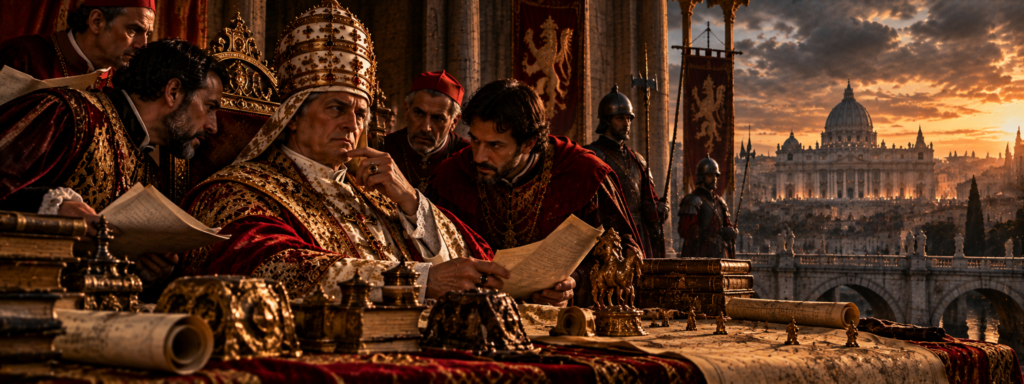
Nicholas III: The Orsini Pope Who Turned Family Power Into Papal Policy
Nicholas III — 1277–1280
When Dante Alighieri imagined the corrupt churchmen of his age burning in Hell, he reserved one of his most memorable encounters for Pope Nicholas III. In the Inferno, Nicholas is thrust headfirst into a fiery hole among the simoniacs, his feet exposed above the ground and consumed by flames while he waits for other corrupt popes to join him. Dante’s punishment was literary invention, not a transcript of historical judgment, and his hostility toward the political papacy of the thirteenth century makes him anything but a neutral witness. Yet the very fact that Nicholas became one of Dante’s great symbols of ecclesiastical corruption reveals how thoroughly the pope’s reputation had darkened within only a generation of his death.
Nicholas III was not remembered primarily as a murderer, sexual libertine, or religious fanatic. His scandal was more recognizably political and, in some ways, more familiar: family. Born Giovanni Gaetano Orsini, he came from one of Rome’s most powerful aristocratic dynasties, and when he became pope in 1277, the fortunes of the Orsini rose dramatically with him. Relatives received cardinalates, offices, influence, territories, and opportunities that made it increasingly difficult to determine where the interests of the papacy ended and those of the Orsini family began.
Nepotism was hardly unique to Nicholas. Medieval popes existed within a political world in which family networks provided allies, soldiers, administrators, money, protection, and continuity, while the violent factional politics of Rome made trusted relatives particularly valuable. A pope surrounded entirely by strangers could quickly become a pope surrounded by enemies. Yet Nicholas pushed familial advancement so visibly that even by the standards of his own age his pontificate became associated with dynastic ambition.
The accusation of simony requires greater caution. Nicholas’s enemies and later writers associated him with the corruption of ecclesiastical office, and Dante’s placement of him among the simoniacs permanently attached that charge to his name. Yet literary damnation is not documentary proof that Nicholas routinely sold church offices for cash, and the historical evidence for particular acts must be distinguished from his broader reputation for exploiting ecclesiastical power. His documented nepotism is strong enough without turning every hostile allegation into fact.
What makes Nicholas particularly fascinating is that he was not simply a crude family opportunist. He was an experienced churchman, a skilled political operator, and a pope with a serious vision of papal independence. He resisted the enormous influence of Charles of Anjou, strengthened papal control in central Italy, reorganized political relationships in Rome, and attempted to prevent any single secular ruler from dominating the papacy. Many of these policies made strategic sense for the Church even while they simultaneously benefited the Orsini.
That ambiguity defines Nicholas III. He could strengthen the papacy while strengthening his family, resist foreign domination while constructing domestic dynastic power, and pursue legitimate ecclesiastical goals through a political system saturated with favoritism. His enemies saw greed where his supporters might have seen prudent government. Dante saw something darker still: a successor of Saint Peter who had turned sacred authority into an instrument of worldly appetite.
Born Into the Roman Aristocracy
Giovanni Gaetano Orsini was born in Rome around 1216 into a family already deeply embedded in the city’s aristocratic politics. The Orsini were not merely wealthy nobles living comfortably beside the Church; they were one of the great dynasties competing for influence over Rome, the Papal States, and the papacy itself. Their rivals included families such as the Colonna, whose own ambitions would later become inseparable from the violent politics surrounding the medieval Church. To be born an Orsini was to enter a world where religion, land, kinship, patronage, and political survival were tightly intertwined.
Giovanni’s father was Matteo Rosso Orsini, an important Roman nobleman whose political influence helped establish the family as one of the dominant forces in the city. Matteo Rosso had played a major role in Roman affairs during the first half of the thirteenth century and had supported the papacy during conflicts with Emperor Frederick II. The Orsini therefore possessed not only wealth but a history of political service that could be presented as loyalty to the Church. Family advancement and papal politics had already been connected long before Giovanni himself became pope.
Giovanni entered ecclesiastical life and advanced rapidly. Pope Innocent IV made him a cardinal-deacon of San Nicola in Carcere in 1244, beginning a cardinalate that would last more than three decades. During those years, he accumulated enormous experience in papal elections, diplomacy, church government, and the shifting alliances of Italy. By the time he reached the papal throne, he was anything but an inexperienced aristocrat suddenly handed spiritual authority.
His long career also exposed him to one of the central problems facing medieval popes: how to govern while surrounded by powerful secular rulers and equally dangerous Roman families. The papacy claimed universal spiritual authority, but the pope still needed physical control of territory, reliable officials, military protection, and political allies. Rome could rebel, emperors could invade, kings could pressure conclaves, and aristocratic factions could make the city nearly ungovernable. A pope therefore needed trustworthy people around him, and in medieval political culture trust often began with blood.
That reality helps explain the nepotism of Nicholas III without excusing it. A modern reader may naturally regard the appointment of relatives as obvious corruption, while a medieval ruler might see family patronage as an essential method of securing loyalty. The problem emerged when family advancement became so extensive that public office appeared indistinguishable from dynastic property. Nicholas would approach that boundary repeatedly.
His Orsini identity never disappeared beneath his papal robes. Instead, his election gave the family access to the most powerful patronage network in Latin Christendom. The pope who wanted to protect the Church from domination by kings would increasingly rely upon his own dynasty to do it. That solution contained the scandal from the beginning.
A Cardinal for More Than Thirty Years
Giovanni Gaetano Orsini’s lengthy cardinalate placed him at the center of some of the most turbulent decades in medieval papal history. He served under multiple popes and witnessed the continuing struggle between the papacy and the Hohenstaufen dynasty. He saw Innocent IV’s confrontation with Frederick II, the political destruction of Hohenstaufen power, and the papal invitation that eventually brought Charles of Anjou into southern Italy. These experiences shaped his understanding of how dangerous an overly powerful secular protector could become.
Charles of Anjou had originally appeared useful to the papacy. The brother of Louis IX of France possessed the military power necessary to challenge Manfred, the Hohenstaufen ruler of Sicily whom the popes regarded as a continuing threat. Charles defeated and killed Manfred at Benevento in 1266, then defeated the young Conradin at Tagliacozzo in 1268. Conradin’s subsequent execution in Naples effectively ended the direct male Hohenstaufen challenge in southern Italy.
The victory solved one papal problem while creating another. Charles now controlled the Kingdom of Sicily, possessed immense political influence in Italy, and held offices that extended his reach into Rome and Tuscany. A prince invited south by the papacy to eliminate one dangerous dynasty was becoming powerful enough to overshadow the institution that had helped him rise. The papacy had exchanged the threat of Hohenstaufen encirclement for the threat of Angevin dominance.
Giovanni Orsini understood this transformation intimately. As a senior cardinal, he participated in the political world in which Charles became indispensable and then increasingly alarming. The lesson was difficult to miss. Secular protectors rarely remained merely protectors once their armies, money, and territorial ambitions became large enough.
The papal elections of the period demonstrated another danger. After Clement IV died in 1268, the cardinals remained divided for nearly three years, producing one of the longest papal vacancies in history. Political divisions, including attitudes toward Charles of Anjou, helped paralyze the College of Cardinals. Giovanni Orsini was one of the powerful figures navigating that deadlock.
The eventual election of Gregory X in 1271 temporarily broke the crisis and led to reforms intended to prevent future vacancies of such extraordinary length. Yet Gregory died in 1276, and a rapid succession of short pontificates followed. Innocent V, Adrian V, and John XXI each died within a relatively brief period. By late 1277, the Church again needed a pope capable of navigating an unstable political landscape.
This time the choice fell upon Giovanni Gaetano Orsini.
The Election of Nicholas III
Giovanni was elected pope on November 25, 1277, after another difficult conclave. He took the name Nicholas III and inherited a papacy surrounded by competing pressures. Charles of Anjou remained extraordinarily powerful, the Byzantine Empire was attempting to navigate relations with the Latin West, Roman aristocratic factions continued their struggles, and the political structure of Italy remained fragmented. Nicholas entered office with decades of experience but no illusion that spiritual authority alone would protect him.
His election immediately strengthened the Orsini position. The family already possessed extensive lands, castles, urban connections, and ecclesiastical influence, but the papacy gave Nicholas opportunities to place relatives in positions capable of expanding that power further. Family members could become cardinals, governors, military figures, and territorial lords. The pope’s patronage became a dynastic resource.
Nicholas’s defenders could point to a practical justification. Rome was notoriously unstable, and Charles of Anjou’s influence threatened papal independence. The pope needed officials whose loyalty he trusted absolutely. Members of his own family provided an obvious pool of dependable allies.
Yet the scale of the favoritism quickly created suspicion. When relatives repeatedly receive offices from a ruler who happens to share their blood, explanations based entirely upon merit become difficult to sustain. Even if some Orsini appointees were capable, their qualifications did not erase the advantage created by kinship. Nicholas was using public ecclesiastical authority in ways that materially strengthened his private dynasty.
The distinction between papal and family interest therefore became increasingly blurred. Nicholas could plausibly argue that strong Orsini officials protected the pope, while critics could just as plausibly observe that every increase in papal security seemed to produce another increase in Orsini power. Both interpretations could be true simultaneously. That ambiguity would haunt his reputation.
Dante later stripped away the ambiguity and portrayed Nicholas as a corrupt churchman consumed by greed. History requires more restraint, but Dante’s hostility did not emerge from nothing. Nicholas’s pontificate provided ample material for people who believed the papacy had become too entangled with aristocratic wealth. The Orsini pope made the family difficult to separate from the office.
Building an Orsini Papacy
Nicholas elevated relatives to positions of exceptional importance. Among the most prominent was his nephew Latino Malabranca Orsini, whom Nicholas created cardinal-bishop of Ostia and Velletri in 1278. Latino became an influential churchman in his own right and would remain important after Nicholas’s death. His advancement nevertheless formed part of a broader pattern in which the pope’s relatives received extraordinary opportunities.
Another nephew, Giordano Orsini, was also elevated to the cardinalate. By increasing the number of relatives within the College of Cardinals, Nicholas did more than reward individual family members. Cardinals elected popes, advised the pontiff, administered the Church, served as legates, and participated in major political decisions. Placing relatives inside the College could therefore extend family influence beyond a single pontificate.
Nicholas also used territorial patronage to strengthen the Orsini. The family acquired or consolidated important possessions, while relatives benefited from offices and jurisdictions connected to papal government. Medieval property arrangements could be complicated, and not every territorial transaction should be reduced to simple theft from the Church. Nevertheless, contemporaries could clearly see that the Orsini prospered while an Orsini occupied the papal throne.
Nepotism itself was not considered automatically scandalous in the same way modern public ethics would treat it. Medieval rulers routinely promoted relatives because family alliances were central to government. Popes faced the additional problem that they could not produce legitimate dynastic heirs, making nephews, brothers, cousins, and other relatives the natural beneficiaries of familial ambition. The very word “nepotism” would later derive from the prominence of papal nephews, though the phenomenon long predated the term’s modern usage.
Nicholas’s pontificate stands out because family advancement became so closely connected to his broader political program. He was not simply giving comfortable benefices to a few obscure relatives. He was building a network capable of dominating strategic positions in Rome and the Papal States. Family patronage became a method of statecraft.
That method carried obvious risks. A pope could persuade himself that his relatives were merely trustworthy servants of the Church while simultaneously enriching them beyond anything they could have achieved without his office. The family could then present its own advancement as service to the papacy. Private interest and public justification became almost impossible to disentangle.
This is where Nicholas’s story becomes darker than ordinary favoritism. The question was no longer whether one nephew deserved one appointment. The question was whether the machinery of the Church was being used to construct a durable aristocratic power base. His enemies believed the answer was obvious.
The Pope Versus Charles of Anjou
Nicholas’s hostility toward Charles of Anjou complicates any attempt to portray him as interested only in enriching his family. Charles represented a genuine political danger to papal independence. He controlled Sicily, possessed influence throughout Italy, and held the office of senator of Rome, giving him a potentially alarming position within the pope’s own city. Nicholas intended to reduce that influence.
One of his most important successes involved preventing Charles from continuing indefinitely as senator of Rome. Nicholas wanted the papacy to regain greater control over Roman government rather than allowing a foreign king to dominate the city politically. In 1278, the pope himself assumed the senatorial position, tightening the connection between papal authority and civic rule. The move simultaneously weakened Charles and strengthened Nicholas.
Nicholas also worked to diminish Angevin influence in Tuscany. Charles had accumulated extensive authority there, and his presence threatened to make the Angevin monarchy the dominant power across much of central and southern Italy. Nicholas encouraged a political rebalancing that reduced this influence. The papacy would no longer behave as though Charles were its indispensable protector.
This policy served legitimate papal interests. A Church that had fought the Hohenstaufens for decades partly because it feared encirclement could hardly welcome another secular ruler becoming overwhelmingly powerful in Italy. Nicholas understood that Charles’s ambitions might eventually become as dangerous as those of the dynasty he had helped destroy. Restraining him was therefore strategically rational.
Yet the Orsini benefited from the same rebalancing. Weakening Charles created political space that Nicholas’s family could occupy. Papal independence and Orsini advancement moved in the same direction. The pope did not need to choose between them because one policy could serve both.
That overlap makes Nicholas difficult to judge. A cynical interpretation sees the language of papal liberty as a respectable cover for family aggrandizement. A more sympathetic interpretation sees Nicholas using the people he trusted most to protect the Church from foreign domination. The surviving evidence allows room for both motives, and human political behavior rarely belongs entirely to one.
The important point is that Nicholas did not merely hand offices to relatives while ignoring the wider Church. He pursued a coherent political strategy. The scandal lies in the way that strategy repeatedly made his own family stronger.
Rome, Territory, and the Family Fortress
Rome in the thirteenth century was not simply the pope’s obedient capital. Powerful noble families controlled towers, fortified residences, neighborhoods, castles, and armed followings. Popes could be driven from the city, civic governments could resist them, and aristocratic factions could transform political disputes into street violence. Controlling Rome therefore required far more than spiritual prestige.
The Orsini possessed precisely the kind of local power a pope needed in such an environment. Their estates and strongholds provided Nicholas with a network of allies rooted in Roman society. This made them useful to the papacy but also made papal patronage extraordinarily valuable to them. Every office could reinforce a family already capable of wielding independent power.
Nicholas also strengthened papal territorial authority in the Romagna. The region had long been contested among imperial, papal, communal, and aristocratic interests, and establishing firmer papal control represented an important political achievement. Nicholas obtained recognition of papal claims from Rudolf of Habsburg, who had become king of the Romans. This helped clarify the territorial foundations of the Papal States.
The agreement with Rudolf was significant because Nicholas wanted to prevent the revival of an imperial power capable of dominating Italy. Rudolf’s recognition of papal territorial claims suited the pope’s broader strategy of creating distance between the empire and the Italian peninsula. The papacy could strengthen its temporal sovereignty while avoiding another confrontation resembling the wars with Frederick II. Nicholas was building a more defensible political position.
Again, family interests accompanied papal policy. Papal territories required governors, rectors, military officials, and administrators, and the pope’s relatives were well positioned to benefit. Strengthening the state created more offices through which the Orsini could exercise power. The institutional growth of the papacy therefore offered opportunities for dynastic growth.
This overlap between state-building and nepotism would recur throughout later papal history. Renaissance popes would make the pattern far more notorious, using papal resources to construct principalities for nephews and sons. Nicholas III belongs to an earlier stage of that development. His pontificate demonstrated how easily the temporal papacy could become a vehicle for family politics.
The Castle of Soriano and Dynastic Ambition
One of the controversies surrounding Nicholas involved the acquisition and redistribution of territorial possessions connected with his relatives. Medieval chronicles and later historians often interpreted these transactions as evidence that Nicholas was determined to transform papal influence into Orsini property. Exact details can be difficult to reconstruct because feudal rights, papal claims, purchases, exchanges, and family possessions overlapped. Simplistic descriptions of the pope simply stealing everything for his relatives therefore require caution.
Nevertheless, Nicholas unquestionably worked to improve the political position of the Orsini. Castles and strategic estates mattered because they were not merely luxurious residences. They controlled roads, agricultural wealth, local populations, and military positions. A family possessing enough fortified territory could remain politically powerful even after its papal patron died.
This was the crucial difference between temporary favor and dynasty-building. A benefice might disappear when an officeholder died, but land could remain within a family for generations. Strategic marriages and territorial acquisitions could transform papal patronage into permanent aristocratic strength. Nicholas understood the value of such resources because he came from the world that depended upon them.
The Orsini were not passive recipients of papal generosity. They were an ambitious dynasty whose members pursued their own interests before, during, and after Nicholas’s pontificate. Their success cannot be attributed entirely to one pope. Yet having the head of the family network occupy the throne of Saint Peter provided opportunities no ordinary aristocratic alliance could match.
Critics therefore saw more than harmless favoritism. They saw sacred authority being converted into castles, offices, and family influence. The pope’s relatives did not merely become comfortable. They became harder to challenge.
That perception helped shape Nicholas’s posthumous reputation. Even when later stories exaggerated particular acts, they rested upon a recognizable historical foundation. The Orsini had prospered spectacularly while Nicholas ruled the Church.
A Pope Between France and Byzantium
Nicholas’s political ambitions extended beyond Italy. One of the most delicate issues he inherited involved relations with the Byzantine Empire and the attempted reunion between the Greek and Latin Churches. Emperor Michael VIII Palaiologos had recovered Constantinople from the Latin Empire in 1261 and feared western attempts to restore Latin rule. Charles of Anjou, in particular, possessed ambitions that threatened Byzantine survival.
The Second Council of Lyon in 1274 had proclaimed a reunion between the Greek and Latin Churches under Gregory X. Michael VIII accepted the union largely because it offered political protection against western attack, although some Byzantine churchmen and much of the population fiercely opposed it. The agreement was therefore fragile from the beginning. Theology and geopolitics were inseparable.
Nicholas approached the Byzantine question with caution and increasing demands. He wanted genuine acceptance of Roman primacy rather than a diplomatic formula that existed largely on parchment. At the same time, restraining Charles of Anjou reduced the immediate danger of an Angevin assault on Constantinople. Nicholas’s anti-Angevin policy therefore had international consequences.
His handling of the union demonstrated the same traits visible elsewhere in his reign. He could be politically pragmatic while insisting upon papal authority. He did not simply surrender ecclesiastical claims for diplomatic convenience. Yet his policies were always shaped by the larger struggle over who would dominate the Mediterranean and Italy.
The Byzantine union remained deeply unstable and would ultimately collapse. Nicholas died before the situation reached its later crisis under Martin IV, whose close relationship with Charles of Anjou produced a much more openly anti-Byzantine papal policy. The contrast between the two pontificates is important. Nicholas was not simply Charles’s puppet.
This independence complicates his image as a purely corrupt pope. He possessed a serious foreign policy and could resist one of Europe’s most powerful monarchs. His problem was not an absence of political principle. It was the persistent tendency for his vision of papal independence to become intertwined with Orsini advantage.
The Franciscan Poverty Controversy
Nicholas also intervened in one of the major religious debates of the thirteenth century: the meaning of Franciscan poverty. The Franciscan Order had expanded enormously since the death of Francis of Assisi, but its commitment to poverty created difficult legal questions. If friars were forbidden to own property individually or collectively, who legally owned the buildings, books, food, and other goods they used? The attempt to live without ownership produced an extraordinarily complicated legal problem.
In 1279, Nicholas issued the bull Exiit qui seminat, an important document interpreting the Franciscan rule. It affirmed the legitimacy of the order’s commitment to poverty and developed legal mechanisms intended to distinguish ownership from use. Property used by the Franciscans could formally belong to the Roman Church while the friars enjoyed its use without ownership. The arrangement attempted to protect Franciscan ideals through sophisticated legal reasoning.
The bull demonstrates Nicholas’s ability as a church administrator. He was not spending every waking hour arranging castles for relatives or plotting against Charles of Anjou. Major theological and institutional questions reached his court, and he addressed them with seriousness. His pontificate included genuine ecclesiastical governance.
Yet Exiit qui seminat also illustrates the legal culture in which Nicholas operated. Problems could be solved through carefully constructed distinctions concerning ownership, use, authority, and jurisdiction. The medieval papacy had become a highly developed legal institution. Nicholas’s government was capable of subtle solutions that affected religious life across Europe.
This makes the nepotism more striking because it existed beside competent administration rather than replacing it. Corrupt patronage and effective government are not mutually exclusive. A ruler can promote relatives unfairly while simultaneously making intelligent policy in other areas. Nicholas appears to have done both.
That combination helps explain why historical judgment remains complicated. He was not an incompetent pope whose only achievement was enriching his family. He was an able pope whose family benefited enormously from his ability. The second description may be more troubling because it shows how corruption can coexist comfortably with competence.
Nepotism in a World Built on Kinship
To understand Nicholas fairly, it is necessary to resist judging medieval patronage entirely by modern standards. Family was one of the fundamental structures of medieval political life. Kings distributed lands among relatives, nobles arranged marriages to create alliances, bishops favored kin, and aristocratic families treated ecclesiastical careers as part of their wider strategy. A pope who refused to rely upon relatives entirely might have found himself dangerously isolated.
Trust was particularly important in Rome. Political betrayal could be fatal, and noble families maintained armed supporters capable of determining who controlled neighborhoods, fortresses, and roads. A pope surrounded by relatives possessed a ready-made network of people whose fortunes were tied to his survival. From that perspective, nepotism could look like security policy.
The ethical problem emerged when trust became entitlement. A relative could be appointed because he was both capable and loyal, but repeated promotions of family members created a system in which blood itself became a qualification. Outsiders faced an obvious disadvantage. The Church’s offices could begin to resemble assets distributed within an aristocratic household.
Nicholas appears to have crossed deeply into that territory. His relatives were not merely servants employed discreetly because no one else could be trusted. Their collective political position improved dramatically. The papacy became an engine of Orsini influence.
Contemporaries were capable of recognizing excessive nepotism even though family patronage was normal. Medieval people did not need modern civil-service ethics to notice when a ruler’s relatives seemed to receive an extraordinary share of benefits. Criticism of Nicholas therefore cannot simply be dismissed as anachronistic outrage invented centuries later. His reputation for family favoritism developed in a culture already accustomed to patronage.
The difference was one of scale, visibility, and consequence. Nicholas possessed resources unavailable to an ordinary nobleman. When he favored relatives, he did so with the authority of the papacy behind him. That transformed family loyalty into a matter affecting the government of the wider Church.
Simony: The Charge That Followed Him Into Hell
Simony takes its name from Simon Magus in the Acts of the Apostles, who attempted to obtain spiritual power through payment. Medieval church reformers regarded the buying and selling of ecclesiastical offices or spiritual things as a grave corruption because sacred authority was not supposed to become merchandise. The eleventh-century reform movement had fought bitterly against practices categorized as simoniacal. By Nicholas’s time, the word carried enormous moral weight.
Dante placed Nicholas among the simoniacs in the nineteenth canto of the Inferno. The punishment is grotesquely memorable: sinners are planted headfirst in holes while flames burn their exposed feet. Nicholas initially mistakes Dante for Pope Boniface VIII, whom Dante expected eventually to join him, and he also anticipates Clement V. The scene transforms corrupt papal succession into an almost infernal parody of apostolic succession.
The literary brilliance of the episode has profoundly shaped Nicholas’s reputation. Dante presents him as avaricious, corrupt, and obsessed with advancing the “bear cubs” of his Orsini family, playing upon the family’s association with the bear. The accusation is devastating because it links family favoritism directly with the commercialization of sacred office. Nicholas becomes a pope who has prostituted the things of God for dynastic advantage.
Yet Dante was writing poetry shaped by his own political experiences and grievances. He was born around the time Nicholas became pope and was still a child when Nicholas died. The Divine Comedy was written decades later in a world transformed by conflicts involving Boniface VIII, Philip IV of France, the Avignon papacy, and Dante’s own exile from Florence. His Nicholas is therefore both a historical pope and a character serving a much larger condemnation of ecclesiastical corruption.
Historians must consequently separate Dante’s testimony about reputation from documentary proof of individual acts. Nicholas’s nepotism is well supported, while broad claims that he routinely sold ecclesiastical offices for money require more caution. Dante’s placement of him among simoniacs cannot itself establish the details of transactions. Poetry is evidence for memory and judgment, not a financial ledger.
That distinction does not rescue Nicholas from criticism. A pope could exploit church offices for family advantage without literally accepting bags of coins in exchange for every appointment. The deeper concern was the conversion of sacred authority into worldly benefit. Dante’s accusation struck precisely because Nicholas’s documented nepotism made the charge believable to later audiences.
Dante’s Burning Pope
Dante’s Nicholas is one of the most vivid papal figures in the Inferno. The poet encounters him among sinners punished for turning sacred things into commodities, and the pope’s inverted body becomes a visual symbol of a Church whose proper order has been turned upside down. A successor of Peter should direct souls toward heaven, yet Nicholas appears buried headfirst beneath the earth. His physical position embodies Dante’s moral judgment.
The scene also attacks dynastic greed. Dante’s Nicholas admits an obsessive concern for advancing the Orsini, represented through imagery associated with bears and their cubs. The papacy, in this portrayal, has become an opportunity to feed a family. Spiritual fatherhood has been displaced by biological and dynastic loyalty.
Dante’s condemnation extends beyond Nicholas personally. Boniface VIII is expected to arrive after him, followed eventually by Clement V, creating a succession of corrupt pontiffs occupying the same infernal punishment. The imagery suggests that papal corruption has become institutional rather than exceptional. One pope disappears into the hole only when another arrives to push him deeper.
That sequence makes Nicholas historically important in Dante’s moral universe. He becomes part of a genealogy of corrupt papal monarchy stretching toward the crises of the early fourteenth century. Dante was not writing a balanced history of Nicholas’s diplomatic achievements, Franciscan legislation, or resistance to Angevin power. He was constructing an indictment of the Church’s entanglement with wealth and politics.
The scene nevertheless preserved Nicholas’s reputation more effectively than many chronicles ever could. Millions of readers who know almost nothing about thirteenth-century Italian politics encounter Nicholas as a pope already burning in Hell. Literature transformed political memory into cultural immortality. His three-year pontificate became inseparable from an imagined punishment that lasts forever.
That is why Dante belongs in Nicholas’s story even though he cannot be treated as a neutral historian. The poem tells us how powerfully the idea of Nicholas as a corrupt family pope had taken hold. A reputation does not need to be perfectly fair to become historically consequential. Sometimes the image survives more vividly than the man.
The Bear and the Keys of Saint Peter
The Orsini name was associated with the Latin ursus, meaning bear, and bear imagery became connected with the family. Dante exploited that symbolism mercilessly when condemning Nicholas for promoting his relatives. The pope who should have guarded the keys of Saint Peter instead appears concerned with enriching his “cubs.” The image compressed a complicated political career into one unforgettable accusation.
The symbolism worked because family advancement was visible. Nicholas’s nephews occupied high ecclesiastical positions, Orsini territorial influence expanded, and the family emerged from his pontificate stronger than before. No elaborate conspiracy theory was necessary to notice the pattern. The pope’s blood relatives prospered under papal patronage.
Yet the metaphor can obscure the institutional logic behind his actions. Nicholas believed he needed reliable allies to reduce Angevin domination, control Rome, and strengthen papal territory. His relatives were useful precisely because their fortunes depended upon his political success. Family loyalty therefore became an instrument of papal independence.
The difficulty is that the instrument also enriched the people wielding it. Every Orsini appointed to an important position gained personal influence while supposedly defending the Church. Every territorial arrangement favorable to the family increased its power beyond the immediate needs of Nicholas’s pontificate. Temporary political necessity could produce permanent dynastic benefit.
This is how nepotism becomes self-justifying. The ruler chooses relatives because they are trustworthy, then their increased power makes them even more useful, which provides a reason to grant them additional authority. Family strength and institutional dependence grow together. Eventually, removing the family can appear dangerous precisely because the ruler has made it indispensable.
Nicholas’s papacy offers a remarkably clear medieval example of that process. He did not need to announce that the Church existed to enrich the Orsini. He could sincerely believe that strengthening the Orsini strengthened the papacy. The scandal lay in how difficult it became to prove where one ended and the other began.
The Sudden End of the Orsini Pontificate
Nicholas III’s reign lasted less than three years. In August 1280, while staying at Soriano near Viterbo, he suffered a sudden illness, commonly described as an apoplectic or paralytic attack. He died on August 22, ending a pontificate that had been politically energetic despite its brevity. There is no solid basis for turning his death into a murder mystery simply because his career produced enemies.
His death immediately altered the balance of power. The Orsini pope had spent his reign restraining Charles of Anjou and strengthening a political network capable of limiting Angevin influence. Once Nicholas disappeared, Charles had every reason to seek a successor more favorable to his interests. Papal elections were political events of enormous consequence, and the next conclave became another arena of factional struggle.
After months of conflict, Simon de Brion was elected pope in 1281 and took the name Martin IV. He was French and much more closely aligned with Charles of Anjou than Nicholas had been. The political reversal was dramatic. Policies Nicholas had pursued to restrain Charles could now be undone.
Martin’s pontificate also brought a harder policy toward Byzantine Emperor Michael VIII and the fragile church union. Charles’s ambitions against Constantinople again gained papal support. The contrast demonstrated how much depended upon the personality and alliances of an individual pope. Papal policy could shift rapidly when one faction replaced another.
Nicholas’s death therefore revealed both the strength and weakness of his family strategy. The Orsini remained powerful, and relatives he had promoted continued to influence church politics. Yet they could not simply control every subsequent papal election. The institution was larger than one dynasty.
Even so, the benefits Nicholas had given his family did not vanish with him. Cardinals retained their positions, territorial power survived, and the Orsini remained one of Rome’s great aristocratic houses. A three-year pontificate had produced consequences lasting far beyond three years. That durability is one reason his nepotism mattered.
The Sicilian Vespers and the World Nicholas Left Behind
Less than two years after Nicholas’s death, the political order Charles of Anjou had built in the Mediterranean exploded. In March 1282, rebellion erupted in Sicily in the uprising remembered as the Sicilian Vespers. Angevin rule collapsed across much of the island, and Peter III of Aragon intervened, beginning a vast international conflict. Charles’s dream of Mediterranean domination suffered a catastrophic blow.
Nicholas did not live to see the rebellion, and historians should resist attempts to make him the secret architect of events that occurred after his death. Later traditions and political narratives sometimes sought to connect various anti-Angevin figures to elaborate conspiracies behind the uprising. Evidence for a single master plan remains debated. Nicholas’s documented opposition to Charles does not prove he engineered the Vespers from beyond the grave.
Nevertheless, his concerns about Angevin power were vindicated in a broader sense. Charles had accumulated enough ambition and territorial reach to alarm many political actors, while his rule in Sicily generated deep resentment. Nicholas recognized that allowing one monarch to dominate Italy and the Mediterranean could threaten papal independence. His effort to restrain Charles therefore appears strategically perceptive.
This complicates the moral picture again. A pope notorious for nepotism could still identify a genuine geopolitical danger. Corruption does not necessarily make a politician foolish. Nicholas may have been both self-interested and correct.
The distinction matters because historical villains are often flattened into incompetence. Nicholas was not incompetent. His policies toward Charles demonstrate considerable strategic understanding, while his territorial negotiations strengthened the papal position. The same political skill that benefited the Church also made him exceptionally effective at benefiting his family.
His story therefore resists the comfortable assumption that bad government always looks chaotic. Nicholas’s government could be purposeful, intelligent, and institutionally productive. The ethical problem existed inside that competence. Family advancement was woven through policies that often worked.
Was Nicholas III Truly a Wicked Pope?
Calling Nicholas III wicked requires defining what the category means. If wickedness demands personal sadism, murder, sexual depravity, or spectacular criminality, Nicholas fits poorly. No credible portrait places him among the most personally monstrous men to occupy the papal throne. His scandal was primarily the use of ecclesiastical power for dynastic advantage.
That may sound mild beside the atrocities associated with other rulers, but corruption at the summit of a religious institution carries consequences beyond private enrichment. Cardinals helped determine future popes, territorial appointments shaped political control, and church offices carried enormous wealth and authority. When a pope favored relatives, he was not simply giving comfortable jobs to cousins. He was altering the distribution of power within the Church.
Nicholas’s nepotism also illustrates the danger of allowing institutional and family interests to merge. Once relatives become the ruler’s most trusted administrators, almost every act benefiting them can be described as beneficial to the institution. Criticism can then be dismissed as opposition to legitimate government. The ruler’s private network becomes protected by public purpose.
The accusation of simony should remain more carefully qualified. Dante’s portrayal made Nicholas the archetypal simoniac, but poetry cannot establish that every ecclesiastical promotion associated with him involved a financial sale. Historians should not transform literary condemnation into documentary certainty. Nicholas’s documented favoritism provides a firmer foundation for criticism.
His placement in the Wicked Popes category therefore rests most securely upon nepotism, dynastic politics, and the exploitation of papal patronage. He used an office claiming universal spiritual responsibility in ways that dramatically strengthened his own aristocratic family. The scandal was not invented by Dante, even if Dante sharpened it into something more absolute. The poet turned a compromised pope into an eternal symbol.
That distinction preserves both historical accuracy and the power of the story. Nicholas does not need fabricated crimes to appear troubling. His real political behavior already exposes one of the recurring temptations of the medieval papacy. Sacred office could become family capital.
Corruption Without Chaos
One of the most important lessons of Nicholas III’s pontificate is that corruption does not necessarily destroy effective government. Nicholas could promote relatives while strengthening papal territorial claims, restraining Charles of Anjou, handling complex diplomatic problems, and issuing significant legislation concerning the Franciscans. The Church did not cease functioning because its pope practiced nepotism. In several areas, papal government became stronger.
That coexistence can make corruption harder to confront. If a ruler’s policies produce useful results, supporters can dismiss family favoritism as a minor price for stability. Relatives may genuinely be competent, making objections appear petty or ideological. The system can therefore continue precisely because it works well enough.
Nicholas’s defenders could have argued that Orsini power protected Rome from Angevin domination. They could point out that trusted family members provided reliable administrators in an unstable political environment. They could emphasize that the pope’s relatives belonged to an experienced aristocratic network capable of governing territories and negotiating political conflicts. None of those arguments is absurd.
The ethical question remains whether the Church existed to strengthen the Orsini or whether the Orsini were merely tools used to strengthen the Church. Nicholas’s policies made the distinction increasingly impossible to observe from the outside. A family benefiting repeatedly from public authority naturally invites suspicion, no matter how competent its members may be. Transparency was not a defining virtue of medieval aristocratic government.
This ambiguity may explain why Dante’s simpler moral judgment became so powerful. Poetry did not need to untangle every motive. Dante could look at the result and condemn it. The Orsini prospered, therefore Nicholas had corrupted the keys of Peter for his cubs.
History must be more careful than poetry, but it does not need to be morally blind. Nicholas operated within a culture where nepotism was common, yet his family advancement was substantial enough to attract lasting condemnation. Context explains the behavior without erasing its consequences. Understanding why he did it is not the same as declaring it harmless.
The Long Shadow of Papal Nepotism
Nicholas III died centuries before the great scandals of the Renaissance papacy, but his pontificate anticipates themes that would later become infamous. Popes such as Sixtus IV, Alexander VI, and Paul III would promote nephews, children, or other relatives on an even more spectacular scale. Papal families would acquire principalities, fortunes, palaces, military commands, and cardinalates. The Church’s spiritual monarchy repeatedly became entangled with dynastic ambition.
Nicholas belongs to this longer history because his reign demonstrates that the temptation was already deeply rooted in the medieval papacy. The pope possessed enormous patronage but could not establish a legitimate hereditary dynasty of his own. Relatives therefore became natural vessels for family ambition. Nephews could function almost like political sons.
The cardinalate was particularly valuable because a cardinal nephew could continue exercising influence after the pope’s death. He could participate in future conclaves, protect family interests, negotiate with rulers, and preserve political networks established during his uncle’s pontificate. Nepotism therefore offered a way for a pope’s family to extend its influence beyond the natural limit of one man’s reign. Nicholas used that mechanism effectively.
The problem became structural rather than merely personal. Even a pope who entered office without extravagant family ambitions faced pressure from relatives expecting advancement. Families invested heavily in ecclesiastical careers because the rewards could be enormous. Once one dynasty benefited, rivals had every incentive to seek similar opportunities when their own candidate became pope.
Nicholas did not invent this system, and later popes would exceed him dramatically. Yet his reputation shows that medieval observers could already recognize the danger. A Church whose offices became prizes in aristocratic competition risked appearing indistinguishable from the secular courts it claimed to judge. The more the papacy behaved like a dynasty, the harder it became to defend its spiritual uniqueness.
Dante’s Hell gave that anxiety its most unforgettable image. Nicholas’s body was inverted because the sacred order itself had been inverted. The keys of Peter had become instruments of family ambition. The punishment transformed political criticism into theology.
The Reputation That Survived the Man
Nicholas III’s actual pontificate was brief, complex, and politically significant. His later reputation became simpler. The experienced cardinal, anti-Angevin strategist, canon-law administrator, Franciscan legislator, Roman aristocrat, and territorial politician gradually disappeared behind the image of the nepotistic pope. Dante played an enormous role in that transformation.
This is one of the dangers of literary immortality. A brilliant writer can define a historical figure for audiences who will never read the archival evidence. Nicholas survives in the popular imagination not because of his negotiations with Rudolf of Habsburg or his policy toward Byzantium but because Dante buried him upside down in a flaming hole. Art selected the memory that history inherited.
Yet Dante’s image endured because it resonated with recognizable features of Nicholas’s reign. If Nicholas had been famous for rejecting family patronage and impoverishing the Orsini, the accusation would have seemed bizarre. Instead, readers knew that his relatives had benefited from his papacy. The poet exaggerated and moralized something grounded in political reality.
The distinction between reputation and evidence remains essential. Dante tells us what Nicholas had come to symbolize, not necessarily the exact details of every transaction during his pontificate. Chronicles, papal documents, appointments, territorial policies, and family networks provide a more reliable basis for reconstructing what Nicholas actually did. The literary afterlife then shows how those actions were remembered.
Nicholas’s blackened reputation therefore belongs to history in its own right. Reputation affects how institutions understand their past and how later reformers define corruption. A pope remembered as a simoniac becomes an example used against future popes. The memory acquires political power independent of the dead man’s intentions.
That is one reason Nicholas remains worth studying. His story is simultaneously about what a pope did and what later generations believed those actions meant. The distance between the two is where history becomes particularly interesting. Dante’s Hell may not be a courtroom, but it is an extraordinary monument to the destruction of a reputation.
The Pope Who Fed the Bear Cubs
Nicholas III did not leave behind the kind of scandal that can be reduced to a single corpse, battle, mistress, or act of spectacular cruelty. His controversy was built gradually through appointments, alliances, territorial arrangements, cardinalates, and the steady rise of relatives who shared his name and blood. Nothing about that process needed to look dramatic on any particular morning. The scandal became visible only when people stepped back and noticed how much stronger the Orsini had become.
That is what makes his pontificate such a useful study in corruption. Corruption does not always announce itself through an illegal payment passed beneath a table. It can operate through perfectly recognizable powers of appointment, patronage, political alliance, and administrative discretion. A ruler does not need to steal from the treasury if he can lawfully direct opportunities toward the people closest to him.
Nicholas possessed legitimate reasons to distrust outsiders. Charles of Anjou had become dangerously powerful, Rome remained unstable, Italian politics were filled with betrayal, and the papacy needed administrators capable of protecting its territorial independence. Relatives offered loyalty in a world where loyalty could not be assumed. The Orsini were therefore politically useful.
The problem was that usefulness and self-interest reinforced one another. Every relative strengthened by Nicholas became another reason to rely upon the family. Every Orsini officeholder made the dynasty more capable of serving papal interests. The more indispensable the family became, the easier further favoritism became to justify.
This cycle allowed nepotism to disguise itself as prudence. Nicholas did not need to believe that he was corrupt. He could believe that he was building a papacy capable of resisting foreign domination. The fact that his relatives became wealthier and more powerful could be interpreted as an unavoidable consequence of choosing reliable servants.
His enemies saw something else. They saw an Orsini using Saint Peter’s authority to feed other Orsini. They saw cardinalates becoming family assets, territories becoming dynastic opportunities, and papal government strengthening a Roman clan. To them, the Church was not being protected from secular politics but swallowed by them.
Dante transformed that accusation into one of literature’s most enduring scenes of ecclesiastical damnation. His Nicholas is not seated upon a throne or surrounded by nephews. He is buried upside down among the simoniacs, with flames licking his feet while he waits for even more corrupt popes to arrive. The imagery is deliberately humiliating because Dante believed sacred authority had been inverted.
The poet’s Nicholas should never simply replace the historical Nicholas. Dante wrote decades after the pope’s death and used him to serve a larger moral and political argument about corruption within the Church. His work reflects the passions of late medieval Italian politics as much as it records the memory of one pontificate. Treating the Inferno as a neutral historical source would therefore be a serious mistake.
Yet dismissing Dante entirely would be equally misleading. Literature becomes historically valuable when it reveals what a figure had come to represent. Nicholas had become believable as a simoniac because his family favoritism was already notorious. Dante did not choose him randomly.
The documented record presents a more complicated man. Nicholas was an experienced cardinal who had spent decades watching secular rulers attempt to dominate Italy. He understood that Charles of Anjou, once invited by the papacy as a solution to the Hohenstaufen problem, had become a problem of his own. Nicholas’s determination to reduce Angevin influence was politically intelligent.
He also strengthened papal territorial claims and negotiated effectively with Rudolf of Habsburg. His policies helped define a more independent papal position in central Italy. He handled international questions involving Byzantium and the fragile reunion of the Churches. His government was not empty of serious ecclesiastical purpose.
His legislation concerning Franciscan poverty further demonstrates that he was capable of addressing difficult religious questions with sophistication. Exiit qui seminat required careful distinctions concerning ownership and use, and its importance extended far beyond Orsini politics. Nicholas was not merely a nobleman wearing papal robes while relatives looted the Church. He governed.
That competence makes his nepotism more interesting rather than less. Corruption is easy to condemn when it accompanies obvious incompetence because the entire regime appears rotten. Nicholas demonstrates the more difficult reality that effective rulers can still exploit institutions for private networks. Good policy in one area does not erase compromised ethics in another.
The same complexity applies to the accusation of simony. Nicholas’s later reputation became saturated with the charge, especially because Dante placed him among those who bought and sold sacred things. Yet responsible history must distinguish literary condemnation from proven transactions. The evidence for extensive nepotism is stronger than the evidence for every specific simoniacal accusation attached to his name.
There is no need to exaggerate. Nicholas’s actual behavior already raises serious questions about the use of papal power. A pope who repeatedly advances relatives through ecclesiastical and political patronage does not need to be caught literally selling a bishopric for a sack of coins before corruption becomes a legitimate subject of discussion.
The deeper problem is commodification of another kind. Offices can possess economic and political value even when they are not formally sold. Giving them to relatives converts institutional authority into family capital. The currency may be blood rather than cash.
Nicholas’s pontificate demonstrates how easily that exchange can occur inside a system built upon patronage. Medieval popes controlled appointments and possessed enormous influence over territories, benefices, diplomatic missions, and ecclesiastical careers. A family fortunate enough to produce a pope gained access to opportunities almost impossible to obtain otherwise. The temptation to use them was enormous.
The Orsini were particularly well positioned to exploit that opportunity because they were already powerful. Nicholas did not create his dynasty from nothing. He inherited a family with land, political experience, armed strength, and deep connections in Rome. Papal patronage magnified an existing machine.
This is why his nepotism had consequences beyond a few comfortable relatives. Strengthening a great aristocratic family altered the political balance of Rome. Cardinals could influence future elections, territorial lords could control strategic regions, and wealthy relatives could sustain factional power after Nicholas himself was dead. Papal favor could outlive the pope.
Nicholas died in 1280 before his policies had fully played out. Charles of Anjou regained influence under Martin IV, while the Mediterranean political order soon exploded in the Sicilian Vespers. The world Nicholas attempted to balance remained violently unstable. No family network could permanently control it.
Yet the Orsini survived and continued to matter. Nicholas’s relatives remained embedded within the Church and Roman politics. The dynasty would produce further cardinals and another pope, Benedict XIII, during the Western Schism, although that later history belonged to a very different political world. The bear cubs did not disappear when Nicholas entered his tomb.
Neither did his reputation. Dante ensured that Nicholas would continue standing as one of the great literary symbols of corrupt papal patronage. Every generation encountering the nineteenth canto of the Inferno would meet the Orsini pope already damned. His administrative achievements could be forgotten while his flaming feet remained unforgettable.
That imbalance may be unfair to the historical man, but reputations are rarely fair. They condense complicated lives into stories people can remember. Nicholas became the pope who enriched his family, and Dante gave that memory a punishment powerful enough to survive seven centuries.
For the Wicked Popes category, that makes him particularly valuable because he represents a form of corruption very different from the grotesque scandals associated with Benedict IX, John XII, or Boniface VII. Nicholas did not need sexual depravity, murder, or open criminality to compromise the papal office. His temptation was respectability itself. Family patronage could be presented as practical government.
The danger of respectable corruption is that every individual decision can appear defensible. One nephew may genuinely be qualified for a cardinalate, one relative may genuinely be trustworthy enough to govern a territory, and one family alliance may genuinely strengthen the pope against a dangerous monarch. No single appointment necessarily proves that the institution has been captured. The pattern becomes visible only through accumulation.
Nicholas’s pattern was difficult to ignore. The Orsini gained influence, relatives rose through ecclesiastical ranks, and family interests became entangled with papal policy. The pope’s defenders could explain each decision individually. His critics judged the total result.
History should do both. It should examine the political realities that made relatives useful while refusing to pretend those realities eliminated self-interest. Nicholas lived in a world where kinship was fundamental to power, but he also possessed choices within that world. Context explains his nepotism without absolving it.
His anti-Angevin policy deserves particular recognition because it shows that Nicholas was not simply using the papacy as a family treasury. Charles genuinely threatened the balance of Italian politics, and Nicholas’s determination to restrain him served papal independence. A weaker pope might have allowed the Angevin king to dominate Rome. Nicholas refused.
Yet even here the shadow of the Orsini remained. The political vacuum created by reducing Charles’s influence offered opportunities to the pope’s own family. Papal independence and dynastic advancement repeatedly marched together. Nicholas never convincingly separated them.
That failure is the core of his darker legacy. A pope claims to serve a universal Church, not a Roman aristocratic household. His authority is supposed to transcend blood. Nicholas governed as though blood remained one of his most valuable political currencies.
Dante understood the symbolism immediately. The successor of Peter had become the father of bear cubs. The sacred office that should have belonged to the whole Church appeared to have become a resource for one family.
The punishment Dante imagined therefore attacked more than greed. Nicholas was upside down because his priorities were upside down. Spiritual wealth had been subordinated to worldly wealth, and ecclesiastical fatherhood had been subordinated to family loyalty. The pope’s body became an image of institutional inversion.
Historical Nicholas was more complicated than that image. He was capable, experienced, strategically perceptive, and serious about papal independence. He confronted real political dangers and achieved meaningful successes. A fair account must preserve those facts.
A fair account must also preserve the uncomfortable truth that competent government can coexist with corruption. Nicholas could strengthen the Church and strengthen the Orsini in the same act. He could believe that the two goals were compatible. That belief did not make the conflict of interest disappear.
This may be the most important reason Nicholas III belongs among the Wicked Popes. His story demonstrates that institutional corruption does not require a monster. It can flourish under a skilled administrator who regards personal networks as indispensable tools of government. The corruption becomes strongest when the ruler can point to genuine accomplishments produced by the same system.
Nicholas left no confession admitting that he had placed family above Church. History rarely provides such convenient evidence. Instead, it leaves appointments, alliances, territories, relatives, political patterns, hostile chronicles, and the extraordinary afterlife of his reputation. Those fragments must be weighed rather than converted into certainty where certainty does not exist.
The result is still deeply troubling. Nicholas III occupied one of Christianity’s highest offices and used its extraordinary patronage in ways that materially strengthened his own dynasty. Whatever mixture of family affection, political necessity, papal strategy, and personal ambition motivated him, the Orsini emerged from his pontificate more powerful. That consequence is difficult to dispute.
Dante supplied the verdict that history itself cannot literally give. He buried Nicholas headfirst in Hell and set his feet on fire. Historians cannot follow the poet into claims about eternal punishment, but they can understand why the image worked.
Nicholas III had spent his papacy trying to make the Church stronger, the papacy freer, Charles of Anjou weaker, and the Orsini more powerful. The first three goals could be defended as statecraft. The fourth stained everything around them.
In the end, that stain proved more memorable than his diplomacy, legislation, or territorial achievements. The Orsini pope became the corrupt pope, and the administrator became the simoniac of Dante’s imagination. His family had benefited from the keys of Saint Peter, and later generations never entirely forgave him for it.
Nicholas died after only three years on the papal throne, but corruption does not require a long reign to leave a long shadow. Offices had been granted, relatives had risen, territories had shifted, and a dynasty had been strengthened. The consequences survived the man who created them.
His story therefore ends not with an accusation of secret murder or a lurid rumor of private vice, but with something quieter and perhaps more recognizable. A powerful man believed that the people he trusted most were the people closest to him by blood, and he possessed an institution rich enough to reward that trust. Each reward could be justified, each appointment could be explained, and each political advantage could be described as useful to the Church.
Eventually, however, the explanations accumulated alongside the benefits. The Orsini grew stronger, the pope’s reputation grew darker, and Dante found the perfect place for him beneath the earth. Nicholas III entered history as an experienced pope who tried to free Rome from the shadow of kings, but he entered literature as something far more devastating: a churchman who could not keep his family’s hands away from the treasures of the Church.
That is the contradiction at the heart of Nicholas III. He fought to prevent the papacy from becoming the instrument of Charles of Anjou, yet he allowed it to become deeply entangled with the fortunes of the Orsini. He defended the independence of Saint Peter’s throne while making that throne extraordinarily profitable to his own kin. His papacy was not simply stolen by a family, because Nicholas himself believed family power could protect papal power.
The tragedy is that the distinction eventually stopped mattering to his reputation. The Church may have gained territory, independence, and political breathing room, but observers remembered the nephews, the castles, the offices, and the unmistakable rise of the Orsini. Whatever Nicholas believed he was building, later generations saw the family crest stamped across the work.
Dante then supplied the final image. The pope who had once occupied the throne of Saint Peter was imagined upside down beneath the earth, trapped among churchmen who had confused sacred office with worldly profit. Flames consumed his feet while he waited for other popes to join him, turning nepotism and simony into an infernal succession.
The historical Nicholas III was never as simple as Dante’s sinner. He was a serious ruler, a formidable politician, and a pope who understood the dangers surrounding the Church. Yet his ability does not erase the central scandal of his reign. It makes the scandal harder to dismiss.
Nicholas III showed how easily a pope could convince himself that strengthening his family and strengthening the Church were the same thing. Once those interests became intertwined, every Orsini success could be defended as papal success, and every papal decision could create another Orsini advantage. The system fed itself because family power produced the very loyalty used to justify further family power.
That was Nicholas III’s most enduring corruption. He did not need to sell Saint Peter’s chair openly in a marketplace. He allowed the enormous authority attached to that chair to flow repeatedly toward his own blood.
Dante called that simony and sent him to Hell. History must use more careful language, but it does not need to look away from the pattern that made Dante’s condemnation believable. Nicholas III became the Orsini pope in the fullest possible sense, and the bear cubs prospered while their kinsman held the keys of Saint Peter.