
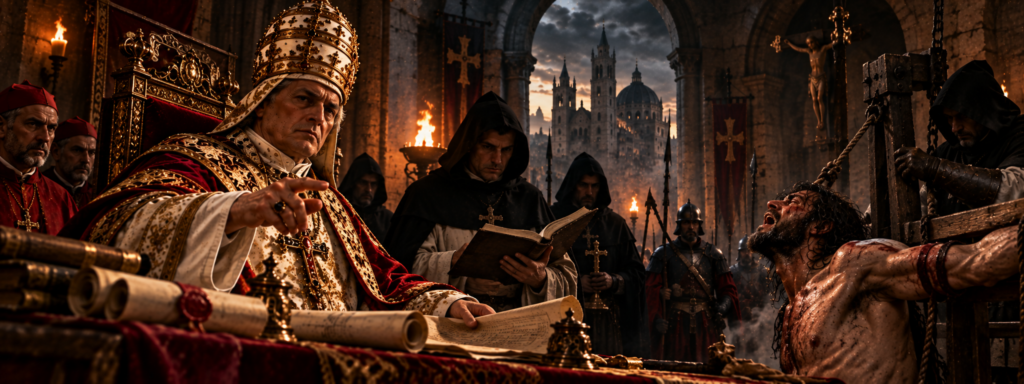
Innocent IV: The Pope Who Authorized Torture in the War Against Heresy
Innocent IV — 1243–1254
There are moments in history when violence does not arrive screaming through a shattered gate or marching behind an army. Sometimes it enters quietly, written onto parchment in careful legal language, surrounded by restrictions, procedures, qualifications, and assurances that everything will remain within acceptable limits. On May 15, 1252, Pope Innocent IV issued the bull Ad extirpanda, a document intended to strengthen the campaign against heresy in northern Italy. Among its provisions was one of the darkest developments in the history of the medieval papacy: secular authorities were permitted, under specified restrictions, to use physical coercion against suspected heretics in order to extract information.
Innocent did not invent torture, nor did he invent the medieval persecution of religious dissent. Roman law had known coercive interrogation, medieval secular courts were increasingly adopting such practices, and the papal Inquisition itself had begun developing under Gregory IX before Innocent became pope. What Innocent did was nevertheless enormously consequential because torture now received formal papal acceptance within the wider machinery being used to uncover and suppress heresy. A practice already available to secular justice had been drawn directly into a system serving the Church’s campaign against religious error.
The restrictions contained in Ad extirpanda mattered, and they should not be erased simply to make Innocent’s story more sensational. The bull did not authorize unlimited mutilation, indiscriminate brutality, or killing during interrogation, and the physical coercion it permitted was formally to be administered by secular authorities rather than by clerics themselves. Yet those qualifications cannot remove the central fact that deliberate suffering had been accepted as a legitimate means of forcing suspected heretics to reveal information. A boundary had been crossed, and it had been crossed not by a drunken, ignorant, or notoriously debauched pope but by one of the most sophisticated legal minds ever to occupy the medieval papal throne.
That distinction is precisely why Innocent IV belongs in the Wicked Popes category. He was not another Benedict IX, treating the papacy like the possession of an aristocratic clan, nor was he a John XII surrounded by lurid accusations of sexual excess and personal violence. Innocent was intelligent, legally sophisticated, politically relentless, and deeply convinced of the extraordinary authority carried by his office. The darkness of his pontificate came not from uncontrolled appetite but from the possibilities created when law itself learned how to authorize coercion.
His reign was also consumed by one of the greatest political struggles of the Middle Ages. Innocent inherited Gregory IX’s bitter conflict with Holy Roman Emperor Frederick II, fled Italy when negotiations collapsed, summoned the First Council of Lyon, declared Frederick deposed, and encouraged resistance against the emperor and his dynasty. After Frederick died, Innocent continued fighting the Hohenstaufen heirs rather than allowing the conflict to die with his old enemy. His pontificate became a demonstration of how far a thirteenth-century pope might attempt to extend spiritual authority into the political world.
Yet Ad extirpanda casts the longest and darkest shadow over Innocent’s reputation because it represented a profound escalation in the institutional treatment of heresy. The Church had already condemned heretics, supported campaigns against them, demanded their punishment, and created specialized investigators to search them out. Under Innocent, the developing inquisitorial system gained access to a method designed specifically to overcome resistance through pain. Investigation had acquired another weapon, and that weapon could now claim the protection of papal law.
Sinibaldo Fieschi: The Lawyer Who Became Pope
Before he became Innocent IV, he was Sinibaldo Fieschi, a member of the powerful Fieschi family of Liguria. His exact birth date remains uncertain, although he was probably born near the end of the twelfth century into an aristocratic environment that provided access to education, ecclesiastical advancement, and political connections. Unlike some earlier medieval popes whose careers depended primarily upon Roman factionalism, Sinibaldo became distinguished as a canon lawyer. His legal education would become one of the defining characteristics of both his intellectual legacy and his exercise of papal power.
Sinibaldo studied within the sophisticated legal culture of medieval Italy and is traditionally associated particularly with Bologna, one of Europe’s great centers for the study of Roman and canon law. Medieval lawyers there were rediscovering and systematizing legal traditions that could be used to define jurisdiction, organize authority, regulate evidence, and reconcile apparently conflicting precedents. Law was becoming one of the great technologies of medieval government, allowing rulers and institutions to exercise power through written procedure rather than relying solely upon custom or personal command. Sinibaldo absorbed that world deeply enough to become one of the most influential canonists of his century.
His ecclesiastical career advanced steadily through positions that placed him close to the center of papal administration. He served as vice-chancellor of the Roman Church and was made a cardinal by Gregory IX in 1227, becoming cardinal-priest of San Lorenzo in Lucina. These offices gave him direct experience with diplomacy, legal disputes, papal government, and the increasingly dangerous confrontation between Rome and Frederick II. When he eventually became pope, he therefore inherited a conflict he had already watched developing from inside the machinery of the Church.
Sinibaldo remained an important legal thinker even after assuming the papacy. His commentary on the Decretals of Gregory IX became highly influential among medieval canonists and helped shape later understandings of ecclesiastical jurisdiction and papal authority. He was not simply a pope who happened to possess some legal training; he was a serious jurist accustomed to translating questions of power into questions of lawful authority. That fact makes his later authorization of coercion particularly important because Ad extirpanda emerged from a papal government deeply comfortable with legal regulation.
The papal throne was difficult to fill after Gregory IX died in August 1241. The conflict with Frederick II had reached a dangerous stage, several cardinals had recently been captured by imperial forces, and divisions within the College of Cardinals made agreement extremely difficult. Celestine IV was elected after a miserable and contentious conclave but died after a pontificate lasting only about two weeks. The Church then endured a vacancy of roughly a year and a half while the cardinals struggled to find a successor capable of navigating the crisis.
In June 1243, the cardinals finally chose Sinibaldo Fieschi, who took the name Innocent IV. Frederick initially had reason to hope the new pope might prove easier to deal with than Gregory IX, because Sinibaldo had not previously been counted among his most implacable personal enemies. Yet the responsibilities of the papal office changed the relationship almost immediately. The cardinal who could maintain a degree of cordiality with Frederick became a pope responsible for defending an institution that regarded imperial domination of Italy as potentially catastrophic.
A famous tradition attributes to Frederick the observation that he had lost a friend among the cardinals because no pope could remain his friend. Whether the remark survives in precisely authentic form is less important than the political truth it expresses. The conflict between emperor and papacy was larger than the personalities occupying either office. Innocent IV soon became every bit as determined an opponent of Frederick as Gregory IX had been before him.
The Emperor Waiting Outside Rome
Frederick II was one of the most remarkable rulers of the medieval world. He was Holy Roman Emperor, king of Sicily, and a monarch whose territories and claims extended across a political geography that left the Papal States dangerously positioned between imperial interests in northern Italy and the Sicilian kingdom in the south. His government in Sicily was unusually sophisticated, his court cultivated intellectual and cultural exchange, and his personality inspired both fascination and hostility. To the papacy, however, his brilliance mattered less than the strategic danger created by his power.
Gregory IX had already excommunicated Frederick repeatedly and fought him through diplomacy, propaganda, political alliances, and military pressure. The conflict involved questions of crusading obligations, ecclesiastical privileges, imperial rights, control of Italian cities, and the independence of the Papal States. Both sides possessed genuine grievances, and neither can be reduced to a simple aggressor facing an innocent victim. By the time Innocent inherited the struggle, decades of accumulated suspicion had made compromise extraordinarily difficult.
Negotiations nevertheless began after Innocent’s election. Frederick welcomed the possibility of reconciliation, while Innocent sent representatives to discuss disputed territories and other outstanding issues. By 1244, an agreement appeared possible, but mutual distrust repeatedly undermined efforts to transform preliminary terms into a lasting settlement. Each side feared that concessions would merely strengthen an opponent who intended to resume the struggle later.
Innocent eventually concluded that remaining within Frederick’s military reach was too dangerous. Rome itself was politically unstable, imperial forces remained powerful, and the pope needed freedom to organize opposition without fearing capture or coercion. In 1244, he escaped from Italy, traveling toward the Ligurian coast and eventually reaching his native Genoa. From there he crossed the Alps and established himself at Lyon, beyond Frederick’s immediate military grasp.
The escape looked like retreat, but Innocent used distance to transform his political position. Frederick could dominate roads and cities in Italy, yet he could not easily silence a pope operating from Lyon and communicating with rulers across Latin Christendom. Innocent was now free to summon a general council and place the emperor himself at the center of an ecclesiastical prosecution. The lawyer who had fled an army prepared to fight with jurisdiction.
Lyon and the Trial of an Emperor
In 1245, Innocent convened what became known as the First Council of Lyon. The council considered several major problems confronting Latin Christendom, including reform, the condition of the Holy Land, the Mongol threat, and the wider difficulties facing the Church. Yet the conflict with Frederick II dominated the gathering because the emperor had become the greatest political enemy of the papacy. What had begun as a prolonged dispute between two powers was now presented as a crisis requiring judgment before the wider Church.
Frederick did not personally appear, but his representative Thaddeus of Suessa mounted a vigorous legal defense. The emperor faced accusations involving broken oaths, violations of peace, attacks upon ecclesiastical liberty, and conduct that Innocent considered incompatible with continued possession of imperial authority. The proceedings blended law, theology, politics, and propaganda in ways characteristic of the medieval struggle between papacy and empire. Neither side believed the dispute could be separated neatly into spiritual and secular compartments.
On July 17, 1245, Innocent pronounced the council’s most dramatic judgment. Frederick was declared deprived of his imperial and royal dignity, and those bound to him by oaths of loyalty were released from their obligations. German princes were encouraged to choose another ruler, effectively transforming papal condemnation into an invitation for political rebellion. Innocent was claiming that papal authority could reach the throne of one of Europe’s most powerful monarchs and declare its occupant unworthy to remain there.
The judgment was breathtaking in theory and much less decisive in immediate practice. Frederick did not surrender his crowns because Innocent had pronounced him deposed, and many of his supporters continued recognizing his authority. Armies still obeyed him, officials still governed in his name, and political realities could not simply be erased by a legal declaration from Lyon. Nevertheless, the sentence provided religious and political legitimacy to Frederick’s enemies and intensified opposition within the empire.
Innocent’s willingness to pronounce such a judgment reveals the extraordinary conception of papal monarchy that shaped his reign. He did not regard the pope merely as bishop of Rome or spiritual adviser to Christian rulers. Under exceptional circumstances, he believed the papal office possessed authority to judge rulers whose conduct endangered the Church and Christian order. The boundaries of jurisdiction were broad because the responsibilities Innocent attributed to the papacy were equally broad.
That same conception of authority would matter profoundly in the campaign against heresy. If the papacy possessed responsibility for protecting Christian society, religious dissent could not remain merely a private theological matter. It could become an offense requiring investigation, punishment, and cooperation between ecclesiastical and secular authorities. Innocent’s war with Frederick and his legislation against heresy were different struggles, but both emerged from an expansive understanding of legitimate papal intervention.
Holy War Turned Inward
After Lyon, Innocent intensified efforts to undermine Frederick’s position throughout Europe. Papal diplomacy encouraged opposition among German princes, and Henry Raspe of Thuringia was elected as a rival king in 1246 by a group hostile to the emperor. Henry died the following year, but William of Holland subsequently emerged as another papally supported challenger. Innocent was no longer merely condemning Frederick spiritually; he was actively encouraging a political order in which Frederick would be replaced.
The language and privileges of crusading also entered the conflict. By the thirteenth century, crusading ideology had expanded beyond expeditions to the Holy Land and could be directed against heretics, political enemies of the papacy, and other groups defined as threats to Christian order. Innocent’s struggle against Frederick participated in this widening concept of holy war. A spiritual institution could now attach sacred incentives to political warfare against another Christian ruler.
The implications were enormous because crusading privileges carried powerful religious meaning. Warriors might receive indulgences and other spiritual benefits traditionally associated with campaigns undertaken in defense of the faith. When such incentives were redirected toward conflicts within Christian Europe, the distinction between defending Christianity and defending papal political interests became increasingly difficult to maintain. Critics of the papacy recognized the problem and accused Rome of transforming sacred warfare into an instrument of temporal ambition.
Frederick’s propagandists answered Innocent with equal ferocity. They portrayed the pope as greedy, politically manipulative, and obsessed with expanding temporal power, while papal writers presented Frederick as a persecutor of the Church and a ruler whose conduct justified extraordinary resistance. Both sides produced sophisticated arguments intended for princes, bishops, cities, and educated audiences across Europe. The struggle became a war over legitimacy as much as territory.
The conflict was also extraordinarily expensive. Papal taxation and financial demands generated resentment in several kingdoms, especially when clergy were expected to help fund political campaigns that did not resemble traditional expeditions to Jerusalem. Innocent needed money to support allies, maintain administration, and continue resistance to the Hohenstaufen dynasty. The papacy’s spiritual claims therefore became entangled with the practical necessities of financing war.
Innocent’s willingness to mobilize religious authority against Frederick illustrates one of the central tensions of his pontificate. He genuinely believed the independence of the Church was endangered by imperial power, and Frederick’s strategic position gave that fear substantial foundation. Yet defending ecclesiastical independence led the pope ever deeper into dynastic politics, military alliances, taxation, and attempts to unseat rulers. The defense of spiritual liberty could look remarkably similar to the pursuit of political supremacy.
Gregory IX Had Built the Machinery
While Innocent fought Frederick, he inherited another institution that would become even more important to his historical reputation. Gregory IX had increasingly relied upon specially commissioned papal inquisitors to investigate heresy, particularly in regions where local bishops were considered unable or unwilling to suppress religious dissent effectively. Dominicans and Franciscans became important participants in these investigations. The system remained uneven and regional, but the basic principle of specialized papal investigation had been established.
Gregory had not created a single centralized Inquisition operating identically throughout Europe. Bishops retained important responsibilities, secular governments differed dramatically, and local political conditions shaped how investigations actually functioned. Nevertheless, Rome increasingly claimed the right to send investigators whose authority did not depend entirely upon local episcopal structures. Heresy was becoming a matter of specialized administration.
The system rested upon the belief that heresy often concealed itself. A suspected dissenter might attend Mass publicly while privately participating in forbidden religious networks, sheltering preachers, attending secret meetings, or maintaining beliefs condemned by the Church. If religious error could hide behind outward conformity, ordinary pastoral supervision seemed insufficient. Investigators needed methods capable of penetrating secrecy.
This created profound evidentiary problems. Belief leaves no wound, stolen object, or corpse that can be displayed before a court, so inquisitors relied upon testimony, reputation, association, confession, and reports about religious behavior. Neighbors could become witnesses, family relationships could become evidence, and old conversations could suddenly acquire legal significance. Investigation therefore moved increasingly into the private world of conscience and community.
Gregory’s own experiments had already revealed serious dangers. Conrad of Marburg’s aggressive anti-heretical activity in Germany generated intense opposition and ended with his murder in 1233. Accusations could multiply rapidly, investigators could become convinced they had uncovered vast hidden networks, and powerful local interests could resist outside interference violently. Yet Conrad’s death did not persuade the papacy to abandon specialized investigation.
Innocent inherited that developing structure rather than creating it from nothing. The inquisitor already existed, the legal category of heresy already existed, and secular governments already possessed coercive powers that churchmen themselves formally avoided exercising directly. What Innocent added in 1252 was a crucial connection between those elements. The investigation of religious dissent could now formally benefit from physical coercion.
Torture Before Innocent IV
Torture had a history far older than the medieval Inquisition. Roman law had permitted coercive interrogation under particular circumstances, especially in relation to enslaved people, and later imperial legislation modified and extended those practices. When medieval scholars rediscovered and intensively studied Roman legal texts, they encountered a sophisticated jurisprudence in which torture could appear as a regulated investigative method. The revival of Roman law therefore helped create an intellectual environment in which coercive interrogation could once again be treated as legally respectable.
Secular courts in medieval Europe were already adopting torture before Innocent issued Ad extirpanda. Its use varied widely according to region, jurisdiction, social status, and local legal traditions, making any claim that Innocent introduced torture to Europe plainly false. Some courts used coercive interrogation more readily than others, and the development was gradual rather than uniform. Innocent’s significance lies not in inventing the practice but in connecting it formally to anti-heretical enforcement under papal authority.
The Church itself maintained important restrictions concerning clerical participation in bloodshed. Clerics were not supposed to function as executioners, and ecclesiastical courts generally distinguished spiritual judgment from corporal punishment administered by secular authorities. A person condemned as an obstinate heretic could be handed over to secular power, which might then impose capital punishment under its own laws. This division of responsibility allowed ecclesiastical authorities to maintain a formal distance from the physical act of execution.
The distinction became morally complicated whenever the outcome was predictable. If an ecclesiastical tribunal knowingly handed an obstinate heretic to a secular authority whose law prescribed death, the fact that a secular executioner physically carried out the sentence did not make the ecclesiastical judgment irrelevant. Medieval institutions divided functions, but the functions remained connected. The same problem would emerge when torture became part of the investigative process.
Inquisitors wanted information because heresy was believed to spread through networks. A suspect might know the names of preachers, hosts, sympathizers, fellow believers, or people who had attended forbidden gatherings. Silence could therefore appear not merely as refusal to answer one accusation but as protection of an entire hidden community. Authorities searching for concealed networks naturally became interested in methods designed to break that silence.
By the middle of the thirteenth century, the necessary pieces were already present. Secular law increasingly accepted coercive interrogation, papal inquisitors were investigating religious dissent, and ecclesiastical authorities expected secular governments to assist in suppressing heresy. Innocent IV did not need to invent an entirely new institution. He needed only to permit those existing systems to work together more closely.
Ad extirpanda: The Door Opens
On May 15, 1252, Innocent IV issued Ad extirpanda, a bull directed particularly toward the suppression of heresy in parts of northern and central Italy. The document imposed extensive responsibilities upon secular officials, requiring them to cooperate with anti-heretical authorities and enforce legislation against people identified as heretics. It dealt with arrests, confiscations, penalties, and civic obligations in a way that treated heresy as a threat demanding coordinated public action. Religious dissent was not being left solely to sermons, theological argument, or episcopal discipline.
The most notorious provision permitted captured heretics to be compelled to reveal the truth concerning their own errors and the identities of other heretics they knew. The coercion was subject to the restriction that it should not cause death or permanent loss of limb. Heretics were compared conceptually with thieves and robbers, categories of criminals already exposed to coercive interrogation in secular law. The argument effectively asked why people regarded as destroyers of souls should enjoy greater protection than ordinary criminals.
That analogy reveals the moral universe behind the legislation. Heresy was not understood as harmless private opinion but as an active danger capable of leading others away from salvation. A heretic could therefore be imagined as committing a form of spiritual violence against the community. Once the offense was defined that way, coercive investigation became easier to justify.
The restriction against killing or permanently maiming the suspect remains historically significant. Innocent was not issuing permission for officials to inflict unlimited injury or torture prisoners to death. The presence of restrictions shows that medieval lawmakers recognized coercion as dangerous enough to require boundaries. It also demonstrates that torture was being considered deliberately and procedurally rather than appearing as an accidental excess.
Yet the same restrictions that limited torture also legitimized it. Once a legal system explains how suffering may be inflicted lawfully, the question changes from whether deliberate physical coercion is permissible to whether the official has followed the required procedure. Violence acquires rules, jurisdiction, and administrative legitimacy. That transformation is the true darkness of Ad extirpanda.
The bull did not instantly produce identical torture chambers throughout Europe. Local laws differed, implementation varied, and later popes would clarify or alter aspects of inquisitorial procedure. Nevertheless, 1252 remains a major turning point because the papacy had formally accepted coercive interrogation as an available weapon in the struggle against heresy. The machinery Gregory IX helped organize had become considerably harder.
The Meaning of “Without Loss of Life or Limb”
The restriction against death or permanent mutilation can sound almost merciful when removed from the reality of what coercive interrogation meant. Medieval authorities were attempting to distinguish controlled investigative suffering from execution or bodily destruction. The suspect was theoretically supposed to survive the interrogation without permanent crippling injury. That limit mattered legally, but it did not make the permitted suffering trivial.
Torture does not need to remove a hand or kill a prisoner to create overwhelming terror. Techniques involving restraint, suspension, pressure, stretching, and other forms of physical coercion could inflict severe pain without necessarily producing the kind of permanent mutilation prohibited by the law. Methods differed across periods and regions, so it would be inaccurate to project every later inquisitorial technique backward into Innocent’s reign. The important point is that deliberate pain itself had become permissible.
The restrictions reveal the administrative mentality behind the process. Torture was not supposed to be vengeance performed by an enraged official. It was supposed to produce information, which meant the prisoner needed to remain alive, conscious, and capable of answering questions. Pain had acquired a defined investigative purpose.
This procedural framing could make coercion appear rational rather than savage. There were rules concerning its use, an objective it was supposed to achieve, and boundaries officials were instructed not to cross. A practice that might otherwise look like assault could therefore be understood by its administrators as lawful interrogation. The language of regulation changed the institutional meaning of the violence without changing what the prisoner physically experienced.
That distinction is one reason Innocent’s role matters so much. Arbitrary violence is comparatively easy for a legal system to condemn because it openly violates established order. Authorized violence is more difficult because the institution itself has declared the act legitimate under specified conditions. Innocent helped place inquisitorial torture in the second category.
He may even have regarded regulation as a means of restraining worse abuses. By defining limits, papal law could claim to prevent officials from killing or permanently maiming suspects during interrogation. Yet regulation and authorization occurred simultaneously, and the protective clause cannot be separated from the permission surrounding it. The same law that said how far officials should not go also told them that they could deliberately inflict pain before reaching that boundary.
Why Confession Became So Important
Confession occupied a powerful place in medieval Christianity. Sacramental confession was associated with repentance and reconciliation, while legal confession could provide compelling evidence in judicial proceedings. For an inquisitor, a confession could identify not only what the suspect believed but whether the person was willing to renounce condemned teachings. The distinction between repentance and obstinacy could determine whether a defendant received penance or faced much more serious consequences.
The problem arose when suspects denied accusations or refused to identify others. Investigators dealing with alleged underground networks might believe they possessed evidence showing that a prisoner knew more than he or she admitted. Silence could therefore be interpreted as deliberate concealment rather than innocence. Once that assumption took hold, interrogation became a contest between the investigator’s certainty and the prisoner’s refusal.
Torture appeared to offer a way through that impasse. Physical pain could supposedly break deliberate resistance and force hidden knowledge into the open. The human body became an obstacle that investigators believed could be overcome in order to reach truth. Yet the method contained a fatal contradiction because extreme suffering creates an incentive to say whatever seems most likely to make the suffering stop.
A tortured prisoner might confess truthfully, but the same prisoner might also invent accomplices, repeat rumors, confirm accusations suggested by interrogators, or admit to acts never committed. If officials already expected a hidden network, coerced testimony could conveniently provide one. Each newly named person could then become another source of names. A system designed to uncover conspiracies therefore possessed the capacity to manufacture them.
Medieval jurists were not completely ignorant of this danger. Rules concerning evidence, confirmation, and the circumstances under which torture could be employed developed partly because legal thinkers understood that pain could produce unreliable statements. Yet awareness of the problem did not lead authorities to reject torture altogether. Instead, they attempted to regulate an inherently unreliable method.
That decision reveals the extraordinary confidence medieval legal institutions placed in procedure. The danger of false confession could supposedly be managed through rules rather than by prohibiting coercion. Innocent’s bull belonged squarely within that legal mentality. The answer to dangerous power was often better-regulated power.
The Secular Hand and the Church’s Judgment
Medieval churchmen maintained a formal distinction between ecclesiastical judgment and the shedding of blood. Clerics were not supposed to act as executioners, and ecclesiastical institutions generally transferred condemned obstinate heretics to secular authorities rather than carrying out capital punishment directly. Secular rulers possessed laws under which heresy could receive severe corporal or capital penalties. The system therefore depended upon cooperation between institutions with different jurisdictions.
This division has sometimes been used to claim that the medieval Church did not execute or torture because secular officials physically carried out those acts. Such a formulation is technically attentive to jurisdiction but historically incomplete. If ecclesiastical authorities investigated a suspect, determined guilt, and knowingly transferred the condemned person into a secular system that prescribed death, the Church remained an essential part of the process. Dividing the labor did not erase the chain of responsibility.
The same issue surrounded Ad extirpanda. Physical coercion was assigned to secular authorities rather than requiring clerical inquisitors to become torturers themselves. Yet the information extracted through that coercion served an investigation whose central purpose was the suppression of heresy. Ecclesiastical and secular functions remained distinct while operating toward a shared objective.
The distinction nevertheless mattered enormously in medieval law. Conflicts over arrest, imprisonment, confiscation, interrogation, sentencing, and execution could produce fierce disputes between bishops, inquisitors, civic governments, nobles, and rulers. Medieval Europe was not governed by one unified authority. The anti-heretical system worked precisely because institutions with different powers were required to cooperate.
Innocent’s legislation strengthened that cooperation. Secular coercive power became explicitly available within a papally supported campaign against religious dissent. The Church could maintain its canonical distance from directly shedding blood while obtaining information produced through methods that deliberately inflicted suffering. The arrangement protected institutional categories more effectively than it protected the body of the suspect.
That is why the legal distinction must be acknowledged without becoming an excuse. Innocent did not order clerics everywhere to seize torture instruments personally. He authorized a system in which other officials could inflict pain for an investigation the Church considered necessary. Responsibility was distributed, but it did not disappear.
Heresy as Disease, Poison, and Crime
Medieval Christian language frequently described heresy through metaphors of contamination. Religious error could be imagined as disease spreading through the body of the Church, poison entering a healthy community, or weeds choking good plants. Such metaphors were common because medieval authorities did not regard doctrine as an entirely private matter. Belief shaped salvation, community, worship, and social order.
The title Ad extirpanda itself belongs to this world of uprooting. The objective was not merely to debate heretical ideas until they disappeared through persuasion. The danger was imagined as something requiring removal before it spread. Once the metaphor became one of infection, tolerance could be portrayed as negligence.
That mentality helps explain how severe persecution could be carried out by people who did not regard themselves as cruel. If heresy endangered eternal souls, allowing it to circulate might seem more immoral than coercing those believed to spread it. Authorities could understand punishment as protection, investigation as pastoral responsibility, and forced disclosure as a means of saving an endangered community. The moral vocabulary surrounding persecution therefore reversed the perspective of the victim.
Innocent’s bull strengthened this transformation by comparing heretics conceptually with serious secular criminals. A person accused of religious dissent was not being imagined merely as someone holding an incorrect philosophical opinion. Heresy was treated as socially destructive behavior. The heretic became an offender whose secrecy could justify coercive investigation.
Once religious identity had been criminalized in that way, the body itself could become evidence-producing territory. Silence was suspicious, association mattered, and private belief acquired public consequences. The system did not need to deny that conscience existed. It needed only to insist that conscience became punishable when it crossed boundaries defined by the Church.
This was the deeper transformation behind Innocent’s legislation. Torture was not an isolated cruelty accidentally attached to an otherwise unrelated institution. It followed from a worldview in which hidden belief could constitute a grave public crime. When the alleged crime existed inside the mind, investigators inevitably became interested in methods designed to force the mind to reveal itself.
The Expanding Power of the Inquisitor
Before torture received formal authorization, inquisitors already possessed formidable powers. They could summon suspects, collect testimony, hear witnesses, impose penances, examine religious practices, and reconstruct networks of association. Communities might be ordered to cooperate, and individuals could face serious consequences for protecting people considered heretics. The inquisitor’s greatest resource was information.
Ad extirpanda expanded what could happen when information was believed to be withheld. A suspect’s refusal to answer could now lead to deliberate physical pressure under specified circumstances. The body entered the investigative process not merely as the object being detained but as something upon which the institution could act to obtain speech. Silence acquired a new physical danger.
The authorization also mattered even when torture was not actually used. A prisoner who knew coercion was legally available might confess or provide names before any physical suffering occurred. Threat can exercise power without being carried out. The existence of torture therefore changed the psychological environment of interrogation itself.
That atmosphere extended beyond individual prisoners. Families, neighbors, hosts, and associates knew that investigations could expand through testimony. A person deciding whether to shelter a suspected dissenter or remain silent about a meeting now faced an institution capable of escalating pressure. Fear could travel through a community before any official sentence was pronounced.
This is one reason historical assessments cannot rely solely upon counting documented torture sessions or executions. Institutional power also operates through expectation. A legal possibility shapes behavior precisely because people know it may be used. The threat of coercion can become part of everyday social discipline.
Innocent’s legislation therefore strengthened the inquisitor even when the inquisitor never touched a prisoner. Behind the questions stood the possibility of another authority capable of inflicting pain. The interrogator’s words carried the shadow of the secular coercive power the papacy had approved.
Innocent the Jurist
It is tempting to describe the authorization of torture as simply an example of medieval barbarism, but that explanation misses what makes Innocent IV so important. He was not indifferent to law, procedure, or intellectual argument. He was immersed in them. His reputation as a canonist rested upon precisely the kind of sophisticated legal reasoning modern readers might instinctively expect to restrain arbitrary violence.
His commentary on the Decretals of Gregory IX became a major work of medieval jurisprudence. Innocent considered questions involving jurisdiction, papal authority, political sovereignty, procedure, property, relations with non-Christians, and the limits of different forms of government. His ideas influenced later lawyers for generations. He belonged among the most intellectually formidable popes of the thirteenth century.
That makes Ad extirpanda more unsettling rather than less. Torture was not authorized because law had disappeared in a frenzy of religious hatred. It was authorized through a legal framework attempting to determine who could use coercion, against whom, under what circumstances, and within what boundaries. The law did not collapse before violence; it organized violence.
This demonstrates a broader historical truth about sophisticated legal cultures. Procedure can restrain arbitrary cruelty, but procedure can also make coercion more stable and respectable. A violent official acting without authorization is vulnerable to punishment for abuse. An official acting inside a recognized procedure can understand the same physical act as professional duty.
Innocent apparently believed that jurisdiction and regulation could distinguish legitimate coercion from lawless brutality. That assumption fits his broader career perfectly. He repeatedly approached questions of power by asking who possessed lawful authority and how that authority could be exercised. Once legitimacy had been established, force could become acceptable.
For Innocent, papal authority occupied an exceptionally elevated position in that hierarchy. The pope could judge emperors under extraordinary circumstances, regulate Christian society, direct campaigns against heresy, and coordinate secular powers in defense of the Church. The legal mind and the powerful pope were therefore not separate aspects of his personality. They reinforced one another.
The Pope Who Claimed Power Over Kings
Innocent’s confrontation with Frederick II revealed just how far his conception of papal authority could extend. At Lyon, he did not merely criticize the emperor or impose another spiritual censure. He declared Frederick deprived of his crowns and released subjects from their oaths. The papal office was claiming a jurisdiction capable of reaching into the political foundations of imperial government.
Innocent’s legal writings likewise articulated an expansive understanding of papal responsibility. He recognized forms of legitimate authority outside direct Christian rule, which makes simplistic claims that he denied all rights to non-Christian rulers inaccurate. Yet he also understood the pope’s responsibility for salvation and natural law in ways that could justify intervention far beyond ordinary ecclesiastical administration. His papal universe possessed few completely sealed borders.
The medieval world itself encouraged overlapping jurisdictions. Kings, emperors, bishops, nobles, monasteries, communes, universities, and popes all possessed privileges and legal rights that frequently collided. Modern distinctions between church and state cannot simply be imposed upon that landscape. Innocent’s papal monarchy developed inside a society where spiritual and political authority were constantly intertwined.
His approach toward heresy followed naturally from this understanding. If the pope bore responsibility for Christian order, then religious dissent could not remain entirely private. The papacy could investigate, condemn, and demand secular assistance because salvation itself had public consequences. Pastoral responsibility expanded into jurisdiction.
The same logic applied to Frederick. Innocent believed the emperor had endangered ecclesiastical liberty and therefore could not shelter behind secular sovereignty. Imperial dignity did not place Frederick beyond judgment. Papal responsibility could reach even the highest throne in Latin Christendom.
This enormous conception of office explains both Innocent’s achievements and his dangers. He possessed the intellectual ability to turn expansive claims into carefully reasoned legal positions. Once those positions were accepted, the papacy acquired extraordinary tools for intervention. The question of what should remain beyond papal reach became increasingly difficult to answer.
The Mongols Beyond the Horizon
While Innocent fought Frederick and strengthened anti-heretical legislation, Latin Christendom faced a terrifying threat from the east. Mongol armies had devastated enormous territories and invaded eastern Europe in the early 1240s, producing reports of destruction that horrified western rulers and churchmen. The sudden withdrawal of major Mongol forces did not eliminate the fear that another invasion might come. Europe needed information about an empire it barely understood.
Innocent responded through diplomacy and missionary initiative. In 1245, he sent the Franciscan John of Plano Carpini on an extraordinary journey toward the Mongol court. John traveled across vast distances and eventually witnessed the enthronement of Güyük Khan. His account became one of medieval Europe’s most valuable early descriptions of Mongol society, military organization, geography, and political expectations.
The exchange between papacy and Mongols revealed two universal political visions colliding. Innocent’s communications called upon the Mongols to cease attacks upon Christians and approached them from within a Christian framework of papal spiritual authority. The Mongol response came from an imperial worldview in which rulers were expected to submit to the Great Khan. Neither side accepted the other’s assumptions about the structure of the world.
The mission did not produce Mongol conversion or submission, but it gave western Europe valuable intelligence and established channels of contact. Innocent’s willingness to send envoys across such distances demonstrates the enormous geographic imagination of his papacy. His conception of Christian responsibility extended far beyond Rome, Italy, or even western Europe.
That expansive vision could produce genuine cultural contact, but it also possessed coercive implications. Innocent’s legal thought considered circumstances under which non-Christian rulers might be expected to admit Christian missionaries and observe principles understood as natural law. Universal spiritual responsibility could become a basis for intervention. The same pope who authorized coercion against suspected heretics at home was thinking about papal relationships with peoples far beyond Latin Christian rule.
This does not mean his Mongol diplomacy should be reduced to inquisitorial policy. The contexts were different, and the missions themselves were remarkable achievements in communication and observation. Yet both reveal Innocent’s inability to imagine the papal office as narrow. His authority always looked outward.
Jewish Communities and the Boundaries of Protection
Innocent’s policies toward Jewish communities reveal another contradiction within medieval papal government. The Church maintained discriminatory restrictions against Jews while also possessing a tradition of papal protection against forced baptism, unlawful violence, and certain forms of seizure or harassment. Innocent operated within both traditions rather than choosing one exclusively. His policies therefore combined protection with profound inequality.
A major controversy during his pontificate concerned the Talmud and other Jewish religious writings. Earlier accusations against Jewish texts had contributed to the notorious burning of manuscripts in Paris in 1242 under the government of Louis IX. The dispute continued under Innocent, with Christian authorities examining whether Jewish writings contained material they regarded as blasphemous or hostile to Christianity. Jewish religious scholarship was therefore exposed to judgment by institutions belonging to another faith.
Innocent’s position was not entirely static, and he showed some awareness that Jewish religious life could not simply be reduced to the Hebrew Bible as Christians understood it. Nevertheless, papal policy continued to assume Christian authority to regulate Jewish existence within Christian society. Protection did not mean equality. Jewish communities remained legally vulnerable to decisions made without their consent.
The pattern resembles Innocent’s broader understanding of government. Difference could be tolerated within boundaries established by legitimate authority. The authority defining those boundaries also claimed the right to intervene when it believed those limits had been crossed. Protection and coercion could therefore coexist within the same legal system.
This complexity matters because Innocent should neither be transformed into a modern advocate of religious toleration nor reduced to a caricature of indiscriminate hatred. Medieval papal policy could genuinely restrain mob violence while simultaneously enforcing discriminatory structures. The contradiction belonged to the system itself. Innocent’s legalism gave that system both protective and coercive force.
His pontificate repeatedly demonstrates the ambiguity of ordered power. Law could shield vulnerable communities from one danger while exposing them to another. Innocent trusted legal categories because he believed proper classification produced justice. People placed inside those categories did not always experience the result as just.
When Regulation Becomes Permission
Defenders of regulated coercion throughout history have often argued that rules prevent worse abuses. There is some truth in that claim because a prohibition against killing a prisoner during interrogation is preferable to unlimited permission to torture someone to death. Requirements concerning evidence, authorized officials, and procedure can restrain arbitrary violence. The difficulty is that regulation can simultaneously normalize the act being regulated.
Before an act receives formal authorization, an official performing it may need to justify violating established rules. After authorization, the burden changes because the act becomes legitimate whenever officials declare that the required conditions have been satisfied. The violence itself no longer appears exceptional. Only violations of its procedural boundaries appear improper.
Ad extirpanda illustrates this transformation with unusual clarity. Torture was not presented as uncontrolled cruelty or personal vengeance. It was treated as a permissible investigative method under restrictions. The existence of those restrictions could make permission itself seem moderate.
This is one of the most unsettling features of Innocent’s legacy. He did not tear down legal barriers in a moment of rage. His government opened a legal passage through them. Officials were told that they could cross the boundary provided they did not travel beyond another boundary placed farther ahead.
Later inquisitorial law would continue wrestling with questions concerning evidence, repetition, confirmation of confession, and clerical involvement. Each clarification could restrain particular abuses while also making the institution more administratively sophisticated. Regulation gave officials a vocabulary through which they could discuss coercion as a technical problem. Torture became something lawyers could manage.
The transformation from violence into procedure is therefore central to understanding Innocent IV. A scream inside an illegal dungeon is obviously an abuse of authority. A scream produced under authorized interrogation is more difficult for the institution to condemn because the institution has already decided the suffering can be lawful. Innocent helped create that second possibility.
The Fundamental Problem of False Confession
Torture contains a contradiction no legal regulation can eliminate. It is supposed to produce truth by creating an overwhelming incentive for the prisoner to speak. Yet the same incentive creates an equally overwhelming reason to say whatever the prisoner believes will stop the pain. The mechanism intended to uncover truth therefore possesses an inherent ability to manufacture falsehood.
Medieval jurists recognized at least part of this danger. Rules developed concerning the evidence necessary before torture, the confirmation of statements, and the circumstances in which coercion could be applied. These rules varied by jurisdiction and changed over time, making sweeping descriptions unreliable. Their existence nevertheless proves that authorities understood coerced testimony could be problematic.
Confirmation after torture did not necessarily solve the problem. A prisoner who knew the coercion might resume if a confession were withdrawn had strong reasons to repeat whatever had previously been said. Fear remained after the immediate physical suffering ended. A formally voluntary confirmation could therefore exist under the shadow of threatened renewed pain.
The problem became especially serious when inquisitors expected networks. A prisoner could name acquaintances simply because interrogators demanded names, and those newly accused people could then face questioning of their own. If each frightened person supplied several additional suspects, an investigation could expand rapidly. Coercive testimony could create the appearance of a vast conspiracy even when relationships were far more ambiguous.
None of this means medieval heresy was imaginary. Cathars, Waldensians, and other dissident movements genuinely existed, although historians continue debating aspects of their organization, beliefs, and the extent to which inquisitorial categories shaped surviving descriptions. Many people consciously rejected teachings or practices demanded by the Church. Recognizing genuine dissent does not make torture a reliable way of discovering it.
Innocent’s authorization therefore attempted to solve one uncertainty by creating another. Investigators feared that suspects concealed the truth, so they received access to a method capable of producing both truth and lies. The law could regulate when torture occurred. It could never guarantee that pain made testimony accurate.
The War Outlives Frederick
Frederick II died in December 1250, ending the life of the ruler who had dominated Innocent’s pontificate. The pope had survived his greatest political enemy, and the emperor’s death opened the possibility that Innocent might finally return to Italy without facing the same overwhelming threat. Yet the Hohenstaufen dynasty remained powerful. Frederick’s sons and supporters ensured that the struggle would not end with one man’s death.
Conrad IV inherited important Hohenstaufen claims, while Frederick’s illegitimate son Manfred emerged as a formidable political figure in southern Italy. Innocent feared that either man might reconstruct the same geographical threat posed by Frederick. The papacy therefore continued seeking ways to break Hohenstaufen control of Sicily. The conflict had become dynastic rather than personal.
Innocent explored alternative rulers for the Sicilian kingdom and attempted to reshape the political order of southern Italy. His successors would eventually carry this strategy much further, most dramatically by inviting Charles of Anjou to challenge the Hohenstaufen heirs. That later struggle culminated in Manfred’s death at Benevento in 1266 and the execution of the young Conradin in 1268. Innocent did not live to see those events, but his policies helped establish the direction in which papal strategy moved.
The prolonged conflict also contributed to the deepening divisions later associated with Guelf and Ghibelline politics. Italian cities and aristocratic families possessed their own local rivalries, so these labels should never be treated as perfectly coherent national parties. Nevertheless, papal and imperial alignments became powerful frameworks through which local conflicts could be understood and intensified. The struggle between Rome and the Hohenstaufens cast a long political shadow.
Innocent considered these interventions necessary for papal survival. A Hohenstaufen ruler securely controlling Sicily and exerting dominant influence in northern Italy could leave the Papal States strategically trapped. From the pope’s perspective, the danger was real. The problem was that eliminating the danger required the papacy to become increasingly entangled in the dynastic politics it claimed the right to judge.
The struggle therefore reveals the recurring paradox of Innocent’s reign. The papacy defended its freedom by exercising more political power. Every attempt to escape domination drew Rome more deeply into the contests of princes. Innocent did not merely survive medieval politics; he helped make the papacy one of its most aggressive participants.
The Return to Italy
After Frederick’s death, Innocent gradually moved back toward Italy. He left Lyon in 1251 and eventually returned to Rome in 1253, demonstrating that the papacy could survive years of physical displacement from its traditional capital. The administrative Church had become strong enough for a pope to govern much of Latin Christendom while operating from beyond the Alps. Exile had weakened Innocent geographically without silencing him institutionally.
His return did not bring peace. Conrad IV remained a threat until his death in 1254, while Manfred continued building power in southern Italy. Innocent attempted to assert papal authority over the succession and initially dealt with Manfred pragmatically. Mutual suspicion soon destroyed whatever cooperation was possible.
Military confrontation followed, and papal forces attempted to impose Innocent’s preferred political settlement in the south. Manfred proved more capable than the pope expected. In December 1254, his forces defeated papal troops at Foggia, strengthening his position and humiliating the papal cause. Innocent’s dream of quickly dismantling Hohenstaufen power remained unrealized.
By then the pope was seriously ill. He died at Naples on December 7, 1254, after an eleven-year pontificate dominated by law, war, diplomacy, heresy, missionary activity, and relentless political struggle. Frederick was dead, but the dynasty Innocent feared had not vanished. The inquisitorial system he had strengthened likewise continued without him.
His death therefore resolved remarkably little. The political struggle passed to his successors, while Ad extirpanda remained part of the legal development of anti-heretical prosecution. Innocent had spent his reign attempting to secure the future of the papacy. Some of the tools he left behind would prove more durable than the political victories he had pursued.
Was Innocent Personally Responsible?
Historical responsibility requires more nuance than attaching every word of a medieval legal document solely to the personality of the pope whose seal authenticated it. Papal legislation emerged from a complicated administrative world involving canon lawyers, cardinals, inquisitors, secular officials, local statutes, political pressures, and existing legal traditions. Ad extirpanda reflected practices already developing in Italian cities and secular courts. Innocent did not invent its entire legal universe.
Secular governments had their own reasons for punishing heresy. Rulers and urban governments feared disorder, challenges to authority, and movements they associated with political instability as well as religious error. Anti-heretical legislation therefore emerged through interaction between ecclesiastical and secular powers. The papacy was central, but it was not the only actor.
Yet papal authorization mattered enormously. Innocent possessed the authority to promulgate the bull, and its provisions entered the legal history of the Church under his pontificate. Later popes would renew and develop elements of the system. The fact that Innocent worked within existing trends does not remove his agency.
There is no need to imagine him personally designing torture devices or standing beside prisoners during interrogation. Such imagery would replace institutional history with melodrama. His responsibility was legal and administrative. He authorized a framework in which torture could serve the campaign against suspected heretics.
That kind of responsibility suited Innocent perfectly. He was a jurist rather than an executioner, and his power operated through decrees, councils, jurisdictions, legal interpretations, appointments, and political judgments. His hands did not need to hold the instruments. The parchment could instruct other hands.
This is precisely why his story deserves attention. Personal cruelty is easy to recognize because the cruel person is visibly present. Institutional cruelty can place enormous distance between the authority granting permission and the person experiencing pain. Innocent IV demonstrates how powerful that distance can become.
The Pope Who Made Coercion Respectable
The most disturbing aspect of Innocent’s role is not that he embraced uncontrolled brutality. It is that his government helped make controlled brutality legally respectable. Torture entered the anti-heretical system surrounded by restrictions designed to distinguish lawful interrogation from lawless violence. Those distinctions could reassure administrators that they remained within the boundaries of justice.
The psychological effect matters because officials rarely wish to understand themselves as villains. A legal framework allows individuals to interpret painful actions as duties assigned by legitimate authority. The secular officer can say the law permits coercion, the inquisitor can say the suspect possesses necessary information, and the administrator can say safeguards have been observed. Responsibility becomes divided among people performing specialized functions.
The prisoner experiences the system differently. Pain remains pain whether the person inflicting it acts from sadism, obedience, religious conviction, or professional routine. Legal language changes the institutional status of the act. It does not change the physical experience.
Innocent’s legacy therefore forces an important distinction between sadism and institutional wrongdoing. There is no reason to imagine him taking personal pleasure in the suffering of suspects. His legislation did not depend upon personal cruelty. Institutions capable of inflicting suffering efficiently do not require sadists at every level.
They require people willing to accept the legitimacy of the procedure. Innocent supplied that legitimacy from the highest ecclesiastical office in western Christianity. His authorization gave coercion something far more durable than an individual torturer’s enthusiasm. It gave coercion a place within law.
What Happened After Innocent
The papal Inquisition continued after Innocent’s death and developed differently across Europe. Dominican and Franciscan inquisitors remained active in various regions, while bishops continued exercising anti-heretical authority of their own. Political rulers influenced how investigations functioned, and local conditions could dramatically alter the severity of enforcement. There was never one perfectly uniform medieval Inquisition operating identically everywhere.
Torture likewise remained available within inquisitorial procedure under regulated circumstances. Surviving evidence does not support the popular image that every person brought before an inquisitor was automatically tortured. Many investigations proceeded through testimony, confession, documentary evidence, reputation, and other methods. Some tribunals used physical coercion more sparingly than sensational popular accounts imply.
Yet the opposite claim, that torture was insignificant because it was regulated or relatively infrequent in some places, is equally misleading. Legal availability matters even when a power is not constantly exercised. A suspect who knows torture is possible enters interrogation under a different kind of pressure. The threat itself can shape testimony.
Later inquisitorial institutions also need to be distinguished carefully from the system developing under Innocent. The Spanish Inquisition established in the late fifteenth century operated within a different political relationship between monarchy and papacy. The Roman Inquisition of the sixteenth century developed in another historical environment. Treating every institution called an Inquisition as one unchanged organization produces bad history.
Institutional ancestry nevertheless remains important. Gregory IX had helped normalize specialized papal inquisitors. Innocent IV allowed coercive interrogation to enter the machinery available against heresy. Later authorities inherited those developments and modified them.
The history therefore unfolded through accumulation rather than one dramatic invention. No single pope created everything later associated with inquisitorial persecution. Gregory provided crucial organizational foundations, Innocent authorized a major escalation, and later generations continued building. That gradual process made the institution more durable because each stage could appear merely to refine what already existed.
Innocent IV Among the Wicked Popes
Compared with the scandalous figures of earlier centuries, Innocent IV can initially seem an unusual choice for a category called Wicked Popes. He was not notorious for drunkenness, sexual misconduct, grotesque private cruelty, or selling the papal throne. His contemporaries knew him as a formidable churchman and jurist. His darkness operated at the level of government rather than appetite.
His pontificate included an attempt to depose one of Europe’s most powerful emperors, an international campaign against the Hohenstaufen dynasty, extensive papal involvement in warfare and dynastic politics, and the formal authorization of torture within anti-heretical enforcement. These were not secret scandals whispered about behind palace doors. They were public exercises of institutional authority. Their consequences extended far beyond Innocent’s private life.
A fair assessment must acknowledge the arguments available in his defense. Frederick II genuinely possessed enough power to threaten papal independence, secular torture already existed, heresy was widely regarded as a grave social and spiritual danger, and Ad extirpanda attempted to impose limits rather than authorize unrestricted brutality. Those facts are historically essential. Removing them would turn Innocent into a caricature.
None of them changes what the papacy accepted in 1252. A suspected heretic could be subjected to deliberate physical coercion in order to obtain information, and that coercion now possessed formal papal approval within specified limits. The fact that torture was regulated does not make it cease to be torture. The fact that Innocent inherited the practice from secular law does not erase his decision to incorporate it into anti-heretical procedure.
Innocent therefore represents a different kind of wickedness from the spectacularly corrupt popes who preceded him. Benedict IX’s scandals appear chaotic and personal, while Innocent’s most disturbing legacy appears ordered and administrative. One abused the papacy as property. The other demonstrated what the papacy could accomplish when a brilliant administrator believed coercion could be made lawful.
That contrast makes Innocent’s story especially valuable for Infamous History. Evil in history does not always arrive wearing the face of obvious depravity. Sometimes it arrives through competent people convinced that they are protecting society. The frightening part is not that the rules disappear but that the rules begin permitting what previously required an excuse.
The Shadow of 1252
The year 1252 deserves recognition as a significant turning point in the history of religious persecution. It was not the beginning of torture, and it was not the beginning of inquisitorial investigation. It was a moment when those two existing developments became more closely connected under papal authority. The resulting combination would have consequences extending far beyond Innocent’s lifetime.
Gregory IX’s inquisitors had already demonstrated Rome’s determination to search actively for concealed heresy. Innocent’s legislation accepted that secular coercive methods could be used to force suspected heretics to provide information. The investigator and the torturer could occupy different institutional roles while serving the same process. Administrative specialization divided responsibility without dividing the objective.
The restrictions within Ad extirpanda reveal that Innocent’s government understood coercion required limits. Death and permanent mutilation were not supposed to result from interrogation, and torture existed inside a framework of legal obligations rather than unrestricted personal vengeance. Those qualifications should remain part of any accurate account. They reveal precisely how violence was being transformed into procedure.
Once deliberate suffering had been accepted in principle, later questions increasingly concerned application. Under what conditions could torture be used, what evidence was necessary beforehand, how could statements be confirmed, and what counted as unlawful repetition? Such questions could genuinely restrain abuses. They could also normalize the underlying assumption that torture itself belonged within legitimate investigation.
That is perhaps Innocent’s darkest institutional contribution. He helped move coercion from the margins of violence into the language of administration. The process acquired officials, restrictions, and legal reasoning. A scream could now occur inside a procedure that the institution considered lawful.
The significance reaches beyond the Middle Ages because the logic is painfully familiar. Governments throughout history have justified coercive interrogation by pointing to hidden enemies, urgent threats, vital information, and carefully designed safeguards. They insist that only limited force will be used and that extraordinary circumstances require extraordinary methods. Innocent’s world possessed its own version of the same argument.
When Pain Became Policy
Innocent IV did not invent the fear of heresy that haunted medieval Christianity. He inherited a Church in which religious unity was widely understood as essential to salvation and social order, while dissent could be imagined as contamination spreading through an otherwise Christian community. The Albigensian Crusade had already shown how violently Latin Christendom could respond to heresy, and Gregory IX had already helped create the developing system of papally commissioned inquisitors. Innocent stepped into an existing history of repression rather than beginning it.
He did not invent torture either. Secular courts were already rediscovering and adapting coercive interrogation through legal traditions influenced partly by Roman law. Judicial torture existed independently of Ad extirpanda, and pretending otherwise would give Innocent responsibility for something far older than his pontificate. His historical importance lies in the decision to make that existing coercive power formally available within the machinery directed against heresy.
In 1252, the papacy accepted that a suspected heretic could, under prescribed conditions, be subjected to deliberate physical coercion in order to reveal information. The person was not supposed to be killed during the interrogation, and permanent mutilation was prohibited. Those restrictions mattered because they reveal an attempt to distinguish regulated coercion from uncontrolled brutality. They do not alter the fact that suffering itself had become an authorized investigative method.
The logic behind the decision could appear compelling to the people who accepted it. Heresy was believed to threaten souls, hidden networks were believed to protect dangerous teachers, and ordinary questioning might fail to uncover the truth. If pain could force a suspect to reveal accomplices, authorities could convince themselves that one person’s suffering protected an entire Christian community. Coercion could therefore be described as a reluctant necessity rather than cruelty.
That moral reversal is one of the most disturbing features of institutional persecution. Violence becomes easier to administer when the person inflicting it believes the violence protects innocent people from something worse. The official does not need to hate the prisoner. He needs only to believe the prisoner possesses information too important to remain hidden.
Innocent’s legal mind was exceptionally well suited to constructing such a system because he believed deeply in the power of regulated authority. His entire career had taught him that jurisdiction, procedure, and law could transform conflict into governable categories. He approached emperors, heretics, political rivals, and ecclesiastical disputes through questions of legitimate power. Once legitimate power had been established, force could follow.
His struggle with Frederick II demonstrated the same instinct on the grandest political scale. Innocent believed the emperor threatened the liberty of the Church, so he constructed a legal case capable of supporting Frederick’s deposition. The declaration did not magically remove Frederick from power, but it gave his enemies religious and political legitimacy. Papal law became a weapon in an international struggle.
When Frederick died, Innocent did not simply declare victory and withdraw from secular politics. He continued working against the Hohenstaufen dynasty because the strategic threat remained. The enemy had expanded from one emperor into a political system. Innocent’s response expanded with it.
His treatment of heresy followed a comparable pattern. The Church did not merely confront individual preachers who openly challenged doctrine. It confronted networks, sympathizers, protectors, hosts, and communities believed to conceal religious dissent. The problem became systemic, and Innocent responded with systemic power.
That is why his pontificate cannot be understood through body counts alone. The historical significance of Ad extirpanda is not measured simply by determining how many prisoners were tortured immediately after May 1252. Institutions matter because they create possibilities that can be used repeatedly. A power need not be exercised every day to transform the relationship between authority and the people subject to it.
The threat of torture could alter an interrogation before torture occurred. A suspect who knew that continued silence might bring physical coercion faced pressure fundamentally different from ordinary questioning. The same possibility could influence witnesses, relatives, and associates. Fear became part of the investigative environment.
The legal safeguards did not eliminate that fear. They helped define the conditions under which fear could be intentionally created. Officials could reassure themselves that they were obeying restrictions even while the prisoner understood that suffering had become an accepted possibility. The institution’s conscience and the prisoner’s experience could therefore diverge completely.
This is where Innocent IV becomes especially important among the Wicked Popes. His story is not primarily about secret vice, personal depravity, or uncontrolled rage. It is about the capacity of respectable authority to make coercion respectable. The darkness lies in the procedure itself.
A pope like Benedict IX could scandalize the Church through his behavior and eventually disappear, leaving later reformers to condemn his memory. Innocent left something more durable because legal permissions can outlive the people who grant them. A decree can be copied, cited, renewed, interpreted, and incorporated into later practice. Institutional memory survives personal mortality.
The inquisitorial system continued after Innocent died. Later popes and inquisitors modified its procedures, regional differences remained substantial, and the institutions commonly grouped under the word “Inquisition” changed enormously over subsequent centuries. Innocent cannot honestly be blamed for every later tribunal or every later act of torture. Historical responsibility becomes meaningless if centuries of development are collapsed onto one individual.
Yet neither can his role be reduced to an insignificant technical adjustment. Gregory IX had helped establish specialized papal investigators, and Innocent IV formally accepted physical coercion within the wider system serving their objective. Later developments had somewhere to begin because earlier authorities had already crossed essential boundaries. Innocent stands at one of those boundaries.
His brilliance makes the episode more unsettling. An ignorant ruler might authorize brutality without understanding what he was doing. Innocent possessed the legal sophistication to understand distinctions, limitations, jurisdictions, and procedural consequences. His government still concluded that torture could be permissible.
The history of coercion repeatedly demonstrates that education alone does not prevent institutional cruelty. Intelligent people can construct sophisticated arguments for actions that inflict enormous suffering. Lawyers can create safeguards around practices that should perhaps never have been authorized. Administrators can become more efficient at enforcing unjust rules.
Innocent’s legacy therefore offers no comforting division between civilization and barbarism. The torture permitted by Ad extirpanda was not outside medieval law. It was brought inside law. That difference is precisely what made it durable.
The same uncomfortable truth applies to his political career. Innocent did not regard his campaign against Frederick as naked ambition. He believed the independence of the Church was genuinely endangered, and there were substantial reasons for that fear. Yet his defensive strategy drew the papacy into deposition, dynastic warfare, political financing, and efforts to determine who should rule major European territories.
Power justified itself through necessity. The emperor was too dangerous to tolerate, the dynasty was too dangerous to restore, and heresy was too dangerous to leave hidden. Each danger expanded the range of actions Innocent considered legitimate. Extraordinary measures became easier to defend because the threats were described as extraordinary.
This pattern does not require Innocent to have been insincere. He may have believed profoundly that he was protecting the Church, defending Christian society, and preserving souls. Indeed, sincere conviction can make coercive power more formidable because the person exercising it does not understand himself as compromised. He believes restraint itself may become irresponsible.
That is one reason Ad extirpanda remains historically important. It shows how torture can enter respectable institutions without anyone needing to announce that cruelty has become a virtue. The argument is framed differently. Torture becomes regrettable, limited, necessary, regulated, and exceptional.
Once it is permitted, however, the exception exists. Officials can invoke it, jurists can interpret it, and successors can inherit it. The moral barrier has already been crossed.
Innocent IV died in Naples in December 1254, only a few years after issuing the bull that would become one of the most notorious documents associated with his pontificate. Frederick II was already dead, but the struggle against his dynasty continued. The political world Innocent had tried to reshape remained unstable. His victories were incomplete.
The institutional world proved more enduring. Papal inquisitors continued operating, secular authorities continued cooperating in anti-heretical enforcement, and torture remained available within later inquisitorial procedure under various regulations. Innocent himself vanished from the political battlefield. The authority he had helped legitimize remained.
That may be the most haunting distinction between Innocent IV and many of the personally scandalous popes who came before him. A debauched pope eventually dies, and his appetites die with him. A violent factional pope can be overthrown, imprisoned, or strangled, bringing his personal reign of terror to an end. A legal principle can survive quietly in manuscripts and institutions long after its author has entered the grave.
Innocent did not need to stand inside an interrogation chamber for his decision to matter. Somewhere far from the papal court, an official could ask questions because the institution had authorized the investigation. A suspect could refuse because the answer endangered friends, relatives, or fellow believers. The official could then invoke a power that Innocent’s papacy had declared permissible.
The restrictions would still exist. The language of law would still exist, and the official might sincerely believe those boundaries separated justice from cruelty. The prisoner would know something simpler: pain had become part of the questions being asked.
That is Innocent IV’s darkest legacy. He did not create every instrument of religious persecution, and he did not invent the inquisitorial system that preceded him. He took a developing machinery of investigation and allowed it to reach farther into the human body.
The decision came with conditions rather than chaos, and it came through legislation rather than a fit of rage. It was issued by a pope renowned for legal intelligence rather than by one remembered for personal depravity. Those facts do not soften the story; they make it more disturbing because they show how easily violence can become respectable once authority learns to surround it with procedure.
Innocent IV believed in the power of law, and much of his career was devoted to using law to defend an extraordinarily ambitious conception of the papal office. In 1252, that confidence produced a document in which deliberate suffering could be treated as a legitimate means of extracting truth from people accused of dangerous belief. The papacy did not abandon order when it accepted torture. It brought torture inside the order.
That is why Innocent IV belongs among the Wicked Popes. His darkness was not the darkness of a private chamber filled with vice, nor the reckless brutality of a ruler incapable of controlling himself. It was the colder darkness of an institution deciding that pain could serve a lawful purpose, defining limits around that pain, and then allowing officials to proceed beneath the authority of those limits.
The parchment carried no scream, and the legal clauses shed no blood by themselves. They did something more enduring by telling the machinery of persecution that coercion could be legitimate when properly controlled. Once that principle existed, the distance between law and suffering became only a matter of implementation. Innocent IV helped close that distance, and generations after his death would live with the consequences.