
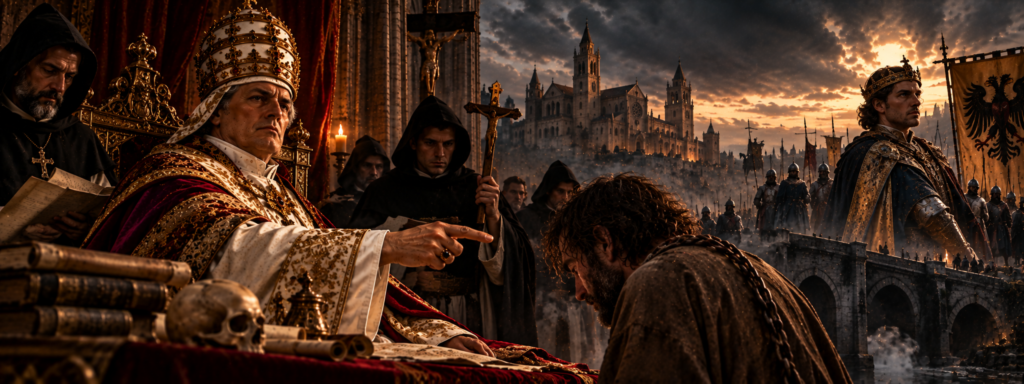
Gregory IX: The Pope Who Built the Machinery of the Inquisition
Gregory IX — 1227–1241
When Gregory IX became pope in 1227, the medieval Church already knew how to hunt heresy. Bishops had investigated suspected heretics, secular rulers had punished them, councils had demanded their suppression, and crusading armies had devastated communities accused of sheltering dangerous beliefs. What Gregory inherited was not a peaceful Church suddenly introduced to persecution by one ruthless pope. What he helped create, however, was something more organized, more centralized, and ultimately more enduring: a system in which specially commissioned papal agents could travel beyond the ordinary structures of local episcopal authority to investigate, prosecute, and condemn heresy in the pope’s name.
Gregory’s pontificate was dominated publicly by another enormous struggle, his increasingly bitter conflict with Emperor Frederick II. Pope and emperor excommunicated, negotiated, reconciled, accused, threatened, and fought until much of Italy seemed trapped between two men who each believed the other represented a danger to Christian order. Gregory excommunicated Frederick more than once, denounced him in increasingly apocalyptic language, and spent his final years trying to prevent imperial power from overwhelming the papacy. Frederick answered with propaganda of his own, military force, and an equally determined insistence that the pope had exceeded the proper boundaries of spiritual authority.
Yet Gregory’s confrontation with Frederick was only one expression of something larger. Gregory believed deeply in law, hierarchy, papal authority, religious discipline, and the obligation of the Church to defend Christian society against threats from within as well as without. He commissioned the great collection of canon law known as the Decretals of Gregory IX, strengthened the administrative reach of Rome, supported new religious orders, intervened in universities, promoted crusading, and attempted to impose order upon a Christian world that seemed constantly on the verge of fragmentation. The same instinct that made him organize law also helped him organize repression.
That is why Gregory IX belongs among the Wicked Popes despite being nothing like the debauched pontiffs of earlier centuries. There are no credible stories of him selling the papacy, turning the Lateran into a brothel, or using Saint Peter’s throne as a family toy. Gregory was austere, serious, highly educated, intensely religious, and convinced that Christian truth required protection. The unsettling part of his story is that persecution under such a man could become more systematic precisely because he was disciplined rather than decadent.
The papal Inquisition associated with Gregory did not spring fully formed into existence on a single morning, and the later popular image of a monolithic medieval Inquisition controlled from one dark chamber in Rome is historically misleading. Procedures evolved gradually, varied enormously from region to region, and depended upon cooperation between papal representatives, local clergy, bishops, secular rulers, and communities. Torture, which would become infamous in later inquisitorial practice, was not introduced into papal inquisitorial procedure by Gregory IX himself. Nevertheless, during his reign the investigation of heresy became increasingly entrusted to papally appointed inquisitors, particularly members of the Dominican and Franciscan orders, creating an institutional framework that would long outlive him.
Gregory therefore represents a crucial transition. Before him, anti-heretical persecution had often depended heavily upon local bishops, councils, rulers, or extraordinary campaigns. Under him, Rome increasingly claimed the ability to send specialists into troubled regions with authority derived directly from the pope. Heresy was becoming not merely a local pastoral problem but a crime investigated through an increasingly centralized ecclesiastical system.
The transformation did not require Gregory to imagine himself cruel. He could believe he was protecting souls, preserving Christian unity, and correcting dangerous error. That belief is precisely what makes his pontificate so disturbing. Gregory IX helped build machinery capable of persecution while believing that machinery served salvation.
Ugolino of Ostia: The Old Cardinal Who Became Pope
Gregory IX was born Ugolino, or Ugo, dei Conti di Segni, probably around the middle of the twelfth century, although his exact birth year remains uncertain. He belonged to the powerful Conti family of central Italy and was related to Pope Innocent III, whose extraordinary pontificate had already transformed papal government. Ugolino received a sophisticated education and became thoroughly immersed in the theological, legal, and administrative culture of the medieval Church. By the time he reached the papacy, he had spent decades watching Rome extend its authority across Europe.
Innocent III helped advance his career, appointing him to important positions within the Church. Ugolino became cardinal-bishop of Ostia, one of the most prestigious positions in the College of Cardinals, and served repeatedly as papal legate. He negotiated with rulers, dealt with crusading affairs, represented papal interests in political conflicts, and developed extensive experience in the practical exercise of ecclesiastical power. He was therefore anything but an inexperienced old man unexpectedly placed upon Saint Peter’s throne.
His long career also brought him into contact with the religious movements transforming thirteenth-century Christianity. Ugolino became closely associated with Francis of Assisi and the early Franciscans, serving as cardinal protector of the order. He also maintained connections with Dominic and the Dominican movement. These relationships reveal a man genuinely interested in spiritual reform, preaching, poverty, and the renewal of Christian life.
That side of Gregory should not be discarded simply because his later policies included persecution. Medieval religious history becomes distorted when compassion and coercion are treated as qualities that could never exist within the same person. Gregory could admire Franciscan poverty while believing obstinate heretics deserved severe punishment. Within his worldview, the two positions were not contradictory because both were directed toward preserving what he regarded as authentic Christianity.
When Pope Honorius III died in March 1227, Ugolino was elected quickly and took the name Gregory IX. He was already elderly by medieval standards, perhaps around eighty if the earlier estimates of his birth are accepted, although the uncertainty surrounding his age makes exact claims difficult. Whatever his precise years, his energy during the next fourteen years would be remarkable. Gregory entered the papacy prepared to govern aggressively.
Waiting for him was one of the most dangerous rulers medieval Rome would ever confront.
Frederick II: The Emperor Gregory Could Not Control
Frederick II was Holy Roman Emperor, king of Sicily, king of Germany, and one of the most extraordinary rulers of the Middle Ages. Raised in Sicily amid Latin, Greek, Arab, Norman, and Jewish influences, he cultivated a reputation for intellectual curiosity that fascinated admirers and alarmed enemies. He sponsored scholarship, corresponded with learned men, built an efficient government in Sicily, and possessed ambitions stretching across Italy and the Mediterranean. To the papacy, however, his accumulation of power presented an obvious strategic danger.
The geographical problem was especially serious. Frederick controlled the Kingdom of Sicily in southern Italy while also possessing the imperial title and claims extending into northern Italy. The Papal States lay between these spheres of influence. A sufficiently powerful emperor could effectively surround Rome.
Frederick had also promised repeatedly to go on crusade. Honorius III had tolerated delays because political circumstances, preparations, and imperial obligations complicated departure. Gregory possessed far less patience. Almost immediately after becoming pope, he expected Frederick to fulfill his vow.
In 1227, Frederick finally embarked, but illness spread among the expedition, and the emperor himself became seriously sick. He turned back shortly after departure. Whether Gregory believed the illness genuine mattered less than the fact that Frederick had once again failed to proceed toward the Holy Land as promised. The pope excommunicated him.
The punishment stunned contemporaries because Frederick had actually begun the expedition before turning back. Gregory regarded the repeated postponements as part of a pattern of broken promises and disobedience. Frederick insisted that illness had made continuation impossible and accused the pope of acting unjustly. Their relationship deteriorated almost immediately into open hostility.
The confrontation established the tone of Gregory’s reign. He did not hesitate to use the most formidable spiritual weapon available against one of Europe’s most powerful rulers. Frederick, equally stubborn, refused to behave like a chastened sinner. Two men with enormous confidence in their own authority had begun a struggle neither would truly win.
The Excommunicated Crusader
Frederick did something extraordinary after his excommunication: he went on crusade anyway. In 1228, still under ecclesiastical condemnation, he sailed east and entered negotiations with the Ayyubid sultan al-Kamil. Instead of relying primarily upon a massive military campaign, Frederick used diplomacy. The result was the Treaty of Jaffa in 1229, which restored Jerusalem and several other places to Christian control under negotiated terms.
The achievement should have been a spectacular triumph for the crusading movement. Jerusalem, lost to Saladin in 1187, had been recovered without the catastrophic bloodshed of another major siege. Yet Frederick remained excommunicated, and relations with papal representatives in the East were deeply hostile. The emperor’s success therefore became another battlefield in his struggle with Gregory.
Frederick entered Jerusalem and participated in a ceremony associated with his royal claim, but the situation lacked the straightforward legitimacy a reconciled crusading emperor might have enjoyed. Gregory’s supporters continued opposing him, while Frederick portrayed himself as the successful crusader being persecuted by an unreasonable pope. The propaganda value was enormous. Each side could accuse the other of damaging Christendom through pride.
Meanwhile, papal forces attacked Frederick’s territories in southern Italy. The emperor returned from the East and rapidly reasserted control. The spectacle was extraordinary: a pope had excommunicated a crusading emperor, the emperor had recovered Jerusalem through negotiation, and papal troops had invaded his kingdom while he was away. Sacred warfare, territorial politics, and personal rivalry had become almost impossible to separate.
Negotiations eventually produced the Peace of San Germano in 1230. Gregory lifted Frederick’s excommunication, and the emperor confirmed important ecclesiastical rights. For a time, pope and emperor managed an uneasy coexistence. The reconciliation, however, never removed the underlying conflict over power in Italy.
Both men had learned something dangerous about the other. Gregory knew Frederick would continue acting even under excommunication. Frederick knew Gregory was willing to use spiritual sanctions and military pressure against him. Their temporary peace rested upon calculation rather than trust.
A Pope Obsessed With Order
Gregory’s struggle with Frederick makes more sense when placed beside his broader approach to government. He believed that disorder threatened the Church at multiple levels. Imperial expansion could threaten papal independence, heresy could threaten Christian unity, inconsistent law could weaken ecclesiastical government, and undisciplined clergy could undermine religious credibility. His response to all of these problems was organization.
Canon law was becoming one of the most sophisticated legal systems in medieval Europe. For generations, popes had issued decretals answering legal questions and resolving disputes. Gratian’s influential Decretum, compiled in the twelfth century, had helped organize older canonical traditions, but subsequent papal legislation continued accumulating. By Gregory’s reign, the mass of legal material had become difficult to navigate.
Gregory commissioned the Dominican canonist Raymond of Peñafort to produce a new authoritative collection. The resulting Decretals of Gregory IX, promulgated in 1234, organized a vast body of papal legislation into a coherent legal framework. It became one of the foundational collections of western canon law and remained enormously influential for centuries. The project reveals Gregory’s instinct to transform scattered authority into organized systems.
That instinct matters enormously when considering his treatment of heresy. Gregory did not invent the idea that heretics should be investigated or punished. He inherited centuries of theological condemnation and decades of increasingly aggressive anti-heretical policy. What he contributed was the same kind of centralizing impulse visible in his legal reforms.
The Church would no longer rely exclusively upon whether a particular bishop possessed the energy, knowledge, or political freedom to investigate heresy effectively. Papal authority could commission individuals specifically for the task. These men could move through regions, demand cooperation, hear testimony, impose penances, and identify people considered obstinate in error.
The transition was gradual, inconsistent, and sometimes chaotic. Nevertheless, the direction was unmistakable. Gregory was helping turn persecution into administration.
Heresy Before Gregory IX
Gregory inherited a western Europe already deeply anxious about religious dissent. Cathar communities had spread through parts of southern France and northern Italy, while Waldensians and other movements challenged ecclesiastical assumptions in different ways. Some dissenters rejected doctrines central to Catholic Christianity, while others criticized clerical wealth, preached without authorization, or developed practices Rome considered dangerously independent. Church authorities did not regard these movements as harmless theological diversity.
Innocent III had already demonstrated how far the papacy might go against heresy. The Albigensian Crusade, launched in 1209, brought years of warfare to southern France. Towns were captured, populations killed or displaced, nobles dispossessed, and political conquest became intertwined with religious suppression. Gregory therefore inherited a world in which military force against heresy had already received papal approval.
The Fourth Lateran Council of 1215 further strengthened the legal framework. Heretics were condemned, secular rulers were expected to suppress them, and property confiscation could accompany conviction. Bishops bore responsibility for investigating heresy within their dioceses. The Church had already moved far beyond mere theological debate.
Yet local enforcement remained uneven. Some bishops were vigorous, while others lacked resources, enthusiasm, or political support. Local elites might protect suspected heretics because of family ties, territorial interests, or hostility toward outside interference. Communities could resist investigations, hide fugitives, or intimidate witnesses.
Gregory’s innovation developed partly from frustration with this inconsistency. If heresy represented a danger to the entire Church, its suppression could not depend solely upon local circumstances. Rome needed agents whose loyalty and authority came directly from the papacy. The solution would eventually become known as the papal Inquisition.
This was not yet the later Spanish Inquisition, which belonged to a very different political and institutional setting centuries afterward. Nor was it a single permanent bureaucracy instantly established by one decree. Gregory’s system emerged through a series of commissions and experiments. Its significance lies precisely in the fact that temporary measures gradually hardened into an institution.
The Road Toward Papal Inquisitors
In the early 1230s, Gregory began appointing individuals with specific responsibility for pursuing heresy. Some of the earliest experiments involved German territories, where the controversial preacher Conrad of Marburg received extraordinary authority. Conrad had previously been associated with religious reform and had served as spiritual adviser to Elizabeth of Hungary. His later activity as an investigator of heresy would become notorious.
Conrad pursued suspected heretics with an intensity that alarmed even some contemporaries. Accusations multiplied, procedures could be severe, and powerful nobles eventually found themselves implicated. The precise details of every case are difficult to reconstruct because surviving accounts are shaped by hostile and partisan perspectives. Nevertheless, Conrad’s methods generated substantial resistance.
In 1233, Conrad was murdered after becoming embroiled in conflict with nobles he had accused. His death demonstrated one of the dangers of empowering zealous investigators without sufficiently developed procedural restraints. Papal authority could give an inquisitor extraordinary confidence, but it could not guarantee that local communities would accept his judgments. Centralization created power faster than it created uniform practice.
Gregory did not respond by abandoning the project. Instead, papal commissions increasingly turned toward members of the mendicant orders, especially Dominicans and, in some regions, Franciscans. These friars possessed characteristics that made them attractive inquisitors. They were mobile, educated, accustomed to preaching, and less dependent upon local aristocratic networks than many diocesan clergy.
Dominicans in particular developed a lasting association with inquisitorial work, although it would be inaccurate to reduce the entire order to that function. The Order of Preachers had been founded around preaching, theological education, pastoral work, and combating religious error through instruction. Many Dominicans never served as inquisitors. Those who did, however, became some of the most recognizable agents of the developing papal system.
The logic was powerful. A local bishop might have relatives, political obligations, territorial rivalries, or decades of complicated relationships within his diocese. A friar commissioned by Rome could arrive with fewer local attachments. What looked like independence from one perspective could look like frightening outside intrusion from another.
The Birth of a System
The papal Inquisition cannot be assigned a single birthday with complete precision. Historians generally locate its institutional emergence during Gregory’s pontificate, particularly in the early 1230s, when papal commissions increasingly empowered designated inquisitors to pursue heresy. The process developed differently in France, Italy, Germany, and other regions. Uniformity came slowly.
Gregory’s contribution was nevertheless decisive because the pope increasingly treated anti-heretical investigation as something requiring specialized papal agents. These inquisitors were not simply ordinary parish priests hearing confessions. They were commissioned to discover concealed religious dissent, examine accusations, interrogate suspects, determine whether beliefs were heretical, and impose or recommend penalties. Their authority could overlap uneasily with that of local bishops.
The word “inquisition” itself derives from the idea of inquiry or investigation. Medieval legal procedure was changing in ways that allowed authorities to initiate investigations rather than relying entirely upon formal private accusers. This development occurred in both ecclesiastical and secular law. Applied to heresy, it created a mechanism capable of searching proactively for hidden offenses.
That distinction mattered because heresy was believed to operate secretly. A murderer left a corpse, a thief left missing property, and an invading army could be seen approaching. A heretic might outwardly attend church while privately participating in forbidden religious networks. Authorities therefore believed ordinary criminal procedures were insufficient.
The inquisitor’s task was to uncover belief itself through behavior, testimony, association, confession, and reputation. Neighbors could become witnesses, relatives could become sources of information, and private religious practices could acquire legal significance. The boundary between pastoral concern and criminal investigation became dangerously thin.
Gregory’s system was still developing when he died. Later popes would refine procedures, issue further regulations, and confront abuses. Yet the essential transformation had occurred. The papacy had begun creating a specialized mechanism for investigating religious thought and allegiance.
What an Inquisition Actually Looked Like
Popular imagination often pictures the medieval Inquisition as an endless sequence of underground torture chambers. Reality was more bureaucratic, more varied, and in some ways more unsettling because much of the process looked like legal administration rather than uncontrolled sadism. Inquisitors arrived in a region, preached against heresy, announced periods during which people could confess voluntarily, collected testimony, and constructed networks of information. Written records increasingly became essential.
People who confessed promptly and cooperated might receive spiritual penances. These could include prayers, pilgrimages, fasting, wearing distinctive crosses, or other public acts. More serious cases could involve imprisonment. Those considered obstinate or relapsed faced far graver consequences.
Ecclesiastical authorities generally did not themselves perform executions because canon law maintained restrictions upon clerical participation in bloodshed. Instead, people judged unrepentant heretics could be handed over to secular authorities. Secular law in many territories treated obstinate heresy as a capital offense. Burning became the punishment most famously associated with such cases.
The distinction between ecclesiastical judgment and secular execution was legally meaningful but morally complicated. If an inquisitorial court determined that someone was an obstinate heretic knowing that secular law prescribed death, handing that person to secular authorities did not make the Church irrelevant to the outcome. The process divided responsibility between institutions. It did not eliminate responsibility.
Torture requires especially careful treatment in Gregory’s story. The formal papal authorization allowing torture in inquisitorial proceedings is associated with Innocent IV’s bull Ad extirpanda in 1252, more than a decade after Gregory IX’s death. Gregory therefore should not be described as the pope who introduced torture into the papal Inquisition. Doing so would collapse different stages of institutional development into one sensational claim.
What Gregory did establish was the framework into which harsher procedures could later be inserted. Specialized investigators, papal commissions, legal categories of heresy, cooperation with secular authorities, and increasingly systematic recordkeeping already existed or were developing. The machine did not yet possess every later component. Gregory helped construct the machine.
Conrad of Marburg and the Danger of Zeal
Conrad of Marburg provides an early warning about what could happen when anti-heretical authority became concentrated in exceptionally zealous hands. He had built a reputation for severe religious discipline before becoming associated with inquisitorial activity. His relationship with Elizabeth of Hungary, whom he served as spiritual director, was itself remembered for extreme ascetic demands. By the early 1230s, his attention had turned aggressively toward alleged heretics.
Reports of Conrad’s investigations portray procedures that could move with alarming speed. Suspects faced pressure to confess, while refusal could be interpreted as evidence of obstinacy. Accusations spread upward into aristocratic society, eventually touching Count Henry of Sayn. When powerful nobles found themselves threatened by methods previously directed toward more vulnerable people, opposition intensified.
Henry appealed and defended himself before an assembly at Mainz in 1233. Conrad’s accusations failed to secure the result he wanted. Shortly afterward, Conrad was attacked and killed while traveling. His murder ended one particularly aggressive experiment but did not end papal inquisitorial policy.
The episode exposed a fundamental institutional problem. If inquisitors were sent to overcome local reluctance, they needed enough independence to resist local pressure. Give them too little authority, and powerful communities could ignore them. Give them too much, and accusation itself could become dangerously difficult to challenge.
Gregory’s response illustrates his commitment to the broader anti-heretical project. The failure of one investigator did not persuade him that centralized inquiry was inherently misguided. Instead, the system continued developing through other agents and regions. Individual excess could be treated as a problem of personnel or procedure rather than an argument against the institution.
That reasoning would become familiar in the history of inquisitions. Abuses might lead to regulation, appeals, or procedural refinement. The underlying assumption that heresy required investigation remained intact. Gregory’s reign helped make that assumption institutional.
The Dominicans Enter the Story
The Dominican Order was particularly suited to Gregory’s purposes because its members combined mobility, theological training, preaching, and obedience to an organized religious structure. Dominic himself had died in 1221, before Gregory became pope, but the order expanded rapidly. Its friars established houses in university cities and developed a formidable intellectual tradition. Gregory recognized their usefulness.
Beginning in the 1230s, Dominican friars received commissions to investigate heresy in various regions. Franciscans also served as inquisitors, particularly in parts of Italy. The exact distribution of responsibility varied, and bishops retained important roles. The medieval Inquisition was never simply a Dominican monopoly.
Nevertheless, Dominican involvement gave anti-heretical investigation a new kind of professional character. A friar trained in theology could identify doctrinal deviations more precisely than an uneducated local official. A member of an international religious order could be reassigned from one region to another. Papal commissions could connect these men directly to Rome.
The system also produced resentment. Communities did not necessarily welcome outsiders arriving with authority to investigate private beliefs. Local clergy could resent interference in diocesan affairs. Nobles could see inquisitorial activity as a threat to political autonomy.
Resistance sometimes became violent. Inquisitors were threatened, expelled, attacked, and occasionally killed. The most famous Dominican inquisitor murdered during this era, Peter of Verona, died in 1252 after Gregory’s pontificate, but his later canonization demonstrated how inquisitorial martyrdom could reinforce the institution. Violence against inquisitors could be interpreted as further evidence of the dangerous forces confronting the Church.
A self-reinforcing cycle could emerge. Heresy justified inquisitors, resistance justified stronger inquisitors, and attacks upon inquisitors demonstrated the supposed ferocity of heretical opposition. Institutions created to confront hidden enemies could interpret resistance as confirmation that the enemy was real. Gregory’s policies helped establish the conditions in which that logic could flourish.
The Emperor Strikes Back
While Gregory built mechanisms against heresy, his conflict with Frederick II continued simmering beneath the temporary peace. Frederick strengthened royal government in Sicily through the Constitutions of Melfi in 1231, creating one of the most sophisticated legal systems of medieval Europe. Gregory watched carefully for any provisions threatening ecclesiastical privileges. Two highly organized rulers were constructing competing systems of authority on opposite sides of the same political landscape.
For several years, cooperation remained possible. Frederick even assisted Gregory when the pope faced rebellion in Rome. Their relationship was therefore not a simple fourteen-year war of uninterrupted hatred. Political necessity repeatedly produced temporary alliances.
The deeper conflict concerned northern Italy and the Lombard cities. Frederick wanted to restore effective imperial authority, while the papacy feared that decisive imperial victory would leave Rome dangerously surrounded. Gregory supported or sympathized with forces resisting excessive imperial domination. Frederick increasingly believed the pope was sabotaging legitimate imperial rights.
By 1239, the relationship collapsed completely. Gregory excommunicated Frederick again. The language used by both sides became increasingly savage, transforming political rivalry into an ideological struggle over the structure of Christendom. Gregory portrayed Frederick as a dangerous enemy of the Church, while imperial propaganda depicted the pope as greedy, worldly, and politically manipulative.
Some papal rhetoric surrounding Frederick approached apocalyptic imagery. Frederick’s enemies associated him with blasphemy and threats to Christian order, while stories circulated accusing him of religious skepticism or outright unbelief. Several sensational statements attributed to Frederick are difficult to authenticate and may reflect hostile propaganda. His religious views remain debated and should not be reconstructed from enemy accusations alone.
What is certain is that pope and emperor increasingly treated one another as existential threats. The struggle was no longer a disagreement capable of easy compromise. Gregory wanted Christendom to see resistance to Frederick as defense of the Church. Frederick wanted rulers and clergy to see resistance to Gregory as defense of legitimate secular authority.
Excommunication as a Political Weapon
Excommunication was not merely a medieval equivalent of political criticism. It excluded an individual from the sacramental life of the Church and carried profound spiritual significance within medieval Christianity. Applied to a ruler, it could also destabilize political loyalty. Subjects, allies, bishops, and rival princes might begin questioning whether obedience to an excommunicated monarch remained obligatory.
Gregory’s repeated use of excommunication against Frederick therefore had enormous stakes. The pope believed Frederick had violated commitments and threatened ecclesiastical rights. Frederick believed Gregory was weaponizing spiritual authority for political purposes. Their disagreement concerned not only particular territories but the legitimate boundaries of papal power.
Gregory was hardly the first pope to excommunicate an emperor. The Investiture Controversy had produced spectacular confrontations between Gregory VII and Henry IV more than a century earlier. Yet Frederick’s vast territories and formidable government made the thirteenth-century conflict especially dangerous. A decisive imperial victory in Italy might fundamentally alter the balance between empire and papacy.
The pope’s spiritual weapons were accompanied by practical politics. Gregory sought allies, encouraged resistance, raised funds, and participated in the shifting military struggle across Italy. Frederick responded with armies and diplomatic pressure. The conflict between spiritual and temporal power repeatedly became literal warfare.
This complicates any attempt to portray Gregory as simply defending religion from secular aggression. The Papal States were territorial possessions, and the papacy behaved as a political power as well as a spiritual institution. Gregory’s concerns about Frederick were not imaginary, but neither were they purely theological. The independence and territorial security of papal government were at stake.
Gregory’s pontificate therefore reveals how easily spiritual sanctions could become intertwined with geopolitical struggle. Excommunication might be sincerely understood as religious discipline while simultaneously serving political strategy. Medieval actors did not necessarily experience those purposes as mutually exclusive. Modern historians should resist pretending they were entirely separate.
The Decretals: Building a Legal Church
In 1234, Gregory promulgated the collection that became known as the Liber Extra or Decretals of Gregory IX. Raymond of Peñafort had organized the material into five books dealing broadly with judges, procedure, clergy, marriage, and crime. The collection replaced several earlier compilations as the authoritative body of papal decretal law alongside Gratian’s Decretum. Its influence would endure for centuries.
The importance of this project extends far beyond Gregory’s personal reign. Canon law regulated marriage, clerical discipline, ecclesiastical courts, property, procedure, elections, benefices, and countless other aspects of church life. By consolidating papal legislation, Gregory helped create a more uniform legal environment across Latin Christendom. Rome’s authority could increasingly travel through texts as well as legates.
The Decretals also reveal Gregory’s intellectual character. He believed problems could be ordered through law. Conflicting precedents could be organized, procedures clarified, jurisdictions defined, and authority made more consistent. The chaotic diversity of local practice could be drawn into a wider institutional framework.
That same legal imagination shaped the developing response to heresy. Heresy was not merely a theological error to be refuted in sermons. It was becoming a juridical category with procedures, investigators, penalties, and relationships between ecclesiastical and secular courts. Religious conformity increasingly possessed an administrative structure.
The connection should not be exaggerated into a claim that the Decretals themselves created the Inquisition. The history was more complicated, and anti-heretical procedures drew from numerous legal developments. Yet Gregory’s codification and inquisitorial policies emerged from the same papal culture. Both sought to make Roman authority systematic.
The pope who organized canon law was therefore also the pope who helped organize the search for religious dissent. One project became a monumental achievement in legal history. The other became synonymous with persecution.
Gregory, Jews, and the Contradictions of Papal Protection
Gregory’s policies toward Jewish communities reveal another complicated aspect of medieval papal government. Like other medieval popes, he inherited a tradition that combined legal discrimination with protection. Jews could face restrictions concerning public office, social interaction, clothing, and relations with Christians. At the same time, papal policy could condemn forced conversion and unauthorized violence against Jewish communities.
Gregory enforced discriminatory provisions in some circumstances, including rules requiring distinctive dress and limiting certain forms of Jewish participation in Christian society. Such measures reinforced the idea that religious minorities should remain visibly separate. They belonged to a wider medieval legal culture that treated religious difference as a matter requiring regulation. From a modern perspective, their exclusionary character is unmistakable.
Yet Gregory also issued or reaffirmed protections for Jews. He invoked the traditional papal principle that Jewish communities should not be subjected to forced baptism, unlawful seizure of property, or mob violence. When crusaders attacked Jewish communities in parts of France, Gregory demanded restitution in some cases. Papal authority could therefore function simultaneously as a source of discrimination and a shield against worse violence.
This apparent contradiction makes sense within medieval Catholic thought. Judaism was regarded as religious error, but Jewish existence was generally tolerated within defined legal boundaries. Conversion was desired, but forced baptism was theologically problematic. Violence outside lawful authority could be condemned even while discriminatory laws remained accepted.
Gregory’s treatment of Jews therefore parallels broader themes of his pontificate. He wanted society ordered through authoritative categories. Protection existed inside those categories rather than through a modern principle of religious equality. The same legal Church that could protect a minority from mob attack could insist that the minority remain visibly subordinate.
Understanding that distinction prevents both romanticization and caricature. Gregory was neither a modern advocate of tolerance nor simply a ruler seeking indiscriminate persecution. He operated within a hierarchical religious worldview. His policies reflected both the restraints and the injustices built into that worldview.
The Mysterious Bull Vox in Rama
One of the most sensational documents associated with Gregory IX is the 1233 papal bull Vox in Rama. It addressed reports of an alleged heretical group in Germany and described grotesque initiation rituals involving demonic figures, obscene acts, and the ritual appearance of a black cat. The text has become famous in modern retellings, often detached almost entirely from its historical context. Some popular accounts even claim Gregory declared war on cats, leading Europeans to massacre them and thereby worsening the Black Death more than a century later.
That popular story is unsupported. Gregory did not issue a universal decree ordering the extermination of cats, and there is no credible chain of evidence connecting Vox in Rama with continent-wide cat killings or the later plague. The document concerned specific allegations about heresy in Germany. Turning it into a medieval anti-cat campaign creates a dramatic internet legend rather than accurate history.
The bull remains disturbing without embellishment because it demonstrates how allegations of heresy could merge with fantasies of secret ritual evil. Medieval authorities feared not merely doctrinal disagreement but hidden communities believed to invert Christianity deliberately. Reports of demonic worship could make suspected heretics appear not simply mistaken but actively aligned with supernatural evil. Once an enemy was imagined in those terms, ordinary restraint became harder to maintain.
The reliability of the allegations transmitted in Vox in Rama is highly questionable. They emerged from the same environment surrounding Conrad of Marburg’s aggressive investigations. Confessions obtained under intense pressure, rumor, hostile testimony, and the expectations of investigators could all shape such narratives. Similar patterns would recur repeatedly in European persecution.
Gregory apparently took the reports seriously enough to circulate warnings and demand action. That fact reveals the vulnerability of even a highly educated pope to sensational accusations when those accusations fit existing expectations about heresy. Legal sophistication did not necessarily protect medieval authorities from believing extraordinary stories. Sometimes it gave them more effective mechanisms for acting upon those stories.
The episode offers a warning about institutional fear. Once authorities become convinced that hidden enemies operate beneath ordinary appearances, lack of visible evidence can itself seem proof of secrecy. Gregory’s developing inquisitorial system existed partly to uncover what supposedly could not be seen. Vox in Rama shows how dark the imagined hidden world could become.
When Heresy Became a Crime of Identity
The most profound change represented by medieval inquisitorial practice concerned the relationship between belief and legal identity. Christianity had always possessed doctrines and boundaries, and church authorities had condemned heresy since antiquity. What developed in the high Middle Ages was a more systematic legal apparatus for identifying individuals as members of prohibited religious communities. Belief could become evidence of criminal disobedience.
Investigators therefore needed to distinguish between ignorance, temporary error, suspicion, repentance, obstinacy, and relapse. Someone who accepted correction might receive penance. Someone who returned to condemned beliefs after formally renouncing them could face far more serious consequences. The system created gradations of religious guilt.
This complexity is important because inquisitorial proceedings were not designed simply to execute everyone accused. In many surviving records from later medieval inquisitions, large numbers of defendants received penances rather than death sentences. That reality should be acknowledged because sensational portrayals distort the historical process. It does not make the underlying system benign.
The coercive power lay partly in the investigation itself. People could be compelled to answer questions about beliefs, acquaintances, meetings, family members, and past behavior. Communities could become networks of witnesses and suspects. A person’s religious identity was no longer entirely private or pastoral.
Fear could therefore spread without mass execution. The arrival of an inquisitor could reopen old disputes, expose secret sympathies, encourage denunciations, and force people to choose between loyalty to neighbors and cooperation with authorities. Even relatively restrained inquisitorial activity could alter the social atmosphere of a town. Suspicion became institutional.
Gregory did not design every later procedure associated with this system. Nevertheless, his papal commissions helped establish the principle that specialized agents of Rome could investigate religious identity. That principle would prove extraordinarily durable.
The Machinery Outlives the Emergency
Institutions created during emergencies have a tendency to survive the emergencies that produced them. Gregory’s inquisitorial commissions initially responded to particular regions believed to contain serious heretical threats. The pope could plausibly regard them as extraordinary measures. Over time, however, extraordinary measures became recognizable offices and procedures.
Later popes continued appointing inquisitors. Manuals were written, precedents accumulated, records expanded, and territories developed more regular inquisitorial structures. The institution became increasingly capable of reproducing itself. An inquisitor trained another generation of officials who inherited both procedures and assumptions.
The shift matters because temporary persecution depends heavily upon moments of political panic. Institutional persecution can continue after panic subsides. It acquires files, personnel, legal memory, jurisdiction, and administrative routines. The question changes from whether an investigation should exist to how the existing investigation should operate.
Gregory’s legal mentality helped make such continuity possible. He believed in systems capable of transcending individual officeholders. His Decretals were designed to create legal order beyond his own lifetime. His inquisitorial policies likewise established mechanisms that later popes could expand without starting again from nothing.
This is why Gregory’s responsibility cannot be measured solely by the number of people executed during his pontificate. His historical significance lies in institutionalization. A ruler who personally orders a hundred deaths commits an obvious horror, but a ruler who creates machinery used by successors for generations leaves a different kind of legacy. Gregory’s legacy belongs primarily to the second category.
The machinery would change enormously after him. Torture would receive papal authorization under Innocent IV, inquisitorial practice would develop regional variations, and later institutions would differ significantly from Gregory’s early experiments. Yet the road toward those systems passed unmistakably through his pontificate.
The Final War With Frederick
By the late 1230s, Gregory’s conflict with Frederick II had become increasingly dangerous. Frederick’s victories in northern Italy strengthened imperial power and intensified papal fears. Gregory excommunicated him again in 1239, and the political struggle entered a phase of extraordinary bitterness. Both sides flooded Europe with arguments designed to destroy the other’s credibility.
Gregory attempted to summon a general council in Rome to address the conflict and other ecclesiastical matters. Bishops and prelates began traveling toward Italy. Frederick, regarding the proposed council as a papal weapon intended to condemn him, moved to prevent Gregory from assembling it. The conflict soon produced one of the most dramatic episodes of the papal-imperial struggle.
In 1241, a Genoese fleet carrying prelates toward Rome encountered forces allied with Frederick near the island of Giglio. The imperial side defeated and captured many of those traveling to the council. Cardinals, bishops, abbots, and other churchmen became prisoners. The council Gregory hoped to convene could not proceed as planned.
The seizure intensified papal fury. Gregory portrayed Frederick’s actions as an assault upon the liberty of the Church. Frederick insisted that the supposed council was politically manipulated and defended his actions within the broader war. The possibility of reconciliation had nearly vanished.
Imperial forces advanced dangerously close to Rome. Gregory was an elderly man confronting an emperor whose armies threatened the papal capital itself. The struggle that had begun over crusading obligations fourteen years earlier had become a battle over whether papal or imperial power would dominate Italy. Neither side showed much inclination to surrender.
Then, in August 1241, Gregory IX died. Frederick had not defeated him formally, and Gregory had not destroyed Frederick’s power. Their war remained unresolved. The old pope left behind a Church still fighting the emperor and an inquisitorial system only beginning to reveal how enduring it would become.
Gregory IX and the Myth of the All-Powerful Inquisition
It is important not to project the later history of inquisitions backward onto Gregory’s reign. He did not command a continent-wide secret police with identical procedures in every kingdom. Medieval Europe was too politically fragmented, communications were too slow, and local institutions were too powerful for anything resembling a modern centralized police state. Papal authority depended heavily upon cooperation.
Many regions never experienced papal inquisitors in the same way as southern France or northern Italy. England, for example, did not develop the same enduring medieval inquisitorial structures. Local political conditions shaped enforcement. A papal letter could authorize action without guaranteeing that action would occur exactly as Rome intended.
Inquisitors themselves differed. Some were aggressive, others cautious, and still others became embroiled in local politics. Procedures changed over time as canonists, popes, bishops, and practitioners confronted practical problems. The institution should therefore be understood as evolving rather than static.
Gregory nevertheless provided a crucial principle of centralization. Heresy could be investigated by specially appointed agents whose authority came directly from the papacy. This allowed Rome to bypass local hesitation when necessary. It also allowed local defendants to confront officials who might possess little connection to their communities.
The resulting system could be both more professional and more impersonal. Professionalism might reduce certain forms of arbitrary local vengeance because trained investigators followed procedures. Impersonality could also make repression more efficient because inquisitors were less constrained by local relationships. Institutionalization always carries both possibilities.
For Gregory, the advantage was obvious. Christian truth should not depend upon whether a local bishop happened to be energetic. Rome could provide the consistency. The frightening implication was that persecution no longer needed local enthusiasm either.
Was Gregory IX a Fanatic?
Calling Gregory a fanatic can obscure more than it explains. He was certainly uncompromising on many issues, particularly papal authority and heresy, but he was also a sophisticated lawyer, diplomat, administrator, and patron of religious movements. His policies followed recognizable institutional logic. He was not simply acting from uncontrolled rage.
His relationship with Frederick illustrates this complexity. Gregory could excommunicate the emperor and later reconcile with him. He could cooperate with Frederick when Roman political circumstances required it. Their eventual hatred developed through years of conflicting interests rather than appearing fully formed at the beginning.
His inquisitorial policy likewise developed from existing legal and pastoral concerns. Gregory did not wake one morning and invent persecution because he enjoyed suffering. He inherited a Church already committed to suppressing heresy. His distinctive contribution was making suppression more organized.
That distinction does not excuse the consequences. In some ways, it makes them more historically important. Personal fanaticism dies with the fanatic, while administrative systems can survive reasonable, educated, disciplined founders. Gregory’s legacy lasted because it was institutional rather than merely emotional.
He believed law could serve truth. He believed trained agents could serve law. He believed papal authority could ensure that both operated consistently. Those assumptions produced remarkable achievements in canon law and deeply troubling developments in religious prosecution.
Gregory’s life therefore resists the comfort of psychological caricature. There is no need to imagine him foaming with hatred toward every dissenter. A calm conviction that dissent must be eliminated can build stronger institutions than rage ever could.
The Saintly Pope and the Persecuting Pope
Gregory’s close relationship with Francis of Assisi creates one of the most striking contrasts in his career. As Cardinal Ugolino, he had supported the Franciscan movement and served as its protector. After becoming pope, he canonized Francis in 1228, only two years after the friar’s death. Gregory clearly recognized something profound in Francis’s radical religious life.
Francis had preached poverty, humility, repentance, and peace while embracing an extraordinarily vulnerable form of Christian existence. The movement inspired by him offered one response to the religious anxieties of the age: renewal through example. Gregory supported that response enthusiastically. He understood the power of holiness.
At almost the same moment, Gregory was strengthening another response to religious anxiety: investigation and coercion. The contrast appears jarring to modern eyes. A pope could honor the man remembered for embracing lepers and preaching peace while authorizing officials to pursue people accused of heresy. Medieval Christianity contained both impulses.
Gregory probably saw no contradiction because Francis submitted to the Church while heretics, in his understanding, rejected it. Poverty and radical devotion were admirable when contained within orthodox obedience. Similar religious intensity outside approved boundaries could become threatening. Authority determined which forms of religious enthusiasm could flourish.
This distinction shaped the medieval Church profoundly. New orders such as the Franciscans and Dominicans became instruments of renewal because they received papal approval. Other movements were condemned because their doctrines or practices crossed boundaries Rome considered essential. Gregory stood at the center of that process.
His papacy could therefore produce saints and inquisitors almost simultaneously. Both emerged from the same determination to renew Christian society. The difference lay in whether Rome recognized a movement as part of the Church or as an enemy within it.
Gregory’s Greatest Institutional Achievement—and His Darkest One
The Decretals of 1234 and the developing papal Inquisition might initially appear to belong to entirely different parts of Gregory’s reign. One concerns legal scholarship and ecclesiastical administration, while the other concerns persecution. Yet both reveal the same governing instinct. Gregory wanted a Church capable of acting consistently across enormous distances.
The Decretals organized law so that clerics and judges could know authoritative rules. Papal inquisitors organized anti-heretical enforcement so that local hesitation would not determine whether suspected religious dissent was investigated. In each case, central authority attempted to overcome fragmentation. Rome became the source of uniformity.
Centralization can solve genuine problems. Contradictory legal traditions create injustice, while powerful local elites can protect wrongdoing. A more universal system can establish procedures and standards unavailable in fragmented jurisdictions. Gregory’s legal reforms therefore deserve recognition as substantial administrative achievements.
The same tools become dangerous when the underlying objective is coercive conformity. A fragmented system may persecute inconsistently. A centralized system can persecute efficiently. Administrative competence is morally neutral until attached to a purpose.
Gregory attached that competence to the suppression of heresy because he believed religious error endangered souls and Christian society. From his perspective, failure to act would have represented negligence. From the perspective of those investigated, the distinction between pastoral concern and institutional intimidation could disappear quickly.
This is the central darkness of Gregory IX. He did not merely endorse persecution. He helped give persecution infrastructure.
The Limits of Papal Control
Like Innocent III before him, Gregory discovered that creating institutions did not guarantee control over every person acting in their name. Conrad of Marburg’s disastrous career demonstrated how quickly delegated authority could generate accusations and resistance. Other inquisitors would likewise become embroiled in local disputes. Rome might issue instructions, but distance complicated supervision.
Gregory attempted to regulate as well as empower. Medieval inquisitorial history contains repeated efforts by popes to correct abuses, clarify jurisdiction, and impose procedure. These attempts should not be dismissed because they reveal genuine concern about uncontrolled prosecution. They also reveal that abuse was predictable enough to require regulation.
The institutional answer to abuse was usually more law rather than abandonment of the institution. If an inquisitor acted improperly, the solution could be better instructions. If jurisdiction overlapped, Rome could define boundaries. If procedures varied, canonists could clarify them.
This pattern mirrored Gregory’s broader political worldview. Disorder called for stronger structure. Problems created by authority could be corrected through better authority. The possibility that some forms of coercive power might be inherently dangerous received far less consideration.
That assumption would shape later inquisitorial development. Every refinement could make procedure more orderly while simultaneously making the institution more durable. Regulation did not necessarily weaken persecution. It could legitimize it.
Gregory’s genius for organization therefore had an ambiguous legacy. The pope who wanted to restrain chaos created structures capable of surviving individual mistakes. Those structures also survived individual popes.
The Wickedness of Institutions
Gregory IX is a useful subject for the Wicked Popes category because his story forces the definition of wickedness beyond personal scandal. He was not notorious for drunkenness, sexual misconduct, nepotistic orgies, or grotesque private cruelty. His surviving reputation is that of a serious churchman. If wickedness is measured only by personal vice, he fits poorly.
If historical consequence matters, the picture changes dramatically. Gregory helped institutionalize papal investigation of heresy. The mechanisms developed under his authority became part of a tradition of religious prosecution lasting for generations. Later procedures would grow harsher and more sophisticated, but Gregory helped establish the institutional foundation.
He also demonstrated the extraordinary political use of spiritual sanctions against Frederick II. Excommunication became part of a geopolitical struggle involving armies, territories, propaganda, and competing visions of Christian government. Gregory believed the emperor threatened the freedom of the Church. Frederick believed the pope threatened legitimate imperial authority.
Neither struggle can be reduced to simple villainy. Heresy was genuinely understood by medieval Catholics as spiritually dangerous, and Frederick genuinely possessed enough power to threaten papal independence. Gregory’s fears were not inventions. The moral question concerns what he believed those fears justified.
His answer was expansive. Dangerous emperors could be excommunicated repeatedly. Dangerous beliefs could be investigated by specially commissioned agents. Christian order could be protected through increasingly centralized papal power.
Gregory therefore represents a form of historical darkness produced not by lawlessness but by law. His papacy made repression more systematic precisely by making it more legal. That distinction is crucial.
A Legacy That Continued After Death
Gregory died in 1241 without seeing the final outcome of his struggle with Frederick. The papacy entered a difficult transition, and the imperial conflict continued under his successors. Frederick himself survived until 1250. The struggle between empire and papacy remained one of the defining political conflicts of thirteenth-century Italy.
The inquisitorial system Gregory helped develop proved far more durable than either man. Successive popes continued appointing inquisitors, particularly Dominicans and Franciscans. Procedures became more elaborate. Manuals and legal interpretations accumulated.
In 1252, Pope Innocent IV issued Ad extirpanda, authorizing secular authorities under regulated circumstances to use torture in obtaining information from suspected heretics. That development occurred eleven years after Gregory’s death and should not be falsely attributed to him. It nevertheless entered an institutional structure whose centralizing foundations had been laid during Gregory’s reign. The distinction between founder and later developer matters, but so does continuity.
The medieval Inquisition would never become a single perfectly uniform organization. Regional variations remained substantial, and political rulers often shaped enforcement. Nevertheless, the idea of papally authorized specialist investigators endured. Heresy had become an administrative field.
Gregory’s Decretals endured as well. For centuries, canon lawyers studied the legal collection associated with his name. Its influence reached areas of western legal thought far beyond anti-heretical prosecution. The same pope therefore left two very different monuments to institutional order.
One helped systematize law. The other helped systematize suspicion. Both reflected Gregory’s belief that a universal Church required universal mechanisms of authority.
The Pope Who Turned Persecution Into Procedure
Gregory IX did not invent Christian persecution of heresy. Long before his election, church councils had condemned heretics, bishops had investigated religious dissent, secular rulers had imposed brutal punishments, and crusading armies had marched into southern France under papal authorization. Innocent III had already demonstrated how lethal the defense of religious unity could become. Gregory inherited all of that history when he became pope in 1227.
What Gregory contributed was a different kind of power. He increasingly placed the investigation of heresy into the hands of specially commissioned papal agents. These men could move beyond the limitations of ordinary local enforcement and act with authority derived directly from Rome. The pursuit of heresy was becoming a specialized ecclesiastical function.
That development did not occur through one perfectly designed decree. Gregory experimented, adjusted, delegated, and reacted to local circumstances. Conrad of Marburg’s violent career demonstrated how dangerous poorly restrained inquisitorial zeal could become. Dominican and Franciscan involvement offered a more organized network of trained religious personnel.
The resulting institution remained uneven. Different regions developed different practices, bishops retained authority, secular governments played indispensable roles, and inquisitors themselves varied enormously. Anyone imagining Gregory sitting in Rome directing every interrogation misunderstands medieval government. Centralization was a process rather than an accomplished fact.
Nevertheless, something fundamental had changed. Rome no longer needed to wait passively for every bishop to investigate heresy within his own diocese. The pope could send investigators. Those investigators could arrive specifically because local mechanisms were considered inadequate.
That principle transformed the geography of religious authority. A suspected heretic might once have dealt primarily with familiar local clergy and political powers. Increasingly, an outsider could arrive carrying a papal commission. The investigation itself became evidence that Rome’s reach had entered the community.
Gregory believed this was necessary because heresy was hidden. Dangerous beliefs could spread through private meetings, family networks, traveling preachers, and communities that outwardly appeared Christian. If bishops lacked the ability or determination to uncover such networks, the Church needed another mechanism. Specialized inquiry seemed like a rational response.
The logic becomes frightening because it contains no natural stopping point. The more hidden the enemy was believed to be, the more intrusive investigation could become. Failure to find heretics might mean none existed, but it could also be interpreted as evidence that they had concealed themselves successfully. Suspicion could therefore generate further suspicion.
The allegations surrounding Conrad of Marburg’s investigations illustrate the danger. Extraordinary stories of secret rituals and demonic worship circulated through ecclesiastical channels. Gregory’s Vox in Rama treated some of those allegations with seriousness. The papacy was not merely combating theological propositions written openly in books; it was confronting an imagined underground world of hidden corruption.
Modern legends have exaggerated the episode into claims that Gregory ordered the extermination of cats across Europe. He did not, and repeating that story would replace genuine history with folklore. The real document is disturbing enough because it demonstrates how sensational accusations could reach the highest levels of church government. Fear did not need invented cat massacres to become dangerous.
Gregory’s relationship with Frederick II reveals the same governing instinct on a grander political stage. The emperor was not a hidden heretic in a village but one of the most powerful rulers in Christendom. Gregory nevertheless approached him through the same fundamental conviction that papal authority possessed both the right and obligation to confront dangerous disorder. When Frederick failed to meet papal expectations, Gregory reached for excommunication.
The first confrontation began over the emperor’s delayed crusade. Frederick claimed illness had forced him to return after departure, while Gregory regarded the latest delay as the culmination of years of broken promises. The pope excommunicated him. Frederick responded not with submission but by proceeding on crusade while still excommunicated.
The resulting spectacle bordered on absurdity while remaining deadly serious. An emperor condemned by the pope negotiated the recovery of Jerusalem. Papal forces attacked his territories while he was away. Christian politics had become tangled so thoroughly that crusading success could coexist with ecclesiastical condemnation.
Their reconciliation in 1230 demonstrated that neither man was incapable of compromise. For several years, cooperation remained possible. Frederick even aided Gregory during trouble with the Romans. The later image of pope and emperor as eternal enemies should not erase those periods of pragmatic coexistence.
Yet their underlying interests could not remain aligned. Frederick’s growing power in northern Italy threatened the political security of the Papal States. Gregory increasingly feared encirclement. Frederick increasingly resented papal interference in imperial affairs.
When their conflict erupted again, spiritual and political language merged almost completely. Gregory excommunicated Frederick again in 1239. Accusations escalated, propaganda intensified, and both men attempted to convince Christian Europe that the other threatened legitimate order.
Gregory’s willingness to deploy excommunication repeatedly reveals the enormous political significance spiritual sanctions had acquired. He did not view excommunication as a mere diplomatic insult. It was a religious judgment with potentially devastating political consequences. The spiritual weapon became part of an earthly war.
This is where Gregory’s pontificate becomes especially important for a history of papal power. He did not separate law, religion, and politics into modern categories. An emperor threatening papal territories could simultaneously become an enemy of ecclesiastical liberty. A heretic rejecting doctrine could simultaneously become a criminal threat to Christian society.
Once those categories overlapped, papal jurisdiction expanded dramatically. Gregory could claim authority not because he believed himself an ordinary king but because he believed spiritual responsibility reached into political and social life. His power operated through the conviction that souls and institutions could not be separated. That conviction gave him an extraordinary range of action.
The Decretals of 1234 represent the constructive side of the same ambition. Gregory wanted the Church’s law organized, accessible, authoritative, and consistent. Raymond of Peñafort’s compilation gave Latin Christianity one of its most important legal collections. It would shape ecclesiastical jurisprudence for centuries.
That accomplishment should not be minimized simply because Gregory’s inquisitorial policies are darker. Historical figures can create institutions of genuine intellectual importance while simultaneously creating mechanisms of repression. Gregory did both. The tension belongs inside the story rather than being resolved artificially.
His legal achievement also helps explain why his inquisitorial legacy became so durable. Gregory thought institutionally. He did not merely respond to problems personally and allow solutions to disappear when the crisis ended. He sought mechanisms capable of continuing.
That instinct transformed heresy from a recurring emergency into an administrative concern. Inquisitors could be appointed, jurisdictions defined, procedures developed, evidence collected, and judgments recorded. The search for doctrinal error acquired bureaucratic memory. Persecution no longer depended entirely upon spontaneous outrage.
This did not necessarily mean every inquisitor behaved brutally. Some procedures could actually restrain local mob violence by insisting upon investigation before punishment. Accused people might confess, recant, receive penances, or challenge allegations through available procedures. The system was more complicated than a permanent conveyor belt leading directly to execution.
Yet legal procedure does not automatically make coercion humane. A carefully documented process can still punish people for beliefs. A trained investigator can still intimidate communities. An orderly institution can still produce injustice.
Indeed, institutional order can make coercion stronger because it becomes repeatable. A mob eventually disperses. A bureaucracy keeps records.
Gregory’s Inquisition kept developing after his death because it did not depend entirely upon Gregory. Later popes could appoint new inquisitors. Religious orders could supply trained personnel. Canon lawyers could refine procedures.
That durability distinguishes Gregory from popes remembered for spectacular personal crimes. Stephen VI’s Cadaver Synod horrified Rome, but the grotesque trial of a corpse did not become a permanent department of papal government. Benedict IX’s repeated seizures of the papacy became a scandal, but his particular dynastic chaos eventually ended. Gregory’s institutional choices possessed a longer afterlife.
This is why body counts alone cannot measure his historical significance. Gregory did not personally preside over centuries of inquisitorial trials. He did not authorize every later procedure. He certainly did not introduce every cruelty later associated with the institution.
Torture provides the clearest example. Gregory should not be falsely described as the pope who authorized inquisitorial torture. That development belongs to the pontificate of Innocent IV in 1252. Gregory had been dead for more than a decade.
Yet Innocent IV did not create his policy in an institutional vacuum. Papal inquisitors already existed. The investigation of heresy had already become increasingly specialized. Relationships between ecclesiastical judgment and secular punishment had already developed.
Gregory therefore occupies an uncomfortable historical position. He cannot fairly be blamed for every later development, but later developments built upon structures he helped establish. Founders rarely control everything institutions become. They remain part of the institution’s ancestry.
The same complexity appears in Gregory’s relationship with the mendicant orders. His support for Franciscans and Dominicans demonstrates genuine commitment to spiritual renewal. He canonized Francis of Assisi and encouraged movements that revitalized medieval Christianity. The pope associated with inquisitorial centralization was also capable of recognizing extraordinary sanctity.
That contrast should not be softened because it reveals something essential about Gregory’s world. He did not divide Christianity into spirituality on one side and coercive authority on the other. Both could serve the same truth. Francis could renew believers through poverty, while inquisitors protected believers from heresy.
Modern readers may find those methods morally incompatible. Gregory did not. The difference between Francis and a condemned dissenter was not intensity of religious conviction but obedience to what Gregory understood as the true Church.
That boundary became increasingly consequential. Religious enthusiasm inside approved structures could receive papal protection. Religious enthusiasm outside those structures could attract investigation. Rome positioned itself as the authority capable of deciding which was which.
The Dominican Order became especially important because its intellectual and preaching traditions made its members effective defenders of orthodoxy. Their later association with inquisitorial work has sometimes overshadowed everything else they did. That distortion should be avoided. Dominican history contains theology, preaching, education, missionary activity, mysticism, pastoral care, and far more than prosecution.
Nevertheless, some Dominicans became central figures in the developing Inquisition. Gregory’s reliance upon mendicant friars helped give inquisitorial work a trained and mobile personnel base. Rome could now deploy educated religious specialists beyond ordinary diocesan structures. Central authority acquired human infrastructure.
The consequences reached into ordinary communities. An investigation into heresy did not involve only famous theologians debating abstract doctrines. It could involve neighbors describing one another’s religious habits. It could involve families questioned about meetings held years earlier.
People might be asked who had visited a house, who had listened to a forbidden preacher, who had received a suspected heretic, or who had participated in a particular ritual. Memory itself could become evidence. Personal relationships could become liabilities.
That social dimension explains why inquisitions could generate fear even when executions were relatively uncommon. Punishment was only one source of power. Investigation itself could transform behavior. People who knew they might eventually be questioned had reasons to watch what they said and whom they trusted.
Institutional suspicion changes communities before any sentence is pronounced. It encourages secrecy among targets and denunciation among opponents. It can turn private disagreements into potentially dangerous accusations. Gregory’s system created mechanisms through which those accusations could travel upward into formal authority.
The murder of Conrad of Marburg demonstrated how explosive that process could become when accusations reached powerful people. Conrad’s death did not prove every accusation against his methods, but it showed the intensity of resistance he provoked. An investigator armed with papal authority had collided with aristocratic society. The result was violence.
Gregory did not conclude that the concept of papal inquisitors had failed. The system continued. That decision may be one of the most consequential of his reign.
A less institutionally minded pope might have treated Conrad’s disaster as proof that extraordinary investigators caused more trouble than they solved. Gregory instead remained committed to the need for specialized enforcement. Problems in implementation did not invalidate the principle. They demonstrated the need for better implementation.
That is the administrative logic running through his pontificate. Bad law required better law. Weak enforcement required stronger enforcement. Disorder required structure.
Even his war with Frederick followed that instinct. Gregory feared a political order in which imperial power could dominate Italy and reduce the independence of Rome. Frederick believed his imperial rights were legitimate. Neither man accepted a structure in which the other’s authority became supreme.
Their confrontation eventually threatened Rome itself. Gregory attempted to assemble a council, Frederick’s forces captured prelates traveling toward it, and imperial armies pressed dangerously close to papal territory. The old pope who had spent years excommunicating the emperor now faced the possibility of military defeat. Spiritual authority had reached the edge of armed confrontation.
Gregory died before that confrontation could reach its final conclusion. He did not live to see Frederick’s eventual death or the later destruction of the Hohenstaufen political position in Italy. His last years remained consumed by the struggle. The pope who had spent his reign building systems died amid unresolved war.
Yet the institution most closely associated with his darker legacy did not depend upon victory over Frederick. The inquisitorial project survived. Papal investigators continued operating under successors who had their own political crises.
That survival is the clearest measure of Gregory’s importance. His war with Frederick belonged intensely to the thirteenth century. The idea that religious dissent could be investigated by specialized authorities would travel much farther.
Later inquisitions were not identical to Gregory’s early papal Inquisition. The Spanish Inquisition established in the fifteenth century operated under a different relationship between monarchy and papacy. Roman inquisitorial institutions of the sixteenth century belonged to yet another environment. Using the single word “Inquisition” can hide these enormous differences.
Still, institutional genealogies matter. Gregory IX stands near the beginning of the papal system that made specialized investigation of heresy a regular feature of medieval ecclesiastical government. His pontificate marks a moment when suppression became increasingly organized. The significance lies in the transition.
Gregory’s motives were almost certainly religious as well as political. He believed heresy threatened salvation. He believed the Church had an obligation to respond. There is little reason to imagine that he secretly regarded Christianity as merely a pretext for power.
That sincerity should be acknowledged because it makes the historical lesson more serious. Systems of persecution do not require cynical architects. They can be built by people convinced they are defending society from genuine danger.
Gregory saw himself protecting Christian unity. He saw himself protecting papal independence from Frederick. He saw himself protecting ecclesiastical law from confusion.
Each goal could be described as defensive. Yet the methods of defense accumulated enormous coercive power. Investigation, excommunication, legal centralization, political warfare, and religious discipline all expanded Rome’s ability to intervene.
This is why Gregory IX belongs among the Wicked Popes without requiring lurid personal scandal. He demonstrates a form of darkness produced by institutions rather than appetites. His significance lies not in what he did behind closed doors but in what he authorized publicly.
A debauched pope can damage the reputation of his office. A corrupt pope can sell favors and enrich relatives. Gregory’s impact was deeper because he helped alter how the office itself functioned.
Under his authority, the papacy became more legally organized. It also became better equipped to search for religious enemies. The two developments emerged from the same faith in centralized order.
There is a temptation to judge historical institutions only by whether their administrators followed procedures. Gregory’s story shows why that standard is inadequate. Procedure can restrain arbitrary cruelty, but it can also make coercion respectable. Once persecution acquires forms, records, jurisdictions, trained personnel, and legal justification, it stops looking like chaos.
It begins looking like government.
That transformation is Gregory IX’s darkest legacy. He did not invent hatred of heresy, and he did not invent punishment for religious dissent. He helped give both a durable administrative home.
The Church he governed believed eternal souls were at stake. From inside that worldview, specialized investigation could appear compassionate because discovering error might produce repentance before death. Even punishment could be described as correction or protection of the wider community. Medieval theological logic could therefore place coercion inside a pastoral framework.
For those investigated, the experience could look very different. A stranger armed with papal authority could question beliefs, demand names, examine relationships, and decide whether repentance was genuine. Refusal to cooperate could deepen suspicion. A person declared obstinate could eventually be surrendered to secular justice with fatal consequences.
The fact that Gregory did not personally light execution fires does not erase the relationship between ecclesiastical judgment and secular punishment. Medieval institutions divided tasks. The Church identified obstinate heresy, while secular authority carried out penalties involving blood. Legal distinctions mattered, but victims experienced the combined system.
Gregory’s reign therefore illustrates how responsibility can become dispersed across institutions. The inquisitor investigates, the ecclesiastical court judges, the secular ruler punishes, and each actor can claim only part of the final outcome. No single hand appears to contain the whole process. Yet the process still exists because all the hands cooperate.
That is another reason institutions can become more dangerous than individual tyrants. Responsibility becomes fragmented. Everyone performs a defined function.
Gregory IX did not create the finished machinery later generations would know. He created and strengthened essential gears. His successors added others.
Innocent IV would authorize torture under regulated circumstances. Later inquisitors would develop manuals and procedural traditions. Secular rulers would continue shaping how punishments were enforced.
None of those developments should be collapsed into Gregory’s personal record. Historical accuracy requires boundaries. Gregory’s responsibility is substantial enough without making him answer for actions taken after his death.
His actual contribution was more foundational. He strengthened the principle that the pope could appoint specialist investigators to seek out heresy. He helped normalize the idea that religious dissent required systematic investigation.
That principle survived because it fit the broader Church Gregory was building. Canon law was becoming more organized. Papal government was becoming more centralized.
The mendicant orders supplied mobile personnel. European rulers increasingly possessed bureaucratic states capable of cooperating with ecclesiastical judgments. The thirteenth century was creating institutions on both sides of the church-state relationship.
Gregory stood at the center of that institutional age. He understood its possibilities exceptionally well. His achievements and his dangers are inseparable from that understanding.
He could commission a legal collection capable of shaping western Christianity for centuries. He could also commission investigators whose successors would shape the history of religious persecution. Both required the same ability to think beyond immediate crises.
Gregory IX therefore leaves history with a particularly uncomfortable legacy. He was not merely a cruel man whose cruelty died with him. He was an organizer.
Organizers leave systems behind.
When Gregory died in 1241, Frederick II remained alive, heresy remained alive, political conflict remained alive, and the Church continued facing many of the same problems that had defined his pontificate. Gregory had not solved them. He had changed the tools available for confronting them.
Some of those tools were intellectual and legal achievements. Others created structures capable of frightening intrusion into conscience and belief. History inherited both.
The final judgment on Gregory should therefore avoid the easy extremes. He was not the cartoon inventor of every horror popularly associated with the Inquisition. He did not create the Spanish Inquisition, did not authorize the later use of inquisitorial torture, and did not personally direct a uniform European police apparatus.
He was also not merely an innocent administrator whose name became unfairly attached to later persecution. During his pontificate, papally appointed inquisitors became an increasingly important mechanism for suppressing heresy. Gregory actively participated in that development because he believed it necessary.
His intentions may have been sincere. His fear of heresy was shared by much of the medieval Church. His concern about Frederick’s power had genuine political foundations.
None of those facts eliminates consequence. They explain how consequence became possible.
Gregory IX’s papacy shows how persecution becomes most enduring when it stops depending upon anger. Anger burns fiercely and disappears. Institutions remain after tempers cool.
They preserve documents, precedents, offices, and assumptions. They teach successors what previous officials considered normal. They turn extraordinary measures into routine procedure.
Gregory helped make the investigation of heresy one of those procedures. That achievement was quieter than the sack of a city and less visually dramatic than a crusading massacre. Its consequences reached across generations.
The old pope who fought Frederick II spent his life defending the authority of Rome against forces he believed threatened Christian order. In doing so, he helped create a Church more capable of imposing that order. The price of that capability would be paid by people whose beliefs placed them outside the boundaries Rome was determined to defend.
That is why Gregory IX belongs in the darker history of the papacy. His story is not a warning about what happens when an obviously wicked man gains power. It is a warning about what happens when a disciplined, intelligent, deeply religious administrator decides that certain forms of belief are too dangerous to be left outside a system of investigation.
Gregory did not need to hate every person accused of heresy. He needed only to believe that heresy must be found.
He did not need to personally torture prisoners. He needed only to create institutions that later generations could make harsher.
He did not need to imagine himself a persecutor. He could imagine himself a guardian.
That distinction may have mattered enormously to Gregory IX. It mattered far less to those who eventually found themselves standing before the machinery his pontificate helped set in motion. By the time of his death, religious persecution in western Christendom was becoming something more formidable than a crusade, a riot, or an angry bishop’s campaign: it was becoming a system, and systems have a way of surviving the people who convince themselves they are necessary.