
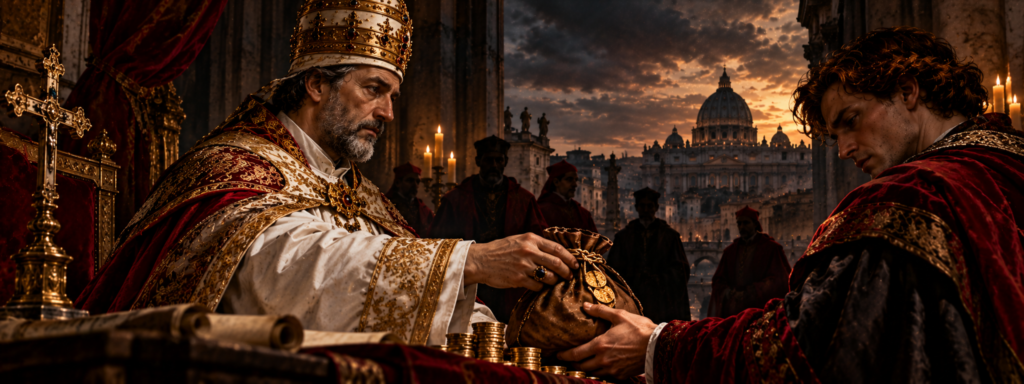
Gregory VI: The Pope Who Bought Benedict IX’s Resignation to Save the Church
Gregory VI — 1045–1046
In the spring of 1045, the papacy had become something dangerously close to a commodity. Benedict IX, driven from Rome once and restored by force, had become a symbol of everything critics believed was rotten in the eleventh-century Church. Roman aristocratic families fought over the papal throne, rival claimants challenged one another, and violence repeatedly decided questions that ecclesiastical procedure could not settle. Into this chaos stepped a respected Roman priest named John Gratian, who apparently believed that he had discovered a way to remove Benedict without another battle for the streets of Rome.
The solution was money. Benedict agreed to surrender the papacy in connection with a substantial financial payment, and Gratian subsequently became Pope Gregory VI. Gregory seems to have believed that he was rescuing the Church rather than purchasing its highest office, and there are good reasons to take that possibility seriously. Unfortunately for him, the difference between paying a pope to resign and buying the vacancy created by that resignation became almost impossible to explain once the man supplying the money became the next pope.
Gregory VI is therefore one of the strangest figures in the history of scandalous popes. He was not remembered primarily as a libertine, murderer, sadist, or shameless aristocratic adventurer. His personal reputation was considerably better than that of Benedict IX, and some of the most important reformers of the age initially regarded his accession with hope. The future Pope Gregory VII would remain loyal to him even after his pontificate collapsed, suggesting that Gregory VI was far more complicated than the simple caricature of a corrupt man purchasing Saint Peter’s throne.
That complexity does not make the scandal disappear. Money changed hands in connection with Benedict’s resignation, Gregory benefited directly from the resulting vacancy, and the transaction eventually made his own position impossible to defend. When King Henry III of Germany entered Italy in 1046, the resulting investigation at Sutri ended Gregory’s pontificate along with the competing claims that had plunged Rome into confusion. A man who apparently wanted to cleanse the papacy discovered that his chosen method had contaminated him as thoroughly as the institution he hoped to reform.
Gregory’s story is consequently darker than a straightforward tale of greed. It is the story of a man who may have believed that an improper method could be justified because it would produce a righteous result. It is also the story of a Church discovering that reform could not depend merely upon replacing scandalous men with respectable ones. If the system itself allowed sacred offices to become entangled with money, family power, political coercion, and private bargains, then even good intentions could become another form of corruption.
Rome Before Gregory: A Papacy in the Hands of Powerful Families
The crisis Gregory inherited had been developing for decades. Rome’s great aristocratic families possessed wealth, fortified estates, armed retainers, political clients, and influence over important churches. Control of the papacy could strengthen all of those advantages, giving a family prestige and access to one of the most important institutions in western Christianity. Papal elections therefore became inseparable from the brutal politics of the city.
The counts of Tusculum had been particularly successful. Benedict VIII became pope in 1012, and after his death in 1024 he was succeeded by his brother Romanus, who took the name John XIX. When John died in 1032, another member of the same family, Theophylact, became Benedict IX. For more than three decades, the papal throne had therefore remained under the extraordinary influence of a single Roman dynasty.
Benedict’s age at his election became part of his later legend. Some medieval accounts made him absurdly young, even suggesting that he was a child of approximately twelve, but those claims should not be repeated as established fact. Modern reconstructions generally make him older, perhaps in his late teens or around twenty, although his precise birth date remains uncertain. Even under the more cautious estimate, his youth reveals the enormous power his family possessed.
His later reputation was disastrous. Reforming writers accused Benedict of sexual excess, violence, sacrilege, and behavior so scandalous that later generations turned him into one of the standard examples of medieval papal corruption. Some of the most lurid allegations came from hostile sources and cannot automatically be treated as literal descriptions of his private life. The political chaos surrounding his pontificate, however, is much more securely documented.
By 1044, hostility toward Benedict and resentment of Tusculan domination erupted into open revolt. Benedict was driven from Rome, and his enemies installed John, bishop of Sabina, as Pope Sylvester III in January 1045. Sylvester was associated with the rival aristocratic network traditionally connected with the Crescentian faction. The change of pope therefore represented not simply religious dissatisfaction but a dramatic shift in control of Rome.
Benedict refused to accept his removal. His Tusculan relatives retained estates, fortresses, supporters, and enough military strength outside the city to organize a return. Within weeks, Sylvester’s government collapsed under renewed pressure, and Benedict reentered Rome in March 1045. Sylvester withdrew to Sabina, leaving behind an unresolved question about whether he had ever been a legitimate pope at all.
Benedict had recovered the throne, but he had not restored order. His enemies remained powerful, his reputation had deteriorated, and his recent expulsion demonstrated that Tusculan control could be challenged successfully. Rome had experienced rebellion, a rival papacy, and restoration within a matter of months. The next attempt to remove Benedict would avoid open warfare, but it would produce an even more extraordinary scandal.
John Gratian Before the Papacy
John Gratian was a Roman priest with a reputation strikingly different from Benedict’s. Before becoming pope, he served as archpriest of Saint John at the Latin Gate and was regarded as a serious ecclesiastic rather than a reckless aristocratic prince. The surviving tradition does not portray him as a man who had spent years plotting to seize the papacy. Instead, he appears to have belonged to the increasingly influential world of churchmen concerned with reform.
Gratian is traditionally described as Benedict IX’s godfather, although the precise nature of their relationship is not documented with complete certainty. If the tradition is accurate, it placed Gratian unusually close to the younger pope. He would have had both religious and personal reasons to be concerned by Benedict’s increasingly disastrous position. The relationship may also have made him a natural intermediary when Benedict began considering resignation.
The reforming atmosphere of the period is essential to understanding Gratian’s actions. Across western Europe, churchmen were becoming increasingly hostile toward simony, clerical misconduct, and the domination of ecclesiastical offices by wealthy secular families. Bishops and abbots could acquire positions through payments or political patronage, while aristocratic families treated church appointments as extensions of dynastic power. Reformers believed these practices were poisoning the spiritual authority of the Church.
Rome itself presented an especially embarrassing example. How could the papacy lead a movement against corrupt appointments while its own succession remained deeply entangled with Tusculan wealth and Roman factional politics? Benedict’s reputation made that contradiction even more painful. Removing him could therefore appear not merely politically convenient but spiritually necessary.
Gratian seems to have concluded that Benedict could be persuaded to leave peacefully. The alternative might have been another rebellion followed by another violent restoration, repeating the cycle that had already produced Sylvester III. A financial settlement offered the possibility of removing Benedict without armies fighting through Rome. From a practical perspective, the bargain may have appeared almost merciful.
The problem was that the object at the center of the bargain was the papacy. Benedict was not selling a house or surrendering an ordinary political appointment. He was relinquishing an office understood to possess sacred authority, and Gratian would become the immediate beneficiary of the vacancy. The transaction therefore placed a respected reformer directly inside the very culture of financial influence that reformers were struggling to destroy.
Why Benedict IX Wanted to Leave
Benedict’s reasons for surrendering the papacy remain uncertain. A persistent medieval tradition claims that he wanted to marry and therefore wished to free himself from the obligations associated with the papal office. Later accounts embellished the story with a particular prospective bride and negotiations involving her family. Those details are colorful, but they are not secure enough to be presented as unquestioned fact.
Political exhaustion offers another plausible explanation. Benedict had already been driven from Rome and forced to recover his position with Tusculan support. His enemies remained active, Sylvester III was still alive, and another uprising could occur at any moment. The papacy had become a dangerous possession requiring constant political defense.
Financial considerations may also have mattered. Benedict had enjoyed the revenues and privileges associated with papal office, and resignation threatened to deprive him of substantial resources. Compensation could therefore be presented as provision for his future rather than a literal purchase price for spiritual authority. That interpretation would later become important for anyone attempting to defend Gregory’s role in the transaction.
Whatever mixture of motives drove Benedict, he became willing to resign if satisfactory financial arrangements were made. Gratian agreed to provide or facilitate the payment. The amount cannot be reconstructed with confidence because medieval accounts differ, and later attempts to convert the supposed sum into modern values create a false sense of precision. The essential fact is much simpler and far more damaging: money was connected with Benedict’s surrender.
In May 1045, Benedict IX resigned. John Gratian subsequently became pope and took the name Gregory VI. The scandalous Tusculan pope was gone, and a respected Roman priest had replaced him. For anyone desperate to believe that reform had finally reached Rome, the change must have looked promising.
The difficulty was obvious from the beginning. Gregory had provided the means by which Benedict agreed to depart, and Gregory then occupied the office Benedict surrendered. Even if the payment had been intended only as compensation for resignation, the sequence looked like a transaction involving the papal throne. Gregory’s motives might explain why he had done it, but they could not erase what had happened.
The Bargain That Would Destroy Gregory
It is common to summarize the episode by saying that Gregory VI bought the papacy from Benedict IX. That description captures the scandalous appearance of the transaction, but it risks oversimplifying Gregory’s intention. There is no compelling reason to assume that Gratian simply approached Benedict as a greedy buyer seeking to purchase spiritual power for himself. The surviving picture is considerably more complicated.
Gregory seems to have believed that Benedict’s removal was worth paying for because Benedict had become a catastrophe for the Church. Under that interpretation, the payment purchased Benedict’s departure rather than the papacy itself. Once Benedict resigned, a new pope could be chosen through the appropriate ecclesiastical process. Gregory may therefore have regarded the financial settlement as separate from his own accession.
His critics could answer that the distinction was artificial. Benedict resigned because money was provided, and Gregory became pope because Benedict resigned. The payment and the succession were therefore connected even if formal steps separated them. Without the bargain, the vacancy might never have existed.
This mattered because simony was becoming one of the central moral issues of the age. The term derived from Simon Magus, who in the Acts of the Apostles attempted to purchase spiritual power. Medieval reformers used the concept to condemn the buying and selling of ecclesiastical offices and spiritual privileges. A financial arrangement that determined who occupied the papal throne could hardly avoid comparison.
Gregory’s intentions therefore collided with the principle he hoped to defend. If money could be used to remove a bad pope so that a good pope could replace him, similar arguments might justify purchasing bishoprics or abbeys whenever the purchaser claimed noble motives. The campaign against simony would become filled with exceptions. Reformers increasingly believed that sacred office needed protection from financial exchange regardless of the supposed virtue of the people involved.
The bargain contained the seed of Gregory’s destruction from the moment it was made. He had removed Benedict without another battle for Rome, but the cost was not merely financial. Gregory had inherited a question that could never be answered simply by pointing to his good character. Had he paid to save the papacy, or had he paid for the circumstances that allowed him to become pope?
Hope for a Reformed Papacy
Gregory’s accession was not greeted universally as an obvious act of corruption. Important reformers appear initially to have welcomed him, which suggests that his contemporaries understood the circumstances with more nuance than the phrase “he bought the papacy” implies. His personal reputation gave people reason to believe that the nightmare surrounding Benedict IX might finally be ending. Rome had exchanged a scandal-ridden aristocratic pope for a churchman associated with reform.
Peter Damian’s reaction is particularly significant. Damian would become one of the fiercest voices of eleventh-century ecclesiastical reform, attacking simony and clerical misconduct with extraordinary intensity. He nevertheless initially regarded Gregory favorably and expressed hope in his pontificate. Such support would be difficult to explain if Gregory had been universally understood from the beginning as nothing more than a shameless purchaser of office.
Another important supporter was Hildebrand, the future Pope Gregory VII. Hildebrand’s precise early position and relationship with Gregory VI are not perfectly documented in every detail, but his loyalty to Gregory is clear. He would accompany the fallen pope into exile after Sutri. That association connected Gregory’s failed pontificate directly with the generation that would later transform papal government.
Gregory therefore possessed something Benedict had largely lost: moral credibility among serious churchmen. He appears to have wanted reform, order, and an end to the degradation of the papal office. He inherited a city where those ambitions were desperately needed. Unfortunately, he also inherited the political consequences of Benedict’s years in power.
Rome remained divided among aristocratic factions, and Sylvester III had not vanished simply because Gregory became pope. Benedict’s family remained powerful outside the city, while rival families maintained their own supporters. The papal treasury and temporal government had been weakened by years of instability. Gregory’s respectable character could not make those structural problems disappear.
His pontificate consequently began with hope but little security. The pope could preach reform, but he also had to control Rome. He could condemn corruption, but he had to answer questions about his own accession. Gregory had escaped Benedict’s personality without escaping Benedict’s political world.
Sylvester III Refuses to Disappear From the Story
The presence of Sylvester III complicated Gregory’s legitimacy even before Benedict revived his own ambitions. Sylvester had been elected after Benedict was driven from Rome in late 1044 and early 1045. Benedict’s supporters regarded that election as invalid because Benedict had never resigned. Sylvester’s supporters could argue that Rome had legitimately rejected Benedict and chosen another pope.
After Benedict returned, Sylvester retreated to his bishopric in Sabina. He did not immediately launch another successful attempt to seize Rome, but his earlier election remained an unresolved fact. If Sylvester had been legitimate, Benedict’s restoration was itself questionable. Gregory’s succession from Benedict would then inherit an additional defect.
This is one reason the crisis cannot be reduced to a simple sale between Benedict and Gregory. The papacy had already become constitutionally confused before the payment occurred. Benedict had been expelled, Sylvester installed, Benedict restored, and Sylvester driven away. No universally recognized process had definitively settled which actions were lawful.
Gregory therefore entered an office surrounded by unresolved claims. He could insist that Benedict had been the legitimate pope and had now resigned, allowing Gregory to succeed him. Sylvester and his supporters could reject the first half of that argument. Benedict himself would soon create problems for the second half.
The result was a papal succession that looked increasingly impossible to untangle. Each claimant could point to a different event supporting his position. Sylvester possessed an election, Benedict possessed his original election and restoration, and Gregory possessed Benedict’s resignation followed by his own accession. The Church had accumulated competing claims faster than it could resolve them.
Gregory needed stability to make his reforming reputation meaningful. Instead, he found himself standing at the center of a constitutional wreck. The financial transaction that brought him to power would soon become only one of several reasons outside intervention appeared necessary.
Benedict Regrets the Bargain
Benedict IX did not remain quietly retired. At some point after his resignation, he renewed his claim to the papacy. Medieval traditions connected this change of heart with the collapse of the marriage plans supposedly motivating his resignation, although that explanation remains uncertain. What matters is that Benedict no longer behaved as though the financial settlement had permanently ended his connection with the throne.
His return transformed Gregory’s already difficult situation into something extraordinary. Benedict had accepted money connected with his resignation, yet he now asserted that he still possessed rights to the papacy. Sylvester III remained alive with his own disputed claim. Gregory occupied the papal office while both predecessors remained politically relevant.
Later writers sometimes described the resulting situation as three popes simultaneously ruling different parts of Rome. That image should be treated cautiously because political control was more fluid than a neatly divided map suggests. Gregory appears to have possessed the strongest immediate claim and occupied the central papal position, while Benedict and Sylvester retained supporters and influence. Nevertheless, the famous image captures the fundamental reality that papal authority had fractured.
The crisis was devastating to the prestige of the Roman Church. A bishop in another part of Europe looking toward Rome could reasonably wonder which claimant represented legitimate authority. Each man’s position contained an obvious weakness. The institution that was supposed to provide unity had become an example of division.
Gregory’s bargain had therefore failed at its most basic objective. Benedict had been paid to leave, but the payment had not made him disappear. The political forces supporting Benedict remained intact, and Benedict himself proved unwilling to accept permanent retirement. Money had purchased a temporary resignation rather than a durable solution.
This failure would become central to Gregory’s tragedy. He had compromised his own legitimacy for the sake of ending a crisis, yet the crisis continued anyway. The moral cost remained while the practical benefit evaporated. Gregory was left with the worst possible combination: a disputed accession and an unresolved rival.
Rome Under Gregory VI
Gregory attempted to govern despite the instability surrounding him. The temporal responsibilities of the medieval papacy included protecting church property, maintaining order, defending pilgrims, and dealing with armed factions. Rome and the roads around it could become dangerous when central authority weakened. A pope who could not provide security risked losing both political credibility and practical control.
Some traditions credit Gregory with taking vigorous measures against brigandage and disorder. Such actions remind us that a medieval pope could not govern entirely through spiritual exhortation. Papal authority possessed a territorial dimension, and maintaining it could require armed force. Gregory’s reforming reputation therefore did not make his government politically passive.
The continuing violence also helps explain why he may have considered the payment to Benedict preferable to another direct confrontation. Gregory had seen what factional warfare could do to Rome. Benedict’s first expulsion had merely produced Sylvester, followed by Benedict’s armed restoration. A negotiated resignation could have seemed like the least destructive option available.
Yet the disorder proved that Benedict had never been the only problem. Roman aristocratic politics had developed over generations, and no single financial settlement could dismantle those networks. The Tusculans did not surrender their fortresses because Benedict accepted money. The Crescentian factions did not abandon their ambitions because Gregory wanted reform.
Gregory consequently faced a political environment stronger than his personal reputation. He could be respected and still be weak. He could be sincere and still be unable to impose order. Medieval Rome had destroyed or compromised many men who underestimated that distinction.
By 1046, the crisis was becoming intolerable. Gregory’s own legitimacy was increasingly questioned, rival claimants remained, and the city still lacked stable government. The solution would come from outside Rome. It would arrive with a German king powerful enough to make every Roman faction reconsider its position.
Henry III Comes to Italy
Henry III of Germany was one of the most formidable rulers in western Europe. He possessed strong religious interests and supported efforts to reform ecclesiastical abuses, including simony. At the same time, he believed that Christian kingship carried substantial authority over the Church. Reform and royal power therefore reinforced one another in his political worldview.
Henry also intended to travel to Rome and receive the imperial crown. That ambition created an immediate problem because the coronation needed to be performed by a pope whose legitimacy could withstand scrutiny. Gregory occupied the papal throne, but the circumstances of his accession were increasingly controversial. Benedict and Sylvester made the situation still more uncertain.
An emperor crowned by a disputed pope could inherit part of that dispute. Henry therefore had powerful political reasons to resolve the succession before his coronation. His reforming convictions gave him an equally powerful religious justification. Rome appeared incapable of cleaning up its own papal crisis, and Henry could present himself as the ruler capable of restoring order.
His intervention should not be portrayed as purely altruistic. German rulers had long possessed interests in Italy, and influence over the papacy could strengthen imperial authority. Replacing Roman aristocratic domination with a pope dependent upon Henry would benefit the king as well as the Church. Medieval politics rarely separated religious conviction from political advantage as neatly as modern categories might suggest.
Henry crossed the Alps in 1046 accompanied by bishops, nobles, and considerable political power. His arrival fundamentally changed the balance inside Italy. Roman families that could fight one another successfully were in no position to ignore a German king backed by an army. For the first time in the crisis, an outside figure possessed enough strength to impose a settlement upon all the claimants.
Gregory did not run from him. Instead, he went to meet Henry and participated in the process that would examine the papal dispute. That decision strongly suggests that Gregory believed his motives and conduct could survive scrutiny. He was about to discover that the issue was no longer whether he had meant well.
Gregory Faces the King
The initial encounter between Gregory and Henry was not simply a confrontation between criminal and judge. Gregory remained the reigning pope and retained considerable personal respect. Henry treated the situation seriously enough to seek an ecclesiastical resolution rather than simply marching into Rome and installing another candidate by naked force. A council would provide the institutional framework for clearing the competing claims.
Gregory had reasons to hope that such an examination might vindicate him. He could explain Benedict’s scandalous conduct and the danger of continued civil conflict. He could emphasize that the money had been intended to secure Benedict’s peaceful retirement rather than purchase spiritual power. His own conduct as pope could be offered as evidence that greed had not motivated him.
The problem was that the argument depended heavily upon intention. Gregory believed, or could plausibly claim, that he had paid for Benedict’s departure rather than for Saint Peter’s throne. The bishops examining the case could focus instead upon consequences. Benedict’s paid departure created the vacancy from which Gregory benefited.
A reform movement serious about simony could not easily base its rules upon the private motives of individual buyers. A wealthy candidate could always insist that his payment served the Church. A noble family purchasing a bishopric could claim that its chosen candidate was unusually virtuous. Once intention became the primary defense, the prohibition against financial influence risked becoming meaningless.
Gregory had therefore placed himself in a position where his strongest moral defense was also institutionally dangerous. The better his intentions appeared, the more tempting it might become to create exceptions for well-intentioned financial transactions. The reformers gathering around Henry increasingly wanted the opposite. They wanted a principle strong enough to survive sympathetic cases.
That principle was about to be applied to the pope himself.
The Synod of Sutri
The Synod of Sutri assembled in December 1046, north of Rome and beyond the immediate control of the city’s aristocratic factions. Henry III’s presence gave the proceedings enormous political weight. The surviving accounts do not preserve every stage of the synod with perfect clarity, and historians continue to debate some procedural details. The broad result, however, is unmistakable.
Sylvester III’s claim was addressed first or among the first. His election had occurred while Benedict IX remained alive and insisted that he had never legitimately ceased to be pope. Hostile traditions also accused Sylvester of obtaining the office through bribery. The settlement at Sutri rejected his claim and treated his occupation of the papacy as illegitimate or deeply compromised.
Benedict’s position was also extraordinarily weak. He had voluntarily resigned and accepted financial compensation connected with that resignation. Whatever claim he attempted to revive afterward had to overcome his own earlier surrender. His repeated willingness to leave and return made his relationship with the papacy appear almost personal and proprietary.
Gregory presented the most difficult problem. He was the recognized reigning pope, had a comparatively strong personal reputation, and had supporters among reform-minded churchmen. He was not accused primarily of the kinds of sexual or violent scandals attached to Benedict. The challenge concerned the financial transaction that had made his accession possible.
Gregory acknowledged the substance of what had happened. The defense was essentially that he had paid Benedict to resign because removing Benedict was necessary for the good of the Church. His intention had been reform, not the purchase of spiritual authority. In moral terms, the distinction was substantial.
In institutional terms, it was insufficient. Money had induced Benedict to relinquish the papacy, and Gregory had then become pope. The connection between payment and succession was too direct for a reforming Church to ignore. Sutri transformed Gregory’s private justification into a public judgment against his pontificate.
Simony at the Highest Level
The word “simony” could encompass several forms of financial corruption in medieval ecclesiastical life. Bishops might pay rulers or powerful nobles for appointment. Monastic offices could become objects of patronage or purchase. Clerics might exchange money for ordination or spiritual privileges.
Reformers believed such transactions degraded the Church because spiritual authority could not legitimately be treated as merchandise. The principle became especially urgent during the eleventh century as reforming networks sought to free ecclesiastical institutions from aristocratic and royal exploitation. A bishop who purchased his see might feel indebted to the patron who sold it. An abbot selected because of wealth rather than religious merit could turn a monastery into another family possession.
Gregory’s case brought the issue to the highest possible level. If the pope himself could obtain office after paying his predecessor to resign, how could Rome credibly condemn lesser churchmen for similar transactions? Gregory’s personal virtues could not solve that contradiction. The papacy had to embody the principle it expected the rest of the Church to obey.
There was nevertheless something unusual about his case. Gregory had not apparently paid Benedict because he admired the commercial value of the papacy and wanted to own it. He had paid because Benedict’s continued presence seemed disastrous. The act therefore resembled ransom as much as purchase.
That distinction has encouraged sympathy for Gregory across centuries. One can understand why a conscientious priest might believe that paying a corrupt pope to disappear was preferable to allowing the scandal to continue. Yet understanding the reasoning does not remove the institutional consequences. The papal throne had still become connected to a financial bargain.
Sutri ultimately treated the transaction as incompatible with Gregory’s continued rule. Whether every participant used precisely the same legal vocabulary is less important than the outcome. Gregory could no longer remain pope while the Church claimed to be cleansing itself of simony. His attempt to defeat corruption had become an example of corruption’s reach.
Did Gregory Confess to Buying the Papacy?
Later retellings sometimes portray Gregory dramatically confessing before the council that he had purchased the papacy and immediately condemning himself. Such narratives fit the image of a conscientious man recognizing his own error, but the exact wording and procedure should not be reconstructed as though a modern transcript survives. Medieval sources often shaped ecclesiastical events into morally satisfying narratives. Caution is therefore necessary when repeating supposed speeches.
The underlying acknowledgment of the financial arrangement is much more secure. Gregory did not successfully deny that money had been involved in Benedict’s resignation. His defense depended upon the purpose of the payment rather than upon pretending it never happened. That admission left him vulnerable once the council rejected his distinction.
Some accounts present Gregory as voluntarily resigning after recognizing that his accession had been compromised. Others describe the outcome more strongly as deposition. The difference matters because medieval ideas about papal authority made the formal judgment of a pope by inferiors constitutionally difficult. A voluntary resignation offered a cleaner legal solution.
Political reality complicates the language of voluntariness. Henry III had arrived with enormous power, rival claims were being swept aside, and Gregory had little realistic ability to defy the settlement without reopening the entire crisis. A resignation made under such circumstances could be formally voluntary while heavily pressured. Medieval politics frequently operated within that gray area.
What Gregory did not do is equally important. He did not respond by gathering armed supporters and attempting to seize Rome again. He did not follow Benedict’s example of treating every loss of office as temporary. Once the judgment had been reached, Gregory accepted the end of his pontificate.
That response preserves the central paradox of his character. Gregory’s accession was compromised by money, yet his departure suggests a man unwilling to plunge the Church into further conflict merely to preserve his own power. His fall does not reveal a hidden Benedict IX. It reveals a reformer whose chosen method had become indefensible.
The End of Gregory VI
By December 1046, Gregory VI was no longer pope. Whether the final legal act is best described as resignation under pressure or deposition followed by acquiescence, his pontificate had ended. He had ruled for roughly a year and a half. The bargain intended to rescue the Church had destroyed the man who made it.
Henry III now needed a new pope. After consideration of possible candidates, Suidger, bishop of Bamberg, was selected and became Clement II. His elevation represented a sharp break with the recent pattern of Roman aristocratic domination. The new pope came from Henry’s ecclesiastical world rather than from the Tusculan or Crescentian factions.
On Christmas Day 1046, Clement II crowned Henry III emperor in Rome. The ceremony proclaimed that the crisis had been resolved and Christian political order restored. Three compromised claims had been cleared away, and a new pope stood beside a newly crowned emperor. The spectacle offered a powerful contrast with the chaos of the previous two years.
Yet the settlement contained another contradiction. Henry had intervened partly to free the papacy from corrupt Roman factional politics, but his intervention demonstrated overwhelming secular influence over papal succession. The German king had become the decisive force determining who could and could not occupy the throne. Reform had been achieved through royal power.
Later reformers would become deeply uncomfortable with that dependence. If aristocratic families should not control ecclesiastical appointments, why should kings? If money should not determine who became bishop, why should royal authority determine it instead? The questions raised by Sutri would eventually lead far beyond Gregory’s personal scandal.
For the moment, however, Gregory’s role was finished. The respected priest who had attempted to buy Benedict’s retirement had lost the office he hoped to reform. He now faced exile.
Exile With the Future Gregory VII
Gregory left Italy under Henry’s authority and traveled north into Germany. The exact circumstances of his departure are described differently, and the degree to which he should be considered a prisoner rather than an honored exile is not perfectly clear. What is certain is that he did not return to govern Rome. His papal career had ended permanently.
Hildebrand accompanied him. That loyalty is one of the most consequential details of the entire episode because Hildebrand would later become Pope Gregory VII. The future reforming pope therefore witnessed Gregory VI’s rise, compromised accession, confrontation with royal power, removal, and exile at close range. Few experiences could have offered a more dramatic education in the dangers surrounding the eleventh-century papacy.
Gregory died not long afterward, generally placed in 1047 or 1048, with Cologne traditionally associated with his final period. The precise chronology of his last months is less certain than the political events that brought him there. He never returned to Rome to defend his reputation or attempt another pontificate. Unlike Benedict, he remained gone.
His ending possesses a bleak irony because the man he had paid to remove would return yet again. Clement II died in October 1047, and Benedict IX exploited the renewed vacancy. With support from powerful allies, Benedict regained Rome and began what is counted as his third period as pope. Gregory, meanwhile, was dead or dying in exile.
The contrast is almost cruel. Benedict repeatedly survived disgrace because he possessed powerful family backing and an extraordinary determination to return. Gregory accepted judgment and disappeared from political life. The man with the better reputation suffered the quieter ending.
That difference does not make Gregory’s transaction innocent. It does, however, remind us why his story should not be told as though Benedict and Gregory were morally interchangeable. One repeatedly treated the papacy as something to reclaim. The other ultimately surrendered it when his continued possession threatened further scandal.
Hildebrand’s Lesson
Hildebrand’s loyalty to Gregory VI created a bridge between the scandal of 1045 and the great reform struggles of the later eleventh century. The younger churchman would return to Rome and become increasingly influential under successive reforming popes. He eventually emerged as one of the dominant figures in the Roman Church. In 1073, he became Pope Gregory VII.
Gregory VII would attack simony with extraordinary determination. He would also insist upon clerical discipline and challenge secular rulers who attempted to control ecclesiastical appointments. His confrontation with Henry IV, son of Henry III, produced the famous Investiture Controversy. The struggle would reshape relations between spiritual and secular authority across medieval Europe.
It would be too simple to claim that Gregory VI’s downfall directly created Gregory VII’s entire political program. The reform movement drew upon monasteries, canonists, bishops, theological ideas, political conflicts, and decades of institutional development. Hildebrand’s thought cannot be reduced to a single personal experience. Nevertheless, his association with Gregory VI placed him inside one of the defining crises of the age.
He had seen what aristocratic domination did to the papacy. He had watched Benedict IX return repeatedly because the Tusculans possessed political power. He had seen a respected reformer compromised by a financial bargain intended to end that domination. Finally, he had watched a German king arrive and determine the fate of the Roman Church.
Those experiences illustrated two dangers that later reformers would attack relentlessly. Ecclesiastical office could be corrupted by money, and ecclesiastical independence could be threatened by secular power. Gregory VI’s downfall embodied the first problem. Henry III’s solution embodied the second.
The young Hildebrand accompanied the defeated pope away from Rome carrying memories of both. Decades later, the reforming papacy would challenge both simony and royal control with a confidence unimaginable during Benedict IX’s reign. Gregory VI failed, but the world produced by his failure did not remain unchanged.
Benedict IX Comes Back
Clement II’s death in 1047 reopened the papal struggle with astonishing speed. Benedict IX, apparently unwilling to accept that his connection with the papacy had ended, returned to Rome with aristocratic support. He occupied the throne for a third time. The man who had once accepted money to resign now demonstrated how little finality that bargain had achieved.
Later accusations attempted to connect Benedict or his supporters with Clement’s death, but such claims should not be presented as established fact. Clement’s death was certainly convenient for Benedict, but political benefit does not prove murder. The documented events are extraordinary enough without adding an uncertain assassination. Benedict simply exploited the opportunity created by the vacancy.
His restoration made Gregory’s original strategy look tragically ineffective. Gregory had compromised his own accession to persuade Benedict to disappear peacefully. Less than three years later, Benedict was back in Rome. The payment had solved nothing permanently.
Henry III again intervened through his supporters. Poppo of Brixen was selected as pope and became Damasus II in 1048. Pressure eventually forced Benedict from Rome for the final time. His extraordinary series of pontificates finally ended.
The solution was therefore not Gregory’s private bargain but overwhelming political force backed by institutional reform. Benedict left permanently only when the balance of power that had repeatedly restored him was broken. The lesson was difficult to miss. Corrupt systems cannot always be dismantled by negotiating with the person currently benefiting from them.
Gregory had tried to buy peace from Benedict. Benedict had taken the money and later returned. Few details summarize the futility of Gregory’s strategy more brutally.
Was Gregory VI a Simoniac?
Calling Gregory a simoniac requires careful explanation. In the broad historical sense, his accession was compromised by a transaction that contemporaries and later reformers considered simoniacal. Money had been exchanged in connection with the surrender of ecclesiastical office. The resulting scandal was serious enough to end his papacy.
That does not prove that Gregory possessed the motives normally associated with a corrupt purchaser. He apparently did not seek the papacy merely because it offered wealth, prestige, or power. His previous reputation was strong, and reformers initially trusted him. His subsequent behavior does not reveal a man obsessed with enriching himself.
The distinction is important because simony describes both an act and a broader moral problem. A person can participate in a corrupt transaction while believing that the transaction serves a good purpose. Gregory appears to have done precisely that. His sincerity did not change the structure of the exchange.
This is why the phrase “Gregory bought the papacy” is simultaneously useful and misleading. It accurately conveys the financial contamination surrounding his accession. It misleadingly suggests that Gregory and Benedict sat down as ordinary buyer and seller with no larger purpose involved. The historical reality was morally messier.
A more accurate description is that Gregory financed or participated in the financial settlement that secured Benedict’s resignation and then became Benedict’s successor. That sequence created an appearance of simony so strong that Gregory could not overcome it. His intentions mitigate the picture of his character without erasing the institutional problem. Both parts belong in any fair account.
Gregory’s story therefore resists easy moral labeling. He was neither an innocent bystander nor necessarily a greedy purchaser. He was a reform-minded churchman who made a decision that compromised the reform he hoped to achieve. That contradiction is exactly what makes him historically significant.
The Difference Between Gregory VI and Benedict IX
Gregory VI and Benedict IX are linked permanently by the transaction of 1045, but their characters should not simply be merged into one story of papal corruption. Benedict belonged to the powerful Tusculan dynasty and repeatedly relied upon family influence to secure or recover the papacy. His pontificate became surrounded by allegations of extreme personal misconduct, even though the most sensational stories require caution. His political behavior alone demonstrates an extraordinary attachment to possession of the office.
Gregory came from a different background and possessed a different reputation. He was known as a respected priest before becoming pope. Reformers who would have had little patience with another Benedict initially placed hope in him. Hildebrand’s continued loyalty after his downfall further distinguishes him from the caricature of a cynical ecclesiastical buyer.
Their conduct after losing the papacy also diverged sharply. Benedict repeatedly returned after expulsion, resignation, and political defeat. Gregory accepted the judgment against his accession and went into exile. He did not organize a rival papal court or attempt to recover Rome through violence.
Yet the two men became morally entangled because Gregory chose to solve the Benedict problem on Benedict’s terms. Benedict wanted compensation to surrender the office, and Gregory agreed to provide it. By participating in that bargain, Gregory accepted the premise that material payment could legitimately influence possession of the papacy. The reformer entered the corrupt system in order to escape it.
This is why Gregory cannot simply be presented as Benedict’s innocent opposite. Better motives do not make every method legitimate. Gregory’s willingness to participate in the transaction gave Benedict’s scandal a second life. The corruption of one pontificate flowed directly into the accession of another.
The difference between them remains important, but so does the connection. Benedict demonstrated how an aristocratic family could treat the papacy as political property. Gregory demonstrated how even a reformer could become compromised when he tried to negotiate with that system rather than replace it.
The Papacy Could Not Be Purchased for a Good Cause
Gregory’s deepest historical problem was not that his goal lacked merit. Removing Benedict IX was entirely understandable, and many contemporaries believed reform was urgently necessary. The problem was the principle established if Gregory’s method were accepted. Sacred office would become negotiable whenever enough people agreed that the result justified the payment.
Imagine the implications elsewhere in the Church. A wealthy reformer could purchase a bishopric from a corrupt incumbent and claim that he intended to govern more honestly. A monastery could pay a scandalous abbot to resign and then reward the person who financed his departure with the abbacy. Every act of simony could acquire a moral defense.
Reformers therefore needed a standard that did not depend entirely upon the purchaser’s character. The office itself had to remain outside financial exchange. That principle could produce harsh results in sympathetic cases. Gregory became one of those cases.
The decision against him also demonstrated that papal office did not place its occupant beyond the moral standards being demanded of lesser clergy. A bishop accused of purchasing office could not reasonably be condemned while the pope’s own financial transaction remained unexamined. The reform movement needed credibility. Gregory’s continued reign threatened that credibility.
His removal therefore served a purpose larger than the fate of one man. It signaled that simony was not merely a weapon Rome intended to use against distant bishops. The papacy itself could be contaminated by the same abuse. Reform had reached the throne.
That achievement came at Gregory’s expense. A pope who apparently wanted to fight simony became one of the examples demonstrating why simony could not be tolerated. His personal tragedy became an institutional lesson.
Henry III: Rescuer or New Master?
Henry III emerged from Sutri as the dominant political figure in Rome. He had helped eliminate the competing claims and supported the elevation of Clement II. To reformers desperate for order, his intervention could look providential. The German king had accomplished what Roman factions could not.
Yet Henry’s success raised another troubling question. If secular aristocrats should not determine who became pope, why should a king possess such influence? The answer in 1046 was practical: Henry had the power to restore order, and the Roman Church desperately needed it. Practical necessity, however, had been Gregory’s own justification for paying Benedict.
The parallel is striking. Gregory compromised one principle because he believed an emergency required it. The Church then relied upon Henry’s secular power because another emergency seemed to require that. Each solution solved an immediate problem while creating a future constitutional question.
The papacy’s dependence upon Henry would not last uncontested. Reformers increasingly sought freedom from lay investiture and secular control. Under Gregory VII, the conflict would explode into open confrontation with Henry IV. A reform movement initially strengthened by imperial intervention eventually turned against imperial domination.
Sutri therefore sits at a crossroads rather than at the end of a story. Henry rescued the papacy from a succession crisis but demonstrated how vulnerable it remained to kings. Gregory’s removal strengthened the principle against simony but revealed the weakness of papal political independence. Both problems would shape the next generation.
Gregory VI occupies the center of this transition because his downfall required Henry’s intervention. The pope who tried to escape Roman aristocratic corruption was removed by German royal power. Reform had begun, but independence had not yet followed.
The Wickedness of a System
Gregory VI belongs in the Wicked Popes category even though he may have been personally more respectable than many of the men surrounding him. His story exposes a form of corruption that cannot be reduced to individual depravity. The papacy had become embedded within political structures capable of compromising almost anyone who attempted to control it. Gregory entered that system believing he could use one of its methods for a better purpose.
This distinction is important because history becomes distorted when every scandal requires a cartoon villain. Benedict IX provides plenty of dramatic material, even after hostile exaggerations are stripped away. Gregory does not. His tragedy comes from moral compromise rather than spectacular vice.
The system offered him a seductive argument. Benedict was damaging the Church, another violent rebellion might be disastrous, and a payment could persuade him to leave peacefully. If a relatively small evil prevented a much larger one, perhaps the bargain could be justified. Gregory apparently accepted some version of that reasoning.
The danger was that the papacy itself became part of the calculation. Once money influenced who left the throne and who succeeded, spiritual authority became entangled with financial power. Gregory could insist that his intentions were different from those of an ordinary simoniac. The institutional effect remained disturbingly similar.
His story therefore expands the meaning of wickedness within papal history. Sometimes wickedness lies in cruelty, greed, lust, or violence. Sometimes it lies in a political system that teaches respectable people to believe that corrupt methods are necessary. Gregory VI belongs primarily to the second category.
That makes his story unusually relevant beyond the eleventh century. Institutions often decay not because every participant is malicious but because compromises gradually become normal. Gregory’s papacy offers a medieval example of that process at the highest possible level.
A Reformer’s Failure
Gregory’s pontificate lasted only about eighteen months, but its failure helped clarify the direction reform would take. Personal virtue was not enough. Replacing Benedict with a respectable priest did not automatically repair the papacy. The procedures governing ecclesiastical office needed reform as much as the people occupying those offices.
The crisis also demonstrated the danger of aristocratic domination. Benedict’s family had been powerful enough to restore him after expulsion. Sylvester’s rival faction had been powerful enough to install another pope temporarily. Gregory could not establish stability because both political networks survived.
Later reformers increasingly sought institutional mechanisms capable of reducing such interference. The papal election decree of 1059 gave cardinal bishops a leading role in choosing future popes. The system would continue evolving, and political manipulation certainly did not disappear. Nevertheless, the reform represented an attempt to prevent repetitions of the chaos surrounding 1045.
Gregory’s financial bargain also strengthened the demand for uncompromising opposition to simony. Reformers could point to his experience as proof that good intentions could not sanitize a purchased ecclesiastical advantage. Once money entered the process, legitimacy became vulnerable. Prevention was safer than trying to judge the purity of every participant’s motives afterward.
The papacy that eventually emerged from the reform movement would become far more assertive. Popes claimed greater authority over bishops, councils, kings, and emperors. Rome increasingly presented itself as the center of ecclesiastical government rather than merely another prize contested by local families. The transformation was neither immediate nor complete, but the direction had changed.
Gregory did not live to enjoy that transformation. He became one of the casualties whose failure helped make it necessary. His attempt to reform the Church through compromise became an argument for reform without compromise.
The Pope Who Paid Twice
There is a cruel symmetry in Gregory’s story because the payment to Benedict cost him twice. First came the material price required to secure Benedict’s resignation. Then came the political and spiritual price when the transaction destroyed Gregory’s legitimacy. The act that made him pope became the reason he could no longer remain pope.
The exact amount paid matters less than the symbolism. Benedict had attached material compensation to his departure from the highest ecclesiastical office in western Christianity. Gregory accepted that arrangement because he believed Benedict’s removal justified it. The papacy therefore became connected with a financial exchange regardless of the participants’ preferred terminology.
Gregory’s second payment was exile. He surrendered the office, left Rome, and died away from the city he had hoped to reform. His pontificate became remembered less for whatever administrative achievements he attempted than for the bargain that created it. One decision swallowed almost everything else.
The institutional cost was larger still. Rome’s inability to produce an uncontested pope invited Henry III to intervene and demonstrated the weakness of papal independence. The Church could not claim moral leadership while three competing claims surrounded its highest office. Gregory’s scandal became part of a crisis of credibility extending far beyond his own reputation.
Yet the consequences were not entirely destructive. The crisis intensified demands for reform and exposed weaknesses that could no longer be ignored. Gregory’s failure helped demonstrate why ecclesiastical offices needed protection from financial exchange and aristocratic control. His downfall therefore contributed indirectly to the transformation he had hoped to achieve.
The irony is almost complete. Gregory failed as the pope who tried to rescue reform through compromise. His failure helped convince later reformers that compromise of that kind could never be safe.
Why Gregory VI Belongs Among the Wicked Popes
Gregory VI should not be placed beside Benedict IX as though the evidence portrays them as identical men. Benedict’s political career reveals repeated attempts to possess the papacy through family power, restoration, resignation, and renewed claims. Gregory’s reputation suggests a man who sincerely wanted to end that scandal. Their motives and subsequent conduct were markedly different.
Nevertheless, Gregory belongs in this history because his accession crossed a line with enormous consequences. He participated in a financial settlement that secured Benedict’s resignation. He then became pope. The connection was impossible to ignore.
His case also demonstrates why historical accuracy matters when discussing scandalous popes. It would be easy to describe Gregory as simply buying Saint Peter’s throne from Benedict and stop there. That version is dramatic but incomplete. It removes the very moral ambiguity that makes the episode so compelling.
The more unsettling story is that Gregory may have been trying to do the right thing. He saw a scandalous pope damaging the Church and chose a method that promised a peaceful solution. He apparently believed the end justified the means because the end was ecclesiastical reform. The Church eventually concluded that the means had corrupted the end.
That judgment destroyed his pontificate without necessarily destroying his reputation as a man. Hildebrand remained loyal to him, and later historians have often treated Gregory with considerable sympathy. One can believe that Sutri was correct about the transaction while still believing Gregory’s intentions were substantially better than Benedict’s. Moral judgment does not require flattening historical complexity.
Gregory VI therefore represents a different kind of Wicked Pope. His story is not about a monster occupying a sacred office. It is about a potentially decent man making a disastrous compromise while trying to save that office from monsters and opportunists.
The Bargain That Solved Nothing
The ultimate condemnation of Gregory’s strategy lies in what happened afterward. Benedict had been paid to resign, yet Benedict renewed his claim. Gregory lost the papacy because of the payment, yet Benedict eventually returned after Clement II’s death. The bargain failed both morally and practically.
This failure reveals the weakness of treating Benedict as the entire problem. Benedict was certainly a major source of scandal, but Tusculan power existed beyond him. Roman aristocratic competition existed beyond him. The weaknesses in papal election and governance existed beyond him.
Removing Benedict temporarily therefore could not restore the institution. Another claimant remained, another faction could rise, and another vacancy could reopen the conflict. Gregory attempted to solve a structural crisis by negotiating with one individual. The structure survived the bargain.
Henry III’s intervention succeeded more decisively because it changed the political balance rather than merely persuading Benedict to retire. Even that solution remained temporary and created new tensions over imperial control. Lasting reform required deeper changes in how the papacy understood elections, ecclesiastical office, and secular influence. Those changes would unfold over decades.
Gregory’s experience became a warning against shortcuts. Paying Benedict looked easier than rebuilding the system that allowed Benedict to dominate Rome. The shortcut produced another disputed pontificate. History frequently makes apparently efficient solutions expensive in ways their architects cannot anticipate.
Gregory VI paid that hidden cost personally. He obtained the resignation he wanted and briefly possessed the papacy he hoped to reform. Less than two years later, he had lost Rome, his title, and his future.
A More Complicated Judgment
Judging Gregory requires holding several ideas together without forcing them into a simpler moral story. He participated in a transaction that compromised papal succession. The transaction had a clearly financial character and was regarded as simoniacal enough to destroy his position. Those facts cannot be softened away merely because Gregory seems sympathetic.
At the same time, the evidence does not justify presenting him as another Benedict IX. His reputation before his accession was substantially better. Reformers initially trusted him, and Hildebrand remained loyal after his fall. His behavior at Sutri and afterward lacks the desperate determination to reclaim power that characterized Benedict.
Gregory can therefore be criticized without being caricatured. His mistake was not necessarily greed. His mistake was believing that a corrupt mechanism could be safely used for a righteous purpose. That is a more subtle failure and, in some ways, a more instructive one.
It also explains why Gregory’s story belongs beside the more sensational episodes of papal history. Spectacular depravity attracts attention because it is easy to recognize. Moral compromise is quieter and often more consequential. Gregory’s decision influenced the legitimacy of the entire Roman Church.
His downfall demonstrates that institutions sometimes have to reject actions performed by people whose motives they respect. Otherwise, principles become dependent upon personalities. The campaign against simony could not survive if Gregory received an exception simply because reformers liked him. Sutri forced that uncomfortable consistency.
The result was painful but historically significant. Gregory lost the papacy, while the principle he had compromised became stronger. His defeat became part of the foundation upon which later reformers would build.
The Price of Saving Saint Peter’s Throne
Gregory VI entered papal history at a moment when Rome seemed almost incapable of governing itself. Benedict IX had been driven from the city, Sylvester III had briefly replaced him, and Benedict had returned with the support of his powerful family. The papal throne had become entangled with aristocratic rivalry, armed force, and unresolved questions of legitimacy. A respected priest looking at that chaos could reasonably believe that almost any peaceful solution was preferable to another battle.
John Gratian found such a solution, or at least thought he had. Benedict was willing to resign if compensated, and Gratian was willing to provide or arrange that compensation. The agreement promised something Rome desperately needed: an end to Benedict’s pontificate without another violent uprising. Gratian could then help rebuild a Church humiliated by years of scandal.
The flaw was hidden in plain sight. Benedict was accepting money in connection with the surrender of the papacy. Gratian, the man providing the money, would become the next pope. No amount of careful explanation could prevent those two facts from appearing inseparable.
Gregory may sincerely have believed that he purchased Benedict’s retirement rather than Saint Peter’s throne. That distinction deserves to be preserved because it tells us something important about his motives. He should not be transformed into a greedy villain merely because later generations prefer simple stories. Historical fairness requires acknowledging that a man can commit a compromised act without possessing wholly corrupt intentions.
The problem was that institutions cannot always survive on distinctions of private intention. Simony threatened the Church precisely because financial influence could be disguised in respectable language. A payment could be called a gift, compensation, patronage, gratitude, or necessity. Reformers needed to examine what the money actually accomplished.
Gregory’s money helped accomplish a papal resignation. Gregory then became pope. Whatever he intended, the financial exchange had altered the succession.
That reality followed him from the beginning of his pontificate. His reputation could inspire reformers, but it could not erase the bargain. His efforts to restore order could improve Rome, but they could not change the circumstances of his accession. Every attempt to condemn simony elsewhere risked turning attention back toward him.
Worse still, the bargain did not solve the political crisis. Sylvester III remained alive with his disputed history. Benedict IX reconsidered his resignation and renewed his claim. The papacy became surrounded by three men connected with the throne through three different and conflicting chains of legitimacy.
Gregory had accepted moral compromise to obtain stability. He received moral compromise without stability. The calculation failed on both sides.
Henry III’s arrival made that failure impossible to ignore. The German king possessed enough power to force a resolution that Roman factions had repeatedly failed to achieve. He also wanted an uncontested pope to crown him emperor. Religious reform and imperial politics therefore converged at exactly the moment Gregory was most vulnerable.
Gregory’s willingness to face the process at Sutri remains significant. He did not behave like a man desperately hiding an obvious crime. He apparently believed that the circumstances of Benedict’s resignation could be explained. His defense rested upon the difference between buying an office and paying a scandalous officeholder to leave it.
Sutri refused to allow that distinction to preserve his papacy. The financial connection had contaminated the succession too deeply. A Church increasingly determined to eradicate simony could not credibly ignore a comparable transaction at its own summit. Gregory’s personal reputation was not enough.
His pontificate ended, and he accepted the result. That acceptance separates him sharply from Benedict IX, who repeatedly returned whenever political circumstances allowed. Gregory did not gather troops, reclaim Roman churches, or announce another restoration. He left Italy and went into exile.
Hildebrand went with him. That detail ensures that Gregory’s failure reaches far beyond his own short pontificate. The future Gregory VII witnessed the humiliation of a pope whose reforming intentions had been compromised by money and whose fate had been determined under the shadow of royal power. The next generation would become increasingly determined to confront both problems.
Gregory VI therefore stands at the threshold of a transformed papacy. Behind him was the Rome of Tusculans, Crescentians, family dynasties, disputed elections, and aristocratic warfare. Ahead lay the reform movement, the growing power of the cardinals, the attack on simony, and the struggle to free ecclesiastical appointments from secular domination. Gregory’s pontificate belonged to the broken world between them.
He did not create that broken world. Benedict’s family had dominated the papacy long before Gratian became Gregory. Sylvester’s disputed election had already demonstrated the weakness of succession. Roman political violence had already made the Apostolic See dangerously unstable.
Gregory nevertheless became part of the problem when he attempted to solve it through money. His choice illustrates the difference between confronting a corrupt system and bargaining with it. Benedict could be paid to leave, but the assumptions that made such a payment possible remained intact. The papacy was still being treated as something from which an individual could derive material compensation.
The failure became even clearer when Benedict returned. Clement II’s death gave the Tusculan pope another opportunity, and Benedict seized Rome for a third time. The man Gregory had paid to remove once again occupied the office. Gregory’s sacrifice had not even purchased permanence.
That final irony gives the story much of its darkness. Gregory lost the papacy because he had paid Benedict to leave it. Benedict accepted the payment and eventually returned anyway. The reformer was ruined while the scandal he attempted to eliminate briefly rose again.
Yet Gregory’s failure helped produce a lesson that survived him. Reform could not depend upon finding a respectable man willing to make one questionable bargain. The procedures surrounding ecclesiastical office had to change. Money, family influence, and political coercion had to be confronted as structural problems rather than occasional inconveniences.
Later reformers would pursue that principle far more aggressively than Gregory ever could. Papal elections would be reorganized. Simony would be attacked repeatedly. The relationship between popes and secular rulers would erupt into conflicts capable of shaking kingdoms.
Gregory did not live to see those battles. His own battle had already ended in exile. He became one of the uncomfortable memories behind them.
His place among the Wicked Popes should therefore remain carefully defined. Gregory VI was not necessarily wicked in the same sense as the most notorious figures in papal history. The evidence does not support turning him into a libertine, murderer, or shameless buyer motivated solely by greed. His scandal was more subtle and perhaps more unsettling.
He believed that corruption could be used against corruption. He believed money could remove a pope whose continued presence damaged the Church. He believed the resulting vacancy could become the beginning of reform.
For a brief moment, it seemed possible that he was right. Benedict resigned, Gregory became pope, and respected reformers welcomed the change. Rome appeared to have escaped one of the darkest episodes in its recent history.
Then Benedict revived his claim, Sylvester’s disputed status remained unresolved, and Gregory’s own financial transaction became impossible to defend. The solution had produced another problem. Rome needed rescue once again.
Gregory ultimately paid far more than the money given to Benedict. He paid with his pontificate, his position in Rome, and the historical reputation he might otherwise have enjoyed as an early reforming pope. The bargain became the defining event of his life. Everything he hoped to accomplish afterward remained trapped beneath its shadow.
That is why Gregory VI deserves a place in the history of the Wicked Popes. His story demonstrates that papal corruption was not confined to spectacularly immoral personalities. It could reach respectable priests, reformers, and men who believed they were acting for the good of the Church. A corrupt institution could make compromise appear virtuous until the consequences arrived.
Gregory’s intentions may indeed have been better than Benedict IX’s. His willingness to accept judgment may reveal a humility Benedict rarely displayed. His loyalty to reform may have been genuine, and the devotion shown to him by Hildebrand suggests that contemporaries who knew him did not simply regard him as a fraud.
None of that changes the central event. Benedict wanted compensation to surrender the papacy. Gregory provided the money that made the surrender possible. Gregory then occupied the throne Benedict had vacated.
The coins did not need to be wicked.
The intentions did not need to be wicked.
The man himself did not need to be wicked.
The transaction was enough to compromise the papacy because it allowed money to become part of the mechanism by which one pope left and another took his place. Gregory discovered that sacred authority could not safely be rescued through a bargain that made it resemble property. The reformer who wanted to cleanse Saint Peter’s throne had allowed a price to become attached to its possession.
That was the tragedy of Gregory VI. He saw a Church drowning in scandal and reached for what looked like the quickest way to pull it free. Instead, he tied his own pontificate to the very corruption he hoped to escape.
When the Church finally cut that knot at Sutri, Gregory was cut away with it. He left Rome while others carried forward the reform he had wanted, and the future Gregory VII accompanied him into exile as a living witness to the disaster. Benedict IX had made the papacy look purchasable, but Gregory VI demonstrated something even more dangerous: that a man could participate in such a bargain while sincerely believing he was saving the Church.
His story therefore ends not with a monster exposed but with a warning about compromise. The darkest institutions are not sustained only by people who delight in corruption; they can also ensnare people who convince themselves that corruption is temporarily necessary for a worthy cause. Gregory VI attempted to defeat a scandal with a transaction that looked too much like the scandal itself. He paid Benedict IX to relinquish Saint Peter’s throne, became pope in the vacancy that followed, and ultimately discovered that the price of that bargain was his own right to remain there.