
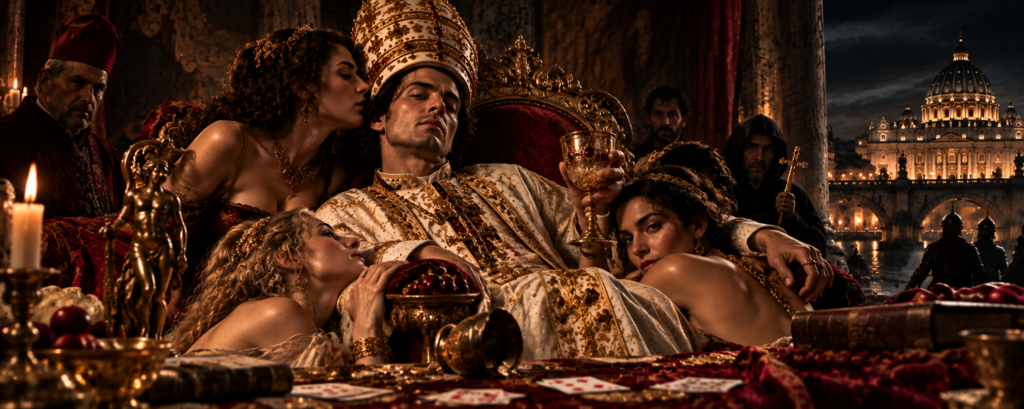
John XII: The Teenage Pope Accused of Turning the Lateran Into a Den of Vice
John XII — 955–964
In November 963, bishops and Roman clergy assembled in Saint Peter’s beneath the authority of Emperor Otto I to consider accusations against a pope who had fled the city rather than face them. What followed reads less like an ordinary medieval church council than the indictment of a violent aristocratic prince. Pope John XII was accused of adultery, fornication, sacrilege, perjury, mutilation, murder, drunkenness, gambling, and converting the papal palace into a place so notorious for sexual misconduct that respectable women supposedly feared visiting Rome. Witnesses even alleged that while gambling he invoked pagan gods and that he had ordained men in scandalous circumstances, including supposedly making a ten-year-old boy a bishop.
The catalogue was almost too perfect. John was barely into his twenties, born into the dynasty that had controlled Rome for decades, and had inherited secular authority before becoming pope while still extraordinarily young. His enemies portrayed him as a reckless aristocrat who treated the throne of Saint Peter as an extension of his private palace, mixing sacred office with hunting, warfare, gambling, sexual affairs, and brutal revenge. The accusations became the foundation of a reputation so dark that John XII would be remembered for centuries as one of the most scandalous men ever to occupy the papacy.
Yet there is an immediate problem. Much of the detailed evidence comes from people aligned with John’s political enemy, Otto I, particularly Liutprand of Cremona, whose delight in scandal is obvious throughout his writings. The synod hearing the accusations was convened while an imperial army occupied Rome, and Otto had every reason to justify removing a pope who had turned against him. Some charges may have been true, others exaggerated, and a few may have been political propaganda sharpened into moral horror.
That uncertainty does not rescue John’s reputation. Even after stripping away the most sensational allegations, a disturbing political record remains: an extraordinarily young aristocrat inherited control of Rome, became pope through arrangements made by his father, pursued military adventures, invited a powerful German king into Italy, crowned him emperor, secretly turned against him, fled Rome when confronted, was deposed, returned with armed supporters, mutilated enemies, overturned the proceedings against him, and died suddenly at approximately twenty-seven years old. His pontificate was not merely scandalous because later writers said unpleasant things about him. It was genuinely violent, unstable, and politically explosive.
John XII is therefore one of the essential Wicked Popes, but his story deserves better than a simple list of sexual accusations. Behind the lurid descriptions of the Lateran lies a larger drama about a young man who inherited enormous power before he had acquired the judgment to control it, a Roman dynasty that had effectively transformed the papacy into a family possession, and an emperor who arrived as John’s protector before becoming his destroyer. Their struggle changed the relationship between Rome and the German monarchy for generations.
The young pope who supposedly toasted the Devil while throwing dice was scandalous enough. The political reality surrounding him was even more dangerous.
Octavian: The Prince Who Became Pope
John XII was born Octavian, probably around 937, although his precise birth date remains uncertain. His father was Alberic II, prince of the Romans and the dominant secular ruler of Rome for more than two decades. Alberic had seized power in 932 after overthrowing his own mother, Marozia, whose extraordinary influence had defined the previous phase of Roman aristocratic domination. Octavian was therefore born into a dynasty already deeply entangled with the papacy.
His family history could almost serve as a summary of the Saeculum Obscurum. Marozia had helped place her son John XI on the papal throne while exercising enormous political influence in Rome. Alberic then revolted against Marozia, imprisoned her, and reduced his papal half-brother’s secular authority while governing the city himself. For the remainder of Alberic’s life, successive popes performed ecclesiastical functions beneath the political supremacy of the prince of Rome.
Alberic proved considerably more stable than many rulers surrounding him. He governed Rome from 932 until 954, resisted attempts by outside rulers to dominate the city, supported monastic reform, and maintained a political order that prevented the constant violent turnover that had characterized earlier decades. Yet his government also ensured that the papacy remained subordinate to his dynasty. The bishop of Rome might exercise spiritual authority, but Alberic possessed secular power.
As his death approached, Alberic prepared to fuse those two forms of authority in the next generation. According to the surviving tradition, he gathered Roman nobles and compelled them to swear that when the reigning Pope Agapetus II died, they would elect Alberic’s son Octavian as pope. Alberic himself died in 954, leaving Octavian as heir to his secular authority. When Agapetus died the following year, the oath was fulfilled.
Octavian became pope in December 955 and took the name John XII. He was probably around eighteen years old, perhaps somewhat older depending upon uncertain chronology, but in any case astonishingly young for the office. The prince of Rome had become bishop of Rome.
The consequences would be extraordinary.
When the Papacy Became a Family Inheritance
John’s election represented the culmination of decades of aristocratic domination. His grandmother Marozia had influenced papal succession, his uncle John XI had occupied the papal throne, and his father Alberic had controlled several popes without becoming one himself. John now combined the family’s secular inheritance with the ecclesiastical office. The distinction Alberic had maintained between prince and pope effectively collapsed.
This was not hereditary succession in a formal legal sense. John was elected, and ecclesiastical procedures surrounding his elevation still mattered. Yet an election arranged in advance by the candidate’s father and secured through oaths from the Roman aristocracy hardly represented an independent choice. The papacy had become embedded within dynastic politics to an extraordinary degree.
John’s adoption of a new name also attracted later attention. Earlier popes had sometimes changed names, but John’s choice helped establish a practice that would become increasingly common in later centuries. Octavian, the secular prince, became John, the pope, although the two identities were never truly separated. He continued behaving as a Roman aristocratic ruler while holding the highest ecclesiastical office in western Christianity.
That combination created obvious dangers. A prince could hunt, wage war, build alliances, punish enemies, and pursue dynastic interests in ways that sat uneasily beside expectations surrounding the bishop of Rome. John inherited both sets of responsibilities while still extremely young. He also inherited a political culture in which violence was normal and family power mattered more than abstract institutional boundaries.
Later critics would argue that John never truly transformed from Octavian into a pope. In their portrayal, the sacred office merely gave a young Roman prince additional resources for an already worldly life. That judgment comes largely through hostile sources, but the political structure of his reign makes the criticism understandable. John governed as both pope and territorial ruler from the beginning.
The question was whether he possessed the maturity to handle either role.
The Young Lord of Rome
Youth alone does not explain John’s disastrous reputation, and medieval society did not necessarily regard young aristocrats as incapable of wielding power. Boys and teenagers could inherit kingdoms, duchies, counties, and ecclesiastical offices when dynastic circumstances required it. Regents and advisers might compensate for inexperience. John’s difficulty was that he inherited an unusually complicated combination of powers in one of the most politically dangerous cities in Europe.
Rome was filled with aristocratic families whose loyalty could change rapidly. Beyond the city stood rival Italian princes, the Byzantine Empire, southern Lombard powers, and the increasingly formidable German monarchy. The Papal States themselves were difficult to control, while territories theoretically belonging to the pope could be occupied or threatened by powerful neighbors. John needed diplomatic restraint as much as aristocratic confidence.
The surviving record suggests that restraint was not his defining quality. He pursued territorial ambitions and became involved in military campaigns intended to recover or expand papal influence. His opponents later accused him of behaving more like a reckless secular noble than a spiritual leader. Even if their moral accusations were exaggerated, his political decisions repeatedly placed Rome in danger.
John’s secular inheritance may have encouraged this approach. He had not risen through decades of ecclesiastical service, diplomacy, monastic administration, or episcopal government. He inherited Roman political authority and then acquired the papacy almost immediately afterward. His formative experience was dynastic rather than clerical.
That background helps explain why the Lateran under John became associated with an aristocratic court culture rather than austere ecclesiastical government. Hunting, banquets, military planning, gambling, sexual relationships, and factional politics were all familiar elements of noble life. Whether every accusation about John’s palace is true, contemporaries clearly believed his conduct blurred the distinction between papal residence and princely court.
The scandal was not simply that a pope sinned. Medieval Christians were perfectly aware that clergy could sin. The scandal was that John seemed to make little effort to distinguish the behavior of the pope from that of the young prince he had been before his election.
The Alleged Brothel of the Lateran
The most infamous accusations concern John’s sexual conduct. Hostile accounts portray the Lateran Palace as a center of extraordinary debauchery, with the pope accused of relationships involving both married and unmarried women. Specific women were named in the accusations presented against him, including a widow and other women associated with the Roman court. Later retellings expanded the picture until the papal palace resembled a permanent brothel.
This material requires caution. Sexual allegations were powerful weapons in medieval political conflict, particularly against clergy whose office demanded chastity. Accusing an enemy pope of fornication was not merely gossip; it attacked his moral legitimacy at the point where clerical standards made him especially vulnerable. Otto’s supporters therefore had obvious reasons to emphasize such charges when justifying John’s removal.
Yet it would be equally careless to dismiss every allegation as fabrication. Multiple hostile reports converge upon the broader picture of a pope whose sexual behavior caused serious scandal. John’s aristocratic lifestyle, youth, and reputation among contemporaries made such accusations plausible even if individual stories cannot be independently verified. There is no compelling reason to assume that all of his enemies invented the entire pattern from nothing.
One of the most memorable claims was that respectable women hesitated to visit Rome because they feared the pope’s sexual aggression. This sounds rhetorically exaggerated and should not be treated as a statistical description of female travelers avoiding the city. Its importance lies in what the accusation was intended to communicate: John’s reputation had allegedly become so notorious that the spiritual center of western Christianity was unsafe for women because of the man occupying its highest office.
That was devastating propaganda. Pilgrims came to Rome to pray at the tombs of apostles and martyrs. The suggestion that women approaching those sacred places risked becoming targets of the pope himself inverted everything the city was supposed to represent.
Whether the Lateran literally functioned as the brothel later writers imagined is impossible to establish. What can be said is that John’s contemporaries accused him of repeated sexual misconduct and that those allegations formed a major component of the case used to depose him. The scandal was not invented centuries afterward; it was already politically explosive during his lifetime.
Gambling With the Devil
The accusations became stranger when John’s enemies moved beyond sexual misconduct. Witnesses at the 963 synod reportedly alleged that the pope gambled and invoked pagan gods while doing so. In some versions, he called upon Jupiter, Venus, or demons when throwing dice. Later retellings sharpened this into the image of a pope drinking or gambling to the Devil.
Such claims are extraordinarily difficult to verify. They may preserve genuine memories of irreverent language used during drinking or gambling, but they also resemble moralizing accusations designed to portray John as something worse than an ordinary sinner. A pope who fornicated was scandalous; a pope who invoked pagan gods suggested deliberate contempt for Christianity itself. The rhetorical escalation is obvious.
The charge nevertheless reveals the depth of hostility surrounding John. His enemies did not merely argue that he governed badly or violated clerical discipline. They portrayed him as sacrilegious, almost anti-Christian, a man who mocked the sacred office he occupied. The accusation transformed personal vice into spiritual betrayal.
Other charges reinforced that image. John was accused of celebrating or attending liturgical acts improperly, neglecting expected religious practices, and ordaining clergy in irregular circumstances. One particularly sensational accusation claimed that he ordained a ten-year-old boy as bishop of Todi. Whether the child’s age was accurate or exaggerated, the story portrayed John as treating sacred office with contempt.
The cumulative effect was deliberate. Each allegation attacked a different dimension of papal legitimacy: sexual purity, clerical discipline, reverence, sobriety, justice, and orthodoxy. By the time the charges were assembled, John appeared not merely unworthy but almost a parody of a pope.
That does not mean the catalogue was false. It means we should recognize that it was a prosecution case constructed by his enemies rather than a neutral biography.
Blood, Mutilation, and Fear
The allegations of violence were even more serious. John was accused of causing deaths, mutilating opponents, and inflicting brutal punishments. One charge involved the death of a cardinal subdeacon, while another accused him of mutilating a cardinal by cutting off his nose. A further allegation concerned blinding another churchman.
Here again, the political context complicates the evidence without making it irrelevant. Tenth-century Roman politics were genuinely violent, and John’s own later actions after returning to power demonstrate that mutilation of enemies was not merely something hostile writers imagined him capable of doing. Medieval political punishment frequently involved blinding, mutilation, imprisonment, exile, and execution. Such acts were intended both to incapacitate enemies and to advertise victory.
John had grown up in a dynasty created through precisely this kind of politics. His grandmother Marozia had helped overthrow John X, whose brother was killed and who himself died in captivity. His father Alberic had seized Rome through revolt and imprisoned Marozia. Violence was not an aberration in John’s political inheritance; it was one of the methods through which that inheritance had been created.
This context does not excuse cruelty. It helps explain why allegations of violent punishment sounded plausible to contemporaries. John was not operating inside a peaceful ecclesiastical bureaucracy suddenly corrupted by one unusually vicious teenager. He was ruling a city where political defeat could mean mutilation or death.
The distinction between pope and Roman prince once again became dangerously thin. A territorial ruler might punish traitors brutally, but the bishop of Rome was expected to embody a different moral ideal. John held both identities simultaneously, and his enemies used the contradiction relentlessly.
The accusations would become central once a more powerful ruler entered Italy. That ruler was Otto I.
Berengar II and the Italian Crisis
John’s greatest political problem came from Berengar II, king of Italy. Berengar had risen amid the continuing instability of the Italian kingdom and had already clashed with Otto I of Germany. Otto had intervened in Italy in 951, married Adelaide, and asserted his own claims, while Berengar eventually remained as a subordinate ruler. Once Otto returned north, however, Berengar behaved with increasing independence.
The papacy found itself threatened by Berengar’s expansion and by the activities of his son Adalbert. Papal territories and Roman interests were vulnerable, while John lacked the military resources necessary to defeat Berengar alone. The young pope therefore looked beyond Italy for assistance. The most obvious protector was Otto.
By this time Otto had become one of the most formidable rulers in western Europe. His victory over the Magyars at Lechfeld in 955 had dramatically increased his prestige, and he had consolidated authority within the German kingdom after years of rebellion. He possessed the military strength John needed. He also possessed ambitions of his own.
Inviting Otto into Italy was therefore both logical and dangerous. John hoped to obtain protection against Berengar without surrendering Roman independence. Otto had every reason to help because intervention offered the possibility of the imperial crown. Each man believed he could use the other.
The alliance would initially appear spectacularly successful. Within a few years, John would crown Otto emperor in Saint Peter’s. Shortly afterward, the pope would discover that the protector he had summoned was powerful enough to determine who could remain pope.
Otto Comes to Rome
Otto crossed into Italy in 961 with an army capable of overwhelming Berengar’s position. His campaign carried him south toward Rome, where John prepared to receive the ruler he had invited. The meeting represented the convergence of two very different forms of authority. John possessed the apostolic throne and the right to confer the western imperial crown, while Otto possessed the military strength necessary to defend that throne.
On February 2, 962, John crowned Otto emperor in Saint Peter’s Basilica. Otto’s wife Adelaide was crowned empress. The ceremony revived imperial traditions that had weakened dramatically during the political fragmentation of the previous decades and established a relationship between the German monarchy and the imperial title that would shape European politics for centuries.
For John, the coronation should have secured a powerful protector. For Otto, it transformed kingship into empire and provided religious legitimacy for his wider political ambitions. Both men stood to gain enormously. The difficulty lay in deciding what each owed the other afterward.
Their relationship was formalized through agreements commonly associated with the Ottonianum. Otto confirmed extensive papal possessions and protections, drawing upon earlier Carolingian traditions. At the same time, imperial interests in papal elections and Roman loyalty were strengthened. The exact constitutional implications of the arrangements have generated considerable historical debate, but the political reality was unmistakable: Otto had not come to Italy merely to serve as John’s hired soldier.
The emperor intended to exercise influence in Rome. John soon realized that the man he had summoned to protect the papacy could become a threat to the independence of his dynasty.
The alliance began to unravel almost immediately.
The Pope Turns Against His Emperor
Once Otto moved away from Rome to continue operations against Berengar, John began exploring alternatives. Sources accuse him of opening communications with Otto’s enemies, including Adalbert, Berengar’s son. There were also contacts or attempted contacts involving other powers who might help counterbalance the emperor. The pope who had invited Otto into Italy was now maneuvering against him.
From John’s perspective, the reversal was not entirely irrational. Otto’s growing influence threatened the political independence inherited from Alberic. John had not summoned a permanent imperial supervisor; he had wanted military assistance against Berengar. Once Otto began acting as emperor with claims over Roman political arrangements, the young pope had reason to fear that one enemy had simply been replaced by a stronger one.
The problem was that betrayal carried enormous risk. Otto possessed both military power and a plausible argument that John had violated their agreements. If the emperor could demonstrate that the pope was conspiring with Berengar’s faction after receiving imperial protection, he could present intervention as punishment for treachery rather than naked conquest. John’s moral reputation provided additional ammunition.
Otto attempted to investigate the reports. According to hostile accounts, he initially expressed disbelief at some accusations concerning John’s private behavior, perhaps suggesting that youth might be corrected. Whether those remarks are preserved accurately or shaped by Liutprand to make the emperor appear patient and reasonable is uncertain. The narrative nevertheless serves an obvious purpose: Otto is portrayed as reluctant to condemn until evidence becomes overwhelming.
John did little to reduce the danger. His political maneuvering continued, and Adalbert eventually appeared in Rome. For Otto, this was intolerable. The emperor turned back toward the city.
John prepared to resist.
A Pope in Armor
One of the more striking aspects of John’s career is his willingness to participate in military affairs. He was not simply a frightened cleric waiting behind palace walls while soldiers decided his fate. As ruler of Rome and the papal territories, he had inherited a martial political culture and appears to have taken that role seriously. Contemporary portrayals sometimes place him directly within armed conflict.
When Otto returned toward Rome in 963, John’s position became increasingly desperate. The emperor commanded disciplined forces and enjoyed support among Roman opponents of the pope. John could not rely upon the city’s loyalty indefinitely. His earlier alliance with Otto had also allowed the emperor to establish relationships within Rome that now worked against him.
John eventually fled. He reportedly took part of the papal treasury with him, an action his enemies naturally portrayed as theft or evidence of selfishness. From John’s perspective, portable wealth was essential for financing resistance and maintaining allies. Medieval rulers fleeing hostile armies rarely abandoned every resource to their enemies if they could avoid it.
His departure opened Rome to Otto. The emperor entered the city in November 963 and found himself in the extraordinary position of controlling Rome while the reigning pope remained outside it. Otto now had to decide what to do with John.
He could attempt reconciliation, but John’s betrayal made trust nearly impossible. He could leave the papal throne empty while John remained alive, but that would preserve a permanent focus for resistance. The remaining option was the most radical: put the pope on trial and remove him.
A synod assembled in Saint Peter’s.
The Trial of John XII
The synod of November 963 produced one of the most extraordinary indictments in papal history. Bishops, clergy, and Roman representatives gathered in the presence of Otto and considered accusations against the absent pope. John was summoned to appear and defend himself. He refused and challenged the legitimacy of proceedings conducted under imperial pressure.
The charges covered almost every category of misconduct imaginable. John was accused of homicide, perjury, sacrilege, simony or irregular ordination, adultery, fornication, incestuous or otherwise prohibited sexual relationships, gambling, drinking, and invoking pagan deities. He was accused of mutilating clergy and treating ecclesiastical office with contempt. The Lateran was portrayed as a place where vice flourished under papal protection.
Liutprand of Cremona provides the fullest surviving narrative and was himself deeply connected to Otto’s political world. That fact cannot be pushed aside. Liutprand was a talented writer, diplomat, bishop, and polemicist who knew how to make enemies look ridiculous or monstrous. His account should never be treated as though a neutral stenographer recorded every word.
Yet the synod itself was real, John’s conflict with Otto was real, and the charges were serious enough to be publicly aired before bishops and Roman clergy. Some participants were likely motivated by fear or opportunism, but others may genuinely have believed the accusations. Political bias does not automatically make testimony false.
The correct approach is therefore neither unquestioning acceptance nor blanket dismissal. We can confidently say that John had acquired a severe reputation for misconduct among important contemporaries and that accusations of sexual, violent, and sacrilegious behavior were formally presented against him. We cannot confidently say that every individual charge was true exactly as recorded.
The distinction matters because John’s reputation has often been built by treating the indictment as a proven verdict on every detail. History is more complicated. The prosecution was politically motivated, but the defendant was hardly innocent of political wrongdoing.
The Ten-Year-Old Bishop
Among the most memorable accusations was that John had ordained a child as bishop. The boy was said to have been approximately ten years old and associated with the see of Todi. If literally true, the act represented a shocking violation of ecclesiastical norms and an extraordinary example of treating church office as patronage. It became one of the favorite stories used to illustrate John’s contempt for religious discipline.
The precise details are difficult to verify independently. Medieval polemicists sometimes exaggerated ages to make irregular appointments appear even more grotesque. A very young candidate could become “ten years old” in hostile retelling because the number emphasized absurdity. Without independent documentation, certainty is impossible.
The allegation nevertheless fits a broader and well-documented problem within medieval church politics. Powerful families frequently sought ecclesiastical offices for relatives or dependents, and aristocratic influence could produce appointments that violated the ideals later reformers would emphasize. John’s own papacy had resulted from dynastic manipulation. He was hardly governing within a system untouched by nepotism.
If the charge contained truth, it would demonstrate how naturally John treated ecclesiastical office as part of aristocratic patronage. If exaggerated, its plausibility still tells us something about his reputation. His enemies believed their audience would accept that the pope might elevate a child to a bishopric.
That alone reveals how badly John’s credibility had deteriorated.
The Missing Sign of the Cross
Another accusation claimed that John failed to make the sign of the cross at appropriate times. On its surface, this might appear trivial beside murder and mutilation. Within the prosecution’s larger narrative, however, it served a deliberate purpose. John was being portrayed not merely as morally weak but as contemptuous of Christianity.
The gambling allegations worked the same way. Drinking or gambling could be condemned as clerical misconduct, but invoking Jupiter, Venus, or demons transformed ordinary vice into sacrilege. The prosecution repeatedly pushed John’s behavior beyond sin toward deliberate mockery of sacred things. That rhetorical pattern should make us cautious.
Medieval political attacks frequently used religious language to delegitimize opponents. A bad ruler became impious, a political betrayal became perjury before God, and sexual misconduct became evidence of spiritual corruption. John’s enemies had every reason to make his private behavior appear cosmically offensive. Otto was not merely removing a political opponent; the narrative suggested he was rescuing the Church from desecration.
John’s actual religious beliefs remain unknowable. Nothing requires us to imagine him as a secret pagan or Satanist, as later sensational retellings sometimes imply. Irreverent aristocratic behavior, drunken joking, or hostile invention could all explain the most extreme allegations more plausibly.
The scandal remains powerful without supernatural embellishment. A pope accused by his own contemporaries of mocking the religious practices he was supposed to embody was already in profound trouble.
The Emperor Judges the Pope
The synod raised a constitutional problem far larger than John’s personal misconduct. By what authority could an emperor depose a pope? The bishop of Rome occupied a unique position within the western Church, and no straightforward legal mechanism allowed a secular ruler simply to remove him. Otto’s military control of the city did not automatically create ecclesiastical jurisdiction.
John exploited this weakness by refusing to recognize the proceedings. He reportedly threatened those participating in the synod with excommunication. From his perspective, bishops cooperating with an emperor against their pope were themselves acting illegally. The confrontation therefore became a struggle not only over John’s morality but over the boundaries between imperial and papal power.
Otto and the synod proceeded anyway. On December 4, 963, John was declared deposed. The assembly then selected Leo VIII, a Roman official who was still a layman at the time of his election. Leo was rapidly advanced through the necessary ecclesiastical orders and consecrated pope.
The irony was remarkable. A synod condemning John partly for irregular ecclesiastical conduct replaced him with a man whose own rapid elevation required obvious procedural irregularities. Political necessity had overwhelmed canonical neatness. Otto needed a pope he could trust, and Leo provided one.
The legitimacy of Leo VIII’s initial pontificate has remained complicated because John’s deposition itself was deeply controversial. If an emperor-backed synod lacked authority to depose John, then John remained lawful pope and Leo was an antipope during the overlap. Medieval papal politics rarely provided the clean constitutional answers later institutions would prefer.
For John, legal theory mattered less than military reality. He had lost Rome.
For the moment.
Rome Turns Against Otto
Otto’s victory did not mean the Romans welcomed permanent imperial control. Many resented the emperor’s intervention and regarded Leo VIII as an imposed pope. John’s family still possessed supporters within the city, and the political tradition established by Alberic had emphasized Roman independence from outside rulers. Otto had removed an unpopular pope only to remind the Romans that foreign armies could determine their government.
Tensions erupted in January 964 when a Roman uprising challenged imperial authority. Otto’s forces crushed the revolt with considerable bloodshed. The episode demonstrated that imperial control depended upon soldiers rather than universal Roman acceptance. It also showed that John’s cause remained alive even while he was absent.
Otto eventually left Rome to continue his wider Italian campaign. That departure created the opportunity John needed. The moment the emperor’s military presence weakened, John’s supporters moved. Leo VIII fled the city and sought imperial protection.
John returned to Rome in February 964. The deposed pope had become pope again in practical terms because he controlled the city. Whatever Otto’s synod had declared, political reality had reversed itself.
John now possessed an opportunity to show mercy toward the men who had participated in his deposition. He chose another path.
The revenge that followed strengthened the darkest parts of his reputation.
The Pope Returns for Revenge
John summoned his own synod after returning to power. The acts of the imperial council were rejected, and Leo VIII was condemned. Bishops and clergy who had cooperated with Otto faced punishment. John’s restoration therefore became both a legal reversal and a political purge.
Several opponents suffered mutilation. According to the surviving accounts, one had his nose cut off, another lost fingers, and others were subjected to humiliating or brutal penalties. The precise identities and details vary in retellings, but the broader pattern of violent retaliation is well established in the hostile narrative. John’s enemies had attempted to destroy him, and he responded according to the ruthless political customs of his age.
This episode matters enormously when evaluating the earlier accusations of violence. Even if Otto’s synod exaggerated John’s previous conduct, his behavior after restoration demonstrates that he was willing to employ physical mutilation against political enemies. The pope’s violence is therefore not merely a collection of unverified allegations from a hostile trial. His return to Rome produced a documented atmosphere of vengeance.
Medieval political mutilation served practical and symbolic purposes. Cutting off a nose, tongue, hand, or fingers marked the victim publicly and could make future political or ecclesiastical activity difficult. Blinding was frequently used against rivals because it incapacitated them without technically shedding blood in execution. Such punishments were horrifying but not unique to John.
The scandal arose from the identity of the man ordering or permitting them. John was not merely a Roman prince avenging treason. He was pope, the spiritual leader whose enemies had already accused him of treating sacred office like secular lordship. His revenge appeared to confirm their portrait.
The young pontiff had regained his throne. He had not regained control of his reputation.
Otto Prepares to Return
John’s restoration created an intolerable challenge for Otto. The emperor had publicly deposed him, installed Leo VIII, and tied imperial prestige to the legitimacy of that decision. John’s return made the entire settlement look temporary. If Otto allowed him to remain, imperial authority in Rome would suffer a humiliating defeat.
Another confrontation therefore appeared inevitable. John needed allies strong enough to resist Otto’s return, while the emperor prepared to restore the political order established in 963. The pope’s position remained precarious because Rome alone could not indefinitely withstand imperial military pressure. His survival depended upon time and shifting alliances.
He received very little time. In May 964, only a few months after returning to power, John died suddenly. He was approximately twenty-seven years old.
The circumstances immediately generated scandal. A pope accused throughout his life of sexual misconduct died unexpectedly while his political enemies were preparing to move against him. Later writers naturally connected the death with his sexual reputation.
The most famous version claimed that John was caught in bed with a married woman and attacked by her husband. Another tradition, preserved in hostile accounts, attributed his death to a stroke or sudden seizure while engaged in adultery, sometimes interpreted by moralizing writers as divine punishment. Still later versions embellished the story further.
None can be established with confidence.
The Mysterious Death of John XII
John died on May 14, 964. That date is considerably firmer than the colorful stories explaining how. Liutprand, predictably, connected John’s death to sexual misconduct and gave the event a moralizing interpretation. Other accounts developed the possibility that an enraged husband fatally assaulted the pope after discovering him with his wife.
The murdered-by-a-jealous-husband version is irresistible storytelling. It provides perfect poetic justice for a pope accused repeatedly of adultery: the behavior that supposedly defined his life literally kills him. That very perfection should make us cautious. Medieval chroniclers frequently interpreted sudden deaths as moral judgments, especially when the dead person already possessed a scandalous reputation.
A stroke, seizure, or other sudden medical event is entirely possible. John was young, but young people could die abruptly from conditions medieval observers could not diagnose. Violence is also possible given the political culture surrounding him. There is simply not enough reliable evidence to choose confidently among the alternatives.
What can be said is that John’s death was sudden and extraordinarily convenient for several political actors. Otto no longer needed to solve the difficult problem of removing him again. Leo VIII’s supporters could claim that the obstacle to restoration had disappeared. Roman aristocrats, however, still resisted allowing the emperor complete control over papal succession.
John’s death therefore ended one crisis and immediately opened another. The Romans elected Benedict V rather than accepting Leo. Otto responded by marching back to Rome, besieging the city, deposing Benedict, and restoring Leo VIII.
Even in death, John XII’s struggle with Otto continued shaping the papacy.
The Pope Who Created an Emperor
One of the greatest ironies of John’s life is that the man who became his most dangerous enemy owed the imperial crown to him. John had summoned Otto into Italy and personally crowned him emperor in 962. Without John’s appeal, Otto might still have pursued Italian ambitions, but the specific path leading to his Roman coronation would have been different. The pope helped create the political force that later removed him.
The coronation also had consequences extending far beyond either man’s lifetime. Otto’s imperial title strengthened the enduring association between the German monarchy and the western empire. Future German kings would repeatedly cross the Alps seeking imperial coronation and intervening in Italian politics. The relationship between pope and emperor became one of the defining political tensions of the central Middle Ages.
John therefore occupies an unexpectedly important place in European history. His personal scandals often overshadow the constitutional consequences of his reign. The struggle of 963 raised questions about whether emperors could judge popes, whether Romans could elect popes without imperial approval, and how spiritual and secular authority should interact. These issues would return with even greater intensity during the Investiture Controversy more than a century later.
Neither John nor Otto possessed a settled constitutional theory capable of resolving those questions. They acted according to political necessity, inherited precedent, military power, and competing claims of legitimacy. John invoked papal authority against imperial interference. Otto invoked imperial responsibility to restore order within a scandalized Church.
Both arguments would echo through medieval history.
The teenage pope accused of gambling with demons therefore helped set the stage for conflicts that would eventually involve some of the most powerful popes and emperors of the Middle Ages.
How Much of the Scandal Was True?
Any responsible account of John XII eventually confronts the central question: how much should we believe? The easiest approach is to accept Liutprand and the 963 synod literally, producing a pope guilty of nearly every imaginable vice. The opposite approach dismisses the accusations as imperial propaganda and portrays John mainly as the victim of Otto’s expansion. Neither extreme fits the evidence comfortably.
Liutprand was unquestionably partisan. He served Otto’s political world, disliked many of the people he described, and wrote with a taste for sexual scandal and humiliating anecdotes. The synod itself occurred under imperial occupation and had an obvious political objective. John was not being tried in anything resembling a neutral court.
Yet John had genuine enemies in Rome before Otto arrived, and his behavior after restoration confirms his capacity for violent retaliation. His alliance with Otto followed by secret negotiations with Otto’s enemies is difficult to portray as political innocence. His extremely young accession through his father’s arrangements demonstrates dynastic corruption independent of Liutprand’s testimony. The broad picture of a worldly, politically reckless pope does not depend upon believing every sexual allegation.
The sexual charges are more difficult. There is enough contemporary hostility to make repeated misconduct plausible, but individual affairs cannot usually be verified independently. Claims involving pagan invocations, extreme sacrilege, and the most theatrical details deserve even greater skepticism. Hostile sources often become most creative when explaining why an enemy deserved his fate.
The safest conclusion is also the most historically satisfying. John XII was almost certainly not the cartoonish monster created by accepting every accusation literally, but neither was he merely an innocent reformer destroyed by imperial propaganda. He was a young aristocratic pope whose documented political behavior was reckless and violent, and whose contemporaries credibly regarded his private conduct as deeply scandalous.
The darkness is real even when some of the shadows were painted by his enemies.
The Lateran as a Palace of Scandal
The image of the Lateran under John became one of the most enduring symbols of papal corruption. Later writers described it as a place where women, drinking, gambling, and violence replaced prayer and administration. The language grew increasingly lurid over the centuries. John’s name became shorthand for everything that could go wrong when an immoral man occupied a sacred office.
The Lateran of the tenth century was more than a religious residence. It was also an administrative and political center in a Rome where popes exercised temporal power. Courtiers, soldiers, aristocrats, petitioners, clerics, servants, diplomats, and relatives all moved through the world surrounding the pope. A young ruler raised as a prince would naturally bring elements of secular court culture into that environment.
That context makes some accusations easier to understand without automatically confirming them. Banquets, hunting companions, political retainers, and aristocratic women appearing around the papal court could be interpreted differently depending upon the observer. A reform-minded bishop might see scandal where a Roman noble saw ordinary court life. John’s enemies then pushed that contrast to its most damaging extreme.
Yet clerical expectations mattered. John was not simply another count holding court. He had accepted ordination and the papal office, and contemporaries were entitled to expect behavior appropriate to that role. The argument that he behaved like other aristocrats therefore explains the scandal rather than excusing it.
John’s failure may have been precisely that he never fully accepted the distinction. He inherited the papacy as part of his family’s political estate and seems to have governed accordingly. The Lateran became controversial because Octavian the prince never disappeared inside John the pope.
The Curse of Alberic’s Success
Alberic II had created the political conditions that made John’s accession possible. For more than twenty years, he had kept Rome relatively stable by controlling the papacy from outside it. His son inherited a city accustomed to dynastic rule and a papacy already weakened as an independent political institution. Alberic’s final decision to unite those powers in Octavian may have undone much of the stability he had created.
The father had possessed decades of political experience. The son inherited authority while still very young. Alberic had known how to resist kings without necessarily provoking overwhelming retaliation, whereas John invited Otto into Italy and then turned against him. The difference in political judgment was enormous.
There is a broader lesson in the contrast. Dynastic systems can transfer titles more easily than competence. Alberic could guarantee that his son became pope, but he could not guarantee that the young man would possess the restraint necessary to manage the office. John inherited the results of his father’s political skill without inheriting the experience that produced them.
His accession therefore represents both the triumph and failure of the Theophylact dynasty. The family had spent decades increasing its control until one of its young heirs possessed both Rome and the papacy. That concentration of power should have represented ultimate success. Instead, it provoked an imperial intervention that permanently changed Roman politics.
Alberic had spent his life keeping outside rulers from controlling Rome. His son summoned the most powerful one directly to Saint Peter’s.
The dynasty reached its peak and began losing control almost simultaneously.
John XII and the End of the Pornocracy
John is often treated as the final spectacular product of the political order associated with the Saeculum Obscurum and the so-called pornocracy. The terminology is imperfect, particularly because it reduces complex aristocratic politics to sexual scandal. Yet John’s reign unquestionably marks a turning point. The Roman dynasty that had dominated papal politics since the days of Theophylact and Marozia could no longer operate without confronting revived imperial power.
Otto’s intervention did not permanently free the papacy from aristocratic influence. Roman families would continue manipulating elections, staging coups, imprisoning popes, and competing for control throughout the tenth and eleventh centuries. The Crescentii and Tusculani would later become particularly important. The struggle between local and external control remained unresolved.
What changed was the scale of imperial involvement. Otto had demonstrated that a German ruler could cross the Alps, occupy Rome, convene a synod against a pope, and install another candidate. Future emperors would remember the precedent. So would future popes who resented it.
John’s own behavior provided Otto with the moral justification necessary for such intervention. Had the pope possessed an impeccable reputation, removing him would have looked more obviously like imperial aggression. The extraordinary accusations allowed Otto to present himself as a defender of ecclesiastical order. John’s scandal became politically useful.
This is another reason the truth of individual charges matters. Propaganda works best when attached to enough reality to remain believable. John gave his enemies abundant material through his political recklessness and violent conduct. They may have embroidered the portrait, but he helped provide the canvas.
His pontificate thus became the point where Roman aristocratic corruption and imperial reforming claims collided. Neither side emerged entirely innocent.
The Problem With Calling Otto the Hero
Older narratives sometimes present Otto as the strong Christian emperor who rescued Rome from a depraved pope. There is some truth behind the image. John’s government was deeply problematic, and Otto possessed legitimate reasons to be alarmed by both papal misconduct and political betrayal. His intervention brought a degree of order and connected Rome with a powerful monarchy capable of protecting it.
Yet Otto was hardly a disinterested reformer. He wanted imperial authority in Italy, influence over Rome, and control over the conditions surrounding papal elections. Removing John strengthened those ambitions enormously. Installing Leo VIII gave him a pope dependent upon imperial support.
The irregularity of Leo’s elevation also exposes the political nature of the intervention. Leo was still a layman when selected and had to be rushed through ecclesiastical orders before consecration. If canonical purity were Otto’s only concern, such a procedure was awkward at best. Political reliability mattered.
The Romans recognized this and resisted. Their opposition to Leo was not necessarily an endorsement of every aspect of John’s behavior. They could dislike John and still reject the emperor’s right to choose their pope. Medieval political loyalties were not binary.
John’s struggle with Otto therefore should not be reduced to wicked pope versus virtuous emperor. It was a conflict between two ambitious rulers whose interests briefly aligned and then violently diverged. John’s misconduct weakened his moral position, but Otto’s army gave the emperor arguments that theology alone could never provide.
The papacy would spend centuries wrestling with the consequences of such imperial protection.
Revenge as Evidence
John’s actions after returning to Rome are among the strongest pieces of evidence against attempts to rehabilitate him completely. Once Otto departed and Leo fled, John regained control without immediately facing an imperial army. He could have used that moment to present himself as the lawful pope forgiving opponents coerced by foreign occupation. Such restraint might even have strengthened his legitimacy.
Instead, he retaliated. Clerics associated with his deposition suffered punishments that included mutilation, while John’s synod reversed the acts taken against him. His response belonged to the political culture of vengeance rather than reconciliation. The prince had reappeared beneath the papal vestments.
These punishments also make earlier accusations of cruelty more plausible, though they do not prove every charge. A man demonstrably willing to mutilate opponents in 964 could reasonably have used similar methods earlier. The historical record therefore provides more than hostile rhetoric when assessing John’s capacity for violence.
His vengeance also reveals how personal the conflict had become. Otto’s synod had not merely challenged John’s policies; it had declared him morally unworthy and removed him from the office his father had secured for him. Men John knew had testified or cooperated against him. His return offered the opportunity to punish betrayal.
In a secular aristocratic feud, contemporaries might have understood such retaliation as harsh but familiar. From a pope, it appeared especially disturbing. The office that should have represented spiritual judgment had become an instrument of personal revenge.
That contradiction sits at the center of John’s legacy.
The Death That Became a Morality Tale
John’s sudden death was almost destined to become a morality tale. Medieval chroniclers frequently interpreted unexpected deaths as evidence of divine judgment, especially when the deceased had powerful enemies or a notorious reputation. A pope accused of adultery dying during an adulterous encounter provided an irresistible narrative. The story seemed to prove everything his critics had said about him.
The jealous-husband version intensified the lesson. According to later retellings, John was discovered with another man’s wife and beaten so severely that he died. Other versions attributed the fatal blow to the Devil himself, transforming the pope’s alleged sacrilege into supernatural punishment. Such embellishments reveal more about later moral imagination than reliable forensic evidence.
Liutprand’s account is closer to the events but remains hostile and moralizing. He had every incentive to make John’s death appear consistent with the sins attributed to him. Sudden illness during a sexual encounter may be possible, but possibility is not confirmation. We do not possess evidence capable of establishing the precise circumstances.
The responsible conclusion is therefore deliberately limited. John died suddenly on May 14, 964, shortly after recovering Rome and while renewed conflict with Otto threatened. Contemporary or near-contemporary hostile sources connected his death with sexual misconduct, but the exact cause is uncertain.
That uncertainty should remain intact. A mysterious death does not need a fabricated solution to be dramatic.
John had spent his brief adult life surrounded by scandal, warfare, betrayal, and revenge. Dying unexpectedly before his enemies could return was a fittingly chaotic end even without a jealous husband entering the room.
What John XII Actually Did
Separating allegation from documented behavior leaves a substantial record. John inherited secular control of Rome through his father and became pope through a succession arrangement Alberic had secured before his death. He pursued military and territorial policies, appealed to Otto I for assistance against Berengar II, and crowned Otto emperor in 962. He then entered communications with Otto’s enemies and attempted to escape the emperor’s growing influence.
When Otto returned, John fled Rome. An imperial-backed synod heard extensive accusations against him and declared him deposed, replacing him with Leo VIII. John later returned after Otto’s departure, regained the city, overturned the imperial settlement, and inflicted harsh punishments upon opponents. He died suddenly a few months later.
None of these facts depends upon believing that John invoked demons at dice or transformed the Lateran into a literal brothel. They establish a pontificate characterized by dynastic manipulation, political betrayal, violent conflict, disputed deposition, and revenge. That alone would earn John a significant place in the darker history of the papacy.
The sexual allegations add another layer but should remain properly attributed. John’s contemporaries accused him of extensive misconduct, and the breadth of those accusations makes some underlying scandal likely. Yet individual stories cannot all be independently confirmed. The difference between “John was accused of” and “John certainly did” is essential.
Historical accuracy does not require draining the drama from his life. It requires placing the drama where the evidence can support it.
In John’s case, there is more than enough.
A Pope Who Never Had Time to Grow Old
John’s youth deserves consideration without becoming an excuse. He may have been only eighteen when he became pope and was still in his twenties when he died. Most men entrusted with comparable authority would have spent decades preparing for it. John inherited it almost overnight because his father had arranged the succession.
Youth may explain some recklessness. A young aristocrat surrounded by retainers, wealth, political privilege, and few meaningful restraints could easily develop an exaggerated sense of invulnerability. Becoming pope as well as prince would only magnify that danger. John had been taught by circumstances that Rome belonged to his family.
Yet he was not a child throughout his pontificate. By the time of his conflict with Otto, he had ruled for several years and possessed ample evidence that political decisions carried serious consequences. His decision to conspire against the emperor after inviting him into Italy cannot simply be dismissed as adolescent foolishness. It was a calculated gamble.
The gamble failed because John underestimated Otto’s power and perhaps overestimated Roman loyalty. His father had successfully balanced external rulers for decades, but John lacked Alberic’s patience and experience. Once Otto controlled Rome, the young pope discovered that inherited authority could disappear remarkably quickly.
His restoration showed courage and political resilience, but the vengeance that followed suggests that defeat had taught him little about restraint. John regained the city and immediately resumed the ruthless style of politics that had helped create the crisis. Death prevented us from knowing whether age might eventually have changed him.
He never reached thirty.
His entire notorious papacy unfolded during years when many future popes would still have been junior clerics.
The Prince Beneath the Vestments
The simplest way to understand John may be to remember that he inherited two identities that never fully merged. As Octavian, he was the son of Alberic II, heir to a Roman principality created through aristocratic revolt and maintained through political strength. As John XII, he was bishop of Rome and successor of Saint Peter. Medieval papal government required elements of both identities, but John seems to have allowed the princely one to dominate.
His military adventures reflected the prince. His alliances and betrayals reflected the prince. His retaliatory mutilations reflected the violent aristocratic politics in which he had been raised. Even the alleged sexual and gambling culture surrounding the Lateran resembles hostile descriptions of a young nobleman’s court more than an ecclesiastical household.
The papal identity nevertheless mattered enormously when John needed legitimacy. He could crown Otto emperor because he was pope, threaten opponents with excommunication because he was pope, and condemn the synod attempting to remove him because he was pope. Sacred authority became one of the political weapons available to the Roman prince.
That combination made him dangerous. A secular noble could be defeated without creating a crisis over the leadership of western Christianity. Removing John raised questions about whether emperors could judge popes and whether a pope remained pope after losing control of Rome. His personal failures became institutional problems.
This is why John XII matters beyond scandal. His pontificate demonstrates what could happen when papal spiritual authority and hereditary aristocratic power were fused inside a young ruler whose political instincts remained those of a Roman prince.
The consequences reached far beyond his bedroom.
Wicked Pope or Victim of Propaganda?
The question is often framed as though only two possibilities exist. Either John was one of history’s most depraved popes, or he was a victim of Ottonian propaganda. The surviving evidence points toward a more uncomfortable middle ground. He could be genuinely scandalous and still have been slandered.
Political propaganda rarely requires complete invention. Otto’s supporters had every incentive to collect genuine complaints, magnify them, add moralizing interpretation, and arrange them into the most devastating possible portrait. John’s documented behavior gave them plenty to work with. The result may contain truth and exaggeration simultaneously.
Liutprand is particularly important here. He is too knowledgeable to ignore and too partisan to trust blindly. His writing preserves invaluable details about tenth-century politics while repeatedly demonstrating his willingness to humiliate people he disliked through sexual and moral accusation. Reading him requires constant awareness of both qualities.
The synod’s charges should therefore be treated like an indictment rather than a modern conviction based upon independently tested evidence. They tell us what John’s enemies formally accused him of and what some contemporaries claimed to have witnessed. They do not allow us to certify every allegation as fact.
John’s own actions provide the necessary anchor. His dynastic accession, military adventurism, betrayal of Otto, flight from Rome, restoration, and brutal retaliation are sufficient to establish a deeply troubled pontificate. His sexual reputation adds credible darkness without needing every sensational detail to be true.
The result is not rehabilitation. It is a more historically defensible condemnation.
The Wicked Pope Who Changed Europe
John’s personal reputation has sometimes obscured the enormous political consequences of his decisions. By inviting Otto into Italy, he helped create the circumstances in which the German king received the imperial crown. That coronation in 962 became a landmark in the development of the medieval empire. The relationship between German kingship, Italian rule, and imperial coronation would endure for centuries.
His conflict with Otto also established dangerous precedents surrounding imperial intervention in papal affairs. The emperor participated in a synod that deposed a pope and installed another candidate. Rome resisted, John returned, and competing claims to papal legitimacy followed. The episode demonstrated how easily attempts to reform the papacy through secular power could create new constitutional crises.
Later reformers would insist that the Church needed freedom from precisely this kind of lay control. Yet the moral condition of popes such as John provided powerful arguments for outside intervention. If Roman aristocrats could place an allegedly debauched young prince on Saint Peter’s throne, imperial supporters could plausibly ask who else was capable of restoring order. The solution created its own danger.
This tension would define medieval politics. A corrupt or weak papacy invited secular intervention, while secular intervention threatened ecclesiastical independence. Reform required protection, but protectors could become masters. John and Otto acted out an early version of a conflict that later popes and emperors would fight on a much larger scale.
John therefore left a political legacy entirely disproportionate to his short life. He died before thirty, yet the consequences of his alliance and rupture with Otto extended across generations.
The young pope accused of treating Rome like his playground helped reshape the political architecture of medieval Europe.
Why John XII Belongs at the Heart of Wicked Popes
Some figures require explanation before they belong in a category called Wicked Popes. John XI belongs because his reign reveals aristocratic domination even though his personal wickedness is uncertain. John X belongs because his rise and fall expose the violence surrounding the papacy despite his substantial achievements. John XII requires much less justification.
Even after applying every reasonable caution to hostile sources, his pontificate remains extraordinary. His election was arranged through dynastic power. His secular government was reckless. His relationship with Otto moved from desperate alliance to betrayal and open conflict. His restoration produced violent revenge against opponents.
On top of those documented political failures sits a contemporary catalogue of moral accusations almost unmatched in papal history. Adultery, fornication, sacrilege, gambling, drunkenness, mutilation, homicide, irregular ordination, and pagan invocations were all associated with his name. Some details may be propaganda, but the overall scandal was real enough to become politically decisive during his lifetime.
John also represents the culmination of the Roman aristocratic system that had developed across several generations. Theophylact and Theodora built influence, Marozia expanded it, Alberic II consolidated it, and John inherited the result. What earlier family members achieved by controlling popes, John embodied by becoming pope himself.
The experiment failed spectacularly. Within eight years of his accession, a German emperor occupied Rome and presided over his deposition. Within nine, John was dead.
Few papal careers move so quickly from dynastic triumph to institutional catastrophe.
The Last Days of the Young Pope
The final months of John’s life must have been filled with extraordinary tension. He had recovered Rome, punished enemies, and publicly repudiated the synod that removed him. Yet Otto remained in Italy, Leo VIII remained alive, and imperial retaliation was only a matter of time. John’s restoration was therefore real but precarious.
He needed allies, money, soldiers, and political support capable of resisting another imperial advance. His previous alliance with Berengar’s faction had already contributed to the conflict, while Otto’s victories reduced the number of viable alternatives. Rome could resist temporarily, but sustained confrontation with the emperor would be difficult. John’s position depended upon events moving faster than Otto could respond.
Then John died. Whatever political strategy he had been constructing disappeared with him. His sudden death prevented the expected second confrontation and threw Rome immediately into another succession crisis.
The Romans chose Benedict V, demonstrating once again that they rejected Otto’s assumption that Leo VIII should simply resume office. Otto returned, besieged Rome, forced Benedict’s surrender, and restored Leo. Imperial power had prevailed, at least temporarily.
John’s death therefore did not restore peace. It removed the central personality from a struggle that had already become larger than him. Rome and empire would continue fighting over the consequences.
For a man who died so young, John left behind an astonishing amount of wreckage.
The Man Behind the Accusations
John XII is difficult to recover as a human being because hostile testimony dominates his portrait. We can infer ambition, confidence, and a willingness to take risks from his political actions. We can see anger and vindictiveness in his retaliation against enemies. Beyond that, the individual beneath the scandal remains elusive.
There are no intimate writings revealing how he understood the papacy. We do not know whether he experienced religious doubt, whether he took some spiritual duties seriously while ignoring others, or whether he ever regretted the lifestyle attributed to him. His enemies had little interest in preserving complexity. They needed a villain.
It would be equally speculative to imagine a misunderstood young man secretly devoted to reform. Nothing in the evidence supports such rehabilitation. John’s documented career displays enough recklessness and violence to make a deeply negative assessment reasonable without inventing private motives. Historical fairness does not require sympathy where evidence provides little basis for it.
What fairness does require is recognizing the environment that created him. John did not invent dynastic papal politics. He inherited a system built by his grandmother, father, and other Roman aristocrats. He was raised to regard control of Rome as a family right and was promised the papacy before the previous pope was dead.
The astonishing thing may not be that such a system produced John XII. The astonishing thing may be that anyone expected it to produce a saint.
A Dynasty’s Final Gamble
Alberic’s decision to secure the papacy for Octavian was the ultimate gamble of his political career. For decades he had maintained a stable separation between secular rule and papal office. Popes could govern the Church while Alberic governed Rome. The arrangement limited papal independence but also prevented the weaknesses of one office from immediately infecting the other.
By uniting them in his son, Alberic eliminated that safeguard. John’s personal conduct now affected Roman secular government, while his political mistakes threatened the papacy. A scandal surrounding the prince became a scandal surrounding the pope. A military dispute involving Roman territory became a confrontation over the successor of Saint Peter.
Otto exploited precisely this fusion. John’s political betrayal justified military action, while allegations about his morality justified ecclesiastical deposition. The emperor could attack both Octavian and John simultaneously because they were the same man. Alberic’s dynastic triumph gave John’s enemies twice as many ways to destroy him.
The consequences demonstrate why later papal reformers would attempt to separate papal elections from direct hereditary aristocratic control. When a family could promise the papacy to its heir, spiritual qualifications became secondary to dynastic succession. John’s reign became a warning of what that system could produce.
The Roman dynasty did not disappear after his death, and aristocratic influence remained powerful. Yet the world Alberic had created was permanently changed by Otto’s intervention. The family had gambled that controlling the papacy would secure Rome.
Instead, it helped bring an emperor through the gates.
Scandal, Power, and the Making of a Monster
John XII’s reputation grew darker as generations repeated the accusations. Stories were simplified, embellished, and detached from the political circumstances of 963. The hostile testimony of Otto’s supporters became biography, while uncertain allegations became established “facts.” Eventually John appeared almost less like a historical ruler than a catalogue of medieval vice.
That transformation is understandable. His story contains everything scandalous history loves: a teenage pope, inherited power, alleged mistresses, gambling, sacrilege, mutilation, betrayal, an imperial invasion, deposition, revenge, and mysterious death. Few historical figures offer such a concentrated collection of dramatic material. John practically invites sensationalism.
Yet sensationalism can paradoxically make him less interesting. If John becomes merely a depraved caricature, the political system that created him disappears from view. His conflict with Otto becomes divine punishment rather than a major constitutional struggle. The synod becomes a simple criminal trial rather than an emperor-backed attempt to remove a pope.
The real John was dangerous precisely because he was more than a collection of vices. He inherited Rome, commanded political loyalty, crowned an emperor, negotiated alliances, resisted deposition, regained his city, and punished his enemies. His power made his alleged misconduct consequential.
A drunken aristocrat gambling in a private palace would have been a local scandal. A pope doing so while controlling Rome could become a crisis for western Christianity.
That difference explains why John XII became legendary.
The Darkness That Survives the Propaganda
Once every doubtful anecdote is removed, John still stands among the darkest papal figures of the tenth century. His accession demonstrates extreme dynastic manipulation. His foreign policy demonstrates dangerous opportunism. His conflict with Otto demonstrates political betrayal and miscalculation, while his restoration demonstrates a willingness to use brutal punishment.
The accusations of sexual misconduct cannot be proven individually, but they were sufficiently widespread and contemporary to form an important part of his historical reputation. They should be presented as accusations rather than verdicts, yet neither should they be dismissed merely because hostile sources preserved them. Medieval political enemies often lied, but they also weaponized truths.
The allegations of pagan invocation and extreme sacrilege deserve the greatest caution. They fit too perfectly within the moral architecture of the prosecution. John was being transformed from a sinful pope into an almost anti-Christian figure whose removal could appear divinely necessary. Such rhetorical escalation is common in polemical writing.
His death received the same treatment. A sudden end became punishment for adultery because that explanation completed the story contemporaries wanted to tell. Whether a jealous husband struck him, illness killed him, or some other event occurred remains unresolved. The uncertainty should be preserved rather than filled with legend.
John does not need the legends. His documented life is dark enough.
The Pope Who Turned His Throne Into a Battlefield
John XII inherited a world his family had spent generations building. His grandmother Marozia had dominated Roman politics and helped make and unmake popes. His father Alberic II had overthrown her, ruled Rome for more than twenty years, and reduced successive pontiffs to political dependence. Before dying, Alberic arranged the final triumph of the dynasty by securing a promise that his son Octavian would eventually become pope.
The plan worked. Octavian inherited secular authority and then became John XII while still extraordinarily young. The prince of Rome and the bishop of Rome were united in one person, apparently placing both sacred and secular power securely in the hands of Alberic’s heir. What looked like the culmination of a dynasty would become the beginning of its greatest crisis.
John’s youth does not absolve him, but it helps explain the dangerous mixture surrounding his reign. He possessed immense authority before acquiring the experience necessary to manage it. He had been raised inside a political culture where family control, military force, revenge, and aristocratic privilege were normal. Becoming pope did not erase that upbringing.
His enemies claimed that it barely changed him at all. According to the accusations presented against him, the Lateran became a stage for sexual misconduct, gambling, drunkenness, sacrilege, violence, and irregular ecclesiastical appointments. Women were allegedly endangered by his appetites, clergy suffered mutilation, and sacred rituals were treated with contempt. The most extreme charges even portrayed him invoking pagan gods while gambling.
We cannot accept that entire catalogue uncritically. Liutprand of Cremona was hostile, Otto’s synod had an obvious political purpose, and the prosecution benefited enormously from portraying John as morally monstrous. Individual allegations range from plausible to difficult to verify to suspiciously theatrical. Responsible history must preserve those distinctions.
Yet caution should not become exoneration. John was no innocent pope quietly governing until a foreign emperor fabricated a scandal. His documented political career was reckless enough on its own. He invited Otto into Italy, crowned him emperor, turned against him, negotiated with his enemies, fled when Otto returned, and later exacted brutal revenge upon those who had cooperated in his deposition.
The punishments following John’s restoration are particularly revealing. Whatever exaggerations surrounded earlier accusations of violence, the restored pope demonstrated that he was willing to mutilate political enemies. His behavior belonged to the brutal aristocratic world from which he came. The papal office did not prevent him from practicing its methods.
His alliance with Otto proved to be the defining mistake of his pontificate. John wanted a protector capable of defeating Berengar II without becoming master of Rome. Instead, he summoned a ruler powerful enough to claim the imperial crown and impose his authority upon Roman politics. The pope created an emperor and then discovered that emperors expected obedience.
Their confrontation transformed John’s personal failures into a constitutional crisis. Could an emperor judge a pope? Could a synod operating beneath imperial military power legitimately depose the bishop of Rome? Could Romans reject an emperor’s chosen pope and restore the man he had removed? The events of 963 and 964 produced no lasting answer, but the questions would haunt medieval Europe.
John responded to deposition with remarkable resilience. He waited for Otto to leave, returned to Rome, drove out Leo VIII, assembled his own synod, and reclaimed authority. Whatever else he was, John was not passive. The young aristocrat who had inherited the papacy possessed enough political instinct to exploit Roman hostility toward foreign control.
He also possessed enough vindictiveness to make his restoration bloody. Men who had helped remove him suffered punishment. The conflict became intensely personal, and papal government became an instrument through which political revenge could be administered. John’s enemies had called him violent; his return gave that accusation new credibility.
Then, suddenly, he was dead. On May 14, 964, at approximately twenty-seven years old, John XII disappeared from the struggle before Otto could return to confront him again. Hostile tradition immediately surrounded his death with sexual scandal, claiming that he died during adultery or was fatally attacked by an enraged husband. Those stories remain possible but unproven.
The uncertainty surrounding his death is appropriate for a life preserved largely through hostile testimony. John XII exists for us through layers of accusation, propaganda, political record, and later legend. Separating those layers requires caution, but the effort does not reveal a hidden saint beneath them. It reveals a complicated young ruler whose genuine failures were severe enough that his enemies needed less invention than later defenders might wish.
His reign also exposes the weakness of the system that produced him. John became pope because his father could effectively arrange the succession in advance. His ecclesiastical career mattered less than his bloodline. Rome had allowed the papacy to become so thoroughly embedded within aristocratic politics that a young secular prince could inherit the city and then receive the throne of Saint Peter as the final component of his family estate.
That arrangement was almost designed to blur every boundary the papacy needed. John could not easily distinguish between enemies of his family and enemies of the Church, between papal territories and dynastic possessions, between political punishment and ecclesiastical discipline, or between the Lateran as sacred residence and the Lateran as aristocratic court. The prince and pope existed inside the same young man.
Otto’s intervention exposed the danger but created another one. If aristocratic Rome could produce an unworthy pope, imperial power could claim the right to correct Rome. Once emperors possessed that justification, papal independence faced a new threat. John’s failures therefore helped strengthen the very kind of secular interference later reformers would struggle desperately to escape.
This is what makes his pontificate more than a collection of medieval scandals. The accusations about women, gambling, mutilation, and pagan gods are memorable because they are shocking. The political consequences are more important because they helped reshape the relationship between papacy and empire.
John XII stands at the point where the old Roman aristocratic domination of the papacy collided with the revived power of the German monarchy. His family had spent generations making Rome independent enough to resist outside masters. John invited the strongest outside master of his age into the city and crowned him emperor.
The consequences outlived them both. Future German kings would look toward Rome and the imperial crown, while future popes would wrestle with the dangerous question of how to obtain secular protection without surrendering ecclesiastical freedom. The conflict that erupted around John anticipated struggles that would eventually shake medieval Europe.
His personal reputation remained darker. Generations remembered the young pope supposedly surrounded by mistresses, throwing dice, drinking, hunting, mutilating enemies, and mocking sacred things. Some of those images almost certainly owe their sharpest details to hostile pens. Yet they endured because John’s actual life provided a believable setting for them.
That may be the most damning element of all. The accusations were politically useful because enough about John’s conduct made them credible. A pope known for restraint, disciplined government, and moral seriousness would have been much harder to portray as the monster described at Otto’s synod. John had already created the conditions in which the worst stories about him could flourish.
He was not merely a victim of propaganda, nor can he responsibly be described as guilty of every charge ever attached to his name. He occupied the uncomfortable territory between those extremes: a genuinely scandalous ruler whose enemies made his scandal even darker. Historical accuracy requires preserving both truths at once.
John XII died before he had the opportunity to grow into a different kind of ruler. Perhaps age would have moderated him, or perhaps the habits of his youth would only have deepened. History offers no answer because his life ended before thirty, after fewer than nine years as pope. What survives is the astonishing wreckage of those years.
He inherited Rome from his father and the papacy through his father’s command. He summoned Otto to save him and crowned Otto emperor. He betrayed the alliance when imperial protection became imperial control. He fled, was deposed, returned, took revenge, and died before the struggle could reach another battlefield.
Few popes compressed so much conflict into so little time. Fewer still became the subject of accusations ranging from adultery to murder to invoking pagan gods over a gambling table. Whether every charge was true matters enormously to responsible history, but it does not change the larger verdict on the age that produced him.
John XII was what could happen when the throne of Saint Peter became a dynastic inheritance before the young man inheriting it had learned where princely privilege should end and papal responsibility begin. His family had spent decades capturing the political machinery of Rome, only for its greatest apparent triumph to expose the papacy to a new and formidable master. The teenager placed on Saint Peter’s throne became the pope who crowned the emperor capable of removing him.
That is why John XII belongs at the heart of Wicked Popes. The darkness of his reign does not depend upon believing every lurid story written by his enemies. It lies in the combination of credible scandal, documented violence, dynastic corruption, political betrayal, and catastrophic miscalculation that surrounded the papacy during his brief life.
The Lateran may never have been quite the permanent house of debauchery described by hostile chroniclers, and John may never have literally toasted pagan gods over the dice. Those details remain allegations and should remain identified as such. The reality we can establish is unsettling enough: the successor of Saint Peter became indistinguishable from a young Roman warlord often enough that contemporaries found the most outrageous accusations believable.
John XII inherited a sacred throne as though it were part of a family estate. Before he was thirty, that throne had become a battlefield between pope and emperor, Roman and German, dynasty and institution, sacred office and secular appetite. He died suddenly before the conflict could finish him politically, leaving behind a reputation blackened by enemies but rooted in a pontificate that had genuinely descended into violence and chaos.
The boy Alberic had prepared to inherit Rome became the pope who lost control of it. The protector he summoned became the emperor who deposed him, the clergy he ruled became witnesses against him, and the enemies he punished survived to preserve stories of his excesses. More than a thousand years later, it is impossible to know exactly where John XII ends and the monster created by his enemies begins.
What remains certain is that there was enough darkness in the real man that the legend never needed much help.