
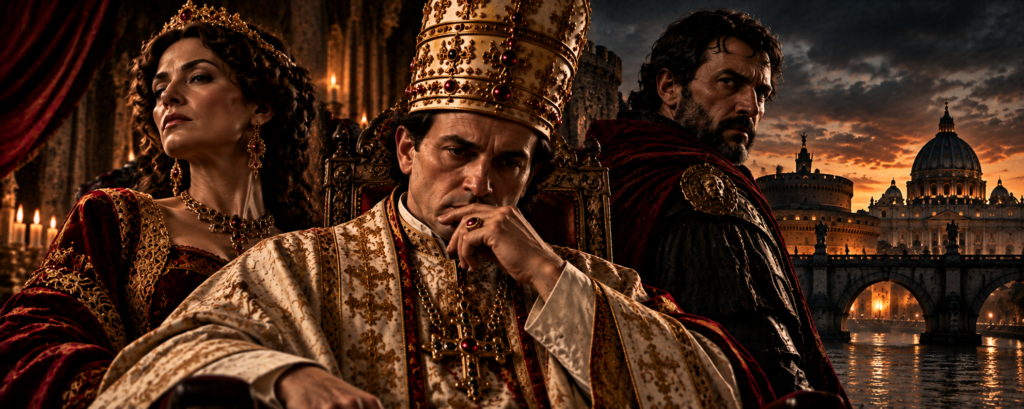
John XI: The Pope Trapped Between His Mother and His Brother
John XI — 931–935
John XI became pope because he belonged to one of the most powerful families in Rome. Within roughly a year, that same family had stripped him of almost everything that made the papacy politically powerful. His mother, Marozia, had dominated Roman politics and helped place him on the throne of Saint Peter. His half-brother Alberic II then overthrew their mother, seized control of the city, and left John with the title of pope while taking effective secular power for himself.
It was an extraordinary family drama even by the standards of tenth-century Rome. John was the son of a woman who had helped overthrow Pope John X and had become powerful enough to influence the succession of several popes. One later tradition claimed that John’s father was himself a pope, Sergius III, which would make John the biological son of one pontiff before becoming another. That allegation has become one of the most famous scandals of the Saeculum Obscurum, although the evidence is disputed and John may instead have been the legitimate son of Marozia’s husband, Alberic I of Spoleto.
The sensational version of John’s life practically writes itself. He was supposedly the illegitimate child of a pope and his aristocratic mistress, raised by the most notorious woman in Rome, elevated to the papacy through his mother’s influence, and then reduced to political irrelevance when his brother staged a revolt and imprisoned their mother. Later writers looking for evidence of papal decadence could hardly have invented a more convenient figure. Yet John himself remains strangely indistinct inside the scandal surrounding him.
There is no compelling evidence that John XI was personally monstrous, unusually cruel, sexually depraved, or violently corrupt. Unlike Stephen VI, he did not put a corpse on trial; unlike Sergius III, he was not deeply associated with the bitter revival of the Formosan conflict; and unlike John XII, he would not become the subject of a catalogue of allegations involving violence and sexual misconduct. John XI belongs among the Wicked Popes for a different reason. His pontificate reveals just how completely the papacy could become a possession fought over by Roman families during one of the institution’s darkest political periods.
His story is therefore not primarily the story of a wicked man. It is the story of a papal throne caught inside a dynasty. John became pope while his mother ruled Rome, remained pope after his brother overthrew her, and died while that brother still controlled the city. The spiritual office survived, but much of its political independence disappeared around him.
To understand how a pope could become almost a prisoner of his own family, we have to begin years before John XI’s election. His story begins with the rise of Theophylact, Theodora, Marozia, and the extraordinary aristocratic dynasty that learned how much power could be gained by controlling Rome’s bishops.
The Family That Learned to Control Popes
Rome at the beginning of the tenth century was a city caught between enormous religious prestige and profound political weakness. The Carolingian imperial system that had once offered the papacy a powerful external protector had fragmented, while competing Italian rulers struggled over kingship and imperial legitimacy. Local aristocratic families filled the resulting vacuum. The bishop of Rome remained one of the most important religious figures in western Christianity, but possession of the papal office increasingly depended upon political power inside the city itself.
Among the families that prospered in this environment, none became more famous than the dynasty associated with Theophylact and his wife Theodora. Theophylact accumulated important offices and titles within Roman government, while Theodora appears to have exercised considerable influence in her own right. Later hostile writers transformed the couple, especially Theodora, into symbols of moral corruption. Yet their power rested upon much more substantial foundations than scandalous stories about sexual manipulation.
The family possessed wealth, patronage networks, political offices, marriage connections, and access to armed supporters. These resources allowed its members to influence who governed Rome and, increasingly, who became pope. During the pontificate of Sergius III, their political importance became particularly visible. By the time John XI was born, his family stood near the center of Roman power.
Theophylact and Theodora had daughters who carried that influence into the next generation. The most famous was Marozia, whose career would become inseparable from the history of the papacy during the first half of the tenth century. She married powerful men, survived violent changes in Roman politics, accumulated titles and authority, and eventually became the dominant figure in the city. Her son John grew up inside a world where family politics and papal politics had become almost impossible to separate.
That environment shaped John’s life before he could possibly have shaped it himself. He was not an ambitious outsider who fought his way into Rome or a powerful bishop who built an independent ecclesiastical career before becoming pope. His greatest political asset was the family into which he had been born. That asset would first carry him onto the papal throne and then become the source of his political captivity.
The Question of John’s Father
Few details surrounding John XI have attracted more attention than the identity of his father. According to a famous later tradition, Marozia had been the mistress of Pope Sergius III and gave birth to John as the result of their relationship. If true, the scandal would be extraordinary: a reigning or recently reigning pope fathered a child with one of Rome’s most powerful aristocratic women, and that child later became pope himself. The story became almost irresistible to generations of writers chronicling the corruption of the medieval papacy.
The allegation is especially associated with Liutprand of Cremona, whose writings provide some of the most vivid and hostile descriptions of tenth-century Roman politics. Liutprand portrayed Marozia and her mother Theodora as sexually corrupt women who exercised power through their relationships with men. His accounts are valuable because he lived relatively close to the period and possessed important political knowledge. They are also deeply partisan, moralizing, and particularly hostile toward powerful women.
John’s paternity therefore cannot simply be settled by repeating Liutprand. Marozia was married to Alberic I of Spoleto, a powerful nobleman and military figure who is the other principal candidate for John’s father. Chronology does not conclusively eliminate either possibility, and the surviving sources do not provide evidence strong enough to resolve the matter beyond reasonable doubt. Modern historians have consequently remained divided or cautious about accepting Sergius’s paternity.
The difference matters because older accounts often present John XI as “the son of Pope Sergius III” without qualification. That transforms a disputed allegation into a biographical fact and exaggerates the certainty of the evidence. The responsible formulation is less sensational but more accurate: later tradition claimed that Sergius III fathered John with Marozia, while John may instead have been the son of Alberic I. We simply cannot know with confidence.
Yet the paternity story became historically important regardless of whether it was true. It contributed enormously to the image of the tenth-century papacy as a hereditary and sexually corrupt institution. A pope fathering another pope seemed to encapsulate everything critics wanted the Saeculum Obscurum to represent. John XI would spend his entire historical afterlife beneath the shadow of a relationship that may never have existed.
Marozia: More Than a Papal Mistress
Reducing Marozia to the alleged mistress of Sergius III badly understates her importance. She was one of the most formidable political figures in early tenth-century Rome, and her power cannot be explained simply through sexuality. Her marriages connected her to major aristocratic houses, while her birth connected her to the dynasty already dominating Roman government. Over time, she accumulated enough authority to influence papal elections and determine who could govern the city.
Her first husband, Alberic I of Spoleto, was an important political and military figure. Their marriage strengthened the relationship between the Roman aristocracy and one of the major powers in central Italy. Alberic participated in the political struggles surrounding Pope John X and eventually came into conflict with the papal regime. His own violent political career helped create the world inherited by his sons.
After Alberic’s death, Marozia continued building her position rather than retreating into widowhood. She married Guy of Tuscany, another powerful nobleman whose military resources strengthened her ability to intervene in Roman affairs. The marriage was unmistakably political as well as dynastic. Marozia was assembling the alliances necessary to challenge anyone who threatened her family’s control of Rome.
By the late 920s, the greatest threat was Pope John X. He had originally risen within the political environment created by Marozia’s parents but had gradually attempted to construct a power base independent of their family. His brother Peter became increasingly influential in Roman government, creating what looked like a competing dynasty around the papacy. Marozia and Guy responded with force.
In 928, their faction overthrew John X. Peter was killed during the struggle, and the pope was imprisoned, traditionally in the Castel Sant’Angelo. John X died in captivity under uncertain circumstances, with one tradition claiming that he was smothered while another suggests that the hardships of imprisonment caused his death. Marozia emerged from the coup as the dominant political figure in Rome.
A Mother Who Could Make Popes
The overthrow of John X demonstrated how powerful Marozia had become. A reigning pope who had governed for approximately fourteen years, crowned an emperor, and helped organize the victorious campaign against the Muslim stronghold on the Garigliano had been unable to survive her opposition. His international prestige meant little once he lost control of Rome. Marozia’s faction possessed the force necessary to remove him physically from office.
The papal succession that followed unfolded within her political dominance. Leo VI became pope after John X but survived only a matter of months. Stephen VII followed and governed for roughly two years. Neither man escaped the broader political environment controlled by Marozia and her allies.
Then, in 931, Marozia’s own son became pope. John XI was probably still a relatively young man, perhaps in his early twenties, although uncertainty surrounding his birth date makes precise claims difficult. His rapid elevation is almost impossible to separate from his mother’s power. Whatever ecclesiastical qualifications he possessed, being Marozia’s son was undoubtedly the most important political fact surrounding his election.
This is where John’s story becomes central to the Saeculum Obscurum. A Roman aristocratic woman had become powerful enough that her son could ascend to the throne of Saint Peter while she exercised secular dominance over the city. Whether Sergius III was John’s father adds scandal to the story, but it is not necessary to make the situation extraordinary. Marozia’s documented political influence is remarkable enough.
John’s accession represented the apparent triumph of her dynasty. The family that had spent decades influencing popes now possessed a pope who was literally one of its own members. Marozia stood at the height of her authority, and her son occupied the most prestigious ecclesiastical office in western Europe. For a brief moment, it must have seemed that her control of Rome had become almost unassailable.
The Young Pope in His Mother’s Rome
John XI’s first year as pope unfolded beneath his mother’s political supremacy. The surviving evidence does not allow us to reconstruct their daily working relationship, and claims that John was merely a helpless puppet from the first moment of his pontificate go beyond what can securely be established. Marozia nevertheless possessed overwhelming influence in secular Roman government. Any pope ruling under those conditions would have found political independence extremely difficult.
The arrangement also demonstrates how far papal government had moved from the ideal of an autonomous ecclesiastical election. Roman aristocratic power had influenced papal succession before, and emperors and kings had interfered with papal elections for centuries. What made John’s case so striking was the direct family connection. The dominant ruler of Rome was the pope’s mother.
That did not mean John possessed no ecclesiastical authority. The distinction between secular and spiritual power became increasingly important during his pontificate. Even under aristocratic domination, the pope remained bishop of Rome and continued performing functions associated with the wider Church. His office could be politically constrained without becoming religiously meaningless.
The surviving evidence from John’s reign is sparse compared with that of many later popes, which makes sweeping judgments dangerous. We do not possess a detailed personal chronicle revealing his thoughts about Marozia or his ambitions for the papacy. We cannot know whether he resented his mother’s dominance, accepted it willingly, or considered it simply the normal political environment of his world. The young pope remains frustratingly silent.
What we can see is the structure around him. Marozia controlled Rome, John occupied the papal throne, and the family appeared to have fused secular and ecclesiastical power more completely than ever before. Within a year, that arrangement would collapse spectacularly.
Marozia Reaches for a Crown
Marozia’s ambitions did not end with making her son pope. After the death of Guy of Tuscany, she pursued a marriage with Hugh of Provence, king of Italy. Hugh had previously been connected with Pope John X and represented one of the strongest secular rulers in the peninsula. Marriage to him offered Marozia the possibility of joining her control of Rome with royal authority.
The proposed union was politically explosive. Hugh was related to Guy, and questions of prohibited degrees of kinship required careful handling before the marriage could proceed. The papacy could provide the necessary ecclesiastical legitimacy, placing John XI in the uncomfortable position of facilitating a marriage involving his own mother. The precise extent of John’s personal involvement is difficult to establish, but the ceremony became another example of family and papal politics colliding.
For Marozia, the marriage offered extraordinary possibilities. She already controlled Rome and had a son on the papal throne. If she became queen alongside Hugh and helped him secure greater authority in the city, her dynasty could potentially unite Roman aristocratic power, papal influence, and the Italian monarchy. The political structure surrounding John XI might become stronger than anything his family had previously achieved.
Not everyone in the family welcomed that prospect. Marozia had another son, Alberic II, born from her marriage to Alberic I of Spoleto. Unlike John, whose career was ecclesiastical, Alberic was positioned within the secular aristocracy. Hugh’s arrival threatened his own future and the independence of the Roman nobility.
The conflict that followed would destroy Marozia’s supremacy almost overnight. It would also transform John XI from the son of Rome’s ruler into the brother of its new master.
The Wedding That Became a Rebellion
Marozia and Hugh married in Rome in 932. Later accounts surround the occasion with dramatic stories, including the claim that Hugh insulted or struck Alberic during the wedding festivities. According to this tradition, the humiliation enraged the young nobleman and helped provoke him to call the Romans to revolt. As with many vivid anecdotes from this period, the precise details should be treated cautiously.
The deeper political tensions require no personal insult to explain the rebellion. Hugh was a foreign or outside king from the perspective of many Romans, and his growing influence threatened local aristocratic autonomy. Marozia’s marriage could allow him to dominate Rome and potentially pursue imperial ambitions. Alberic had powerful reasons to oppose that outcome.
He rallied support within the city. The Romans rose against Hugh, and the king found himself in a dangerously hostile environment. Hugh escaped Rome, reportedly by fleeing from the Castel Sant’Angelo or the fortified area associated with the wedding crisis, while Marozia was unable to follow him to safety. Her political empire collapsed with astonishing speed.
Alberic seized control of Rome. Marozia, the woman who had overthrown John X and placed John XI on the papal throne, was imprisoned by her own son. Her ultimate fate is uncertain, although she appears to have remained confined and eventually disappeared from the political record.
The family revolution was complete. John XI remained pope, but the person controlling Rome was no longer his mother. It was his brother.
Alberic II Takes Rome
Alberic II proved to be one of the most effective secular rulers of tenth-century Rome. He adopted titles emphasizing his authority over the Romans and governed the city for more than two decades. Unlike his mother, whose power had depended partly upon a series of marriages and shifting alliances, Alberic created a remarkably durable regime. His control would outlast John XI and several subsequent popes.
The papacy became politically subordinate within this new order. Alberic did not need to depose his brother because John could remain useful as the spiritual head of the Roman Church. Removing him might also create unnecessary instability or invite intervention from outside powers. It was simpler to separate papal religious authority from the secular government of Rome.
John consequently remained pope after the revolt. He could perform ecclesiastical functions, issue privileges, communicate with churchmen, and exercise the spiritual responsibilities associated with his office. Political power, however, belonged overwhelmingly to Alberic. The pope’s brother governed the city in which the pope lived.
This arrangement reveals something important about aristocratic domination of the papacy. Alberic did not need to wear the papal tiara himself to control Rome. Nor did he need to replace John with a more obedient cleric immediately after the revolt. By controlling the military and political institutions surrounding the pope, he could leave the ecclesiastical office intact while stripping it of much of its secular independence.
For John, the change must have been dramatic even if we cannot reconstruct his personal reaction. He had become pope while his mother stood at the height of her power. Now she was imprisoned, her royal husband had fled, and the brother who defeated her controlled the city. John survived because Alberic chose to let him survive.
A Pope Under His Brother’s Rule
Descriptions of John XI as a prisoner are common, but the exact nature of his confinement requires care. Some later accounts portray him as virtually imprisoned within the Lateran and permitted to perform only religious ceremonies. The broader political reality certainly supports the conclusion that Alberic severely restricted papal temporal authority. Whether John was literally confined at every stage of the remaining pontificate is less certain.
The distinction does not change the fundamental imbalance. Alberic controlled Rome’s secular government, military resources, and political decision-making. John could not realistically challenge his brother without allies capable of overturning the regime. After Marozia’s defeat, no such coalition emerged.
The arrangement may even have provided a degree of stability after decades of violent papal politics. Rome had witnessed contested elections, the Cadaver Synod, papal depositions, imprisonments, aristocratic coups, and possible murders. Alberic’s government reduced the frantic competition for control by establishing a durable secular authority. Stability, however, came at the price of papal political independence.
John’s position therefore embodied a strange contradiction. He remained one of the most important spiritual figures in western Christianity, but within Rome he operated beneath his brother’s authority. Bishops and abbots far beyond Italy could seek papal confirmation or privileges from a man who possessed limited ability to determine the political future of his own city. The universal claims of the papacy and its local weakness had rarely stood in sharper contrast.
The Pope Who Could Bless but Not Rule
John’s reduced political position did not make his pontificate meaningless. Surviving papal acts show that ecclesiastical business continued. Monasteries sought privileges, bishops required recognition, and disputes within the wider Church still created occasions for papal involvement. Alberic controlled Rome, but he did not attempt to abolish the religious functions of the papacy.
This division of responsibilities probably suited Alberic. The prestige of an operating papacy benefited Rome and could strengthen the legitimacy of the regime surrounding it. A functioning pope also maintained relationships with churches and rulers across Europe that Alberic could not simply replace with secular authority. Keeping John in office therefore had practical advantages.
For John, religious administration may have been the only meaningful sphere left open to him. There is little evidence that he possessed the freedom or resources necessary to rebuild the kind of independent political network attempted by John X. His brother had learned from the earlier conflict. A pope allowed to accumulate too much secular power could become a rival.
The result was a papacy divided against itself. The office retained sacramental and ecclesiastical significance while much of its temporal authority passed into the hands of a Roman prince. John wore the papal title, but Alberic governed the city. The distinction would shape not only John’s pontificate but the papacies that followed.
Cluny and the Wider Church
One of the most important developments connected with John XI’s pontificate involved the growing monastic reform movement centered upon Cluny. Founded in Burgundy in 910, the monastery had been designed to enjoy unusual freedom from ordinary secular and episcopal interference. During the tenth century, Cluny would develop into the center of a powerful reforming network. Papal protection became increasingly important to that independence.
John granted or confirmed privileges benefiting Cluny and its reforming mission. The exact administrative history is complex, but his pontificate forms part of the early relationship between the papacy and the movement that would eventually transform western monasticism. This is an extraordinary irony when placed against the reputation of John’s age. A pope remembered primarily as a product of aristocratic corruption contributed to the institutional environment from which later ecclesiastical reform would grow.
Cluniac reform emphasized disciplined monastic life, liturgical observance, and freedom from inappropriate lay control. Those concerns would eventually resonate strongly with broader movements seeking to free the Church from secular domination. John himself, meanwhile, lived under the political authority of his brother. The contrast could hardly be sharper.
It would be wrong to portray John as consciously preparing the eleventh-century Gregorian Reform. He could not have foreseen how Cluny’s influence would develop generations after his death. Nevertheless, his support for monastic privileges reminds us that the papacy continued doing consequential religious work even during the Saeculum Obscurum. Institutional history rarely divides cleanly into periods of total corruption followed suddenly by periods of reform.
The same papacy could be politically captive in Rome while strengthening religious institutions elsewhere. John XI illustrates that contradiction exceptionally well.
A Family Divided Between Church and State
The relationship between John and Alberic created an unusual division within the same dynasty. One brother held the papacy, while the other controlled Rome. Their mother, who had once dominated both political spheres, remained imprisoned or otherwise removed from power. The family’s internal revolution had produced a new constitutional reality almost by accident.
Alberic’s authority was secular and military. He controlled the aristocracy, administered the city, managed political relationships with outside rulers, and prevented rivals from challenging his position. John retained ecclesiastical authority but could not convert it into independent secular power. The brothers therefore embodied two different kinds of rule.
There is little reliable evidence of open personal conflict between them after 932. John may have resented his brother deeply, but we cannot manufacture hostility simply because the political arrangement was unequal. Alberic may likewise have treated John respectfully in religious matters while denying him political freedom. The sources do not reveal the emotional relationship behind the institutional one.
What they do reveal is Alberic’s success. He would continue controlling Rome after John’s death and through the pontificates of Leo VII, Stephen VIII, Marinus II, and Agapetus II. No pope during his lifetime succeeded in breaking his dominance. John XI was therefore the first of several pontiffs forced to operate within the political order Alberic created.
The irony is severe. Marozia had placed one son on the papal throne and attempted to use marriage to secure even greater dynastic power. Another son destroyed her regime and reduced his papal brother’s secular authority. The dynasty survived, but not in the form she intended.
What Happened to Marozia?
After Alberic’s revolt, Marozia largely disappears from reliable political history. Later tradition generally holds that she was imprisoned, possibly in the Castel Sant’Angelo, the same fortress associated with the captivity of John X after her own coup four years earlier. The symmetry is striking enough that later storytellers naturally emphasized it. A woman who had imprisoned a pope was herself imprisoned by her son.
The precise conditions and duration of her captivity are uncertain. Some accounts assume that she remained imprisoned until her death, while the date of that death itself is not securely known. What is clear is that she never recovered her former political dominance. Alberic’s regime permanently displaced hers.
John’s position in relation to his mother’s fate is unknown. We have no reliable evidence that he attempted to free her, nor do we know whether he possessed enough political freedom even to consider doing so. The absence of evidence has sometimes encouraged speculation about family loyalties, but speculation should remain exactly that. The surviving record tells us almost nothing about John’s personal response.
This silence makes the family drama more unsettling rather than less. A pope’s mother had been the ruler of Rome, and then she became the prisoner of his brother while he remained pope. The people involved were connected not merely by political alliance but by blood. Yet the surviving sources preserve institutions and outcomes far more clearly than private grief, anger, or betrayal.
John’s life therefore has an almost claustrophobic quality. His family had given him the papacy, but family power also defined its limits. There was nowhere in Roman politics he could move without encountering another member of his dynasty.
The Alleged Son of Sergius III
The claim that John was Sergius III’s son became especially powerful because of what happened after his election. If the allegation were true, the papal throne had passed from father to son within roughly two decades. That possibility seemed to transform the papacy from an ecclesiastical office into something approaching a hereditary possession. Later critics understandably seized upon the image.
Yet the chronology and evidence remain too uncertain for certainty. Alberic I was Marozia’s husband and is entirely plausible as John’s father. Medieval chroniclers could use accusations of illegitimacy and clerical sexual misconduct as political weapons. Liutprand’s hostility toward Marozia makes caution particularly necessary.
There is also a tendency to treat the scandal as though Sergius secretly prepared John for succession. Nothing supports such a narrative. Sergius died in 911, approximately twenty years before John became pope, and there is no evidence of a dynastic papal plan extending across those decades. John’s election is far more readily explained by Marozia’s political dominance in 931.
If Sergius was indeed his father, the connection remains extraordinary but probably incidental to John’s eventual elevation. Marozia’s power, not Sergius’s long-dead influence, placed John in a position to become pope. If Alberic was his father instead, the political interpretation barely changes. John remained the son of the woman controlling Rome and a member of its dominant dynasty.
The paternity mystery is therefore less important than it first appears. The sensational question asks whether John had papal blood. The historically significant answer is that he unquestionably had aristocratic power behind him.
Was John XI Corrupt?
The temptation to assume corruption arises from the circumstances of John’s election. A young man belonging to the ruling family became pope while his mother dominated Rome, which hardly resembles an independent ecclesiastical process. Nepotism and dynastic influence clearly shaped the political environment surrounding his elevation. Yet those circumstances do not automatically tell us what John himself did once in office.
The surviving record does not contain the kind of catalogue of personal misconduct associated with John XII. There are no reliable stories of John XI murdering rivals, mutilating enemies, turning the Lateran into a center of sexual scandal, or using papal power for spectacular acts of cruelty. His reputation derives primarily from his family connections and political weakness. In that sense, he is almost the opposite of the stereotypical Wicked Pope.
He may have benefited willingly from Marozia’s manipulation of papal politics. There is no reason to imagine him as an unwilling candidate dragged onto the throne against his wishes. At the same time, young aristocratic churchmen were raised within systems where family patronage was normal and advancement through connections hardly unusual. Applying modern assumptions about independent career choice can distort the world he inhabited.
The strongest criticism concerns the nature of his accession rather than dramatic personal crimes. John became pope because Rome’s political system allowed one family to exercise extraordinary influence over the office. His election illustrates the institutional corruption of the age even if his own moral character remains obscure. That distinction is essential to treating him fairly.
John XI belongs among Wicked Popes not because we can prove he was wicked, but because his papacy shows what could happen when the office itself became a dynastic prize.
The Saeculum Obscurum
The Latin phrase Saeculum Obscurum, commonly translated as the “Dark Age” or “Dark Century,” became attached to the period of papal history extending through much of the tenth century. Later historians saw these decades as a low point in which Roman aristocratic families dominated papal elections and the spiritual dignity of the office became subordinate to local politics. John XI’s pontificate sits near the heart of that story. His family connections make him one of its most recognizable symbols.
The even more sensational term “pornocracy” was later used to describe the period dominated by Theodora and Marozia. The word suggests government by prostitutes or sexual corruption and reflects the hostile portrayal of these women in later sources. It remains memorable but is historically problematic. Their political power was far more substantial than the term implies.
Marozia did not dominate Rome merely because powerful men desired her. She possessed dynastic connections, property, titles, marriage alliances, armed supporters, and the ability to build political coalitions. Her overthrow of John X required military and aristocratic power, not seduction. Her son’s election as John XI likewise reflected control of Roman politics rather than simply sexual influence.
The label nevertheless captures something about the moral shock later generations experienced when looking back at the period. Popes seemed to rise and fall according to the interests of a small aristocratic circle. Family relationships became entangled with ecclesiastical succession. Rumors of papal mistresses and illegitimate children flourished in precisely the environment where they appeared most believable.
John XI stands at the center of that reputation. Whether Sergius III fathered him or not, contemporaries and later writers could look at his mother’s power and reasonably conclude that the papacy had become deeply compromised by Roman dynastic politics. The scandal did not depend entirely upon sex. The family tree itself was enough.
A Pope Without Rome
After Alberic’s victory, John occupied one of the strangest positions imaginable. He was bishop of Rome without governing Rome in any meaningful secular sense. He remained the recognized pope while his brother controlled the political machinery surrounding him. The title survived, but much of the power traditionally associated with papal government had been separated from it.
This distinction between spiritual and temporal authority was not entirely unprecedented. Popes had long operated beneath emperors, kings, exarchs, and local rulers capable of constraining their political choices. What made John’s situation remarkable was the intimacy of the domination. The secular ruler was not a distant emperor or foreign conqueror but his own brother.
Alberic could control access, appointments affecting secular government, military resources, and relationships with outside powers. John could not simply call upon an independent papal army and remove him. Any attempt to challenge the regime would have required a political coalition strong enough to defeat the man controlling the city. No such challenge materialized.
John therefore appears increasingly in the sources as an ecclesiastical rather than political pope. His surviving actions concern church privileges and religious administration more than the grand Italian diplomacy characteristic of John X. That change reflects the altered structure of power. Alberic had effectively removed the papacy from competition for secular supremacy within Rome.
The system was humiliating from the perspective of later papal monarchy, but it may have provided temporary stability. Rome no longer changed rulers through constant papal coups. Alberic’s government endured, and popes came and went beneath it. Political peace had been purchased by placing the papacy under aristocratic control.
The Church Continued Beyond the Palace
It is easy to imagine a politically weakened pope as completely irrelevant, but medieval ecclesiastical authority did not work that way. John remained capable of issuing papal documents recognized beyond Rome. Monasteries and bishops still valued papal privileges. The prestige of the apostolic see continued even when the man occupying it lacked political independence.
This resilience is one of the most important themes in the history of the medieval papacy. Institutions can survive periods when their leaders are personally weak or externally controlled. The office of pope carried traditions, legal claims, religious symbolism, and relationships extending beyond any individual pontiff. Alberic could dominate John without simply becoming pope himself.
That distinction also helps explain why the papacy eventually escaped the political conditions of the Saeculum Obscurum. Roman aristocrats could control elections and secular government, but they could not easily erase the wider religious significance of the office. Bishops throughout western Europe continued recognizing Rome as a center of ecclesiastical authority. Reformers in later generations would build upon those surviving claims.
John XI therefore presided over a papacy that was weak and resilient at the same time. Its local political independence had nearly disappeared, yet its religious network remained functional. The contradiction would become increasingly important as monastic reform movements expanded across Europe.
The darkness of John’s age should consequently not be mistaken for institutional death. The papacy was compromised, manipulated, and constrained, but it endured. John himself embodied that endurance by remaining pope even after his family’s political world collapsed around him.
Alberic’s Rome
Alberic II’s regime deserves attention because it shaped the final years of John’s pontificate more than John himself did. After overthrowing Marozia, Alberic established control over Rome with remarkable effectiveness. He presented himself as prince of the Romans and built a government capable of resisting external interference. Kings who hoped to dominate Rome discovered that Alberic would not surrender the city easily.
Hugh of Provence repeatedly attempted to recover influence after fleeing the revolt. Alberic resisted him, maintaining Roman independence from the king who had briefly become his stepfather. The struggle gave Alberic reasons to keep the papacy firmly under control. A politically independent pope could potentially ally with Hugh and threaten the regime from within.
John’s position was therefore shaped by wider Italian politics as well as family rivalry. Allowing him unrestricted secular authority would have created a dangerous alternative center of legitimacy. Alberic could not risk the pope becoming a doorway through which foreign intervention entered Rome. Restricting John was politically rational from the prince’s perspective.
This does not make the arrangement benign. The pope’s independence was sacrificed to preserve Alberic’s government. John’s ability to shape the temporal affairs of the Roman Church was sharply constrained by someone who possessed no ecclesiastical office. The family that had once used the papacy to strengthen itself now used secular power to contain the papacy.
Alberic would eventually take dynastic control one step further. Before his death, he arranged for the Roman aristocracy to accept his own son Octavian as the future pope. That young man would become John XII, one of the most notorious pontiffs in medieval history. The dynasty surrounding John XI was far from finished with the throne of Saint Peter.
From John XI to John XII
The connection between John XI and John XII illustrates how deeply family power penetrated the tenth-century papacy. John XI was Alberic II’s half-brother, while John XII was Alberic’s son. Within a generation, two members of the same extended dynasty occupied the papal throne. Their routes to power differed, but both were inseparable from aristocratic control of Rome.
John XII’s pontificate would become far more scandalous than John’s. Contemporary accusations portrayed him as violent, sexually promiscuous, sacrilegious, and politically reckless, although some details came from hostile opponents and require the same caution applied to earlier sources. His reign would also bring the German king Otto I dramatically into Roman affairs. The aristocratic system that had contained the papacy would eventually collide with a revived imperial power.
John XI therefore occupies a transitional place within the dynasty. He came to power through Marozia’s supremacy and then lived under Alberic’s regime. John XII would inherit the political legacy Alberic created but combine secular and papal authority in his own person. The family’s relationship with the papacy evolved from influence to direct kinship and eventually to something approaching dynastic possession.
That progression makes John’s apparently uneventful later pontificate historically significant. His weakness demonstrated that Alberic could control a pope without becoming pope. His nephew would later demonstrate what happened when the Roman prince and pope effectively became the same person. The consequences would be explosive.
John’s story is therefore not an isolated curiosity. It is a crucial link in the chain connecting Sergius III, Marozia, Alberic II, and John XII. Through his family, the political history of the papacy across several decades can almost be read as a dynastic saga.
A Mother, Two Sons, and the Throne of Saint Peter
Few families in papal history produced a drama quite like Marozia’s. One son became pope while she ruled Rome. Another son overthrew her, imprisoned her, and reduced his papal brother’s political authority. That second son then arranged for his own son to become pope.
The sequence sounds almost fictional because medieval papal history is often imagined as a world of cardinals selecting elderly churchmen according to established procedures. Tenth-century Rome operated very differently. Papal elections were shaped by local aristocratic factions, outside rulers, clergy, popular support, and armed power. Formal religious legitimacy existed alongside political realities that could determine which candidate actually occupied the Lateran.
Marozia understood those realities exceptionally well. So did Alberic. John XI appears to have been less successful as an independent political operator, but his weakness may partly reflect the fact that his brother deliberately denied him the opportunity to become one.
There is no evidence that John possessed the military instincts of John X or the relentless political ambition of Sergius III. Perhaps he was temperamentally more suited to ecclesiastical life, or perhaps circumstances simply made resistance impossible. The historical record is too thin to decide. What matters is that the family surrounding him had already determined the limits within which he could act.
The throne of Saint Peter had become the center of a family drama in which John was simultaneously one of the most prestigious figures and one of the least politically powerful. His mother had helped give him the office. His brother ensured that the office would not make him ruler of Rome.
Why John Did Not Fight Back
It is tempting to ask why John never attempted to overthrow Alberic. A pope possessed enormous prestige and could potentially appeal to kings, bishops, and aristocrats beyond Rome. John X had cultivated precisely such networks before his downfall. Why did John XI apparently accept his diminished position?
The first answer is practical. Alberic controlled Rome, and a pope who openly rebelled against him risked imprisonment, deposition, or death. John had already witnessed what happened when his mother lost a political struggle. The recent memory of John X’s overthrow provided another warning about the dangers of challenging the dominant faction.
The second answer concerns available allies. Hugh of Provence remained hostile to Alberic, but cooperation with Hugh would have placed John in the middle of the conflict that triggered the revolt in the first place. Other Italian rulers lacked either the ability or incentive to invade Rome on John’s behalf. The papacy possessed prestige but not an independent military machine capable of defeating Alberic alone.
A third possibility is that John did not desire secular confrontation strongly enough to risk everything. His personal ambitions are unknown. He may have accepted a division in which Alberic governed Rome while he administered the Church. Without evidence of his private intentions, portraying him as secretly plotting liberation would be as speculative as portraying him as perfectly content.
Survival itself may have been an achievement. John remained pope for several years after the revolt and died without suffering the violent fate of John X. In an age when losing a political struggle could mean imprisonment or strangulation, avoiding confrontation had obvious advantages.
The Limits of Calling Him a Puppet
The word “puppet” is convenient but can oversimplify John’s position. Alberic unquestionably possessed superior political power, and John operated beneath his authority. Yet the pope retained ecclesiastical functions that Alberic could not simply perform in his place. The relationship was therefore one of domination rather than complete substitution.
John could still grant privileges because those acts required papal authority. He could still participate in church affairs because being prince of Rome did not make Alberic bishop of Rome. Religious institutions beyond the city recognized John’s office independently of his brother’s secular title. The pope therefore possessed a sphere of genuine authority, however restricted.
Calling him a puppet also risks erasing the institutional complexity of medieval Rome. Secular and ecclesiastical powers overlapped but were not identical. Alberic benefited from having a functioning pope precisely because John’s spiritual legitimacy could accomplish things secular force could not. The brothers occupied unequal but distinct positions.
A better description is that John was politically subordinated. His temporal freedom was severely restricted, while his religious office continued to function. That distinction explains why Alberic kept him on the throne rather than replacing him. A controlled pope could be more useful than another disputed succession.
The situation remains deeply compromising for the papacy. An institution claiming universal spiritual authority was being politically contained by the pope’s own brother. Yet acknowledging the surviving religious authority makes the story more accurate and, in many ways, more interesting.
The Death of John XI
John died in late 935, ending a pontificate of approximately four years. Unlike several popes surrounding the violent struggles of the period, there is no strong tradition that he was murdered. His death appears to have occurred while Alberic remained firmly in control of Rome. The brother who had restricted his political authority survived him by nearly two decades.
John was succeeded by Leo VII. Alberic’s dominance continued without serious interruption, demonstrating that the political system created after Marozia’s overthrow did not depend upon John’s personal presence. Popes could change while the prince of Rome remained. The secular regime had become more durable than individual pontificates.
The relative quiet surrounding John’s death contrasts sharply with the drama of his accession and the revolution of 932. He entered the papacy at the height of his mother’s power and died after years beneath his brother’s government. The middle of his pontificate contained one of the most extraordinary family coups in Roman history. Yet John himself passed from the scene without the violent finale attached to so many other figures of the age.
That quiet ending may explain why he is less famous than Sergius III, John X, or John XII. There is no corpse trial, suspicious prison death, or spectacular catalogue of personal depravity to define him. His importance lies instead in what happened around him. He was the pope through whom the transformation from Marozia’s regime to Alberic’s regime became visible.
John’s death did not free the papacy. Leo VII inherited the same fundamental political reality. Alberic remained master of Rome, and the pope remained beneath his shadow.
The Wickedness of a System
John XI forces us to think carefully about what a Wicked Popes category is meant to reveal. If it contains only men who personally committed spectacular acts of cruelty or corruption, John would be a questionable inclusion. The surviving evidence simply does not support portraying him as one of history’s great papal villains. His life becomes significant when the category is also used to explore periods in which the papacy itself became trapped within violent and corrupt political systems.
John’s election was inseparable from his mother’s power. His political weakness was inseparable from his brother’s coup. His disputed paternity became inseparable from the scandalous reputation of Sergius III and Marozia. Almost every memorable feature of his pontificate emerged from dynastic politics rather than personal wickedness.
That makes him an unusually revealing figure. A pope need not be personally monstrous for his reign to expose profound institutional corruption. John sat upon the most prestigious ecclesiastical throne in western Europe because his family dominated Rome, and then remained there while another member of that family stripped away his political independence. The office had become something aristocrats could manipulate without necessarily destroying its religious functions.
The darkness therefore lies in the structure. Popes were vulnerable to whoever controlled the city, while Roman nobles understood that papal legitimacy could strengthen their own political ambitions. Family patronage could make a pope, military revolt could imprison the pope’s mother, and secular authority could reduce the pontiff to a carefully limited role. John XI’s reign shows the system operating with almost clinical clarity.
He belongs among the Wicked Popes because sometimes the most disturbing story is not what the pope did. It is what everyone around the pope was able to do with him.
Separating John from the Legends
Several claims about John require especially careful treatment. The first is that Sergius III was his father. The allegation is historically important and entirely possible, but it cannot be presented as certain. Alberic I remains a plausible alternative, and the hostility of important narrative sources demands caution.
The second is the tendency to describe John as Marozia’s obedient puppet from the first day of his pontificate. Her political dominance makes substantial influence almost certain, but we lack the detailed evidence necessary to reconstruct every decision. John may have possessed more ecclesiastical independence than the word “puppet” suggests. Political dependence and complete personal passivity are not identical.
The third is the assumption that Alberic kept John literally imprisoned throughout the remainder of his life. John’s freedom was clearly restricted in a political sense, and some accounts use language suggesting confinement. Yet the precise physical conditions under which he lived cannot be reconstructed confidently. What matters is that he could not challenge Alberic’s control of Rome.
Removing these exaggerations does not make the story less dark. It replaces melodrama with a more disturbing political reality. John was a pope whose mother possessed enough power to help elevate him and whose brother possessed enough power to prevent him from ruling independently.
The facts require no invented villainy. The family itself tells the story.
The Strange Resilience of the Papacy
One of the most remarkable aspects of John’s pontificate is that the papacy survived such profound political humiliation. A modern institution subjected to comparable family control might lose legitimacy entirely. Yet medieval Christians continued seeking papal privileges, recognizing Roman authority, and treating the bishop of Rome as an important ecclesiastical figure. The office proved more durable than the political independence of the men occupying it.
This resilience would become crucial in later centuries. The papacy eventually escaped the direct control of Roman aristocratic dynasties, developed stronger procedures surrounding elections, allied with reform movements, and claimed increasingly expansive authority. None of that was inevitable during John’s lifetime. From his perspective, aristocratic domination may have appeared permanent.
The survival of ecclesiastical administration beneath Alberic’s rule preserved the institutional foundations necessary for later recovery. Papal documents continued to be issued. Relationships with monasteries and bishops continued. Rome remained a center of religious legitimacy even when its pope could not govern the city freely.
John deserves neither exaggerated credit for that survival nor exaggerated blame for the political weakness surrounding him. He was one occupant of an institution larger than himself. His reign demonstrates how institutions can endure even when their leaders operate under extraordinary constraints.
The papacy survived Marozia, Alberic, and the entire Saeculum Obscurum. John XI did not rescue it from that darkness, but neither did the darkness destroy it.
The Mother Who Made a Pope
Marozia’s role in John’s life remains impossible to escape. She had risen through a political world dominated by men and became powerful enough to overthrow one pope and elevate another. Whatever one thinks of her methods, that achievement required formidable political intelligence. She was far more than the sexual caricature created by hostile writers.
Her greatest apparent triumph was John’s accession. A son occupying the papal throne while she controlled Rome gave her dynasty extraordinary reach. Had her marriage to Hugh succeeded politically, she might have joined that Roman and papal influence to the Italian monarchy. The revolt of Alberic destroyed that possibility.
There is an almost Shakespearean quality to the outcome, though the history needs no fictional embellishment. Marozia built a dynasty powerful enough to dominate Rome, only to be overthrown by one of the sons produced by that dynasty. The pope she had helped create remained in office while she disappeared into captivity.
John was therefore both evidence of her success and witness to her failure. His papacy survived the collapse of her government because Alberic found the office useful. The son who symbolized Marozia’s dominance became part of the political order that replaced her.
Whether John ever saw his mother again after the revolt is unknown. That unanswered question belongs to the human silence surrounding the political record. History tells us who controlled Rome, but not what the pope felt while his mother sat imprisoned somewhere within it.
The Brother Who Controlled a Pope
Alberic’s treatment of John demonstrates a colder and perhaps more sophisticated form of political domination than simple deposition. He did not need to kill his brother or place another man on the papal throne. He merely needed to ensure that papal authority remained confined to areas that did not threaten his government. The arrangement worked.
By allowing John to continue ecclesiastical administration, Alberic avoided unnecessary conflict with the wider Church. By monopolizing secular authority, he prevented the pope from becoming a rival ruler. This division helped stabilize Rome after decades of political chaos. It also made the pope dependent upon the goodwill of his brother.
The system continued after John’s death because it had never depended upon him personally. Alberic supervised successive popes while maintaining his own control of the city. His regime became one of the longest-lasting political orders Rome had experienced during the chaotic tenth century. From the perspective of secular governance, it was remarkably successful.
From the perspective of papal independence, it was deeply compromising. The pope could bless, ordain, confirm privileges, and perform religious ceremonies, but another man decided the political future of Rome. John XI was the first pope to experience the full force of Alberic’s system. Several successors would experience it as well.
The family drama had therefore produced something larger than itself. Marozia’s overthrow created a political structure that shaped the papacy for more than twenty years.
From Captive Pope to Reforming Church
The contrast between John’s constrained papacy and the later reform movement is one of the great ironies of medieval Church history. During John’s lifetime, Roman aristocrats could manipulate papal elections and restrict the pope’s secular freedom. A century later, reforming popes would claim the authority to confront kings and emperors over the independence of the Church. The transformation was enormous.
Cluny formed one of the bridges between those worlds. The monastic movement’s insistence upon freedom from lay interference helped nurture ideals that later reformers applied more broadly. John XI’s support for Cluniac privileges therefore sits awkwardly but fascinatingly beside his own dependence upon a lay ruler. The politically constrained pope helped protect institutions committed to ecclesiastical independence.
There is no evidence that John recognized the irony. He was responding to immediate religious and administrative circumstances rather than designing a future revolution. Historical consequences often extend far beyond the intentions of the people producing them. His papal acts became part of an institutional tradition that later generations could use in ways he never anticipated.
This is another reason John should not simply be dismissed as Marozia’s son. Even a weak pope could participate in developments larger than Roman factional politics. His office connected him to religious movements whose importance would eventually dwarf the aristocratic feuds consuming his family.
The Saeculum Obscurum contained seeds of reform alongside corruption. John’s pontificate helps us see both.
A Pope Overshadowed by Everyone Around Him
John XI remains one of the strangest figures in papal history because almost everyone around him appears more vivid than he does. Sergius III dominates the scandal surrounding his birth. Marozia dominates the story of his election. Alberic II dominates the story of his remaining pontificate.
Even John X, the pope overthrown before John’s accession, possesses a more dramatic biography. He led coalitions, crowned an emperor, fought aristocratic rivals, and died in captivity. John XII, John’s nephew, would later become far more notorious through allegations of sexual misconduct and violence. John XI sits quietly between these larger personalities.
That obscurity should not be mistaken for insignificance. Sometimes the person who appears least powerful reveals the political system most clearly. John’s inability to dominate his own narrative demonstrates how thoroughly the papacy had become entangled with forces outside the pope’s control.
He was important precisely because other people could use his office. Marozia could strengthen her dynasty by placing him on the throne. Alberic could strengthen his regime by keeping him there under restriction. Monasteries and bishops could still seek his religious authority despite his political weakness.
John himself almost disappears inside the institution. That disappearance is the heart of his story.
Why John XI Belongs Among the Wicked Popes
John XI belongs in the Wicked Popes category with an important qualification: he should not be presented as personally comparable to its most notorious villains. There is no convincing evidence that he possessed the cruelty of Stephen VI, the alleged ruthlessness surrounding Sergius III, or the scandalous reputation later attached to John XII. His inclusion is contextual rather than a verdict that he was individually monstrous. He represents the corruption of papal politics more clearly than personal depravity.
His election demonstrates aristocratic domination at its most intimate. The ruler of Rome was his mother, and her political power was central to his accession. Whether his father was Pope Sergius III remains disputed, but the fact that the allegation appeared plausible to later generations reflects how thoroughly papal and aristocratic family politics had become intertwined. John entered office already surrounded by scandal he had not necessarily created.
His remaining pontificate demonstrates the opposite side of the same system. Once Alberic overthrew Marozia, John could not rely upon the sacred prestige of his office to preserve political independence. His own brother controlled Rome and limited the pope’s secular role. The family that elevated him also contained him.
That trajectory makes John’s reign indispensable to understanding the Saeculum Obscurum. Sergius III reveals the emergence of Theophylact influence. John X reveals the danger of attempting to break away from aristocratic control. John XI reveals the moment when dynastic power became so overwhelming that a pope could remain in office while another member of his family effectively ruled around him.
His story is therefore not one of spectacular wickedness. It is something colder: the story of an institution being possessed.
The Pope Between Marozia and Alberic
John began his pontificate standing beneath his mother’s shadow. Marozia had survived husbands, alliances, coups, and political enemies to become the most powerful figure in Rome. Her son becoming pope appeared to confirm the triumph of her dynasty. Within a year, that triumph had become a prison.
Alberic’s revolt transformed everything. Marozia lost Rome and her freedom, Hugh fled, and John remained on the papal throne under an entirely different political order. The pope had not changed, but the person controlling the world around him had. Power passed from mother to son while the other son remained seated in Saint Peter’s chair.
John’s survival may have required accommodation. Challenging Alberic could have produced the same fate suffered by John X only a few years earlier. The memory of deposition, imprisonment, and suspicious death was not ancient history but recent Roman experience. A cautious pope had good reasons to avoid confrontation.
Whether John accepted the arrangement willingly is impossible to know. Perhaps he resented Alberic every day of his remaining life, or perhaps the brothers reached a practical understanding that divided religious and secular authority. The sources preserve no conversation capable of answering the question. We are left with the political outcome rather than the emotions behind it.
That outcome was unmistakable. John was pope, but Alberic ruled Rome.
The Papal Throne as a Family Possession
The deepest scandal of John XI’s pontificate lies not in any proven sexual affair or act of violence. It lies in how naturally the papal office had become integrated into aristocratic family strategy. Marozia could help elevate her son because control of Rome gave her enormous influence over papal succession. Alberic could restrict that son because control of Rome also allowed him to dictate the limits of papal government.
This was not hereditary monarchy in a formal legal sense. No law declared that the papacy belonged to the Theophylact dynasty. Elections and ecclesiastical procedures still existed, and religious legitimacy remained important. Yet political reality could overwhelm formal independence.
The later elevation of John XII would make the dynastic pattern even clearer. Alberic arranged for his own son to succeed eventually to the papacy, bringing the office once again directly into the family’s bloodline. By then, control over Saint Peter’s throne had become one of the dynasty’s most valuable political assets. The papacy was not legally hereditary, but powerful Romans had learned how to make it behave as though it sometimes were.
John XI stands at the center of that development. His election was the triumph of one generation’s influence, while his subordination marked the triumph of another. He was both beneficiary and casualty of dynastic control.
That is a darker legacy than any unproven bedroom scandal.
The Quiet Pope of a Violent Dynasty
John XI died without the kind of spectacular downfall that made several neighboring pontificates infamous. No mob dragged him through Rome, no prison murder can confidently be attached to his death, and no council publicly humiliated him. His life simply ended while his brother continued governing the city. The absence of a violent finale almost feels unusual for the period.
Yet violence framed his entire pontificate. He became pope only a few years after his mother helped overthrow John X, whose brother was killed and who himself died in captivity. Within a year of John’s accession, Alberic overthrew Marozia through revolt and imprisoned her. The pope remained seated between two political convulsions produced by his own family.
His apparent passivity may therefore have been rational. John had seen what Roman political ambition could cost. His family history was filled with people who reached for greater power and ended in exile, captivity, or death. Remaining within the religious sphere permitted by Alberic may have been the safest path available.
That possibility should not be romanticized into wisdom without evidence, but it helps explain why the absence of rebellion need not mean weakness of character. Survival in tenth-century Rome often required knowing when not to fight. John survived until 935, which was more than several politically ambitious popes around him managed.
His quietness is therefore deceptive. Beneath it lay the accumulated violence of an entire dynasty.
A Dark Age Without a Simple Villain
John XI’s story reminds us why the Saeculum Obscurum should not be reduced to a catalogue of depraved popes. The deeper problem was structural. Roman political institutions were weak, aristocratic families possessed enormous power, imperial authority was inconsistent, and papal elections could become extensions of local factional struggles. Even a pope who committed no spectacular crimes could become part of a deeply compromised system.
Marozia is not a simple villain either. She was ruthless enough to participate in the overthrow of John X, but the sexual caricature imposed upon her by hostile writers distorts the nature of her power. Alberic was not merely a wicked brother imprisoning his family; he created a stable government and defended Roman autonomy while simultaneously subordinating the papacy. The people surrounding John resist easy moral categories.
John himself resists them most of all. He benefited from nepotism and dynastic influence but then became subject to the same family power. He held an office obtained through a compromised political environment yet appears to have carried out legitimate ecclesiastical functions. He was privileged and constrained at the same time.
That complexity makes him valuable for Wicked Popes. The category becomes more historically meaningful when it includes not only obvious villains but also figures who reveal the systems in which papal corruption flourished. John XI is one of the clearest examples.
Sometimes the throne was darker than the man sitting on it.
John XI and the Long Shadow of Sergius III
Even after John’s death, the claim that Sergius III had been his father ensured that his memory remained connected with one of the most controversial popes of the previous generation. The alleged relationship created a narrative bridge between the aftermath of the Cadaver Synod and the height of Marozia’s power. Sergius represented the violent anti-Formosan struggle, while John represented the aristocratic domination that followed. The possibility of biological fatherhood seemed to make the connection literal.
Historically, the political continuity matters more than the biological one. Sergius had relied upon the Theophylact family during his pontificate. That family’s power expanded after his death and eventually allowed Marozia to dominate Rome. John XI emerged from the political system Sergius had helped normalize regardless of whether he carried Sergius’s blood.
This distinction protects the narrative from becoming dependent upon an uncertain allegation. Even if future evidence somehow proved Alberic I was John’s father, almost nothing about the broader interpretation would change. John would still have been Marozia’s son, Theophylact’s grandson, Alberic II’s brother, and a pope elevated within the dynasty controlling Rome. His significance is secure without Sergius.
The alleged paternity remains worth discussing because contemporaries and later historians used it to characterize the age. Rumors themselves can become historically influential when they shape reputation for centuries. The important task is to preserve the boundary between the existence of the allegation and the truth of the allegation.
John XI may have been the son of a pope. He was unquestionably the son of Roman power.
The Dynasty Outlives the Pope
When John died in 935, Alberic II’s rule was only beginning. The prince continued dominating Rome through several subsequent pontificates, maintaining the political structure created after Marozia’s overthrow. Leo VII succeeded John and operated beneath Alberic’s authority. Stephen VIII, Marinus II, and Agapetus II would follow under similar conditions.
Alberic’s long rule demonstrates that John’s political subordination was not merely the product of a personal family feud. It became an enduring system of government. The pope handled ecclesiastical affairs while the prince controlled Rome. Alberic had effectively solved the aristocratic problem of how to benefit from the papacy without allowing the pope to become a political rival.
Before his death in 954, Alberic prepared another extraordinary step. He secured agreement that his son Octavian would eventually become pope. When Agapetus II died, Octavian succeeded as John XII, uniting the family’s secular rule with the papal office in his own person. The separation imposed upon John XI would be reversed in the next generation.
That reversal would produce new problems. John XII’s controversial reign helped draw Otto I into Roman politics and contributed to another transformation of the relationship between papacy and empire. The aristocratic dynasty that had once seemed capable of permanently possessing Rome would eventually encounter a power strong enough to challenge it.
John XI did not live to see any of this. Yet his pontificate forms an essential stage in the process. The family surrounding him had not merely influenced the papacy; it was experimenting with different ways of controlling it.
The Man We Can Barely See
Perhaps the most frustrating thing about John XI is how little of the man survives. We know the family relationships that shaped his world, the political revolution that restricted him, and some of the ecclesiastical acts performed during his pontificate. We know far less about his personality. The sources simply did not preserve him with the vividness granted to Marozia or Alberic.
Was he ambitious before Alberic’s revolt? Did he resent becoming politically subordinate? Did he fear his brother? Did he mourn his mother after her imprisonment or blame her for creating the circumstances that led to the family’s collapse? None of these questions can be answered responsibly.
The temptation to fill those gaps is especially strong in narrative history. A novelist could create a fascinating John: the young pope caught between loyalty to his mother and fear of his brother, haunted by rumors that another pope was his father. History cannot supply those thoughts without evidence. The absence itself must remain part of the portrait.
What survives instead is almost symbolic. John appears as the figure seated on the papal throne while stronger personalities move around him. Marozia raises him, Alberic confines him, and later historians argue over Sergius’s possible paternity. The pope becomes the still center of a violent family storm.
That may be the most accurate image we can preserve.
The Prison Was the Family
John XI’s life did not require chains to become confined. From the moment he became pope, his political possibilities were defined by his family. Marozia’s power made his accession possible, while Alberic’s power determined what he could do afterward. Even the scandal surrounding his birth depended upon another member of the same political circle.
This is why focusing solely upon whether John was literally imprisoned after 932 misses the larger point. His confinement was political and dynastic before it was physical. The papacy could not escape the family controlling Rome because John himself belonged to that family. Any attempt to rebel would become both a political revolt and a civil war among relatives.
His situation also demonstrates why aristocratic domination could be so difficult to dismantle. The boundary between Church and dynasty had become blurred at the highest level. Removing one family member did not necessarily remove the family’s influence because another relative could occupy a different center of power. Marozia fell, but Alberic replaced her.
John remained where he had been throughout the transformation: on the throne of Saint Peter. The title suggested supremacy, but the reality was dependence. His family had built the staircase that carried him upward and then closed the door behind him.
The image is more haunting than the lurid stories about the “pornocracy.” A pope did not need to be chained in a dungeon to lose control of Rome. John XI only needed a brother stronger than he was.
Why His Story Matters
John XI matters because his pontificate strips away the comforting assumption that institutional corruption always requires a spectacularly corrupt individual. The papacy during his reign was deeply compromised even though the pope himself left no famous catalogue of atrocities. His election was shaped by dynastic power, and his government was restricted by dynastic power. The institution had become vulnerable regardless of the personal morality of the man occupying it.
His story also demonstrates the danger of allowing scandal to replace analysis. The question of whether Sergius III fathered him is fascinating, but it can distract from the documented political reality. The question of whether Marozia was sexually immoral can distract from the fact that she possessed enough political power to overthrow a pope. The lurid details are memorable, while the structures of power are more consequential.
John’s pontificate reveals those structures with unusual clarity. His mother could influence the papacy because she controlled Rome. His brother could dominate the pope because he controlled Rome. Whoever possessed the city possessed enormous leverage over the bishop whose universal spiritual claims were rooted there.
The later history of the papacy would involve repeated attempts to solve this problem. Popes would seek imperial protection, resist imperial interference, develop new electoral procedures, cultivate reforming movements, and eventually construct stronger papal government. John lived before those solutions existed.
His reign shows why they eventually became necessary.
The Pope Who Wasn’t the Villain
There is a temptation in a category called Wicked Popes to make every subject fit the title by force. John XI should resist that temptation. The evidence does not justify transforming him into a monster simply because the age around him was corrupt. Doing so would make his story less accurate and less interesting.
John’s significance lies precisely in the fact that he was not the great villain of his own pontificate. Marozia was the dominant political figure at its beginning, Alberic at its end, and the disputed shadow of Sergius III hung over his birth. John himself occupied the center while exercising surprisingly little control over the forces defining his reign.
That position makes him almost tragic. He possessed one of the most prestigious titles in Christendom but lacked the political independence normally associated with power. His mother had made him pope, and his brother ensured that being pope would not make him master of Rome. The throne elevated him and trapped him simultaneously.
His life also forces a broader question about responsibility. How much blame belongs to a man who benefits from a corrupt system but later becomes constrained by it? John clearly benefited from his mother’s influence, yet he also suffered from the dynastic domination that influence helped create. History does not provide an easy verdict.
The ambiguity is exactly why he belongs here. Wicked Popes should not merely catalogue monsters; it should explore the moments when the papacy itself became vulnerable to the darkest forms of power.
A Throne Surrounded by Family
When John XI died in 935, his mother had been politically destroyed, his brother ruled Rome, and the question of his father’s identity was already part of the scandal surrounding his family. He had spent approximately four years as pope, yet his pontificate had never truly belonged to him in the way the reigns of stronger medieval pontiffs would. The most decisive events occurred around him and were driven by people sharing his blood. Few popes have been so completely enclosed by family politics.
Marozia had apparently reached the summit of Roman power when John became pope. She controlled the city, possessed formidable aristocratic connections, and prepared to marry the king of Italy. Within a year, she had lost everything to Alberic. John watched the political world responsible for his elevation collapse without losing the papal title it had given him.
Alberic understood that leaving John in office posed little danger once secular power had been removed from his hands. The pope could perform religious functions while the prince governed Rome. That arrangement would outlive John and shape several subsequent pontificates. His personal weakness became the model for a wider political system.
The family would return to the papal throne in an even more dramatic form when Alberic’s son became John XII. By then, the distinction between Roman prince and pope would nearly disappear. The dynasty that constrained John XI would eventually place its secular heir directly into the papal office.
John therefore sits at the midpoint of an extraordinary story. Before him came Sergius III, Theophylact, Theodora, Marozia, and the rise of aristocratic domination. After him came Alberic’s long rule and John XII’s notorious papacy. John XI connects the two halves.
The Darkest Thing About John XI
The darkest thing about John XI is not that he may have been the illegitimate son of Pope Sergius III. That claim remains uncertain, and treating it as fact would give scandal more authority than the evidence deserves. Nor is the darkest thing some hidden catalogue of crimes, because no such catalogue survives. John’s reputation cannot honestly be built upon atrocities we have no reason to believe he committed.
The darker reality is that his personal character barely mattered to the political system surrounding him. Marozia’s power mattered when he became pope. Alberic’s power mattered after 932. John could be devout or cynical, ambitious or passive, intelligent or mediocre, and the fundamental structure of his pontificate would still have been determined by his family.
That is a remarkable degradation of papal political independence. The office supposedly inherited from Saint Peter had become embedded so deeply in Roman dynastic politics that a mother could help place her son upon the throne and another son could decide how much authority his papal brother would actually exercise. The spiritual dignity of the office survived, but its political autonomy had nearly vanished.
John’s obscurity therefore becomes meaningful. He disappears because stronger forces dominate the record. His mother, brother, possible father, and eventual nephew all seem larger than he does. The pope himself becomes almost secondary to the dynasty possessing access to his throne.
In a history filled with wicked popes, John XI offers something different. He shows us what happens when the pope is not the most dangerous person in Rome.
The Son, the Brother, and the Pope
John XI entered history as someone’s son before he ever became pope. Whether that father was Alberic I or Sergius III remains unresolved, but his mother is certain: Marozia, one of the most powerful women ever to dominate early medieval Rome. Her political strength helped carry him into the papacy. His own path to power cannot be separated from hers.
He then became someone’s brother in an even more consequential sense. Alberic II’s revolt shattered Marozia’s regime and created a new political order in which John remained pope without remaining politically supreme. Alberic did not need to destroy the papacy. He only needed to control the city around it.
Somewhere inside those relationships was John himself, a man whose thoughts history largely lost. He issued papal acts, participated in the continuing life of the Church, supported privileges associated with monastic reform, and survived the political revolution that destroyed his mother’s authority. Yet the narrative repeatedly returns to the people surrounding him because they possessed the power to define his circumstances.
This is what makes his pontificate so unsettling. John held the title that should have made him the central figure, but title and power had separated. The pope was present, functioning, and recognized, while another man ruled Rome.
The throne remained magnificent. The man sitting on it remained constrained.
The Pope Who Inherited a Cage
John XI’s pontificate began as the apparent crowning achievement of Marozia’s political career. She had survived the violent struggles of tenth-century Rome, helped overthrow John X, outmaneuvered rivals, and reached a position from which her own son became pope. Whether John was also the son of Sergius III remains disputed, but the rumor gave later generations the perfect symbol of an age they already considered corrupt. The papacy seemed to have become not merely politically controlled by one family but perhaps biologically inherited within it.
Then the family turned upon itself. Marozia’s attempt to bind her Roman power to Hugh of Provence triggered the revolt that brought Alberic II to supremacy. Hugh fled, Marozia was imprisoned, and John remained pope beneath his brother’s authority. Within a single year, the young pontiff had gone from being the son of Rome’s ruler to being the politically subordinate brother of its new ruler.
There is no evidence that John responded with heroic resistance. There is also no evidence that meaningful resistance was realistically available to him. Alberic possessed the city, its aristocratic support, and the force necessary to maintain his regime. Recent Roman history had already demonstrated what could happen to popes who lost political struggles.
John survived by occupying the religious space left to him. He remained bishop of Rome, performed ecclesiastical functions, issued privileges, and participated in the wider life of the Church. His support for institutions associated with the developing Cluniac reform movement creates a striking contrast with his own political dependence. The captive papacy could still help nourish forces that would eventually demand greater freedom for the Church.
He died in 935 without recovering the secular independence lost after Alberic’s revolt. His brother remained master of Rome, and subsequent popes entered the same political system. The dynasty that had helped create John’s papacy outlived him and eventually produced John XII, whose reign would bring the scandals of aristocratic papal politics to another dramatic climax.
John XI therefore belongs among the Wicked Popes, but not because he deserves to stand beside history’s most notorious papal villains. His story is darker in a quieter way. He shows how far the institution could fall even when the man occupying it was not exceptionally monstrous.
He benefited from a compromised system, certainly. His mother’s domination of Rome cannot be separated from his election, and his accession demonstrates how thoroughly family influence had penetrated papal succession. Yet John also became trapped within that same system when his brother seized power. The beneficiary of dynastic politics became its subordinate.
That transformation is the key to understanding him. John XI was never powerful enough to become the great villain of his age because the people around him possessed too much power of their own. Marozia shaped his rise, Alberic shaped his reign, and hostile chroniclers shaped the scandalous reputation of his birth. Even after death, John struggled to escape the stories created by others.
The famous question of whether Sergius III was his father will probably never be answered with certainty. It remains possible, dramatic, and historically influential, but it should never overshadow what can actually be demonstrated. John was unquestionably Marozia’s son, unquestionably part of the Theophylact dynasty, and unquestionably pope during a period when his family exercised extraordinary control over Rome.
Those facts are enough. They place him at the center of the Saeculum Obscurum without requiring invented crimes or unquestioned acceptance of hostile gossip. They also reveal why the sensational term “pornocracy,” however memorable, can obscure more than it explains. Sex may have played a role in the politics of the period, but wealth, blood, marriage, military force, patronage, and control of Rome mattered far more.
John’s papacy ultimately became a family possession in the bleakest possible sense. His mother helped give it to him, his brother decided what he could do with it, and his nephew would later inherit the political world created around it. The throne of Saint Peter stood at the center of a dynasty whose members alternately elevated, constrained, overthrew, and replaced the men who occupied it.
There is something almost more disturbing about John XI than about the spectacular villains of papal history. Stephen VI had to exhume a corpse to demonstrate the savagery of his politics. John XII would accumulate accusations so outrageous that his name became synonymous with papal scandal. John XI needed to do almost nothing extraordinary at all.
His very weakness tells the story. A pope could sit in Rome wearing the highest ecclesiastical title in western Christendom while his brother governed the city, his mother languished in captivity, and rumors claimed that another pope had fathered him. The office survived, ceremonies continued, documents were issued, and the Church carried on, yet the political independence of the man at its center had been hollowed out.
John XI did not create the darkness surrounding the tenth-century papacy. He inherited it. He was born into the family that had learned how to control the throne, raised within the political world that made such control possible, and elevated by the woman who had become its most formidable practitioner. When that woman fell, the darkness did not lift; it merely changed hands.
Marozia’s Rome became Alberic’s Rome, and John remained pope through the transition. That continuity is perhaps the most important fact of his reign. The papacy no longer needed the same aristocrat to dominate it because the system of domination had become stronger than any individual ruler.
John XI died with the title of pope intact, but the city of Rome belonged to his brother. His mother had given him a throne and his brother had turned that throne into a boundary beyond which he could not safely move. He was elevated higher than almost any man in Christian Europe and yet remained enclosed by the ambitions of his own blood.
That is why his story belongs in Wicked Popes. Not because John XI was necessarily wicked, but because his papacy reveals an age in which wickedness did not have to come from the pope himself. Sometimes it came from the struggle to possess him, control him, use his authority, and keep him safely seated while someone else ruled.
John XI inherited the throne of Saint Peter at the height of his mother’s power. He died upon that same throne beneath the power of his brother. Between those two moments lies one of the clearest portraits of the Saeculum Obscurum: a pope surrounded by family, wrapped in sacred authority, and trapped inside a dynasty that had learned that controlling Rome could be almost as powerful as controlling the Church itself.