
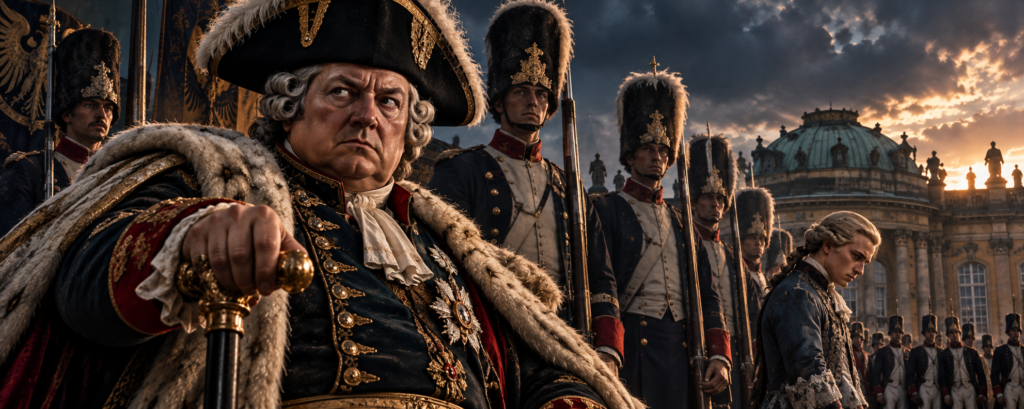
Frederick William I of Prussia: The Soldier King, the Giant Regiment, and the Son He Tried to Break
King in Prussia, 1713–1740 | Violent Rages, the Potsdam Giants, Royal Austerity, the Katte Execution, the Tobacco College, and a Family Ruled by Fear
The King with the Cane
The people of Berlin had good reason to become nervous when they saw their king approaching. Frederick William I did not always remain safely hidden behind palace walls, surrounded by layers of servants and ceremony. He liked to move through his capital, inspecting buildings, questioning subjects, looking for idleness, and judging whether the people around him were behaving as he believed they should. In his hand he often carried a heavy cane, and it was not merely ornamental. Servants, officials, soldiers, and ordinary citizens could discover that the king’s idea of correction included physical violence, particularly when his notorious temper erupted. By the time he died in 1740, stories of the Soldier King striking people in the streets had become part of the legend of a ruler who seemed determined to turn not only his army but his entire kingdom into a regiment under his personal command.
Inside his palaces, Frederick William could be even more frightening. His children learned to watch his moods, his wife endured an increasingly bitter marriage, and his eldest surviving son became the principal target of a campaign of humiliation and coercion that nearly ended in the prince’s death. The future Frederick the Great loved music, French literature, elegant clothes, philosophy, and the flute, all interests his father associated with softness and decadence. Frederick William wanted an obedient soldier for an heir and reacted to his son’s independence as though it were a dangerous military mutiny. Their conflict eventually became so unbearable that the eighteen-year-old prince attempted to escape Prussia, only to be captured and forced to confront the horrifying consequences of defying his father.
Then there were the giants. Frederick William possessed an extraordinary fascination with unusually tall soldiers and assembled them into the famous regiment remembered as the Potsdam Giants. Recruiters searched across Europe for exceptionally tall men, foreign rulers learned that a towering grenadier made an excellent diplomatic gift, and the king spent astonishing amounts acquiring recruits despite his obsessive hatred of waste. Some men joined willingly and enjoyed privileged treatment, while others were obtained through coercive recruiting practices that gave the king’s collection a much darker character. Frederick William could eliminate expensive court offices without hesitation while becoming intensely excited by the discovery of another unusually tall soldier.
These contradictions have encouraged generations of writers to describe Frederick William as mad. He could be administratively brilliant while personally explosive, financially disciplined while extravagantly obsessive, deeply religious while brutally cruel, and politically calculating while behaving with astonishing impulsiveness toward the people closest to him. Later medical historians proposed that some of his physical and behavioral symptoms might have been caused by porphyria, a metabolic disorder capable of producing severe abdominal and neurological symptoms, but the retrospective diagnosis remains uncertain and should not be presented as established fact. There is no persuasive evidence that Frederick William lived in a permanent state of psychosis or that he was incapable of understanding reality. His place among the Mad Monarchs rests instead upon something more unsettling: a combination of violent temper, obsessive behavior, extreme rigidity, chronic physical suffering, authoritarian certainty, and an almost compulsive need to control the people around him.
A Prince Who Despised Splendor
Frederick William was born in Berlin on 14 August 1688, the son of Frederick III, Elector of Brandenburg, and Sophia Charlotte of Hanover. His father eventually elevated the dynasty’s status by crowning himself Frederick I, King in Prussia, in 1701, surrounding the new royal title with the ceremonial magnificence expected of European monarchy. Sophia Charlotte was cultivated, intellectually curious, interested in music and philosophy, and associated with the great thinker Gottfried Wilhelm Leibniz. Their son grew into a man whose tastes seemed almost deliberately designed to reject that environment. He preferred uniforms to elaborate court dress, military drill to artistic conversation, administrative reports to philosophical speculation, and practical usefulness to almost every form of aristocratic display.
His hostility toward luxury developed into something approaching a personal creed. The expensive court maintained by his father represented to Frederick William everything that was dangerous about monarchy when it became preoccupied with appearances. Palaces, elaborate ceremonies, costly entertainments, ornamental offices, expensive clothing, and unnecessary servants consumed money that could instead be directed toward the army and government. His reaction was not merely the ordinary thrift of a ruler trying to balance a difficult budget. Frederick William increasingly treated extravagance as a moral defect, as though spending money unnecessarily revealed weakness of character.
This attitude would become central to his kingship, but it also created one of the first great contradictions of his personality. Frederick William did not actually object to spending enormous amounts of money when the object interested him. He could condemn artistic or ceremonial expenditure while devoting substantial resources to soldiers, military equipment, and especially his collection of unusually tall grenadiers. His frugality therefore followed an intensely personal hierarchy of value rather than a universal refusal to spend. Money devoted to court splendor was waste, while money devoted to the military was investment, even when that investment took the eccentric form of acquiring another enormous soldier for the king’s private regiment.
The young prince also displayed the forceful temperament for which he would later become notorious, although childhood stories must be treated cautiously. Later accounts describe spectacular tantrums, stubborn confrontations with attendants, the destruction of expensive clothing he disliked, and even an episode in which he supposedly swallowed a silver shoe buckle rather than surrender it. Another story claims that he threatened to throw himself from a window when a governess refused his demands. Such anecdotes may preserve genuine memories of a difficult child, but stories about famous rulers are frequently reshaped after their adult reputations become known. What is safer to say is that Frederick William developed unusually strong preferences early, particularly his fascination with soldiers and his contempt for elaborate court culture.
The Soldier King Takes Command
When Frederick I died in February 1713, his twenty-four-year-old son inherited a monarchy whose court expenditure he regarded with disgust. Frederick William immediately began cutting costs, dismissing unnecessary servants, reducing ceremonial expenses, selling or eliminating luxuries, and dismantling much of the expensive courtly world his father had created. To aristocrats accustomed to royal magnificence, the transformation must have seemed almost violent. The new king was not interested in competing with Versailles through mirrors, silk, music, and spectacle. He wanted money, soldiers, bureaucrats, weapons, farms, taxpayers, and officials who did what they were told.
The austerity had a practical purpose. Brandenburg-Prussia was a scattered collection of territories with fewer resources than the great monarchies surrounding it, and Frederick William understood that military power required dependable revenue. He strengthened the financial administration, scrutinized expenditures, demanded accountability from officials, and accumulated substantial reserves. His reign saw important administrative consolidation, particularly through institutions such as the General Directory, which helped coordinate financial, military, and governmental functions. He also encouraged settlement and economic development, particularly in territories damaged by war, plague, and depopulation.
Frederick William worked extraordinarily hard. He read reports, inspected accounts, questioned administrators, monitored military affairs, and demanded a level of efficiency that could make royal service exhausting. Officials who failed to meet his standards risked more than bureaucratic reprimand because the king’s notorious temper could transform administrative disagreement into personal confrontation. He hated what he regarded as laziness with an intensity that blurred the line between political philosophy and personal obsession. To Frederick William, an inefficient official was not simply incompetent but morally defective.
His greatest institutional obsession was the army. During his reign, the Prussian military grew dramatically until it became extraordinarily large relative to the kingdom’s population. Training, discipline, equipment, recruitment, and officer organization received constant royal attention, and the army increasingly became the central institution around which Frederick William imagined the state itself. Yet the Soldier King was not a reckless conqueror. He participated in conflict and gained territory, including acquisitions from Sweden after the Great Northern War, but he generally avoided gambling his carefully constructed military machine in endless wars.
This restraint reveals something important about his militarism. Frederick William did not love the army merely because armies fought battles. He loved it because the army represented order made visible. Soldiers stood where they were placed, dressed according to regulation, moved together, obeyed commands, and could be inspected, measured, trained, punished, and rewarded. The parade ground offered him something ordinary human relationships rarely did: a world in which uncertainty appeared to disappear.
A Kingdom Becoming a Barracks
Frederick William’s government was authoritarian even by the standards of eighteenth-century monarchy, but it was not chaotic. His methods produced results, and that administrative competence makes his private behavior more disturbing rather than less. He strengthened state finances, expanded military capacity, developed bureaucratic institutions, encouraged productive settlement, and left his successor an unusually powerful state. The king who could erupt into frightening rages was also capable of sustained planning over decades.
His political philosophy emphasized service. Nobles were expected to serve as officers, bureaucrats were expected to work relentlessly, peasants and townspeople were expected to contribute economically, and the king himself believed he was obligated to labor for the state. Frederick William did not think monarchy existed merely to provide him with pleasure. In his own mind, kingship was work, and he expected everyone beneath him to embrace the same ethic.
This sense of duty helps explain why his austerity was more than personal miserliness. He accumulated money because he believed financial reserves protected the kingdom, strengthened the army because he believed military weakness invited destruction, and attacked corruption because he regarded government as an instrument that had to function efficiently. The state was not his playground in the manner of a purely self-indulgent despot. It was a machine for survival.
The problem was that Frederick William increasingly treated human beings as components of that machine. People who performed their assigned roles could earn his approval, while those who resisted seemed to provoke something deeper than ordinary disagreement. He could respond to disobedience as though it threatened the entire moral structure upon which his world depended. This tendency became dangerous in government, grotesque in his pursuit of giant soldiers, and devastating inside his own family.
The Rages of the Soldier King
Contemporary evidence leaves little doubt that Frederick William possessed a violent temper. He shouted, threatened, struck people, and sometimes responded to relatively minor frustrations with extraordinary aggression. His heavy cane became associated with these outbursts because he was known to use it against people who displeased him. The exact details of individual street encounters often come through anecdotes that may have been embellished, but the larger pattern of personal violence is too well established to dismiss.
The king’s anger was especially intense when he encountered behavior he considered idle, extravagant, effeminate, dishonest, or insubordinate. Stories describe him confronting people in Berlin and demanding to know why they were not working, chastising citizens for clothing or behavior he disliked, and physically attacking individuals who failed his spontaneous inspection. His subjects therefore encountered a monarch who did not merely legislate discipline from a palace. He sometimes appeared personally in the street to enforce it.
Eighteenth-century Europe was certainly more accepting of corporal punishment than modern societies. Soldiers could be subjected to savage military discipline, children were beaten during education, servants could be struck by masters, and public punishment was woven into ordinary social life. Frederick William must be judged within that environment rather than against twenty-first-century expectations alone. Yet even contemporaries recognized that his behavior could be extreme, particularly because a king normally possessed servants and officials to enforce punishment rather than personally attacking people.
His violence was not always random. In many cases, it emerged from his conviction that punishment corrected defective behavior. That makes the pattern more revealing because Frederick William could believe he was improving people while frightening or injuring them. The cane was therefore more than a weapon of temper; it symbolized a political philosophy in which force could become an acceptable shortcut to obedience.
Pain, Gout, and the Porphyria Question
Frederick William suffered severely from physical illness, particularly during the later part of his reign. Gout caused periods of intense pain, his mobility deteriorated, his weight increased, and other ailments gradually transformed the energetic ruler into an increasingly sick man. Chronic pain almost certainly affected his mood at times, especially when combined with the enormous stress he imposed upon himself through work and government. His heavy consumption of alcohol could also aggravate some of his physical problems.
The most famous retrospective medical theory proposes that Frederick William suffered from acute porphyria. Certain forms of porphyria can produce severe abdominal pain, neurological disturbances, agitation, anxiety, psychiatric symptoms, and dark or reddish urine. Historical descriptions interpreted as resembling some of these symptoms encouraged medical historians to suggest that the disease might explain at least part of the king’s periodic deterioration. The possibility has received serious scholarly attention and therefore deserves consideration rather than dismissal.
It nevertheless remains a retrospective hypothesis rather than a confirmed diagnosis. Frederick William cannot be subjected to the biochemical and genetic tests that would normally be necessary to establish porphyria, while abdominal pain, irritability, mood disturbance, and discolored urine can have multiple causes. Gout, kidney problems, alcohol consumption, medications, cardiovascular disease, chronic pain, and other illnesses complicate any attempt to reconstruct his health. The evidence can support possibility, but not certainty.
The theory has sometimes been connected to the famous claim that Britain’s George III also suffered from porphyria because the royal families were related. That once-popular explanation for George III’s illness has itself been heavily challenged by later historical and medical scholarship. The weakening of the George III diagnosis does not automatically disprove porphyria in Frederick William, but it does demonstrate the danger of building elaborate hereditary medical narratives from incomplete historical descriptions. It is safer to say that Frederick William suffered unquestionably from serious physical illness and may have had an underlying metabolic disorder that cannot now be proven.
Most importantly, disease should not become an excuse for cruelty. Severe pain can worsen irritability and neurological illness can alter behavior, but neither explanation automatically transforms decades of coercion into involuntary symptoms. Frederick William made political and personal choices throughout his life. Any medical explanation must illuminate those choices without erasing responsibility for them.
The Potsdam Giants
Frederick William’s fascination with unusually tall soldiers became the most famous eccentricity of his reign. The unit remembered as the Potsdam Giants contained exceptionally tall grenadiers gathered from Prussia and across Europe. Height fascinated the king to a degree that astonished contemporaries, and particularly impressive recruits could become objects of extraordinary royal enthusiasm. Foreign diplomats quickly discovered that sending Frederick William a very tall soldier could win more gratitude than many conventional gifts.
The regiment was real, but popular retellings often exaggerate its rules. A minimum height of approximately six feet two inches is frequently repeated as though it were an absolute regulation governing every recruit, although surviving evidence does not justify treating one modern measurement as universally fixed. The principle was simpler: Frederick William wanted unusually tall men, and the taller they were, the more desirable they became. In an era when average male height was considerably lower than today, some of his prized grenadiers must have appeared genuinely enormous.
Recruitment ranged from ordinary military service to methods that were far more coercive. Some tall soldiers entered voluntarily and could receive good pay, privileges, or royal favor. Others were effectively treated as valuable commodities, pursued by recruiters who knew that delivering an exceptional specimen could please the king. Foreign rulers sent tall men as gifts, recruiters scoured territories beyond Prussia, and complaints arose when enthusiasm for obtaining desirable bodies overwhelmed ordinary considerations of consent.
Frederick William’s expenditure on the regiment exposed the contradiction at the heart of his famous thrift. He despised unnecessary servants, expensive ceremonies, extravagant clothing, and artistic luxury, yet he could spend remarkable sums acquiring a particularly tall soldier. This was not hypocrisy in his own mind because he did not regard the grenadiers as waste. They represented military magnificence, discipline, physical power, and the aesthetic ideal of the state he wanted to create.
The giants were therefore Frederick William’s luxury collection. Other monarchs accumulated paintings, porcelain, horses, jewels, rare books, or elaborate gardens. Frederick William collected extraordinary soldiers, arranged them in uniforms, drilled them, reviewed them, and took enormous pleasure in their appearance. His obsession was unusual not because eighteenth-century rulers did not collect human dependents, but because he transformed physical height itself into something close to a royal treasure.
Kidnapping Giants and the Dark Side of Recruitment
The search for tall men inevitably created abuses. Recruiters knew that Frederick William valued exceptional height, and the incentives encouraged aggressive methods that could cross into coercion and abduction. Stories circulated throughout Europe of tall travelers or foreign subjects discovering that Prussian agents had taken an alarming interest in their bodies. Some individual anecdotes are difficult to verify, but the coercive character of parts of the recruiting system is historically credible and well established enough to form part of the king’s darker reputation.
Popular accounts sometimes claim that virtually anyone of sufficient height was vulnerable, including priests, craftsmen, diplomats, and foreign travelers. The more sensational versions should be treated carefully because Frederick William became such a legendary eccentric that almost any bizarre giant story could later attach itself to him. Nevertheless, diplomatic embarrassment surrounding recruitment was real, and the king’s desire for tall men could encourage behavior that violated normal boundaries. A person’s unusual body could become a royal asset before the person himself had much opportunity to object.
Another famous story claims that Frederick William attempted a primitive form of selective breeding by pairing tall grenadiers with unusually tall women in hopes of producing giant children. The story appears frequently in popular accounts and fits his fixation with height, but claims of a systematic state-run breeding program are less securely documented than the existence of the giant regiment itself. Matchmaking or encouragement may have occurred without constituting the organized eugenic experiment sometimes described in modern retellings. This distinction matters because the genuine history is already strange enough without converting every later anecdote into established policy.
The same caution applies to the gruesome claim that Frederick William placed soldiers on stretching racks to increase their height. Elaborate versions describe men being mechanically stretched while the king watched, sometimes eating his meal, until injuries or deaths forced the experiment to stop. Reliable evidence for such a systematic practice is extremely weak, and the theatrical details have the character of a legend built around a real obsession. The king did enough disturbing things in pursuit of giant soldiers that later generations had little difficulty believing he might have done even worse.
Giants in the Sickroom
One persistent tradition holds that Frederick William took comfort in seeing his beloved grenadiers when he was ill or depressed. He certainly enjoyed reviewing soldiers, and military display provided him with satisfaction far beyond ordinary professional interest. It is therefore plausible that troops were brought before him or paraded for his enjoyment during periods when his health prevented normal activity. The sight of disciplined soldiers may have represented order and strength at moments when his own body was failing him.
Later versions of the story become increasingly spectacular. Some describe enormous numbers of giants marching through or near the king’s sickroom while musicians accompanied them, and particularly colorful retellings add exotic performers or a bear to the procession. These details should not be repeated as unquestioned fact merely because they make irresistible historical theater. Frederick William attracted precisely the kind of folklore in which every genuine eccentricity acquired another layer of absurdity.
The underlying emotional relationship between the king and his soldiers, however, was real. Frederick William found military drill reassuring and aesthetically satisfying. Rows of men responding instantly to command represented a world in which confusion had been defeated by discipline. For a ruler whose family relationships and European diplomacy repeatedly frustrated him, the predictable movement of a regiment may have offered an unusual sense of control.
This helps explain why the Potsdam Giants were more than military curiosities. They were symbols of the king’s ideal world, one in which bodies could be selected, uniforms standardized, movement synchronized, and individuality subordinated to command. The very qualities that made the regiment beautiful to Frederick William also reveal the darker assumptions underlying his conception of human order.
Sophia Dorothea and the Royal Marriage
Frederick William married Sophia Dorothea of Hanover in 1706, seven years before he became king. She was his first cousin and the daughter of the future George I of Great Britain, placing the marriage at the center of an important network connecting Prussia, Hanover, and Britain. Sophia Dorothea was intelligent, politically aware, and far more sympathetic to the refined courtly culture her husband increasingly despised. Their marriage produced numerous children, but the household they created became notorious for conflict.
The queen hoped to secure prestigious British marriages for their children, particularly Crown Prince Frederick and his sister Wilhelmine. These plans became entangled in complicated diplomacy, and Frederick William’s attitude toward them changed as his suspicions of British and Hanoverian intentions increased. What might have remained an ordinary disagreement over dynastic strategy became another source of domestic warfare because the king treated political opposition within his family as deeply personal. Sophia Dorothea and her children could find themselves maneuvering around his moods rather than simply negotiating with him.
Wilhelmine later left memoirs describing the royal household as a place of fear, humiliation, and violence. Her account must be read with awareness that she was both participant and victim, writing from her own perspective and with strong grievances against her father. Yet other evidence confirms enough of Frederick William’s violent behavior that the basic picture cannot be dismissed as a daughter’s revenge. The palace could become an emotionally dangerous environment whenever the king believed his authority had been challenged.
The family conflict mattered because Frederick William did not separate domestic obedience from political obedience. His wife and children were members of a dynasty and therefore instruments of state policy as well as people with private preferences. Marriage, education, religion, clothing, friendships, and hobbies could all become matters of royal government. No member of the family experienced this more painfully than the crown prince.
Fritz, the Son Who Refused to Fit
Frederick, born in January 1712, developed into precisely the kind of young man his father feared. He was intelligent, sensitive to music, fascinated by French literature, interested in philosophy, fond of elegant conversation, and an accomplished flute player. None of these qualities prevented him from possessing political or military ability, but Frederick William interpreted them through his own narrow understanding of masculinity and kingship. To him, the prince seemed soft, frivolous, Frenchified, and dangerously unlike the soldier monarch he wanted as his successor.
The father-son conflict intensified as Frederick grew older. The king attempted to regulate his son’s education, clothing, schedule, friendships, and interests, while Frederick sought increasingly elaborate ways to preserve a private intellectual and musical life. Books and music could become acts of resistance because they represented an identity Frederick William was trying to suppress. What might have been ordinary generational conflict became dangerous because one participant possessed absolute royal authority over the other.
Physical abuse formed part of the relationship. Contemporary evidence and family testimony describe Frederick William striking his son, publicly humiliating him, pulling or dragging him by the hair, insulting him, and treating him with extraordinary severity. Popular accounts add specific humiliations such as forcing the prince to kiss muddy boots or subjecting him to various elaborate punishments, but not every colorful detail is equally well documented. The secure evidence is already sufficiently disturbing without embellishment.
Frederick William appears to have believed he was correcting weakness rather than merely indulging cruelty. That conviction made the situation worse because the king could interpret resistance as proof that harsher discipline was necessary. Frederick’s refusal to become exactly what his father demanded therefore produced escalating punishment rather than reconsideration. The prince gradually learned that honesty about his interests could expose him to danger.
The Escape Plot
By 1730, the relationship had deteriorated to the point that eighteen-year-old Frederick contemplated escape. During a royal journey, he planned to flee his father’s territory with assistance from trusted associates, including Lieutenant Hans Hermann von Katte. The scheme was discovered before Frederick could reach safety, and the consequences were catastrophic. A family rebellion suddenly became a military and political crime because Frederick was not merely a frightened son but the crown prince and an officer in the Prussian army.
Frederick William reacted with extraordinary fury. His son’s attempted flight confirmed his darkest suspicions about the prince’s loyalty and character, and he considered the possibility of treating him with the severity applied to military desertion. Frederick was arrested, interrogated, stripped of much of his status, and imprisoned at Küstrin. The question of whether the king might actually execute his own heir became sufficiently serious to alarm those around him.
Military and legal authorities were reluctant to provide the outcome Frederick William appeared to desire. Executing the crown prince would have created a dynastic crisis as well as a scandal across Europe. Frederick’s royal status complicated the application of ordinary military law, and powerful figures resisted the king’s most extreme impulses. The prince’s life was ultimately spared, but Frederick William found another target upon whom royal discipline could fall.
Hans Hermann von Katte had helped the prince. He was arrested, tried, and initially received a sentence less severe than death. Frederick William rejected that leniency and ordered him executed.
The decision transformed the escape affair from a frightening family crisis into one of the darkest episodes in eighteenth-century royal history. The king did not merely want to punish the man who had assisted his son. Katte’s death would become part of Frederick’s punishment as well, a demonstration that the prince’s resistance could destroy the people he cared about.
Hans Hermann von Katte and the Execution at Küstrin
Katte was a young officer from a military family and had developed a close relationship with Frederick. Historians have long debated whether their attachment was romantic or sexual, particularly because Frederick’s intimate relationships and sexuality remain subjects of considerable historical discussion. The surviving evidence allows the possibility of a romantic dimension but does not permit every later claim to be treated as certain. What is indisputable is that Katte mattered deeply to Frederick and participated in the escape conspiracy.
The court-martial did not initially impose the death sentence Frederick William wanted. The king nevertheless insisted that Katte die, exercising royal authority to increase the punishment. This intervention reveals the extraordinary intensity of his response because he was not reluctantly enforcing an unavoidable military judgment. He deliberately chose greater severity than the court had recommended.
On 6 November 1730, Katte was taken to execution at Küstrin. Frederick was confined in a position from which the execution was deliberately made part of his punishment, and accounts describe his extreme distress as Katte was brought out to die. The precise words attributed to the two young men vary among sources and should not be treated as verbatim certainty, but there is no serious doubt about the emotional horror of the event. Katte was beheaded while the imprisoned crown prince was forced into proximity with the spectacle.
Frederick reportedly collapsed or became overwhelmed during the execution. Whether every dramatic detail later attached to the scene is accurate matters less than the central fact that Frederick William used Katte’s death as a lesson for his son. It was calculated psychological punishment carried out under the authority of a father who believed disobedience required crushing correction. Whatever reconciliation eventually occurred between father and son, nothing could undo that morning.
Teaching the Prince to Obey
After Katte’s execution, Frederick remained under severe restrictions. He was required to study administration and government at Küstrin, where he learned practical aspects of finance, agriculture, bureaucracy, and provincial management. Frederick William wanted his heir transformed from the cultured young prince he distrusted into a useful servant of the Prussian state. Ironically, this enforced education would later prove immensely valuable to Frederick as king.
The crown prince also learned another skill: concealment. Open resistance had nearly destroyed him, and he now understood that survival required outward obedience. He could perform the role his father demanded while protecting parts of his personality beyond the king’s reach. The distinction between public duty and private identity became one of the defining patterns of his adult life.
Gradually, relations improved. Frederick demonstrated administrative competence and greater willingness to conform publicly to his father’s expectations, while Frederick William began to recognize qualities in his son that his earlier fury had obscured. The prince was eventually restored to a more normal position and married Elisabeth Christine of Brunswick-Wolfenbüttel-Bevern in 1733, a match arranged largely according to dynastic considerations rather than personal passion. Their marriage would remain emotionally distant.
The reconciliation should not be romanticized. Frederick William may eventually have developed genuine pride in his son’s abilities, and Frederick may have recognized aspects of his father’s statecraft worth respecting, but the relationship had already been permanently shaped by fear. Frederick had learned that paternal authority could reach into his friendships, private interests, and even the lives of those around him.
The father had wanted to teach obedience. What he also taught was secrecy.
The Tobacco College
Frederick William’s favorite form of social relaxation was the famous Tabakskollegium, or Tobacco College. This was an informal gathering in which the king and selected companions smoked pipes, drank beer, discussed politics, exchanged coarse jokes, and temporarily abandoned some of the ceremonial stiffness of ordinary court life. The atmosphere reflected almost everything Frederick William preferred over the polished aristocratic salons associated with French culture.
The gathering could appear egalitarian because rank mattered less than in formal court ceremony, but equality around an absolute monarch always had limits. Participants understood that the king controlled the mood, and his amusement could come at another person’s expense. Drinking, smoking, teasing, arguments, and practical jokes sometimes produced an atmosphere that was more intimidating than relaxed. Frederick William’s idea of companionship could still contain coercion.
Alcohol was an important feature of these evenings, and heavy drinking may have worsened the king’s physical condition. It could aggravate gout and other health problems, while advocates of the porphyria theory have noted that alcohol can precipitate attacks in susceptible individuals. Tobacco added another habitual indulgence, although its long-term dangers were not understood in the eighteenth century. The king who preached discipline therefore maintained social rituals that could work directly against his own health.
The Tobacco College also demonstrates that Frederick William was not simply humorless. He enjoyed jokes, companionship, drinking, conversation, and deliberately rough entertainment. The problem was that his humor often depended upon humiliation, and people who amused the king did not necessarily enjoy the experience themselves.
Gundling: The Scholar as Court Entertainment
Jacob Paul von Gundling became perhaps the most notorious victim of Frederick William’s court humor. Gundling was an educated historian and scholar who held genuine intellectual and official positions, but he was also repeatedly transformed into an object of ridicule. The king and his companions exploited his weaknesses, encouraged his drinking, subjected him to practical jokes, and made his dignity part of the evening’s entertainment.
Accounts of Gundling’s humiliation include bizarre costumes, mock ceremonies, frightening pranks, and episodes involving animals. One famous story describes monkeys being introduced into his surroundings as part of the harassment. As with many anecdotes from Frederick William’s court, individual details can be difficult to verify with equal confidence, but the overall pattern of sustained humiliation is well established. Gundling occupied the peculiar position of being both a recognized scholar in royal service and something resembling a court jester.
The treatment reveals more than simple anti-intellectualism. Frederick William did not oppose knowledge when he considered it useful. He valued administrative expertise, practical education, military science, theology, economic knowledge, and technical competence. What enraged him was intellectual activity he considered pretentious, speculative, impractical, or detached from service to the state.
Gundling therefore became a symbol of the king’s contempt for scholarship that failed his personal test of usefulness. Frederick William could employ an intellectual while simultaneously humiliating him for being one. His son, who treasured literature and philosophy, could hardly have missed the lesson.
Christian Wolff and the War on Dangerous Ideas
The philosopher Christian Wolff encountered an even more serious form of Frederick William’s hostility toward abstract thought. Wolff was one of the leading German philosophers of his age and taught at Halle, where his rationalist ideas attracted admiration as well as intense opposition from theological rivals. His enemies eventually persuaded the king that aspects of Wolff’s philosophy threatened religion and social order.
A particularly effective argument connected philosophical determinism with military discipline. If human actions were predetermined, critics suggested, a deserter might claim he could not be morally responsible for abandoning his regiment. Whether this was a fair interpretation of Wolff mattered less than the fact that it struck directly at Frederick William’s deepest concern. Anything that appeared capable of weakening military obedience was intolerable.
In 1723, the king ordered Wolff to leave Prussian territory on extremely short notice. The traditional account gives him forty-eight hours and associates failure to comply with the threat of hanging. Wolff departed, and the episode became one of the most famous examples of Frederick William’s willingness to use state power against intellectual ideas he considered dangerous.
His son’s later court would provide a remarkable contrast. Frederick the Great corresponded with philosophers, invited Voltaire to Prussia, wrote philosophical works, composed music, and cultivated an image of enlightened kingship. The cultural world Frederick William tried to suppress returned under the son he had tried to remake.
The King Who Hated France
France occupied a peculiar place in Frederick William’s imagination. French language, fashion, manners, and court culture dominated elite European society, and the king increasingly treated them as symbols of everything he considered decadent. Elaborate clothing, refined etiquette, sophisticated conversation, and the cultural prestige of Versailles represented a model of monarchy opposite to his own.
His hostility contained an obvious irony. Frederick William had grown up in a world deeply influenced by French culture and possessed familiarity with the French language. His rejection therefore resembled rebellion against an environment he knew intimately rather than simple ignorance of it. The intensity of his reaction may partly explain why his son’s enthusiasm for French literature and culture provoked him so profoundly.
Colorful stories claim that Frederick William deliberately tried to disgrace French fashion by dressing criminals or condemned prisoners in fashionable French clothing. Such anecdotes fit his personality and may reflect genuine acts or attitudes, but they should be treated cautiously when the documentation is uncertain. His contempt for French cultural influence is secure even when particular theatrical gestures remain questionable.
The dispute over France became another battlefield between father and son. Frederick admired French literature, wrote extensively in French, corresponded with French intellectuals, and later built a court culture deeply shaped by Francophone tastes. Every French book and elegant coat could therefore appear to Frederick William as evidence that the heir was slipping toward the world he most despised.
Austerity Taken to Extremes
Frederick William’s assault on court expenditure became legendary. He reduced the scale of the royal household, curtailed luxuries, sold unnecessary possessions, and redirected resources toward government and the army. The transformation was so dramatic that later stories portrayed the royal family almost as prisoners of the king’s economy, deprived of ordinary comforts while he counted every coin.
One popular anecdote claims that Queen Sophia Dorothea and the princesses were forced to wash dishes because Frederick William dismissed so many servants. The broader atmosphere of austerity is unquestionably real, but picturesque stories of this kind should not automatically be treated as literal descriptions of daily palace life. The Prussian monarchy continued to maintain servants and ceremonial functions, even if its court was far less extravagant than under Frederick I.
The king’s thrift nevertheless reached deeply into domestic life. He wanted his family to understand that royal status did not justify limitless expenditure, and he viewed unnecessary consumption with moral suspicion. His hostility toward luxury became another means of control because clothing, furnishings, entertainment, and personal spending all fell under royal scrutiny.
The result was a court that felt strikingly different from many of its European counterparts. Frederick William did not eliminate monarchy’s privileges, but he stripped away much of the cultural softness surrounding them. The palace increasingly reflected the same austere values he imposed upon the state.
The King in the Streets
Frederick William’s habit of personally inspecting Berlin helped turn him into a figure of urban folklore. He could appear without the enormous ceremonial distance expected of a monarch, observing citizens and demanding explanations for whatever caught his attention. This accessibility was not necessarily reassuring because an encounter with the king could quickly become an interrogation.
Stories describe him demanding that apparently idle men return to work, criticizing women whose behavior violated his expectations, and striking people who failed to satisfy his standards. Some later anecdotes undoubtedly became exaggerated because Berliners had every incentive to tell stories about the terrifying king with the cane. Yet the underlying pattern of intrusive personal supervision matches what is known about Frederick William’s governing style.
He regarded idleness almost as a moral disease. A healthy person who appeared to be doing nothing useful represented wasted human capacity, and waste offended him whether it involved money, labor, or military resources. His famous street interventions therefore reflected the same ideology that shaped his bureaucracy and army.
The king did not believe government should remain abstract. He wanted to see whether his orders were working, whether officials were performing, and whether subjects were behaving productively. The result could look like energetic kingship from one perspective and terrifying micromanagement from another.
Wilhelmine and the Palace of Fear
Frederick’s sister Wilhelmine left one of the most vivid accounts of life inside Frederick William’s family. Her memoirs portray a household in which the king’s moods shaped everyone’s behavior and where arguments over diplomacy, marriage, clothing, or personal preference could become frighteningly intense. She remembered her father as violent, domineering, and unpredictable.
Her testimony cannot simply be accepted without scrutiny because memoirs are shaped by memory, resentment, self-justification, and the author’s later understanding of events. Wilhelmine had suffered within the family and possessed strong reasons to view her father harshly. Nevertheless, enough independent evidence supports Frederick William’s aggression that her account cannot be dismissed as invention.
The marriage negotiations involving Britain became particularly poisonous. Sophia Dorothea wanted prestigious matches linking Frederick and Wilhelmine with her Hanoverian relatives, while Frederick William became increasingly distrustful of the diplomatic maneuvering surrounding the proposals. The children found themselves caught between parental factions, and family loyalty became entangled with international politics.
Wilhelmine eventually married Frederick, Margrave of Brandenburg-Bayreuth, and later cultivated an artistic and intellectual environment markedly different from her father’s austere court. Like her brother, she built an adult life containing many of the cultural pleasures Frederick William had distrusted. His attempt to shape his children through force therefore produced an ironic result: the more aggressively he condemned their tastes, the more those tastes became part of their independence.
Religion, Duty, and the Morality of Severity
Frederick William’s religious convictions were important to his understanding of kingship. He was a serious Protestant monarch whose faith emphasized duty, discipline, work, obedience, and moral responsibility. He did not see himself as a king entitled to endless pleasure simply because he had inherited a crown. He believed he was obligated to work for the state and answer before God for how he used his authority.
This helps explain why his cruelty could coexist with genuine self-denial. Frederick William restricted many of his own luxuries, worked relentlessly, accumulated money for the state, and devoted extraordinary energy to administration. He could therefore regard himself as demanding nothing from others that he was unwilling to demand from himself, even when that belief ignored the obvious difference between voluntary self-discipline and violence imposed upon someone else.
His treatment of Frederick may have been partly shaped by this moral certainty. The king believed his son’s tastes endangered the character required of a future ruler, and he treated harsh discipline as corrective rather than destructive. Music, French literature, elegant clothing, and private friendships appeared not as harmless preferences but as symptoms of weakness that had to be eliminated.
This is what makes Frederick William’s paternal cruelty particularly disturbing. A parent who knows he is being cruel may eventually feel guilt or restraint. A parent convinced that cruelty is medicine can always prescribe another dose.
A Military State Built by a Reluctant Warrior
One of the strangest features of Frederick William’s reign is the contrast between the enormous army he built and his comparatively restrained use of it. He increased the military establishment dramatically and demanded relentless drilling, yet he did not pursue the endless wars of conquest that might be expected from such a militarized ruler. His caution preserved the army for his successor.
This suggests that Frederick William’s military obsession cannot be explained entirely through strategic ambition. The army itself was part of his conception of a properly ordered society. Military organization transformed individual men into predictable components of a disciplined whole, exactly the kind of transformation he repeatedly tried to impose elsewhere.
The Potsdam Giants represented this vision in exaggerated form. Their unusual bodies made them visually spectacular, but what Frederick William wanted from them was still discipline. Their height attracted him, yet their uniformity and obedience completed the image.
His son would inherit this military system and use it with far greater aggression. Within months of Frederick William’s death, Frederick II invaded Silesia and began the wars that transformed Prussia into a major European power. The father created an extraordinarily sharp sword and spent much of his reign keeping it in its sheath; the son drew it almost immediately.
The Final Years
By the late 1730s, Frederick William’s body was failing. Severe gout and other illnesses reduced his mobility and subjected him to periods of intense pain. The ruler who had spent decades demanding physical vigor from everyone around him increasingly found himself trapped by a body that refused to obey.
Chronic illness appears to have darkened his moods, although it is impossible to assign particular outbursts to particular medical causes with confidence. Pain, alcohol, stress, and whatever underlying diseases he suffered could all have influenced his emotional state. If porphyria was present, it may have contributed further neurological and psychiatric symptoms, but the evidence cannot establish that connection decisively.
Frederick William nevertheless continued working and worrying about the future of his state. His relationship with Frederick had improved considerably since the catastrophe of 1730, and the king gradually recognized that his son possessed considerable ability. The prince had demonstrated competence in administration and military matters without surrendering his intellectual and musical interests.
The final relationship between them was therefore more complicated than simple hatred. There was reconciliation, respect, and perhaps genuine affection alongside memories of profound abuse. Frederick could appreciate what his father had built without forgetting what his father had done.
Frederick William died at Potsdam on 31 May 1740 at the age of fifty-one. He left his son a strong treasury, an extraordinarily disciplined army, and a government capable of extracting and organizing resources with unusual efficiency. The kingdom was prepared for greatness, even if the father and son possessed radically different ideas about what greatness should look like.
Frederick the Great Inherits the Machine
Frederick II became king immediately after his father’s death. The transformation must have been extraordinary for a man who had once been imprisoned and threatened by the same monarchy he now controlled. The prince who had attempted to flee Prussia was suddenly its absolute ruler.
He did not dismantle his father’s administrative or military achievements. Instead, he recognized their enormous value and used them. The army Frederick William had trained became the instrument through which Frederick seized Silesia from the Habsburg monarchy and began Prussia’s transformation into one of Europe’s great powers.
Yet the new king also reclaimed the cultural world his father had tried to suppress. Frederick played the flute, composed music, wrote poetry and philosophy, corresponded with intellectuals, admired French literature, and later created Sanssouci as a retreat shaped by tastes almost calculated to horrify the Soldier King. The son combined his father’s disciplined state with the intellectual and artistic identity he had preserved despite paternal persecution.
The irony was immense. Frederick William had feared that his musical, French-speaking, philosophical son would become a weak monarch. Instead, Frederick became one of the most formidable military rulers of the eighteenth century without abandoning the interests his father had treated as evidence of weakness.
The Soldier King had been wrong about what strength looked like.
Was Frederick William I Mad?
If madness is defined as sustained psychosis, profound loss of contact with reality, or inability to govern coherently, Frederick William I does not belong comfortably within that definition. His administrative record demonstrates long-term concentration, strategic understanding, financial competence, and the ability to pursue complex policies over decades. Prussia did not become stronger by accident.
Yet historical accusations of madness were never limited to clinical psychosis. Extreme anger, bizarre obsessions, unpredictable violence, compulsive habits, cruelty, and behavior that violated accepted social boundaries could all cause rulers to be described as mad, deranged, or tyrannical. Frederick William possessed enough of these characteristics to make his reputation understandable.
Modern diagnostic labels do not solve the problem. His behavior can be made to resemble features associated with several psychiatric or personality conditions, but retrospective diagnosis from eighteenth-century evidence is extraordinarily uncertain. Porphyria remains medically interesting but unproven, while gout and serious physical illness are far better documented.
The most historically responsible conclusion is therefore also the most unsettling. Frederick William did not need to be clinically insane to behave monstrously. He could understand government brilliantly while failing catastrophically in his treatment of people.
His intelligence did not restrain his cruelty.
Sometimes it gave his cruelty a system.
The Logic Behind the Violence
Frederick William’s behavior becomes easier to understand when viewed through his obsession with usefulness. Money had to be useful, officials had to be useful, nobles had to serve, soldiers had to obey, children had to prepare themselves for dynastic duty, and intellectual activity had to contribute something practical. Anything that seemed ornamental, idle, undisciplined, or self-indulgent provoked contempt.
This worldview produced genuine accomplishments. Wasteful expenditure was reduced, state administration improved, military organization became formidable, and royal finances strengthened. Prussia emerged from his reign better equipped to survive among much larger neighbors.
The same worldview became dangerous whenever a human being refused to fit its categories. Frederick wanted music when his father wanted military drill. Gundling possessed scholarship that the king considered ridiculous. Wolff pursued philosophy that Frederick William believed threatened obedience. Tall men became valuable because the king had decided their bodies belonged within his ideal regiment.
Violence then became a method of correction. The king did not always strike people because he had temporarily lost all control. Sometimes he struck them because he believed control was exactly what they needed.
That distinction makes him more frightening, not less.
The Son at Küstrin
No episode better captures Frederick William’s dark side than the Katte execution. The king’s giant soldiers may be stranger, his Tobacco College more eccentric, and his street inspections more colorful, but Küstrin reveals what happened when paternal authority, military discipline, wounded pride, and absolute power converged.
Frederick had tried to escape. His father could have interpreted that act as evidence that their relationship had become intolerable, but Frederick William interpreted it primarily as betrayal and disobedience. The king’s worldview left little room for the possibility that his own behavior had driven his son to desperation.
Katte became the instrument through which the lesson would be delivered. The young officer was sentenced to death despite the court-martial’s greater leniency, and Frederick was forced to experience the execution as part of his punishment. The king had transformed another man’s death into a disciplinary message.
The episode strips away the comic eccentricity that often surrounds Frederick William’s reputation. There is nothing amusing about a giant regiment when placed beside a father deliberately arranging the death of his son’s companion. The same monarch who carefully measured the usefulness of state resources was capable of using a human life to demonstrate authority.
Frederick survived the lesson. Katte did not.
The Father Who Created What He Feared
Frederick William spent years trying to prevent his son from becoming a weak king. He attacked Frederick’s music, French tastes, intellectual interests, friendships, and resistance because he believed they were incompatible with military kingship. The irony is that Frederick eventually became a far more famous soldier than his father.
The administrative education imposed at Küstrin contributed to Frederick’s understanding of government. The army his father built gave him military power. The treasury Frederick William accumulated allowed him to act with confidence when opportunity appeared. In these respects, the father unquestionably helped prepare the son’s success.
Yet Frederick’s greatness did not come from becoming a copy of Frederick William. He retained the very characteristics his father had tried to destroy. He remained musical, intellectual, Francophile, skeptical, and capable of creating a sophisticated court culture utterly unlike the barracks atmosphere of his youth.
Frederick William therefore succeeded and failed simultaneously. He gave his son the machinery of power but could not dictate the personality that would operate it. The prince learned discipline without surrendering identity.
That may have been the one form of resistance the Soldier King could never defeat.
The Madness of Absolute Discipline
Frederick William’s story reveals why the history of royal madness cannot be reduced to a catalogue of psychiatric diagnoses. Some monarchs suffered unmistakable periods of severe mental illness. Others acquired reputations for madness because their behavior appeared obsessive, violent, grotesque, unpredictable, or incomprehensible to the people around them.
Frederick William belongs primarily to the second group. He was not incapable of rationality; in government, he could be ruthlessly rational. What made him extraordinary was the extent to which his need for order penetrated every part of life.
The state had to be disciplined, the army drilled, money accounted for, officials supervised, subjects industrious, clothing practical, scholarship useful, and children obedient. Even the physical dimensions of soldiers became objects of royal control. There seemed to be almost nothing Frederick William could encounter without asking whether it could be made more orderly.
The tragedy was that human beings cannot be drilled indefinitely without consequences. Frederick’s individuality produced conflict precisely because it resisted reduction to his father’s system. Sophia Dorothea’s political preferences produced conflict because she was not merely an extension of her husband’s will. Gundling’s dignity mattered even when the king found his humiliation entertaining.
Katte’s life mattered even when the king found his death useful.
The Giant Regiment as a Portrait of the King
The Potsdam Giants have endured because they seem to summarize Frederick William’s eccentricity in a single image. A severe, economical monarch who condemned luxury spent enormous energy acquiring unusually tall soldiers, dressed them magnificently, drilled them relentlessly, and delighted in their appearance. The contradiction is so perfect that it almost seems invented.
Yet the giants were not really inconsistent with his worldview. Frederick William considered them beautiful because they embodied military order. Their unusual height exaggerated the physical presence of the soldier, while their discipline transformed that physical presence into something controlled.
The regiment also revealed his willingness to treat people according to characteristics useful to him. Height became currency. A man could attract royal attention because his body possessed a feature the king coveted, and the resulting recruitment could range from fortunate opportunity to frightening coercion.
The giants were therefore not merely toys, even though Frederick William’s personal fascination could make them seem like a collection. They were soldiers inside a real military system, but they were also human trophies within the king’s private mythology of power.
Other monarchs surrounded themselves with portraits of ancestors, sculptures of classical heroes, fountains, jewels, and tapestries. Frederick William preferred living columns of enormous grenadiers.
They were his art collection made flesh.
The Limits of Medical Explanation
The temptation to explain Frederick William through porphyria is understandable. A single disease capable of producing physical pain, neurological symptoms, agitation, depression, and behavioral disturbance offers an elegant explanation for a ruler whose body and temperament both caused concern. Historical reality is rarely so convenient.
Even if Frederick William did suffer from porphyria, the disease would not explain his entire personality. His military interests developed early, his austerity followed coherent political reasoning, his administrative reforms required sustained planning, and his coercive understanding of authority remained consistent across decades. These were not simply episodic symptoms appearing during acute illness.
Chronic pain probably intensified his irritability, and periods of severe sickness may have made his rages worse. Alcohol may have aggravated his condition, while the enormous physical suffering of gout should not be underestimated. A man in relentless pain may become more impatient, depressed, anxious, or angry.
But historical explanation must distinguish influence from absolution. Illness may help explain why Frederick William sometimes became especially volatile without explaining why he believed humiliation was legitimate, why he overrode Katte’s sentence, or why he treated his son’s independence as something to be crushed.
The search for a diagnosis can become another way of avoiding the more uncomfortable conclusion. Human beings do not require rare diseases to become cruel when given enormous power.
The King Who Made Prussia Strong
Frederick William’s political achievements were substantial. He inherited a monarchy whose territories were scattered and whose resources could not compare easily with those of France, Russia, Austria, or Britain. By concentrating upon finances, bureaucracy, population, and military organization, he made Prussia far more formidable than its size suggested it should have been.
He accumulated a strong treasury and left an army of roughly eighty thousand men, an extraordinary force for his kingdom’s population. He strengthened administrative structures and helped establish the close relationship between monarchy, bureaucracy, landed elites, and military service that would characterize Prussia for generations. His policies toward settlement and reconstruction contributed to the recovery and development of damaged territories.
These achievements make simplistic descriptions of him as merely insane impossible. A ruler lost in permanent delusion could not easily sustain such a coherent program. Frederick William understood the strategic problem confronting Prussia and spent decades constructing an answer.
His answer was discipline.
That answer worked remarkably well when applied to budgets, military training, and administrative procedures. It became far more dangerous when applied to human personality.
The king’s greatest strength and greatest defect therefore emerged from the same source. Frederick William believed almost everything could be improved by imposing order upon it.
Prussia often could.
People were another matter.
The Final Contradiction
When Frederick William died in 1740, he left behind the state he had spent his life building. He had not transformed Prussia through dazzling court culture or spectacular conquest. He had done it through budgets, drills, inspections, recruitment, bureaucracy, taxation, discipline, and relentless attention to detail.
His son inherited all of it. Frederick II took the treasury, army, officers, bureaucratic machinery, and political discipline created by his father and used them to change the balance of power in Europe. The son Frederick William once regarded as dangerously soft became Frederick the Great.
Yet Frederick did not honor his father by becoming another Soldier King. He surrounded himself with music, books, philosophical discussion, dogs, artists, intellectuals, and French culture. He preserved the private self his father had attempted to eradicate.
This is the central irony of Frederick William’s life. He succeeded brilliantly at shaping institutions and failed spectacularly at shaping another human being. His army obeyed, his bureaucracy functioned, and his treasury filled.
His son survived him.
The King Who Tried to Drill the Human Soul
Frederick William I belongs among the Mad Monarchs not because history can confidently diagnose him with insanity, but because his reign demonstrates how disturbing a perfectly functional monarch could become when obsession, anger, physical suffering, cruelty, and absolute authority reinforced one another. He did not need hallucinations to terrorize his household. He did not need psychosis to collect giant soldiers through coercive networks or to strike people who failed his standards. He did not need a neurological diagnosis to turn his son’s attempted escape into a lesson written in another man’s blood.
His most famous eccentricities can sometimes make him appear almost comic. The giant grenadiers, tobacco evenings, obsession with thrift, hatred of French fashion, street inspections, and contempt for philosophers produce a character so strange that he can resemble a grotesque figure from satire. Yet the comedy disappears whenever the consequences of his behavior come into focus. Gundling endured humiliation, Wolff fled Prussia, the royal children lived under fear, Frederick was imprisoned, and Katte died beneath the executioner’s blade.
Frederick William’s accomplishments cannot simply be erased because of his cruelty. He strengthened Prussia, improved its finances, expanded its military power, tightened administration, and handed his successor one of the most formidable political machines in Europe. Nor can those accomplishments excuse what happened within his family. Historical importance and moral ugliness can exist in the same person without cancelling each other out.
Perhaps that contradiction explains why Frederick William remains so compelling. He was not a useless madman accidentally occupying a throne. He was capable, hardworking, disciplined, intelligent, and frighteningly certain that his methods were necessary. His cruelty did not exist outside his political philosophy; at its worst, it grew directly from it.
He believed disorder could be corrected.
He believed weakness could be disciplined.
He believed disobedience could be punished until it disappeared.
For soldiers standing on a parade ground, the system could produce astonishing precision. For a kingdom surrounded by powerful enemies, it could create strength. For a bureaucracy, it could produce efficiency. Inside a family, however, the same philosophy could become a nightmare, because love, personality, friendship, creativity, and independence cannot be commanded into formation.
The final image of Frederick William’s reign is therefore not merely the Soldier King reviewing a magnificent line of towering grenadiers. It is also the frightened young prince at Küstrin, confronted with the death of a friend because he had tried to escape his father’s control. Those two scenes belong together because both reveal the same ruler: a man fascinated by obedience and enraged by resistance, convinced that people became better when they submitted to his design.
Frederick William succeeded in building the Prussia he wanted. He filled its treasury, enlarged its army, strengthened its administration, and prepared it for a future no previous Prussian ruler could have imagined. His son would use that inheritance to seize territory, defeat great powers, survive devastating wars, and turn Prussia into a European force.
But Frederick William never completely conquered Frederick.
The prince he beat continued to love music. The son whose French books offended him continued to read and write in French. The young man he imprisoned became a king who welcomed philosophers, composed music, and built a palace devoted to the cultivated pleasures his father had regarded with suspicion. Even after Katte’s execution, the part of Frederick that his father most wanted to destroy remained alive.
That may be the most fitting judgment on the Soldier King. Frederick William could command tens of thousands of soldiers, discipline a bureaucracy, frighten a capital, collect giants from across Europe, and reorganize an entire kingdom according to his will. He could even force his son to kneel temporarily before his authority. What he could not do was transform another person’s inner life simply because he possessed a crown.
The Prussia he created survived him, and so did the son he tried to remake. One became his monument; the other became his successor. Between them lies the dark legacy of Frederick William I—a king whose genius for discipline helped create a great power, whose obsession with control made his own household a place of fear, and whose life demonstrates that the line between order and tyranny can become terrifyingly thin when the man enforcing it believes he is always right.