
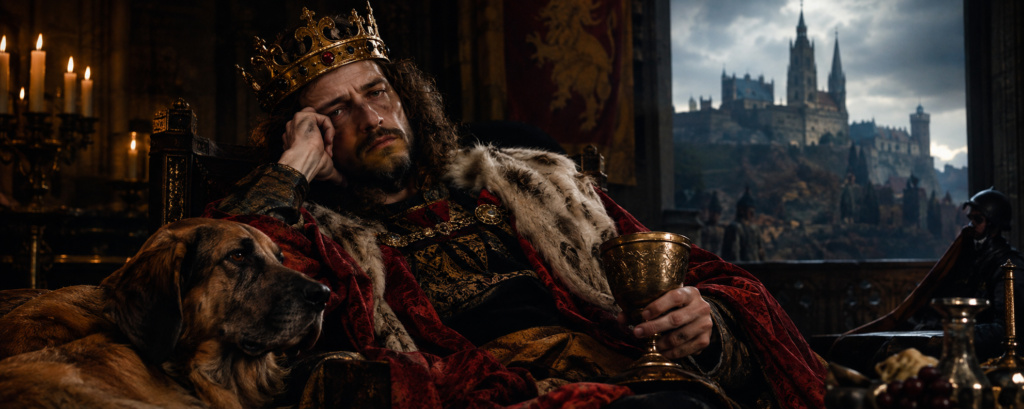
Wenceslaus IV: The Idle King, the Drowned Priest, and the Crown He Could Not Control
King of Bohemia, 1378–1419 | King of the Romans, 1376–1400 | Drunkenness, Violent Rage, Court Favorites, Noble Rebellion, Imprisonment, and the Slow Collapse of Royal Authority
The King Who Became a Scandal
Wenceslaus IV inherited one of the most glittering royal legacies in medieval Europe. His father, Emperor Charles IV, had transformed Prague into an imperial capital, strengthened the Luxembourg dynasty, cultivated universities and artists, and maneuvered through the treacherous politics of the Holy Roman Empire with extraordinary patience. Wenceslaus inherited Bohemia, the German kingship, immense dynastic prestige, and the expectation that he would eventually follow his father all the way to the imperial crown. Instead, his reign became associated with drunkenness, violent rages, hated favorites, rebellious nobles, imprisonment, political humiliation, religious conflict, and a growing conviction that the king simply did not possess the temperament required to govern the world his father had left him.
Later chroniclers turned Wenceslaus into something close to a medieval grotesque. He became the king who supposedly preferred taverns to councils, hunting lodges to imperial diets, common drinking companions to princes, and enormous hunting dogs to respectable courtiers. Stories accused him of wandering Prague disguised as an ordinary man, drinking through the night, frequenting bathhouses and brothels, erupting into murderous tantrums, and condemning servants to death over trivial offenses. His first wife was even said to have been mauled to death by one of the huge dogs he allowed into his bedroom, although stronger evidence indicates that this famous story is almost certainly false.
Other parts of Wenceslaus’s dark reputation are much harder to dismiss. In 1393, during a vicious confrontation with the Archbishop of Prague, the king ordered the arrest of several clerics, and the archbishop’s vicar-general, John of Nepomuk, was tortured and thrown into the Vltava to drown. Wenceslaus’s relationships with the Bohemian nobility became so poisonous that aristocratic conspirators physically seized and imprisoned their own king. His half-brother Sigismund later did much the same thing, exploiting Wenceslaus’s weakness while positioning himself as the more capable Luxembourg ruler. In 1400, four of the prince-electors finally declared that Wenceslaus was no longer fit to serve as King of the Romans, condemning him for failures that amounted to idleness, negligence, uselessness, and unworthiness.
None of this demonstrates that Wenceslaus was clinically insane. Unlike his contemporary Charles VI of France, Wenceslaus is not securely documented suffering episodes of psychosis, losing awareness of his identity, failing to recognize people around him, or experiencing an obvious collapse in his grasp of reality. His reputation for “madness” grew instead from a poisonous mixture of heavy drinking, uncontrolled anger, political withdrawal, cruelty, scandalous companions, ineffective government, and behavior that violated medieval expectations of what a king should be. His story belongs among the Mad Monarchs precisely because it reveals how easily political failure and defective royal self-control could become a kind of madness in the eyes of contemporaries.
Wenceslaus was therefore not simply a drunken fool who accidentally inherited a crown. He was educated, culturally sophisticated, capable of political action, interested in magnificent art, and resilient enough to survive conspiracies that might have destroyed another ruler. Yet the same man repeatedly failed to build lasting political relationships, allowed personal disputes to escalate into violence, withdrew from responsibilities when sustained engagement was desperately needed, and watched enemies turn his private habits into weapons against him. The tragedy of Wenceslaus was not that his mind suddenly disappeared. It was that he remained capable of understanding the world around him while becoming progressively less capable of controlling it.
A Crown Placed on a Toddler’s Head
Wenceslaus was born in Nuremberg on 26 February 1361, the eldest surviving son of Charles IV and Anna of Świdnica. From the beginning, his life was inseparable from his father’s dynastic ambitions. Charles had spent decades strengthening Luxembourg power and understood that royal succession could never simply be left to chance. Wenceslaus was therefore treated not merely as a child but as the future of an entire political system, and almost every important stage of his youth was shaped by the need to make his eventual inheritance appear inevitable.
In 1363, when Wenceslaus was only two years old, he was crowned King of Bohemia. Later stories claimed that the terrified toddler screamed through the ceremony and behaved in ways that observers retrospectively interpreted as ominous, with increasingly colorful versions adding humiliating details. Such stories should be treated cautiously, because a frightened two-year-old reacting badly to an elaborate medieval coronation tells us nothing about his later mental health. What matters is the extraordinary reality beneath the legend: Wenceslaus was publicly transformed into a king before he could possibly understand what kingship meant.
Charles continued to shape his son’s life around political necessity. Wenceslaus received an education appropriate to a prince and was introduced early to court ceremony, diplomacy, administration, and the expectations of the Luxembourg dynasty. He was not an ignorant or intellectually incapable young man, and his later patronage demonstrates considerable appreciation for culture and royal symbolism. Yet being trained to perform kingship was not the same as developing the temperament required to enjoy its relentless demands, and Wenceslaus would spend much of his adult life appearing to resist precisely the kind of constant political engagement that had defined his father.
Charles achieved another extraordinary success in 1376 when the fifteen-year-old Wenceslaus was elected King of the Romans. The election positioned him as his father’s successor in Germany and potentially as the future Holy Roman Emperor, although Charles had to expend considerable political capital to secure the result. By the time Charles died in November 1378, his seventeen-year-old son possessed the Bohemian crown and the German kingship, along with expectations that would have been difficult for almost anyone to satisfy. Wenceslaus inherited his father’s titles and political machinery, but he did not inherit the personality that had made that machinery work.
Living Beneath the Shadow of Charles IV
Charles IV had been a master of a form of government that depended upon patience. The Holy Roman Empire was not a centralized state in which an emperor could simply issue commands and expect obedience. It was a shifting landscape of princes, bishops, cities, dynasties, territorial interests, legal privileges, and ecclesiastical powers, all of which required negotiation. Charles succeeded because he understood that imperial authority had to be cultivated constantly, and he possessed an extraordinary willingness to travel, bargain, concede, flatter, threaten, and wait.
Wenceslaus proved far less comfortable with this political world. He could make decisions and conduct negotiations, but he did not demonstrate his father’s relentless attention to the empire’s competing interests. German princes increasingly complained that their king remained too preoccupied with Bohemia and failed to appear when his presence was required. The criticism was politically useful to Wenceslaus’s enemies, but it was not entirely invented, and his repeated absence gradually became one of the central accusations against his kingship.
The Western Schism, which began in 1378, made the situation even more dangerous. Rival popes divided Christian Europe, and the King of the Romans occupied a position from which vigorous diplomacy might have enhanced his authority. Wenceslaus became involved in efforts to resolve the crisis, but his policy appeared inconsistent and ultimately ineffective. No ruler could easily have solved a schism that frustrated some of the most capable statesmen and churchmen of the age, yet Wenceslaus’s inability to impose direction became another piece of evidence for those who already believed that he was failing.
Most humiliatingly, Wenceslaus never received the imperial coronation. He is sometimes loosely called Holy Roman Emperor, but historically he remained King of the Romans until the German electors deposed him in 1400. The missing imperial crown became almost symbolic of his life: he had been raised from infancy to inherit the summit of his father’s political achievement, but he never reached it. What Charles had carefully built for his son gradually became the standard against which that son was condemned.
Wenceslaus the Idle
The nickname that eventually clung to Wenceslaus was devastating in its simplicity: the Idle, or the Lazy. Medieval kings were expected to be active rulers who traveled, judged disputes, maintained peace, led armies, received petitioners, negotiated with nobles, protected the Church, and displayed themselves publicly as the center of political order. A king who seemed to avoid these responsibilities could therefore be accused not merely of laziness but of failing morally in the office God had supposedly entrusted to him.
Wenceslaus’s enthusiasm for hunting became central to this criticism. Hunting itself was entirely normal for a medieval monarch, and aristocratic culture treated it as both recreation and preparation for war. The problem was not that Wenceslaus hunted but that his enemies increasingly believed he preferred hunting to governing, especially when urgent imperial business demanded his attention elsewhere. Every journey to a hunting residence could therefore be interpreted as another retreat from duty.
His castles at Žebrák and Točník became particularly associated with this image. Wenceslaus developed Točník into an impressive royal residence, and these castles provided the privacy, hunting grounds, and smaller social environment that seem to have appealed to him. It would be misleading to imagine that royal government stopped whenever he left Prague, because documents were still issued and political business continued around an itinerant medieval court. Nevertheless, perception mattered, and a king repeatedly absent from the places where princes expected him to appear could easily be portrayed as hiding from his responsibilities.
The accusation of idleness was therefore more political than psychological. Wenceslaus did not spend forty years doing literally nothing, nor was Bohemia without government throughout his reign. What he failed to do was perform kingship with the intensity expected from a ruler carrying the legacy of Charles IV. His enemies converted that uneven engagement into a devastating character judgment, and eventually the judgment helped cost him a crown.
Wine, Taverns, and a Reputation for Drunkenness
Wenceslaus’s reputation for heavy drinking is one of the most persistent features of his biography. Medieval chroniclers repeatedly associated him with alcohol, drinking companions, feasting, and behavior considered inappropriate for a king. Because many of those writers were hostile to him, individual anecdotes cannot simply be accepted at face value, but the consistency of the tradition suggests that excessive drinking was probably a genuine aspect of his life.
The claim that his alcoholism began after physicians prescribed alcohol following a serious illness in 1388 is far less secure. Medieval physicians certainly used wine medicinally and understood health through humoral theories in which food and drink could be prescribed as treatment. It is nevertheless difficult to demonstrate that a specific medical recommendation transformed Wenceslaus into a chronic alcoholic, and the story is better treated as a later attempt to explain a reputation that had already become notorious. His drinking should be discussed as a well-attested accusation and probable habit, not as a modern clinical diagnosis reconstructed from incomplete medieval evidence.
Alcohol itself was not scandalous at a medieval court. Kings, bishops, nobles, and townspeople routinely drank beer and wine, often in quantities that would seem substantial by modern standards. Wenceslaus’s problem was the perception that drinking interfered with his dignity, judgment, and willingness to perform royal duties. His critics claimed that he preferred prolonged drinking sessions and informal companions to serious political business, transforming ordinary aristocratic consumption into evidence of moral and governmental failure.
His choice of companions made the scandal worse. Wenceslaus became notorious for promoting lesser nobles and royal servants rather than relying exclusively upon the great aristocratic families that expected privileged access to the king. Hostile chroniclers could describe such men as low-born, disreputable, or little better than drinking companions, although those descriptions often reveal aristocratic prejudice as much as objective social reality. To Wenceslaus, men whose careers depended upon royal favor may have seemed safer than magnates possessing castles, armies, and independent political networks of their own.
The strategy nevertheless created a destructive cycle. Powerful nobles resented the favorites and became more hostile to the king, which gave Wenceslaus additional reasons to distrust them and depend upon his personal circle. That dependence then deepened aristocratic resentment and encouraged further resistance. What looked to his enemies like the irrational preference of a drunken monarch was also a recognizable attempt to govern through men who could not easily challenge him, but Wenceslaus pursued the policy without the political skill necessary to prevent it from becoming explosive.
The King Who Did Not Trust His Nobles
Wenceslaus’s distrust of the great Bohemian aristocracy was not simply paranoia. Medieval magnates possessed enormous independent power, and the strongest among them could threaten royal authority directly. Wenceslaus’s decision to rely on lesser nobles and household officials therefore had a rational foundation, particularly because such men owed their advancement directly to the crown and had fewer independent resources with which to rebel.
The problem was the aggressive manner in which royal favorites accumulated influence. Great nobles expected to participate in government as part of the traditional political order, and exclusion could be interpreted as both a personal insult and an attack upon aristocratic privilege. Offices, lands, judicial influence, patronage, and access to the king all carried enormous material value. The struggle over Wenceslaus’s favorites was therefore not merely a conflict over etiquette; it was a battle over who would control the kingdom.
Hostile accounts later transformed the royal household into something resembling a criminal entourage. Wenceslaus was accused of surrounding himself with obscure men, executioners, tavern companions, and sycophants who encouraged his worst impulses. Some of this language reflects the contempt of aristocratic writers toward men they regarded as socially inferior, and it should not be repeated uncritically. Yet the political consequences were unmistakable, because Wenceslaus’s reliance upon favorites helped persuade powerful nobles that ordinary cooperation with the king was no longer sufficient to protect their interests.
Their response eventually went far beyond protest. In 1394, a coalition of Bohemian nobles seized their own king and placed him under restraint. A monarch who feared that his aristocracy might turn against him suddenly discovered that the threat was not imaginary at all. From that point onward, any attempt to interpret Wenceslaus’s suspicion purely as mental instability becomes impossible, because the people around him genuinely were capable of conspiracy, kidnapping, and imprisonment.
The King Kidnapped by His Own Subjects
The seizure of Wenceslaus in 1394 was one of the most humiliating episodes of his reign. A medieval king was supposed to embody public authority, yet Wenceslaus could not even guarantee the security of his own person. His enemies physically captured him and attempted to use possession of the king as a weapon in their struggle over government.
The rebellion grew from long-standing aristocratic resentment toward Wenceslaus’s favorites and methods of rule. His cousin Jobst of Moravia became involved in the broader Luxembourg struggle, while different members of the dynasty maneuvered for advantage. Wenceslaus was moved under guard, and for a time his enemies possessed the extraordinary leverage that came from controlling the body of the king himself.
Resistance organized by supporters, including his younger half-brother John of Görlitz, eventually helped restore Wenceslaus to freedom. Yet release could not erase the damage. The capture demonstrated that his enemies no longer regarded the sacred dignity of kingship as sufficient protection against direct coercion, and it exposed the weakness beneath the ceremonial splendor of the Bohemian crown.
It is tempting to imagine that such an experience intensified Wenceslaus’s suspicion, anger, or withdrawal, but historians cannot reconstruct his internal psychological response with confidence. What can be said is that his political environment repeatedly rewarded distrust. A king who had genuinely been kidnapped by nobles did not need a psychiatric disorder to believe nobles might be dangerous.
This is one of the central ironies of Wenceslaus’s reputation. Later writers described him as paranoid, yet some of the people he feared really were plotting against him. They would not be the last.
The Dogs That Became Part of the Legend
Wenceslaus’s love of hunting dogs became one of the most memorable elements of his legend. He undoubtedly valued dogs, as did many aristocratic hunters, and evidence indicates that suitable animals could be prized diplomatic gifts. Later chroniclers and storytellers, however, transformed an ordinary aristocratic passion into something darker and more eccentric, describing enormous hounds roaming freely through the royal apartments and even sharing the king’s private chambers.
The most notorious story concerns his first wife, Joanna of Bavaria. According to the familiar legend, Joanna rose during the night near the end of 1386 and accidentally startled one of Wenceslaus’s enormous hunting dogs. The animal supposedly attacked her so violently that she died, creating an almost grotesquely perfect story about a king whose uncontrolled private obsession destroyed the woman sleeping beside him. For centuries, the tale appeared in accounts of Wenceslaus as though it were established fact.
Stronger documentary evidence points in another direction. Diplomatic correspondence indicates that Joanna had suffered from a prolonged febrile illness before her death, making disease a far more plausible explanation. Tuberculosis has been suggested, although assigning a precise modern diagnosis remains uncertain. The dramatic dog-mauling story therefore appears to belong to the mythology that accumulated around Wenceslaus rather than to the most reliable reconstruction of Joanna’s death.
The survival of the legend is nevertheless revealing. People believed it because it matched the king they thought they knew: reckless, strange, obsessed with hunting, and indifferent to ordinary restraint. Once Wenceslaus had acquired that reputation, almost any story involving dogs, drink, violence, or negligence could attach itself to him and seem immediately credible.
Two Marriages and No Heir
Wenceslaus had married Joanna of Bavaria in 1370 as part of the elaborate dynastic politics arranged by Charles IV. Their marriage produced no surviving children, and Joanna’s death left Wenceslaus without the heir necessary to secure a straightforward continuation of his own branch of the Luxembourg dynasty. The absence of children would become increasingly important as his relationships with other members of the family deteriorated.
Claims that Wenceslaus’s drinking caused infertility go beyond what the evidence can establish. Medieval marriages could remain childless for many reasons, and historians possess no reliable medical information allowing them to determine whether either spouse was infertile. The temptation to connect every misfortune in Wenceslaus’s life to alcohol should therefore be resisted, even if excessive drinking genuinely contributed to other aspects of his reputation.
In 1389, Wenceslaus married Sophia of Bavaria. This marriage also produced no children, leaving his eventual succession dependent upon the wider Luxembourg family. Sophia would remain beside him during some of the most turbulent years of his reign and became associated with the religious world surrounding the reform preacher Jan Hus.
The absence of an heir increased the importance of Wenceslaus’s half-brother Sigismund. Sigismund was ambitious, energetic, and already deeply involved in the politics of Hungary and central Europe. As Wenceslaus’s authority weakened, the younger brother became simultaneously a potential ally, successor, rival, and threat, creating a family relationship that would eventually become one of the darkest political struggles of the reign.
John of Nepomuk and the King’s Most Notorious Crime
The legend of Joanna’s death may be false, but the killing of John of Nepomuk is not. In 1393, Wenceslaus became embroiled in a bitter conflict with Jan of Jenštejn, the Archbishop of Prague. The dispute involved ecclesiastical jurisdiction, royal authority, appointments, and the broader question of how far the king could impose his will upon powerful church institutions.
One important flashpoint involved the Benedictine abbey of Kladruby. Wenceslaus apparently hoped that an expected vacancy would provide an opportunity to reorganize ecclesiastical authority in a manner favorable to the crown. When the abbot died, however, the monks quickly elected a successor, and John of Nepomuk, serving as the archbishop’s vicar-general, confirmed the election. The king’s political opportunity disappeared almost immediately.
Wenceslaus reacted furiously. Members of the archbishop’s circle were arrested, and John was among those subjected to interrogation and torture. The precise extent of Wenceslaus’s personal physical participation has been debated, so it is safer to say that the violence occurred under his authority and in his presence than to reconstruct every movement inside the torture chamber as established fact.
John did not survive the confrontation. On 20 March 1393, he was bound and thrown from Prague’s stone bridge into the Vltava River, where he drowned. The killing of a senior ecclesiastical official was a shocking escalation of a political dispute and provided Wenceslaus’s enemies with powerful evidence that the king’s temper could become lethal when his authority was challenged.
Later tradition transformed John into the martyr of the confessional. According to the famous devotional story, he had served as Queen Sophia’s confessor and refused Wenceslaus’s demand that he reveal what the queen had confessed. The jealous king supposedly tortured and murdered him for protecting the secrecy of confession, a story that became central to John’s later sainthood.
The confessional version is not the strongest explanation supported by contemporary evidence. The political struggle between Wenceslaus and Archbishop Jan, together with the Kladruby dispute and John’s position as vicar-general, provides a much firmer historical context. The distinction matters because there is no need to invent a jealous husband demanding his wife’s secrets in order to make Wenceslaus look frightening. The documented political killing is disturbing enough.
A Temper That Became a Political Weapon
Wenceslaus’s reputation for violent anger appears repeatedly in hostile accounts. Chroniclers described a king who could react explosively when contradicted and whose rage sometimes seemed wildly disproportionate to the offense. Over time, stories accumulated in which cooks, monks, servants, officials, and other unfortunate people supposedly faced terrible punishment because they had displeased him.
Many of these anecdotes cannot be independently verified. A notorious ruler often attracts moralizing stories, and medieval chroniclers were perfectly capable of using dramatic incidents to illustrate what they believed to be a king’s essential character. Once the death of John of Nepomuk had demonstrated that Wenceslaus could authorize extreme violence during a personal political confrontation, additional tales of murderous rage became much easier to believe.
The famous stories about cooks executed for unsatisfactory meals or servants destroyed over trivial mistakes should therefore be presented as part of his reputation rather than unquestioned fact. They tell us something important about how contemporaries and later writers imagined him, but they cannot all be used as documentary evidence for individual acts. Wenceslaus’s historical record contains enough genuine violence that exaggeration was able to grow around a credible foundation.
What emerges is not necessarily a clinically unstable man but a ruler whose anger became politically dangerous. Medieval kings possessed enormous coercive power, and a moment of rage could therefore have consequences unavailable to an ordinary person. When Wenceslaus lost his temper, he did so as a man surrounded by guards, prisons, torturers, officials, and legal authority, turning defects of temperament into matters of life and death.
The King in Disguise
Another persistent tradition describes Wenceslaus disguising himself in ordinary clothing and slipping into Prague after dark. He supposedly drank in taverns, mixed with common townspeople, visited bathhouses and brothels, listened to gossip, and occasionally became involved in quarrels. The image is wonderfully vivid, but it belongs to a wider tradition of stories about rulers moving incognito among their subjects.
Such tales were not unique to Wenceslaus. Medieval and later folklore repeatedly imagined kings disguising themselves, sometimes to discover what ordinary people thought of their government and sometimes simply to experience freedom from court ceremony. In Wenceslaus’s case, however, the stories became darker because they fitted his existing reputation for drinking and his preference for companions outside the highest aristocracy.
There may have been some genuine behavior behind the legend. Wenceslaus did appear comfortable with lesser courtiers and seems to have disliked some of the rigid social expectations surrounding royal life. Yet there is not enough evidence to reconstruct regular nocturnal expeditions through Prague’s taverns and brothels as though someone had kept a reliable diary of his movements.
The stories are valuable because of what they reveal about his reputation. Wenceslaus was repeatedly imagined escaping downward through the social hierarchy, away from princes and bishops toward servants, townsmen, bath attendants, tavern keepers, and drinkers. To aristocratic critics, this was more than eccentricity; it was a rejection of the natural social order.
A king was supposed to elevate his surroundings through his presence. Wenceslaus was accused of degrading himself through the company he chose to keep. In a society obsessed with rank, that alone could make his behavior seem profoundly abnormal.
The Wenceslas Bible and the Other Side of the King
The caricature of Wenceslaus as an intellectually empty drunk becomes difficult to sustain when confronted with the cultural world surrounding his court. The magnificent Wenceslas Bible, produced during his reign, ranks among the masterpieces of late medieval manuscript illumination. Its rich decorative program demonstrates extraordinary artistic skill and reflects a court deeply engaged with visual symbolism, luxury, and royal representation.
Wenceslaus himself appears within the manuscript’s symbolic universe. Royal emblems, kingfishers, knots, and mysterious bath-maiden figures recur throughout its decoration, creating imagery that has fascinated historians for generations. The bath-maid motif in particular has encouraged lurid speculation about Wenceslaus’s private sexuality and supposed fascination with bathhouses.
Those interpretations should be handled cautiously. Medieval court symbolism could operate on political, personal, allegorical, and devotional levels simultaneously, and it cannot simply be read as an illustrated confession of the king’s sexual habits. Later storytellers nevertheless found the imagery irresistible, especially because it seemed to support existing tales about Wenceslaus’s unconventional private life.
The manuscript reveals a ruler capable of appreciating complex artistic patronage. He was not incapable of concentration or cultural interest, nor was his court devoid of sophistication. The problem was not that Wenceslaus cared about nothing; it was that the things capable of holding his enthusiasm were not always the things his political position required him to prioritize.
This distinction helps explain the cruelty of his nickname. “The Idle” suggests a man without energy, but Wenceslaus clearly possessed energy for hunting, architecture, art, companionship, and personal interests. His failure was one of direction and consistency rather than complete inertia.
The Bath-Maid Legends
The recurring bath-maiden imagery associated with Wenceslaus generated some of the strangest legends surrounding him. Later stories described a bath attendant named Zuzana or Susanna who supposedly helped the king escape captivity, sometimes becoming his lover in the process. The tale exists in different forms and cannot be treated as straightforward documentary history.
Bathhouses occupied an ambiguous position in medieval urban culture. They were places of hygiene and social interaction, but they could also carry erotic associations, making them ideal settings for scandalous stories. A king already accused of drunkenness and inappropriate companions naturally attracted legends involving bath maids.
The stories also reinforced the theme of Wenceslaus finding loyalty among socially humble people while being betrayed by elites. Nobles kidnapped him, princes deposed him, and relatives imprisoned him, while a humble woman supposedly came to his rescue. Whether the episode ever happened is less important than the symbolic contrast that made it memorable.
Wenceslaus’s legends repeatedly reverse the expected social order. The people who should have protected the king become his enemies, while people whom aristocratic culture considered insignificant become his companions or rescuers. This inversion contributed to the sense that his entire kingship operated according to the wrong rules.
An Empire Growing Tired of Its King
While Wenceslaus struggled with noble opposition in Bohemia, dissatisfaction with his German kingship continued to grow. The prince-electors complained about his absence, his failure to maintain public peace, his inability to resolve the Western Schism, and what they regarded as neglect of the empire. Political rivals had obvious incentives to magnify these failures, but the grievances accumulated over many years.
The Holy Roman Empire demanded personal engagement. Royal authority was not strong enough to operate automatically through distant bureaucratic institutions, and a king who failed to travel and negotiate could quickly discover that regional powers were governing without him. Wenceslaus’s preference for remaining closer to Bohemia therefore had consequences far beyond personal reputation.
By the late 1390s, several electors were actively considering his removal. They did not need to demonstrate that he was insane, nor did they attempt to produce anything resembling a medical diagnosis. Their argument was more devastating because it addressed the purpose of kingship itself: Wenceslaus was allegedly failing to do the work for which a king existed.
On 20 August 1400, the archbishops of Mainz, Trier, and Cologne together with the Count Palatine of the Rhine declared him deposed as King of the Romans. Their indictment emphasized his failures, negligence, inactivity, and conduct they considered unworthy of the office. Rupert of the Palatinate was subsequently elected in his place.
Wenceslaus refused to recognize the deposition as legitimate and continued to use royal titles. Yet he never mounted a successful campaign to recover the German kingship, and the political inheritance Charles IV had constructed for him effectively disappeared. The imperial crown that had seemed almost predetermined during his childhood would never be his.
Cruel in Anger, Passive in Crisis
One of the most striking contradictions in Wenceslaus’s behavior is the gap between his personal ferocity and his institutional weakness. When an individual directly frustrated him, as John of Nepomuk did during the conflict with the archbishop, Wenceslaus could react with terrifying violence. When confronted by broad political crises requiring years of patient coalition-building, however, he often seemed unable to sustain the same determination.
This contradiction helped create the impression of instability. Chroniclers could portray him as raging uncontrollably one moment and retreating into hunting or drinking the next. Modern readers may be tempted to translate this into mood disorders or other psychiatric categories, but the evidence does not support such certainty.
A simpler explanation may be more persuasive. Personal confrontation is immediate, emotional, and easy to understand, while imperial government is exhausting, slow, and dependent upon compromise. Wenceslaus may have possessed the temperament to react fiercely to a direct challenge while lacking the patience to manage complex institutional opposition.
That combination was disastrous in a medieval monarch. His anger could frighten individual officials but could not make German electors obedient. His authority could torture a cleric but could not reliably discipline powerful nobles.
The king was therefore capable of being brutal without being strong. His subjects could fear what he might do during a confrontation while simultaneously doubting whether he could protect them against larger threats. Few combinations are more destructive to royal authority.
The Murder of His Counselors
In 1397, several prominent men associated with Wenceslaus’s government were murdered at Karlštejn by members of the aristocratic opposition. The killings demonstrated once again how violent the struggle over royal favorites and political influence had become. Men who served the king could no longer assume that royal protection would keep them safe.
Wenceslaus’s response appeared inadequate to many contemporaries. A medieval king was expected to defend his household and avenge attacks upon those serving him, because failure to do so undermined the value of royal service itself. If enemies could murder royal counselors without decisive punishment, the weakness of the crown became visible to everyone.
The victims are sometimes described loosely as envoys, but they were more accurately royal counselors or favorites caught in the factional struggle within Bohemia. The distinction matters, although it does not erase the damage caused by Wenceslaus’s inability to impose effective justice. His enemies had struck directly at his political circle and survived.
The episode again illustrates the strange imbalance in his rule. Wenceslaus could unleash terrible violence during a personal conflict with church officials, yet he sometimes appeared politically paralyzed when violence was directed against his own supporters. To contemporaries, that inconsistency could seem irrational. In practical terms, it made loyalty to the king increasingly dangerous.
Sigismund, the Brother Who Would Not Remain a Brother
Wenceslaus’s half-brother Sigismund eventually became one of the dominant political figures of fifteenth-century Europe. He was ambitious, energetic, adaptable, and determined to expand Luxembourg power, qualities that could make him useful to Wenceslaus but also extraordinarily dangerous. Through his marriage to Mary of Hungary, Sigismund became deeply involved in Hungarian politics and acquired a power base independent of his older brother.
Their relationship shifted repeatedly between cooperation and rivalry. Wenceslaus needed family support against rebellious nobles, while Sigismund could claim that intervention was necessary because his brother had failed to maintain order. Every weakness in Wenceslaus’s position therefore created an opportunity for Sigismund to present himself as the more effective alternative.
In 1402, Sigismund moved decisively against him. Wenceslaus was effectively seized and transferred into custody, eventually being held in Vienna under Duke Albert IV of Austria. Once again, a crowned king found himself physically controlled by people who claimed political necessity while pursuing interests of their own.
The episode makes simplistic claims about Wenceslaus’s paranoia especially problematic. His nobles had kidnapped him, and now his brother had effectively imprisoned him. Suspicion toward powerful men was not evidence that Wenceslaus imagined conspiracies; his political world repeatedly produced real ones.
He eventually escaped in 1403 and returned to Bohemia. The escape demonstrates a degree of resilience that disappears from caricatures of the completely apathetic king. Wenceslaus could still act decisively when survival demanded it, but every captivity further damaged the dignity of a monarchy already struggling to command respect.
A King Who Had Rational Reasons to Be Suspicious
The word “paranoia” appears frequently in modern popular descriptions of Wenceslaus, but it must be used carefully. Paranoia implies irrational or pathological suspicion, whereas Wenceslaus inhabited a court in which people repeatedly conspired against him. Powerful nobles seized him, members of his own dynasty exploited him, royal favorites were murdered, and German princes formally removed him from office.
That does not mean every suspicion he entertained was justified. It means historians cannot infer mental illness simply because he distrusted those around him. A ruler who had twice experienced imprisonment had learned through experience that royal blood offered limited protection.
His dependence upon favorites can therefore be understood partly as a security strategy. Lesser nobles and household servants owed their advancement to the king and possessed fewer independent resources with which to challenge him. Their loyalty could seem more dependable than that of magnates who commanded armies of their own.
The tragedy was that this solution made the underlying problem worse. Powerful nobles interpreted their exclusion as an attack, rebelled against the favorites, and thereby confirmed Wenceslaus’s belief that they could not be trusted. Each side produced the behavior the other feared.
The result resembled paranoia from the outside because Wenceslaus’s circle of trust grew increasingly narrow. Yet the political machinery generating that suspicion was frighteningly real.
Depression, Rage, and the Limits of Retrospective Diagnosis
Wenceslaus is sometimes described as moving between violent rage and profound apathy. There are enough reports of anger, withdrawal, and neglected responsibilities to make the description superficially attractive. Some modern accounts have gone further and suggested depression, dissociation, bipolar tendencies, or other psychological explanations.
Such diagnoses cannot be established responsibly from the surviving evidence. Medieval chroniclers were not clinical observers, and their vocabulary described moral character rather than psychiatric symptoms. A king might be called wrathful, lazy, melancholy, drunken, or foolish without any of those words corresponding precisely to a modern disorder.
Wenceslaus’s political withdrawals may have resulted from many causes. He may have been demoralized by repeated defeat, frustrated by the demands of imperial politics, physically affected by alcohol, temperamentally avoidant, or simply more interested in hunting and private life. Several explanations could have operated simultaneously.
His violent anger likewise does not establish psychosis. People can behave brutally while remaining entirely aware of reality and responsible for their actions. Indeed, treating Wenceslaus’s cruelty as evidence of insanity risks obscuring the moral and political choices involved.
The most defensible conclusion is therefore cautious. Wenceslaus probably drank heavily, appears to have possessed a volatile temper, and sometimes withdrew from political responsibilities. Those traits could damage judgment and government without constituting a diagnosable mental illness.
Why Wenceslaus Was Not Charles VI
The comparison with Charles VI of France is particularly useful because the two kings were near contemporaries. Charles VI experienced severe episodes in which his relationship with reality became unmistakably disturbed. He sometimes failed to recognize people close to him, suffered dramatic behavioral changes, and endured recurrent periods of incapacity that profoundly altered French government.
Nothing equivalent is securely documented for Wenceslaus. He did not forget that he was king, fail to recognize his family, or display a clearly documented delusional system. He remained capable of political maneuvering, patronage, escape, negotiation, and calculated decision-making.
This does not make him psychologically healthy. It simply means the evidence supports a different kind of historical story. Wenceslaus’s reputation arose primarily from conduct that contemporaries considered incompatible with proper kingship rather than from unmistakable psychiatric breakdown.
For medieval observers, the distinction may have mattered less than it does to modern historians. A king who could not master drink, anger, appetite, favorites, or political obligations appeared fundamentally disordered. Royal self-government was treated as the foundation of governing others.
Wenceslaus repeatedly failed that test. His “madness” therefore existed most powerfully as a political and moral judgment.
Jan Hus and the Religious Crisis
The later years of Wenceslaus’s reign unfolded against an increasingly dangerous religious crisis. Prague had become one of Europe’s major intellectual centers, and reform-minded scholars criticized clerical wealth, corruption, abuses of authority, and aspects of contemporary church practice. The writings of the English theologian John Wycliffe influenced debates at the University of Prague and helped create the intellectual environment in which Jan Hus emerged.
Hus became a celebrated preacher at Bethlehem Chapel and attracted both popular support and powerful enemies. Queen Sophia showed sympathy toward his preaching, while Wenceslaus’s own position shifted according to political circumstances. The king was not a committed revolutionary attempting to destroy the medieval Church, but he was willing to support reformist interests when they aligned with his struggle against ecclesiastical or political opponents.
The University of Prague became another battleground. In 1409, Wenceslaus issued the Decree of Kutná Hora, changing the university’s voting structure in favor of the Bohemian nation. Many German masters and students responded by leaving Prague, with some helping strengthen the new University of Leipzig.
The decision demonstrates that Wenceslaus was still capable of forceful political action. It also shows his tendency to resolve complex institutional conflicts through dramatic interventions that created new problems. Czech influence increased, but the intellectual and national divisions surrounding religious reform deepened.
Hus’s conflict with ecclesiastical authority eventually escalated beyond Wenceslaus’s ability to manage it. The preacher traveled to the Council of Constance under a safe-conduct associated with Sigismund and was condemned for heresy. His execution by burning in 1415 transformed him into a martyr for his supporters and ignited fury throughout Bohemia.
The Kingdom Begins to Break Apart
The death of Hus radicalized a movement that had already been gathering strength. Bohemian nobles protested against the Council of Constance, reformist preaching spread, and religious identity became increasingly entangled with political resentment and Czech national consciousness. Wenceslaus found himself trapped between forces that were becoming less willing to compromise.
His response was inconsistent but not incomprehensible. He attempted to preserve royal authority while avoiding complete identification with either the radical reformers or their uncompromising Catholic opponents. The problem was that the political center was disappearing beneath him.
By 1419, radical Hussite agitation in Prague had reached explosive levels. The preacher Jan Želivský became a powerful voice among the urban population, and demands for religious reform merged with hostility toward municipal officials. Wenceslaus attempted to restore or protect Catholic officeholders in some positions, further enraging radical factions.
On 30 July 1419, a Hussite procession confronted officials at the New Town Hall in Prague. Violence erupted, and several councilors were hurled from the windows and killed in what became known as the First Defenestration of Prague. The attack represented far more than a riot; royal authority itself had been publicly challenged by a movement that no longer feared conventional political restraint.
Accounts claim that Wenceslaus reacted to the news with overwhelming rage. Some chroniclers connected the emotional shock directly with the health crisis that preceded his death a little more than two weeks later. The dramatic connection is plausible but impossible to prove medically.
The Final Weeks
Wenceslaus died on 16 August 1419 at Nový Hrad near Kunratice. He was fifty-eight years old and had been King of Bohemia for more than four decades. His German kingship had effectively ended nineteen years earlier, but the Bohemian crown remained his until death.
Later accounts described his final illness as the consequence of fury over the Prague defenestration. Depending upon the telling, he suffered a seizure, stroke, or other collapse after hearing what had happened. Medieval chroniclers often shaped rulers’ deaths into moral conclusions, and Wenceslaus’s legendary temper made a death caused by rage narratively irresistible.
The precise medical cause cannot now be established. What is certain is that his death came at a disastrous moment. Bohemia was already fractured by religious conflict, and the disappearance of the king removed an imperfect but important restraint upon open warfare.
Sigismund claimed the Bohemian crown, but Hussite opposition to him was fierce. The kingdom soon descended into the Hussite Wars, during which repeated crusading armies were defeated by forces inspired by the religious movement that had developed during Wenceslaus’s final years. The political world Charles IV had spent a lifetime constructing had transformed beyond recognition.
Wenceslaus did not create all of these forces, and it would be unfair to blame the Hussite Revolution entirely upon him. Yet decades of weakened royal authority made the coming crisis harder to contain. His death did not cause the storm, but it removed one of the last barriers standing in its path.
Sigismund Inherits the Consequences
Sigismund would eventually become one of the most important rulers in Europe. He became King of the Romans and, in 1433, Holy Roman Emperor, finally achieving the imperial dignity Wenceslaus had never obtained. Yet his success should not be interpreted as proof that all of Wenceslaus’s problems could have been solved by a more energetic man.
Sigismund himself struggled desperately to impose authority upon Bohemia. His association with the Council of Constance and the execution of Jan Hus made him deeply hated among Hussites, and military campaigns against the movement repeatedly ended in humiliation. The religious revolution proved far larger than a simple rebellion against one incompetent king.
Nevertheless, the contrast between the brothers was impossible for posterity to ignore. Wenceslaus had inherited the German kingship through their father’s careful planning and lost it. Sigismund eventually secured the imperial crown after decades of his own political struggle.
There was a cruel dynastic symmetry in the outcome. The younger brother who had once participated in the older brother’s imprisonment ultimately achieved the title for which Wenceslaus had been prepared since adolescence. The Luxembourg imperial project survived, but it survived by passing around the man Charles IV had originally chosen to inherit it.
The Myth of the Murderous Hounds
The story of Queen Joanna’s death deserves attention because it illustrates exactly how Wenceslaus’s historical reputation became distorted. A king known to love hunting dogs loses his young wife unexpectedly, and generations later the two facts fuse into a story in which the dogs kill her. The resulting anecdote is so vivid that it becomes more memorable than the less dramatic reality of prolonged illness.
Once accepted, the story reinforces every other accusation. Wenceslaus becomes not merely a hunter but a man so obsessed with dangerous animals that he allows them into the royal bedchamber. His wife becomes an innocent victim of his eccentricity, and his supposed refusal to abandon the dogs afterward transforms grief into monstrous indifference.
The documentary evidence pointing toward illness dismantles much of this narrative. Joanna appears to have been sick before her death, making the famous nocturnal attack extremely unlikely. Wenceslaus also arranged an elaborate funeral, which hardly supports the crudest portrayals of a husband indifferent to her fate.
Yet the legend remains historically valuable because it reveals how thoroughly Wenceslaus’s reputation had prepared audiences to believe the worst. His genuine affection for dogs provided the hook, while his later reputation supplied the cruelty. Historical memory did the rest.
The episode should therefore remain part of his story, but clearly identified as legend rather than fact. Wenceslaus’s reign contains enough authentic darkness without requiring a queen to be torn apart in his bedroom.
The Legend of the Tavern King
The same principle applies to stories about Wenceslaus wandering Prague in disguise. These tales may preserve genuine memories of a ruler who enjoyed informal company and disliked aristocratic ceremony, but their precise details are difficult to verify. Later storytellers transformed that tendency into an almost nightly ritual of taverns, brothels, drinking, and street quarrels.
The legends are particularly revealing because they invert medieval social expectations. A king was supposed to occupy the summit of hierarchy and surround himself with people whose status reflected his own. Wenceslaus was instead imagined deliberately descending into the city’s lower social spaces.
This image reinforced aristocratic criticism of his favorites. The same king who supposedly preferred tavern drinkers to princes also promoted men of comparatively modest birth into positions of influence. His personal and political behavior therefore appeared to violate the same fundamental rule: he refused to respect the hierarchy his nobles believed sustained the kingdom.
Whether he actually spent nights drinking anonymously among ordinary Prague residents is less important than the cultural meaning of the accusation. Wenceslaus became the king who fled downward whenever the obligations of rank became unbearable. The palace opened into the tavern, the council chamber into the hunting lodge, and the formal court into a private circle of companions who demanded less from him.
The legend therefore captured something real even if its individual episodes were embellished. Wenceslaus often seemed more comfortable away from the political world he had been raised to command.
A Reputation Built from Contradictions
Wenceslaus is difficult to understand because his reign is filled with contradictions. He was accused of laziness yet survived four decades of dangerous politics. He was portrayed as intellectually empty yet presided over remarkable artistic patronage. He was considered weak yet could be brutally violent.
He was accused of irrational suspicion, but his enemies really did kidnap and imprison him. He was portrayed as incapable of political action, yet he sometimes intervened decisively in Bohemian affairs. He was condemned as socially perverse for relying upon lesser men, but rulers had obvious reasons to prefer servants who lacked the independent power of great nobles.
These contradictions help explain why the label of madness became attractive. Madness offered a simple answer to behavior that otherwise seemed inconsistent. The king was cruel because he was mad, passive because he was mad, suspicious because he was mad, drunk because he was mad, and politically ineffective because he was mad.
History is rarely so convenient. Wenceslaus’s behavior emerged from personality, political structure, family rivalry, aristocratic resistance, habits, preferences, and repeated experiences of betrayal. No single diagnosis can replace that complexity.
Indeed, calling him insane can make him less understandable. It turns choices into symptoms and political conflicts into medical episodes. Wenceslaus deserves a darker and more demanding judgment than that.
Why the Electors Finally Removed Him
The German electors who acted against Wenceslaus in 1400 did not need to prove he had lost his mind. Their case focused upon his performance. He had allegedly neglected the empire, failed to maintain peace, mishandled ecclesiastical affairs, and demonstrated conduct incompatible with the dignity of the German kingship.
Their judgment was not politically neutral. The electors possessed interests of their own, and replacing a weak monarch offered opportunities to increase their influence. Deposition was therefore both a judgment upon Wenceslaus and an act of political self-interest.
Still, the language used against him is revealing. Medieval kingship was theoretically sacred, but it was also practical. A king who repeatedly failed to perform the functions expected of him could discover that subjects were capable of developing arguments explaining why obedience was no longer required.
Wenceslaus’s private reputation strengthened the political case. Stories about drink, hunting, favorites, anger, and neglect made institutional failures seem like expressions of personal corruption. The king was not merely absent; he was supposedly drunk. He was not merely politically isolated; he preferred disreputable companions.
Character became evidence against office. Once that happened, recovering authority became enormously difficult.
The electors did not have to demonstrate madness. They merely had to demonstrate failure and persuade one another that failure had become permanent.
Alcohol and the Limits of What We Can Know
It is reasonable to conclude that Wenceslaus drank heavily, but describing him as a clinically diagnosed alcoholic goes beyond the surviving evidence. Chroniclers repeatedly associated him with excessive drinking, and the accusation appears too deeply rooted to dismiss as pure invention. Yet no medieval source provides the kind of systematic information necessary for modern diagnosis.
We do not know his average daily consumption, whether he experienced withdrawal, how frequently he became intoxicated, or how directly alcohol affected specific decisions. Hostile chroniclers could also use drunkenness as a moral accusation even when they lacked firsthand knowledge of individual episodes. The evidence therefore supports a reputation and probable pattern rather than a clinical case file.
That distinction does not make alcohol politically irrelevant. If a king repeatedly appeared intoxicated or was widely believed to be so, his authority could suffer whether every story was accurate or not. Political reputation operates through perception as much as fact.
Wenceslaus’s drinking became a universal explanation for his weaknesses. Anger became drunken rage, withdrawal became drunken indifference, and poor judgment became proof that wine had conquered reason. Once that framework took hold, every failure strengthened it.
The historical truth was probably less tidy. Alcohol may indeed have aggravated existing weaknesses, but it did not create the hostile nobility, the Western Schism, Luxembourg family rivalry, or the structural difficulties of governing the Holy Roman Empire. Wenceslaus’s bottle existed inside a much larger political disaster.
A King Who Survived More Than His Reputation Suggests
For all his failures, Wenceslaus possessed a remarkable ability to survive. He endured aristocratic rebellion, kidnapping, imprisonment, deposition from the German throne, family betrayal, religious crisis, and decades of hostile propaganda. A man entirely incapable of political action would have been unlikely to remain King of Bohemia until 1419.
Royal institutions continued functioning during his reign. Bohemia remained economically and culturally significant, and Prague retained much of the importance it had acquired under Charles IV. Wenceslaus’s government was troubled, but it was not a forty-year administrative vacuum.
This makes his failure more interesting. He was capable enough to preserve his Bohemian kingship but not capable enough to reproduce his father’s broader authority. He could survive political disasters without decisively mastering them.
His resilience repeatedly returned him to the throne, but each crisis diminished the prestige surrounding that throne. The king might escape imprisonment, yet everyone now knew he could be imprisoned. He might remain King of Bohemia, yet everyone knew German electors had removed him from another crown.
Survival prevented complete collapse during his lifetime. It did not restore the aura of invulnerability that medieval monarchy required.
The Crown as a Cage
There is something profoundly tragic about a man who had been turned into a king almost before he could speak appearing throughout adulthood to seek refuge from kingship. Wenceslaus’s preference for hunting, private residences, familiar companions, and a smaller court can be interpreted without assuming psychiatric illness. These environments simply offered forms of life less demanding than the political theater Charles IV had designed for him.
At a hunting lodge, Wenceslaus could pursue an activity he enjoyed and understood. Dogs did not negotiate constitutional privileges, and trusted household companions did not possess the independent armies of great nobles. A smaller residence reduced the number of people competing for access and allowed the king greater control over his surroundings.
Yet every retreat created political consequences. Princes interpreted absence as neglect, nobles interpreted exclusion as hostility, and rivals used his withdrawal as evidence of unfitness. The places where Wenceslaus may have felt most comfortable therefore became symbols of his failure.
The crown followed him wherever he went. A medieval king could not simply declare himself exhausted and withdraw permanently into private life without destabilizing the political order. His personality was a public institution whether he wanted it to be or not.
This may explain the enduring image of Wenceslaus hiding in castles while the world outside deteriorated. The image is exaggerated, but its emotional truth is powerful. He had inherited a role from which there was no ordinary escape.
Not a Madman, but a Dangerous King
The evidence does not justify diagnosing Wenceslaus with psychosis, bipolar disorder, severe personality disorder, or another specific modern psychiatric condition. His behavior was erratic enough to disturb contemporaries, but the surviving sources do not document the kind of symptoms required to make such conclusions responsibly. Heavy drinking, violent anger, political avoidance, suspicion, and poor judgment can exist without psychosis.
That does not make Wenceslaus harmless. In some ways, the absence of demonstrable insanity makes his darkest actions more troubling. John of Nepomuk’s torture and death cannot simply be dismissed as the incomprehensible act of a man detached from reality.
Wenceslaus understood power. He understood imprisonment because he experienced it himself, and he understood the threat of coercion because his political world operated through it constantly. When his government subjected opponents to violence, it participated in the brutal political culture of the age rather than wandering unknowingly into it.
The label “mad” can therefore become an excuse if used carelessly. It risks turning moral responsibility into medical inevitability. Wenceslaus’s temper may have been extreme, and alcohol may have worsened it, but those possibilities do not erase agency.
His reign is frightening precisely because a king did not need to be insane to become destructive. He only needed enough power to make his weaknesses dangerous.
The Slow Destruction of Royal Trust
The central story of Wenceslaus’s reign is not madness but the destruction of trust. He distrusted nobles and promoted favorites. Nobles resented those favorites and rebelled, confirming his distrust. His political circle narrowed while opposition broadened.
Churchmen resisted his interference, and one of their officials ended dead in the Vltava. German princes doubted his leadership and eventually deposed him. His own brother used his weakness to imprison him.
Each crisis left the king with fewer reasons to trust anyone outside his immediate circle. Each attempt to protect himself made powerful outsiders more suspicious of him. The monarchy gradually became trapped in a feedback loop of fear and retaliation.
This process also helps explain why Wenceslaus’s government could alternate between aggression and passivity. A ruler uncertain of institutional support may react violently when he possesses immediate control but hesitate when confronting opponents too powerful to intimidate directly. Personal rage becomes easier than sustained statecraft.
Wenceslaus’s enemies interpreted this inconsistency as proof that he was unstable. The deeper reality may have been that his monarchy had lost the network of cooperation necessary to convert royal will into reliable political action.
A king surrounded by enemies can still issue commands. The problem begins when nobody knows whether those commands will be enforced.
By the end of Wenceslaus’s reign, that problem had become chronic.
The Last Years of an Exhausted Monarchy
The religious turmoil surrounding Jan Hus placed new pressures upon a political system already weakened by decades of conflict. Wenceslaus tried to maneuver between competing factions, but the divisions within Bohemia were becoming too deep for ordinary royal compromise. Reform had become connected with questions of national identity, ecclesiastical authority, urban politics, and noble power.
The execution of Hus in 1415 transformed dissatisfaction into something far more explosive. His followers regarded him as a martyr, while the Council of Constance had demonstrated that the institutional Church would not tolerate his teachings. Wenceslaus inherited the consequences without possessing the political authority necessary to impose a universally accepted settlement.
The years that followed saw increasing radicalization. Different reformist groups developed different theological and political goals, while Catholic interests resisted concessions. Prague became a center of agitation, preaching, demonstrations, and growing hostility toward officials perceived as enemies of reform.
The First Defenestration of Prague in July 1419 revealed that the crisis had passed into open violence. Councilors were thrown from windows and killed by an enraged crowd, an act that directly challenged the structures through which Wenceslaus governed. The king’s reported fury upon receiving the news therefore makes perfect political sense even if later chroniclers dramatized its medical consequences.
His death shortly afterward left the kingdom without the ruler who, for all his failures, had remained the recognized center of Bohemian monarchy for decades. The result was not peace but acceleration toward war.
The Death of Wenceslaus
Wenceslaus died on 16 August 1419, only weeks after the Prague defenestration. Chroniclers connected his death with an intense emotional reaction to the news, and later retellings sometimes describe him suffering a fatal stroke or seizure caused by rage. The exact medical mechanism cannot be established.
The narrative was irresistible because it seemed to complete his life. The king remembered for violent temper supposedly died from one final explosion of anger while learning that his authority had been publicly humiliated. Medieval historical writing often favored such moral symmetry.
Yet the real circumstances were grim enough without embellishment. Wenceslaus died knowing that his kingdom was entering a crisis more dangerous than almost anything he had previously faced. Religious divisions had become political rebellion, and his designated dynastic successor was deeply unpopular among those driving the reform movement.
His body could be buried, but the problems of his reign could not. Sigismund inherited a claim to Bohemia and discovered that claiming a crown was far easier than ruling the people beneath it. The Hussite Wars soon demonstrated how profoundly the political landscape had changed.
Wenceslaus had spent decades struggling to prevent rivals from controlling him. In death, he left behind a kingdom that no individual could easily control.
The King His Enemies Called Unworthy
Wenceslaus’s place among the Mad Monarchs ultimately depends upon understanding what “madness” meant in political culture. His contemporaries did not require evidence of hallucinations or psychosis to decide that something was wrong with a king. A monarch who could not govern himself according to accepted ideals could be treated as fundamentally unfit to govern others.
Wenceslaus violated those ideals repeatedly. He was accused of excessive drinking, uncontrolled anger, inappropriate companionship, political negligence, and excessive devotion to hunting. His nobles rebelled, his counselors were murdered, and his conflicts with churchmen culminated in torture and death.
His German deposition turned these accusations into a formal political verdict. The electors declared that his performance no longer justified his position. Whatever personal motives they possessed, they were able to make the case because Wenceslaus had already supplied years of evidence that could be arranged against him.
The king’s private weaknesses therefore became constitutional weapons. Wine was no longer merely wine; it was proof of negligence. Hunting was no longer recreation; it was abandonment of duty. Favorites were no longer servants; they were evidence of corrupt judgment.
Once everything a king enjoys can be transformed into evidence against him, reputation has become a battlefield. Wenceslaus lost that battlefield decisively.
The Man Behind the Monster
Removing the legends does not reveal a misunderstood genius secretly equal to Charles IV. Wenceslaus made serious mistakes, damaged important relationships, and allowed personal anger to contribute to horrifying violence. His failures were real.
What disappears under closer examination is the cartoon. His wife almost certainly did not die beneath the teeth of his hound. The lurid tales of servants routinely murdered over bad meals cannot all be treated as reliable. His supposed nights of anonymous debauchery in Prague belong partly to folklore.
The surviving king is more complicated. He appreciated magnificent art, understood political strategy, could recover from imprisonment, and maintained his Bohemian crown through decades of conflict. He was capable of decisive action even though he often failed to sustain it.
He also appears to have been a difficult man. His temper, drinking, mistrust, and preference for favorites created problems that his political environment magnified enormously. He lacked the patient interpersonal discipline that had made his father so effective.
That combination created the historical Wenceslaus: neither helpless madman nor innocent victim, but a ruler whose weaknesses repeatedly became public disasters.
The King Who Could Not Escape Himself
Wenceslaus’s greatest enemy was not always Sigismund, the German electors, the Bohemian nobility, or the Archbishop of Prague. Again and again, his own habits and reactions made difficult situations worse. When compromise was needed, anger could intervene; when sustained engagement was required, withdrawal could follow; when broad coalitions were necessary, he narrowed his circle of trust.
Yet even this pattern should not be turned into simplistic psychology. Wenceslaus was responding to a genuinely hostile political world. He did not invent the ambitions of the German princes, the Western Schism, aristocratic privilege, or Luxembourg family rivalry.
What he failed to do was manage them effectively. Great kings are often remembered not because they faced easier problems but because they found ways to survive difficult ones while preserving authority. Wenceslaus survived physically but repeatedly surrendered political ground.
His father’s legacy made every failure appear larger. Charles IV had constructed an imperial dream around Prague and the Luxembourg dynasty. Wenceslaus became the son who seemed to squander it.
The comparison may have been unfair, but medieval politics rarely cared about fairness. A king was judged against the expectations attached to his crown.
Wenceslaus’s crown carried extraordinary expectations.
He never grew large enough to fill them.
The Dark Legacy of Wenceslaus IV
Wenceslaus IV did not become infamous because one spectacular episode proved that he had gone mad. His reputation developed gradually, fed by years of stories about wine, rage, dogs, hunting, favorites, political absence, aristocratic rebellion, imprisonment, and cruelty. Some stories were true, some exaggerated, and some almost certainly false, but together they created one of the most enduring portraits of failed medieval kingship.
The genuine evidence is dark enough. John of Nepomuk died after torture and was thrown into the Vltava during a confrontation with royal power. Wenceslaus’s relationships with the Bohemian aristocracy deteriorated until his own nobles were willing to kidnap him, while Sigismund later demonstrated that even family ties could not protect the king from political exploitation. German electors stripped him of the kingship their predecessors had granted him, and the imperial destiny Charles IV had planned for his son disappeared without Wenceslaus ever becoming emperor.
At the same time, the legends surrounding him warn against allowing a ruler’s reputation to become a substitute for evidence. Joanna of Bavaria’s supposed death beneath the teeth of a royal hound appears to be fiction built around Wenceslaus’s genuine love of hunting dogs. Stories of tavern adventures, brothels, murderous reactions to bad meals, and other bizarre behavior should likewise be separated from events that can actually be documented. Wenceslaus was sufficiently flawed that generations of writers found it easy to make him worse.
His place among the Mad Monarchs therefore rests on something more interesting than a retrospective diagnosis. Wenceslaus was not demonstrably psychotic, nor did he experience the unmistakable mental collapse documented in rulers such as Charles VI of France. Instead, he became “mad” in the political imagination because he appeared incapable of exercising the self-control medieval kingship demanded. His anger seemed excessive, his drinking scandalous, his companions inappropriate, his priorities distorted, and his government increasingly ineffective.
That perception had real consequences. Kingship depended upon people believing that the ruler stood at the center of order, and Wenceslaus increasingly appeared to stand at the center of disorder instead. His nobles rebelled against him, churchmen feared him, princes ignored him, and relatives exploited him. The more authority slipped away, the more he retreated toward the people, places, and pleasures he trusted, and the narrower his world became.
There is something deeply tragic in that contraction. Wenceslaus had been crowned before he was old enough to understand the ceremony and elected King of the Romans while still a teenager. His father had constructed a future around him so carefully that there was almost no space in which the young prince could become anything other than a ruler. When adulthood revealed that he lacked many of the qualities necessary to sustain that inheritance, there was nowhere for him to go.
He could retreat to Točník or Žebrák, but he remained king. He could surround himself with hunting dogs and familiar companions, but princes still demanded decisions. He could distrust nobles, but government required their cooperation; he could resent churchmen, but the Church remained one of the great pillars of medieval political life. Every attempted escape eventually brought him back to the same impossible reality.
The most unsettling feature of Wenceslaus’s story is therefore not madness but responsibility. He did not need to lose touch with reality to become dangerous. He only needed to possess enormous power while lacking the discipline, patience, and political skill required to use it consistently. His temper could turn a church dispute into torture and death, while his avoidance could allow larger crises to deepen until they threatened the monarchy itself.
When Wenceslaus died in August 1419, the kingdom he left behind was already moving toward revolution. The German crown had long since been taken from him, the Hussite movement was becoming militant, and Sigismund waited to claim an inheritance that would prove extraordinarily difficult to possess. Charles IV had left his son a magnificent political structure; Wenceslaus left his successor a kingdom on the verge of war.
Posterity remembered him accordingly, but not always accurately. It gave him murderous dogs, drunken adventures, monstrous tantrums, and a private world filled with grotesque eccentricities. Those legends survived because they seemed to explain how the heir of Charles IV could fall so far.
The truth is less theatrical and more disturbing. Wenceslaus did not need a murderous hound, a secret brothel life, or a diagnosable psychosis to destroy his reputation. His real reign already contained a drowned cleric, murdered counselors, aristocratic conspiracies, imprisonment by his own political world, betrayal by his brother, removal from the German throne, and the gathering storm of religious revolution. He was not a king who suddenly went mad and lost everything in a single catastrophic break. He was a king who lost authority gradually, conflict by conflict and relationship by relationship, while remaining aware enough to understand that the magnificent inheritance built for him was slipping away.
That is what makes Wenceslaus IV such a fitting figure for the darker history of monarchy. His story shows that a ruler could be branded mad without hallucinating, raving, or forgetting his own identity. Sometimes the accusation emerged because a king’s personality seemed incompatible with the enormous demands of his office, and because the people around him could no longer distinguish between the disorder of the man and the disorder of the realm.
Wenceslaus spent almost his entire life wearing a crown, yet the crown never truly seemed to fit him. By the end, the child whom Charles IV had raised to inherit an imperial dream had become the aging king associated with wine, rage, imprisonment, lost authority, and a kingdom moving toward war. His enemies called him idle and unworthy, later generations made him mad, and legend transformed him into a monster. The historical Wenceslaus was more complicated than any of those judgments, but the tragedy at the center of his life remains difficult to escape: he had been trained from infancy to rule a world that, once it was finally his, he could never fully command.