
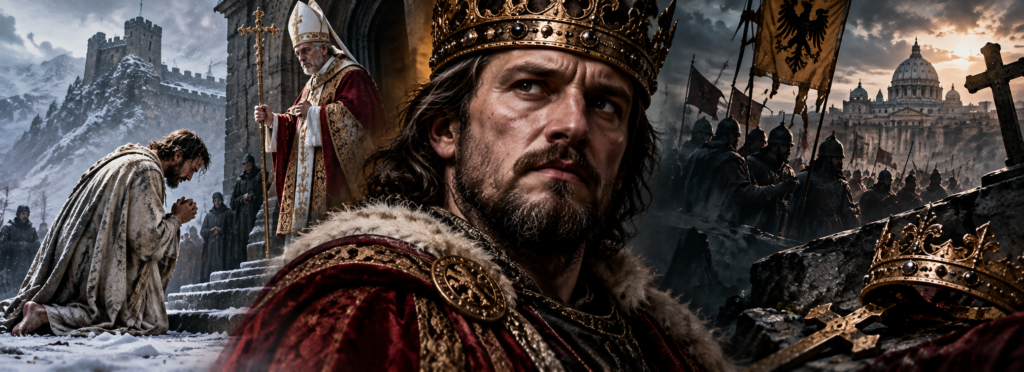
Henry IV: The Emperor Who Defied the Pope, Knelt at Canossa, and Lost His Crown to His Own Son
Holy Roman Emperor, 1084–1105 | King of the Romans, 1056–1105 | The Investiture Controversy, Canossa, Civil War, Excommunication, Family Betrayal, and a Reign of Relentless Conflict
The Emperor Outside the Gates
In January 1077, one of the most powerful rulers in Europe crossed the frozen Alps and appeared before the fortress of Canossa in northern Italy. Henry IV, King of the Romans and future Holy Roman Emperor, had spent the previous year attacking Pope Gregory VII with extraordinary ferocity, denying his legitimacy and ordering him to abandon the papal throne. Now Henry had come seeking absolution from that same pope, because excommunication had turned a theological confrontation into an existential political crisis. According to the famous account associated with Gregory’s own description of the episode, Henry waited for days before being admitted, appearing as a penitent while the German princes who opposed him watched the struggle between monarchy and papacy reshape the political world around them. Internet History Sourcebooks
Few scenes in medieval history have been more heavily mythologized. Henry is often imagined standing barefoot and nearly naked in deep snow for three entire days, a humiliated emperor reduced to shivering outside a castle until an implacable pope finally took pity on him. The surviving evidence supports the essential drama of Henry’s penitential appearance and Gregory’s initial reluctance to receive him, but some of the familiar visual details have been amplified by centuries of retelling. More importantly, Canossa was not simply a psychological collapse in which an arrogant ruler suddenly became submissive. Henry had a compelling political reason to obtain absolution before Gregory could enter Germany and join the princes preparing to judge whether Henry should remain king.
That combination of apparent humiliation and ruthless political calculation would characterize much of Henry’s extraordinary career. He could be confrontational to the point of recklessness and then suddenly conciliatory when survival demanded it. He could denounce Gregory as a false monk and demand that he leave the papal throne, only to promise obedience when excommunication threatened his crown; later, when his position recovered, Henry returned to war against Gregory, supported a rival pope, invaded Italy, and finally received an imperial crown from the antipope Clement III. Internet History Sourcebooks
To later observers, such reversals can make Henry appear wildly unstable. He has been characterized as stubborn, volatile, suspicious, vindictive, and capable of driving conflicts far beyond the point at which compromise might have served him better. Yet there is no persuasive evidence that Henry IV suffered from psychosis, mania, or any identifiable severe mental disorder, and claims about his private psychological state must remain speculative. His apparent instability is better understood through the violent political world that formed him, beginning with a childhood in which the young king was effectively kidnapped by powerful churchmen who wanted control of both the child and his kingdom.
Henry’s story belongs among the Mad Monarchs not because he can responsibly be diagnosed as insane, but because contemporaries and later generations confronted a ruler whose conduct repeatedly seemed to swing between extraordinary audacity and astonishing submission. His reign became an almost continuous cycle of confrontation, rebellion, reconciliation, renewed confrontation, excommunication, civil war, and betrayal. He survived revolts by nobles, a struggle with one of the most formidable popes of the Middle Ages, rival kings, hostile bishops, accusations from his second wife, and rebellion by his eldest son, only to be overthrown at last by another son who imprisoned him and forced him from the throne.
Henry spent much of his life fighting men who claimed he had abused royal power. By the end, the enemies surrounding him included his own children.
A Child King in a Kingdom of Wolves
Henry was born on 11 November 1050, the son of Emperor Henry III and Agnes of Poitou. His father belonged to the powerful Salian dynasty and had exercised formidable influence over both Germany and the papacy, but Henry III died unexpectedly in 1056, leaving his six-year-old son as king. The boy inherited enormous theoretical authority at an age when he could exercise virtually none of it himself.
His mother Agnes assumed responsibility for the regency, but the political order Henry III had constructed proved difficult to preserve. Great aristocratic families, ambitious bishops, regional dukes, and ecclesiastical reformers all possessed their own interests. The monarchy’s weakness during a minority gave them opportunities that would have been much harder to exploit under a powerful adult emperor.
The young Henry consequently grew up surrounded by political competition in which possession of his person meant access to royal authority. Medieval monarchy did not separate the individual ruler cleanly from the institution of kingship. Whoever controlled the child king could influence appointments, grants, policy, patronage, and the distribution of power throughout the realm.
In 1062, that reality produced one of the most dramatic episodes of Henry’s childhood. Archbishop Anno II of Cologne and a group of nobles seized the approximately eleven-year-old king during an event traditionally known as the Coup of Kaiserswerth. The conspirators invited Henry aboard a vessel on the Rhine and then carried him away from his mother’s control.
Later accounts describe the terrified boy leaping into the river in an attempt to escape and nearly drowning before being rescued. Details vary in the sources, and the episode should not be transformed into a modern psychiatric origin story in which a single trauma mechanically explains every later decision. Nevertheless, the political lesson was unmistakable: powerful men who publicly claimed to serve the crown could physically seize the king when it suited them.
The Kidnapping at Kaiserswerth
The Coup of Kaiserswerth was not a random abduction committed by common criminals. It was a calculated political seizure organized by some of the most powerful men in the kingdom. Anno and his allies sought to remove royal government from Agnes’s influence and place it under their own direction, effectively transforming custody of the boy into control of the monarchy.
For Henry, the experience must have demonstrated the dangerous ambiguity of medieval loyalty. Bishops were supposed to be among the king’s great supporters, spiritual fathers of Christian society and essential pillars of imperial government. Yet bishops had participated in taking him from his mother and controlling his person.
It is tempting to attribute Henry’s later suspicion of clerical authority directly to this childhood experience. Such an interpretation is plausible, but it cannot be proved. Medieval sources do not provide the kind of intimate psychological testimony that would allow historians to reconstruct a direct line from childhood trauma to adult behavior.
What can be demonstrated is that Henry’s minority was politically unstable and that powerful churchmen repeatedly competed for influence over him. Anno’s dominance was eventually challenged by Archbishop Adalbert of Bremen, another ecclesiastical prince whose closeness to Henry alarmed rival nobles. The young king therefore grew up not simply surrounded by bishops but surrounded by bishops fighting one another for access to royal power.
That background gives later events an almost bitter symmetry. The adult Henry would spend decades insisting that kings possessed rights over bishops and resisting a reform papacy determined to reduce secular control over ecclesiastical appointments. The boy who had once been controlled by prelates became the ruler who refused to accept that the Church could dictate the terms of his kingship.
A Young King Determined to Rule
Henry was declared of age during the 1060s and began assuming personal responsibility for government. He inherited a monarchy whose authority had weakened during his minority, and his early policies reflected a determination to recover what had been lost. This was not inherently irrational. Medieval rulers routinely spent the beginning of their personal reigns trying to reclaim royal rights surrendered or appropriated during regencies.
The difficulty lay in Henry’s methods and in the resistance they provoked. He sought to strengthen royal authority, particularly in Saxony, where royal estates and newly constructed fortifications became major sources of resentment. Henry increasingly relied upon men whose status and fortunes depended directly upon royal service rather than upon the great hereditary princes.
Among these servants were the ministeriales, a legally unfree or servile class who could nevertheless become highly trained administrators, warriors, estate managers, and officials. Their status seems paradoxical to modern readers because a man could be legally unfree while exercising substantial authority on behalf of a king or bishop. For rulers, ministeriales offered an obvious advantage: their position depended upon the lord who elevated them, making them potentially more reliable than hereditary aristocrats possessing independent territorial power.
Henry did not invent the ministerial system, nor did he literally replace the entire German aristocracy with serfs. The practice was already an important feature of German political and ecclesiastical administration. Nevertheless, his reliance upon royal servants and his attempts to strengthen the crown could antagonize princes who saw their traditional influence threatened.
What looked to aristocratic opponents like an intolerable inversion of social hierarchy could look to Henry like sensible statecraft. He had spent his childhood watching powerful nobles and bishops control the monarchy. Depending upon men whose fortunes came directly from royal favor was one way to reduce that dependence.
Bertha of Savoy and the Marriage Henry Tried to Destroy
Henry’s first marriage produced one of the strangest scandals of his early adult life. He had been betrothed while young to Bertha of Savoy, daughter of Count Otto of Savoy and Adelaide of Susa, and the marriage was politically valuable. Bertha’s family controlled strategically important Alpine territories, making the alliance useful to a German ruler whose ambitions and responsibilities extended into Italy.
Yet in 1069 Henry attempted to end the marriage. The surviving accounts portray his reasoning as remarkably thin. He did not produce the kind of overwhelming canonical accusation that might have made annulment politically understandable, and his expressed aversion to remaining married to Bertha shocked ecclesiastical authorities.
The episode has sometimes been interpreted as evidence of irrationality or extreme emotional volatility. It certainly reveals a young ruler willing to risk a strategically important alliance over intense personal dissatisfaction. Yet medieval aristocratic marriage was a political institution, and rulers frequently attempted to manipulate marital arrangements when relationships or political interests changed.
The striking feature is that Henry retreated when resistance became too great. Church authorities refused to grant him the easy separation he wanted, and the political costs of pursuing the matter became dangerous. Henry abandoned the attempt and remained married to Bertha.
The marriage subsequently became far more durable than the scandal of 1069 suggested. Bertha remained beside Henry through some of the most dangerous years of his life and accompanied him during the crisis that led to Canossa. Whatever Henry’s earlier aversion had been, she became a significant and loyal royal partner.
This pattern would recur throughout his reign. Henry could push aggressively toward a goal, encounter overwhelming resistance, retreat dramatically, and then reverse course again when circumstances changed. Such behavior could look erratic, but it also reflected a ruler constantly testing how far his power could reach.
The Saxon Powder Keg
The most dangerous domestic challenge of Henry’s early reign developed in Saxony. The region possessed a strong aristocratic identity and a difficult relationship with the Salian monarchy, while Henry’s efforts to expand and consolidate royal power there generated growing hostility. Royal castles became especially potent symbols of what Saxon opponents regarded as intrusive government.
Henry’s construction and use of fortified royal centers, including the Harzburg, allowed the monarchy to project power into the region. Yet castles required supplies, garrisons, lands, and labor, and the people surrounding them could experience royal expansion as direct exploitation. Local nobles also feared that Henry was constructing a network capable of reducing their autonomy.
By 1073, resentment erupted into major rebellion. Henry found himself confronted by a powerful coalition and was temporarily placed in an extremely dangerous position. The king who would soon challenge the papacy itself first had to survive a domestic revolt that threatened his authority within Germany.
The rebellion demonstrates why Henry’s political personality cannot be assessed in isolation from circumstances. His determination to strengthen monarchy did provoke resistance, but the princes opposing him were not neutral observers diagnosing an unstable king. They possessed their own interests and feared the growth of royal power.
Henry’s aggressive centralization could therefore be simultaneously rational from the perspective of monarchy and dangerously provocative from the perspective of aristocratic politics. His reign repeatedly operated inside that contradiction.
Victory That Encouraged Recklessness
Henry eventually recovered from the Saxon crisis and achieved a major victory over his opponents in 1075. The success dramatically improved his political position. A king who had recently seemed vulnerable now appeared capable of imposing his authority upon powerful rebels.
Victory may also have encouraged him to confront another source of opposition with far greater confidence than prudence justified. Pope Gregory VII had become increasingly determined to reform the Church and to assert ecclesiastical independence from secular control. Henry’s recovery in Germany occurred just as the conflict between royal and papal authority was becoming explosive.
The coming Investiture Controversy was about more than a ceremonial question of who placed a ring or staff into a bishop’s hands. Bishops and abbots controlled enormous territories, revenues, legal rights, fortifications, and political networks. German kings had long depended upon churchmen as essential components of royal government precisely because bishops, unlike hereditary dukes, did not normally produce legitimate dynasties capable of permanently inheriting ecclesiastical principalities.
Control over episcopal appointments was therefore deeply connected to control over the empire. If Henry lost his ability to influence who became bishop, he risked losing one of the monarchy’s most important political instruments. Gregory, meanwhile, believed that lay domination of ecclesiastical office corrupted the Church and violated the proper independence of spiritual authority.
Neither side believed it was arguing over a minor technicality. They were arguing over the architecture of Christian power.
Gregory VII and the Battle Over the Church
Gregory VII was elected pope in 1073 and became one of the most formidable advocates of the reform movement associated with his name. He sought to combat simony, enforce clerical discipline, and strengthen the authority of the papacy over the Church. These reforms inevitably collided with political customs through which kings and nobles exercised influence over ecclesiastical appointments.
Henry continued intervening in episcopal affairs, including the contested church of Milan. Gregory increasingly treated such behavior as unacceptable, while Henry regarded papal interference as an attack upon established royal rights. The conflict escalated from disagreement into a struggle over whether king or pope possessed superior authority within Christian society.
Gregory warned Henry and threatened severe ecclesiastical consequences. Henry responded not with cautious diplomacy but with one of the most aggressive political letters of the medieval period. At the assembly of Worms in January 1076, Henry and supportive German bishops rejected Gregory’s authority and demanded that he leave the papacy.
The surviving letter addresses Gregory contemptuously as Hildebrand and denies him the dignity of legitimate papal office. Henry accused him of confusion, pride, unlawful ambition, and attacks upon divinely ordained kingship. He ended by commanding Gregory to descend from the apostolic throne, language that amounted to a direct declaration that the king and his bishops considered the pope deposed. Internet History Sourcebooks
The move was extraordinarily dangerous. Henry had transformed a dispute over church government into a direct contest over whether the pope could remain pope.
Gregory answered by attacking whether Henry could remain king.
“Descend, Descend”
Henry’s letter to Gregory has become one of the clearest examples of the aggressive defiance associated with his personality. It was not the cautious language of a ruler seeking compromise. Henry portrayed Gregory as a usurper and false monk and insisted that kingship came directly from God rather than from papal permission.
The famous concluding demand that Gregory “descend” from the apostolic seat was not merely an angry insult written in private. Henry acted with the support of bishops assembled at Worms, turning the attack into an institutional challenge. His episcopal allies issued their own denunciation of Gregory, demonstrating that the confrontation was broader than one king’s temper. Internet History Sourcebooks
Nevertheless, Henry badly underestimated Gregory’s ability to retaliate. In February 1076, the pope excommunicated Henry, declared him deprived of rule over Germany and Italy, and released his subjects from their oaths of loyalty. In a political culture where kingship was inseparable from sacred legitimacy, this was a devastating escalation. Internet History Sourcebooks
Excommunication did not magically erase Henry’s armies or legal claims, but it gave his enemies an extraordinary weapon. German princes who already resented royal authority could now present resistance as compatible with Christian obedience. Political rebellion and ecclesiastical condemnation began reinforcing one another.
Henry had attempted to remove Gregory.
Instead, he gave his own enemies a means of removing him.
Excommunication and the Collapse of Royal Support
The speed with which Henry’s position deteriorated after excommunication revealed how fragile his apparent victory over the Saxons had been. German princes gathered in opposition and demanded that Henry resolve his conflict with Gregory. The king who had recently commanded the pope to abandon Rome now faced the possibility of losing his own throne.
At Oppenheim in 1076, Henry’s political isolation became severe. He promised obedience and reconciliation, distancing himself from the confrontational stance he had adopted at Worms. The surviving material shows the extraordinary reversal: Henry pledged reverence toward Gregory and repudiated measures previously taken against him. Internet History Sourcebooks
To later observers, this could look like astonishing inconsistency. Within months, Henry had moved from demanding Gregory’s removal to promising submission. Yet the political logic was ruthless and clear. If Henry remained excommunicated long enough for Gregory to enter Germany and cooperate with the rebellious princes, his kingship might not survive.
Henry therefore decided to reach the pope before his German opponents could turn ecclesiastical condemnation into permanent deposition. Winter, mountains, and humiliation were preferable to losing the crown. He crossed the Alps and went to Canossa.
The supposed madman’s most famous act of submission was therefore also one of the most calculating political gambles of his reign.
Canossa
Gregory was staying at Canossa under the protection of Countess Matilda of Tuscany when Henry arrived in January 1077. The king sought absolution, but Gregory faced his own dilemma. As pope, he could not lightly refuse genuine penance from an excommunicated Christian, yet absolving Henry threatened to disrupt the political strategy of the German opposition.
The resulting encounter became legendary. Gregory’s account emphasizes Henry’s penitential appearance and the pope’s reluctance before finally granting absolution. The traditional image of the king standing barefoot in snow for three days captures the humiliation, although the precise physical details should not be embellished beyond what the sources securely establish. Internet History Sourcebooks
Politically, Henry achieved something important. The pope had absolved him before presiding over a German judgment against him. The excommunicated king could now return to the political struggle claiming restored communion with the Church.
Canossa therefore cannot simply be interpreted as Gregory crushing Henry. The king accepted a spectacular humiliation because it helped disrupt the coalition threatening his throne. His willingness to bend completely when survival required it was one of the reasons he remained so difficult to destroy.
Yet absolution did not restore peace. The German opposition had developed interests of its own and was not prepared simply to surrender because Gregory had lifted the ban.
The civil war continued.
A Rival King and a Kingdom Divided
In 1077, Henry’s opponents elected Rudolf of Rheinfelden, Duke of Swabia, as a rival king. Germany now faced a civil war in which competing royal claims overlapped with the unresolved struggle between Henry and the papacy.
Henry fought relentlessly to preserve his throne. The conflict moved across regions, alliances shifted, and both sides attempted to secure ecclesiastical as well as aristocratic support. The Investiture Controversy had become inseparable from a German war over kingship.
Gregory initially attempted to navigate the competing claims, but the conflict eventually escalated again. In 1080 he excommunicated Henry for a second time and supported Rudolf. The pope’s second ban demonstrated that Canossa had not produced lasting reconciliation. Internet History Sourcebooks
Henry answered by supporting the deposition of Gregory and the elevation of Wibert of Ravenna as a rival pope, Clement III. What had begun as a conflict over episcopal appointments had now produced rival kings and rival popes.
This was the political world Henry created and inhabited: every challenge generated a counter-challenge, every deposition another deposition, every claim to sacred legitimacy an opposing claim. Compromise repeatedly gave way to escalation.
To Henry’s enemies, this looked like reckless obstinacy. To Henry, surrender could mean the destruction of royal authority and perhaps his dynasty itself.
The Death of Rudolf and Henry’s Recovery
Rudolf of Rheinfelden died in 1080 after being mortally wounded in battle. His death was politically valuable to Henry, and royal propaganda could interpret the fate of the rival king as evidence of divine judgment.
The opposition did not disappear, but Henry’s position improved sufficiently for him to turn greater attention toward Italy. He crossed the Alps and carried the conflict directly against Gregory. Rome itself became the prize.
After prolonged campaigning, Henry entered Rome in 1084. Clement III crowned him emperor, giving Henry the imperial title he had pursued while simultaneously presenting the extraordinary spectacle of an emperor receiving coronation from a pope whose legitimacy depended upon imperial support.
Gregory VII found himself trapped in Castel Sant’Angelo before being rescued by Norman forces under Robert Guiscard. The rescue brought its own catastrophe because Norman troops sacked parts of Rome, creating hostility toward Gregory among the population. Gregory left the city and died in exile at Salerno in 1085.
Henry had survived the pope who excommunicated him.
But surviving Gregory did not end the struggle Gregory had helped unleash.
Emperor at Last
Henry’s imperial coronation in 1084 marked a remarkable recovery from the apparent disaster of 1076. Eight years earlier he had been excommunicated and threatened with deposition. Seven years earlier he had stood as a penitent at Canossa.
Now he was emperor.
The reversal demonstrates why describing Henry simply as irrational misses something essential. He possessed extraordinary resilience and political endurance. Many rulers would have been destroyed by the combination of aristocratic revolt, papal excommunication, rival kingship, and civil war.
Henry repeatedly rebuilt his position. He could retreat when necessary, negotiate when weak, fight when strong, and exploit divisions among his enemies. The very reversals that made him appear inconsistent also contributed to his survival.
Yet there was a destructive side to this persistence. Henry rarely transformed temporary victories into stable settlements. Enemies defeated in one phase often reappeared in another, while broken agreements deepened mistrust.
He could win battles without ending wars.
His reign became less a progression toward political settlement than an exhausting sequence of recoveries from crises that repeatedly returned in new forms.
Bertha: The Wife He Once Tried to Reject
Through many of these struggles, Bertha remained beside the husband who had once attempted to end their marriage. She accompanied Henry during the journey associated with Canossa and shared the dangerous political life of a royal household moving through rebellion, excommunication, and war.
The transformation of their marriage is striking. The young Henry had once claimed that he could not bear the union and sought release despite lacking a compelling canonical justification. The mature king relied upon Bertha as queen and dynastic partner.
They had several children, including Conrad and the future Henry V. Those sons were essential to the continuation of Salian rule, but they would eventually reproduce the pattern of family rebellion that had haunted Henry’s own childhood.
Bertha died in 1087. Whatever emotional relationship had developed between them cannot be reconstructed in intimate detail, but her political loyalty stands in sharp contrast to Henry’s youthful attempt to discard her.
The wife he had once tried to escape remained loyal through some of his worst humiliations.
His sons would prove far less forgiving.
Eupraxia of Kiev and the Darkest Scandal
After Bertha’s death, Henry married Eupraxia of Kiev, a Rus’ princess and widow who took the name Adelaide or Praxedis in the western political world. The marriage initially offered dynastic advantages, but it eventually disintegrated into one of the most sensational scandals of Henry’s reign.
Eupraxia broke with Henry and escaped into the protection of his enemies. She subsequently made grave accusations against him in ecclesiastical settings, contributing to the already poisonous propaganda surrounding the emperor.
Later accounts attribute horrifying sexual and religious abuses to Henry, including claims that he subjected his wife to sexual degradation and forced her into encounters with other men. Some retellings have expanded the accusations into lurid stories involving ritualized sexual depravity, “black masses,” or naked altar ceremonies. Those elaborations should not be presented casually as established fact.
The accusations emerged during an intense political and ecclesiastical struggle in which Henry’s enemies had every incentive to depict him as morally monstrous. That does not prove Eupraxia lied, and dismissing her allegations merely because they were politically useful would be equally irresponsible. It means the historian must distinguish between the existence of accusations, which is historically significant, and the certainty that every sensational detail was literally true.
The scandal nevertheless inflicted serious reputational damage. An emperor already condemned by church reformers could now be portrayed not merely as a political enemy of the papacy but as a man whose private household reflected moral corruption.
Henry’s marriage had become another battlefield.
What Eupraxia Actually Tells Us
Eupraxia’s accusations are often used as evidence that Henry’s private behavior had become psychologically deranged. That conclusion goes further than the surviving evidence permits. Medieval political propaganda routinely used sexual misconduct as a weapon because rulers were expected to embody Christian morality.
What can be said is that the marriage collapsed catastrophically. Eupraxia feared or hated her husband enough to leave him, align herself with his enemies, and accuse him publicly of serious abuse. Whatever the precise truth behind individual allegations, the relationship had become profoundly hostile.
Henry’s political circumstances make it difficult to separate private breakdown from public strategy. His enemies could use Eupraxia because her status as his wife gave her testimony extraordinary force. A hostile pope accusing Henry of immorality could be dismissed as partisan; an empress describing degradation inside the marriage was harder to ignore.
The episode also reinforced an existing image of Henry as a ruler who violated boundaries. Opponents already accused him of violating ecclesiastical liberty and political custom. Allegations of sexual abuse allowed them to portray the same transgressive character inside his household.
Whether that portrait reflected the real Henry, propaganda, or some combination of both remains disputed. It should not be converted into a psychiatric diagnosis.
The scandal is dark enough without pretending certainty where none exists.
The Son Who Turned Against Him First
Henry’s family troubles extended beyond marriage. His eldest surviving son Conrad had been elevated and prepared for a future role within the dynasty, but by the early 1090s he turned against his father in Italy.
Conrad’s rebellion was a devastating personal and political blow. A king could portray rebellious dukes as traitors, but a rebellious son raised uncomfortable questions about the royal household itself. If the heir abandoned his father, enemies could argue that Henry’s tyranny had become intolerable even to his own blood.
Conrad allied himself with Henry’s opponents and was crowned king in Italy. His rebellion coincided with the emperor’s broader difficulties in the region, including opposition from Matilda of Tuscany and the reform papacy.
Henry eventually recovered, and Conrad’s rebellion failed to destroy him. The emperor had his rebellious son displaced within the succession and promoted the younger Henry, the future Henry V, instead.
The decision appeared practical. One son had betrayed him, so another would inherit.
Henry could not know that the replacement would eventually do exactly the same thing.
The Pattern of Betrayal
By this stage, betrayal had become a recurring feature of Henry’s life. Powerful bishops had taken him from his mother as a child. Saxon nobles rebelled against him. Gregory VII excommunicated and attempted to depose him, while German princes elected rival kings.
His second wife fled and accused him publicly. Conrad rebelled. Every crisis could therefore reinforce a worldview in which loyalty was temporary and power had to be guarded constantly.
It would be tempting to call this paranoia, but the term must be used carefully. Paranoia implies unreasonable or delusional suspicion, whereas Henry had repeatedly experienced genuine betrayal. Distrust in such circumstances was not necessarily pathological.
The problem was that a ruler who expected betrayal could help produce it. Harsh treatment of opponents, aggressive assertions of authority, broken agreements, and dependence upon loyal servants could convince uncertain nobles that rebellion was safer than submission.
Henry’s reign therefore developed a vicious political cycle. He distrusted powerful men because they rebelled, and powerful men rebelled partly because they distrusted what Henry would do if he became strong enough to punish them.
Neither side needed to be insane.
They simply needed to believe the other was dangerous.
The Emperor Who Could Not End the War
The death of Gregory VII did not end the Investiture Controversy because the conflict had never truly depended upon two personalities alone. It concerned fundamental questions about the relationship between secular and ecclesiastical authority, and those questions survived both Gregory and the political circumstances that had first produced the confrontation.
Successive popes continued opposing Henry. Urban II, elected in 1088, strengthened the reform papacy and supported Henry’s enemies. The emperor therefore remained trapped in a struggle that had consumed decades of his reign.
The contrast between Henry’s persistence and his inability to achieve final settlement is striking. He had outlived Gregory, defeated or survived rival kings, entered Rome, received the imperial crown, and preserved his dynasty through repeated crises. Yet the fundamental dispute remained unresolved.
The eventual compromise over investiture would not come until the Concordat of Worms in 1122, sixteen years after Henry’s death. By then his son Henry V was emperor.
Henry IV therefore spent much of his adult life fighting a conflict he could neither abandon nor finish. His stubbornness prolonged it, but structural forces larger than his personality ensured that simple surrender by one man would not have resolved every issue.
The emperor’s tragedy was partly that he personalized a conflict that was institutional at its core.
Was Henry Emotionally Unstable?
Hostile chroniclers provide material from which later writers have constructed a psychologically volatile Henry: proud, impulsive, suspicious, sexually immoral, vindictive, and prone to dramatic reversals. Yet medieval political sources are exceptionally dangerous material for retrospective psychiatric diagnosis.
Henry lived during one of the most ferocious propaganda struggles of the Middle Ages. Supporters of the papacy had strong reasons to depict him as morally corrupt and tyrannical, while imperial writers had equally strong reasons to portray Gregory and his allies as usurpers attacking divinely ordained kingship. Character assassination was part of political warfare.
There is no solid basis for diagnosing Henry with psychosis, bipolar disorder, a personality disorder, or another specific modern psychiatric condition. Claims that he suffered “deep depressions” under stress may be plausible in a general human sense, but the surviving record does not allow confident clinical reconstruction.
His behavior can often be explained politically. The denunciation of Gregory was an assertion of royal and episcopal rights, Canossa was a maneuver to save his crown, and renewed warfare followed because absolution had not resolved the German civil conflict. Even apparent reversals frequently corresponded to changing balances of power.
Henry could still be reckless, vindictive, or stubborn without being mentally ill. Personality and political judgment are not diagnoses.
That distinction is essential if his story is to remain history rather than retrospective speculation.
The Meaning of Canossa Reconsidered
Canossa is often presented as the perfect example of Henry’s unstable pendulum between arrogance and humiliation. In January 1076 he ordered Gregory down from the papal throne; one year later he appeared as a penitent asking the same man for absolution. The contrast is undeniably dramatic.
Yet Henry’s behavior becomes much more coherent when viewed through the political calendar. German princes had given him a limited period in which to resolve his excommunication, and Gregory intended to travel north. If pope and princes met while Henry remained under the ban, his enemies could create an enormously powerful coalition.
Henry moved first. By crossing the Alps and obtaining absolution, he changed the political conditions before the planned judgment could occur. The humiliation was real, but it purchased something valuable.
This was not necessarily the act of a man swinging uncontrollably between emotional extremes. It could be the act of a ruthless political survivor willing to sacrifice dignity temporarily to preserve power permanently.
Henry’s later behavior supports that interpretation. Once circumstances changed, he did not remain submissive. He resumed the struggle, backed a rival pope, entered Rome, and became emperor.
Canossa was therefore not the opposite of Henry’s defiance.
It was another weapon in the same fight.
A Son Swears Loyalty
After Conrad’s rebellion, Henry turned increasingly toward his younger son, also named Henry. The younger Henry was designated as heir and associated with kingship, but his father attempted to protect himself against another family betrayal.
The younger Henry reportedly gave assurances that he would not seize authority from his father during the emperor’s lifetime. Given Conrad’s rebellion, the demand was understandable. Henry IV had learned that even dynastic succession could become a weapon against a reigning monarch.
For a time, the arrangement held. Yet the emperor’s continuing conflict with the papacy gave the younger Henry both an opportunity and a justification for rebellion. An excommunicated father could be portrayed as a threat to the dynasty’s legitimacy and to the peace of the empire.
In 1104, Henry V rebelled.
The emperor who had survived Gregory VII, Rudolf of Swabia, Saxon revolts, Italian wars, Conrad’s betrayal, and decades of ecclesiastical condemnation now faced an enemy uniquely positioned to destroy him.
His own chosen heir claimed the future against him.
The Second Son’s Rebellion
Henry V’s revolt gathered support among princes exhausted by his father’s prolonged conflicts. The younger Henry could present himself as a solution to the political instability that had defined the empire for decades. He did not need to deny the Salian dynasty; he represented it.
This made the rebellion far more dangerous than an ordinary aristocratic uprising. The choice was no longer between Henry IV and an unrelated rival. It was between an aging emperor and the son who would inherit his crown anyway.
Henry IV attempted resistance, but his political position deteriorated. Negotiation followed, and the emperor eventually fell into his son’s hands. Accounts of the precise interactions between father and son were shaped by partisan narratives, but the outcome is clear.
Henry IV was compelled to surrender the royal insignia and abdicate in 1105. The ruler who had spent decades defending the sacred independence of his kingship from papal claims lost his throne not to Gregory VII, not to a Saxon rebel, and not to a rival dynasty, but to his own child.
The symmetry was merciless. As an eleven-year-old, Henry had been taken from his mother by men seeking control of the monarchy. In old age, he again found himself deprived of effective freedom while others dictated the fate of his crown.
The child king who had been seized became the emperor who was seized.
Imprisonment and Abdication
Henry’s forced abdication was not the peaceful retirement of an aging ruler. It represented political defeat and personal humiliation after nearly half a century of kingship. He had ruled as German king since childhood and had spent his adult life insisting that his authority came from God.
Now his son demanded that authority.
The emperor did not simply accept permanent defeat. He escaped and attempted to rally support, demonstrating once again the extraordinary resilience that had characterized his career. Even after Canossa, excommunications, rival kings, family rebellions, and forced abdication, Henry remained unwilling to disappear quietly.
Support for him revived in parts of the empire, particularly around Liège, and another round of conflict seemed possible. The aging emperor was preparing to challenge his son’s settlement when death intervened.
Henry IV died on 7 August 1106.
Even then, his conflict with the Church followed him beyond death.
An Emperor Denied Peace in Death
Henry died while still burdened by ecclesiastical condemnation, creating problems surrounding his burial in consecrated ground. His corpse therefore became part of the continuing struggle between imperial dignity and papal authority.
The emperor who had fought over sacred legitimacy throughout his life could not simply be laid peacefully among his ancestors without controversy. His body experienced a form of exclusion that echoed the excommunications that had repeatedly destabilized his reign.
Eventually Henry received burial at Speyer Cathedral after ecclesiastical reconciliation permitted it. The magnificent imperial setting contrasted sharply with the political humiliation of his final year. He had died deposed, but he remained part of the Salian imperial dynasty.
Death did not settle the ideological struggle either. Henry V inherited the same fundamental dispute over investiture that had consumed his father. The son who overthrew Henry IV eventually found himself confronting the papacy over many of the same questions.
The conflict would finally produce compromise in 1122 at Worms, the very city where Henry IV had launched his great attack against Gregory VII nearly half a century earlier.
History rarely produces irony more neatly.
The Marriage Scandals and the Problem of Propaganda
Henry’s marriages illustrate the difficulty of separating personality from political propaganda. His attempt to divorce Bertha appears genuinely impulsive and politically damaging, while his later marriage to Eupraxia ended amid accusations so shocking that they have continued to color his reputation.
Yet the two episodes should not simply be combined into a diagnosis of sexual or psychological depravity. The Bertha crisis occurred when Henry was a young ruler asserting personal desires against political and ecclesiastical expectations. He retreated when opposition became overwhelming and subsequently maintained the marriage.
The Eupraxia accusations are much darker but also much harder to verify. She publicly broke with Henry and made serious allegations, and the existence of those accusations is historically secure. The most sensational later details, however, emerged within a highly charged propaganda environment and cannot automatically be accepted as literal descriptions of events.
The responsible approach is neither to declare Henry innocent of every accusation nor to present hostile allegations as proven fact. Eupraxia’s testimony demonstrates that the imperial marriage had deteriorated catastrophically and that she accused Henry of severe sexual abuse and degradation. It also demonstrates how private scandal could become a political weapon during the Investiture Controversy.
Henry’s enemies were eager to believe the worst of him.
By then, decades of conflict had given them abundant reasons to do so.
Commoners, Ministeriales, and the Emperor’s Political Revolution
Henry’s use of ministeriales has sometimes been presented as bizarre proof that he deliberately inverted the medieval social order by choosing serfs over nobles. The reality is more nuanced and, in many ways, more interesting.
Ministeriales were legally unfree but could occupy prestigious military and administrative positions. Kings, bishops, and great lords increasingly relied upon them because they offered skilled service without possessing the same inherited independence as major aristocratic families.
Henry’s preference for dependable royal servants therefore had a strong political logic. A duke with vast hereditary lands could defy the king and survive; a ministerialis whose status depended upon royal favor had far more incentive to remain loyal.
The policy nevertheless aggravated aristocratic resentment when combined with Henry’s efforts to expand royal authority. Great nobles could see men of lower legal status exercising influence while their own traditional role was restricted. Social contempt and political fear reinforced one another.
This did not by itself cause the Saxon rebellion, which had multiple territorial and political causes. It contributed, however, to the broader impression that Henry intended to govern around the great princes rather than through them.
Once again, the behavior that opponents described as outrageous was not irrational. It was a deliberate strategy for escaping aristocratic dependence.
The danger was that Henry pursued such strategies in a kingdom where aristocratic cooperation remained indispensable.
Was Henry Paranoid?
The word “paranoid” is frequently applied to rulers who distrusted those around them, but Henry’s life demonstrates why historians should use it sparingly. He had extraordinary reasons to distrust people.
He was kidnapped as a child by political elites. Nobles repeatedly rebelled against him. Bishops abandoned him. A pope declared him deposed. Rival kings were elected against him, his second wife fled to his enemies, and both of his adult sons eventually rebelled.
A man who remained completely trusting after such experiences might have been more surprising than one who became suspicious. Henry’s political world repeatedly confirmed that loyalty could vanish when circumstances changed.
This does not mean every suspicion he held was justified. Nor does it mean that his own behavior played no role in creating hostility. A ruler who punished opponents harshly and broke agreements could make betrayal increasingly attractive to people afraid of what reconciliation might mean once he recovered strength.
Henry’s distrust therefore existed inside a feedback loop. Betrayal encouraged suspicion, suspicion encouraged coercive behavior, coercion encouraged further betrayal, and every new revolt seemed to confirm the assumptions created by the previous one.
That cycle can resemble psychological paranoia from a distance.
In Henry’s case, much of the danger was entirely real.
Reckless or Relentless?
Henry’s enemies frequently had reason to regard him as reckless. His denunciation of Gregory VII in 1076 was an extraordinary gamble that initially backfired catastrophically. His repeated willingness to reopen conflicts after temporary settlements made durable trust difficult.
Yet the same qualities could be described differently. Henry was extraordinarily persistent. He repeatedly recovered from positions that seemed politically hopeless and refused to accept defeats that would have ended the careers of less determined rulers.
Canossa is the clearest example. Pride did not prevent him from humiliating himself when humiliation offered a route to survival. This was not the behavior of a man incapable of adapting to reality.
The problem was that Henry’s adaptability operated within an uncompromising conception of kingship. He could alter tactics dramatically while remaining stubborn about fundamental claims. He would kneel before Gregory to remove excommunication without accepting Gregory’s broader vision of papal supremacy.
This distinction explains many of his apparent reversals. Henry changed methods more readily than goals.
His opponents could mistake tactical flexibility for dishonesty because agreements made during weakness often ceased to restrain him once his strength returned.
From their perspective, Henry could never be trusted.
From his perspective, surrender under duress did not necessarily erase rights he believed God had given him.
The Myth of the Mad Emperor
There is no sound historical basis for declaring Henry IV insane. He did not display the documented episodes of psychosis associated with rulers such as Charles VI of France, nor do the sources establish the severe mental collapse seen in some other monarchs.
His reputation for instability grew instead from behavior that appeared extreme. He fought the papacy for decades, endured excommunication twice under Gregory VII, supported an antipope, survived rival kings, attempted an ill-considered divorce, became the subject of horrifying marital accusations, and experienced rebellion from both of his sons.
His emotional life remains largely inaccessible. Chroniclers sometimes portray him as volatile, proud, deceptive, or morally corrupt, but many wrote within political and ecclesiastical struggles that made neutrality almost impossible. A papal partisan describing Henry’s character was not conducting a psychiatric assessment.
The emperor’s actions themselves generally display awareness of political reality. He understood when his position at Oppenheim had collapsed. He understood that absolution at Canossa could divide his enemies. He understood the strategic value of controlling episcopal appointments and of supporting a rival pope.
Those calculations could be ruthless and sometimes disastrous.
They were not the calculations of a man detached from reality.
The Trauma Question
Henry’s childhood kidnapping remains one of the most tempting explanations for his later personality. An eleven-year-old king was removed from his mother by men who wanted political control, and later accounts describe a frightening attempt to escape into the Rhine. It is easy to imagine such an experience leaving lasting emotional scars.
Modern psychology recognizes that childhood trauma can influence adult attachment, trust, emotional regulation, and responses to perceived threats. Yet applying those insights directly to an eleventh-century ruler without detailed personal evidence would turn reasonable possibility into unsupported diagnosis.
Henry himself left no psychological memoir explaining that Kaiserswerth taught him never to trust bishops. His later conflict with the Church also had structural causes that would have existed regardless of childhood experience. German kings depended upon episcopal appointments, while Gregorian reformers wanted to restrict secular control over those offices.
Still, the personal history cannot simply be dismissed. Henry knew from childhood that bishops could act as political princes, manipulate royal government, and physically control a king. When Gregory VII later insisted that ecclesiastical authority could judge royal conduct, Henry encountered the claim as someone whose earliest political memories had already demonstrated how dangerous powerful churchmen could be.
We cannot say Kaiserswerth caused the Investiture Controversy.
We can say Henry entered that controversy with unusually bitter experience of clerical politics.
Father and Sons
The rebellions of Conrad and Henry V provide one of the most tragic patterns of Henry’s life. Dynastic monarchy depended upon sons, yet sons could become the most dangerous rivals because they possessed legitimate claims and natural constituencies among men who wanted political change without destroying the dynasty.
Conrad’s rebellion taught Henry this lesson first. The emperor responded by disinheriting him and promoting the younger Henry. The solution appeared to preserve the dynasty while punishing betrayal.
Then Henry V rebelled as well.
The second rebellion suggests that the problem cannot simply be explained by one unusually disloyal son. Henry’s prolonged political conflicts created incentives for heirs to separate themselves from an aging ruler whose excommunication and wars threatened their own futures.
The younger Henry could promise princes and churchmen a fresh beginning while still preserving Salian rule. His rebellion therefore became politically attractive to people exhausted by his father’s inability to achieve lasting peace.
For Henry IV, however, the political logic could only make the betrayal more bitter. He had replaced one rebellious heir with another and received the same result.
The emperor who distrusted everyone finally discovered that even succession itself could not be trusted.
Forced From the Throne
The events of 1105 brought Henry’s reign to its humiliating conclusion. His son gained the advantage, and Henry IV was compelled to surrender the symbols of kingship and abdicate. The man who had fought Gregory VII over whether a pope could depose a divinely ordained king was deposed through a rebellion led by his own heir.
There was a terrible consistency to the ending. Henry had spent decades insisting that sacred kingship could not simply be taken from him by hostile ecclesiastical judgment. Yet monarchy in practice depended upon political support, and once enough princes shifted behind his son, theological claims could not preserve power by themselves.
Henry did not disappear quietly. He escaped and attempted to rebuild support, proving that the stubbornness of his earlier years remained intact. Even in his mid-fifties, after almost five decades as king, he was prepared to fight again.
His death in 1106 prevented another extended civil war. Henry V inherited the monarchy but also inherited the unresolved conflict with the papacy.
The father’s political world survived his overthrow.
His son had removed the man without removing the problem.
A Reign That Consumed Itself
Henry IV’s reign lasted approximately half a century as German king, an extraordinary span dominated by conflict. He began as a child whose authority was controlled by others and ended as an emperor whose authority was taken by his own son.
Between those two humiliations came almost every form of medieval political crisis imaginable. There were aristocratic rebellions, civil wars, rival kings, rival popes, excommunications, sieges, disputed episcopal appointments, marital scandals, dynastic betrayals, and ideological warfare over the nature of Christian authority.
Henry survived an astonishing amount. That survival itself became part of the problem because each recovery encouraged him to continue fighting. Defeat rarely persuaded him that a conflict should end; it persuaded him that he needed time to regain strength.
His opponents learned the same lesson. A humbled Henry could become dangerous again, so reconciliation with him never guaranteed security.
This created a reign in which peace repeatedly contained the seeds of the next war. Agreements became pauses, absolution became strategy, and family loyalty became temporary.
Henry could survive almost anything except the accumulation of consequences produced by survival itself.
Mad, Erratic, or a Product of His Age?
Henry IV’s behavior was certainly capable of appearing erratic. He attempted to discard a politically valuable wife and then remained married to her for years. He ordered Gregory VII from the papal throne and then traveled to Canossa seeking absolution.
After receiving that absolution, he resumed the struggle, supported an antipope, invaded Italy, and received an imperial crown from Gregory’s rival. He relied upon ministeriales in ways that threatened aristocratic interests, fought prolonged wars against rebellious nobles, and repeatedly returned to confrontation after compromise appeared possible.
Yet none of these actions requires mental illness as an explanation. His marital crisis reflected personal desire colliding with dynastic obligation. His reliance upon ministeriales strengthened royal administration against independent magnates, while his struggle over investiture concerned genuine political resources and competing theories of authority.
Even Canossa becomes less contradictory when understood strategically. Henry’s objective was not emotional consistency but preservation of kingship. He could submit ceremonially while refusing to abandon the political principles over which the struggle had begun.
The result was a ruler who looked unpredictable because he was willing to use radically different methods depending upon circumstances. Humility and aggression were not necessarily opposite states of mind for Henry.
They were political instruments.
The Emperor and the Pope
Henry IV and Gregory VII have often been presented as personal opposites locked in a titanic duel: the stubborn emperor against the uncompromising pope. There is truth in the image, but focusing too heavily upon personality risks obscuring the institutional revolution occurring around them.
The eleventh-century reform movement was changing the Church’s understanding of its independence and authority. Secular rulers had long exercised extensive influence over bishoprics, while reformers increasingly viewed such control as a source of corruption and subordination.
Henry inherited a monarchy deeply dependent upon imperial churches. Gregory inherited a reform movement increasingly unwilling to accept royal domination of ecclesiastical office. Conflict was therefore highly likely even if both men had possessed gentler personalities.
Their personalities nevertheless intensified it. Neither accepted the other’s fundamental claim. Gregory asserted an extraordinary vision of papal authority, while Henry regarded royal power as divinely ordained and not subject to arbitrary papal removal.
Once Henry commanded Gregory to descend from the papal throne and Gregory responded by releasing Henry’s subjects from their oaths, compromise became extraordinarily difficult. Each side had challenged the legitimacy of the other.
The argument was no longer about appointments.
It was about who had the authority to judge whom.
The Price of Never Yielding
Henry’s persistence preserved his crown for decades, but it also exacted enormous costs. Germany endured repeated rebellion and civil war, while the monarchy’s relationship with sections of the aristocracy remained deeply unstable. The conflict with the papacy consumed political energy across generations.
Henry also suffered personally. His first marriage nearly collapsed through his own attempt to end it, his second collapsed spectacularly, and both of his adult sons eventually rebelled. His final years were spent fighting the heir he had chosen after the previous heir betrayed him.
This is where stubbornness becomes central to understanding Henry even without medicalizing it. He repeatedly treated compromise as temporary when he believed fundamental royal rights were at stake. Opponents therefore learned that concessions might simply give him time to recover.
Yet surrender would also have carried costs. If Henry permanently abandoned royal influence over the imperial church, he could weaken the monarchy relative to both bishops and princes. His resistance was not meaningless obstinacy.
The tragedy lay in his inability to find a durable middle ground.
That middle ground eventually emerged at Worms in 1122, after Henry was dead.
Henry IV Among the Mad Monarchs
Henry IV belongs in the Mad Monarchs category as a ruler whose reputation for volatility and reckless confrontation invites questions about personality but resists psychiatric certainty. He was not a documented psychotic monarch, and there is insufficient evidence to diagnose severe depression, mania, paranoia, or a personality disorder.
His behavior was extreme because his political world was extreme. He inherited the throne as a child, was kidnapped by men seeking control of his government, struggled against princes who resented royal consolidation, and confronted a papal reform movement fundamentally challenging established imperial practices.
He could be impulsive. The attempted divorce from Bertha was politically foolish, and the attack on Gregory at Worms helped turn a serious dispute into a crisis that nearly cost him his crown. He could also be strategically sophisticated, as the journey to Canossa demonstrates.
Henry’s apparent contradictions therefore deserve explanation rather than diagnosis. He was capable of pride and humiliation because both could serve political survival. He could compromise when weak and repudiate compromise when strong because he viewed coerced concessions differently from permanent surrender.
This made him extraordinarily difficult to trust.
It did not make him insane.
The Emperor Who Survived Everything but His Heir
Henry’s life began with adults fighting over possession of a child king and ended with a son fighting to possess the father’s crown. Between those points, Henry spent decades resisting anyone who attempted to define the limits of his authority.
Gregory VII could excommunicate him but could not permanently remove him. German princes could elect rival kings, but Henry survived them. Saxon rebels could threaten his rule, but he recovered. Eupraxia could flee and publicly denounce him, while Conrad could rebel and lose his place in the succession.
Again and again Henry returned.
That extraordinary capacity for recovery may have reinforced his belief that he could survive every crisis if he refused to surrender permanently. Experience had repeatedly rewarded stubbornness. Even Canossa, remembered as his greatest humiliation, ultimately allowed him to escape the immediate danger posed by excommunication and the German opposition.
Henry V finally broke the pattern because he offered Henry’s exhausted enemies something earlier rivals could not: continuity without the father. Supporting the son did not require abandoning the Salian dynasty.
The emperor’s greatest political asset, his hereditary monarchy, became the weapon used against him.
The Last Humiliation
There is something almost Shakespearean about Henry’s final defeat, although the reality needs no fictional embellishment. The ruler who had refused to accept Gregory VII’s right to remove him from kingship was ultimately forced to surrender royal power under pressure from his own child.
Henry had spent his life arguing that his crown came from God. Yet divine theory could not command armies when princes deserted him. Sacred kingship could strengthen authority, but it could not substitute for political support.
His son understood this. Henry V assembled enough support to isolate his father and turn dynastic succession into immediate regime change. The emperor who had once used every tactical maneuver available to survive was finally outmaneuvered by someone raised inside his own political household.
Even then Henry escaped and attempted to recover. His refusal to accept defeat remained almost astonishingly consistent.
Had he lived longer, Germany might have endured yet another civil war between father and son.
Death accomplished the settlement that politics had failed to produce.
The Emperor Who Would Not Stay Defeated
Henry IV died in 1106 without resolving the great struggle that had defined his adult life. He had fought for royal influence over the Church, but the relationship between empire and papacy remained unsettled. He had fought to preserve his dynasty, but his own son had overthrown him.
Yet calling his reign simply a failure would miss its complexity. Henry preserved Salian monarchy through crises that repeatedly threatened to destroy it. He demonstrated that papal excommunication could destabilize kingship without automatically annihilating it, and that political authority within the empire could not be reduced to a simple hierarchy in which either pope or emperor permanently dominated the other.
His enemies changed Christian political thought as much as he did. Gregory’s claims and Henry’s resistance forced contemporaries to confront fundamental questions about obedience, deposition, sacred authority, and the limits of kingship.
The resulting intellectual conflict outlived both men. The Investiture Controversy helped transform medieval understandings of church and state precisely because neither side could simply crush the other.
Henry’s obstinacy therefore produced consequences far beyond his own survival. He helped turn a dispute into an epoch.
That achievement came at an enormous human and political price.
The Final Judgment
Henry IV was not the mad emperor of later imagination. There is no reliable evidence that he suffered psychosis, and attempts to diagnose him with a severe personality disorder, bipolar illness, clinical paranoia, or another modern condition exceed what the surviving sources can establish. His enemies accused him of many things, but medieval accusations produced during an ideological civil war cannot be treated as psychiatric case notes.
He was, however, a ruler of extraordinary contradictions. He could be provocative enough to order a pope from the throne of Saint Peter and pragmatic enough to cross the Alps seeking that pope’s absolution when his own throne was endangered. He could attempt to destroy a marriage for reasons that appeared astonishingly personal and then remain with the same woman as she accompanied him through his greatest crisis. He could suffer defeat after defeat and repeatedly return to power, apparently convinced that no settlement made under weakness needed to define the rest of his reign.
Some of his behavior was reckless. His confrontation with Gregory in 1076 gave rebellious princes an ecclesiastical weapon they used immediately, and his inability to create lasting trust contributed to decades of recurring conflict. Yet his stubbornness cannot be separated from a political world in which surrender could genuinely destroy royal power.
His childhood provides an especially haunting background. Henry learned before adolescence that bishops and princes could take a king physically into their custody while claiming to act for the good of the realm. Whether that experience psychologically scarred him cannot be proved, but it taught a political lesson no child king could easily forget: royal blood did not make a ruler safe.
The adult Henry responded by attempting to build a monarchy strong enough to resist those who had dominated his minority. He relied upon royal servants, asserted control in Saxony, defended influence over episcopal appointments, and insisted that kingship came directly from God. Every one of those strategies created enemies among groups whose cooperation he still needed.
His reign consequently became a machine that manufactured opposition. The harder Henry pushed, the more princes resisted; the more they resisted, the more convinced he became that royal power needed strengthening. Papal intervention intensified aristocratic rebellion, aristocratic rebellion intensified royal coercion, and royal coercion strengthened the arguments of the papal party.
Henry lived inside that cycle for decades.
The accusations of Eupraxia darkened his reputation further, but they must remain accusations rather than unquestioned fact. Her break with Henry was real, her public denunciations were real, and the political damage was real. The most lurid stories surrounding ritualized sexual depravity cannot responsibly be repeated as established history simply because they fit the image of a morally corrupted emperor.
The rebellions of his sons are less ambiguous. Conrad turned against him, was displaced, and died before inheriting the empire. Henry V, the son elevated in his place, eventually repeated the betrayal with far greater success.
There is a brutal irony in the pattern. Henry spent his life fearing that other men would use sacred or political authority to strip him of a crown he believed God had given him. Gregory tried. German princes tried. Rival kings tried.
In the end, his son succeeded.
The child seized at Kaiserswerth became the father trapped by his own heir. The king who had once been carried away from his mother against his will ended his reign forced to surrender power to another man claiming that the realm needed rescue from him. The symmetry does not prove that Henry’s childhood determined his future, but it gives his life an almost unbearable circularity.
Even after abdication, he refused to remain defeated. He escaped, found supporters, and prepared to fight again. At fifty-five, after decades of rebellion, excommunication, war, betrayal, and humiliation, Henry IV was still trying to recover what had been taken from him.
That relentless refusal to surrender may be the quality that best explains both his greatness and his disaster. Henry could survive because he refused to accept political death. He also prolonged conflicts because every apparent ending became another opportunity to begin again.
His contemporaries could see stubbornness as wickedness, treachery, pride, or instability. Modern readers may be tempted to turn those judgments into psychological diagnoses. Neither approach fully captures him.
Henry IV was not a madman wandering helplessly through an imaginary world. He was a fiercely contested medieval ruler fighting over real power with equally determined opponents. His world contained rebellious princes, militant church reformers, disputed popes, rival kings, strategic marriages, dynastic betrayals, and armies willing to enforce competing visions of Christian order.
The tragedy was not that Henry failed to understand this world.
He understood it well enough to survive inside it for almost his entire life.
What he never mastered was the art of ending the struggle.
His father left him a crown when he was six. Bishops seized him when he was eleven. Saxons rebelled against him, Gregory excommunicated him, rival kings challenged him, his wife denounced him, and his sons betrayed him. Each time Henry responded by fighting, maneuvering, submitting when necessary, recovering when possible, and beginning the contest again.
Eventually there was almost nobody left to fight except his own family.
When Henry IV died in 1106, the great argument of his reign remained unresolved. The emperor was gone, Gregory VII was long dead, and yet empire and papacy still disputed the boundaries of their authority. Henry V inherited not only his father’s crown but his father’s conflict.
The eventual settlement at Worms would require both sides to accept distinctions Henry IV and Gregory VII had been unable or unwilling to make. Neither throne completely swallowed the other. Kings retained important influence, while the Church secured protections for ecclesiastical authority.
Henry never lived to see that compromise.
Perhaps that is the most fitting ending to his turbulent life. He had spent decades moving between confrontation and concession without finding a peace he could accept, surviving humiliation only to return to battle and defeating enemies only to discover new ones waiting behind them. His reign was not the story of insanity consuming an emperor.
It was the story of conflict consuming almost everything else.
Henry IV entered history as a child whose crown made him valuable enough to kidnap. He left it as an emperor whose crown made him dangerous enough for his own son to overthrow. Between those two betrayals stretched one of the most turbulent reigns of the Middle Ages, a life in which power was never secure, loyalty was never permanent, and even submission could become another form of warfare.
Canossa remains its perfect symbol, but not because Henry went mad enough to crawl before his enemy. He went because he understood that survival sometimes required an emperor to kneel. When the danger passed, he rose again, returned to the struggle, and eventually drove the same pope from Rome.
That was Henry IV’s defining contradiction. He could bend almost impossibly far without truly yielding, and he could survive humiliations that would have destroyed other rulers without learning how to prevent the next catastrophe. The result was a reign of astonishing resilience and almost continuous instability.
He was not a mad emperor in any diagnosis historians can defend. He was something history can document far more securely: a stubborn, aggressive, adaptable, frequently reckless ruler formed by a violent political childhood and trapped inside an escalating struggle over the nature of medieval power.
Henry IV spent his life refusing to let pope, prince, rebel, wife, or son decide what kind of king he was allowed to be. In the end, that struggle cost him peace, damaged his family, divided his kingdom, and finally took the crown itself.
Yet even after the crown was gone, Henry tried to take it back.
For perhaps the first time in his life, only death made him stop.