
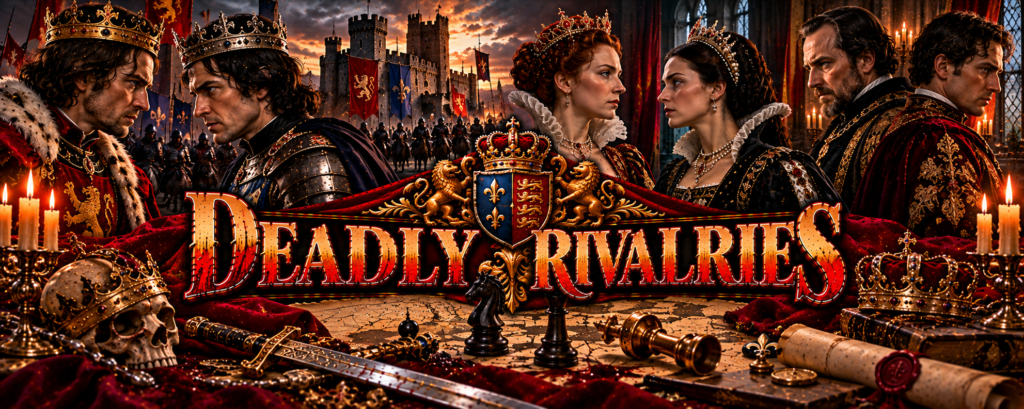
Royal courts were built on competition. Kings fought brothers for crowns, queens battled favorites for influence, nobles destroyed rival families, and ambitious relatives turned inheritance disputes into conspiracies, rebellions, imprisonment, and murder. Some rivalries lasted decades; others consumed generations, dragging entire kingdoms into wars that began as disputes between a handful of powerful people.
Deadly Rivalries explores the bitter feuds between monarchs, heirs, siblings, cousins, nobles, royal favorites, and competing dynasties whose struggles for power became personal. These were conflicts fueled by jealousy, ambition, disputed inheritances, romantic entanglements, religious divisions, old grievances, and the simple reality that medieval and early modern politics often offered very little room for defeated rivals.
Few rivalries became more destructive than the struggle between Henry VI and Edward IV, whose competing claims helped drive the Wars of the Roses. What began as a dynastic contest developed into repeated battles, depositions, restorations, betrayals, and executions as Lancaster and York fought for control of the English crown. Powerful nobles changed sides when circumstances demanded it, and families discovered that supporting the losing claimant could cost them their lands, titles, or lives.
Even allies could become enemies. Edward IV and Richard Neville, Earl of Warwick, had once been essential partners in the Yorkist victory, with Warwick’s political and military influence helping Edward secure his throne. Their relationship eventually collapsed as disagreements over marriage, foreign policy, patronage, and power drove the “Kingmaker” into rebellion. Warwick ultimately helped restore the Lancastrian Henry VI before being killed fighting Edward’s forces at Barnet in 1471.
Royal women could become equally formidable rivals. The relationship between Elizabeth I and Mary, Queen of Scots combined dynastic competition, religion, international politics, rebellion, and the dangerous question of succession. Mary possessed a significant claim to the English throne and became the focus of plots against Elizabeth after fleeing to England. Nearly two decades of captivity ended with Mary’s execution in 1587, making their intertwined histories one of Europe’s most famous royal rivalries—even though the two queens never actually met.
The conflict between Catherine de’ Medici and the powerful Guise family unfolded against the violence of the French Wars of Religion. Royal authority, aristocratic ambition, Catholic militancy, Protestant resistance, and competing noble factions created a political world in which alliances shifted rapidly and assassination became a recurring possibility. The rivalry between France’s great families demonstrates how powerful nobles could sometimes become nearly as dangerous to one another as they were to the monarchy itself.
Other rivalries began within families. Brothers competed over inheritance, uncles challenged nephews, mothers fought to protect their children’s claims, and cousins discovered that sharing royal blood made them potential enemies. The closer someone stood to the throne, the more dangerous that relationship could become. A beloved brother could become a rival claimant, while an ambitious uncle might suddenly find that a young nephew was the only person standing between him and a crown.
Beyond royal families, aristocratic feuds could destabilize entire regions. Noble houses maintained armed retainers, controlled strategic castles, dominated local governments, and pursued vendettas across generations. An insult, disputed inheritance, broken marriage agreement, or murder could create cycles of retaliation in which descendants inherited enemies alongside estates and titles.
Some rivalries became famous precisely because the historical reality is difficult to separate from later storytelling. Richard III and Henry Tudor, Thomas Becket and Henry II, Thomas Cromwell and Thomas Howard, Duke of Norfolk, and countless other political opponents acquired reputations shaped by chronicles, propaganda, plays, novels, and later historical interpretation. The person remembered as a scheming villain by one generation might appear to another as the victim of hostile sources.
Deadly rivalry was not confined to Europe. Imperial courts throughout history produced struggles between princes, ministers, generals, royal mothers, consorts, siblings, and competing political factions. Ottoman succession struggles could become lethal contests between brothers, while Byzantine emperors faced ambitious relatives and military commanders capable of transforming court rivalries into coups. Wherever enormous power depended upon proximity to a ruler, rivalry followed.
The stakes made reconciliation difficult. Losing an ordinary political argument might mean embarrassment; losing a struggle at a royal court could mean exile, confiscation, imprisonment, mutilation, or execution. Rivals therefore had powerful incentives to destroy one another completely before they themselves could be destroyed. Yesterday’s defeated enemy could become tomorrow’s rebel.
Yet accusations surrounding famous rivalries require careful examination. Chroniclers often favored one faction, monarchs justified executions by portraying opponents as traitors, and victorious dynasties had every reason to blacken the reputations of those they defeated. Personal hatred undoubtedly existed, but conflicts later remembered as bitter vendettas could also involve complicated disagreements over government, religion, inheritance, and political survival.
Explore history’s most dangerous royal and aristocratic rivalries, from feuding siblings and competing heirs to rebellious nobles, royal favorites, rival queens, ambitious ministers, and dynasties determined to destroy one another. Follow the insults, betrayals, secret alliances, broken friendships, arranged marriages, conspiracies, rebellions, battles, assassinations, imprisonments, and executions that transformed political competition into something far more personal.
Separate genuine hatred from political necessity, contemporary evidence from later propaganda, and documented conspiracies from accusations invented by victorious enemies as we uncover why these relationships became so destructive. These are history’s deadly rivalries—where blood made people family, ambition made them enemies, and sometimes there simply wasn’t room for both sides to survive.